Digging Potatoes

We planted potatoes a long time ago.  Well, it seems like a long time ago.

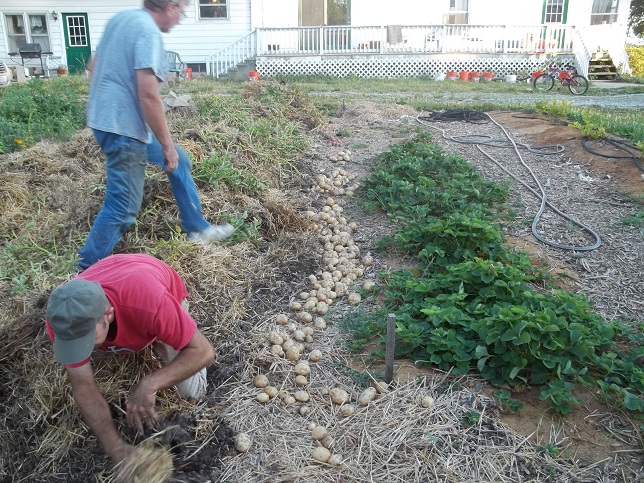
It’s time to dig them out.  I dug potatoes in the morning before work.

Then dad and I dug potatoes in the evening after it cooled off a bit.

These were the short rows of potatoes.  I would estimate I planted 25-30 pounds of seed potatoes in this garden and harvested 200 pounds.  Many of the potatoes came up when we pulled the plant out.  Very few were down in the soil.  The majority of the potatoes were just laying in the hills and it was all hand digging.  Who knows how many I missed.

I let the potatoes dry off a bit before bagging them up in burlap sacks my sister brought by.

We found a tomato hornworm grub and a garter snake as we worked down the evening row.  I have an awful lot of organic material on the rows I’ll need to find a home for.  Not sure what to plant in these beds for the fall garden but we’ll figure it out.

Everything is dry, dry, dry.  Hopefully we’ll get some rain next weekend and I can plant again.  Let me know how your garden is doing.

No Doubt, it’s a Drought

Farmers are never satisfied with the weather.  Environmentalists are never satisfied with the weather.  In both cases, it seems it’s the worst it has ever been and there is no hope of recovery.  I’m an alternative environmentalist and an alternative farmer.  I need medication.  Global climate change advocates tell me it’s too hot/cold/wet/dry because of decades of human activity.  Astrophysicists present that temperatures follow solar flare cycles (and that a huge solar flare could wipe out the power grid).  The alternative farmer in me knows I can do little to affect the sun but I can take action to positively (or negatively) impact the hydrological cycle.  I can sequester more carbon.  I can cycle nutrients more quickly.  I can grow more food with less irrigation.  I can landscape in such a way to not only hold more of the rain that falls on my farm but to encourage more rain in my region.  “If everyone of us would sweep their own doorstep, the whole world would be clean.”  These notions appeal to my inner alternative environmentalist but where the rubber hits the road, I need rain now.  Now.

Today we’re in a drought and it’s getting pretty gritty.

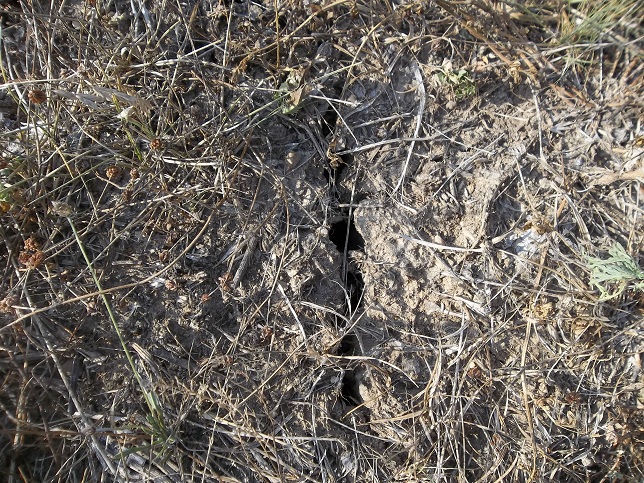
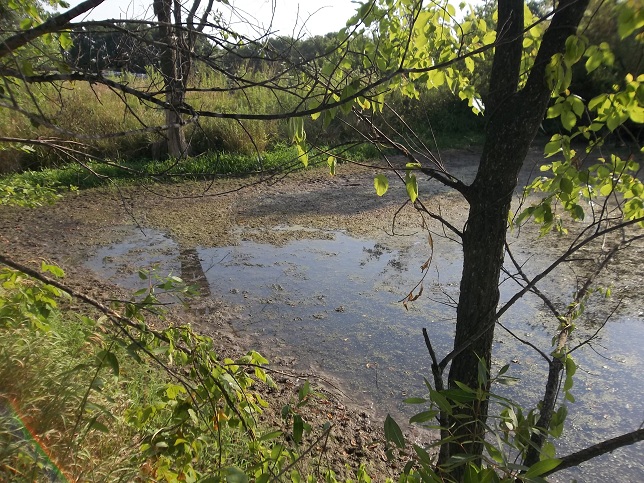
I helplessly watch the rainclouds float on past to the North and South.  They kind of spit at me for a few minutes here and there but no rain.  No real rain for weeks.  We’re short by 18 inches this year…a big deal to a midwesterner.  We had solid rain at the beginning of May, an hour of hail mid-May and a half-inch of rain a few weeks ago.  The pond is down a foot already.

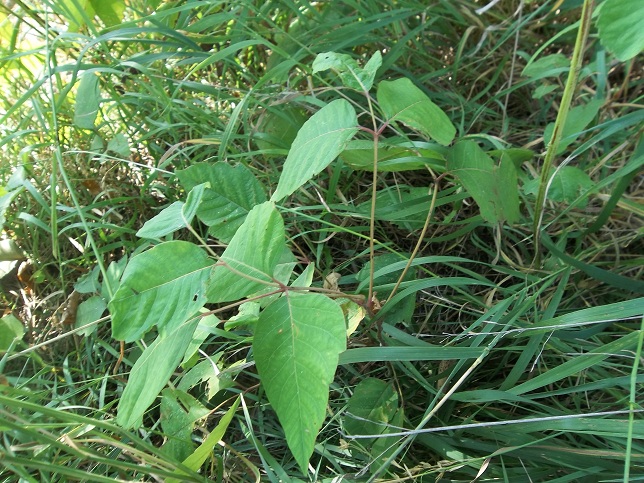
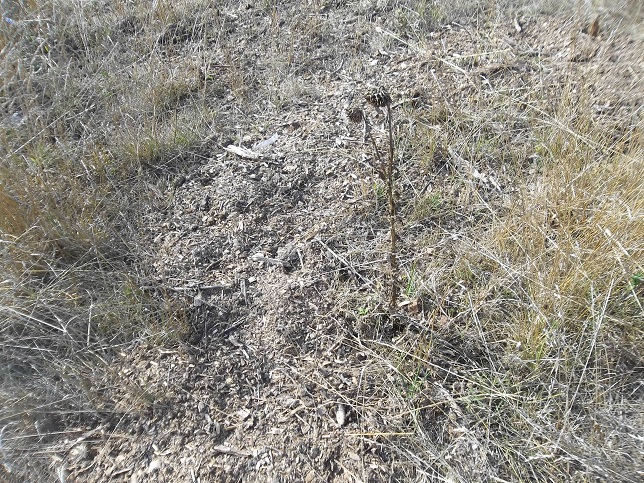
The grass under the maple trees has given up…the maples have sucked the ground dry.  It seems that nothing can stop the poison ivy though.

What can I do about it now?  Not much.  Drought is a fact of life.  It happens.  It always happens.  As I read Walt Davis he jokes that the Texas rainfall average may be 20″ but that’s because they get 60″ one year and none for the next two years.  I have to learn to manage for drought.

I have grass.  It’s not pretty, it’s not a lot but it’s there.  Where the goats, chickens and pigs have been there’s a tall, diverse stand of grass…even if dry.  I’m surprised how little moisture there is under the tall grass but at least there’s something standing to catch the dew…when there is dew.  I need to fence out the neighbor’s cows so I can monopolize the growth.  I need to maintain and encourage that stand.  Where the grass is short I need to allow rest.  Where there is bare dirt I could put down any number of things but I have been leaning toward using litter out of the layer house or sawdust as a mulch.

Going forward I need to catch my greywater (not to mention the infrequent rain) in a series of swales down the hill from my house.  I don’t really know how to establish the swales at a minimum of expense but I’m considering using a 2-bottom plow just to get something out there.  I need to grow more trees.  The lack of shade out there is a killer.  Beyond shade, I need protection from wind to help limit evaporation.  Also, I need more things for my goats to eat.  I may buy a box of hybrid poplars and interplant with fruit and nut trees on the swales.  But the real focus needs to be on building additional ponds.  I don’t even know how to estimate what a pond will cost but I know what it’s worth to the land.  That’s going to have to become a large part of our future farm budgeting.  We need to catch and hold the water as high as possible and work to slow it down as it runs downhill.

Each of these things will work to dampen (lol) the effects of drought in the future.  What can I do now?  Right now!

There are good chances for rain this weekend.  All I can do today is pray.  Just pray.  Rain breeds rain.  If we get a little moisture this weekend, maybe we’ll get more next weekend.  Maybe, by the time hurricane season gets started in the gulf, we’ll have so much rain I’ll write a blog post complaining about being waterlogged.  Oh, to dream!  In the meantime I’ll keep my animals watered and shaded and my kids cool inside.  I’m afraid there’s nothing I can do about the solar flares.

15 Years Ago Today

15 years ago today it was wet.  Warm but also wet.  Today we are something like 12-18″ behind on rainfall.  Isn’t it interesting the cycles nature goes through?  Averages average out.

Like the rainfall, our marriage has seen various patterns.  There are times when it’s easy to be in love with her.  There are times when it’s work for both of us.  We have been through the worse of “better or worse” but the average is pretty high.

I’m very thankful that she married me 15 years ago today.  My, how things have changed.

Chicken Processing Knives

I got an email from a reader who corresponds with me fairly regularly.  In the email he was sharing what is going on as he starts.  He has a 3 piglets in Premier fence and 101 chicks.  He asked a series of questions including this one:

What tools do you recommend for the dirty work, knives, shears, etc?

We use victorinox knives.  A boning knife for killing, evisceration and foot removal and a 6″ skinner for cut-ups.  As much as I like that victorinox skinner I have an old Dexter knife that is better.  I think Salatin uses a smaller poultry knife for evisceration but we just use the boning knife throughout.  We originally got this from Grady’s post on knives.

You also need a good cleaver.  I said a good cleaver, not a cheap cleaver.  I had a neighbor who gave me a collection of knives and saws.  He was in his ’80’s and his parents had been butchers.  I’ve got some pretty neat stuff.  My cleaver is an antique…and it’s awesome.  If you can’t find an old one, buy a high-carbon steel one.  Don’t skimp here.  You’ll need this when you butcher your pig and quality matters when you’re splitting your hog.

I’m still looking for a good set of game shears.  A friend suggested Cutco but I haven’t really looked yet.  I just use my cleaver.  The friend was helping me clean a rabbit at the time and swears by game shears.

School’s Out For Summer

It’s time for our planned summer break.  The broilers are all in freezers or customer bellies.  Just pullets and a few turkeys on pasture.  Our daily workload has dropped significantly.  Now all we have to do is feed and water in the morning, milk the goats and just check everybody a couple of times and we’re set.  Well, we have to soak the hog wallow a couple of times too.  This accomplishes two things; drains the hot water out of the 100 yard long hose so they will have cool water to drink again and gives them a cool place to pig it up.

Now, when I get up before the sun I don’t have to spend 15-20 minutes moving chicken tractors, feeding and watering.  I just open the chicken house door, feed there, water the rabbits, shower and head to the office.

We have waited all spring for this day.  We partied like it was 1999…well we watched the new True Grit and ate pizza after the kids went to bed.  Now we’ll tick off the days till we get our last batch of broilers mid-August.  We’re thinking about scrapping our big order for fall Cornish Cross chicks and ordering a variety of alternative broilers just to try them side by side.  We thought Kosher King, S&G Heritage White, Freedom Rangers and Moyer’s K-22.  Let me know what you think in the comments section.  Also, give me suggestions for alt. broilers just in case I am missing a good option.

Just a side note, I took a hog panel off of one of the hoop chicken tractors to give the pullets a bit of extra shade.  They seemed to appreciate the shade, I appreciate how many different ways I can use those chicken tractors.

Quarts of Berries, Gallons of Lotion

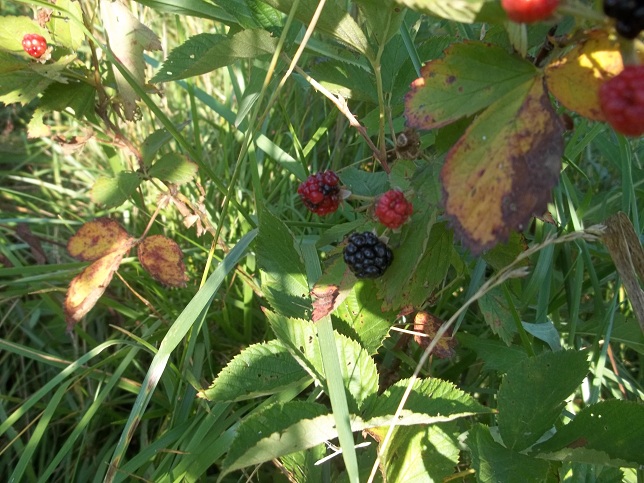
We have been picking dewberries for days now.  They are not quite the same as raspberries.  Aunt Marion set me straight on which berry is which.  I keep a volunteer patch near the beach at the pond.  Apparently I keep poison ivy there too.  We are beginning to cultivate this volunteer stand…meaning I mowed through the middle of them last fall separating the brambles so we could really get in there.  This year I’ll mulch them and yank the poison ivy.  Pretty good picking for so little rain.

You know the best part of picking berries?  Eating them.  Most of our berries go to the freezer for later though.  We get about a quart a day which we promptly wash, spread on a cookie sheet and freeze.  Then we use a spatula to pry them up and pop them into a freezer bag and use them later for smoothies or forget them till spring and mix them 50/50 with strawberries in jam.  Maybe toss in a couple of mulberries too.  Mmmmm.

So, trying to put a positive spin on everything, you know the best part of poison ivy?  Hot water.  It feels great.  Soon the poison ivy will clear up and we’ll be left to enjoy the fruits of our labor.

Not-So-Awful Chicken Offal

In the last 4 days I have butchered near enough to 300 birds as makes no difference.  The last three days have all been above 100 degrees.  One might think there would be a smell.  Well, there is a slight odor when you’re next to the compost pile.  Otherwise, not so much.  Here’s how we build the compost pile.

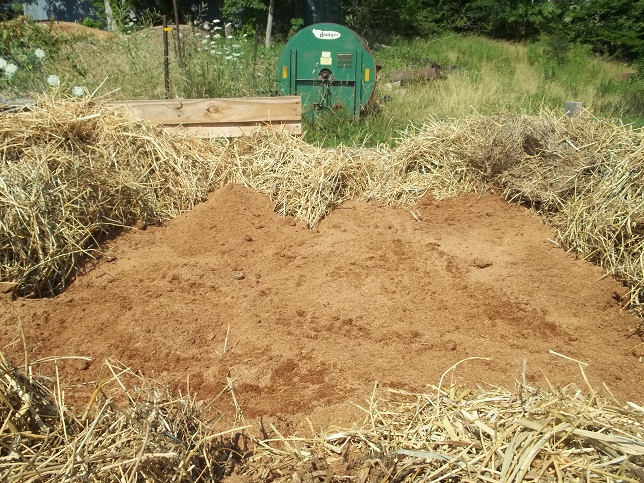
I build my piles with pallets since pallets are free.  The pile needs to be a minimum of 3’x3’x3′ so it has enough mass to heat up.  It is important that your compost pile “cook” itself when you’re adding in manures or animal wastes.  They will digest more quickly keeping the scavengers away.  Normally I use 8 pallets wired together with baling wire in a big 2 pallet by 2 pallet square.  We dig  a slight depression in the ground in the center of the pile.  Then we add a foot or so of straw, old hay or, better yet, bedding along with a shovel or two of finished compost.  From then on, we add layer after layer of compost and carbon.  These pictures reflect the maturity of the pile.  We’re nearing the top.  I should also point out that I don’t stir my compost.  That’s too much like work.  I just let it sit for 12-18 months and feed it keep it hot most of that time.  Biology does the rest.

First I scrape away the covering material from the top.  This is 6 or 8 inches of used bedding and hay the goats rejected.  I pull the material to the edges of the pile leaving about a foot-thick wall around the perimeter.

Then I dump the buckets and level them out across the pile.  Same goes if you’re composting humanure.  If there is any roadkill in the area I toss that in too.  When we have kitchen scraps we can’t feed to livestock we put them here.  We don’t feed pork to pigs or chicken to chickens so if she makes a potato soup with chicken broth and sausage…

Next I cover the offal with an equal volume of sawdust.  I’m shooting for 2-3″ of sawdust here.  The carbon absorbs the nutrients, sponges up moisture and keeps the smell down.

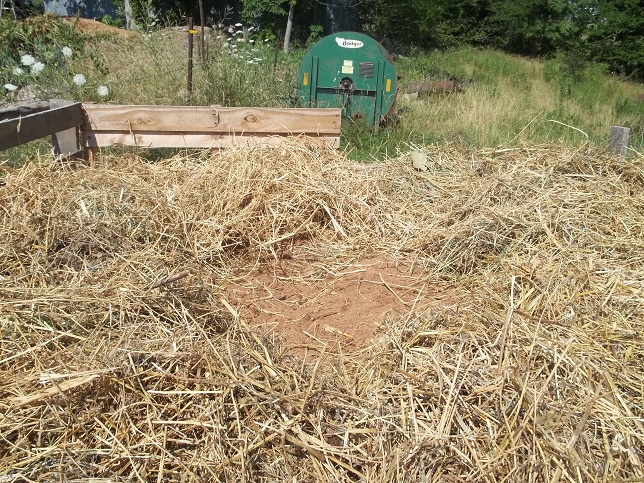
Then I pull the covering material in from the edges and cover as well as I can.  We’ll need more material but it’s a start.

The goal is at least 6 inches of covering material.  That allows moisture in if it will ever rain and filters odors.

So, there you go.  Our current pile is 6×6.  It should last us until we start a new pile on April 1st.  If not, I’ll get two more pallets and make it a bit longer.

Good luck with your composting.  Don’t overthink it.  If it stinks, add carbon.  If it’s not hot, add nitrogen.  Stacey has some good ideas on that topic.

Featherman Product Review Update

This post serves as an update to my original review in April 2012.  Though I think that post is still worth reviewing, the scalder and I have gotten to know each other better and I have more to say about it.

I’m nearly 900 birds into my new Featherman equipment.  Today we processed 75 birds in just under an hour working at an easy pace.  As usual, I was kill, head removal, scald, pluck, foot removal and tail gland removal.  I also plucked whatever the plucker missed.  Three of my children stood at the table to hang up to 8 birds for mommy and to help me pluck feathers.  The oldest daughter also cut feet and glands.  My wife eviscerates 4 birds at a time cutting all crops, setting down the knife, pulling the crop and trachea from each, picking up the knife, cutting all the vents, setting down the knife and gutting each bird.  Finally, the oldest son collects the finished birds from the shackles, removes the lungs, inspects and rinses the birds and places them in chill water.  We started at 8:45 and by 10:30 we were scrubbed, had the offal in the compost and relaxing for a few minutes to write a blog post (this one).  Again, 75 birds took an hour to dress out for 2 adults and 4 children (aged 11, 9, 7 and 6) working at an easy pace.  This was not possible before we had our Featherman setup.

Even with our Featherman setup, I have a few issues.  Every part of the process hinges on the scalder.  If the water is too cold you don’t get a good pluck.  That translates into extra time spent picking feathers out later.  If the water is too hot, the skin tears and you end up with a mess you have to salvage by cutting up the bird.  When we processed on Wednesday we spent 3 frustrating hours trying to keep the scalder lit and warm.  When we finally finished I was sufficiently frustrated that I emailed Featherman to ask what could be done.  Was I using it wrong?  Am I trying to force the equipment beyond its design?  Should I sacrifice a chicken before firing up the scalder each time to appease the scalder gods?

David replied just over 2 hours later.  I’ll say that differently.  The owner of the company replied to my email almost immediately.  That’s cool.  Anyway, here’s his full reply.

Hi Chris,

I very much appreciate the time you’ve taken to outline the problems. I regret you are having them, but this is how we learn, grow, and improve. I am confident we can rectify every problem area you have identified.

I’m just back from Falling Sky Farm In Arkansas and got a big education there. Cody does 8000-9000 birds per year. At this level they are more intimate with the equipment than I can ever be. Although he doesn’t use our scalder (but one with the same burner) he says he had to move indoors. The slightest bit of wind kept it from warming up.

If you are committed to an outdoor space-the way my wife and I always did it-do your best to shield the scalder from the wind while still giving it plenty of combust/exhaust air.

Steel baskets with sharp edges remaining are a huge mistake. I will let our machining and our shipping people know. A potential injury like that should never have gone out. I got cut at the beginning too. They were all supposed to be well sanded down. Due to the extra weight and chore of sanding, we have redesigned with a heavy wire mesh (1″ opening) rather than the flat and sharp expanded metal. We are adding fingers at the ends to help deter heads and feet from dragging on the outside. If you want to swap yours we will be accommodating. They are not out of production yet, however.

I have seen the Ashley and Poultryman scalders – with identical burners as ours – produce at 200 birds per hour. There is no reason ours cannot. You do have the new model scalder, correct? Our first scalder is limited by the burner to 70 bph. Either there is a perennial problem with wind or there is some obstruction in the gas or the air is choked. Look at the flame. It should be a bright blue with only a bit of yellow at the tip and about 1 1/2″ long. If not, check for dirt in the orifice (clean with air, not an object), adjust the air intake cover to see if that helps. If the flame looks good then it is environmental cooling.

Poor location of the scalder, too much or too little air flow, jostling causing movement of wires or thermocouples or pilot light or air intake cover, dirty burner orifices – all of this I have seen or personally experienced as I used the equipment. On one video shoot we waited four hours for water to heat outside, finally broke down and set up inside a green house and zipped along fine (rooster video with roto-dunker). Stainless takes up and gives off heat incredibly rapidly and I’m guessing and hoping that is the culprit here but it is always a challenge to sleuth from far away.

I’m very keen for your demo to go well and for the quirks to disappear. Please keep me informed and let us know what we can do.

One last suggestion. Get a digital thermometer and put the probe safely in the scald water so that you know immediately if the temperature is falling off.

Thanks again,

David Schafer
Featherman Equipment
www.featherman.net
660.684.6464 farm

I was and am pretty satisfied with his response.  The fire under my scalder looks good so I need to find a way to shield my scalder from wind if we continue to do my part of the job outside.  It was pretty breezy toward the end of our processing on Wednesday.  Also, primarily because of sharp edges, we’re working on replacing my roto-dunker with the one he mentioned above.  David writes later to say that, like the newly redesigned scalder, the roto dunker will evolve in time.

I’m watching the roto-dunker closely. I don’t think we are done with it yet. Nobody knows better than I the frustration of equipment mishaps at processing time. This business from Heaven was born of blood, sweat and tears. We are a long way from being finished with a line of equipment.

I am at the summer break in my schedule.  900 birds down, 300 to go in the fall.  Here are my thoughts regarding my Featherman purchase:
-The cones and stand are great.  If you want to process 200 BPH, you’re going to need more than 8 kill cones…lol.  Look for a post coming up on how we clean up the stand.
-The scalder heats up quickly and it does work well but wind and cold weather both tax its abilities.  In May I heated water three times from one 20# propane tank.  That shows it can be efficient at heating water when conditions are right.  Conditions were wrong, wrong, wrong Wednesday.
-The roto-dunker can be your friend.  If your birds dress out below 4 pounds it will turn two in each side.  If above 4 pounds, one in each side.  As I say above, using the roto-dunker under those parameters frees me to go do other things for a few minutes.  That time counts when I’m working to keep my cones full.
-The plucker is absolutely trouble-free.  I do wish I had gotten the turkey plucker though.  I had gotten the milage out of my poor Whizbang plucker.  I remember the frustration of using it on large batches of birds last year.  The Featherman plucker has asked nothing of me.  Not so much as a hiccup.
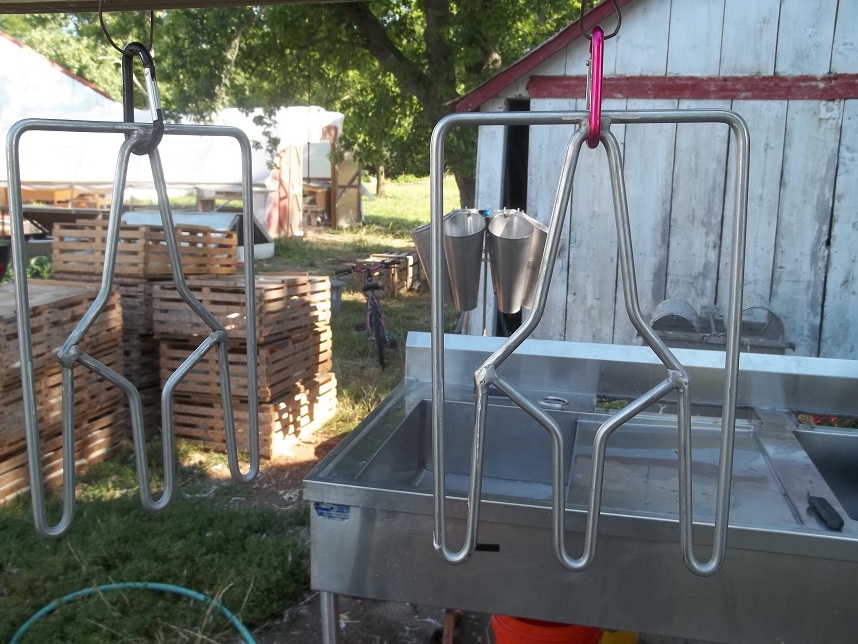
-Evisceration shackles of any make will speed up your process and help your back but the Featherman shackles are, not surprisingly, the best value we have found.  I hung ours with some inexpensive carabiner clips.
-The chill tank is durable, easy to clean and holds a lot of birds.

I wrote to David because I was frustrated with his scalder.  Looking back, I was really frustrated with the wind.  Any scalder would have given me the same trouble and any other scalder would have cost me more money.

Thanks David for all you do to help small farmers like me and for taking the time to respond to my questions.

Too Big to Succeed

This is in response to comments I got on my recent post titled “How Much Could you Make?”  Based on comments, my readers saw me as moping because my marketing skills aren’t where I would like them to be.  I suspect they are right, though I hope I wasn’t moping.  I was trying to say it’s tempting to expand and dive into any number of activities before I’m skillful at any of them.  Marketing is pretty far up on the list of things I need to improve but it’s more than just that.

My dad recently asked, “Why don’t you get some more layers?  That’s money you make every day.”  First, I appreciate my dad asking me questions. He’s not questioning my judgement, he sees an opportunity and wants to help me succeed.  He’s encouraging me to grow.

I think the layers are a good example of why I’m reluctant to grow.  A few layers are easy to keep.  A small home flock eats your kitchen scraps, weeds, bugs, etc. and gives you enough eggs to keep your kitchen hopping.  They are entertaining in the extreme.  Your only role is to ensure they have water, shelter and protection from everything that walks.  With a small flock the needs of the chickens are few.  Now.  Let’s shift gears.  Let’s go from three birds up to 300 birds.   Now you need in the neighborhood of 10 pounds of feed every day.  Now you need a much larger shelter.  Now you could lose a bird a night for a week and not notice it…that’s bad.

Each night we gather or 30 or so eggs in a basket.

We bring that basket in the house and set it on the buffet.  When two baskets are full we set out 5 or 6 egg cartons, sort and clean each egg by hand and label them for sale.  We get somewhere in the neighborhood of 14 dozen eggs each week in the summer, 8-10 in the winter.  We try to put an americauna egg in the front right of every box.  Blue eggs really freak people out sometimes.

While I agree we don’t get enough eggs, that’s where we are now.  My house holds 50 birds.  That’s it.  It’s a portable house.  I can’t build an addition onto it.  In the winter we house our flock in the greenhouse.  I can only fit so many birds in that greenhouse.  My infrastructure (or lack thereof) dictates my scale.

But my scale is also dictated by other factors.  There are only so many eggs I can lug up the hill in baskets.  Only so many eggs I can handle, clean and pack.  There are only so many hours in a day.  I’m nearing the ceiling for my skill level, my children’s ability to help at their age and my availability outside of employment.

It’s that last one that hurts the most.  I’m not even making enough money to pay the very modest farm payment, let alone live on.  I have to find a way to bridge the gap somehow.  At this time, we’re adding to our list of products using seasonality on our side.  But, as several commenters pointed out, I need to gain more exposure through everything from farmers markets to Facebook.  I just have to get out there.  But to get out there I have to have something to sell.  Now we’re back to the beginning.

It is a lot to think about.  It’s a lot of work.  It’s a lot of time invested in a helpless, tasty little bird with a narrow profit margin when my time is factored in (and I’d rather do nothing for nothing).  But it’s exposure.  Customers want eggs.

You see where I’m at here?  I need to grow knowing that not all growth is good.  I don’t want to overextend myself but have to do something to move forward.  I could quickly become too big to succeed complete with sick animals, neglected children and a failing marriage.  I’m using my time, putting my assets at risk and trying to anticipate customer needs.  I have to tread carefully.

Second Butchering Day Aftermath

We’re tired.  Like tired tired.  Wiped out.  Used.  Sapped.  Tapped out.  Done.  Spent.  200 birds.  2 days.  2 adults, 4 children and a little help from my mother-in-law.  The dog may have eaten a few livers too.  We also went swimming, watched a little Star Trek, read, played legos and took care of the rest of the farm but the poultry processing was the absolute focus.  It’s not like we’re new to this…it’s just hard work.

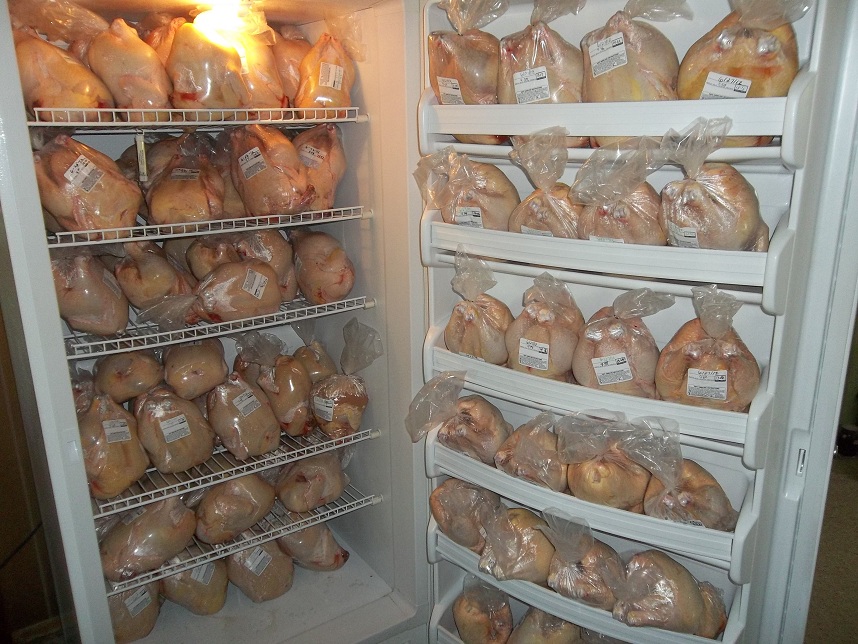
Here’s a shot of the new freezer:

Here’s a shot of the CL freezer we got from a nice couple in a beautiful home complete with chickens and kittens way, way out past the greater MO trailer park-o-rama off of 70 somewhere.  I mean way out there.  Well, not as far off the beaten path as we are…but still.  Way out there.

So.  That ought to keep ’em for a while cause that’s it.  Well, I have another hundred on pasture to butcher in the next three days or so but then I mean it.  That’s it.  Well, that’s kind of it.  That’s it till we butcher again in October.  Maybe.  Raymond Mears (ex-gf’s grandfather (I have some of his ties)) said, “Corn in the bin is money in the bank”.  I suppose I could look at this chicken that way.  As long as the power doesn’t go out, it’s money in the bank and it’s safe from the 4-legged masked bandits that have apparently taken over the farm.  I saw 3 in my yard early this morning!  Sheesh!

I read about guys who process 300-500 birds/day or process 10,000 birds/year.  Salatin says he processes 30,000.  I can’t imagine how they chill all those birds.  Those two freezers are putting out a lot of heat right now.  Maybe walk-in coolers can handle it better.

We work to be very efficient from kill to chill and from chill to freezer but I’m surprised to take note of how long we spend packing the birds into transport crates.  I don’t think there is much of a solution to that but I haven’t been estimating that time correctly.  Just an observation.

Well, chicken for dinner tonight.