Not a Domestic Engineer

There are no slippers on my feet.  I don’t eat bonbons.  I work.  I work a lot.
A friend was visiting and shared that she had recently stopped working, choosing to stay home instead.  She said people comment that if they stayed home they would be bored.  It’s as if people assume we wear pajamas all day, sitting around watching TV.  Nothing could be further from the truth.

This season of my life is about creating a home.  I know we house wives have fun with the term “Domestic Engineer”, but I personally don’t like the sound of it.  We use it in an attempt to sound professional but it sounds impersonal.  Creating a home isn’t like taking a blueprint of a house, building walls and putting in fixtures and ta-da you have a home.  Creating a home is more like creating a piece of art.   There is no formula for an inviting, warm, welcoming, secure home but I can tell you that it takes time purposefully spent.  Our home is not just a place we sleep and keep our stuff.  For many in my generation that is their idea of a home.  When we lived in the suburbs, our neighbors were never home.  Their homes were where they slept and watched TV.  Their lives happened other places.  So when people comment that staying at home would be boring they think that is what happens at home, we sleep and watch TV.  That sounds boring to me too.

I choose to stay home.  Our lives happen here and we love it.  I am not saying we never leave and never see other people.  But our lives are grounded here with our family.  I am not a “soccer mom”.  I am not my children’s chauffer.  I will not spend my parenthood on the sidelines as a cheerleader.   Parenting is not a spectator sport.  Is it wrong to put your kids in sports?  No.  But if running your kids around and watching them do stuff is the magority of the time you spend with your kids you may need to rethink your activities.  When we evaluate what our kids do with thier time, can we say that those activities meet our goals as a family?

Our family goals are to steward the resources God has given us with the gifts God has blessed us  with.  God put my kids with my husband and me on purpose.  Their gifts and personalities are a blessing and a help to our gifts and personalities.  It takes time and energy working together to learn and develop the children’s talents.  I would not have that time and strength to get to know my kids in such a way if I was working outside the home and if I was running our kids to 10 different extracurricular activities.

This is not an attack on working moms.  I know for some it is not a choice.  For us living on one income is a financial sacrifice .  We have one car, no cable TV, I do not have a cell phone, our kids are not in gymnastics, karate, or anything right now, we shop at thrift stores for clothes, I cook our food from scratch, our furniture is a little used, my house would never be seen in Better Homes and Gardens.  Those things don’t help our family meet our family’s purpose.  Are you filling your life with purpose or business and stuff?  What are you willing to give up to gain a home?
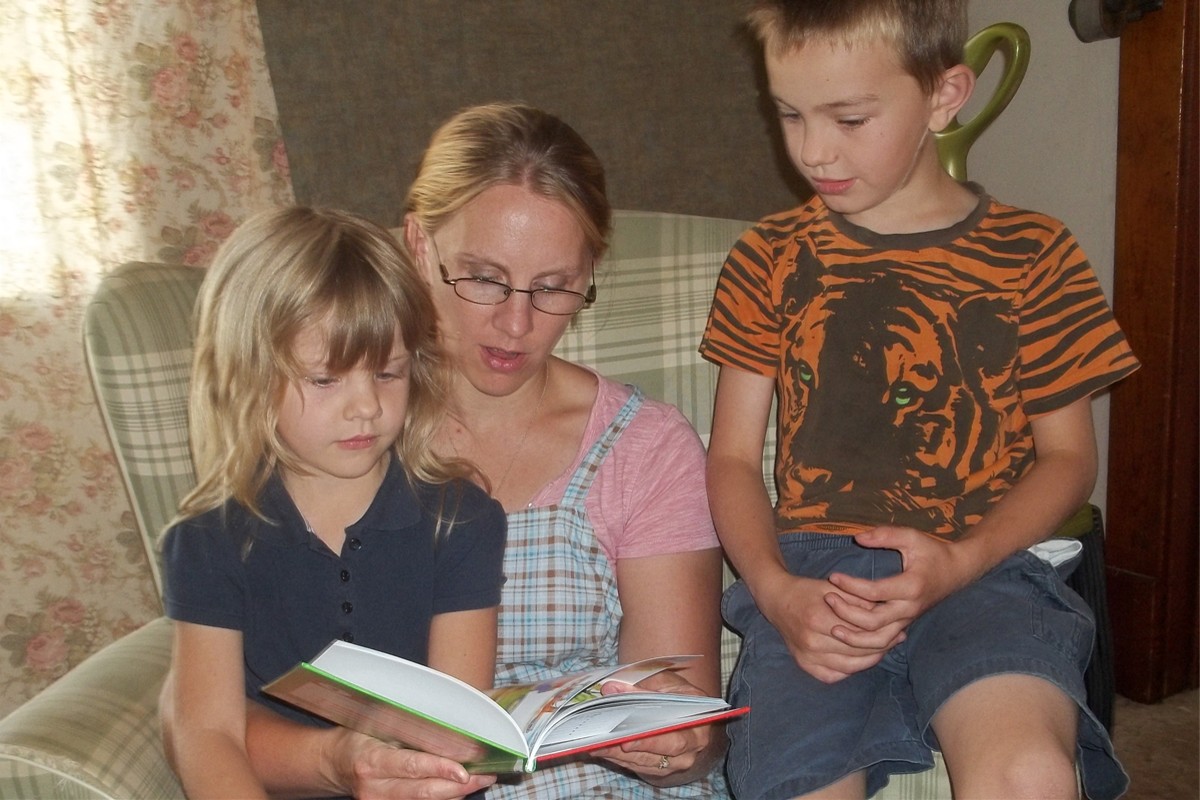
Creating a home isn’t about a physical place.  For example, I follow Discover. Share. Inspire.  This family has no house in the normal sense.  But as I read their blog and read their interactions with their kids I can see a home there.  God has given them a different canvas to create their family’s purpose on.  Our family’s canvas for right now is our 20 acres.  Our work and interactions on this farm are creating a beautiful home.  At the end of my day I am exhausted but I can look back on it with a sense of accomplishment and fulfillment.

What are some of your family goals?  What is your canvas?  I know as my kids get older and my life’s seasons change my idea of what makes a home will change too.  I am curious what you as an empty nester or single feel makes a home.  How do you create your home?

This was a guest post from my lovely bride.  If you like this sort of thing, check our her blog, The 20 Acre Academy.  She promises to update it as soon as she gets the time….lol.
Putting up Peaches

Peach preserves, peach pie filling, peach halves, sliced peaches…

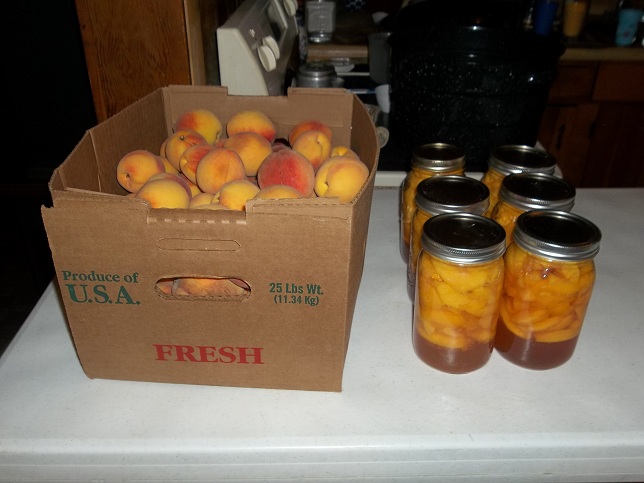
I made arrangements to buy 3 bushels of peaches from Calhoun county.  That’s a lot of peaches.  We’ll be busy for a couple of days so please forgive me if I don’t keep things updated here.  This is me practicing what I preach.  I’m stocking up.  I’m buying locally.  I’m buying in bulk from a small farmer (my co-worker’s father-in-law).  They are not organic.  I’m sure they have been sprayed but this will do until we get our own orchard planted.

Each box (pictured below) is half a bushel.  Half a bushel makes about 9 quarts of canned peaches.  Sterilize and fill each jar, pour in hot syrup and place in a hot water bath for 30 minutes.  Not much to it, just a lot of work.

It’s scald, peel, slice and pit over and over and over.  But, boy! they taste good.

Mom says when she was a girl my grandpa would drive to Calhoun to load up the back of the truck with peaches.  Then extended family would be in the kitchen (my kitchen) working together to put them up.  It’s hot, sticky work.  Here’s to hoping help is willing…and we don’t run out of jars…

Blue Eggs

Two of our pullets have started to lay but not the two I would have expected.

We keep blue egg layers for a number of reasons.  First, customers appreciate the novelty.  Well, most of them do.  Second, it is an easy way to keep two flocks in the same place and still know whose eggs are whose.  In the past, the blue eggs have been from my daughter’s flock so she earns a little money each day.  I have never purchased Ameraucana chicks, always started pullets.  Though they are pretty, I have never really been impressed with the birds as layers.  Without exception they have been late to lay and inconsistent layers in winter.  This isn’t just an impression I carry, the birds are a difficult sell to local egg producers as started pullets.

This year I ordered 50 Ameraucana pullets from Cackle hatchery.  Not only are they nice, colorful birds, they are the first in the flock to begin laying eggs.

Where are the brown eggs?  We also keep hybrid layers and RIR pullets from Central hatchery out there.  I would have expected to see something out of the hybrid layers by now.  All pullets are the same age…hatched on the same day (Feb 28), even though they came from two different hatcheries.

I suppose it is possible that I did something other raisers don’t do…or many things other raisers don’t do.  I guess so but I don’t know exactly what.  The birds were brooded in a greenhouse and fed Fertrell broiler mash for the first few months then placed on alfalfa to finish out.  I wasn’t expecting to get blue eggs for at least another month.  Maybe these two are just freaks.  We’ll see what they do going forward.  Surely there will be a brown egg out there today…

Strolling Through the Pasture July 2012

Chicory, dickory dock.

We’re covered in chicory.

Overall the pasture is a dry, weedy mess.  It hasn’t rained for weeks.  Nothing is growing.  The corn isn’t filling out on the ears, the beans aren’t making.  It’s not a good year to rowcrop.  I haven’t fenced my cousin’s cows out so it’s still open grazing.  I need to get them fenced out soon so I can begin rotational grazing (even if that’s rotational hay feeding) my own cows and letting the pasture rest to build up something of a stockpile.  There is some pretty good pasture still available North of the cemetery in the bottom but for some reason the cows don’t head that way.  Maybe the grass is sweeter where the chickens have manured.

The raccoons have been eating wild cherries by the pond.  You can see where the whole raccoon platoon troops by every night.  There’s a group of four.  They march past the pond, down the hill by the road, scoot by at the end of my driveway, then needle their way through the logs and brambles to an old collapsed culvert where they sleep all day.  Yeah, I have scouted them out a little bit.  Yes, I missed.

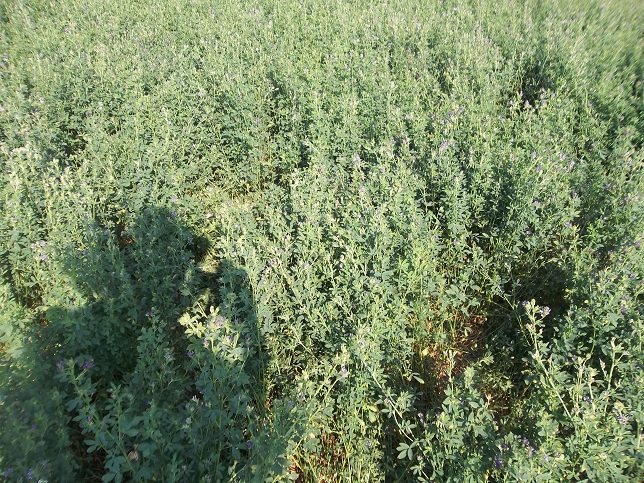
The alfalfa blooms were really pretty.  I took these pictures several days before we mowed hay.  I didn’t see any sign of my bees working the alfalfa but the bumblebees and japanese beetles were out in force.

Then there’s the thistle.  Always the thistle.  We cut and salted thistle until it got so hot we couldn’t stand to do it anymore.  The seed dispersal will overtake our efforts.  I’m counting on high-density planned grazing to win this battle for me in the long term.

Ah, poison ivy.  If only you were a cash crop.  I’m getting itchy just looking at it.

Next month we should see the goldenrod come in bloom.  Goldenrod honey tastes terrible but it does feed the bees.  Here’s to hoping for another hay crop.  Rain would sure help.  How is your pasture doing this month?

Lazarus Blueberries

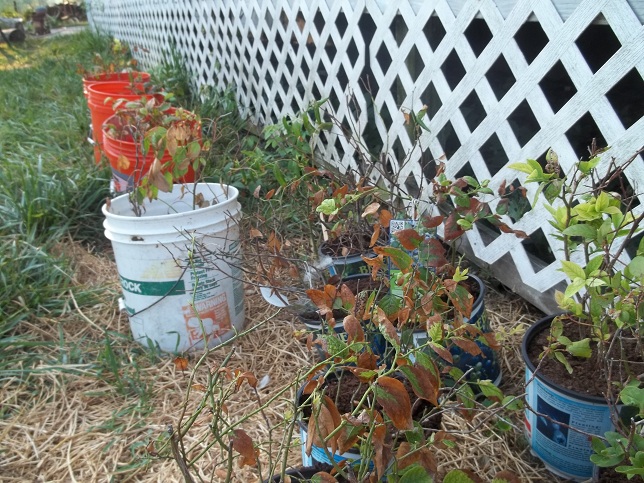
I found these poor little things on sale for $2.50.  Normally I’m not one to bring home sick, helpless little things but I like blueberries, have a pallet of peat and am willing to try.

The retailer had just about given up on them.  I found 9 that still had green leaves.  I brought them home, filled the pots to the top with peat and gave them a good soaking in a bucket.  Each day since then I have soaked them in about 2″ of water in a bucket until the peat is saturated.  Then they sit in partial sun all day.  We’ll see what happens.  I may have wasted $20.  I don’t really think so though.

I planted two over by the pond about a month ago.  Every day they get a bucket of water and they are doing as well as they are doing.  I dug a big hole for each, mixed in a bag of peat in each hole and carried wheelbarrow after wheelbarrow of sawdust.  I should put an odometer on my wheelbarrow…

What about you?  Is there something you just can’t pass up when you see it on sale?  Do you believe you have the touch to bring things back to life or are you at least willing to try?  Have any tips that would help me out?

Make Hay While the Sun Shines

Boy is the sun shining.  Every day.  Sun, sun, sun.  Nothing but sun.  All the sun the grass can eat.  It’s time to put that grass away for later.

Let’s focus on the alfalfa field for now.  The alfalfa field looked like this (well, not as many blooms).  You want to allow the plants to get to about 10% bloom before you cut.

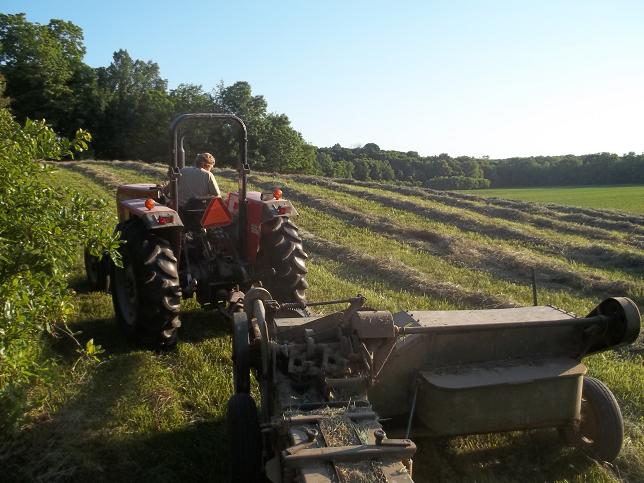
So we cut it three days ago with dad’s hay conditioner.  It gobbles up the hay, crimps the stems and lays it gently in a windrow out back.

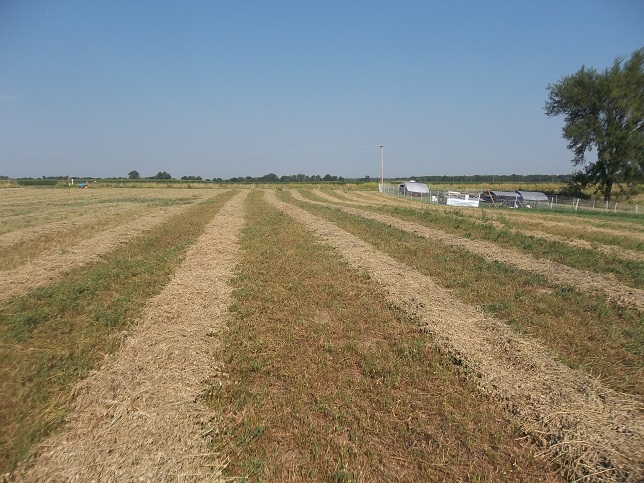
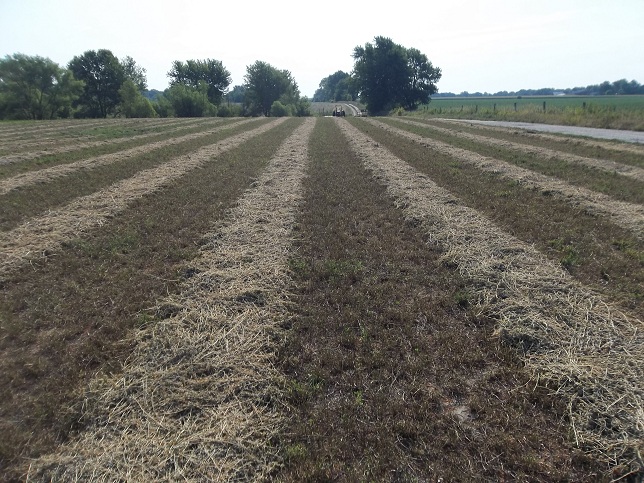
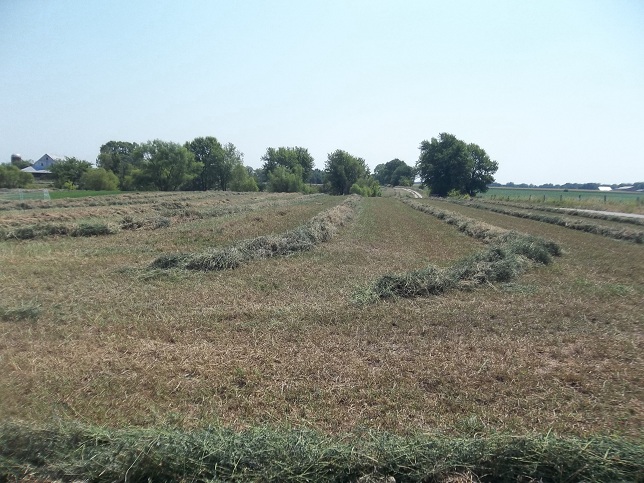
When you’re finished and it has cured for a couple of days you get a field like this:

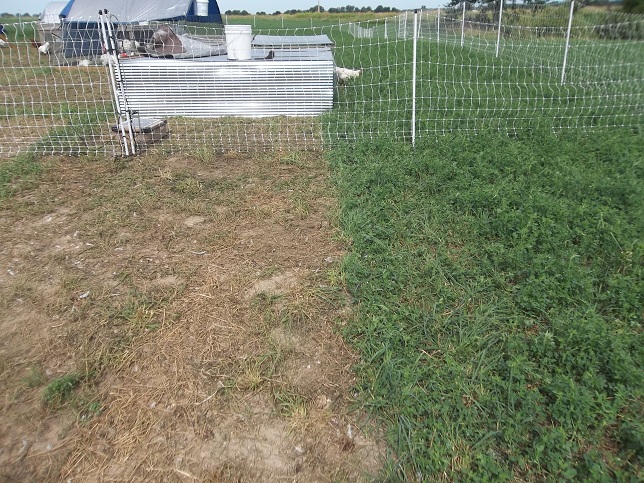
If you look closely there’s a spot on the left where the alfalfa was killed.  Our chicken tractors were on that spot when we got about 3″ of rain across a week but the bulk of the rain came toward the end.  The chickens turned that spot into mush.  The alfalfa gave up the fight.  Otherwise, the chickens don’t seem to have hurt the stand and remember, they do this when they go past:

So, I have long windrows of alfalfa.  It looks dry

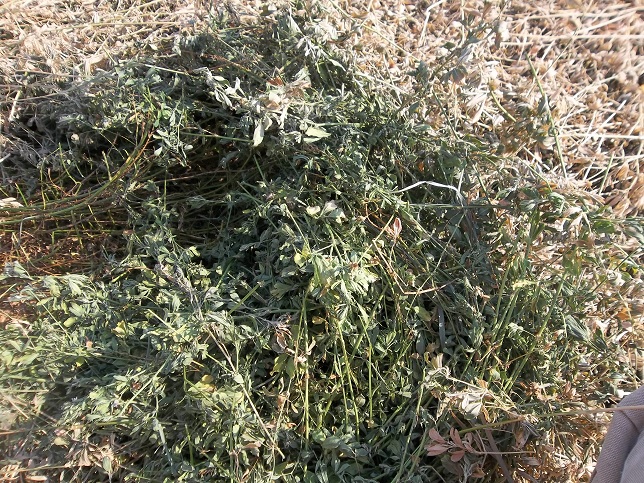
but if we look closer we see it needs to be raked before we bale.  The stuff underneath isn’t quite ready yet.

Grab a handful of stems and give them a twist.  If they don’t break, they’re not ready.  If they’re not ready you’ll end up with moldy hay at best, a barn fire at worst.  But then, if it’s too dry all of the leaves will fall off and the hay will be all stems.  Quality hay is a skill.  It’s a skill I continue to work on and probably will for the rest of my life.  Sigh…

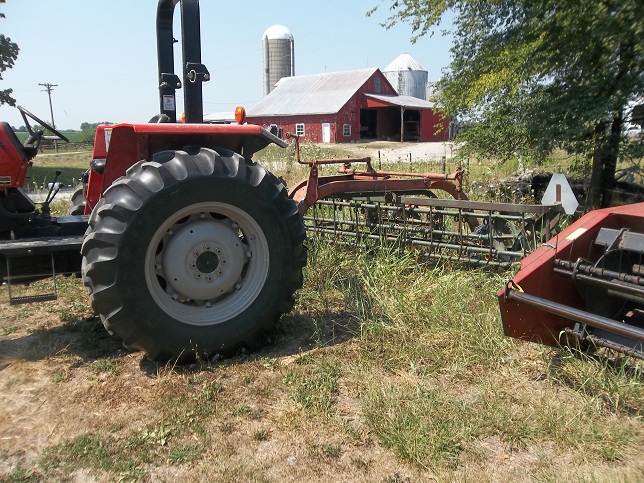
Next I rake the windrows together, turning the hay so it will dry better, combining rows so we make fewer passes up and down the field baling.  What’s a rake?  This is a rake.

So this….

becomes this…

A few hours later and we’re ready to bale.

We baled and baled and baled.  The bales may get moldy from all the sweat I soaked them with.  No pictures of the baling process this time but you can look at the blog post from an earlier hay cutting.

The fields are bare now.  Ready to grow back again, hopefully encouraged by a coming rain.  Before the rain gets here I need to clean up the small piles of hay we missed with the baler.  It’s not hard work, just one wheelbarrow at a time.  Sometimes I carry an armload of hay as I ride my bicycle.  That makes my wife laugh.  Why is she always laughing at me?  (lol)

Now it can rain.  Please, Lord, let it rain.  I’ll take a light rain that lasts 3 weeks.  I’ll take a series of downpours over the next three days.  Last night it sprinkled just enough that you could smell the rain on the hot tar of the road.  That’s a summer-only smell…and I would like to smell more of it.  Just let it happen, Lord.  I’m ready.

Can I get an Amen?

Whoops! What is THAT?!?!?

Have you ever seen a pullet laying her first egg?  I would swear to you she’s embarrassed.  First she’s uncomfortable then she feels like something happened…something she couldn’t control.  She whips around to take a look at what just happened and sees what looks like a rock.  “Did I do that?”  She takes a quick look around at the rest of the flock to see who saw what just happened then takes a quick peck at the thing just to make sure it’s real.  If she breaks the shell she’ll probably just eat the egg.  If not, she’ll just run away hoping to avoid future social stigma.

Maybe it’s not that dramatic but I’ve seen it happen a few times.  Pullets are always surprised when they lay an egg.  It’s pretty funny.

These pullets arrived on Mar. 1st.  Today (July 14th) I found my first pullet egg from the new flock.

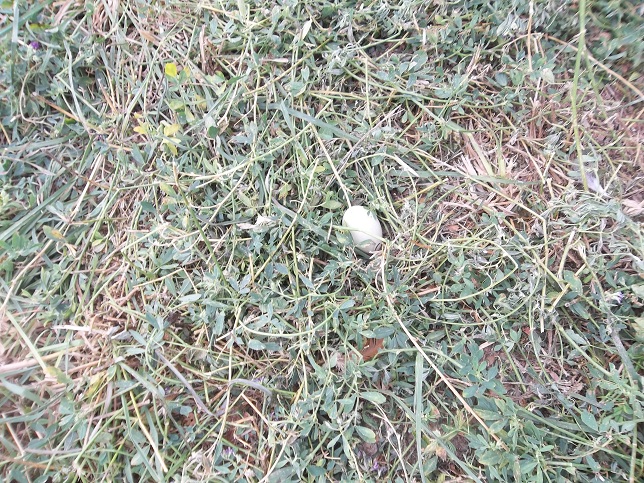
It was laying in an opened chicken tractor in the alfalfa.  Well, if there’s one there’s probably two.  Sure enough.

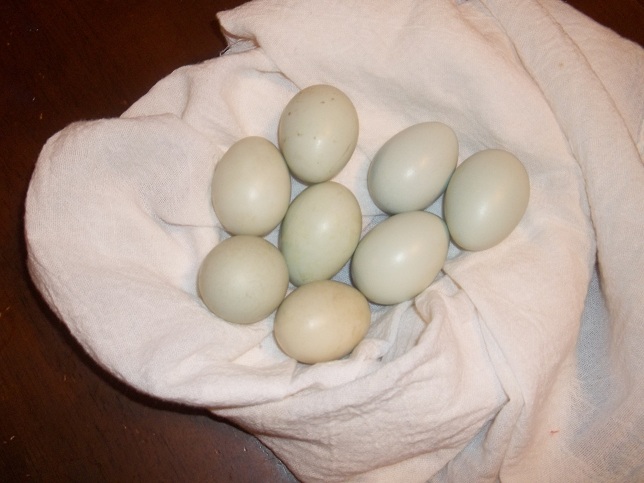
Two blue eggs.  I’ve never gotten blue eggs before brown.  I’m amazed.  In the past our Easter Eggers were always the last to lay.  Far out.  I need to get busy building nesting boxes…

Green Stuff?

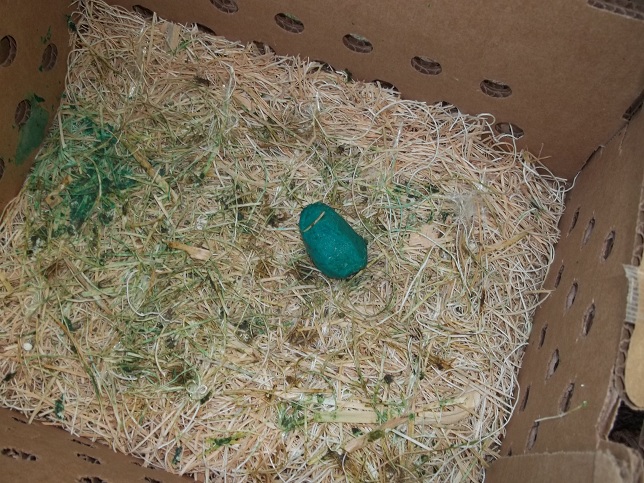
We ordered some pullets from Cackle Hatchery this week.  I’m always reluctant to order chicks mid-summer but I saw the forecast was for temps in the lower 90’s, called the hatchery and took a chance.  Because I was late ordering, my normal hatchery could only send 25 so I ordered another 40 from Cackle (all they had).  The Cackle chicks got here first.  The Cackle chicks came with a blob of green stuff.  I have seen the remains of the green blob before but I’ve never actually found a green blob.

It’s food, hydration and protiotic all in one.  I believe the commercial name is Grogel.

Online reviews of Grogel are strongly positive and the birds look great.  I’m afraid to look under the covers to see what it is and how it’s made.  The birds look great.

More Layer Pullets

Early in the Spring (or late in the Winter) I ordered 250 layer pullets.  Then I got cold feet and sold 175 of them at 8 weeks.  That worked out well in some ways.  It covered my expenses so the 75 or so I kept were basically free but in other ways it didn’t work out so well.  I still don’t have enough birds to meet the demand for my eggs.

So we ordered more pullets.  It took a couple of tries to find a break in the weather and a hatchery that could fill my order on short notice.  I was looking for 100 sex-link pullets, no Whammies.  At the last minute I called Cackle Hatchery to find out what they had left.  They could ship 35 Cinnamon Queen and 5 Red Sex-Link.  Sold.  Then I called Schlecht.  Schlecht closes at 4:30 on Friday.  Etta didn’t answer the phone.  I did get her by email.  She promised 25 Golden Comet pullets.  65 birds.  I can make do with 65 birds.

The Cackle order arrived Wednesday morning but was short by 10 birds.  We are expecting another shipment on Friday.  The Schlecht order arrived early Thursday morning.  They were a little sluggish but looked good and there were 5 extra birds!  A few minutes under the heat lamp and they were ready to go.

I have talked about this before but here’s the setup again.  They are in our 8×8 outdoor brooder.  It is easy to warm, easy to get into and comfortable for the birdies.  We use nipple waterers because they stay clean.  The chicks figure them out almost immediately.

We give them broiler mash in trays for the first few weeks.  I want to get them off to a good start.  After day two they get creek sand to get their gizzards off to a good start.  We try to give them constant access to fresh greens.  Today I dropped in two big handfuls of alfalfa chaff from the hay wagon.  Just like you, chicks need to eat their greens.

These birds will remain in the brooder for 2-3 weeks depending on the weather.  Then we’ll move them out to pasture where the older pullets are and pop them into chicken tractors.  That will give them a chance to grow out without being picked on by the bigger birds but will also give them a chance to socialize with the bigger birds a little bit.  By being on pasture they will get the best possible nutrition and will always leave their manure behind.  Raising them on pasture really makes a bird that can’t be beat in terms of health.  Our future flock, your future eggs.  Healthy birds.

How Do You Recycle….You Know…That Stuff?

I’m going to use a dirty word.  It’s a word that will stop all conversation in the room.  People find it shocking…appalling.  Use this word and others will question your sanity.  In short, hilarity ensues.

Ready?

Humanure.

You are, quite literally, full of crap.  It’s a fact.  You produce it at intervals throughout the day.  What do you do with it?  Do you pollute drinking water to make it magically go away?  Where does it go?  Do you have a septic tank?  How often do you have to get that pumped out?  Where does it go from there?  Do you live in town?  Where does that go?  Sewage treatment plant.

Sewage treatment, under ideal circumstances, separates liquids from solids in several stages after removing odd bits of trash.  The trash and a large portion of solids head to the landfill.  That’s nice but what happens when it rains?  From a Wisconsin newspaper from October of 2010:

In all, about 9.1 billion gallons of untreated sewage-contaminated water — enough to fill 457,000 backyard swimming pools — were released into the environment by 276 villages, cities, counties and sewage districts on 1,198 occurrences statewide since Jan. 1, 2006, according to data collected by the DNR and analyzed by The Post-Crescent. The wastewater overflows happened in 58 of the state’s 72 counties, including throughout the Fox Valley.

Rain was listed as the cause of nearly 80 percent of the overflows since 2006.

The article linked above lists some truly horrifying stats on sewage overflows.  Nearer to home, I remember an event causing the sewage treatment plant in Jacksonville, IL to overflow, putting the city on a boil water order.  Let me say that differently.  Because of rain, everybody’s doody mixed with the drinking water.  The solution was to boil the doody-water so it would be safe to drink.

Ew.

Tell you what.  You can boil your doody-water all you want.  I’ll make you a promise.  It won’t be my doody in the water.  OK?  I have a better solution all of us can embrace.  Ready?  Compost.

I found Joseph Jenkins’ Lovable Loo some time ago.  We needed a solution for the barn as we were potty-training our daughter.  Plus our septic tank had failed and we were pretty desperate for an inexpensive solution.  Enter the eco-potty.

Jenkins’ excellent book describes a method of collecting our various biological deposits (wastes is the wrong word) in a bucket.  Everything goes in the bucket.  Everything.  Each deposit is covered with sawdust.  There is no smell.  Let me repeat that.  There is no smell.  We go through a bucket for each person in the house each week and use nearly a bucket of sawdust for each bucket we fill.  This is not a composting toilet, just a receptacle.

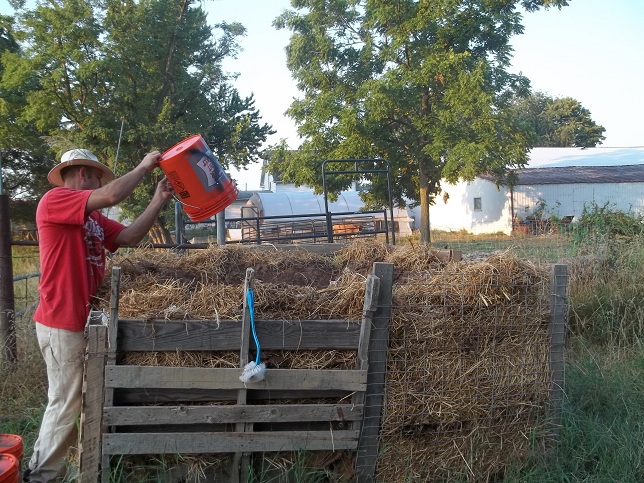
We compost our wastes on site.  Nobody hauls, pumps, aerates, filters or chops our waste.  It doesn’t have a chance to pollute fresh water.  More importantly, no Persians were shot to make the transportation of my doody cheaper.  We just carry the bucket to this year’s compost pile, open the pile and dump the bucket.  It really is just a bucket of wet sawdust when we dump it out.  Then we rinse (using rainwater when it rains (remember rain?)), wash with a biodegradable soap and rinse again.  The clean buckets sit in the full, sterilizing sun until we’re ready for them again.

We continue adding humanure to the compost pile for a full year.  At the end of the year we begin a new pile.  I don’t turn the compost because
A. that’s gross
B. that’s too much like work.

We just open the top, pour new stuff in and cover it all up again.  Then the pile sits unattended, unloved and untouched for another year.  By that time the material has cooked itself thoroughly, cooled and has been sifted, sorted and sterilized by earthworms.  Any bits of plastic or whatever are sterile and can be sifted out easily.  We also compost roadkill animals, chicken offal, pig heads and whatever else we can come up with but I’ll cover that in a separate blog post.

Jenkens uses his humanure compost on his garden after 2 years.  I have enough other sources for compost and enough need for compost other places that I choose not to.  It is uncomfortable enough asking guests to use a bucket.  It’s more uncomfortable to say, “Hey, remember when you were here 2 years ago and used the bucket?  I used that to grow tonight’s dinner!”  Nah.  Our pastures will benefit from the compost and we’ll use the composted winter animal manures on the garden…mostly chicken manure.  Somehow that’s less icky from a guest’s perspective.  Now, the EPA disagrees and says it’s no big deal.  It is unusual for me to quote a government alphabet soup agency in a positive way but let me state clearly that I am in favor of using biosolids in agriculture.  That’s kind of the point.  I think the municipal collection is wasteful, inefficient and unsustainable but since we have it let’s put it to good use.  But far better is to gather your own waste and deal with it yourself.  That may not be easy for appartment dwellers but I’m sure we can find a workable solution.  In a normal world, companies would pay you to collect and process your biological wastes…but we don’t live in a normal world (IMHO, largely due to alphabet soup agencies).  All that said, I promise you, when you’re at my house eating food from my garden you aren’t eating people doody.  Just composted chicken, cow, pig, goat, worm, duck, toad, snake, mouse doody mixed with a dead baby bird or two that fell out of a nest in a windstorm.

“OK.  Fine.” you say.  “I’m willing to try it if you can prove to me it really saves any water.  I mean, I have a low-flow eco toilet that I sometimes have to flush twice if I want to “deliver the mail”…but it says it’s eco!”  Did your water bill go down by 30% when you started using your double-flush low-flow toilet?  Our water bill went down by 30% immediately.

It deserves more excitement than that. We have saved at least $500 on water since we began using the toilet 14 months ago.  I think that’s pretty cool.  On top of that, I have an enormous pile of…compost I can spread on my fields.

This post is more “how-we” than “how-to”.  In fact, it really just introduces the concept.  For the real how-to I have to suggest Jenkins’ book and his series of Youtube videos.  Outside of those two resources, let me know if you need more detail or if you have any questions.  The best thing you can do is just get a couple of buckets and take it for a test drive.