Green Acres of My Life

My father has known me for 36 years and, next to Julie, qualifies for the title of “Best Friend.”  He’s pretty well in tune with my likes and dislikes.  Dad said, “You should watch the first episode of Green Acres and write a blog post about it.”  So, Dad.  Here it is.

Now, before we get too carried away I invite you to watch it for yourself.  Julie found herself crying in laughter and sympathy with Lisa (Oliver’s wife).  Oliver’s enthusiasm and naivety mirror my own.  In fact, though we lack a hole in the floor leading to the cellar, the show hits a little too close to home.

Oliver reads the blogs of his day, USDA bulletins, every spare moment of his life.  That sounds familiar.  He spends every moment growing anything he can including mushrooms in his office desk drawer.  His job is just something he does well though mechanically and without enthusiasm.  He lacks that feeling of accomplishment, purpose and fulfillment.  That good kind of tired you get after a day of physical labor.  He says:

“A farm would give me a feeling of accomplishing something.”

and later…

“This has been the dream of my life: to buy a farm!  Move away from the city.  Plow my own fields.  Plant my own soil.  To get my hands DIRTY!  Sweat and strain to make things grow!  To join hands with you, the farmers…the backbone of our economy.”

Like Oliver, I wanted a real farm like the one I was born on.  Unlike Oliver I actually bought the one I was born on (er…well, the one my parents lived on when I was born at the hospital).  Like Oliver I bought a run-down house with sheds that are falling in on themselves, failing fences and odd bits of junk everywhere.  Unlike Oliver I wasn’t suckered into it.  Like Oliver I have a beautiful, sophisticated, thin, blonde wife.  Unlike Oliver my wife came along willingly…and doesn’t have a Hungarian accent.  Like Oliver, I bought with big, unrealistic expectations, no experience and inhuman optimism.  That optimism has been just about beaten out of me.  Maybe this year we can limit our losses to just a couple thousand dollars then turn things around to positive numbers in our 5th year.  I don’t know.  The infrastructure needs are so great.  It looks to me like Oliver just pours money into the farm every episode.  My pockets aren’t deep enough for that.  Fortunately I don’t have a Mr. Haney in my life.

Look.  I don’t have any help for you if you have decided to get your hands dirty and join the backbone of the nation.  You’ve picked a tough row to hoe.  I think we can do it (or I wouldn’t be trying) but it’s not easy.  I have to suggest that Oliver’s adjustment would have been easier if there had been no house at all…if he had only had the sense to send Mr. Haney packing then take a match to the empty house at the beginning of episode 2 and build new.  My land itself is a fixer-upper.  I don’t have time to deal with the house issues.  Neither does Oliver.  I like to encourage my farmers that they can succeed.  You can.  But try not to put yourself behind the 8 ball from the beginning just because you were born somewhere.

Channeling Lisa, my wife, lovely as ever, upon viewing the farm as we return from a business trip to Florida, looks at me from the passenger seat and says, “Let’s go back.”

Green Acres offers a response, “Keep Smiling.”

If you’re going to do this, Keep Smiling.

Playing in the Rain

RainyDay

Sunday we had a strong wind out of the South, warm temperatures and an inch of rain.  The kind of rain that paints the ground green.  Mom was out of the house so I took the kids on an adventure.

I have to cut wood.  Have to.  I have a number of trees down and I’m running out of time.  But we don’t have to kill ourselves cutting wood.  I told the kids I would use one tank of gas in the chainsaw while they dragged limbs and stacked firewood and then we could have some fun.  Well, we had fun the whole time.  Dripping, soaking, pruny-fingered, wet sock fun.

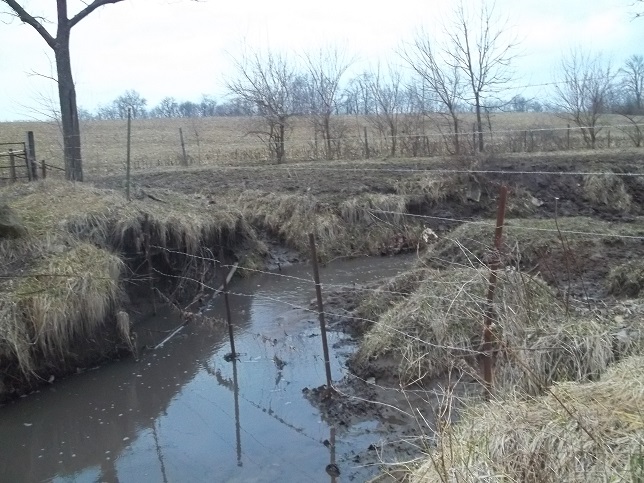
Our chores behind us, we tromped off through the pasture to the branch to see how deep the water was.  It was deep.  And swift.  Normally the branch is just a trickle.  It’s the weak point in the fence that the neighbor cows use to come steal food.

Branch

We threw sticks in the water and watched them float away.  We probed the water to see how deep it was.  I warned the kids of the danger.  The youngest fell in anyway.

I have a million things to do.  I don’t have time to splash through the puddles, exploring pastures I have played in my entire life but if I don’t do this now, when will I?  The farm is a family experience…I have to experience it with them.  That’s kind of the point.  I can sacrifice sleep to get the taxes finished.  The kids won’t wait.

Freezer LaBoeuf

Well, we had a calf.  This was not unexpected.  It was kind of a crossed finger thing.  A friend was getting some straws in, offered to pasture my cows and ended up turning our heifer out with his bull.  So…calf.

Cousins

He was born around sunset on a cold, snowy evening.  We were trying to keep the chicks in our brooder alive during a severe cold snap and, dang, if Flora didn’t go into labor.  That’s all we needed.  Obviously this has a happy ending but it gets worse before it gets better.

He didn’t get up.  He lay in the straw, wet and cold, while mamma licked him clean.  But he didn’t stand.  He slowly crawled out into the snow.  I grabbed him up and carried him back into the straw, covered him with my coat and hat and started rubbing his cold legs.  Not much happening.  Nothing else to do, we took him inside to the wood stove to try warming him up inside.  Then we grabbed a halter and rope, tied up Flora and milked about a gallon our of her.  Once he had something warm to drink he started looking better.  By the time we had 3/4 of a gallon in him he was up and around…a bit of a nuisance.  The kids named him “Freezer”, not because he got cold but because that’s where he’s headed.  Freezer LaBoeuf.

He was dry, the straw was deep and fresh so we took him back to Flora for the evening.  It got down to 12 degrees that night so we went to bed with fingers crossed.  I’ll be danged if I put a calf in a dog crate in the back room for the night.

Morning came and he was looking good…hungry, but good.  He couldn’t figure out what part of the mom was the tasty part and mom, being a heifer, wasn’t interested in being nursed, though she was spraying milk out of two teats.  So, we grabbed her halter and rope and got to filling a bucket.  Now, this isn’t the easiest thing in the world to do.  Flora’s teats are about as big as a thimble.  We milked about a half-gallon, filled a bottle to feed the calf then went back to milking.  Another half gallon, another half gallon.  We took turns milking with one finger and the thumb.  Ugh!  Lord!  Let it end!  She kicked, she walked around, she wapped us in the face with her tail.  Pretty awesome, eh?

We kept that up all day Saturday and Sunday morning.  Oh, you should have seen us out there Saturday night after church.  An hour of milking an engorged but reluctant cow.

Allow me to interrupt my narrative here to remind you we’re trying to keep chicks alive in the brooder, it’s 12 degrees outside and the world is covered in snow.  Great sledding, lousy for livestock husbandry.

Where was I?  Oh yeah.  Sunday, Julie was pooped.  We lost 40 chicks in 3 nights, the calf was proving to be a lazy mooch, and the kids all had minor sledding injuries and major tiredness issues.  It was time for that darned calf to help with the milking chores himself.  So, the wife set to work.  She milked a little.  He got curious.  She gave him a finger covered with milk.  He stuck around…betrayed by his stomach.  20 minutes of teasing the calf with the promise of a meal and he found a thimble teat he could hold on to.  You could see his whole world had changed.

Freezer

Later in the morning, we went to check our little bull calf to see if he had mastered his new discovery.  He was gone.  Mom had decided it was better out in the pasture with the other two than to be cooped up in a stall.  She pushed the gate open (it was just held with twisted baling wire, not exactly secure) and trotted off with her little man.

I was so proud.  So relieved.  So tired.

We’re done calving in winter.

Snow Day

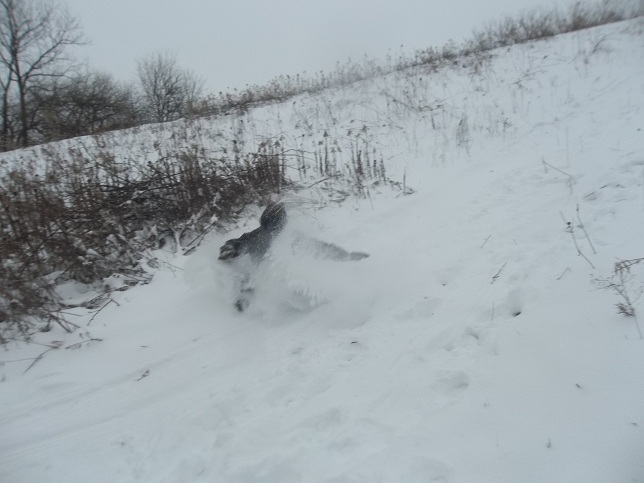
I can telecommute to work when the weather is poor.  That means there are no days off.  It snowed a lot today starting around noon.  It’s now 5 and we have something like 4-6″ out there.  It’s time to go sledding.  I ditched work at 4, sprinted through our chores and headed to the hill.  The kids caught up with me later.

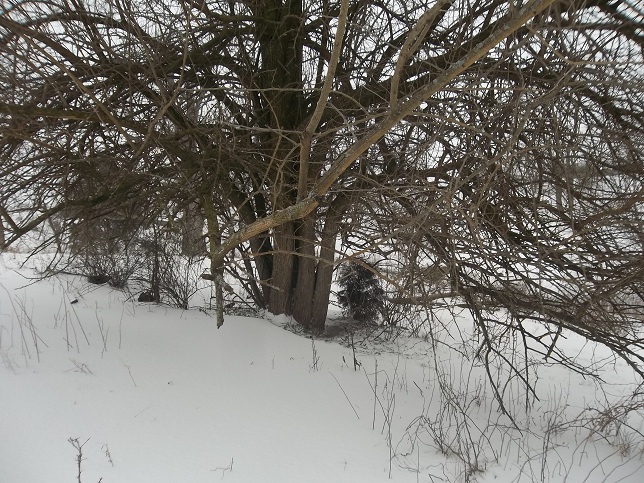
Now, if you are at all familiar with the John Cusack movie “Better Off Dead” you’ll understand when I say that this hill is our K12, dude.  It starts by the big, overgrown octopus of a hedge tree (which is not long for the world).

SleddingK12

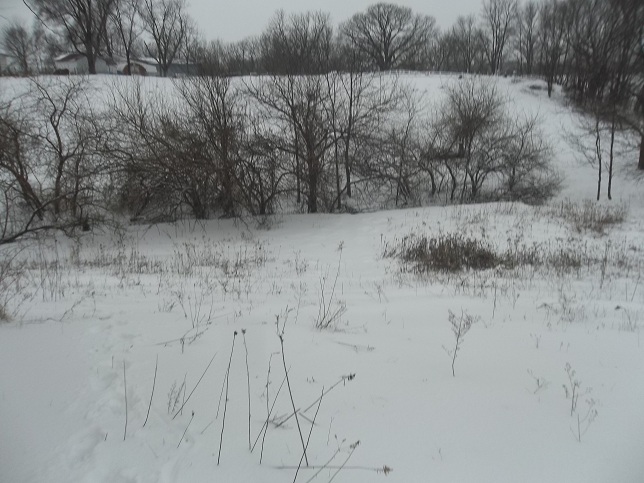
Then we sled a greater-that-45-degree hill, ramping over cow paths and hoping not to hit any stumps.

SleddingK12_2

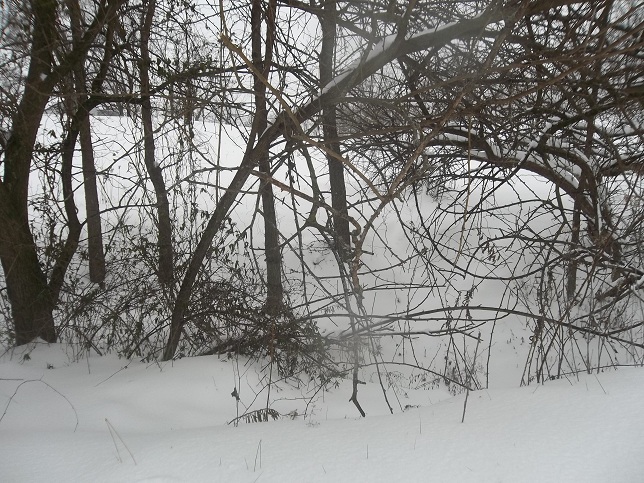
And just as we reach top speed, the ground levels out for about 10 feet.  We have to stop immediately or we’ll meet our death in the hedge-tree-guarded creek bed.

SleddingK12_3

The oldest daughter calls it “disemmemberment hill”.  Yes, that’s how they spell it.

SleddingK12_4

The snow gave way to ice pellets and high winds.  Time to head inside and dry out.  I think semi-perilous adventures like sledding disemmemberment hill are important moments in my children’s lives.  By the way, no one was disemmembered today, though I did catch several ice pellets in the eye.

Stuffed Rabbit (Updated)

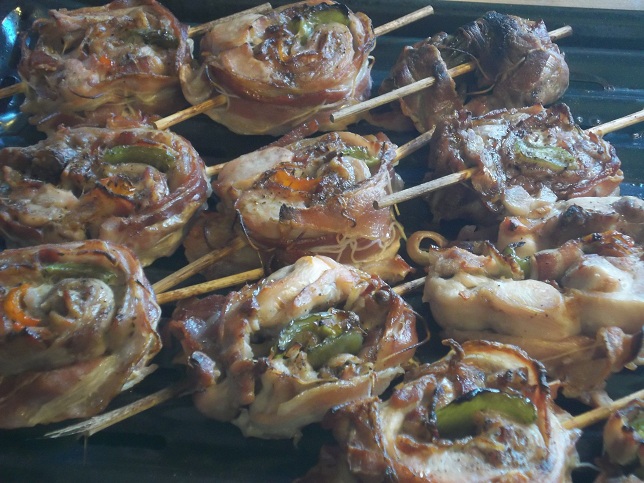
We harvested rabbit this week, setting aside a couple for ourselves.  Rabbit + bacon is always a good thing but when we saw this video we knew we had to try it.  Now, he uses pancetta but we’re working with what we’ve got.  I can’t just go butcher a pig so I can make some pancetta can I?  Well…

He shows how to debone it here:

So we put those videos to work and lunch is in the oven.  I’ll let you know how it tastes…if I can make myself waddle over to the keyboard.

StuffedRabbit

Oh, and we have rabbits for sale while they last.

UPDATE: (Later in the day…)

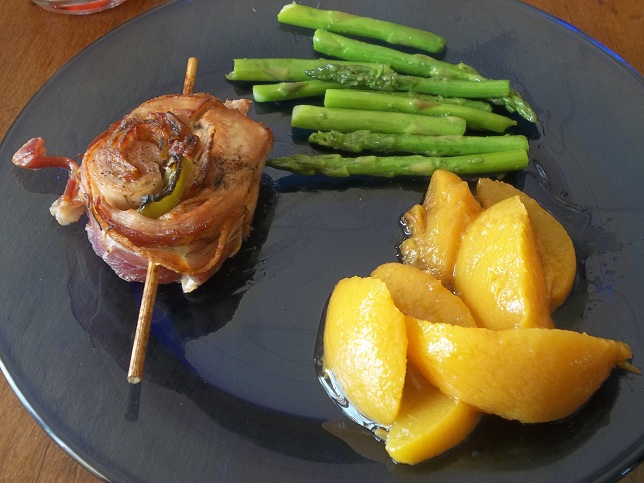
On the seventh day we rested, ate rabbit and it was good.

We initially cooked it on a cookie sheet then, later, broiled it on a broiling pan.  That’s the way to go if you want to avoid soggy bacon.

RoastedRabbit

The oldest boy went back for thirds.

DinnerIsServed

Southern Indiana Grazing Conference Notes

Last week (Wednesday) I drove across Illinois and into my father’s home state of Indiana to attend the Southern Indiana Grazing Conference.  My oldest (eldest?) son and I left home at 4:00 in the morning and arrived at 9:30 Indiana time.  We were late.  I missed the first speaker.

For my more casual readers, this is going to be a boring post.  No pictures, just farm geek soil management detail.  Rather than bore the reader with the entirety of the notes I took let me introduce the speakers I saw and offer a summary of their main points.

My friend Darby said the first speaker talked about moving commodity beef through an operation.  Low profit, volume sales.  Buy them young, castrate them early and sell them when you can make a profit.

The next speaker was David Hall of Ozark Hills Genetics.  David Hall was worth the trip all by himself.  I was late for the first portion of his talk but his second portion discussed selecting for cattle that perform well on fescue as fescue is the dominant grass in the region and it naturally defends itself from overgrazing.  From The Fescue Endophyte Story:

Studies with animals consuming endophyte-infected fescue have shown the following responses in comparison to animals grazing non-infected fescue: (1) lower feed intake; (2) lower weight gains; (3) lower milk production; (4) higher respiration rates; (5) higher body temperatures; (6) rough hair coats; (7) more time spent in water; (8) more time spent in the shade; (9) less time spent grazing; (10) excessive salvation; (11) reduced blood serum prolactin levels; and (12) reduced reproductive performance. Some or all of these responses have been observed in numerous studies in dairy cattle, beef cattle, and sheep consuming endophyte-infected pasture, green chop, hay and/or seed.

Hall reinforced the lessons I gleaned from various books on selection traits for building a herd.  In short, select cows that breed back within a defined window.  You may leave the bull in for more than 45 days to see that all cows are bred but sell cows that don’t calve in the first 45 days of your breeding window.  Those cows that breed back early and often are able to perform on fescue.  He also had a slide suggesting that cows don’t show a profit until the 3rd or 4th calf.  Optimal economic return is in years 8-11 for commercial cow/calf operations.  Finally, he suggested you keep heifer calves that wean a little light.  Calves in the 450-500 pound range tend to be long-lasting cows.  Calves that wean above that have trouble breeding back, according to his records.

Someone in the audience asked, “Why don’t you just rip out the fescue and plant more palatable annual grasses?”  He responded saying his neighbors (primary customer base) have fescue.  If he is selecting for high performance on a poor forage base he’ll be providing bulls that perform well anywhere.

The next speaker was Jay Fuhrer on Integrating Livestock to Work Within Your System.  In short, he was rotating livestock into crop ground to build soil.  He offered lists of cover crops they use in North Dakota to provide a winter forage base for the cattle.  They keep the cows on pasture during 48″ snowfalls (since the snow mostly blows into big drifts).  A few cows bulldoze through snow to find feed, others come behind and eat what was uncovered.  Most of their water is sourced from the snow but once or twice each week the cows walk a mile to the barn for water.  Amazing.  Beyond the normal turnip, radish and pea crops he adds sunflower.  More on cover crops in the next presentation.

Because they suggest a large diversity of cover crops, the ranch he works with frequently, Black Leg Ranch, has a variety of income sources including hunting and agrotourism.  The ranch owners apparently had many children interested in coming back home.  Mom and dad told the kids to figure out how to run their own enterprise on farm.  Jay had a slide of all the things they are doing to generate income together.  Pretty cool.  The bullet point I found most interesting was custom grazing 2,000 yearling calves stocked at 12 head/acre, moving every 2-3 days.  That’s covering some ground.

Jay was followed by Gabe Brown.  Gabe was also from North Dakota and focused on annual cover crop production.  I’m sorry to say I have few notes of Gabe’s presentation.  I was too fascinated by his operation to stop and write things down.  What I remember was his efforts to escape chemical agriculture, no-till crops in and maintain companion plantings in wide variety to keep soil covered with biomass…always leaving 3-5″ of covering material on the soil.  He showed slides of long lists of seeds he puts into his drill and simply says to set the drill to feed the largest seed and let ‘er rip, being sure to include flowering plants to attract beneficial insects.  His grazing operation was pretty slick, complete with photos of Batt-Latch in action.  Again, he was focused on plant diversity, soil biology and constant cover of the soil.

At this point we were pretty tired.  Early morning, long drive, lots of carbs at lunch…tired.  But Walt Davis took the stage and he was the main reason we came.  He drove home the importance of ranching for profit instead of for production and do so by leveraging your biological capital.  Provide unlimited forage.  Provide a mix of forages (cows can eat enough alfalfa but when mixed with other species they will tend to eat more).  Handle animals so as to prevent stress (stress lessens gains).  Don’t graze based on a calendar, graze based on recovery.  Watch your animals.  They should spend as much time ruminating as grazing.  Check their manure to see if they are getting the right quality for their age and use animals of lower nutritional requirements to condition pasture for high-demand animals.

That leaves us with the final speaker, Ed Ballard, on extending the grazing season.  Ed is a numbers man.  Numbers after 3 in a dark room when I’m tired are a difficult subject.  He presented charts showing the benefits of allowing the animals to graze their own feed as opposed to making feed for them.  He was suggesting it costs $2.50-$4.00 per day to feed hay to cows as opposed to $0.25 to $0.35 cents per day of grazing.  Even if you can’t graze, you are better off buying in hay (purchased in summer) instead of making your own hay as making hay is expensive.  Ed just point blank stated that if you’re not frost-seeding clover in your pastures right now you’re making a mistake.

All of the speakers added to my overall cattle management education.  Ed gave me immediately actionable items.  I need to seed clover.  I need to stockpile forage.

You Will Know Them by Their Hen Fruit

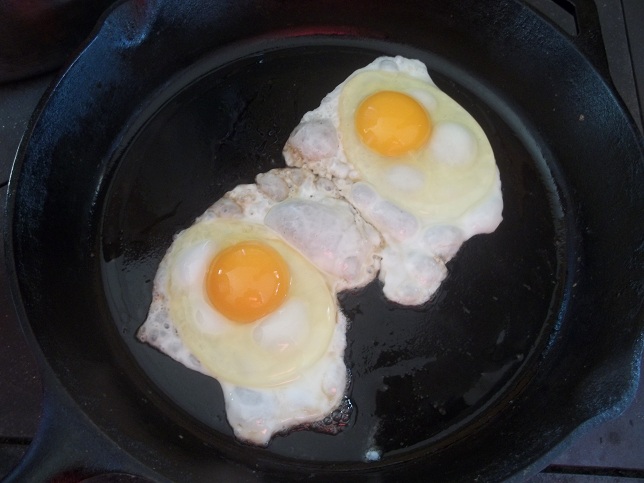
Over the weekend I noticed our egg yolks are looking a little pale.  A customer also mentioned it to me.  That’s not much of a shock given the time of year but it’s something I need to manage.  The picture also indicates that my whites are a little loose, though those particular eggs came from geriatric hens so it may be a hen issue.

EggYolks

The yolks should be orange.  The kind of orange that screams at you like like William Wallace calling for his favorite crayon…”ORANGE!!!”  My chickens are not getting enough greens in their diet.  Later in the spring when the dandelions are growing well, the color will return on its own.  Right now the chickens need some supplemental greens.  I’ll start tossing in a bucket or two of alfalfa chaff and some winter annuals that are growing among the carrots in the garden (chickweed and henbit) and we’ll see how things go.  Things are starting to green up already but I’m not moving the birds fast enough to keep them in the green.  Work, work, work.

If you want a little bit of homework you can read about what makes a good pastured egg and how they compare to factory eggs on a nutritional level at Mother Earth News.

PS
My lovely bride (who is looking particularly beautiful today) says my joke title is a bit of a reach.  Chime in on comments if you get it at all.

Dances With Pigs

If you are looking to expand your vocabulary look no further than pig ownership.  A pig is a 120 pound ball of muscle complete with teeth and fully equipped to outsmart your every effort to muscle them into making the right decision.  In this particular adventure I did not teach my wife or children or neighbors within a half mile any new words.  Everybody stayed calm…this time.  I’m going to skip to the end then tell you from the beginning.  We have learned to modify our schedule and to allow the livestock to dictate the pace.  Yes, I wanted to wrap up the pasture change in 5 minutes but it took almost two days.  It happened on the pigs’ schedule.

When our pigs see us they come running to the fence hoping for a tasty treat.  All of their experiences with us have been positive (well, except maybe the castration) and we give them food to reinforce the lesson.  If a pig is uncomfortable, no amount of yelling or abuse will make them more comfortable.  You just have to wait it out.  Patience and kindness.  Just moving to a new location is stressful for the pigs.  I can only compound that stress by changing from the nice food guy to the mean guy with a stick.  I have to tell you though, as I was standing in the rain Sunday morning I was wishing I had a tranquilizer dart for each pig so I could just carry them to their new pen.  Ultimately, patience proved easier by far.

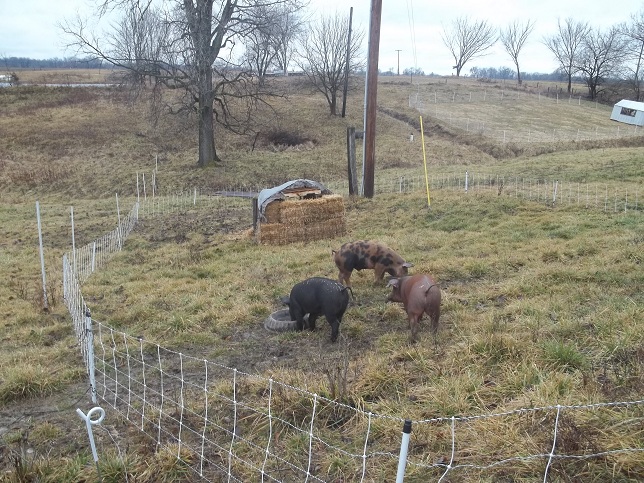
The pigs were still in the winter sacrifice area on pasture and, since their initial (well, secondary) introduction to electric fence, hadn’t gone anywhere.  The pigs know that the white wires hurt but they also seem to think there is some sort of voodoo concerning the ground where a white wire once was.  As before, we made a corridor of fencing, initially with two strands of polywire, later with Pig Quikfence.  Saturday morning I opened the fencing from their pasture into the corridor then began moving their pallet and straw bale house to the new location 250 yards away.  The pigs stood their ground.  No amount of scrambled eggs or chicken broth could convince them to budge.

Hours pass.  The pigs aren’t having any of it.  They will not cross the line.  At 3:30 I decide to crowd them into the corridor by squeezing their electric fence toward them a little at a time.  Everything was going great until the black pig decided his fear of the unknown was greater than his fear of the fence and he attempted to break through the fencing and escape.  It was a shocking experience for both of us.  I don’t have to remind you that pigs are distinctly lacking in handles so I found myself wrapped in a tangling mass of electric fence and pork…until we pulled enough of the fence that it came unplugged.  Fortunately I had an insurance policy in place…a length of PermaNet surrounding their pen just in case.  The little black pig backed his way out of his fence and neither of us were worse for the wear.  The fence was not broken, just pulled from its posts and I learned my lesson.  Patience.  We closed things up for the night and headed off to church vowing to return in the morning.  Maybe tomorrow hunger will override fear.

After milking on Sunday I turned the cows out and set up the corridor again.  The pigs were not interested.  I put down a trail of feed hoping they would follow along.  They would come up to a certain point.  Then they ran back to their pile of straw on the ground.  Well, I have other things to do with my time.  They can’t escape the corridor so I’ll just check on them from time to time.

ChangingPigPastures

Around 11:00 I was sent out to the pigs with a bucket of scraps.  I placed these scraps deep in the corridor and upwind of the pigs.  The red pig (cleverly named “Red”) decided they smelled so delicious he had to get some of that.  Spot and Blackie (names just happen with small numbers of livestock) stayed back with a “not fair!” look on their face.  Again I walked away.  At 11:45 the kids called to me, “Dad!  The pigs are in the corridor!”  That’s what I was waiting for.  I headed out with a bucket full of feed and, like following the pied piper, the pigs were close at my heels all the way to their new home.

ChangingPigPastures3

Nobody was upset.  Nobody was abusive.  No frustration, crying, swearing off pigs forever or talks with the children about types of language that are acceptable around the house and how sorry daddy is and daddy promises to do better next time then daddy sneaks off to down a highball.  Nope.  Just pigs following that nice guy who brings them food and a new, fresh pasture full of greens on a South-facing slope.

ChangingPigPastures4

They will get to be here for a few days then we’ll move on to the next pasture.  It’s all about disturbance and rest.

I need the pigs to work for me.  It’s not enough that they get fat and taste great.  They have a job to do.  But MY job is to help them do their work.  My job is to make them happy in their work.  I see these animals several times every day.  My pigs don’t cower in fear at my approach.  They greet me, they grunt at me, they run and skip as I approach (really).  Happy pigs.  Happy pigs are easy to move.  Happy pigs are easy to load.  Happy pigs taste better.  There is enough stress on livestock.  I don’t have to add to it.  I can spend two days waiting on pigs to move themselves.  It will be even easier next time.

Drill and Tap it’s Time for Sap

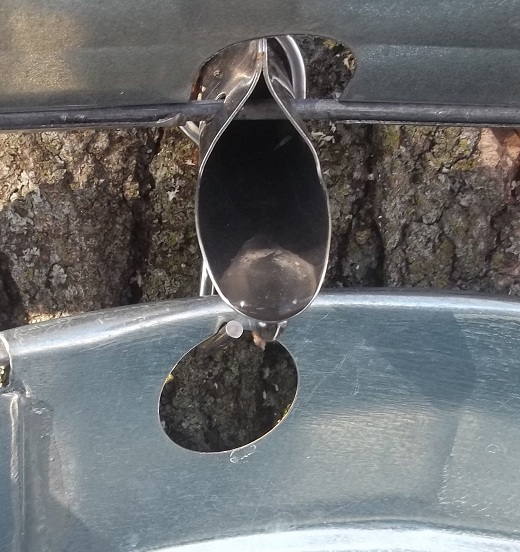
We had an inch of snow last night but daytime temps have been above freezing for at least a week now.  That means I’m late to the party.  Oh well.  Trees are tapped now.  And here I planned on tapping trees on Valentines day.  Silly me.

MapleSap


Let me know if you are tapping your trees this year.  Have you collected any sap yet?


Finding Perfect Cows

The search is on.  I am beginning the process of hiring as many as five full-time employees.  Applicants must be female, young and fertile.  Good physical condition is a must and they must maintain that condition while eating grass and living outside.  I’ll be looking at hair quality (but not color), length of legs, size of belly and fatness of rump on all applicants.  If things go as planned, after 10-12 years of healthy reproduction and the applicant has deposited approximately 250,000 pounds of manure the applicant be slaughtered, butchered and eaten.  I’ll explain the full qualifications below.

These aren’t criteria I have whipped up from my own experience or imagination.  I am working to distill what I have learned from studying books on grazing cattle.  Feel free to disagree.  You aren’t disagreeing with me.  I found information on selecting cattle for your herd in five cattle books I treasure:

Comeback Farms by Greg Judy
Ranching Full-Time on Three Hours a Day by Cody Holmes
How to Not Go Broke Ranching by Walt Davis
Salad Bar Beef by Joel Salatin
Grass-Fed Cattle by Julius Ruechel

I feel all 5 of these will stand the test of time…meaning I’ll still be looking up things in them in 10-15 years.  My copies of each are worn and heavily bookmarked.  I have read most of the modern texts concerning cattle.  That means I have read a lot of junk.  I feel this list represents the best of what is out there currently.  I think it is worth reading so many opinions because Proverbs 15:22 says

Plans fail for lack of counsel, but with many advisers they succeed.

I’ll add to the list Success on the Small Farm by Haydn Pearson.  Though not a cattle book, it’s a classic in every sense of the word.  It contains some sound advice about herd management as well as little nuggets of wisdom on anything you want to know about.  Further, my copy is loaded with notes, underlining and little newspaper clippings pasted in by a man named Gerhard Richert who bought the book originally in 1946.

Finally, I’m going to focus on cows.  Not bulls.  I’m not selecting bulls at this time.  I’m selecting cows…preferably heifers.  The main points are get quality stock that will thrive on feed you can source on farm.  Measure your success by their fertility and how infrequently you have to call the vet.  But, don’t take my word for it.  Let’s hit the books!

Only one book in my pile gives specific recommendations for starting a new herd.

Click on image for source

Greg Judy begins on page 234 with a bullet point from his mentor, Ian Mitchell-Innes:

Buy two young heifers for the price of one bred cow.  Graze these heifers through your management system and keep the ones that perform well, sell the ones that don’t.

He goes into more detail in the next chapter on page 246:

So where does a person find some grass-genetic cattle?
The most economical method would be to attend local cow sales and look for small frame cows.  These smaller frame cows will always be cheaper to buy than the monster cows that all the mainstream producers want.

…When you’re looking for these smaller frame cows, watch for cows that have a big gut for lots of grass capacity.  Most cows today have had all the gut capacity bred out of them.

Pearson describes making a profitable dairy at some length in Chapter 10: Small Farm Dairy (a chapter Mr. Reichert seems to have skipped).  He makes three main points.

For the beginning farmer who likes cattle, this is the one most essential point: Get quality stock.

He drives this home with an illustration I’ll share in the next post and goes on to say you should grow your own feed and find a good market for your products.  For now it suffices that Mr. Pearson wants the reader to buy quality stock, not whatever is cheap.

Click on image for source

All authors seem to agree that you want a smaller than industry standard cow, topping out around 1,000-1,200 pounds.  Holmes suggests 950 would be better as:

Smaller cows eat less grass.  It makes a lot more sense to have a herd of 950-lb. cows weaning off 450-lb calves on grass than 1,500-lb. cows weaning off 575-lb calves running on a  creep feeder.

Click on image for source

Salatin is unconcerned with breed.  He is concerned about animal performance on grass.  At this point in the discussion he really only weighs in on those two points.  Animals vary widely within breeds so you can’t rely on breed alone and most of the modern cattle genetics are geared toward an animal that’s at a disadvantage on pasture.

Davis suggests you buy local cattle in Chapter 14: Adapted Animals.

Different breeds are differently adapted to different climates.  Even within a breed, regional changes require adaptation.  He begins by discussing resistance to local parasites and diseases then goes on.

Radical changes in climate and elevation severely stress animals with the greatest effects occurring when animals go from cold to hot climates, from low humidity to high, and from high elevation to low.  Differences in mineral content of forages also play a role in how soon and how well animals adapt to a new area.  In many phosphorus-deficient areas, the local shrubs have considerably higher phosphorus content than the grasses; local animals learn to browse the shrubs and cope fairly well, but animals new to the areas that don’t have a history of browsing are at a severe disadvantage.

It is more than likely that part of the adaptation process relates to the rumen microorganism populations adapting to local conditions. [and later still discussing gut flora…] it would be illogical to think that these organisms do not develop genetic traits that make them better adapted to the local conditions found in soil and forage.

As usual, buy local.  Even if you can’t find grazing genetic stock locally, you might be better off buying animals from your own region.

Ruechel adds to the pile by suggesting the list above plus a few more.

On page 23 he says replacement heifers and cows should be

feminine in appearance.  [and later…]  She and her daughters should cycle for the first time at ten months and conceive at fourteen months.

On pages 24 and 25 Ruechel lists bullet points of things to look for in a replacement heifer.  These include details the other authors skipped: wide mouth, well developed udder, short, slick shiny hair.  The bullet points are detailed, less abrupt and inspire fewer giggles than Judy’s choice of words on page 249 of Comeback Farms:

The cows should have a big old butt on them.  This is a feminine trait.  It gives them more room to calve.  A cow needs a big butt.

All kidding aside, between Ruechel’s bullet points and Judy’s entertaining list you get a nice checklist of traits to pay attention to.  Judy even suggests linear measurement as detailed by Jans Bonsma.  I’ll leave the reader to research that.

So.  I need to buy quality local heifers of small frame and feminine appearance.  These should come from cows that cycled early and often.  Once I get those heifers I need to get rid of the underachievers.  I’ll detail that process in the next article.

Be sure to check out the books I listed above.  If I could only pick one out of the pile I suspect it would be Comeback Farms by Greg Judy though I do appreciate the wealth of experience brought by Davis.

Please comment with your cattle buying criteria or any additional book recommendations.