The Wind Blew…

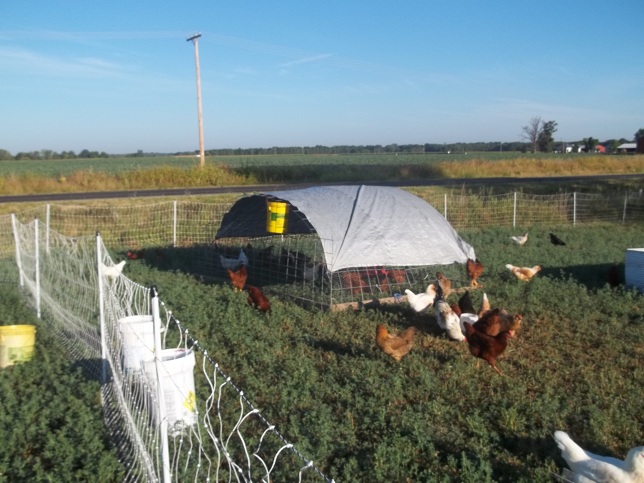
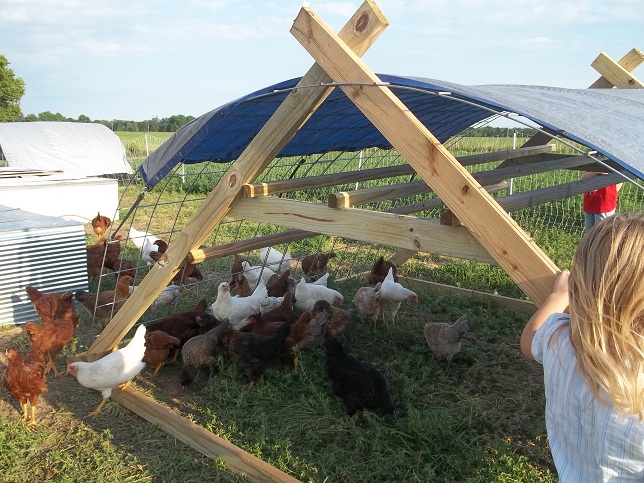
The wind blew.  The rain fell.  One of my chicken tractors tried to go over the rainbow and landed on the fence.

That’s really no big deal.  We have one of the hog panels off of it so it’s wide open.  It just gives the pullets a little extra shade and water on hot days. Last night it was empty.  Nobody got hurt.

The tractor is pretty simple.  Four 2x4s screwed together at the corners with a bit of plywood under each corner for a gusset.  The panels are held on the frame with fence staples.  The tarps are held on with tarp straps.  The screws at the corners failed when it tried to land on the wicked witch.  I put it all back together in front of the ever-critical chickens while the wife and kids splashed in the pond.

I can always count on them for help.  This time I left the sail off…I mean the tarp that covers the side.  That should help airflow and shouldn’t impact shade since the sun is almost straight up this time of year.

Since I touched on the Wizard of Oz a couple of times I’ll finish with this just for giggles.

Egg Prices, Corn Prices and the Value of My Wife’s Time

What does it cost to produce a dozen eggs?  This is important since we’re staring down the barrel of a regional total crop failure.  Corn prices are rising and my dad’s tenant indicates that only about 1/3 of the stalks have ears and those ears aren’t filling out.  There’s hardly a bean in the soybean fields around me.  If this is true on a wider scale, we could be in some trouble.  How much will this affect the price of the eggs we produce?  Let’s break it down a little bit.

Averaged out, I get around 60 dozen eggs each month.  Each dozen needs its own, new egg carton (Illinois law).  When I ordered cartons in Feb. they were $0.32, now those same cartons cost me $0.56 each.  They have another paper carton that’s $0.36.  I don’t like it as much but two dimes saved is two dimes earned.  Eggs will taste just as good and the cartons are just as recyclable.
My flock of 40 birds eat 200 pounds of feed each month.  If corn costs $6.50 (what I paid last year for my dwindling supply of corn), it costs me $12.89 for the ingredients to grind my own bag of feed.  That doesn’t count the equipment cost or time involved in grinding that feed.  If corn stays at $8.00, each bag will cost $13.57 before grinding.

What other costs are involved?  Each morning we have to fill the drinkers and feeders and move the houses.  Each evening we have to gather the eggs.  Every other day we clean, sort, weigh, candle and pack the eggs.  Every few days we build fence.  What is that time worth?

It takes 5 months to go from chick to egg and those first eggs each pullet lays are quite small…too small to sell.  So, even though they start laying at 5 months, they are 6 months old before I can begin selling their eggs.  That’s 6 months of feed, water and care that I have to pay for with eggs over the next 18-20 months of productive hen life.

I have to pay for their housing.  I have to pay for the fencing that surrounds them ($0.04 per length per day).  I will lose some birds to predation and weather.  How much do I pay myself for sitting in a field all night holding a gun when predators get a taste for chicken?

I have to fill out the paperwork for our egg license and meet with our inspector annually.  He checks our fridge temperature, validates our scale and egg quality then hands us some promotional items.  At least he comes to our house so we don’t have to make a trip to some testing facility in Timbuktu but it still takes time.  We have to get a license from the king to sell our own eggs.  That license costs $15 each year plus we pay an inspection fee of $0.11 per 30 dozen eggs…to pay for our inspector to drive here once each year and say, “Hi”.  That takes away from our profit also.  One day, if we work hard enough, we can pay income tax too.  Oh, to dream!

So what do I charge?  It would appear that I could make a little (only a little) money selling eggs but the income is limited by the number of hours in a day.  I have to handle every egg.  The costs above indicate I am paying $1.28 just for feed and egg cartons plus a few more cents for inspection and licensing (you know, because consumers can’t judge for themseves if cartons are clean or if eggs are any good).  The fencing and housing are spread over 10 years and the chick and brooder time are spread over 2 years then we harvest and sell the bird as a stewing hen.  We charge $3.50 for our eggs and get an average of 60 dozen each month.  That means we make something like $3 each day from eggs before accounting for our time.  Either we need to increase our egg production, raise our prices or close up shop.  Salatin says he makes $12 over the life of the hen.  I think he’s right.  It’s a lousy primary enterprise but they do sanitize the pasture and keep the family entertained.  At $8 corn I’m under some pressure to lower my entertainment cost or find feed alternatives but the real pressure comes from labor costs.  It takes a lot of time to feed and water the animals then gather, sort and peddle the eggs.  Compared to our labor costs, the price of corn is insignificant.  My prices have to go up, not because the price of corn went up, but because I’m learning about business the hard way.

That’s not to say food costs won’t rise because of the bad crop.  They will.  60% of the corn produced in this country is fed to animals.  It’s in most dog and cat foods…not just what we feed pigs, chicken and (unfortunately) beef.  Corn is in everything…including your gas tank.  Soybeans are in everything too.  Producers are going to have to determine the marginal utility of each compared to substitutions.  I may feed potatoes and milk to pigs…if I continue to raise pigs.  But, as a consumer, you need to consider marginal utility as well.  Just because corn products cost more doesn’t mean you have to buy them.  What substitutions can you bring into your kitchen?  I’m afraid there is little substitution for a good egg.  I’ll do my best to make appropriate substitutions on my side as well as streamline my labor to encourage you to continue to buy my eggs.  I believe you will continue to find my products to be a good value even in the face of rising prices.

—UPDATE—

Dad pointed out a couple of things not factored into my equations above.  75 layers generate 15-21 pounds of manure each day or a maximum of 115 pounds of nitrogen, 65 pounds of phosphorus and 42 pounds of potassium per acre, not to mention the trace minerals I put in their feed ration.  That has value.  They also eat bugs.  That has value.  I don’t mean to say my chickens are a drain on our budget, I’m saying, in terms of farm cash flow, economies of scale work against me trying to generate income from a small flock.

Preparing for Chicken Processing

There is a rhythm to work.  Every job has its own groove.  You just have to find it.  Processing chickens is no different.  You have to find your groove.

We moved from square dancing to bebop this year when I upgraded my equipment.  At first we tripped all over ourselves trying to make sense of our Featherman equipment.  It was pretty bad.  Now, it’s no big deal.  As a team, we have divided the workload so each of us is working at a good pace.  With that in mind, I want to address a portion of an email I got from a friend/reader.  I pared down his original question a bit.

…as my first processing day is approaching fast in two weeks, I am assembling some equipment.  I got some knives, heat-seal bags, table-top, scale, etc.  one thing I am still pondering is the chill tank situation.  I am leaning on going with two 110 gallon black stocktank tubs from tractor supply.  They are fairly cheap per gallon compared to some options, $64 for 110 gallons.  I can’t seem to find another freezer or 55 gallon food grade barrels locally.  I was also comparing rope tubs as you mentioned or large rubbermaid trash cans, but I would think the larger 110 gallon tanks would stay cooler longer?  Just looking for your advice.  Also, how long do you chill the birds?  How much ice should I have on hand?  somewhat scared,

If I’m not mistaken, the author has about 100 birds to process and has not processed birds before.  Rather than go with 220 gallons of chill tank in any format to chill all 100 birds at once, I would like to see him spread his processing out over several relaxing days.  I suspect it would take us the better part of 4 hours to sterilize equipment, kill, eviscerate, chill and pack 100 birds then clean up again.  At the end of it we would be tired.  When we first started we got tired after 20 birds.  Our friends at Porter Pond Farm needed 7 hours just to kill and process 130 birds their first try.  Keep in mind, they had help and that 7 hours did not include bagging the birds.

So the best thing you can do is just process a few birds at a time.  Maybe 2 days of 20 birds and one day of 60 birds or 4 days of 10 and one of 50.  Give yourself some time to find the groove.  Just how does Salatin get the crop out so quickly?  It takes time to learn how to do it.  Watch this video over and over.  And over.

We figure you need 10 pounds of ice per 6-10 birds.  We chill the birds until they are cold.  You’ll know when the ice stops melting.  We normally let them rest in the ice water while we compost and clean up.  Then we change clothes and start bagging.  Maybe 90 minutes.  You can save a few bucks by using frozen bottles of water and blocks of ice have more thermal mass but less surface area.

I suspect there are better places to deploy cash than to buy stock tanks to chill birds.  They aren’t a bad idea as they can always be deployed for livestock use but I really doubt you’ll do 100 birds your first day.  If you do, I doubt you’ll be anxious to go back for seconds.  There is a lot of skill involved.  Until you can work efficiently and as a team you’re probably better off doing 20 birds at a time.  20 birds can be chilled in coolers you probably already own.

Here are some other things you need but didn’t list in your email:

  1. You need a Compost Pile.
    With 100 birds to process you need to get four pallets.  Wire them together top and bottom with baling wire so they stand in a square.  Scoop out a bowl in the bottom center of the compost pile then throw in a bale of straw or old hay as a base layer.  Also, see if you can get a couple of trash cans full of sawdust from a sawmill…the finer the better.  Really, a pickup load of sawdust would be better.  Well, a dump truck would be better still but get what you can.  As you process birds, pull a layer of the straw to the sides, dump in your chicken offal, add a layer of sawdust above and cover with fresh straw.  See the link above for more specific detail.
  2. Sharpen your knives.
    Even if your knives are new, sharpen them.  Really sharp.  Crazy sharp.
  3. Gather buckets.
    You will need a bucket for every 20 or so birds you process but we keep one at each station.  One bucket for heads and feet, one for evisceration, one for lungs and some others for feathers and blood later.  You probably already have buckets, just make sure they are empty and ready on butcher day.
  4. Do a dry run.  Heat the water.  Dress one bird out.  Chill it.  Bag it.  Go through the motions all along the way.  Learn what you need to learn.  Find out what you didn’t plan for.

I am sure this list could be larger.  What did I miss?  What are your thoughts?  I may be too far from my first chicken processing experience.  I remember it being very difficult.  I wouldn’t want to do 100 birds out of the gate.


Chicken Snack

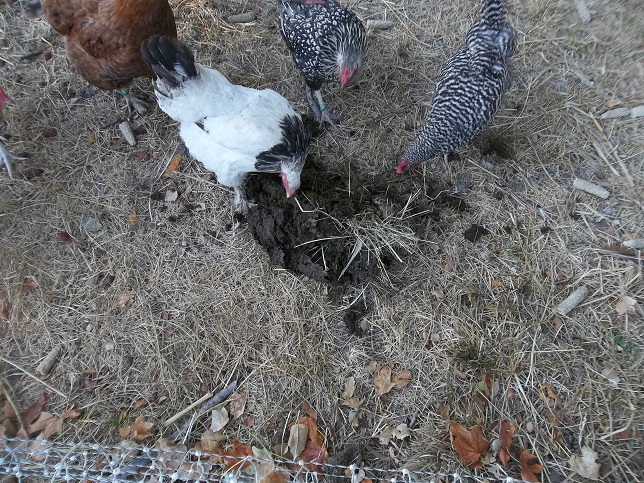
This is a chicken snack…on a fork.  Cow pie a la mode…sans la mode…

It’s cow manure, aged to perfection (about 2 days old).  Cow manure has lots of interesting things in it for chickens to scratch out.  Normally, the chickens find cow manure each time I move them to new pasture but during the heat wave the birds are stuck in the front yard.  I’m bringing them cow manure.  It should also add fertility to the yard.  Not a bad thing.

Anyway, serve at room temperature and without a plate.  Chickens really make pigs of themselves.  No reason to wash dishes afterward.

One curious bird starts a trend.  Then the other ladies join in.

I don’t really know what they are finding but they are doing more than just digging.  Cow manure has many things that are helpful to a chicken’s digestion.  Now, don’t gross out.  Chickens aren’t people.  This is a very normal thing they are doing.  Birds follow herbivores in nature doing this very work.

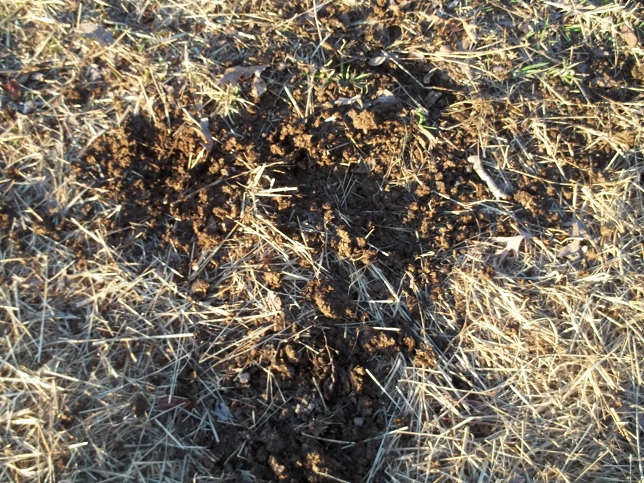
Just a few minutes later and the cow pie is gone.

In the early spring when there are large flocks of red-winged black birds roosting in the trees…so many it’s hard to have a conversation outside, the cow pies get decimated.

They love it.  Our chickens love it.  The pasture benefits from it.  Everybody wins.

Blue Eggs

Two of our pullets have started to lay but not the two I would have expected.

We keep blue egg layers for a number of reasons.  First, customers appreciate the novelty.  Well, most of them do.  Second, it is an easy way to keep two flocks in the same place and still know whose eggs are whose.  In the past, the blue eggs have been from my daughter’s flock so she earns a little money each day.  I have never purchased Ameraucana chicks, always started pullets.  Though they are pretty, I have never really been impressed with the birds as layers.  Without exception they have been late to lay and inconsistent layers in winter.  This isn’t just an impression I carry, the birds are a difficult sell to local egg producers as started pullets.

This year I ordered 50 Ameraucana pullets from Cackle hatchery.  Not only are they nice, colorful birds, they are the first in the flock to begin laying eggs.

Where are the brown eggs?  We also keep hybrid layers and RIR pullets from Central hatchery out there.  I would have expected to see something out of the hybrid layers by now.  All pullets are the same age…hatched on the same day (Feb 28), even though they came from two different hatcheries.

I suppose it is possible that I did something other raisers don’t do…or many things other raisers don’t do.  I guess so but I don’t know exactly what.  The birds were brooded in a greenhouse and fed Fertrell broiler mash for the first few months then placed on alfalfa to finish out.  I wasn’t expecting to get blue eggs for at least another month.  Maybe these two are just freaks.  We’ll see what they do going forward.  Surely there will be a brown egg out there today…

Whoops! What is THAT?!?!?

Have you ever seen a pullet laying her first egg?  I would swear to you she’s embarrassed.  First she’s uncomfortable then she feels like something happened…something she couldn’t control.  She whips around to take a look at what just happened and sees what looks like a rock.  “Did I do that?”  She takes a quick look around at the rest of the flock to see who saw what just happened then takes a quick peck at the thing just to make sure it’s real.  If she breaks the shell she’ll probably just eat the egg.  If not, she’ll just run away hoping to avoid future social stigma.

Maybe it’s not that dramatic but I’ve seen it happen a few times.  Pullets are always surprised when they lay an egg.  It’s pretty funny.

These pullets arrived on Mar. 1st.  Today (July 14th) I found my first pullet egg from the new flock.

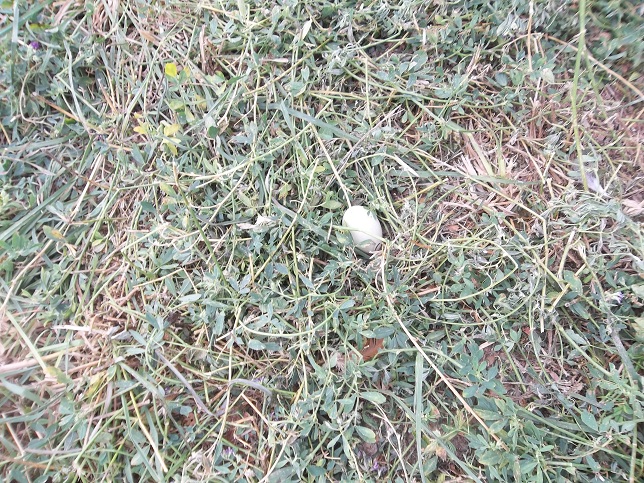
It was laying in an opened chicken tractor in the alfalfa.  Well, if there’s one there’s probably two.  Sure enough.

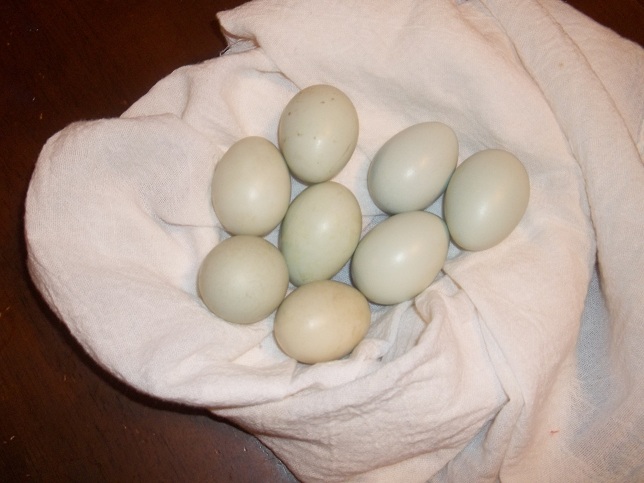
Two blue eggs.  I’ve never gotten blue eggs before brown.  I’m amazed.  In the past our Easter Eggers were always the last to lay.  Far out.  I need to get busy building nesting boxes…

Green Stuff?

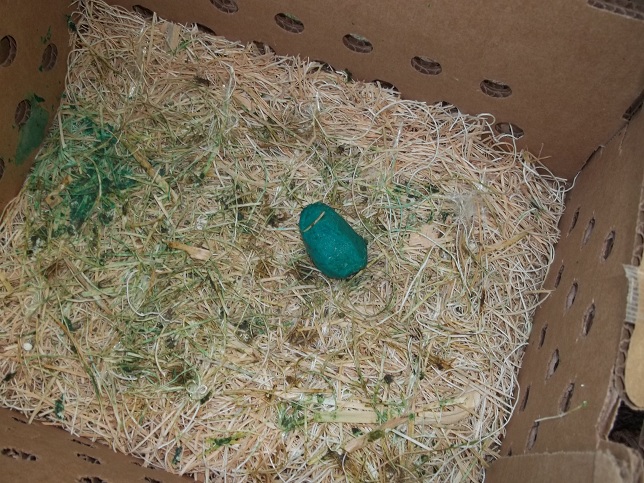
We ordered some pullets from Cackle Hatchery this week.  I’m always reluctant to order chicks mid-summer but I saw the forecast was for temps in the lower 90’s, called the hatchery and took a chance.  Because I was late ordering, my normal hatchery could only send 25 so I ordered another 40 from Cackle (all they had).  The Cackle chicks got here first.  The Cackle chicks came with a blob of green stuff.  I have seen the remains of the green blob before but I’ve never actually found a green blob.

It’s food, hydration and protiotic all in one.  I believe the commercial name is Grogel.

Online reviews of Grogel are strongly positive and the birds look great.  I’m afraid to look under the covers to see what it is and how it’s made.  The birds look great.

More Layer Pullets

Early in the Spring (or late in the Winter) I ordered 250 layer pullets.  Then I got cold feet and sold 175 of them at 8 weeks.  That worked out well in some ways.  It covered my expenses so the 75 or so I kept were basically free but in other ways it didn’t work out so well.  I still don’t have enough birds to meet the demand for my eggs.

So we ordered more pullets.  It took a couple of tries to find a break in the weather and a hatchery that could fill my order on short notice.  I was looking for 100 sex-link pullets, no Whammies.  At the last minute I called Cackle Hatchery to find out what they had left.  They could ship 35 Cinnamon Queen and 5 Red Sex-Link.  Sold.  Then I called Schlecht.  Schlecht closes at 4:30 on Friday.  Etta didn’t answer the phone.  I did get her by email.  She promised 25 Golden Comet pullets.  65 birds.  I can make do with 65 birds.

The Cackle order arrived Wednesday morning but was short by 10 birds.  We are expecting another shipment on Friday.  The Schlecht order arrived early Thursday morning.  They were a little sluggish but looked good and there were 5 extra birds!  A few minutes under the heat lamp and they were ready to go.

I have talked about this before but here’s the setup again.  They are in our 8×8 outdoor brooder.  It is easy to warm, easy to get into and comfortable for the birdies.  We use nipple waterers because they stay clean.  The chicks figure them out almost immediately.

We give them broiler mash in trays for the first few weeks.  I want to get them off to a good start.  After day two they get creek sand to get their gizzards off to a good start.  We try to give them constant access to fresh greens.  Today I dropped in two big handfuls of alfalfa chaff from the hay wagon.  Just like you, chicks need to eat their greens.

These birds will remain in the brooder for 2-3 weeks depending on the weather.  Then we’ll move them out to pasture where the older pullets are and pop them into chicken tractors.  That will give them a chance to grow out without being picked on by the bigger birds but will also give them a chance to socialize with the bigger birds a little bit.  By being on pasture they will get the best possible nutrition and will always leave their manure behind.  Raising them on pasture really makes a bird that can’t be beat in terms of health.  Our future flock, your future eggs.  Healthy birds.

School’s Out For Summer

It’s time for our planned summer break.  The broilers are all in freezers or customer bellies.  Just pullets and a few turkeys on pasture.  Our daily workload has dropped significantly.  Now all we have to do is feed and water in the morning, milk the goats and just check everybody a couple of times and we’re set.  Well, we have to soak the hog wallow a couple of times too.  This accomplishes two things; drains the hot water out of the 100 yard long hose so they will have cool water to drink again and gives them a cool place to pig it up.

Now, when I get up before the sun I don’t have to spend 15-20 minutes moving chicken tractors, feeding and watering.  I just open the chicken house door, feed there, water the rabbits, shower and head to the office.

We have waited all spring for this day.  We partied like it was 1999…well we watched the new True Grit and ate pizza after the kids went to bed.  Now we’ll tick off the days till we get our last batch of broilers mid-August.  We’re thinking about scrapping our big order for fall Cornish Cross chicks and ordering a variety of alternative broilers just to try them side by side.  We thought Kosher King, S&G Heritage White, Freedom Rangers and Moyer’s K-22.  Let me know what you think in the comments section.  Also, give me suggestions for alt. broilers just in case I am missing a good option.

Just a side note, I took a hog panel off of one of the hoop chicken tractors to give the pullets a bit of extra shade.  They seemed to appreciate the shade, I appreciate how many different ways I can use those chicken tractors.

Too Big to Succeed

This is in response to comments I got on my recent post titled “How Much Could you Make?”  Based on comments, my readers saw me as moping because my marketing skills aren’t where I would like them to be.  I suspect they are right, though I hope I wasn’t moping.  I was trying to say it’s tempting to expand and dive into any number of activities before I’m skillful at any of them.  Marketing is pretty far up on the list of things I need to improve but it’s more than just that.

My dad recently asked, “Why don’t you get some more layers?  That’s money you make every day.”  First, I appreciate my dad asking me questions. He’s not questioning my judgement, he sees an opportunity and wants to help me succeed.  He’s encouraging me to grow.

I think the layers are a good example of why I’m reluctant to grow.  A few layers are easy to keep.  A small home flock eats your kitchen scraps, weeds, bugs, etc. and gives you enough eggs to keep your kitchen hopping.  They are entertaining in the extreme.  Your only role is to ensure they have water, shelter and protection from everything that walks.  With a small flock the needs of the chickens are few.  Now.  Let’s shift gears.  Let’s go from three birds up to 300 birds.   Now you need in the neighborhood of 10 pounds of feed every day.  Now you need a much larger shelter.  Now you could lose a bird a night for a week and not notice it…that’s bad.

Each night we gather or 30 or so eggs in a basket.

We bring that basket in the house and set it on the buffet.  When two baskets are full we set out 5 or 6 egg cartons, sort and clean each egg by hand and label them for sale.  We get somewhere in the neighborhood of 14 dozen eggs each week in the summer, 8-10 in the winter.  We try to put an americauna egg in the front right of every box.  Blue eggs really freak people out sometimes.

While I agree we don’t get enough eggs, that’s where we are now.  My house holds 50 birds.  That’s it.  It’s a portable house.  I can’t build an addition onto it.  In the winter we house our flock in the greenhouse.  I can only fit so many birds in that greenhouse.  My infrastructure (or lack thereof) dictates my scale.

But my scale is also dictated by other factors.  There are only so many eggs I can lug up the hill in baskets.  Only so many eggs I can handle, clean and pack.  There are only so many hours in a day.  I’m nearing the ceiling for my skill level, my children’s ability to help at their age and my availability outside of employment.

It’s that last one that hurts the most.  I’m not even making enough money to pay the very modest farm payment, let alone live on.  I have to find a way to bridge the gap somehow.  At this time, we’re adding to our list of products using seasonality on our side.  But, as several commenters pointed out, I need to gain more exposure through everything from farmers markets to Facebook.  I just have to get out there.  But to get out there I have to have something to sell.  Now we’re back to the beginning.

It is a lot to think about.  It’s a lot of work.  It’s a lot of time invested in a helpless, tasty little bird with a narrow profit margin when my time is factored in (and I’d rather do nothing for nothing).  But it’s exposure.  Customers want eggs.

You see where I’m at here?  I need to grow knowing that not all growth is good.  I don’t want to overextend myself but have to do something to move forward.  I could quickly become too big to succeed complete with sick animals, neglected children and a failing marriage.  I’m using my time, putting my assets at risk and trying to anticipate customer needs.  I have to tread carefully.