Our mineral array from Free Choice Enterprises arrived Thursday morning. The company sent enough to last 10 cows a couple of months. Let me say that differently. They sent a bag of everything plus extra trace mineral arrays and extra extra phosphorus.
Good thing too. The cows attacked the phosphorus. Attacked. It.
As frost was arriving we were feeding comfrey to the cows. Apparently comfrey is a phosphorus accumulator. The cows loved it. Other phosphorus accumulators include dock and shagbark hickory. These are all plants that grow deep root systems over years and years…involving relationships with fungal environments. I don’t remember seeing the cows eating dock. Any tree leaves within reach are fair game though. I can’t discount the possibility that comfrey may simply taste good.
But why do the cows think we are short on phosphorus? There’s plenty of manure on the pasture all year. All manner of N-P-K has been spread on my farm for the last 60 years…or harvested and fed into my cattle…and dumped on the pasture. How could we possibly be short on phosphorus? It’s not like there’s a shortage of dock growing in my pastures.
I’ll tell you what I think. I probably won’t know if I’m right in my lifetime but I’ll tell you anyway.
I think it’s because the pastures have been grazed down to nothing forever. No residual left to cover the dirt summer or winter. Just pulses of spring and fall lush growth. That is an environment that favors bacterial growth…it inhibits fungal growth. Further, the cows tend to manure under shelter…to rest under shade then unload before walking away. Some percentage of the manure ends up on the pasture but a large percentage of it is concentrated under trees.
But over the next 50 years or so, if we can keep managing our grazing for high residual, we’ll see an increase in fungal activity and a more even distribution of manure. It will help when we establish diverse strips of trees on contour in our pastures. It also helps to have high diversity in our pastures.
But I have to wonder about the buffalo. What would a herd of buffalo do if they came across a phosphorus lick as they grazed the prairie? Would they stop to partake?
Do children like candy?
Maybe that’s what I’m seeing. Maybe it’s not so much a nutritional deficiency as just the cows stocking up on something hard to find while it’s on sale. We’ll see if the rate of consumption continues over the next 20 years…but I’m not jumping to conclusions if it does. What I’m really looking for is cows giving birth to healthy calves without difficulty. Cows without health problems. Phosphorus? Meh. I just have to trust that the cows know what is good for them…in this case. I don’t take the same position concerning lush alfalfa though.
All I really know is that I need to close the loop on my land as much as possible to keep our nutrients at home. Keeping our dirt covered and our roots deep should help with that. The cows and I will come to some accord concerning mineral consumption. So far I’m liking what I’m seeing.
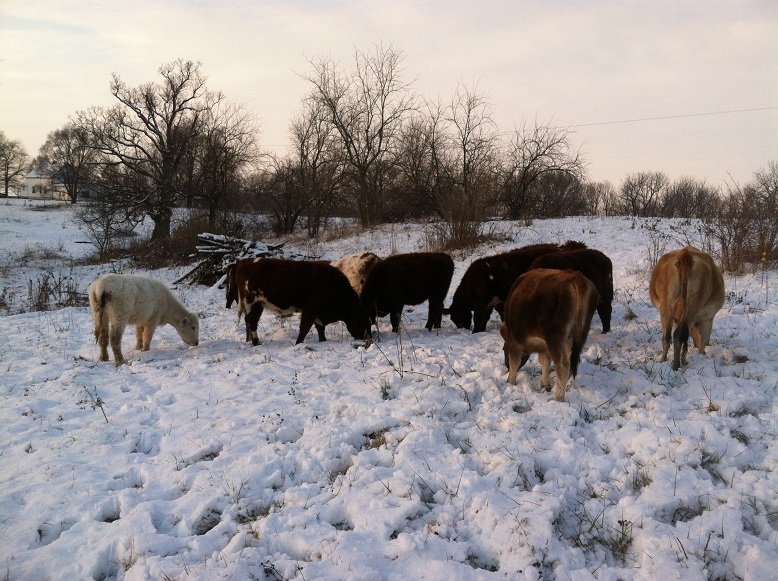
My shorthorns have never had to work for their dinner in the winter. I mean, it’s one thing to put them out on the frozen ground and ask them to clean up orchardgrass and leftover alfalfa. It’s another thing entirely to ask them to bulldoze through 6″ of snow to graze the grass beneath. Worse, we asked the cows to break a new trail across the pond dam and meander to the barn to access their new pasture. We rely on the Jerseys to move the herd. We opened up a new path and showed it to Flora. She led the way. Cows were moved. No pushing, no hollering, nobody got angry. We just let the heifers follow another cow. She knows what to do. No big whoop.
Same deal grazing in the snow. The shorthorns don’t seem to know what to do. Again the Jerseys knew the drill and they led the way. Well, one of them led the way. The other follows in our footsteps. Literally. She eats where our feet revealed the grass beneath. The Shorthorns figured it out quickly enough and soon cleared and grazed large areas of the pasture.
This ground hasn’t been grazed since late July. Last I checked there was 14-18″ of fescue standing as well as a good mix of radishes, turnips and the remains of summer forages like sudangrass. Hopefully this will give us some relief from feeding hay. Three days last week we fed two square bales/day among the 10 cows. I know that’s not much but I’m not happy about it anyway. According to our hay pile, we have to do better.
The cows are in the SE corner of the field where the water supply is (a narrowed and compressed #24 from this post). Here’s the same picture from April of last year after we let the horses graze it to the nubbins. Compare to the picture above to notice how much brush grew back in 8 months.
We made a narrow strip running to the North. Next we’ll open up a strip to the west a little at a time, not restricting access to places the cattle have already grazed. I know this will allow some concentration of nutrients but it will also allow the cows to pick their winter shelter and access the water supply. So, yes, I’m lazy.
The winter shelter thing was a recent comment from my father…his concern was that strip grazing wasn’t allowing the cows to find the place in the pasture where they are most comfortable during a storm. As we move them around they have usually access to the leeward side of a hill or just to a comfy spot under a tree…especially when a storm is brewing. We try to make sure there are a variety of options in each section for winter grazing. Summer grazing has its own list of considerations (shade) but winter is more about shelter from wind than about keylines. Also, I have to balance cow comfort against winter feed requirements and future pasture productivity. The cows are the tool, not the target. I think there is a middle ground that suits everyone’s goals. Happy cows, healthy pasture, even manure distribution, lowered (or eliminated) hay requirements. That’s what we’re shootin’ for anyway.
The snow should melt this week making things easier for the moos. How’s grazing at your place?
Matron mentioned chopping ice in a recent post. We chop ice too.
It is no use trying to drag hoses 1/4 mile across the pasture to where the cows are strip grazing. The hoses are frozen. I do my best to lay them downhill on South-facing slopes but when the high temperature is 25F, ice tends to build up. The best you can hope for is a big buildup of ice at the end of the hose you can work out with your pocketknife. But odds are, somewhere along the way, the ice froze in the hose and caused a buildup before it could run out. So we chop ice in the pond.
I go out onto the pond where the water is at least 18″ deep and cut a hole in the ice. At this point the ice is a minimum of 2.5″. Not thick enough to trust but thick enough to get the job done if I stick to the shallows.
I cut a hole a little larger than the dimensions of a bucket laying on its side. Each chop sprays ice or water at my face. It’s always a good time to come into the house with ice caked into my beard. Almost every bucket brings up pond moss and it is not uncommon to scoop up bullfrog tadpoles too. I try to put those back.
Then I make the short march back to the trough with 10 gallons of water in my hands. 8 trips later, I’m done. Julie puts in a couple more buckets in the afternoon then in the morning I chip out all the ice and dump out the remaining water to start fresh again.
We were letting the cows water themselves at the pond but we found they are wary of the ice at the edge. Letting the cows get their own water is far easier for all parties involved and would necessarily be the solution if we had more cows on winter pasture. But we don’t. And this works.
In another week or so we’ll leave the alfalfa field and go to the fescue stockpile. There is a newly-installed spigot in that pasture. WHEW! After that? I dunno. We’ll start the cows up by the cemetery and work our way through the triangle and through the bottom. Hope the pasture lasts!
The pigs are much easier. They have a big water tank sitting on a mountain of compost. There has been a film of ice at the very top of the water. Otherwise, the compost keeps the water running.
I think the white calf is OK. She’s not as runny today as she was yesterday. Still a mess though. She is kind of a downer calf anyway and is always lagging behind the group or squeezing under the fence. I don’t hold out much hope for her genetic future but we’ll see.
The wide jersey pointing her rear our way was runny last week. I have to wonder if I’m not pushing them too hard…trying to stretch pasture too far. Maybe some of the cows are getting insufficient nutrition. Or just an imbalanced diet. Julie and I put out a bale of alfalfa and a bale of grass hay this morning. 7 of the cows got to work on the grass while the other three started on the alfalfa. The white calf ate grass hay from one pile, then ate grass hay from another then ate a little alfalfa. We try to let them medicate themselves. I just have to make what they need available to them. The next section of the field we will strip graze has a good mix of grasses and legumes. Should be better for the moos.
I took the day off Thursday to do some hunting and catch up on some chores. I haven’t been hunting yet. Oh well. I’m a lousy hunter anyway. I am also trying to teach my right hand man to back up a trailer. We’ll need a few more sessions. Power steering would help.
Otherwise, cold day. The heavy snows went south…for now. Good day to do some housework!
My apologies to the show Heroes for my choice of title. I never saw the show but the marketing still found me. Give that marketing firm a raise!
I read a lot of Ambrose Evans-Pritchard’s work as I read economics information on “the internets”. You know, a man has to have a hobby. I read about global economics for fun. Seriously, if you pay close attention you’ll be in stitches. If it helps, begin by understanding that the world’s financial experts are all idiots. Pretenders. They have no real insight into the future they rarely grasp the present and they learn nothing from the past. But, since they have some prestigious degree, they think they can tell us how to improve – even save! – the world with (…get this…) interest rates. LOL! I guess if all you have is a hammer…
Anyway. Mr. Evans-Pritchard published an article about dirt. Well, he published an article about a published article about dirt. And I think it’s worth reading. Kind of a validation that I’m moving in the right direction…but not fast enough. Further, he points out that we, as humans, have a tendency to prefer instant gratification over delayed…or even deferred. I mean, we could have acorns for the next 50 years but I need an oak board now. I could avoid diabetes and keep my feet but I really like pie. We could have savings but there is so much cool stuff to buy. We could have had cedars in Lebanon but we needed a desert. We are a short-sighted species. Ripping the soil gives us an immediate boost in fertility…though at the expense of future fertility. “Well, we’ll figure out tomorrow when it comes.”
Now that I have agreed with him let’s look closer at what Mr. Evans-Pritchard actually wrote. I mean, I kind of just picked out the points that make me feel vindicated as I initially skimmed the article. How does he really feel? I think he’s a little confuzzled. How about this quote?
It comes as China and emerging Asia switch to an animal protein diet, replicating the pattern seen in Japan and Korea as they became rich. As a rule of thumb it takes 4kg-8kg of grains in animal feed to produce 1kg of meat.
What kind of meat requires 8-16 pounds of grain per pound to produce!? It doesn’t take any grain to produce 2.2 pounds of beef. Or lamb. Or goat. What about fish? It takes 3 pounds of grain to make a pound of pork on a production hog floor but you can reduce or eliminate that if you park your piggies under oak trees, chestnut trees and apple trees. They also do well on alfalfa and a healthy dose of cow manure. I mean, his article is essentially about how modern row cropping is destroying the earth and goes on, in the quote above, to say that we can only feed animals with additional row cropping. And that, we have established, is bad. So we have to do more row cropping to feed the world grains. And that, we have established, is bad.
But why not just let the cows eat grass? Make beef the new chicken. Close up shop on all those Arkansas chicken houses and twelve-thousand sow farrowing operations in Manitoba. I am suggesting the issue at hand isn’t simply the lost of soil biota brought on by tillage and chemical death but, instead, our continuing use of the wrong paradigm. Stop taking feed to cows. Take the cows to the feed. Ta-da! Stop buying eggs at the store. Keep a few hens and feed them kitchen scraps. Ta-da! Use tree crops instead of annual crops. Make our Coca-Cola with high-fructose chestnut syrup! Ta-da! Just give your HOA the bird and get some chickens. See how easy?
The UNCCD is aiming for a global deal to achieve “zero net land degradation” from 2015, mostly by replanting forests. The body’s environment chief Veerle Vanderweerde says it is not going well. “We know what to do to restore degraded land. It’s not impossible but it takes time, money, dedication, and political will, and there is not a lot political will.”
Where to begin? Political will? I think that means use of force. As in, “we have the guns so you do what we say.” Remember this passage?
Yacouba Sawadogo, “the man who stopped the desert”, began to revive the ancient zai technique thirty years [ago] to stop soil erosion on his little farm in Burkina Faso. It involved digging small holes and filling them with compost and tree seeds to catch the seasonal rains, recreating a woodland of 20 hectares in the arid Sahel. Sadly, local officials then expropriated the land.
So much for political will. Time? Money? Dedication? Whose? If we elect some bonehead to fix our problems…well, I don’t have high hopes that our problems will get fixed. In fact, I have centuries of evidence that our problems become worse as governments become more involved. I don’t need regulation forcing me to set aside forested land as magical and protected so we can have a “net zero land degradation.” We need massively net negative land degradation. And this is something we can do on our own. No guns election required! Stop ripping soil and leaving it bare and exposed for 6-7 months each year. Instead, grow cover crops, graze livestock, rotate polyculture crops through. If you have the time, Gabe Brown has a lot to teach us on this topic. He talks about “speeding up biological time” and says, “Feeding 9 billion people will be not be any problem whatsoever if we change our production model and focus on soil.” I feel he backs up that bold claim.
We need the freedom to do the things that were traditionally done before 1950 but leveraging modern technology and new ideas. I need to be free to combine livestock, wildlife, trees, people and time in a carbon-sequestering, soil-building, sustainable and profitable mix. The money will suddenly appear so Mr. Elected Bonehead can have his pound of flesh. Check out Mark Sheppard’s book for a real life example of regenerative forested agriculture. (I could list any number of books that illustrate this well but Mark Sheppard is high on my list. I mean, who can resist a guy who has the …stuff… to lecture for two and a half hours then pull out a guitar to sing a song at the audience?)
Back to the point, there is no need for political will to do this. We don’t have to elect leaders to point guns at us so we will behave. We already know what to do. If you don’t I hope you are sitting down for this. It’s utterly profound. Stop looking at “them“. Stop blaming “them“. What are you doing? How are you saving the world? Where do you buy your food? What system do you vote for each day? We don’t need people signing petitions against industrial ag. What a waste. We need consumers educating themselves…involving themselves. Just go – you yourself – and purchase products from farmers who care about soil health. Farmers who don’t saturate their fields with chemical death. Farmers who enhance life by composting and growing food and building healthy soil. We need agricultural pioneers finding ways to do more with less in spite of existing government regulations and writing narcissistic little blogs like mine about what goes right and what goes wrong. Farmers, not legislators, need your support.
If you are not a farmer (and most people aren’t), find a farm that looks and smells good. Don’t worry about the ugly buildings or the beat-up jalopy in the driveway. Learn what healthy animals look like. Learn what healthy grass looks like (it doesn’t look like a lawn). Look at tree health. Smell the air. Feel the soil. Then invest in the farmer by buying his produce so he can continue to grow.
Patronize a farmer, save the world.
I have a few afterthoughts that really don’t belong in this posting. Don’t worry about peak oil. Peak oil will bring modern industrial agricultural practices to an immediate halt. But not before peak phosphorus brings modern ag to a halt. Unless the lack of humus in our soils enables a drought that brings modern ag to a halt first. There are alternatives. In case you haven’t seen this (how could you have missed it?) I give you this short presentation. May it change your whole life…and through you, the world. Please watch this video. (BTW, note his confession that, as a government agent, he advised his country to shoot 40,000 elephants to “save” the ecology. Made the problem worse.)
I also have to add, if you live near us and are interested in partnering with us in saving the world we can offer you excellent quality and value. If you are inclined to vote, please vote for us.
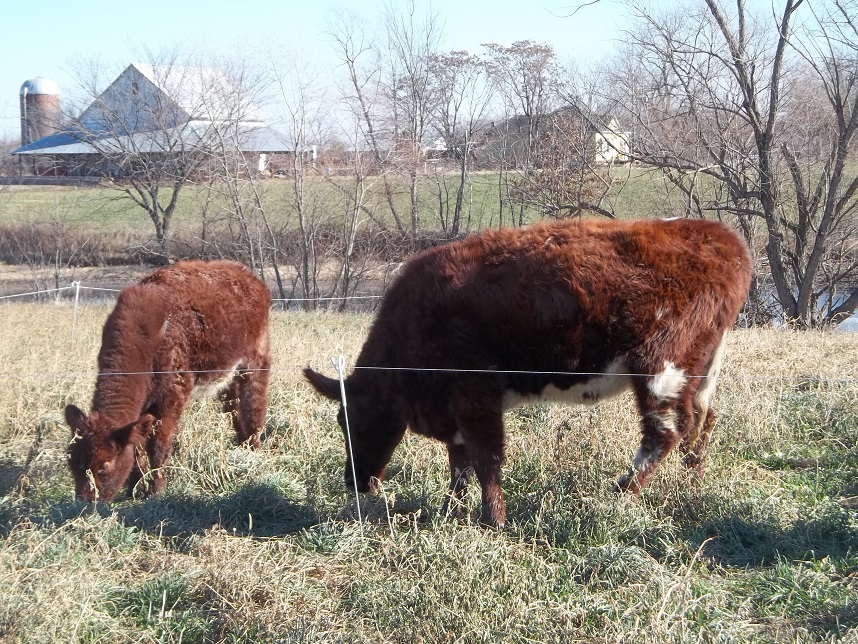
Right now the girls (and boy) are on the alfalfa field. We graze the field in strips 20′ deep and maybe 40′ wide…but really that depends on how much forage is out there. Each day they get another 20′ added on until we run out of field. Then we start at the pond again and munch it all down. Here are the strips in the alfalfa field. The foreground shows the difference between where they have grazed and where they haven’t. I’m letting the cows crop it pretty close.
The cows were lounging and chewing cud when I arrived today but got up immediately when I moved the fence.
The grazing is not their only source of nutrition. I split one square bale into two piles early each morning. Initially I was doing this because the alfalfa was still fresh in the field. I wanted the cows to have a bulk of dry matter before they could eat fresh alfalfa to prevent bloat. Now I do it just to stretch my field and put more manure down. I could put them in a feed lot and just feed them hay but I think they are better off with a bit of fresh greens daily. Besides, this way I don’t have to haul manure.
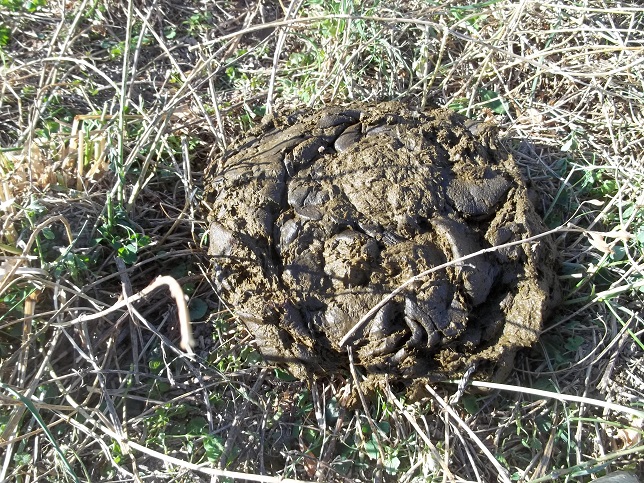
Speaking of manure, this is looking a little on the dry side:
But this one is looking a little better. Note the one above looks a little crumbly and there is a depression in the one below.
I don’t want it to pile. I want it to dip…but not drip. Their manure tells me if they are getting enough protein in their diet and tells me a fair amount about their overall condition. For the most part things are looking good. Anywho. That’s probably enough talk about cow manure.
Half of my farm is still standing stockpiled and waiting for the cows. Good thing too. Hopefully we’ll wrap up the alfalfa field by mid-December and begin on the real stockpile on the hill they haven’t grazed since July. That will clear disemmemberment hill for sledding later in the winter.
There is a long stretch of the year when we can hardly catch our breath. The schedule is booked solid. Chicks arrive in mid-February. The garden starts to go in early in March. Before you know it we are planting a fall crop in the garden, cutting the last of the hay and watching the birds fly South. Every day is long and it seems like we are always behind. Then it is November and you realize you didn’t make an appointment for the hogs. Shoot.
In November the sun rises after I leave for work and goes down before I get home. That’s ok. The cows don’t ask for much from us. There are no chicks. The hay is in the barn. Pigs need very little. We still have a number of projects around the farm but it is time to catch our breath.
It’s hard to take a picture of the cows in the dark but tonight the sky cooperated very nicely. The moon had just risen.
Right now the moon is rising when I’m doing chores at night and still up when I drive to work. It’s kind of nice.
In the distance I hear the constant sound of fans drying grain in bins. It’s like the sound of a car coming down the pavement at speed but constantly in the background. Once in a while I hear a chicken negotiating for more space on the roost. In the center of the picture are headlights from my neighbor’s tractor. He’s doing his fall plowing, even at night as we are expecting some weather in the next two days. The sound of the tractor is hardly noticeable. You have to stop and listen to the world around you.
The cows are at the South edge of the property and can drink from the pond. They congregate under a grove of maple trees near the edge of the pond at night. The grove seems to hold warmth and the pond moderates the temperature change. I would prefer that they sleep and manure uphill but…you know. Cows today. Can’t tell them anything.
So my evening consists of walking in the cold moonlight to check the cows for any signs of bloat and just to say “hello”. Then I check the pigs for food and water, put on my pajamas and park my tookus by the fire. Similarly, my morning is just a walk to the cows and a peek at the pigs. Julie checks water and collects eggs later in the day.
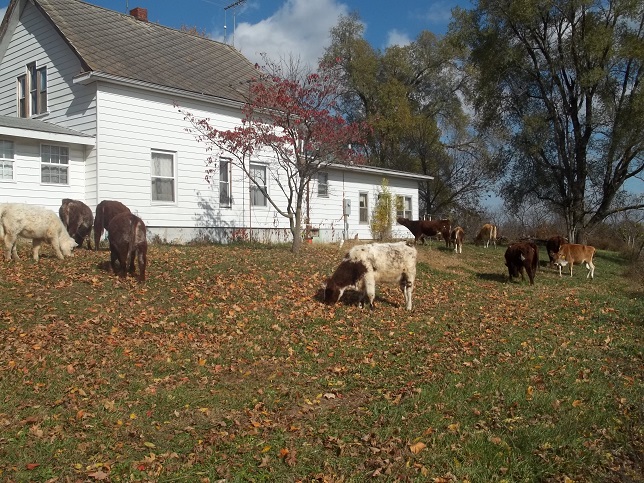
It is important to us that we do things that cause our neighbors to crane their necks as they drive slowly past. Yes, the cows are in the yard. As the world works today, If people don’t think we are weird then we are doing something wrong. I don’t want to be normal in a world of chemical agriculture and chemical lawn maintenance.
I had to give a very large area to the cows because the grass was short. The girls are also doing a good job of smoothing out some rough places left over from some trenching that we had done in the spring.
We have grazed the slope in three sections from bottom to top. I prefer to start at the bottom so rain doesn’t wash manure onto upcoming forage. We just follow the keylines around the farm as much as possible. The fence pictured above does not follow the keyline so we just have to work with what we’ve got.
The fun part was when I lit the fire this morning in the back room. I heard a weird noise…like a burp or something…and looked to my right. Ms. White was looking in the window at me. Kinda funny. Ever have a cow looking in your window? Maybe you had to be there.
Fall came a little late but it’s here in force now. We just had four nights in a row of below-freezing temperatures. Now we have to be in the habit of disconnecting our hoses at night and laying them on a slope to drain. An extra chore. Rain is just about to set in so we’ll be up to our knees in mud before long.
This fall cold snap probably won’t last. We have seen 90 degree days in November before. But it’s a reminder of what is coming…and soon. The next few nights will kill the alfalfa and clover as well as the summer grasses. The leaves will begin to fall in earnest.
We have already slowed the cows down, asking them to crop the grass very close on the South-facing slopes. I expect these slopes will have time to put on another 8 inches of grass before the fescue really goes dormant in December but, for now, I want to put down a lot of hooves, mouths and manure in tight pastures…even if we move several times/day. That late fall regrowth will be just what the doctor ordered in April when we are looking for a little pasture to graze. The fescue should come through winter in good shape.
I plan to feed a little hay while we are on this North-facing slope. Roots are shallow here and the plants have a hard time in the blazing sun of July and August. They have fully recovered since the last grazing but the plant population is lower than we would like and, again, root systems are shallow. We are relying on hooves to push waste hay and manure into the soil surface, disturbing the soil and making a nice bed for seed germination as weather allows…possibly in the spring. The hay idea comes from my talks with David Hall. He said he fed 30 days worth of hay across 5 months to make the hay and pasture stretch. We are sort of starting that now…at least, right here where the pasture is poor. Grazing in tight areas, moving daily, feeding a little hay in the morning…about 1/10th of the dry matter a cow would otherwise need.
That all sounds nice. We have a plan. But it is not without its problems. Shorter days, colder weather, hose management, extra bedding for pigs…nothing life-altering but many small extra chores with fewer hours of daylight causing problems.
We spread our compost on the winter stockpiled pasture a few weeks ago (Sep. 9th). The compost pile was the end result of offal from 1,200 chickens, 3 pigs and a goat along with a year’s worth of humanure and kitchen and garden waste. That pile was built over the course of a year then aged for another year. At the end of that time my eldest son and I shoveled it into the manure spreader sifting out bits of trash (string, bag tops, wire and one pig skull) then I spread it on the fall stockpiled pasture. We spread the compost to help boost fall fescue growth as well as to help innoculate the soil.
Isn’t it interesting that the first step toward building healthy soil is to increase the soil bacteria? Kinda makes one rethink using anti-bacterial soap. The compost spread in a thin layer across a couple of acres. If things go as planned, I’ll get the pigs moved and I’ll spread another layer from that cow/pig bedding on the field as well. Not only will it give the stockpile an extra kick of growth, it will help the stockpile tolerate the cold weather. This practice was emphasized in several books including Salatin’s $alad Bar Beef but also by Stacey last year on her blog. Thanks for the reminder Stacey!








 Chism Heritage Farm