Interview With David Hall Part 2

Last time I wrote about a conversation I had with David Hall about recognizing the cost of raising a heifer calf.  She will have to throw her fourth calf at age 6 to pay for her own development.  This is no small feat as heifers are still growing themselves and gaining molars…without which, it’s hard to fully chew their cud.  That first calf is hard on a heifer as she has to provide milk for a growing calf while retaining/regaining condition so she cycles in time for her next pregnancy within a defined breeding window.  Without those molars, she faces an up-hill battle.  Now, I have heard Kit Pharo toss this around a little bit suggesting if we’re ever going to forgive a cow for coming up open it’s when she’s due for a second calf…but he hasn’t done that in practice, he just suggested it might pencil out.

That math makes sense but why bother raising heifers when I can buy bred heifers?  Either way somebody has to pay those heifer development costs but maybe I can save myself some labor if I can find replacement heifers of the same quality.  While it is possible to buy in heifers a little cheaper than I can raise them, it’s a little bit of a gamble genetically.  David said, “If my own herd genetics are good enough I can afford to spend more on my own heifers than taking a chance on new genetics.”

So, what is it we’re looking for when we are shopping for a long-lasting heifer?  Well, here are the herd requirements David listed on his first slide in the presentation:

  • Fit the environment (Adaptable)
  • Calm
  • Calving Ease
  • Fertile
  • Longevity
  • Low Maintenance Requirements

David started his presentation in February by showing a table of relative values comparing a business based on yearling sales to a feedlot.  According to the chart (which I believe was cited to a research company and I’m unwilling to republish), reproduction is 10x more important than carcass quality for yearling sales.  If you are in the business of selling calves, you have to have calves to sell.  The detail below should help us find stock that will work for us, delivering and weaning a calf year after year but keep in mind, fertility is the top priority.  So let’s look at the criteria in detail, though I think you’ll find the details overlap considerably.

Adaptable:
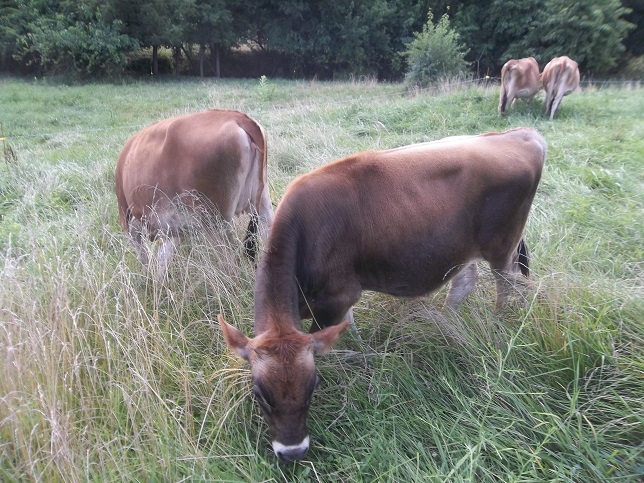
“Be sure to breed to bulls who have a proven record on fescue.  Get a bull that is well adapted to your environment.”  If I have 25 cows and one bull, that bull makes up half of the genetic makeup of the next generation.  Picking the right bull matters and the consequences of a poor choice will impact the operation for years to come.  For example, I want a bull that is slick-haired as the shaggy cows (Ms. White) don’t perform as well as the slick cows (#111) on hot days in July.  Even better were the Jerseys who got slick in April or May in spite of cool weather and continue grazing when the heat index is above 100.  I feel that it is important to select within my herd for shorthorn genetics that are still out working alongside of the Jerseys.  Those Jerseys are the benchmark.  I have a couple of cows I can usually count on to be out there working on a hot day so I’ll tend to favor their offspring in the coming years.

Bull1

Disposition:
“Cull out ornery cows and bulls.”  As an inexperienced cow owner (I’m not a cattleman.  I’m a cow owner.  Maybe in a few years I’ll graduate.), it is easy to confuse ornery and nervous.  There is a difference between the cow that wants to eat you and the cow that is afraid of you.  Ms. White was terribly skittish when she first arrived and when she saw us it was time to run…and all the cows went with her…right through the fence.  I thought we were going to have to invite her to leave.  But, after a little while, with a few changes on our part, she fell into the routine.  She hadn’t been in as close proximity to humans as she necessarily is on a daily basis with our daily grazing moves.  She has to walk right past me every day now and is doing fine.  That said, she does tend toward excitement and we want cows that tend toward calm.  Hopefully she’ll give us steer calves each year.  Looking at cows as employees David says, “if the employee has a bad attitude she needs to be fired.”

Calving Ease:
If I pick a bull that throws heavy birth weight calves, I’m breeding heavy birth weight into my herd.  I don’t want to spend my spring camping out with the herd and pulling calves.  I want to sleep in my soft, comfy bed, get up early and head out to the pasture with a camera to take a picture of the new, live calf on the ground…a calf that was born without any interference from me.  If I am selecting for cows that bring a live calf in for weaning each year I have to be careful to do my part by stacking the deck in their favor.

Fertility:
We need a heifer that cycles three times before we introduce the bull at 15-16 months.  We need her to settle, not just the first time but also (and more importantly) on her second pregnancy.  Finally, we need her to continue to get pregnant every year, on time and bring a live calf in at weaning.  “View your cows as employees.  That cow’s job is to put on weight and bring in a healthy calf.  Any employee that doesn’t work gets fired.  No calf?  Fired.”

David says he breeds in the fall (more on that another time) from December 1 – January 15th.  “A short, defined breeding season will push [the herd] forward faster than anything you can do.”  However, a bred cow is worth more than an open cow so he DOES leave the bull in after January 15th.  “Leave the bull in to breed cows that are late BUT sell any cow that did not breed in 45 days.”

Finally, he points out that “there is a strong relationship between age of puberty and longevity.”  Cows that are late to mature don’t tend to last in the herd.

Longevity:
As we looked at last time, “Cows must be 6 years old and rear 4 calves to pay for her development costs.  Optimal economic return is in  years 8-11 for commercial cow/calf operations.”  So a 6 year-old cow has broken even.  I need more than 4 calves out of her to make money.  If she misses throwing a calf within a defined window she gets fired.  If her attitude is poor she gets fired.  If I have to pull a calf, she probably gets fired.  The odds are against 90% of the cattle in North America but without this culling we’ll go broke pampering our tea cup cattle and servicing the equipment required to pamper them.  That means a short, slick 14 year old cow with a good attitude has thrown 12 calves, year after year eating whatever there is to eat on my farm, with a little bite of salt and mineral.  Any cow that can do this has just the genetics we’re looking for in our future herd and continues to impact our herd genetics positively over time.  Any cow that can’t will be fired before she makes much of a genetic contribution to the herd.  Any bull I select for my own use MUST come from a older cows as that predisposes future generations for success.

Low Maintenance Requirements:
I just touched on this but if she is fertile and long-lasting she obviously doesn’t demand much from me.  I need thrifty cows.  Because much of my forage base is fescue, I’m looking for short, barrel-shaped, light-weight cows.  Hall said 70% of a cow’s feed is used to maintain condition.  A 1,700 pound cow has to eat much more feed to maintain condition than does a 1,000 pound cow.  There are only so many hours in a day.  How many pounds of forage can a cow ingest and ruminate on each day?  To be direct, a heifer that is weaned above 600 pounds won’t last.  The cards are stacked against the big cow in a forage-based operation.  111 stays fat no matter what.  Notice how wide her mouth…it’s as wide as her eyes.  Maybe wider.
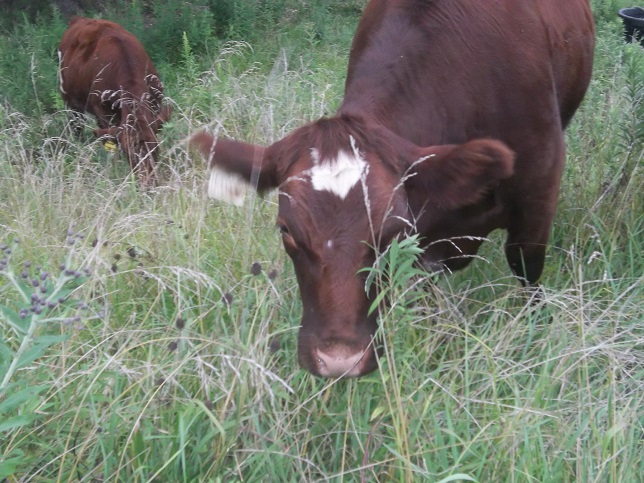
111

So where do you find these cows?
I wish I knew.  You need to pick a bull based on his mother and her production numbers.  How many calves has she thrown.  How big were the calves?  How big is the mother?  How old is she?  When looking for heifers from within our herd or when buying outside, look for calves that weaned below 500 pounds.  We’re looking for a 4-5 frame score.  Again, big cows have to eat more to maintain condition.  Small cows are hard to market.  I could probably run 2-3 Dexter cows per acre on my farm but what feedlot wants to finish out Dexters?  I have to find the middle ground between what the market demands and what is profitable to produce.  They can’t be too big, they can’t be too small.  Hall says to sell the extremes.  Hall also pointed out that crossbred cattle tend to have better longevity.  That’s something to consider when buying stock.

Over time there are things you are watching for in your herd.  Cows should be feminine but we’re looking for function, not beauty.  A cow with a rough hair coat should find work elsewhere (I have a couple of these).  A cow with bad feet or a bad udder should go down the road.  Too big or too small?  No calf this year?  Poor attitude?  Prolapse?  Down the road.

This kind of selection doesn’t require much of the manager.  It comes back to the three O’s (which are really two O’s); Old, Open or Ornery.  The old cow will eventually come up open, weather from loss of teeth, bad joints or whatever.  The selection process is hard on herd numbers early on but success breeds success…literally.  In a few years…decades maybe – a picture of our cows will feature less leg than this one both from change in genetics and prenatal response to conditions and management.  Really.
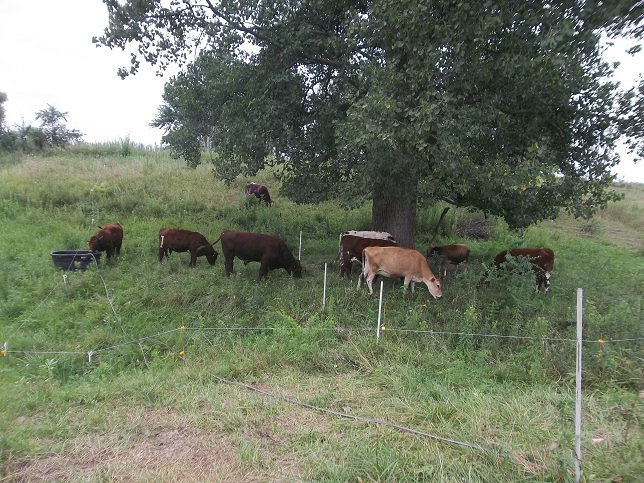
GroupPhoto

In part 3 we’ll go a little more in-depth on ideas David has for making the operation profitable and ways to smooth out the highs and lows of the cattle market.

Interview With David Hall Part 1

I heard David Hall of Ozark Hills Genetics speak at the Southern Indiana Grazing Conference last winter.

I was thinking about his presentation and reviewing my notes and needed a little clarification so I shot him an email.  This started because I’m working on the economics of each of our enterprises trying to answer a simple question: Would I be better off financially living in the suburbs?  I don’t work for free and I certainly don’t want to pay my livestock for the privilege of owning them.

I asked David:

I heard you speak in Indiana this spring and you said, “Cows must be 6 years old and rear 4 calves to pay for her development costs.  Optimal economic return is in years 8-11 for commercial cow/calf operations.”

I’m hoping you can give me a little more detail on that.  Spell out for me what you believe it costs to raise a replacement heifer on grass, when you sell her calves and what your expected return per calf is.  Also, how much should it cost a grazing operation to keep a cow each year?  This article suggests $350 per head but I have a hard time with that math.

Rather than reply to my email, which he said would require him to write a book, he asked me to call him back.  Over two phone conversations and nearly an hour of chatting I ended up with 5 pages of notes on top of the 5 pages of notes I took during his presentation.  (Talk about a generous man!)

He was ready when I called and, after greeting me politely, started right in.  “Cost is wildly different between ranches but you can roughly figure $500-550 for every weaned calf.  This counts salt, mineral, vet, medicine, land charge (calculated on how much it would cost you to rent your neighbor’s ground) and how much time you spend.”  Obviously packing more animals in per acre without raising your feed bill is a good thing and spreading your time across more animals helps with the labor charge, not to mention discounts for buying salt and mineral in volume.  Labor is the big expense and reckoning the rest of the data as closely as I can I come up with $450 to keep a cow each year.  Since some percentage of cows are going to come in without a calf at weaning that price should go up but let me be a little lazy in this post.  We’ll stick with the $500 figure for my farm, you calculate your own for your farm.  Feeding hay can really ratchet that annual maintenance up.

That takes us to point of weaning.  Now that we know what a calf costs, let’s find out what she’s worth.  Right now, that 450 pound weaned heifer – that cost us $500 to raise – is worth $2/pound.  That varies by year.  So, any heifer we keep this year should be reckoned at that price and we should work from there.  Think of it this way, you could have had $900 but you got this heifer instead.  It costs money and time to raise and maintain that heifer and it costs something to breed her…either by bull or by straw.  However, not all heifers breed so you need to reckon your heifer costs by the group.

Hope you’re keeping up here, David was moving pretty quickly.

Let’s ratchet up the cost of that heifer.  You ready?  I’ll relate David’s example.  Of a group of 30 heifers, 25 settle in your breeding window.  Of those 25 pregnancies, 20 wean calves.  Of those 20 heifers that brought in calves, 17 re-breed.  Those other 13 heifers don’t fit our program.  My cost per heifer is not reckoned per head…it’s divided over the 17 that were successful at breeding a second time.  If that’s too harsh for you, Chip Hines says to measure profit by the calf across your entire operation but when talking to David, I was specifically talking about development costs of a heifer.  He took it through the second pregnancy.  As time passes and you select for thrifty, fertile, long-lived cows you’ll have a higher rate of success weaning calves but you should probably count on culling 10% of your herd each year.  For the sake of simplicity, let’s pretend those 17 heifers are built to last in the example below.

Starting at the beginning (where else?) you are paying $27,000 for 30 weaned heifers..maybe 6 months old.  You find a quality bull and pay $20 per head ($600) to have them bred at 15 months so they will calve at 24 months.  I’m choosing not to buy a bull to keep total costs at a minimum.  A bull eats every day, I need one for 6 weeks.  We could have started with 30 bred heifers for $45,000 which might be worthwhile if they were high quality animals.  More on that next time.  Keeping those 30 weaned heifers for 18 months (until calving) costs you another $22,500 but when you breed again you are down to 20 cows (the ones that calved).  The rest were sold as springing heifers who missed your breeding window or as open heifers.  Let’s say you can sell them for $1,200 each ($12,000).  After all of that we sold 20 heifer calves ($900 each) and 10 grown heifers for a total of $30,000 and it only cost us $50,100 to do it!  The heifers owe us $20,100.

But we have to breed our 20 remaining heifers.  That’s another $400.  17 of those breed in our window but we carry all 20 through the year.  Our cows only owe use $10,000 for maintenance this year.  We sell the 3 late breeders for $3,600 and sell our 17 calves for $15,300.  This year we’re doing all right making $8,900 so the cows only owe us $11,200.

When those heifers (all 17 of them) drop their third calves (in our fictional scenario) we’ll see another $15,300 with breeding costs of $340 and maintenance of 8,500.  We’re looking at $6,460 in profit as long as we can keep this thing running.  This year the herd only owes us $4,740.  Looks like the heifers will pay us back next year!

That’s why David says it takes four calves for a 6-year old to pay for her own development.  “Optimal economic return is in years 8-11 for commercial cow/calf operations.”  If she falls out at 6 years old we haven’t gotten ahead.  Every year she calves after 6 increases the desirability of her offspring.

The cattle market is a wild ride at times…who knows what the price will be next year.  Along with keeping my production costs minimal, I have to work to provide a quality product so I can make the numbers listed above.  I don’t think Gordon Hazard is paying $2/pound for calves, but he’s not buying calves of the quality under discussion here (small, British breeds, grass-genetic, long-lived).  We have always believed that it costs just as much or more to maintain a poor cow compared to a good cow but Hazard looks for the undervalued calf of any class, gets it to feedlot weight and sends it down the road.  We can’t sell into that market with the numbers presented above.  From what David described, he sells a fair number of culls and calves into the commodity market but sells 150 bulls each year for breeding stock to help make the numbers work.

Any business you start will require an investment and several years to achieve profitability.  A cow/calf operation is no exception.  Is it right for me?  My pastures are currently pretty poor quality.  Cows can get by on less than stockers…requiring a lesser quality pasture.  Right now, cows look like a good way to improve my pastures…but the climb to profitability looks pretty steep.

That wraps up most of page one of my conversation with David Hall.  Next time I’ll share my notes about buying or breeding genetics in your herd, stock selection, adding in other livestock types and keeping a job in town.  Let me know if you have any trouble with my math or if you have any questions or suggestions.  I want to emphasize, my goal here isn’t to discourage the raising of cattle.  I’m sharing my thoughts and research as I analyze the costs and work to put my farm and my time to its best and highest use.  You know…stewardship.

A Fair Amount of Bull

We bought our heifers from Moore Shorthorns in Jerseyville.  They also have a grass-raised, red, slick, small-framed (4-5), young, calving ease shorthorn bull.  Try saying that three times fast.  He’s fairly light and has good conformity.  He came from another nearby farm and, more than anything, he was raised on grass.  We asked if we could use him…for a small fee.

Bull1Tom delivered him Monday afternoon and he instantly detected that Flora was ready for service.  We had no idea.  No sooner was he unloaded than he was hard at work.  Well, here’s to hoping for a Shorthorn/Jersey cross.  Hope we get a bull calf….mmmmm…steak.

Bull2His disposition is good.  He doesn’t seem to mind us being around but we are still mindful of him.  He’s so busy chasing girls he doesn’t seem to notice us but we still keep an eye on him.  6 weeks from now he’ll go home and we’ll be back to our normal routine.  We’ll also get our two new additions at that time.  This little heifer:

RedHeifer

and this one:
WhiteHeiferBoth are small heifers compared to the rest of their graduating class, weighing 450 pounds at weaning.  I expect them to be 4 or 5 frame cows.  Tom had a giant shorthorn heifer that just won grand champion at the Madison county fair and will probably win again.  She was at least a 7 or 8 frame heifer and she’s due to calve in September.  I let him know I’ll soak up the smaller calves he produces…all high quality animals, just smaller-framed (In a grass operation, a cow has to eat a percentage of its weight.  That’s obviously easier if they are smaller.).  Tom’s show calves tend to be sold or selected the day they are born so I don’t even see them.  Really, Tom picked these two out for me ahead of time knowing what I’m looking for.

Hopefully this bull will throw small calves and, hopefully, the calves will be pre-adapted to performance on my pastures.  A few generations from now I should have just the cow we need.  Weather red, white or roan….she just has to be small.  Truth be told, I’m partial to red.

What’s This Stuff For?

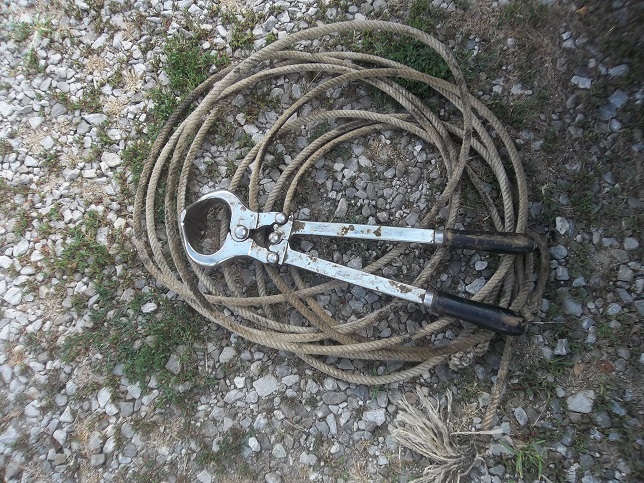
“What’s this stuff for?” my kids asked me.

RopeAndClamp“Well, Freezer was not a vigorous young calf.  We don’t want to allow him to become a bull.  So, today we’re going to make him a steer.”

I held the rope.  Julie held the tail up.  Steve used the clamp.  The kids got their answer.

Freezer went back to the pasture to be near mom.  Really not a big deal.

FreezerFreezer should turn a lighter color again soon.


Grazing From Now Until August

On or around August 1st our borrowed bull will arrive.  Between now and then I have to plan my grazing through my reserve grazing area.  Our heat-sensitive heifer needs us to plan for shade.  Our Jersey cows need to be AI’d before the bull arrives and we have to have the cows away from the perimeter fence so the borrowed bull and the neighbor’s bull don’t try to duke it out through barbed wire.

With me?  Lots of planning to do.  I need 15 or so days of grazing then I need to return to the top of the hill under the walnut tree where we can keep an eye on Mr. Bull.

Here’s the plan in picture form with thanks to Google Maps.  The projected (planned(hoped for(please God!))) dates are listed on the map in the order they will be grazed.

GrazingPlanWell, that’s the rough plan anyway.  Now, I’m not following keylines.  Well, I kinda am.  The lines marked are approximations, just giving an idea.  I am a little concerned about 23 and 24 as there is little shade available in those pastures.  I will probably give them access to 22 for 3 days so they can find refuge from the sun, though I am concerned about the concentration of manure under those few hedge trees.  Don’t worry that 27 looks much larger than 16, the grass under the pond dam is very poor in quality.  If feed runs short I’ll drop a few bales of hay.  It is important that the cows return nutrients to each paddock even if I have to import them.

If you want to see this area from ground level in winter, check out this post.  For readers of some duration, 17 is what the kids call Disemmemberment Hill“…sledding directly into massive, tangled, thorny hedge trees at the bottom of the hill.  Should be less disemmembering this winter as the cows and I have cleaned it up a bit.  In fact, over time it should become less and less disemmembering as I cut firewood and the cows make the slopes more gentle.  That’s the plan anyway.

At least I’ve got a plan.  To be honest, most of the time we wing it but I’m trying to do better.  Who knows where I would be when that bull gets here if I didn’t try for something.

Grazing, Recovery and Litter

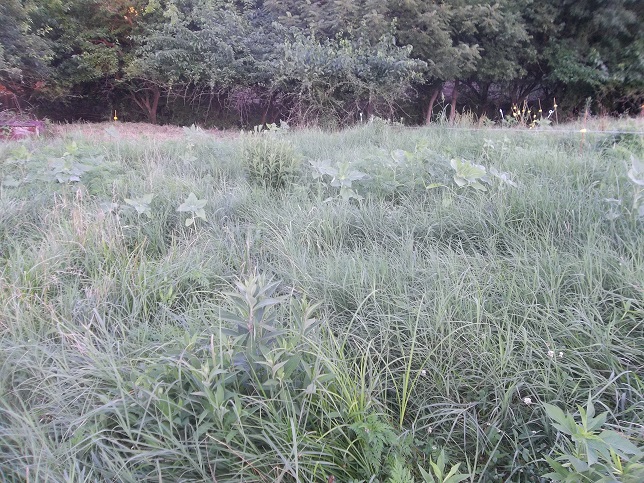
Grass.  How much should the cows eat?  How much should they leave behind?  When can they go back?  And how does litter fit into the equation? They were last grazing this grass 51 days ago.  Look at all the seed heads.

MayPasture15

I let them graze what they wanted and push the rest into litter moving quickly across the landscape.  Today they have returned.  My grazing strategy is largely the same.  The exception is I want a higher utilization of grass to stretch my grazing time longer than 51 days.  We have slowed down.

51DaysLater

You hear grass gurus say, “Let the cows eat the top 1/3rd of the plant then move on.”  What does that mean?  Top 1/3rd?  The grass was about knee-high.  The cows ate some places down to the ground and didn’t touch other places.  They tromped huge amounts of grass into the soil and the ground by the water trough.  How do you measure the top third and convince the cows to graze more evenly?  “Excuse me, ladies.  If I could have everyone’s attention.  Please line up side by side with your heads down and walk slowly through the pasture eating just a portion of the grass in front of you, never returning for a second bite.  Then the grass in front is un-trampled and clean.  You will just have to eat whatever is there.  Please don’t be picky.  Thank you.”

Other gurus proclaim the virtues of leaving litter on the ground to feed the soil.  How much litter?  How much trampling?  How much manure?  Then they tell you not to graze again until the grass has recovered.  OK.  That’s not so bad.  But what does “recovery” look like?  A seed head?  I don’t get many seed heads in December but some of the forage still grows.  What then?  Today I listened to Episode 53 of the Agricultural Insights podcast.  This podcast featured discussion on the 1/3rd grazing, litter and grass recovery questions.  Turns out, I’m not alone in not understanding how to convince a cow to only eat so much plant.  Graeme Hand offered advice (and advises listeners not to take any advice!) on grazing against the top 1/3rd rule.  In short, grass wants to be grazed as that gives it a competitive advantage against weeds and brush and helps it to tiller out into the landscape.  By managing recovery and litter we are progressing more toward perennial grasses and low-risk profitability.  Basically there are a couple of things he wants you to look at but first a summary:

“There has to be a reason to put them in a paddock and there must be a reason to take them out. The reason to put them in is you’re going to make this pastoral grassland healthier by actually coming in there…it’s got good litter, all the plants are recovered… it’s got ground covers, understory, midstory and canopy so that it’s actually got structure, it’s actually got function and then there’s a really good reason to graze it because you’ll actually make it better.  Then you stay there until the animals are starting to say to you, ‘…where our rumens are at the moment and this feed you’ve given us, it’s time for us to move.”(@31:50)

Let’s break it down a little bit.

Has the grass recovered?  Does it look like it has been grazed previously with jagged edges at the top of the blades? (@27:30)  If so, recovery is incomplete.  Incomplete recovery will allow annual weeds to establish and limit the litter available to feed the soil.  This is incomplete (it was grazed at the end of June)

IncompleteRecovery

But this grass, last grazed on May 20 (51 days ago), is completely recovered.

CompleteRecovery1

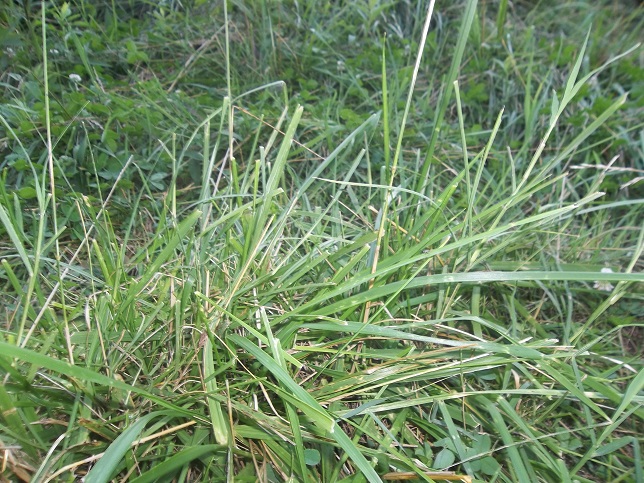
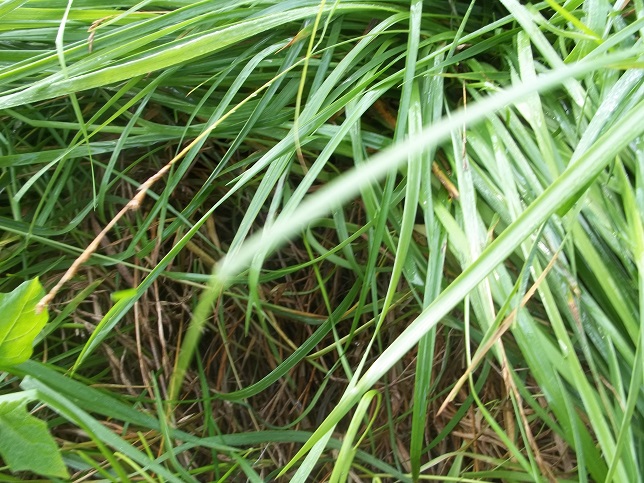
Between the green growing grass and the brown litter you should see a layer of yellow grass that is being pushed down by the growing mass above.  We’re looking for fresh litter since the previous graze (@23:30).  That’s a sign of recovery.  Looking into this stand of grass…well, this laying down of grass…

CompleteRecovery2

We can find some fresh yellow.  We can also see that, though we have plenty of leaves, my plant density is poor.  I need more plants per square inch.  And more clover.  Well, maybe next year.

NewAndOldGrass

Earlier in the podcast Hand said, “If the land has got thistles and forbs and weeds it’s pretty clear that your recovery is too short.” (@15:40)

How do you know what the recovery period is on your land?

He suggests you set up trial areas.  You pack the cows in a test area at proper density and move them off when they are down to the litter.  Then allow that area to recover twice as long as your current rotation.  Maybe do this in a corner of a paddock.  If the rested ground looks better than your other pasture, you should be making adjustments.  Hand feels that the difference will be obvious.  The rested ground may be hard for him to look at because it has gone bad.

“A pasture is ready to be grazed when there is the right mix of feed and litter” (@18:20).  Litter is key. “If you want the land to be not eroding, if you want the land to be infiltrating water, if you want the land to be cyling nutrients…you need very large perennial grasses with decomposing litter between those perennial grasses….if you’re not creating that…then you’re actually not doing what we need to do to get that stable, low-cost, low-risk production.”(@21:25)

CompleteRecovery3

In the picture above, I have more grass here than I have ever seen before.  When we first moved here it was thorny, pioneer trees, thistle and ragweed.  There is still ragweed out there (along with Queen Anne’s Lace) but a variety of grass is coming on thick.  We are moving toward better water infiltration and nutrient cycling.  And check the sunflowers in the background!  They will be eaten or trampled this week.  Oh well.

How much should the cows eat?

Are the cows pushing litter into the ground?  When they are finished you should have a layer of litter covering the soil but the green should be gone.  Remember, we’re increasing stocking density (different than stocking rate) to achieve grass recovery, soil health and to propel desirable grass species forward.  The goal is to provide everything our cows need from a nutritional perspective by providing everything the grass needs from a nutritional and health perspective.  Doing this right puts dollars in our pockets and builds soil health over time.

Litter

More specifically, when is it time to move the cows?

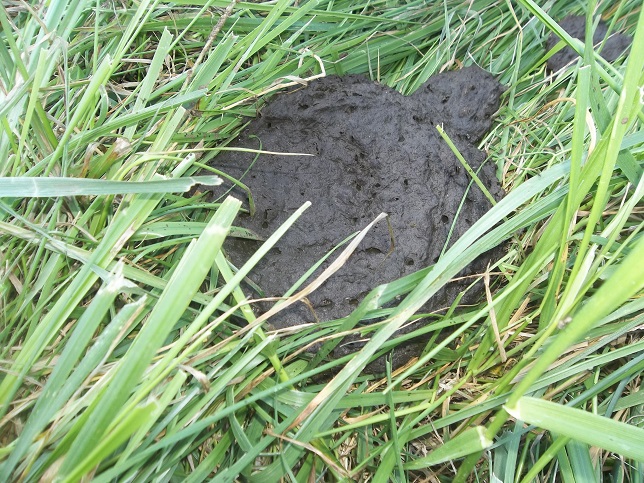
Are the cows eating litter?  “You don’t want the animals eating the soil food.” (@18:30) Is their manure getting runny?  Are their rumens less than full?  Hand says, “We shift them …[when] about 10% of the cows are starting to show slightly hollow on that left hand side, on that gut fill.” (@31:00)

Molly

As long as they’ve got good gut fill, good dung scores and they’re not eating the litter he leaves them there.

DimpledPid

The best thing he said (and this is a paraphrase of multiple quotes) was that incomplete recovery may push the cows to perform better but will, ultimately, bankrupt the operation by impoverishing the soil.  Second to that was his advice to test your own results, not listen to gurus.

BTW, I highly recommend the Agricultural Insights podcast.  Chris Stelzer is really putting together some good shows.  Unfortunately, my carpool doesn’t always want to hear about feeding grass to cows…or milk to dirt…or…

Hot Day, Almost a Bad Day

Well, the good news is no cows died.

We had a hot cow early Sunday afternoon.  She was standing with her tongue sticking out and mountains of drool falling from her mouth.  Heat stress.  How did this happen?  She was standing next to a water tank that was half-full.  The other cows were lounging in the shade.  What on Earth!?

As an immediate fix we moved the cows under a tree and filled a water tank with fresh, cold water.  Then we hosed the hot cow down with cool water.  It didn’t take long and we were out of danger.  She took a good drink of cold water then another.  Ultimately she lay down in the shade with the other girls.

OK.  What went wrong?  We had the cows up for milking…normal thing.  The night before I asked them to mow the driveway.  They obliged.  The next morning I thought they could mow out by the mailbox for me.  They were delighted.  4″ grass and clover mix must have been what they dreamed of.  Then, to top off the tank, I let them graze the ditch.

After the emergency passed, I came inside to fully research what I did wrong.  Turns out, that high-protein grazing early in the day mixed with increasing temperatures was a recipe for disaster.  Good thing they were up by the house!  This PDF provides a good summary of signs and causes.

The cows were stuffed to the gills just as the day got hot.  The full rumen was limiting lung capacity.  The heat of fermentation was compounding the problem.  Plus, this is a heifer who hasn’t shed her winter coat out well.  Greg Judy says that’s grounds for culling.  I think she needs another year as I basically took her off of hot feed and threw her on pasture in April.  She may just need time to adjust nutritionally.  As long as she doesn’t come up open…

So.  We are now introducing the cows to fresh pasture in the evening, moving once/day.  I’m also checking to be sure there is shade available in every paddock.  Consequently, some ground will go ungrazed for the next 4-6 weeks and we’ll skip around on cool days.  Today was 97 degrees.   Two days from now they are calling for 85.  Skipping around will get us through the worst of it.  I’m glad I have pasture in reserve.  I’m glad I bought several extra water tanks.  I’m glad I didn’t cut down all of the hedge trees out there.  I’m glad I under-stocked my farm leaving me with options to handle heat stress and inexperience.  Unfortunately, the cows are translocating nutrients from the top of the hill to the bottom of the hill, where the trees are.  That’s not desirable…but we’ll work with what we’ve got and plant more trees in coming years.

Two other notes:

  1. The neighbor’s cows are all pretending to be hippopotami to deal with the heat and flies, especially the ones without black hides.
  2. The Jersey cows don’t seem to notice the heat.  They graze all day.

One final note, much of this thinking carries through well to pet dogs…if that’s what you have for livestock.

Goldenrod Down

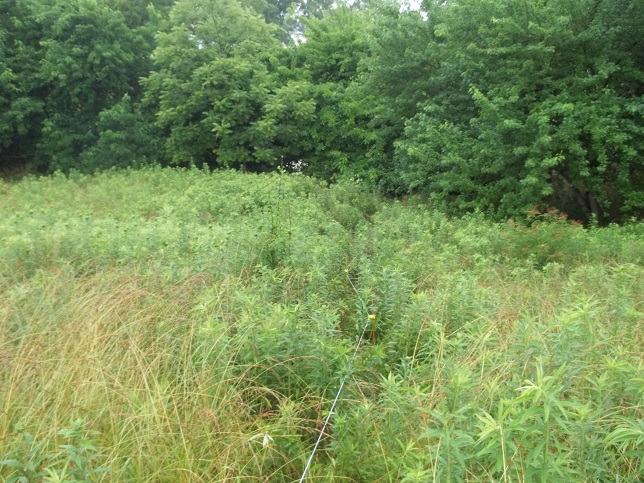
Yesterday we parked the cows under a hedge tree in a dense, tall stand of goldenrod.  The cows were allowed to the right of the fence (the white line).

JulyGrazing3

Panning a bit to the right, looking at the same place it looks like this now, 14 hours later.

TheDayAfterAs you get closer to the fence there is less trampling.  Makes sense.  The cows are well-trained because the fence is consistently hot.  But huge amounts of green material has been pushed into the soil.  My bees may miss the goldenrod (which makes a lousy honey by the way) in the fall but this is a great first step toward making my pastures better.  We’ll rinse and repeat over the coming years, ultimately getting ahead of the weeds.  The cows also showed me two honey locust trees I didn’t know about.  Hafta fix that.

The cows are up the hill now.  Still full from last night but every one of them has their head down, unless they are eating leaves from a tree.

EarlyMorningMove

Grazing According to Plan…and Recovery…and Faith…but Mostly Plan.

It’s summer.  It’s time to stretch pasture.  If this year follows the normal pattern, it’s about to get hot and dry, though it’s cool and rainy this week.  I am banking on the grazing we did all spring (two complete rotations) to have left enough carbon,  fertility and residual grass to carry the grazing through summer drought and into a stage of strong recovery for fall and winter grazing.  I took this picture 34 days ago:

Trample

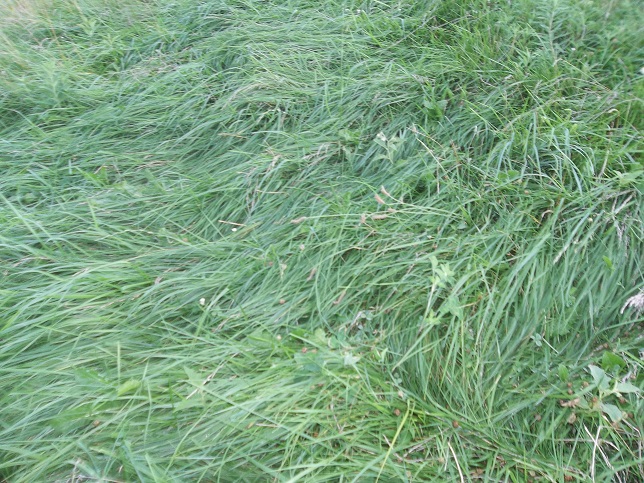
Here is that same spot today.

JulyGrazing1

Recovery happens.  Look at that tangled, matted mess of grass, clover, thistle…probably 50 different plants all within arm’s reach.  (It’s probably laying down because I need more calcium).  I have inches of mulch from stepped on tall fescue matted on the ground all over my farm.  From that I have a diverse, thick stand of forage that’s hard to walk through.  That’s the goal.  Increased forage diversity and density.  If we accomplish that goal we can carry more cattle.  The slope South of the house was a thick tangled mat of leafy fescue this spring, the result of hog manure last winter.  Much of the farm looks like that now except it’s not pure fescue.  It’s amazingly diverse, dark green and leafy.  The frequent rains and cool weather are only helping the cool-season grasses too.

JulyGrazing5

Now, I don’t think 40 days is enough because just beyond the reach of view the recovery is much less.  Then it looks better.  Then worse.  We covered 8 acres in 34 days.  I have to slow things down now that the grass is slowing down.  I have a few acres of reserve we have planned as July grazing.  That should give us the extra time we need to achieve recovery while allowing room for wildlife diversity on the farm and plant species diversity.  Also, if I had tried to graze those few extra acres in the spring I would have been further behind on my primary grazing areas.  The best option was to just let it go but to be successful this requires coordination, planning, preparation and a fair amount of guess work.  For example, we were here on June 11th.

MorningCows

Today it looks like this (from a slightly different angle, sans moos):

JulyGrazing6

All that grass was tromped turned into a sponge and food source for the soil.  The dense mat of dead grass holds moisture as it decays feeding the growing grass.  You can see the mix of new and old grass in the background compared to the mowing line that is the path to the family cemetery.  One might think it’s time to graze it again but I think that would be a mistake.  The grass is tall but the forage hasn’t recovered.  You’re seeing tall wild oats, some fescue and quite a bit of clover but the remaining forbs really haven’t recovered yet.  I could graze it now but I’ll get more bang for my buck if I just hang on a bit longer.  More root growth, more plant diversity, more volume of grass.  I just have to wait.  Besides, drought may start tomorrow and that standing grass is money in the bank.  But let’s say I’m wrong.  (It’s OK.  I get told I’m wrong a lot.  No, a lot lot.  (As if I’m not insecure enough.))  The grass will go to seed, the cows will mat it down and my next recovery will be even stronger and more drought resistant.

It was with these thoughts that I spent some time walking the pasture with my wife last night.  We looked at forage recovery, quality and density and, also, at our cows.  This is the first year I have managed grazing cattle, it’s the first year the pastures have been allowed to rest, it’s the first time these cows have had to graze for a living…lots of firsts.  I have two that are slick and fat, two that are slightly less slick and have less belly (one with ringworm), and two that are carrying good weight but also carrying lots of hair (both are mostly white).  Greg Judy would cull the last four.  I explained to my wife that those four heifers are probably just here to eat grass with the hope of throwing bull calves.  I plan to breed them to a more fescue-tolerant bull but the future herd will probably come from the two slick cows and any others I can find like them.

Then we spent some time talking about the importance of focusing on the forage, not on the cows.  The cows are the result of grazing management.  The cows are the tools we use to manage our forage.  But the grass is the goal…well, the soil but grass is the obvious result of soil health.

JulyGrazing2

I have 3 acres set (maybe 4) set aside that we haven’t touched yet this year.  I have 4-5′ tall weeds out there.  Starting this week the cows are expected to knock most of it to the ground and eat what they can.  We’ll move pretty quick through there in narrow strips.  This is a remodel job.  Should be exciting!  That part of the pasture has always been a nasty, weedy mess.  Now we’re going to remodel before those weeds go to seed.  Then we’ll let it rest until we graze in the fall again then sled on it in the winter.

JulyGrazing3

The rested ground is kind of a weird thing but Greg Judy mentioned it in a video, I had the acreage to spare and though we would give it a try.  I hope there is something they will eat out there.  We’ll see.  I think it will work well from a carbon perspective if the cows can find something to eat.

Thoughts and Advice…but not from me

I read Thoughts and Advice From an Old Cattleman while sitting in a hotel in Florida last week…along with other reading.  I thought I would share some of my thoughts, but I’ll keep my advice to myself…short of this one thing:  Get this book.

The author details a plan for moving cattle through your pastures on a regular basis, selling and then immediately buying again.  If the market is down, you’ll buy immediately.  If the market is up, you’ll have to pay more for better animals but still, buy immediately.  Different classes of animals do better at different times.  He goes into long detail about feeding, worming, fly killer…all things we don’t do but also talks about getting the most bang for your buck on grass…using low-cost grass to grow calves up to feeder size.

A recurring theme in the reading I have done lately is the disassociation of ranching and tractor ownership.  Gordon goes so far as to say you are better off with 4 ex-wives than with 4 John Deere’s.

Again, I highly recommend this book.  I found it to be very encouraging that a 70+ year old man runs 1,800 head of calves across 3,000 acres (with zero debt!) and humorously complains that he only has enough work to keep him busy for 3-4 hours each day.  Wow.  Poison aside, he’s doing things right.

I am now rethinking everything we have on the farm.  Iron pile?  Buildings?  Corrals?  Fencing?  Ponds?  Chickens?  Cattle?  Which of these things are increasing in value?  Can I make it with a cow/calf operation or should I consider exclusively running or at least adding stocker calves?  How can I put my debts behind me?