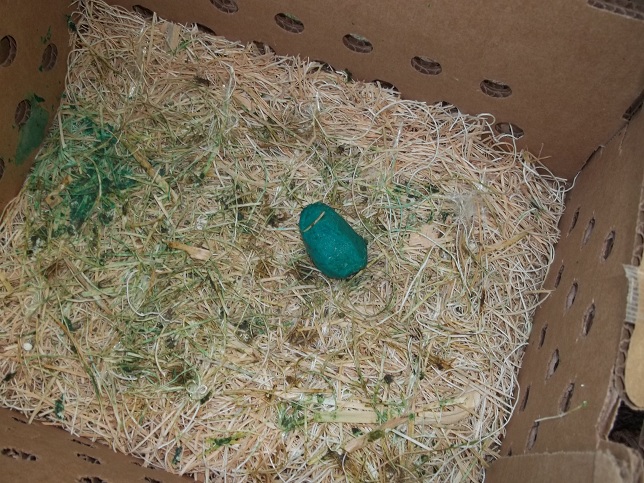
We ordered some pullets from Cackle Hatchery this week. I’m always reluctant to order chicks mid-summer but I saw the forecast was for temps in the lower 90’s, called the hatchery and took a chance. Because I was late ordering, my normal hatchery could only send 25 so I ordered another 40 from Cackle (all they had). The Cackle chicks got here first. The Cackle chicks came with a blob of green stuff. I have seen the remains of the green blob before but I’ve never actually found a green blob.
It’s food, hydration and protiotic all in one. I believe the commercial name is Grogel.
Online reviews of Grogel are strongly positive and the birds look great. I’m afraid to look under the covers to see what it is and how it’s made. The birds look great.
Early in the Spring (or late in the Winter) I ordered 250 layer pullets. Then I got cold feet and sold 175 of them at 8 weeks. That worked out well in some ways. It covered my expenses so the 75 or so I kept were basically free but in other ways it didn’t work out so well. I still don’t have enough birds to meet the demand for my eggs.
So we ordered more pullets. It took a couple of tries to find a break in the weather and a hatchery that could fill my order on short notice. I was looking for 100 sex-link pullets, no Whammies. At the last minute I called Cackle Hatchery to find out what they had left. They could ship 35 Cinnamon Queen and 5 Red Sex-Link. Sold. Then I called Schlecht. Schlecht closes at 4:30 on Friday. Etta didn’t answer the phone. I did get her by email. She promised 25 Golden Comet pullets. 65 birds. I can make do with 65 birds.
The Cackle order arrived Wednesday morning but was short by 10 birds. We are expecting another shipment on Friday. The Schlecht order arrived early Thursday morning. They were a little sluggish but looked good and there were 5 extra birds! A few minutes under the heat lamp and they were ready to go.
I have talked about this before but here’s the setup again. They are in our 8×8 outdoor brooder. It is easy to warm, easy to get into and comfortable for the birdies. We use nipple waterers because they stay clean. The chicks figure them out almost immediately.
We give them broiler mash in trays for the first few weeks. I want to get them off to a good start. After day two they get creek sand to get their gizzards off to a good start. We try to give them constant access to fresh greens. Today I dropped in two big handfuls of alfalfa chaff from the hay wagon. Just like you, chicks need to eat their greens.
These birds will remain in the brooder for 2-3 weeks depending on the weather. Then we’ll move them out to pasture where the older pullets are and pop them into chicken tractors. That will give them a chance to grow out without being picked on by the bigger birds but will also give them a chance to socialize with the bigger birds a little bit. By being on pasture they will get the best possible nutrition and will always leave their manure behind. Raising them on pasture really makes a bird that can’t be beat in terms of health. Our future flock, your future eggs. Healthy birds.
I’m going to use a dirty word. It’s a word that will stop all conversation in the room. People find it shocking…appalling. Use this word and others will question your sanity. In short, hilarity ensues.
Ready?
Humanure.
You are, quite literally, full of crap. It’s a fact. You produce it at intervals throughout the day. What do you do with it? Do you pollute drinking water to make it magically go away? Where does it go? Do you have a septic tank? How often do you have to get that pumped out? Where does it go from there? Do you live in town? Where does that go? Sewage treatment plant.
Sewage treatment, under ideal circumstances, separates liquids from solids in several stages after removing odd bits of trash. The trash and a large portion of solids head to the landfill. That’s nice but what happens when it rains? From a Wisconsin newspaper from October of 2010:
In all, about 9.1 billion gallons of untreated sewage-contaminated water — enough to fill 457,000 backyard swimming pools — were released into the environment by 276 villages, cities, counties and sewage districts on 1,198 occurrences statewide since Jan. 1, 2006, according to data collected by the DNR and analyzed by The Post-Crescent. The wastewater overflows happened in 58 of the state’s 72 counties, including throughout the Fox Valley.
Rain was listed as the cause of nearly 80 percent of the overflows since 2006.
The article linked above lists some truly horrifying stats on sewage overflows. Nearer to home, I remember an event causing the sewage treatment plant in Jacksonville, IL to overflow, putting the city on a boil water order. Let me say that differently. Because of rain, everybody’s doody mixed with the drinking water. The solution was to boil the doody-water so it would be safe to drink.
Ew.
Tell you what. You can boil your doody-water all you want. I’ll make you a promise. It won’t be my doody in the water. OK? I have a better solution all of us can embrace. Ready? Compost.
I found Joseph Jenkins’ Lovable Loo some time ago. We needed a solution for the barn as we were potty-training our daughter. Plus our septic tank had failed and we were pretty desperate for an inexpensive solution. Enter the eco-potty.
Jenkins’ excellent book describes a method of collecting our various biological deposits (wastes is the wrong word) in a bucket. Everything goes in the bucket. Everything. Each deposit is covered with sawdust. There is no smell. Let me repeat that. There is no smell. We go through a bucket for each person in the house each week and use nearly a bucket of sawdust for each bucket we fill. This is not a composting toilet, just a receptacle.
We compost our wastes on site. Nobody hauls, pumps, aerates, filters or chops our waste. It doesn’t have a chance to pollute fresh water. More importantly, no Persians were shot to make the transportation of my doody cheaper. We just carry the bucket to this year’s compost pile, open the pile and dump the bucket. It really is just a bucket of wet sawdust when we dump it out. Then we rinse (using rainwater when it rains (remember rain?)), wash with a biodegradable soap and rinse again. The clean buckets sit in the full, sterilizing sun until we’re ready for them again.
We continue adding humanure to the compost pile for a full year. At the end of the year we begin a new pile. I don’t turn the compost because
A. that’s gross
B. that’s too much like work.
We just open the top, pour new stuff in and cover it all up again. Then the pile sits unattended, unloved and untouched for another year. By that time the material has cooked itself thoroughly, cooled and has been sifted, sorted and sterilized by earthworms. Any bits of plastic or whatever are sterile and can be sifted out easily. We also compost roadkill animals, chicken offal, pig heads and whatever else we can come up with but I’ll cover that in a separate blog post.
Jenkens uses his humanure compost on his garden after 2 years. I have enough other sources for compost and enough need for compost other places that I choose not to. It is uncomfortable enough asking guests to use a bucket. It’s more uncomfortable to say, “Hey, remember when you were here 2 years ago and used the bucket? I used that to grow tonight’s dinner!” Nah. Our pastures will benefit from the compost and we’ll use the composted winter animal manures on the garden…mostly chicken manure. Somehow that’s less icky from a guest’s perspective. Now, the EPA disagrees and says it’s no big deal. It is unusual for me to quote a government alphabet soup agency in a positive way but let me state clearly that I am in favor of using biosolids in agriculture. That’s kind of the point. I think the municipal collection is wasteful, inefficient and unsustainable but since we have it let’s put it to good use. But far better is to gather your own waste and deal with it yourself. That may not be easy for appartment dwellers but I’m sure we can find a workable solution. In a normal world, companies would pay you to collect and process your biological wastes…but we don’t live in a normal world (IMHO, largely due to alphabet soup agencies). All that said, I promise you, when you’re at my house eating food from my garden you aren’t eating people doody. Just composted chicken, cow, pig, goat, worm, duck, toad, snake, mouse doody mixed with a dead baby bird or two that fell out of a nest in a windstorm.
“OK. Fine.” you say. “I’m willing to try it if you can prove to me it really saves any water. I mean, I have a low-flow eco toilet that I sometimes have to flush twice if I want to “deliver the mail”…but it says it’s eco!” Did your water bill go down by 30% when you started using your double-flush low-flow toilet? Our water bill went down by 30% immediately.
It deserves more excitement than that. We have saved at least $500 on water since we began using the toilet 14 months ago. I think that’s pretty cool. On top of that, I have an enormous pile of…compost I can spread on my fields.
This post is more “how-we” than “how-to”. In fact, it really just introduces the concept. For the real how-to I have to suggest Jenkins’ book and his series of Youtube videos. Outside of those two resources, let me know if you need more detail or if you have any questions. The best thing you can do is just get a couple of buckets and take it for a test drive.
We planted potatoes a long time ago. Well, it seems like a long time ago.
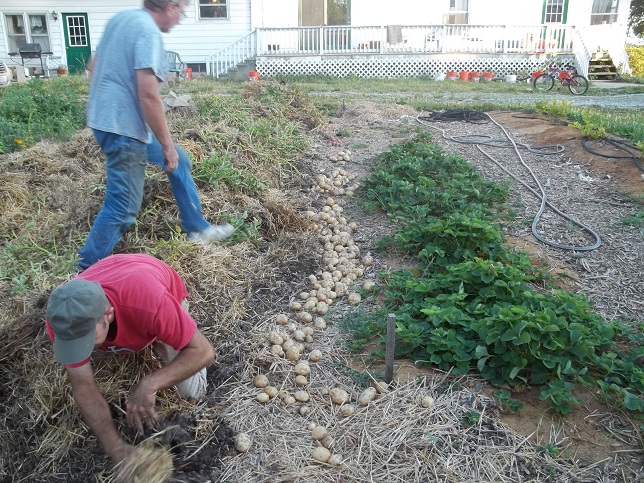
It’s time to dig them out. I dug potatoes in the morning before work.
Then dad and I dug potatoes in the evening after it cooled off a bit.
These were the short rows of potatoes. I would estimate I planted 25-30 pounds of seed potatoes in this garden and harvested 200 pounds. Many of the potatoes came up when we pulled the plant out. Very few were down in the soil. The majority of the potatoes were just laying in the hills and it was all hand digging. Who knows how many I missed.
I let the potatoes dry off a bit before bagging them up in burlap sacks my sister brought by.
We found a tomato hornworm grub and a garter snake as we worked down the evening row. I have an awful lot of organic material on the rows I’ll need to find a home for. Not sure what to plant in these beds for the fall garden but we’ll figure it out.
Everything is dry, dry, dry. Hopefully we’ll get some rain next weekend and I can plant again. Let me know how your garden is doing.
Farmers are never satisfied with the weather. Environmentalists are never satisfied with the weather. In both cases, it seems it’s the worst it has ever been and there is no hope of recovery. I’m an alternative environmentalist and an alternative farmer. I need medication. Global climate change advocates tell me it’s too hot/cold/wet/dry because of decades of human activity. Astrophysicists present that temperatures follow solar flare cycles (and that a huge solar flare could wipe out the power grid). The alternative farmer in me knows I can do little to affect the sun but I can take action to positively (or negatively) impact the hydrological cycle. I can sequester more carbon. I can cycle nutrients more quickly. I can grow more food with less irrigation. I can landscape in such a way to not only hold more of the rain that falls on my farm but to encourage more rain in my region. “If everyone of us would sweep their own doorstep, the whole world would be clean.” These notions appeal to my inner alternative environmentalist but where the rubber hits the road, I need rain now. Now.
Today we’re in a drought and it’s getting pretty gritty.
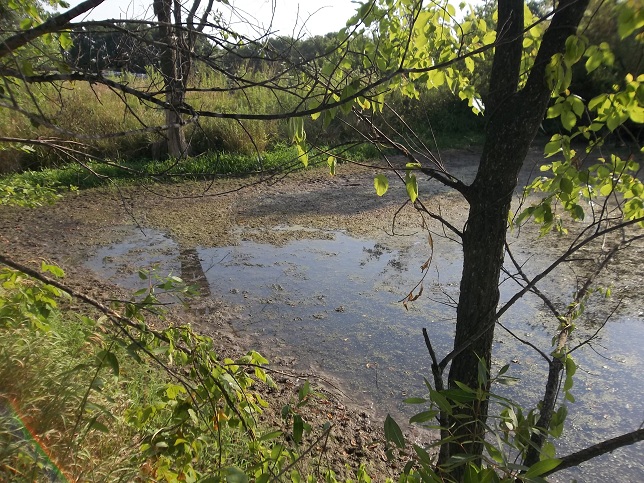
I helplessly watch the rainclouds float on past to the North and South. They kind of spit at me for a few minutes here and there but no rain. No real rain for weeks. We’re short by 18 inches this year…a big deal to a midwesterner. We had solid rain at the beginning of May, an hour of hail mid-May and a half-inch of rain a few weeks ago. The pond is down a foot already.
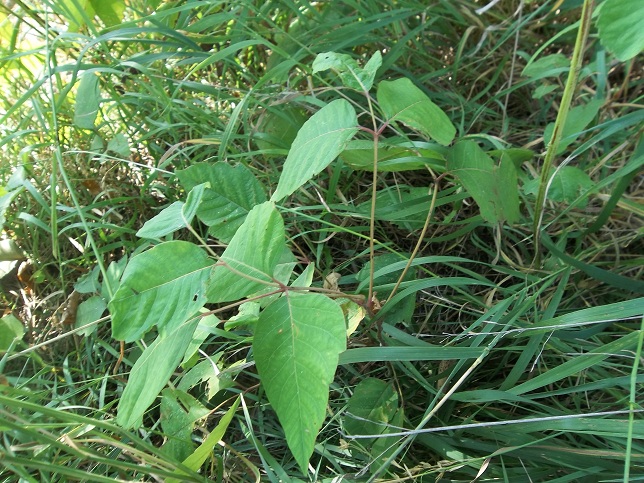
The grass under the maple trees has given up…the maples have sucked the ground dry. It seems that nothing can stop the poison ivy though.
What can I do about it now? Not much. Drought is a fact of life. It happens. It always happens. As I read Walt Davis he jokes that the Texas rainfall average may be 20″ but that’s because they get 60″ one year and none for the next two years. I have to learn to manage for drought.
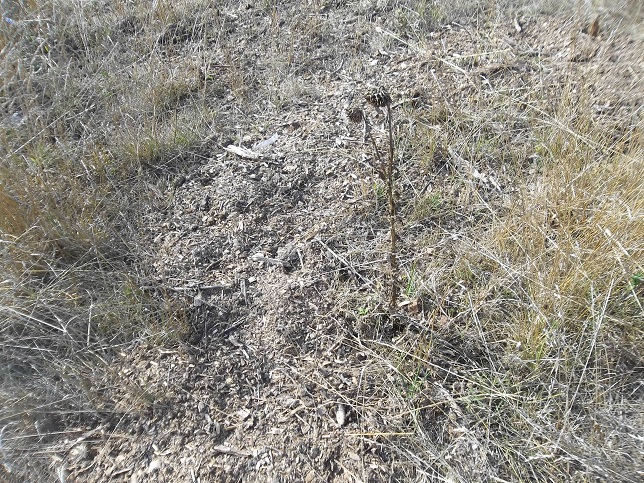
I have grass. It’s not pretty, it’s not a lot but it’s there. Where the goats, chickens and pigs have been there’s a tall, diverse stand of grass…even if dry. I’m surprised how little moisture there is under the tall grass but at least there’s something standing to catch the dew…when there is dew. I need to fence out the neighbor’s cows so I can monopolize the growth. I need to maintain and encourage that stand. Where the grass is short I need to allow rest. Where there is bare dirt I could put down any number of things but I have been leaning toward using litter out of the layer house or sawdust as a mulch.
Going forward I need to catch my greywater (not to mention the infrequent rain) in a series of swales down the hill from my house. I don’t really know how to establish the swales at a minimum of expense but I’m considering using a 2-bottom plow just to get something out there. I need to grow more trees. The lack of shade out there is a killer. Beyond shade, I need protection from wind to help limit evaporation. Also, I need more things for my goats to eat. I may buy a box of hybrid poplars and interplant with fruit and nut trees on the swales. But the real focus needs to be on building additional ponds. I don’t even know how to estimate what a pond will cost but I know what it’s worth to the land. That’s going to have to become a large part of our future farm budgeting. We need to catch and hold the water as high as possible and work to slow it down as it runs downhill.
Each of these things will work to dampen (lol) the effects of drought in the future. What can I do now? Right now!
There are good chances for rain this weekend. All I can do today is pray. Just pray. Rain breeds rain. If we get a little moisture this weekend, maybe we’ll get more next weekend. Maybe, by the time hurricane season gets started in the gulf, we’ll have so much rain I’ll write a blog post complaining about being waterlogged. Oh, to dream! In the meantime I’ll keep my animals watered and shaded and my kids cool inside. I’m afraid there’s nothing I can do about the solar flares.
15 years ago today it was wet. Warm but also wet. Today we are something like 12-18″ behind on rainfall. Isn’t it interesting the cycles nature goes through? Averages average out.
Like the rainfall, our marriage has seen various patterns. There are times when it’s easy to be in love with her. There are times when it’s work for both of us. We have been through the worse of “better or worse” but the average is pretty high.
I’m very thankful that she married me 15 years ago today. My, how things have changed.
I got an email from a reader who corresponds with me fairly regularly. In the email he was sharing what is going on as he starts. He has a 3 piglets in Premier fence and 101 chicks. He asked a series of questions including this one:
What tools do you recommend for the dirty work, knives, shears, etc?
We use victorinox knives. A boning knife for killing, evisceration and foot removal and a 6″ skinner for cut-ups. As much as I like that victorinox skinner I have an old Dexter knife that is better. I think Salatin uses a smaller poultry knife for evisceration but we just use the boning knife throughout. We originally got this from Grady’s post on knives.
You also need a good cleaver. I said a good cleaver, not a cheap cleaver. I had a neighbor who gave me a collection of knives and saws. He was in his ’80’s and his parents had been butchers. I’ve got some pretty neat stuff. My cleaver is an antique…and it’s awesome. If you can’t find an old one, buy a high-carbon steel one. Don’t skimp here. You’ll need this when you butcher your pig and quality matters when you’re splitting your hog.
I’m still looking for a good set of game shears. A friend suggested Cutco but I haven’t really looked yet. I just use my cleaver. The friend was helping me clean a rabbit at the time and swears by game shears.
It’s time for our planned summer break. The broilers are all in freezers or customer bellies. Just pullets and a few turkeys on pasture. Our daily workload has dropped significantly. Now all we have to do is feed and water in the morning, milk the goats and just check everybody a couple of times and we’re set. Well, we have to soak the hog wallow a couple of times too. This accomplishes two things; drains the hot water out of the 100 yard long hose so they will have cool water to drink again and gives them a cool place to pig it up.
Now, when I get up before the sun I don’t have to spend 15-20 minutes moving chicken tractors, feeding and watering. I just open the chicken house door, feed there, water the rabbits, shower and head to the office.
We have waited all spring for this day. We partied like it was 1999…well we watched the new True Grit and ate pizza after the kids went to bed. Now we’ll tick off the days till we get our last batch of broilers mid-August. We’re thinking about scrapping our big order for fall Cornish Cross chicks and ordering a variety of alternative broilers just to try them side by side. We thought Kosher King, S&G Heritage White, Freedom Rangers and Moyer’s K-22. Let me know what you think in the comments section. Also, give me suggestions for alt. broilers just in case I am missing a good option.
Just a side note, I took a hog panel off of one of the hoop chicken tractors to give the pullets a bit of extra shade. They seemed to appreciate the shade, I appreciate how many different ways I can use those chicken tractors.
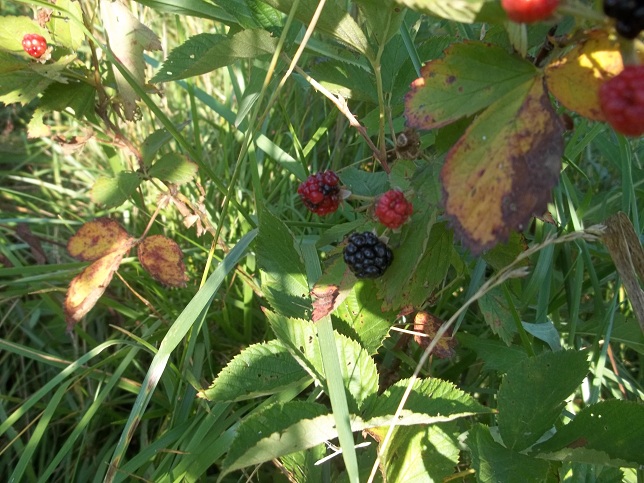
We have been picking dewberries for days now. They are not quite the same as raspberries. Aunt Marion set me straight on which berry is which. I keep a volunteer patch near the beach at the pond. Apparently I keep poison ivy there too. We are beginning to cultivate this volunteer stand…meaning I mowed through the middle of them last fall separating the brambles so we could really get in there. This year I’ll mulch them and yank the poison ivy. Pretty good picking for so little rain.
You know the best part of picking berries? Eating them. Most of our berries go to the freezer for later though. We get about a quart a day which we promptly wash, spread on a cookie sheet and freeze. Then we use a spatula to pry them up and pop them into a freezer bag and use them later for smoothies or forget them till spring and mix them 50/50 with strawberries in jam. Maybe toss in a couple of mulberries too. Mmmmm.
So, trying to put a positive spin on everything, you know the best part of poison ivy? Hot water. It feels great. Soon the poison ivy will clear up and we’ll be left to enjoy the fruits of our labor.
In the last 4 days I have butchered near enough to 300 birds as makes no difference. The last three days have all been above 100 degrees. One might think there would be a smell. Well, there is a slight odor when you’re next to the compost pile. Otherwise, not so much. Here’s how we build the compost pile.
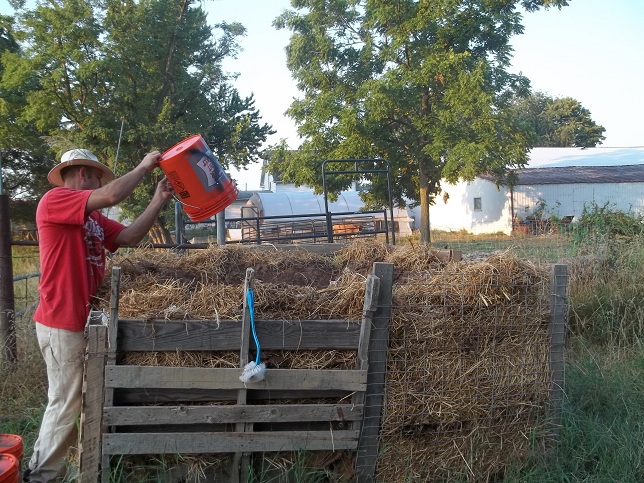
I build my piles with pallets since pallets are free. The pile needs to be a minimum of 3’x3’x3′ so it has enough mass to heat up. It is important that your compost pile “cook” itself when you’re adding in manures or animal wastes. They will digest more quickly keeping the scavengers away. Normally I use 8 pallets wired together with baling wire in a big 2 pallet by 2 pallet square. We dig a slight depression in the ground in the center of the pile. Then we add a foot or so of straw, old hay or, better yet, bedding along with a shovel or two of finished compost. From then on, we add layer after layer of compost and carbon. These pictures reflect the maturity of the pile. We’re nearing the top. I should also point out that I don’t stir my compost. That’s too much like work. I just let it sit for 12-18 months and feed it keep it hot most of that time. Biology does the rest.
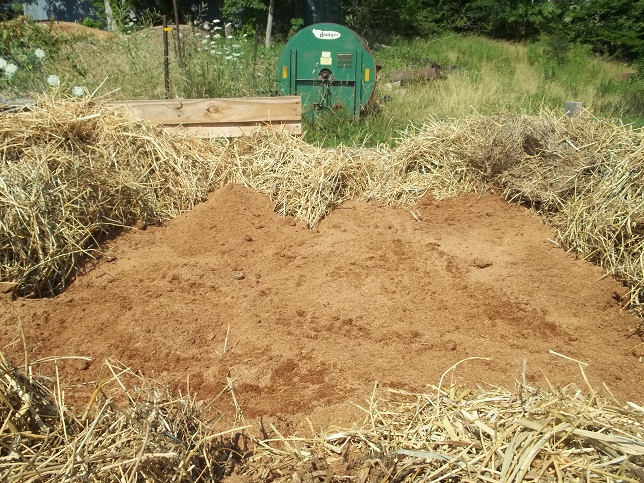
First I scrape away the covering material from the top. This is 6 or 8 inches of used bedding and hay the goats rejected. I pull the material to the edges of the pile leaving about a foot-thick wall around the perimeter.
Then I dump the buckets and level them out across the pile. Same goes if you’re composting humanure. If there is any roadkill in the area I toss that in too. When we have kitchen scraps we can’t feed to livestock we put them here. We don’t feed pork to pigs or chicken to chickens so if she makes a potato soup with chicken broth and sausage…
Next I cover the offal with an equal volume of sawdust. I’m shooting for 2-3″ of sawdust here. The carbon absorbs the nutrients, sponges up moisture and keeps the smell down.
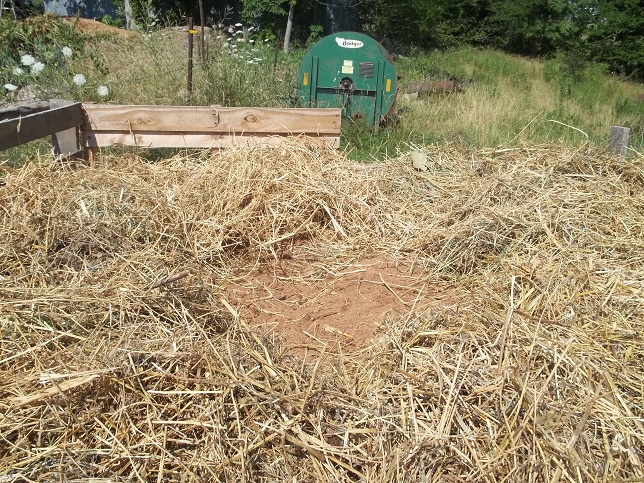
Then I pull the covering material in from the edges and cover as well as I can. We’ll need more material but it’s a start.
The goal is at least 6 inches of covering material. That allows moisture in if it will ever rain and filters odors.
So, there you go. Our current pile is 6×6. It should last us until we start a new pile on April 1st. If not, I’ll get two more pallets and make it a bit longer.
Good luck with your composting. Don’t overthink it. If it stinks, add carbon. If it’s not hot, add nitrogen. Stacey has some good ideas on that topic.











 Chism Heritage Farm