Preparing for Chicken Processing

There is a rhythm to work.  Every job has its own groove.  You just have to find it.  Processing chickens is no different.  You have to find your groove.

We moved from square dancing to bebop this year when I upgraded my equipment.  At first we tripped all over ourselves trying to make sense of our Featherman equipment.  It was pretty bad.  Now, it’s no big deal.  As a team, we have divided the workload so each of us is working at a good pace.  With that in mind, I want to address a portion of an email I got from a friend/reader.  I pared down his original question a bit.

…as my first processing day is approaching fast in two weeks, I am assembling some equipment.  I got some knives, heat-seal bags, table-top, scale, etc.  one thing I am still pondering is the chill tank situation.  I am leaning on going with two 110 gallon black stocktank tubs from tractor supply.  They are fairly cheap per gallon compared to some options, $64 for 110 gallons.  I can’t seem to find another freezer or 55 gallon food grade barrels locally.  I was also comparing rope tubs as you mentioned or large rubbermaid trash cans, but I would think the larger 110 gallon tanks would stay cooler longer?  Just looking for your advice.  Also, how long do you chill the birds?  How much ice should I have on hand?  somewhat scared,

If I’m not mistaken, the author has about 100 birds to process and has not processed birds before.  Rather than go with 220 gallons of chill tank in any format to chill all 100 birds at once, I would like to see him spread his processing out over several relaxing days.  I suspect it would take us the better part of 4 hours to sterilize equipment, kill, eviscerate, chill and pack 100 birds then clean up again.  At the end of it we would be tired.  When we first started we got tired after 20 birds.  Our friends at Porter Pond Farm needed 7 hours just to kill and process 130 birds their first try.  Keep in mind, they had help and that 7 hours did not include bagging the birds.

So the best thing you can do is just process a few birds at a time.  Maybe 2 days of 20 birds and one day of 60 birds or 4 days of 10 and one of 50.  Give yourself some time to find the groove.  Just how does Salatin get the crop out so quickly?  It takes time to learn how to do it.  Watch this video over and over.  And over.

We figure you need 10 pounds of ice per 6-10 birds.  We chill the birds until they are cold.  You’ll know when the ice stops melting.  We normally let them rest in the ice water while we compost and clean up.  Then we change clothes and start bagging.  Maybe 90 minutes.  You can save a few bucks by using frozen bottles of water and blocks of ice have more thermal mass but less surface area.

I suspect there are better places to deploy cash than to buy stock tanks to chill birds.  They aren’t a bad idea as they can always be deployed for livestock use but I really doubt you’ll do 100 birds your first day.  If you do, I doubt you’ll be anxious to go back for seconds.  There is a lot of skill involved.  Until you can work efficiently and as a team you’re probably better off doing 20 birds at a time.  20 birds can be chilled in coolers you probably already own.

Here are some other things you need but didn’t list in your email:

  1. You need a Compost Pile.
    With 100 birds to process you need to get four pallets.  Wire them together top and bottom with baling wire so they stand in a square.  Scoop out a bowl in the bottom center of the compost pile then throw in a bale of straw or old hay as a base layer.  Also, see if you can get a couple of trash cans full of sawdust from a sawmill…the finer the better.  Really, a pickup load of sawdust would be better.  Well, a dump truck would be better still but get what you can.  As you process birds, pull a layer of the straw to the sides, dump in your chicken offal, add a layer of sawdust above and cover with fresh straw.  See the link above for more specific detail.
  2. Sharpen your knives.
    Even if your knives are new, sharpen them.  Really sharp.  Crazy sharp.
  3. Gather buckets.
    You will need a bucket for every 20 or so birds you process but we keep one at each station.  One bucket for heads and feet, one for evisceration, one for lungs and some others for feathers and blood later.  You probably already have buckets, just make sure they are empty and ready on butcher day.
  4. Do a dry run.  Heat the water.  Dress one bird out.  Chill it.  Bag it.  Go through the motions all along the way.  Learn what you need to learn.  Find out what you didn’t plan for.

I am sure this list could be larger.  What did I miss?  What are your thoughts?  I may be too far from my first chicken processing experience.  I remember it being very difficult.  I wouldn’t want to do 100 birds out of the gate.
 

All Peached Out

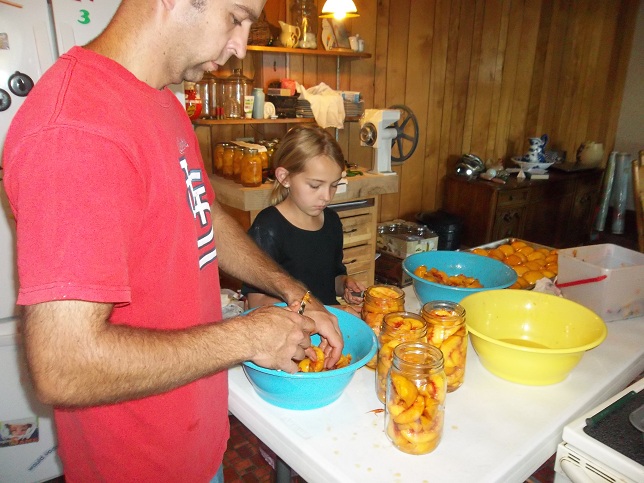
Whew!  I brought 3 bushels of peaches home on Thursday.  Friday we canned the bruised ones but the rest were too green.  Saturday they were looking pretty good but we had a family gig most of the day followed by church in the evening.  That takes us to Sunday morning.  Early Sunday morning followed Sunday afternoon followed by a nap.

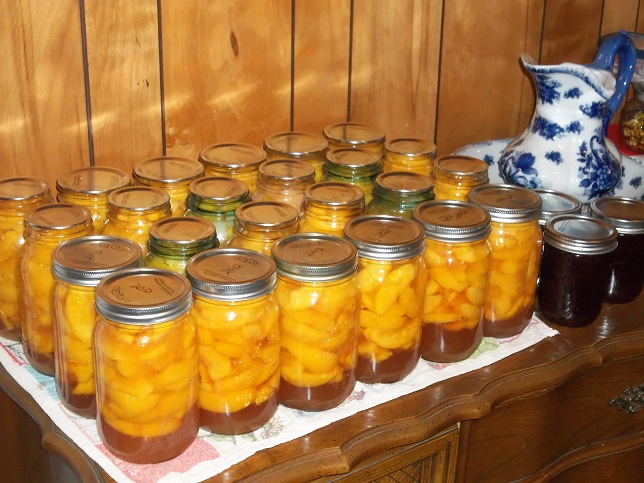
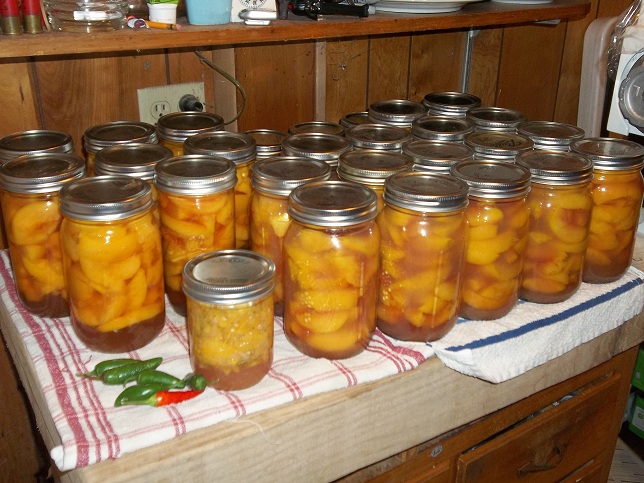
32 quarts of peaches, 17 quarts of pie filling, 6 pints of peach salsa, 4 pints of peach and dewberry jam, 7 gallons of frozen peaches, we gave away peaches to family and ate so many we all foundered.  There may have also been a peach daiquiri in there too…

What’s the fun of working if there is no reward for hard work?  What sounds good to you?  I say we have peach sundaes on homemade goat milk ice cream piled on top of waffles!

…or if you’re 7 you can scoop it up into a waffle cone.  The kids were pretty well peached out at this point and opted for chocolate syrup and carmel on their ice cream.

I have done harder work.  I have worked longer hours.  But standing in a hot kitchen on a hot day holding hot, sticky peaches wears on the body.  Mom reminded me that the old timers would put up 100 quarts of everything.  Here’s to the old timers.  Thanks to mom and Aunt Marion for helping out this weekend.

Humanure Q&A

Humanure is a part of our farm.  It’s part of our land stewardship plan.  Humanure is also a part of your life, it just may not be part of your own stewardship plan.  We work to manage our resources carefully.  That means it belongs on the blog…just maybe with less frequency than you have seen lately.

I got an email from a reader with a few questions and comments about humanure.  I thought I would share my responses.  Keep in mind, we’re doing our best here but I’m far from an expert.  If you have a comment on any of my responses or any questions at all, please don’t hesitate to share in the comment section.  Also, as I have said before, this is more “how-we” than “how-to”.

With Humanure Handbook I do have a few questions that I keep hoping he’ll answer before I get to the end…aren’t there issues with compost piles leaching? That seems to be one of his objections to septic fields yet, surely compost will leach to some extent as well.

If the compost pile is built correctly, I’m not too worried about leachate.  Within hours of adding to the compost pile, the pile heats up to several hundred degrees.  Use big amounts of carbon at the bottom, always add to the top.  You’ll end up with a carbon barrier at the bottom, a healthy layer of compost above that and all your hot stuff further up.  I also maintain a buffer of sawdust around my compost piles when heavy rains hit because I have seen chicken…stuff…ooze out of the pile when it gets saturated.  I have to believe that happens underground too. I should also cover the pile during periods of heavy rain.  Finally, the compost pile, unlike a septic tank, moves from year to year.  This year’s is out in the pasture.  Last year’s is next to the machine shed.  The year before that was by the garage.  I don’t believe I can overload the soil with leachate in one year with 312 buckets and 1000 chicken’s guts…especially since I work so hard to put a heavy layer of carbon under the pile and work to control saturation.  The wife adds that she thinks by the time the cooked compost filters through the carbon base it’s going to be OK.

What do you do when someone in the family is sick – upchucking sick?  Currently I flush the bucket contents down the toilet.  Do you compost that?

Nobody has been sick like that for years.  I guess we’ll compost it.

He talks about hospitals having to have their own composting facilities carefully ensuring the temp in the compost is right for killing pathogens.  What if someone goes on antibiotics ([Husband’s] recent bout with his face infection comes to mind)?  Does that affect how you do things?

Antibiotics?  I dunno.  We really try not to use them.  I guess we’ll compost it.

We did have a very amusing family discussion about humanure, the upshot of which is that the kids begged me not to start that particular project till they were living away from home.  I have to get better at composting before I can do much with the idea anyway, so they’re safe for now.

For Pete’s sake.  Just build one. Composting skill?  How are you going to develop skill unless you’re motivated by 6 buckets of magical nastiness waiting by the back door and a husband and children who don’t think you’ll actually go through with it?  Go for it.  Quit fooling around.  Go show ’em!  The pretty girl with the braids wants to wear “Friends of the Environment Foundation” shirts so then give her a chance to make a positive contribution!  What can you use for carbon on the island?  We love having a big sawdust pile.  I use sawdust for everything now.

Again, let me know if you have any additional questions or comments.  The humanure toilet is really no big deal.  There is no sloshing, yucky mess. The carbon soaks up all the sloshing.  When you dump the bucket it just looks like wet sawdust…plus orange peels or whatever else you compost.

Chicken Snack

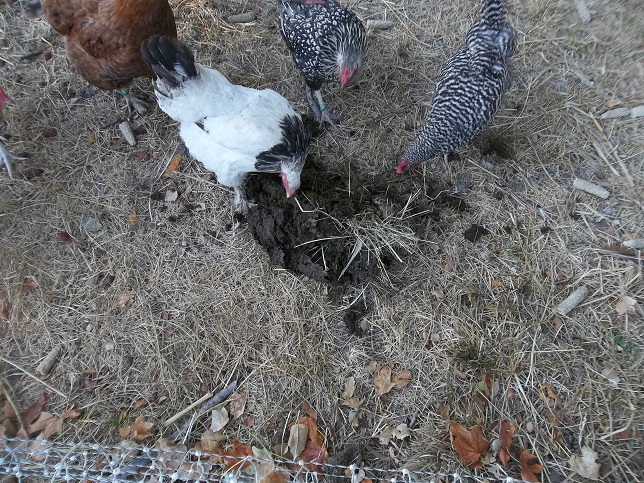
This is a chicken snack…on a fork.  Cow pie a la mode…sans la mode…

It’s cow manure, aged to perfection (about 2 days old).  Cow manure has lots of interesting things in it for chickens to scratch out.  Normally, the chickens find cow manure each time I move them to new pasture but during the heat wave the birds are stuck in the front yard.  I’m bringing them cow manure.  It should also add fertility to the yard.  Not a bad thing.

Anyway, serve at room temperature and without a plate.  Chickens really make pigs of themselves.  No reason to wash dishes afterward.

One curious bird starts a trend.  Then the other ladies join in.

I don’t really know what they are finding but they are doing more than just digging.  Cow manure has many things that are helpful to a chicken’s digestion.  Now, don’t gross out.  Chickens aren’t people.  This is a very normal thing they are doing.  Birds follow herbivores in nature doing this very work.

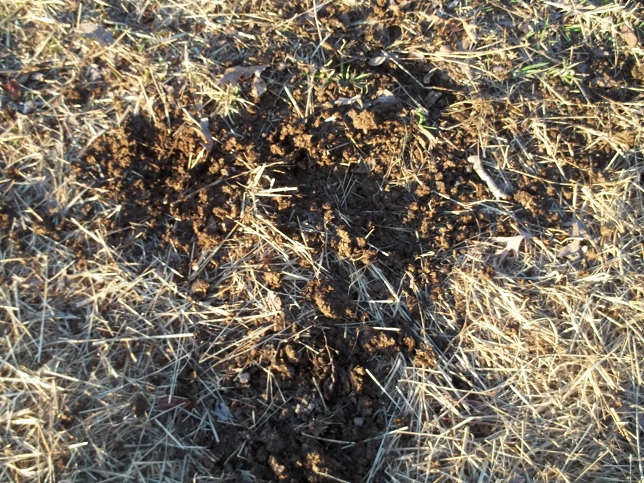
Just a few minutes later and the cow pie is gone.

In the early spring when there are large flocks of red-winged black birds roosting in the trees…so many it’s hard to have a conversation outside, the cow pies get decimated.

They love it.  Our chickens love it.  The pasture benefits from it.  Everybody wins.

Putting up Peaches

Peach preserves, peach pie filling, peach halves, sliced peaches…

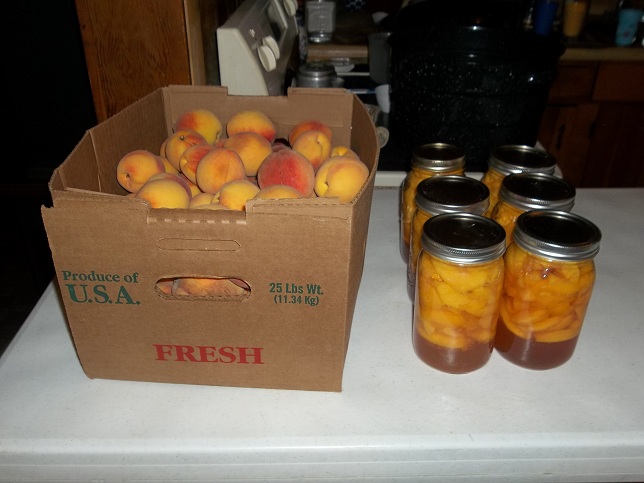
I made arrangements to buy 3 bushels of peaches from Calhoun county.  That’s a lot of peaches.  We’ll be busy for a couple of days so please forgive me if I don’t keep things updated here.  This is me practicing what I preach.  I’m stocking up.  I’m buying locally.  I’m buying in bulk from a small farmer (my co-worker’s father-in-law).  They are not organic.  I’m sure they have been sprayed but this will do until we get our own orchard planted.

Each box (pictured below) is half a bushel.  Half a bushel makes about 9 quarts of canned peaches.  Sterilize and fill each jar, pour in hot syrup and place in a hot water bath for 30 minutes.  Not much to it, just a lot of work.

It’s scald, peel, slice and pit over and over and over.  But, boy! they taste good.

Mom says when she was a girl my grandpa would drive to Calhoun to load up the back of the truck with peaches.  Then extended family would be in the kitchen (my kitchen) working together to put them up.  It’s hot, sticky work.  Here’s to hoping help is willing…and we don’t run out of jars…

Blue Eggs

Two of our pullets have started to lay but not the two I would have expected.

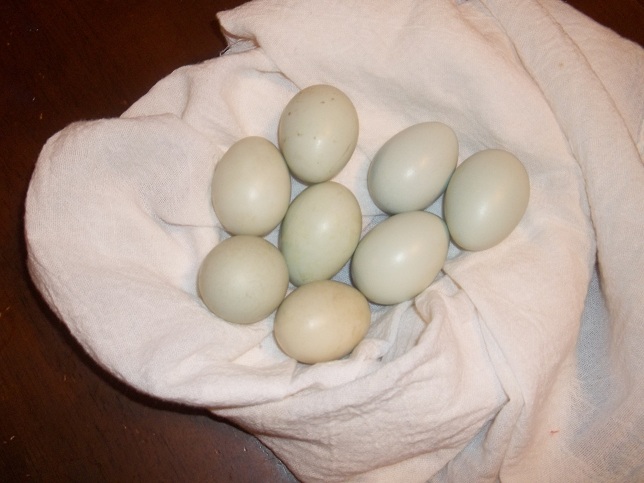
We keep blue egg layers for a number of reasons.  First, customers appreciate the novelty.  Well, most of them do.  Second, it is an easy way to keep two flocks in the same place and still know whose eggs are whose.  In the past, the blue eggs have been from my daughter’s flock so she earns a little money each day.  I have never purchased Ameraucana chicks, always started pullets.  Though they are pretty, I have never really been impressed with the birds as layers.  Without exception they have been late to lay and inconsistent layers in winter.  This isn’t just an impression I carry, the birds are a difficult sell to local egg producers as started pullets.

This year I ordered 50 Ameraucana pullets from Cackle hatchery.  Not only are they nice, colorful birds, they are the first in the flock to begin laying eggs.

Where are the brown eggs?  We also keep hybrid layers and RIR pullets from Central hatchery out there.  I would have expected to see something out of the hybrid layers by now.  All pullets are the same age…hatched on the same day (Feb 28), even though they came from two different hatcheries.

I suppose it is possible that I did something other raisers don’t do…or many things other raisers don’t do.  I guess so but I don’t know exactly what.  The birds were brooded in a greenhouse and fed Fertrell broiler mash for the first few months then placed on alfalfa to finish out.  I wasn’t expecting to get blue eggs for at least another month.  Maybe these two are just freaks.  We’ll see what they do going forward.  Surely there will be a brown egg out there today…

Strolling Through the Pasture July 2012

Chicory, dickory dock.

We’re covered in chicory.

Overall the pasture is a dry, weedy mess.  It hasn’t rained for weeks.  Nothing is growing.  The corn isn’t filling out on the ears, the beans aren’t making.  It’s not a good year to rowcrop.  I haven’t fenced my cousin’s cows out so it’s still open grazing.  I need to get them fenced out soon so I can begin rotational grazing (even if that’s rotational hay feeding) my own cows and letting the pasture rest to build up something of a stockpile.  There is some pretty good pasture still available North of the cemetery in the bottom but for some reason the cows don’t head that way.  Maybe the grass is sweeter where the chickens have manured.

The raccoons have been eating wild cherries by the pond.  You can see where the whole raccoon platoon troops by every night.  There’s a group of four.  They march past the pond, down the hill by the road, scoot by at the end of my driveway, then needle their way through the logs and brambles to an old collapsed culvert where they sleep all day.  Yeah, I have scouted them out a little bit.  Yes, I missed.

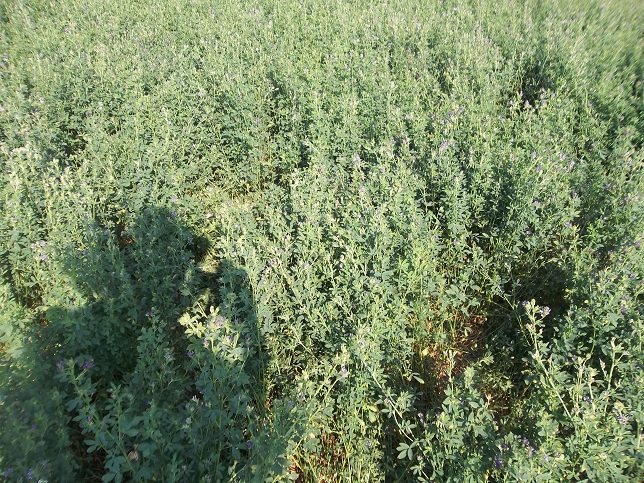
The alfalfa blooms were really pretty.  I took these pictures several days before we mowed hay.  I didn’t see any sign of my bees working the alfalfa but the bumblebees and japanese beetles were out in force.

Then there’s the thistle.  Always the thistle.  We cut and salted thistle until it got so hot we couldn’t stand to do it anymore.  The seed dispersal will overtake our efforts.  I’m counting on high-density planned grazing to win this battle for me in the long term.

Ah, poison ivy.  If only you were a cash crop.  I’m getting itchy just looking at it.

Next month we should see the goldenrod come in bloom.  Goldenrod honey tastes terrible but it does feed the bees.  Here’s to hoping for another hay crop.  Rain would sure help.  How is your pasture doing this month?

Lazarus Blueberries

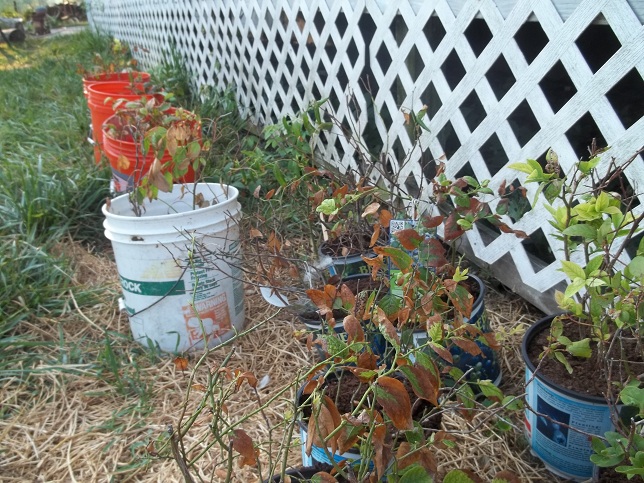
I found these poor little things on sale for $2.50.  Normally I’m not one to bring home sick, helpless little things but I like blueberries, have a pallet of peat and am willing to try.

The retailer had just about given up on them.  I found 9 that still had green leaves.  I brought them home, filled the pots to the top with peat and gave them a good soaking in a bucket.  Each day since then I have soaked them in about 2″ of water in a bucket until the peat is saturated.  Then they sit in partial sun all day.  We’ll see what happens.  I may have wasted $20.  I don’t really think so though.

I planted two over by the pond about a month ago.  Every day they get a bucket of water and they are doing as well as they are doing.  I dug a big hole for each, mixed in a bag of peat in each hole and carried wheelbarrow after wheelbarrow of sawdust.  I should put an odometer on my wheelbarrow…

What about you?  Is there something you just can’t pass up when you see it on sale?  Do you believe you have the touch to bring things back to life or are you at least willing to try?  Have any tips that would help me out?

Make Hay While the Sun Shines

Boy is the sun shining.  Every day.  Sun, sun, sun.  Nothing but sun.  All the sun the grass can eat.  It’s time to put that grass away for later.

Let’s focus on the alfalfa field for now.  The alfalfa field looked like this (well, not as many blooms).  You want to allow the plants to get to about 10% bloom before you cut.

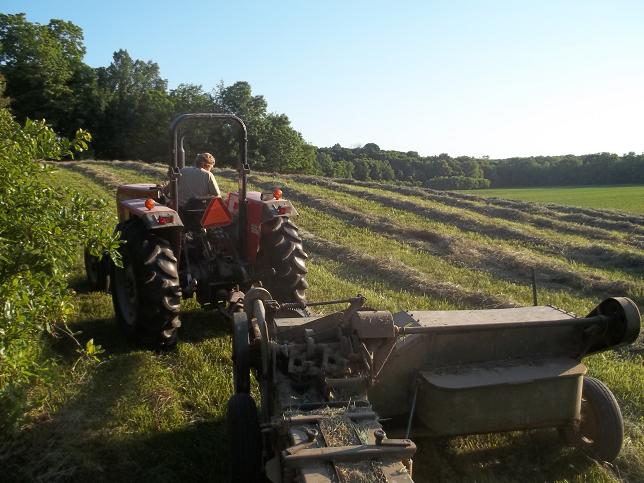
So we cut it three days ago with dad’s hay conditioner.  It gobbles up the hay, crimps the stems and lays it gently in a windrow out back.

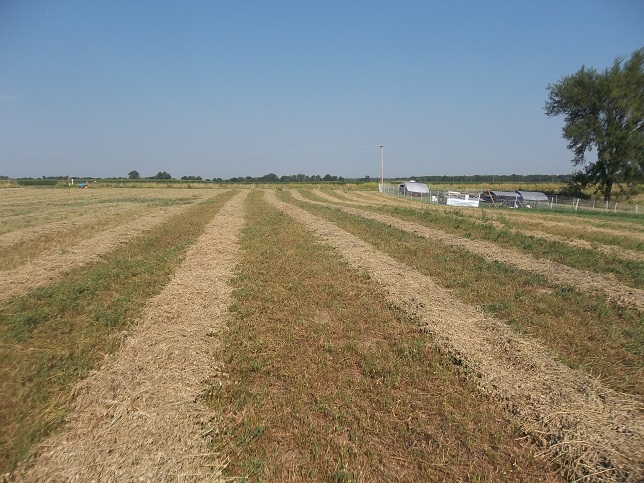
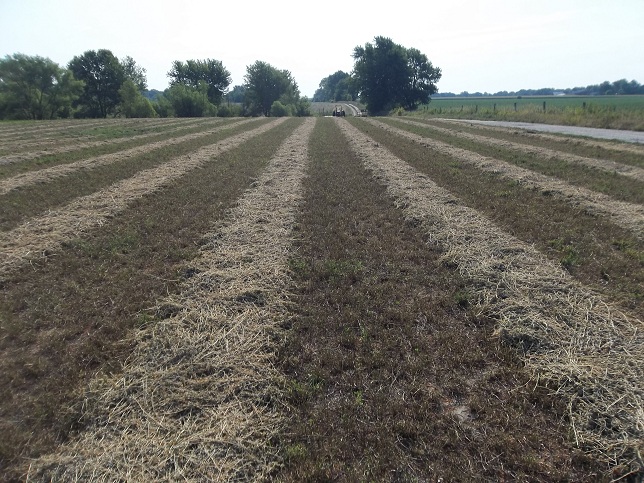
When you’re finished and it has cured for a couple of days you get a field like this:

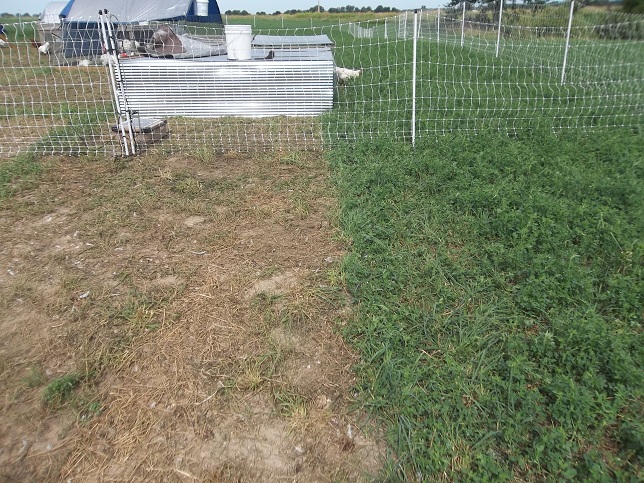
If you look closely there’s a spot on the left where the alfalfa was killed.  Our chicken tractors were on that spot when we got about 3″ of rain across a week but the bulk of the rain came toward the end.  The chickens turned that spot into mush.  The alfalfa gave up the fight.  Otherwise, the chickens don’t seem to have hurt the stand and remember, they do this when they go past:

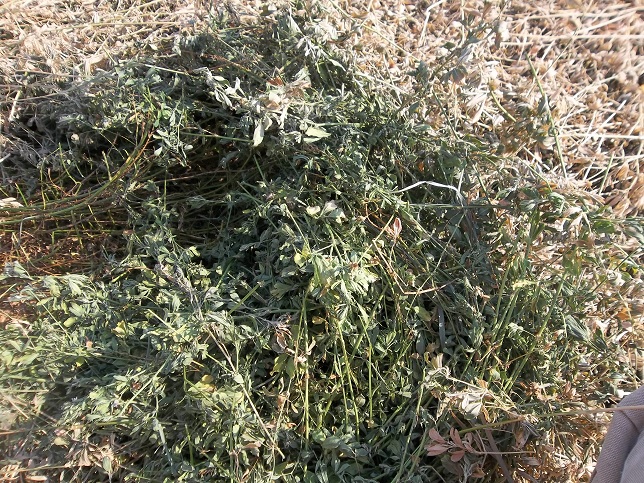
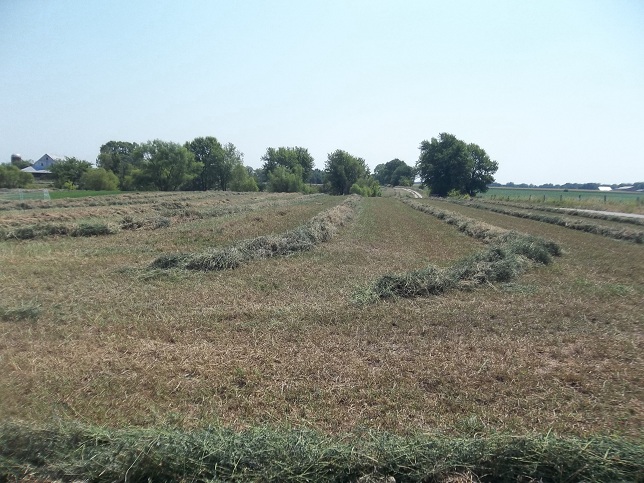
So, I have long windrows of alfalfa.  It looks dry

but if we look closer we see it needs to be raked before we bale.  The stuff underneath isn’t quite ready yet.

Grab a handful of stems and give them a twist.  If they don’t break, they’re not ready.  If they’re not ready you’ll end up with moldy hay at best, a barn fire at worst.  But then, if it’s too dry all of the leaves will fall off and the hay will be all stems.  Quality hay is a skill.  It’s a skill I continue to work on and probably will for the rest of my life.  Sigh…

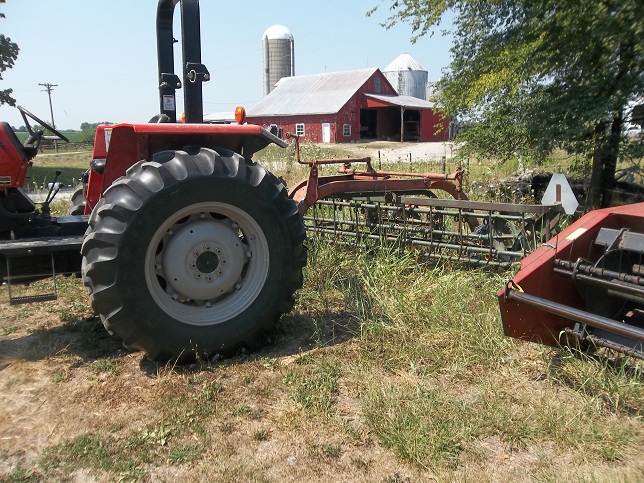
Next I rake the windrows together, turning the hay so it will dry better, combining rows so we make fewer passes up and down the field baling.  What’s a rake?  This is a rake.

So this….

becomes this…

A few hours later and we’re ready to bale.

We baled and baled and baled.  The bales may get moldy from all the sweat I soaked them with.  No pictures of the baling process this time but you can look at the blog post from an earlier hay cutting.

The fields are bare now.  Ready to grow back again, hopefully encouraged by a coming rain.  Before the rain gets here I need to clean up the small piles of hay we missed with the baler.  It’s not hard work, just one wheelbarrow at a time.  Sometimes I carry an armload of hay as I ride my bicycle.  That makes my wife laugh.  Why is she always laughing at me?  (lol)

Now it can rain.  Please, Lord, let it rain.  I’ll take a light rain that lasts 3 weeks.  I’ll take a series of downpours over the next three days.  Last night it sprinkled just enough that you could smell the rain on the hot tar of the road.  That’s a summer-only smell…and I would like to smell more of it.  Just let it happen, Lord.  I’m ready.

Can I get an Amen?

Whoops! What is THAT?!?!?

Have you ever seen a pullet laying her first egg?  I would swear to you she’s embarrassed.  First she’s uncomfortable then she feels like something happened…something she couldn’t control.  She whips around to take a look at what just happened and sees what looks like a rock.  “Did I do that?”  She takes a quick look around at the rest of the flock to see who saw what just happened then takes a quick peck at the thing just to make sure it’s real.  If she breaks the shell she’ll probably just eat the egg.  If not, she’ll just run away hoping to avoid future social stigma.

Maybe it’s not that dramatic but I’ve seen it happen a few times.  Pullets are always surprised when they lay an egg.  It’s pretty funny.

These pullets arrived on Mar. 1st.  Today (July 14th) I found my first pullet egg from the new flock.

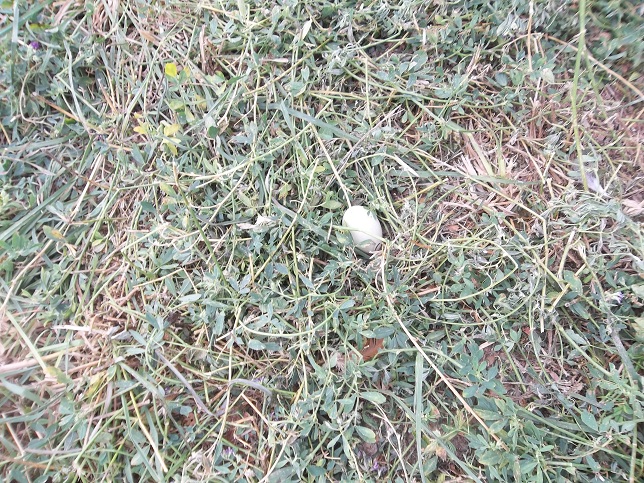
It was laying in an opened chicken tractor in the alfalfa.  Well, if there’s one there’s probably two.  Sure enough.

Two blue eggs.  I’ve never gotten blue eggs before brown.  I’m amazed.  In the past our Easter Eggers were always the last to lay.  Far out.  I need to get busy building nesting boxes…