Making the Transition to Full Time

This spring we attended the 2013 Family Economics Conference.  We feel this was a good use of a few hundred dollars and a couple of days off.  We bought, and recommend, the DVDs of the presentations.  Among other speakers, we saw Joel Salatin speak 5 times.  We limited ourselves to bothering him just 3 times after he spoke including a small gift of some essential oils.  One of Joel’s topics was titled, “Going Full Time with Your Part-Time Farm”.

Salatin

Again, I think the DVD or the MP3 are worth your time.  Rather than go point by point in detail I would like to focus on one point of his talk: becoming a low cost producer.  He also discusses value adding but I’ll leave it to the reader to obtain a copy of the speech for yourself.  I think the whole conference is worth buying and I might prefer the MP3 over the DVD as you get more for less money.  Also, one of the speakers tends to flap his arms quite a bit and that’s distracting.  You don’t notice that in the MP3.

Chism Heritage Farm sells premium products.  We sell things you can’t buy elsewhere and are in demand but our supply is limited because we are small.  Our marketing ability is also limited.  These ideas come together when we realize we can only ask so much for our eggs before we begin driving customers away.  The best way for us to widen our profit margins is not to raise prices.  The best way is to lower our production costs (which will enable us to lower our prices).

Utilization and Ownership

There are several things we can do to help keep costs low.  The first is to make sure that everything we buy is fully-utilized.  The most utilized equipment on our farm is a 5-gallon bucket.  We use them for everything.  We haul water and feed (rabbit feed, chicken feed, pig feed, cow minerals).  We have used them to carry 5 or 6 chicks at a time when moving from brooders to pasture.  We use them to hold chicken offal when butchering.  Apple drops, peach pits and skins and kitchen scraps for the pigs. They make handy containers for moving gravel, for protecting wheat for long-term mouse-proof storage. I use a bucket to carry matches, paper and tools when I trim brush and cut wood in the winter. If all else fails, we can use a bucket to catch water that drips in the leaky roof. Not every bucket is full every minute of the day but we spread the cost of the bucket across each additional function. Now, apply that thinking to a lawn mower. How many different operations can you spread your lawn mower across? The utility of the good has nothing to do with the initial price. Tractors are very useful and can power any number of implements…but those implements, like lawn mowers, tend to only perform one function.  Our wagons can be useful but this year the baler put up less than 500 bales.  Now it will sit for another year.  And we have a spare.  And a shed to keep it in.  Not to mention the mower/conditioner and the rake that were barely used this year.

HayRestack

So to keep costs low, we have very few farm implements and barter/borrow the use of the rest from my dad. That’s the closest I’ve come to asking my parents for help since I got married. Salatin says, “A profitable farm looks pretty threadbare.” Our feed grinder was purchased for scrap price and we have kept it together for four years so far. We initially bought it to grind chicken feed but we also use it to grind hog feed.  The initial cost was low and we spread that costs out between two operations. Now, truth be told, we really shouldn’t grind feed at all.  We should have it delivered and allow another operation to spread that machinery cost across a wider number of customers while also saving ourselves time and labor. As we grow, this situation will be changed. Along with this thinking, we should not own hay equipment.  We should allow someone else to have the joy of ownership and maintenance of that equipment.

As a final note on this thinking, remember Gordon Hazard?  The following quote is from this article.  As you read this, remember that Hazard raises 1,800 steers on 3,000 acres.

Hazard operates with a 1996 Dodge Dakota truck, a Polaris Ranger, a 14-foot stock trailer, one horse and saddle, a portable loading chute and $100 of fencing tools.

“I can get everything else I need done from custom workers or my neighbour. Why are you going to bother your neighbour? Cuz he’s got payments to make on that trailer.”

Stack Enterprises

Just like spreading equipment costs across multiple functions can lower the production costs associated with that equipment, spreading land use across multiple enterprises lowers the impact the cost of land use has on each enterprise.  Salatin gives the example of his hoop houses holding rabbits, pigs and chickens in the winter then vegetables in the summer.  What does that greenhouse cost?  What does the square footage within that greenhouse cost?  It’s nice to run cattle around your farm but cattle tend to be low-margin, even if low cost.  But if each acre covered by cows is also covered by sheep, pigs and chickens we’ll see higher resource utilization, higher nutrient cycling and lower land costs per enterprise as now we’re spreading the land cost over 4 businesses instead of just one.  Can this go further?  Sure.  We could add fruit and nut trees and shrubs.  We could harvest timber and firewood.  We could build bird nesting boxes and invite birdwatchers to our farm.  The possibilities are endless…the more we keep stacking enterprises per resource, the more the cost per unit of production continues to fall.  It’s this kind of thinking that allows McDonald’s to lose money on a hamburger and make it up on sales of soda.  Eggs may be a loss leader for us until you factor in the value of the manure and pest control.
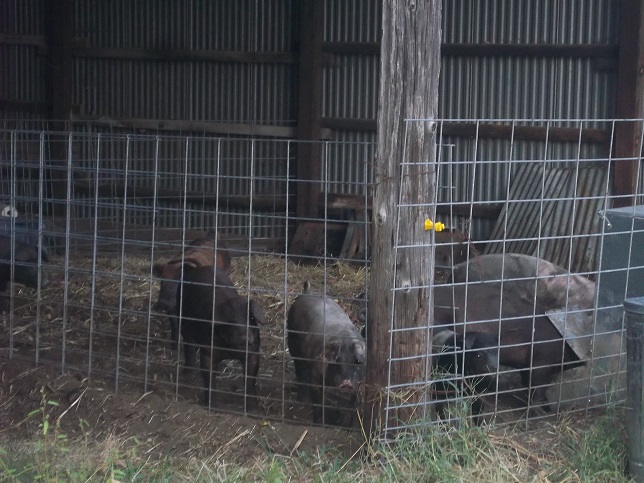
Piggies

Use Your Time Efficiently

Labor is expensive.  Everything you do takes time but the time spent with the cows is mostly accounted for in the travel to and from, not in moving the cows between pastures. It does not take significantly more time to move 500 cows than it takes to move 50 cows but the travel time is split between more animals. Salatin connects two eggmobiles so the resources used moving one chicken house moves two houses instead. Beyond simply economies of scale, Salatin delivers hog feed once per hog pasture. He delivers just enough for the entire time the hogs will be in that location.  No return trips with more feed, just move the pigs to the next prepared space.  Every feed delivery comes at a cost.  Minimize those expenses.

Rent or Lease Before Buying

Salatin points out how many acres have been abandoned…land that was in use for agriculture 15 years ago and is now entirely unused (reverting to forest). He sites a Cornell study that identified 3.1 million acres that have been abandoned in New York. There is more productive land out there than people to farm it. Often that land can be rented or used for much less than the cost of ownership. With your high-use, portable infrastructure it’s no big deal to just pack up and move to the next land lease. Salatin says “You don’t have to own any land to farm” and later, “Because the price of land no longer bears any resemblance to its productive capacity, we very well may be entering a time where people buy land for economic defense […] and people that don’t have money are going to become the farm managers.” In his book You Can Farm he suggests that renting is the way to build wealth in agriculture, land ownership preserves that wealth.

Practice Function over Form

Pretty does not equal profitable.  The pretty white-picket fence, well-manicured lawn and a new home tie up capital that could otherwise be employed toward productive endeavors.

“A profitable farm looks pretty threadbare.”  Borrow a tractor.  You don’t need much equipment.  In his video Pigs ‘n Glens (which I highly recommend) he says everything you need to fence in x pigs can fit in a 5-gallon bucket.  Sure, you need some way to deliver feed but you don’t need to handle the pigs.  He WALKS them to and from pasture.  That’s what we do too. ChangingPigPastures3

Use your infrastructure.  Just like the 5-gallon bucket example, if you have a tractor, use it as much as you can. If the equipment is single-use (like our chick brooders) build them as cheaply as possible and make them last. Our farm does not look like one you would see on a magazine cover but I’m not paid to produce magazine covers.  I am paid to produce chicken, pork and beef for your table.  Pretty, painted fences won’t make the steak taste better, just more expensive. A new machine shed would be nice but how will I pay for it?

We are working to provide you the most nutrient-dense, safe and flavorful products you can buy at the best price possible.  To accomplish this we don’t drive new cars.  We rarely buy clothes.  Everything on the farm could use a coat of paint.  We use it up, wear it out, make it work or do without.  It is even painful to us when we have to retire a 5-gallon bucket.

It is these thoughts I keep in mind as we continue to farm part-time.  There are a number of reasons why I have to keep my town job, not the least of which is I still have so much to learn.  Over time, application of ideas like those presented by Salatin above will enable us to make the switch.  Let me know if you have any other ideas to give us a boost.
Looking Through the Calving Window

Our borrowed bull arrived on July 29th.  He has been a good boy and we’re just about finished with him.  In fact, I believe he has completed his work…we’ll just keep him around for a couple more weeks for insurance.  It was interesting to watch him pair up with a different heifer every few days though he was fairly discreet about his work.

July 29 he was not discreet.  That means we should be ready for a calf around or before May 7th.  So, realistically, our calving window is all of May and most of June.  That puts calving a little…maybe a lot…later than I would like but we should be safe.  It’s late enough for good grass for the last 30 days of gestation, early enough to avoid the punishing heat…well, most years.

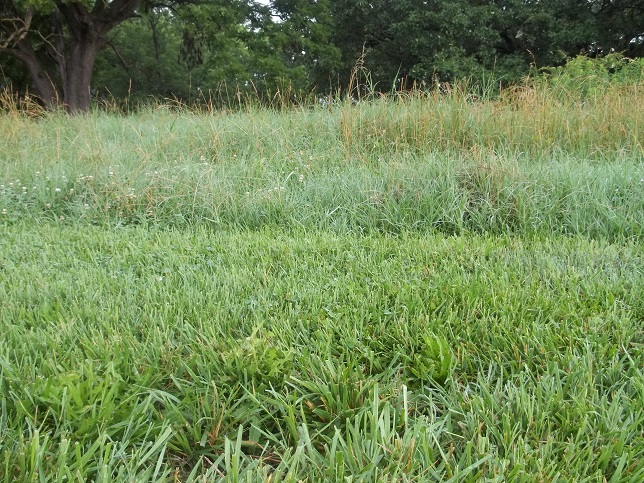
2012 was an unusually warm year and it started early.  My cousin planted corn on St. Patrick’s day, the same time I was planting potatoes.  It was lucky he planted early as that corn made where later plantings either didn’t make or were affected by aflatoxin.  By April 10 of 2012 our pastures were growing very well.

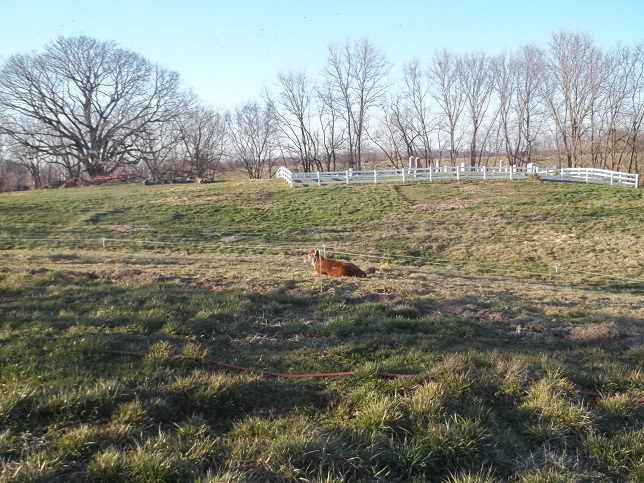
NewPasture1Compare that to April 9 of 2013 in nearly the same location from a different angle:

AprilPasture10I would love the early spring of 2012 if I could retain the mild summer of 2013 along with it.  Otherwise I’m content to hold off a little bit.

Moving forward a month we can compare again.  Basically the same stretch of ground on May 6,2012 but facing South this time:

PastureWalk3Once again, the same ground, same angle on May 4,2013.

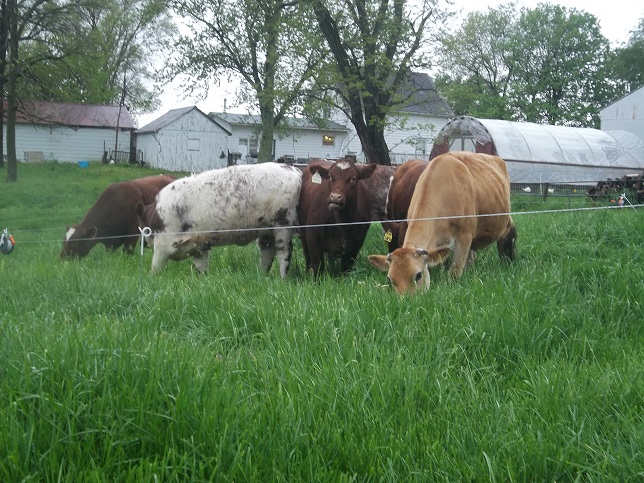
TopOfHillIt looks like there is not as much forage available in the 2012 picture but you should know the goats and chickens both grazed across it that spring before the picture was taken as well as the tenant’s cows.  In the cow picture from 2013 the cows are running across for the first time, though I did feed hay on pasture the month prior.

Based on what we have recorded of our own pastures, it looks like we’ll have a terrific quantity of high-quality forage just in time for calving next spring, even if spring comes a little early.  Let’s push this out into June.  By June 11, 2012 the same spot in the picture above had reverted to a big thistle patch.

PastureCompare that to June 2 of 2013.  The thistle and weeds couldn’t establish in such high density because of our grazing practices and the increased soil health.  Just mountains of fescue.

TrampleSo May 7 may be a week later than I really want but if there’s a late spring I’ll be glad for it.  Going forward I think I’ll shoot for May 1st.  I am also anxious to tighten up the calving window from 6 weeks down to 3 or 4.  but I know that will be hard on the first-calf heifers.  Guess that’s part of the program.

Now I have to plan where to calve next year.  Where indeed!

Are you planning your pasture usage on an annual basis?  Did you plan for that weekend you’ll be in Sheboygan for a wedding?  Did you make room for a drought reserve?  Where will you put the cows during hot weather?  During deer season?  Better yet, do you have any tips to help me plan my own schedule?

After writing this post I have to pause to reflect on two things.  First, I’m really happy I took the time to document the state of my pastures on at least a monthly basis for the last 18 months.  I can see changes, though, the changes may simply be due to weather patterns rather than grazing patterns.  A few more years should really prove the grazing method out.

Second, I seem to spend a lot of blog time focusing on cows, an enterprise I don’t believe will carry the farm.  Why do I do this?  I feel it is necessary to give the cattle a lot of attention BECAUSE the margins are so tight.  I need the cows to cycle nutrients…to utilize a low-value resource (grass) and trample plant material, seeds and manure into the soil building the soil organic matter, water-holding capacity and soil life over time.  The cows are uniquely suited for these purposes.  They are the foundation on which I can build the rest of our farm’s future.  I have to keep my pencil sharp or my foundation become shaky.

Sometimes the Cows Get Out

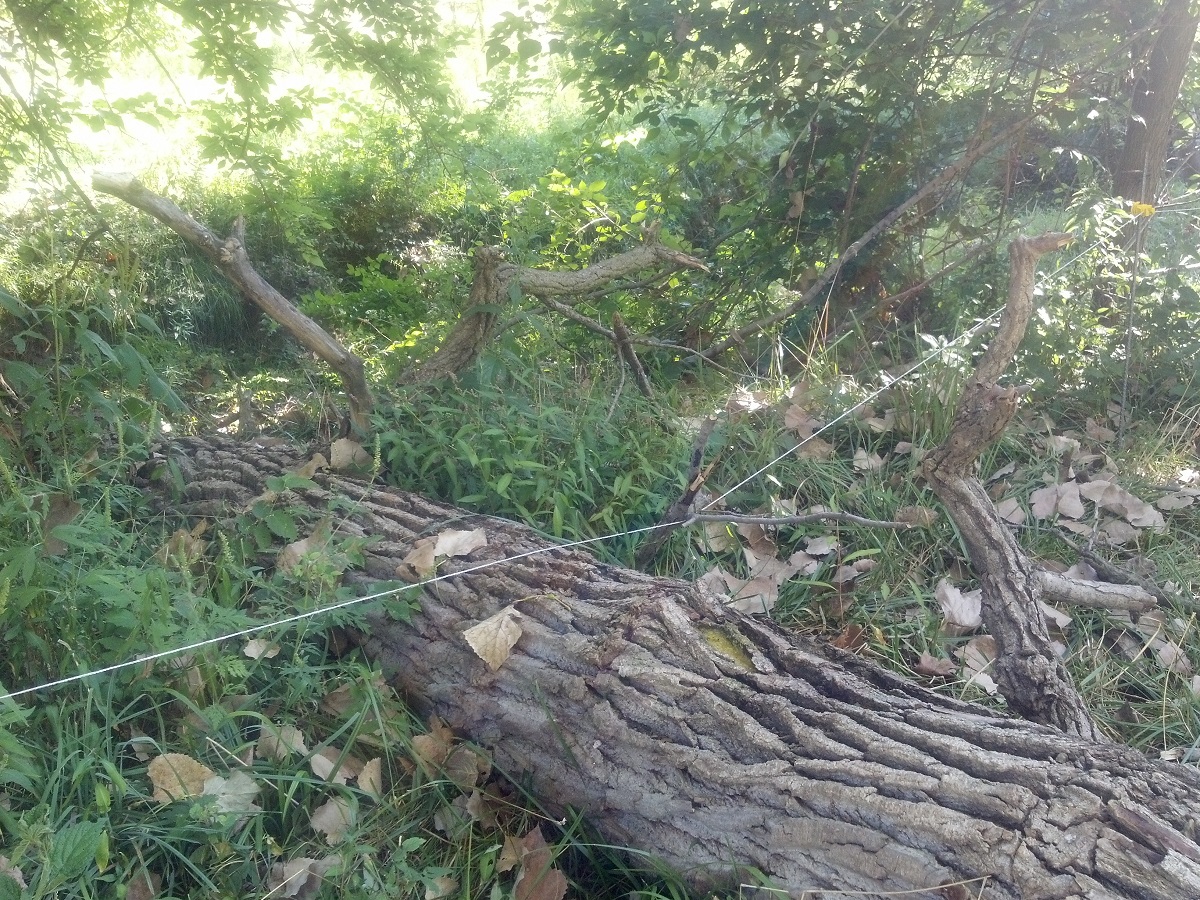
Sometimes the Cows get out.  They usually escape when I’m away on business going as far as 30 feet from where they should be (not far).  Last night a limb fell from a tree onto the fence and made an opening where they could simply walk over the fence.  We have a HUGE cottonwood that has been shedding limbs all spring.  Recently I fenced over a fallen limb hoping to clean it up when the weather cools.  That was a mistake.  Not a huge deal except, as usual, I was not home to discover their jailbreak.  My wife noticed it.  She got the one escaped cow back in with little difficulty.  This is unusual but not unexpected.

cow sees her chance

Unusual but not unexpected.

It happens.  Chicks die in the brooder.  Pigs get out.  Raccoons eat chickens.  Equipment fails on butcher day…just when you need it.  The baler throws a bad bale or the mower breaks a tooth.  All part of the thrill of farming.  With chicks, you buy more than you expect to sell, knowing something will go wrong in the brooder and some percentage will die.  With equipment, you try to keep parts around for the most common problems…extra teeth or shear bolts.  You also try to build extra time into your schedule for a trip to town to have a tire repaired.  If the cows escape their daily grazing area, you hope your perimeter fence is in condition to at least keep the cows on the farm.

On any given day a lot of unusual but not unexpected things can happen.  Don’t let it wear on you.  It’s just part of the job.

Chickens for Hipsters?

Am I a hipster?  OH golly!  I might be…especially since I’m currently growing a beard…and generally go against the grain…and don’t care…and I have a liberal arts degree!…and read constantly…and work in tech…and raise chickens. Oh shoot!  But I don’t wear tight-fitting clothes, don’t wear pretend glasses and I keep my hair short.  Oh, and I don’t drink coffee for a meal.  Whew!

Before I get going, please understand this is a post about eating animals and recognizing the usefulness of livestock in reshaping and healing our environment.  With me?  OK.  Let’s go.

A friend forwarded me a link to an article about the tragedy of backyard chickens ending up in animal shelters, blaming hipsters for this trend and somehow claiming that there just isn’t enough land in the world for us all to eat meat.  I have so much to say about this article I’m not even sure where to begin.

I want animal shelters to remain empty and unused.  Unfortunately, biology crossed with irresponsibility (or accidents) means a lot of cats and dogs are born unwanted or have with quirks or defects that make them hard to keep.  I truly and deeply sympathize with this issue and am currently working on a deal with a vet to have all of the barn cats fixed (all 18 of them) knowing it will probably cost me a small fortune, knowing those cats will never find homes, and knowing they will each, in turn, become a tasty snack for a passing owl or coyote or the victim of a brutal territorial fight with a feral tomcat (it’s a rough life on the farm).  But, never fear, more unwanted kittens will be dumped on the road past my house and will find their way here.  I’ll have them spayed or neutered too.

With that out of the way, I’ll start with economics (look for another post with more detail on chickenomics).  A pullet costs around $2 as a chick and 5 months of feed before laying the first egg or it costs $10 as a ready to lay pullet.  For simplicity, let’s avoid the brooder phase and just buy the ready to lay pullet.  At this point she owes you $10.  Now, she can pay that back as many as 5 different ways:

  1. Scratch soil and eat bugs.  This is a big deal.  Fewer bugs, better incorporation of nutrients, good times.
  2. Convert feed into manure
  3. Lay eggs
  4. Ultimately make soup and compost
  5. Provide companionship (optional and totally subjective.  Maybe even crazy.)

Now, any old bird can scratch, snuggle, poop and be killed for soup.  Snuggling (and swimming(I really hope that lady is an actress)) may be unique to an individual’s perception of a relationship toward a specific bird but egg laying requires something else.  You have to have a hen, not a rooster.  You have to have a young hen.  As they get older hens lay fewer, but larger, eggs.  Just as there are few pre-menopausal 90 year women, there are few 9 year old hens laying eggs.

LayerHen

That’s a very important detail.  Again, any old bird will poop.  But birds that lay an egg every day bring home the bacon.  Pets are nice but if I’m going to stay up all night trying to catch a raccoon to protect a bird, I expect breakfast in return.  Further, she eats every day and chicken feed at the local farm store was priced at $16 for 40 pounds this past weekend.  Little Henny started out $10 in the hole.  If she’s not laying eggs you really have to value her manure to keep her alive.  The additional profit center offered by egg production makes a huge difference when that bird is trying to repay you.  Now, some people keep parrots because they like having a bird around.  That’s nice but what do you do with a parrot that doesn’t parrot?  I don’t know but I know what you do with an egg laying bird that doesn’t lay eggs.  (Hint: it has to do with carrots and noodles.)

So that takes us to the next step.  Either cut her throat, pluck her feathers (harder than you would believe), and dress her out (looks nothing like a store-bought bird!) for soup (cause she’s too tough to roast) or you sell her to someone else willing to do that work.  As a third option, as presented by the article linked above, you send the chicken to a chicken retirement shelter.  Sigh.

Now, look.  We tend to anthropomorphize our dogs and cats.  I get it.  I even do it myself.  Reggie, our dog, is part of our family…even if he sometimes pees on the couch.  I will never eat Reggie.  Reggie’s entire purpose in life is to provide companionship.  When we hired him, that was the job: love my kids.  He does a good job of it.  When he dies we’ll bury him out in the pasture with the other dogs and remember him fondly.  To get love from Reggie I have to treat him well, feed him and protect him.  He may provide protection himself but …well, probably not.  If, in return for the care we give him, Reggie decided to attack my children the arrangement would change.  We would probably change dogs.

Reggie

Now, compare that to a chicken.  I (and I suggest most suburban chicken owners) want eggs.  To get eggs I have to provide feed, water and protection.  To give eggs the bird has to be young.  I may feel some level of attachment to a hen and that may make me willing to continue caring for her as she becomes older.  I may feel she has a “right” to live out her life after faithfully giving me 400 eggs in 600 days.  That’s fine…except I probably originally got chickens because I wanted eggs, not to gather more pets.  In most towns you are limited on how many birds you can keep.  And you want eggs.  Besides, she has value after she finishes laying eggs.  We should always put our resources to their best and highest purpose…she tastes good.  So I, as a suburban chicken owner, would raise her replacement and make soup or sell her to someone else who wants soup.

That’s the deal.

As a closing remark, the article states, “there just isn’t enough land for all the meat, dairy and eggs we want to eat”.  Sigh.  This ties into my next point. Livestock (and pets) can, and should, be used to enhance the environment they are kept in.  A chicken can quickly enhance soil fertility and plant diversity but it can also quickly overload the soil with nutrients, cause runoff and stink up the neighborhood.  Same with a dog.  Same with a cow.  Same with a pig (and I think suburban folks would be much better off raising a pig than a chicken but that’s a conversation for another day).  It’s all in how they are used.  But God help the vegetarian who wants to cycle nutrients in the absence of consumable livestock.  I can raise a cow per acre on sunlight and rain.  I don’t need to use petroleum to rip soil, plant seeds, cultivate, spray (even organic sprays) then harvest, dry and transport.  Nope.  I just graze the cow until it weighs enough…or I milk it each day and sell, raise or eat its offspring.  Beef raised on harvested sunlight without fossil fuel should be cheaper than chicken.  It’s the kind of thing we should raise in zones 3 and 4 if you can think of the city as permaculture zone 1.  Produce should be grown in the city so you can have a nice salad with your beef after we walk the cows to town for slaughter.  How much land do we need to cultivate for annual crops?  Once you cut out 70% of the corn crop that is grown for livestock feed and whatever is wasted on ethanol production how much land do we really need?  Not a whole lot…less than 3% of the available land (the current residential lawn space).  All we have to do is convert a portion of our lawn space into productive garden space, put up some high tunnels, let cows eat grass and walk the cows to town for slaughter.  Then you can graze co-owned dairy cows on what remains of your urban lawn space and raise your own chickens on your kitchen scraps.  Now, that’s a pretty extreme simplification but I think it’s more realistic than assuming it’s simply not possible.  It’s not sustainable under the current agricultural paradigm but it’s entirely possible (and ecologically beneficial) for the world to eat meat.  You might even take a page out of Will Allen‘s book and eat fish with your salad.

So, go get yourself a chicken or two and help save the world…even if you’re not a hipster.

Tired of Picking Beans

Our oldest daughter stuck with the bean picking for an hour Tuesday morning.  Then she screamed, “I’m Done!” and ran into the house crying.  This is not what we want out of our children.

Did we push her too hard?  Was she simply having a bad day? Probably a little of both with a dash of older brother tossed in.

It’s the hottest weather we have had all year, we have pigs again, broiler chicks, pullets we hatched out, young rabbits, stupid ducks, layers, cows and a 40′ row of beans.  Not to mention the tomatoes we are simply ignoring.  The workload is taking its toll on everyone.  That’s why we only plant beans every few years.

Anybody else risking your children’s sanity or skirting divorce by canning beans this year?

Something Worth Doing

One question is on a constant loop in my mind.  It doesn’t matter where I live, what I am doing or how I am feeling.  One question assaults me moment by moment, day after day…year after year like the drums heard by The Master in Dr. Who.

“Why are you doing this?”

The question doesn’t even refer to a specific activity.  It just hangs there…pestering me for an answer.  Why do I go to work?  Why do I like steak?  Why are hot dogs better than bologna?  Why?

I have beaten the budget to death with blog posts attempting (with varying degrees of success) to justify my farming habit.  Behind the scenes I have been scouring books, talking to friends (really pestering Matron!), and thinking.

SignsOfLife

From Gene Logsdon’s Living At Nature’s Pace

My father walked an empty, desolate barnyard, listening for the long-ago songs of life.  He heard only a loose sheet of tin roofing, curled over, scratching itself distractedly in the wind.  He cried.  He cried because he no longer had the energy to keep the barn full of life himself.  He cried because none of his children were willing to fill it full of life again.  He cried because he could not die here on the farm amidst life, as his forebears had been able to do, but might soon, too soon, have to shuffle off to the country home like his urban counterparts.

That’s certainly part of the answer.  I want to be surrounded by life!

Current Events Aug. 2013

We’re a little busy right now, as is everyone else.  Here are a few pictures of things we’ve been busy with.

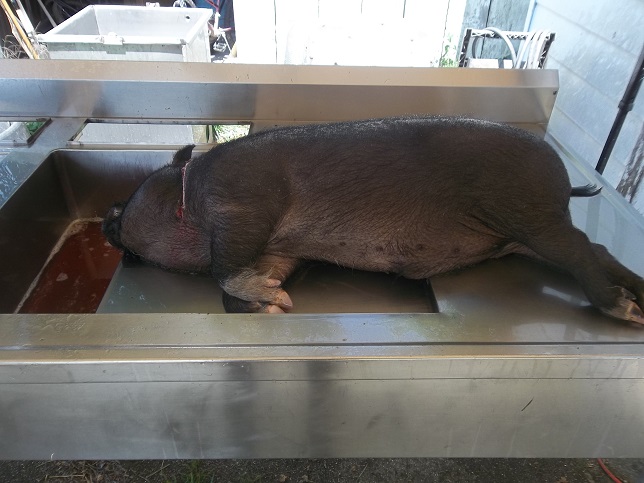
My sister raised a potbelly pig in her back yard.  We introduced it to the freezer.  He was an uncut boar.  I’ll say it was an interesting culinary experience. I had not scraped a hog previously.  I regret scraping this one.  We tried mason jar lids and a torch.  Mixed results.  I suspect my scalding method could be improved.

It reminded me it was time for us to get some pigs of our own.  These should be ready in late November or early December.  Get your order in now.
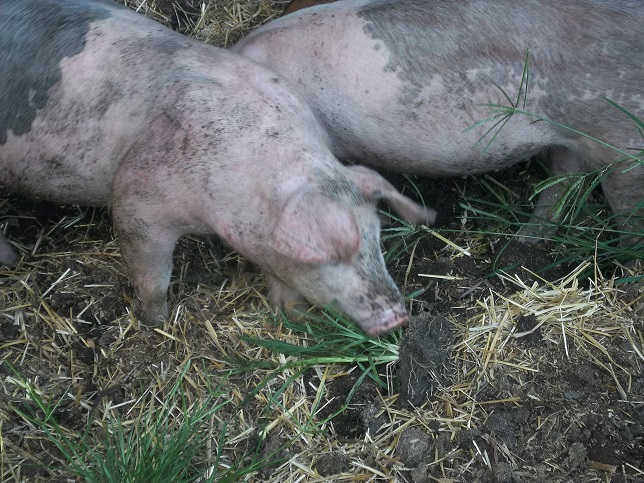
The pigs were hungry for grass and had a great time digging through last winter’s cow bedding.

PigsEatGrassWe are busy canning beans, peaches, tomato sauce…you name it.

As time allows we put a few ducks in the freezer.  It’s pretty hard work.  A chicken takes us about a minute, a duck takes about 10.  The extra step of waxing the bird makes it come out clean but adds a lot of time to the process. Here we are peeling the wax.

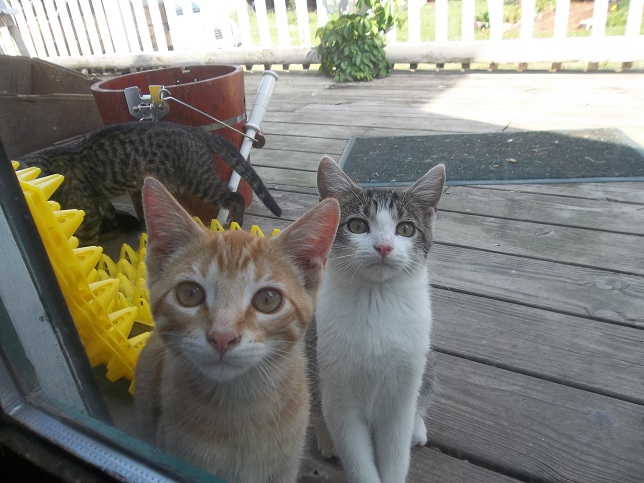
And always the kittens are watching us…looking for a hole in our defenses…wanting to invade our home and love us to death.  The kittens fail to realize that I enjoy them but do not love them.  That was a distinction my grandpa tried to explain to me when I was younger.  I understand it now.  More on that another time.

So..Why Cows?

SO, I ask myself over lunch at work one day, “Why Cows?”

A: That’s a great question, self.  I’ll tell you.  First, because I’m lazy.  Cows don’t need much in terms of time or inputs.  No feed grinding, no extravagant fences…just grass, water and wire.  Second, because I don’t want to mow (see Lazy) and need a way to cycle nutrients.

Q: So what does that mean in terms of annual revenue?  Go ahead.  Answer me as if I’m naive.

A: That’s not such an easy question to answer.  We have gone over some of this before but let’s do it again.  I’ll try to break this out a little bit to make the math easier and I’ll go ahead and make it personal…ish.

Income:
Let’s assume I have 1 cow per acre on my 60 acres.  I could, on average, sell calves for $1.55.  (Now look, I know calves are selling for $2 right now but that’s largely because corn prices fell and feedlots are buying calves again.  Prices change.  Stick with the $1.55.)  That’s $697 for every 450# calf I sell each year.  Not all 60 cows are going to calve.  Let’s say we average 54 calves at weaning.  So we’re looking at $37,665 of income if the weather is perfect and I’m completely stocked on my 60 acres.  But still, that’s gross and I have to keep 6 heifers (-$4,185) as replacements, selling 6 open cows(+$6,000) taking us to $39,480 of gross income.

Expenses:
Cows don’t need much but they do need a little.  They’ll need salt ($5/head), minerals ($50/head) and hay ($100/head if we feed for 60 days) and will have to pay for the ground (pasture rents around here for $50/acre…just happens that we get enough rain to support 1 cow/acre).  Then there’s a cost for my labor (8 hours/week priced at minimum wage divided over the number of cows in the herd…not much difference in labor for 6 cows and 60 cows but it’s $7/cow at 60 or $70/cow at 6).  That all roughly adds up to $212/cow/year for 60 cows.  Gordon Hazard says to add in another $100 for vet bills and hope it goes unspent.  That takes us to $312 per cow per year or $18,720.

Minerals

With gross income of $39,480 and expenses of $18,720 (we already accounted for kept heifers worth $4,185) we’re down to $20,760 ($346 per acre)…before we pay tax.  Now, in truth, my farm expenses are higher than what we have accounted for but the cows, as an enterprise, command market price for pasture rent and don’t need me to own a tractor, build big barns or to watch cable TV.  I could dream of charging my cattle business $20/hour for my time but they would fire me in favor of $7/hour labor.  From a business perspective, I’ve outlined what a cow costs, not what a farm costs and certainly not what a family costs.  My farm payment isn’t the cow’s problem.  My lifestyle isn’t the cow’s problem.  See the difference there?  As a business unit, the cows can earn their keep…it just isn’t hugely profitable.

So, again, after paying myself minimum wage to move cows (because we’re limited by the market, not my desires), the farm kept $20,760 from the cattle operation.  That’s about a 6% return on the farm’s investment.  10% is a magic number.  It’s high enough to attract interest in business, not so high as to attract too much attention.  It’s enough to maintain fences and infrastructure, enough to help fund additional enterprises on the farm, and enough to help save up for a rainy day.  But I’m looking at a 6% return…assuming I can keep my farm fully stocked.  By the way, we’re not fully stocked.

Herd

Now, to help out a bit, land ownership is separate from cattle ownership.  Gordon Hazard says his cows pay him for pasture usage and all of that money goes directly into an account for buying more land, that he paid for the original land and herd with his off-farm work.  That sounds familiar.  The farm income is just enough to cover the farm payment each year.  There is little left.  I made $7/hour for working a little over an hour/day…but, after 30 years the farm is mine…along with a pretty nice herd of grass-genetic cattle.  It is important that the land carries the debt and not the cattle as I can take the cows with me if things go bad.

So the cows can carry the farm.  Those cows don’t need much from me for that money…but it’s not a whole lot of money.  And the income would not be steady, it’s highly variable.  Some years I’ll need more hay.  Some years I’ll have to sell stock to stand a drought.  Then I’ll face a few years of reduced profits as I rebuild herd numbers.  But the math seems to work…it’s just not going to make us millionaires any time soon…and I’m probably not going to quit my day job.

Q:  How can I make it better?

A:  Well, I can work to cut costs.  That might help.  A little.  Going without hay would be a big boost…can you imagine if I had to feed hay for 120 days instead of 60?  Maybe if I had permanent paddocks I could simply subdivide.  Then I could spend less time building fence…but that only goes so far as my labor costs are already quite low.  What if I grazed somebody else’s cattle and they bought the hay?  Now there’s an idea.  I’ll have to put a pencil to that.

There are other enterprises I can pursue to add to the bottom line but pimpin’ eggs ain’t easy.  Nothing is easy…and nothing takes as little time as the cows.

Q:  So is that it?

A:  I don’t know.  I really don’t.  I have customers asking me for pastured beef.  I’ll have to raise some of those calves to slaughter weight.  That cuts down on the number of cows I can carry but it enables me to de-stock my farm quickly during a drought.  My revenue will be lower but I would be more flexible.

Q:  So, Mr. Steward, how long till you retire and farm full-time?

A:  I think this all shows that cattle are not likely to be a primary source of revenue on my 60 acre farm but they are the primary tool we will use for nutrient cycling and the foundation from which our other operations launch.  We work to run a truly diverse farm as the more uses I have for each acre, the more profit I can derive per acre.  Add in timber, hogs, sheep, chickens and recreational value and we might start getting somewhere but something has to mow the grass.  So we have our solar-powered lawn mowers that need attention for about an hour/day and pay the rent.

So I guess that’s that.  The cows will pay the rent and cycle the nutrients but won’t, by themselves, allow me to quit my day job…at least as long as I’m limited to 60 head.  Now the hard part: Getting to 60 head!

Pasture Litter …Again

For the last few days the cows grazed in front of the family cemetery.  This was a thick stand of bermudagrass with cowpeas, millet and a few other things mixed in.  There was also a mowed path to the cemetery gate.  In fact, it looked like this about 6 weeks ago:

JulyGrazing6Notice the mowed area in the foreground.  With me?

One of our goals in using cattle for rotational grazing is to cover, protect and feed the soil with litter.  This keeps the soil cooler and traps more moisture than just bare ground.  Where is the litter going to come from in the foreground?  It ain’t.  I mean, you would think some portion of the grass clippings would stick around and blanket the ground but there just isn’t enough mass…the soil biota eat through it too quickly.

So the cows grazed it.  Here’s what the mowed area looks like now:

GrazingShort1

Not much for litter covering the soil.  The cows ate it right down to the nubbins…horses would have eaten it to dirt.  But the rest of the pasture looks pretty good.

GrazingLitter1

We had them packed in pretty tightly and we got good trampling and manure coverage.

GrazingLitter3The cows did a pretty good job.  I can see the benefits of packing them even tighter.  Maybe someday…

Again, there is very little left where the pasture had been mowed (a necessity for cemetery access).  That area will be a little slower to recover.  I expect the trampled grass to come back quickly…in time for fall grazing.  Hopefully we’ll get to graze it twice more this year.

GrazingLitter2


Most of the neighbor’s pastures look like the foreground in this picture…except they also have clumps of weeds.  If they don’t they have been mowed.  From the road they look OK just like this picture looks OK.  It’s only when you go in close to investigate that you realize how damaging it is.  Hot, baked, dead earth is not conducive to future grass crops.


1,000 Cows on the Move

I have to believe this is more than 1,000 head.

These cattle are managed by Neil Dennis in Saskatchewan.  Based on a presentation he did for PowerFlex fence that is posted on Youtube, he packs cows into a half-acre and moves them throughout the day, overnighting them in the larger area, then starts small again the next morning.  To match his stocking density (1.3 million pounds per acre) I would start my 10 cows in an 18×18 area.  6 steps by 6 steps.

Anyway, I think it’s just amazing.  I can’t imagine what the neighbors would think if I took 1,000 cows down the road on a Sunday morning.

3 things to take away from the presentation linked above (and I should caution you, it’s pretty hardcore grazing stuff.  You can skip the first video, really.)

  • Never have more cows than your wife can look after.
  • Neil Dennis says he can’t afford to own cattle.  He just grazes them for other people.  Might be a lesson for me in that…
  • Neil does a lot of testing to see what works on his land.  It’s surprising which techniques fail to measure up to the propaganda on his farm.