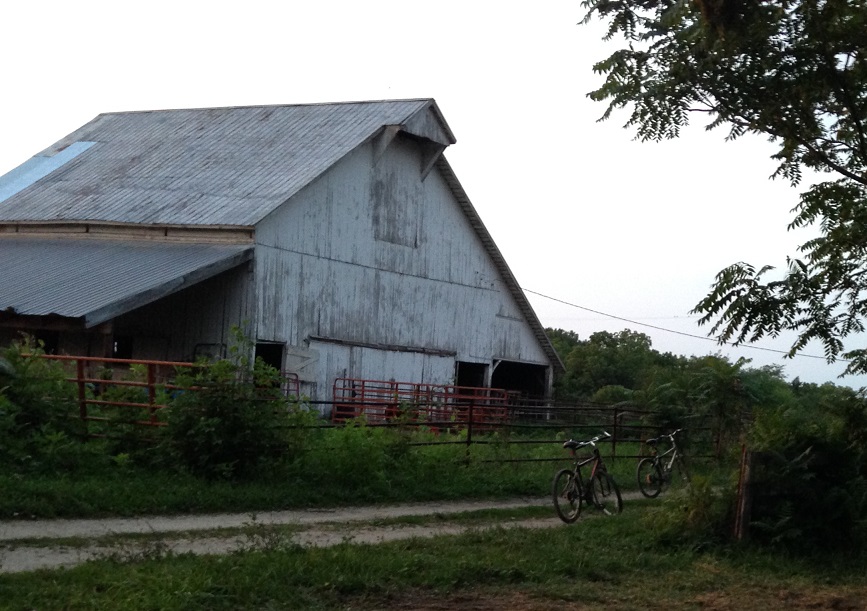
We rode our bikes to the barn to finish up chores just as the sun was setting. It was a small list of things to do, all light work. The dairy cows need a little more pasture to get them through the night, we need to check on the calves, make sure the pigs have water and tuck in the chickens. We have already given the beef cows fresh pasture as we do every 12 hours or so. They mowed, trampled and manured through a tall jungle of giant ragweed today. They also pruned a black locust sapling for me. Looks great.
The evening air is filled with the noises of cicadas, crickets and the call of a Bobwhite quail along with the soft hum of the bicycle tires on the road. The few remaining barn swallows finish hunting for the day. The breeze is blowing from the southwest and carries the sweet smell of the neighbor’s cornfield. You can still smell a bit of summer in the hay loft in February but that corn smell is fleeting. The neighbors feed corn silage in the winter but that has an entirely different, but pleasant, smell. They will start cutting silage soon and then the corn harvest will begin in earnest. Those tall walls of corn will be gone and we will be able to see our neighbor’s houses again. Fall is coming…and fast.
But tonight we just have a few chores to do. The kids are gone for the evening and Julie and I wanted to be outside together. We park our bikes by the barn and open up a little more grazing for the dairy cows then check on the calves. Not much to worry about with those two, just make sure they have water, a little hay and a clean, dry bed.
The SLW pullets are not quite ready for bed yet, though a few are starting to roost. We are still working to train them to roost indoors. They are still working to train us to leave them alone. Who will win?
Julie leads the way to the main layer flock. We need to move the birds to fresh pasture tomorrow morning so I take a roll of fence with me. The birds are still busy hunting for bugs and getting a last drink of water before going to bed.
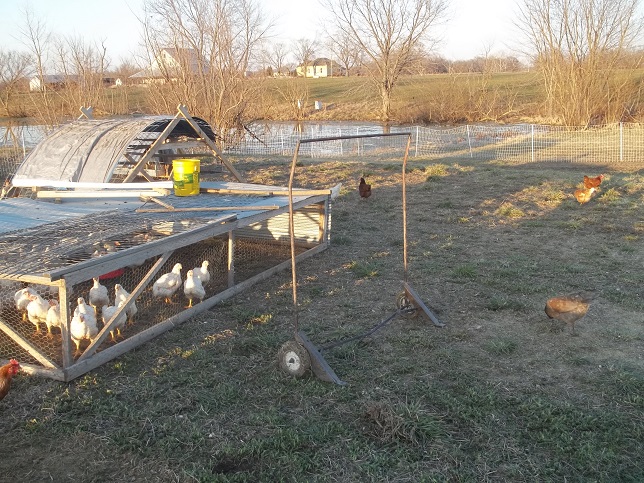
They need a little more time. I busy myself building fence for tomorrow’s chicken pasture. It should be enough room to last them until Sunday, complete with fresh cow pies to scratch through. In no time at all I have two of the three fence panels in place and decide to call it a day. I am surprised at how many saplings have come up in the pasture this year. A stray bird or two just refuse to roost in the chicken house each night. I find and catch those birds (one in a nest box, one under house, roosted on the running gear) and close up the house for the night. It won’t be long and the birds will be in the greenhouse.
Julie left before I started on the fence as we were expecting the children to come home any minute. She also wanted to get the dishes done so we could just relax together after we put the kids to bed. She and I both have a number of books going at once and are anxious to make some headway. I have to keep my mouth shut and my eyes scrunched to keep the bugs out on the bicycle ride home in near-total darkness.
It was a beautiful summer evening. Cool weather, light work to do. Really, just a chance to stand in awe of the world around us. I get to live here. For a short while this farm is mine. There are times when it seems like too much work, too much stress, too much all happening at once but today I am thankful.
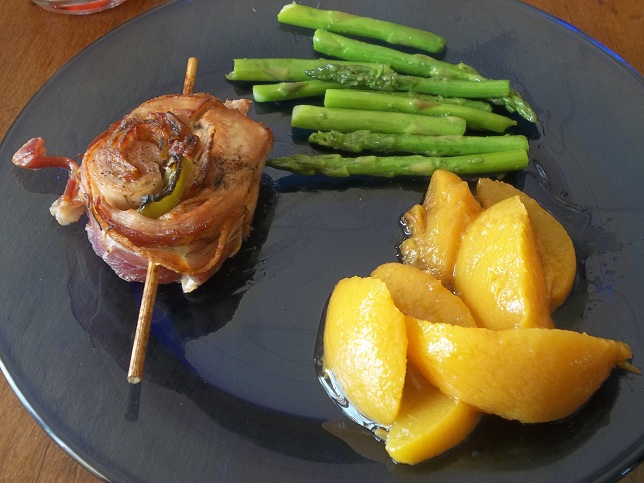
It may not be apparent on the blog. It may not really be obvious on the farm. Julie and I have scaled things back a bit this year. In the short term it hurts our bottom line (but not by much) but in the long-run I think it will pay dividends. It doesn’t matter if I butcher 500 broilers or 5,000 (the state-imposed limit). It matters that the food you buy from me is the best you have ever eaten. So good, in fact, that you take pictures of it cooking, post a picture of it on your plate on Instagram and, most importantly, tell all of your friends about the delicious chicken you bought from me. Then you will come back for more and word of mouth will grow our business. You are our marketing plan.
…or in this case rabbit.
However, because we scaled back your friends may just have to wait until next year to buy a delicious bird from us. I have to make sure it is worth waiting for. If I just cranked out large numbers of mediocre birds…well…mediocre birds don’t start conversations. They are just something to eat. Average birds cost less than a dollar a pound so I can’t compete with that market. And I can’t market to the average consumer. I have to raise the very best and cater to those who appreciate it.
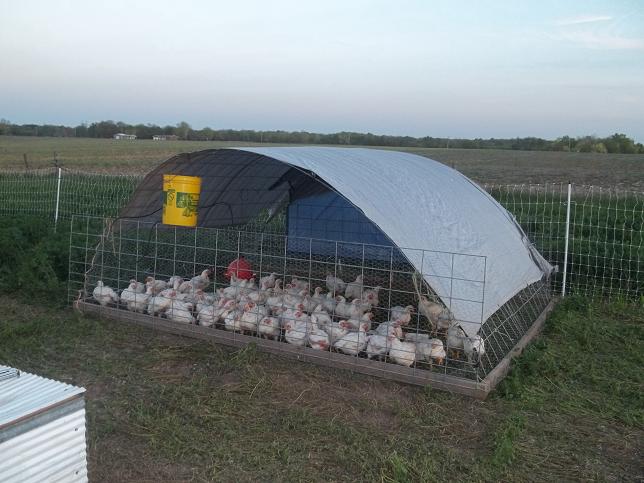
After a number of years of raising broilers we have tried it all. One year we butchered 75-150 birds every other Saturday. Think about that. All summer long. And we sold them all! But Julie was tired. She started losing her fingernails from scraping lungs out and her back hurt from standing at an odd position to do the work. Don’t forget that I have a job in town. Julie had to go to the chicken tractors at least twice daily to fill water and feeders but Julie just isn’t strong enough to move the chicken tractors. And we found that the CX birds have a hard time with our summer heat. When it’s triple-digits in the shade they just didn’t do well in our Salatin-style chicken tractors. Switching to hoop-style tractors helped bird health but we also have to be concerned with farmer health. We just didn’t want to go water chickens when the heat index was 112. Just as important we found that customers stopped cooking dinner in the hot weather. Our sales pattern (and this may only apply to us) was to sell birds between Memorial Day and July 4, then again from October 1 until we ran out around Christmas or New Years. Our current schedule produces birds only for those windows. Now our freezers are not filled (or failing) when the weather is hot and customers don’t want to cook anyway.
But it doesn’t stop there. If customers don’t want chicken in August, they certainly don’t want pork. Now we try to time our batches of pigs to be out the door by July 1 and little pigs arrive shortly after. Little pigs can manage in the heat well and will be ready to roast and serve with fresh apple cider in October or early November. And you should know that we don’t do large batches of pork. First, I don’t think I could market a dozen hogs all at once but second, and most important, I don’t think I could produce a quality product at my current ability level. So we usually run a batch of four pigs, three times/year. Does that seem like too few? It’s just the right number for our interest, ability, equipment and market. And, fortunately, that’s a lesson we didn’t have to learn the hard way, short of a half of a hog my folks bought for the processing cost after the customer evaporated.
But it’s not just a matter of working to meet customer time preference, it’s also about minimizing our distractions so we can serve you better. Let’s face the facts. If I didn’t have a job, we wouldn’t have a farm. That’s the awful truth. So we have to build the farm around Julie and the kids. What can they manage well? Right now we are focusing on dairy, eggs and pork, keeping each operation small. There are beef cattle on pasture but I manage them almost entirely. The rabbits are gone. The goats are gone. I miss the turkeys. We are focusing on just those three things: the best possible milk for our own table AND fat, healthy calves. The very best egg in the world from fat, healthy birds. Pork the likes of which you have never tasted from animals that are respected and live with purpose. Outside of those three we are educating our children, reclaiming our farm from overgrowth, heating our home with wood, putting up winter stores of food and hay, gardening and playing tag. And we can’t overlook the need for Julie and I to maintain our marriage. That’s more than just saying, “Hi” and kissing goodnight. There has to be time for us to rediscover each other as people. My marriage may seem unrelated to my chicken eggs but you have to know that there wouldn’t be any eggs to sell if my marriage failed.
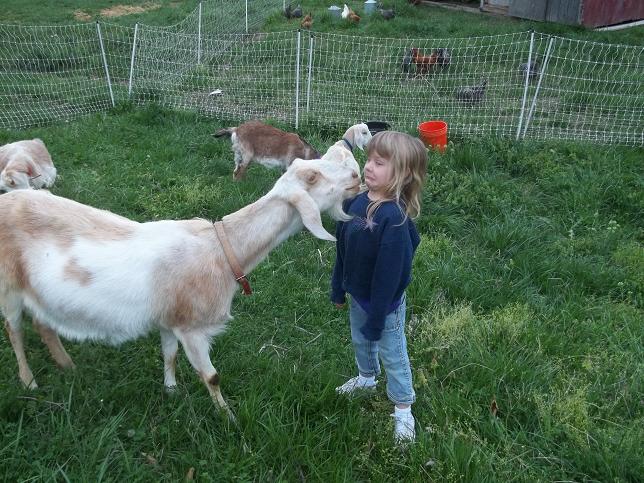
I miss having them but there are no turkeys or goats or rabbits this year. We just don’t have the time. As we learn to do a few things well we will become more efficient…streamlined and that will open up additional opportunities on our farm. How many pigs did Salatin raise last year? A lot. How many pigs did Salatin raise in 1995? Eight. (Read under the heading “Hogs for Free”). You want to grow up to be just like Joel Salatin? Start small. And he didn’t just have pigs for the sake of having pigs. He had a job for them to do then he built a market for his products over time. We are taking our time. Our skill is growing. Our market is growing. We are careful not to allow ambition to overrun marketing and husbandry. We want to provide the best for you, ensure the best for our family and do so by limiting growth while we continue to learn.
Does this apply even if you live in town? I hope it does. What are you doing with your time? Are you really working toward your goals or are you just trying to keep up? Or, worse, are you just keeping busy? We have scaled back to move forward. Together.
There is just a lot of work to do. So much that I can’t get it all done. I have projects that remain unstarted – let alone unfinished – for months. What is the most important thing I have to do each day?
Well, I rather like being married. A marriage doesn’t really work out like advertised in the brochure. It takes a lot of work. A lot of work. Beyond that I have these kid…things. I may be utterly content to get up at 4:30, do a little housework, eat a little breakfast then spend the next 12 hours running a chainsaw but those guys?…well, they are not. They need me to …like…talk…and stuff. Worse, to listen! I don’t mind talking too much but I’m not a good listener. That should be evident in the fact that I write a blog I don’t read. This is particularly embarrassing when a reader wants to discuss something I don’t remember writing. But there are other things the kids need too. They need a little freedom to make messes and I don’t deal with messes well. They want to pull out all of the Legos and cover all of the tables in the house with their creations, leaving plastic containers and lids on the floor as well as the odd lego here and there for me to step on. I like Legos. I like my children. But sometimes, on some days, the combination does not work.
I make a real effort to keep up on artwork, dreams, and goals of my children. I work to find out where they are strong and where they are struggling. We sit together. We work on multiplication over breakfast. The younger ones want to hold hands as we walk places. We play with Legos or play video games together. We read the same books and watch the same videos and do the same things. Sometimes they just want to be nearby, jumping on the hay I am stacking. That’s cool.
My kids need time and attention.
But so do my livestock. And so does the barn. And the roof is leaking over the bathroom. And the garden is growing a nice crop of weeds. And something is wrong with the computer. And X called…something is wrong with their computer. And we have a hay forecast. And that mountain of manure won’t spread itself. And I need to get to town to pick up another ton of feed. And that friend in Florida called and needs me to fly down and work for a couple of days. And…
So after spending time with my family what is the best use of my time?
Well, the farm does not generate enough income at this point to support itself. I have gross receipts of roughly $6,000 worth of hogs, $4,000 worth of eggs and $7,000 worth of chicken…so even before taking out feed and equipment costs we can’t make the payment. The world runs on Net, not on Gross. The farm has to grow.
But the farm can’t grow if I’m not home to do the work. But I have to go to work to pay for the farm. And I can’t simply “Go” to work, I have to work at it. And with what I do, I have to keep studying it outside of work hours because I work in tech and technology always changes. SO I listen to tech podcasts in the car, read tech blogs and books and even teach my specific skill set when I get the chance (If you ever want to learn something, teach it).
The farm, as it stands today, won’t pay for itself. I have to have a job. My job requires me to study. But my family needs me to be a dad. And somebody has to pack the eggs.
So we are finding ways to streamline processes and increase efficiency so we can grow the farm anyway. We have tried some things and found they are better left to others who are more skilled…or just have more time. For example, I really don’t have time to use my sawmill. I should probably do the little sawing I need to do and sell it. I don’t really have time to bale hay. Right now I use vacation time to bale hay but maybe I should buy in hay or have it custom baled on the shares and use my vacation days to go to the zoo. I can just keep on going. It’s probably not a good use of my time to butcher chickens. Deer hunting is a total waste of time (especially since I never bother to fill my tags). I should find a job that will allow me to telecommute. If we keep going down this course I’ll decide I should sell the farm and buy a house within a mile of work so I can ride my bike. But what’s the fun in that?
Let’s stop talking about elimination. Let’s focus on getting better. How fast can we milk the cows? What are the bottlenecks we run into? Are these problems due to management? Can they be streamlined? Is my travel path between chores efficient? Dairy to pigs to layers to pullets to beef cows. How long do we spend bringing the dairy cows back to the barn? How long does it take to prep for milking? Is milking a one-person job or a two-person job? Should one of us do this while the other is putting breakfast together? What is the minimum number of times we can start the truck in a day?
When thinking about the efficiency problem I noticed how long it was taking me to move the old layer flock from one place to the next. The layers are surrounded by 4 lengths of electric netting in a square shape. I have three extra lengths that I use to build the next square. Then I take down the divider between the two squares, move the birds, move the feeder, move the drinker(s), move the shell, put the divider back up and let the birds out of the house. Well. That sucks. Just moving the three new lengths of fence takes 20 or more minutes and a lot of walking. Why am I fencing the birds? The new layer house is pretty strong. I’m going to put the whole flock in the freezer October 1. The replacement flock will start laying any day now. We are seeing no predator pressure in part because we are moving the birds so frequently. Why do I need fence? Because I hate hunting easter eggs every day. But without fence I just back the truck up to the house, load the feeder, oyster shell and drinker on the truck and head on down the road. As a bonus, we could drive right up to the feeder now instead of carrying sacks of feed across the fence. The birds range further, the farmers have more time. In spite of the advantages we are concerned about security and, again, hate hunting for eggs.
Beyond that, I just pretend to be busy, Julie IS busy. Schoolteacher, referee, caregiver, friend, farmer, business person (with several businesses going), housekeeper, cook, student …all that and a few hobbies on the side including photography. She has had to forget about sewing. Not only do I have to be efficient about getting chores done, I have to do as many of the chores as I can so she can have time to just be Julie. Specifically, I have to do all the chores that she is not strong enough to do like move chicken tractors and carry feed…chores that have injured her in the past. Sometimes, in spite of our best efforts and the fact that we grow all this great food, our freezers and pantry are fully stocked and the garden is productive, there are still days, I’m sorry to say, when she calls to say she can’t make dinner and needs me to pick something up. So I get up early to wash dishes and do laundry. I work with the kids to help them find the fun in washing dishes and to teach them to work efficiently themselves. We try to cook too much at one meal so we have leftovers at the next meal (hard to do with 4 growing children).
Whatever we do, however well we do it, whatever time we save it all falls apart anyway. We seek additional efficiency here or there to free up a few minutes then we find something else to do with that time…forcing us to seek additional efficiency. On and on it goes. “Honey, let’s get sheep!” She ignored me.
Life is demanding. We have to build and maintain our relationships. We have to keep up on housework. We have to build our various businesses. We have to maintain what we have built. I have to continue working off-farm. And we have to do all of it efficiently. I cherish the opportunity to sleep or read in the carpool. Some things just have to be cut out. But some things we just have to work through to find that new point of efficiency. We no longer raise broilers in the summer. We try not to milk cows past November (ice is not our friend in the dairy). We take time between batches of pigs. We schedule our year to allow time to catch our breath. To give our relationships a checkup. To make sure we are still united in vision and willing to make adjustments where needed.
If we are going to do anything as a married couple we have to prevent that busyness from destroying our marriage. A little at a time things just seem to sneak in. We work proactively to keep finding little places we can do better so our marriage is not disrupted but it is a difficult process.
It is an ongoing process.
Like everything else.
This week I am spending quite a bit of time on this topic…both to publish a backlog of unpublished posts and because I’m really struggling right now. It is not as simple as saying I enjoy work so I work and that’s that. There are 5 people living in my house and 2 people living next door that I love and want to share my life with. Dad doesn’t always want to shovel horse manure or climb on my roof in a rainstorm. I can always count on mom to help me make strawberry jam or salsa but who is she really? There are people in my life, not just co-laborers. That’s where we are going this week. Hope you come along.
If you are burning the candle at both ends you aren’t as bright as you think you are.
Pastor shared that last week in church. It took me all week to write it in a post. Always in a hurry, putting things off as long as possible, finishing others just on time, never any time to spare. That needs to change.
I don’t even know what I would do if I had a week of real vacation. Given the option I would just work. Maybe the work is the vacation. If so, why do I put certain things off?
My standard advice to someone interested in raising broilers is to read Pastured Poultry profits then raise 25 birds in the fall and see what it’s all about. You should be able to get in and out of 25 birds for under $500 counting equipment and still have enough birds to make processing day worth the effort. It is also the usual minimum for shipping chicks. 25 gives you enough birds to eat through the winter with a few extra to share with loved ones or neighbors. It also leaves you a margin for error. And you will make mistakes. This first batch will take you to school. That, in summary, is what this post is all about.
The Complete Formula Spend the month of July preparing for chicks to arrive on August 15th (or 8 weeks before your first frost). Find a hatchery within about 4 hours of you to minimize stress on the animals and so you can drive there if the weather is hot on shipping day. We have had some bad experiences with the postal service in hot weather so it might be better to just go pick them up.
Birds We are big fans of the Cornish Cross. Our friend Darby likes the S&G Heritage White. Others like Rangers. That’s all well and good but I want you to get in and get out of birds in a hurry. CX are a suitable, inexpensive bird and will provide your general education while finishing on pasture in 56 days. Also, white feathers are easier to pluck than red or black feathers. 25 birds shipped from Schlecht Hatchery would have cost me $43.25 in Fall of 2013.
Feed
I’m going to suggest that you go ahead and use (gasp!) Purina Sunfresh or something similar but add a dollop of yogurt and some kelp…better yet, buy a bag of Fertrell Poultry Nutri-Balancer (PNB). I realize this won’t satisfy a desire for whole grain, non-GMO feed but it will get you overcoming inertia. In 8 weeks the birds should be around 5 pounds. You need 3+ pounds of feed to make 1 pound of bird so you will ultimately need 375 pounds of feed to raise 25 birds. Make that 400. 8 bags of feed at $17 each will run you $136. We add fish meal for the first two weeks to bring the protein level in the feed up from 19% to 21%. Obviously this adds to the feed cost. If you can’t find fish meal use game bird feed for the first 2 weeks. Right now 26% game bird feed is cheaper than 19% grower. Add in the kelp and/or the PNB and you are more in the $175-200 range. Just totaling chicks, shipping and feed brings costs to something like $1.94/pound of packaged meat. Economies of scale are working against you…don’t be discouraged. You aren’t producing the kind of bird you can buy in the store so don’t compare your prices to theirs.
Chick Arrival and First Few Days I want to start this section with a warning. Chicks die. No matter what breed, you are going to lose a bird or two. It is going to happen. You may find a dead bird in the shipping box. You may find a weak bird in the box…that you nurse along until it finally dies. Birds die. Birds that die after about 4 or 5 days are your fault. Before then, it’s just sad. Move on.
However, birds also live. Birds you think will never make it are running around the next day. Those are the birds to watch out for. It seems that birds that get off to a bad start never recover…meat birds are the worst at this. Friends have raised whole batches of birds after a brooder disaster (got cold) and they are always small, inefficient birds. Do things right in the brooder and everything goes better.
You will need some sort of brooder. For 25 birds you can get by with a 100 gallon poly water trough or an old bathtub and a red heat lamp that you can adjust if the birds get too hot. I like the poly troughs because there are no corners for birds to get smashed in, the sides are too tall for escape and there is no chance of a draft. Also the trough has other uses. Bed the birds on non-cedar wood shavings or chips and keep adding fresh shavings day by day. You will find that the bedding warms as it decomposes and things begin to make their home among the chicks adding protein to their diet and boosting the chick’s immune system. You won’t want to do this in your living room. For the first few days, feed the chicks in an upside-down frisbee. Dig down a little so the frisbee sits level with the bedding. The birds will make a mess with wasted feed but they’ll eat well. In a few days you should switch to a covered feeder. You should have at least one quart drinker in the brooder for your 25 chicks and you need to keep it full. Put a tablespoon of sugar per quart of water for the first two or three days and never give new chicks cold water. We have also found our birds try to stand in the drinker then risk hypothermia. We control that by putting marbles in the drinker bowl to just below the water level. The lip of the drinker should always be just below beak height so it stays clean. We find the most success placing the drinker on a brick buried in the bedding for stability. Add bricks as the chickens grow and as you add bedding.
You’ll need to watch brooder temps during the heat of the day and keep them warm at night. Gradually decrease the brooder temperature after 10-14 days by raising the heat lamp a little each day. The birds will soon feather out and will be strong enough to survive overnight without a lamp but there will also be heat coming from the bedding itself. When the weather is dry and warm for a few days in a row and the birds are well feathered out plan to move them out to pasture.
Chicken Tractor
We are big fans of chicken tractors. Go ahead and build a chicken tractor sized for 60 birds. If this turns out not to be your cup of tea you can either sell it or recycle the parts into other projects or uses. We have several designs and my favorite is the hoop made of cow panels. I have used these for chickens, pigs and as a greenhouse and it would make a suitable calf shelter. I feel that most of the plans online are overbuilt and very heavy. We just try to keep it as simple as possible…and not hurricane-proof. There are numerous advantages to hoop chicken tractors beyond their versatility. You’ll see what I mean when you help someone with a flat chicken tractor gather birds on butcher day…hands and knees in chicken poop. A tractor like this should take 2 hours or less to build.
You are going to need a dolly to move the chicken tractor. I’m not much at welding or fabrication so I traded a guy 8 chickens and he made this for me.
We based it on the pictures and description in Pastured Poultry Profits. Move the chicken tractors every day. When the tractors have more and larger birds you will need to move them more frequently. We find it is easier to move the tractors when the birds are hungry in the morning.
You will also need a way to water the birds. It is not uncommon to have 100 degree days in September and 90 degree days in October in Illinois so you should plan sufficient water capacity. We hang a 5-gallon bucket from the hoop and feed a Plasson bell waterer. The tractor and drinker should cost you around $160 to put together. You could skip the bell waterer in favor of a metal drinker but the bell stays so much cleaner it’s really worth it. Clean water is important.
Feeders
We use 4″ PVC cut in half for feeders. Remember, we’re going cheap here. Some feed falls off of the ends but the birds clean almost all of it up. Just buy a 10′ pipe, cut it into 5′ sections and rip the halves on a tablesaw…or have somebody else do it if you don’t have a saw. PVC tends to pinch the blade on the first cut so I think it’s better to make an incomplete first cut then finish later with a box cutter. I hope that’s clear.
Then take two 8″ lengths of scrap 2×2 and screw the PVC to a flat side to act as legs. This solution is cheap and should last as long as you want to raise birds. Each half of pipe should hold two quarts of feed. Put enough feeders in that all of the birds can eat at the same time. As birds grow you will need more feeders.
We usually let the feeders go empty by 6pm after the birds are 4 weeks old. We feel that letting the birds go hungry overnight boosts their overall health and increases our success rate with the birds. Less gain per bird but more total weight of live animals. Fewer flippers…birds that die of heart failure and you find them laying on their backs.
Processing
You can do this. You don’t need to buy a few thousand dollars worth of specialized equipment. You don’t need to rent equipment. You can do this.
You can do this. Say it with me. “I can do this.” I believe in you. You. Can. Do. This.
Go.
At a minimum you need a couple of sharp knives, a work surface outside (plastic table, tailgate), a bucket for offal and a pot of hot water.
Killing the bird is always an issue. I have a co-worker who joked that she was afraid of me because I am a remorseless killer of animals. Please understand, I am not without remorse. I’m a city kid. I cried when I killed my first rooster. The whole experience was emotionally draining and difficult and we ended up with this skinny little thing that was hardly worth cooking. It can be really discouraging to kill a rooster. Anyway, make a cone with a bleach bottle, screw it to a post and you are ready to go. Place the bird in the cone upside down. I hang on to both legs with my right hand and the wings with my left. When the bird is fully inserted into the cone I release my left hand and reach down to find the bird’s head. I put my left forefinger on the bird’s comb and my left thumb under the beak and pull down gently but firmly. Then I let go of the legs with my right hand grab the knife. Place the curve of the knife on the bird’s ear and push the knife through toward the back. If your knife is sharp you won’t have to saw. The knife will just go through. Don’t cut the windpipe or sever the spine. We just want to cut deep enough that your right hand gets covered in blood immediately. Then repeat the same cut on the other side of the bird’s head.
The bird will die in just a few seconds then the nervous system will begin to twitch. The cone acts to restrain the bird as it begins to twitch and thrash preventing it from breaking wings or bruising meat. In just a few seconds we are ready to scald the bird.
Plucking a bird is a breeze if you scald it correctly. All that expensive equipment just makes the scald and pluck fast when handling hundreds of birds. You are probably going to process 5-10 birds at a time. All you need to do is heat water on your stove, carry the hot water (carefully) outside, add a dollop of dish soap to the water and get to work. You might prefer to heat the water on a turkey fryer. Whatever, just don’t spend money here. Your water should be 145 degrees and you should swish the bird gently up and down in the water for 60 seconds. At that point the feathers should pull out easily. If you soak longer or hotter you risk cooking the skin and it will rip off when you pluck. Shorter or cooler, you’ll have a hard time getting feathers to release. You may need a pliers for pin feathers. I find it helps to hang the bird by its feet and pluck from the tail to the head but we have plucked our share of birds just laying them on a table.
From here on out there are any number of informative videos that will get you through it. My favorite is the Featherman video showing Salatin but Grady Phelan put up a video of the whole process with a helmet cam that’s pretty cool.
With practice you’ll need around 30 minutes to process 25 birds but the first time you will need several hours to process 5. I suggest you start with 5 birds one morning and 10 more the next. That leaves 10 more birds for a third processing date. Those final 10 could be the smaller birds of the batch and holding off a week will give you a chance to change your setup, resharpen your knives and figure out how to do it faster. In just a few sessions your first 25 birds will be in the freezer and you’ll be eating like a king.
Reflection
You have the rest of the fall and all of winter to reflect on your chicken experience. What did you think? Was it everything you had hoped it would be? Will you go back for more? What will you do differently next time? Do you think this is something you could do as a business?
You have everything you need to grow out 60 birds at a time. Maybe add another stock tank or upgrade to a 300 gallon tank. Other than than, based on our experience, I would encourage you to keep working with what you have. With just what you have you could easily finish 60 birds every month from May through September if you wanted…300 birds! We splurged and bought a used whizbang chicken plucker for $400 and we did thousands of birds with that and a stock pot on a turkey fryer frame. We were several years into our business before we contacted Featherman and we bought our equipment with profits from the previous season’s sales. Don’t buy anything you don’t absolutely need. Repeat that to yourself. This applies outside of farming too.
Can you sell the birds?
We could write a book on how much we don’t know about marketing. There are three main things to consider here:
1. Is it legal where you live?
2. Is anybody you aren’t related to interested in your product?
3. What are your costs? How much do you have to charge to make a profit?
Be sure to pay close attention to #3. Your costs are not fixed. They are not. Really. You don’t have to own land to raise chickens. You don’t have to spend $500 to build a chicken tractor. You don’t have to buy (now I know this will ruffle some feathers) non-GMO organic coconut-based chicken feed for the first batch. You can get 80% of the way toward the bird you want to raise without breaking the bank. The best way to save money is to keep it in your pocket. But you have to spend some money along the way no matter what you do. Keep track of those costs. Keep track of your time. By just raising 25 birds you are missing any number of efficiency gains you will realize with larger batches later. For example, if you can’t process them yourself, you have to divide the trip to the processor by 25 birds instead of, maybe, 1,000 birds. You with me? But you have to pay for that education and this is part of it. 25 expensive birds from now and you’ll be well on your way to your diploma.
Beyond that, we find that customers want a bird that looks like a grocery store bird. Shrink bags cost a little more but we think they are worth it for the better storage and presentation quality.
So that’s it. You just have to get your feet wet. I’m sure I have left out important details but you won’t know what you don’t know until you go find out. When you do, feel free to email us or leave a comment. We’ll do what we can to help you out.
UPDATE:
After a little offline discussion I want to further emphasize the importance of actually reading those books you bought. I have nearly worn out our copy of Pastured Poultry Profits. Beyond that, we got some good brooder tips from Andy Lee in his books Chicken Tractor and Day Range Poultry. Also we found some helpful information in the book Raising Poultry on Pasture. But just buying the books won’t do any good. You have to read them. You have to grok them. If you only have the budget for one book, Pastured Poultry Profits is the one.
I also want to say that we run 60 birds in a 8×12 chicken tractor. That’s smaller than Salatin uses so we run proportionally fewer birds. And at times I wonder if they wouldn’t be better off with 50 birds per tractor…especially if the weather prevents us from butchering them on schedule. Watch your birds. They will tell you what they need.
Oh the things I would buy! The farm will absorb all the money and labor I can throw at it and it will never be enough. There is always more work to do. More I could spend money on. More I could throw resources at.
Some things are better than others. Some things are higher priority. Sometimes priority is somewhat ambiguous. It’s hard to know. But there are several things we own that we don’t need but enjoy owning…places we have tucked a little spare cash and feel we have been rewarded for it.
Well, mostly anyway. We have an electric range. We have a furnace. They both work well when the power is on. But the wood stove is so nice all winter long. Just park your tookus next to it and you’ll thaw out in no time. Wet, ice-covered gloves will thaw and dry while bacon fries and bread cooks. It’s amazing. The whole skillet heats evenly, not focused at the center! You will also lose weight, gain strength and stay warm cutting wood to feed the thing. 5 months of wood is a lot. No. A lot. No. You are still thinking too small. A Lot lot.
So we sharpen the chain, mix the fuel, put on safety glasses and hearing protection and heavy gloves and spend dry days in winter cutting hedge trees, cleaning fences and managing the woodlot for the future. Multiple shoots come up from a coppiced stool. We pick the one that looks the strongest and cut the rest…year after year. We build fires. We build brush piles for wildlife. Then we remember we forgot to stoke the fire in the stove so somebody goes home to put a big log on. Nothing worse than a cold stove on a winter evening.
It certainly isn’t something we need but it really is nice. This old, drafty house is hard to heat so we don’t. We just set the thermostat at 57 and keep that fire roaring. We recognized a need, had a little extra cash and are now reaping the benefits.
There are any number of places I would spend extra cash on the farm but we don’t seem to be burdened by unspent money these days. It would be nice to have a second car, more and better cows, a round baler, a loader tractor, 1,000 chestnut trees, 3,000 hazelnuts, sheep, a new machine shed, more and larger greenhouses…on and on. Long lists of things I don’t really need but would REALLY like to have. Things that would make our life here a little better. Trenched water lines, pond, a floor in the loft of the cattle barn…heck, a new cattle barn.
But it all costs money.
Well, Mr. Jordan, don’t you have a bona-fide city computer job? Well, yes. So where does the money all go?
A few years ago I could tell you to the penny. To the penny! I kept a little notebook outlining my goals and stating my finances clearly. But that fell to the wayside. Some people only pray when they are cornered and look to God as their last chance. That, I guess, is how I feel about budgeting. And it shows.
But, again, no matter how much money I spend I could always find a need for more. That’s unfortunate but it’s the truth. It doesn’t matter how well I budget. It matters how I prioritize.
I’m glad we bought the wood stove. However, I am careful to distinguish needs from wants. There are wants that are worth having. But maybe not right now. I think the pond falls into that category. It would be nice but there are other priorities. That was a hard thing to say though.
A 6 foot tall, 175 pound bulldozer. A small bulldozer is still a bulldozer and that’s what I am. In front of me is the endless list of work to do. Behind me, laying broken and crumbled, is anything that got in my way. Trees. Weeds. Family.
I am me when I write on this blog. This is me. The real Chris Jordan. But the person you read about is only a small portion of who I am. The real Chris Jordan is, among other things, hot-tempered, impatient and insecure. My insecurity has driven me far beyond what a whole list of schoolteachers told me I was capable of but what has it cost me? I’m certainly egocentric and how narcissistic is this blog?
It doesn’t matter how much money I make. The farm (like any business) will consume it all. It doesn’t matter how much work I do. There is always more work to do. Always. But who will I work with? Who do I work for? I can’t be enslaved by dirt. The dirt doesn’t care. Will I just become Ebeneezer Scrooge enjoying my cold, dark house because “darkness is cheap”, not cherishing the light of loving relationships?
To avoid becoming that I have to slow down. I tend to be critical of my own mistakes but I need to be understanding of those made by others. I need to keep my mouth shut because words can never be unsaid! I have to pause, take the time to learn about my family each day and show a genuine interest in each of them…supporting them…loving them.
My wife means more to me than my cows do. That seems like an obvious statement until you look at where I am putting my time. It also seems like a lesson I would learn one of these days. The real Chris Jordan is pretty dense.
I often write that I love my wife. I love my wife. I am delighted to praise her openly. I appreciate her thoughts and her presence and her strength. I appreciate her forgiveness. And gosh! she’s pretty.
Farming is hard. Physically and emotionally. Marriage is hard. Physically and emotionally. Take time today to strengthen your ties with those you hold dear. Go ahead. Be the first to forgive…as Julie is. Then talk through the problems. They won’t just go away on their own.
The layers are near the cattle in a weedy, overgrown pasture complete with brush, fallen limbs and dead trees. Every morning I walk out to let the birds out of their house. Every morning I see this and think, “Oh No! Is that a dead cow? How did it get there? What could have happened?”
Then I remember. It’s just an old log.
Every morning. Every. Stinking. Morning. I should probably have a cup of coffee before I do my chores. And I should burn that old log.
Our eggs are on sale again. No. I’m not crazy. I can do math.
I have X birds. They eat every day whether they lay eggs or not. They use roost space eggs or not. They need to be protected eggs or not. The costs of the bird, the feed, the housing and the fencing are fixed. What varies is the number of eggs.
Let’s make the math simple. Let’s say I have 100 birds. I can normally count on 100 birds laying 65-70 eggs. But egg production varies seasonally. We get few eggs when the days are short. We get few eggs when the weather gets hot. We get many eggs when the birds are young, fewer when they get older. They take time off each fall to molt. This is a biological, not mechanical, system and, consequently, it varies.
But, again, what doesn’t vary is the cost. I own the fence and the birds…now I have to pay for it.
So let’s say the flock costs me $15/day to maintain. When the birds lay 66 eggs, 6 are going to be cracked, checked or misshapen and can’t be sold. That leaves 5 dozen for me to sell. I’m not going to work for free so we charge $4/dozen for our eggs and we bring in $20 gross, $5 net.
You down?
Right now the flock is laying more like 90 eggs/day. That’s more eggs for no additional cost, even if I can’t sell 10% of them. I add in two additional cartons ($0.30 each), and have more eggs in my egg case than my regular customers can buy. As nice as it would be to bring in $28/day, I need to sell those eggs, not feed them to the pigs. This is my chance to attract new customers. I run a 25% off sale. Folks who think $4 is too high for eggs are happy to pay $3. If I get $3 for 7 dozen eggs I’m grossing $21/day. The extra cartons knock me down to $5.40 net. That extra $0.40 is probably absorbed by the extra tray space and wash/sort time.
Now, some suggest that I should use the surplus cash coming in right now to make up for the expected shortfall this winter. I think that is sound theory except for two things. First, we have a new layer flock coming online soon and should not see much of a winter production drop. Second, I don’t know what to do with all the eggs I am collecting these days. Let’s go drum up new business! Eggs are a little more than a labor of love anyway.
I’m collecting more eggs for the same cost. I’m gaining exposure to new customers. I’m making more money at the end of the day…even with cheaper eggs. But the real question is, “Why are we getting more eggs?” Good question. I think it comes down to management. Not only are we collecting more eggs overall, we are collecting more salable eggs. I’ll start with the salable eggs. With our old hoop-style chicken house we had to bend down to go in and collect the eggs…so we didn’t want to do it very often. So most days we would just collect eggs once each day. When there are more than 4 or 5 eggs in a nest box the birds tend to crush an egg or two, smearing the remaining eggs and nesting material with broken egg mess and bits of shell. Now that we can collect the eggs outside of the structure while standing we don’t seem to mind collecting eggs late in the morning and again in the evening. We are also doing a better job of keeping fresh, clean nesting material in the boxes. As a result we are able to sell a higher percentage of the eggs we collect.
But we are also just getting more eggs. To the point that I plan to add another nest box array. Some of this is seasonal. Longer days and unusually cool weather make it better for the birdies. But I think most of it is due to recent changes to our housing situation. We built a new layer house on wheels. I insulated the roof of the building and provided for excellent ventilation. The high yesterday was in the 90’s but inside of the building was cool and breezy. I was removing soiled bedding from the interior of the house and dust was not a problem. I wasn’t even warm until I stepped out of the building. Beyond the house, we have just turned our birds free. Grandpa’s rock collection spans most of the farm making it difficult to step in fence posts for netting so we are just letting the older birds run. That creates a few real problems like predation, hidden eggs and birds roosting in strange places. However, the birds are able to scratch and gather from a much larger area, lowering their feed consumption. They especially seem to like the horse stalls where they find undigested oats. This would work much better if we had a larger farm. If we had 300 acres (and 150 cows) we could move the chickens further each time, keeping them busy in new places. I’ll have more to say about fully free range birdies another time.
Back to the point, more food, less heat, better housing, more convenient nest boxes…these things all combine to break all records for egg production on our farm. It’s not uncommon for us to collect 100 eggs from 110 birds.
So eggs are on sale right now with the hope that we can establish ties with new customers…customers who were reluctant to give us a chance at $4. With luck, they will try our eggs, notice the difference and offer us additional chances in their kitchens.
I’m afraid I’m a terribly sexist person. Worse, I am sexist without remorse. When selecting candidates for the position of intimate lifetime companion I only interviewed women. But I did interview a lot of women and feel, ultimately, I made an excellent choice. The fact that I can’t imagine life with another woman is evidence that I didn’t marry Julie simply because she is female. Julie is my wife, not simply some lady who lives in the same house and acts as cook, cleaning lady and…um…exercise partner. I knew what I wanted when I was looking for her. When I found her I made a fool of myself trying to monopolize her attention (boy did I ever).
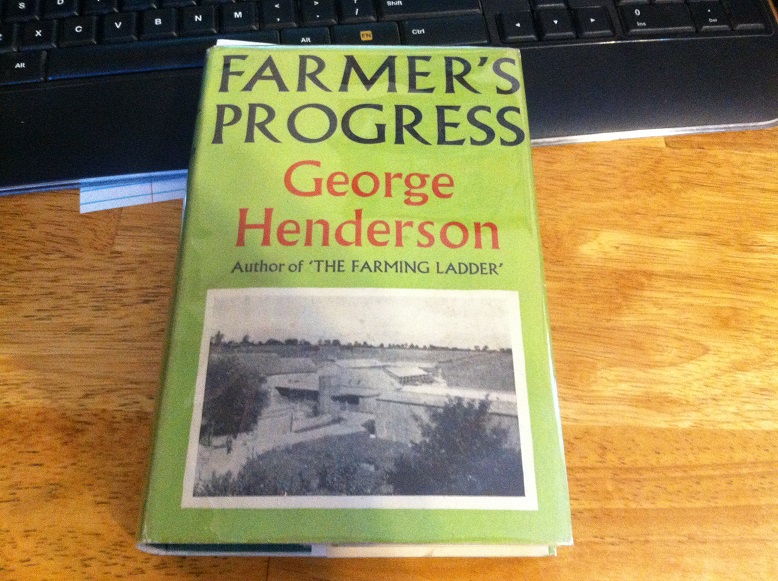
Henderson begins this chapter by saying there are a couple of four word phrases that will change your life. The first is “Will you marry me?” The second is, perhaps one day only, when you come to agreement on a farm and say, “I will take it.”
Henderson was making a little joke at the start of the chapter but his little joke is worthy of additional reflection. Buying a farm is a big deal and one should proceed with caution and move forward with purpose.
…if you have a definite long-term policy of progressive farming in mind, a farm is one of the cheapest things you can buy at the present time, either as a source of wealth, food, or future happiness. I once met the previous owner of our farm, and he said to me, ‘I would not have sold that farm for twice the money, had I known what could be done with it.’ I replied, ‘It would not be sold for twenty times the money we gave for it, in view of what has been done to it!’
There is little reason to buy land just for the sake of buying land. The work is too hard. The burden too great. It really is not for everybody. But if you have a vision, it is worth seeking out additional counsel. I don’t feel that Henderson says all there is to say about taking a farm so I’m calling in assistance from M. G. Kains. His book Five Acres and Independence is worth reading as well. Chapter 3 is titled Tried and True Ways to Fail.
Anybody can buy a farm; but that is not enough. The farm to buy is the one that fits the already formulated general plan – and no other! It must be positively favorable to the kind of crop or animal to be raised – berries, eggs, vegetables, or what not. To buy a place simply because it is “a farm” and then to attempt to find out what, if anything, it is good for, or to try to produce crops or animals experimentally until the right ones are discovered is a costly way to gain experience…
That one quote neatly summarizes the bulk of Henderson’s entire chapter. Begin with the end in mind. What is your vision? Lay it all out. What do you want to do? Because, really, any old scrap of land won’t do. Some places are a little more wet, a little more dry, a little more grass or a little more forest. What, in Salatin’s terms, is the unfair advantage you could leverage on this land. Rather than imposing your will on the landscape, how can you nestle in your little enterprise in such a way that you enhance the local ecology?
Just as I was picky about my wife (blonde, thin and tall were at the bottom of my list, btw) I was picky about my farm. My goodness Julie and I must have looked at every bit of land in Macoupin, Jersey, Greene and Madison counties that was for sale over a 3-year period. At one point we nearly purchased a 10-acre hill knowing we would have to tear the house down and start over. We moved to grandma’s house intending to keep our stuff here while we continued to look elsewhere. I remember grandma telling me that she was worried that none of her children or grandchildren even wanted the farm. Almost everyone else moved away. Before we knew it we transitioned from renting an acre with the house to owning 20 acres. Then to owning 60 acres, barns, buildings, bins…the works. Are we better off owning this mess than renting it?
Henderson has a lot to say on the notion of renting vs. buying.
If you rent you will pay away the value of the farm over the next twenty or thirty years and be no nearer owning it. If you buy, and the land is nationalized, you will be robbed of a greater part of your capital…and you will be reduced to the level of a tenant, but under an absentee landlord represented by officials, lacking the two inseparable virtues of the best type of private landowner – love of the land, and wisdom in dealing with it.
Later on he talks about looking at farms by talking to neighbors and finding out the history of the land. Was it recently owned or recently rented? How long were the tenants there? Tenants tend to strip resources thinking only of the short-term. They also tend to leave messes. Our pastures are filled with thorny trees, our barns are in disrepair and much of our infrastructure needs to be replaced because there hasn’t been a loving owner since grandpa died. Dad has enough to do on his farm, he can’t come over here to cut sprouts. Nobody was paying him to. No cousins showed up. The long line of tenants didn’t care. So here we are.
But we do know the history of the farm. I know who built which building and what the buildings were designed for. The loft in the horse barn used to be filled with timothy hay. I know when the barn was remodeled for milking. Grandpa always filled the barns with hay and the silo with corn silage. Every year. I know where the orchard used to be and its placement, in relation to the farm, makes a lot of sense. I garden where my grandma gardened. My great-grandfather successfully grew rocks. My grandfather successfully grew rocks. I need to break that pattern of soil loss…but I know the history of the farm.
Henderson is also concerned (rightly) about location suggesting you avoid buying land along a highway as anything portable is not safe.
We live in an age when there is no respect for property, and if you catch anyone the magistrates will probably weep over the poor fellow and put him on probation. It is hard having to sit up night after night in the weeks before Christmas to guard your turkeys because the local police tell you they cannot do anything about it. A farmer once told me he started to keep guard through fear that thieves might come, and ended by longing that they should, that he might at least have the satisfaction of shooting someone who had kept him out of bed so long.
But it’s not all about roads and rocks and dirt and buildings. It’s not all about location and rainfall patterns and utilities. Buying land is also about people. You will have neighbors. Henderson has a humorous quote on that topic.
One wise old farmer used to ask new neighbors where they came from, and what the people were like in that district. And if he was told they were very nice, or the opposite, he would say, ‘Ah, hes. You will find them just the same here.’
I am related to most of my neighbors in one way or another and somehow they are just like the neighbors I have had elsewhere. That’s neither good or bad, just a reflection of who I am…maybe, at times, a little too independent for my own good.
But Henderson wants you to talk to the neighbors even going as far as to give the example of a man who, when looking to buy a farm, walks the last four miles to the place and stops at every house along the way asking for directions and opinions of the place. Henderson suggests you look at the soil type and slope and includes some very insightful comments about each.
Not only am I terribly sexist, I am also, apparently, farmist. And that’s a very good thing. Just as Julie had to have more than a pulse to be my companion, not every scrap of land will meet your needs…your goals…your ideals. Look at a lot of land. Define your vision. Make sure the land you are committing to is not just suitable but also a good value.
Incidentally, if you intend to farm really well, and maintain a high output per acre and per person employed, the actual rent you pay is of little importance; it is certainly not worth arguing in terms of shillings per acre.







 Chism Heritage Farm