Excellence, Diversity, and Creativity in Agriculture

What are you farming for?  Why bother?  Isn’t there something easier you can do?  (Oh, gosh.  There are a lot of easier ways to make a dime.)

I want to offer my customers the best products on the market.  I want my customers to be confident that I am giving them everything I can, doing everything I can, being as frugal as I can, stewarding the ecology as well as I can and serving them as well as I can.  I am not a carbon copy of another farmer.  To do this successfully I seek inspiration from a broad range of sources from personal interaction to podcasts to huge numbers of books.  I try to do a number of complimentary things as well as I can, always seeking new and better ways to accomplish my goals.  That’s fine for me but I am not enough.  I hope to help inspire a new generation of stewards working toward similar goals.  Why?

I can raise chicken for about 25 families currently.  I may be able to grow that in time but that’s where I’m at.  According to the Census bureau there are 114 million households.  Servicing those households with chicken at my scale would require nearly 5 million farmers and I would estimate 15-20 million farmers are required to meet the broad dietary needs of those households.  There are only about 2 million “farmers” in the US currently.  There are only 300 million people in the US.  Now apply that math on a global scale.  Where are those farmers going to come from?  How can we inspire families to dream of the day their children grow up to become entrepaneurial farmers?  How can we bless children with a vision of success that doesn’t include forcing their bodies to fit the shape of a chair?  How can we raise a healthy, strong, vibrant, non-allergic generation ready to propel us forward into a drought-resistant world brimming with a diversity of life and health?  It has to come from the bottom up.

“Their dreams have been about building unity when they should have been about creating excellence – even if that means diversity” – The Telegraph

I’m not interested in discussing the content of the article as this is the wrong format for that.  I’m interested in that quote.  How can I focus on inspiring/creating excellence even if it means doing things differently?  How can I write in a way that inspires readers to adopt and change our ideas to fit their situation?  How can I help others find new solutions to old problems…enabling diversity?  How can I further broaden my perspective to allow for new ideas and methods…even those that may show me to be in error?  How can I be better, beyond simply increasing my skill as a farmer, at building and participating in a diverse community?  Let me answer in as few words as I can.

We need more farmers.

Guess I’ll have to expand on that.

More farmers means greater intensity.  Modern rowcrop farming is about cashflow, not food production and it’s certainly not about “feeding the world”.  I can have a more intensive focus and a higher level of productivity per square foot on one acre than I can with 1000 acres.  There is only so much one person can do.  I can utilize a broad area but the more area I manage, the less the intensity of management.  Further, if I was grazing 10,000 cows on 6,000 acres I may not have time to stack in other profitable enterprises.  More farmers mean greater intensity and productivity.  More farmers also means more innovators, discovering new and better ways to solve old problems.  How can we stack more growth on fewer acres?  How can we sequester more carbon?  How can we find more ethical and efficient ways to produce eggs for our neighbor’s kitchens?  I suggest it can only happen if we have more people working to solve that problem…people who are willing to pursue ideas others think are silly.

Who is best qualified to generate silly ideas?  The youth.

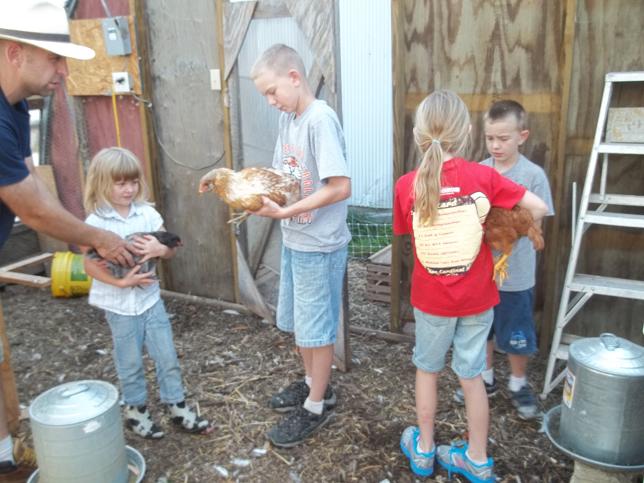
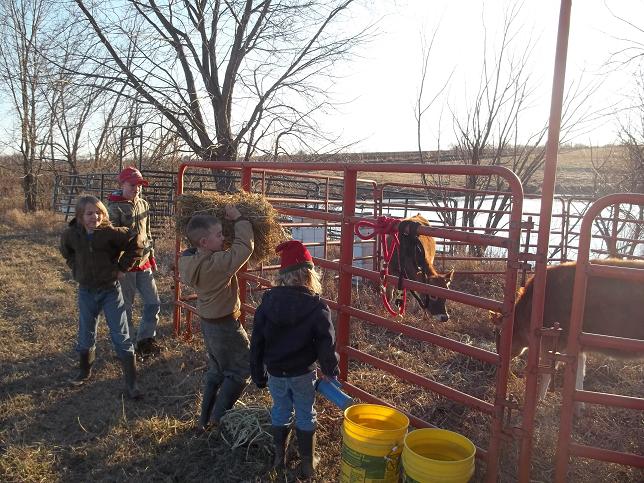
As we age we become increasingly risk averse.  We become set in our ways, believing in the paradigm that has gotten us where we are, even if it has exceeded it’s point of maximum efficiency.  Youth aren’t stuck in a rut and aren’t afraid to look silly…unless they are confined in a daytime prison camp, subjugated by peers and are actively punished for non-conformity by their guards teachers.  I am the seventh generation on this land and from what I can tell, each of us has done it differently.  At least, I do it differently than grandpa did and he farmed differently than his father.  How can I perpetuate that legacy?  I try to read everything I can, spend a lot of time thinking before committing to an action and try, really try to allow my kids ages 6-11 to feel like their input is part of the decision making process here and to feel that their contributions are valued.  Many of our successful ideas come from our children.
But how can more young people (not children) begin farming when they typically have negative equity and no business experience?  I don’t have an easy answer.  I could go into a long post on economics and monetary policy but, again, this isn’t the right forum for that (maybe I need another blog…).  It is important to start small and use what you have but there has to be more we, as a community, can do to encourage agriculture as a way of life.  Land owners need to find ways to encourage young entrepaneurs to become tenants, managers, partners or interns.  Give them some way to learn before they leap, some way to earn and some measure of guidance as they build equity and, ultimately, independence.  One successful example is the New Zealand model of sharemilking.  There’s a nice article on the concept here.  We are working to find ways to involve our children in our businesses and to start complimentary enterprises of their own while we are still here to help them back up when they fall down.  We make a major financial investment in our children, model frugality so they can buy land of their own someday and teach them what little we know about marketing.  Most of all, we teach them to pursue excellence and independence.

Each of our children want to do different things; rabbits, pigs, laying hens, and a taco stand.  Yes.  A taco stand.  We’re not laughing.  It’s nice that our kids can do different things but it’s important that they do complimentary things.  Bill Mollison said, “Diversity isn’t involved so much with the number of elements in a system as it is with the number of functional connections between these elements. Diversity is not the number of things, but the number of ways in which things work.”  However, he later cautions, “Just by putting a lot of things together, we might reach the stage where we pollute the system simply with diversity.”  On our own farm we have to be careful to measure our success and admit our shortcomings as we attempt to stack elements.  This yearning for diversity, though pointed in the same general direction, also applies to my neighbors…even the GMO-happy glyphosate crowd.  My favorite dairy farmer in the world who builds ponds, grazes his cattle, maintains his timber and generally moves in the right direction does any number of things differently than I would.  He is weighing his options and making the best choices he can.  We have to allow for differences as we work to influence the world around us.  As more of us turn to agriculture, more differences will appear.  The same problems exist in both Maine and Texas but the solutions may be entirely different.  The same is true of farms across the road from each other.  We need to encourage these farmers to both pursue the best solution they can find locally and to build relationships with each other to continue sharing ideas.

Mollison continues: “We have got to let experts loose on the ground. We need hundreds and hundreds of them. We don’t want at any time to patent anything or to keep any information to ourselves”.  That’s it.  I need to be free to improve on your ideas.  You need to be free to improve on mine.  As we push forward we may eventually make something useful…who knows!  I spend a lot of time reading and discussing Salatin’s works, in part, because he hasn’t patented his ideas.  He and Andy Lee showed me how to use a chicken tractor.  I modified Salatin’s plan and built one that works well where I live.

I’ll say again that I’m going against the grain here.  I do things that nobody does…a few things nobody has ever done.  I’m an odd duck.  When I screw up (frequently) I have a number of people ready to pounce and say, “See?  What were you thinking?  I told you it wouldn’t work.”  Gene Logsdon points out that, because I’m different, it’s as if I’m telling my farming neighbors that they have been doing the wrong things for the last 60 years.  We, as practitioners of alternative agriculture, need to find common ground with our conventional neighbors.  Yes, we all do it our own way.  Some of us are even successful at it.  But we need to stand together even with our conventional neighbors.  There is nobody else who can/will support us.  If we are a community, our success will influence them to adopt our ideas in time.  If we push them away it will only make things worse.

We can’t all do the same things the same way.  Building a community is a better aim…a diverse, understanding, creative community pursuing excellence.  My farm is not your farm.  My schedule is not your schedule.  My budget is not your budget (be thankful).  My interests are not your interests.  My priorities are not your priorities.  In spite of this we can find common ground and we can achieve similar goals together.

So now the big question.  How can we get more youth excited about sustainable agriculture/permaculture?  Go out and meet your farmer.  Find a farmer who is excited and be inspired to see his work continue, expand and improve.  Find a farmer who will take time to break things down for children, inspiring them to see farming, not as drudgery, mud, blood and sweat, but as passion, meaningful work and a valuable contribution to the health of our world.
Overcoming Inertia

Someday.  Someday.  We hear it all the time.  “We’re not ready yet.”  “I’ll have chickens someday.”  “I would like to have a goat someday.”

Guests come to our farm, admire our children, the work we do, the love we share and the sense of accomplishment, fulfillment and purpose that fills our lives.  They begin telling us things about someday.  This is a big chunk of our ministry at Chism Heritage Farms.  It’s not all about healing land and feeding our community.  We also want to heal and feed people on an emotional level.  We begin asking questions.  “Why did you get out of bed this morning?  What are you hoping to accomplish today.  I’m not talking about SOMEDAY, I’m talking about TODAY!”

“Someday” is a lie you tell yourself.  Someday will slip past before you realize it.  What is it that’s really holding you back?  Why not begin to embrace your dream now?  Are you afraid?  Think it won’t work?  Have you ever failed at anything?  I have, early and often.  Failure is easy.  Anybody can fail but few have the courage to really do it well.  Have you ever really succeeded at anything though?  I have done that too…but not without spectacular failures along the way.  How much don’t I know about raising pigs, chickens or children?  Or being married?  A lot.  But it hasn’t stopped me yet.

Go for it.

You don’t know what your dream is?  You’re not alone.  I see an entire generation waiting to be told what to do.  Let me tell you what to do.  Something.  Several somethings.  Just go do stuff.  You’ll find something you do well.  Work to do better.  You won’t find purpose in front of the TV.  If you are absolutely unable to find something worth doing, do nothing.  Absolutely nothing.  Sit down somewhere bright and convert Vitamin D in the sunlight.  Look at the world around you.  What contribution can you make?  What problem can you solve.  What are you here for?  What can you do today?  Pray about this.  You are a part of creation.  You were created.  Why were you created?  Did you ever think to ask your creator?

Maybe you already know what it is…that thing that screams at you each day.  Maybe you have starved it down to a whisper but you still hear it.  What can you do today to make that dream a reality?  What’s the first step?  Write it down.  Just write it down.  Fill a page with as many details as you can come up with.  Better yet, write it in a small notebook you can carry around with you daily.

Second step?  Look at what you’ve written.  Post it somewhere you can’t avoid (bathroom mirror).  Make that vision a part of your life.  Be purposeful about your purpose.

Third, start reading.  Turn off the TV.  Turn it off.  My wife says in the video we are sedating our lives with entertainment a la Aldous Huxley.  (Ironic that she said that in video.)  Start with a few simple things.  You’ll need to be inspired to pay down debt.  I suggest the following as a starting point:

Rich Dad, Poor Dad…for all its flaws we recognize the positive impact it made in our lives.
The Dream Giver…another imperfect book but the message it contains is outstanding.
If you’re going to pursue farming, read You Can Farm and The Contrary Farmer.  These are truly classics of agricultural writing and will give you the confidence to go against the current.  If you’re not into farming, find the classics of your passion.

Find a writer you like and read everything they have written.  It really won’t take long in your new post-TV life.  Then, begin reading what your favorite author reads.  We read everything Gene Logsdon wrote, including correspondence we had with him through the mail.  Gene Logsdon pointed me to Andy Lee.  Andy Lee pointed me to Joel Salatin.  We read (and continue to read) Joel Salatin and moved to the farm.  That’s how it works.  Start reading.

Fourth, as you read, find ways to attack your debt.  All of your debt.  Since you’re not watching TV anymore you don’t have a cable bill.  You might even free up some cash by selling the TV, though that may be a wash as you replace the entertainment center with a bookshelf.  Pick one debt and put everything into it.  Once gone roll that payment into a second debt.  We paid off 2 cars, 2 college loans and saved a downpayment for a farm on one modest income in just a couple of years…with four children.  We didn’t subscribe to any magazines, we didn’t eat out, we didn’t go on vacation.  We pursued our purpose.  Now it’s your turn.

Finally, avoid negativity.  Well-intentioned loved ones will think you are crazy.  They’ll tell you it won’t work.  They may even say something helpful like, “I tried that once” or “You’re young, you’ll learn”.  You need to learn.  You need to learn to avoid these people’s opinions.  They may honestly think they are being helpful.  They may not realize they want you to fail because they feel like failures and misery loves company.  You also have to learn to shut out that internal voice that says you will fail.  Fight discouragement.  You aren’t destined to be discouraged.  You’re destined to make a positive contribution to the world around you.

Go write something down.  James Altucher says the same thing every day on his blog.

Oh, and if you’re considering farming I highly recommend you read this first.

Strolling Through the Pasture June 2012 Edition

It is interesting how the plants have changed in the last month.  The pennycress is just about all gone.  Henbit has disappeared.  The goats are doing a good job of eating back the brush.

Fescue is clearly the dominant species with pockets of wildflowers here and there.

There are a number of other grasses out there including wild oat and orchardgrass, both of which I would like to encourage.

I was also surprised to find a little cheat.

Once I fence out my neighbor’s cows I’ll be able to run my own on the pasture with a planned, high-density impact instead of the cows just running wild eating what they choose.  For now, I’m happy to have a diversity of grasses and weeds…but less fescue would be great.

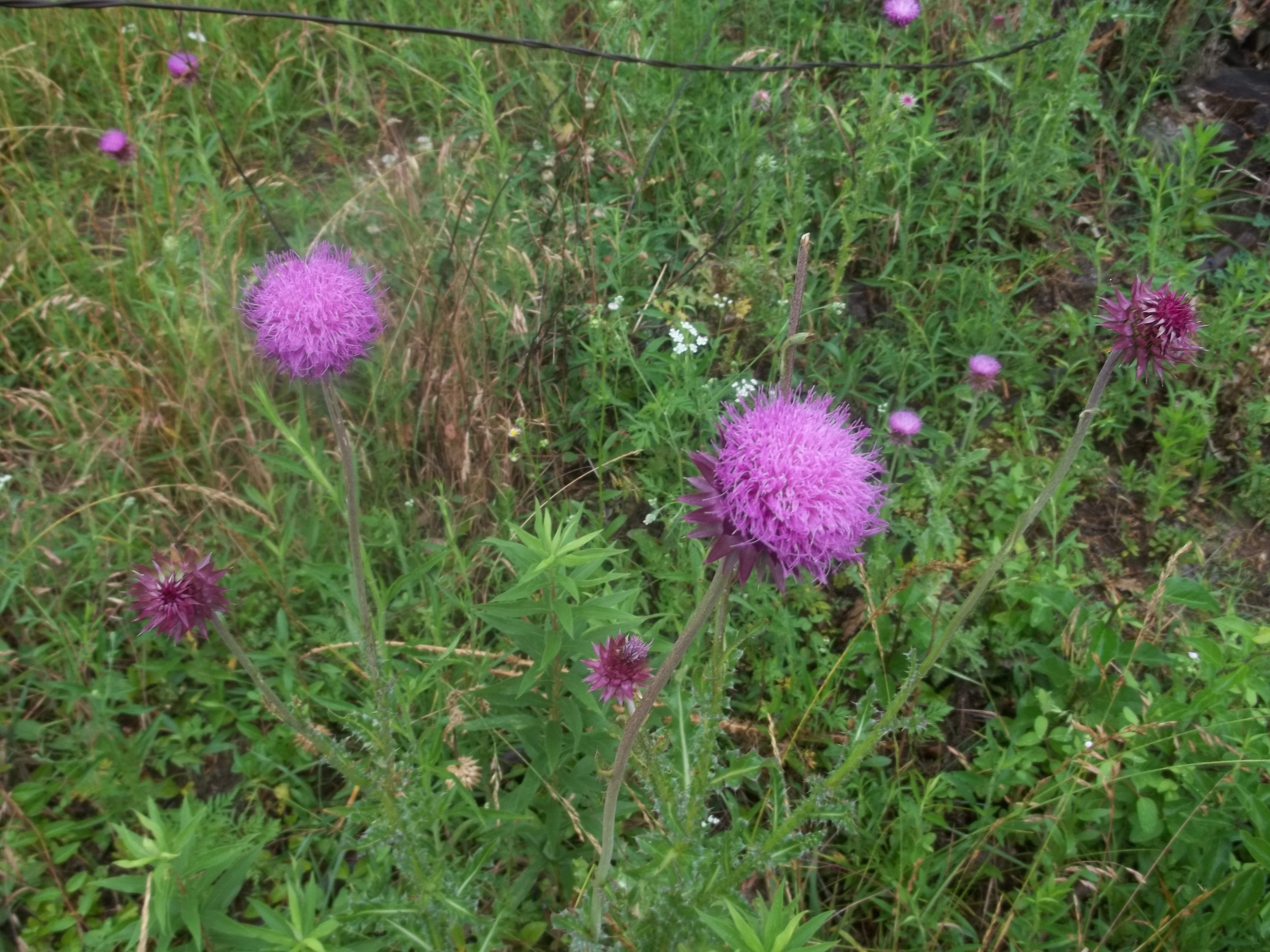
I have had to mow the Canadian thistles.  It was just taking too much of our time to chop them by hand.  A farm guest recently suggested we chop the thistles close to the ground and put a few grains of Morton salt on them.  Sounds like a plan.  There are still plenty out there.  Kinda pretty though.

Clovers are fairly thick now.  A wide variety of weeds are growing well, some are in bloom.  All that variety helps my nutrient cycling and ensures my livestock have access to the things they need.  Everything from wild carrot

to horsenettle.

Ragweed isn’t threatening to take over this year…for once.  It’s just in a little pocket by the house.  Achoo!

I could continue listing plants and pictures but you get the idea.  There is a wide variety out there.  I think that’s a good thing.  It’s not a lawn.  I would like to see things change a bit and suspect they will over time.  Especially now that we got a rain!

How is your pasture doing?

Nothing is Perfect

I like our Premier One Permanet.  I really, really like it.  But, since I have lost 4 pullets in 5 days to one dirty, stinking, filthy so-and-so skunk who is either bulletproof or can dodge bullets like Neo from Matrix and who can get through/under the fence in spite of a consistent 8,000 volts running through the permanet, it’s obviously not perfect.

I watched legions of raccoons splash at the pond night before last.  Raccoons aren’t getting through my fence and killing my chickens.  It’s a skunk.  One single bird each night.  Raccoons would kill several each.  The fence does a good job of keeping the raccoons out but can’t keep a determined skunk out.  It also failed to protect us from a mink once.  Neighbors are nice but they need to respect my property.  This kind of wanton property destruction and outright theft can not be tolerated.  Murdering a chicken is a capital crime if you are a skunk or a mink.  Skunks who murder and eat four chickens in five nights bring out the worst in me.

So I camped out at the pond, flashlight and gun in hand.  Just a tarp, an old blanket and the lumpy ground.  400 chickens make a lot of noise.  No skunk showed up to party.  I had to move the East side of the fence yesterday to continue moving the chicken tractors so maybe I filled in the unknown gap the skunk was using.  Maybe he smelled me.  Maybe he died a horrible death from a great horned owl.  I don’t know.  I won’t sleep well until I know.

The fence is not a perfect solution but it mostly gets the job done.  When it doesn’t, it makes for a long couple of nights and days of guilt, discouragement and stress.  At least it’s not cold out.  Or raining.  Yet.  Fortunately, the fence is 99% reliable.

Oh.  It’s raining now.  Well, that’s good.  It hasn’t rained in about a month.  Maybe the skunk will catch pneumonia.

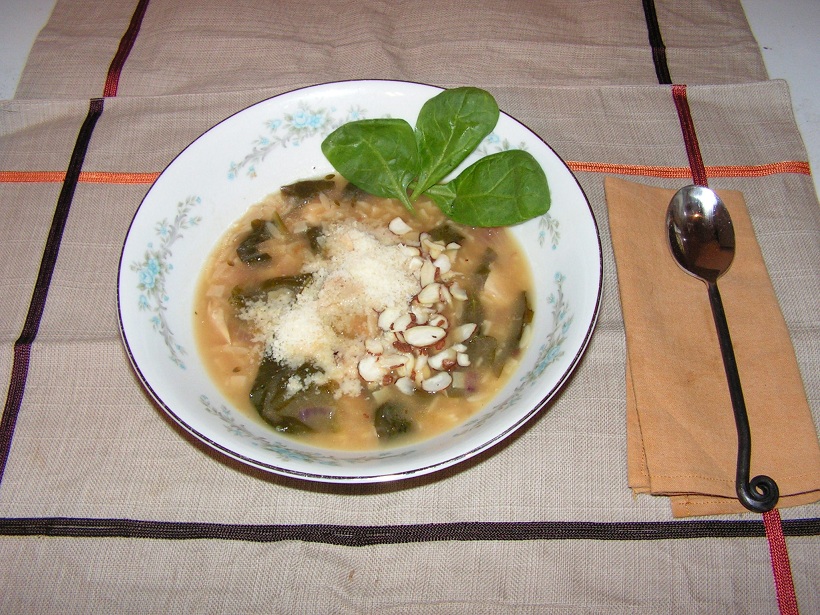
Day 5: Spring Orzo Soup


Spring Orzo Soup

  • 2 TBS Olive Oil
  • 1 onion, chopped
  • 2 cloves garlic, minced
  • 1 lemon, juiced and reserve zest
  • 1 tsp red pepper flakes
  • 2 sprigs lemon thyme
  • 2 cups spinach leaves packed
  • 1 1/2 C Uncooked Orzo Pasta
  • 1/2 C dry white wine
  • 7 1/2 C Chicken Broth
  • remaining cubed chicken or 1-2 cups
  • 2 TBS water
  • 1TBS Cornstarch
  • 1/4 C Parmesan Cheese
  • 1/2 C slivered almonds

Saute the onion and garlic in oil until fragrant.  Add the lemon zest, pepper, and thyme and cook another 3 minutes until the onions are golden brown.  Turn the heat to medium and add spinach and orzo.  Cook for one minute.  De-glaze pan with 1/2 C white wine.  Add broth, chicken, and lemon juice.  Bring to a simmer and cook for 12-15 minutes until orzo is barely tender.  Whisk water and cornstarch together.  Bring the soup to a light boil and add cornstarch mixture.  Let thicken for 3 minutes.  Garnish with Parmesan and Almonds.

Serve with crustini and Cantaloupe Raspberry Salad

Cantaloupe Raspberry Salad

  • 1/4 C chopped mint
  • 1 TBS honey
  • 2 tsp lime juice
  • 1 Cantaloupe cubed
  • 3 1/2 C raspberries

In a small bowl, whisk together the chopped mint, honey, and lime juice. Allow the mint-honey dressing to chill in the refrigerator for 15 minutes.

Gently toss the prepared dressing with the cantaloupe and raspberries.  Serve the salad immediately or store it in the refrigerator for up to 2 days.

Crustini

  • 1 french baguette cut into 1/2 inch slices
  • 1/4 C olive oil
  • 1/4 C butter
  • 2 cloves garlic minced
  • salt and pepper
  • 1/4 cup Parmesan or Romano cheese

Set oven to broil.  Mix oil, butter, garlic, salt and pepper in sauce pan.  When hot, dip bread into oil on both sides.  Dip one side of bread into Cheese and place cheese side up on cookie sheet.  Broil for 8 minutes.

Thank you for trying this out!  When summer reaches it’s peak, look out on this blog for a week of recipes using chicken and summer produce.  As always, I appreciate feedback and am happy to answer any questions.  Contact me at Jacquelyne@sew4cons.com and keep up with me at City Roots and Fruits.

What Do Pigs Do on a Farm?

What do pigs do on a farm?

What an excellent question.  Truly.  What’s the point of keeping a pig?  I mean, the meat is good…well, great.  But does that justify keeping pigs?  Is it fair to the animal to expect it to eat and get fat and contribute nothing…serve no positive purpose?  What do they DO?

I don’t think I could look an animal in the eye if all it did for me was get fat so I can eat it.  I, personally, don’t find life fulfilling without having a purpose.  Animals need purpose too.  Our chickens sanitize, debug and eat weeds.  They give us eggs to pay the rent.  Bees have a similar arrangement.  Goats clear the brush, give us milk and keep us entertained.  What is a pig’s purpose?  They don’t lay eggs and you don’t milk sows.  How can pigs pay the rent?

1.  They eat.
Pigs eat things we don’t.  Things we won’t.  They are omnivores.  You’ll see them eating clover.  You might catch them eating a snake or a mole.  They love when we throw them broken eggs.  They clean up whatever is out there.  Plus they get extra or soured milk, garden waste, non-pork kitchen scraps and convert it all to bacon.  Mmmmm…bacon.  Got unwanted blackberries growing out there?  Let the pigs eat them.  Yes.  Eat them.  No roundup required.  No mowing.  Just electric fence and bacon.

2.  They poop.
Ah, manure.  My old friend.  We need more manure.  Just think of what happens on a stretch of pasture across 11 days.  The goats eat the weeds and brush and drop a LOT of manure.  The goats also leave a pile of unwanted hay behind..loaded with manure.  Then the chickens come through and scratch at the hay pile, pick through the manure and eat all the bugs, often leaving bits of corn and feed behind…and very rich manure.  Then the pigs come through.  By this time, the tall, thorny things are out of the way, the bugs are gone and it’s time for the pigs to get down to business.  They nibble at the leftover hay, they nest into the hay, stirring the pile for later composting on site.  They eat any feed the chickens lost or forgot.  They dig up rhizomes, root for worms, loosen the soil and break up the sod and add in their own manure.

3.  They root.
We don’t ring our pigs because we want to leverage their rooting behavior.  Go ahead.  Tear it up.  Rooting is like plowing the soil.  They dig, scratch and generally make a mess of things.

All that sod action, combined with the manure they are putting down, makes a great seed bed but is quite harmful to annual grass species.  That’s fine with me as I’m working to increase my stand of native perennial grasses.  I’m working to establish better forages in my pastures so the pigs and I make a great partnership.  I need more orchard grass and less infected fescue.  The pigs lead the way and I follow up with a broadcast seed mixture.  I throw a mix of vernal alfalfa, timothy, perennial rye and orchardgrass along with a deer plot mix containing triticale, oats, winter peas, clover, chickory, turnip, and (of all things) daikon radish!  It was weird for me to look at deer food plot mixes since I never fill my deer tags but Steve suggested it.  Sure enough, looks like a lot of good things for my soil/ecology in there.  Beyond cows, goats, chickens and pigs, that plant variety will boost the rabbit population, feeding the coyotes, hawks and owls.  All of those animals, including the deer, add manure to my farm.  If I can get them to spend more time on my farm (weird to say that about coyotes), they will translocate nutrients from neighboring land onto my own.  All I have to do is let the pigs dig and toss out a little seed.


4.  They drink.
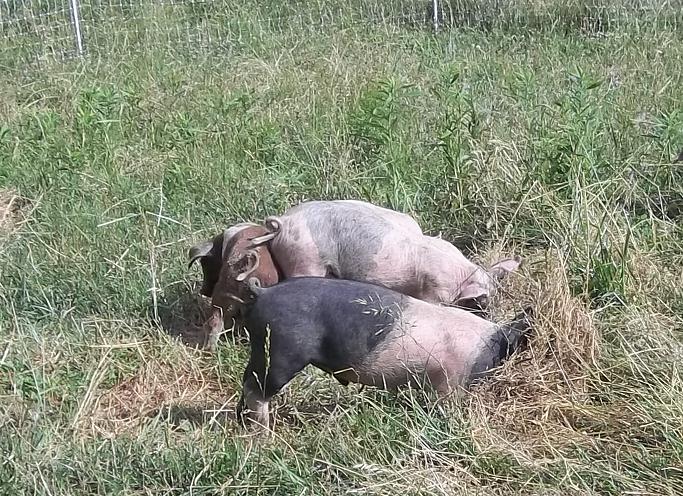
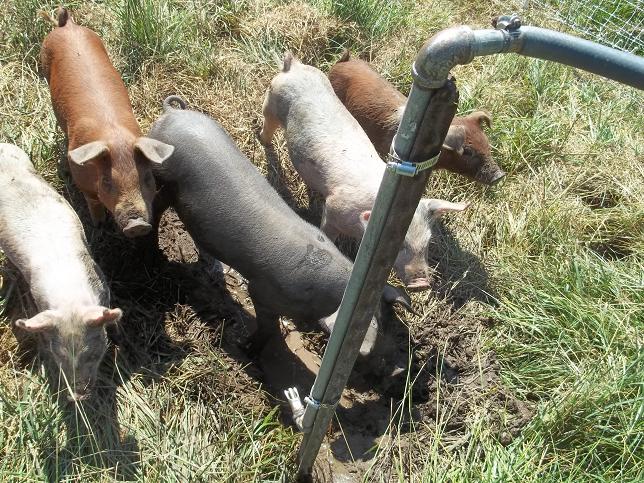
We use a simple poor-boy solution with a nipple to water the hogs.  Lots of people ask me what a “nipple waterer” is and how it works.  I’ll let the pigs show you.

There is always a wallow under the drinker.  It takes almost no time at all for the pigs to saturate the soil near the drinker and put their noses to work digging out a bathtub.  They need it.  It’s no big deal for me to fill the holes back up with wood chips, sawdust and compost.  I can fix the trip hazard and the pasture is better off for the disturbance.

5. They sleep.
They don’t sleep so hard that I can sneak up to get a picture of it but they sleep.  A lot.  I mean a lot lot.  They spend about 20 minutes eating at the trough each day, they spend about 20 minutes drinking at the watering nipple each day.  They root around for more food for about another hour or two.  That leaves a good 21 hours to sleep and sleep they do.

So, what do pigs DO on a farm?  They efficiently convert a wide array of resources into a more bio-available state.  Used judiciously, pig snouts, hooves and manure can be used to enhance the land, rather than degrade it.  Once the pig has served out its purpose, playing and rooting in your pasture, it’s time to go to market.  We butcher our own here at home but also sell whole and half hogs to customers through the local butcher.  Beyond fixing nutrients and making them available and helping remodel and renovate your pasture, the pig then adds to your family financially if not nutritionally.  With all this in mind I can’t imagine a farm working without a pig.  In fact, I would recommend a pig to city people.  Just get a pot belly pig and tell your neighbors it’s a weird breed of dog.  Then serve it for Christmas dinner.

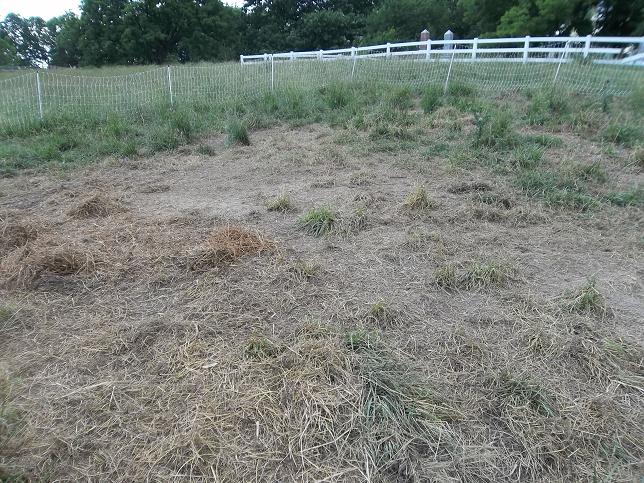
I don’t have a formula for pasture movement, you have to use your eye.  Soil conditions vary season to season and week to week.  You just have to pay attention to the forage available and the condition of the pasture to know when to move.  The eye of the master fattens the stock.  An experienced master has a better eye.  Get yourself a couple of pigs and start training your eye.  You can quickly create a moonscape in your pasture and sometimes that’s just what the doctor ordered.  Most of the time, though, a little disturbance goes a long way.

Beware of poisonous plants in your pastures.  I’m not going to burden you with an extensive list but be aware that seedling cockleburs will kill your pigs.  Cockleburs are just coming on right now so we’re on the lookout.

Hill Potato Blues

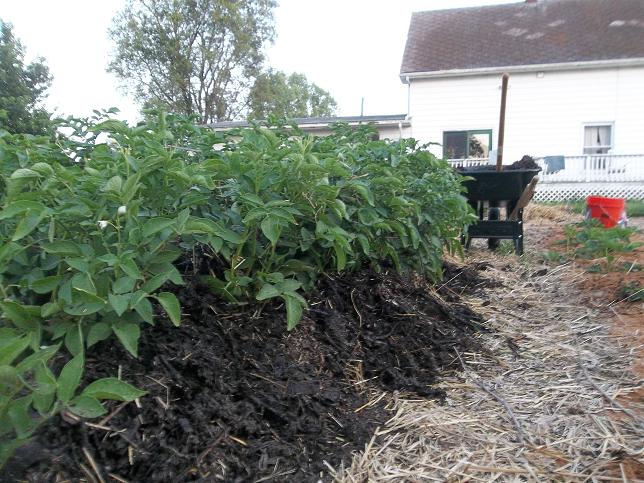
What seems like a lifetime ago, but was just this past St. Patrick’s Day, we planted potatoes.  We have hilled them.  And hilled them.

Today, with the greenhouse nearly empty of livestock (just the rabbits and ducks left), I started hauling out bedding.  Well, more than started, I worked on it for a couple of hours and went a foot deep in a 10×15 area but didn’t really make much of a dent.  While the wife and kids weeded the garden I hauled wheelbarrow after wheelbarrow out to the garden beds to surround the peppers.  Finally, I just had to do it.  I had to hill the potatoes again.

The bedding I am hauling out is mostly from under the rabbit cages.  It’s months worth of wood chips mixed with rabbit manure, chicken manure, old hay and who knows what else.  It’s moist, warm and full of worms.  It’s also heavy.

This really isn’t a huge deal but by planting the way Jeavons says to, and since potatoes don’t always come straight up where they should, there’s a dense pack of plant matter and it’s kind of hard to deliver the compost where it is needed.  But I did it.  And kept going back for more.  And I’ll do some more tomorrow.  Why, oh why did I plant 100 pounds of potatoes?

Yes, the plants really do tower over my wheelbarrow.  It’s not just a perspective thing.  I can’t seem to get enough material in there to hill them the way I would like.

New Layer House Prototype

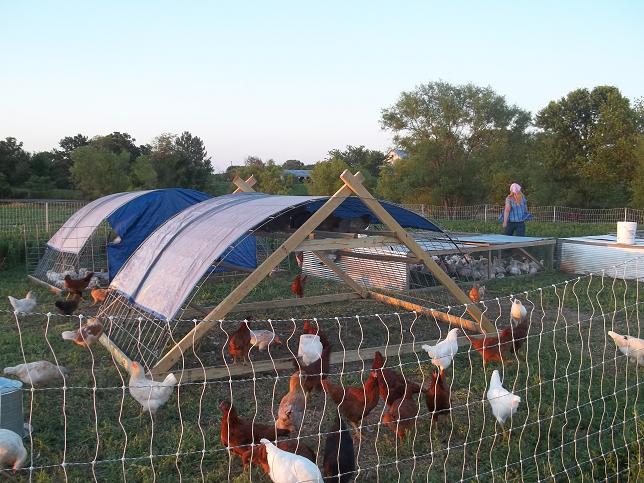
I like the cow panel hoop chicken tractors so much I thought I would try my hand at making a layer house out of them.  This will solve several problems for me.  Primarily, I don’t want to clean out bedding in a layer house on pasture.  Also, I don’t want to use a tractor to move my layers.  This design has several drawbacks though.  First, it’s open on both sides.  An owl could fly right in and ruin my day.  Second, I have some concerns about the weather.  We’ll certainly keep them in a greenhouse over the winter.  Anyway, here it is.

The crossed 2x4s support the hoop and prevent it from swaying.  Then there are roost bars across the span.  I may need to put in two more 2x4s to prevent the roost bars from drooping.  I also may need to lower the roost bars a bit as the pullets grow.

Overall though, I really like it.  I plan to hang nest boxes off of one side or both.  For now these birds follow immediately after the chicken tractors and I move their house daily.

We had a bit of a circus rounding up the pullets in the greenhouse to move them out to pasture.  Everybody helped and after a little while, all birds were caught, their wing feathers were clipped and they were packed into crates for the big move to the alfalfa field.  Once there, we had a good time convincing these birds they needed to roost in the structure.  Oh well.  Keeps things interesting.

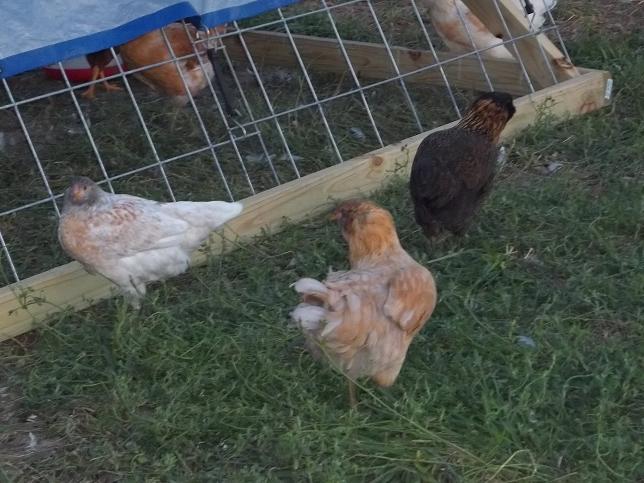
Now, it just so happens that I have a few Americauna pullets to spare.  If you know anyone interested in them, please let us know.

I’ll keep you posted on how the house works out.  We’re two days in.  So far…so good.

Day 4: Spring Chicken French Salad


Spring Chicken French Salad

  • 1 1/2 TBS butter
  • 3/4 C baby carrots
  • 1 C baby zucchini (or sliced regular zucchini)
  • 1 C baby yellow squash (or sliced regular squash)
  • 1/2 C peas
  • 1/2 C green beans
  • 1 C water
  • 1 C cubed chicken
  • 1 TBS fresh chives minced

Melt butter in pan.  Add carrots and toss to coat.  Add the water, season to taste with salt and pepper.  Simmer for 4 minutes

Add the remaining vegetables and chicken and continue to cook and stir until water is evaporated.  If they are not soft then add a little more water and continue to cook.

Stir in creme fraiche and chive and serve with sour dough baguette.

Stay tuned for….

Day 5: Spring Orzo Soup

Jacquelyne Aubuchon is a guest contributor to this blog and a loving sister and aunt to the residents of Chism Heritage Farm.  You can contact her at Jacquelyne@sew4cons.com or keep up with what she is doing at City Roots and Fruits.

Watering the Hogs on the Cheap

One of the questions we get regularly is how we deliver water to the hogs on pasture.  We don’t have hydrants in pasture so how do we do it?

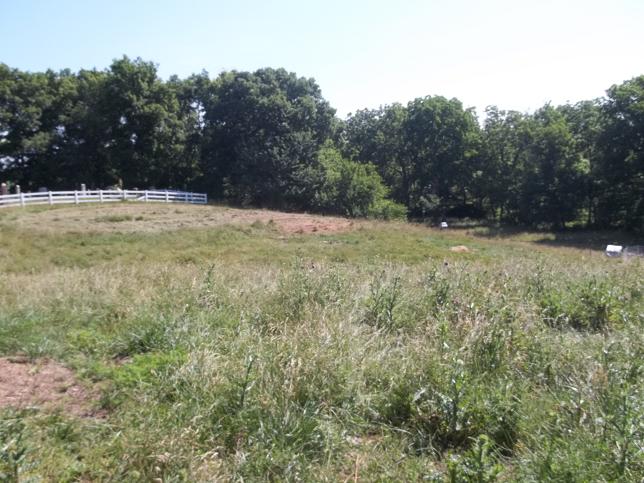
In the winter we carry a bucket to a couple of rubber pans.  The pigs only need water a couple of times/day and we make sure they get all they want.  When the danger of freezing a hose is replaced with the danger of overheating a pig we use a hose.  Our hose runs from under my feet to the center right of the picture…where that second hill breaks over.  You will read that there is some concern about giving pigs hot water to drink (and the water in the hose is certainly hot) but we think any water is better than no water, the pigs seem to do fine on it and if we had to install hydrants throughout the farm we would not keep pigs.  Maybe we’re getting away with something here but the pigs are happy, they grow well and we don’t have any problems so we continue with our poor-boy solution.

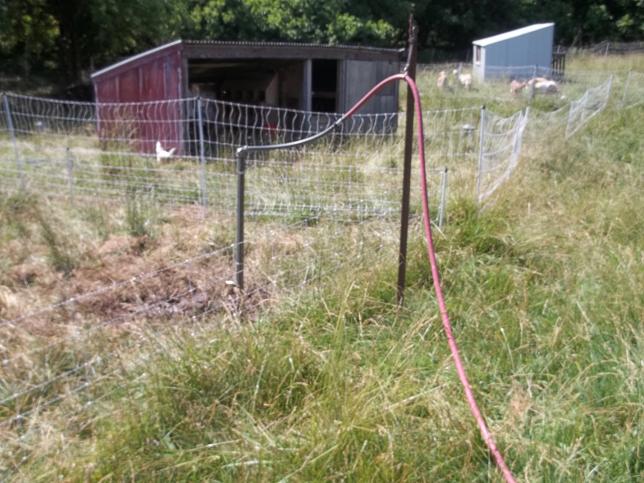
Then we bridge across the fence.  I have a short length of old, broken hose suspended by a tarp strap from an old, broken t-post.  You with me on the old broken stuff?  I’m going for mileage here.  Everything has to keep working for us.  The posts pull up easily and the whole assembly breaks down for easy setup at the next pasture.

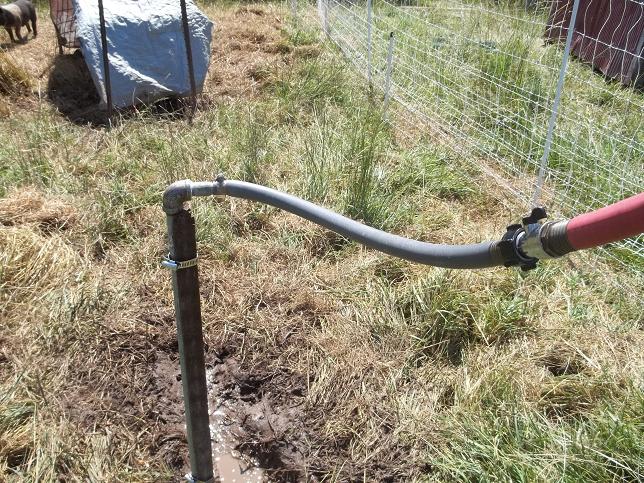
There is a shut-off valve as we cross the fence.  With that valve in place we have easy access to water for goats and chickens (further up the rotation).  This helps add a multi-purpose dimension to our infrastructure, a constant goal.  A short length of hose screws on to the shut-off valve and is clamped on to an adaptor in the pipe elbow.

Then it is a short trip down to the nipple through pipe held to an old, broken t-post by hose clamps.  The hogs get all the water they need, which translates to enough to make a wallow.  This wallow is about 24 hours old.  It will get bigger.  Pigs like and probably need to wallow in mud.  Lots of farmers don’t like their hogs to do this but we think it makes a good opportunity to add in pockets of organic material.  Plus, we think it’s a small price to pay for the amount of work the hogs do on pasture.
What kind of “work” do the pigs do for us on pasture?  What do pigs DO on a farm?  I’ll answer that in an upcoming post.