Merry Christmas

Thank you for reading our blog.  If you’re in the midwest, I hope you are safe and warm someplace cozy during the storm that’s coming through.  Maybe a book and a warm cookie in hand…even if Christmas isn’t your bag.

There’s no shortage of work to do here but we’re taking a couple of days to just relax with the kids.  Merry Christmas.

Fence v. Winter Storm

What a mess.  What a total mess.  Cows out of their designated grazing area!  Fence isn’t shocking!  Nothing works and it’s near absolute zero after factoring the wind chill!  Thursday we had a winter storm blow through.  It began with a thunderstorm and 30 mph winds and sideways rain.  Lots of rain.  When I got in my car at 6:30 am to drive to work it was 54 degrees outside.  When I got to work at 8 it was 34 degrees outside and the wind had picked up to 50 mph.  Then it started snowing.  When I drove home in the late afternoon I followed a semi pulling a trailer.  The trailer was being blown by the wind and wagged behind the truck like a dog’s tail.

We didn’t bother bringing the cows in.  They know where the barn is.  They had been in the barn recently but they know better than I do where they are most comfortable during a storm.  They found a sheltered place down in a valley and hunkered down for the night.  We put a few obstacles out by the layers to give them some relief from the wind and noticed several chicken tractor lids had taken flight and nearly landed in the pond.  Goats were warm, pigs got a whole new bale of straw, ducks were just ducky so we told the kids to sleep downstairs by the wood stove, built up a big fire and went to bed early…praying that the power would stay on all night but ready if it did not.

The power stayed on but the cows got out just the same.  At milking time we brought the cows up to the barn to milk.  They were feeling ornery and walked the long way around.  Cows!  Once up, it was time to start looking at the fence.  The charger was ticking but not lighting up.  It was shorting out somewhere.  That’s the worst.

The place to start is to turn off half of the fence.  Part of my fence is pretty OK.  The other part is…well…servicable.  All of it is legacy fence, built by grandpa’s hired men or cousins of mine over the last 40 or 50 years.  I trust the newer part…mostly.  So I cut the switch.

FenceBlues6

As expected, this made no difference to the fencer so I knew which way to begin the long march around the combine shed, through the iron pile and back around the house.  Then I found it.

FenceBlues1

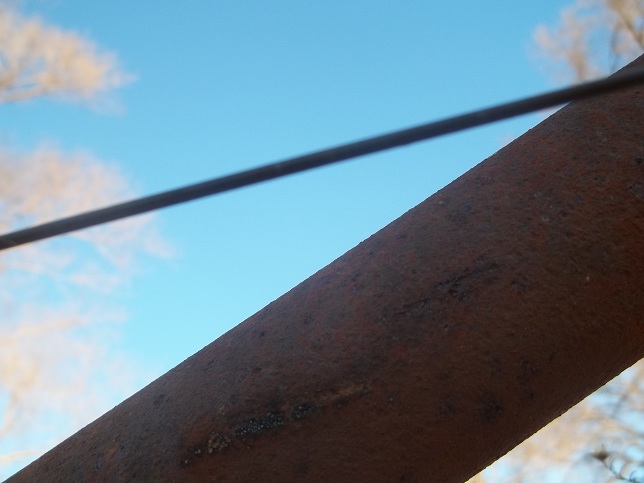
The fence was touching an iron corner brace.  This is one of the wonders of fences built by hired help.  Oh well.  New fences are in the works anyway.  I separated the wire from the pipe and continued my inspection.

FenceBlues2

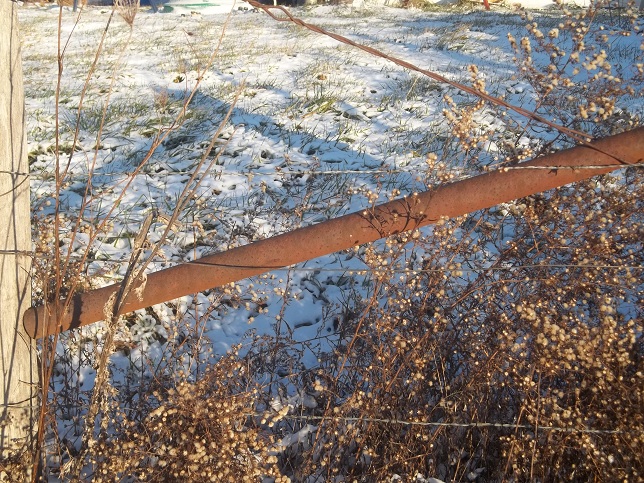
Not too much fence to walk between break points.  Then I had to walk the strands of fence we use for the cows current pasture, checking at each rebar post to make sure the wire wasn’t touching a post.

Rebar Posts

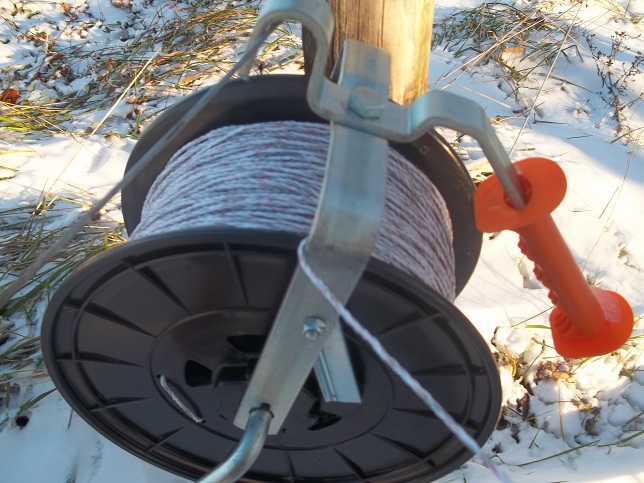
There were a few problems to work out along the fence until the end.  At the end, the spools were supported by another rebar post but the wind, rain and gravity had knocked that post over.  I cheated by hanging the spools off of the perimeter fence.

FenceBlues4

Well, that’s what it looked like later.  I didn’t realize I created a new short on my own.  Nothing worse than fixing one short and creating another.  Had to walk back out to fix it.  That’s what I get for taking a shortcut early in the morning in the cold wind.

FenceBlues5

Back up to the fence charger and it was at full charge.

FenceBlues7

Now, I don’t want to pretend it was all work and I don’t want to say I was all alone out there.  I had help.  But what is the fun of having your own cemetery hill if you can’t sled on it?

Sledding2

So I made a few trips down myself.  The railed sled has carried me downhill for 30 years that I remember.  Dad would carry it up the hills because I just wasn’t strong enough when I was little.  That sucker gets heavy after a few trips.  Now I carry it up the hill for my kids.  Good times.

Sledding1

The storm made a lot of work for us today but it also gave us a chance to play before breakfast.  Hope the storm gave you something fun too.

The Family Stronghold

You are the same today you’ll be in five years except for two things: the people you meet and the books you read. – Charlie “Tremendous” Jones

Well, Charlie, I just read the book and I’m different already.

We have been reading Bill Bonner’s Family Fortunes slowly over the past few months, taking our time, chewing through it and pausing to ruminate on concepts presented chapter by chapter.  I am the latest in a long line of family farming the same ground but, unfortunately, there is no family fortune.  We have eroded, North-facing hills, very little fertility and a couple of nickles.  We are lacking Bonner’s description of a council of family elders, a family bank and millions in cash and equity available for investment in coming generations of family entrepreneurs. I didn’t inherit the land I live on.  I am buying it with money I make, not money my dad gave me.  The only wealth I recieved to date from mom and dad was my faith, my work ethic and an insatiable desire to learn.  College was not a choice and was on my own dime.  Family sweat, not family cash, helped us reclaim the farm from the thorns and brambles and that’s where my dad has really contributed to the cause.  We have spent years clearing thorny things out of the pastures and fixing fences with years of work still ahead of us.  My job is to hold onto this land so the next generation can take the reins from me.  If I do my job well they will not only have the opportunity to inherit the ground, they will be getting something of greater value than I did.  That’s stewardship.

Bonner talks about the need to follow a well-worn path in business…doing something that others have already succeeded at.  We read and follow the examples of leaders in alternative ag.  He talks about how important it is that I not try to go it alone, that I work hard and take one bite at a time until I “find something that works before you run out of time, money and confidence” (p. 126).  He goes on to suggest a farm as possibly the ideal family business on page 141.

What is the ideal family business?  Hard to say, but it might be a large, diversified family farm.
Here’s why:

  • It is a difficult business, perhaps with relatively low returns on capital.
  • It requires active, on-site management.
  • It is physical, tangible, observable – and something to which people can become sentimentally attached
  • There is generally little liquidity, and a “liquidity event” is a very big deal.
  • The main asset – land – compounds in value without capital gains or income taxes.

What does this have to do with anything?  Our greatest assets are our children.  We work hard to teach our children right from wrong.  …that we are endowed by our Creator with certian unalienable rights.  To teach them when to speak and when to be silent, when it is appropriate to joke around, what topics are appropriate sources of humor and which are taboo and when to push the envelope.  We work hard and always put something away for a rainy day.  We think about what we feed our bodies and what we feed our minds.  We are careful about what sources of entertainment we choose and how much we allow ourselves to be entertained.  We love each other.  We value life.  We value community.  These ideas define us.  More to the point, they shape us and build us as a unit and create our family culture.

Though family culture could develop anywhere, Bonner presents that certain locations can function as an incubator of the family.  A place to hole up during a period of unemployment or just a place to relax and write a book.  I like these ideas.  Years ago I hit a crisis point that caused me to re-evaluate my purpose in life and, ultimately, forcing me to re-invent myself.  This happened in the home with my family beside me.  We stayed in our stronghold (playing Mario Kart Double-Dash!) for an entire summer together.  That house in town functioned as a stronghold for a time but, ultimately, it was too small for our needs.  We, as a family, felt a calling to grow beyond a garden and a couple of chickens.  Strangely, we find it to be easier to be involved in each others lives on 20 acres than on 1/8th of an acre.  We have common goals and interests but still have space for individualism.

StrongHold

Bonner suggests “Your stronghold should be a place where you can live almost indefinitely on local resources” (p. 302).  The stronghold should be well provisioned beyond just wine and firewood and it should be fully paid for.  If the goal is to have a refuge point during a period of personal crisis, you shouldn’t be worried about paying for it or what you will eat.  Well, we’ve got the firewood, a little food in the pantry and are planting fruit and nut trees.  Our efforts at canning food are increasingly successful and our gardens are better every year.  These things are nice but the big one in the list is just having it paid for.  Ugh.  We are nowhere near paying for the farm, though it is high on our priority list because it is difficult to do anything in debt.  Mostly, though, it’s because I want to leave my children more than a legacy of debt.

Proverbs 13:22 says:

A good man leaves an inheritance for his children’s children, but a sinner’s wealth is stored up for the righteous.

This house…this stronghold is our last refuge from the world.  The place we feel secure from whatever the world throws at us (including 50 mph snow storms).  If nobody else believes in us, if we fail at everything we have tried, when we are down on our luck and feeling blue this place is home.  This is not just the place where we hang our hats, it’s the place we return to after our long and weary travels.  The place we want our children to return to….their children to return to.  A place generations of us have come home to.  It is our stronghold against the world if necessary.

Our job, a job we have chosen, is to start from nothing on worthless (but expensive) ground in a worn out, drafty house with a leaky roof and build something lasting.  Our job, as a couple, is to lay the foundations of lasting family culture and plant the seeds of future wealth.  Time is on our side.  The overall goal has nothing to do with farming (or even money for that matter) but building a family.  This farm is just where it happens.

Obviously I liked and recommend the book.  Be careful reading it though.  It’s likely to light a fire under your tookus.

Which Would You Rather Hold?

Would you rather have dirt or Dollars?  Like Neo being offered the blue or red pill, my father asked me the same question.  Taking the red pill was the obvious choice.  This one is tougher.  Wanna see just how deep the rabbit hole goes?

DollarsOrDirt2

Which would you rather hang on to for the next 50 years?  Holding cash during a period of inflation is a bad thing but uncertainty abounds.  Yes, our beloved central bank has been trying to cause serious inflation for the last 4+ years but they haven’t succeeded yet…though they have been wildly successful over the last 100 years.

Let’s be specific about land and dollars.  There is an 80 acre plot of land North of my house owned by my grandmother’s estate.  Let’s just play with the biggest numbers I can reasonably imagine and using money I don’t have.  I can’t buy this ground so I can do this without emotion.  What if it sold for $10,000/acre?  Would it be better to buy $800,000 in CDs at the bank for 1.7%?  That would earn $13,600 annually.  I could make the same money renting the ground out for $170/acre BUT I would have to manage a tenant.  CD rates are at their bottom and COULD go up.  We have never gotten that kind of money as rent for an acre of that ground.

Looking at history, the value of the dollar has gone in one direction for the last 100 years.  Down.  The dollar has lost 95% of its purchasing power since 1913 and 35% since 2001 (check the dollar index).  As that trend continues, putting $800,000 in a 2% CD would cost me 2-3% annually.  If that trend accelerates…!  Land has had its ups and downs and is currently way, way up.  Land may crash in value but will always be worth something.  Given the trend in dollar value, land should continue increasing as expressed in dollar terms.  Since investors are chasing yesterday’s returns and farmland was worth a mere $5,000/acre yesterday could it be worth $20,000 tomorrow?  As a speculative bet, knowing I have the central bank and a large trend on my side I would rather put my money in land.  I spoke to one of the old timers in the neighborhood and he agreed.  In fact, he said if you have any cash at all you should put it in land as there is no use putting it in the bank.  I’m a little bothered that he’s an old timer.  I can remember when he wasn’t.  What does that say about me?

While dollars are more portable and are infinately liquid (at least for now), land stays put and is illiquid.  If you choose to own land you are making a decision to put down roots.  By buying the land I have married myself not only to the farm but also to Illinois.  Illinois, kids, is broke.  Brokety broke.  There is absolutely zero possibility of Illinois meeting their future obligations.  The promises they have made are just too big and, unlike the federal government, Illinois can’t just print their way out of their problems.  But they will try.  I fear for the “rich” farmers sitting on millions of dollars worth of equity.  If you equate property tax with wealth tax and view the land owners with envious eyes, it is easy to see what should be done: increase property taxes to punish the rich.  This supports a case for owning something Aristotle described as being more liquid, more portable, easily divisible, intrinisically valuable and durable.  But that’s a subject for another day.

Dollars allow you to buy productive assets or consumer goods.  Land is a productive asset and is difficult to consume.  The increasing land prices don’t stick me with capital gains year after year but does allow me to create value.  I could raise 40,000 broilers, 80 cows and 300 pigs on the same 80 acres not to mention 10,000 dozen eggs.  I could also harvest chestnuts, walnuts, pecans, fence posts, firewood, maple syrup, dewberries, deer, squirrels, rabbits and fish from that same 80 acres year after year.  While I don’t want to imagine what an employee would cost, that’s easily $200,000 worth of production after expenses and may even pay the taxes!  And who knows what beef or milk will sell for in 5 years.

Given my vision, my talent, my desire to serve my community and heal my land, I would happily part with $800k in exchange for 80 acres.  Grandpa paid $10,000 for it 50 years ago but those dollars are all gone.  The land is still here.

I choose land even if I’m only a little bit Irish.

Mom’s family has been here almost as long as the state has existed.  I think there is even a shalali in the basement.  Many of my mother’s fathers didn’t buy the land, they inhereted it.  I bought it.  Either way, we have to work the land to make it pay.  I can see and feel and understand how to make land work.  I know you can make money work for you but it’s a very abstract concept I just don’t understand especially in the current environment.

Strolling through the Pasture December 2012 Edition

I haven’t published my walks in the pasture for several months.  It got dry, hot and turned brown.  Where the pigs were we grew the most amazing oats, rye and turnips.  The pigweed was beyond belief.  You’ll just have to take my word for it.  Now it’s December.

The pasture was home to my neighbor’s cows for 8 months this year on top of years of constant grazing.  Beyond housing the neighbor’s cows, we rotated our goats, chickens, pigs, our own cows and even some hare pens on this pasture this year.  The pasture, though not worse for the wear, is ready for rest.  It looks pretty good from this angle but…

Pasture1

…if we walk South and look North you can see some of the battle scars.  Pigs.  I love pigs.  Truly, I do.  They are so much fun when they are little, so tasty when they aren’t little.  They dig, root, manure, eat, scrounge and play.  Look closely and you can see where the fences were this fall by the berms the pigs built rolling dirt with their noses up to the fence line.  Look for various piles of wood chips used to fill in everywhere the pigs made wallows.   But, in the aftermath of pig surgery we had the nicest stands of oat, rye and turnip you could ask for and the cows said thanks.

Pasture2

At my feet there is an area under the walnut grove that grows little other than henbit and chickweed.  Both of these are welcome as is the daikon radish that apparently isn’t going to make it.  Oh well, it will rot.

Pasture3

Around the hill a bit further South my oldest son and I have marked out a location for a swale.  A swale is just a ditch on contour.  It can be inches or feet deep, inches or feet wide.  But the point is, it holds water back so it can’t rush down the hillside.  Instead, it slowly infiltrates the soil and meters the water into (not over) the landscape below.  I’m really itching to get a swale established here as well as plant a number of trees above, on and below the swale.  More on that another time.

Pasture4

Down the hill further south and you get the slope featured in the July pasture walk.  The slope was entirely covered in chicory.  It still is.  Soon the freezing and thawing action on the hill will break the stems and the stems will fall over.  Next spring it will come back looking like dandelion leaves but with a red vein in the center of each leaf.  I can’t wait.

Pasture5

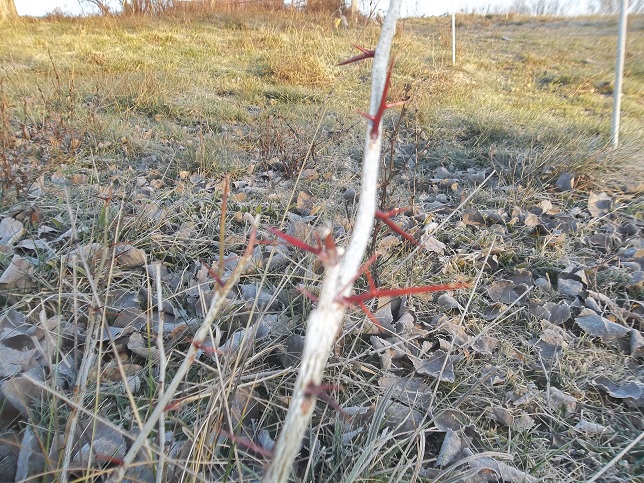
Then I spy a thorny nemesis.  If not for the thorns I would really like honey locust.  They are pretty, smell nice, make a useful seed, and are a legume.  But then there are the thorns.  A honey locust thorn went completely through my boot and foot one day last winter.  Those trees need to go.

HoneyLocust

A little to the east I have to stop and root for a little plantain plant.  Come on little buddy!

Pasture6

Crossing the bridge a little further East I find another tree.  I am less adamant about ridding the farm of Osage Orange than I am Honey Locust.  They are thorny, yes, but they make fence posts that will outlast me and awesome firewood.  I’m torn.  Well, not with this one.  It is in the wrong place and has to go.

OsageOrange

Wrapping up and heading home, I’m amazed at how much grass is left after the cows grazed the hillside a month ago.  At that time they wouldn’t touch the fescue.  I also notice how much clean-up I need to do on this hill.

Pasture7

Looks like the only things actively growing out there are the henbit and the chickweed.  Several grasses are still green but I don’t hold out much hope for growth for several more months.  April maybe?  Ugh.  So much to do…

Still Grazing

Every night the cows come up to the shed where we feed them hay.  We do this so we can separate the calf so there will be milk for us.  In the morning, we milk while feeding them dried molassas and oats with a turnip, beet, daikon radish or whatever we can find.  Otherwise, during the day, the cows are still grazing.  Horses too.

The world is frozen this morning.  Cows, goats, chickens and pigs all get ice water.

IceWater

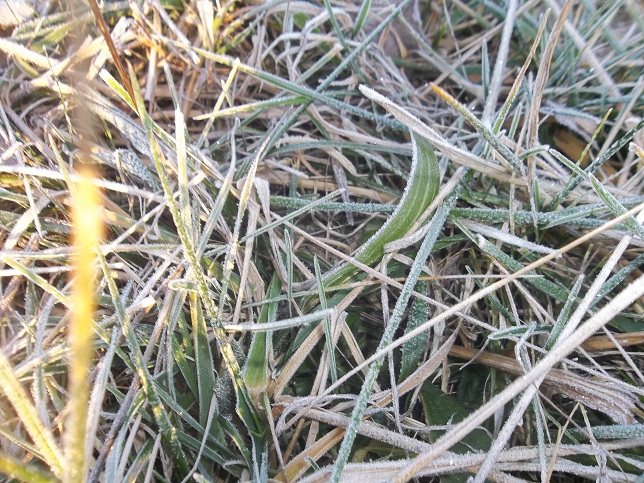
Cows are having frosted fescue and ryegrass.

Grazing2

We’ll continue grazing our way around the North side of the combine shed and into the pasture to the West.   That amounts to about 2 acres of grazing that hasn’t been touched since about September (when I finally fenced my cousin’s cows out of my pasture).  Little by little we move the electric fence opening more grazing area.  I don’t have a back fence up on this pasture as the grass is pretty much finished.

Grazing1

Then there are another couple of acres to graze in the bottom when we get around to it.  The cows on the next hill are the neighbors and they are grazing wheat and turnips that were sewn when the corn was tall.  I can graze the bottom just down the hill from grandpa tree.  That too has been untouched for several months.  It would be better if it had rested since July but…next year.  Unfortunately it’s not wheat and turnips.  It’s fescue and goldenrod.

BottomPasture

Ah, goldenrod.  These leaves are pretty much what is left of goat pasture.  Poor goats have been on hay since the leaves fell.

GoldenRod

The horses don’t seem to mind the fescue so we’re stretching their hay by rotating them where the cows have already been.  I have a hill near the horse barn that is a solid mass of fescue foot deep.  The horses do a good job grazing it down to the nubbins, fertilizing the ground and tearing it up with their hooves.  This will make a good seed bed for clover in the late winter.

HorseHooves2

So that’s the state of things.  We encourage the cows to graze as frost makes the fescue more palatable.  The horses munch, stomp and deposit.  The goats nibble leaves and seed heads where they can find them.  We keep notes on what is out there and are determined to do better next year.  Higher plant populations, greater diversity, more palatability, taller grass, more stockpile, fewer weed trees….the list goes on.  It’s mid-December and we’re still grazing and I feel pretty good about that.  Hope this keeps up.

In For Repair

My Oliver 550 needed a little work.  Not only was it missing horribly on cylinder #2, it didn’t have any oil pressure.  Oil is the stuff that keeps the metal from touching metal…preventing the engine from wearing out.  “Missing” means that the four-cylinder engine was running at 75% capacity.  And it sounded bad.  And I had gas in my oil…you know, the stuff that’s supposed to protect my engine.  That’s not a good thing.

Oliver

Fearing the worst I took my tractor to a local machine shop, asking him for a worst-case estimate.  He said if it needed an overhaul it would be $2,500.  I only paid $3,000 for the tractor to begin with and there is another in better shape on CL right now for $4,500.  So, now what.  At what point do you pull the plug?  When do you send your equipment off to become scrap and parts?  What happens when I get worn out?!?!?

Three weeks later it turns out that the top end of the engine looked fine.  The shop put in new rod and main bearings, rebuilt the oil pump, replaced the relief valve and are sending it home.  All for much less than the worst-case scenario.  This is work I probably could do.  But there’s only so much I can do.  It’s not the best use of my time to wrench on my tractor.  Heck, it’s not the best use of my time to move a chicken tractor either.  I’ve written about this before.

My tractor came home.  We mowed a little bit with it to get ready for grandma’s funeral.  I used it to pull some logs and move a few things and …guess what!  It died.  I can’t even get it started.  I haven’t determined if this new problem is a fuel issue or an electrical issue.  It’s just dead.  I’m hoping it’s something simple this time.

At what point do you decide it’s not worth repairing?  Is it better to have a payment on a depreciating tractor that probably will work or no payment on a depreciated tractor that may or may not work?  We are really working to embrace option #3: no tractor at all.

Goumi and Apples

In working to establish tree guilds around the dwarf apple trees I planted I ordered goumi.  Near as I can tell it’s pronounced gwammee, not gummy.

The book Gaia’s Garden lists plants appropriate to an apple tree guild.  The guild includes bee balm, comfrey, daffodils and a few others but let’s just start with what we have.

Goumi1

I have apple trees already.  Thanks to Sandusky Valley I now have goumi.  They don’t look like much now but they should take off in the spring.  Toby Hemenway suggests you fit Goumi anywhere you can to help establish new trees and boost production.  The idea is that goumi (a nitrogen-fixing plant) grown next to and in proximity of trees will provide nourishment to the trees.  He even suggests you plant your apple and goumi in the same hole, cutting the goumi back each year to half the tree size.

Goumi is propagated by cutting.  The cuttings I got were bare-root and well rooted.  I made a mix of well-composted horse manure, sawdust, perlite and a greensand and planted the goumi at even spaces between the apple trees.  The trees are planted 8′ apart so I planted 2 goumi in a line at the 4′ mark.  This should keep the plants in sufficient sunlight as the guild develops.

Let me know if you have any experience with goumi or recipies you can share.

The Steel Hay Wagon – Wagon Series Part 3

Part three of my series on hay wagons is less for the woodworker and more for the welder.  I can’t imagine building this at current steel prices but, in a pinch, it would do and seems it will last forever.  This too is a guest post from my father.  I’ll hand it over to dad now.
Back to the farm auction.
Here I am hands in pockets, lots of temptations at another farm sale.  This time a neighbor is selling his equipment. He is cleaning out his sheds as he is quitting farming and has rented out his farm to a high rent farmer.
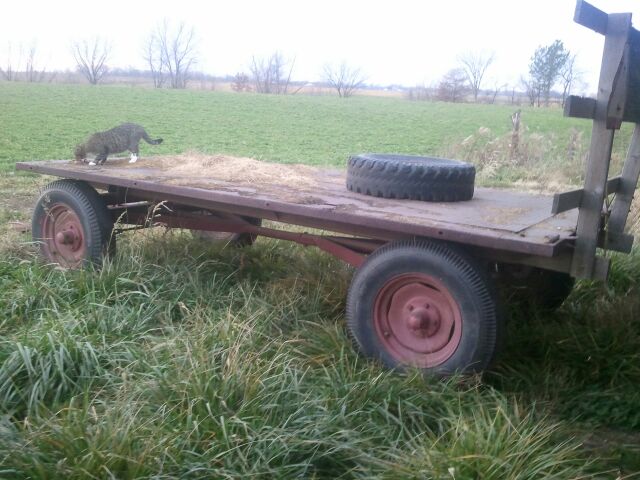
I am doing pretty good, I only bought a sloppy joe and a soda so far.  Then there is this old flat wagon with a steel bed.  The tires are holding air.  “Alright boys what am I bid for this wagon? $250, 200, come on what will you give? $100, $50, here 50 now 60,70,80.”. Who bid $90?  Oh that was me!  “$90 once, $90 twice, sold for $90 to that fellow.  What’s your number sir?
SteelWagon1
There you go, a $90 wagon that has hauled thousands of bales through the years (maybe 15 years).  And has been a work bench, a storage unit, hayride wagon…you get the idea.
SteelWagon2
We had our first flat tire on this wagon this year and that is the only repair we have had on it in maybe 15 years.  This wagon has a diamond tread on the deck but it still gets slippery, especially with loose hay.  [Editor’s Note: the deck can also get hot!]
Someone told me once every auction has a soft place, this auction had a cheap hay wagon.
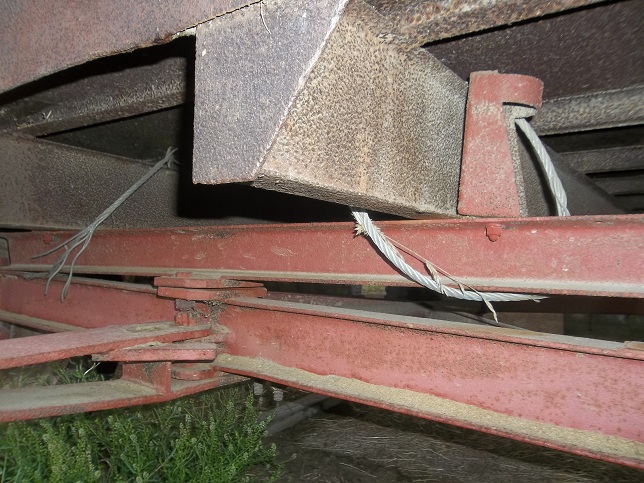
The construction is simple and straightforward.  Instead of wooden runners they used a pair of I-beams.
SteelWagon3
There is a frame of bent steel around the perimeter and the tread plate top supported by U-shaped joists on 14″ centers.  In the rear we bolted a 2×4 to each I-beam to support our headache rack.
SteelWagon4
The headache rack is also held on by a couple of brackets up top.  It’s easy to remove the headache rack this way…just 4 bolts.
SteelWagon5
One of these days we may go crazy and paint it. Who knows.

The One Hundred Twenty Dollar Hay Wagon (Wagon Series Part 2)

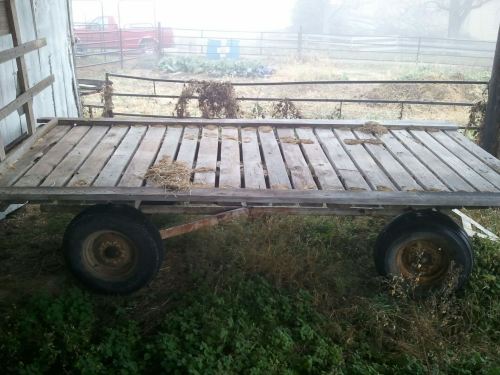
Part two of our Hay Wagon series is a guest post from my father.  You’ll see comments from “Not Caretaker” from time to time…that’s him.  Don’t be fooled by the pictures.  This is a great hay wagon and cost about half as much as any of mine and pulls straight.  We have put thousands upon thousands of bales on this beauty over the years.  Let me step out of the way and had the microphone to dad.

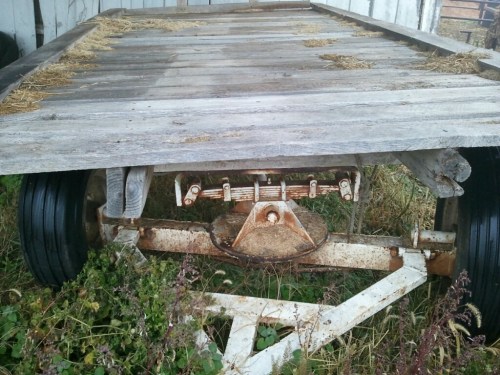
I would describe myself as thrifty.  That said I am willing to repurpose rebuild or do without.  I bought a wagon running gear from a local fertilizer dealer for $100.00.  It had an anhydrous ammonia tank on it at one time.  This running gear had one distinction from most other running gears in that the whole front axle turns on a center king pin where the usual farm gear steers like a car, both front wheels turn together with a tie rod.   Either running gear will do but the gear like this one will follow whatever is pulling it quite well.

At about this same time I was at a farm auction trying to keep my buyers number in my pocket.  The auctioneer came to a pile of used lumber (oak, spruce) of various dimensions and lengths.  Some of this was new 16’ lumber that had been use for concrete forms .  “What am I offered for this lumber?  $25, $25, $20, $20, ok boys someone start off, what’ll you give?”  I heard myself say “$10”.  The auctioneer said “alright I got $10, give me $15, $15, $14,$11, sold for $10 to number 313”.

Back to how to build $120.00 hay wagon you can see where the money is going.  I sistered  two of the 2X6X16’s together to make a stringer for the foundation of the wagon bed.  Made two of them and fastened them to the wagon gear about forty inches apart.  Then I used 8’ oak boards for the deck and nailed them across the stringers placing them about an inch apart basically building a deck like you might have on your house.  The spacing of the deck gives the guy riding the wagon a good footing and is not slippery like the solid decked wagon written in the first of this series.

There you have a plan for an economical wagon.  You may not be able to buy a used running gear  that cheap as iron prices have driven up the price of farm machinery , but there are still bargains out there.   Used lumber is still a bargain you just have to find it.

Now I want to mention  something about using these wagons.  We stack bales right off the wagon (see videos in earlier posts).  I had an old neighbor, Tommy M, who helped me bale until he retired.  He would run the baler and I would ride the wagon and stack hay.  He always told me he knew how fast to drive by looking back at me, if my tongue was hanging out and I was breathing hard he knew he was driving fast enough.  How I wish he could still drive the baler.

Now that I drive the baler and Head Farm Steward rides the wagon, I know just how fast to drive.

HFS again.  In case you missed it, Part 1 is here.