Easy Autumn Farming, Chores in the Dark

There is a long stretch of the year when we can hardly catch our breath. The schedule is booked solid. Chicks arrive in mid-February. The garden starts to go in early in March. Before you know it we are planting a fall crop in the garden, cutting the last of the hay and watching the birds fly South. Every day is long and it seems like we are always behind. Then it is November and you realize you didn’t make an appointment for the hogs. Shoot.

In November the sun rises after I leave for work and goes down before I get home. That’s ok. The cows don’t ask for much from us. There are no chicks. The hay is in the barn. Pigs need very little. We still have a number of projects around the farm but it is time to catch our breath.

It’s hard to take a picture of the cows in the dark but tonight the sky cooperated very nicely. The moon had just risen.

NighttimeRight now the moon is rising when I’m doing chores at night and still up when I drive to work. It’s kind of nice.

In the distance I hear the constant sound of fans drying grain in bins. It’s like the sound of a car coming down the pavement at speed but constantly in the background. Once in a while I hear a chicken negotiating for more space on the roost. In the center of the picture are headlights from my neighbor’s tractor. He’s doing his fall plowing, even at night as we are expecting some weather in the next two days. The sound of the tractor is hardly noticeable. You have to stop and listen to the world around you.

The cows are at the South edge of the property and can drink from the pond. They congregate under a grove of maple trees near the edge of the pond at night. The grove seems to hold warmth and the pond moderates the temperature change. I would prefer that they sleep and manure uphill but…you know. Cows today. Can’t tell them anything.

So my evening consists of walking in the cold moonlight to check the cows for any signs of bloat and just to say “hello”. Then I check the pigs for food and water, put on my pajamas and park my tookus by the fire. Similarly, my morning is just a walk to the cows and a peek at the pigs. Julie checks water and collects eggs later in the day.

This farming thing is so much easier in the fall!
Today’s Wood Pile

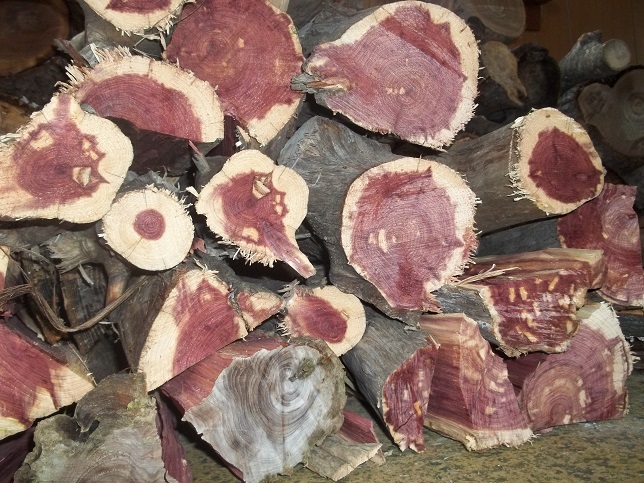
I emptied the cemetery hill of dead standing trees and snags this year bringing down an elm, a couple of oaks, a walnut or two and a juniper tree. Ah, juniper. I limbed out the juniper and carried the pole home on my shoulder…didn’t cut it until today. Oh the smell!

JuniperIt splits well, burns quick and clean but doesn’t really get hot. Perfect for a mild fall day…when I’m feeling lazy…and just want to take a nap by the fire. There is not a lot of juniper on the farm. One tree is big enough to saw, the others are small and are routinely shredded by deer and cattle. This one is a treat. Isn’t it pretty?


Fall Plans, Winter Problems

Fall came a little late but it’s here in force now. We just had four nights in a row of below-freezing temperatures. Now we have to be in the habit of disconnecting our hoses at night and laying them on a slope to drain. An extra chore. Rain is just about to set in so we’ll be up to our knees in mud before long.

This fall cold snap probably won’t last. We have seen 90 degree days in November before. But it’s a reminder of what is coming…and soon. The next few nights will kill the alfalfa and clover as well as the summer grasses. The leaves will begin to fall in earnest.

fallgrazing2

We have already slowed the cows down, asking them to crop the grass very close on the South-facing slopes. I expect these slopes will have time to put on another 8 inches of grass before the fescue really goes dormant in December but, for now, I want to put down a lot of hooves, mouths and manure in tight pastures…even if we move several times/day. That late fall regrowth will be just what the doctor ordered in April when we are looking for a little pasture to graze. The fescue should come through winter in good shape.

fallgrazing

I plan to feed a little hay while we are on this North-facing slope. Roots are shallow here and the plants have a hard time in the blazing sun of July and August. They have fully recovered since the last grazing but the plant population is lower than we would like and, again, root systems are shallow. We are relying on hooves to push waste hay and manure into the soil surface, disturbing the soil and making a nice bed for seed germination as weather allows…possibly in the spring. The hay idea comes from my talks with David Hall. He said he fed 30 days worth of hay across 5 months to make the hay and pasture stretch. We are sort of starting that now…at least, right here where the pasture is poor. Grazing in tight areas, moving daily, feeding a little hay in the morning…about 1/10th of the dry matter a cow would otherwise need.

That all sounds nice. We have a plan. But it is not without its problems. Shorter days, colder weather, hose management, extra bedding for pigs…nothing life-altering but many small extra chores with fewer hours of daylight causing problems.

Late Summer Changes

Fall has arrived and things change quickly around here. The barn swallows disappeared a few weeks ago, the other birds started flocking up, huge swarms of migrating dragonflies have come and gone and now hawks are migrating through.

Not much I can do…but there’s not much I want to do about hawks. Dad and I saw a juvenile hawk sitting on a chicken tractor, looking at the broiler chicks beneath.  He was obviously frustrated by the wire. For some reason he was ignoring the layers. Maybe the were just too big for him.  Who knows.  As we went past he spooked and took off. A few minutes later he speared a pigeon off the roof of a nearby silo.

We have reached the point where you can’t take a step in the woods without ducking under a spider web. It is as if we finally reached a critical mass of insects allowing more and spiders and praying mantises…or they have just eaten so many for so long they are all big and fat. And believe me, we have seen some big, big spiders and I swear I saw a 10″ long praying mantis yesterday.

TangledWeb

The sunflowers that were all so pretty in August have drooped over so we cut the heads and set them to dry. I’m glad we could complete that cycle before the cows grazed that area. Hard to believe it took us 4 months to rotate pastures around the farm.

Sunflowers

Sunflowers as of Sep. 1

The cowpeas in the pasture didn’t set a pod all summer until September. Same with the cockleburs. It became increasingly unpleasant to pull cocklebur plants in my pasture over the last month.

Dad keeps a detailed journal of changes, frost dates, etc. I don’t currently do anything formal though I used to track the frost dates and the first time I heard a spring peeper (Pseudacris crucifer) and our toad (Bufo americanus). Do you track the changes around you each year? On this topic, I would like to revisit the book Great Possessions by David Kline. I haven’t read that in years. Less seasonal but just as good is Scratching the Woodchuck.

Failing to Plan for Fall Egg Demand

I get this all the time.

“So, Chris, my 14 year-old daughter just watched Food Inc.  Now she’s not eating.  How much are your eggs?”

“Chris, we just started this new diet (Paleo, Zone, Sally Fallon…you name it) and need a source of clean food.  Do you sell eggs?”

“Chris, my sisters are coming in town this weekend and we are hoping to do a bunch of baking.  Can you get me 3 dozen extra?”

Well, shoot.  Our eggs are $4 (that’s $0.50 less than an inferior egg costs at Walmart!) but I’m afraid I can’t take new customers until Spring.  I would love to publish more on the topic of working to lower food costs and prices but for now, see what Salatin had to say about it in his speech about going full-time.

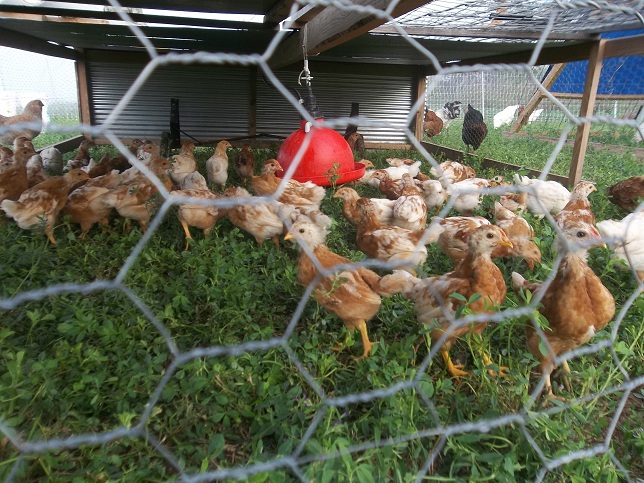
I sell a better egg than you can buy anywhere at a better price than you can find in a store. Consequently I don’t have enough eggs. Any chicken owner will tell you that egg availability changes through the year.  In the spring we are swimming in eggs.  In the heat of the summer the girls slow down (understandably) and heading into fall they molt. We’re in the lean times and it will get worse before it gets better. To account for this, most chicken owners start pullets in the spring so they begin laying in the fall. That way when the older hens molt they can be retired (either to the freezer or to Craig’s List) and the new hens will pick up the slack through the winter. I realize I’m not using specifics here but I’m just relating a general trend.

I failed. Our spring was so busy I just couldn’t raise pullets.  My travel schedule, my work schedule, the endless amount of work the farm requires of us…I couldn’t get it all done in the spring. Something had to give.  Since I didn’t sow, I don’t get to reap.  No pullets? No eggs. Not only can’t I accept new customers, I’m struggling to satisfy the demands of my existing customers.  I should have ordered pullets in the spring…like we always have.

Pullets On Pasture

Chalk this one up as a mistake we will work to avoid going forward.  If you focus on making a quality product, customers will find you.  You need to anticipate and accommodate that demand. I could have put down a book one evening late last winter and gotten everything ready for a few hundred chicks.  I just didn’t. As a consequence, I’m missing an opportunity to feed more people. Lesson learned.

Time for Change

Every day I sweat through my clothes before work then I sweat through another set of clothes after work.  You can imagine my wife’s appreciation for the amount of laundry I am generating.

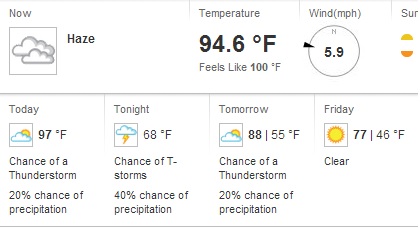
Looks like today is the last hot, hot day for a while.  In fact, it looks like we’ll get a chance to light our wood stove two nights from now!  Compare “Feels Like” to Friday’s low below.

Weather

Picture captured from Weather Underground

That’s a pretty wild change.  I can’t wait.  Maybe we’ll cook on our wood stove Saturday morning!  That may be the last time until mid-October but I’ll take what I can get.

Current Events Aug. 2013

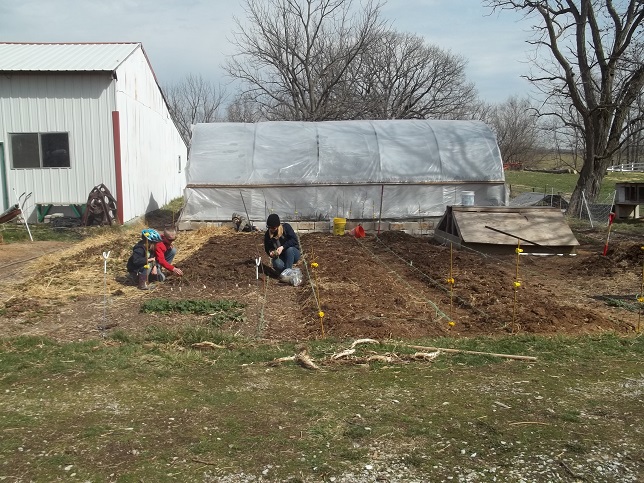
We’re a little busy right now, as is everyone else.  Here are a few pictures of things we’ve been busy with.

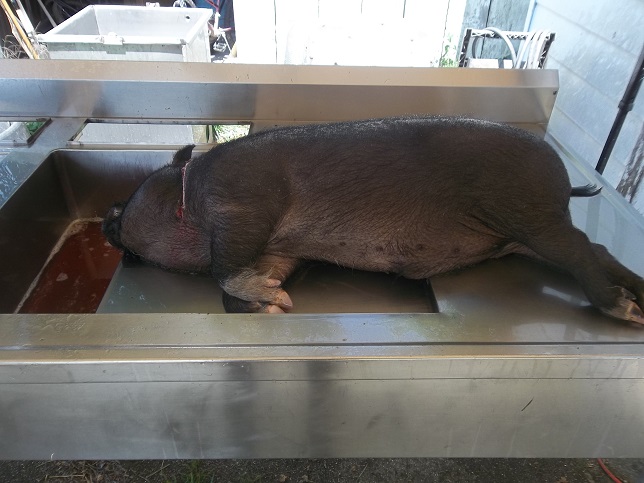
My sister raised a potbelly pig in her back yard.  We introduced it to the freezer.  He was an uncut boar.  I’ll say it was an interesting culinary experience. I had not scraped a hog previously.  I regret scraping this one.  We tried mason jar lids and a torch.  Mixed results.  I suspect my scalding method could be improved.

It reminded me it was time for us to get some pigs of our own.  These should be ready in late November or early December.  Get your order in now.
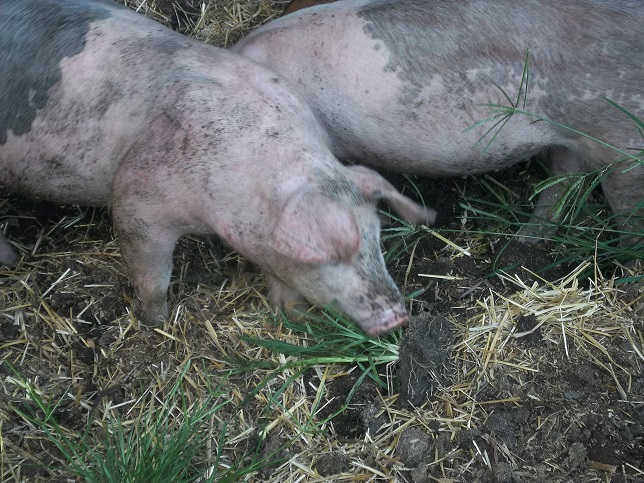
The pigs were hungry for grass and had a great time digging through last winter’s cow bedding.

PigsEatGrassWe are busy canning beans, peaches, tomato sauce…you name it.

As time allows we put a few ducks in the freezer.  It’s pretty hard work.  A chicken takes us about a minute, a duck takes about 10.  The extra step of waxing the bird makes it come out clean but adds a lot of time to the process. Here we are peeling the wax.

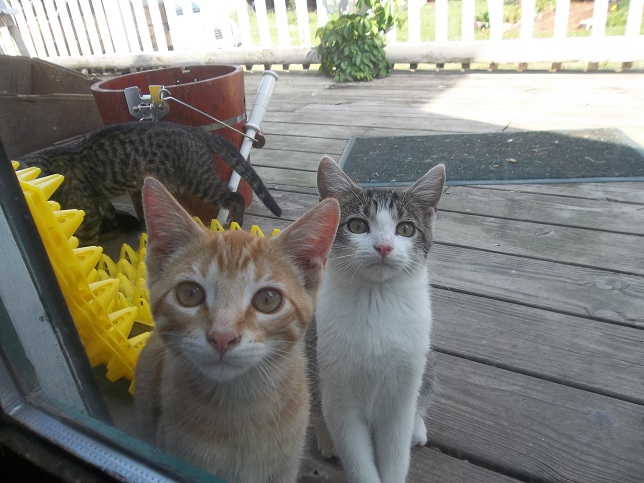
And always the kittens are watching us…looking for a hole in our defenses…wanting to invade our home and love us to death.  The kittens fail to realize that I enjoy them but do not love them.  That was a distinction my grandpa tried to explain to me when I was younger.  I understand it now.  More on that another time.

Hot Day, Almost a Bad Day

Well, the good news is no cows died.

We had a hot cow early Sunday afternoon.  She was standing with her tongue sticking out and mountains of drool falling from her mouth.  Heat stress.  How did this happen?  She was standing next to a water tank that was half-full.  The other cows were lounging in the shade.  What on Earth!?

As an immediate fix we moved the cows under a tree and filled a water tank with fresh, cold water.  Then we hosed the hot cow down with cool water.  It didn’t take long and we were out of danger.  She took a good drink of cold water then another.  Ultimately she lay down in the shade with the other girls.

OK.  What went wrong?  We had the cows up for milking…normal thing.  The night before I asked them to mow the driveway.  They obliged.  The next morning I thought they could mow out by the mailbox for me.  They were delighted.  4″ grass and clover mix must have been what they dreamed of.  Then, to top off the tank, I let them graze the ditch.

After the emergency passed, I came inside to fully research what I did wrong.  Turns out, that high-protein grazing early in the day mixed with increasing temperatures was a recipe for disaster.  Good thing they were up by the house!  This PDF provides a good summary of signs and causes.

The cows were stuffed to the gills just as the day got hot.  The full rumen was limiting lung capacity.  The heat of fermentation was compounding the problem.  Plus, this is a heifer who hasn’t shed her winter coat out well.  Greg Judy says that’s grounds for culling.  I think she needs another year as I basically took her off of hot feed and threw her on pasture in April.  She may just need time to adjust nutritionally.  As long as she doesn’t come up open…

So.  We are now introducing the cows to fresh pasture in the evening, moving once/day.  I’m also checking to be sure there is shade available in every paddock.  Consequently, some ground will go ungrazed for the next 4-6 weeks and we’ll skip around on cool days.  Today was 97 degrees.   Two days from now they are calling for 85.  Skipping around will get us through the worst of it.  I’m glad I have pasture in reserve.  I’m glad I bought several extra water tanks.  I’m glad I didn’t cut down all of the hedge trees out there.  I’m glad I under-stocked my farm leaving me with options to handle heat stress and inexperience.  Unfortunately, the cows are translocating nutrients from the top of the hill to the bottom of the hill, where the trees are.  That’s not desirable…but we’ll work with what we’ve got and plant more trees in coming years.

Two other notes:

  1. The neighbor’s cows are all pretending to be hippopotami to deal with the heat and flies, especially the ones without black hides.
  2. The Jersey cows don’t seem to notice the heat.  They graze all day.

One final note, much of this thinking carries through well to pet dogs…if that’s what you have for livestock.

4 Inches in 45 Minutes

4″ in less than an hour.  That’s a lot of rain.  The storm was not intense, it just rained a lot in a short amount of time.  The basement filled with water but that’s another story.

Flood1

The stream was up 5′ above where it is now, which was about another 5′ in elevation from where the cows were pastured.  Looks like the whole bottom was a stream briefly.

Flood2All of our wide collection of driftwood was moved.  The barrier fences on both ends of the branch will need to be cleaned out and maintained.  But the good news is we’re covered in grass.  While the neighbor lost a lot of soil from cow paths and bare dirt, I suspect we trapped soil.  I especially like the protein tub pushed against the fence in the first picture.

Looks like the pasture wasn’t hurt, just the fences.  We’ll deal with what comes our way.

Regularly Scheduled Simplification

There is only so much I can ask of my wife.  She is intelligent, beautiful and strong.  She cooks, cleans and cares for all 5 of her dependents (including me).  She teaches the children.  She washes, sorts and boxes the eggs.  She runs her own business, continues her ongoing education as well as that of the children and keeps the farm running when I go sit in the A/C at a desk job.  It is important that we simplify things as much as possible…that I stack the cards in her favor.  She is strong but she has a hard time moving chicken tractors.  She is willing to work hard but tires out long before I do.  There are only so many hours in a day and I can’t expect her to be able to do everything I can do.  So we have to simplify.

Milking

What do I mean by that?  Recently we took possession of 6 new heifers.  Now, six heifers doesn’t look like much on paper but it’s a whole new deal for us.  Rotational grazing.  Mob stocking.  Hoping and praying that the green stuff growing in our fields is appetizing to our hooved animals.  We have to learn how to move fence, how to move the water tank, how to troubleshoot shorts in our fencing, how to watch for problem weeds and to monitor how full the cows are.  Again, on paper, no big deal.  But in real life, learning all of that all at once is a bit daunting.  Learning all of that while keeping the food cooked, the dishes washed, the laundry folded, the kids educated and the business growing is pretty rough (though she does it all while looking great).

Sunshine

So we simplified.  We scheduled our production for the year and made sure several things were finished or on break before the heifers arrived.  The broilers are in the freezer.  No more chicken tractor chores.  The pigs went to market.  No more planning and moving pig pastures…or working pig pasture recovery into our grazing schedule.  We planned ahead, knowing our spring is busy and staging things out so we could learn new skills away from the pressure of existing skills.  Now, there’s no getting away from housework or even garden work but just freeing her from checking broilers 3-4x per day and liberating her from her fear of 300 pound hogs lightens her workload enough that she can afford to focus on these new heifers just when they need it without shorting the kids of the time they need.

Garden

The goats were scheduled to be sold in December.  The two females finally left today.  Once they are gone we’ll be down to just ducks, cows and layers.  Over time we’ll work pigs back into the rotation.  In the fall we’ll do another big batch of broilers.  In between we’ll attend Cattle Grazing University, Chism Heritage Farm campus, and the school of hard knocks.  Experience is a great teacher.  I have read every grazing book I could get my hands on and I’ve learned more in the last week than ever before.

Broilers

I think pigs, turkeys, goats and broilers all have a place in our lives, in our business and on our farm but we can only ask so much of ourselves.  At regular intervals we plan time to review what we are doing, why we are doing it and verifying that we are making the best use of our time.  Are we happy or just busy?  It makes me happy to see the pigs run in the pasture.  I enjoy butchering chickens with my children.  I love our goats.  That said, today I’m content to watch the cows eat grass.  They have a lot to teach me and require my full attention.

Most importantly, I have to consider my wife.  This is our dream, not simply mine.  I can’t abuse her with hard labor and expect her to remain enthusiastic.