I would rather not relate my first two experiences loading hogs. I’ll do it but only because I love you.
There were a lot of…adjectives. Maybe some high temperatures. A fair amount of running, yelling, pushing, lifting and other unpleasantness. This was capped off when we got to town and one escaped the chute and ran around the street near the packer. That was awesome.
One of our goals is to ensure our animals have a wonderful life right up until the end. I don’t want loading into a trailer to be unpleasant for man or beast. I have found a better way.
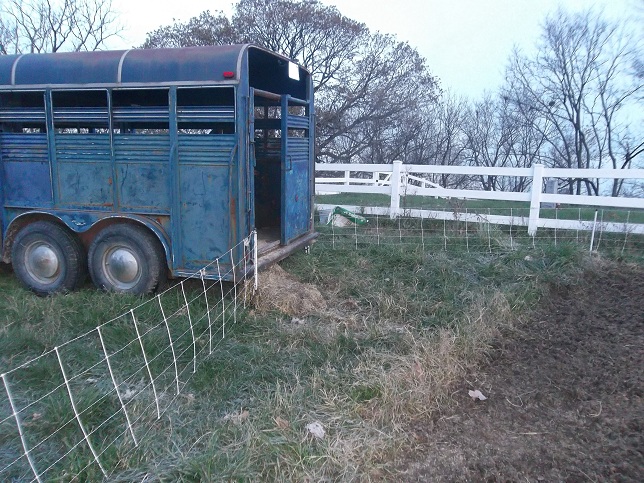
The pigs load themselves. Rather than attempt to load the pigs the morning I drive to town, I back the trailer out there the night before. I butt the electric fence up against the sides of the trailer and put their feed inside. Curiosity and appetite lead them into the trailer and I close the door. No muss, no fuss. Up they go. I have loaded them this way twice now. Old timers think it’s a fluke…just like the electric fence I keep them in with.
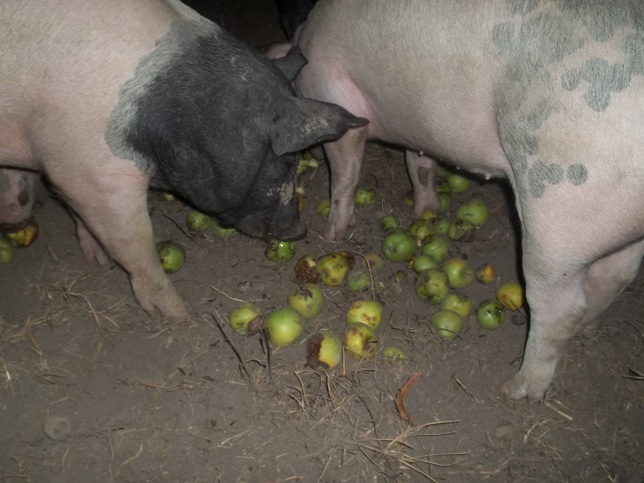
Monday night the fourth and final pig showed resistance to loading into the trailer. Rather than pressure the animal to fit my schedule, I backed off. 3 of them were loaded into the front partition. The fourth was reluctant. I put some apples by the door and went to eat supper. After supper he still hadn’t loaded. I decided bring the cows up, feed the goats and close the chickens. When I got back his curiosity had won out over his caution and I closed the door while he munched away at the apples.
This represents a major epiphany and is entirely my father’s idea. Thanks Dad.
Where have you found frustration with livestock? How have you overcome it?
I maintain and encourage offline correspondence with readers. Many of you all around the world read my blog regularly but don’t comment. Who are you in the UK, Australia, Hungary, Pakistan and the Netherlands? What about you Singapore? India? Get to know me!
Anyway, this was in with Jesse’s comments about chicken processing:
Jesse:
I also wanted to ask how many sections of electro-netting you are using for your pigs. My three pigs are in one 100ft section of the premier fencing. I am moving it once a week, which is taking me about 4 hours total since I have to clear/mow where the fencing is going, then cover seed the old paddock. I’m thinking of getting more fence and giving them two sections of that fence. I was curious how much you are using for your number of pigs.
I own 4 sections of pig quikfence. I use two at a time so I have an empty paddock set up at all times. I do tear down and set up in my free time, long before I move the pigs. I’m behind on seeding where the pigs have been but I’ll get it before the next rain. I need to haul wood chips to fill in the wallow and I need to rake the rough spots smooth. I also need to cut some brush before I seed. I’m sold on that deer food plot mix I found with rape, turnip, daikon radish, etc. Pretty cool.
Jesse later:
4 sections of pig fence, that’s exactly what i’m thinking of doing. i only have two right now, so when i set the second one up adjacent, i still have to make this awkward temporary chute out of cattle panels because the gates don’t line up. plus with only 1 100′ section and the three pigs, i’ve been moving the whole thing weekly, and i’d like to be able to let each paddock go at least 2 weeks. what is your typical rotation time? do you use a non-electric gate as a door between the paddocks? or just the break in the pig fence?
where did you find that deer plot mix? it sounds good, only with my rotation and small number of pigs, i don’t think i’ll be re-using paddocks this year, so i’ve just been seeding with rye grass. one of the guys at the farm bureau did recommend rape. man i hate that plant name. i really just don’t like ordering 10lbs of rape.
There are a couple of ways to set up your fence. We tend toward setting up an hourglass [two squares]. All four fences join in the middle. [Jesse later said this wasn’t clear so I drew this
[]
[]
to make it more clear] We just peel back two posts and feed the pigs on the other side. When they find their way through we close it up. While they are eating I move the fence charger. As time allows I roll up the fence, usually immediately.
Rapeseed looks like kale but is sold as canola. Pick your term. I bought the mix at my local farm supply store. It’s this stuff right here.
Though I like it, I don’t think I’ll buy the mix again. No promises though. It’s not difficult to come up with winter rye, cowpeas, clover, chickory, etc and make my own mix…hopefully for less money. Even planting turnips behind the pigs would be great…especially if I let the turnips grow then put my chickens over the turnip patch after frost. I’m also spreading raw aragonite behind the pigs. No, they won’t return to the same ground again but, like the turnip and chicken example, I’m creating forage opportunities for other animals (including wildlife) and establishing groundcover.
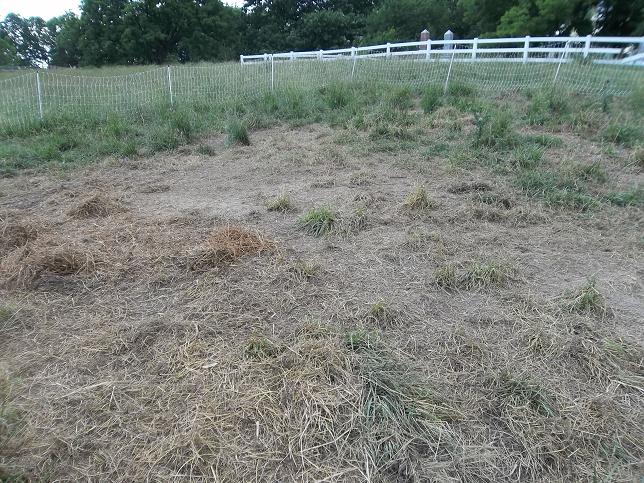
I realized later I didn’t answer his question about rotation time. I’ll try to answer it now. Ready? It varies. I know that is a terrible answer. Sometimes I just want them to eat and manure a bit. Sometimes I want them to tear everything up, kill everything and work in wood chips and straw like last winter in the garden. Sometimes I count on them to clean up weeds and tree nuts but not destroy the pasture. Sometimes I want them to wipe the pasture out so I can re-seed with a variety of forages. Sometimes it’s so stinking hot and dry we can’t drive a fence post in the ground with a hammer so we just sacrifice an area. Yesterday I moved the pigs because they were nearing the end of forage in their pasture and a rainstorm was moving in. I didn’t want them to create a mud volleyball pit so…off they went. Here’s Joel Salatin aswering the same question.
Key points:
It depends
For his pastures, it’s time to move the pigs when they eat 2 tons of feed. Pigs can create a lot of disturbance on their way to 2 tons of feed so go back to point 1…it depends.
He currently has three pig finishing pastures and another one under development. Each pasture is about two acres in size and is divided into eight smaller paddocks. These pastures are each stocked with 30 to 50 pigs.
He said it is very important to leave some trees in each paddock as pigs are very susceptible to sunburn.
I should also point out that pigs wallow. Big pigs make big wallows. As stated above, I fill their wallows in with wood chips, compost, sawdust or old bedding…basically, whatever is laying around. You might think this is a nuisance but I think it’s a valuable part of pasture renovation and of allowing the pigs to be pigs.
I’m not a pig farmer. I’m a farmer with pigs. I’m learning with you and am happy to help discover the answers with you. If you need real expert help, write a letter to Salatin. He always writes back. Also, check out Sugar Mountain Farm. Walter does things a little differently than we do but he really knows his beans…er…pigs. Better than that, find someone who pastures pigs locally (yeah, good luck with that!).
So I says to me wife, I says, “Honey, What does this look like to you?”
And she says to me, she says, “Looks like the pigs dug a swale.”
And I says to her, I says, “Well I think it looks like the….pigs….du….oh.”
And so you see, kids, it’s a good idea, from the standpoint of your future genetic line, to marry someone both more attractive than you and, more importantly, more intelligent than you. But in practice it sucks. Not only does she run circles around me intellectually, everywhere we go people look at us like, “What’s SHE doing with HIM?”
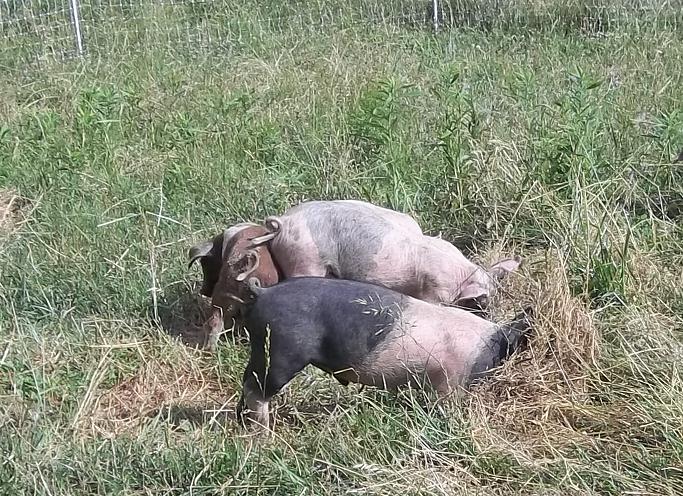
So, while I work to determine how much of a swale I can hire the pigs to build for me on contour and sulk about being continually outsmarted by my lovely bride, here’s a video of the pigs enjoying fresh pasture. Ever seen a pig eat grass?
My hogs weigh in around 150 pounds now. They are slower in growing out than their floor-raised counterparts for a number of reasons. First, though they eat roughly the same amount, they don’t have access to food all day long. Because they don’t have access to a snack any time they want they tend to be a bit leaner than they would otherwise be. Also, they have room to run, exercise, fight and play which, not surprisingly, results in a leaner animal. Finally, my pigs are expected to work for a living. They aren’t laying on slatted concrete relaxing in the shade, inches away from feed and water. They are out on the sun-baked pasture. There are goodies buried in the brick-like soil and they work to find them. After they work the soil I plant a few seeds. They are happy with the work they accomplish. They are happy to live life in the sun with a chance to fully discover the purpose of their design…well, not the reproductive parts. My customers are happy because I deliver a lean, healthy, happy and, consequently, tasty animal to the locker.
Let’s make it even better. Right now immature apples are falling from the apple trees at Aunt Marion’s house. It is important to remove the drops from the orchard to control the pest population and limit disease vectors in the orchard. The kids and I pick up a few bags full of apples each evening. Later this week they’ll work with Aunt Marion (who recently celebrated her 94th birthday) to sift the good from the bad under the early ripening apple trees. For now we just harvest from under the mutsu apple tree.
The pigs get a 5-gallon bucket of unsorted apples each evening for dinner which is the same as saying they get unlimited access to apples. They really make pigs of themselves. This will add flavor to the finished product giving a lean, healthy, flavorful pig you just can’t buy anywhere. By the way, we’re sold out of fall pork.
A lot of my readers are looking for more information on my pig trough. Either that or they just want to see more of the pigs. Either way, today is your day.
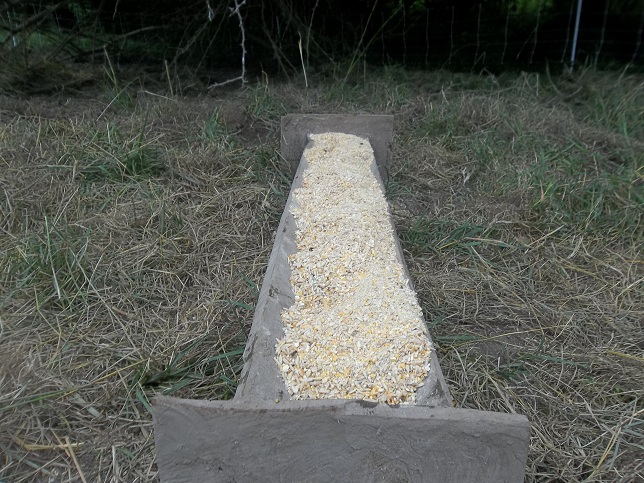
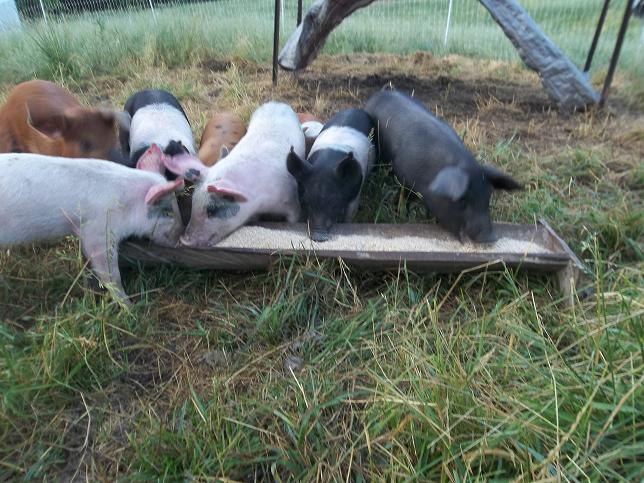
I took slab oak from my sawmill. Slab lumber is waste wood. It either has bark on it, marks from the chainsaw or it’s an uneven thickness. Whatever the reason, it’s more useful as firewood than for furniture. I cut it down to a 1×6 then cut it into 3.5′ long sections and screwed those together in an L shape. I had 8-10″ long boards left over and I screwed those to the ends of the trough to act as legs. These are rough measurements but it really couldn’t be more simple.
Now that the pigs are getting some size to them they don’t all fit around the trough. We give them a rubber pan too. The rubber pan is better than a metal pan because pigs play with their feeders and inevitably push them against the fence. I don’t want them to associate the feed pan with pain when they push it against the electric fence.
Now, the moment you’ve been waiting for. Breakfast at Piggany’s. I especially liked the pig trying to figure out the mystery of the feed bucket. Please notice the pigs aren’t tackling me to get to the feed trough. Feeding your pigs is more art than science. I want them to grow, I want them to get enough but I don’t want them to waste the feed. They eat more on cool mornings than on hot afternoons so we try to account for that in our routine too. I recently increased their ration because they had been eating it all and I like for them to have a little snack between feedings. I try to feed them a little more than they can finish in one sitting. The rubber pan still had feed in it from last night so I guess I went overboard yesterday. On the other hand, they weren’t tackling me to get to the feed either.
What an excellent question. Truly. What’s the point of keeping a pig? I mean, the meat is good…well, great. But does that justify keeping pigs? Is it fair to the animal to expect it to eat and get fat and contribute nothing…serve no positive purpose? What do they DO?
I don’t think I could look an animal in the eye if all it did for me was get fat so I can eat it. I, personally, don’t find life fulfilling without having a purpose. Animals need purpose too. Our chickens sanitize, debug and eat weeds. They give us eggs to pay the rent. Bees have a similar arrangement. Goats clear the brush, give us milk and keep us entertained. What is a pig’s purpose? They don’t lay eggs and you don’t milk sows. How can pigs pay the rent?
1. They eat.
Pigs eat things we don’t. Things we won’t. They are omnivores. You’ll see them eating clover. You might catch them eating a snake or a mole. They love when we throw them broken eggs. They clean up whatever is out there. Plus they get extra or soured milk, garden waste, non-pork kitchen scraps and convert it all to bacon. Mmmmm…bacon. Got unwanted blackberries growing out there? Let the pigs eat them. Yes. Eat them. No roundup required. No mowing. Just electric fence and bacon.
2. They poop.
Ah, manure. My old friend. We need more manure. Just think of what happens on a stretch of pasture across 11 days. The goats eat the weeds and brush and drop a LOT of manure. The goats also leave a pile of unwanted hay behind..loaded with manure. Then the chickens come through and scratch at the hay pile, pick through the manure and eat all the bugs, often leaving bits of corn and feed behind…and very rich manure. Then the pigs come through. By this time, the tall, thorny things are out of the way, the bugs are gone and it’s time for the pigs to get down to business. They nibble at the leftover hay, they nest into the hay, stirring the pile for later composting on site. They eat any feed the chickens lost or forgot. They dig up rhizomes, root for worms, loosen the soil and break up the sod and add in their own manure.
3. They root.
We don’t ring our pigs because we want to leverage their rooting behavior. Go ahead. Tear it up. Rooting is like plowing the soil. They dig, scratch and generally make a mess of things.
All that sod action, combined with the manure they are putting down, makes a great seed bed but is quite harmful to annual grass species. That’s fine with me as I’m working to increase my stand of native perennial grasses. I’m working to establish better forages in my pastures so the pigs and I make a great partnership. I need more orchard grass and less infected fescue. The pigs lead the way and I follow up with a broadcast seed mixture. I throw a mix of vernal alfalfa, timothy, perennial rye and orchardgrass along with a deer plot mix containing triticale, oats, winter peas, clover, chickory, turnip, and (of all things) daikon radish! It was weird for me to look at deer food plot mixes since I never fill my deer tags but Steve suggested it. Sure enough, looks like a lot of good things for my soil/ecology in there. Beyond cows, goats, chickens and pigs, that plant variety will boost the rabbit population, feeding the coyotes, hawks and owls. All of those animals, including the deer, add manure to my farm. If I can get them to spend more time on my farm (weird to say that about coyotes), they will translocate nutrients from neighboring land onto my own. All I have to do is let the pigs dig and toss out a little seed.
4. They drink.
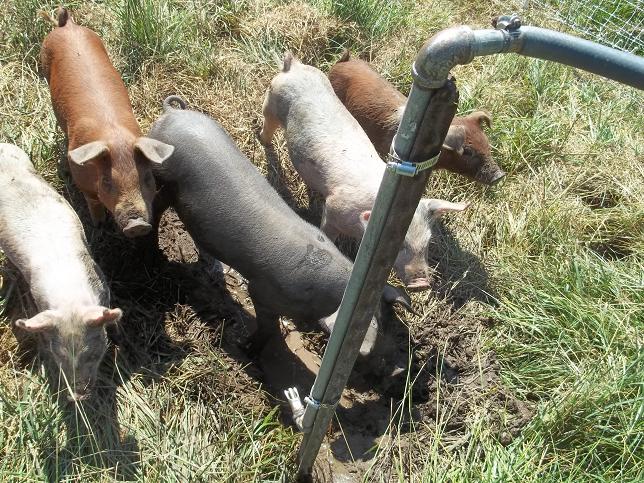
We use a simple poor-boy solution with a nipple to water the hogs. Lots of people ask me what a “nipple waterer” is and how it works. I’ll let the pigs show you.
There is always a wallow under the drinker. It takes almost no time at all for the pigs to saturate the soil near the drinker and put their noses to work digging out a bathtub. They need it. It’s no big deal for me to fill the holes back up with wood chips, sawdust and compost. I can fix the trip hazard and the pasture is better off for the disturbance.
5. They sleep.
They don’t sleep so hard that I can sneak up to get a picture of it but they sleep. A lot. I mean a lot lot. They spend about 20 minutes eating at the trough each day, they spend about 20 minutes drinking at the watering nipple each day. They root around for more food for about another hour or two. That leaves a good 21 hours to sleep and sleep they do.
So, what do pigs DO on a farm? They efficiently convert a wide array of resources into a more bio-available state. Used judiciously, pig snouts, hooves and manure can be used to enhance the land, rather than degrade it. Once the pig has served out its purpose, playing and rooting in your pasture, it’s time to go to market. We butcher our own here at home but also sell whole and half hogs to customers through the local butcher. Beyond fixing nutrients and making them available and helping remodel and renovate your pasture, the pig then adds to your family financially if not nutritionally. With all this in mind I can’t imagine a farm working without a pig. In fact, I would recommend a pig to city people. Just get a pot belly pig and tell your neighbors it’s a weird breed of dog. Then serve it for Christmas dinner.
I don’t have a formula for pasture movement, you have to use your eye. Soil conditions vary season to season and week to week. You just have to pay attention to the forage available and the condition of the pasture to know when to move. The eye of the master fattens the stock. An experienced master has a better eye. Get yourself a couple of pigs and start training your eye. You can quickly create a moonscape in your pasture and sometimes that’s just what the doctor ordered. Most of the time, though, a little disturbance goes a long way.
Beware of poisonous plants in your pastures. I’m not going to burden you with an extensive list but be aware that seedling cockleburs will kill your pigs. Cockleburs are just coming on right now so we’re on the lookout.
One of the questions we get regularly is how we deliver water to the hogs on pasture. We don’t have hydrants in pasture so how do we do it?
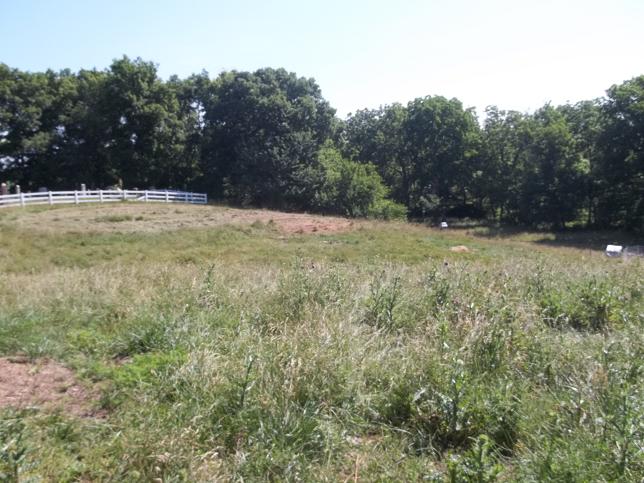
In the winter we carry a bucket to a couple of rubber pans. The pigs only need water a couple of times/day and we make sure they get all they want. When the danger of freezing a hose is replaced with the danger of overheating a pig we use a hose. Our hose runs from under my feet to the center right of the picture…where that second hill breaks over. You will read that there is some concern about giving pigs hot water to drink (and the water in the hose is certainly hot) but we think any water is better than no water, the pigs seem to do fine on it and if we had to install hydrants throughout the farm we would not keep pigs. Maybe we’re getting away with something here but the pigs are happy, they grow well and we don’t have any problems so we continue with our poor-boy solution.
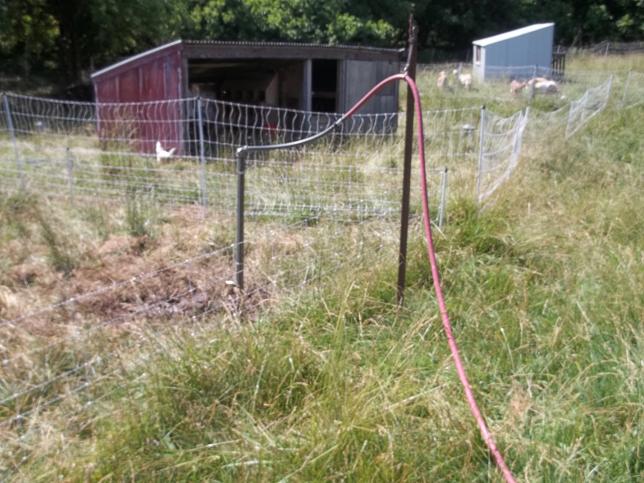
Then we bridge across the fence. I have a short length of old, broken hose suspended by a tarp strap from an old, broken t-post. You with me on the old broken stuff? I’m going for mileage here. Everything has to keep working for us. The posts pull up easily and the whole assembly breaks down for easy setup at the next pasture.
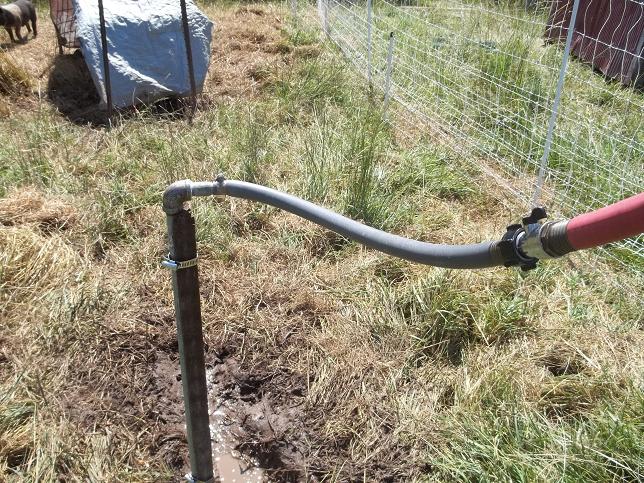
There is a shut-off valve as we cross the fence. With that valve in place we have easy access to water for goats and chickens (further up the rotation). This helps add a multi-purpose dimension to our infrastructure, a constant goal. A short length of hose screws on to the shut-off valve and is clamped on to an adaptor in the pipe elbow.
Then it is a short trip down to the nipple through pipe held to an old, broken t-post by hose clamps. The hogs get all the water they need, which translates to enough to make a wallow. This wallow is about 24 hours old. It will get bigger. Pigs like and probably need to wallow in mud. Lots of farmers don’t like their hogs to do this but we think it makes a good opportunity to add in pockets of organic material. Plus, we think it’s a small price to pay for the amount of work the hogs do on pasture.
What kind of “work” do the pigs do for us on pasture? What do pigs DO on a farm? I’ll answer that in an upcoming post.
I was asked recently how I feed the pigs…or what I feed the pigs in since round pig feeders are not exactly cheap. It isn’t a question I had given much thought to as we just solved the problem and moved on. Our primary motivation is keeping the soil healthy. After that we work to keep the animals healthy. Within those constraints we work to find the best combination of durable, local, inexpensive/free and suitable.
If you give your pigs free access to eat throughout the day they will, unsurprisingly, gain weight faster and put on more fat. If you feed them twice per day they tend to be leaner. Many, if not most, farmers provide enough feed to last several days and go do other things. We keep our pigs near our chickens and feed them when we open and close the hen house each day. We give them roughly 3% of their bodyweight each day of the Fertrell grower ration as well as a little garden waste, some apple drops, acorns or whatever else is handy. Really, we want them all to be satisfied and have a little feed left in the trough for a snack later. This would be unrealistic if we were raising more than a few pigs as 4,000 pounds of pork need to eat 120 pounds of feed each day and I doubt my dainty wife is going to lug feed out to the pasture in that volume.
I took some slab oak lumber from my sawmill to the tablesaw and built a durable feed trough. It works well for 8 small pigs or 4 larger pigs but, again, forces us to put eyes on our pigs twice daily.
We water them with a nipple on a garden hose. It’s not exactly ideal having three lengths of garden hose stretched across the pasture but it certainly has a light footprint and is easy to install. It was also fairly cheap. There is some concern about the pigs having access to cool water so, on hot days, we disconnect the hose and spray the hogs or their wallow to cool off the water again. Honestly, I haven’t noticed that the pigs care.
The nipple is on a 3/4″ galvanized pipe. Actually, it’s 2 pipes and2 elbows. I use hose clamps to keep the pipe on an old, broken t-post with an elbow pointing over the perimeter fence. The hose clamps allow us to raise the nipple as the pigs grow. It’s pretty easy to move when we move the pigs.
Check your hog water several times daily in case the nipple clogs, the hose gets pinched, someone disconnects the water, etc.
Also, be sure to move the hose before you take the mower out to clip the thistle. I really thought it was 10 feet over! What a day Saturday was.
We brought home our new pigs on the 5th. They immediately escaped. Yeah.
We use Premier One Pig QuikFence for our pigs but I have never owned 18 pound pigs before. These little guys just squirt right through the fence. No big deal though, they ran back into the fenced area and we grabbed a spare length of PermaNet. That has them contained. They now have a firm grasp on the concept that white wires are their boundary, though, like velociraptors, they will test the boundary from time to time.
These little guys are complete. The whole hog is there. Well, the boars I bought are now barrows but otherwise from head to tail the whole pig is there. It’s the tail that is most unusual. We have always gotten our pigs from a confinement floor. In confinement the pigs can choose to play with the metal bars holding them in, the drinker nipples, the feeder or that other pig over there. They dock pig tails to keep them from being bitten off, leading to infection. Check the video to see the pigs wag their tails.
Also, we don’t ring our pigs. I want them to dig. They do make holes to wallow in, I just fill those with wood chips, manure, compost…anything handy.
The pigs bat clean-up behind the other animals and do a good job finding kernels of corn that the chickens missed. They also dig up the multi-flora roses that the goats gobbled up. Finally, I sometimes use the pigs to just plow up the pasture, one section at a time, allowing me to renovate that area.
They are still pretty shy. They haven’t figured out that we bring them food every day. It won’t be long and they’ll be under foot. While pigs are cute, hogs are a dangerous nuisance but boy, do they taste good. Enjoy your pigs while they are little.
My friend Steve pointed us to the most interesting hog farmer I have ever met. He farrows on pasture, raises pigs in deep bedding and uses, of all things, large black hogs in his hybridization program. In a world of specialists and sub-specialists, I found a guy who is not only farrow to finish, he does it in a way that honors the pig-ness of the pig. There are things I would do differently (multispeciation) but he’s going against the grain and keeping his head above water.
I met Mike Butcher some months ago. The first thing noticed was that he was pigging on pasture…in February. I saw a number of huts spread across the field, each hut with a sow, each sow with a litter of little pigs. Out in the real world, sows are kept in confinement in crates to minimize the number of little pigs that get squished when the sow lays down or eaten when she expresses her stress level. Mike has selected for good mothering instinct and farrows in an environment that give the sow room to relax.
Yes, it’s a muddy mess, but we’re in monsoon season here. I really want to drive home the point that he’s pigging on pasture. His sows do such a good job of mothering the pigs he had one who kept 15 piglets this week!
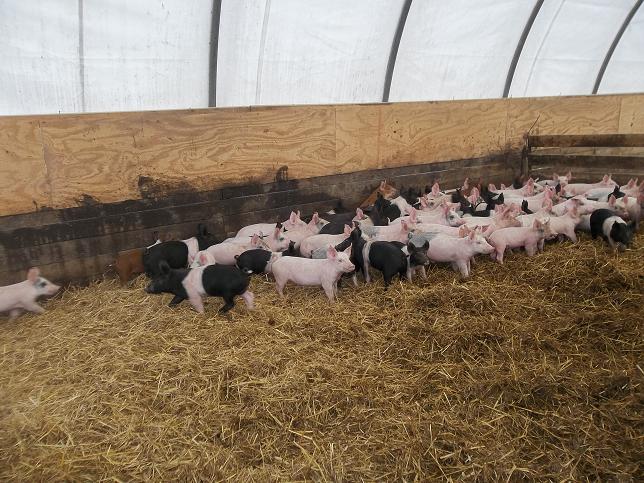
Once the pigs are weaned they move to a series of hoop houses. Unlike other confinement buildings I’ve been in, Mike’s hoop houses don’t have slatted floors with a manure pit beneath. Instead, the shoats were bedded in a deep layer of straw and the larger pigs were bedded with round bales of corn stalks. As a consequence, there was little smell and enormous compost piles. Enormous.
Look at the space available to these little guys. And they have a foot of straw to root, play and sleep in. From a confinement perspective, this is hog heaven.
Again, Mike pigs on pasture, uses heritage sows with excellent mothering characteristics, raises pigs in deep bedding and composts everything. I don’t know what else I could expect from him. I was so pleased I bought 8 pigs. I was so pleased with his price I gave him a free chicken along with the check. If you’re in the Palmyra area and want to see hog confinement done artfully, find Mike Butcher.
At one time this was normal. I’m happy to support Mike in his business.
We had a few problems keeping these little guys fenced when we got home. Look for an article on that in the near future.
Glossary:
Farrow (verb) – To give birth to a litter of pigs
Pig (verb) – See Farrow. Also written as “pigging”
Shoat (noun) – Weaned pig male or female








 Chism Heritage Farm