If you are looking to expand your vocabulary look no further than pig ownership. A pig is a 120 pound ball of muscle complete with teeth and fully equipped to outsmart your every effort to muscle them into making the right decision. In this particular adventure I did not teach my wife or children or neighbors within a half mile any new words. Everybody stayed calm…this time. I’m going to skip to the end then tell you from the beginning. We have learned to modify our schedule and to allow the livestock to dictate the pace. Yes, I wanted to wrap up the pasture change in 5 minutes but it took almost two days. It happened on the pigs’ schedule.
When our pigs see us they come running to the fence hoping for a tasty treat. All of their experiences with us have been positive (well, except maybe the castration) and we give them food to reinforce the lesson. If a pig is uncomfortable, no amount of yelling or abuse will make them more comfortable. You just have to wait it out. Patience and kindness. Just moving to a new location is stressful for the pigs. I can only compound that stress by changing from the nice food guy to the mean guy with a stick. I have to tell you though, as I was standing in the rain Sunday morning I was wishing I had a tranquilizer dart for each pig so I could just carry them to their new pen. Ultimately, patience proved easier by far.
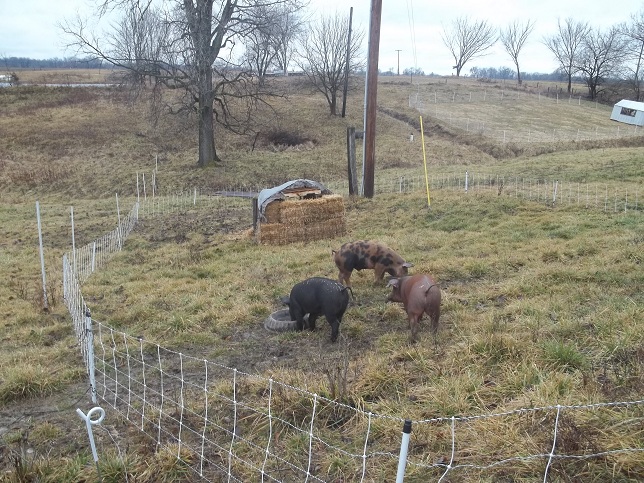
The pigs were still in the winter sacrifice area on pasture and, since their initial (well, secondary) introduction to electric fence, hadn’t gone anywhere. The pigs know that the white wires hurt but they also seem to think there is some sort of voodoo concerning the ground where a white wire once was. As before, we made a corridor of fencing, initially with two strands of polywire, later with Pig Quikfence. Saturday morning I opened the fencing from their pasture into the corridor then began moving their pallet and straw bale house to the new location 250 yards away. The pigs stood their ground. No amount of scrambled eggs or chicken broth could convince them to budge.
Hours pass. The pigs aren’t having any of it. They will not cross the line. At 3:30 I decide to crowd them into the corridor by squeezing their electric fence toward them a little at a time. Everything was going great until the black pig decided his fear of the unknown was greater than his fear of the fence and he attempted to break through the fencing and escape. It was a shocking experience for both of us. I don’t have to remind you that pigs are distinctly lacking in handles so I found myself wrapped in a tangling mass of electric fence and pork…until we pulled enough of the fence that it came unplugged. Fortunately I had an insurance policy in place…a length of PermaNet surrounding their pen just in case. The little black pig backed his way out of his fence and neither of us were worse for the wear. The fence was not broken, just pulled from its posts and I learned my lesson. Patience. We closed things up for the night and headed off to church vowing to return in the morning. Maybe tomorrow hunger will override fear.
After milking on Sunday I turned the cows out and set up the corridor again. The pigs were not interested. I put down a trail of feed hoping they would follow along. They would come up to a certain point. Then they ran back to their pile of straw on the ground. Well, I have other things to do with my time. They can’t escape the corridor so I’ll just check on them from time to time.
Around 11:00 I was sent out to the pigs with a bucket of scraps. I placed these scraps deep in the corridor and upwind of the pigs. The red pig (cleverly named “Red”) decided they smelled so delicious he had to get some of that. Spot and Blackie (names just happen with small numbers of livestock) stayed back with a “not fair!” look on their face. Again I walked away. At 11:45 the kids called to me, “Dad! The pigs are in the corridor!” That’s what I was waiting for. I headed out with a bucket full of feed and, like following the pied piper, the pigs were close at my heels all the way to their new home.
Nobody was upset. Nobody was abusive. No frustration, crying, swearing off pigs forever or talks with the children about types of language that are acceptable around the house and how sorry daddy is and daddy promises to do better next time then daddy sneaks off to down a highball. Nope. Just pigs following that nice guy who brings them food and a new, fresh pasture full of greens on a South-facing slope.
They will get to be here for a few days then we’ll move on to the next pasture. It’s all about disturbance and rest.
I need the pigs to work for me. It’s not enough that they get fat and taste great. They have a job to do. But MY job is to help them do their work. My job is to make them happy in their work. I see these animals several times every day. My pigs don’t cower in fear at my approach. They greet me, they grunt at me, they run and skip as I approach (really). Happy pigs. Happy pigs are easy to move. Happy pigs are easy to load. Happy pigs taste better. There is enough stress on livestock. I don’t have to add to it. I can spend two days waiting on pigs to move themselves. It will be even easier next time.
Welcome to 2013. It’s time to order your chicks or make preparations for the feeder pigs you’ll buy in March and generally get ready for the growing season. Soon the farm stores will offer chicks for sale and you’ll be tempted to finally take the leap. This is the year. We’re really going to do it!
Good for you! But let’s approach this with a measure of sobriety.
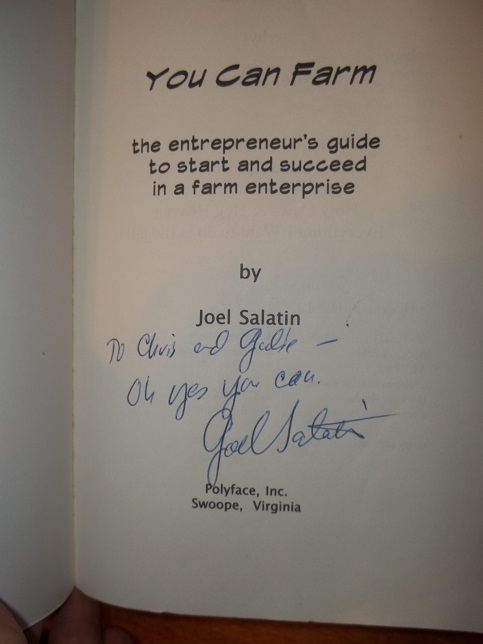
Joel Salatin signs copies of his book You Can Farm with “Oh, Yes you can!”
You can.
But you can also underestimate how hard it is going to be. How hard it will always be. You may become more efficient at keeping your little flock of birds and you may get faster at processing chickens…but that will just encourage you to raise more next time. Your profit margin will always be low but you can increase your cash flow by moving more inventory. So, you raise a few more. You are better at the work and more efficient per unit of chicken but you are still DOING THE WORK! It is never easy to roll out of bed at 2:00 in the morning, find your shoes, load your gun and run outside to kill whatever you can hear attacking your chickens this time…only to realize you forgot your pants…and it’s 20 degrees. The next morning you will be tired. This cycle can continue forever. More production, more skill, more raccoons, more chickens, more customers, more packaging, more ice, more, more, more forever. Forever. Forever!
So, yes, you can. You really can. But it’s harder than you think.
When people ask me how to get started we try to sit them down for a serious conversation. These same discussion is written in numerous farming books but I think it’s worth hitting the main points before moving on. All of these are #1 but I have 5 number 1 rules.
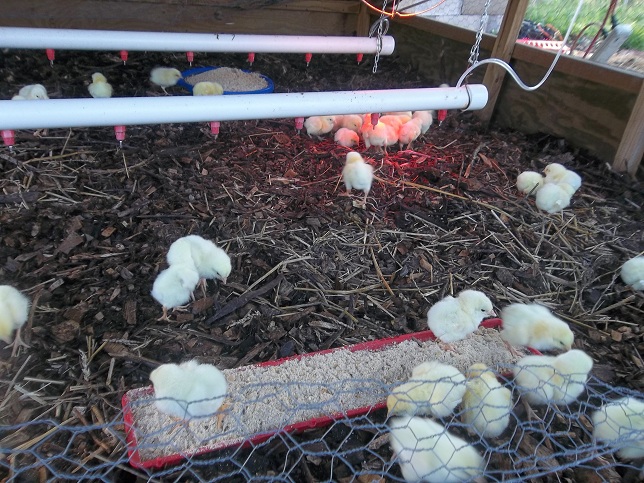
1. Start small. No, smaller than that. If you want to raise chickens, raise as many as 50 for yourself. Just see what all the fuss is about. Ideally you’ll brood broilers late in summer about 7 weeks before your first frost. Then you can butcher on a cool day when the flies aren’t flying and you’ll have all winter to consider your experience. Or just skip the broilers and brood 6 layer chicks. 6 birds will give you far more eggs than you can eat.
2. Go slow. Don’t start out with layers, broilers, pigs and a goat. The learning curve is too steep. If you feel you have a good handle on raising and selling broilers, maybe try your hand at a couple of pigs. Once that is mastered, add the next thing. Take your time. Pay your dues.
3. Buy the least amount of equipment you can. Try to get by with the knives you already have so long as they are sharp and not serrated. Boil water on the stove to scald the birds. If you want to be fancy, borrow a turkey fryer to heat your scald water. Hand pluck the birds. Don’t make a big investment in equipment until you absolutely, positively have to do it. Even then, look for alternatives. Any money you spend is money you can’t spend again. Dad said to me this morning, “They don’t sell capital at Walmart.”
4. Don’t go it alone. This should be listed first but I’m too lazy to re-sort them. If you’re married you need your spouse on board. If your spouse doesn’t want to use a bucket potty just give it up. It’s not worth your marriage to go potty in a bucket. It’s also not worth your marriage to bask in the glory of a compost pile full of blood and feathers. If you’re not married, consider finding someone to help you. Animals eat every day. Even when you have the flu.
5. Read books. Shoot your television, get on a first-name basis with the librarian (you’ll sell her chicken later), park your tookus in a comfy chair and start going through your book pile. Goat Song gave a great example of this recently.
So what’s this all about? A couple of things. First, I was sad to read that our friends at Porter Pond Farm are hanging up their hats. They worked hard, ate awesome food and fed their community. But they worked hard. They may have worked too hard. Take a moment, follow the link and read their story.
There is a lot of temptation to mash the accelerator pedal of farm production. “By golly, if 100 chickens and a cow are good then 2000 chickens and 10 cows will be great! Heck, with 20,000 chickens and a 40-cow raw milk dairy we could ditch our day jobs…and we could do it in 3 years!” Well, yes, you could…but I really don’t think you can.
The first thing you have to do is start. You will never begin if you don’t begin. You begin at the beginning. But start slowly. Don’t bite off more than you can chew. Holy cow. Let me give you a personal, non-farming analogy. I tried my first Crossfit workout on 11-30-2005. One heck of a workout. I looked at the list of exercises (jump rope, jump to a platform, do a modified push-up and climb a rope) as many times as I can in 20 minutes. No problem. I’m young, strong and in shape. I’ll probably knock out 8 or 10 rounds. No problem. I gave 100% for 20 minutes. I was so wrong I even posted a comment on the site:
I honestly thought I was going to die. Double unders are hard, but the burpees did me in.
First crossfit workout. 2 complete rounds, much tired.
I bit off more than I could chew. Now, I was young, stupid and a total glutton for punishment so I came back for more. And more. But I backed way off on my intensity and my expectations and that paid off. I was a bit of a fanatic for a few years there. The intensity and discipline required to maintain that performance level ultimately proved more than I could maintain. Because I realized my error early on and backed off for a while, sought coaching and took my time building skill I was able to achieve some real successes in CrossFit and make positive contributions to the community.
Back to farming, you have to start. Read a book, raise a couple of pullets, whatever you do start doing and start having fun. Playing Around was published in October. It wasn’t my most popular post but, to me, it was one of the most important. One of my key ideas in that post was the notion that I don’t want to do this alone. I want my family on board with me. Among other things, it triggered a response from a beginning farmer we met earlier in the year. We spoke to him and his lovely bride over Skype one afternoon, making the suggestions listed above (including the reference to the humanure toilet). In his eagerness to get rolling, he didn’t listen to me. He raised something like 300 broilers right out of the gate, bought all new Featherman equipment and included pigs in his operation…and, by my reckoning, was amazingly successful. But, after reading my post about making time to play he responded to me:
“I don’t want to farm alone.” Chris, that is something I am starting to understand at the end of my first production season. All my past farming experiences and internships had been a team effort. This season it was primarily me, and something was lost. There are other concerns, but recently I stopped having fun and I am ready to call this a learning experience and move on. I have so much passion for natural, responsible, sustainable farming–I had to experience it. The season was successful, all the animals turned out great without incident. I am proud of that, but I have lost my vision to continue. Maybe I went too fast and burnt out. Maybe I am unwilling to make the family and financial sacrifices necessary to get through the rough curve of starting a small farm business. Maybe I finally found a challenge too big for me to handle. Maybe my joy is producing food for my family and friends, not producing food for the masses as a career. My relationship with my wife has become closer than ever over this past season as we’ve struggled with this issue. My wife’s strength and commitment to me is amazing. I felt the need to share my recent thoughts with you after reading your blog this morning. I have a deep respect for everything you are working towards.
I responded, as I often do, with too many words. Just as I told him to slow down getting in, I now wanted him to slow down getting out. Here are several replies edited into one:
…go back and read Salatin. I can’t figure out which book but somewhere he says his first year they raised 450 broilers and gave half of them away. The second year they raised 300 and didn’t have enough. In PPP he says he raised 1,000 birds his fourth year.
This is hard stuff. I completely understand what you wrote but don’t let a season of discouragement prevent you from pushing forward. Sometimes it’s hard. I have probably 60 dozen eggs I can’t sell right now. Soon I’ll solve that problem [ed: I sold them]. Who knows what is next. If it wasn’t farming something else would ruffle my feathers. I’m grateful to be in a position where too much food is my worst problem.
If it isn’t for your wife, it isn’t for you. But if you and she are willing but discouraged, stay the course.
He replied a few more times giving additional detail (again with a little editing):
I have at least 100 beautiful chickens down in the freezer. Thankfully they all fit, but I really overestimated my market. I’m really disappointed actually. People know about my birds, over 100 people alone on facebook, and I’ve given away over 20 just as samples. Even most of our family won’t drive out to get some great chicken. I just didn’t get enough positive feedback this season to feed my vision. And after studying my numbers closer, and after 3 weekends of serious processing, I can’t ever see reaching 10,000 birds or anywhere even close, not the processing of or the selling of. I am disappointed that I may not be able to make it work, especially when I have neighbor kids who come over just to marvel at the pigs and chickens–and these are rural kids. Sad that they’ve never seen a pig up close before. But i can’t ask my wife to sacrifice what it would take for me to commit to this in a way where it could work. It’s not her dream. Well, you can see I’m really tore up about this, just need to get it out. Thanks again for listening.
We responded saying 100 extra chickens was not a problem. He could host some friends for Sunday afternoon football and go through 100 chickens in no time. Also they start really selling closer to Christmas. He replied:
You are right about 100 chickens not being a big deal. We just processed our final 100 broilers last weekend, and I really didn’t think they would all fit. Plus I need space for at least half a pig in a few weeks. The stress of the whole situation is causing me to blow these little issues into big ones. I’ve read and re-read Salatin. I wish I would have taken his advice and your advice and started much smaller. But I was way too excited. That’s why I am disappointed. I thought I would enjoy every second of this and spring out of bed every morning excited to be producing amazing food. Over the season I lost something.
This is not uncommon. Salatin talks about lending out his old plucker to farmers just getting started. They quickly decide it’s too much work, return the plucker to Salatin and give him their customers…lol. If you are about to take the leap please, please start small. Ease your way into it. Test the waters. If possible, find customers first. But whatever you do, dream big, don’t get discouraged and move slowly. If there is someone else with you at the beginning, make sure they are with you at the end.
I spoke to and emailed him earlier today. He responded with this:
Chris, it was good to hear from you today. I did have an amazing summer, learned a ton, got in great shape, and ate some of the best food I’ve ever tasted. I’m not exactly sure what’s next, but I hope to be processing a few chickens where ever we go.
Take your time. Move slowly. Seek frugality. Relationships are more important than chickens. Keep learning. If you apply these ideas you’ll have fun and stick with it…for a while anyway.
Oh, I could take this post a lot of directions. A lot of directions. I’ll start with generalizations then make this about farming at the end. I pinkie swear.
We are very fortunate. Very blessed. I have always had at least one job. In college I worked at McDonalds (everybody should work food service!), polished floors overnight at WalMart, mowed grass, worked in the labs and greenhouses on campus, did an independent research project, worked construction and did odd jobs anywhere I could including painting little toy soldiers for some hobby shop in Indiana. Having hit the bottom of our checkbook several times and being too proud to ask our parents for cash, we learned quickly to spend less than we make. We play strong defense with our cash. We are a one-car, no cable or satellite or TV at all family who don’t send their kids to karate, ballet, gymnastics, swim team, baseball or even scouts. We budget carefully making sure we distinguish between wants and needs. It was only recently decided (after lengthy discussion) that a no-contract cell phone was a need.
And now, after years of sacrifice, I am at a place in life now where, thanks to the miracle of credit and a near-perfect credit score, I couldbuy anything I wanted.
Anything I want. But not everything I want. I can’t afford everything I want. I have to be selective.
Now, I already understood that completely without really giving it any thought. In fact, it wasn’t until I heard my parents discussing a similar topic that I realized what it meant…how simple yet profound it is.
Let’s make a list. First, I need to buy another 40 acres…and soon. I need cattle to help generate revenue and keep the grass mowed and the pasture fertilized. I need a new perimeter fence to keep the cattle contained when a deer runs through the paddock fence. A milking parlor would be nice. OOH! and a bobcat! Heck, an excavator and bulldozer would do wonders for the landscape and future water supply. The barn needs some repair…well, quite a bit actually. The yellow house needs…well, let’s just skip that. My house needs to be skipped too. The machine shed should be replaced. A real garage would be nice. Sure would be convenient to buy a few thousand trees instead of collecting and sprouting the nuts. A walk-in freezer would be a life saver but would probably require a backup generator. And once the farm starts shaping up wouldn’t it be nice to buy that piece of ground just across the fence? Or a place to snow bird in Florida? Or even just a second vehicle?
But we can’t do it all. Even if we could, we shouldn’t do it all. I have a limited amount of money and a very limited amount of time. I have to get the most bang for my buck because I can’t have it all. Each day I make decisions and live with the consequences. There is no time for second guessing. I just have to go. When I make wrong choices I have to work extra hard to make those bad choices work out anyway. There is no looking back. I just have to do it…whatever it is. If I could have everything…if I could do everything then I could do it right. But I can’t. I just do the best I can with what I have.
Have you ever reviewed Pareto’s Law? The 80/20 rule? The idea that 20% of the things I do around the farm make 80% of the impact is probably true but I find it offensive anyway. I’m wasting 80% of my time and there’s no way to fix it. In fact, 80% of that 20% is also a waste of time. That means that 4% of my labor on the farm accounts for 96% of the impact. For those of you troubled by percentages I offer the following clip:
For sake of example, let’s say I spend 80% of my farming time raising layers (egg birds), moving netting and houses, hauling water, grinding feed, gathering, washing, sorting and packing eggs and outsmarting the raccoons. Then sell the eggs for 20% of my annual profit. Actually, that’s a pretty accurate example so I’ll push forward. Constrast that with the pigs. I spend about 20% of my farming time with the pigs and make about 80% of the comparitave farm profit. Now, I do more than two things with my time but among layers and pigs, 80/20 seems to hold water.
So what do we do with that thinking? Is it a waste of time for me to keep a layer flock? I don’t know. I would guess that 80% of my sales are egg sales. But 100% of my pig sales are to customers who already buy something else from me…typically eggs. 20% of my revenue gets my foot in the door for the rest. If I sell off (or make soup with) the layer flock I would have a lot of extra time on my hands each day (80% of my farm time). My farm revenue picture would immediately go down a bit but not more than 20% even though I would abandon 80% of my customer base. What percent of future revenue would be negatively impacted?
I don’t know but let’s run with it. Let’s pretend I have cleared house. I got rid of the items that I have currently identified as accounting for 20% of the revenue and 80% of the time. Now what happens? That’s right, We get to drill into that profitable remainder and cut out the fat. What else do I do with my time? Well, I have this job off farm that uses more than 20% of my time but brings in more than 80% of the family revenue. I guess that means the pigs get cut out too so I can focus more of my energy on my job.
Well, that took an unhappy turn. Let’s not take Pareto to it’s logical conclusion. There is joy, purpose and value in inefficiency. Don’t sweat it, egg customers. I won’t abandon you. I do think there is value in evaluating how I spend my time as time is mine to steward as well as family, land and livestock.
Total. Complete. Unequivocal. Failure. Well…failure-ish. You’ll see what I mean.
Ugh.
So, Chris, how much money did you make this year? You ready to buy some additional land and quit your job and farm full time?
No. Not really. Maybe more land since grandma passed and we need to exercise our option on the East 40. But I’ll be sitting at a desk for a long time to come. I don’t want to publish my whining for all the internet to see. Many our readers share our dreams and I want to present a realistic picture of what goes on here. We have a ball on the farm. Not every day but overall it’s a hoot. Part of the fun is laughing at ourselves and learning from our mistakes. Learn with us. Also, I want to make clear that if we do make it as farmers it will be because of my own incompetence. Give me the chance to hand the reins to one of my children and I’ll run out of the way. They are the future of the farm. Thank God.
We sold around 950 broilers this year (600 were cut-ups). Add to that 14 pigs, 3 goats, around 200 pullets, a dozen or so stewing hens, and, based on some back of the envelope math, 1,000 dozen eggs to date. Pulling out our little envelope again I calculate that we sold roughly 7,500 pounds of meat from our little 20 acres. This doesn’t count the 600 or so bales of alfalfa hay we put up, bushels of produce from the garden, duck eggs, a gallon or so of maple syrup or the fish we caught from the pond. I am also not including the pigs we butchered for ourselves (3), chickens we ate (about 1/week), the three turkeys we raised for ourselves, the four goats we still have, the three cows we still have or the mountains of walnuts I have ignored in the pasture.
All from 20 acres. Any money we made was poured back into fencing, livestock housing, repairs on equipment or new equipment. Julie and I didn’t take a dime in pay. There is just enough left to carry our pigs through the year and start up again in the spring. We (quite literally!) worked our tails off. It shows. The barn is full. the pasture looks 100% better. Our freezers still have a little inventory. Our larder is stocked. But there’s no cash. Business failure.
Each year we add to our infrastructure with whatever little money we make…and it just keeps sucking whatever money we can pour into it. All so I, with my limited ability, can flirt with disaster hoping and praying someone somewhere will buy another dozen eggs. Begging friends and family to take a free chicken, taste the difference and tell a friend, scrambling like a madman to hustle another half of pork. Nearly every customer returns. I couldn’t tell you what percentage but I can tell you their names. They return telling me they can’t stand store-bought eggs anymore. The pork is the best they have ever eaten. They are grateful they can trust that our chickens are clean and safe to eat. But there is only so much pork and chicken a customer will buy. I need more customers.
More customers mean I have to produce more food and anticipate demand. I have to attempt to anticipate the needs of the market when increasing my production. Take my chickens for example. Right now we are looking at sales figures from the past few years and looking for consumption patterns. This is information we didn’t read in any books or blogs. It looks like customers really want spring to arrive early because we have many requests for whole birds in February and March, the time when our freezers are empty. Fried chicken is popular for Mother’s Day, Memorial Day, Father’s Day and the 4th of July. Then there is a period in mid-summer when the heat sets in and nobody wants to cook anything. I have to sell out before the drought starts (whenever that happens) and have empty freezers until I butcher again in the early fall. I can’t order chicks when it’s 100° outside or they will die in the mail so I can’t order chicks until mid-August unless I drive to the hatchery. Then I have to have them off of pasture before the second week of October so the pasture has time to recuperate before we get a hard freeze. Besides, in October the sun goes down early and the chickens stop eating early and grow slowly. I have to hit a small window with just the right amount of production to meet fall and holiday demand as well as carry enough inventory to last until I butcher again because, as I said, there is a late winter demand for chicken.
And don’t get me started on anticipating commodity prices. Should I buy corn out of the field? Is it better for me to buy bagged feed from the elevator or grind it myself? What will prices do in 6 months? Ugh. Chick prices are already up.
I have to find a way to grow animals, grow my business, remodel and reshape the farm landscape in a positive way, continue learning sales, farming, accounting, tax laws and researching Illinois chicken regulations. All this as a part-time job I can only squeeze in evenings and weekends.
Absolute failure financially but we are getting pretty good at the work. Maybe next year as the kids grow they can find better ways to do this. Or the year after…
Would you rather have dirt or Dollars? Like Neo being offered the blue or red pill, my father asked me the same question. Taking the red pill was the obvious choice. This one is tougher. Wanna see just how deep the rabbit hole goes?
Which would you rather hang on to for the next 50 years? Holding cash during a period of inflation is a bad thing but uncertainty abounds. Yes, our beloved central bank has been trying to cause serious inflation for the last 4+ years but they haven’t succeeded yet…though they have been wildly successful over the last 100 years.
Let’s be specific about land and dollars. There is an 80 acre plot of land North of my house owned by my grandmother’s estate. Let’s just play with the biggest numbers I can reasonably imagine and using money I don’t have. I can’t buy this ground so I can do this without emotion. What if it sold for $10,000/acre? Would it be better to buy $800,000 in CDs at the bank for 1.7%? That would earn $13,600 annually. I could make the same money renting the ground out for $170/acre BUT I would have to manage a tenant. CD rates are at their bottom and COULD go up. We have never gotten that kind of money as rent for an acre of that ground.
Looking at history, the value of the dollar has gone in one direction for the last 100 years. Down. The dollar has lost 95% of its purchasing power since 1913 and 35% since 2001 (check the dollar index). As that trend continues, putting $800,000 in a 2% CD would cost me 2-3% annually. If that trend accelerates…! Land has had its ups and downs and is currently way, way up. Land may crash in value but will always be worth something. Given the trend in dollar value, land should continue increasing as expressed in dollar terms. Since investors are chasing yesterday’s returns and farmland was worth a mere $5,000/acre yesterday could it be worth $20,000 tomorrow? As a speculative bet, knowing I have the central bank and a large trend on my side I would rather put my money in land. I spoke to one of the old timers in the neighborhood and he agreed. In fact, he said if you have any cash at all you should put it in land as there is no use putting it in the bank. I’m a little bothered that he’s an old timer. I can remember when he wasn’t. What does that say about me?
While dollars are more portable and are infinately liquid (at least for now), land stays put and is illiquid. If you choose to own land you are making a decision to put down roots. By buying the land I have married myself not only to the farm but also to Illinois. Illinois, kids, is broke. Brokety broke. There is absolutely zero possibility of Illinois meeting their future obligations. The promises they have made are just too big and, unlike the federal government, Illinois can’t just print their way out of their problems. But they will try. I fear for the “rich” farmers sitting on millions of dollars worth of equity. If you equate property tax with wealth tax and view the land owners with envious eyes, it is easy to see what should be done: increase property taxes to punish the rich. This supports a case for owning something Aristotle described as being more liquid, more portable, easily divisible, intrinisically valuable and durable. But that’s a subject for another day.
Dollars allow you to buy productive assets or consumer goods. Land is a productive asset and is difficult to consume. The increasing land prices don’t stick me with capital gains year after year but does allow me to create value. I could raise 40,000 broilers, 80 cows and 300 pigs on the same 80 acres not to mention 10,000 dozen eggs. I could also harvest chestnuts, walnuts, pecans, fence posts, firewood, maple syrup, dewberries, deer, squirrels, rabbits and fish from that same 80 acres year after year. While I don’t want to imagine what an employee would cost, that’s easily $200,000 worth of production after expenses and may even pay the taxes! And who knows what beef or milk will sell for in 5 years.
Given my vision, my talent, my desire to serve my community and heal my land, I would happily part with $800k in exchange for 80 acres. Grandpa paid $10,000 for it 50 years ago but those dollars are all gone. The land is still here.
I choose land even if I’m only a little bit Irish.
Mom’s family has been here almost as long as the state has existed. I think there is even a shalali in the basement. Many of my mother’s fathers didn’t buy the land, they inhereted it. I bought it. Either way, we have to work the land to make it pay. I can see and feel and understand how to make land work. I know you can make money work for you but it’s a very abstract concept I just don’t understand especially in the current environment.
I would rather not relate my first two experiences loading hogs. I’ll do it but only because I love you.
There were a lot of…adjectives. Maybe some high temperatures. A fair amount of running, yelling, pushing, lifting and other unpleasantness. This was capped off when we got to town and one escaped the chute and ran around the street near the packer. That was awesome.
One of our goals is to ensure our animals have a wonderful life right up until the end. I don’t want loading into a trailer to be unpleasant for man or beast. I have found a better way.
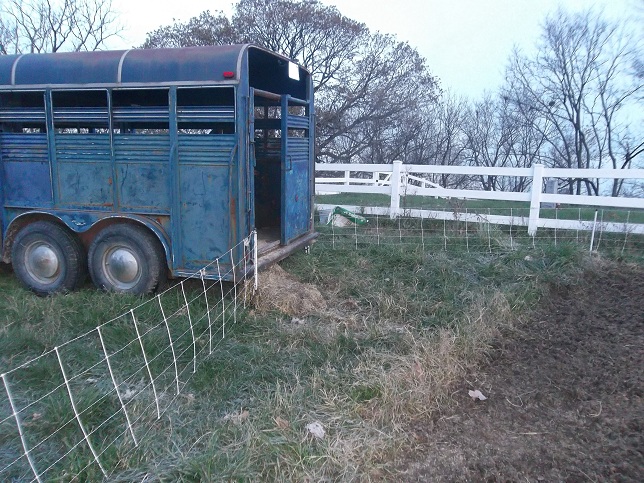
The pigs load themselves. Rather than attempt to load the pigs the morning I drive to town, I back the trailer out there the night before. I butt the electric fence up against the sides of the trailer and put their feed inside. Curiosity and appetite lead them into the trailer and I close the door. No muss, no fuss. Up they go. I have loaded them this way twice now. Old timers think it’s a fluke…just like the electric fence I keep them in with.
Monday night the fourth and final pig showed resistance to loading into the trailer. Rather than pressure the animal to fit my schedule, I backed off. 3 of them were loaded into the front partition. The fourth was reluctant. I put some apples by the door and went to eat supper. After supper he still hadn’t loaded. I decided bring the cows up, feed the goats and close the chickens. When I got back his curiosity had won out over his caution and I closed the door while he munched away at the apples.
This represents a major epiphany and is entirely my father’s idea. Thanks Dad.
Where have you found frustration with livestock? How have you overcome it?
So. You want to be a farmer. I know you can buy the land but can you work the land?
Let’s paint a picture. Little house…just big enough for the fam but no room for clutter. A cellar for your jars of canned goods. A wood burning cook stove. A milk cow, a couple of pigs, some chickens, a big garden and a couple of fruit trees. Ah, the good life. If you have children, add homeschooling to the mix because you love spending time with your family and you know you can give more personalized attention to the children than they would get anywhere else. Yup. One of you stays at home with the kids and keeps the farm chores under control, the other drives off to the city to actually pay for the farm and get insurance. Those rose colored glasses are already clearing up aren’t they?
Did you know gardens grow weeds? That orchards grow deer? Did you know that livestock die? Worse, did you know they sometimes get sick and don’t die? Can you actually send that steer off to be killed, shoot the pig or kill the chicken? Do you want to sit out all night hoping that ^&*(#! raccoon/mink/possum/skunk/etc. comes back so you can shoot it? Sleeping (well, tossing) in the open air night after night with a gun in one hand and a flashlight in the other. Do your children see roadkill and ask if we should stop to pick it up for the compost pile? Have you ever had a hog bite the sleeve of your Carhartt and pull if off of you (and drag it through the mud) while another hog bites a hole in your new rubber boot and the rest of them put their dirty noses against your work pants and nibble at the seams? Then you’ve got manure on your sock, in your boot, on your pants, all over your jacket. You become immune to the smell that lingers and only the other customers at the shopping center notice it. How many layers do you want to keep on your acreage? DO YOU KNOW HOW MANY EGGS THAT IS?!?!?!? How many eggs do you think you can actually eat and sell? Seriously! What are you going to do with them all? Throw them at the pigs? (…that’s not a bad idea…)
How about compost? Each day you muck out the stall (horse, cow…whatever) into a wheelbarrow. Then you add it to a pile (probably requiring you to fork or shovel it high onto the pile). Then you fork or shovel the pile a couple of times to keep the compost active and hot. Then you fork or shovel it into a wheelbarrow again and head off to the garden for more forkin’ shoveling! All so you can sneak a few minutes here and there of pulling bushels of weeds and handfuls of produce from your garden that never quite manages to look the way it did when you first envisioned it.
And oh! A wood cook stove! How romantic! You see the nice glow in the stove, you see the lovely wife pulling a roast out of the oven with a pie in the warmer. You don’t see the husband off camera with a hole in his boot wearing a smelly jacket (stupid pigs) holding a chainsaw for his entire week of vacation, felling, cutting, splitting and stacking the wood so he can save a few dollars over just buying propane. Oh, you can get the job. No problem. But can you do the job?
Fresh milk! It’s fresh! It’s raw! It’s fun! (for the first two or three milkings). Then it becomes a chore. Another chore. I mean, you got up early this morning, fired up the wood stove, went mud-wrestling with the pigs, let the chickens out (checking for dead birds), moved the chicken tractors, watered the ducks, pulled a couple of weeds in the garden while getting a beet to feed the cow, somehow managed to catch the cow, squeezed the milk out of her for 30 minutes (oh, my aching everything), strained and chilled the milk and somehow 7:00 turned into 9:30 and those small humans you keep in the house haven’t eaten yet. Oh, and there’s laundry to wash, laundry to put away, summer clothes to pack, fall clothes to unpack, lunch to make, phone calls to answer (your husband asking if you are having a nice day), eggs to wash, sort and sell, somehow you have to make time to teach those small humans to read, write and cypher, the goats managed to escape somehow so you have to chase them down. Then that husbandof yours who drives to the city to sit on his rear all daywill be home soon and he had the gall to ask what you did today since there is still a basket of laundry that needs to be folded and you didn’t gather the eggs…you know, because HIS TIME IS TOO VALUABLE TO WASTE GATHERING EGGS OR PUTTING AWAY LAUNDRY! HE CAN GO FEED THE STUPID PIGS TONIGHT! Oh, and you totally forgot to work on the applesauce, to pick and freeze peppers out of the garden, and another day passed without watching that webinar for that new side business you’re thinking of taking up in your free time and if you don’t start making cheese soon you’ll have to buy yet another fridge!
You can get a farm. No problem. But can you do the work? Whew!
I’m not saying you can’t do the job. I’m asking if you can do the job. I know you can get the job. I’m not arguing that with you. Banks will loan the money. Interest rates are attractive. But what are you going to do when you get there? Will you miss your manicure? You won’t miss the weight you are guaranteed to lose. You might miss putting your feet up from time to time.
So that takes us to why. Why do we do it? Why do we quite literally work our rear-ends off day after day? That’s a question for another post. I’ll give you a hint: Before the farm I felt like Joe from the clip above walking around the office in his pointless life.
Averages are just average. No real magic here. Averages are descriptive, not predictive, and macro, not micro. Take enough years worth of weather information and you’ll see a picture of “normal” with the understanding that in any given year there is no normal. Graph the data, zoom out and it all looks normal. The bumps along the way smooth out. The trend appears. The lie appears. Those bumps along the way when you’re in your pasture trying to keep livestock alive when it’s 114 and hasn’t rained in weeks? Those are part of the normal. But the average rounds them down.
Averages lie. I enjoyed reading Walt Davis’ book How to Not Go Broke Ranching. In that he jokes that his part of the world gets an average of 30″ of rainfall but in reality he gets 90″ one year and nothing for another two.
On average we get 3 inches of rain in August. We got closer to 9 last month (4.5 in 2 hours on Aug. 2nd) with more coming today. The ponds are full, the creeks are swollen, my gutters runneth over. Where was this rain in July?
But it will add to the new average. On average we get 32″ of rain each year. Sometimes we get more than we can swallow, sometimes we’re in drought. Heck, last year we went 5 months without rain. That’s normal. But the average dictates we SHOULD get about 3″ each month.
I need to find ways to store more water…to sponge it up, to hold it back and to deliver it where it is needed the most. That way I can survive the normal drought and hold back the normal flood.
There are all kinds of ways to do this. Keep up with us as we explore our options over the next few decades.
If you don’t find this an interesting problem to solve I would invite you not to become a farmer. Maybe you should get a nice place on the edge of town. Maybe get a big lawn mower and a couple of fruit trees and deck/patio surrounding a pool and invite your farmer to come for a swim on a hot day.
I’m in a hurry to get started this morning before the rain returns. I need to move chickens, pigs and goats then lay out a few more paddocks for the cows so I’ll try to update this with some interesting pictures later when it starts raining. No promises though.
It’s hard to get it all done. Some of the things we do really turn out well. Some of the things we do could turn out better. Some of the things we do go as badly as possible…worse than we could imagine.
My wife, parents and even extended family are generally supportive of our efforts here. Even within that group I am no golden boy. Outside of that group it is easy to find criticism. I’m going against the grain. I am defying convention and tending toward worse offenses. But it’s easy to get past other people’s opinions of me. Sometimes there are real problems. Sometimes you make a mistake. That mistakes snowballs into bigger problems. Standing there, with my back against the wall, I ask myself, “Why can’t I do anything right?”
This blog has become more of a “how-we” than a “how-to”. If you want to defy convention, I want to encourage you. If you want to try your hand at raising a few chickens or pigs, I’ll tell you what I have found works…and what I have found doesn’t work. I like to make specific mention of what doesn’t work so you don’t make the same mistakes. I’m not just spouting off about my experiences/abilities on the blog, I’m sharing my adventure with you…even the bad parts. Now, before we get too far along here, let me reassure you that I’m fine. I’m OK. I’m not frustrated or angry or thinking about quitting. My goal here is not to depress my readership. My hope is that by opening up here I’ll encourage you to keep going. This stuff is hard. You can do it. I’ll get through it. So will you.
OK? Let’s go.
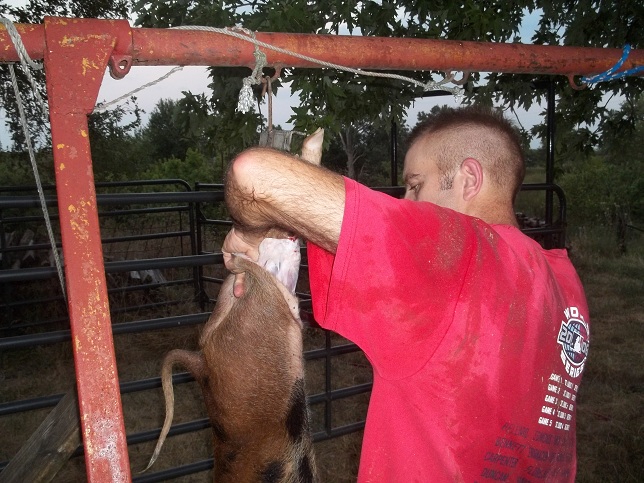
I do everything wrong. Not just wrong but as badly as possible. Experience is a harsh teacher and I am a slow learner. Let me give you a few examples. Here is a picture of me, dressing a pig. You can see from my sweat that it was hot outside. You can see from the dirt on my back that I carried the pig up the hill on my shoulder rather than kill it in a more convenient spot. If you could smell you would know she peed on my right shoulder as I carried her. I had to remember not to wipe my brow with that shoulder. Why did I carry a hog across the pasture on my back and dress it out on a 95 degree evening in July?
Because we screwed up. Hot weather is a problem for pigs. Hot weather without water is a serious problem. When I realized what had happened 7 of our 8 pigs ran to the drinker to get their fill. The eighth pig just looked at me. Poor Zing. I carried water to her, attempted to cool her with buckets of water over her body and held the bucket down so she could drink out of it. A few minutes later we lost her.
There is an agreement between me and my livestock (and my tomato plants too). I provide everything they need. They provide everything I need. I dropped the ball, I lost a pig.
Now, there’s only so much I can do to manage the heat. I can’t save every chicken, no matter how hard I try. There are things I can do to lessen the stress on my animals. Some of it is falling into a routine. Some of it is overcoming personal inertia. More than anything it’s time management. But the truth is I don’t have this all figured out. Some things I do work really, really well. Other things could go better. As I get better I’m more able to manage my time. As I can manage my time better I’ll get more of the things done that I need to do.
Please don’t read this blog thinking I have all the answers. I have some answers. I have found some things that work reasonably well. I don’t think I’ll ever exit the discovery phase. I don’t think I’ll ever be “good” at this farming stuff. Not only do I have a lot to learn, sometimes bad things happen. Sometimes the cows get out. Sometimes a raccoon eats a chicken. Sometimes people make mistakes. All of our safeguards failed poor Zing. It was a busy, hot day and nobody checked the water.
If there’s a positive outcome here, the next day we wrapped and froze the meat and discovered one of our freezers was beginning to thaw. If not for the pig we would have lost around $1100 worth of chicken.





 Chism Heritage Farm