Preparing Fertile Ground

This is the second in a quick series about farm sustainability…sustainability gained by preparing the next generation.

I can’t do this forever. I could work for decades but not forever. Also, I can’t do this alone. I could try but without some level of redundancy something is going to fail eventually. So the first step (following the example of all previous generations who made me) was to find a suitable companion and carry on the family tradition. Not only can my wife fill in when I am unavailable but we have kidlets that are coming along as well. Those kidlets are the future of the farm. They are the key to our farm’s sustainability plan. I won’t last forever and I can’t do this alone so we are manufacturing our replacements. And they have to be willing participants in the manufacturing process. If they don’t want the job we have to find someone who does or the farm goes away.

With that in mind I want to talk briefly about what we feel is the first step in training our children: Preparing fertile ground.

This is easy in the garden. Build up soil humus and add nutrients…same as saying to invest time bringing your soil to life. How is this different from the human mind? We have to bring our minds to life. Maybe this doesn’t seem as straightforward as a wheelbarrow of composted horse manure. Maybe that’s because we haven’t bothered to learn what children need. Wow. That’s a disturbing thought…that we have more innate, cultural knowledge of soil health than we have of mental health. [Shiver] Have to think on that a bit.

Kids

Our four children may look the same but that’s where the similarities end. Each have their own interests, abilities, dreams and desires. Pushing each child to follow a set pattern of educational development in a one-size-fits-all approach would probably lead to universal failure. I suppose we could medicate and attempt to retrain where the kids don’t fit but that seems inappropriate and cruel. What seems better, at least for us, is to allow the children to direct the learning process. To discover where each child is in the lifelong process of learning and to encourage them to continue. This discovery process requires more of us as parents but…I mean…we didn’t have kids thinking it would be a vacation. Our children are an investment.

I have to make a conscious effort to engage my children in conversation and to pay attention to them as we interact on a daily basis. What does my oldest daughter enjoy? What motivates her? What is her love language? How can I meet her needs personally and, later, in terms of education? Before I can help my daughter to learn she has to trust and respect me and I have to learn who she is. She really doesn’t want to learn the ins and outs of my profession. That’s not her bag. Before she will trust and respect me I have to make an interpersonal connection with her. It’s not enough that I simply claim her as my daughter. It is not enough that I feed and clothe her. I have to be someone she trusts. Someone she loves. Someone she respects.

If I can earn her love, trust and respect I can begin finding out who is really in there. Once I know who she is we can begin to guide her development. If I don’t know her, I can only force her onto a path of my own design…one she may not be excited to follow.

I am quite vocal about my generation’s tendency to take our children to karate, soccer, swimming, scouts, awana, dance, baseball and gymnastics. Nobody has time to even cook, let alone interact, with a schedule like that. Your children will interact with others while you watch…but that’s not what we’re after! Add in homework and football games and PTO and Bible studies…any of these things, taken individually, could help you build intimacy with one or more of your children. But these activities are more commonly used as a daily distraction to “keep the kids busy and out of trouble”. You know, because having kids is such a burden. Isn’t that what you are telling them? “Oh, what a long day at work. Now get your cleats we have to get to the field! I guess we’ll just have to stop for pizza again. I don’t know how we can afford to continue doing this but we’re doing it for you. Get out on that field with your little friends and I’ll go talk to the parents over here. Maybe you and I can talk on Sunday…after church…after the football game…after evening services…before bedtime.” That schedule does not lead to intimacy…it does not build fertile ground. It probably boosts sales of anti-depressants though.

Finding the fertile ground in our children is a matter of taking the time to learn who they are. Investing that time now gives us the chance to plant seeds of opportunity later. This has nothing to do with deciding what cool new curriculum we are using this year. Fertile ground is about relationships. Why would you want to live with someone who doesn’t want to know you? Maybe that’s why kids grow up and leave home.

To be sustainable I need my kids to grow up and stick around. I need fertile ground to plant seeds into. I have to make an emotional investment in my children. Some of that has to do with sticking around on the farm but mostly, it’s about making deliberate choices to be engaged in my children’s lives. I could probably succeed at engaging my children at a soccer game but I fear soccer is mostly a distraction separating us from them. Be engaged.

Next time we’ll talk about planting seeds…you know, discovering interests, passion and purpose in the lives of our children…and in ourselves.

Farming, Home School…What’s the Difference?

We scatter seeds. It is all about planting now and reaping later in our pastures and in our personal lives.

TractorDriver

Here’s the main idea of our home schooling: We get the kids interested in something. When they show interest we run together. Curriculum doesn’t matter. Nobody gets up in the morning and throws a fit about doing a math lesson. We do what we are excited about…and usually math comes along for the ride. I mean, you can’t price the chickens without doing a little math…so it just happens. We certainly have a nice collection of math curricula (like Life of Fred) but the curriculum isn’t as important as the appreciation. You with me?

You may not care about our home schooling philosophy but, believe it or not, this is a post about farm sustainability.

I can’t force my kids to learn to do math. We learned that the hard way. We just work it in to our daily interactions. We count the dots on legos (Hand me a 10×2 flat blue) or estimate the acorns on a branch, estimate the branches on a tree and multiply it out. If I print out a math page and park them at the table inside on a sunny day we’ll have a problem. Similarly, we also can’t force a pig to load up in a trailer when it is out in a pasture. If I try to force the pig to do something…anything…the pig will put its head down and dig in its heels. Pigs are always asking, “What’s in it for me?”

My kids ask the same question. We all do. “What’s in it for me?”

I have to make sure everybody wins. If everybody wins, everybody has fun. If everybody has fun, life is easy. Salatin doesn’t force pigs to aerate his compost. He incentivises them to aerate his compost by burying corn ahead of time.  Pigs get fat, bedding gets composted, everybody wins. This is certainly applicable in farming but only to a point. Let’s stop talking about pigs and focus on the kids. Farming is more sustainable because of pigs. Farming is ONLY sustainable because of future generations. But I can’t force them to farm. I can only scatter seeds hoping they fall on fertile ground. Further, I have to let the seeds grow. I am 24 years older than my oldest child. If I wait until I’m 84 to give him control of the farm he’ll be 60. Will he want to control the farm then or just retire? His oldest could be 36 (YIKES!). Will they want the farm? Their oldest kid could be 12 (DOUBLE YIKES!). I have to make room for the seed to grow. Who are we planting seeds in…and for what purpose? And I can’t just plant the seed, I have to nurture it and reap the harvest. I am sowing seeds of success…purpose…vision into my children. I don’t anticipate being in charge of anything around here in 10-15 years. My goal is to become superfluous. I’ll be the janitor. It will be awesome! But for that to happen I have to plant the seeds now. As our children grow they will begin to search for purpose. Our children’s purposes can all be here. All I have to do is prepare, plant, nurture and get out of the way.

I plan to expand on this thinking a little bit in future posts. I hope you’ll stick around and share any thoughts you have with us.

Farming and the Application of Force

I read a large variety of books and blogs mostly in the alt. agriculture umbrella but also a few that fit in an alt. economics category…if you’ll allow that term. I enjoy the way Bill Bonner writes…tying humor, criticism, common sense and wealth advice all together in a fun little package. He also overuses ellipses…and I like that. I wrote about a book of his I read a year ago if you are interested.

On a recent blog post Bill wrote,

Force doesn’t work in human affairs, because it doesn’t bring people what they really want. Force doesn’t give you a ‘win-win’ trade.

Instead, force sets up a ‘win-lose’ transaction. A man robs a liquor store. He has booze. But the liquor-store window is broken, and the store’s insurance rates go up. The world is poorer as a result.

Force rarely works in domestic affairs, either. A woman coerced is rarely a happy woman. And an unhappy woman rarely makes a man happy for long.

Nor does force work in an economy. When the Fed forces interest rates down, it is driving buyers and sellers to do something that they otherwise would not do. It is exercising brute force on markets.

Does it work? Ask any jackass who has ever tried price controls or centralised economic planning. The answer is no.

I could go on a tear about using voluntary transaction between individuals to build farm sustainability but, instead, to put this in line with other recent posts I have put here, I’ll tie on to the part where he is talking about relationships between a man and a woman. I am stronger than my wife. Significantly. (If you think this is an obvious statement you haven’t met enough farm wives. There are some strong women out here!) I can easily pin my wife to the floor while the kids tickle her. But I have to be careful to make sure she is having fun…that she’s part of the game, not a victim of the game. Everybody has to have fun.

Everybody has to have fun.

Did I move to my grandmother’s house, dragging 5 others along by strength of will or did the 6 of us agree and follow a prepared course of action? Years later, is everybody still having fun? Do we all agree that we are better off now than we were before…than we believe we would have been had we made other choices?

If I can answer these questions positively I have the foundation I need to answer the other questions. Why do we have cows? It’s the best way we can fix carbon and cycle nutrients in the pasture while respecting my family’s time. Why do I want to sell farm products? To make customers happy, to heal our pasture and preserve ecological resources, to heal our community to provide my family with the highest-quality food available and, importantly, to make our farm economically sustainable. How important is that? I’ll quote from another blog I’ve been reading through lately:

Want to know what I consider to be a sustainable farm?  Very simple:  One that stays in business.   It’s fine and good to be for the environment, and all farmers I know  care very much about their land, but you can’t save the world unless you’re a going concern.   If you, dear reader, are interested in farming to improve the environment, please do consider this point carefully.  …the bottom line is…  well, the bottom line.  Make a profit.  Keep going.

Well, OK.  I’ll go on a tear about using voluntary transactions between individuals to build farm sustainability.  I don’t want customers who buy out of pity. That’s not win-win. I want customers who are enthusiastic about our products. Customers who are sensitive to animal conditions and nutrient density, not customers who are looking for cheap food. I’m happy to provide food of the highest quality to customers who will pay a fair price. Cheap out on me and I lose. If I cheap out on you, you lose. We both hold up our end of the bargain and we both come out ahead. That blog post above points out that a business went broke, not because their quality was poor and not because of lack of customer demand but because they couldn’t meet their obligations.

But let’s pretend there are no expenses (including taxes) and there are no customers to satisfy…that no money is needed. How do I build enthusiasm in my children without forcing them to do the work?

Did you know we home school our children? My wife has a blog about it. She doesn’t write anything on the blog but it is hers. Anyway, I have memories of my lovely bride calling to say that our then 6 year-old daughter was crying and hiding her face in a pillow because she didn’t want to do reading lessons! “I just don’t think she is cut out for home schooling!” she said.

So we hit the books. What do other parents do when their students/children hit a wall? Some push through it…with apparent success.  Others just take a break and let the kid figure it out when they are ready…again, with apparent success. We found a home school philosophy that said we should inspire, not require our children to read. Inspire them. Rather than force our daughter to read we just focused more of our own time on reading. She noticed and it was almost as if she said, “Gosh, I don’t know what they find in those darned book things but there must be something in there.” So she started reading…and kept at it.

We didn’t have to force her to read. Will this work for all children? I don’t know all children. It has worked out pretty well in our family.

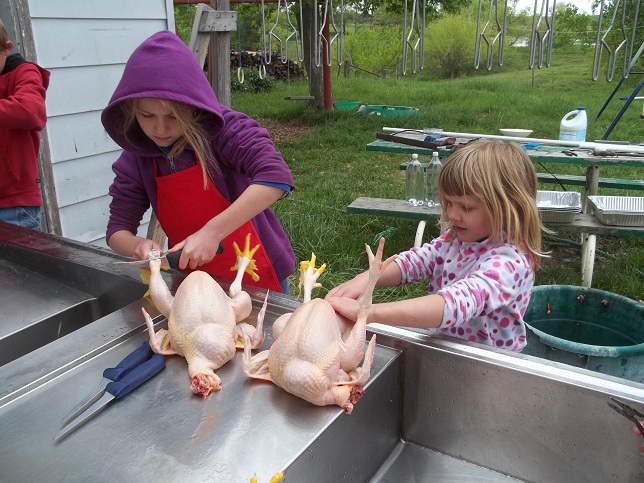
When we moved here we (the adults) led the way on butchering chickens. Three of our children were curious about it, one (the same one) wanted to stay in the house and do housework. OK. That lasted a couple of years. But now, we all help on butchering day. Everybody has a job. Nobody HAS to do it. We work together. That’s that.

And, I think, that’s how it should be. Some days you don’t want to have your shoes covered in chicken guts. I totally get it. But most days, you want to fulfill your role within your team.

If that role is washing dishes and baking pie with grandma, cool. But if you want to join us outside there’s a place for you. Here she is in purple, proud that she can cut off the feet.

GirlsIgnore the full crops on those birds.  We had some bad weather and just had to work when we could.

To My Children

Kids, The Survival Podcast has quoted something twice recently, both times it resonated with me.  Both times it is referenced as an old indian proverb but I’m not concerned with the source of the quote.  I’m concerned with the substance.

We do not inherit the earth from our ancestors; we borrow it from our children.

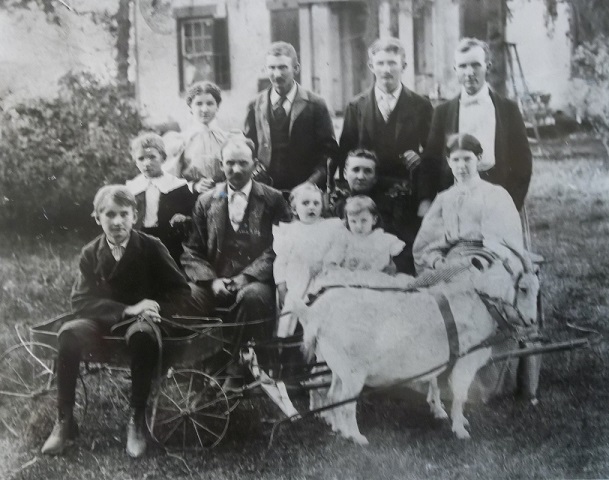
As you know, I am the 7th or 8th generation on the farm. (I lose track because there were several men named William Chism and my eyes glaze over when my sister tries to explain the family history to me. If you want, you can read some family history here.) Unlike my grandfather, however, I didn’t inherit the farm. I bought it. But what I paid for wasn’t just land…I could pay less and get more elsewhere. Beyond living near my parents (which I think is important), I paid for the privilege of giving you, my children, the same memories I have. I played under grandpa tree. I have always wondered how long the chain has been growing into the limb of the big walnut and who put it there. I swam in the creek, played in the mud and looked at the animal tracks. When cleaning the yellow house we found drawings under the wall covering…drawings my sister made when we were small. You get the same memories and experiences but on a 25-30 year delay. We even make the same cookies Grandma used to make in her own kitchen. I know, roughly, who built what fence. What role my father, my cousin, Barney Gillespie (ask me about Barney sometime) and others played in laying out the current infrastructure of the farm. What sheds were built and by who (whom?)…and when. I know the last time there were pigs on the hog floor and who they belonged to (cause I was paid to keep the floor clean). Your great, great, great uncle Dick built our house. Your great-grandparents lived here and your grandmother was raised here…your grandma and grandpa had their wedding reception in the family room when it was nearly new. Great-Grandpa Tom’s cousin Chick Chism built the kitchen, bathroom and family room onto the house in the ’60s. Your grandpa built another addition in the last 10 years. The bottom is full of walnut trees. Those trees have regrown since your great-grandparents were married at Christmas in ’46 when great-grandpa Tom had them logged and sawn as a wedding present. There is walnut lumber in projects all over the farm, including furniture my grandma built. You with me here?  We have roots in this place! This is home.

Our family has been here for a while.  I see and honor the contributions our ancestors made and, though I have to deal with the consequences of their actions, I am not enslaved by their work nor by the memories of their contribution.  William Chism did not work for his father.  The first Chism off the boat didn’t leave Scotland for his father.  They did it for their children. As the current steward of this farm, my obligation is not to my grandfather.  He had his own ideas of how things should be done…his own dreams. When the time came, grandpa embraced change.  I’m going to suggest that the shape of the farm changed more under my grandpa’s stewardship than ever before that, largely because he had modern machinery.  He didn’t embrace or avoid change for the sake of his father or grandfather.  He sold the horses and did what he did seeking immediate and long-term impact on the land, in his wallet and for the sake of his children…as in my mom.  As in me.  As in you.  He was working for us.

A good man leaves an inheritance for their children’s children… Proverbs 13:22

So now it’s my turn. It’s my job. I don’t want to simply restore the farm to its former glory. The fences need to be replaced, the buildings need to be repaired, there are 3 rotten posts in the big barn, the timber needs to be managed, the pastures are weedy, thorny and brushy and the ponds have gotten shallow. I’ll do the work but the goal is not to restore the farm to 1965 condition (though that would be an improvement).  I feel that my real calling is to put the farm into 2050 condition. What is the farm of the future? Kit Pharo advertises solar bulls. I agree with that thinking. We need a solar-powered herd. We also need rich, living, drought-tolerant and erosion-proof soils growing a wide variety of native forages. I need perennial tree crops. I need to store large amounts of water in case there aren’t any rainy days. I need to assemble a war chest to get us through lean times. I need to do a lot of work…some of it building on my grandfather’s vision, some of it leaning on my father’s advice, some of it remembering what Barney would say, most of it going my own direction. It’s not that the choices grandpa made were wrong, it’s that many of those choices are not valid in the current economy. If I hand the next generation a farm worthy of 1965 I will have failed in my calling as steward. I have to anticipate what the farm of the future will look like and build it now. Not only do I have to do the work, I have to pay for it all.

Kids, I love you. Each of you. I hope I can shape you as you each decide how best to steward the resources God blesses you with…how best to fulfill your own calling. Everything I have will be yours someday. Not only do I have to train you to be ready to accept it, I have to prepare it to accept you. The farm is just one of many things I am using that I hope will be yours someday. Please note the uncertainty in that sentence. I hold my blessings with an open hand and I am teaching you to do the same. The farm is ours to steward until it isn’t anymore. It is first for God then for you, not for my parents, not for my grandparents, not for great, great Uncle Dick that your mother and I are working. When you assume stewardship, continue moving forward with your own vision. Don’t be limited by my goals. You are not slave labor on the farm. Your mother and I are. We work for you. I love you.

Better Because it Costs More?

What is a car supposed to do?  Why do we need them?  From a utilitarian perspective, we simply need them to help us get from A to B.  Do leather seats help us get from A to B?  No, but somehow a car with leather seats is normally considered better than one without. In fact, the less utilitarian a car is the better it is, up to a certain point.  I mean, I would probably enjoy driving a Lamborghini but not when grocery shopping. So there are two things there, Price has little to do with function and every paradigm has its limits. This applies to cows, land and money equally.

The price of money is particularly interesting (pun intended).  Money today is worth more than money tomorrow.  That’s why we pay more for it.  In part, this is also true because our central bank is targeting inflation, destroying the value of currency over time but even with a stable currency, money today costs more than money tomorrow. We want it NOW! I have to INTEREST you in deferring consumption today so I can use your money now…so I offer to pay you back more than you loan me. Similarly, if I borrow your cow I can’t repay you in 5 years with the same or equal cow.  You have lost 5 years of calves from that cow and, potentially, additional calves from heifers those calves would have birthed. I would have to INTEREST you in loaning me a cow…or herd…or even just a bull for stud service. I recently borrowed a bull and I am expected to repay the same bull plus $20 for each cow covered. How is that different than interest on money? Everybody involved is participating voluntarily so everybody believes they are better off in some way at the end of the day. Well, that’s how it should work but we have this central bank thing that dictates what borrowed money should cost today which really gums up the works for everybody unless you’re borrowing in terms of cattle and they butt out). That’s a topic for somebody else’s blog though.

Bull2

Back to the point. Money today is more expensive than money tomorrow…but is it better? And, if it is better are there any limits to the “better-ness”?

Hoo boy. Well, I guess it can be…or can be perceived as such. I mean, I borrowed money to buy the farm because I thought I was better off with the farm today than I would be if I waited till I was 60 and had the cash. Plus, the farm I want is available today.  Would it be available in another 25 years? Further, farming is a young man’s game…especially the getting started part. If I don’t get started I’ll never get going. So we borrowed…but not without reservations. Reservations you’re probably tired of reading about.

Borrowing can be a really bad idea too. We don’t borrow for consumption.  We don’t use credit to buy hamburgers, t-shirts or even cars (which means we take care of our cars…they last a long, long time). We even buy our livestock with cash…forcing us to grow slowly and deliberately. I could see a time when I would want to grow the herd quickly, forcing me to borrow tomorrow’s calves today but I would hate to explain to my banker that the cow I bought with his money died. I would also hate to make payments on a dead cow. 

Further, because future money is available for buyers today, prices today tend to go up. If everyone had to pay cash for cars and houses we would have fewer dollars chasing after scarce goods…prices would have to fall (which is great if you are poor or have savings but horrible if you owe money on depreciating assets). But we live in the opposite world. In the current economy we can borrow money for houses, educations (lol), cars, farms, cows, hog buildings, tractors…you name it. Every loan puts more and more money in competition for the same number of goods…driving prices higher (which is horrible if you have savings or are poor but helps out borrowers). If our economy lacked available credit, the perceived currency value of my farm would have to fall (see 2008)…and my lender would get nervous. But that’s part of the deal. My banker is betting that my farm will retain value and that I will be able to repay…otherwise he wouldn’t voluntarily loan me money.

So because of easy credit, prices are higher. Does that higher price make my farm better than it was when my great, great, great….grandpa paid tens of dollars for it? No. The work that went into the farm over the generations makes it better. The lack of work that went into maintenance in the last 20 years makes it worse. Price has nothing to do with “better”. The “better” of the thing has to do with the work we accomplish with it. Farmers vary in skill level. A skilled farmer is going to do a better job with the land. I have to be more skilled than the farmers who came before me or I will have wasted the land, money and time.

Family

Maybe you disagree. Maybe you are happier when you pay more for the same thing. I dunno. I tend to look for sales or buy things second hand…or third hand.  But the cost of the thing has nothing to do with the “better” of the thing. If I need it, I need it. If I need it immediately I’m going to have to pay more for it. As we farm we try to limit our immediate needs. We try to plan years in advance. Years. Decades. Lifetimes. What will my great-grandchildren do with their inheritance? Can I influence that now? How much do I have to pay now to make things better for my grandchildren? Do I pay the future by not having a second vehicle? Do I pay the future by enslaving myself to the farm and to an off-farm job? Do I pay the future by avoiding eating meals out or by not going to see a movie? If the goal is to build better futures for my children’s children I have to pay a lot now. Does the future get better as I pay more for it? It might if I’m thoughtful about how I use my resources in the present. When does that paradigm run out? I doubt I’ll ever know.

So what if you don’t have kids? Does this matter to you? It most certainly does! The money part of the farm has nothing to do with the better part of the farm. You, as a steward (the dirt will outlast you), should be working and investing in future generations, even if they aren’t your kids. There are consequences to your actions. You don’t live in a bubble. Make choices that positively impact the community around you. Yes, it will cost you something; time, energy, cash. But that’s just part of the deal. You can’t simply consume your way through life. That is, I feel, immoral. Make a positive impact. Go out and “better” something. Do it cheaply if possible.

…and Then There Were 60

Why so many posts about the budget recently?  Because yesterday was the day.  We bought another 40 acres to complete the property purchase.  I literally bought the farm.  I have to tell you, it’s weighing on me.  It isn’t enough to simply pay the note on the loan, we have to build several businesses AND keep a job in town AND raise children AND remain somewhat socially involved all at the same time.  The first goal is to get to 30 cows.  30 cows and we’ll raise their calves, always keeping the best heifers.  60 acres.  That way we can de-stock the farm if the weather turns sour without impacting our core breeding herd.  Then, someday, we’ll rent more ground and increase the core breeding herd.  First things first.

30 cows.  I have 10 now.  I need 20 more.  This year we should have 4 heifer calves.  16 more $900 heifers.  $14,400.  Where is that going to come from?

And we need more eggs.  Many, many more eggs.  Customers are demanding more eggs.  More chickens.  More fencing.  More money.

And we need to raise more pigs.  Maybe start farrowing.  That will require additional infrastructure.

And the current farm infrastructure needs a LOT of repair.

I’m going to stop talking now.  How about a tour of the new land instead?  Let’s just see what’s out there with a little commentary.

Something Worth Doing

One question is on a constant loop in my mind.  It doesn’t matter where I live, what I am doing or how I am feeling.  One question assaults me moment by moment, day after day…year after year like the drums heard by The Master in Dr. Who.

“Why are you doing this?”

The question doesn’t even refer to a specific activity.  It just hangs there…pestering me for an answer.  Why do I go to work?  Why do I like steak?  Why are hot dogs better than bologna?  Why?

I have beaten the budget to death with blog posts attempting (with varying degrees of success) to justify my farming habit.  Behind the scenes I have been scouring books, talking to friends (really pestering Matron!), and thinking.

SignsOfLife

From Gene Logsdon’s Living At Nature’s Pace

My father walked an empty, desolate barnyard, listening for the long-ago songs of life.  He heard only a loose sheet of tin roofing, curled over, scratching itself distractedly in the wind.  He cried.  He cried because he no longer had the energy to keep the barn full of life himself.  He cried because none of his children were willing to fill it full of life again.  He cried because he could not die here on the farm amidst life, as his forebears had been able to do, but might soon, too soon, have to shuffle off to the country home like his urban counterparts.

That’s certainly part of the answer.  I want to be surrounded by life!

What’s This Stuff For?

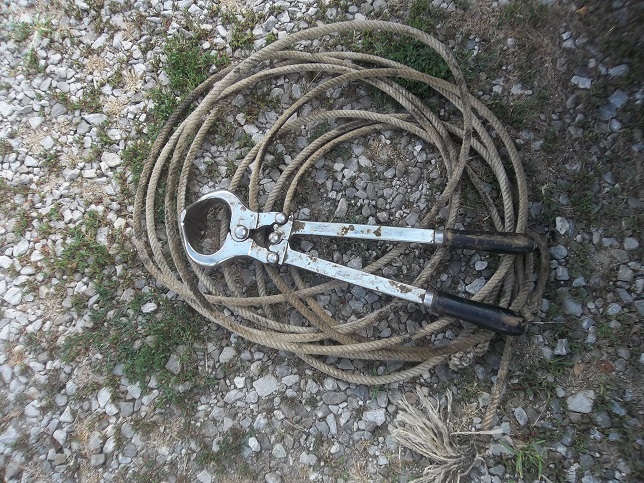
“What’s this stuff for?” my kids asked me.

RopeAndClamp“Well, Freezer was not a vigorous young calf.  We don’t want to allow him to become a bull.  So, today we’re going to make him a steer.”

I held the rope.  Julie held the tail up.  Steve used the clamp.  The kids got their answer.

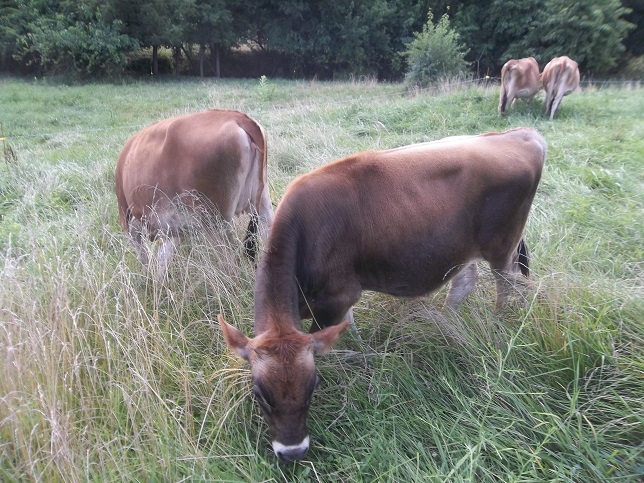
Freezer went back to the pasture to be near mom.  Really not a big deal.

FreezerFreezer should turn a lighter color again soon.


Raising My Replacement

Hard to say why but it’s hard to find kids who want to stand on a dusty hay wagon on a 95 degree day and handle a few hundred bales twice.  But it’s time to cut hay.  And I’m massively allergic.  I’ll spend days coughing, sneezing and wheezing after riding the wagon behind the baler.  But this year it’s not so bad.  My son, at age 12, rode the wagon.  I stood back and watched him succeed.

BuckBaler

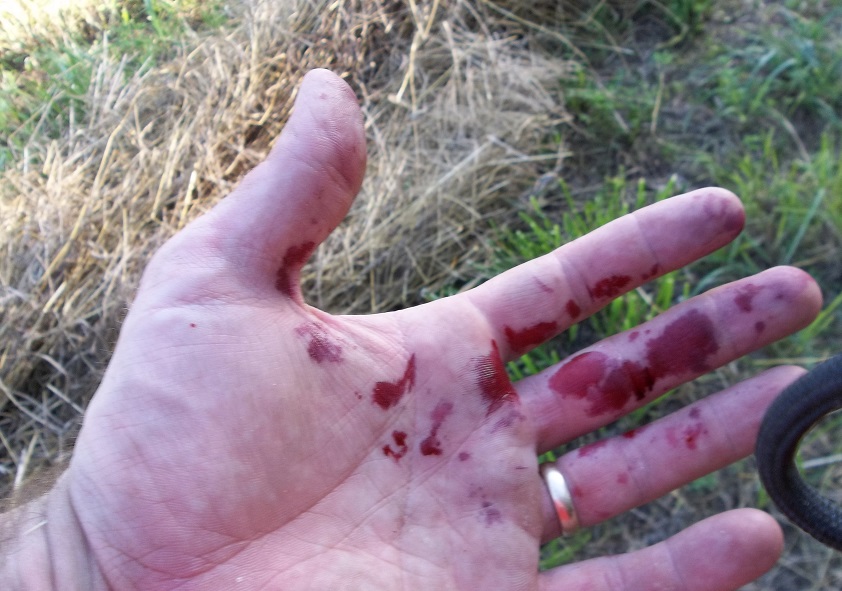
Since he can do that, I can spend more time eating berries.  I was caught red-handed.  Mulberries were juicy!

MulberryJuiceIt gave me time to reflect on what we are doing, why we are doing it and how to get that last sweet dewberry out from under the poison ivy leaf.

PoisonIvyAndBerriesGood luck with that.  Maybe I should stick to mulberries.  Either way, the days of putting up our own hay may be numbered.

Adventures in Childhood

Let me put together several recent conversations I had with my kids into a single narrative.

“Dad, what did you study in college?”

“Well, I majored in Biology…though I have a liberal arts degree.  That means I took more classes than I could have, with a wider focus than you might suspect but still spent 40 hours/week dissecting dead cats and sharks for Comparative Vertebrate Anatomy.  I also had a job on campus caring for animals in the Biology department.  I raised rats and mice, cared for the snakes and lizards and cleaned the salt-water aquariums.  But mostly I tried to convince your mother that I was the right guy for her while working several jobs at once so we could finish college with minimal debt.”

“Snakes?”

“Well, yes.  But also salamanders and frogs and turtles.  In fact, when we look through Tom R. Johnson’s book, “The Amphibians and Reptiles of Missouri” I have observed or collected nearly everything pictured short of the toads that are only common in Western Missouri.”

“Yeah, but…Snakes?”

BlackSnake

“Yup.  Snakes.  Lots of them.  Most of the snakes that live here are safe to handle and, if you are careful how you act around them, actually seem to like it.  To them, you’re just a warm tree.  Tom Johnson’s book indicates that there are probably 3 Prairie Kingsnakes for every acre.  Now, to be sure, ask me before you go picking up snakes.  There are a few around here that can really hurt you and one you may be allergic to.  Here, hold this Prairie Kingsnake. ”

“Where did you find it?”

“The neighbors are cultivating their field to plant beans.  That ruined his habitat so he was crossing the road looking for a new home.  Since we have acres and acres of grass he’ll probably find a home here.”

PrairieKingsnakeAnd that’s how it goes.  We talk about stuff.  We go out and do stuff.  We take pictures of stuff.

Butterfly

Beyond the wildlife, there’s cool dead stuff out here too!  My cousin’s bull died in the creek two or three summers ago and with the recent rains the bones resurfaced.  It’s an exciting time of discovery…and work.  They dig for cow bones in the creek bed then haul them over hill and dale to our back porch.  I think they want to re-assemble them…like I need a bull skeleton in my living room.  Hmm…let me know if you want a cool bull skeleton in your living room.  We haven’t found the skull yet.CowBones

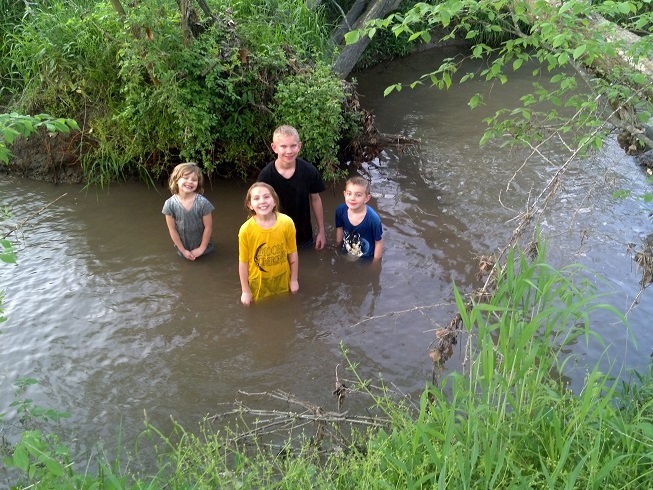
But it’s not all work.  Sometimes it’s just fun to get wet.CreekSwim

Or pick up a dead frog.  Whatever.

DeadFrogMoving out here wasn’t necessarily the best financial decision we could have made but none of the children in our former subdivision have excavated cow bones from a creek bed.  I drive a long way to work each day.  I think it’s worth the sacrifice.  Maybe I’m wrong.  Maybe my kids will be in therapy after years of helping butcher chickens, swimming in creeks, fighting off ticks and going potty in a bucket.  Who knows.  Maybe they would have been in therapy if we had lived in the suburbs and taken them to ballet.  At least they will be physically strong and healthy as they sit on the therapist’s chair.  Maybe they’ll give the therapist something interesting to listen to for once.  There is the very real possibility that my kids will be able to handle what life throws their way…that they will be well-adjusted, thoughtful, caring, curious, intelligent men and women of God who don’t need a therapist, just a little time for reflection in the woods.