Carrying the Cows’ Water

Matron mentioned chopping ice in a recent post. We chop ice too.

It is no use trying to drag hoses 1/4 mile across the pasture to where the cows are strip grazing. The hoses are frozen. I do my best to lay them downhill on South-facing slopes but when the high temperature is 25F, ice tends to build up. The best you can hope for is a big buildup of ice at the end of the hose you can work out with your pocketknife. But odds are, somewhere along the way, the ice froze in the hose and caused a buildup before it could run out. So we chop ice in the pond.

PondHoleI go out onto the pond where the water is at least 18″ deep and cut a hole in the ice. At this point the ice is a minimum of 2.5″. Not thick enough to trust but thick enough to get the job done if I stick to the shallows.

I cut a hole a little larger than the dimensions of a bucket laying on its side. Each chop sprays ice or water at my face. It’s always a good time to come into the house with ice caked into my beard. Almost every bucket brings up pond moss and it is not uncommon to scoop up bullfrog tadpoles too. I try to put those back.

PondPathThen I make the short march back to the trough with 10 gallons of water in my hands. 8 trips later, I’m done. Julie puts in a couple more buckets in the afternoon then in the morning I chip out all the ice and dump out the remaining water to start fresh again.

We were letting the cows water themselves at the pond but we found they are wary of the ice at the edge. Letting the cows get their own water is far easier for all parties involved and would necessarily be the solution if we had more cows on winter pasture. But we don’t. And this works.

In another week or so we’ll leave the alfalfa field and go to the fescue stockpile. There is a newly-installed spigot in that pasture. WHEW! After that? I dunno. We’ll start the cows up by the cemetery and work our way through the triangle and through the bottom. Hope the pasture lasts!

The pigs are much easier. They have a big water tank sitting on a mountain of compost. There has been a film of ice at the very top of the water. Otherwise, the compost keeps the water running.

The White Calf and the Pasture

I think the white calf is OK. She’s not as runny today as she was yesterday. Still a mess though. She is kind of a downer calf anyway and is always lagging behind the group or squeezing under the fence. I don’t hold out much hope for her genetic future but we’ll see.

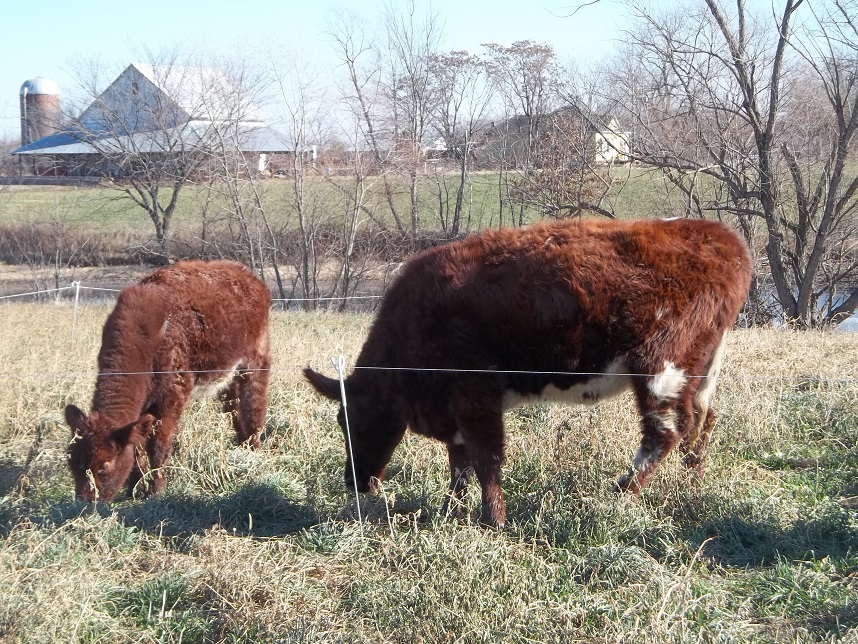
WhiteCalfThe wide jersey pointing her rear our way was runny last week. I have to wonder if I’m not pushing them too hard…trying to stretch pasture too far. Maybe some of the cows are getting insufficient nutrition. Or just an imbalanced diet. Julie and I put out a bale of alfalfa and a bale of grass hay this morning. 7 of the cows got to work on the grass while the other three started on the alfalfa. The white calf ate grass hay from one pile, then ate grass hay from another then ate a little alfalfa. We try to let them medicate themselves. I just have to make what they need available to them. The next section of the field we will strip graze has a good mix of grasses and legumes. Should be better for the moos.

NextStrip

I took the day off Thursday to do some hunting and catch up on some chores. I haven’t been hunting yet. Oh well. I’m a lousy hunter anyway. I am also trying to teach my right hand man to back up a trailer. We’ll need a few more sessions. Power steering would help.

BackinUpOtherwise, cold day. The heavy snows went south…for now. Good day to do some housework!

The Group W Bench

If you don’t get the title…well, obviously you didn’t have the same father I have. I’ll need about 30 minutes to tell you all about the 27 8×10 color glossy photographs with the circles and arrows and a paragraph on the back of each one explaining what each one was to be used as evidence against us. We’ll start with the half a ton of garbage and some friends who live in the bell tower of an old church, talk quite a bit about the draft and we’ll finish up singing “You can get anything you want…” I mean…I mean…I meeeeen I’m sittin’ here on the bench…

GroupW…eating my lunch and creating a nuisance and playin’ with the pencils and fillin’ out the forms and it’s 62 degrees outside and it will be below freezing for the next…eternity and I’ve got spring fever so bad I can hardly stand it.

Weather Forecast brought to you by wunderground.com

Weather Forecast brought to you by wunderground.com

And my dad calls. “Looks like you’ve got a calf that’s about to die.”

Well. That’s great. Shoot. Never lost a calf before. First time for everything I guess.

Now what? Now it’s 67 degrees outside, I’m stuck sittin’ here on the group W bench creating a nuisance and playing with the pencils and fillin’ out the forms and my dad says I have a sick calf.

Then my wife calls and the water line guy is there to dig. Guess what I forgot?

So I call my dad and tell him about the Group W bench and the pencils and the forms and the sick calf and the water line guy and he stops me right there and says, “Kid…You got a lot of darned gall calling me up to tell me that. What is it you want me to do about it?”

So I continue to tell him the story about the Group W bench and the created nuisance and the pencils and the forms and the rapidly changing temperature and the sick calf and he stops me right there and says, “Kid…You’re my boy. I’ll take care of it.”

Well that’s about the time my wife (who has a rare day off from watching the kids) calls to say she gave the cows a fresh tank of water with a pint of ACV and she’s on her way to get a bale of good grass hay. I suspect the calf either has been eating too much alfalfa (fresh or baled) or something fast-moving is going through the herd. One of the jerseys was unexpectedly runny for a couple of days last week. But the white calf clearly isn’t feeling well. She gets up, she eats, her ears are up but she looks a little gaunt, has been laying in manure and her rump is covered. I’ll have to keep a close eye on her but hopefully the grass hay will be just what the doctor ordered.

But here I sit on the group W bench. Not a danged thing I can do. Sigh.

Now if you’re the kind of a reader who knows about the Alice’s Restaurant Anti-Massacree Movement you know why I’m writing this. You might know somebody in a similar situation or you may be in a similar situation and if you’re in a situation like this there’s only one thing you can do. With feeling.

And if you have no idea what this post was about then come back tomorrow. Hopefully I’ll have good news about the white calf.

Strip Grazing the Winter

Right now the girls (and boy) are on the alfalfa field. We graze the field in strips 20′ deep and maybe 40′ wide…but really that depends on how much forage is out there. Each day they get another 20′ added on until we run out of field. Then we start at the pond again and munch it all down. Here are the strips in the alfalfa field. The foreground shows the difference between where they have grazed and where they haven’t. I’m letting the cows crop it pretty close.

StripsThe cows were lounging and chewing cud when I arrived today but got up immediately when I moved the fence.

StripGrazing2The grazing is not their only source of nutrition. I split one square bale into two piles early each morning. Initially I was doing this because the alfalfa was still fresh in the field. I wanted the cows to have a bulk of dry matter before they could eat fresh alfalfa to prevent bloat. Now I do it just to stretch my field and put more manure down. I could put them in a feed lot and just feed them hay but I think they are better off with a bit of fresh greens daily. Besides, this way I don’t have to haul manure.

FreshGrazing

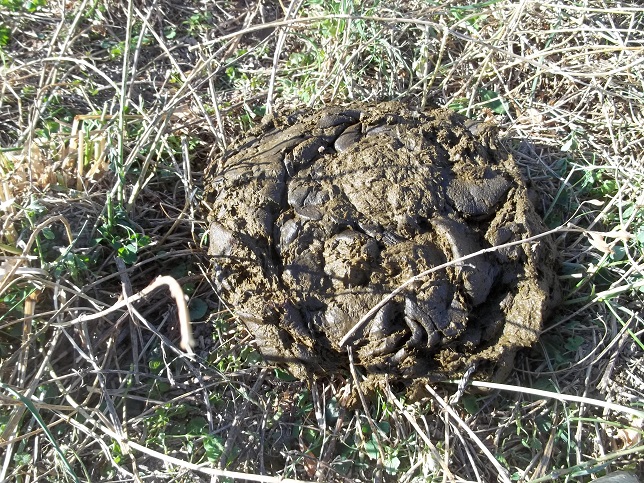
Speaking of manure, this is looking a little on the dry side:

LittleStiffBut this one is looking a little better. Note the one above looks a little crumbly and there is a depression in the one below.

JustAboutRightI don’t want it to pile. I want it to dip…but not drip. Their manure tells me if they are getting enough protein in their diet and tells me a fair amount about their overall condition. For the most part things are looking good. Anywho. That’s probably enough talk about cow manure.

Half of my farm is still standing stockpiled and waiting for the cows. Good thing too. Hopefully we’ll wrap up the alfalfa field by mid-December and begin on the real stockpile on the hill they haven’t grazed since July. That will clear disemmemberment hill for sledding later in the winter.

Easy Autumn Farming, Chores in the Dark

There is a long stretch of the year when we can hardly catch our breath. The schedule is booked solid. Chicks arrive in mid-February. The garden starts to go in early in March. Before you know it we are planting a fall crop in the garden, cutting the last of the hay and watching the birds fly South. Every day is long and it seems like we are always behind. Then it is November and you realize you didn’t make an appointment for the hogs. Shoot.

In November the sun rises after I leave for work and goes down before I get home. That’s ok. The cows don’t ask for much from us. There are no chicks. The hay is in the barn. Pigs need very little. We still have a number of projects around the farm but it is time to catch our breath.

It’s hard to take a picture of the cows in the dark but tonight the sky cooperated very nicely. The moon had just risen.

NighttimeRight now the moon is rising when I’m doing chores at night and still up when I drive to work. It’s kind of nice.

In the distance I hear the constant sound of fans drying grain in bins. It’s like the sound of a car coming down the pavement at speed but constantly in the background. Once in a while I hear a chicken negotiating for more space on the roost. In the center of the picture are headlights from my neighbor’s tractor. He’s doing his fall plowing, even at night as we are expecting some weather in the next two days. The sound of the tractor is hardly noticeable. You have to stop and listen to the world around you.

The cows are at the South edge of the property and can drink from the pond. They congregate under a grove of maple trees near the edge of the pond at night. The grove seems to hold warmth and the pond moderates the temperature change. I would prefer that they sleep and manure uphill but…you know. Cows today. Can’t tell them anything.

So my evening consists of walking in the cold moonlight to check the cows for any signs of bloat and just to say “hello”. Then I check the pigs for food and water, put on my pajamas and park my tookus by the fire. Similarly, my morning is just a walk to the cows and a peek at the pigs. Julie checks water and collects eggs later in the day.

This farming thing is so much easier in the fall!

The Taming of the Crew

We got most of the shorthorns heifers in April. They wanted nothing to do with us.

Shorthorns2It was like they said, “Look, dude, we’re cows. Not pets. Just leave us alone.”

Then, in November…

ScratchingThePollSo what happened?

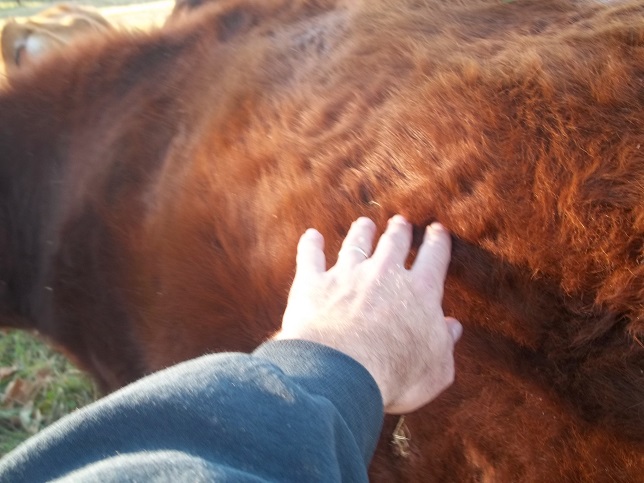
I’ll tell you specifically. I was scratching one of our dairy cows on the poll and 41 decided she wanted to see what that was all about. 41 has been curious all summer. Some of the cows keep a safe distance from me. Sometimes I can touch them on the rump. Once in a great while I can put a hand on their rumen. Here I am reaching out to 111 while she grazed in the barn lot a few days ago:

Rumen

But 41 was different. 41 let me touch her nose. Twice. Yeah.

So today, with bellies full of pasture and the sun setting I guess things just lined up the right way. 41 decided she wanted a little of the attention Flora was getting. I picked some burrs out of her poll. She was a little wary but wanted more scratching at the same time.

I won’t win every cow. My chances are better if I can make a positive impression on a young calf but even then it’s not 100%. The key is to let the cow pick you…and to let the cow pick the time. One of our milking cows is only my friend at milking time. I need to stay 3 feet away at all other times. Both cows see Julie as another calf but I am just someone to be tolerated.

I have experienced similar things with dogs. Some dogs really like me. Some, when they first meet me, cower. I met one dog, I later found out completely dominated her owners, who found me to be a threat. There is some weird herd dynamic thing that I don’t fully understand and it certainly applies to cows. Horses too. There is some almost subliminal issue of dominance I am completely oblivious to. That is certainly felt in the cow herd.

I will never get around being a predator. I will always be a threat. My eyes face forward therefore I am a predator. The cows know this. I could raise a bottle calf in a stall away from the herd and develop a closer relationship with her but cows in the pasture will only let me in so close. Sometimes I can pick off the burrs.

Things change over time. I need to be consistent. Patient.

Why is this important? Because those cows are going to calve and when they do they need to see me as a friend, not a threat.

Envisioning 5,000 Cows

My recent post about our vision has sparked some interesting discussions with friends and family. Among them is just the pure logistics involved in managing a herd of that size. It has been a fun discussion but we have come up with few answers. Just guesses. Estimations. You should play the exciting copy of our home game! All the fun of farming in the comfort of your dining room…no manure required!

Let’s say we have 5,000 cows. Wouldn’t that be nice? We would need between 250 and 400 bulls to keep things moving but we would only need those bulls for 2 months. I guess the rest of the year they are being pastured off-site. Or maybe we keep the bulls in with the cows over the winter and separate them at spring greenup, selling pregnant cows that don’t calve by a certain date. Maybe we AI a selected group of cows and heifers but the bulls are still out there for cleanup.

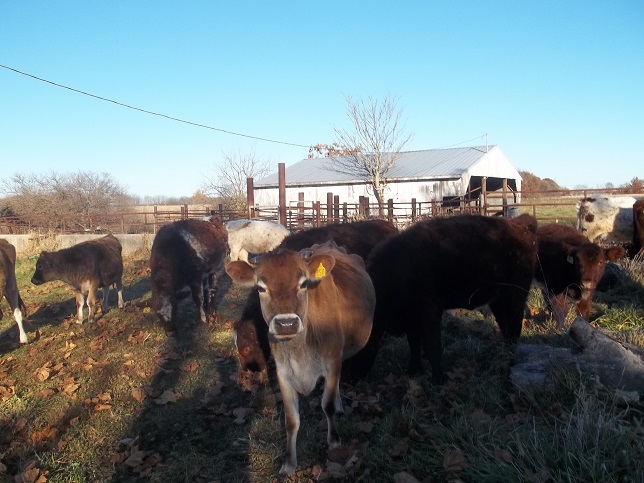
HerdInNovember

5,000 cows would require 5,000-ish acres where we live. Nearly 1,700 acres would be stockpiled in rotation each year. Each day I would open up a 20-50 acre pasture for grazing, even if a little at a time to increase herd pressure and movement. There would be no housing. No shelter. If the soil gets wet we’ll just have to move them faster and deal with the pugging.

Each summer we would cull 10% of our cows because they were open or bred late in the season. That would leave us with 4,500 calves. Now we have 2,250 steers to fatten over two years and 2,250 heifers to raise for two years. Let’s go back to the steers. We would have 2,250 bull calves to castrate. That sounds like a long day of working cattle. And it’s a mere 24 semi-loads of calves if we sell the calves or raise them on another farm.

And we might want to raise the heifers on another farm. Or raise them on another farm with the steers. Good heavens! Another farm! Maybe we should back off on our cow numbers and raise everything together in one mob. But for sake of discussion, stick with me on the idea of 5,000 cows.

All of that indicates I need to reserve a portion of my 5,000 acre cow/calf land for handling facilities.

Back to the heifers. I need to reserve 500 heifers as replacements each year as well as…what? 50? bull calves? So that lowers my sale numbers…except those are replacements. I’ll have 50 bulls to sell, most of which would still be viable bulls, just not as good as the replacements I raised. Oh, sure, some will be lame, injured or sterile but over time I should be selecting increasingly hardy animals. So. 5,000 cows. 5,000 calves. 500 heifers. 50 bull calves. That’s a lot of beef.

I know a lot of operations work at this scale but the numbers involved are far beyond my own comprehension. When we talk I can see the wheels turning in dad’s mind. 5,000 cows. What would it look like? It’s fun to talk about but I want to see it. I mean, if this is a mere 1,000 cows…

Now, let’s really have some fun with this. Jim Elizondo says you should have equal weights of sheep and cows…meaning 4-6 sheep per cow. So that would back us off to 2,500 cows and include 10,000+ hair sheep (cause we ain’t shearing!). Good golly the fencing we would need for that! And the dogs!

Then we want to clean up after the cows with a flock of birds. A flock of birds that can cover 20-50 acres. What is that? 10,000 chickens? 20,000 chickens? How much feed would I go through each day? How would I deliver it? How would I sell that many eggs? Could I even get a license to keep that many birds? Who is going to collect all those eggs?!?!?

gathering eggs

I have no idea.

I also can’t tell you what I would do with 20,000 -40,000 lambs each year. And I can’t tell you how I would sell that many cows.

Those are problems we would have to grow into. Thank goodness I can’t just go out and buy the land and livestock tomorrow. It is too big of a problem for me to solve at once. This is a problem for generations of us to solve together over the span of several decades.

Cattle Mineralization, Nutrition and Human Weight Loss

Yes. Human weight loss. I’m going to write a post about feeding cattle and how I feel that is analogous to human weight loss. How’s that for ambition? I think there is enough here to chew on for a bit without going too deep on the topic.

Here goes.

We recently bought the Hayless Wintering in Florida DVD set by Jim Elizondo. You may think $119 is a bit high for a movie but if you feed 25 fewer small square bales of grass hay the first year you have broken even. You may also think that since he’s in Florida and you’re not he has nothing to offer you. You would be wrong. Anyway, in that DVD Jim says cattle can overeat by 40% trying to get enough of a specific mineral they are lacking. I want to spend some time on that idea.

Cattle know what they need. It is not uncommon for cattle to select a specific mineral they want from an array and just pick the ones they need and in the quantity required. That’s the whole concept behind the Free Choice Minerals programs and you can see it at work in one of our favorite youtube videos about milking cows (skip to 7:45):

But let’s say minerals are in short supply. What’s a cow to do? Well, this grass over here has a small amount of X in it so I’ll just eat more of it. As much as 40% more than the cow needs to maintain condition. Jim says he has seen cattle with scars on their sides from overfilling the rumen and tearing the skin. Those cows were seeking better mineralization.

If the cow had sufficient nutrition it wouldn’t be eating that extra feed. Another cow would. You with me on this? If this is true, you could have 40% more animals on the same forage and land if the cattle were getting proper minerals. In fact, FCE says the cow can overeat by 50%!

Read that again! That’s money in your pocket!

Jim goes into detail on working with the existing pasture to improve nutrition and mineralization over time. He says he offers a source of protein supplement when feeding lignified pasture (dead, brown, old grass) to cattle…usually flax seed meal as bean meal is almost all GMO. That may go against the grazing ideal we all have in our minds but when seeking to improve pasture health (the real goal) you have to enable the cattle to thrive. The added protein helps the rumen to digest low-protein, dried grasses. Play with the cards you are dealt. Supplement carefully where needed to maintain nutrition levels over time, making the best use of what is available. This applies to our meal planning at home…working with what we have in terms of ingredients and in terms of budget.

So what does this have to do with human weight loss? Well, maybe nothing. But maybe everything.

Click image for source.

If cattle can overeat to make up for a lack of nutrients can we do the same? Do we do the same…even without realizing it? Would you suggest the average American is thin and eats food that in nutritionally dense in small quantities or would you say we, as Americans are overweight, eating nutritionally poor food in large quantities? Is it possible that we are consuming some portion of those calories, not simply because we crave fat, salt and sweet, but because our body is telling us we need something that we aren’t getting elsewhere. So we eat more. And the extras that come packaged with that whatever we are looking for don’t simply pass through as unnecessary excesses. Some of them deposit themselves in, around and under us.

This came to mind in a conversation with my lovely bride who, without any real effort, is losing weight. Now, maybe our data is off and she has a tapeworm or a tumor causing weight loss but assume with me that she is as healthy or more than the average 30-something woman with four children. What has changed?

For the last year Julie has been taking a very high-quality vitamin supplement (the FDA says I can’t tell you the name cause speech isn’t free). I noticed her jeans were getting baggy and we started paying more attention to what was going on. She says she needs to eat less at a meal to feel satisfied. Otherwise, she is limiting (not eliminating) wheat. We cook with bacon grease. There are still cookies or brownies in the house from time to time. We still drink wine and hard cider and the occasional soda. But mostly she eats high-quality foods we grow or purchase, drinks water or coffee and takes her vitamins. For exercise she walks to the cows and chickens and picks up at least one feed bag every day of the week. All of that has been essentially the same for the last 4 years. The switch from a multi-vitamin to (no free speech) was the only real change.

Maybe I’m mistaken but it appears to me that paying attention to nutrition and mineralization can not only increase our livestock health and carrying capacity, it also puts my already thin wife into even smaller jeans and makes better use of our food budget.

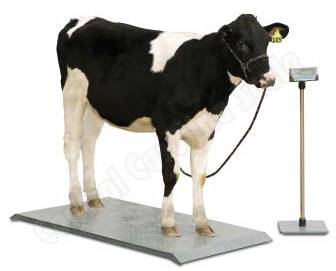
For the sake of disclosure, I am switching to FCE’s mineral program right now but I stand to make nothing by mentioning their product nor by linking to a scale manufacturer. My wife does sell the vitamins she takes and would be happy to sell them to you. But I wrote this post out of a sense of amazement, not seeking sales.

Grazing the Whole Hill

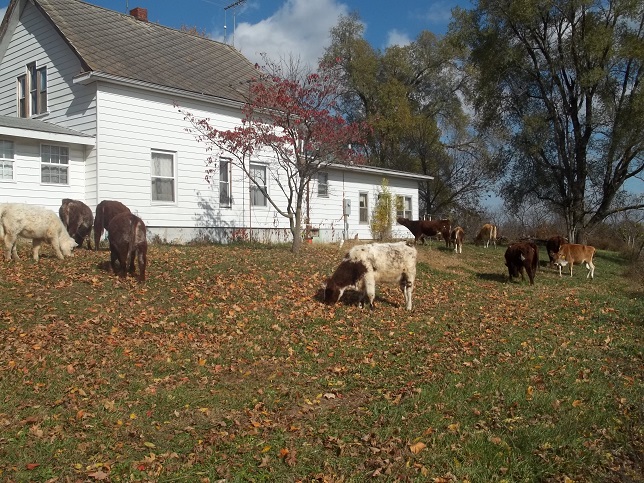
It is important to us that we do things that cause our neighbors to crane their necks as they drive slowly past. Yes, the cows are in the yard. As the world works today, If people don’t think we are weird then we are doing something wrong. I don’t want to be normal in a world of chemical agriculture and chemical lawn maintenance.

MowingInNovemberI had to give a very large area to the cows because the grass was short. The girls are also doing a good job of smoothing out some rough places left over from some trenching that we had done in the spring.

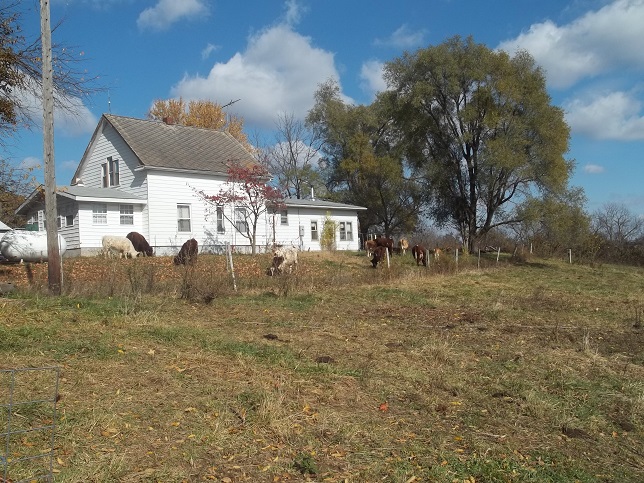
TheWholeHillWe have grazed the slope in three sections from bottom to top. I prefer to start at the bottom so rain doesn’t wash manure onto upcoming forage. We just follow the keylines around the farm as much as possible. The fence pictured above does not follow the keyline so we just have to work with what we’ve got.

The fun part was when I lit the fire this morning in the back room. I heard a weird noise…like a burp or something…and looked to my right. Ms. White was looking in the window at me. Kinda funny. Ever have a cow looking in your window? Maybe you had to be there.

Fall Plans, Winter Problems

Fall came a little late but it’s here in force now. We just had four nights in a row of below-freezing temperatures. Now we have to be in the habit of disconnecting our hoses at night and laying them on a slope to drain. An extra chore. Rain is just about to set in so we’ll be up to our knees in mud before long.

This fall cold snap probably won’t last. We have seen 90 degree days in November before. But it’s a reminder of what is coming…and soon. The next few nights will kill the alfalfa and clover as well as the summer grasses. The leaves will begin to fall in earnest.

fallgrazing2

We have already slowed the cows down, asking them to crop the grass very close on the South-facing slopes. I expect these slopes will have time to put on another 8 inches of grass before the fescue really goes dormant in December but, for now, I want to put down a lot of hooves, mouths and manure in tight pastures…even if we move several times/day. That late fall regrowth will be just what the doctor ordered in April when we are looking for a little pasture to graze. The fescue should come through winter in good shape.

fallgrazing

I plan to feed a little hay while we are on this North-facing slope. Roots are shallow here and the plants have a hard time in the blazing sun of July and August. They have fully recovered since the last grazing but the plant population is lower than we would like and, again, root systems are shallow. We are relying on hooves to push waste hay and manure into the soil surface, disturbing the soil and making a nice bed for seed germination as weather allows…possibly in the spring. The hay idea comes from my talks with David Hall. He said he fed 30 days worth of hay across 5 months to make the hay and pasture stretch. We are sort of starting that now…at least, right here where the pasture is poor. Grazing in tight areas, moving daily, feeding a little hay in the morning…about 1/10th of the dry matter a cow would otherwise need.

That all sounds nice. We have a plan. But it is not without its problems. Shorter days, colder weather, hose management, extra bedding for pigs…nothing life-altering but many small extra chores with fewer hours of daylight causing problems.