Adventures in Childhood

Let me put together several recent conversations I had with my kids into a single narrative.

“Dad, what did you study in college?”

“Well, I majored in Biology…though I have a liberal arts degree.  That means I took more classes than I could have, with a wider focus than you might suspect but still spent 40 hours/week dissecting dead cats and sharks for Comparative Vertebrate Anatomy.  I also had a job on campus caring for animals in the Biology department.  I raised rats and mice, cared for the snakes and lizards and cleaned the salt-water aquariums.  But mostly I tried to convince your mother that I was the right guy for her while working several jobs at once so we could finish college with minimal debt.”

“Snakes?”

“Well, yes.  But also salamanders and frogs and turtles.  In fact, when we look through Tom R. Johnson’s book, “The Amphibians and Reptiles of Missouri” I have observed or collected nearly everything pictured short of the toads that are only common in Western Missouri.”

“Yeah, but…Snakes?”

BlackSnake

“Yup.  Snakes.  Lots of them.  Most of the snakes that live here are safe to handle and, if you are careful how you act around them, actually seem to like it.  To them, you’re just a warm tree.  Tom Johnson’s book indicates that there are probably 3 Prairie Kingsnakes for every acre.  Now, to be sure, ask me before you go picking up snakes.  There are a few around here that can really hurt you and one you may be allergic to.  Here, hold this Prairie Kingsnake. ”

“Where did you find it?”

“The neighbors are cultivating their field to plant beans.  That ruined his habitat so he was crossing the road looking for a new home.  Since we have acres and acres of grass he’ll probably find a home here.”

PrairieKingsnakeAnd that’s how it goes.  We talk about stuff.  We go out and do stuff.  We take pictures of stuff.

Butterfly

Beyond the wildlife, there’s cool dead stuff out here too!  My cousin’s bull died in the creek two or three summers ago and with the recent rains the bones resurfaced.  It’s an exciting time of discovery…and work.  They dig for cow bones in the creek bed then haul them over hill and dale to our back porch.  I think they want to re-assemble them…like I need a bull skeleton in my living room.  Hmm…let me know if you want a cool bull skeleton in your living room.  We haven’t found the skull yet.CowBones

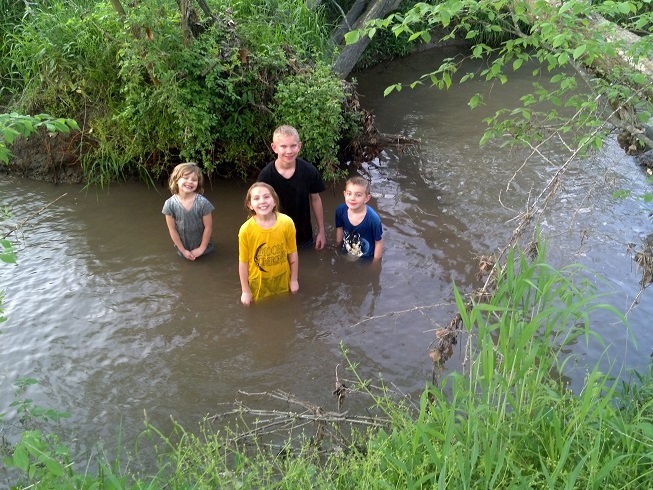
But it’s not all work.  Sometimes it’s just fun to get wet.CreekSwim
Or pick up a dead frog.  Whatever.

DeadFrogMoving out here wasn’t necessarily the best financial decision we could have made but none of the children in our former subdivision have excavated cow bones from a creek bed.  I drive a long way to work each day.  I think it’s worth the sacrifice.  Maybe I’m wrong.  Maybe my kids will be in therapy after years of helping butcher chickens, swimming in creeks, fighting off ticks and going potty in a bucket.  Who knows.  Maybe they would have been in therapy if we had lived in the suburbs and taken them to ballet.  At least they will be physically strong and healthy as they sit on the therapist’s chair.  Maybe they’ll give the therapist something interesting to listen to for once.  There is the very real possibility that my kids will be able to handle what life throws their way…that they will be well-adjusted, thoughtful, caring, curious, intelligent men and women of God who don’t need a therapist, just a little time for reflection in the woods.

Strolling Through the Pasture May 2013

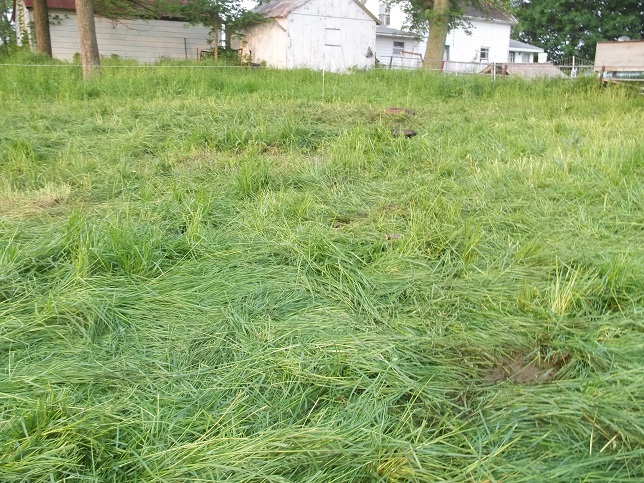
I’ll start off by making a loop around the cemetery hill then we’ll head North.  Looking toward the cemetery I’m standing in grass that won’t be grazed for about 2 weeks…but what a difference two weeks makes.  Compare this picture with this one taken two weeks later with this one taken another two weeks later.  What a difference two weeks makes.  Closest to the cemetery is ground that was grazed two weeks ago.  Recovery is happening but it really didn’t get trampled as well as the pasture in the foreground.

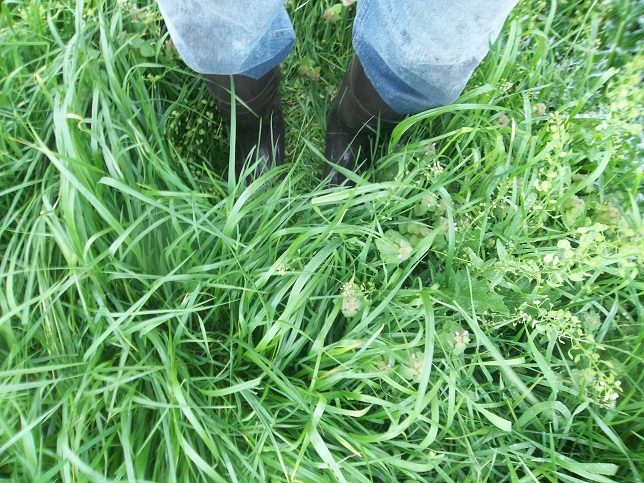
MayPasture1The fescue is tall but the other grasses have a lot of growing ahead of them before I can graze them again.

MayPasture3Maybe this is a better picture.  The cows ate whatever this was right down to the ground.  That’s my fault, not the cow’s fault.

MayPasture4We grazed across the remaining bottom ground South of the branch then crossed the branch and grazed it out.  You can see the line where we put electric fence 2-3′ inside of the perimeter fence.  I really didn’t want my cousin’s Angus bull to get any opportunity with my Shorthorns.

MayPasture5Also notice the abundance of honey locust trees.  I’ll be busy next winter.

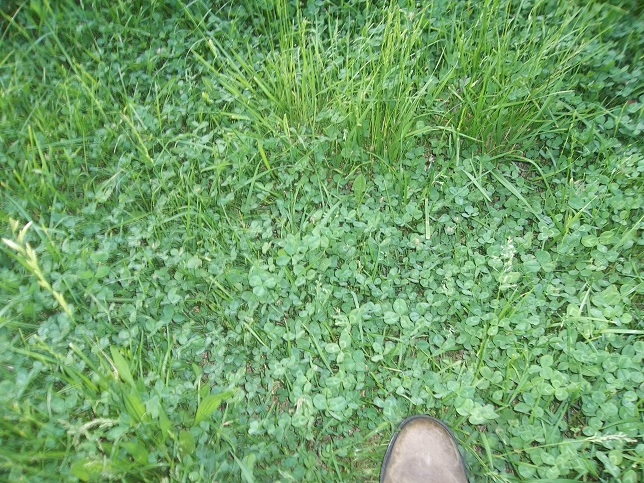
Cows grazed the best out of this, trampled quite a bit but we still didn’t have enough pressure on the land.  Too much fescue was left standing.  But there was a section in the middle that got missed in the grazing rotation.  The diversity of species there is amazing and shows where the above picture started.  A good stand of red clover and a mix of weeds including goldenrod, burdock and multi-flora rose but there was a total lack of chicory and dandelion.  Maybe because it’s wet, sandy bottom ground.  Who knows.

MayPasture6Notice none of the fescue heads were nibbled off.  Yup.  We messed up.  Oh well, we’ll trample it hard when we come through again in June.

MayPasture7The next area was grazed a little over two weeks ago.  Portions of it are recovering well, other portions are totally dominated by white clover and the recovery is slow.

MayPasture8Back to the South the bottom ground is recovering well.  A fair portion of the growing green stuff is goldenrod but this has been a weedy mess for years.  Two years ago (maybe three?) the 6 of us spent an evening with a tractor pulling hundreds of saplings our of the bottom then I mowed it (I mowed because I didn’t have cows).  Now I’m hoping to continue improving the stand by way of cows.  Check in again in a couple of years to see.

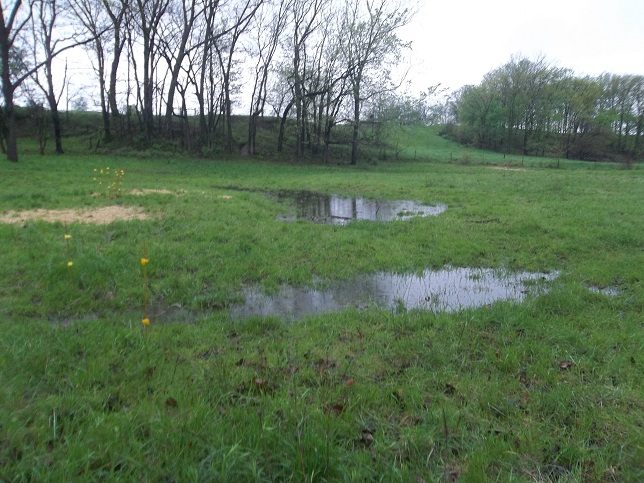
MayPasture9The stand is recovering well but there are a lot of hoof prints.  We got more than a foot of rain toward the end of April, several more inches at the beginning of May.  I would guess we have had 16-20″ of rain in the last 6 weeks.  Anyway, hoofprints…

MayPasture10Follow this link to see the flood water standing in the bottom.  This is the same area (side view) today (…well, Sunday).

MayPasture11Up the hill, my fallen tree is getting lost in the grass.  I thought the grass was tall last time we grazed here.  I have never seen this much grass here before and am anxious to see what it looks like in another month when the cows return to it.

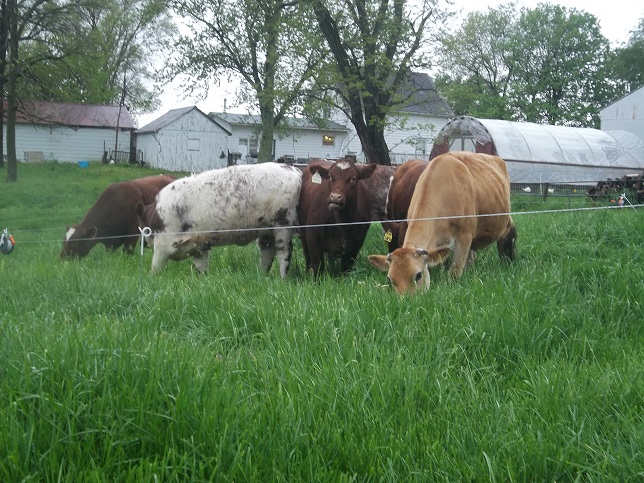
MayPasture12Now we have made the loop and we’re back to the cows.  They have nothing to say to me and are clearly unafraid.  None of them want to snuggle with me but the dairy cows are nearly pets.  The others know I’m the guy who can move the fence forward, I mean nothing else to them.  Look carefully at the picture and you can see the next division we’ll open up the next morning.  Two fences behind the cows.  We just roll those two cross fences backwards then push the water and the back fence forwards leaving 2-3 days of grazing area under the cows at any given time.

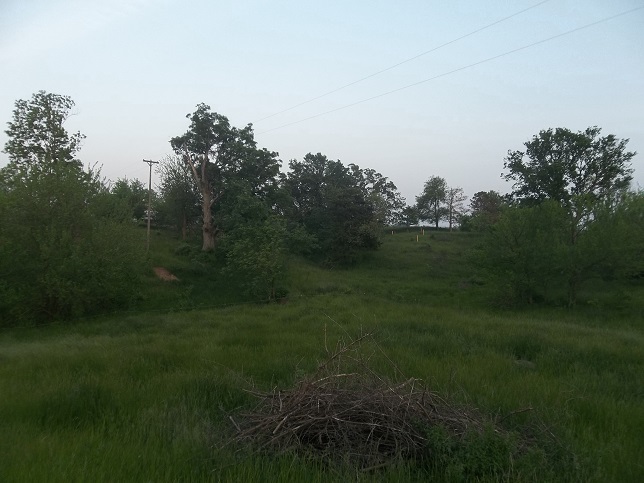
MayPasture15A little further South, looking South I can see the few acres I have set aside for drought.  By my measurements I am actively grazing less than 10 acres with 8 heifers and two calves.  I have 4 acres set aside as a reserve along with odd patches of hilly, wooded areas I don’t care to pasture heavily.  Add to that 3 or 4 acres of alfalfa (well, mostly alfalfa….well, mostly alfalfa and orchardgrass…well, mostly alfalfa and orchardgrass and a few bare spots where the chickens killed the plants standing in mud during days of heavy rainstorms) that we’ll use for hay.  I hope to graze this pretty hard starting in July and again in November or December.  The plan is to set aside a portion of the farm each year for stockpile.  This gives my main pastures additional recovery time just when they need it and builds standing forage for winter grazing.  I’m not exactly making this up as I go along but I am playing by ear.  Stay with me as I learn.  Anyway, straight ahead of the brush pile is an old bridge.  The stream flows from right to left under the bridge.  Everything across is set aside for July.

MayPasture16Now moving West we come to the place the pigs were in March.  It’s hard to hurt fescue…

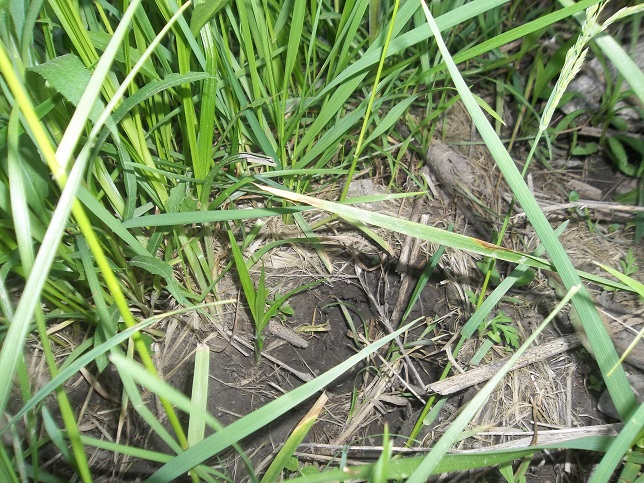
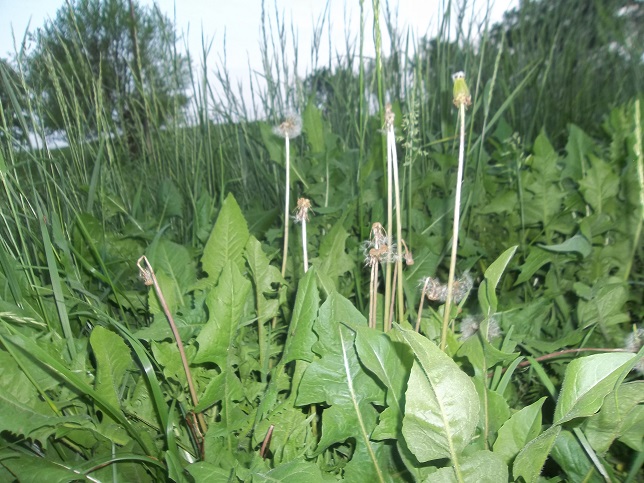
MayPasture13…but there are some spots where the pigs managed to set it back.  Those spots are dominated by chicory and dandelion.  I’ll need to work to get more clover growing here going forward.  There is always more to do.

MayPasture14We’ll just have to wait and see what the cows eat here in a few weeks.  Hopefully it’s not too stale.  I may follow Gabe Brown’s advice and sew in cowpeas, sunflowers and millet as the cows stomp through, then winter annuals when they go through again in the fall.  Who knows.  Again, playing by ear here.

In spite of my best efforts to build big grazing areas early and cover the farm quickly I fell behind.  It all got away from me.  Now I’m slowing down a little, trampling more grass with narrow grazing strips and just hanging on.  The plan is to double our herd size next year as our farm triples in size.  Yeah, I know…but you have to work within your budget.

How is your grass growing?

4 Inches in 45 Minutes

4″ in less than an hour.  That’s a lot of rain.  The storm was not intense, it just rained a lot in a short amount of time.  The basement filled with water but that’s another story.

Flood1

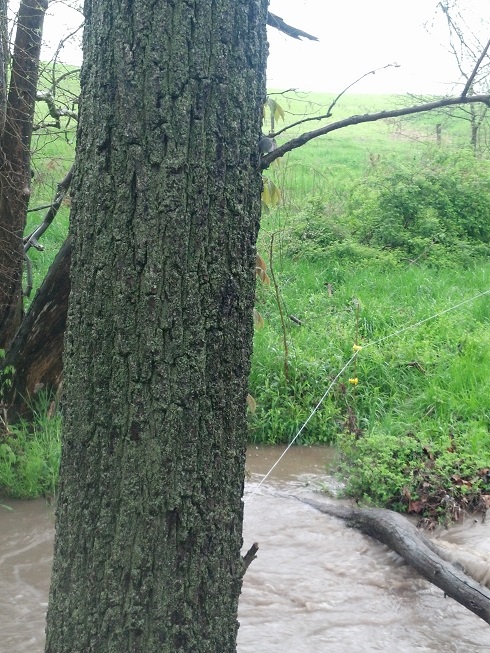
The stream was up 5′ above where it is now, which was about another 5′ in elevation from where the cows were pastured.  Looks like the whole bottom was a stream briefly.

Flood2All of our wide collection of driftwood was moved.  The barrier fences on both ends of the branch will need to be cleaned out and maintained.  But the good news is we’re covered in grass.  While the neighbor lost a lot of soil from cow paths and bare dirt, I suspect we trapped soil.  I especially like the protein tub pushed against the fence in the first picture.

Looks like the pasture wasn’t hurt, just the fences.  We’ll deal with what comes our way.

Morning Grazing May 2013

One day.  Just one day.  This is the first paddock of second grazing of the growing season.  We raced across the farm through late March, April and early May, now we are beginning to slow down.  I’m asking the cows to work through a somewhat narrow grazing area, trampling around 60% of the standing forage, eating 30% and leaving 10% standing.

GrazedGround

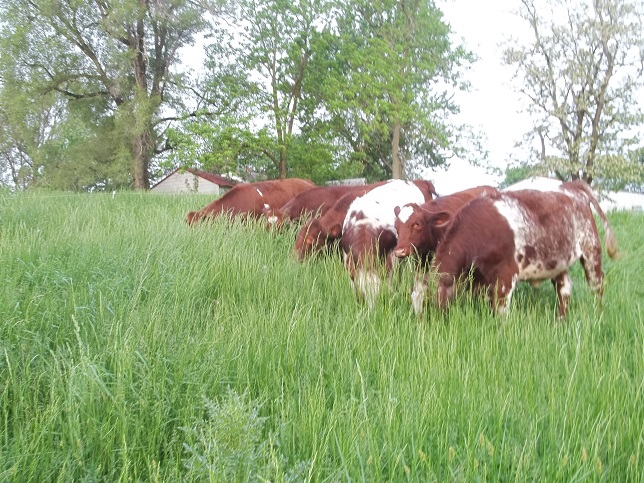
They seem just as happy as can be.  They mob up, as much as 6 cows can mob up, and march across whatever fresh ground I give them then lay down to chew their cud.

Heifers

Looking forward a bit, in about two weeks we’ll be here:

CrimsonClover

The cheat that is growing there will be absolutely unpalatable by then but the crimson clover out there should help.  They’ll just trample what they don’t eat but the cheat will stick to their socks.

Sooner or later the cows will be on the South slope of the hill.  That slope is hot, fairly steep and covered in cow paths.  In short, it doesn’t grow a lot of grass.  The hill is mostly clay and is hard packed.  We’re just praying for weeds to break up the clay.

SouthSlope

I have to make sure this has recovered as much as possible before we graze it, not for the sake of the cows but for the sake of future grass here.  I need healthy grass, deep roots and more microbes.  We’ll have to manage it carefully to clean up these spots.

BareGround

Will it work?  I have the cows I have, right cows or not.  I have to put the cows I have in the right place at the right time for the right length of time while allowing time for the rest of the farm to recover.  And while managing for pasture diversity.  No pressure.

I think we’re getting there.  In case I mess up I have about 4 acres in reserve.  Gotta have a backup plan.

What’s your backup plan?  How does your pasture look?

Regularly Scheduled Simplification

There is only so much I can ask of my wife.  She is intelligent, beautiful and strong.  She cooks, cleans and cares for all 5 of her dependents (including me).  She teaches the children.  She washes, sorts and boxes the eggs.  She runs her own business, continues her ongoing education as well as that of the children and keeps the farm running when I go sit in the A/C at a desk job.  It is important that we simplify things as much as possible…that I stack the cards in her favor.  She is strong but she has a hard time moving chicken tractors.  She is willing to work hard but tires out long before I do.  There are only so many hours in a day and I can’t expect her to be able to do everything I can do.  So we have to simplify.

Milking

What do I mean by that?  Recently we took possession of 6 new heifers.  Now, six heifers doesn’t look like much on paper but it’s a whole new deal for us.  Rotational grazing.  Mob stocking.  Hoping and praying that the green stuff growing in our fields is appetizing to our hooved animals.  We have to learn how to move fence, how to move the water tank, how to troubleshoot shorts in our fencing, how to watch for problem weeds and to monitor how full the cows are.  Again, on paper, no big deal.  But in real life, learning all of that all at once is a bit daunting.  Learning all of that while keeping the food cooked, the dishes washed, the laundry folded, the kids educated and the business growing is pretty rough (though she does it all while looking great).

Sunshine

So we simplified.  We scheduled our production for the year and made sure several things were finished or on break before the heifers arrived.  The broilers are in the freezer.  No more chicken tractor chores.  The pigs went to market.  No more planning and moving pig pastures…or working pig pasture recovery into our grazing schedule.  We planned ahead, knowing our spring is busy and staging things out so we could learn new skills away from the pressure of existing skills.  Now, there’s no getting away from housework or even garden work but just freeing her from checking broilers 3-4x per day and liberating her from her fear of 300 pound hogs lightens her workload enough that she can afford to focus on these new heifers just when they need it without shorting the kids of the time they need.

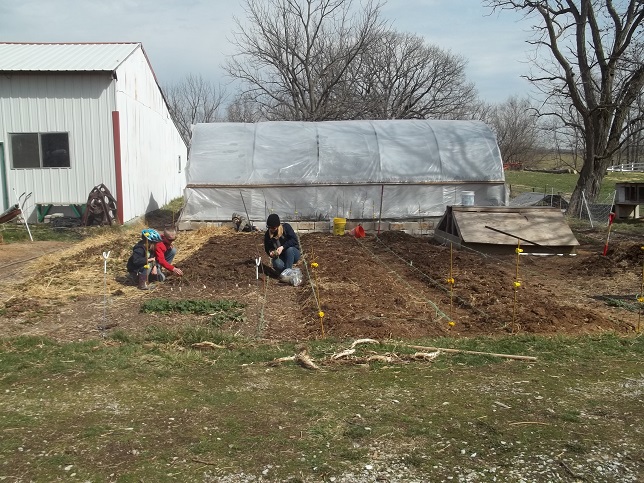
Garden

The goats were scheduled to be sold in December.  The two females finally left today.  Once they are gone we’ll be down to just ducks, cows and layers.  Over time we’ll work pigs back into the rotation.  In the fall we’ll do another big batch of broilers.  In between we’ll attend Cattle Grazing University, Chism Heritage Farm campus, and the school of hard knocks.  Experience is a great teacher.  I have read every grazing book I could get my hands on and I’ve learned more in the last week than ever before.

Broilers

I think pigs, turkeys, goats and broilers all have a place in our lives, in our business and on our farm but we can only ask so much of ourselves.  At regular intervals we plan time to review what we are doing, why we are doing it and verifying that we are making the best use of our time.  Are we happy or just busy?  It makes me happy to see the pigs run in the pasture.  I enjoy butchering chickens with my children.  I love our goats.  That said, today I’m content to watch the cows eat grass.  They have a lot to teach me and require my full attention.

Most importantly, I have to consider my wife.  This is our dream, not simply mine.  I can’t abuse her with hard labor and expect her to remain enthusiastic.

Hatching a Few Eggs

The duck hatch was so successful we set some eggs from our mostly New Hampshire flock.  Somebody gave us a gold laced Wyandotte and a Buff Orpington so those eggs were mixed in as well.  We can sift those chicks out as they hatch striped, not a big deal.  They started hatching Thursday night and will have to be finished Sunday morning so I can set more eggs.

IncubatorWe are attempting to hatch our own replacement layers this year.  Approximately 20% of the eggs we get are not New Hampshire eggs.  50% of those remaining will be males.  And we shouldn’t expect to hatch more than about 75% of the eggs we set.  That means I probably only get 12 pullets every hatch.  I’ll be hatching for a while.  It would be better if I would just go separate those two hens from the flock but the kids like the striped chicks.

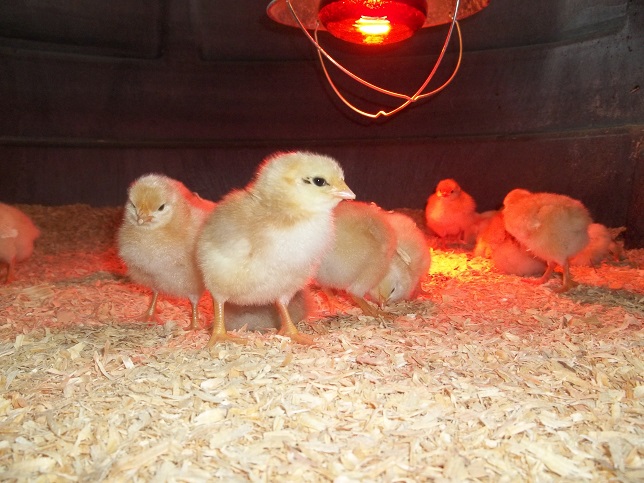
Brooder

For now we are brooding in a 300 gallon Rubbermaid trough in the back room.  Really, this is just a place to keep the chicks warm until we free up brooder space in the greenhouse.  (AKA we kick the ducks out).  We’ll need nicer weather before we do that.

NHRThis is an awful lot of fun and could be the beginning of generations of NHR chickens on our farm.  Their mothers and fathers (plural) have survived 2-3 years of heat, cold, wet and dry.  Some of their peers didn’t make it.  Hopefully, in a few generations, we’ll have birds that are genetically predisposed to success on our farm.

Red birds?  Red cows?  I sense a trend.

April Showers Bring May Showers

After last summer, I never thought I would wish it would stop raining.  We got a foot of rain in April.  We are off to a good start toward another foot 3 days into May.  It’s unbelievable.  An inch of rain by day.  Another inch by night.  The good news is we’re grass farmers.  Our crop is already in.  In fact we have harvested a second crop from most of the farm!  Chew on that!

MinorFlooding

We had been grazing the cows across the bottom on both sides of the creek.  They would need snorkels to graze down there now.  Fortunately we had some high ground well rested.  In fact, it’s perfect.  Lots of diversity.

WetKnees

And this is where we had pigs last October!  Pig manure is great!  It also helps to have pasture in reserve just in case.  This has been resting since we last grazed through in January.  Just think of the root systems!  Think of the grass those cows will trample into the soil!  Think of the water I’m holding now and how much more I’ll hold in the future!  And those girls will get fat!

TopOfHill

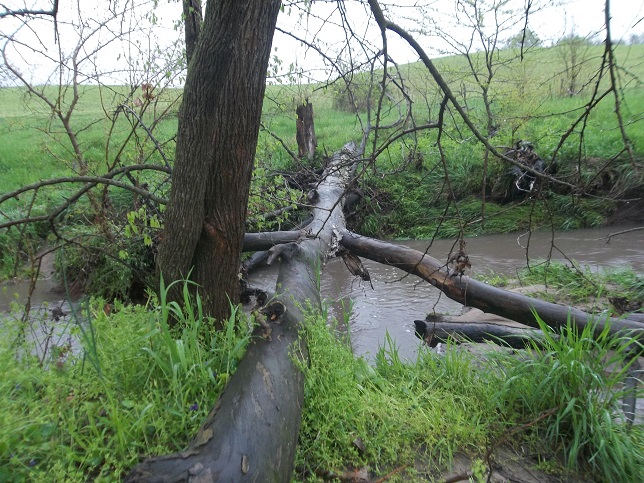
The creek attempted to claim our fencing but we got it untangled, recovered our posts and moved everything up hill.  I had to cross the creek on a fallen walnut tree but we got the job done.  The creek in the picture is down two feet from where it was last night.  The current flood emphasized the need for me to keep fallen branches cleaned up down there as they tangled up our fencing and clogged up the gate that keeps the cows in where the creek hits our property line.  I say creek but it’s not a creek.  It’s the branch.  I know.  City kid.

FallenWalnut

Regular readers know that farming is only one of many things we do.  We are so busy working and playing, it’s hard to find time to write.  Bear with us.

UPDATE:

My lovely bride took this picture at the peak of the flood yesterday.  Can you see the mouse?

Mouse

Doubled Our Footprint…er…Hoofprints

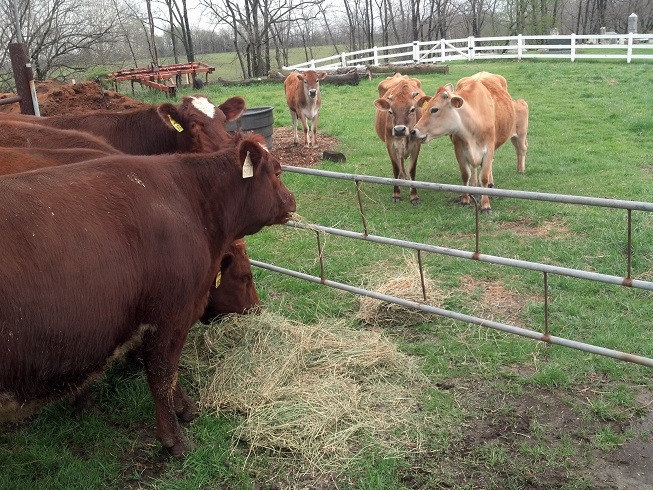
We doubled our hoofprints Wednesday.  We started with two Jersey heifers and their calves and added four Shorthorn heifers.  And it looks like we’re going to go ahead and pick up a couple more.  (Update two days later: now 6 shorthorns.) All registered.  All fat.  Each weighing more than any two of my little Jerseys combined.  Ugh.

These girls know how to eat.  Our Jerseys will look right past second cutting alfalfa.  The Shorthorns licked it right up.  It was pretty amazing.

Shorthorns1

Once they were full of hay we opened up a new strip of pasture and turned the girls out with the Jerseys.  I have to say, I was a little nervous.  Each of the heifers had a strongly negative experience with our electric fence before we turned them out and had been in electric fence previously but…still nervous.  So far so good.

Shorthorns2

Needless to say they went right to work eating everything in sight.  It was late afternoon before we put them out and their bellies were full of hay so I had little fear of bloat.  Everybody seemed to get along.  I only had to stop them from pacing the fence once.  Just me in a lawn chair with a camera.  They seem gentle.  Not pets but they don’t mind me being in the same zip code with them.  Big bellies, big butts, short legs.  They will mature a little on the heavy side for our ideal and they aren’t specifically bred for performance on fescue but…good looking cows.

So.  Now we’re hanging on for dear life.  Rolling through spring pasture.  Huge, heavy hoofprints pushing organic material deep into the pastures.  Pretty cool.  I need them to really abuse a section of pasture or two but I have to be careful not to stress them.  They’ve been on a hot feed in a feedlot for the past few months.  Grass-only is quite the change.  Further, we’re having trouble keeping May (the skinny Jersey) in condition.  She’s doing better right now but she’s not as much of an agressive eater as the other 7 cows.

Wish us luck and feel free to offer advice.

Processing Day: Things We Have Learned

Saturday was beautiful.  We worked at a leisurely pace and wrapped up processing and packing birds in about 3 hours of work time then went to church in the evening.  No big deal.

Sunday was awful.  Awful.  The wind picked up and I felt like I was fighting the scalder all day long.  Just awful.

As a quick review, we really like our Featherman equipment but you have to know its limitations.

The Featherman kill cones are awesome.  We find cleanup is easier if we fill the base with sawdust before we begin but the cones themselves owe me nothing.  The plucker may be the best thing ever.  Compared to the Whizbang we used before, the Featherman plucker is a dream.  Where before the birds would tear, legs would get stuck or the belt would fall off, with this beauty there is no belt, the fingers are very soft and we have never had a leg (or head) fall through.  On top of that I suspect, were one so inclined, the plucker would work on the moon.  Really.

But now the fun part.  I’ll start by saying in the old days we used a pot on a turkey fryer in conjunction with a number of pots warming water on an electric stove.  It was awful.  I was married to the scalder, holding two birds at a time in the water, hoping I was keeping the water at a consistent temperature and trying not to splash water into the burner.  Please understand, your whole processing experience hinges on getting a good scald.  If your scald is poor, your day will be long.  You will pick feathers all the way through to packaging…slowing that process down too.  So we got the Featherman one.  Bigger burner, larger thermal mass, automatic dunker.  Should be awesome right?

Well…it is.  But only under fair conditions.  You can’t expect a miracle.  If you are working outside in a 20 mph wind on a 30 degree morning you should hold off for better weather.  That was reinforced for us yesterday.  The first 10 or 12 birds were great.  From then on it was all downhill.  At 30 we decided to call it and go eat an early lunch as the propane tank had frozen.  The kids and I even fit in some goof-off time.  I fell asleep playing video games with them.  The kids thought it was hilarious.

By 1:00 the air temperature had risen enough that the scalder was back on top of its game…but out of propane.  I changed tanks, heated some water on the stove to kickstart the process and we dove into the work.  We worked at a slow pace as we were tired from processing the day before and finished up 115 birds by 3.

Beyond just understanding the limitations of the equipment, over the years we have made a few adjustments to make things better.  Let me start with the scalder:

  • Work with the weather.  If it’s cold and windy either move indoors or wait until it is not cold and windy.  Similarly, if you want to play baseball at night, turn on bright lights or hold off till daytime.  I don’t know why this is so hard for me to remember.
  • If the birds dress out above 4 pounds each you can only put one bird in each basket.  Smaller birds can double up.  The roto-dunker motor can only do so much lifting.
  • Refill the water frequently.  Keep it full.  Refill with warm water if available to keep the burner from working so hard.
  • There is an overflow location on your scalder.  Plug it.
  • Be sure your scalder is parked level.  Even 1/4″ out of level and you risk the birds falling out.

Other processing tips?

  • Sharp knives.  If your knives are razor sharp you do less cutting or sawing.  Less work means less tired.  Less tired is more good.
  • Keep a bucket of water near kill station to clean your kill knife(-ves).  I now keep a gallon bucket of warm, soapy water on top of the kill station and drop my knife in every kill.  It is just more pleasant to use a knife that isn’t coated in dried blood.
  • Be careful what you sell.  Years ago we offered a group of Asian customers more than we could deliver at a profit.  We offered chicken with feet and head still attached.  They loved it but the bird didn’t fit in a gallon Ziploc bag.  Again, it sold well but was inconvenient for us.  Sometimes customers ask for heads or feet or gizzards.  It would be nice to sell every part of the bird but there are no free lunches.  At some point we have to say no.
  • Don’t use gallon Ziploc bags.
  • Say no.  Yeah, I know.  Look.  Pencil it out.  It may sound like a great idea but every new idea takes more time.  And more energy.  And more packaging.  I have better things to do with my time than split gizzards.  Maybe when the kids are older.
  • If you are going to cut up a bird make sure you are getting paid to do so.  The total of the bird cut into parts should be greater than the price of the bird intact.  If it’s not, either raise your prices or stop wasting your time.  Dumb, dumb, dumb.
  • Give yourself enough time.  We can kill 100 birds in about the same time it takes us to clean up from killing any number of birds.  Clean up takes longer than you expect.  Plan for it.  After we clean up we shower, change and begin packaging the birds.  Again, this can take more time than you expect at a time when you are already tired.
  • Plan to rest.  Chicken processing is intense, hard, heavy work.  I kill, scald and pluck.  That means I pick up each 7 pound bird when I pack it in a crate, load it into a cone, place it in the scalder, move it to the plucker and carry it to foot removal and final picking.  Along the way I pull the head.  Let’ me tell you, I’m sore the next day.  Plan to rest.

Other tips:
We (I) have made (make) a lot of stupid decisions…usually based on emotion.  Fear can keep you in bed.  Carelessness can cause major injury.  Short tempers can damage your relationship with your children…er…co-workers.  Raising chickens can make you swear off raising chickens.  But fear is paralyzing.  Fear is the mind killer.  Fear is the little death that brings total obliteration.  Confront your fears.  Chicks will die for no apparent reason.  Chickens may not always die quickly.  A dying chicken will fling poop in your face.  You will cut your finger.  Some customers may complain about your prices.  Freezers full of meat may thaw.  You may lose money.  Your family may say, “I told you so”.  Once those fears are counted and compelled, they can quickly be dispelled.  Don’t be afraid.

Let me know if you have any additional tips for butchering day.  It’s hard work but little changes to the routine can make it better.  It seems to get better for us each year, beyond the kids growing up and becoming more helpful.

Grazing in the Rain

The cows are busy bulldozing the ground the pigs recently worked.  This is a south-facing slope.  The fescue has recovered to 10 or 12 inches and the cows really seem to like it.  We are grazing the fescue pretty hard right now hoping to knock it back and make room for better grasses and an array of clovers.  The cows are taking quite a bit of the grass.  Normally we try to graze the top third of the plant but right now we are letting them take more.  Some of that is our ability to read the pasture, some of it is experience, some of it is intentional.  Early spring weather and fescue are both forgiving.  I am surprised how much fescue the cows are eating.  I am also surprised how much kelp they are eating.  I suppose they are using the kelp for a source of magnesium and the fescue toxicity is low in the cool weather.

Grass

The cows are hard at work but really prefer to graze in the later hours of the day.  We still feed hay in the morning and Julie is milking once/day every other day, letting the calves take the rest.  The ground is soft from pigs and rain and there is a hoof print at least every square foot and a manure pat every square yard.  I have high hopes for this slope as it recovers.  The cows get a series of 20×20 areas throughout the day, anything they grazed 4 days ago gets fenced out.  They have room to move around, find a place to lay down and always fresh grazing.  The 4-day old grazing needs to be protected as it is beginning to recover.

PastureThe cows are regaining condition quickly.  They had about 3 weeks on the eastern face of this hill ending with the top of the hill.  That was largely a stand of henbit, chickweed, fodder oats, fescue and a mix of clovers.  That hill will now rest for at least 45 days before the cows see it again.  Later in the summer it will be more like a 90 day rest period.  I look forward to grazing this again in June…before it gets too hot as there is little shade on the slope.

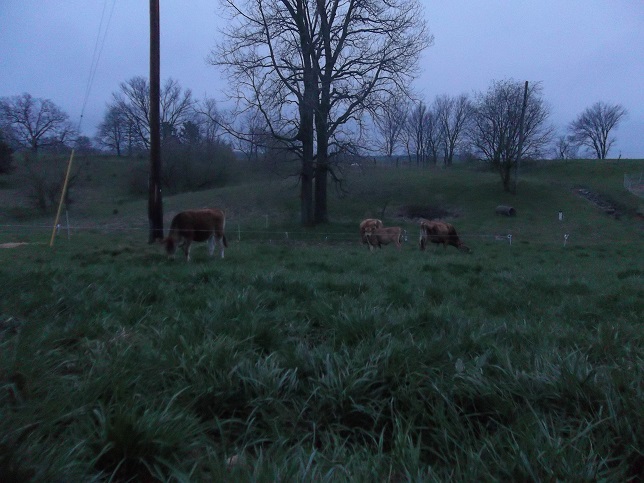
CowsGood night cows.  We have nearly 3″ of rain in the forecast for the next 30 hours.  I’ll do my best to keep your hooves on fresh ground and your bellies full.

After this hill we’ll take the cows back over West of the cemetery and work our way to the West.  Hopefully when we get there they will be joined by some new friends.  More on that another time.

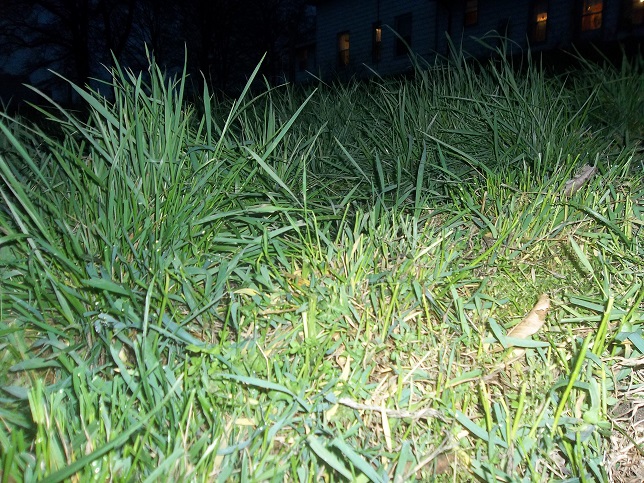
Sorry the pictures are dark.  I had to take pictures after chores were finished…after I got off work.  Lots to do getting ready for the next round of monsoon.