Reading Journal 2015 Week 7

Malabar Farm by Louis Bromfield

What a great book. Special thanks to SailorsSmallFarm for sending it to me. I would not have gotten to it so quickly otherwise. In fact, SSF has suggested a number of books I have enjoyed and may be my favorite librarian.

I’m going to have some fun with this book because I really am enjoying it. But I also think the author was a bit windy here and there. Please don’t mistake my humor for a lack of respect. I will revisit this book soon and encourage you to do the same.

I am currently at the halfway point of this book. My goal is to read a book each week but I just couldn’t muscle through this book in a week. There is too much to think about.

What is the book about?

That should give you the basic idea. There was a certain tone expressed in the book…that of a wealthy intellectual out to set some things straight, addressing his adoring public. Maybe that was just a style of the time. Let me give you an example. As you read this, contrast it to Oliver from Green Acres puffing out his chest and pontificating on the virtues and values of the brotherhood of American farmers.

…our own philosophy that the good farmer is a man who knows as much as possible, never stops learning, and has the intelligence to apply his knowledge and information to the conditions and the program of his own piece of land. It is the kind of farmer we must have in the nation and in this world; it is the kind of farmer we will have inevitably because the other kind is certain to be liquidated economically, despite bribes, subsidies and price floors and their land will be taken over eventually by those who cherish it and can make it productive and maintain that productivity. In the world and even in this country, where there was once so much good land that we believed it inexhaustible both in fertility and in area, mankind, if he is to survive, cannot permit agricultural land to be owned and managed by the lazy, the indifferent and the ignorant.

I don’t know that I disagree. It’s a fair summary of capitalism too. But there’s something in the tone. Oliver sounds naive but entirely lovable. At times, Bromfield is just preachy.

I would also like to add that this book is a follow-up to another of his titles, Pleasant Valley. I haven’t read Pleasant Valley but I think I would like to.

Is it a classic?
Yes. Published in 1947 and affecting my farm today. For large portions of the book I felt he was dragging it out but every so often, in unexpected ways, he would cut to the quick. I would stop and read aloud to Julie.

Will you read it again?
I almost can’t wait. Reading this in a week is like trying to go to seven family Thanksgiving dinners in a single weekend. Too much. Even spread over two weeks it’s a lot to digest.

Does it belong on your bookshelf?
I think I always say “Yes” to this question. Yes.

Can you relate a favorite passage?
Brace yourself.

Mrs. Johnson appeared and turned out to be very intelligent having had many years of experience working along dietary and nutrition lines. She was very interesting about her experiences with the dreary Okie camps in California during the bad years. She agreed that after the post-war boom dies down, we shall have the armies of migratory workers, dispossessed from poor, worn-out land, back on our hands, a liability, not only in relief and taxes but a moral, physical, and spiritual liability to the nation. The economic-human problem of the “poor whites” and “Okies” is an extremely complex one which in the end can be solved only be dealing with fundamentals – soil, diet and education in that order. Poor, worn-out soil produces specimens handicapped physically, mentally and morally from the very beginning. Food grown on such soil from which calcium, phosphorus, and other vital minerals and elements are exhausted can only produce sickly specimens, both humans and livestock. Wretched diet aggravates sickliness, and poor, under-nourished, stupid people make bad farmers who only destroy the soil still further. Education comes third because it is useless to attempt education with people sick physically and mentally from deficiencies of vital minerals. It is no good trying to solve the problem by taxes, WPA, charity and relief, although these may be necessary in time of acute crisis.

From Chapter 4, he is often lamenting large cities and industry…though he is also pushing for more efficient, industrial farm production…away from generalist farming. (Cue the fife!)

It is remarkable how people are becoming interested in these things – a very hopeful sign. If we can overcome the evils, economic and social, which industry and great cities have brought us, we shall be making progress. That is the frightening element in the recent elections. A growing urban proletariat without economic security can wreck everything that America has been in the past and darken the whole of her future.

Going back in time to chapter 2 we can see what he wants for the regular family (as inspired by The Have-More Plan). Farmers should specialize. But everybody else?

The general, widely diversified, and self-sufficient program is, however, admirably suited to the small-scale enterprise of industrial, white-collar and middle-bracket-income citizens with a few acres in the suburbs or in the country itself. This category of small, largely self-sufficient holdings is increasing constantly in numbers and it provides not only a bulwark of security for the individual but a source of strength for the nation as well. A well-managed small place with vegetables, fruit trees, chickens, perhaps a pig or two and a cow provides not only a source of large saving in the family food budget, but it also is a source of health, recreation, outdoor life, and general contentment for the whole family.

At this point, I have to hand the reins to Oliver again.

On the topic of The Have-More Plan, I just want to point out that farms don’t solve problems. Relationships are hard. Business is hard. Work is hard. Life is hard. But harvest comes in due season…if you can survive that long.

When Ed asked for a divorce, Carolyn told Judge House, “I felt like a work horse being turned out to pasture.”

There is a chapter titled, “Malthus was Right”. I think Malthus was right. At some point, it is theoretically possible that we could breed beyond the population we can feed. But I think he is also wrong. The chapter is in support of the notion that we should scream in terror as we approach the Earth’s human carrying capacity. He points to inefficient agricultural methods as some of the reason but, really, proposes no solution. In earlier chapters he bragged that he could keep a cow on every acre of his land. There are 2 billion acres of agricultural land in the US. But there is no proposal to raise cattle and sheep instead of corn, corn, corn…though he does complain about the practice of raising corn, corn, corn and hogs, hogs, hogs and, worst of all sins, of feeding corn to cattle…though he feeds corn silage to cattle. All of Africa. Australia. Russia covers 12 time zones. What do you mean we can’t feed ourselves? We have not yet begun to graze! There were two chapters about what a great healer of the Earth grass is…and anecdote after anecdote supporting the idea that the Earth is better for our management than it would be without it…and yet, he suffers from hysteria and despair that there are too many people. Let’s not be hysterical. Let’s start doing. And while you take a break from all the doing, do a little writing, make a video…find some way to share what you are doing with others to help them get started. Then they can do the same. And on it goes. Like network marketing of global agriculture.

Who should read this book?
There are portions of this book that I thought were fluff. Whole chapters of journal entries that I thought I should skim. A chapter about dealing with bluegill populations (by catching them and dumping them in a stream or neighbor’s pond) and another on his love of his pack of boxers. But overall I think this is a great book…a book you should read to further your understanding of “modern” agriculture.

But there is a lot of fluff…or what struck me as fluff. Let’s talk about growing grass for two chapters, shall we? OK. Here’s the low down. Lime your soils with two tons to the acre then rip the hardpan. If you have weeds and poverty grasses, rip those out and cover the soil with them. Now, add in chemical fertilizer, barn compost, 9 pounds of alfalfa, 5 pounds of brome grass and one pound of ladino clover. Focus, over time, on increasing your soil organic matter so the land can sponge up more moisture. That’s it. Sure, it won’t work just anywhere but it worked great here.

I summarized two chapters in that paragraph above. Two whole chapters. However, Bromfield was writing to help change the future. I live in the future.

Take home messages:
I’ll wrap this up next week when I finish the book.


Can you believe that’s the only book I worked on this week? No links to articles about space. No lecture on the positive virtues of Minecraft. Just keeping busy and staying warm.

Hope you are doing the same.

Cold weather this week. I plan to spend a fair amount of time by the fire reading a book. I need to do some recreational reading this week too. Maybe another book by Wodehouse or a book in the Dune series.

Please discuss this book with me. I hope you are reading it too. Share your favorite quotes or let me know if I have missed the point. Please don’t let me remain ignorant. Help me explore these ideas.

Click here to see all entries in my reading journal.
My Valentine

January 29, 2015

It’s going to happen again. Valentine’s day. Julie’s February birthday. Shoot. I need to plan for that somehow. Two weeks.

Two weeks.

Two.

Weeks.

No idea what to do this year. Chocolate covered strawberries?

February 1, 2015

I still don’t know what to do. Just…you know. And you do know, don’t you? I love you. I love you a lot.

When we read Love Languages we identified what yours is. But that’s not mine…so I don’t know how to do it. Quality time? What do I do? Just hang out? I have stuff to do. Can’t we go do that stuff…but together? Doesn’t that count?

Probably not.

February 2, 2015

I have daughters!

Now what? OK. Maybe I could give them a block of diamonds in Minecraft? I could code in an unbreaking pick axe for both. Hmmm. What are their love languages? The older girl likes to cook. Acts of service? The younger one is a snuggle bunny. She likes to be with me, holding my hand when walking. She usually gets up when I do and she stays near me. But the older one? What is her language? How can I make her understand that I love her? How can I meet her at her level? Bake cookies together? Zucchini bread?

February 4, 2015

Julie, do you know that I love you? I love you every day. Why do I feel all this pressure on some arbitrary day in the winter? I love you.

February 6, 2015

Julie found this in my drafts, read it and asked me to omit certain details. Particularly a note about how great she looked in her workout clothes. So I took that out. But still, she looks great.

February 13, 2015

Shoot. It’s here. It happened. There was some discussion about going out to dinner or going to a church activity or something. That’s not what I had in mind. I thought we could get a couple of steaks and a bottle of wine and just spend the evening together at home. She got some steaks from Steve today and asked me to pick up a bottle of wine on my way home. Wine is difficult. I could get the $5 bottle of funky stuff that smells like a wrung out gym sock or the $10 bottle of funky stuff that smells like a wrung out gym sock or the $4 bottle of sweet red who knows what that doesn’t taste too bad and isn’t too sweet. $4 it is then. What a great date I am.

What about the girls?

Let’s revisit that chocolate-covered strawberry thing. Maybe that’s something I could do with the kids. I think “With” is more important than “For”. With. OK. Good deal. Need a bag of white chocolate chips and a bag of milk chocolate chips.

OK. The whole Valentines Day, Dad/Husband thing is in good shape.

If you haven’t figured out Valentine’s day for yourself I’ll leave you with some words of wisdom from Brak.

Well, They Were Full…

The cows were checked at 3:00 in the afternoon. Everybody was fat, full, napping and chewing cud  in the sunshine so she decided they didn’t need another section of pasture for the day.

The next morning? Empty bellies all around.

What happened?

She looked at the wrong data.

You know to look at the cow’s left side, between the rib and the pelvis to see if there is an indentation or if the rumen is full, right? Cool. That’s what she did. The cows were full. But she didn’t look at the pasture.

When the cows got up in the middle of the night for a snack there was nothing left to eat. The cows were full at 3:00, seventeen hours later they were not.

Being people who want full cows, we took several lessons out of this experience. We have to look at the cow. That’s good. But we also have to judge the pasture. That is particularly difficult as everything looks brown to us and the cows seem to graze fairly selectively. But we have all kinds of pasture remaining ungrazed. All kinds…like 15 acres. And grass will start growing in a month so there is no need to be stingy with it.

And we have all kinds of hay remaining. As extra insurance, I’m going to just put out 20 or so small squares right in the paddocks so Julie just has to untie and spread them a little. If we offer too much hay and the cows use some for bedding the chickens will scratch it out later.

The cows didn’t get enough to eat overnight. One night of that treatment is not a huge deal. But it shouldn’t happen again tonight. Tonight they will get an extra move.

Reading Journal 2015 Week 6

So what’s the deal? What’s with all the books?

Some years ago (maybe 2006?) Pastor Mark used a Charlie “Tremendous” Jones quote in a sermon. I’ll just let Mr. Jones tell you in a couple of clips.

Here is the quote pastor Mark shared:

That’s what it’s all about. I would encourage you to find more of his materials and give them a look. Apparently he had a spare house to hold his library. Julie just rolled her eyes.

I’m making a few formatting changes each week trying to make this more of what I want it to be. I don’t think I need to publish an in-depth review of everything. Sometimes I just want a record of what I have read.

This coming week I plan to read Malabar Farm. A friend sent me a spare copy she had. I’ll be pressed to get through that book as it looks meaty and Spring is upon us. Chicks will arrive on the 17th. I still don’t have pigs. We are putting garden in a greenhouse but otherwise we are a little behind on our work list. My reading time is suffering.


Farming Manual by George Henderson

What is the book about?
How to get it done by the man who got it done. The Farming Ladder is Henderson’s overall farming philosophy wrapped up in a neat little package. The Farmer’s Progress is more detail focusing on getting young farmers started. This book is more about Henderson as an older farmer passing on hard-won experience. He is detailing everything from training youth to work efficiently to training us in hedge laying. There are things that just don’t transfer well via text but I’ll save my criticism for later in the post.

Is it a classic?
Yes. All three of his books. I don’t care how many aluminum cans you have to pick up to pay for these books. Buy them. Read them. Treasure them. Not kidding.

Will you read it again?
Oh, yes. Several times.

Does it belong on your bookshelf?
Get the other two books first. A reader linked me to a .pdf of this book but the file was structured so facing pages were presented both at once. There may be a way to present single pages but it was beyond me…and beyond frustrating. I couldn’t read the .pdf on the screen of my phone. So I bought the book. And it wasn’t cheap. So my long-winded answer is that I didn’t find the .pdf readable so I had to get a physical copy to read. And it will now live on my bookshelf forever. Your shelf? How much of a completionist are you?

Can you relate a favorite passage?
Well, let’s start at the beginning.

Start at five o’clock and do an hour’s work until breakfast time. An hour for breakfast and start again at seven o’clock. A twenty minute break mid-morning with a  glass of milk, fruit or a scone. A good meal at midday and a rest until one o’clock. Half an hour for tea at four-thirty. Another two hours’ work, followed by a light meal will complete the day without any sense of exhaustion at any time. If one rests on Sundays between the mid-morning break and tea time, it gives you a seventy-two-hour week, and if every hour is properly planned and organized the output of work will justify the effort involved and will leave a sense of quiet satisfaction and achievement. The work must also be planned to give variety and interest, one would not want to hoe sugar beet for seventy-two hours. From labour health, from health contentment springs.

Well, that certainly fits with last week’s ideas from Elon Musk but I like his notion that you need a variety of work throughout the day. There are certainly seasons when it is appropriate to work 10 hours on a single task but every day for a few months? No thanks.

The habit of reading, and deriving knowledge from books, is essential for any young man who wishes to go far in farming. It is worth studying how to read quickly. A practiced reader will read the introduction carefully, which should describe the purpose of the book, and then flip quickly through and make brief notes on the sections which will merit closer study. In some books there are whole chapters which may be skipped altogether. The skill in quick reading lies in directing the eyes between the lines, and it will be found that whole phrases instead of individual words are being taken in at a glance.

But all you read are mere theories until we have tried them out in practice. Whatever comes to us, good or bad, is usually the result of our own action or lack of action.

So work hard and read a lot.

At a later point in the book he is talking about seeking maximum efficiency as we move toward mechanization on the farm. He points out that it costs

£4 to the acre for custom combining, often leaving a lot of grain behind on the ground (one grain to the square foot is 4 lb. to the acre), and then a further charge for baling the straw – if weather permits.

And later,

Nine-tenths of the crops we grow are cashed in through animals.

You know what I want? I want an hour to drink coffee with George Henderson. I know he is frugal but he’s suggesting we build a rick with our grains. Why? Because that’s a cheap way to store it. Sure, why not. But then what? Well, you have to thresh it. OK. So what if you have to combine 3,000 acres of wheat? Well then, we’ll use a machine and leave some on the ground.

Have you ever seen a corn field in the fall? Around here they get the corn (maize) out in September most years. We get a warming spell in October and the fields that haven’t been plowed will look like they have been replanted with corn. Not just the end rows where the corn head knocked the stalks down leaving whole ears in place, the whole field. Terribly wasteful. But it makes more economic sense than putting an army of people to work gathering $3 corn out of the stubble.

And if 90% of the grain goes to livestock anyway, why not let the livestock glean the fields? They’ll add fertilizer while they are there.

So, Mr. Henderson, I await your answer. In the meantime I’ll try a few things out on my own. I understand it is easier to transport one pound of pork than to transport three pounds of corn. That’s why so many farmers around here have confinement hogs. I get it.

After a lengthy chapter on human anatomy to help us understand and observe why we need to work certain ways he closes by saying,

A person who would take exercise in preparing for farm work will find there is nothing to equal walking with a good posture.

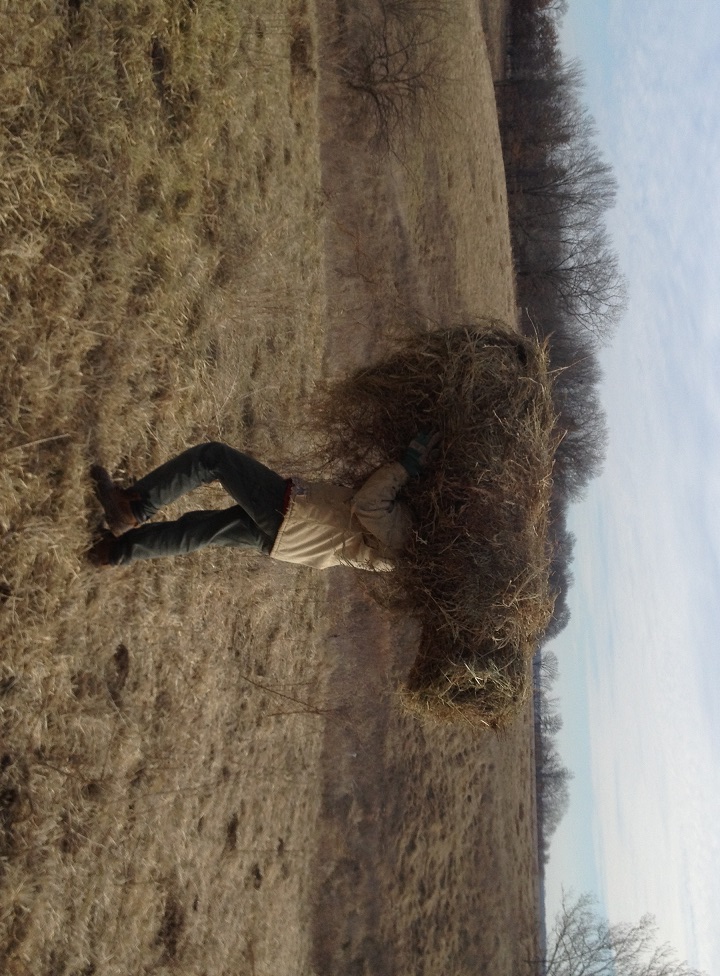
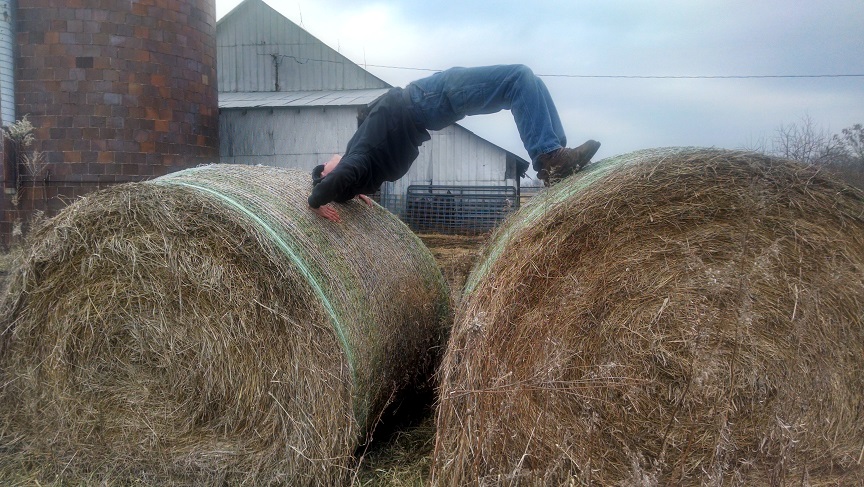
I think that’s pretty good advice. Go take a walk. It’s February 8th today and the weather is particularly spring-like. In fact, I may have entirely missed the maple sap. We spent the entire day outside yesterday and it was great. We walked to the woods in the corner of our property, cutting thorny sprouts along the way, hoping to find deer sheds (too early). But all six of us, my brother in law and my two nephews were out in the mud, climbing on hay bales, crushing ice under boots and having a good time. Go for a walk. Even if you’re not a farmer.

Who should read this book?
Read through the table of contents in the .pdf. The book is honest about the subjects it covers. If you want to read Henderson’s detail on hedging, feel free to read what he has to say. If you want to learn about hedging though, this book won’t get it done. Watching YouTube might get you a little closer. But you’ll probably have to find somebody to work with for some time to really get it down. Reading this book was, for me, less about the content and more about gaining a better understanding of George Henderson.

Take home messages:
Mr. Henderson read everything he could and, as this book shows, worked to bring it all together. It’s not enough to read for entertainment. It’s not enough to read for information. You have to, as Mortimer Adler points out, read for understanding. Henderson understood.

I think that’s the message to get here. Read beyond the borders of your specific interest. See what else is out there, see how it relates to what you already know and get a better picture of the whole. I think Henderson could see a bigger world than I can at the present time. But I’m working on it.


Article of the Week

I don’t like the “X of the Week” subtitle. I’ll work on that.

Julie and I have subscribed to Graze for several years now. Our friend with the dairy, Steve, recommended it and said he easily recovers the cost of the publication each year. So we did. And I agree.

This month’s issue (Volume 22, No. 2) has an article by Gabe Brown detailing his transition away from a high-maintenance, high-cost of maintenance herd to a low-maintenance, grass-based herd. Basically, Gabe pulled the plug on the herd and kept the survivors. I highly encourage you to read it. In fact, I make it a point to read anything of Gabe’s, though I don’t hold his word up as gospel. He just seems to say interesting and thought-provoking things.

Anyway, he pulled the plug. I’ll quote a little bit here but I want you to make it a point to read the article…somehow. OK? Promise? Pinky-swear? OK.

You have to decide what’s not necessary to your operation. In ours it was all vaccines, de-wormers, pour-ons, grain supplementation and as much hay as we could eliminate in our environment. We got rid of all of them cold turkey, all at the same time.

OK. Great. Now, skip forward.

I’m not going to kid you: That first year, the conception rate averaged less than 50%, which tells you just how wrong our cattle were for what we wanted to do.

HOLY TOLEDO!

But here’s what the article doesn’t tell me…and it’s important. He lost 50%…of how many? A few weeks ago I read the King Ranch book. He talked about keeping 6 heifers out of 1000, culling the rest. Similarly, Phil Rutter talks about hoping to keep 8 of the first 5,000 hazels he plants. So I might suggest that Brown wasn’t aggressive enough. But I might also suggest HOLY TOLEDO! Half of his herd!?!?!?!?

Let’s play with that for a minute. Just a minute, I know you have other things to do with your day. I have 13 cows. Next year, following this plan, I would have 6…plus 3 heifers. What’s the cull rate on the second generation? Was I lucky enough to stop at 50% the first year? Maybe if I had cattle numbered in the hundreds or thousands…I don’t know.

It does seem that this is the time to take my medicine. But I have heard Ian Mitchel-Innes say that you need 300 cows before you close your herd. So what do I do between now and then?

The best I can.

I have to raise my cattle to the best of my ability, selecting bulls with a background on grass. I may even need to cross-breed my herd to increase the value of my calf crop, bring up fertility and take my herd closer to grass. Whatever I do, I think it’s a hoot. And I’m glad you are here with me. Let me know if you are taking the same medicine.

BTW, I recently (within the last 4 months) read Man, Cattle and Veld. Zietsman had very similar feelings but would keep non-performing heifers in his herd to keep mob numbers up. He just wouldn’t keep their offspring for breeding. That’s the approach I’m taking. I don’t like Snowball. Mrs. White and 27 didn’t breed until they were 3. I’m happy to have their calves but I won’t be selecting future bull calves from them because they were late to mature…mostly because they are so danged tall. But this year 70 is going to have to go. She appears to be a non-breeder.

Let’s talk a little more about my cow herd in my post about reading books. I want small cows. I want small cows. I want small cows. Small cows. Not short cows. Not tiny cows. Small. At least in the eyes of my neighbors. Small. There is some concern that if you breed heifers too early you’ll stunt their growth. So what? Why do we care if my cow weighs 1,000 pounds and is frame 4 instead of 1300 pounds and frame 5? We haven’t changed the genetic potential of her offspring, just the expression of her own genetics. So I raise my replacement heifers on grass and they do appear to be a little smaller than other heifers I bought last summer with similar birth dates…but those similar heifers were given corn.

Why does this matter at all? Because every day a cow eats a percentage of her body weight. The more they weigh the more they have to eat. Mrs. White eats a lot. By shrinking my cows I will need less grass to maintain my herd lowering my production costs and, potentially, increasing my output…I just have to make sure my calves have the potential to be everything the market demands in terms of size and weight.

And I think that’s just the kind of change Mr. Brown was talking about.


Please give me some feedback on this post. I read a lot. Like, a lot, lot. I like to share with my readers when I find a book that helps a farmer out. But I also like to be entertained so I include links to movies and music. Fun books too. Please let me know if there are questions I can answer for you or if you have any suggestions to help make this format more meaningful.

Also, let me know if you are doing any of the reading with me…even if you are running behind. Share your favorite quotes. Tell me if I missed the point.

Click here to see all entries in my reading journal.

It’s a Long Walk

My oldest and I attended the Southern Indiana Grazing Conference a few years back. First, I want to express how valuable that conference was to me personally. Every speaker gave me pages of notes I still act on. Gabe Brown was one of those speakers. Just as a side note, Gabe mentioned that cows have legs and a little walk does them good. He grazes through the winter but if the cows want a drink they have to walk back to the barn.

Walk.

CowsWalking

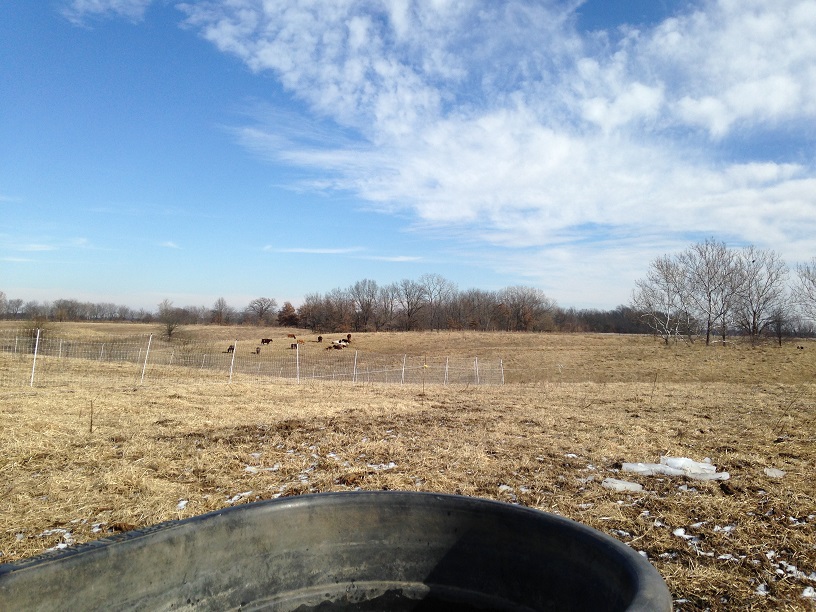
If nothing else, it helps their digestion. Might work for you too. Maybe you should go for a walk. The netting you see in the picture above is for the chickens. That’s not the cow fence.

My cows don’t have to walk too far. Just through a couple of small valleys and they only seem to make the trip once/day. They mostly just drink from a stream that is somehow still running when it’s below freezing out there.

They were just hanging out today. Mrs. White is a noisy cud chewer. (Mrs. White has red on her face. Look, man. I don’t name them. The white one is Snowball or 13.)

I want to make a note about the heifer dust. It’s looking a little…erm…firm. I’ll have to keep an eye on that and may need to up the protein somehow.

The title of this post was inspired by David Allan Coe. It’s a long walk to Nashville. Just FYI.

Dear Charles,

In Sunday’s Reading Journal I mentioned that Julie and I could only even attempt to farm because I have an established career off-farm. I am my own financial backing. I know next-to nothing about marketing, herd management, and grass management. Farming is so much harder than it looks in a book. But we are learning. We are living on-campus and paying for our education. My off-campus job requires me to sit at a desk in the air conditioning for hours on end, 5 days each week solving challenging tech puzzles with people I consider friends. I suppose there are things I could have done to accelerate our farm’s earnings but I’m OK with moving slowly…adapting my lifestyle as I learn.

But I almost missed it.

I got tired of tech. Long, late nights and listening to morning radio as I returned home for 2 hours of sleep then back to it again. On-call rotations working with remote technicians in remote places. No sunlight. Cubicle hell. Low pay.

But I enjoyed woodworking. I made bookshelves, a hutch for our kitchen, beds for my kids, crown molding…I wanted to work in a wood shop. Surely that would be better than working in a data center for another minute.

I met a man who owned a cabinetry shop nearby. He spent quite a bit of time with me on a Tuesday evening and was probably late for dinner. He said he could tell by the sound his equipment made whether or not the employee was running the machine at capacity. He explained to me that he would be happy to hire me but he hoped I would reconsider. I would be better off, he said, to stick it out and apply myself in my career. In time it would bear fruit.

That was 2003. I would like to thank Charles for his advice.

Dear Charles,

You were right. I will never know what could have been and I don’t care. I have no regrets (about that decision anyway). I continue to do a little woodworking as a hobby but stayed the course in my career. And, surprisingly, I’m not unhappy.

Some of this is because I have simply decided to be happy where I am. …to grow where I am planted. But some of it is maturity. I live in a dream world…on my family farm with my wife and children, next to my parents. I don’t think this could have happened if I had given up on my career.

At what I feel was a critical point in my life, you gave me the push I needed. I stuck it out. I studied. I worked. I did what you said I should.

And, at least to this point, I am winning.

Thanks for the help.

Chris Jordan

My job can’t make me happy. Neither can my farm. I have to make me happy. Most of that is a simple decision.

Will I ever farm full-time? I think so. But I can’t make that leap immediately. I have a lot of learning and growing to do. Biological processes take time.

But wait! There’s more.

It is true that Julie and I are only here because I have a job. But Julie and I are also only here because Julie doesn’t have an off-farm job. If you ever want to make me angry ask, “Chris, does your wife work or does she stay home?”

Julie does more before 9 am than most Army folks do all day. Julie makes everything work. Chris is just a worker. Just like his job, Chris has to wake up every morning and make a decision to continue in his relationship with Julie. Chris has to make decisions to keep strengthening bonds and support, encourage and enable her in her work. I choose how I feel about Julie. And I choose to love her. Every day.

I could continue listing factors that make living here possible but that has nothing to do with Charles. Today I was thinking about Charles.

Reading Journal 2015 Week 5

This is turning into an endurance race and I’m stretched a little thin. To help with the time crunch I have started getting up at 4:30 but making myself go to bed at 10. I may have to start staying up 30 minutes late though. Another thing I am doing is allocating blocks of time for specific activities. Not really my bag but it seems to work.

This week was particularly tough because of the programming book I included. The book is great and easy to understand. Knocking out 4 chapters/day while writing out all the code? Not easy…even though I came into this experienced. Next week I plan to back off a bit. A reader recently sent me a link to Henderson’s Farming Manual and that should do for the week. Want to read it with me?

Skip around if you want but please take a moment to read the “Article You Hafta Read” section below.


Born Again Dirt by Noah Sanders

What is the book about?
It’s kind of a Bible study, kind of a lecture on proper Christian attitudes on the farm. Kind of a book about Christian life and attitudes. Kind of a book about permaculture that doesn’t say the word “Permaculture”.

Is it a classic?
No. Yes. Maybe. Honestly, I would have a better idea on this one if Julie had read it with me. This is a discussion book, not one to read in isolation. I had a hard time narrowing down the favorite passage section because I kept finding ideas I wanted to run with. Not that these ideas are necessarily new or profound but the book lays the ideas out neatly and in a way that begs for discussion. So fun to read? Yes. Good for discussion? Yes. Food for thought? Yes. Classic? …maybe.

Will you read it again?
No. Yes. Maybe. I think I will refer to it from time to time. More later.

Does it belong on your bookshelf?
Um…I would have been happy to borrow it. I’ll probably loan it out. Maybe it won’t come back. Maybe it will. Not too worried.

Can you relate a favorite passage?
I list this passage in direct contrast…or maybe in support of…hmmmm. I’ll try again. I list this passage to accompany the ending quote I used last week when discussing Gladwell book (Outliers). Sanders says the following:

If you are a farmer, then you realize that you aren’t in control of everything that affects your farm. Rain, hail, drought, disease, and pests can impact the production and fruitfulness of our farms, and we can’t do anything about it most of the time. Even if nothing ever went wrong, we still can’t take credit for things going right. We can’t make things grow. We can plant seeds and care for animals and water the ground, but unless God causes increase we won’t accomplish anything.

As Christian farmers we must recognize that we are completely dependent on the Lord to make us succeed. A successful farm comes not from our own strength or skill, but from God blessing our faithfulness.

Arkush said that’s fatalistic and pessimistic, belonging to a feudal system. I mean, “The Earth is the Lord’s and the fullness thereof.” My farm is not mine. I just get to use it for a while. “Everything in the Heavens and the Earth is yours, O Lord. We adore you as being in control of everything. Riches and honor come from you alone and you are the ruler of all mankind; your hand controls power and might and it is at your discretion that men are made great and given strength.” It’s all his, man. The cattle on a thousand hills. The gold. All of it. And anything I do I do in his power.

So do I agree with both thoughts? Um… Well, you know, either you believe in God or you don’t. If you do believe in God, what kind of a god is God? Is God the kind of deity standing idly by as we spin out of control, are we pets to be looked after or are we companions to be blessed? I choose the latter. Any post-creation example in the Bible of a miracle requires action by man. The widow had to get jars and pour oil. Noah had to build the ark. Seriously? Did God need some dude to build a boat to save animals? Moses had to keep his hands up. Hands. Someone had to get jars of water for Jesus. Why didn’t Jesus just miracle up some bottles from a future French vineyard? Because we have to do our part. There isn’t much I can do to make a seed sprout…short of making the conditions right. And I’m not sure the Chinese proverb listed by Gladwell contradicts the book of Proverbs…”All hard work leads to profit, but mere talk leads only to poverty.

Back to the book.

This sounds familiar:

the income for the average farming family is now the same as for other farming occupations. However, the study admitted that eighty-seven percent of their income came from off-farm jobs!

The author is referencing a publication from 1997 called Rural Conditions and Trends but I can’t seem to dig it up. But I don’t doubt the trend but I’m not sure it’s honest. There are all kinds of distortions in these figures. Let’s go a little different direction. Where I live the average age of farmers is above 65. Why is that? Is it because nobody younger wants the farm? That doesn’t appear to be the case here. Plenty of kids Julie and I went to school with are still working on their family farms…but they have businesses of their own. Often they haul grain or rock so their occupation is “Truck Driver”. The oldest in the family typically owns all of the land and has a big life insurance policy to help manage the transfer.

Many of the farm wives around are school teachers or nurses. They are the primary source of off-farm income. What happens to the on-farm income? It gets plowed back into the farm to lower the taxable income. New trucks, new tractors, new buildings…it seems the worst thing a farmer can do is show a profit. Of course 87% of income comes from off-farm! Just like the average age of farmers, we haven’t identified a problem…we have identified a strategy. I’ll hit this topic more personally in a bit.

Here’s a gem:

I believe our farms should be homes that are beautiful and fruitful, not just workplaces where we also live. Many times our farms can take over our lives because we never leave our work and go home. We tend to work all the time because we live where we work. However, as good as work is, our lives are to be primarily relationship-oriented (God and people), not work-oriented. Therefore we should view our farms as, first and foremost, our homes, and not a production factory where we live.

Who should read this book?
There is a lot here and this isn’t one to skim lightly through. This would be a great thing for a farming couple to work through or maybe even share with a Bible study group. Especially a group with little or no experience with sustainable farming practices.

Take home messages:
The chapter on marketing and pricing is very good noting that

A good steward doesn’t waste or just retain his master’s property – he adds to it.

If we aren’t seeing increase …well? We might as well put our money in a hole in the ground. And Jesus said that behavior isn’t rewarded.

If we were doing our job of honoring the Lord the Earth would be beautiful, fruitful and habitable. My farm is a reflection of my efforts toward God’s design. Yipe! He quotes a lot of scripture in this book…all of it pointed at me.

One who is slack in his work is brother to one who destroys.
Proverbs 18:9

And just go ahead and read Proverbs 24:30-34. Go ahead. Then come tour my farm. See my thorns, weeds and weak fences. My failing buildings. My junk piles.

I have some work to do.


Hello World!: Computer Programming for Kids and Other Beginners (Second Edition) by Warren Sande

Let’s go to Christmas of 1994 together, shall we? Julie’s parents bought a 486 computer with 4 MB of memory and a dot matrix printer! It even had a “Turbo” button! At the time memory was something like $100/MB but we needed more…somehow. We had trouble getting Warcraft: Orcs and Humans to load if we exited Windows to go back to DOS. The solution was to put a menu in the Autoexec.bat. We gave it 20 seconds to choose to boot to DOS with anything unnecessary stripped out of the boot cycle or just to boot to Windows. Our problems were solved. And it was all magic in the land before the Google.

This book took me back to that time. That level of excitement. Even one of the games I played at that time. I can’t tell you how much fun I had playing this book…I mean…reading this book this week. I want to be clear here, I started off working through 4 chapters each day in this book but that pace could not be maintained. There is just too much work required of the reader. I did not finish this book but I will. One week just isn’t enough time.

What is the book about?
Breaking python programming down into bite-sized portions while making it interesting and available to the uninitiated.

Is it a classic?
No. Things change too quickly in tech. This book is pretty awesome though.

Will you read it again?
Only as my kids go through it.

Does it belong on your bookshelf?
Yes.

Can you relate a favorite passage?
Chapter 10 makes a clone of Ski Free! I spent hours playing Ski Free more than two decades ago and had totally forgotten it.

Who should read this book?
Anyone who wants to dip their toes into a deep body of water. Might be dangerous out there. Might be fun too. Adventure awaits! Make it up as you go along. I recommend it for 14+ and work through a chapter/day, repeating most chapters and giving a little cushion of time. Give yourself 2 months to really get it done. This is not a novel. You have to re-train your brain.

Whatever you think of Heinlein, programming a computer is on his list of things everybody should be able to do. This book is a great place to start.

Take home messages:
Programming doesn’t have to be boring.


Article You Hafta Read

I imagine you, reader, want to ask me a question. Maybe something like this, “Chris, this is a farm blog. You use your farm blog to discuss your efforts to inspire your children to advance your ambitions and make them their own. Why do you talk so much about computers?”

I’m glad you asked. Are you ready for my answer?

I know which side my bread is buttered on.

With that introduction, I think you should go read this article then come back for some more thoughts. If you don’t want to click I’ll summarize. The author is, appropriately enough, a writer. She is discussing how writers afford to write and the dishonesty with which they address that very subject. Let’s apply that to farming.

I am the seventh generation on this farm. You know how much money and land I have inherited to get here? ZERO. I took over a crappy, smelly, leaky, drafty farmhouse on a farm with porous fences, failing pond dams and pastures filled with cowpaths and thorny trees. This wasn’t a working farm when I took over. This was a big hole that eats money.

My farm is sponsored by my incredible job in town. A job that requires me to continually update my skill set or they will pull their sponsorship. My farm is also sponsored by my job in Florida…a job I do on my vacation time…another job that will pull my sponsorship if I don’t stay certified in my tech field. Yeah. My farm is also sponsored by some other work I do on the side here and there.

The author above says she is largely sponsored by her spouse. I feel the same way. In addition to everything else she does, Julie runs the farm when I’m at work. But it doesn’t stop there. Mom and dad are always around. Dad checks chicken water, waters rabbits, owns tractors I don’t and lets me use them. And it doesn’t stop there. I have somehow managed to surround myself with supportive, caring people. Did you read above where I said, “Julie’s parents bought a 486 computer…”? That computer is a big part of the reason I have the job I have (and a big part of the reason their youngest son has the job he has). And they buy chicken from me!

But having people rooting for me isn’t enough. I still have to do the work. I still have to code. I still have to build fence. I still have to be loving toward my wife and repay the investment others have made in me.

Someday someone might ask, “Chris, how did you build the farm into a dominant, interplanetary enterprise?”

I will answer “I surrounded myself with loving, encouraging people, worked hard at my town job and read like it was going out of style. We also lived on less than I earned and reinvested all farm income.”


This Week in Media

On the topic of 100 hour weeks I found the following video.

…figure out if something really makes sense or if it’s just what everybody else is doing.

If you have read my blog for any length of time at all you know I am constantly wrestling with my own motivations. I thought this was a powerful video.

You should take the approach that you are wrong. Your goal is to be less wrong.

Just watch the video. I can’t transcribe it all.


Please give me some feedback on this post. I read a lot. Like, a lot, lot. I like to share with my readers when I find a book that helps a farmer out. But I also like to be entertained so I include links to movies and music. Fun books too. Please let me know if there are questions I can answer for you or if you have any suggestions to help make this format more meaningful.

Also, let me know if you are doing any of the reading with me…even if you are running behind. Share your favorite quotes. Tell me if I missed the point.

Click here to see all entries in my reading journal.
Back to the Barn. Again.

I keep the cattle on pasture as much as I feel like I can. Feel. We play it by ear. I don’t want to pamper my cows but I also don’t think it’s good for them to be out in rain on a 33 degree night when the temperature is dropping. Especially when it’s so easy to just open a gate and stand up a temporary fence so they can be warm and dry in the barn. I am also concerned for the pasture itself. Plus, it’s no fun walking way out in the pasture to check cows when it’s sleeting and the wind is blowing. Let’s save the farmer (Julie) a little trouble.

MrsWhiteSycamore

Saturday’s forecast keeps changing from 3-5″ of snow to half an inch of rain and back again. They can’t seem to decide. Either way the cows will come in Friday evening. No soupy pastures. No cold, muddy cows.

Take a look at the picture above. That’s fresh ground. The cows are always moving to fresh ground. There are good root systems under the standing grasses, plenty of stuff above ground…we don’t let it get all trampled, manured and soupy. It is getting torn up around the mineral feeder though. That’s on me. For the most part, we are adding manure without degrading the forage stand. That’s a big part of the plan to move cows in before the storm.

CattleBarn

Please understand, this is not a prescription. The world is full of cattle living life outdoors. This is just us doing what we are doing this weekend. I’m not telling you how to do it. I’m making a judgement call and a note in my journal. “On January 30 we took the cows to the barn because of weather.”

Friday morning or Friday evening I have to find time to move a dozen or so square bales of hay to the cattle barn and a half dozen bales of straw. There is no loft in the cattle barn. Note to self: Add “Build a loft in the cattle barn” in May to the year’s work list. Also add “Cut wood for loft with sawmill” in April/May and “Cut trees for sawmill” in February.

Saturday the cows and I will be indoors. They will be chewing cud. I working my way through a small stack of books and a big cave in Minecraft.

Not So Good Hay

We had a wet summer. Don’t look a gift horse in the mouth and certainly don’t complain about rain in the summer…but Geez! We were two months late getting first cutting hay out. The alfalfa was all stemmy and went to seed.

We didn’t cut until July. Even then it got rolled it up wet. It must have rained every three days…not a way to cure hay. You reach a point where the future hay is negatively impacted by not cutting the old stuff. We were there. We had to get that stuff out so we could grow better next time. So my cousin cut and took his share.

30 bales of stems that were fat and woody and had fallen over onto the ground with new growth coming out of them. Awful stuff. Not a single bale I can feed to a cow out of the first cutting. But at least it didn’t burn up. I saw these at a friend’s house recently. He’s lucky it didn’t catch fire. Some years ago my cousin had sudangrass where he later planted the alfalfa field. There are still three or four black bales at the south edge of my property entirely blackened. It happens.

BurnedHay

What in there would catch fire you ask? Well, you have a wet mass of organic material. Biology begins to work. Life creates warmth. Respiration. Reproduction. Growth. Waste. Cellular Mitosis. The bale in this case is little more than a big compost pile wrapped in plastic netting. That can burn. So can a compost pile. So can a pile of wood chips.

Half of my bales are only good for compost. So that’s what we’ll do with them. I’ll gather up the feedlot manure and make a lasagna with alfalfa hay and feedlot and bedding. Then we’ll spread that on the fields. The alfalfa all went to seed so that will be nice.

The other half of my bales? Well…not so good. But not so bad. I just have to play it by ear and let the cows make bedding out of the bad stuff. Or let the chickens scratch through it. Sometimes the center of the bale is moldy but usually it’s just the outer 6-8″. I stand the bale on end and peel off the outer layers. See this smoke?

MoldSpore

That’s not smoke. It’s mold spore. That first 30 bales I was talking about earlier all sprouted mushrooms last summer.

Compost is the only solution. I can’t even use it for pig bedding as it would make them sick.

It’s hard to put up a good round bale in wet weather. Most of our small square bales are excellent though…this year anyway. Squares are easier to evaluate. You know what they should weigh as you lift them by hand. You can dig into the pile and feel for warmth or moisture or you can tear a bale apart and inspect it easily and you can move it by hand. It’s hard to move a round bale by hand. Even just the center of one.

BaleCenter


At this point I’m tending to unroll a bale down the hill and just let the cows pick through it, making bedding of what they don’t want. Dad and I have some concerns about how long a thick mat of hay will persist on the ground but we’ll just have to play it by ear. Hopefully the chickens can scratch it out and the worms will decompose it.

I don’t have any advice here. More than half of my hay is worthless. It’s hard to put up good hay, especially early in the season. I would prefer to just buy it in but hay quality is a concern there too. Maybe dad will weigh in with some ideas for how to ensure hay quality. Hopefully dad and I will have a better hay year in 2015, but still moist.

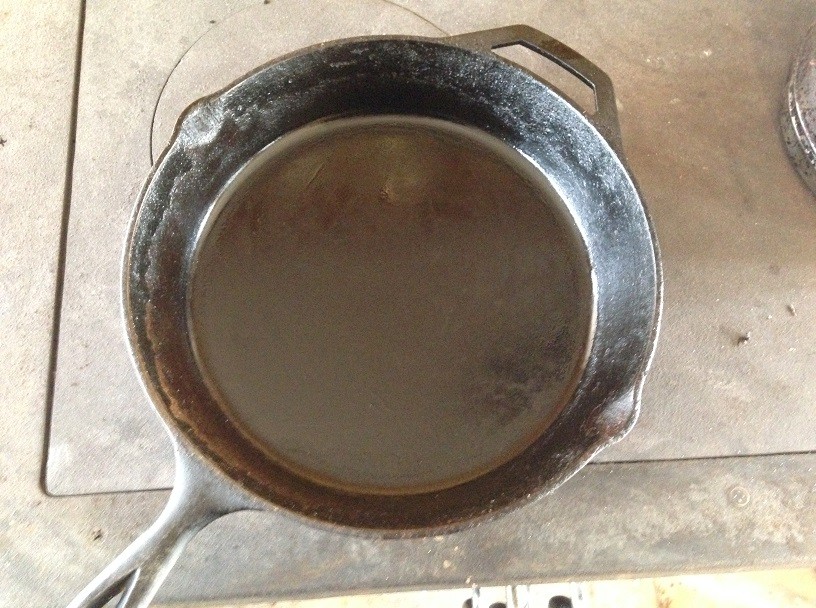
My Iron Skillet

I love our iron skillet. This is our second iron skillet. The first skillet was a wedding present but Julie didn’t keep it. Too heavy, too hard to wash. The dishwasher did bad things to the seasoning. But now we know better. We wonder which of our grandchildren will want it when we are gone? It will still function as a non-stick surface or assault weapon in 100 years.

From the factory the cooking surface was rough. I sanded the skillet with wet or dry sandpaper wrapped around a block of wood and lubricated the sandpaper with a drop of cooking oil to work the day we bought it. I ran out of patience before it was entirely polished but it was close. After that it was just years of scraping it clean with a metal spatula and cooking bacon grease into the surface. mmmm….bacon.

We cook eggs every day. We have made apple pie in it. We cook potatoes. Skillet chili. Pancakes. We fry steaks. On and on and on it goes.

How do we wash it? I don’t. I scrape it clean then cook a new layer of bacon grease in it, wiping it out with a paper towel. You really should use animal fat instead of vegetable oil as vegetable oil becomes sticky. Then we store it in the oven until next time. That’s it. I know, this won’t work in a commercial kitchen.

If the skillet has dried chili in it from the last meal (…ahem!) things are a little different.

ChiliSkillet

I heat up the skillet then pour a little equally hot water into it. That boils off the bad stuff. Then I melt in a quarter-sized drop of bacon grease, scratch that around, wipe it out with a dry paper towel and call it good. BTW, if you use cold water in a hot skillet you will have a lump of cracked iron that is vaguely shaped like a skillet, not a skillet.

CleanSkillet


The sides of the skillet are never polished like the bottom is. You don’t scrape and scratch and chisel away at the sides like you do the bottom. That’s just how it is. If you cook in your skillet for years and years and years the outside will accumulate burned grease coating that is almost impossible to get off. Almost impossible. If you want to be free of the accumulation, throw your skillet in an outdoor fire. When it cools down, give it a little scrub, add some bacon grease and get cookin’ again.

One tip I think helps to keep the non-stick non-stick is to heat the skillet. I know, you people with your new-fangled teflon-coated aluminum skillets just pop the egg in and turn the burner on but these beauties, they need a little more time. Take a little bit to get the skillet warm before you pour in the egg. That instant sear on the bottom of the egg ensures it won’t stick. We usually put the skillet on the stove when we light the stove. By the time the fire is burning well, the skillet is warm enough to use.