Am I Doing This Right?

My farm didn’t come with a manual.  No formula.  Nothing set in stone.  No function you plug values into.    “You take X cows, you take Y acres and you allow Z time and voila, wealth, drought-resistance and ecological diversity.”  No 8-minute YouTube video that will teach you the simple secrets of livestock management on this farm.  Just soundbites here and there.  Things you glean from years of reading books, listening to presentations and, ultimately, doing it all wrong.  I just have to do the best I can and make mistakes along the way.  As an added bonus, I brag about my mistakes on the internet for all to read!

Allow me to describe the farm as I bought it then we’ll take a look at where I hope it’s going…eventually.

House

We moved to the farm house because we had to.  We had a beautiful home in suburbia with really nice neighbors.  We felt safe.  We were obviously weird owning one car, mowing the grass with a reel mower, home schooling our kids and cooking our own food but still, we were able to find meaningful relationships and fun.  I installed hardwood floors, updated the wiring, built bookshelves galore, cabinets and a window seat.  We made the house a home.  But somehow it wasn’t our home…just a place we were visiting.  We began looking for a few acres.  We thought we would go ahead and list our house and by the time it sold we’d find a new place to live.  Well, word of mouth travels fast and before we got the house listed we sold for our asking price.  We had a month to get out and no place to go.

“Well, Grandma’s house is empty.”

So we rented Grandma’s house, not intending to stay.  It was just a place to put our stuff until we could move closer to town again.  Just a couple of acres.  That’s all we needed.  We couldn’t find a couple of acres.  Our business began to grow.  We could no longer sustain our meat, egg and goat milk business on an acre (the yard).  We had to grow.  So we made arrangements with my grandma and my uncle to buy 60 acres of the farm…20 acres now, 40 later.  Hoo boy.  20 acres.  20 acres of thorns.  20 acres that had been grazed almost continuously my entire life and, apparently, had pigs on it constantly before I was born.  20 eroded, weedy, nasty, thorny acres of hills and eroded creek bed far from our primary customer base with the promise of another 40 of the same.  (Did I mention the buildings were (are) in worse condition than the pastures?  How about the fences?)

OldPasture1

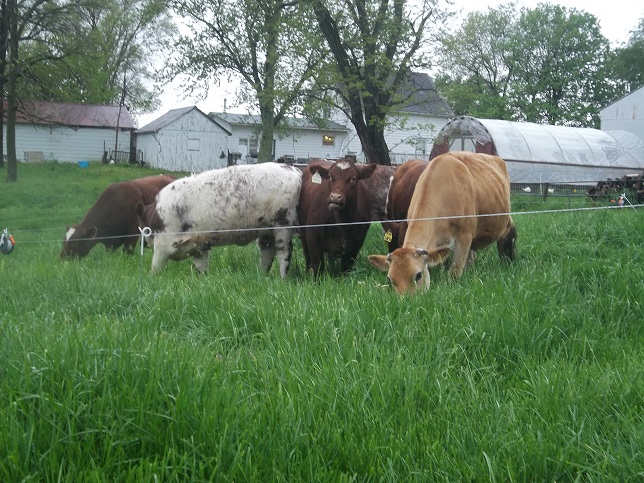
OK.  What’s the plan?  On top of a decade spent reading, studying and getting some hands-on experience we spent the first few years on the farm allowing a tenant to graze the land while we cut brush.  Dad mowed the pasture so we could sled.  Then dad got his tractor tires repaired from thorn damage.  We added chickens and goats in rotation around the tenant’s cattle.  Where the goats and chickens had been the grass grew best.  The tenant’s cows spent most of their time on my 20 acres (not the other 40 acres they had access to) eating, tromping and manuring, though unmanaged.  It was obvious that the pasture was improving, the grass density was increasing and the thorny things were being pushed back (though never defeated) by the goat grazing and the goat and chicken manure.  There were fewer thorns in the sled trails every year.
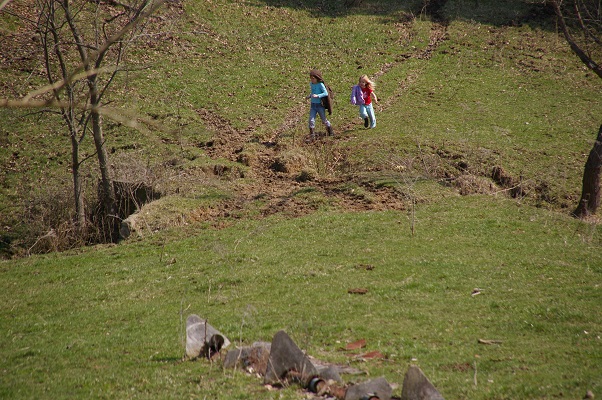
OldPasture

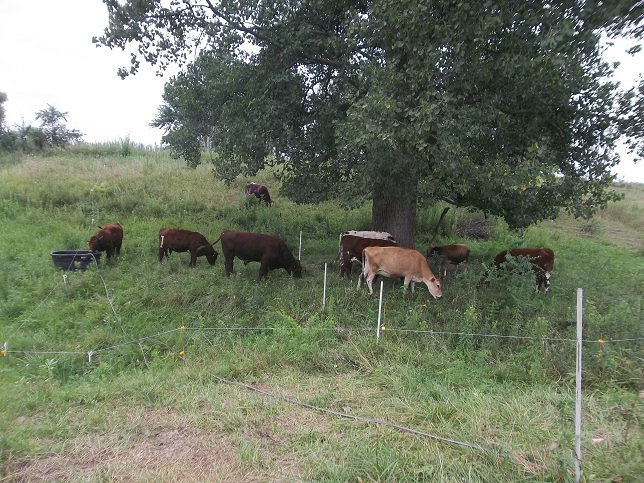
That takes us to now.  The tenant’s cows are mostly fenced out of our 20 (hungry calves still break in from time to time because we have standing grass in the winter and they don’t).  Summer is coming to a close and we are 4 weeks from frost (though it’s over 100 degrees out today).  Our cows are grazing tall pasture in tight, managed, planned rotation.  The girls get fresh forage each day and tromp and manure the ground as they pass.  We overseed where the cows and pigs have already been hoping to increase the diversity of grasses and forbs available in coming rotations…hoping to stretch grazing further into the year with increased plant diversity.  6-12 weeks later we graze the ground again meaning that I have at least 6-12 weeks of standing forage at all times.  Over the winter we’ll graze in strips working to stretch our limited hay supply.  Greg Judy says every inch of grass you can grow is a day you don’t have to feed hay.  If the fall is mild grass could continue growing into December…even if slowly.  Next year we’ll manage all 60 acres.  The plan will stay the same.
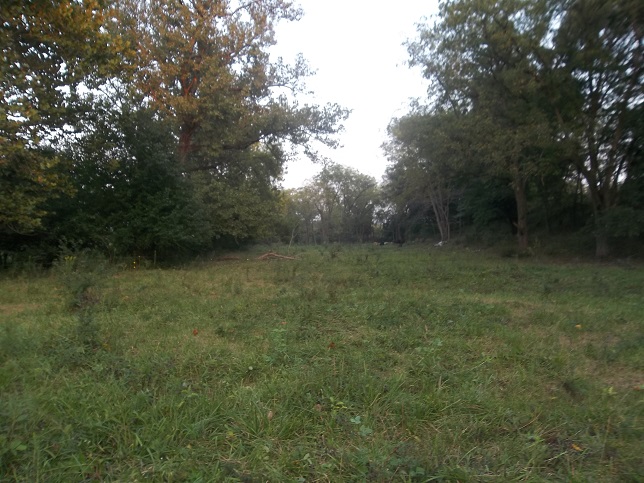
NewPasture

Will this work?  The books say it should.  But am I doing it right?  I hope so.  Heavy animal impact for short periods of time with long recovery periods in between grazings.  The picture above was grazed this week.  Am I setting my grass back long-term?  Am I initializing a cycle of pasture improvement or continuing (or accelerating) pasture decline?  I think I’m improving the pasture.  There is definitely more grass out there than in years past and the cow paths are covered in grass.  I’m not using a tractor, a plow, a disk, a harrow, a drill…just hooves, seed and a little hay.  How many years will it be before I won’t need the hay anymore?  All the books say I’ll start stretching later and later into the year without hay and then I won’t need any.  Is that a function of land improvement or of increased management skill?  Dunno.

I enjoy writing this, in part, to give our customers a window into our business.  I also believe I’m making a contribution to a community that has inspired me…contributing to an open-source farming movement.  Am I doing this right?  I hope you can stick around for a few years to find out with me.  I’m writing the manual for my farm.  Hopefully my kids will be able to refer to it.  Your farm manual will be very different.  Are you writing a manual for your land or just playing it by ear?
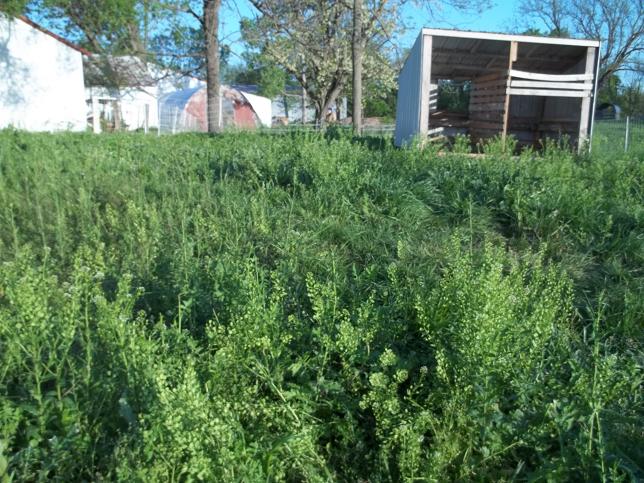
Looking Through the Calving Window

Our borrowed bull arrived on July 29th.  He has been a good boy and we’re just about finished with him.  In fact, I believe he has completed his work…we’ll just keep him around for a couple more weeks for insurance.  It was interesting to watch him pair up with a different heifer every few days though he was fairly discreet about his work.

July 29 he was not discreet.  That means we should be ready for a calf around or before May 7th.  So, realistically, our calving window is all of May and most of June.  That puts calving a little…maybe a lot…later than I would like but we should be safe.  It’s late enough for good grass for the last 30 days of gestation, early enough to avoid the punishing heat…well, most years.

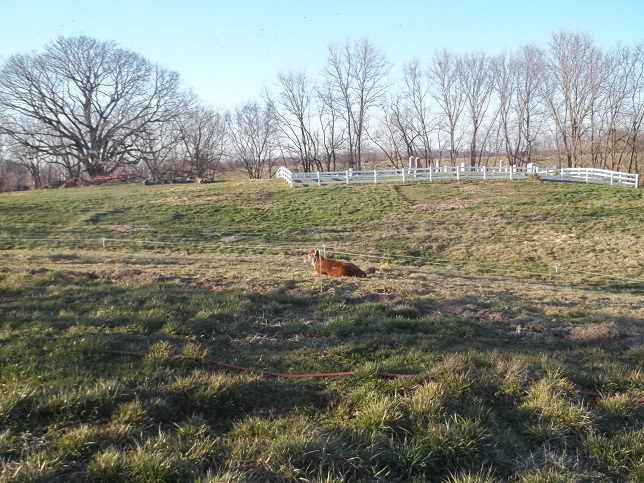
2012 was an unusually warm year and it started early.  My cousin planted corn on St. Patrick’s day, the same time I was planting potatoes.  It was lucky he planted early as that corn made where later plantings either didn’t make or were affected by aflatoxin.  By April 10 of 2012 our pastures were growing very well.

NewPasture1Compare that to April 9 of 2013 in nearly the same location from a different angle:

AprilPasture10I would love the early spring of 2012 if I could retain the mild summer of 2013 along with it.  Otherwise I’m content to hold off a little bit.

Moving forward a month we can compare again.  Basically the same stretch of ground on May 6,2012 but facing South this time:

PastureWalk3Once again, the same ground, same angle on May 4,2013.

TopOfHillIt looks like there is not as much forage available in the 2012 picture but you should know the goats and chickens both grazed across it that spring before the picture was taken as well as the tenant’s cows.  In the cow picture from 2013 the cows are running across for the first time, though I did feed hay on pasture the month prior.

Based on what we have recorded of our own pastures, it looks like we’ll have a terrific quantity of high-quality forage just in time for calving next spring, even if spring comes a little early.  Let’s push this out into June.  By June 11, 2012 the same spot in the picture above had reverted to a big thistle patch.

PastureCompare that to June 2 of 2013.  The thistle and weeds couldn’t establish in such high density because of our grazing practices and the increased soil health.  Just mountains of fescue.

TrampleSo May 7 may be a week later than I really want but if there’s a late spring I’ll be glad for it.  Going forward I think I’ll shoot for May 1st.  I am also anxious to tighten up the calving window from 6 weeks down to 3 or 4.  but I know that will be hard on the first-calf heifers.  Guess that’s part of the program.

Now I have to plan where to calve next year.  Where indeed!

Are you planning your pasture usage on an annual basis?  Did you plan for that weekend you’ll be in Sheboygan for a wedding?  Did you make room for a drought reserve?  Where will you put the cows during hot weather?  During deer season?  Better yet, do you have any tips to help me plan my own schedule?

After writing this post I have to pause to reflect on two things.  First, I’m really happy I took the time to document the state of my pastures on at least a monthly basis for the last 18 months.  I can see changes, though, the changes may simply be due to weather patterns rather than grazing patterns.  A few more years should really prove the grazing method out.

Second, I seem to spend a lot of blog time focusing on cows, an enterprise I don’t believe will carry the farm.  Why do I do this?  I feel it is necessary to give the cattle a lot of attention BECAUSE the margins are so tight.  I need the cows to cycle nutrients…to utilize a low-value resource (grass) and trample plant material, seeds and manure into the soil building the soil organic matter, water-holding capacity and soil life over time.  The cows are uniquely suited for these purposes.  They are the foundation on which I can build the rest of our farm’s future.  I have to keep my pencil sharp or my foundation become shaky.

Pasture Litter …Again

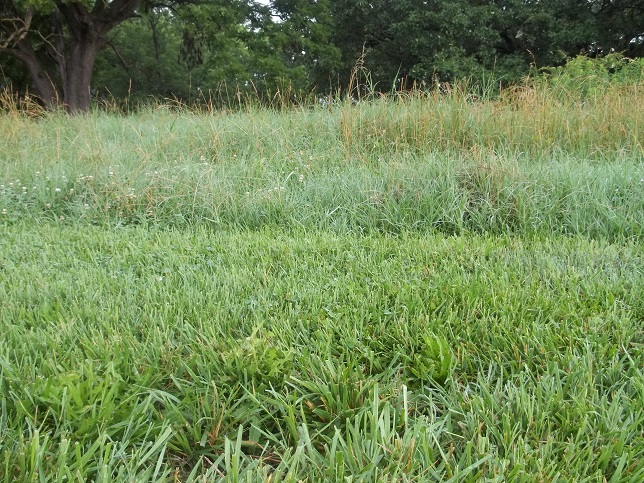
For the last few days the cows grazed in front of the family cemetery.  This was a thick stand of bermudagrass with cowpeas, millet and a few other things mixed in.  There was also a mowed path to the cemetery gate.  In fact, it looked like this about 6 weeks ago:

JulyGrazing6Notice the mowed area in the foreground.  With me?

One of our goals in using cattle for rotational grazing is to cover, protect and feed the soil with litter.  This keeps the soil cooler and traps more moisture than just bare ground.  Where is the litter going to come from in the foreground?  It ain’t.  I mean, you would think some portion of the grass clippings would stick around and blanket the ground but there just isn’t enough mass…the soil biota eat through it too quickly.

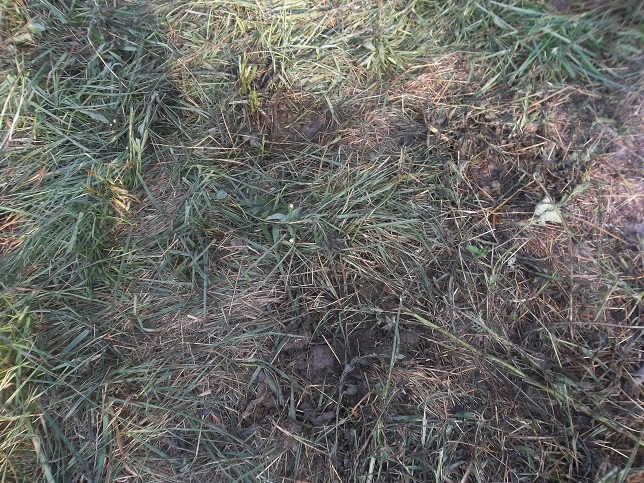
So the cows grazed it.  Here’s what the mowed area looks like now:

GrazingShort1

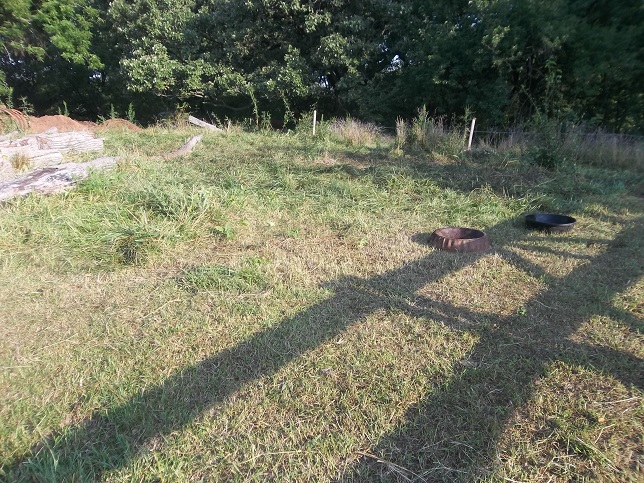
Not much for litter covering the soil.  The cows ate it right down to the nubbins…horses would have eaten it to dirt.  But the rest of the pasture looks pretty good.

GrazingLitter1

We had them packed in pretty tightly and we got good trampling and manure coverage.

GrazingLitter3The cows did a pretty good job.  I can see the benefits of packing them even tighter.  Maybe someday…

Again, there is very little left where the pasture had been mowed (a necessity for cemetery access).  That area will be a little slower to recover.  I expect the trampled grass to come back quickly…in time for fall grazing.  Hopefully we’ll get to graze it twice more this year.

GrazingLitter2


Most of the neighbor’s pastures look like the foreground in this picture…except they also have clumps of weeds.  If they don’t they have been mowed.  From the road they look OK just like this picture looks OK.  It’s only when you go in close to investigate that you realize how damaging it is.  Hot, baked, dead earth is not conducive to future grass crops.


1,000 Cows on the Move

I have to believe this is more than 1,000 head.

These cattle are managed by Neil Dennis in Saskatchewan.  Based on a presentation he did for PowerFlex fence that is posted on Youtube, he packs cows into a half-acre and moves them throughout the day, overnighting them in the larger area, then starts small again the next morning.  To match his stocking density (1.3 million pounds per acre) I would start my 10 cows in an 18×18 area.  6 steps by 6 steps.

Anyway, I think it’s just amazing.  I can’t imagine what the neighbors would think if I took 1,000 cows down the road on a Sunday morning.

3 things to take away from the presentation linked above (and I should caution you, it’s pretty hardcore grazing stuff.  You can skip the first video, really.)

  • Never have more cows than your wife can look after.
  • Neil Dennis says he can’t afford to own cattle.  He just grazes them for other people.  Might be a lesson for me in that…
  • Neil does a lot of testing to see what works on his land.  It’s surprising which techniques fail to measure up to the propaganda on his farm.

July/August Grazing Plan

Oh, how plans change.  If you look at this post, you’ll see the July grazing plan.  It worked well to shade the cows on days well into the 90’s with heat index above 100.  Right on schedule, on the 25th, we were grazing #25.  Happy days.

Now what?  As I started working on my next plan, things cooled off.  The pastures held more feed than I estimated.  We slowed things down.  I had been expecting to do this (Note this is turned 90 degrees so North is to the Left.):

IntoAugust

But the cows are on 1 and it’s the 14th.    I gained two weeks.  Where did it come from?  Some of it was grazing the slope East and South of 3 and 4.  3 days were gained from grazing the unlabeled areas to the right.  A big gain was grazing the edge of the pond.  So, I’m doing fairly well.  I gained 2 weeks because of the cool weather and the use of reserve ground.

But is this all there is to planning your grazing?  Just vague lines on a map?  Well, not really.  If we have to feed hay, where should it go?  Where are the cows going to calve?  What portion of the farm is set aside for drought?  Planning to cut anything for hay?  Will you allow a field to totally rest for a year?  How is that specific area doing?  Are we seeing increasing or decreasing plant diversity?  Good carbon litter?  Where will the cows find shade in hot weather?  Do you have a plan B in case something unplanned happens…like prolonged rain and flooding or prolonged drought?  How will you fence in the Spring, Summer and Fall and how will that change?  How will you winter graze the stockpile?  Where should stockpile remain to start the spring rotation again?

But the questions don’t stop there.  When was that family vacation?  When is that friend getting married?  When do chicks arrive?  When do we usually plant the garden?  When will we have to put up strawberries, blueberries, peaches, green beans, tomatoes or apple sauce?  How are we going to build fence so we can conveniently work around social events, family plans and other farm work?

I want fat cows and healthy pastures.  This won’t happen on its own.  I have to plan my way.  Right now I try to plan a month at a time but in the near future I’ll be better at estimating and can shoot further out.  One of the early chapters of For the Love of Land: Global Case Studies of Grazing in Nature’s Image reminded me of the pressing need to transition to year-round planning instead of just winging it month to month.

Let’s complicate things further.  How many pigs will we pasture this year?  Where will we run them?  How can we coordinate their grazing with that of the cows?  How about turkeys?  Or broilers?  Where do they fit into the rotation?  It’s nice to add all that disturbance and manure but we have to allow recovery.

One step at a time.

Trimming Those Hard to Reach Places

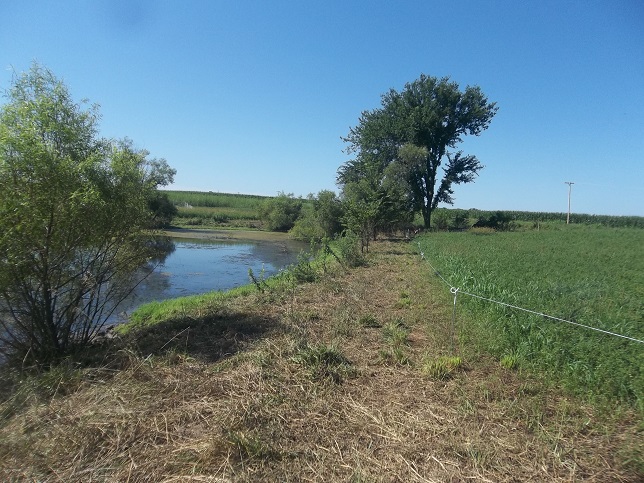
I have a hard time trimming here and there…but no need to go into that.  I’m talking about trimming grass.  There are places it is simply dangerous and foolish to drive a tractor.  For example, the pond’s edge.

We spend a lot of time at our pond swimming, skating (in the winter), catching frogs, fishing or paddling around in our boats.  Most of these activities require access to the shore.  When you are barefoot and wearing shorts…well, a sand beach would be ideal.  Let me know if you want to contribute to the sandy beach fund.  In the meantime, we prefer to keep the weeds short.

PondsEdge1

So how do you get it done?  For years we haven’t.  This year things are different.  We have cows.

PondsEdge3

This ground hasn’t been grazed in years…since I was a kid – so the grass is fairly sparse.  Much of what was out there wasn’t very tasty…but they do like Johnsongrass.  They don’t care for goldenrod no matter what though.  One thing they excel at is trimming up lower branches and opening up new fishing areas.  Along the way they trample in tons of carbon, add fertility and help tighten plant spacing by pushing new seeds in contact with the soil.  That’s all good but we also lose a little hay from the hayfield…but most of it is pretty low-quality stuff anyway.  The cows need to move quickly over this ground.  No big deal though, I have gained 5 days of grazing by going around the pond and may get 3 more before we’re finished.

PondsEdge4They find their way into thickets and tangled masses of grapes, saplings and fallen limbs and tromp the whole down into the soil.  It’s pretty cool.  I have been trying to figure out how to cut into this oak regrowth all year and retain the strongest shoots.  Well, the cows figured it out for me.

PondsEdge2All of this is really accomplishing a couple of things that are very intentional.  First, I’m stretching my pasture by grazing stockpiled reserve elsewhere.  Second, I’m utilizing areas around the hay field that I can’t mow.  Having these edges grazed should help my hay cure faster beyond building fertility in the field over time.  I should point out, I have a fence keeping the cows out of my alfalfa and another fence keeping the cows out of the pond.  (Had to wade out around some trees with long fence posts a couple of times.)

Much of this exercise was inspired from years of reading Throwback at Trapper Creek.  Thanks Matron!

Interview With David Hall Part 2

Last time I wrote about a conversation I had with David Hall about recognizing the cost of raising a heifer calf.  She will have to throw her fourth calf at age 6 to pay for her own development.  This is no small feat as heifers are still growing themselves and gaining molars…without which, it’s hard to fully chew their cud.  That first calf is hard on a heifer as she has to provide milk for a growing calf while retaining/regaining condition so she cycles in time for her next pregnancy within a defined breeding window.  Without those molars, she faces an up-hill battle.  Now, I have heard Kit Pharo toss this around a little bit suggesting if we’re ever going to forgive a cow for coming up open it’s when she’s due for a second calf…but he hasn’t done that in practice, he just suggested it might pencil out.

That math makes sense but why bother raising heifers when I can buy bred heifers?  Either way somebody has to pay those heifer development costs but maybe I can save myself some labor if I can find replacement heifers of the same quality.  While it is possible to buy in heifers a little cheaper than I can raise them, it’s a little bit of a gamble genetically.  David said, “If my own herd genetics are good enough I can afford to spend more on my own heifers than taking a chance on new genetics.”

So, what is it we’re looking for when we are shopping for a long-lasting heifer?  Well, here are the herd requirements David listed on his first slide in the presentation:

  • Fit the environment (Adaptable)
  • Calm
  • Calving Ease
  • Fertile
  • Longevity
  • Low Maintenance Requirements

David started his presentation in February by showing a table of relative values comparing a business based on yearling sales to a feedlot.  According to the chart (which I believe was cited to a research company and I’m unwilling to republish), reproduction is 10x more important than carcass quality for yearling sales.  If you are in the business of selling calves, you have to have calves to sell.  The detail below should help us find stock that will work for us, delivering and weaning a calf year after year but keep in mind, fertility is the top priority.  So let’s look at the criteria in detail, though I think you’ll find the details overlap considerably.

Adaptable:
“Be sure to breed to bulls who have a proven record on fescue.  Get a bull that is well adapted to your environment.”  If I have 25 cows and one bull, that bull makes up half of the genetic makeup of the next generation.  Picking the right bull matters and the consequences of a poor choice will impact the operation for years to come.  For example, I want a bull that is slick-haired as the shaggy cows (Ms. White) don’t perform as well as the slick cows (#111) on hot days in July.  Even better were the Jerseys who got slick in April or May in spite of cool weather and continue grazing when the heat index is above 100.  I feel that it is important to select within my herd for shorthorn genetics that are still out working alongside of the Jerseys.  Those Jerseys are the benchmark.  I have a couple of cows I can usually count on to be out there working on a hot day so I’ll tend to favor their offspring in the coming years.

Bull1

Disposition:
“Cull out ornery cows and bulls.”  As an inexperienced cow owner (I’m not a cattleman.  I’m a cow owner.  Maybe in a few years I’ll graduate.), it is easy to confuse ornery and nervous.  There is a difference between the cow that wants to eat you and the cow that is afraid of you.  Ms. White was terribly skittish when she first arrived and when she saw us it was time to run…and all the cows went with her…right through the fence.  I thought we were going to have to invite her to leave.  But, after a little while, with a few changes on our part, she fell into the routine.  She hadn’t been in as close proximity to humans as she necessarily is on a daily basis with our daily grazing moves.  She has to walk right past me every day now and is doing fine.  That said, she does tend toward excitement and we want cows that tend toward calm.  Hopefully she’ll give us steer calves each year.  Looking at cows as employees David says, “if the employee has a bad attitude she needs to be fired.”

Calving Ease:
If I pick a bull that throws heavy birth weight calves, I’m breeding heavy birth weight into my herd.  I don’t want to spend my spring camping out with the herd and pulling calves.  I want to sleep in my soft, comfy bed, get up early and head out to the pasture with a camera to take a picture of the new, live calf on the ground…a calf that was born without any interference from me.  If I am selecting for cows that bring a live calf in for weaning each year I have to be careful to do my part by stacking the deck in their favor.

Fertility:
We need a heifer that cycles three times before we introduce the bull at 15-16 months.  We need her to settle, not just the first time but also (and more importantly) on her second pregnancy.  Finally, we need her to continue to get pregnant every year, on time and bring a live calf in at weaning.  “View your cows as employees.  That cow’s job is to put on weight and bring in a healthy calf.  Any employee that doesn’t work gets fired.  No calf?  Fired.”

David says he breeds in the fall (more on that another time) from December 1 – January 15th.  “A short, defined breeding season will push [the herd] forward faster than anything you can do.”  However, a bred cow is worth more than an open cow so he DOES leave the bull in after January 15th.  “Leave the bull in to breed cows that are late BUT sell any cow that did not breed in 45 days.”

Finally, he points out that “there is a strong relationship between age of puberty and longevity.”  Cows that are late to mature don’t tend to last in the herd.

Longevity:
As we looked at last time, “Cows must be 6 years old and rear 4 calves to pay for her development costs.  Optimal economic return is in  years 8-11 for commercial cow/calf operations.”  So a 6 year-old cow has broken even.  I need more than 4 calves out of her to make money.  If she misses throwing a calf within a defined window she gets fired.  If her attitude is poor she gets fired.  If I have to pull a calf, she probably gets fired.  The odds are against 90% of the cattle in North America but without this culling we’ll go broke pampering our tea cup cattle and servicing the equipment required to pamper them.  That means a short, slick 14 year old cow with a good attitude has thrown 12 calves, year after year eating whatever there is to eat on my farm, with a little bite of salt and mineral.  Any cow that can do this has just the genetics we’re looking for in our future herd and continues to impact our herd genetics positively over time.  Any cow that can’t will be fired before she makes much of a genetic contribution to the herd.  Any bull I select for my own use MUST come from a older cows as that predisposes future generations for success.

Low Maintenance Requirements:
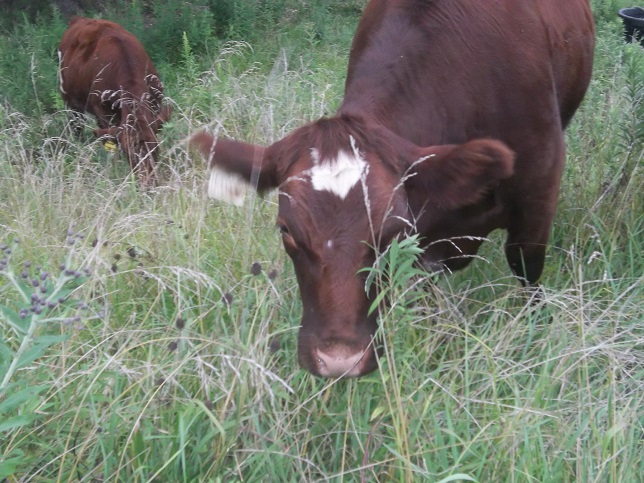
I just touched on this but if she is fertile and long-lasting she obviously doesn’t demand much from me.  I need thrifty cows.  Because much of my forage base is fescue, I’m looking for short, barrel-shaped, light-weight cows.  Hall said 70% of a cow’s feed is used to maintain condition.  A 1,700 pound cow has to eat much more feed to maintain condition than does a 1,000 pound cow.  There are only so many hours in a day.  How many pounds of forage can a cow ingest and ruminate on each day?  To be direct, a heifer that is weaned above 600 pounds won’t last.  The cards are stacked against the big cow in a forage-based operation.  111 stays fat no matter what.  Notice how wide her mouth…it’s as wide as her eyes.  Maybe wider.

111

So where do you find these cows?
I wish I knew.  You need to pick a bull based on his mother and her production numbers.  How many calves has she thrown.  How big were the calves?  How big is the mother?  How old is she?  When looking for heifers from within our herd or when buying outside, look for calves that weaned below 500 pounds.  We’re looking for a 4-5 frame score.  Again, big cows have to eat more to maintain condition.  Small cows are hard to market.  I could probably run 2-3 Dexter cows per acre on my farm but what feedlot wants to finish out Dexters?  I have to find the middle ground between what the market demands and what is profitable to produce.  They can’t be too big, they can’t be too small.  Hall says to sell the extremes.  Hall also pointed out that crossbred cattle tend to have better longevity.  That’s something to consider when buying stock.

Over time there are things you are watching for in your herd.  Cows should be feminine but we’re looking for function, not beauty.  A cow with a rough hair coat should find work elsewhere (I have a couple of these).  A cow with bad feet or a bad udder should go down the road.  Too big or too small?  No calf this year?  Poor attitude?  Prolapse?  Down the road.

This kind of selection doesn’t require much of the manager.  It comes back to the three O’s (which are really two O’s); Old, Open or Ornery.  The old cow will eventually come up open, weather from loss of teeth, bad joints or whatever.  The selection process is hard on herd numbers early on but success breeds success…literally.  In a few years…decades maybe – a picture of our cows will feature less leg than this one both from change in genetics and prenatal response to conditions and management.  Really.

GroupPhoto

In part 3 we’ll go a little more in-depth on ideas David has for making the operation profitable and ways to smooth out the highs and lows of the cattle market.

Black Locust…Its’ What’s For Dinner

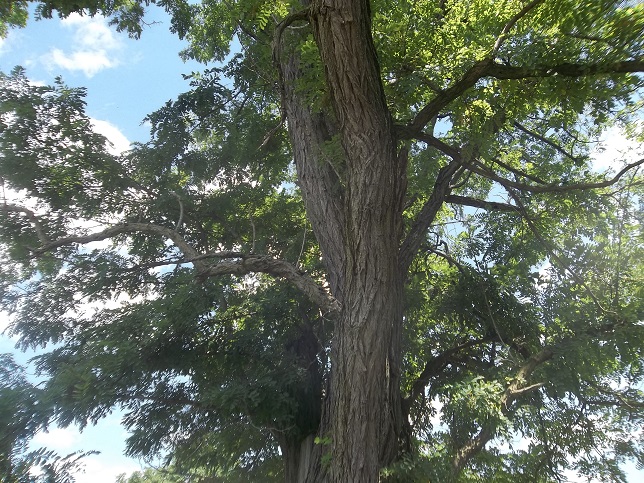
We have a large, old locust tree growing by the garden.  Really, it’s not doing well but it still flowers every spring and throws shoots from its root system.

Locust1I was recently listening to a podcast indicating cows would benefit from pastures planted with as many as 30,000 black locust and black walnut trees per acre.  Chew on that.  Now, I’m not talking about grazing under trees, I’m talking about grazing the trees themselves.  This blog does a good job of explaining and illustrating the concept.

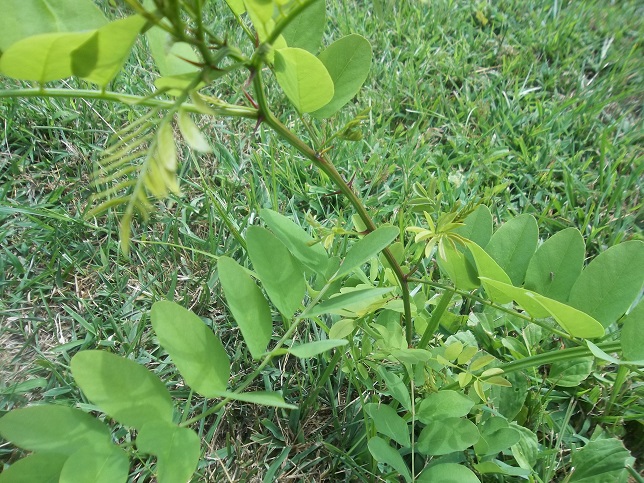
I thought a little verification was in order.  As I said, the black locust throws up a number of shoots on a regular basis.  Since the pastures (including the yard) are being rested between grazings a number of trees have grown about a foot tall.

Locust2Here is another example from a different place in the yard.  Notice the short thorns.

Locust4I identified a couple of trees and turned the cows in while we clamped our bull calf.  It was like the cows had their radar turned on.  The almost sprinted over to the poor locust tree before moving on to a small stand of Johnson grass.  The tree was the first choice.  No wonder I don’t see them sprouting out in the pasture.

Locust3Now we’re looking at transplanting all the shoots we can find to a protected part of the pasture so we can allow them to develop.  Maybe I should plant them at the base of that dry hill…or in rows on contour to the hill.  Either way, I have sufficient confirmation that I’m willing to continue the experiment and propagate more trees.

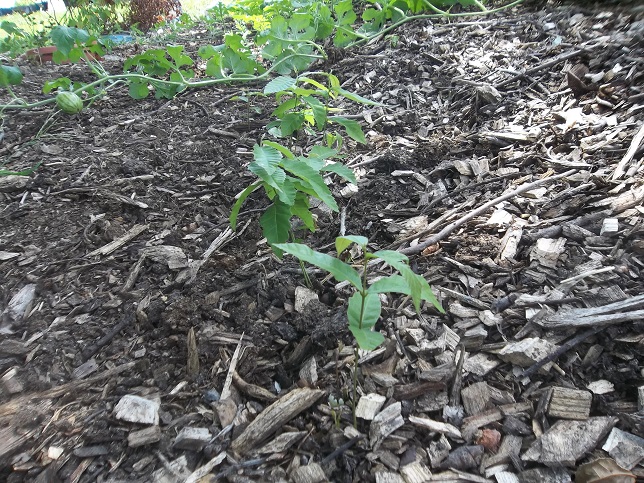
Speaking of tree propagation, the chestnuts I harvested from Eileen’s house are sprouting in the garden.  Hope more show up.

Chestnut

A Fair Amount of Bull

We bought our heifers from Moore Shorthorns in Jerseyville.  They also have a grass-raised, red, slick, small-framed (4-5), young, calving ease shorthorn bull.  Try saying that three times fast.  He’s fairly light and has good conformity.  He came from another nearby farm and, more than anything, he was raised on grass.  We asked if we could use him…for a small fee.

Bull1Tom delivered him Monday afternoon and he instantly detected that Flora was ready for service.  We had no idea.  No sooner was he unloaded than he was hard at work.  Well, here’s to hoping for a Shorthorn/Jersey cross.  Hope we get a bull calf….mmmmm…steak.

Bull2His disposition is good.  He doesn’t seem to mind us being around but we are still mindful of him.  He’s so busy chasing girls he doesn’t seem to notice us but we still keep an eye on him.  6 weeks from now he’ll go home and we’ll be back to our normal routine.  We’ll also get our two new additions at that time.  This little heifer:

RedHeifer

and this one:
WhiteHeiferBoth are small heifers compared to the rest of their graduating class, weighing 450 pounds at weaning.  I expect them to be 4 or 5 frame cows.  Tom had a giant shorthorn heifer that just won grand champion at the Madison county fair and will probably win again.  She was at least a 7 or 8 frame heifer and she’s due to calve in September.  I let him know I’ll soak up the smaller calves he produces…all high quality animals, just smaller-framed (In a grass operation, a cow has to eat a percentage of its weight.  That’s obviously easier if they are smaller.).  Tom’s show calves tend to be sold or selected the day they are born so I don’t even see them.  Really, Tom picked these two out for me ahead of time knowing what I’m looking for.

Hopefully this bull will throw small calves and, hopefully, the calves will be pre-adapted to performance on my pastures.  A few generations from now I should have just the cow we need.  Weather red, white or roan….she just has to be small.  Truth be told, I’m partial to red.