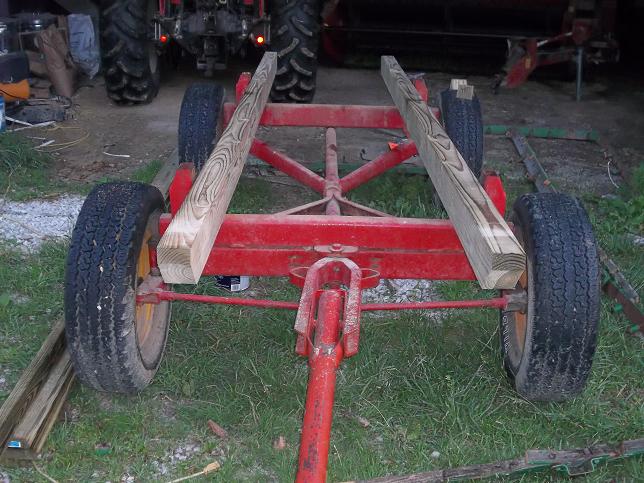
Dad and I drove to Calhoun this winter in response to a CL listing for a hay wagon. The price was right so we brought it home. Originally this wagon was grain tight. Years of outdoor storage had taken its toll on the wood and there really wasn’t much left of it.
All of the sub-frame was both broken and rotten. There were numerous attempts to cobble things back together again but even those were failing. The running gear was sound and the tires were good. That’s about all I had to work with. That was enough for the money.
I used it as it was for a few months hauling brush to my wood chipper but now that hay season is upon us, I need my hay wagon. Dad measured the wagon well and we plan to rebuild the deck just as it was originally. That will take some doing as most of the hardware has seen better days.
Dad began the long process of disassembly a few days ago. It would be nice to paint the frame with the bed off but the schedule just doesn’t allow.
I need this wagon today. Can we finish it in time? I need to stop burning daylight and go drill some holes before work! I’ll offer more details including costs in part 2.
I have read a couple of articles recently on the differences between pasture-raised eggs and confinement eggs. Both point out the advantages of eggs from pasture, one somewhat subjectively, one scientifically. The Mother Earth News article goes pretty far in depth. The Pantry Paratus article is lighter and has a nice video of a small egg handling machine.
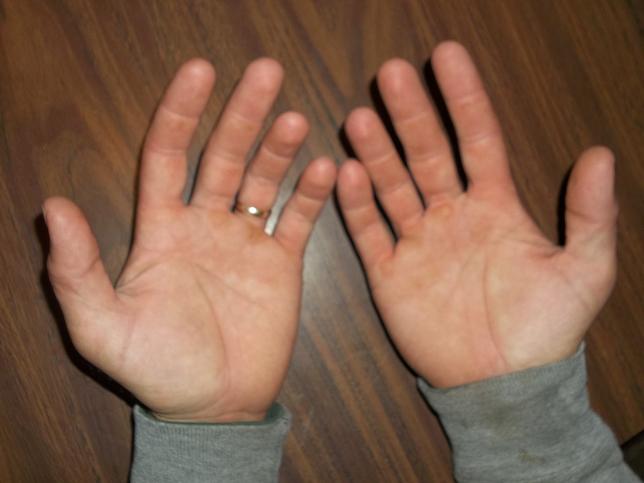
I have an egg handling machine. Two of them, in fact. Both are 1976 models. They work to collect, carry, wash, weigh, candle and pack the eggs. Every day. They are a little older. They show signs of wear, they are a bit scratched up, scarred and thickened…but they are clean.
Actually, they don’t look too bad in that picture. They will by the end of the week when we finish putting up hay. Oh, well. They are multi-purpose machines. In fact, the greater the variety of work I put them to, the longer they last. I don’t spend 8 hours every day packing eggs with them. I don’t spend 8 hours/day every day processing chicken either. We keep our enterprises small enough that each of them is just a portion of our day, minimizing repetitive stress, minimizing drudgery. It’s work but it’s pleasant work.
I’m a small, diversified farmer. I can do that.
Back to eggs. My chickens get enough pasture to last them 3 days. They sanitize the pasture and eat any weeds the goats leave behind and devour bugs. They scratch, dig and poop. They eat worms and leave behind things for worms to eat. Then we move everybody again. The pasture is better where the chickens have been. The eggs are better because of fresh pasture. The periodic, intense disturbance cycle makes everything better.
Best of all, it makes an egg that is out of this world and, according to the research in the Mother Earth article, is healthier than most. Does your farmer move his chickens to fresh pasture regularly?
In nearly every posting I harp on the importance of verifying your farmer with your own eyes and nose. Go visit your farmer. If your farmer hasn’t invited you to his/her farm by the third conversation, find a new farmer.
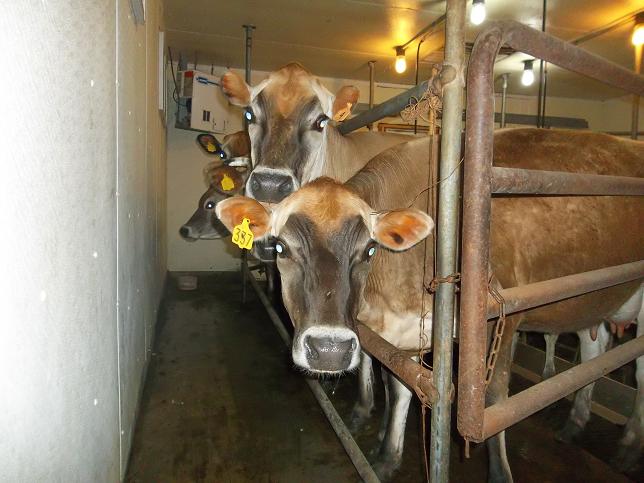
We buy raw milk from Steve Mansfield of Roodhouse, IL. I have inspected, and continue to inspect, his facilities, pastures and herd. I trust that he is more concerned with my welfare than with his own wallet. In fact, I am reasonably certain that he prioritizes his wallet somewhere behind God, family, community and the ecology…though that list may not be in sequence. He is thoughtful, generous, educated, inquisitive and experienced…things you should look for when interviewing your prospective dairy farmer. I believe raw milk is good but not all raw milk is equal. You, the consumer, need to make sure your farmer has clean, slick, fat, healthy animals. Make sure his dairy is nearly spotless because there is no inspection service here. You are electing to be the inspector. You need to be an educated inspector. This PDF will give you a fair start.
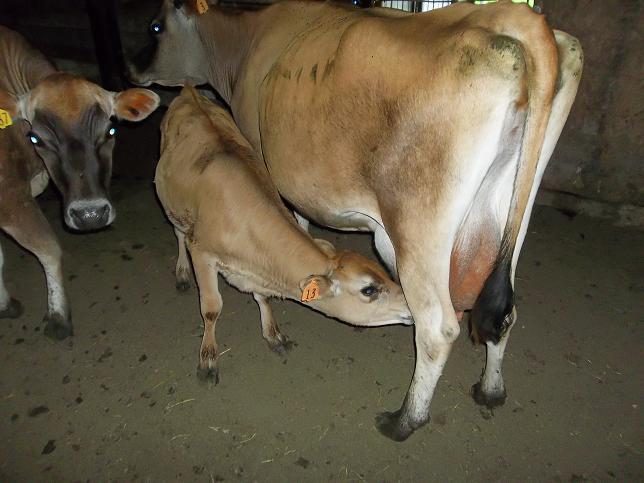
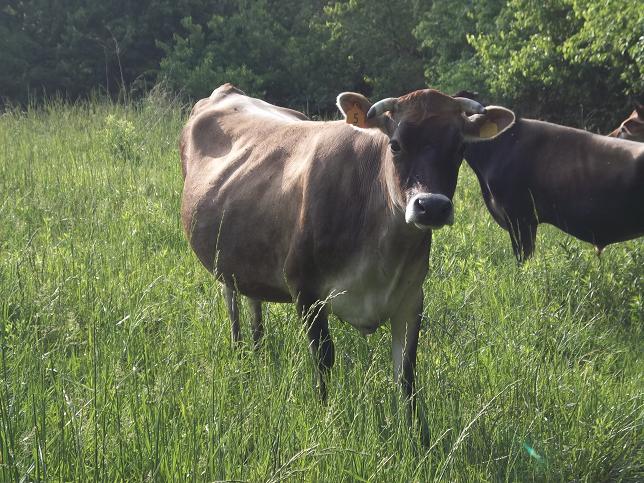
Back to my farmer. Steve has lived here his whole life. He owns 140 acres across the road from his mother’s farm. Steve keeps a full-time job in town and, as a consequence, farms at a much smaller scale than he would like to. Steve keeps a beautiful herd of Jersey cows (mine are from his herd), raises a flock of layers (he bought from me), keeps a few pigs (he bought from Mike Butcher) and puts in a large garden in addition to his small orchard and keeps a collection of orchids in his solarium. Yeah. So where most “farmers” deal in commodities and buy food at the grocery store, Steve and his wife Cindy deal in finished product and shop down the hill from their house. These are real farmers.
Steve has been dairying for 20 years, initially selling to the creamery in a nearby town, later scaling back and selling directly to consumers. He currently milks 7 cows in a Grade-A milking parlor.
I asked him a few questions. Well, I asked him a lot of questions while we were hauling pigs, hauling cows and holding his grandson Saturday morning. I’m able to quote him most of the time but sometimes it’s just my memory of our conversation.
The Farm
Are you doing anything unusual…even among grazers?
Steve laughed when I asked this then offered a list. I am under the impression that these are the main points, not an exhaustive list. He “keeps the calves on the cows, milks once/day, gives no grain to his cows, the cows are on pasture for 20-22 hours each day and he doesn’t milk his cows out so there is plenty remaining for the calves.” If you have been raised around dairy at all you know this is all just crazy talk.
If you haven’t been raised around modern dairy, watch the video below. I could dedicate an entire series of posts to the video. Instead, as you watch the video try to calculate how much fuel is used to feed the cows and handle their manure. Just try. Ask yourself if it is more sustainable to bring the feed to the cows or to take the cows to the feed. Try not to think that their cows don’t get to lounge in the grass, how short their productive lives are or of the environmental impact of that slurry pond overflowing during a heavy rain. In fact, you might feel better if you just skip the video.
How do you maintain your pastures?
Steve says he renovates his pastures every 5-8 years to beat back the fescue. Our fescue is infected with an endophyte and rather than bore you with details I’ll just say it lowers feed intake and milk production. To fight this Steve tears up pasture and seeds a mix of either clover and perennial rye or alfalfa, timothy grass and orchard grass.
Give me a rundown of the typical day in the life of your cow.
“The cows walk to the barn from as far as 1/4 mile away.
“They then stand outside of the barn hollering for their calves until I get them into the barn to milk at 7:30.
“Then the cows rejoin their calves who enjoy breakfast and lick the udders clean. This is a boost for udder health and prevents me from spending my morning doing calf chores.
“The calves are then separated into a pasture of their own where they spend the day grazing.
The cows head back to the pasture and get down to business mowing the grass.”
What do most dairies do with calves?
“Most dairy heifer calves in the US are taken from the cow, fed milk-replacer and are kept in calf huts individually. Once weaned they will follow a grow-out program then will be added to the dry-cow herd, most likely in a free-stall barn so they have room to roam, lay down and eat at the trough. The bull calves are treated similarly but are shipped as early as possible to be fattened for beef.”
Here’s an overview of the very efficient, possibly immoral process courtesy of the University of Wisconsin Cooperative Extension…Wisconsin tax dollars at work.
Raw Milk
The May 2012 issue of Graze published several articles emphasizing the need for producers to educate consumers about the risks involved with raw milk and the need for consumers to evaluate the farm that supplies your milk. The risks vary from a number of possible diseases to our own weakened immune system and a need for our bodies to adjust before we can digest real, living milk.
Do you feel your average customer understands what raw milk is? “Most of our customers find us through the Weston A. Price Foundation or through Real Milk. As a result they are well informed before they find us.”
How are the risks of drinking raw milk different than the risks of consuming any other type of raw food?
“Well, there has been e coli found in Spinach so really it just comes down to evaluating the source of the food.”
…and later, “Johne’s Disease affects 70% of the dairy herd in the US. Confinement dairies don’t notice it because they burn out their cows in 2-3 years and it affects older cows. Pasturization doesn’t necessarily kill the organism that causes Johne’s disease and there have been links between Johne’s and Crohn’s in humans.” Steve runs his cows for up to 14 years, a good indication that his cows are disease free. He has tested in the past and it has always come back negative. Don’t be afraid to ask your dairy farmer. It’s pronounced “Yoh-knees”.
How do you help educate your customers?
“We just talk about food with them. Most customers are well aware that this is a different liquid than the stuff at the store. It’s just not a big deal.”
We are very happy with our dairy farmer. I hope you can find a similar farmer to build a relationship with. Steve isn’t just some guy I buy milk from. I count on him to enhance my family’s health and pay him a premium price for that care. Food isn’t just something you stuff in your face at intervals. We need to learn to look at it as medicine. Find a source of medicine you trust with your life.
Before you charge off to find a source of raw milk, take some time to educate yourself on the potential risks. The organizations I listed above are a great place to jump in. I also recommend this link. There are numerous CDC and USDA reports that indicate that raw milk is anywhere from slightly to significanly more dangerous to your health than pasteurized milk. I believe the real danger is not the lack of pasteurization, it’s the lack of farmer accountability. Weather you are buying meat, milk or spinach, get to know your farmer.
We brought home our new pigs on the 5th. They immediately escaped. Yeah.
We use Premier One Pig QuikFence for our pigs but I have never owned 18 pound pigs before. These little guys just squirt right through the fence. No big deal though, they ran back into the fenced area and we grabbed a spare length of PermaNet. That has them contained. They now have a firm grasp on the concept that white wires are their boundary, though, like velociraptors, they will test the boundary from time to time.
These little guys are complete. The whole hog is there. Well, the boars I bought are now barrows but otherwise from head to tail the whole pig is there. It’s the tail that is most unusual. We have always gotten our pigs from a confinement floor. In confinement the pigs can choose to play with the metal bars holding them in, the drinker nipples, the feeder or that other pig over there. They dock pig tails to keep them from being bitten off, leading to infection. Check the video to see the pigs wag their tails.
Also, we don’t ring our pigs. I want them to dig. They do make holes to wallow in, I just fill those with wood chips, manure, compost…anything handy.
The pigs bat clean-up behind the other animals and do a good job finding kernels of corn that the chickens missed. They also dig up the multi-flora roses that the goats gobbled up. Finally, I sometimes use the pigs to just plow up the pasture, one section at a time, allowing me to renovate that area.
They are still pretty shy. They haven’t figured out that we bring them food every day. It won’t be long and they’ll be under foot. While pigs are cute, hogs are a dangerous nuisance but boy, do they taste good. Enjoy your pigs while they are little.
My friend Steve pointed us to the most interesting hog farmer I have ever met. He farrows on pasture, raises pigs in deep bedding and uses, of all things, large black hogs in his hybridization program. In a world of specialists and sub-specialists, I found a guy who is not only farrow to finish, he does it in a way that honors the pig-ness of the pig. There are things I would do differently (multispeciation) but he’s going against the grain and keeping his head above water.
I met Mike Butcher some months ago. The first thing noticed was that he was pigging on pasture…in February. I saw a number of huts spread across the field, each hut with a sow, each sow with a litter of little pigs. Out in the real world, sows are kept in confinement in crates to minimize the number of little pigs that get squished when the sow lays down or eaten when she expresses her stress level. Mike has selected for good mothering instinct and farrows in an environment that give the sow room to relax.
Yes, it’s a muddy mess, but we’re in monsoon season here. I really want to drive home the point that he’s pigging on pasture. His sows do such a good job of mothering the pigs he had one who kept 15 piglets this week!
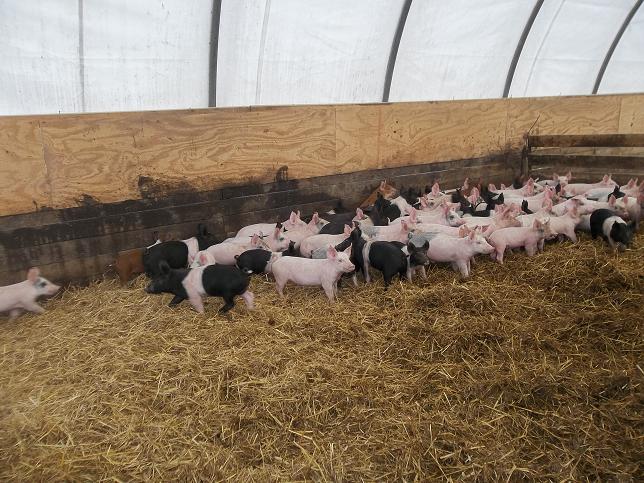
Once the pigs are weaned they move to a series of hoop houses. Unlike other confinement buildings I’ve been in, Mike’s hoop houses don’t have slatted floors with a manure pit beneath. Instead, the shoats were bedded in a deep layer of straw and the larger pigs were bedded with round bales of corn stalks. As a consequence, there was little smell and enormous compost piles. Enormous.
Look at the space available to these little guys. And they have a foot of straw to root, play and sleep in. From a confinement perspective, this is hog heaven.
Again, Mike pigs on pasture, uses heritage sows with excellent mothering characteristics, raises pigs in deep bedding and composts everything. I don’t know what else I could expect from him. I was so pleased I bought 8 pigs. I was so pleased with his price I gave him a free chicken along with the check. If you’re in the Palmyra area and want to see hog confinement done artfully, find Mike Butcher.
At one time this was normal. I’m happy to support Mike in his business.
We had a few problems keeping these little guys fenced when we got home. Look for an article on that in the near future.
Glossary:
Farrow (verb) – To give birth to a litter of pigs
Pig (verb) – See Farrow. Also written as “pigging”
Shoat (noun) – Weaned pig male or female
All the grazing books emphasize the need to walk your pastures regularly. See what’s going on out there, take notes and really pay attention. Today I noticed something I hadn’t seen before. Pigs are hard on clover. Let me show you.
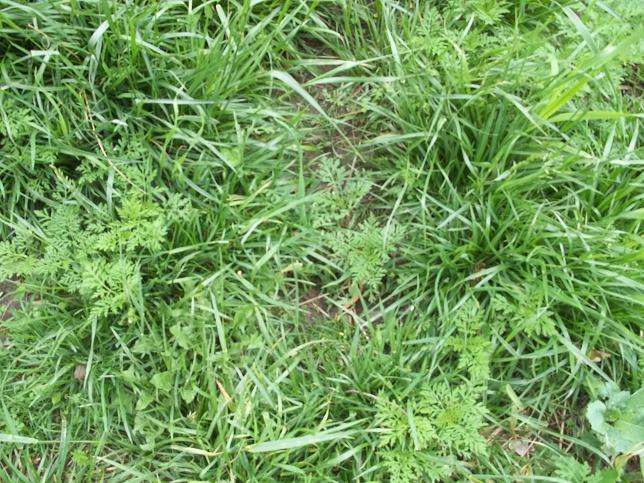
We had pigs on this spot in March. The grass is recovering well and has been grazed once but the clover is almost non-existent. A good mix of grasses and weeds but no clover. I’m not too surprised as it had little clover to begin with but there is none now. None.
Continue with me to the cemetery gate. Here the grass is mowed regularly and the clover grows thick.
Now, look to the South with me. The pigs were on this slope starting in July of last year and worked their way around the hill over time. One section at a time the hillside became a wasteland as the pigs worked their way through. The grasses more than recovered from the disturbance, and did so quickly.
But while the grasses benefited from the disturbance, the clover is absent.
If I look around a little bit I can see new clover establishing itself out of the soil bank but not much in the way of old growth.
Now, wait a minute.” you say, “Mr. Head Farm Steward, didn’t you just have goats and chickens here? Aren’t your cousin’s cows still roaming and grazing in the pasture? Maybe they are eating the clover faster than it can grow.” Well, I don’t think that’s the case. Here’s where the goats and chickens just left. Sure enough, not a clover leaf to be found.
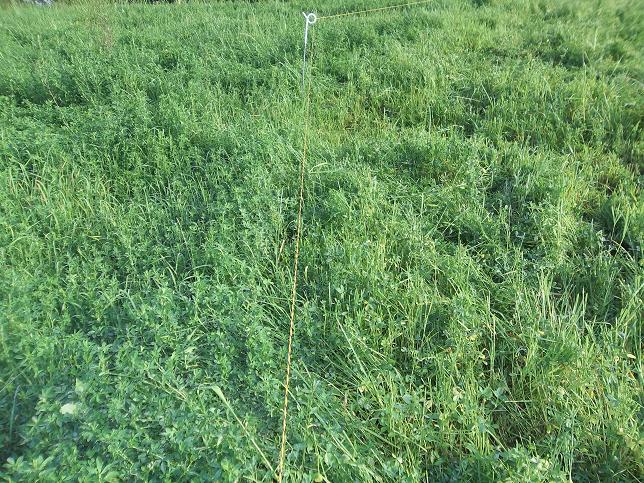
But, if we look back at pasture that has had at least a week to recover we can see strong clover growth. In fact, on the left in this picture you can see a line in the grass where the clover ends. I believe that’s where the pig quick fence stood last summer.
So it appears my grass is strengthened by the presence of pigs but I sacrifice my clover stand. Ah, tradeoffs. Why can’t it be more simple?
Takeaways:
-Walk your pastures regularly
-Take notes
-Take pictures
-Reflect on changes you observe.
-Evaluate these changes to determine if it is really a problem and, if so, if your management has caused it.
It is possible that I just need to move the hogs more frequently to help retain some portion of the clover. I’ll keep fiddling with it.
In a few short days we’ll be enjoying fresh goat milk again. I love goat milk. It makes the best ice cream, the cream doesn’t separate and it is easily digestible. I have heard a lot of people tell me that they think goat milk tastes bad but I think it depends mainly on the goat’s diet. Our goat milk tastes great but our goats are offered a wide variety of forages.
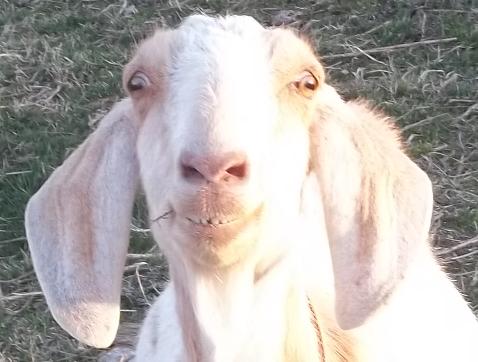
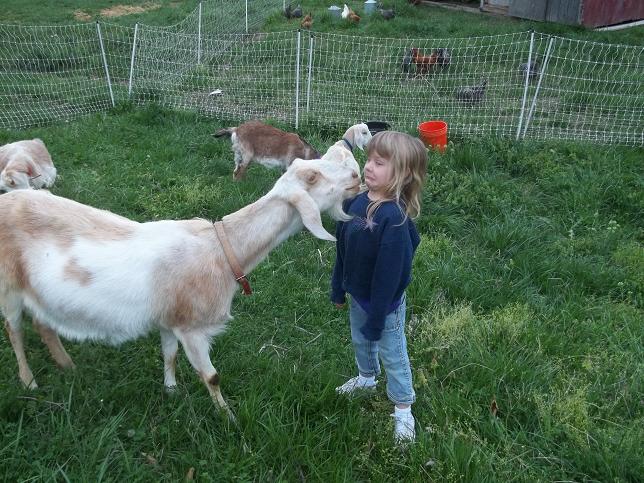
Let me introduce you to our goat herd, headed up by Olive. We bought Olive on Craig’s List some years back. She came from a farm about an hour to the North. I believe she is rounding out her sixth year. She’s a gallon milker and is at least mostly nubian. Isn’t she pretty?
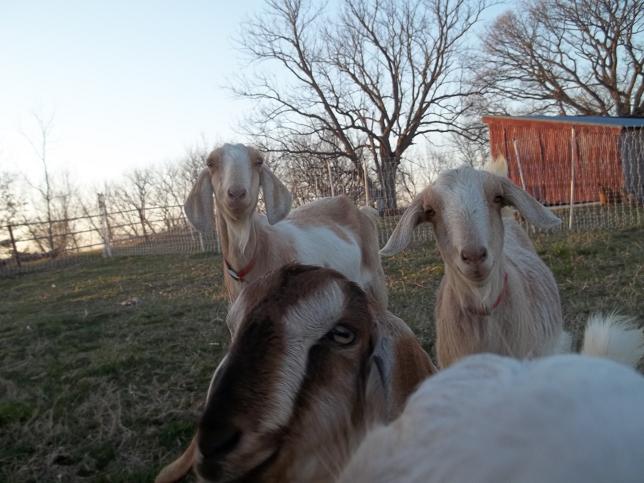
Olive arrived with her twins (Sweet Pea and Popeye (Supper)) two summers ago then gave us quadruplets last year. That’s a pretty strong mark against her as it is a trait we want to select against. We were able to keep two of the four. I made an attempt at a family photo but..well, goats are goats. From the back left Olive, Sweet Pea, Pixie and Honey. Honey wanted to eat my pant leg and refused to pose.
What we like best about the goats is they aren’t much of a threat to our children’s safety. They may love you to death but that’s the worst they’ll do. Billy goats are a little different story…
Olive and Sweet Pea are days away from freshening…from kidding…from having babies. We’ll keep a close eye on them as we believe Olive was bred on Dec. 10th and Sweet Pea was bred a few days later. When Olive was carrying quads last year she developed a limp…you would too. So far she’s getting around normally but you can tell she isn’t comfortable laying down.
This will be Sweet Pea’s first freshening. She’s developing an udder and you can tell she’s not comfortable with any part of this arrangement. She’ll be a handful on the milking stand. Should make for good times though.
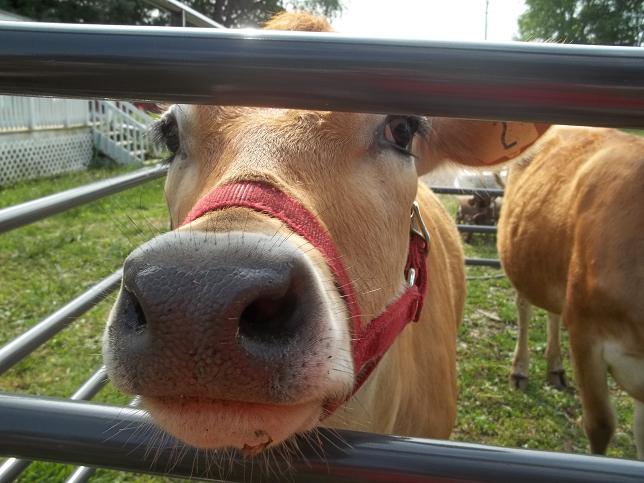
How do cows talk? With their mouths….and with their manure. Their manure says it has been raining a lot recently so let’s stick to the front end for today.
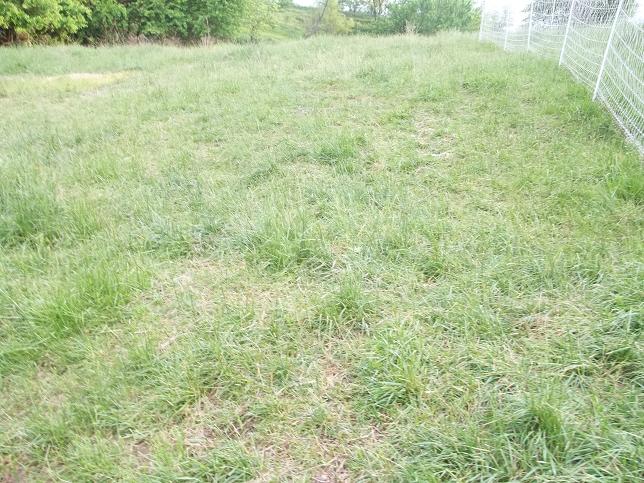
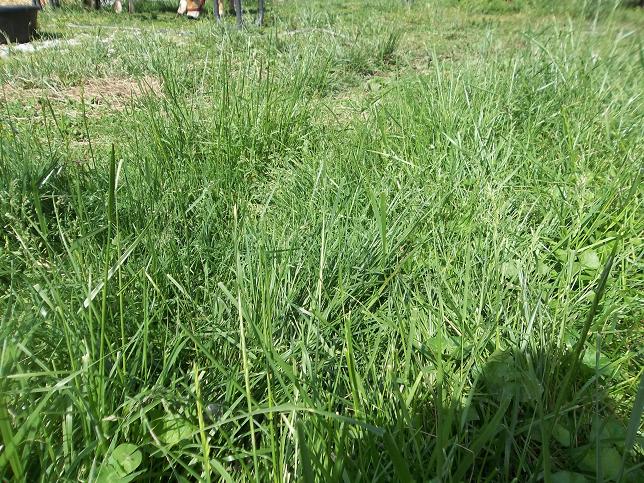
Talk to your cows. They don’t mind. But to hear them you have to listen with your eyes. For example, here the cows told me they don’t care for fescue:
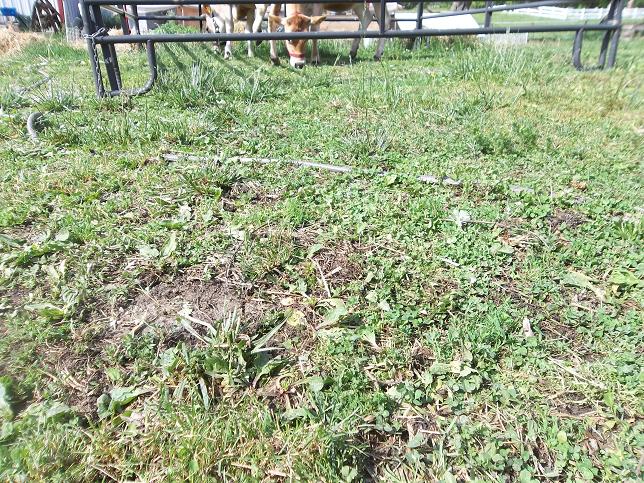
They couldn’t wait to leave the fescue behind. They were placed on this patch at around 9:30 this morning while the day was still cool and the sun was hidden. Just before the monsoon du jour hit we put them back in the barn and moved them to the next spot in the early afternoon:
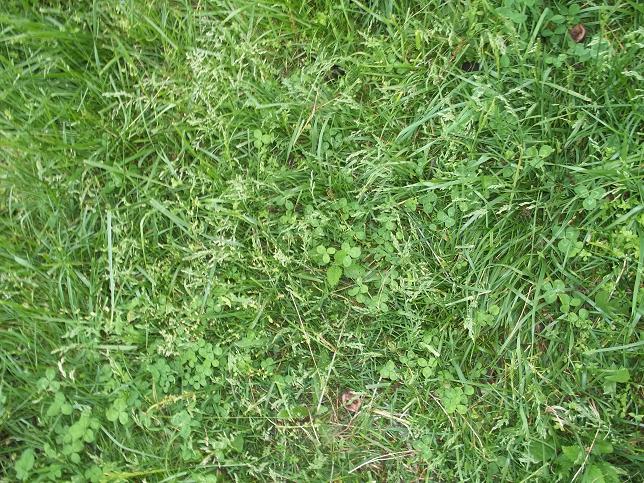
This spot is right next to the spot they ignored, it’s just colonized by different plants, it’s a different time of day and the monsoon passed…for now. If you look closely you’ll see white clover, dandelion, plantain, chickweed, pineapple weed, violets and a variety of grasses I’m not so good with…but little fescue. They ate it right down to the ground.
Now, I’m not as good at speaking cow as I am with chicken or pig but I think this means they liked this spot better. Or it may mean that early morning, pre-rainstorm fescue isn’t very tasty. Or that they were really hungry when I let them out of the barn. I don’t know.
Pssssst!
If any of you speak cow…specifically the Jersey dialect, please comment and let me know.
Full disclosure: I broke down and mowed behind the cows the other day. There were tall clumps of fescue that I just couldn’t ignore. I can only tolerate so much as I look out my window. Bear with me. I’m not there yet.
I can’t tell you where this came from. Well, I could but you would get bored. A co-worker of a friend who goes to my church and works with my sister-in-law….see what I mean?
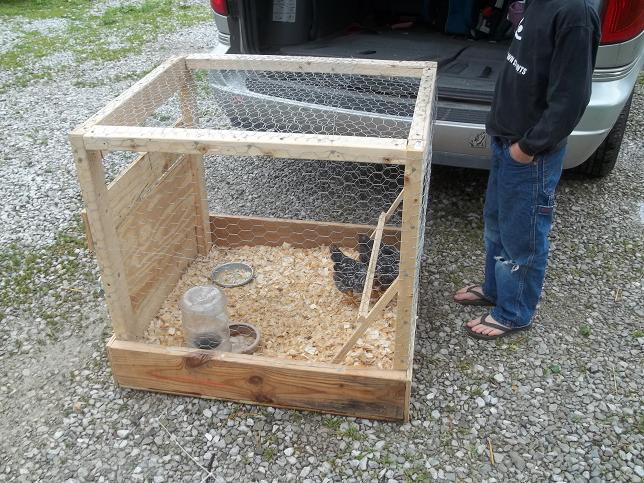
So a guy got some pullets and found it wasn’t his cup of tea. He gave them to us along with a nifty little cage he built. It even has a roost bar built in.
These poor birdies are wondering what happened to their little girl and the life they left behind. But they’ll be loved and well cared for…and it just happens I have two little girls of my own.
The owner delivered them with the remains of a 40# bag of Nutrena medicated crumbles. I’m not sure what to do with it. I don’t even know what Amprolium is…other than a coccidiostat. These birds are faced with an immediate switch to freshly-ground, whole grain feed with a big dose of Fertrell Nutri-Balancer containing a probiotic and lots of fresh, clean water. Coccidiostat indeed! My birds have immune systems and we assault their immune systems regularly…as we do our own. We don’t put healthy birds on crutches just in case! For Heaven’s sake, we pasture our birds. They are exposed to all manner of things the robins bring back from Florida.
Well, with that behind me, these are Silver Laced Wyandotte pullets and appear to be a little over a month old. Most of the farm supply stores around us buy from Cackle hatchery so it’s a good bet they came from there. The birds appear healthy, their cage is perfect for three little birds so we did little more than park them in the greenhouse with the other pullets (who welcomed them with open arms) and the ducks (who are very judgemental) and the rabbits (who pretended not to notice).
Thank you for being so generous Jim. I hope you’ll bring the kids up to see their birds as they grow. We’ll be sure to let them gather eggs, help us milk or just watch them run and play. Nothing quite like free-range children.
If it will ever stop raining I’ll get a shovel full of dirt and grass for the birds to pick at. That ought to give their digestive and immune systems something to do.
Last year we ran only Broad-breasted white turkeys. They were very entertaining, easy to sell but hard for us to manage. This year we are only raising a few…so if you want one you should speak up soon.
Turkeys are very fragile animals. Give them any excuse…any excuse at all and they’ll die. In spite of this we harvested 19 of the 20 birds Sunray hatchery shipped us (#20 broke a leg at about 3 weeks and I put him down). This year we ordered 5 white and 5 bronze turkeys from our friends at Schlecht. These ten arrived with our latest batch of 300 broilers. Unfortunately, one chick and one bronze turkey didn’t survive the post office…further reinforcing our decision to drive to Iowa to pick up or next order in August.
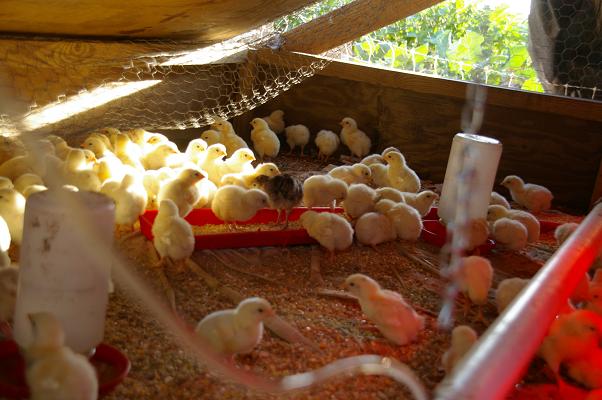
We have moved out of the greenhouse into the outdoor brooders. It can still be a bit chilly in the evenings so for the first few days we cover the ends with plastic (plastic we found out in the pasture that was used for round bales years ago). All 300 are in one 8×8 for now. Soon we’ll split them between the two brooders but early on they like to be close.
Can you spot the turkey? Look for the one that has the start of a snood.
This one is easier:
Here are a few close-ups.
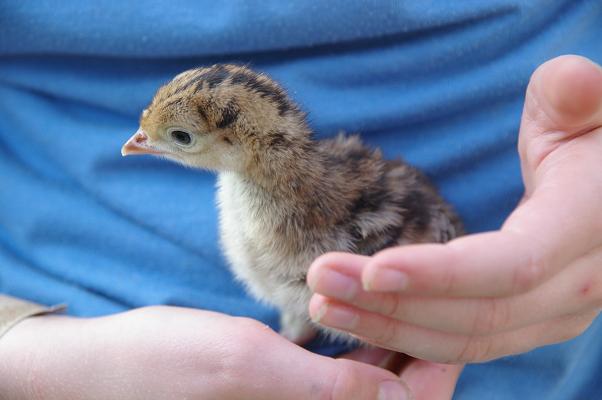
Broad Breasted Bronze
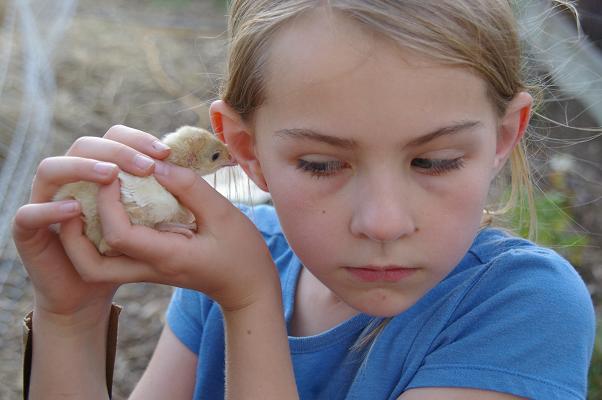
Broad Breasted White. What is it saying?
Keep your fingers crossed. We are still pretty nervous about raising turkeys. They are so fragile.
If you have heard or read that turkeys should not be raised with chickens…well, we heard that too. But it works and works well. The chickens seem to show the turkeys what to do. Joel Salatin talks about it at 5:00 in this video:
Don’t be afraid to get yourself a few turkeys to raise with your broilers. Once they are out of the brooder they are pretty durable. One turkey faught off a raccoon last year, removing the raccoon’s eye. Be careful because they seem to go from 15 pounds to 25 pounds overnight. We found it’s a little harder to market a 25 pound bird than it is a 18 pound bird.













 Chism Heritage Farm