Fall Planting

We have big plans for our fall garden.  We are currently reading through The Winter Harvest Handbook by Eliot Coleman, a very inspiring work.

We moved the two outdoor chick brooders out of the garden area as we are finished brooding chicks for the year.  We spread the manure and bedding around and are planting a large area of beets to feed the cows through the fall/winter.  Then we began moving the hill material out of the potato beds onto a compost pile nearby.  We spread sifted 2-year old compost over the bed as we planted carrots, spinach, radishes and lettuce.  We will continue planting down the 30′ row, week by week as long as we can.  Eventually we’ll be forced into the greenhouse.  Can’t wait.

We limed the other potato row with raw aragonite, spread compost and began planting broccoli.  This row will eventually be home to cabbage and cauliflower as well.

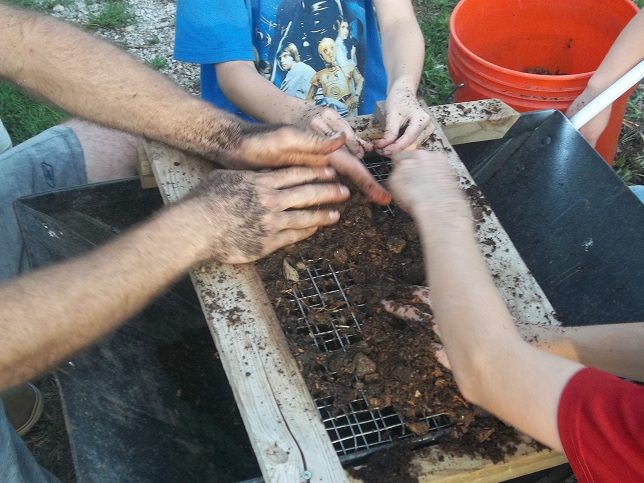
The compost is mostly the bedding and offal from chickens we harvested two years ago along with garden waste from the same time period.  This is my first effort at a compost pile we didn’t turn.  As you might expect, we found a fair number of chicken bones and quite a few undigested wood chips.  Those were sifted out and added to the current compost pile.  No sign of the mountains of feathers I loaded into the pile.

I have high hopes for the fall garden.  We are planting in a hybrid of Jeavons’ methods and Coleman’s.  Broccoli gets staggered in the hex pattern.  Carrots in tight rows.  We’ll see how it goes.

What’s in store for your fall garden?  Getting started yet?

Drought, Death and Discouragement

It’s hard to get it all done.  Some of the things we do really turn out well.  Some of the things we do could turn out better.  Some of the things we do go as badly as possible…worse than we could imagine.

My wife, parents and even extended family are generally supportive of our efforts here.  Even within that group I am no golden boy.  Outside of that group it is easy to find criticism.  I’m going against the grain.  I am defying convention and tending toward worse offenses.  But it’s easy to get past other people’s opinions of me.  Sometimes there are real problems.  Sometimes you make a mistake.  That mistakes snowballs into bigger problems.  Standing there, with my back against the wall, I ask myself, “Why can’t I do anything right?”

This blog has become more of a “how-we” than a “how-to”.  If you want to defy convention, I want to encourage you.  If you want to try your hand at raising a few chickens or pigs, I’ll tell you what I have found works…and what I have found doesn’t work.  I like to make specific mention of what doesn’t work so you don’t make the same mistakes.  I’m not just spouting off about my experiences/abilities on the blog, I’m sharing my adventure with you…even the bad parts.  Now, before we get too far along here, let me reassure you that I’m fine.  I’m OK.  I’m not frustrated or angry or thinking about quitting.  My goal here is not to depress my readership.  My hope is that by opening up here I’ll encourage you to keep going.  This stuff is hard.  You can do it.  I’ll get through it.  So will you.

OK?  Let’s go.

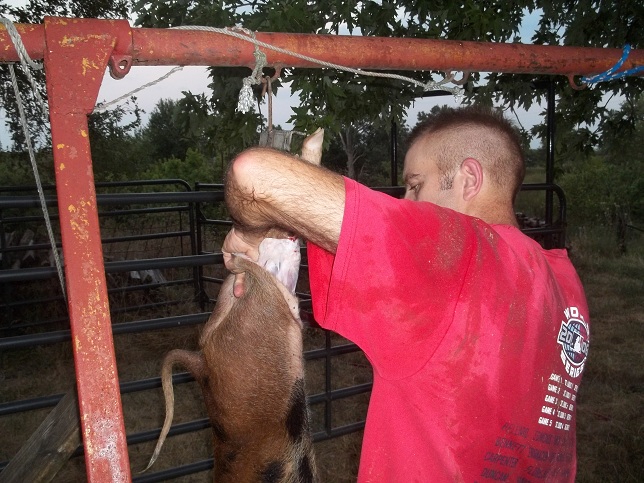
I do everything wrong.  Not just wrong but as badly as possible.  Experience is a harsh teacher and I am a slow learner.  Let me give you a few examples.  Here is a picture of me, dressing a pig.  You can see from my sweat that it was hot outside.  You can see from the dirt on my back that I carried the pig up the hill on my shoulder rather than kill it in a more convenient spot.  If you could smell you would know she peed on my right shoulder as I carried her.  I had to remember not to wipe my brow with that shoulder.  Why did I carry a hog across the pasture on my back and dress it out on a 95 degree evening in July?

Because we screwed up.  Hot weather is a problem for pigs.  Hot weather without water is a serious problem.  When I realized what had happened 7 of our 8 pigs ran to the drinker to get their fill.  The eighth pig just looked at me.  Poor Zing.  I carried water to her, attempted to cool her with buckets of water over her body and held the bucket down so she could drink out of it.  A few minutes later we lost her.

There is an agreement between me and my livestock (and my tomato plants too).  I provide everything they need.  They provide everything I need.  I dropped the ball, I lost a pig.

Now, there’s only so much I can do to manage the heat.  I can’t save every chicken, no matter how hard I try.  There are things I can do to lessen the stress on my animals.  Some of it is falling into a routine.  Some of it is overcoming personal inertia.  More than anything it’s time management.  But the truth is I don’t have this all figured out.  Some things I do work really, really well.  Other things could go better.  As I get better I’m more able to manage my time.  As I can manage my time better I’ll get more of the things done that I need to do.

Please don’t read this blog thinking I have all the answers.  I have some answers.  I have found some things that work reasonably well.  I don’t think I’ll ever exit the discovery phase.  I don’t think I’ll ever be “good” at this farming stuff.  Not only do I have a lot to learn, sometimes bad things happen.  Sometimes the cows get out.  Sometimes a raccoon eats a chicken.  Sometimes people make mistakes.  All of our safeguards failed poor Zing.  It was a busy, hot day and nobody checked the water.

If there’s a positive outcome here, the next day we wrapped and froze the meat and discovered one of our freezers was beginning to thaw.  If not for the pig we would have lost around $1100 worth of chicken.

Farming and Total Recall

I know this is a chronicle of our efforts toward sustainability.  I blog here about farming issues.  Well, we’ll get to that.  I want to tell you about the new Total Recall.  It was so bad I’m going to rant about it on my farming blog.  I’ll bring this back around to farming in a little bit so just bear with me.

I haven’t read Phillip K. Dick’s version of the story.  (I did attempt Do Androids Dream of Electric Sheep recently.)  Of course I saw the version that came out when I was a kid.  That version was also terrible but in a lovable sort of way plus I tend to like Verhoeven’s work.  I mean, if you want to go see it, by all means, go see it but go in knowing it’s Len Wiseman’s best effort to make a Michael Bay movie.  You’ll see 110 minutes of explosions, gunfire and rediculous technology with about 8 minutes of attempted, unsuccessful plot.  I mean, how the heck can you climb a ladder when you’re on a structure that is accelerating out of a gravity well?  But, without giving anything away, let’s look at the premise.  The earth has been reduced to two habitable regions; roughly Britain and Australia.  They are connected by an elevator.  Yes, an elevator…going through the core of the earth.  The rest of the world is a wasteland brought on by chemical warfare.  Then <SPOILER> our hero kisses the girl, shoots some people, some stuff blows up and they all live happily ever after.  Nevermind the fact that you’re transporting slaves 8,000 miles through the Earth every day to build robots instead of just building them where the slaves are.  Has no one studied basic economics?</Spoiler>

So back to chemical warfare.  Now, I’m sure they took certain liberties with PKD’s writing though, again, I haven’t read his work.  What if they had said, “Chemical Farming destroyed the world.”?  How awesome would that be?  I mean, on their map North and South America are totally uninhabitable.  Africa, gone.  Asia, poisoned and uninhabitable.  We’re not talking about Nuclear fallout like in On the Beach, we’re talking clouds of poison that somehow don’t come into the inhabited areas, though they are in the suburbs…  Anyway, it would be much more fun to retain Britain and Australia as the last habitable areas because permaculture activists preserved and maintained the soil fertility and improved the water cycle while the rest of the planet fell prey to the evil machinations of agricultural chemical companies (Mwa ha ha!) with or without the elevator through the core of the planet.

Anyway, don’t poison the planet with your chemicals.  Work to improve the hydrological cycle of your land, improve biodiversity and, as a consequence, increase soil fertility.  And if you have a hankering to see Total Recall, see the one about terraforming Mars instead of the one about the elevator.

Apples and Raindrops

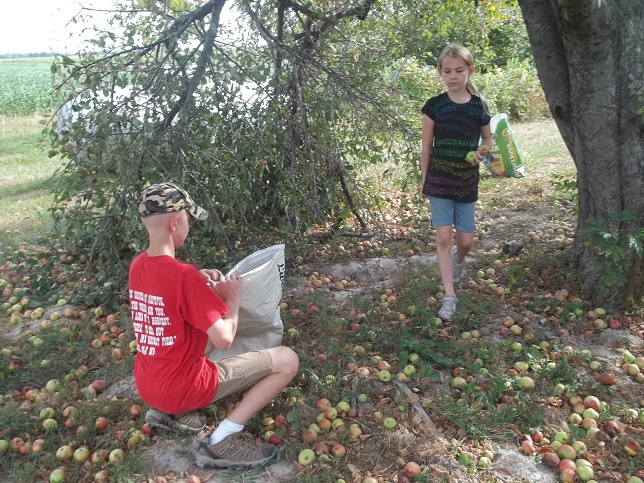
Let’s start with the apples.  Wife took the kids to pick up apples at Aunt Marion’s house (sometimes the kids get confused and call her grandma aunt marion or even Maid Marion…lol). 

They filled three bags, barely making a dent in the supply.  Aunt Marion filled two buckets with apples that were good enough for applesauce.  Please notice the top of the tree broken and laying on the ground.  Yup.  She didn’t let me prune that tree.  Maybe this winter…

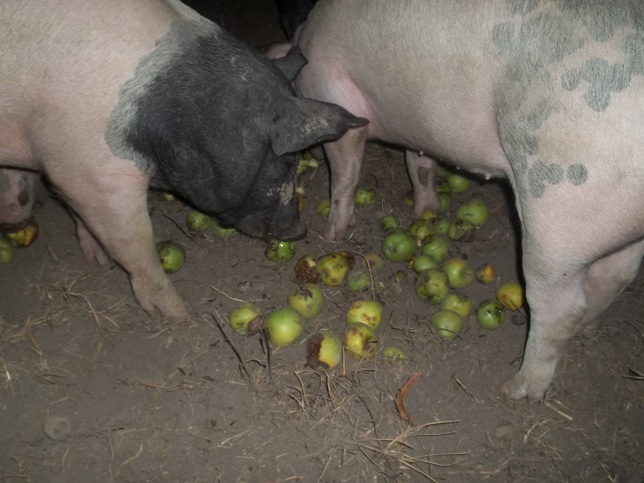
Kids had a ball.  Aunt Marion refuses to slow down.  She was convinced my 7 year old son couldn’t lift the bucket of apples.  Wife was convinced Aunt Marion couldn’t lift the bucket of apples…wheezing as she was.  It was a hot morning but everybody worked hard.  The pigs were pleased with the fruit of their labor.

Then…wait for it…..wait for it……IT RAINED!

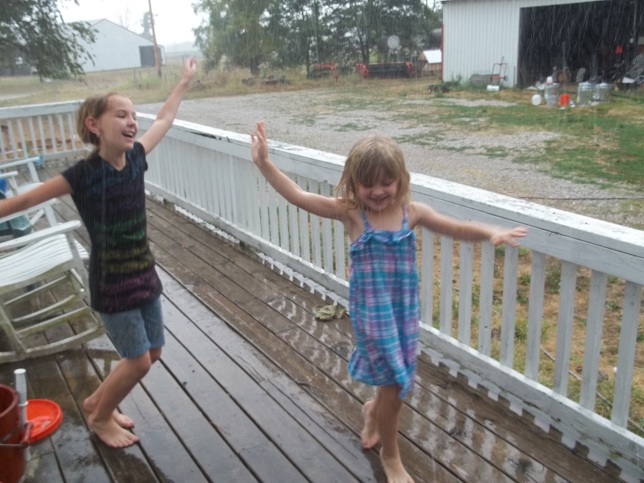
It rained and rained and rained.  Four and a half inches in 2 hours!  The pond filled up and there were even puddles in the driveway!  But nothing comes without a cost.  It cost us our computer and our phones.  Lightning struck the phone line outside of our home somewhere and our DSL modem sparked inside the house.  Though the hardware checks out I can’t get the PC to boot.  I’d say that’s a fair trade for a full pond.  Oh, and the roof leaks!  Isn’t it wonderful?!?!?  Merry Christmas Mr. Potter!

Look for before/after pictures of the pond on another blog post if I can ever get my PC to boot up again…

Converting Apple Drops into Ham

My hogs weigh in around 150 pounds now.  They are slower in growing out than their floor-raised counterparts for a number of reasons.  First, though they eat roughly the same amount, they don’t have access to food all day long.  Because they don’t have access to a snack any time they want they tend to be a bit leaner than they would otherwise be.  Also, they have room to run, exercise, fight and play which, not surprisingly, results in a leaner animal.  Finally, my pigs are expected to work for a living.  They aren’t laying on slatted concrete relaxing in the shade, inches away from feed and water.  They are out on the sun-baked pasture.  There are goodies buried in the brick-like soil and they work to find them.  After they work the soil I plant a few seeds.  They are happy with the work they accomplish.  They are happy to live life in the sun with a chance to fully discover the purpose of their design…well, not the reproductive parts.  My customers are happy because I deliver a lean, healthy, happy and, consequently, tasty animal to the locker.

Let’s make it even better.  Right now immature apples are falling from the apple trees at Aunt Marion’s house.  It is important to remove the drops from the orchard to control the pest population and limit disease vectors in the orchard.  The kids and I pick up a few bags full of apples each evening.  Later this week they’ll work with Aunt Marion (who recently celebrated her 94th birthday) to sift the good from the bad under the early ripening apple trees.  For now we just harvest from under the mutsu apple tree.

The pigs get a 5-gallon bucket of unsorted apples each evening for dinner which is the same as saying they get unlimited access to apples.  They really make pigs of themselves.  This will add flavor to the finished product giving a lean, healthy, flavorful pig you just can’t buy anywhere.  By the way, we’re sold out of fall pork.

Jailbreak

[Cue Bon Scott] – I ain’t spending my life here.  Gonna make a jailbreak.  Oh, how I wish that I could fly.  All in the name of liberty!

So there I was…fast asleep (had been for at least two solid hours) when the phone rings.  Dad says, “Your cows are out.  Come help me put them in.”

It’s 1:00 in the morning.  I’m asleep and my parents have been out partying with friends.  What kind of geek am I to be in bed when my parents are out?  And why are my parents driving home from a social event at 1:00 in the morning?  I don’t know but thank God my parents are driving home from a social event at 1:00 in the morning.

I step outside and see dad walking behind the girls around the curve in front of my house.  Of course the cows don’t want to be caught.  They are fat as ticks with all the stuff they have eaten along the road but still ornery.  They know they have pulled something off and are not anxious to be caught.  Such children!

Dad walks to their right as we go down the road, I follow behind.  Mom follows with the car in case another car comes around the curve.  They have already opted not to go to my house so now we’re headed to the yellow house where the high-security corral will contain them.

We almost get to the driveway and they decide they’re going to run.  I don’t care if we run, walk or jog.  Just don’t miss the driveway for the yellow house!  Dad races alongside of them to turn them in.  In the dim light the cows see the chance to take a left and, miracle of miracles, they do.  Now they’re in the alfalfa field.

I would like to pause for a moment to say that my father isn’t new anymore.  Along with knee surgery and various other problems he lost a toenail recently and it’s causing him to favor his leg.

OK.  Now the cows are in the alfalfa field.  The good news is they are already fat as ticks and they’re only stopping for a quick bite here and there but they are no less spirited.  Mom and dad go ahead in the car to the barn lot to open up the corral.  The wife (who just caught up to us) and I are following the cows on foot to the barn.  This can’t be more than 1/4 of a mile.  The girls know what’s going to happen.  They lived at the barn all winter.  Every day we would walk to and from the pond in the center of the alfalfa field.  At this point it’s routine.

Then the routine breaks.  They don’t want to go to jail.  We get as far as the barn lot and both dash to hide in the giant hackberry that recently fell.

Great.

That led to a couple of rounds at the circus maximus around the barn lot before finally getting them corralled in their jail cell.

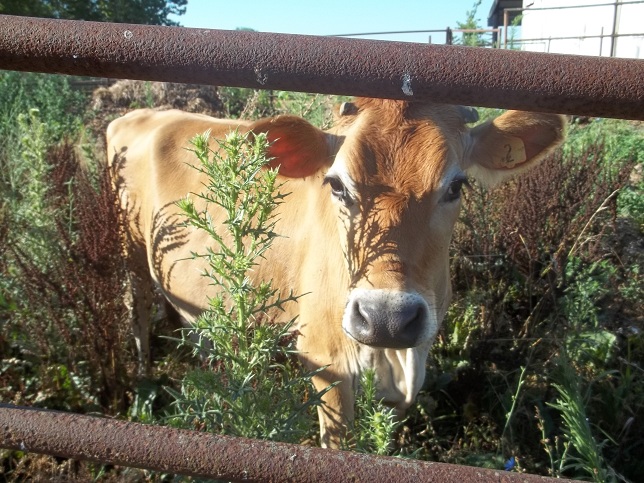
Now, I have to admit, I’m not at my best when woken from a sound sleep.  I’m not at my best when woken from a sound sleep and asked to run a marathon in the dark.  I’m not my best when woken from a sound sleep and asked to run a marathon in the dark chasing my cows and all their various liabilities.  I was ready to sell.  2 springing jersey heifers, best first offer.  By morning I was feeling more reasonable.  Because of the drought we’re out of feed.  We have been moving the cows around the yard and into shade every day trying to keep them away from flies and manure but moving them around doesn’t magically make more feed appear.  We’re down to a little bit of dried johnsongrass and baked red clover along with some dormant fescue and maybe a bit of lambsquarter here and there.  Not much to write home about.  I can’t blame the cows for being tired of eating grass hay we baled out of the ditch with a flake or two of alfalfa.  But if they want to protest their treatment they should do it when it’s daylight.  Is that too much to ask?

Nope.  No cows for sale.  I do need summer to cool off so I can build some fence.  Then I can at least contain those girls in a hot perimeter fence and keep them off of the road.

Had another rodeo on Sunday when we tried to move the pigs to a new pasture but that’s another story.

The Curse of the 3,001st Layer

3,000 Layers.  That’s the limit for my Illinois limited producer license.  3,000.  I’m in no danger of reaching that limit but I think it’s worth discussing.

Why 3,000?  When you get above 3,000 the magical bureaucratic fairy covers your farm with pixie dust and suddenly you have to treat your eggs for salmonella.  I’m sure this legislation is well-intentioned but 3,000 birds?  The number of birds isn’t the issue where chicken and egg health are concerned, population density is.  A farmer can have all 3,000 birds in batteries in a 2-car garage and, from the state’s perspective, that’s no different than 3,000 birds pastured over 10,000 acres.

3,000 birds make around 800 pounds of manure each day.  The unlimited egg producer license is supposed to protect the customer from salmonella but it makes no provision for poisoning the soil under an 1/8th acre 3,001 chicken operation.  “What about the EPA” you ask?  Isn’t that their job?

Nope.  And honestly, thank God.  Remember, the real bad guy in Ghostbusters was from the EPA.

The Illinois EPA doesn’t get involved until you have 82,000 laying hens.  Seriously?  82,000?  Why not an even 100k?  Doing the math, it’s not their concern until your chickens produce 22,000 pounds of manure each day.  Don’t misunderstand.  I’m not asking for EPA involvement.  I’m saying the pure number of birds is useless outside of a spacial context.  I could easily metabolize the manure from 3,000 chickens on 100 acres.  But a backyard producer on 1/8th of an acre could be well within their legal bounds while standing knee-deep in smelly muck poisoned by nitrogen and phosphorus.

This is where you come in.  Your job, as a consumer, is to be the final inspector.  Drive to your farmer’s farm and ask yourself a couple of questions.

  1. Does the place stink?  If so, why?  Does it stink because you are downwind of the neighbor’s CAFO or does it stink because your farmer is trying to raise too many animals in too little space himself?  Are the animals poisoning the soil?
  2. What do you see?  Do the livestock look slick, healthy and bright-eyed but the farm buildings a shambles?  Overlook the buildings.  The farmer is putting his money into animal well-being and future production rather than pretty places to put stuff he probably doesn’t need.  Pretty buildings aren’t a sign of a problem but if he has pretty buildings and sad-looking livestock you might reconsider your purchase.
  3. Walk around a bit.  How do you feel?  Is this a refreshing experience?  Do you feel energized and inspired or do you feel tired, guilty or stressed?

I think these three questions can go a long way toward vetting out the best farmers.  Healthy tomato plants make nutritious tomatoes.  Healthy chickens make nutritious eggs.

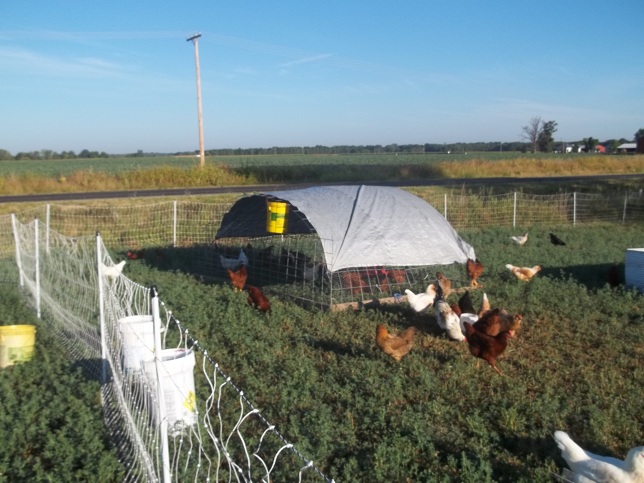
I don’t want to raise 3,000 birds.  I don’t want to retail 1,100 dozen eggs each week.  I don’t want to feed 700 pounds of feed every day.  I don’t want to think about the amount of water I would need or the manure I would have to wheelbarrow around (though the compost would be nice).  Under my current model I would need 40 of my simple hoop layer houses to house 3,000 birds.  I would spend a lot of time moving those across acre-sized pastures.  No thanks.

What I want are healthy birds and a healthy relationship with my customers.  I want an opportunity to make a positive contribution to my community, to my local ecology and to my bank account.  I believe these to be compatable ideas.  But this can’t happen without verification by consumers.  I really hate to channel Regan here.  Trust but verify your farmer.

Think back to your most recent trip to a farm.  How did it smell?  What did you see?  How did you feel?

The Wind Blew…

The wind blew.  The rain fell.  One of my chicken tractors tried to go over the rainbow and landed on the fence.

That’s really no big deal.  We have one of the hog panels off of it so it’s wide open.  It just gives the pullets a little extra shade and water on hot days. Last night it was empty.  Nobody got hurt.

The tractor is pretty simple.  Four 2x4s screwed together at the corners with a bit of plywood under each corner for a gusset.  The panels are held on the frame with fence staples.  The tarps are held on with tarp straps.  The screws at the corners failed when it tried to land on the wicked witch.  I put it all back together in front of the ever-critical chickens while the wife and kids splashed in the pond.

I can always count on them for help.  This time I left the sail off…I mean the tarp that covers the side.  That should help airflow and shouldn’t impact shade since the sun is almost straight up this time of year.

Since I touched on the Wizard of Oz a couple of times I’ll finish with this just for giggles.

Rain at Midnight

Clouds rolled in at dusk.
It rained 1/10th at midnight.
Clean, Fresh.  I’m happy.

or

It rained at midnight.
That makes me a happy man.
My shoes are wet today.

or

Storms rolled through last night.
It gave the Earth a shower.
Everything smells fresh.

or

Giant hackberry fell
The barnlot, the house, the shed
branches cover all

Egg Prices, Corn Prices and the Value of My Wife’s Time

What does it cost to produce a dozen eggs?  This is important since we’re staring down the barrel of a regional total crop failure.  Corn prices are rising and my dad’s tenant indicates that only about 1/3 of the stalks have ears and those ears aren’t filling out.  There’s hardly a bean in the soybean fields around me.  If this is true on a wider scale, we could be in some trouble.  How much will this affect the price of the eggs we produce?  Let’s break it down a little bit.

Averaged out, I get around 60 dozen eggs each month.  Each dozen needs its own, new egg carton (Illinois law).  When I ordered cartons in Feb. they were $0.32, now those same cartons cost me $0.56 each.  They have another paper carton that’s $0.36.  I don’t like it as much but two dimes saved is two dimes earned.  Eggs will taste just as good and the cartons are just as recyclable.
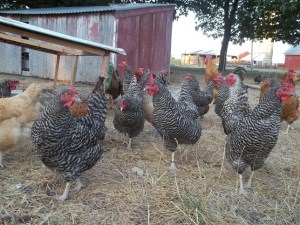
My flock of 40 birds eat 200 pounds of feed each month.  If corn costs $6.50 (what I paid last year for my dwindling supply of corn), it costs me $12.89 for the ingredients to grind my own bag of feed.  That doesn’t count the equipment cost or time involved in grinding that feed.  If corn stays at $8.00, each bag will cost $13.57 before grinding.

What other costs are involved?  Each morning we have to fill the drinkers and feeders and move the houses.  Each evening we have to gather the eggs.  Every other day we clean, sort, weigh, candle and pack the eggs.  Every few days we build fence.  What is that time worth?

It takes 5 months to go from chick to egg and those first eggs each pullet lays are quite small…too small to sell.  So, even though they start laying at 5 months, they are 6 months old before I can begin selling their eggs.  That’s 6 months of feed, water and care that I have to pay for with eggs over the next 18-20 months of productive hen life.

I have to pay for their housing.  I have to pay for the fencing that surrounds them ($0.04 per length per day).  I will lose some birds to predation and weather.  How much do I pay myself for sitting in a field all night holding a gun when predators get a taste for chicken?

I have to fill out the paperwork for our egg license and meet with our inspector annually.  He checks our fridge temperature, validates our scale and egg quality then hands us some promotional items.  At least he comes to our house so we don’t have to make a trip to some testing facility in Timbuktu but it still takes time.  We have to get a license from the king to sell our own eggs.  That license costs $15 each year plus we pay an inspection fee of $0.11 per 30 dozen eggs…to pay for our inspector to drive here once each year and say, “Hi”.  That takes away from our profit also.  One day, if we work hard enough, we can pay income tax too.  Oh, to dream!

So what do I charge?  It would appear that I could make a little (only a little) money selling eggs but the income is limited by the number of hours in a day.  I have to handle every egg.  The costs above indicate I am paying $1.28 just for feed and egg cartons plus a few more cents for inspection and licensing (you know, because consumers can’t judge for themseves if cartons are clean or if eggs are any good).  The fencing and housing are spread over 10 years and the chick and brooder time are spread over 2 years then we harvest and sell the bird as a stewing hen.  We charge $3.50 for our eggs and get an average of 60 dozen each month.  That means we make something like $3 each day from eggs before accounting for our time.  Either we need to increase our egg production, raise our prices or close up shop.  Salatin says he makes $12 over the life of the hen.  I think he’s right.  It’s a lousy primary enterprise but they do sanitize the pasture and keep the family entertained.  At $8 corn I’m under some pressure to lower my entertainment cost or find feed alternatives but the real pressure comes from labor costs.  It takes a lot of time to feed and water the animals then gather, sort and peddle the eggs.  Compared to our labor costs, the price of corn is insignificant.  My prices have to go up, not because the price of corn went up, but because I’m learning about business the hard way.

That’s not to say food costs won’t rise because of the bad crop.  They will.  60% of the corn produced in this country is fed to animals.  It’s in most dog and cat foods…not just what we feed pigs, chicken and (unfortunately) beef.  Corn is in everything…including your gas tank.  Soybeans are in everything too.  Producers are going to have to determine the marginal utility of each compared to substitutions.  I may feed potatoes and milk to pigs…if I continue to raise pigs.  But, as a consumer, you need to consider marginal utility as well.  Just because corn products cost more doesn’t mean you have to buy them.  What substitutions can you bring into your kitchen?  I’m afraid there is little substitution for a good egg.  I’ll do my best to make appropriate substitutions on my side as well as streamline my labor to encourage you to continue to buy my eggs.  I believe you will continue to find my products to be a good value even in the face of rising prices.

—UPDATE—

Dad pointed out a couple of things not factored into my equations above.  75 layers generate 15-21 pounds of manure each day or a maximum of 115 pounds of nitrogen, 65 pounds of phosphorus and 42 pounds of potassium per acre, not to mention the trace minerals I put in their feed ration.  That has value.  They also eat bugs.  That has value.  I don’t mean to say my chickens are a drain on our budget, I’m saying, in terms of farm cash flow, economies of scale work against me trying to generate income from a small flock.