Still Grazing

Every night the cows come up to the shed where we feed them hay.  We do this so we can separate the calf so there will be milk for us.  In the morning, we milk while feeding them dried molassas and oats with a turnip, beet, daikon radish or whatever we can find.  Otherwise, during the day, the cows are still grazing.  Horses too.

The world is frozen this morning.  Cows, goats, chickens and pigs all get ice water.

IceWater

Cows are having frosted fescue and ryegrass.

Grazing2

We’ll continue grazing our way around the North side of the combine shed and into the pasture to the West.   That amounts to about 2 acres of grazing that hasn’t been touched since about September (when I finally fenced my cousin’s cows out of my pasture).  Little by little we move the electric fence opening more grazing area.  I don’t have a back fence up on this pasture as the grass is pretty much finished.

Grazing1

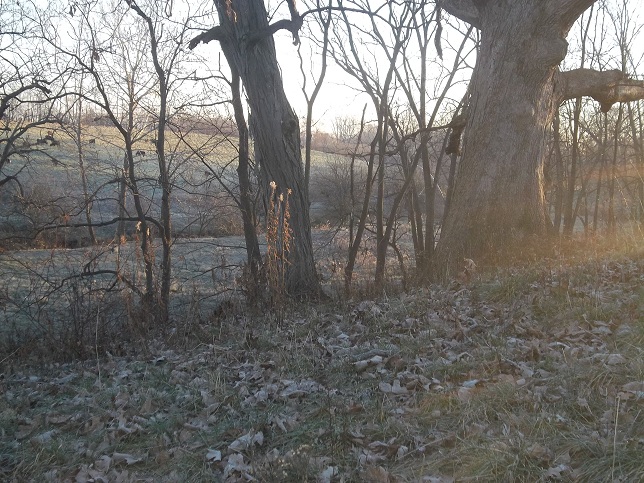
Then there are another couple of acres to graze in the bottom when we get around to it.  The cows on the next hill are the neighbors and they are grazing wheat and turnips that were sewn when the corn was tall.  I can graze the bottom just down the hill from grandpa tree.  That too has been untouched for several months.  It would be better if it had rested since July but…next year.  Unfortunately it’s not wheat and turnips.  It’s fescue and goldenrod.
BottomPasture

Ah, goldenrod.  These leaves are pretty much what is left of goat pasture.  Poor goats have been on hay since the leaves fell.

GoldenRod

The horses don’t seem to mind the fescue so we’re stretching their hay by rotating them where the cows have already been.  I have a hill near the horse barn that is a solid mass of fescue foot deep.  The horses do a good job grazing it down to the nubbins, fertilizing the ground and tearing it up with their hooves.  This will make a good seed bed for clover in the late winter.

HorseHooves2

So that’s the state of things.  We encourage the cows to graze as frost makes the fescue more palatable.  The horses munch, stomp and deposit.  The goats nibble leaves and seed heads where they can find them.  We keep notes on what is out there and are determined to do better next year.  Higher plant populations, greater diversity, more palatability, taller grass, more stockpile, fewer weed trees….the list goes on.  It’s mid-December and we’re still grazing and I feel pretty good about that.  Hope this keeps up.
In For Repair

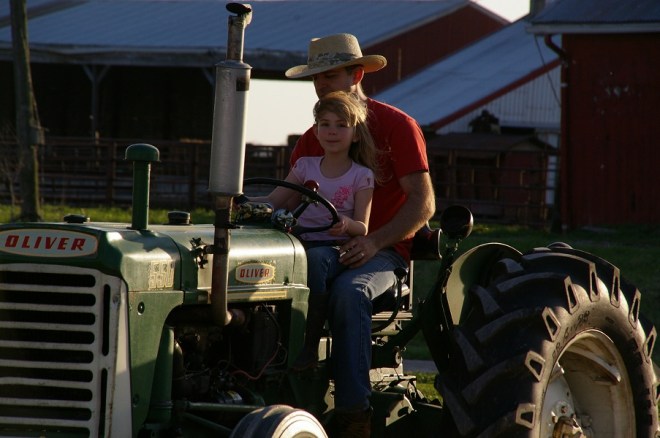
My Oliver 550 needed a little work.  Not only was it missing horribly on cylinder #2, it didn’t have any oil pressure.  Oil is the stuff that keeps the metal from touching metal…preventing the engine from wearing out.  “Missing” means that the four-cylinder engine was running at 75% capacity.  And it sounded bad.  And I had gas in my oil…you know, the stuff that’s supposed to protect my engine.  That’s not a good thing.

Oliver

Fearing the worst I took my tractor to a local machine shop, asking him for a worst-case estimate.  He said if it needed an overhaul it would be $2,500.  I only paid $3,000 for the tractor to begin with and there is another in better shape on CL right now for $4,500.  So, now what.  At what point do you pull the plug?  When do you send your equipment off to become scrap and parts?  What happens when I get worn out?!?!?

Three weeks later it turns out that the top end of the engine looked fine.  The shop put in new rod and main bearings, rebuilt the oil pump, replaced the relief valve and are sending it home.  All for much less than the worst-case scenario.  This is work I probably could do.  But there’s only so much I can do.  It’s not the best use of my time to wrench on my tractor.  Heck, it’s not the best use of my time to move a chicken tractor either.  I’ve written about this before.

My tractor came home.  We mowed a little bit with it to get ready for grandma’s funeral.  I used it to pull some logs and move a few things and …guess what!  It died.  I can’t even get it started.  I haven’t determined if this new problem is a fuel issue or an electrical issue.  It’s just dead.  I’m hoping it’s something simple this time.

At what point do you decide it’s not worth repairing?  Is it better to have a payment on a depreciating tractor that probably will work or no payment on a depreciated tractor that may or may not work?  We are really working to embrace option #3: no tractor at all.

Goumi and Apples

In working to establish tree guilds around the dwarf apple trees I planted I ordered goumi.  Near as I can tell it’s pronounced gwammee, not gummy.

The book Gaia’s Garden lists plants appropriate to an apple tree guild.  The guild includes bee balm, comfrey, daffodils and a few others but let’s just start with what we have.

Goumi1

I have apple trees already.  Thanks to Sandusky Valley I now have goumi.  They don’t look like much now but they should take off in the spring.  Toby Hemenway suggests you fit Goumi anywhere you can to help establish new trees and boost production.  The idea is that goumi (a nitrogen-fixing plant) grown next to and in proximity of trees will provide nourishment to the trees.  He even suggests you plant your apple and goumi in the same hole, cutting the goumi back each year to half the tree size.

Goumi is propagated by cutting.  The cuttings I got were bare-root and well rooted.  I made a mix of well-composted horse manure, sawdust, perlite and a greensand and planted the goumi at even spaces between the apple trees.  The trees are planted 8′ apart so I planted 2 goumi in a line at the 4′ mark.  This should keep the plants in sufficient sunlight as the guild develops.

Let me know if you have any experience with goumi or recipies you can share.

The Steel Hay Wagon – Wagon Series Part 3

Part three of my series on hay wagons is less for the woodworker and more for the welder.  I can’t imagine building this at current steel prices but, in a pinch, it would do and seems it will last forever.  This too is a guest post from my father.  I’ll hand it over to dad now.
Back to the farm auction.
Here I am hands in pockets, lots of temptations at another farm sale.  This time a neighbor is selling his equipment. He is cleaning out his sheds as he is quitting farming and has rented out his farm to a high rent farmer.
I am doing pretty good, I only bought a sloppy joe and a soda so far.  Then there is this old flat wagon with a steel bed.  The tires are holding air.  “Alright boys what am I bid for this wagon? $250, 200, come on what will you give? $100, $50, here 50 now 60,70,80.”. Who bid $90?  Oh that was me!  “$90 once, $90 twice, sold for $90 to that fellow.  What’s your number sir?
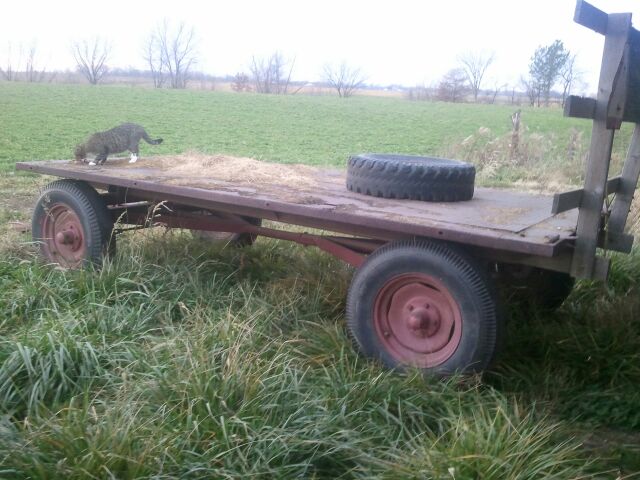
SteelWagon1
There you go, a $90 wagon that has hauled thousands of bales through the years (maybe 15 years).  And has been a work bench, a storage unit, hayride wagon…you get the idea.
SteelWagon2
We had our first flat tire on this wagon this year and that is the only repair we have had on it in maybe 15 years.  This wagon has a diamond tread on the deck but it still gets slippery, especially with loose hay.  [Editor’s Note: the deck can also get hot!]
Someone told me once every auction has a soft place, this auction had a cheap hay wagon.
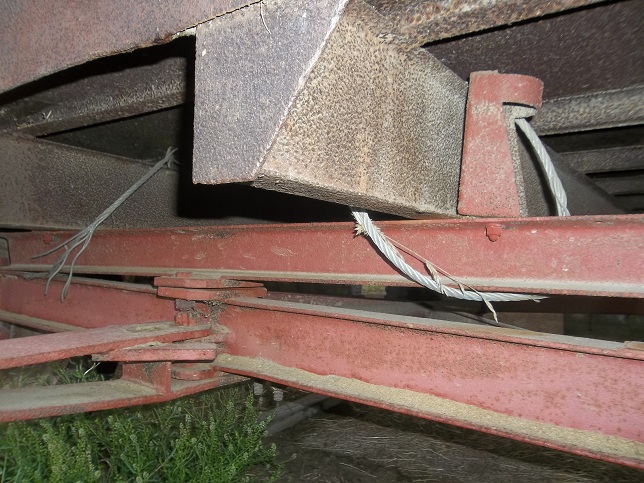
The construction is simple and straightforward.  Instead of wooden runners they used a pair of I-beams.
SteelWagon3
There is a frame of bent steel around the perimeter and the tread plate top supported by U-shaped joists on 14″ centers.  In the rear we bolted a 2×4 to each I-beam to support our headache rack.
SteelWagon4
The headache rack is also held on by a couple of brackets up top.  It’s easy to remove the headache rack this way…just 4 bolts.
SteelWagon5
One of these days we may go crazy and paint it. Who knows.

The One Hundred Twenty Dollar Hay Wagon (Wagon Series Part 2)

Part two of our Hay Wagon series is a guest post from my father.  You’ll see comments from “Not Caretaker” from time to time…that’s him.  Don’t be fooled by the pictures.  This is a great hay wagon and cost about half as much as any of mine and pulls straight.  We have put thousands upon thousands of bales on this beauty over the years.  Let me step out of the way and had the microphone to dad.

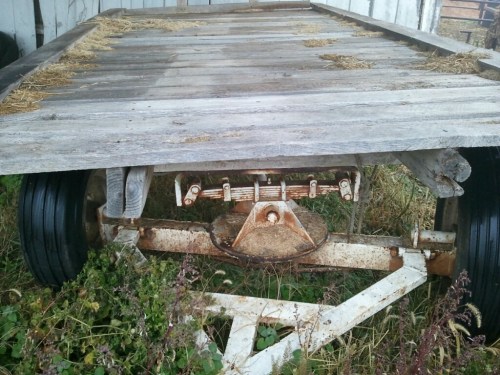
I would describe myself as thrifty.  That said I am willing to repurpose rebuild or do without.  I bought a wagon running gear from a local fertilizer dealer for $100.00.  It had an anhydrous ammonia tank on it at one time.  This running gear had one distinction from most other running gears in that the whole front axle turns on a center king pin where the usual farm gear steers like a car, both front wheels turn together with a tie rod.   Either running gear will do but the gear like this one will follow whatever is pulling it quite well.

At about this same time I was at a farm auction trying to keep my buyers number in my pocket.  The auctioneer came to a pile of used lumber (oak, spruce) of various dimensions and lengths.  Some of this was new 16’ lumber that had been use for concrete forms .  “What am I offered for this lumber?  $25, $25, $20, $20, ok boys someone start off, what’ll you give?”  I heard myself say “$10”.  The auctioneer said “alright I got $10, give me $15, $15, $14,$11, sold for $10 to number 313”.

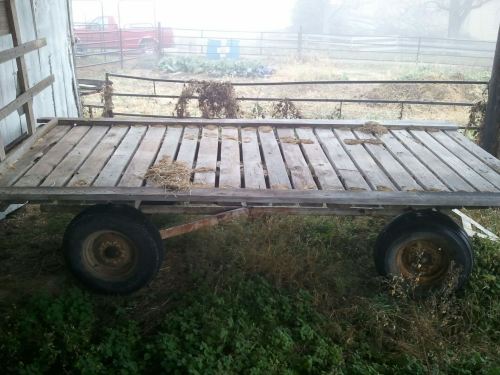
Back to how to build $120.00 hay wagon you can see where the money is going.  I sistered  two of the 2X6X16’s together to make a stringer for the foundation of the wagon bed.  Made two of them and fastened them to the wagon gear about forty inches apart.  Then I used 8’ oak boards for the deck and nailed them across the stringers placing them about an inch apart basically building a deck like you might have on your house.  The spacing of the deck gives the guy riding the wagon a good footing and is not slippery like the solid decked wagon written in the first of this series.

There you have a plan for an economical wagon.  You may not be able to buy a used running gear  that cheap as iron prices have driven up the price of farm machinery , but there are still bargains out there.   Used lumber is still a bargain you just have to find it.

Now I want to mention  something about using these wagons.  We stack bales right off the wagon (see videos in earlier posts).  I had an old neighbor, Tommy M, who helped me bale until he retired.  He would run the baler and I would ride the wagon and stack hay.  He always told me he knew how fast to drive by looking back at me, if my tongue was hanging out and I was breathing hard he knew he was driving fast enough.  How I wish he could still drive the baler.

Now that I drive the baler and Head Farm Steward rides the wagon, I know just how fast to drive.

HFS again.  In case you missed it, Part 1 is here.

Generalizing about Specialization

Specialization has made us all wealthy.  Cell phones, packaged meat, refrigeration…the dreams of kings!  All because of specialization.  Focusing on doing one thing very well and doing it repeatedly means I don’t have to do 50 things poorly.  I focus on doing what I do best and hire other specialists to manage the other things.  For example, I no longer turn wrenches on my own cars.  I hire a specialist.  Also, I am not my children’s dentist but I am my son’s barber.  By separating the duties of a roofer from those of a machinist from those of a cardiologist we end up with better roofing, more precise machining and a better chance of surviving when our lifelong assault on our heart becomes more than it can handle.  We are all better off because of specialists.

Generalization lends security.  What if I can’t get to a dentist?  What if I have to perform CPR on that stranger who wrecked his motorcycle on the road?  What if all the roofing companies are overbooked and nobody is available to put a roof on my house?  That’s when we rely broad knowledge and experience.

Everyone bridges the gap.  No person is 100% dedicated to their field.  The best cardiologist in the world is still a human the rest of the day.  She may also be a mother, a child, a volunteer or a welder by day and a dancer by night (she’s a maniac!)

I have to balance this out as well.  If I did nothing but my primary vocation from sunup to sundown I would make more money but I would be bored…and boring.  Well, more boring.  I really like what I do for a living.  It’s exciting, challenging and stimulating.  It is also air-conditioned and comes with a nice, cushy chair and a desk.  Though I don’t even get a cubicle to protect me from communicable diseases, I do have a desk of my very own. I am not the only specialist in my office.  The office is filled with specialists.  Each of us can create, fix, plan or manage our way to corporate profitability (though some get cubes!).

So far this hasn’t been a current events post about the farm but I’ll swing this back to the farm for you now.  I am a specialist in my career but my career does not define me.  I have traded away decades (yup, plural) of my life and a small fortune in training and books to gain the technical knowledge I possess.  Please understand, I take my job seriously.  I work hard to stay current on changes in technology.  That said, I am not my job.  The job is too small to describe me.  It’s just one thing I do.  I am not a specialist on the farm either.  Our speciality is pastured chicken but we also raise pigs, cows, turkeys, ready-to-lay pullets, mushrooms, garden vegetables, children, make tons and tons of compost, cut and manage our woodlot, and grow acres and acres of grass some of which we store in the barn for future use.  Each of these endeavors requires knowledge, practice, education and experience.  Because we do so many things I can only go so deeply into each one.  Why do I stop at 1200 broilers each year?  Because I am a generalist.  That’s all I can handle given our time constraints…for now anyway.  But the same equipment we use to raise broilers allows us to raise pullets for ourselves and for sale.  In fact, our fencing and chicken tractors can be used for pigs as well.  Not only am I a generalist, I try to utilize multi-purpose, non-specialized equipment.

I can set up, design and maintain your SQL Server database.  I can raise, kill and process chickens, turkeys, rabbits, ducks and pigs.  I am, over time, becoming a gardening and canning fool.  I can shingle a roof with the best of them.  I have flipped burgers, watered plants, mowed grass, designed landscaping, framed houses and traveled the length and breadth of North America (and Puerto Rico) training truck mechanics how to use software.  I have changed tires on everything from cars to semi-trailers to tractors.  I have changed diapers.  But I am not rich.  Were I to give up all this generalist nonsense and focus on my career I might be closer to “rich” but I do feel secure knowing we’ll eat well.

Forgive me if the world is less wealthy because I refuse to specialize.  I’m just having too much fun.  Besides, Heinlien said:

A human being should be able to change a diaper, plan an invasion, butcher a hog, conn a ship, design a building, write a sonnet, balance accounts, build a wall, set a bone, comfort the dying, take orders, give orders, cooperate, act alone, solve equations, analyze a new problem, pitch manure, program a computer, cook a tasty meal, fight efficiently, die gallantly. Specialization is for insects.

-Robert A. Heinlein

Grandma Chism Has Gone Home

I loved my grandma Chism and would like to share a couple of memories of her that stand out in my mind.  Lots of memories of grandma in her house (the house I live in).  She built the kitchen cabinets.  She always hung mistletoe in the back room at Christmas (she loved kisses).  As an adult she came to Christ and spent large volumes of time reading her Bible later in life.  She enjoyed painting.  She made bookshelves for family members using pine and she preferred a fruitwood finish.  She could whip up a lunch for 2 or 20 in the same amount of time, never knowing how many people grandpa would drag to the table for dinner.

She always had cookies on hand.  Oatmeal chocolate chip cookies were almost always in quart bags in the freezer.  My cousin (who is 15 years older than me) and I would often share a bag with a glass of milk at the table.  Those cookies say “grandma” to me.  I’ll share the recipe but, please understand, the recipe was written down and she said, “That’s just about right”.  Here it is as written in the Chism Family Cookbook but trust me, add more flour.

Chocolate Chip Oatmeal Cookies
Marjory Chism
1/2 c. butter
1/2 c. lard or shortening
1 c. brown sugar
1 c. white sugar
2 eggs
1 1/2 c. sifted flour
1 tsp. soda
1 tsp. salt
1 tsp. vanilla

Mix in mixer.

Add by hand:
3 c. oatmeal
1 pkg. chocolate chips

Drop by teaspoonfuls on greased cookie sheet.  Bake at 375 for 12-15 minutes.

The Oliver 66

I was 8 at the time and I wasn’t present for the back story but here is my understanding of how it all went down.  It seems there was something grandma was wanting to buy.  Something she really, really wanted to buy but grandpa said she couldn’t because the money was too tight.  This was a normal condition in the household but this time, whatever it was, grandma really wanted it.  Grandpa went to an auction and came home with a 1950 Oliver 66.  Now, try to picture the event.  Grandma was on the porch when grandpa came home with a tractor…after telling her they didn’t have any money.  If you ask me, grandpa thought the price was fair and bought it on impulse but when faced with his wife he said something like, “Well, it’s like the tractor I started farming with.  I bought it for Christopher.”  As if buying a tractor for a grandson would somehow make it all better.  At any rate, it looks like Grandpa:1 Grandma:0.

Fast forward a few weeks (maybe months).  The family makes the drive 100 miles to visit grandma and grandpa at the farm.  Both are at the door.  Grandpa has no idea what is about to happen when, as I get out of the car, grandma yells, “Christopher, go into the barn and see what your grandpa bought for you.”  I gave a puzzled look at my grandpa and remember him standing with his head down looking defeated.  Grandma gets the win.  I still have the tractor.  My dad restored it years ago and took it to a number of parades.  We sometimes use it to pull a hay wagon but it is mostly retired…but still cool.  Thanks Grandma!

Time Passes

A few years ago my grandma moved to assisted living.  For a short time the house was rented to a crew of men from Missouri who were installing rural water in the county.  Before then I had never seen mud on the carpet in the back room nor had I seen beer cans or poker chips in the house.  They finished their work just as Julie and I were looking for a farm.  It was further from town than we wanted to be but we decided to go for it.  We rented my grandma’s house at first and that gave us an acre to start with goats and chickens.  Then we bought the farm…in the most literal usage.  Though I live here now, it’s still my grandma’s house.  I have trouble with some of her rules.  I know what rooms I am allowed to eat in.  Weird.  I put my garden where she had her garden.  But things have changed.  We don’t watch TV (let alone Lawrence Welk) so our living room isn’t focused on the TV altar.

Great Margie is going in a hole?

My 4 year old nephew is a cute, smart, manipulative (lol) little guy…but still cute.  When the tractor came to dig the hole all of the kids ran out to the cemetery to see what was happening.  One of the children said he asked why we were going to put Great Margie in a hole.  We took a moment to explain the grave and rock are just the memorial.  Great grandma isn’t here anymore.  We are honoring her passing and work to preserve her memory for future generations.

Her Story Goes On

She believed that she was not an accident.  She believed that life has value and that value is not measured by her flesh.  That our bodies are temporary but life is eternal.  That an eternity with God is far preferable to an eternity without Him.  She believed that Christ left heaven, assumed a human form, came to Earth and lived as a man with one exception: he did not sin.  She believed he was killed, not because a few people in Jerusalem 2000 years ago were bad but because all men have fallen.  Because all men needed his pure sacrifice to atone for our sin debt.  Further, that Christ arose from the dead, defeating death and defeating the hold sin has on our eternal lives forever.  That one sacrifice, made for all, acts as a new covenant with God, bridging the gap between His perfection and my natural inclination to go my own way.  Grandma believed this story and I believe Grandma has gone home.  Grandma told me this story.  Our true Chism Heritage is not merely on of agriculture.  Ours is a heritage of faith.

New Cast of Characters

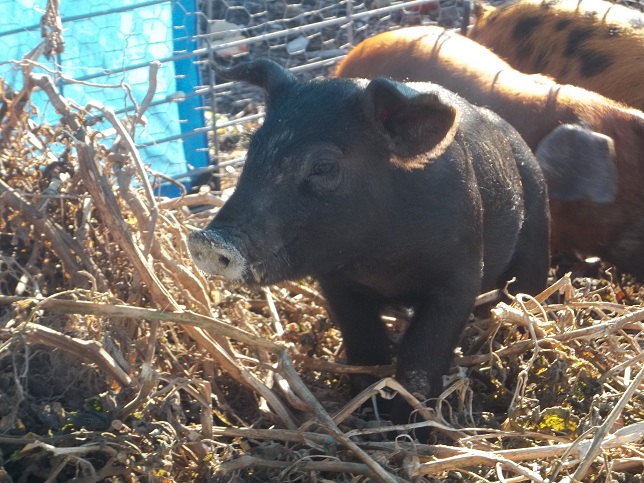
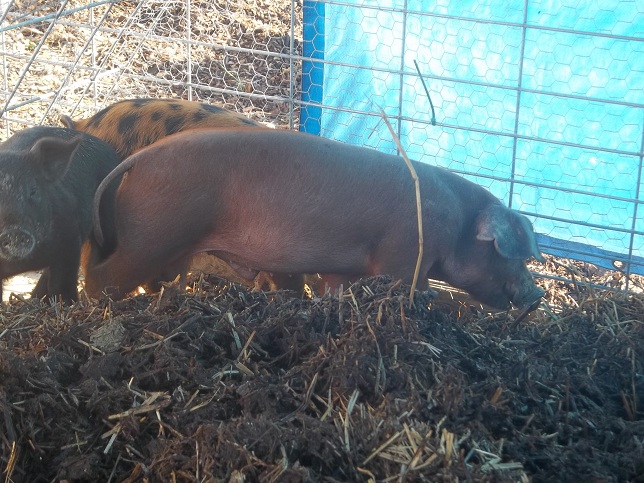
I built a large compost pile in the garden with two truckloads of horse manure and most of the garden waste from tomatoes and peppers.  I needed a little help getting it composted well so I enlisted the help of my sister’s turkeys.  This is just a 2-day assignment before they ship off to the freezer.

But mere turkeys are no match for a manure pile of such magnitude.  It was time to bring out the big guns.  I needed a pigerator.  I brought another chicken tractor home from the pasture, made it reasonably pig-proof and bought some new shoats!  WOOHOO!

I love pigs.  Little pigs.  Cute little oinkers that can’t knock you over and eat your arm.  Little pigs are just the best.  My sister is visiting and pushed me into it because she wanted to cuddle a spotted pig.  We got a spotted pig.

And just in time too because we have some milk that soured when we went to Florida, we’re still trying to put up apples, pears and jalapenos and we generate more kitchen waste than our poor worms can handle.

I may have to go back to Mike’s and get 7 more.

My last few batches of pigs have come from our friend Mike.  I posted about him some time ago.  He was vaccinating newborn pigs yesterday when we visited and we got to hold a tiny, tiny pig.

Thanks Mike for farrowing on pasture and raising such high-quality stock.

Apple Trees in the Ground!

Once upon a time, probably laying in bed on a lazy Sunday morning (when we lived in the city, churched on Saturday and still had lazy Sundays), I said to my lovely bride, “I would like apple trees.  Wouldn’t it be nice to have a fall family gathering where we make fresh cider, take a hayride and roast a pig?”  And that’s where it all began.  That was the dream.  That’s why I live here.  That was probably 8-10 years ago.

And today (after 3 years of planning, hoping, researching and looking for frost pockets) I planted my first apple trees.

They aren’t much to look at.  Just sticks …um..sticking…straight-ish up.  But that’s the start.  They arrived bare root so they need to be staked.  They are planted in hills next to the Georgia wall on the North side of the main garden.  I have all sorts of plans for planting tree guilds all around them but the main point is they are in the ground.

Now, I just cross my fingers and hope for the best.  The money used to buy trees was just money.  The trees themselves are wealth.

Thanks Stark Bro’s.

Alligators on the Farm?

I have a specific and technical skill set that we rely on to pay the bills around here.  Put simply, I make it easier to find data stored on a big computer.  To do this well, I have to remain on top of new technology.  To that end, I just attended an intensive 9 day training course in Sarasota, FL.

I was busy in school then studying at the hotel in the evening.  This was no vacation.  Well, it was no vacation for me.  My wife flew down to visit me about half way through and she made it a point to see the sights and took a few pictures.

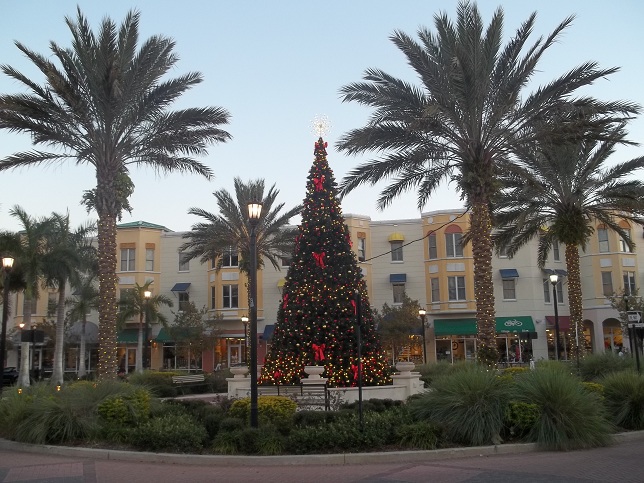
Sarasota is a beautiful town.  Rabid consumerism, broad, flat, straight roads, a surprising number of cows, swamp…what more could you ask for?

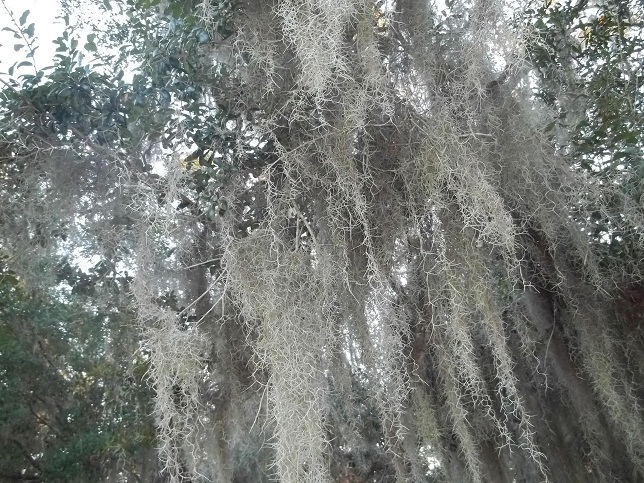
There are any number of wetland preserve areas (as if a wetland can express itself when confined to a 30×30 area and surrounded by pavement).  There were whole groves of live oaks, pine and pineapple trees.  The larger trees were dripping in spanish moss.   Our forests are a dense clump of about 100 kinds of trees (most bear edible nuts), multi-flora rose, poison ivy, dewberries, may apples, grape vines, gooseberries, ginseng and abundant fauna that aren’t inclined to eat your leg.  I couldn’t identify anything edible in the woods there other than acorns and was always aware of the possibility that the thing that looks like a log in the water to the left may be hungry.

So that takes us to alligators.  Alligators.

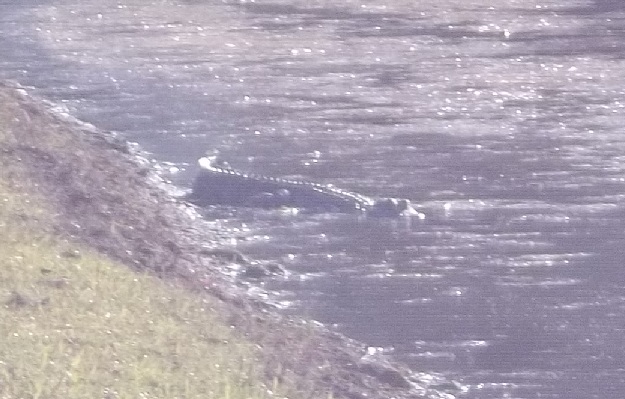
This fella lives in the swampy water hole area across the street from the hotel.  Others live in the various other water holes surrounding the hotel…and on out into the community.  Gators.  I found myself wondering if my electric poultry netting would even bother an alligator…or what I could legally do about it if I found a gator eating my flock.  The birds on the shore often just disappear.  One second there’s a juvenile sandhill crane.  The next second…not even a feather floating in the air.

If there’s anything I fear worse than having my leg eaten by an alligator in Florida it’s finding out my wife’s leg was eaten by an alligator in Florida.  I would rather she had not taken the picture of the alligator.  Before I saw the evidence, gators were just some myth the guys behind the desk in the hotel propagated to scare the tourists.  Julie made it real.  What if they are like velicoraptors?  What if the one is just laying there in the open to get your attention while the rest of the pack hunts you silently from the shadows?  Think I’m kidding?  One of the locals told us they have to be careful because the alligators will warm themselves under your car.  Look before you get in.

Does anybody raise chickens in Florida?  Does anyone else share my entirely rational fear of alligators?