Around the Farm in 80-ish Days

We are returning to pasture that was last grazed in early July. Through the summer we ran 10 cows on 13 acres of pasture. In that time we sold a heifer, borrowed and returned a bull and bought two new shorthorn heifers. 87 days ago our pasture looked like this:

Molly

Then it recovered.  What we found most interesting was the transition from fescue (a cool season grass) to bermudagrass (warm season). The cows like the bermuda grass much less than they like the fescue but that’s a little bit like picking which of two shoes to have for dinner. The fescue seems to trample better as it makes a dense mat and the bermudagrass leaves a standing tangle. We also overseeded with a mix of clovers, millet, cowpeas and sunflower. It gave us a nice crop.

SunflowersWe harvested the sunflower heads and, as usual, let the cows have the rest in small one-day pastures. Obviously we’re packing the cows in pretty tight to stretch 13 acres into three months…though I hope to do better next year. During that time we grazed our drought reserve for the first time this year.

EarlyMorningMoveThen the cows moved on. As the weather allowed we grazed open ground away from the shade. Fortunately we had unseasonably cool weather the first week or so of August and we could graze some ground I had written off until fall. We also stretched our pasture by grazing around the odd edges of the hay field and the pond.
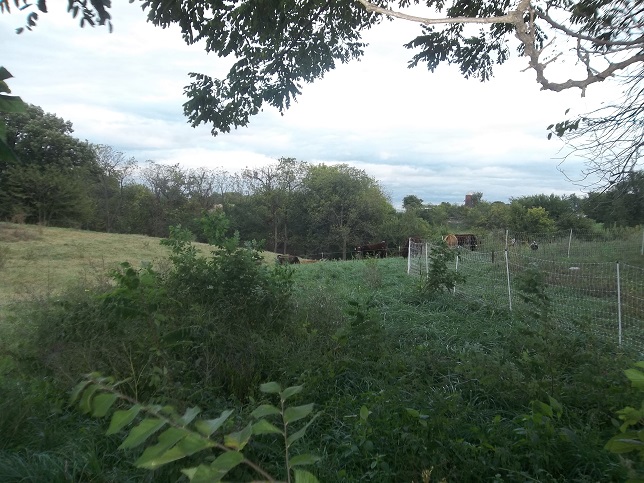
OctoberGrazing

3 months is more than enough time to break the pathogen cycles. More than enough opportunity to rest the ground, more than enough time for the grass to fully recover. But recovery is coming to an end. Grass will continue to grow, though slowly, through mid-December. Every inch of grass that grows is a day I don’t have to feed hay. This is a week’s worth of fescue growth.

FastRecovery

The plan now is to continue the slow rotation on everything but the stockpiled ground as long as it lasts. If things go well, that will take me to December 1st. However, after we get a solid freeze that kills the alfalfa I plan to graze through the alfalfa stand. That could tack on a month of grazing…so now we’re looking at January 1st. There are also a few acres of reserve hay ground that we couldn’t mow this year. If we could graze that I could gain yet another month. So now we’re looking at February 1st. At that point, we’ll put the cows on the stockpile which is conveniently located near the hay barn. By strip grazing the stockpile a little each day we should be looking at March 1st…maybe a little less. Then we’re in the heart of mud season and the hay feeding will begin in earnest, though much of our farm will have standing forage that has been recovering since October. When the thaw completes we’ll hit that recovering ground before moving on. Who knows when that will be though.
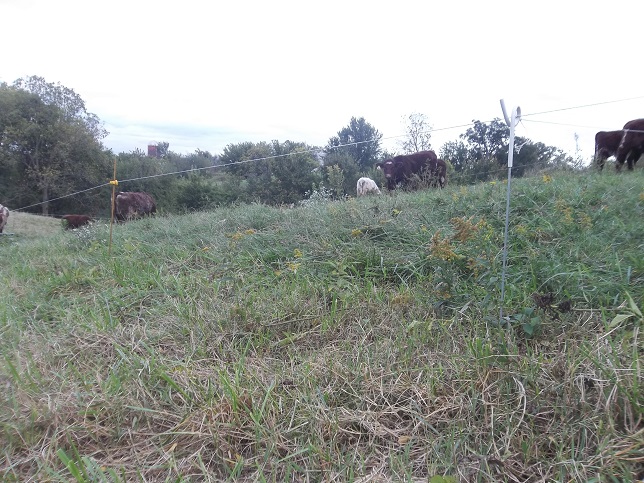
GrazedAndUngrazed

Grass in the foreground was grazed a week ago.

March 1st is an important date for us as that’s the date our tenant will remove his cattle from the additional 40 acres we purchased. That ground will need to recover until at least April 5th before we start moving the cows quickly across large pastures. Then we’ll set aside a portion of farm to rest for the year (probably planted with a number of new trees), a portion of the farm we’ll only use during calving, a portion we’ll stockpile for drought and winter, a portion we will cut hay from…you get the idea. I have a lot of plans for how to utilize 60 acres but 11 cows and their calves can’t do it alone. I’ll share more of next year’s grazing plan in detail as I firm it up but it really won’t take shape until I’m stuck inside this winter. For now my focus is on grazing from now until March 1, leaving as much hay in the barn as I can in case next summer is a doozey.

Zen Cows, Intense Pigs

Cows and Pigs are the two favorite parts of my farm day. Chickens? Meh.

Pigs are just crazy. Pigs learn about things with their mouths. They bite to feel. I had a pig feel the wrist of my Carhartt jacket when I was about 18 and dang if he didn’t just pull it right off of me, dragging it through the hog lot. I never wore it again. Pigs want to explore you. They want to rub on you and be scratched. They want to smell you, make noises at you and they will never leave you alone. It’s fun but pretty intense. I know the pigs would just love to eat me. It goes both ways. I do think the pig below (Newton) is smiling.

IntensePigsCows on the other hand want little to do with me. The milk cows may want me to scratch them on their poll and the steer may be a little too tame for his own good but otherwise, the cows are content to do their thing and let me do my thing. It’s peaceful. They don’t bellow at me the way the neighbor cows do when a tractor starts. They just munch away at their cud. Maybe get a drink of water. Maybe a lick of salt or kelp. When it’s time to move, we move. No big whoop. It’s all very zen. Nobody is trying to eat me.

ZenCowsI could sit in the shade and watch the cows all day.


Farming and the Application of Force

I read a large variety of books and blogs mostly in the alt. agriculture umbrella but also a few that fit in an alt. economics category…if you’ll allow that term. I enjoy the way Bill Bonner writes…tying humor, criticism, common sense and wealth advice all together in a fun little package. He also overuses ellipses…and I like that. I wrote about a book of his I read a year ago if you are interested.

On a recent blog post Bill wrote,

Force doesn’t work in human affairs, because it doesn’t bring people what they really want. Force doesn’t give you a ‘win-win’ trade.

Instead, force sets up a ‘win-lose’ transaction. A man robs a liquor store. He has booze. But the liquor-store window is broken, and the store’s insurance rates go up. The world is poorer as a result.

Force rarely works in domestic affairs, either. A woman coerced is rarely a happy woman. And an unhappy woman rarely makes a man happy for long.

Nor does force work in an economy. When the Fed forces interest rates down, it is driving buyers and sellers to do something that they otherwise would not do. It is exercising brute force on markets.

Does it work? Ask any jackass who has ever tried price controls or centralised economic planning. The answer is no.

I could go on a tear about using voluntary transaction between individuals to build farm sustainability but, instead, to put this in line with other recent posts I have put here, I’ll tie on to the part where he is talking about relationships between a man and a woman. I am stronger than my wife. Significantly. (If you think this is an obvious statement you haven’t met enough farm wives. There are some strong women out here!) I can easily pin my wife to the floor while the kids tickle her. But I have to be careful to make sure she is having fun…that she’s part of the game, not a victim of the game. Everybody has to have fun.

Everybody has to have fun.

Did I move to my grandmother’s house, dragging 5 others along by strength of will or did the 6 of us agree and follow a prepared course of action? Years later, is everybody still having fun? Do we all agree that we are better off now than we were before…than we believe we would have been had we made other choices?

If I can answer these questions positively I have the foundation I need to answer the other questions. Why do we have cows? It’s the best way we can fix carbon and cycle nutrients in the pasture while respecting my family’s time. Why do I want to sell farm products? To make customers happy, to heal our pasture and preserve ecological resources, to heal our community to provide my family with the highest-quality food available and, importantly, to make our farm economically sustainable. How important is that? I’ll quote from another blog I’ve been reading through lately:

Want to know what I consider to be a sustainable farm?  Very simple:  One that stays in business.   It’s fine and good to be for the environment, and all farmers I know  care very much about their land, but you can’t save the world unless you’re a going concern.   If you, dear reader, are interested in farming to improve the environment, please do consider this point carefully.  …the bottom line is…  well, the bottom line.  Make a profit.  Keep going.

Well, OK.  I’ll go on a tear about using voluntary transactions between individuals to build farm sustainability.  I don’t want customers who buy out of pity. That’s not win-win. I want customers who are enthusiastic about our products. Customers who are sensitive to animal conditions and nutrient density, not customers who are looking for cheap food. I’m happy to provide food of the highest quality to customers who will pay a fair price. Cheap out on me and I lose. If I cheap out on you, you lose. We both hold up our end of the bargain and we both come out ahead. That blog post above points out that a business went broke, not because their quality was poor and not because of lack of customer demand but because they couldn’t meet their obligations.

But let’s pretend there are no expenses (including taxes) and there are no customers to satisfy…that no money is needed. How do I build enthusiasm in my children without forcing them to do the work?

Did you know we home school our children? My wife has a blog about it. She doesn’t write anything on the blog but it is hers. Anyway, I have memories of my lovely bride calling to say that our then 6 year-old daughter was crying and hiding her face in a pillow because she didn’t want to do reading lessons! “I just don’t think she is cut out for home schooling!” she said.

So we hit the books. What do other parents do when their students/children hit a wall? Some push through it…with apparent success.  Others just take a break and let the kid figure it out when they are ready…again, with apparent success. We found a home school philosophy that said we should inspire, not require our children to read. Inspire them. Rather than force our daughter to read we just focused more of our own time on reading. She noticed and it was almost as if she said, “Gosh, I don’t know what they find in those darned book things but there must be something in there.” So she started reading…and kept at it.

We didn’t have to force her to read. Will this work for all children? I don’t know all children. It has worked out pretty well in our family.

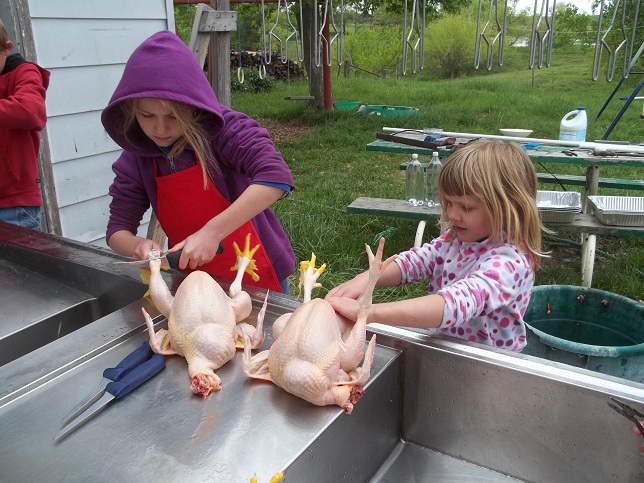
When we moved here we (the adults) led the way on butchering chickens. Three of our children were curious about it, one (the same one) wanted to stay in the house and do housework. OK. That lasted a couple of years. But now, we all help on butchering day. Everybody has a job. Nobody HAS to do it. We work together. That’s that.

And, I think, that’s how it should be. Some days you don’t want to have your shoes covered in chicken guts. I totally get it. But most days, you want to fulfill your role within your team.

If that role is washing dishes and baking pie with grandma, cool. But if you want to join us outside there’s a place for you. Here she is in purple, proud that she can cut off the feet.

GirlsIgnore the full crops on those birds.  We had some bad weather and just had to work when we could.

What Do You Do When She is Gone?

So, Mr. Steward, what do you do when your wife goes to a convention for a few days?

Well, I can get the farm chores done a whole lot faster than she can but I lean pretty heavily on the kids to help out with meals and household chores. Mostly, I focus on housework and, apparently, listen to a lot of Willie Nelson. Like, a lot. I know, right?

Singleness of Heart. Planted in the Land.

Jeremiah 32:38-41 says:

They will be my people, and I will be their God. I will give them singleness of heart and action, so that they will always fear me and that all will then go well for them and for their children after them. I will make an everlasting covenant with them: I will never stop doing good to them, and I will inspire them to fear me, so that they will never turn away from me. I will rejoice in doing them good and will assuredly plant them in this land with all my heart and soul.

We must remain a family unit. Each of us has a different calling but all of us have one purpose. I am a Steward. Caring for the Earth is not an end…it’s an occupation. I hold my portion, working it to honor my Lord.

What will my children be granted stewardship over? I don’t know. But I do know that I would rather continue my work with my children as they grow than continue my work without them. I do hope and pray that my kids will find meaningful, rewarding work here on the farm when they are grown. Sometime I’ll share the vision we have for our family over the next 65+ years. I hope you have a vision…a preferred future. A dream. A goal you are working toward. It’s not much fun just putting in your time and using oxygen.

With the verse at the top in mind, Julie and I frequently pray, “Father, we honor your name. All that we have is yours and we thank you for the blessings you have entrusted to us. I pray that you will give our family a sense of unity as we live out your purpose, helping us to follow you day by day. Lord, we need your continued blessing. You promise in Jeremiah 32 to never stop doing good to us. Lord, we stand on that promise. Grant us wisdom to fear you and help us to continue doing good for your glory…plant us in this land, Lord.”

What do you dream of? What do you pray for?

Late Summer Changes

Fall has arrived and things change quickly around here. The barn swallows disappeared a few weeks ago, the other birds started flocking up, huge swarms of migrating dragonflies have come and gone and now hawks are migrating through.

Not much I can do…but there’s not much I want to do about hawks. Dad and I saw a juvenile hawk sitting on a chicken tractor, looking at the broiler chicks beneath.  He was obviously frustrated by the wire. For some reason he was ignoring the layers. Maybe the were just too big for him.  Who knows.  As we went past he spooked and took off. A few minutes later he speared a pigeon off the roof of a nearby silo.

We have reached the point where you can’t take a step in the woods without ducking under a spider web. It is as if we finally reached a critical mass of insects allowing more and spiders and praying mantises…or they have just eaten so many for so long they are all big and fat. And believe me, we have seen some big, big spiders and I swear I saw a 10″ long praying mantis yesterday.

TangledWeb

The sunflowers that were all so pretty in August have drooped over so we cut the heads and set them to dry. I’m glad we could complete that cycle before the cows grazed that area. Hard to believe it took us 4 months to rotate pastures around the farm.

Sunflowers

Sunflowers as of Sep. 1

The cowpeas in the pasture didn’t set a pod all summer until September. Same with the cockleburs. It became increasingly unpleasant to pull cocklebur plants in my pasture over the last month.

Dad keeps a detailed journal of changes, frost dates, etc. I don’t currently do anything formal though I used to track the frost dates and the first time I heard a spring peeper (Pseudacris crucifer) and our toad (Bufo americanus). Do you track the changes around you each year? On this topic, I would like to revisit the book Great Possessions by David Kline. I haven’t read that in years. Less seasonal but just as good is Scratching the Woodchuck.

I Can’t Do This Alone

I got an email from Matron of Husbandry recently in which she wrote:

A lot of it is about the support that family members give you, more than a piece of ground.  Look at Greg Judy, new wife, new attitude, success.  Not saying anyone should get a new wife or husband but Joel says the #1 cause of business failure is spousal disinterest, or disapproval or disagreements.

I have two directions for this post. Maybe three. Rather than tell you what I’m going to tell you, I’ll just tell you.

This farming thing is hard. I know it’s romantic. I know it’s something people sit and dream about…someday. Believe me, I get it. Our “someday” happened 4 years ago. Fortunately our dream is still alive in spite of the reality we crashed into upon arrival. I spend a big chunk of my time on the blog wrestling with reality. Questions like, “How are we going to pay for this?” “Where are the customers?” “How are we going to keep animals alive?” “Can we endure the stress?” “Is it all worthwhile?” These don’t make for my most popular posts but I feel like it would be wrong to avoid the topic.

Obviously I think we’ll get through but I hope you, my reader, understand that it’s a lot of work. I could be living out here alone like Dick Proenneke but Dick didn’t have livestock. He had wildlife. If Dick needed a sick day his stash of firewood might get a little low but he had enough of whatever he needed that he didn’t have to work every dang day. We have livestock. One day in August without water and I won’t have livestock anymore. That requires redundancy…not just in terms of water supply but also in terms of manpower. If the well pump stops working we have a problem the cows can’t solve on their own and I would have a hard time addressing the well pump issue with a broken leg. I rely on my wife to back me up when I am not available…or my father. I am relying more and more on my oldest son to help out too. This wouldn’t happen without them.

But it goes beyond the workload. The work can be discouraging. I have written this before but sometimes things go wrong. Sometimes a lot of things go wrong all at once. Sometimes your fence is working perfectly to keep 4-legged predators out of the chickens and an owl flies in and has dinner. 3 nights in a row. Sometimes the drought ends suddenly and the roof leaks, the creek floods, a branch drifts past dragging the fence with it and you have to round up the cows and take them to higher ground. At night. In the rain. When water is coming into your house. or a big snow load pushes in a shed roof and 8 months later you still haven’t had time to fix it. These kinds of things get tiring. They wear on you emotionally.

Was this what you had in mind sitting in your comfortable suburban home dreaming of a few acres, a few cows and a beautiful sunset? Who are you going to share your troubles with? Well, obviously I talk to my wife and my father. I also share what is appropriate with my children without weighing them down. They need to know that I don’t think it’s easy…and they won’t get it from the blog as they don’t bother reading what they have lived through…lol. But if you’re just dreaming, well that’s no big deal. Anybody can dream. Anybody can talk. Nobody even has to listen. I talk to lots of people…people I never meet read my blog. I guess you read. I don’t know. Heck, maybe you just look at the pictures.

But I don’t go it alone. I am not a rock. That quote from Matron above says it all. The work is hard…but manageable. If Julie was not 100% on board the task would be impossible. She would feel neglected every time I went to look at the cows. Instead I receive affirmation from her as we take on the day’s chores together…even if separately. We are a team.

I couldn’t do this without a helpmate.

And as much as I love my wife (and I do) I also couldn’t do this without my father. Oh my gosh! can I disagree with him at times! but I appreciate that he is coming to the table with ideas and experience of his own. Our mild disagreements are an important part of moving the farm forward. When I say, “Dad, What about this crazy idea?” he’s usually able to help me explore the idea more fully. Not that he talks me out of it necessarily, just to look at it from other angles. Also my children, for their part, are a tremendous help not just with the labor but with forcing me to break our plan down into small steps with few moving parts. If I can explain my vision of the farm to my children in a way that they can express it to others…well, that just makes the whole farm marketing job easier. It also prepares them for the transition…the time when I’m the dad they come to with crazy ideas for their farm.

I couldn’t do this without the support of my family.

There is one other category I feel is essential: Mentors. I have written about Mike and Steve, though you may not realize how much time I spend picking their brains. I think it is obvious that I constantly reference Matron of Husbandry and rely heavily on books by farmers who have actually succeeded at this farming thing. Not only do I need the support of my wife and my family, I need the experience and wisdom of folks who have survived the ups and downs of farming…because the downs can get pretty low. If I had to choose between a recently “successful” farmer and an old farmer I would pick the old farmer. Same with investment advisors.

I couldn’t do this without a mentor.

So, that’s it. If you’re going to fight the odds on your homestead and make a go of it, make sure your spouse is on board, drag your family along and find yourself a mentor. Maybe you are stronger than me but I can’t do this alone.

More Egg Math

Someone brought this to my attention. It’s from a Facebook posting for a farm in Oregon. No names are required. I’m not “telling them off”, just utilizing their example.

Every two months we order a one ton tote of verified GMO free, organic and locally produced chicken feed. It is the most expensive and high quality feed in our area. We believe this feed as a supplement to fresh pasture and organic veggies produces the best eggs possible for our members. Every year we spend about $6,000 on chicken feed. We sell all of our eggs which totals to 850 dozens and we sell them for $6.50 per dozen. That means this year we will lose about $800 on our eggs. So the question becomes, do we raise our prices? or do we buy poorer quality feed resulting in poorer quality eggs? This is a question that the farmer faces everyday but the consumer is the one to answers it.

The detail that they buy “the most expensive and high quality feed in our area” amuses me. You have to pay the most to get the best? Really? Are you sure you are getting the best or are you just paying the most and making an assumption? And I really have a lot to say about “verified” GMO-free feed and the quality of protein available in substitutes. Anyway.

Let’s start with his egg production numbers. He says he gets 850 dozen eggs/year and loses about $800 on eggs (If you do the math he loses $475 on feed but let’s just run with his numbers).  That’s 2.3 dozen/day. Let’s say they raise their prices to $12/dozen ($1 per egg!). That brings egg revenue up from $5,525 to $10,200…which is a good thing because his calculation above doesn’t count land usage, fencing, housing, labor, etc.

But let’s look at his numbers again.

He’s buying in bulk, getting a one ton tote – 2000 pounds, same as 40 bags – for, apparently $1,000. That’s $25 per bag of feed. High but not entirely out of the question. We pay significantly less but we live where the corn and beans are grown and our customers aren’t demanding non-GMO organic. They’re delighted with fresh, orange-yolked eggs that taste good and come from healthy birds out on healthy pasture. But I digress.

The farmer in question gets 10,200 (850 * 12) eggs each year…or around 27 eggs/day. Let’s say they get 30 eggs and throw away 3 that are checked, cracked, stained or misshapen. A chicken lays 2 eggs every three days. Really good ones lay an egg every 28 hours. Let’s pretend there is no winter. To get 30 eggs you would need (30/.66) 45 birds…as two thirds of the birds are laying each day…right? He’s feeding 2,000 pounds of feed every two months, or 33 pounds of feed every day or 22 pounds of food per chicken per month. My birds don’t eat that much but maybe my chickens are freaks so I did a quick search of the internets and I found that a laying hen (probably in confinement) should eat 10 pounds of feed every month and they tend not to overeat. He’s going through more than twice that amount of feed. So I guess they have at least twice that number of birds and they aren’t laying well…which could either be an indication of bad genetics, age or maybe his high-quality feed isn’t high-quality enough.

Now, I’m skeptical of the 10 pound figure. First because it comes from Nutrena. They don’t use whole grains…it’s like giving your chickens snickers bars. But the article suggests correctly that free-range birds can harvest some portion of feed for themselves…at least, for a portion of the year. We feel that we need to feed our chickens whole grains (even if shattered) rather than processed remainders. We also take our mineralization and pro-biotics seriously. If the chicken itself has unhealthy gut flora she can’t digest and absorb her food efficiently (and we feel this applies to ourselves as well). I don’t want those minerals to just slip right through the bird. With that in mind, with very little searching, I found this quote from a Backyard Chickens member:

I have 61 in my free ranging flock and I go through 200 lbs of feed a month.

UPDATE:
As Craig pointed out in the comments below, that figure is pretty extreme. In fact, it is almost as extreme as 20 pounds of feed per chicken. I apologize. Craig’s numbers, my numbers and several others I have spoken to are more in the 7 pounds/bird range when on pasture. If you are unhappy with my calculations for the number of chickens involved, calculate the pounds of feed per egg. I think that may better illustrate the lack of efficiency the farmer in this example is ignoring.

I don’t know what the revenue picture is for the farm (though Facebook indicates they are building a big new barn) but it looks to me like they could save a little money and, probably, a lot of time if they would stop raising chickens for eggs…or, at least, abandon the chickens they are currently raising. Rather than transport 3 pounds of feed to Oregon maybe he should transport 1 pound of eggs and spend additional time planting, weeding and marketing produce. Do 2 dozen eggs/day really bring in enough customers to justify paying them to take the eggs? As you know, I’m dealing with similar issues here.

Business or Chore List?

I have nearly 3 hours in a car every week day. 3 hours. Sometimes I use that time to just think. Sometimes I need to decompress on my way home from a stressful day. Sometimes I sleep while my carpool buddy drives. A fair portion of the time I listen to podcasts.

I have mentioned the Agricultural Insights podcast previously. The host does a great job of finding informative and interesting guests and this week was no exception. Give a listen to “Ranch Management and Ranching For Profit with Dave Pratt.” Rather than steal Chris’ thunder and give it all away (like I probably did last time) I’ll share one idea that impacted me positively…giving me something to think about in the quiet times of the drive.

Do I have a business or do I have a collection of assets and a chore list?

At this time, probably just a collection and a list. How do I change that? I’ll let you know as I figure it out over the next few decades.

If you are interested in putting your hands in dirt I highly recommend listening to the podcast above and reading up on additional resources Dave Pratt makes available on his site. After listening, if you liked what you heard, go ahead and subscribe to the podcast via RSS or iTunes. Just having more subscribers, even free ones, helps Chris deliver a quality product and makes it available for free for the first two weeks after the release date. You might also consider a paid subscription, something I am weighing myself.

I have never met nor have I any affiliation with Chris Stolzer. I’m just making a recommendation for something I like.

A Moral Obligation

I tend to be both insecure and introspective…utilizing my introspection to analyze my own insecurities…uncertain of my conclusions.

Yup.  I’m a mess.

I spend a large amount of my time evaluating my own decisions, actions and motivations.  For example my recent post about why I have cows?  Grass is a low-input, low-value good.  Converting grass to something of higher value is desirable.  How do you convert acres and acres of low-value forage?  Cows are a pretty good option.

But why do I have cows?  Wouldn’t it be easier to park my tookus on the couch with a book in hand?  Wouldn’t it be easier to order a pizza or to buy peaches already canned?

I could live as if there were no tomorrow.  I could eat whatever I wanted, smoke, drive like a maniac, money wouldn’t matter…remember this in Groundhog Day?  I wouldn’t have to concern myself with my children’s future…there is no future.  No future? no concern about consequences of my actions…no moral consequences.  Like Bill Murray’s character, I wouldn’t even have to floss.

Well, that doesn’t sit well with me and it all boils down to this: I believe this is a moral issue.

We could, as residents of this world, simply consume as much as we can as fast as we can…living to have fun.  Unfortunately, the sun is very likely to rise in the morning.  Then what?  There is only so much leftover pizza within reach of the couch.  At some point I have to walk to the kitchen for more (ugh, work).  But there is only so much pizza in the freezer.  Then I either have to go to the store to buy pizza or I have to dial my phone (work, work, work) and ask someone to cook and deliver a pizza to me…and they will expect payment.  Ugh!  There is only so much money in my wallet, in my checking account or available on my credit card.  Now I either have to wait for someone to give me money, I have to take someone else’s money by force or I have to trade some portion of time I would normally spend on my couch for money doing any number of things I may not want to do. Worst of all, that cuts into my pizza-eating couch time!

Beyond simply meeting my own needs for MOAR! pizza, I work to contribute positively to the world around me. To some extent, I’m seeking to increase my surplus so I can buy better-tasting pizza but I’m also working to ease the pizza burden of current and future generations. And I feel this is something we are obligated to do. Whose planet is this? Does the planet belong to some long-dead pharaoh? How about George Washington? Should I preserve Illinois in the memory of Abraham Lincoln (lol)? How about my father? Do I want to prevent Illinois from turning into a desert or a chemical monoculture (same thing really) for my still-living father’s sake? Maybe…but that’s really not enough. I seek to enhance the soil ecology for the sake of generations yet to come, not to impress my wife.

I’m not going to own this land forever. In the light of that truth I have two options. I could, if I desired, strip the land of all wealth taking every dollar of value from the soil then abandoning the victimized soil to time. No big deal, it happens every day. Instead, I could seek to increase the water-holding capacity of my soil, improve my timber, solidify my fences and repair my buildings…not seeking peer approval, not seeking a higher resale value, (though both would be a natural result) but to hand the next owner something better than what I was handed. It’s not easy to build value into some things but farmland…that’s something else. It requires that I enable the farm to produce more than is consumed and that I return surplus to the land…cycling nutrients through. Distilled down to its essence, farming is the business of catching and holding sunlight and rain…then cycling surplus sunshine and rain back through the system. This could be done on a balcony in a 5-gallon bucket.

It strikes me as immoral to consume more than I contribute. I feel we have a moral obligation to produce.  That means seeking to increase and make the best use of all resources under my control. Everything from kittens to eggs to dollars and especially my children’s childhood.

How can you apply this to your own stewardship?