
The last week in short:
- Taxes? Done. (grumble)
- Chickens? Sold or in the freezer.
- Cows? Fat.
- Marriage? Intact…barely.
- Feeling? Tired. Sore.
- Pullet chicks? Safe in the brooder.
- Blog? Unattended.
So. Yeah. All the work got done but the night before we butchered birds Julie turns to me and says, “I feel like we are a little distant” or some such statement…apparently I wasn’t listening to her. Point taken.
But the taxes got done on time. We lost so much money on the farm everything turned out OK. How about that? I really don’t remember much else of my week. I know Julie spent the early part of the week on the phone with the tax office and working on spreadsheets for hours on end.

I took Thursday off of work to butcher the first 200 broilers. We wanted to have birds to customers in time for Easter weekend which proved to be a good choice. I have a lot to say about this spring’s batch of broilers but let’s start with butcher day. Then we’ll go back in time a little bit.
Thursday started Wednesday night. The layers needed to go to fresh pasture before they began protesting. We also needed to pull the feeders out of the chicken tractors so the broilers digestive tracts would be clean for butcher day. Just like every night, we all come in the house hungry and tired around 8:15. Supper…brush teeth…bedtime. Julie wonders if we are losing our closeness. I don’t know. I haven’t noticed anything wrong.
The plan was to start butchering at 8:00 sharp. My biological alarm clock wakes me up at 4:00. Time to make the donuts. I filled the scalder, washed up some equipment, sharpened knives and washed dishes. Julie stayed in bed. She later told me I left the bathroom light on as my way, in her words, of “giving a not-so-subtle hint that she needed to get up too”. Julie and I wanted to give the kids a treat for breakfast and, since we had a surplus of brown bananas, we decided on banana bread muffins. With the scalder warming, the dishes washed, the paper trash burned, the buckets ready, the knives sharp and breakfast and coffee delivered to my belly and muffins cooling on the counter it was time to go check the animals.
Julie opened the nest boxes, I loaded up the crates on the trailer. The kids attended to other chores. Everybody met up again at the brooder. There was about a 30% chance the new layer pullets would arrive Thursday morning and I wasn’t ready. I spread out the remaining bedding, added fresh and got everything warm and ready. It is always better to give chicks warm water when they arrive so we like to have the water in place well in advance.
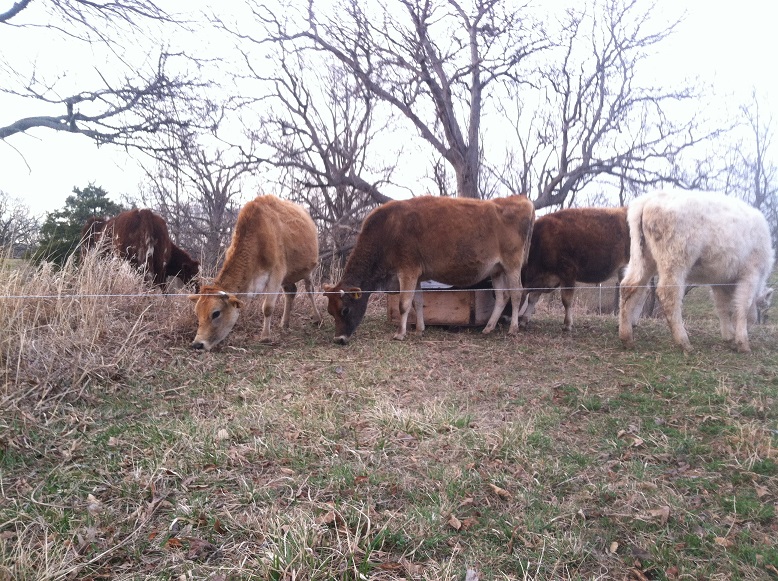
Then the kids and I went out to move the cows and catch the broilers. The youngest son rolled up the fencing to allow the cows access to fresh grazing. Pretty cool that a 9 year old can manage a herd of cattle. The rest of us crated up the first 50 birds and took them home. Julie had returned home to wash and sanitize the surfaces.
It’s funny how time flies. We missed out 8:00 start time…by 90 minutes.
But everybody had eaten a banana bread muffin, tied on their aprons and decided what job they were going to do today. I always kill/scald/pluck and remove the heads. Always. That is the worst and most demanding job. To cover all three jobs I have to move around a lot, lift and control flapping birds and spend the whole day covered in a delicious mixture of blood and chicken manure. The best is when the back end of a bird ejects liquid in your face like a squirt gun. So I do that job.
The girls check the birds for feathers that were missed by the plucker (usually the tail feathers or under the wings) and the oldest girl removes the feet and slides the bird to the oldest boy. His job is to slice through the skin just above the breast then loosen the crop, esophagus and trachea. Then he delivers the birds to the shackles where Julie finishes the evisceration. The youngest boy then does final inspection, removes lungs, bits of liver and sprays the birds out before putting them in the first rinse water tank.
That’s the first half of the process. I believe each bird gets about a minute of work from crate to chill tank. When packaging we see each bird for about another minute. Really, we just do a quick inspection, final feather check then pop each into a bag, clamp the bag shut and weigh, price and label the bird before escorting them to the freezer.
It has to go fast and the whole process can be thrown out of whack by a bad scald. So that’s where we’re going to start.
So now let’s go back in time. Things that could have gone better with the Broilers:
The scalder:
Longtime readers know I have a love/hate thing with my scalder. I have moved it inside, out of the wind. I have blocked a portion of the chimney to help it retain heat. I have removed the (broken) thermocouple and piped the burner directly to the propane tank giving me complete control over the flame. I have done everything I can think of to make it more efficient short of coating the outside of it with spray foam and it still can’t keep up with me. It just can’t. Either it needs two burners or I need two scalders. I’m going to suggest that the scalder is limited to about 50 birds/hour on a 60 degree day with no wind. I can work twice as fast as that so I end up frustrated when the volume of chickens passing through the scalder exceeds the scalder’s ability to generate and retain heat. It reaches a point where we just have to call a stop for 15 minutes or so. The solution may be to box up 50 birds at a time, run those birds through then cover the top of the scalder while going back to the field for more birds.
Chicken Tractors:
This is totally on me. We lost a lot of birds. Normally we see a less than 5% death loss on birds from the time they exit the shipping box to the time they crate up on butcher day. One exception to this was an unexpected and cold rainstorm that came through 2 days after we moved chicks to chicken tractors a few years back. We lost a bunch of birds that night but this year we seemed to lose one or two every night totaling 15% of the crop. We put 300 chicks in the brooder and brought 296 out three and a half weeks later. The first few weeks on pasture were fine…then the loses started mounting up. So here was the problem: I concentrated small birds into fewer chicken tractors. My tractors allow us to keep 50 grown broilers comfortably. When they are small, though, I prefer to keep them in larger groups. More manure, less work. That is a mistake. I need to split the birds up early. As soon as we got them back down to appropriate numbers we stopped finding dead birds. You really have to respect that 2 sq. ft. per bird ratio. A bird just needs room to get away.
Seasons:
Our chicks arrive on or shortly after Valentines day. We do this so we can hit the market with birds early. Usually, in Illinois, the weather breaks just as the birds are ready for pasture. This year the pasture was a little behind the birds. That was hard on the birds and it was hard on the farmers. But if we delay by two weeks we will have to save birds from clouds of buffalo gnats at the end of April. Or we, ourselves, will be suffering from mouthfuls of gnats and itchy stings while butchering the birds. So we could delay even longer so the chicks are in the brooder when the gnats emerge. That means we aren’t on pasture until the middle of May and don’t butcher until July. July seems to be the beginning of the real, searing heat. July 4 is a popular time to BBQ chicken but after that, nobody wants to cook. We have carried full freezers through 107 degree days in July and August. No fun. So, when is the best time to raise birds? I think we’re doing the right thing getting chicks on Valentines day and hitting the early market. This year worked out very well making fresh birds available for Easter weekend. But we may push off a week or so next year to give the grass a little more time. It’s hard to get this stuff right.
Marketing:
60% of the birds should be sold before we even buy the chicks. It’s not hard to sell chicken. Not at all. But it is hard to sell 300 chickens one at a time. Not only do we need to continue following up with existing customers, we need to work to penetrate new markets and encourage buyers to stock up for the year. We do broilers spring and fall. How many birds do you need to make them stretch between batches? What can I do to convince you to use the whole bird so I don’t have to cut them up?
Julie:
Julie always tears a fingernail off when eviscerating. Always. She doesn’t enjoy the work. It makes her sore and tired and leads to days worth of discussions of the value of driving our chickens 4 hours each way to a processor and changing our license type. I can certainly see the merit of this idea but I think the better solution would be to make sure we have rubber gloves for her to wear or, better yet, rearrange things so I am doing the evisceration. Maybe our oldest can kill/scald/pluck and I can just take it from there. He may be slow enough for the scalder for a while.
Too Many Birds:
200 is a lot of birds to do in a day. No matter how many birds we process we have to clean and sterilize all of our equipment before and after. That work takes about an hour total. 50 birds realistically take us about an hour (because of the scalder). Packaging 50 birds takes us about an hour. How many hours do we want to work in a day? It might be better for Julie to get everything ready to process 50 birds each night after I get home from work. She could clean and prep the work area, the kids can help catch the birds. With supper in a crock pot, we could start as soon as I get home and wrap up before bedtime.
Not Saturday or Sunday:
After work or on a vacation day…anything is better than butchering on a weekend. We need to respect our family time. The kids need daylight hours where dad isn’t hustling to get some chore done. Beyond butchering birds I am scrambling to finish collecting wood I have been cutting since March for next year’s wood pile. I need to get this done before the grass hides the wood from me and before it gets so hot out I won’t want to do the work. I get focused on my work. I need to make it a real point to chill out. Just play with the kids. If I get a free moment I put my nose in a book or take a short nap. My free moments need to be spared for my children…and for my wife…
We Feel Distant:
…because my wife is my favorite person. There is no other person I want to be with. For the rest of my life, better or worse, richer or poorer, sickness and health until death. She is with me when we do morning chores. We wash dishes, we wash and pack eggs, we move chicken tractors, check the brooder, move the cows, check the pigs then race home where she packs a breakfast and lunch for me. Soon we will include milking in our morning routine. We stick together…and do so very purposefully. But being together is, apparently, not the same is being close…emotionally. We talk. We hold hands. We kiss. But she feels that we are lacking some level of closeness that goes beyond just the chore list. I have to tell you, I have a hard time even understanding what she is talking about. Apparently, the thing to do is to just sit with her, maybe read the Bible together and …um…not…work. Talk. Just talk and listen. No agenda beyond letting it happen. Girls are so weird. But if that’s what she needs, well, she puts up with a lot from me. It seems like I have to relearn this lesson every so many months. It takes a lot of work for me to not work. I’ll have to work on that.
I’m sure there are more lessons we can glean from this year’s spring broiler crop but that’s enough for today. If you have experiences managing family, marriage and business please share something in comments. Marriage and family are much more difficult than the brochure indicates.








 Chism Heritage Farm