A United Front or How We Got From There to Here.

This post is much more autobiographical than I like to write.  Please accept my apologies.  I think this is an important subject.

My wife and I are in this together.  The things we do are things WE decided to do, not things one of us forces on the other.  We live to fulfill our purpose.  We aren’t simply busy, our work is intentional.  This wasn’t always so.

I met my wife when we were 16 and 15.  I, like most public school children, suffered a total lack of vision.

Anonymous – “What are you going to do after high school?”

Me – “I don’t know.  Join the Marines or go to college or something.”

Even when we went to college I didn’t know what I was there for.  I enjoyed playing tuba so I was a music major for a while.  I enjoyed studying frogs so I became a biology major.  I even did a research project on tadpole development and published a poster at a meeting of the American Society of Ichthyologists and Herpetologists in Seattle, WA in 1997.  After college I needed a job.  Any job would do.  My wife was a year behind me in school so I needed something local.  I went to work for a software company in town.  It was Y2K and software companies were hiring.

You with me there?  Music -> Biology -> Y2K Software.  Movement for the sake of movement.  By all appearances I was succeeding.  I don’t know what I was succeeding at but I was “educated”, employed, married to an intelligent, beautiful woman and owned a home.  It all just sort of happened.

“Would you tell me, please, which way I ought to go from here?”
“That depends a good deal on where you want to get to,” said the Cat.
“I don’t much care where–” said Alice.
“Then it doesn’t matter which way you go,” said the Cat.
“–so long as I get SOMEWHERE,” Alice added as an explanation.
“Oh, you’re sure to do that,” said the Cat, “if you only walk long enough.”
(Alice’s Adventures in Wonderland, Chapter 6)

Though I put too much emphasis on pretty and not enough emphasis on strong, I married remarkably well.  Everything else in life up to that point just sort of happened, but our marriage was intentional.
We realized we were just letting life happen to us not long after we had our first child.

We read a few books including Rich Dad/Poor Dad which, for all its flaws, gave me a push in the right direction.

Much later I found Crossfit and started making different dietary choices.  You have to make better dietary choices so you can recover between Crossfit workouts.  Shopping the perimeter of the grocery store shows you how limited your options are.  It’s easy to exceed your grocery budget eating only fresh foods.  We decided the quick solution was to be more serious about gardening and keep a few hens for eggs.
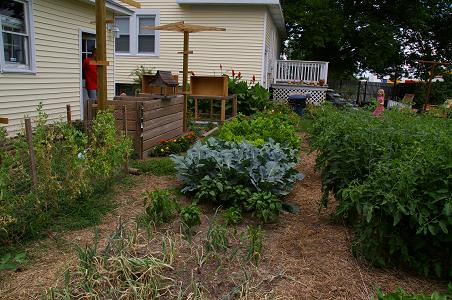
But this is real life.  Real life is hard.  We hit a rough spot in our marriage.  We bought an old fixer-upper house and spent several years making it livable.  As you can imagine, a house without a kitchen adds stress to a marriage.
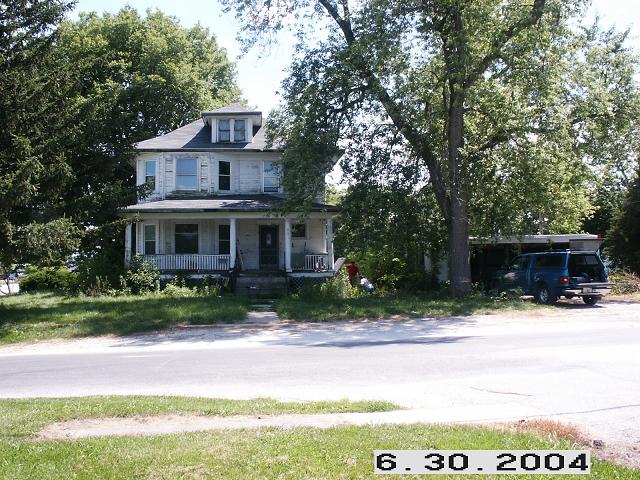
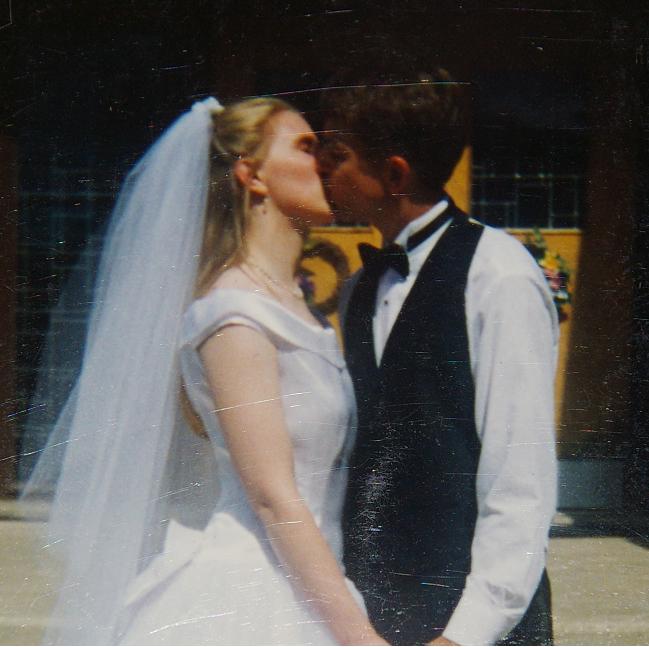
It got pretty gritty and reached a point where we had to make a decision about continuing our partnership.  This was a hard time in our lives.  We were working so hard with small children, work, a major remodel, and home schooling we forgot to make time for emotional intimacy.  It was difficult for us to learn to open up to each other again.  Though I wouldn’t wish it on anyone, I feel this time prepared us for later struggles.  We renewed our vows on our 10th wedding anniversary.  This time we were less formal.

While we rebuilt our relationship we read.  Over time we started shifting our reading away from gardening and more toward agriculture; The Contrary FarmerMaking Your Small Farm More ProfitableBackyard Market GardeningYou Can Farm and Self-Sufficient Life and How to Live it.  I started beekeeping.  We read books about homeschooling.  We studied Shakespeare, history, math, economics and chess.  We switched off our television and studied as broadly as we could, often reading aloud as a family for hours on end.  We adopted the philosophy that we can’t teach our kids but we can model education by teaching ourselves (See Thomas Jefferson Education).  It works.

As time passed we realized it was time to move.  We needed more than just a yard.  We prayed, we continued studying, we continued working, and we prayed some more.  Though the market had just crashed and we knew it would be tough we listed our house.  We had a vision of a preferred future, we were working to gain both experience and knowledge but there were no serious buyers.  Our bags were packed.  We were ready to go.  We couldn’t leave.

It took two years to sell our house.  Then suddenly it was gone.  Where were we going to go?  We looked and looked for small acreage farms but found nothing.  Oh, we found some but we were  not willing to gut and rehab another home and we weren’t looking for a mansion.  It seemed there was nothing in between.  We did, however, find a very nice home on a large lot in a quiet suburb.  The location was excellent, the price was right, the yard was huge and we thought it might be just the place to ride out the storm.  Maybe even build some equity…even if we couldn’t have chickens.

The suburbs proved to be too much for us.  We took on some major remodeling projects in the house, continued to read, continued to work, to garden, to keep bees and to fit in.  It didn’t work.  We just didn’t fit in.  Follow the link for the gory details.

So here we are, several years later, living on the family farm.  The road here was full of twists but there were a few things that were constant throughout.  My wife and I remained faithful; first to the Lord, also to our marriage.  We were diligent about seeking out experience and education.  Though we were stuck in town we were constantly working toward our goals, learning to compost, learning to dress chickens and rabbits, squeezing more food into our garden space.  All of this was accomplished together.  Years of working side by side, supporting each other, questioning our decisions together, moving forward hand in hand…often with great uncertainty.  Even today she weeds the peas….
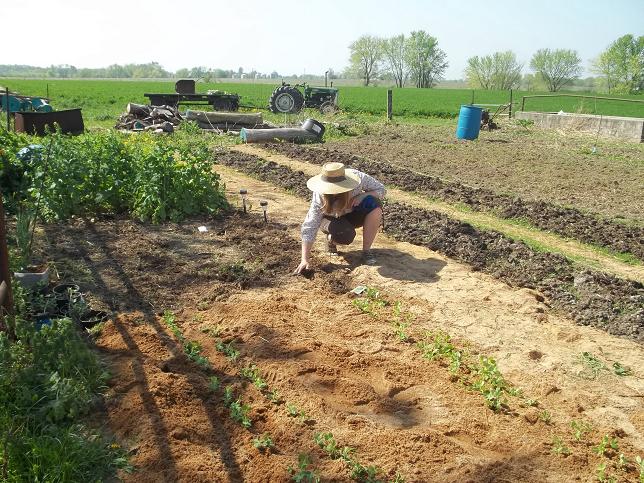
…and I weed the peas.

I get into the near-freezing pond on New Year’s Eve

…and she gets into the near-freezing pond on New Year’s Eve.

I can’t be home working with her every day but all of our planning, all of our decisions, all of our dreaming is done together.  I don’t simply tell her we’re raising X chickens each year and go off to my job leaving her to care for it all.  We develop a plan together that we believe we can manage.  Yes, she works hard.  Yes, I work hard.  But the biggest job is staying close and open to each other…to continue dreaming together.

If you are going to sell your beautiful suburban home, move out to the lonely middle of nowhere, survive the scoffing and questioning of friends and family, milk goats and/or cows, raise chickens, kill/scald/pluck chickens, practice rotational grazing when all your neighbors think you’re nuts and devote yourself to gardening and canning instead of driving to a grocery store you’ll need your spouse on your side.  This is a wonderful place to raise kids, we eat the best food in the world and we have a lot of fun but homesteading stresses marriages.  The work is hard.  It’s easy to take on too much and start blaming each other when the money comes up short.  As a man it is easy to dig in my heels and try to force something to happen.  Because she is with me, I’m forced to stop and consider the consequences.  At times her hesitation is difficult to appreciate as I’m sure she finds it difficult to appreciate my lack of hesitation.

If I have to choose between the family farm and my marriage I choose marriage.  Stewarding my relationship with her is far above my obligation to steward the land.  My dream of remaining married to her for the rest of our lives supersedes my dream of home-cured bacon.  It is easy to lose sight of your goals when searching out a new dream.  Sometimes you find you traded in your Mercedes for a Yugo.  Emotions are poor counselors.  Don’t be afraid to embrace your dreams slowly.  Put your toes in the cold water together.

Leftover Potatoes

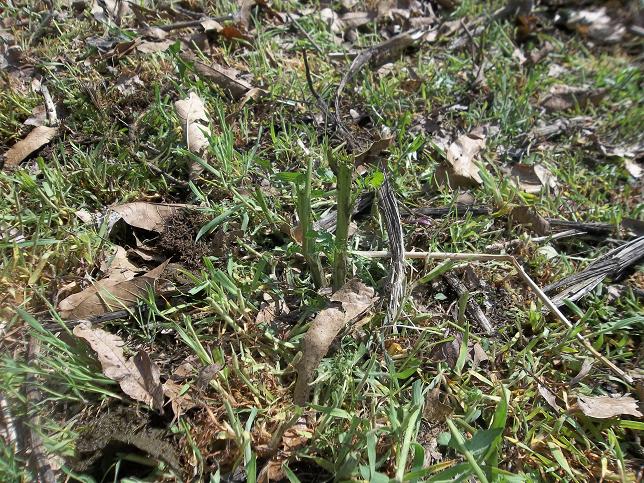
We planted potatoes on St. Patrick’s Day.  They are just beginning to emerge above the manure we covered them with.

Last year’s potatoes were planted in the next row over.  We planted turnips there after the potatoes came out.  Some turnips are still there.  As I pull turnips to feed Wilbur (horse) I have found a few potato plants coming up from potatoes we missed last summer.
Aren’t they beautiful?  How about the one on the left?  Finding these encourages me to plant my potatoes on Labor Day instead of St. Patrick’s Day then mulch the dickens out of them.  This article indicates the fall potatoes spend the winter building a root system then shoot for the sky when it’s warm enough for growth above ground.  Be sure to read that article closely because he details how to plant and mulch them to give them the best chance in the winter.

We live near the Northern edge of zone 6 so fall potatoes are a bit of a gamble.  I’m sure my sister, living further South with a sheltered garden location, would be successful at it.  I’m going to try it in the fall.  Our spring is so busy it would be a relief to have something crossed off our list before spring arrives.  If it fails we won’t be out much.  If it succeeds we may be able to harvest the potatoes in time to plant a late crop of beans.

Let me know if you have any tips for fall potato planting.  These volunteer potatoes say it’s worth looking at.

The Whole Fleet

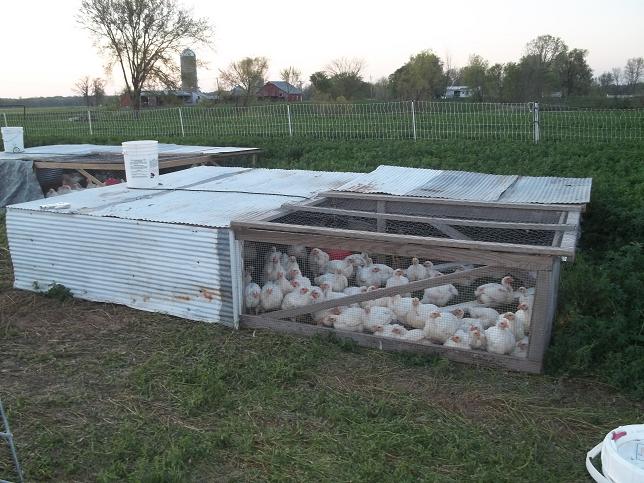
We built our recent chicken tractors after those of Joel Salatin.  The term Chicken Tractor, as near as I can tell, is something Andy Lee gave us.  In Pastured Poultry Profits Mr. Salatin describes a 10x12x2 structure that is lightweight and fairly easy to move.  We built ours as 12x8x2 but otherwise the original tractor is quite similar.  We built it out of scrap material we had laying around.  What could be better?  …or heavier?

That thing is a tank.  It has all kinds of bracing and is made with heavy steel siding rather than the prescribed aluminum.  But, it works.  When we were designing the second tractor we went with fewer braces and lighter steel.  The result was better but not great.

It may not look a lot different but it is a lot lighter.  I was bitten by the bug.  I built a third chicken tractor to see how light I could make it.  Further, I built the third to address a serious issue, heat.  I left the sides off entirely so the wind could blow through and keep things cool inside.

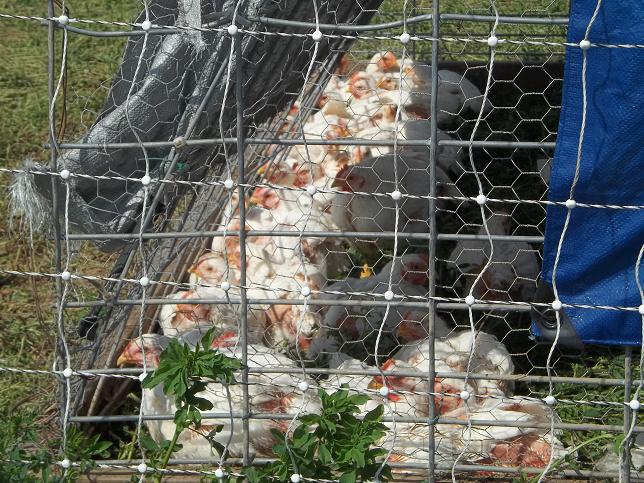
It worked remarkably well.  It is light but won’t blow away in 50 mph March winds.  It stays much cooler than the other two tractors.  But there is a problem.   This spring I have lost zero chickens in the other tractors but I have lost four in this one.  Four.  For those of you playing the home game, that’s a big number.  There appears to be something about that open side that stresses the birds.  I now have a tarp covering the South side of the tractor as it is light, portable, inexpensive and temporary.

That takes us to the fourth tractor design, a radical departure from what we have seen so far.

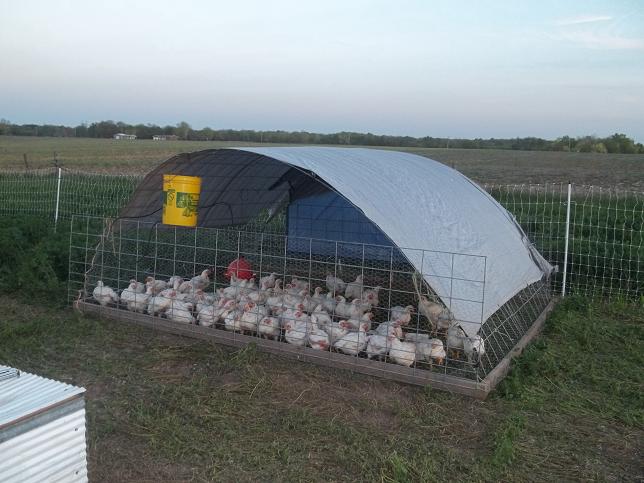
This tractor is the cheapest to build, the fastest to build and the most versatile.  I took one side off for the winter and raised 6 hogs in it.  I could imagine putting weaner pigs in one and moving it daily like they were chickens until they were big enough to escape, though I suppose one could wrap the interior with electric fencing to keep the pigs from rooting out.  I could also imagine using it for a calf shed or a hoop house.  The point is, it’s multi-purpose infrastructure.  We see these as the future of our fleet.

All four tractors use Plasson bell drinkers that are gravity-fed from a bucket.  We use 4″ PVC pipe cut in half lengthwise as a feeder.

Take a moment to imagine your perfect chicken tractor before you build it.  After you build it, take notes on what you would like to do differently.  Don’t be afraid to break from the norm.  By your third or fourth tractor you may have something that fits your organization’s goals.  Mac Stone of Elmwood Stock Farm says before long you’ll end up with a whole fence row of what you thought was the perfect chicken tractor design.

What do pigs do?

Well, pigs eat.  Pigs manure.  Pigs sleep a lot.  Pigs drink and wallow.  The best thing pigs do is dig.

This is a post about digging.  Pigs dig for fun and to find food.  This week we put them in the pasture near the iron pile where they discovered a small pile of odd parts that had been buried in the pasture over time.  These are probably things my grandpa dropped out there 20 or more years ago.

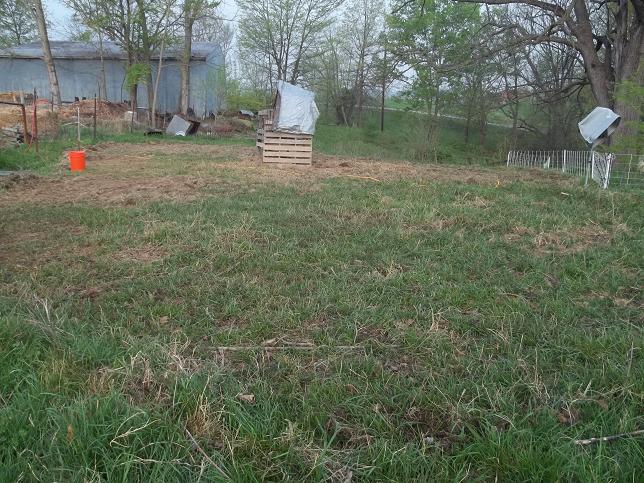
Here’s a view of the whole pasture they left.  They did more digging further away, less closer and almost none up close.

Looking the other direction I have drawn some lines.  The further line is where the fence was.  The near line is where they stopped digging.  Why did they stop digging?

They did not dig where they manured because pigs are clean animals.  They manured near the fence and did not dig in their manure.  There is almost no manure anywhere else in the pasture.  Just there by the fence.

The pasture will recover quickly where the manure is.  The pasture will recover slowly where they dug but, in the long term, the massive disturbance will allow opportunity for plant succession that would not have happened otherwise.  There is a seed bank in the soil that will now have a chance to come to life.  There will be grass.  There will be weeds.  It will be great.

When keeping pigs on pasture it is important to leave them enough room to play, to dig, and to take care of business.  If you place too many pigs in too small of a space or leave them in one place for too long, the whole area will be defoliated.  We try to manage things so when the pigs run out of fresh grass to eat they are moved to a new location.  By that measure the pasture has a reasonable chance to recover quickly.

Good luck with your own experiments with pigs, grass and portable fence.  Things may work out differently for you.

Bringing Up the Average

“Let’s raise a few hundred meat birds and try to sell them.  What’s the worst that could happen?”

That’s a pretty naive question.  I asked it once.  Lots of things go wrong but I’ll share the one I fear the most.  Chicken death.

Chicks just die.  They may die from being abused or neglected by postal workers.  They may be eaten by snakes or bitten by rats.  They can get any number of ailments; curly toe, pasty butt, coccidiosis.  Some of these can be prevented with diet and hygiene but sometimes they just die for no reason.  Chicks can get too hot.  Chicks get cold and pile on top of each other, killing the ones at the bottom.  Worse, the smothered chicks don’t die and you waste a few days nursing a dying chick along.  Then it dies.

Let’s say you got them through the critical first 5 days and they survived the two or three weeks before you put them on grass.  You kept things clean and kept them healthy and they are ready to go to pasture.  Once there they can die from heat, cold, raccoons, skunks, opossums, minks, cats or dogs.  Everything thinks a chicken is tasty.  I take precautions to keep the birds safe from predators with electric netting but nothing is perfect.  Even if the netting works buffalo gnats can suffocate them.  Hot weather or cold weather will kill them.  Heavy rain can drown them and wind can crush them under their houses.  A waterer can clog on a hot day and they’ll all die.  They can get run over by the wheels on the chicken tractor dolly.  They frequently die of heart attack, especially as they get older, though this is manageable.  Honestly I pray for safety every night my chickens are on pasture, pray every morning when I get up and pray every time I peek in the tractor.

I want to emphasize that these are fragile little creatures that taste good to predators.  Even with good management bad things can happen.  I lost nearly 30 layers to one mink in one night.  I can’t tell you how sad I felt when I opened the door to the chicken house and found all those chickens piled up on the floor.  Then, the next night, I saved the remaining 40 layers when I shot the mink in the hen house.  I’m not out in my field hunting down everything that shares my farm but I have an obligation to take steps to protect the animals in my care.  That mink found a way into my Ft. Knox chicken house two nights in a row.  That’s enough.

This is a part of why pastured products cost more.  Not only do my animals live normal chicken lives in the sun and grass, not only do they eat real, whole grains instead of leftovers from manufacturing processes, I expend a tremendous amount of time per animal watching over them.  A mass-produced, confinement bird can live or die.  A chicken that costs less than $1/pound was never cared for, let alone allowed to embrace it’s inner chicken.

To recap, it’s really, really hard to keep the meat birds alive for 7 or 8 weeks.  We are better at it than most but still have room for improvement.  It saddens me to find a dead bird, not because of the financial loss but because it means I failed in my part of the agreement.  I provide health and safety for a short time.  They pay me back with a meal.

Chickens like sunlight.  They like to scratch in the dirt, eat bugs and really enjoy eating greens.  These are things denied to all but a few chickens in this country.  Find yourself a farmer who is willing to make the chickens happy.  His chicken will cost more.  His chicken is worth more.

Maple Sap and Nectar

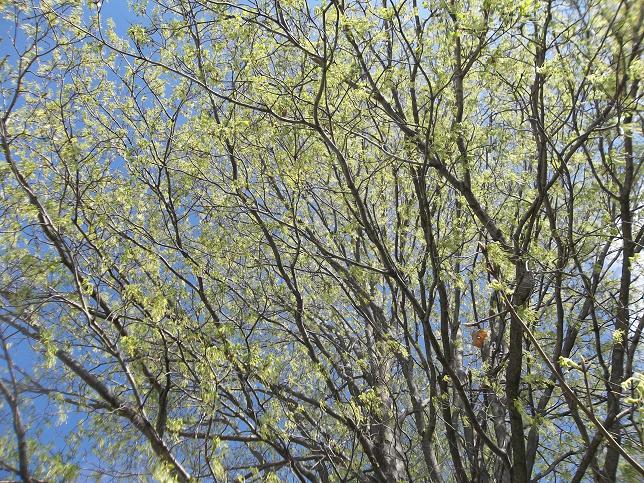
My grandmother planted three sugar maples in the front yard around the time I was born.  We do everything with these trees.  We play catch under their shade, we enjoy their fall colors, we jump in their leaves, we tap them for sugar and our bees buzz their flowers.  I want to discuss these last two briefly.

We are a seasonal farm.  We shut down most of our business for the winter and just catch our breath.  Yes, we try to stretch our garden as late into the season as we can, yes we raise replacement layers in the winter but for the most part we put our feet up and read or play scrabble.  This year we added something to our winter activities.  We watched water boil.  We picked up a tree tapping kit from tapmytrees.com.  The equipment we got wasn’t cheap but was excellent.  Also, you need to be aware that there are different kinds of maple trees and they need to be at least 12″ in diameter before you tap.  Those could be 30 year old trees at their first tap.  You might want to get them planted soon.  Also, this doesn’t hurt the tree.

Here are the steps involved to gather the sap.  I’ll post a follow-up on how we dealt with the sap and made syrup and sugar from it.

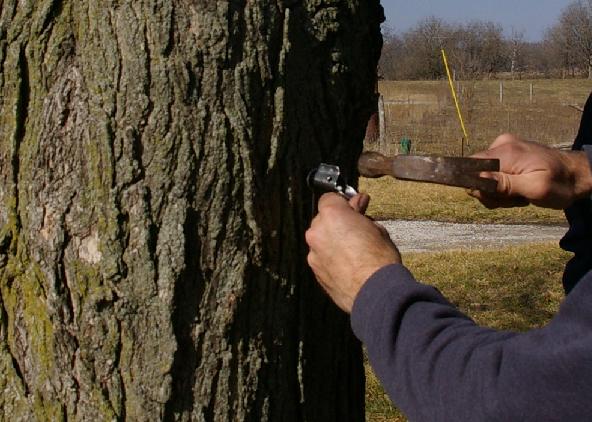
Using the drill bit supplied in the kit, drill a hole in the tree.  Drill up at a slight angle and 2″ deep.

Now, tap the …erm…tap into the tree.  It will be a snug fit.  There is probably a bucket hook that goes on the tap before you insert it into the tree.  Again, don’t worry, you aren’t hurting the tree.

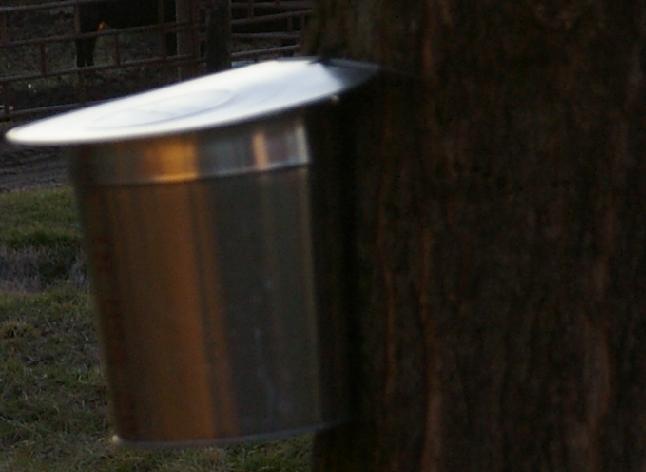
The bucket just hangs from the hood and the sap should start running immediately.  We were surprised by the instant and musical drip into the buckets.

Pop the lid on to keep out the rain and check your bucket daily.  Some of our buckets filled in 24 hours while other trees weren’t as generous.

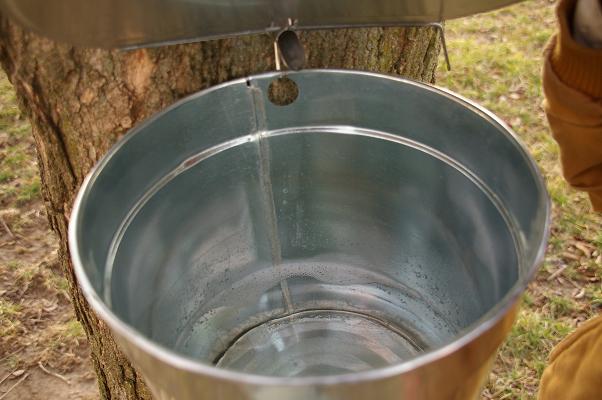
Here’s a shot of the sap.  Please notice it’s a clear liquid.  Once the sap turns milky you’re out of business.

Being out of the maple business isn’t all bad.  A few weeks after our maple season finished the bees were busy at the tops of the trees.  Where the buckets had been drumming, the bees were humming.  What nice trees.  Thanks Grandma.

So, if you have 30 years to wait for syrup, go ahead and plant your trees.  The bees like them, they produce dense shade and beautiful fall colors.  Let me know if you find any additional uses for your trees too.

I would also like to point the reader to pick up a copy of Scott and Helen Nearing’s Maple Sugaring Book.

Creek Sand?

My friend Darby and I were discussing things we do to ensure chick vitality.

Me: “Kelp, creek sand and restricted feed go a long way toward happy birds.”

Darby: “Kelp and creek sand?  Can you elaborate?”

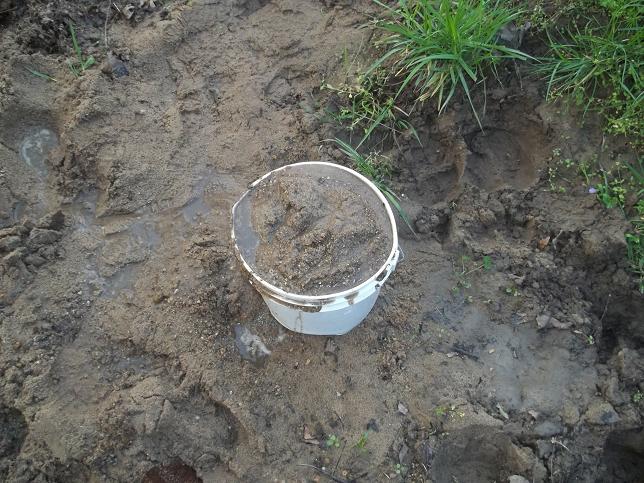
Well, here is the skinny on creek sand.  I go down to the creek (well, the branch) with a bucket and a shovel.

I’m not concerned about getting pure sand, a specific size of the sand or even looking for dry sand.  I just fill the bucket.  The chicks will pick out their favorite bits and everything will be just dandy.  Further, there are small organic bits mixed with the mud and sand as well as small organisms the chicks seem to really enjoy.

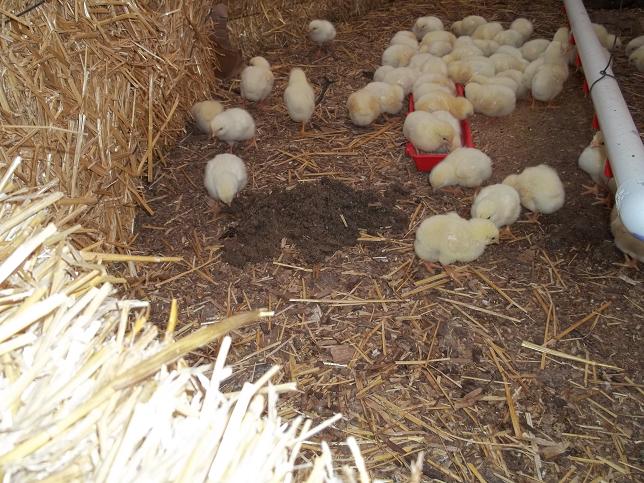
It is important that my day-old chicks have access to sand as soon as possible.  They may totally ignore it.  That’s fine.  It will mix into the bedding or will be there when they dig around later.  But they will eat some, days later they will eat more.  The sand cost me only a stroll down the hill so I don’t mind if they seem to ignore it.  Further, this costs $0 in fuel and there’s no sales tax.  (insert evil laugh)

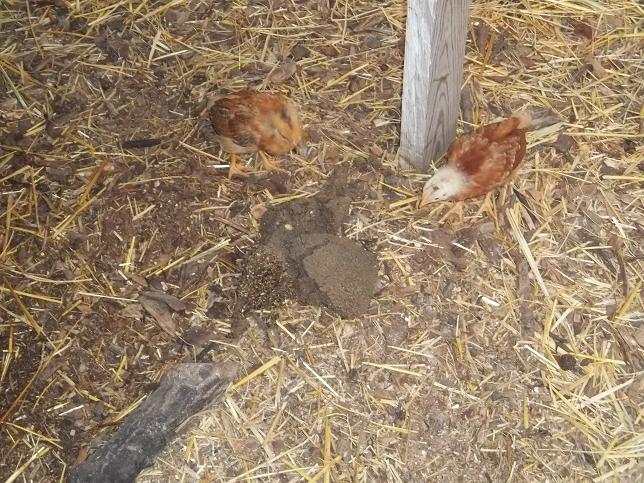
I also put small shovels of sand out for the young pullets and ducks.  Again, they pick out what they want and incorporate the rest into the bedding.  A little sand is a good thing in compost.

Because chickens don’t have teeth they use their gizzard to grind up the food.  The gizzard is just a muscle so rocks stored in the gizzard enable the chicken to utilize feed more efficiently.  By providing creek sand I’m giving the chickens a variety of rocks to pick from and additional nutrition at essentially no cost.  I don’t have to be stingy about creek sand as noted by my friend Darby after he tried it.

D: “Those chicks tore that creek sand up!  Thanks for the suggestion.  I’m also finding that I’m not stingy with it, since I didn’t have to pay for it.  I’m sure it will [make] a nice difference.”

All of this was detailed in Salatin’s “Pastured Poultry Profits” on page 45.  If you are considering raising poultry on pasture, be sure to read this book.

I Need More Carbon

A friend recently commented, “You talk about fecal material a lot.”  I do.  I appreciate manure and what it can do for my soil, the soil life and the world around me.  While most people just use it to pollute drinking water, I make it work.  In order to make it work I need carbon.  Lots of carbon.

The primary use is just to keep the animals warm and dry.  Carbon also helps to sponge up nutrients, preventing odors from escaping and holding nutrients in suspension for later use.  It soaks up liquids, helping to protect the underground water supply.  It adds structure to the soil.  It acts as a weed barrier.  I could go on.

We buy carbon in several forms.

Straw bales are the first thing people think of when they think of barns.  Why straw?  It’s a local resource and is available in quantity.  It’s a by-product of raising small grains.  It is a useful tool for bedding but has its limitations.  It mats quickly, it is not very absorbant and it takes up a lot of space.  On the plus side, it adds air space to compost and rots quickly.

What is better than straw?  Wood chips.

I cut a lot of brush and run most of it through my chipper…the smaller stuff anyway.  That, and chips dropped off by the power company, help me to accumulate large windrows of wood chips.

Wood chips are large and bulky.  They do a good job stabilizing a muddy area but are unpleasant to walk on or scratch in…if you are a chicken.  They are also of limited use absorbing nutrients as there is so little surface area per unit of volume.  But they do make nice paths through the garden.

But what’s better is hardwood sawdust.  Sawdust offers greater surface area per unit of volume and is comfortable to walk on.  Cows prefer to lay on sawdust over straw.  We use it to mulch our garden beds, to bed our chickens, cows in the winter and to catch rabbit manure.

Sawdust quickly soaks up water, urine and manure, it’s easy for the chicks to scratch into, it is easy to move around with a shovel and a wheelbarrow, it is cheap and can be found locally.  We use sawdust straight from the sawmill rather than from a wood shop.  The kiln dried stuff acts and feels different.  Also, we let a pile sit out in the weather for at least a few months before we really tie into it.

Where I am, these are the three easiest forms of carbon to get my hands on.  Each are useful as bedding, build great compost and help maintain soil health.  If given the choice, I would choose a truckload of wood chips over a truckload of fresh horse manure.  It has so many more uses.

Georgia’s Wall Part 3

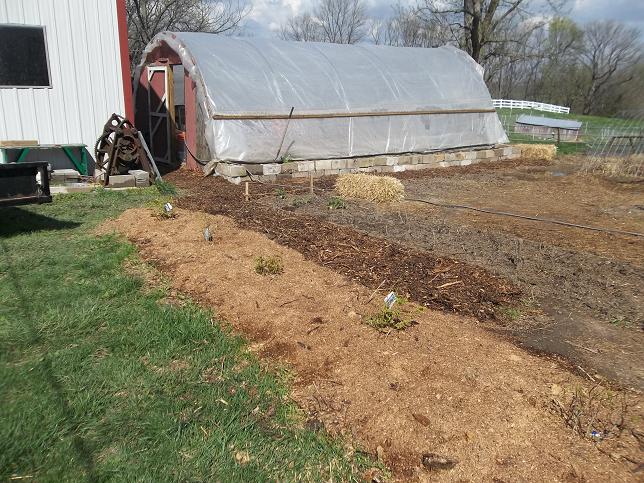
Sunday morning we finished our regular chores and had a few minutes to spare before going to see John Carter with the kids at 9:00.  Four of us shoveled rabbit manure and bedding out of the greenhouse to finish up the raised bed.  The chicks found this activity particularly interesting.

8 Loads later we had 3-4″ of rabbit manure mixed with course sawdust across the entire bed and it was time to wash up and head out.

So, in review, we built a block wall, added in large bark chips and bits of odd firewood, layered course wood chips on top of that, course sawdust on top of that, a layer of composted horse manure, and a thick layer of rabbit manure and bedding.  I gave it a good soaking with the hose and it got surprisingly warm.

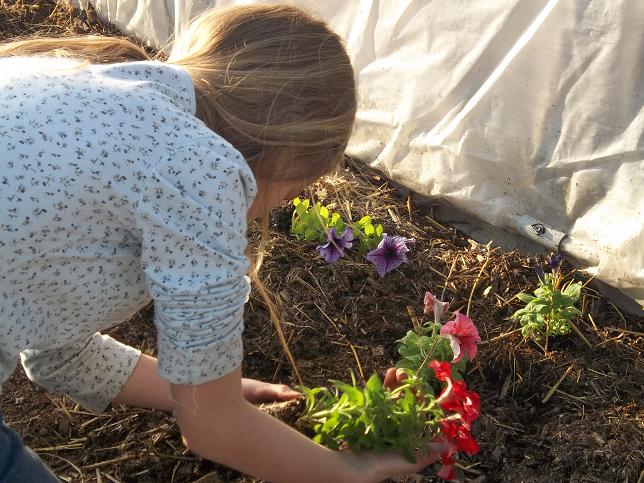
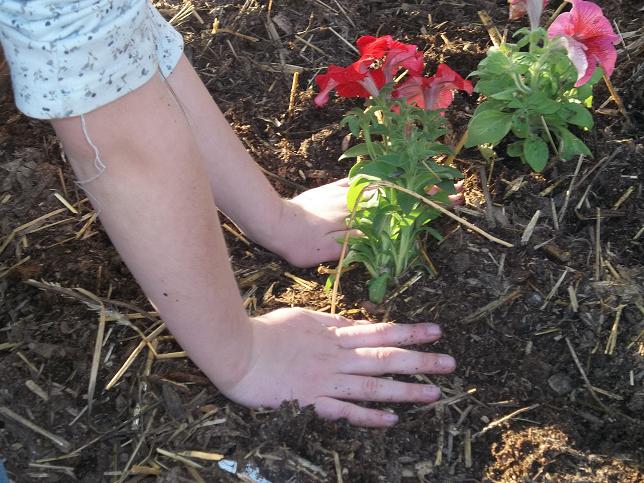
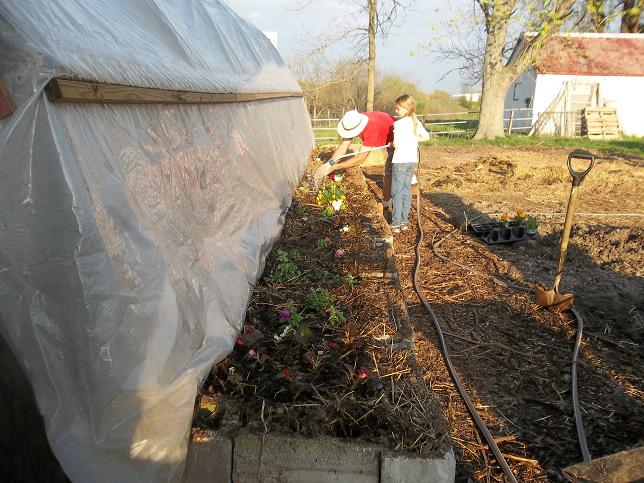
With the movie behind us, friends visited, chicken feed freshly ground and our Sunday afternoon swimming (cold!) out of the way we came back to work in the garden.  We were planting begonias and petunias along with herbs.  We spaced the herbs evenly across the bed and fit the flowers in between.  I layed out the bed and my daughter knew just what to do.

With that finished we gave everything a good drink, washed our hands and began the next project.

Now, you may think it’s silly to plant flowers so early, especially when my main vegetable garden isn’t in.  You may be right, but it was an excuse to work alongside my daughter doing something that helps her feel involved, helps her to make a positive contribution to our family and allows her to express herself.  We weren’t just doing chores that dad says need to be done.  She wanted to do this.  That’s more important than broccoli.

Mowing the grass part 2

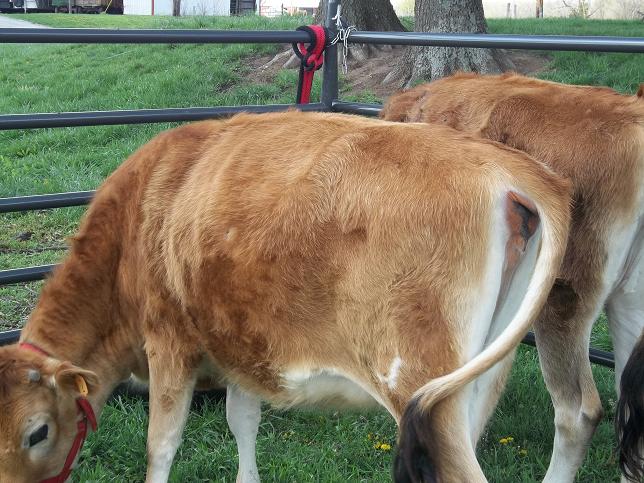
The cows, as you know, get fresh grass daily.  Recently I made their pen smaller and I’m just giving them 144 sq. ft. at a time, moving them 5 or 6 times daily.  This results in excellent trampling and manuring as the grass is sheared off evenly and the weeds are either eaten or trampled.  The picture below shows a line I missed when I moved the pen a bit too far, then shows the progress beyond.  At the end of the day I’m putting something on the order of 90,000 pounds per acre across my lawn.  I could go heavier if I had more forage but since the grass is still short I have to move them frequently.

The stem in the center of this picture was a weed I watched Mable take a bite of then spit out.  I guess once they finished eating their ice cream they went back for their veggies.

Now, I want to be clear that I’m not starving my cows into eating the weeds.  They just like to eat.  Check the rumen on this beauty.  The indentation between the last rib and the pelvis sucks in when the rumen is empty.  Flo is looking full.

So what are they eating?  Well, they’re on the old driveway and it’s a weedy mess.

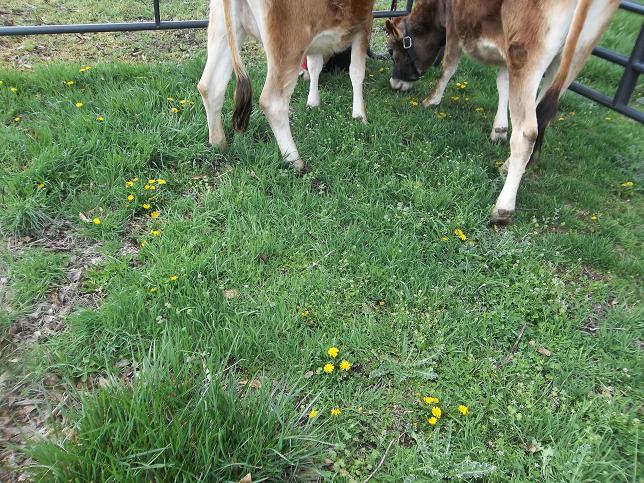
Here is another shot showing the line between what they finished grazing and what they are just starting.

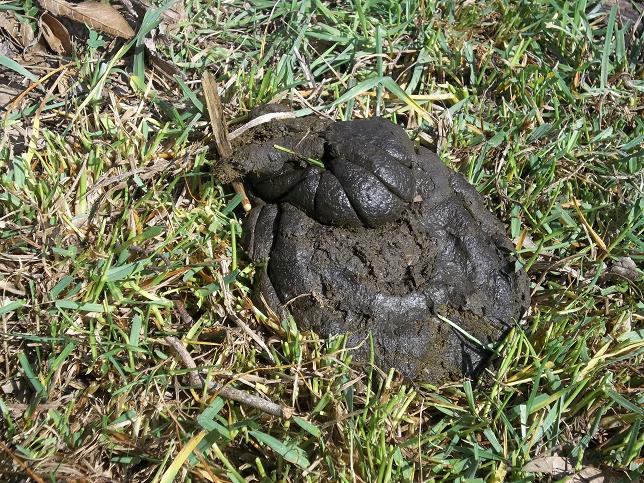
Now, there really is a bit more to it than just moving a panel and waiting for them to eat.  You have to read their manure to see if they are getting enough protein.  This looks pretty good.  A little dry but not bad.

It would be more soupy if the fast-growing green was all they were getting or if I had more clover mixed in my pasture (yard).  I don’t have much clover yet, there is a fair amount of old growth still standing here and they get half a bale of hay every night just to keep things regulated.

Beyond manure I smell them.  Yeah.  Smell their breath.  That tells me a lot about the condition of their rumen.  It should smell sweet.

There are more things I could check if I was more paranoid but if they are laying down, chewing their cud, their manure is pumpkin pie-ish, their breath is sweet, and their coats are shiny they are OK.  The real point is…look at that lawn!  They mowed it, set the weeds back and fertilized it all on solar power.

I think that’s pretty cool.