Current Events Aug. 2013

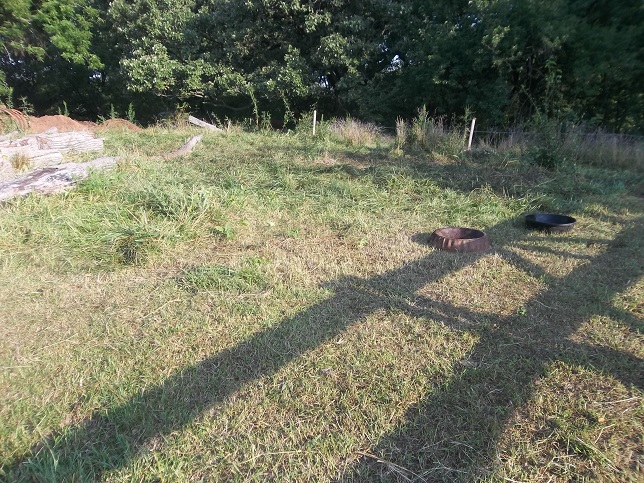
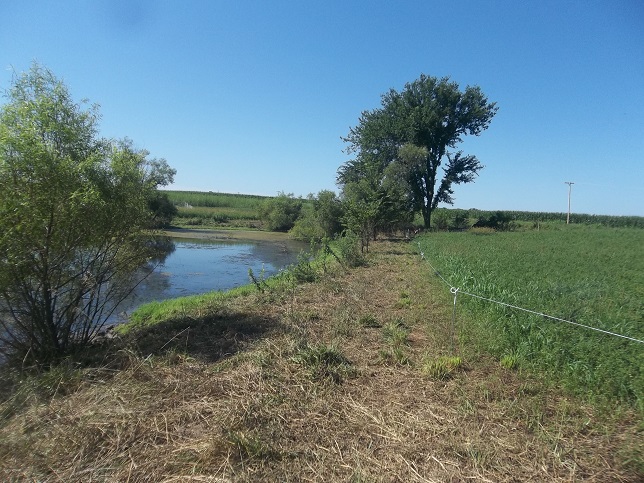
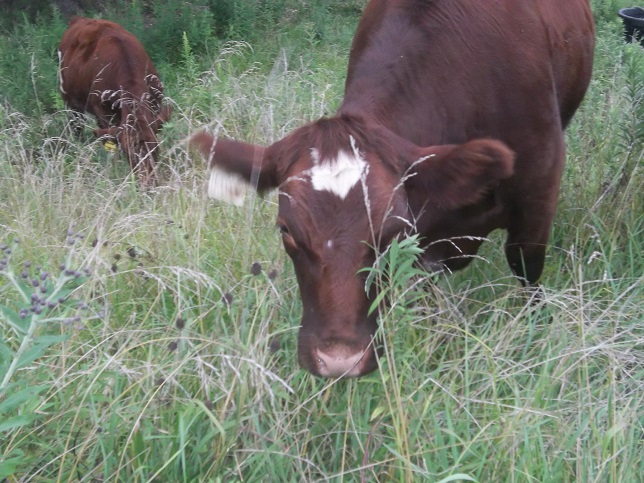
We’re a little busy right now, as is everyone else.  Here are a few pictures of things we’ve been busy with.

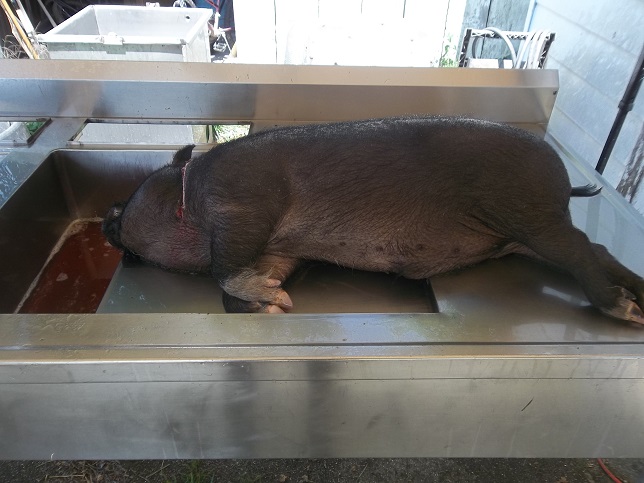
My sister raised a potbelly pig in her back yard.  We introduced it to the freezer.  He was an uncut boar.  I’ll say it was an interesting culinary experience. I had not scraped a hog previously.  I regret scraping this one.  We tried mason jar lids and a torch.  Mixed results.  I suspect my scalding method could be improved.

It reminded me it was time for us to get some pigs of our own.  These should be ready in late November or early December.  Get your order in now.
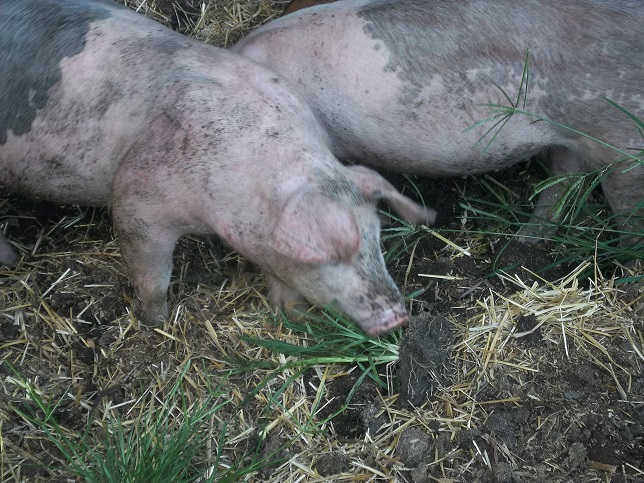
The pigs were hungry for grass and had a great time digging through last winter’s cow bedding.

PigsEatGrassWe are busy canning beans, peaches, tomato sauce…you name it.

As time allows we put a few ducks in the freezer.  It’s pretty hard work.  A chicken takes us about a minute, a duck takes about 10.  The extra step of waxing the bird makes it come out clean but adds a lot of time to the process. Here we are peeling the wax.

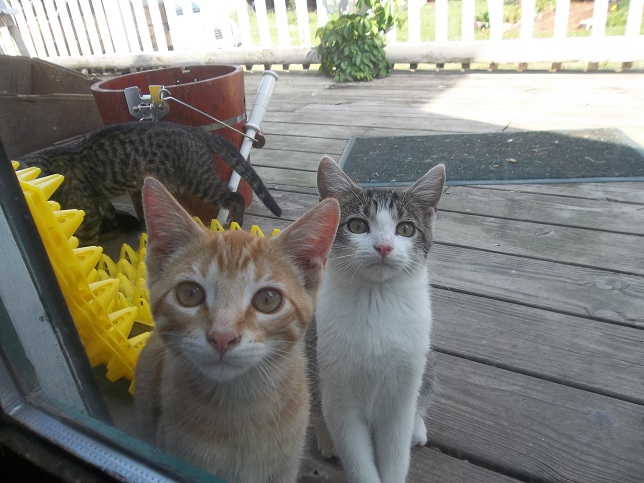
And always the kittens are watching us…looking for a hole in our defenses…wanting to invade our home and love us to death.  The kittens fail to realize that I enjoy them but do not love them.  That was a distinction my grandpa tried to explain to me when I was younger.  I understand it now.  More on that another time.

So..Why Cows?

SO, I ask myself over lunch at work one day, “Why Cows?”

A: That’s a great question, self.  I’ll tell you.  First, because I’m lazy.  Cows don’t need much in terms of time or inputs.  No feed grinding, no extravagant fences…just grass, water and wire.  Second, because I don’t want to mow (see Lazy) and need a way to cycle nutrients.

Q: So what does that mean in terms of annual revenue?  Go ahead.  Answer me as if I’m naive.

A: That’s not such an easy question to answer.  We have gone over some of this before but let’s do it again.  I’ll try to break this out a little bit to make the math easier and I’ll go ahead and make it personal…ish.

Income:
Let’s assume I have 1 cow per acre on my 60 acres.  I could, on average, sell calves for $1.55.  (Now look, I know calves are selling for $2 right now but that’s largely because corn prices fell and feedlots are buying calves again.  Prices change.  Stick with the $1.55.)  That’s $697 for every 450# calf I sell each year.  Not all 60 cows are going to calve.  Let’s say we average 54 calves at weaning.  So we’re looking at $37,665 of income if the weather is perfect and I’m completely stocked on my 60 acres.  But still, that’s gross and I have to keep 6 heifers (-$4,185) as replacements, selling 6 open cows(+$6,000) taking us to $39,480 of gross income.

Expenses:
Cows don’t need much but they do need a little.  They’ll need salt ($5/head), minerals ($50/head) and hay ($100/head if we feed for 60 days) and will have to pay for the ground (pasture rents around here for $50/acre…just happens that we get enough rain to support 1 cow/acre).  Then there’s a cost for my labor (8 hours/week priced at minimum wage divided over the number of cows in the herd…not much difference in labor for 6 cows and 60 cows but it’s $7/cow at 60 or $70/cow at 6).  That all roughly adds up to $212/cow/year for 60 cows.  Gordon Hazard says to add in another $100 for vet bills and hope it goes unspent.  That takes us to $312 per cow per year or $18,720.
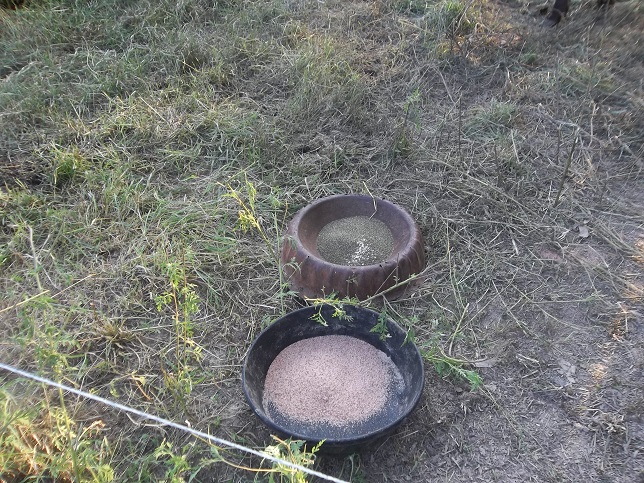
Minerals

With gross income of $39,480 and expenses of $18,720 (we already accounted for kept heifers worth $4,185) we’re down to $20,760 ($346 per acre)…before we pay tax.  Now, in truth, my farm expenses are higher than what we have accounted for but the cows, as an enterprise, command market price for pasture rent and don’t need me to own a tractor, build big barns or to watch cable TV.  I could dream of charging my cattle business $20/hour for my time but they would fire me in favor of $7/hour labor.  From a business perspective, I’ve outlined what a cow costs, not what a farm costs and certainly not what a family costs.  My farm payment isn’t the cow’s problem.  My lifestyle isn’t the cow’s problem.  See the difference there?  As a business unit, the cows can earn their keep…it just isn’t hugely profitable.

So, again, after paying myself minimum wage to move cows (because we’re limited by the market, not my desires), the farm kept $20,760 from the cattle operation.  That’s about a 6% return on the farm’s investment.  10% is a magic number.  It’s high enough to attract interest in business, not so high as to attract too much attention.  It’s enough to maintain fences and infrastructure, enough to help fund additional enterprises on the farm, and enough to help save up for a rainy day.  But I’m looking at a 6% return…assuming I can keep my farm fully stocked.  By the way, we’re not fully stocked.

Herd

Now, to help out a bit, land ownership is separate from cattle ownership.  Gordon Hazard says his cows pay him for pasture usage and all of that money goes directly into an account for buying more land, that he paid for the original land and herd with his off-farm work.  That sounds familiar.  The farm income is just enough to cover the farm payment each year.  There is little left.  I made $7/hour for working a little over an hour/day…but, after 30 years the farm is mine…along with a pretty nice herd of grass-genetic cattle.  It is important that the land carries the debt and not the cattle as I can take the cows with me if things go bad.

So the cows can carry the farm.  Those cows don’t need much from me for that money…but it’s not a whole lot of money.  And the income would not be steady, it’s highly variable.  Some years I’ll need more hay.  Some years I’ll have to sell stock to stand a drought.  Then I’ll face a few years of reduced profits as I rebuild herd numbers.  But the math seems to work…it’s just not going to make us millionaires any time soon…and I’m probably not going to quit my day job.

Q:  How can I make it better?

A:  Well, I can work to cut costs.  That might help.  A little.  Going without hay would be a big boost…can you imagine if I had to feed hay for 120 days instead of 60?  Maybe if I had permanent paddocks I could simply subdivide.  Then I could spend less time building fence…but that only goes so far as my labor costs are already quite low.  What if I grazed somebody else’s cattle and they bought the hay?  Now there’s an idea.  I’ll have to put a pencil to that.

There are other enterprises I can pursue to add to the bottom line but pimpin’ eggs ain’t easy.  Nothing is easy…and nothing takes as little time as the cows.

Q:  So is that it?

A:  I don’t know.  I really don’t.  I have customers asking me for pastured beef.  I’ll have to raise some of those calves to slaughter weight.  That cuts down on the number of cows I can carry but it enables me to de-stock my farm quickly during a drought.  My revenue will be lower but I would be more flexible.

Q:  So, Mr. Steward, how long till you retire and farm full-time?

A:  I think this all shows that cattle are not likely to be a primary source of revenue on my 60 acre farm but they are the primary tool we will use for nutrient cycling and the foundation from which our other operations launch.  We work to run a truly diverse farm as the more uses I have for each acre, the more profit I can derive per acre.  Add in timber, hogs, sheep, chickens and recreational value and we might start getting somewhere but something has to mow the grass.  So we have our solar-powered lawn mowers that need attention for about an hour/day and pay the rent.

So I guess that’s that.  The cows will pay the rent and cycle the nutrients but won’t, by themselves, allow me to quit my day job…at least as long as I’m limited to 60 head.  Now the hard part: Getting to 60 head!

Pasture Litter …Again

For the last few days the cows grazed in front of the family cemetery.  This was a thick stand of bermudagrass with cowpeas, millet and a few other things mixed in.  There was also a mowed path to the cemetery gate.  In fact, it looked like this about 6 weeks ago:

JulyGrazing6Notice the mowed area in the foreground.  With me?

One of our goals in using cattle for rotational grazing is to cover, protect and feed the soil with litter.  This keeps the soil cooler and traps more moisture than just bare ground.  Where is the litter going to come from in the foreground?  It ain’t.  I mean, you would think some portion of the grass clippings would stick around and blanket the ground but there just isn’t enough mass…the soil biota eat through it too quickly.

So the cows grazed it.  Here’s what the mowed area looks like now:

GrazingShort1

Not much for litter covering the soil.  The cows ate it right down to the nubbins…horses would have eaten it to dirt.  But the rest of the pasture looks pretty good.

GrazingLitter1

We had them packed in pretty tightly and we got good trampling and manure coverage.

GrazingLitter3The cows did a pretty good job.  I can see the benefits of packing them even tighter.  Maybe someday…

Again, there is very little left where the pasture had been mowed (a necessity for cemetery access).  That area will be a little slower to recover.  I expect the trampled grass to come back quickly…in time for fall grazing.  Hopefully we’ll get to graze it twice more this year.

GrazingLitter2


Most of the neighbor’s pastures look like the foreground in this picture…except they also have clumps of weeds.  If they don’t they have been mowed.  From the road they look OK just like this picture looks OK.  It’s only when you go in close to investigate that you realize how damaging it is.  Hot, baked, dead earth is not conducive to future grass crops.


1,000 Cows on the Move

I have to believe this is more than 1,000 head.

These cattle are managed by Neil Dennis in Saskatchewan.  Based on a presentation he did for PowerFlex fence that is posted on Youtube, he packs cows into a half-acre and moves them throughout the day, overnighting them in the larger area, then starts small again the next morning.  To match his stocking density (1.3 million pounds per acre) I would start my 10 cows in an 18×18 area.  6 steps by 6 steps.

Anyway, I think it’s just amazing.  I can’t imagine what the neighbors would think if I took 1,000 cows down the road on a Sunday morning.

3 things to take away from the presentation linked above (and I should caution you, it’s pretty hardcore grazing stuff.  You can skip the first video, really.)

  • Never have more cows than your wife can look after.
  • Neil Dennis says he can’t afford to own cattle.  He just grazes them for other people.  Might be a lesson for me in that…
  • Neil does a lot of testing to see what works on his land.  It’s surprising which techniques fail to measure up to the propaganda on his farm.

July/August Grazing Plan

Oh, how plans change.  If you look at this post, you’ll see the July grazing plan.  It worked well to shade the cows on days well into the 90’s with heat index above 100.  Right on schedule, on the 25th, we were grazing #25.  Happy days.

Now what?  As I started working on my next plan, things cooled off.  The pastures held more feed than I estimated.  We slowed things down.  I had been expecting to do this (Note this is turned 90 degrees so North is to the Left.):

IntoAugust

But the cows are on 1 and it’s the 14th.    I gained two weeks.  Where did it come from?  Some of it was grazing the slope East and South of 3 and 4.  3 days were gained from grazing the unlabeled areas to the right.  A big gain was grazing the edge of the pond.  So, I’m doing fairly well.  I gained 2 weeks because of the cool weather and the use of reserve ground.

But is this all there is to planning your grazing?  Just vague lines on a map?  Well, not really.  If we have to feed hay, where should it go?  Where are the cows going to calve?  What portion of the farm is set aside for drought?  Planning to cut anything for hay?  Will you allow a field to totally rest for a year?  How is that specific area doing?  Are we seeing increasing or decreasing plant diversity?  Good carbon litter?  Where will the cows find shade in hot weather?  Do you have a plan B in case something unplanned happens…like prolonged rain and flooding or prolonged drought?  How will you fence in the Spring, Summer and Fall and how will that change?  How will you winter graze the stockpile?  Where should stockpile remain to start the spring rotation again?

But the questions don’t stop there.  When was that family vacation?  When is that friend getting married?  When do chicks arrive?  When do we usually plant the garden?  When will we have to put up strawberries, blueberries, peaches, green beans, tomatoes or apple sauce?  How are we going to build fence so we can conveniently work around social events, family plans and other farm work?

I want fat cows and healthy pastures.  This won’t happen on its own.  I have to plan my way.  Right now I try to plan a month at a time but in the near future I’ll be better at estimating and can shoot further out.  One of the early chapters of For the Love of Land: Global Case Studies of Grazing in Nature’s Image reminded me of the pressing need to transition to year-round planning instead of just winging it month to month.

Let’s complicate things further.  How many pigs will we pasture this year?  Where will we run them?  How can we coordinate their grazing with that of the cows?  How about turkeys?  Or broilers?  Where do they fit into the rotation?  It’s nice to add all that disturbance and manure but we have to allow recovery.

One step at a time.

Raising Cattle that Fit the Box

“Fit the box”.  I’m sure it means cattle that conform to a certain set of criteria but let’s take it literally as it will serve the rest of the post.  Cattle that fit the slaughter box.

Click image for source.

Mechanization requires standardization.  Anything that deviates from what is expected lowers the efficiency of production.  Cattle slaughter is, largely, a mechanical process.  You can see much of the detail on Youtube.  I’ll give you a link in a second but only click if you feel like you should.  There are some rough places in this video that are challenging to our modern cultural norms.  If you do click through, pay attention to how similarly sized every animal is.  They all look the same hanging in the cooler.  Again, don’t click this if you just ate breakfast (Jeff).  You should watch the whole video but the important part starts at the 5 minute mark.  Here’s the link.

I may not produce for the commodity market but it pays to produce what the most common buyer will consume.  The most common buyer wants more of the same.  (Because their customers want whatever they see pictured in the magazine.  I think this is because nobody knows how to cook…they just know how to follow instructions.  It has to look like it does in the book or they get lost.  That’s another discussion.)  To fit the dis-assembly line the packer wants generally the same size of animal.  If there is little difference from one cow to the next, there is little need for adjustment.  They may buy larger or smaller animals but only at a discounted price.  Imagine if a plant was set up for the 650-900 pound carcass and we brought them a monster 3,500 pound bull!  They wouldn’t want it.  It wouldn’t fit in the conveyor from the video above.  Similarly, if we take them a 600 pound steer…that’s too small.  It might turn around in their handling equipment.  They may be more willing to take the steer over the bull but either one will be sold at a discount.  It doesn’t fit their program.  It doesn’t fit the box.

So what prompted this post?  Why can’t you ship dexter cattle to stockyards?

The lower body weight of a dexter equates to a lower feed requirement for maintenance. That means you can pack more in per acre. But we run into a problem when we ship a frame 00 cow to a packer that is used to seeing frame 6 or frame 7 cows…nearly 20 inches of difference. Cattle typically slaughter at 65% of live weight.  That means a 500 pound frame 00 heifer will yield a 325 pound carcass.  An 1100 pound frame 6 heifer will yield a 715 pound carcass.  The smaller has half the t-bone…half the hamburger per kill!  The cuts themselves are smaller.  It may taste great, it may grow well, it may be feed-efficient raising more overall pounds per acre but…what do you do with the ones you don’t direct retail or sell as breeding stock? Here in Illinois I have to pay a fee (tax) per head of livestock slaughtered. The more pounds of beef I can divide that cost over, the lower the percentage cost. So, as a businessman and a grazer, I have to find that happy medium between an elephant cow that can’t eat enough forage to re-breed and a mouse cow that is fat, slick and fertile but won’t fit the box. I’m content to stay with frame 3-4 cows and keep looking for frame 2 bulls.

What is all this Frame Score nonsense?

I’ll let the American Angus Association take care of that as they were the first search result.  Look through the table and compare a mature frame 4 cow to a mature frame 4 bull.  The cow is 50″ at the hip, the bull is 54″.  Go down basically 2 inches on each and we’re at frame 3.  You understand?  So there’s a 4 inch difference between a frame 4 bull and a frame 2 bull.  Now, keep going down on the scale at this site and you’ll see where dexters usually come in.  Here’s an illustration of overall size differences between cattle (click the image for another, slightly different breakdown of frame scores by hip height).

Click image for source.

There is no way a frame 7 bull would last on fescue and weeds at my farm.  He would need more concentrated fuel to keep weight on.  Without concentrated feed the poor animal will spend most of the day just trying to ingest enough forage to maintain weight, robbing it of valuable time ruminating and digesting that forage.  It could be possible if I maintain very high quality forage in all paddocks but by doing so we’re giving up our unfair advantage…cheap grass.  At the other end of the spectrum are the miniature breeds.  They will quickly fill their rumen and lie down to work on digestion.

But, wouldn’t it be fun to run fifty 2,200 pound frame 7 bulldozers across my pastures!  It might also be fun to run 2 dexters per acre through a grazing dairy…if I could find appropriately adjusted attitudes.  But the most fun of all is paying my bills with cash to spare.  To come out ahead grazing, I need a cow that will raise a calf every year on minimal inputs, eating medium-quality grass and needing a minimum of labor.  The calf has to be sized to sell to the widest possible consumer base for the sake of price stability and market predictability.  The cowmen near me who have done this successfully for years suggest I should be shopping for frame 3 to 5 cows.  I’m inclined to take their advice.

Trimming Those Hard to Reach Places

I have a hard time trimming here and there…but no need to go into that.  I’m talking about trimming grass.  There are places it is simply dangerous and foolish to drive a tractor.  For example, the pond’s edge.

We spend a lot of time at our pond swimming, skating (in the winter), catching frogs, fishing or paddling around in our boats.  Most of these activities require access to the shore.  When you are barefoot and wearing shorts…well, a sand beach would be ideal.  Let me know if you want to contribute to the sandy beach fund.  In the meantime, we prefer to keep the weeds short.

PondsEdge1

So how do you get it done?  For years we haven’t.  This year things are different.  We have cows.

PondsEdge3

This ground hasn’t been grazed in years…since I was a kid – so the grass is fairly sparse.  Much of what was out there wasn’t very tasty…but they do like Johnsongrass.  They don’t care for goldenrod no matter what though.  One thing they excel at is trimming up lower branches and opening up new fishing areas.  Along the way they trample in tons of carbon, add fertility and help tighten plant spacing by pushing new seeds in contact with the soil.  That’s all good but we also lose a little hay from the hayfield…but most of it is pretty low-quality stuff anyway.  The cows need to move quickly over this ground.  No big deal though, I have gained 5 days of grazing by going around the pond and may get 3 more before we’re finished.

PondsEdge4They find their way into thickets and tangled masses of grapes, saplings and fallen limbs and tromp the whole down into the soil.  It’s pretty cool.  I have been trying to figure out how to cut into this oak regrowth all year and retain the strongest shoots.  Well, the cows figured it out for me.

PondsEdge2All of this is really accomplishing a couple of things that are very intentional.  First, I’m stretching my pasture by grazing stockpiled reserve elsewhere.  Second, I’m utilizing areas around the hay field that I can’t mow.  Having these edges grazed should help my hay cure faster beyond building fertility in the field over time.  I should point out, I have a fence keeping the cows out of my alfalfa and another fence keeping the cows out of the pond.  (Had to wade out around some trees with long fence posts a couple of times.)

Much of this exercise was inspired from years of reading Throwback at Trapper Creek.  Thanks Matron!

Interview With David Hall Part 3

Parts one and two of this series focused largely on cows.  In this post I’ll wrap up with a focus on business and some final tips.  I didn’t want to pry into David Hall’s personal finances.  I asked him for the top-down view of his farm.  David said they run 400 head of cattle on top of a couple of off-farm businesses.  400 cows and he has time to pursue other interests in town!  So, where is the farm income?  He sells 150 bulls each year.  He sells culls at the local sale barn.  When he ran hair sheep (something he suggests strongly, more later) he sold lambs and cull ewes at the local sale barn.  They are into commodity production, seeking a high tonnage of medium-quality forage for a cow/calf operation instead of high-quality forage for a finishing operation.  That distinction is key.

“To maintain profitability each cow has to bring in a calf at weaning time.  Cows that are too hairy, too big or produce too much milk won’t last in a grazing operation.”

He breeds for fall calving.  Cows are most fertile in the fall, the temperatures are cooler which helps when grazing fescue, those calves help soak up the spring flush of grass and he gets another flush of grass in the fall just as the cows are calving.  He sells 18 month old bulls in the spring as well as weaned calves, just when both the local calf market and the bull market are at their peak.

Hall likes to feed hay.  “Land costs are high.  Feeding hay puts more head on the farm but you have to manage it carefully.”  For 2-3 years he won’t need any hay.  For 2-3 years he’ll need a little hay.  For 2-3 years he’ll need lots of hay.  Hall says to buy hay off-farm.  This went well with his whole theme of allowing specialists to specialize.  For example, someone else raises the stockers, he raises calves.  Allowing someone else to put up hay and own the equipment frees up your time and capital.  One less tractor could easily be 15 more cows.  He drove home how important he thought this was by telling me his family had owned a green farm equipment dealership for 30 years.  “Buying the hay off-farm may have $18-22 worth of fertilizer value (if you just roll out a round bale) we just rolled out for $25.”  Once the cows eat it, the fertilizer value goes up and he doesn’t have to de-stock his farm when forage becomes scarce.  I asked him how long he fed hay last winter (coming out of drought) and he said, “5 months.  But each day I only fed the cows 20% of their diet in hay instead of feeding them 100% hay for 30 days.”  That helped him stretch his stockpiled forage and increase recovery times.  “Feeding hay can make you profitable.”

David, I’m just getting started, next year I’ll have 60 acres and 10 cows.  What would you suggest to help me get stocked?  Here are his quick tips:

“Think about a marketing plan for calves.  Raise good heifers for the next few years as they will be in demand.”

“Buy 10-20 sale barn cows, 100 ewes (hair sheep), spend heavily on getting fencing and water ready and buy in all hay.  You’ll need a dog and better fencing to protect the sheep but sheep can be quite profitable and will utilize forage the cows ignore.  Parasites can be a real issue with sheep so you will need to lengthen the time between grazings.”

“Manage grazing as well as you can.  Whatever happens, do your best…but push for diversity.”  (I think he meant both in livestock and in landscape.)

Livestock are employees.  “Fire employees that don’t work.”

“A short, defined breeding season will push things forward faster than anything you can do.”

Thanks David.

Interview With David Hall Part 2

Last time I wrote about a conversation I had with David Hall about recognizing the cost of raising a heifer calf.  She will have to throw her fourth calf at age 6 to pay for her own development.  This is no small feat as heifers are still growing themselves and gaining molars…without which, it’s hard to fully chew their cud.  That first calf is hard on a heifer as she has to provide milk for a growing calf while retaining/regaining condition so she cycles in time for her next pregnancy within a defined breeding window.  Without those molars, she faces an up-hill battle.  Now, I have heard Kit Pharo toss this around a little bit suggesting if we’re ever going to forgive a cow for coming up open it’s when she’s due for a second calf…but he hasn’t done that in practice, he just suggested it might pencil out.

That math makes sense but why bother raising heifers when I can buy bred heifers?  Either way somebody has to pay those heifer development costs but maybe I can save myself some labor if I can find replacement heifers of the same quality.  While it is possible to buy in heifers a little cheaper than I can raise them, it’s a little bit of a gamble genetically.  David said, “If my own herd genetics are good enough I can afford to spend more on my own heifers than taking a chance on new genetics.”

So, what is it we’re looking for when we are shopping for a long-lasting heifer?  Well, here are the herd requirements David listed on his first slide in the presentation:

  • Fit the environment (Adaptable)
  • Calm
  • Calving Ease
  • Fertile
  • Longevity
  • Low Maintenance Requirements

David started his presentation in February by showing a table of relative values comparing a business based on yearling sales to a feedlot.  According to the chart (which I believe was cited to a research company and I’m unwilling to republish), reproduction is 10x more important than carcass quality for yearling sales.  If you are in the business of selling calves, you have to have calves to sell.  The detail below should help us find stock that will work for us, delivering and weaning a calf year after year but keep in mind, fertility is the top priority.  So let’s look at the criteria in detail, though I think you’ll find the details overlap considerably.

Adaptable:
“Be sure to breed to bulls who have a proven record on fescue.  Get a bull that is well adapted to your environment.”  If I have 25 cows and one bull, that bull makes up half of the genetic makeup of the next generation.  Picking the right bull matters and the consequences of a poor choice will impact the operation for years to come.  For example, I want a bull that is slick-haired as the shaggy cows (Ms. White) don’t perform as well as the slick cows (#111) on hot days in July.  Even better were the Jerseys who got slick in April or May in spite of cool weather and continue grazing when the heat index is above 100.  I feel that it is important to select within my herd for shorthorn genetics that are still out working alongside of the Jerseys.  Those Jerseys are the benchmark.  I have a couple of cows I can usually count on to be out there working on a hot day so I’ll tend to favor their offspring in the coming years.

Bull1

Disposition:
“Cull out ornery cows and bulls.”  As an inexperienced cow owner (I’m not a cattleman.  I’m a cow owner.  Maybe in a few years I’ll graduate.), it is easy to confuse ornery and nervous.  There is a difference between the cow that wants to eat you and the cow that is afraid of you.  Ms. White was terribly skittish when she first arrived and when she saw us it was time to run…and all the cows went with her…right through the fence.  I thought we were going to have to invite her to leave.  But, after a little while, with a few changes on our part, she fell into the routine.  She hadn’t been in as close proximity to humans as she necessarily is on a daily basis with our daily grazing moves.  She has to walk right past me every day now and is doing fine.  That said, she does tend toward excitement and we want cows that tend toward calm.  Hopefully she’ll give us steer calves each year.  Looking at cows as employees David says, “if the employee has a bad attitude she needs to be fired.”

Calving Ease:
If I pick a bull that throws heavy birth weight calves, I’m breeding heavy birth weight into my herd.  I don’t want to spend my spring camping out with the herd and pulling calves.  I want to sleep in my soft, comfy bed, get up early and head out to the pasture with a camera to take a picture of the new, live calf on the ground…a calf that was born without any interference from me.  If I am selecting for cows that bring a live calf in for weaning each year I have to be careful to do my part by stacking the deck in their favor.

Fertility:
We need a heifer that cycles three times before we introduce the bull at 15-16 months.  We need her to settle, not just the first time but also (and more importantly) on her second pregnancy.  Finally, we need her to continue to get pregnant every year, on time and bring a live calf in at weaning.  “View your cows as employees.  That cow’s job is to put on weight and bring in a healthy calf.  Any employee that doesn’t work gets fired.  No calf?  Fired.”

David says he breeds in the fall (more on that another time) from December 1 – January 15th.  “A short, defined breeding season will push [the herd] forward faster than anything you can do.”  However, a bred cow is worth more than an open cow so he DOES leave the bull in after January 15th.  “Leave the bull in to breed cows that are late BUT sell any cow that did not breed in 45 days.”

Finally, he points out that “there is a strong relationship between age of puberty and longevity.”  Cows that are late to mature don’t tend to last in the herd.

Longevity:
As we looked at last time, “Cows must be 6 years old and rear 4 calves to pay for her development costs.  Optimal economic return is in  years 8-11 for commercial cow/calf operations.”  So a 6 year-old cow has broken even.  I need more than 4 calves out of her to make money.  If she misses throwing a calf within a defined window she gets fired.  If her attitude is poor she gets fired.  If I have to pull a calf, she probably gets fired.  The odds are against 90% of the cattle in North America but without this culling we’ll go broke pampering our tea cup cattle and servicing the equipment required to pamper them.  That means a short, slick 14 year old cow with a good attitude has thrown 12 calves, year after year eating whatever there is to eat on my farm, with a little bite of salt and mineral.  Any cow that can do this has just the genetics we’re looking for in our future herd and continues to impact our herd genetics positively over time.  Any cow that can’t will be fired before she makes much of a genetic contribution to the herd.  Any bull I select for my own use MUST come from a older cows as that predisposes future generations for success.

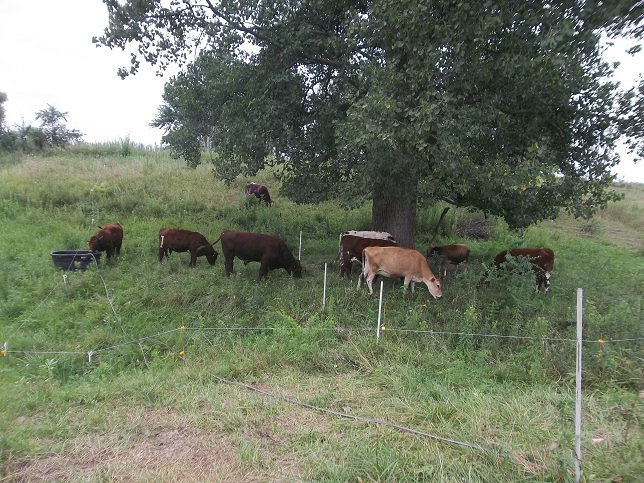
Low Maintenance Requirements:
I just touched on this but if she is fertile and long-lasting she obviously doesn’t demand much from me.  I need thrifty cows.  Because much of my forage base is fescue, I’m looking for short, barrel-shaped, light-weight cows.  Hall said 70% of a cow’s feed is used to maintain condition.  A 1,700 pound cow has to eat much more feed to maintain condition than does a 1,000 pound cow.  There are only so many hours in a day.  How many pounds of forage can a cow ingest and ruminate on each day?  To be direct, a heifer that is weaned above 600 pounds won’t last.  The cards are stacked against the big cow in a forage-based operation.  111 stays fat no matter what.  Notice how wide her mouth…it’s as wide as her eyes.  Maybe wider.

111

So where do you find these cows?
I wish I knew.  You need to pick a bull based on his mother and her production numbers.  How many calves has she thrown.  How big were the calves?  How big is the mother?  How old is she?  When looking for heifers from within our herd or when buying outside, look for calves that weaned below 500 pounds.  We’re looking for a 4-5 frame score.  Again, big cows have to eat more to maintain condition.  Small cows are hard to market.  I could probably run 2-3 Dexter cows per acre on my farm but what feedlot wants to finish out Dexters?  I have to find the middle ground between what the market demands and what is profitable to produce.  They can’t be too big, they can’t be too small.  Hall says to sell the extremes.  Hall also pointed out that crossbred cattle tend to have better longevity.  That’s something to consider when buying stock.

Over time there are things you are watching for in your herd.  Cows should be feminine but we’re looking for function, not beauty.  A cow with a rough hair coat should find work elsewhere (I have a couple of these).  A cow with bad feet or a bad udder should go down the road.  Too big or too small?  No calf this year?  Poor attitude?  Prolapse?  Down the road.

This kind of selection doesn’t require much of the manager.  It comes back to the three O’s (which are really two O’s); Old, Open or Ornery.  The old cow will eventually come up open, weather from loss of teeth, bad joints or whatever.  The selection process is hard on herd numbers early on but success breeds success…literally.  In a few years…decades maybe – a picture of our cows will feature less leg than this one both from change in genetics and prenatal response to conditions and management.  Really.

GroupPhoto

In part 3 we’ll go a little more in-depth on ideas David has for making the operation profitable and ways to smooth out the highs and lows of the cattle market.