Now Presenting…The Future!

Some of this post is just snippets of discussions that happen around the dinner table…or around the chicken evisceration table. Some of this post is stuff we have formally written out. Most of it hasn’t been spoken of outside of our immediate family. All of it has been prayed over…and hard. Just as I focused on budgeting a few months ago as we prepared to buy the rest of the farm, I am focusing on multi-generational farming now as I’m realizing how big my kids have gotten. If this isn’t your bag I hope you enjoy the pictures. You’ll probably get more posts like this now that Fields of Farmers has arrived in the mail.

Our 11 year old daughter asked me, “Dad, in 50 years when I have lots and lots of children…will you still come out here to help us process chickens?”

Well, I hope I will still be useful when I’m 87…and you are still helping with chickens when you are 61…but I suspect you will hand it to the next generation before then. But, yes, I would like to be out there with my great-grandchildren telling the same stupid jokes.

That’s not what she meant to say. She meant to ask if I would still be out there when I was 50. Bear with her, she was cutting feet and oil glands off of chickens at a rapid pace.
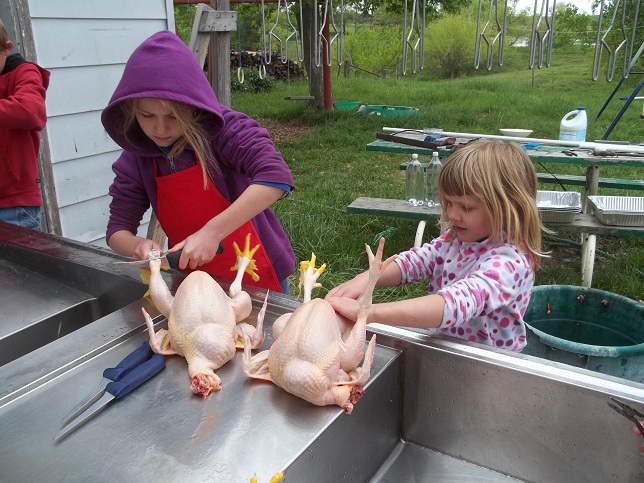
Girls

Oh. Well. 13 years from now is much more visible than 50 years from now. Still uncertain but much closer. Yeah. I expect I’ll still be butchering chickens when I’m 50. Will she still be here when she’s 24? What will she be doing? Will she be married? Kids? Will she choose to make her home here? Will she work here?

How can I express my vision of a preferred future without imposing my will on her life? It’s tricky. If you’ll allow, I’ll tell you what we see through the fog and try to do so in a way that doesn’t enslave our children. I have no idea what is really ahead of us but I do have direction. Let’s look that direction together.

5,000 cows.

I know, right? That number has been with me for a long time. I read Julius Ruechel’s book years ago and he suggested that cattle don’t really act like a “mob” until you have 500 head in one group. Then I read about Ian Mitchel-Innes having 6,000 cows in one group, introducing 400 bulls each summer!

How do I get there? It starts where I am. Then it grows. Ultimately I would need to lease around 5,000 acres of good ground. I also need to breed a nativized or adapted herd of cattle that are fertile, can produce with few inputs and, really, don’t ask for much from me. But you know from my posts about budgeting that cattle alone won’t pay the bills. They are a great way to cycle nutrients through the farm but I’ll need an employee (or child or grandchild) for each 1,000 head of cattle. We’ll eat well but will we be profitable? Selling 10 steers/year is doable. Selling 2,500 steers/year as direct retail freezer beef? At some point (I’ll suggest around 150 cows) we transition to commodity production or depend on selling wholesale. It may require a dedicated salesperson. (Do I have enough children?)

But that’s just the beginning. We’re taking the long-term view here. 5,000 cows requires 5,000 acres in Illinois…more elsewhere. That’s a big area on a map. Not as big as some of the ranches in Texas and Oklahoma but big in Illinois terms. I am necessarily counting on a fall in land prices and lease prices (brought on by an increase in interest rates, crushing and cleansing the economy) to make land available for low-cost producers (like me). Can you imagine converting corn ground that sits tilled, empty and idle for 7 months each year into a year-round carbon-sequestering, sunlight-catching, cow-fattening meadow filled with songbirds, bugs and spiders? Rather than produce a mere 200 bushels of corn we could produce 30 tons of hay…but we won’t cut hay. We’ll just let the cow do the work. Grass with roots 15′ deep. Rows of trees planted on contour. Ponds snuggled into every valley…every hollow hydrating the landscape, preventing flooding downstream, Trees, grass and swales working to prevent agricultural runoff…can you imagine enough farmers getting this idea for the the muddy Mississippi to run clear? I can.

Grazing

But we haven’t started yet! I mean, if we’re talking about 5,000 acres and if each of my 4 kids has 4 kids of their own…we’re going to need more than just beef cattle to keep us all busy and fed. What about dairy? A grass-based dairy herd has to have time to eat each day. You really can’t grow a dairy above 200 head because every step the cow takes to the milking parlor is time the cow is not grazing forage or laying on the hill chewing its cud. Could you grow bigger by building a milking parlor every 200-300 acres so we can milk larger numbers of animals at each milking…rotating through the larger farm over time? Could the farm’s beef cattle prepare better pastures over time for a dairy herd? Could the dairy herd lead the way through the pastures allowing the beef herd to follow and clean up what is left over? Or should I build a herd of thrifty dual-purpose cows? Maybe move South and buy a herd of criollo cows and select for milk production.

But what about pigs? What about chickens? What about lumber? What about a machine shop? What about a hotel? What about an interstellar launch pad? What about ideas my children will generate that I can’t even imagine yet! I don’t know. Each of the things we currently do are small-scale. I can see that any of them will grow beyond what I can handle alone. As these things grow I’ll need my kids to step up and take on a larger portion of it…to continue to grow the operation. The 5,000 cow herd example above is a good illustration of that. Starting with 10 cows today I would be (according to my spreadsheet) 63 before we hit 5,000 cows (bringing in a gross income of something close to $1 million at today’s prices). Moving cows between pastures is not full time work, sorting and working 5,000 cows is more than one man can handle alone. Anyone involved in the farm is going to have to wear multiple hats to be busy full-time. There just have to be enough hats.

But that’s all micro. Let’s go macro.

Does Illinois even want me to be here? Is it in my best interest to ONLY have cattle in one place where one tornado can wipe it all out? …or one new state tax policy (in a state where the pension is only 49% funded (if you are really optimistic about future returns))!

So what do we do? I work in Florida a lot. Can I lease ground in Florida? Yup. That plants our flag in another state. But should we diversify internationally? Wow. I could see a real argument for that. Can I still learn Spanish?

Julie has a long, written story of waking up early one morning with her granddaughter patting her on the face. Three of our children and their families are at home in Chesterfield helping us to wrap up our seasonal work at this farm as we leave it in the farm manager’s hands and the rest of us join the fourth child at the ranch in Chile. Our parents, our kids, their kids all go with us. She wrote this as part of a business class the is taking through a coach. In short, the exercise was to imagine where you hope to be in the near future. Believe it or not, that 60 acre farm with 50 or so cows is attainable even if you are of modest means (as we are). The exercise forced her to imagine, not the trip from A to B, but the trip from A to C. If you’re going to C, you’ll pass B along the way…and keep going. Our immediate goal is to grow our farm to the point that it provides our family’s primary income with my parents in partnership. To stretch that, we hope our kids can earn their income here. To stretch that we may look for multiple locations. To stretch that, we may say goodbye to winters by living in the Southern Hemisphere half of the year. But it all starts here. Feet on the ground…covered in manure…building fence at night…wearing a head lamp in the cold rain.

Tomorrow may be out of reach today…but I’m reaching for it anyway. What are you reaching for?

If it helps, Julie and I sit down together at the first of each year and write down specific and measurable goals. We keep that list in front of us every day to help us stay focused. A new year starts in just under two months. You might start working on your list.
Grazing the Whole Hill

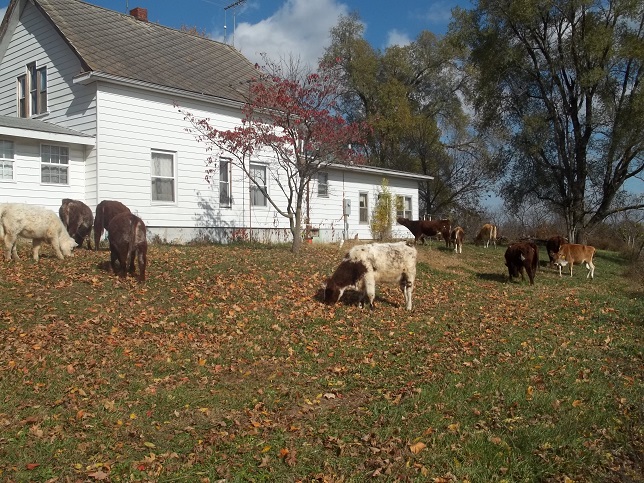
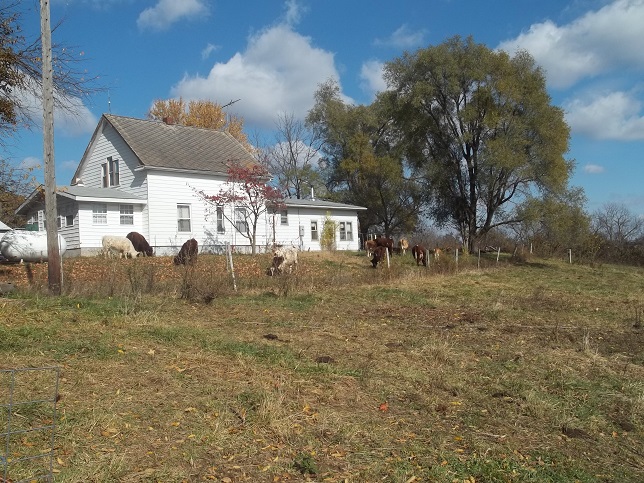
It is important to us that we do things that cause our neighbors to crane their necks as they drive slowly past. Yes, the cows are in the yard. As the world works today, If people don’t think we are weird then we are doing something wrong. I don’t want to be normal in a world of chemical agriculture and chemical lawn maintenance.

MowingInNovemberI had to give a very large area to the cows because the grass was short. The girls are also doing a good job of smoothing out some rough places left over from some trenching that we had done in the spring.

TheWholeHillWe have grazed the slope in three sections from bottom to top. I prefer to start at the bottom so rain doesn’t wash manure onto upcoming forage. We just follow the keylines around the farm as much as possible. The fence pictured above does not follow the keyline so we just have to work with what we’ve got.

The fun part was when I lit the fire this morning in the back room. I heard a weird noise…like a burp or something…and looked to my right. Ms. White was looking in the window at me. Kinda funny. Ever have a cow looking in your window? Maybe you had to be there.

Today’s Wood Pile

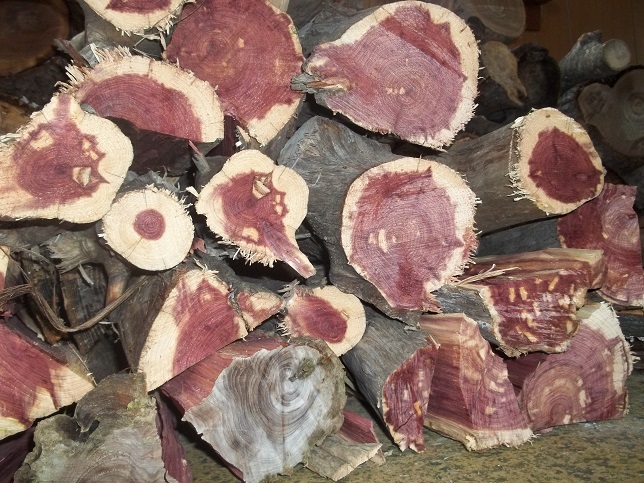
I emptied the cemetery hill of dead standing trees and snags this year bringing down an elm, a couple of oaks, a walnut or two and a juniper tree. Ah, juniper. I limbed out the juniper and carried the pole home on my shoulder…didn’t cut it until today. Oh the smell!

JuniperIt splits well, burns quick and clean but doesn’t really get hot. Perfect for a mild fall day…when I’m feeling lazy…and just want to take a nap by the fire. There is not a lot of juniper on the farm. One tree is big enough to saw, the others are small and are routinely shredded by deer and cattle. This one is a treat. Isn’t it pretty?


Fall Plans, Winter Problems

Fall came a little late but it’s here in force now. We just had four nights in a row of below-freezing temperatures. Now we have to be in the habit of disconnecting our hoses at night and laying them on a slope to drain. An extra chore. Rain is just about to set in so we’ll be up to our knees in mud before long.

This fall cold snap probably won’t last. We have seen 90 degree days in November before. But it’s a reminder of what is coming…and soon. The next few nights will kill the alfalfa and clover as well as the summer grasses. The leaves will begin to fall in earnest.

fallgrazing2

We have already slowed the cows down, asking them to crop the grass very close on the South-facing slopes. I expect these slopes will have time to put on another 8 inches of grass before the fescue really goes dormant in December but, for now, I want to put down a lot of hooves, mouths and manure in tight pastures…even if we move several times/day. That late fall regrowth will be just what the doctor ordered in April when we are looking for a little pasture to graze. The fescue should come through winter in good shape.

fallgrazing

I plan to feed a little hay while we are on this North-facing slope. Roots are shallow here and the plants have a hard time in the blazing sun of July and August. They have fully recovered since the last grazing but the plant population is lower than we would like and, again, root systems are shallow. We are relying on hooves to push waste hay and manure into the soil surface, disturbing the soil and making a nice bed for seed germination as weather allows…possibly in the spring. The hay idea comes from my talks with David Hall. He said he fed 30 days worth of hay across 5 months to make the hay and pasture stretch. We are sort of starting that now…at least, right here where the pasture is poor. Grazing in tight areas, moving daily, feeding a little hay in the morning…about 1/10th of the dry matter a cow would otherwise need.

That all sounds nice. We have a plan. But it is not without its problems. Shorter days, colder weather, hose management, extra bedding for pigs…nothing life-altering but many small extra chores with fewer hours of daylight causing problems.

Putting Compost to Work

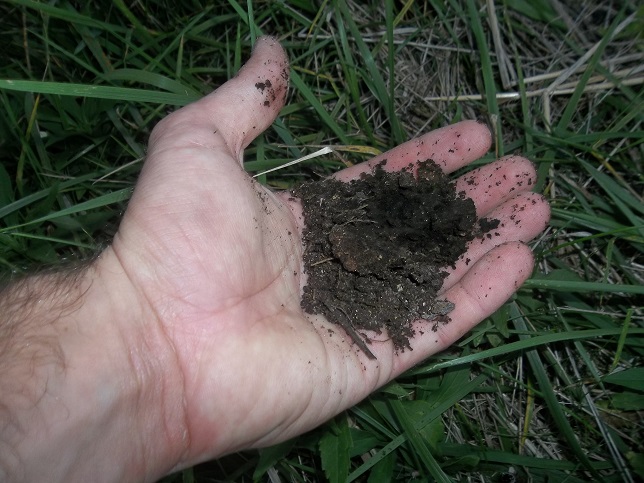
We spread our compost on the winter stockpiled pasture a few weeks ago (Sep. 9th). The compost pile was the end result of offal from 1,200 chickens, 3 pigs and a goat along with a year’s worth of humanure and kitchen and garden waste. That pile was built over the course of a year then aged for another year. At the end of that time my eldest son and I shoveled it into the manure spreader sifting out bits of trash (string, bag tops, wire and one pig skull) then I spread it on the fall stockpiled pasture. We spread the compost to help boost fall fescue growth as well as to help innoculate the soil.

Isn’t it interesting that the first step toward building healthy soil is to increase the soil bacteria? Kinda makes one rethink using anti-bacterial soap. Compost The compost spread in a thin layer across a couple of acres. If things go as planned, I’ll get the pigs moved and I’ll spread another layer from that cow/pig bedding on the field as well. Not only will it give the stockpile an extra kick of growth, it will help the stockpile tolerate the cold weather. This practice was emphasized in several books including Salatin’s $alad Bar Beef but also by Stacey last year on her blog. Thanks for the reminder Stacey!

Planting Seeds in Children’s Minds

This is the third in a series about how we are home schooling and preparing our children for their futures…the future of the farm. Sustainability is the real issue. If you are just joining us, go back and read parts one and two. I have worked to condense this post down to bare bones but I could go on and on. Forgive me if some of my transitions are …less than smooth.

We, as parents, plant seeds on a daily basis. Some of it is intentional, some of it just scatters about. Genuine comments like “Wow! that’s a great drawing!” or “I really appreciate your help” mean a lot to us as humans and, if you were uncertain, children are humans. Those comments are nurturing but they aren’t seeds. The gift of paper and pencil are the seeds. The opportunity to pitch in where needed is a seed. Comments help that seed to grow or cause it to wither.

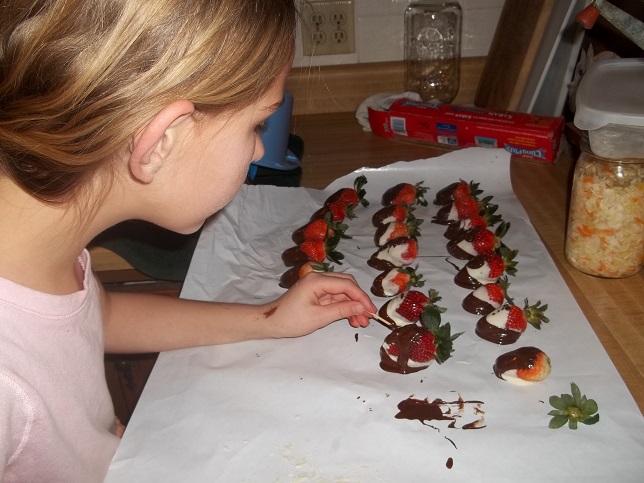
Strawberries

Have you ever heard that little voice in your head attempting to defeat you? Let me open up briefly and tell you what I hear on my worst days. I am a worthless, ignorant, arrogant, selfish and generally bad man…hardly a man at all. I talk too much. People don’t really like me, they tolerate me. I just get in the way. All of my ideas are ridiculous. I’m too skinny, too weak, too tall, too short, too ugly, too hairy. Julie made a mistake marrying me. I’m a lousy father. I’m terrible at my job and I’m just faking my way through my career. Somebody is going to find out…and soon. This (whatever crazy idea) will never work. My cows are not getting what they need because I lack the skill to manage grazing correctly. The list goes on but that’s enough.

Is any of that true? I don’t know…probably some of it to some degree. But those thoughts and others like them are on a near-constant loop in my head on rainy days. I’m not seeking a therapy session. I’m seeking real-life examples. Those are weed seeds. And I am not alone in having a mind littered with weed seeds trying to take root. You hear the voices too. My children hear the voices too.

I have to fight that. I can’t let the weed seeds take root in my children’s minds. I have to reinforce to my children that they are good enough. …that they are not an accident. …that their mother and I love them, cherish them and do not regret having them. …that they can make a difference. My children have purpose. They can work to fulfill that purpose and positively impact the world around them…and for generations to come.

To have this opportunity we, as parents, have to work to build personal, intimate, ongoing relationships with our children. With that foundation in place, we can begin to scatter seeds of our own…nurturing those seeds and working to out-compete the weeds.

HayWagon

But there is a tendency to plant weeds of our own. To scatter seeds that work against our children. Have you ever heard or said any of these gems?

“You should go to college because you are too smart to be a farmer.”

“There’s no future here. You’ll never make any money.”

“If you don’t go to college you will never succeed in life.”

“You can’t do that because it would take a lot of money (and you’ll never have any money (cause we don’t have any money (and my ego can’t stand the thought of you succeeding where I have failed))).”

“This country is going to Hell and there’s nothing we can do about it! It’s all the blue team’s fault (or the red team…both the same really). THOSE people have taken away your whole future! We are helpless.”

Don’t send your kids away. Don’t tell them there is no hope. Don’t teach them to be victims. Don’t seed discouragement.

This isn’t a post telling you to boost your child’s self-esteem. That’s a false god. A whole generation of kids who have accomplished nothing believing they can do anything! That lasts until reality strikes. Then they turn to Pfizer for help.

There is a school of thought that we should fill our homes with tools, not toys. Give our children opportunities not entertainment. Those opportunities are the seeds we are looking for. It’s not enough to believe you can. You have to do it. Book learnin’ and believin’ won’t cut it. You have to do it. Kids have to do it. What are your kids interested in? What do they want to do? What chances have they had to really try something? …to really fail at something? …to learn that failure is a beginning? We have tools, stacks of lumber, musical instruments, paper, pencils, crayons, markers, scissors, glue, computers, books on beginning programming, books, books and more books! Pallets for club houses, old tarps for roof tops, messes everywhere! Adventure everywhere! There are rabbits to raise, chicks to play with, chickens to dress, fencing to build, hay to stack, hay to play on, veggies to plant, weed and pick, cows to move and water…all of these are jobs the kids can help with. Look at the opportunities!

We scatter these opportunities in front of our kids hoping they will pick something up. When something sparks their interest we, the parents, have to be attentive and ready to run. An interested learner will consume massive amounts of information in a short period of time. As a mentor you’ll have your hands full trying to keep up…stay ahead…anticipate which direction the learner will go next. That anticipation requires an intimate understanding between learner and mentor.

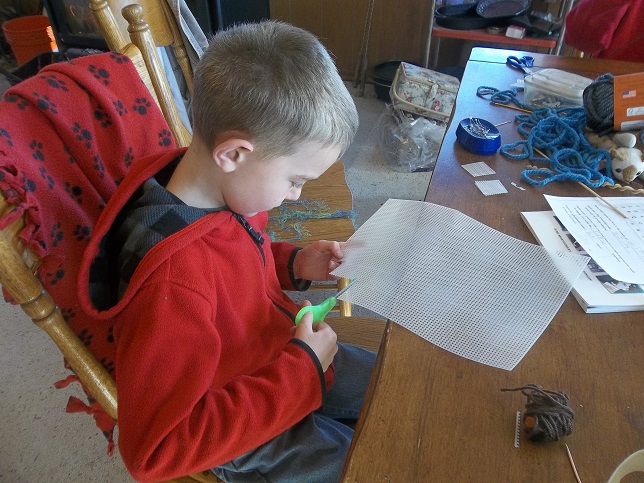
Crafts

There are certainly phases of learning where we are just dumping information in front of the children. Phases where nobody is particularly motivated to chase down a specific curiosity. At those times we read aloud, play together or just hang out. I am always surprised how things work out. In a recent rut I borrowed a video game from a friend. That led to pages and pages of artwork and stories about favorite characters by our youngest two. You never know what will allow the opportunity for encouragement and growth.

And those opportunities can grow. Each of the kids has a preferred set of chores. Daughter #1 has her own chickens. She just muscled in and pushed me out of the way. Now she takes care of them. That’s GREAT! That’s what we are after! And each of the kids know that there is a place for them here. That they can succeed here. That I’m laying a simple foundation for all of us to build on. “You can expand the pig operation, you can expand the cattle. You can grow and sell cut flowers. You can supply nurseries with stock. I’ll clean the toilets!” All of these businesses help each other, build on each other and share and expand the customer base. We are planting those seeds now! There is no reason to wait until the kids are 18 to say, “you know…you and your husband could just live right here with us.” By that time our kids will have defined themselves. It may never have occurred to them that we want them here. We say it now. Maybe my oldest will grow up to be an astronaut…or the manager at a Starbucks…or, worse, the president. He may not want to live here. We all have to make our own choices in life. But I’m giving him the opportunity…and I’m giving it now. We will nurture that seed as it grows…even if it doesn’t sprout for 50 years.

That’s how we believe we can achieve sustainability. To get there we have to separate cheap comments like “Good job, Billy” from nurturing comments like “Billy, you did your very best and I’m impressed. I think you have a real talent for …” Nurturing comments are like a ray of sunshine or a cool drink of water. But you can only nurture seeds…seeds you have to plant. We also have to be careful and purposeful about what seeds we plant. What seeds are you planting in your children’s minds?

Next time I’ll share how we attempt to get out of the way of our children’s successes.

Preparing Fertile Ground

This is the second in a quick series about farm sustainability…sustainability gained by preparing the next generation.

I can’t do this forever. I could work for decades but not forever. Also, I can’t do this alone. I could try but without some level of redundancy something is going to fail eventually. So the first step (following the example of all previous generations who made me) was to find a suitable companion and carry on the family tradition. Not only can my wife fill in when I am unavailable but we have kidlets that are coming along as well. Those kidlets are the future of the farm. They are the key to our farm’s sustainability plan. I won’t last forever and I can’t do this alone so we are manufacturing our replacements. And they have to be willing participants in the manufacturing process. If they don’t want the job we have to find someone who does or the farm goes away.

With that in mind I want to talk briefly about what we feel is the first step in training our children: Preparing fertile ground.

This is easy in the garden. Build up soil humus and add nutrients…same as saying to invest time bringing your soil to life. How is this different from the human mind? We have to bring our minds to life. Maybe this doesn’t seem as straightforward as a wheelbarrow of composted horse manure. Maybe that’s because we haven’t bothered to learn what children need. Wow. That’s a disturbing thought…that we have more innate, cultural knowledge of soil health than we have of mental health. [Shiver] Have to think on that a bit.

Kids

Our four children may look the same but that’s where the similarities end. Each have their own interests, abilities, dreams and desires. Pushing each child to follow a set pattern of educational development in a one-size-fits-all approach would probably lead to universal failure. I suppose we could medicate and attempt to retrain where the kids don’t fit but that seems inappropriate and cruel. What seems better, at least for us, is to allow the children to direct the learning process. To discover where each child is in the lifelong process of learning and to encourage them to continue. This discovery process requires more of us as parents but…I mean…we didn’t have kids thinking it would be a vacation. Our children are an investment.

I have to make a conscious effort to engage my children in conversation and to pay attention to them as we interact on a daily basis. What does my oldest daughter enjoy? What motivates her? What is her love language? How can I meet her needs personally and, later, in terms of education? Before I can help my daughter to learn she has to trust and respect me and I have to learn who she is. She really doesn’t want to learn the ins and outs of my profession. That’s not her bag. Before she will trust and respect me I have to make an interpersonal connection with her. It’s not enough that I simply claim her as my daughter. It is not enough that I feed and clothe her. I have to be someone she trusts. Someone she loves. Someone she respects.

If I can earn her love, trust and respect I can begin finding out who is really in there. Once I know who she is we can begin to guide her development. If I don’t know her, I can only force her onto a path of my own design…one she may not be excited to follow.

I am quite vocal about my generation’s tendency to take our children to karate, soccer, swimming, scouts, awana, dance, baseball and gymnastics. Nobody has time to even cook, let alone interact, with a schedule like that. Your children will interact with others while you watch…but that’s not what we’re after! Add in homework and football games and PTO and Bible studies…any of these things, taken individually, could help you build intimacy with one or more of your children. But these activities are more commonly used as a daily distraction to “keep the kids busy and out of trouble”. You know, because having kids is such a burden. Isn’t that what you are telling them? “Oh, what a long day at work. Now get your cleats we have to get to the field! I guess we’ll just have to stop for pizza again. I don’t know how we can afford to continue doing this but we’re doing it for you. Get out on that field with your little friends and I’ll go talk to the parents over here. Maybe you and I can talk on Sunday…after church…after the football game…after evening services…before bedtime.” That schedule does not lead to intimacy…it does not build fertile ground. It probably boosts sales of anti-depressants though.

Finding the fertile ground in our children is a matter of taking the time to learn who they are. Investing that time now gives us the chance to plant seeds of opportunity later. This has nothing to do with deciding what cool new curriculum we are using this year. Fertile ground is about relationships. Why would you want to live with someone who doesn’t want to know you? Maybe that’s why kids grow up and leave home.

To be sustainable I need my kids to grow up and stick around. I need fertile ground to plant seeds into. I have to make an emotional investment in my children. Some of that has to do with sticking around on the farm but mostly, it’s about making deliberate choices to be engaged in my children’s lives. I could probably succeed at engaging my children at a soccer game but I fear soccer is mostly a distraction separating us from them. Be engaged.

Next time we’ll talk about planting seeds…you know, discovering interests, passion and purpose in the lives of our children…and in ourselves.

Farming, Home School…What’s the Difference?

We scatter seeds. It is all about planting now and reaping later in our pastures and in our personal lives.

TractorDriver

Here’s the main idea of our home schooling: We get the kids interested in something. When they show interest we run together. Curriculum doesn’t matter. Nobody gets up in the morning and throws a fit about doing a math lesson. We do what we are excited about…and usually math comes along for the ride. I mean, you can’t price the chickens without doing a little math…so it just happens. We certainly have a nice collection of math curricula (like Life of Fred) but the curriculum isn’t as important as the appreciation. You with me?

You may not care about our home schooling philosophy but, believe it or not, this is a post about farm sustainability.

I can’t force my kids to learn to do math. We learned that the hard way. We just work it in to our daily interactions. We count the dots on legos (Hand me a 10×2 flat blue) or estimate the acorns on a branch, estimate the branches on a tree and multiply it out. If I print out a math page and park them at the table inside on a sunny day we’ll have a problem. Similarly, we also can’t force a pig to load up in a trailer when it is out in a pasture. If I try to force the pig to do something…anything…the pig will put its head down and dig in its heels. Pigs are always asking, “What’s in it for me?”

My kids ask the same question. We all do. “What’s in it for me?”

I have to make sure everybody wins. If everybody wins, everybody has fun. If everybody has fun, life is easy. Salatin doesn’t force pigs to aerate his compost. He incentivises them to aerate his compost by burying corn ahead of time.  Pigs get fat, bedding gets composted, everybody wins. This is certainly applicable in farming but only to a point. Let’s stop talking about pigs and focus on the kids. Farming is more sustainable because of pigs. Farming is ONLY sustainable because of future generations. But I can’t force them to farm. I can only scatter seeds hoping they fall on fertile ground. Further, I have to let the seeds grow. I am 24 years older than my oldest child. If I wait until I’m 84 to give him control of the farm he’ll be 60. Will he want to control the farm then or just retire? His oldest could be 36 (YIKES!). Will they want the farm? Their oldest kid could be 12 (DOUBLE YIKES!). I have to make room for the seed to grow. Who are we planting seeds in…and for what purpose? And I can’t just plant the seed, I have to nurture it and reap the harvest. I am sowing seeds of success…purpose…vision into my children. I don’t anticipate being in charge of anything around here in 10-15 years. My goal is to become superfluous. I’ll be the janitor. It will be awesome! But for that to happen I have to plant the seeds now. As our children grow they will begin to search for purpose. Our children’s purposes can all be here. All I have to do is prepare, plant, nurture and get out of the way.

I plan to expand on this thinking a little bit in future posts. I hope you’ll stick around and share any thoughts you have with us.

Rome Wasn’t Built in a Day

I used to carry my production schedule everywhere I went. It contained customer contact information, order dates, frost dates, birthdays, notes about President Cleveland…everything. Inside the front cover is a note to myself saying “There is no get rich quick in farming!”

RichFarming

I needed that reminder. Everything moves slowly. Things take time.

Our pastures are lacking in plant diversity, minerals, humus and just biological life. We have cow paths across all pastures with compacted soils beneath, from years of open pastures. The cow paths only turn where a thorny tree blocks their progress. Given the option, the cow will walk a half mile for a bite of sweet grass…always taking the same path. That sweet grass is slowly selected against because the root system never grows out, the grass is not allowed to go to seed, the plant fails to tiller properly…the cows just love it to death over time. Then the cows lounge under the same grove of trees each day compacting the soil under the tree (killing hardwoods) and concentrating nutrients gathered from the entire pasture in one spot. This happened over time. You can’t fix it immediately. It is a slow process.

Our cows are no longer genetically adapted for grazing only. They are built to eat grain so they can wean heavy calves…no matter the cost. This didn’t happen overnight. For years we (cattlemen) kept back the biggest heifers. Then we kept their biggest heifers. Then we fed a little grain to get those heifers fat enough to breed. Then a little more grain. The genetic makeup of the herd doesn’t make an immediate return to grass possible. It has to happen over time.

I dare you to go out and pay cash for a half-million dollar farm. You can do it…eventually. But if you are like me, it will require a lifetime of production and savings and frugality to pile up the cash a little at a time. Just like building fertility in my soil. Just like returning my herd to grass. Just like everything else. There are no real shortcuts. It takes time to heal…to grow.

I was thinking of this today when I decided to write my wife a letter. Like everything else, my relationship with my wife requires consistent investment spread over years. She doesn’t need a daily list of chores from me (well, she does) she needs reminders that we are partners in this, that the dream we are living is ours (not mine)…that I believe in her and that I will always love her. There is no get rich quick in farming. You can’t make up for years of neglect with one afternoon’s worth of work. This is even more true with loved-ones.

Julie,

I am very proud of you. It seems like I never find the time to say it though. You are a great friend to me, a wonderful mother and a fine cook. You are beautiful, strong, healthy and intelligent. None of these attributes came after a reading a how-to book or by changing your habits for a week. You have made small changes over time and have stuck with it making a big difference in many areas of our life. Let’s look at a few examples.

You have never had a problem with your weight but last year you started making a few changes…changes I resisted. You stopped baking bread and started drinking lemon water. Lemon water! You made many small adjustments to our diet…so many and so small I don’t even remember what they were. Over time I couldn’t help but notice that your shape changed…in a way that I liked. This isn’t because you started some fad diet or some intense workout regiment…except for the 21-day sugar detox. It is the result of small choices over time.

We home school our children. This started out simply, teach them to read and cipher and the rest will take care of itself. Over time that has changed. We have added complexity and, later, simplified again…over and over. But always with small changes. Nothing drastic. We just stick to it, working through the problems that come up, taking them on one at a time.

On the farm it is much the same. We started raising a few birds for ourselves and a few extra to sell. We initially bought 24 layers not knowing what we were doing but thinking that was starting small. Then we got Olive for milk. Later, we got 3 pigs…then 8 pigs. Then cows. Then the farm. Then more farm. Always moving toward a specific goal, always moving slowly, growing organically. No huge leaps, no big changes…just small tweaks. We try something, evaluate the results and make additional small changes. Together.

Now you are starting a new business selling (FDA says I can’t say the vendor’s name) oils. Again, this is a methodical process. Learn the products, attend classes, teach classes, attract interest…rinse and repeat. Over time your knowledge of product, of business, of clients increases. Over time your revenue builds until, at some point in the future, your income will replace mine.

None of these are 30-day cures. These are major shifts brought about by a series of small decisions over time. We both know I am resistant to change and, at times, have been less than supportive but I see where things are going and I believe in you. I know you will succeed. I am with you.

So tomorrow morning when you continue your newest practices (listing the 6 most important tasks for the day and yoga) know that I am proud that you are my wife. No matter how I react to the small change du jour, I am behind you 100%. I am with you and I am supporting you. I love you.

Broilers in the Late Fall?

I got an email from a friend asking about getting started with broilers. In summary, the local pastured chicken producers are planning to retire leaving a hole in the market and she is anxious to begin. I edited the email below slightly.

The “chicken people” at the local farmer’s market are throwing in the towel. They’re in their 70’s and are ready for retirement. As a result, there is no one selling chicken or eggs. When we asked them if they had eggs last weekend, they wanted to know if we were on the waiting list. And at the closest FM, the vendor sells out in 3 days after processing.

[My farmer] reminds me that there is a huge hole in the FM since there’s no one selling chicken. I remind him that we’re six months or so from being able to get some land. He goes on to say that we could do it at his farm. I come back with “but it’s 7 days/week and we work” and he responds with “if you buy the feed I’d be happy to move them and feed them when you can’t get out here”. The lady in front of me responds with “I’d be your first customer and if you raised turkeys I’d LOVE you”.

[Husband reminds her that they] don’t have a lot of time as it is and we would have to drive about 25 minutes each way to tend to the birds. We both work…

My thoughts are that we could raise the broilers here for 3 weeks and then move them out to the farm for the next 5 until they’re ready for processing. They could follow his cows on pasture. A win-win for them and us.

Potential problems:

1. We live in suburbia with crazy predator pressure…the raccoons visit the trash can every night and are not afraid of us. Perhaps electronet would be enough?

2. He does not have a LGD so again, there’s the predator issue. Electronet again?

3. The drive. That’s 2 gallons of gas every time we go out to move/feed the birds. About $7/visit

4. Profit. Based on your numbers and Joel’s book, it looks like we could make about $5/bird.

5. Processing equipment. I’ve checked Craigslist and other local sites to see if anyone is renting out their equipment and no luck so far. I wouldn’t consider purchasing it for this potential venture.

6. The split. I have no idea what [the farmer] would want out of this. Who knows…he may not want anything at all but even if he didn’t, that just doesn’t seem fair. What would be a fair compensation? Part of his real estate taxes? “Free” chicken? A monthly rent?

I can’t wait to hear your thoughts!

Well, my first thought is that you sent this on October 5th. That means IF you can get chickens today you’re looking at a slaughter date on or after December 1st. Because day length gets so short and chickens go to bed early, your slaughter date will necessarily be after…like December 15th. I don’t know where you are but I don’t like butchering chickens in the cold. Where we are November and December can be cold, dark and rainy months…not the weather we want to tend to chickens in. Plus, you will be depositing a large quantity of manure on pasture that is going dormant in the cold…potentially leaving the ground without a blanket over the winter.

From there, let’s go through your questions one at a time.

1. Predator pressure in town.
You are right to be concerned. I’m always amazed at how many raccoons I see when I visit Sarasota, FL. Based on what I have seen, most major cities have similar problems. Add in little yippie neighbor dogs and stray cats and your little chicks are in for a rough time. That doesn’t make it impossible though. Electronet will add significant peace of mind if you keep it working daily but they don’t exactly give the stuff away. I have seen cats learn to jump right through the netting which leads me to believe skunks can do the same. You will have to be creative about dealing with predators as you are unlikely to impact the population level by trapping a few animals…just open up some territory.

2. Livestock Guard Dog
Yup…Electronet. To be specific I would go with single-spike PermaNet and plan to support the corners in wet weather. Again, this only goes so far. If your farmer will be moving the chicken tractor you’ll need to buy enough fence that he won’t have to move it too. Otherwise, your labor costs will eat you alive.

3. The Drive
Oh, golly! 25 minutes? No way. Deal breaker. Ain’t happenin’. If for no other reason just because of short days. You want to go visit your birdies after work? It will be dark.

4. Profit
Well, I don’t know what you are selling the birds for but if you spend $7 to drive out there a couple of times each week and pay a worker to move, feed and water the birds…not sure there is anything left over. Charge what you have to.

5. Processing Equipment
Really, this depends on how many birds you’re talking about. For 25 birds you just need a stock pot and a couple of sharp knifes. You could manage 250 birds with the same equipment but a Whizbang plucker starts looking pretty good as you move up from there.

6. The Split
This one is tough. I always calculate 3 minutes per chicken tractor per day not counting time spent walking to the field. That’s just filling water, feed and moving the birds. 3 minutes per day for 35 days spread across 60 birds in each tractor. You can calculate what you are willing to pay him based on the difference between your feed, chick, housing and fencing costs and your sale price. It might be better to contract with him…offer him $X for delivering Y birds at Z average slaughter weight on December 7th with a bonus for numbers or weights above those margins. Then you are hands-free, essentially buying a live bird, butchering it and doing the marketing. No 25 minute drive.

What I would strongly consider:
I wouldn’t want to put broilers out in the field this late in the year. It’s just too hard on the turf. If I were you I would consider raising 25 birds in a chicken tractor over a garden bed this year. Just leave the chicken tractor in one spot and add straw or wood chips regularly to “uppen the soil” as Andy Lee detailed in the book Chicken Tractor. You will want to protect the birds in your yard from predation but this would allow you to manage your birds on a daily basis, gaining your degree in Advanced Broiler Management along the way. You’ll have a freezer full of meat for your family, a few to sell or give to loved-ones and the foundation you need to start strong when you really launch your business in the spring.

Those are my thoughts. Hopefully other readers will chime in. Again, since you haven’t raised broilers previously, I would rather see you invest in portable infrastructure and keep a few birds at home then really launch when you move in the spring. Since it’s already fall you really shouldn’t be out on pasture.