Chicken vs. Beef II: Grudge Match

In a recent post I discussed seeking increased efficiency of production. This led to a long talk with my dad (a good thing). Among the points he wanted to discuss was efficiency of feed conversion of chickens compared to cattle. There are some interesting components to this discussion and some confusing data out there on the Google. If you want to discuss which animal can convert corn most efficiently chickens win compared to cattle. Hands down. If you want to discuss which converts grass most efficiently…well, chickens don’t stand a chance. And that’s important because most of the information you will find includes data on corn poured through feedlot cattle.

If we just narrow the scope to say, “Which animal grows the most pounds of meat per acre?” Well, the answer is chickens. Well, the answer is sort of chickens. Maybe. But it may depend on how you define “per acre” and how much work you want to do to enable that production.

According to Joel Salatin, and from what we have observed, we can sustainably raise 500 broilers per acre per year during the growing season where we live. That’s about the limit of the soil’s ability to metabolize the manure. But that’s not how much ground I need to raise those 500 broilers. I also need half an acre of corn ground, an acre of bean ground and about a third of an acre of oats, along with fish meal, kelp and soft rock phosphate. Let’s just go with 3 acres per 500 chickens resulting in 2,000 pounds of dressed meat or 650-ish pounds per acre. I did similar math for pigs a few years ago. In fact, that post addresses a number of issues I’m going to tackle again today and again tomorrow. ’cause it’s my blog. And I want to. Let me point out, though, that the chickens are not harvesting their own feed in this model.

SO I can sustainably raise 650-ish pounds of chicken on an acre in around 6-8 weeks. Compare that to grass-fed cattle. I need 22-30 months to raise a calf from birth to finished weight. Let’s just say 2 years. In my part of the world (where we grow a state average of 155  bu corn) I can raise one cow per acre. (I think we can push for 1.5 cows per acre but that will take some time.) Also note that the cow is harvesting its own feed. A two year old calf has accounted for one acre for each of two years before bringing me any money and we are really only going to harvest 800 pounds of beef from that carcass. So, really, I’m only raising 400 pounds of beef per acre per year. (Even if you run a stocker operation, that calf has exactly one mother out there in the world somewhere eating grass on an acre of ground (well, unless it’s a twin. Just let that one go.). I’m counting the cow/calf as one animal unit, same as a stocker is one animal unit. Same as 1,200 pounds worth of sheep would be one animal unit.)

Clearly, our winner and still champion…chickens. (Now, I know I’m skipping a lot of analysis and detail here. This is a blog post – a free blog post! – not a book. But play with these ideas for a minute with me and we might both learn something…or at least have a little fun.) To add insult to injury I can sell a pound of whole chicken (dressed right here on the farm) for $3. The neighbors (I use the term “neighbor” loosely here) are selling for $3.40 so I should probably re-evaluate my costs and prices. But compare any chicken price to beef. I have to find customers who are interested in at least 200 pounds of beef all at once, haul the cow to the slaughter plant…garnering somewhere in the neighborhood of $1.50-$2.00 per pound on the hoof. So that’s a gross of $1,800 per acre for chicken vs. a generous gross of $1,400 per acre for beef. But the chicken work was finished in under two months.

Clearly I should raise 60 acres of chicken and ditch the cows altogether. But I did say “gross”. As in before costs. A chicken eats 3 pounds of feed for every pound it gains in weight. Plus there is a big difference in labor needs of chickens and cattle. Now the math gets more difficult. In fact, it may tip the scales decidedly in favor of spending a little time each day moving temporary fencing.

But I don’t have to choose! The two can occupy the same ground (stacking), at different times, and are mutually beneficial. Heck, throw in some trees, ponds and berries and we can really create some diversity! But that’s not the point of today’s story. Not at all. Heck, I can grow cows and corn and chickens on the same ground…over time. Gabe Brown is doing it (well, he doesn’t have broilers…) and his row-crop methods look pretty attractive.

But if you want to live in a world where the sun shines, the rain falls and your animals feed themselves…cows. Maybe you and a horse and a dog keep the herd together and moving from day to day. Maybe you use electric fence for the same purpose. But diesel fuel is not required. What if we measured non-renewable energy units consumed per pound of meat produced?

So I still suggest that cattle are more sustainable than chickens but I admit, I can probably raise more chicken on an acre than I can beef…and in less time. Solar-powered cattle are independent of fuel and grain prices and harvest their own feed. Stacking broilers and cattle together helps lower my all production costs by spreading land costs across additional profit centers while increasing soil fertility and at the same time, helping break parasite cycles among other benefits. Especially since we live right where chicken feed is grown.

So, yes dad, I can probably grow more pounds of chicken per acre than I can pounds of beef but one does not exclude the other. I’ll talk a little bit about specialization and exclusion next time.

Natural Herd Doubling

Yesterday’s post was about maximizing my purchasing power by looking for things that are lagging inflation. Price relationships between goods are complicated and subject to interpretation. This is an imprecise thing. I can be much more precise about other aspects of that post.

I found a comment about my post in another internet, far, far away suggesting I should just increase my herd naturally. That time is often easier to come by than is money.

Well, that’s not…wrong. But I wanted to look at that in detail because it is helpful to see how much time is involved.

The cow math is fairly simple. Feel free to use excel. If you have a good group of cows you’ll still cut out 10% of them every year.  We cull the three Os; Old, Open and Ornery. Early on it happens easily. You cut out cows that won’t stay fenced, cows that always have their head up in alarm and cows that come up open. Beyond that, I’m working to improve my herd over time. Aiming for some level of uniformity. Most importantly, I am building toward a group of cattle adapted for my little piece of Illinois. That may take my entire lifetime. So each year we plan to remove 10% of the herd and plan to continue that practice indefinitely.

Half of the calves born will be heifers.  A heifer will have her first calf at 24 months (or else). Only a portion of the heifers born will be worth keeping. Let’s make things move quickly by suggesting I could keep 75% of the heifers born.

Every year I lose 10% of my breeding-aged animals. I keep 37.5% of calves born as future breeding stock. At two years each of those first-calf heifers bring me a calf. If we carry this through I’ll successfully double my herd of 10 heifers by 2021. I’ll successfully stock my farm in 2027. The year I turn 51.

So, yes. It will happen in time. I can’t get those years back. My pasture will be weakened by undergrazing until my farm is stocked. What were those years worth?

Then again, I have to balance this thinking with the knowledge that I’ll never find just the right cow at just the right price. There is a certain measure of make-do in my herd. There is a large measure of financial restraint expressed in my herd. And that’s how it is.

Cows are more like the farm’s savings account than the farm’s primary revenue generator…both in terms of finances and in terms of fertility. Another comment yesterday suggested I focus on building cash in a hurry so I can build the herd…so I can save toward my future solar-powered cash-generation engine. More on that another time.

What SHOULD a Cow Cost?

What SHOULD a cow cost? I don’t know. But I think it’s worth figuring out…cause I don’t have enough cows and I also can’t afford to waste cash. It’s not that 11 cows aren’t enough for me, personally. It’s that 11 cows aren’t enough for 60 acres. But I’m afraid this blog post can’t answer the question. It can only explore the idea.

Flora

In Feb. of 1976 live cattle were selling for $0.42. If you want to use the BLS Inflation Calculator, start in 1976 with $0.42 and you’ll see the current price should be $1.71. But cattle are selling for an all-time high price of $1.40. So…does that mean cattle are behind on inflation? Maybe we started at the wrong place.

OK. 1981 was a particularly bad year for inflation. Let’s start with 1982. Cattle were $0.62. Start the BLS calculator in ’82 with $0.62 and it will calculate $1.50. We’re still not there.

And that’s what I do with my free time. I didn’t spell it out longhand, I just gave you a handy link. But I could show you my work if you want. My junior-high math teacher would be shocked. I think an 11 year old me would be shocked.

February cattle are listed on CME at $1.40. That means cows are currently priced 7 years behind inflation (if you base on the 1976 price). So are cattle expensive based on historical prices or are cattle discounted compared to official inflation statistics? I don’t know. I really don’t. But I tend to think a 1976 cow is reasonably comparable to a 2014 cow. Actually, I might pay more for a straw from a 1976 Shorthorn Bull as he’s probably closer to grass than most of the currently available breeding stock. Maybe that’s why modern cows are slightly discounted…they aren’t as good.

Let’s approach it a different way. My farm in 1976 was basically the same as it is today. The same sun shone overhead. Similar rainfall patterns were observed. But in 1976 average farm values in Illinois were $1,062 ($4,347.98 adjusted for inflation). 2013 average Illinois farmland prices are $7,900. Carrying the math forward from the BLS page referenced earlier indicates land prices are currently priced 15 years ahead of official inflation!

Fencing

Let’s try again. In Feb of 1976 the S&P 500 was at 99. Today it is at 1838.06. It is now where inflation should have carried it by 2050. So is the S&P priced 36 years ahead or is everything else behind the times?

Maybe I’m looking at it all wrong. Maybe the “official” rate of inflation is understated. Maybe it is more like 6% or 8% as reflected in land and S&P. Then again, maybe demand for cattle is simply down and/or worldwide supply is up so prices are down compared to where real inflation rates would lead us to believe they belong. I don’t know. I’ll keep trying.

An ounce of gold is exactly the same as it was 38 years ago. No rust, no insect damage, it hasn’t gotten stale…no difference whatsoever. In Feb of 1976 an ounce of gold cost $130. Today (as I write this) an ounce goes for $1252. That means either gold is currently priced in 2040 dollars or real inflation is in that 6% – 8% range. If the S&P and Gold give a true picture of inflation, land could be 9 years behind the curve! Cows would be even further behind!

But I don’t care if the official inflation rate is the real inflation rate or not. I see the threat and have to work to preserve and grow my limited amount of capital. I have to plant my money where it will grow. If cows are at an all-time high…well…what goes up must come down. But if cattle are priced behind the centrally planned destruction of the dollar…well…maybe there is an opportunity. If real estate has gotten ahead of inflation maybe it’s time to rent. Maybe I should convert my 2050-priced stocks and my 2029-priced land into 2014-priced dollars to buy 2007-priced cows! I don’t really own any stock and I’m not selling the land. Anyway, I paid a price for my land that reflects the past, not the future…because the market was less crazy when I originally bought.

So I guess it comes down to faith. Do you believe the Federal Reserve will work to continue inflationary policies? Do you think they will be successful? Do you think people will still want to eat beef in the near future? Do you think that beef will necessarily come from North America?

Those last two are difficult and are at the heart of my recent post on lowest cost production. However long the time horizon, will beef be seen as a luxury item or as a necessity? More about this another time.

How much is a cow worth to the future of the farm? They really do a lot of work for us. $1.40? I don’t know. They create a lot of work too. Does the farm present other opportunities that are priced at a larger discount? I may have to scale back my herd expansion plans and focus on growth in other areas…at least in the short term. I mean, the labor participation rate is the lowest it has been since 1977. Land prices are higher than they have ever been. Cattle are higher than they have ever been. The S&P is higher than it has ever been. High prices and high rates of unemployment are not compatible. Will prices come down before employment goes up? Will my own employment rate go down? What happens then?

So back to the original question.  What SHOULD a cow cost? Which is another way of asking, “Is this the right time to buy cattle?” I don’t know. That depends. It may depend on faith. How much faith do you have? Faith in the Federal Reserve? Faith in the hamburger? Faith in the Almighty.

One final note:
If you find errors in my math, don’t bother telling my junior-high math teacher. She’ll just roll her eyes. Again.

Diary of the Winter Stockpile: Day 72

November 1 we were grazing the cows in our yard. I had successfully delayed mowing to the point that the yard functioned as a stockpiled pasture. November 12 the cows were grazing their way around the barnyard. We cut several cuttings of hay in the barn yard each year and the grasses had recovered sufficiently that I thought they should be eaten by cattle rather than smashed by a tractor. By Nov. 16th we felt the alfalfa was ready to graze (or nearly so) so we walked the cows to the alfalfa field.

GrazingStockpile5We started the cows on the fescue and clovers that had regrown since the last hay cutting then, over the course of several days, moved them into the alfalfa field. The first week or so of grazing was not pure alfalfa…it had grasses mixed in. Bloat is a real concern and rapidly changing forages can be problematic so this was when we started feeding a bale of hay each morning. Giving them dry matter early in the day, then moving the cows around noon (after the frost had dried) eased everybody’s worries.

So around Nov. 20 we fed the first bale of hay. The idea is to feed 30 days worth of hay over the course of five months. That way the cows are still eating fresh green forage (which they seem to enjoy) but with a little bit of supplement to make sure they are getting just what they need while also spreading their own manure across the farm. This was inspired by my conversation with David Hall. Early on we were asking 11 cows to share one 60 pound square bale. When the snow got heavy we would split out two bales. The balance of their daily dietary needs was provided by the stockpiled forages. Anyway, enough theory. Let’s look at some more pictures.

GrazingStockpile3The remaining stockpile is looking pretty brown. Fortunately, when the severe cold weather hit last week, the grasses were insulated by a layer of snow. It may not look like much but the cows really seem to appreciate it.

GrazingStockpile4The wilted turnip greens, the turnips themselves, the fescue and other grasses along with a few fallen leaves and the cows are doing quite well. Each day we give them a little more ground (you just get a feel for how much to give them by looking at standing forage, previous day’s utilization and gut fill) and we use that ground as a clean plate for feeding them the day’s hay. I try to feed hay on high ground if I can. If they look hungry we give a bale of grass hay in the afternoon and I try to do better estimating the next day’s pasture. Each night the cows find some reasonably clean sheets and go to bed, often under a tree.

GrazingStockpile2As the pasture freezes and thaws the cows can really cause soil disturbance…disruption…they can really make mud pies. So we try to move the mineral feeder and the water trough regularly, spreading that impact over a greater area. I’m not against mud pies. They will recover before summer. I’m against cows slipping on ice around the water trough. For the most part, though, the pasture is staying in very good condition. We had an inch of rain on Friday on top of 8-10″ of melting snow. The pasture is no worse for the wear.

As always, this is more “how-we” than “how-to” but managing grazing through the winter has, to this point, been a positive experience for us. It really is no big deal to build a little fence and haul a bale out to them each morning. Far, FAR better than the chores required for the short period of time they were in the barn.

Trading Away Wealth and Prosperity

Dad and I read The Last of the Mohicans some years ago. I have kept this quote close at hand ever since. Chingachgook is talking about the history of his people:

My tribe is the grandfather of nations, but I am an unmixed man. The blood of chiefs is in my veins, where it must stay forever. The Dutch landed, and gave my people the fire-water; they drank until the heavens and the earth seemed to meet, and they foolishly thought they had found the Great Spirit. Then they parted with their land. Foot by foot, they were driven back from the shores, until I, that am a chief and a Sagamore, have never seen the sun shine but through the trees, and have never visited the graves of my fathers.

I kept that quote hanging at my desk for several years and think of it often. I live 100 yards from the graves of my mother’s fathers. In what ways am I trading away my children’s heritage?

UPDATE:

In an effort to write a short, concise post (for once) I apparently muddled my meaning. Chingachgook is, to my understanding, lamenting choices made by previous generations. I am a previous generation. The decisions I make today will affect my great, great grandchildren. Now I realize I can be excessively introspective but I think it is worthwhile to take a moment to reflect on the choices I am making. Will today’s decisions truly achieve the desired result? Even if they don’t, have I succeeded in raising children who are resilient enough to overcome whatever comes their way or am I raising a generation of victims?

My final question was wrong because it leads the reader to believe I am actively trading away my children’s future. I am not…or I don’t believe I am anyway. The right question was, are the decisions I am making today leading to my vision of a preferred future or am I simply gratifying present desires? I think it is worth taking a moment to consider and question my motivations.

How we Start a Fire on the First Try

Every morning I light the fire. It is my job…somehow. I have searched high and low for ways to succeed on the first match and I would like to share one thing that seems to work well. Stick bundles. This goes in the firebox above a wad of newspaper and below the split kindling.

Every fallen limb in our yard is regularly gathered up by the kids (mostly maple) and dragged into the house where they cut it to about 10″ lengths, bundle it with others into a 2″ log.

Bundle1I like these better than pine cones for lighting the fire. Not only does a bundle light quickly, it also burns hot and leaves a nice pile of charcoals behind to encourage the remaining wood to burn. And it gives the kids something productive to do with a few minutes of their morning while utilizing more of the wood our farm generates…not to mention the endless sisal twine.

Bundle2So an hour’s worth of work by the kids and we get a week’s worth of easy-to-light fires. I appreciate their contribution both in collecting twigs from the yard and in making the bundles. They appreciate standing behind the warm wood stove on a cold morning. Everybody wins.

Please let me know if you have any other tips to help me light the fire on the first match.

In and Out of the Moo Cow Hotel

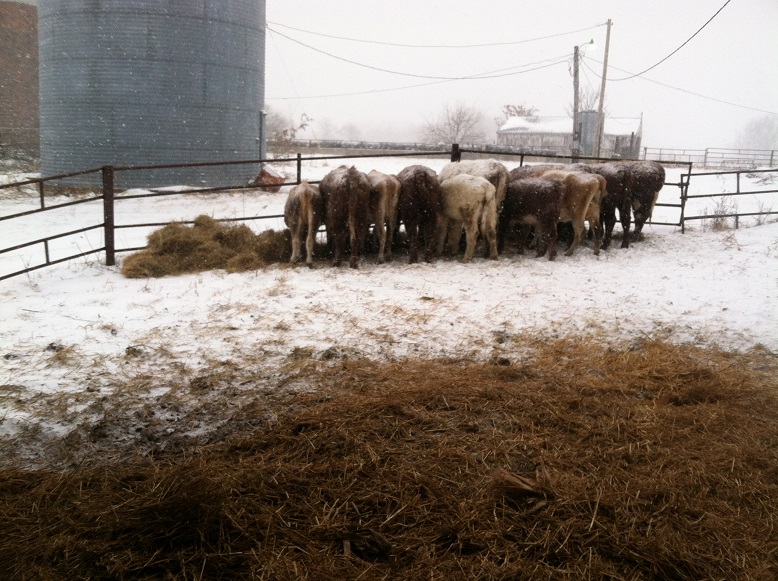
When the bad weather hit Saturday afternoon we moved the cows to the barn. We have been grazing stockpile but with wind chills near -40 F we thought it would be best to have them out of the wind and in a convenient place. Convenient for us…not necessary for them. Really, the cows would have been fine standing together on the leeward side of a hill sheltered by a tree. It really was an issue of convenience for us.

Each morning I would clear the manure from a stretch by the fence and put out bales there. I don’t have a feeder in this lot…something I’ll have to address going forward. I would split the bales in a couple of different locations. Each morning and each evening I would offer a square bale of alfalfa and a square bale of grass. While the cows were busy grazing I would put two or three bales of straw down for fresh bedding after cleaning up big, obvious messes.

FeedLot1

Then I would pull the hose out of the barn loft and refill the water trough, breaking out the ice along the way.

IcyTrough

I have mixed feelings about this entire setup. First, since I don’t have feed bunks I didn’t feel that the cows had a clean plate to eat from each day. It reached a point where there was so much frozen urine and manure I just had to do my best…and my best was barely enough. When the cows are on pasture they get a little more ground each day. That new ground is like a totally clean plate and is a great place to feed them each morning. Then they can graze their day away.

Second, I just don’t think the cows were happy. They just sort of moped about. Like they were a little stir crazy…or had as much cabin fever as the kids did. This was more completely expressed Thursday morning when we led the cows back to pasture. They ate their hay then went running, kicking and bucking through the pasture. They seemed to enjoy stretching their legs for the first time in 5 days.

SnowCows

The cows are not out of their fence. The previous day’s fence posts were frozen in place and could not be removed. The cows bent them all. Stinkers.

So I’m glad, for my own sake, that I have the option to shut up the cows in the barn lot. But I can see that it’s maybe not the best for the cows. Next year I’ll have the entire feedlot for my own use complete with feed bunks. I’ll design my pasture usage to preserve and stockpile the pasture near the feedlot so I can, if needed, allow the cows access to shelter and feed in a bunk but still give them access to the larger pasture area. They will be able to go where they like while still allowing me to feed with relative ease. I’ll just have to make sure I don’t get lazy and feed them in the bunk all winter as I want their nutrients on pasture, not in the feed lot.

Lowest Cost Production

Production, not consumption, makes our world a better place for all. Some of this looks like a chicken and egg discussion but it really is not. Irwin Schiff illustrated this well years ago and I encourage you to read what he wrote (link). In his story the inhabitants of the island caught and ate fish every day but it took them all day to do it. That’s expensive fish…costing them a day’s wages. Then one guy got a bright idea. He made a net (production) so people could work fewer hours to catch their fish (consumption) and could, ultimately, go on to do better things with their time like run for office or open banks (lol). Consumption is an ongoing deal and happens naturally. Efficient production requires risk, effort, imagination and capital.

I am working to insert myself into the cattle business. Just typing that causes me to laugh at my own pretentiousness but that’s what I am doing. I am working to produce cattle efficiently. This requires capital, it involves risk and varying (but never insignificant) amounts of effort. And it requires imagination. Before I move on I want to re-emphasize the word “efficient”. Profit is not a bad thing. Profit is not the measure of greed. Profit is the measure of efficiency. You and I can both produce beef. That’s fine. But I can sell mine below what yours costs because I’m more efficient. But what neither you nor I can do is determine the price. I may be able to sell a few head at $9/pound but none at $900/pound so I have no control, really, over price. I can’t force a customer to buy my beef instead of your beef. I also can’t force my customers to buy beef instead of chicken. I only have total control over production costs. My profit is the difference between the selling price (which I have little control over) and the production costs (which I have absolute control over). If I am going to succeed in the cattle business (remember that 5,000 cow thing?) I am going to have to find ways to profit from cattle production. I mean, I would much rather do nuthin’ for nuthin’ as work for nuthin’. And keeping cattle is work (though, fun work…but is it enough fun to waste the most productive years of my life with?).

But what other costs are involved in cattle ownership? I mean, look. If I have a nice herd of 20 cows and I go out to buy a $4,000 bull that I’ll keep for 3 years I have increased the cost of each calf by $66…not counting the feed that monster will eat or the repair bills he will cause. But we have only just started. Forget the bull. Let’s look around my zip code and see what else I’ll need to keep cattle (if you want to do the math check equipment costs on Tractor House). Apparently I’ll need a couple of loader tractors with front-wheel assist, a newer 4WD 3/4 ton truck, a livestock trailer, a silage wagon, some way to cut silage, a silage pit or a silo, silage blower and silo unloader (God help us!), a hay baler, a mower-conditioner, a hay rake, a trailer to haul hay bales on, ring feeders, feed bunks, head gates, an extra 4WD truck, cell phones, shotguns, rifles, 7-wire fencing, tillage equipment to tear up the fescue, a drill to plant better pasture, a wiper bar for thistle, some sort of sprayer and a big tractor to pull the tiller and drill. In our part of the country we call ourselves farmers and not ranchers and that job title comes with an immense mountain of additional iron supplementation I won’t go into here because it doesn’t effect the price of the cow…it effects the price of the corn…which effects the price of the cow. Because cows just have to have corn…otherwise they don’t get so big and fat. And we need big, fat cows whatever the cost! But all of that equipment will share shed space in the new sheds we have to build for our cow accessory collection. You should note that the whole collection must be painted one color cause that’s better than the other color and gets us more free hats and jackets and the like. And I can’t neglect the new car for my wife and she needs streaks of lighter color in her hair so her friends will say her hair looks cute as they have a $4, four hundred calorie chocolate coffee on their way to the weight watchers meeting. And my kids are going to want to play baseball and soccer and every boy should be in scouts, right? And we’ve been wanting to go to Disney.

So now what does that calf cost? Let’s see…feeder cattle are at $1.68…times 500 pounds…so I get a near all-time high $840 for each calf I sell. Minus transportation costs. Minus auction percentage. Minus, minus, minus. Shoot, just the bull accounts for 7% of the sale price of the calf crop. And each heifer has to have 4 calves to cover the costs of her own development and the average cow doesn’t last that long. How do I make any money at this with all that other nonsense going on?

Today’s post is strongly insprired by Kit Pharo’s Winter 2014 newsletter I received in email this morning (you can, and should, subscribe for free here.) In the lead article he shares his fears that we are pricing our product out of the market. More and more consumers are eating chicken over beef. Why? Because chicken is cheaper. That statement should just about make your head explode. Is it more efficient to plant, fertilize and spray herbicide on corn and beans, harvest those crops, screen them, haul them to town, dry them in a bin, grind them into feed, haul that feed back to the farm where you feed chickens in long houses with high rates of death so we can manually pack the birds into crates, haul them to a processing plant, hang them on a shackle, dress the bird out on a conveyor, part the bird up and sell the tenders at the deli than it is to do basically the same process with cattle?

Read the last 5 words again. Think back to piano lessons. Remember the bass clef? Name the spaces. All. Cows. Eat. Grass. Today not all cows eat grass. We are feeding them like they are hogs or chickens. And that’s why beef is so expensive. We have selected for tall, heavy cows. Cows that can’t maintain body condition on grass alone. Cows that need a little boost of grain to put on enough fat that they cycle on pastures that are simultaneously over- and under-rested because of non-stop grazing and animal selectivity.

We need to re-examine our procedures. Why are we doing what we are doing? We need to take it to bare-bones again to become more efficient producers. North America is a grass-growing paradise! We could be profitable raising cattle at half of current prices! But we would have to sell our tractors for that to happen. And that would hurt consumption. Lower prices lowers GDP (we can’t have that!)…but it feeds more people. We are so strongly oriented toward pure dollars we have lost sight of what we’re here to do. We are not here to use as much fuel as possible while poisoning the soils. We are here to feed the soil and feed the people. And cattle do that much more efficiently than do chickens. But you look weird walking your pasture instead of riding on a 4-wheeler. You look lazy sipping tea while your neighbors put up hay. They might think your baler is broken. And you certainly can’t call yourself a farmer if you don’t own a tractor!

So what do we really need to raise cattle? Sunshine. Rain. Salt. Fencing is really, really nice. Comes to it, we don’t need a big house or a woman with artificial hair coloring to produce beef. We could just live in a tent with our animals. Happens all around the world. Maybe add in some cast-iron cookware. Read Ben K. Green’s books to remember where we came from as a cattle-producing nation. But the house is nice. We enjoy our cast-iron even indoors. It’s handy to have a tractor. It sure would be nice to have a new 3/4 ton 4WD truck in the driveway and the kids want a pony. This is not to say that I believe farmers should take a vow of poverty. I am, however, suggesting that we farmers are impoverishing ourselves by pursuing consumption, rather than working toward efficient production. (That idea goes far beyond just farmers.) Supporting all of this extra consumption forces me to ask more for my product…or seek income elsewhere. Income elsewhere is probably easier. Well, not probably.

It’s hard work to keep a herd of animals healthy whatever the weather throws at us. I knew that before I started. I’m not here to ask for your sympathy. I’m here to say we have an obligation to attempt to lower our production costs, not simply to make more product available for consumption at lower prices, but also because we, as cattlemen, are uniquely suited to healing our soils, increasing fertility, diversity and water capacity. If you haven’t, I encourage you to check out the book Cows Save the Planet. Compare, in your mind, all of the fuel that goes into producing a pound of chicken to the lack of fuel involved in growing grass. Why is chicken cheaper? Any number of reasons…everything from government subsidies to unsustainable energy costs. But when you get down to it, it is largely because we are asking cows to be something they are not and to eat junk they don’t need so we can sit pretty in a new pickup truck.

Keeping it Clean

We had some friends for dinner last Thursday. At least one of their sons works seasonally for a local berry farm. He shared a conversation he overheard from some of their customers. Here is the main idea:

We came here because the place we normally pick ran out of strawberries. We will not return to that other place. This place is so much cleaner. So much nicer.

Those few sentences teach me a lot. We focus on producing a quality product but not on creating an atmosphere of beauty. It may not always be pretty but we get it done. And we do a good job.

But I have to admit, we could have less junk laying around. I suspect that turns some people off. At the same time, people roll in and marvel at our garden. So we are doing well in some areas but I know we can do better. Our shop is full of all kinds of who knows what. At least we could hide that. As I have said before, much of the iron in the pastures can be hauled away. A little paint here or there…

But that isn’t limited to the yard. It’s also the house. If it matters what customers see when they pull in the driveway, it must also matter what friends see when they walk in the door. I have shared before how hard we work to de-clutter our house. Somehow any flat surface gets covered in papers needing filing or artwork from our children. It just piles up. Books out of place, stray socks, stuffed animals, knitting, legos…you get the idea. Beyond that, there are clothes we no longer wear, shoes we have outgrown, furniture we have worn out or broken, books we will no longer read. You with me here?

Previously we were purging our home every 6 months but Julie has really stepped up our efforts to purge our home of clutter in the coming year, working on a weekly basis. This is one of her 2014 goals. Ranging from ridding ourselves of surplus Christmas decorations to activities. If this interests you, keep up with us on her blog or on Facebook and participate with us this year. You can also count on me to detail every little thing that we do on the farm…including working to make it pretty.

Handful of Acorns

Winter Phosphorus Needs

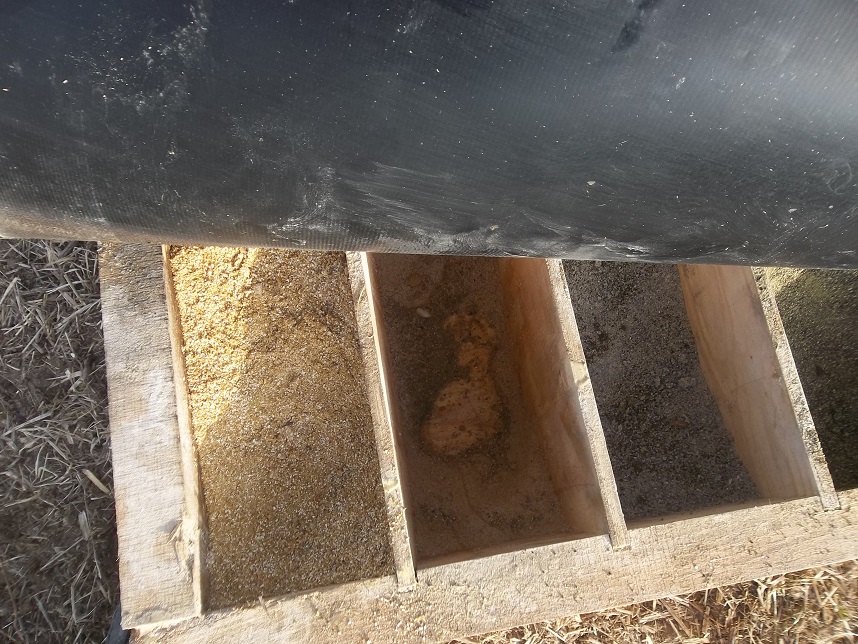
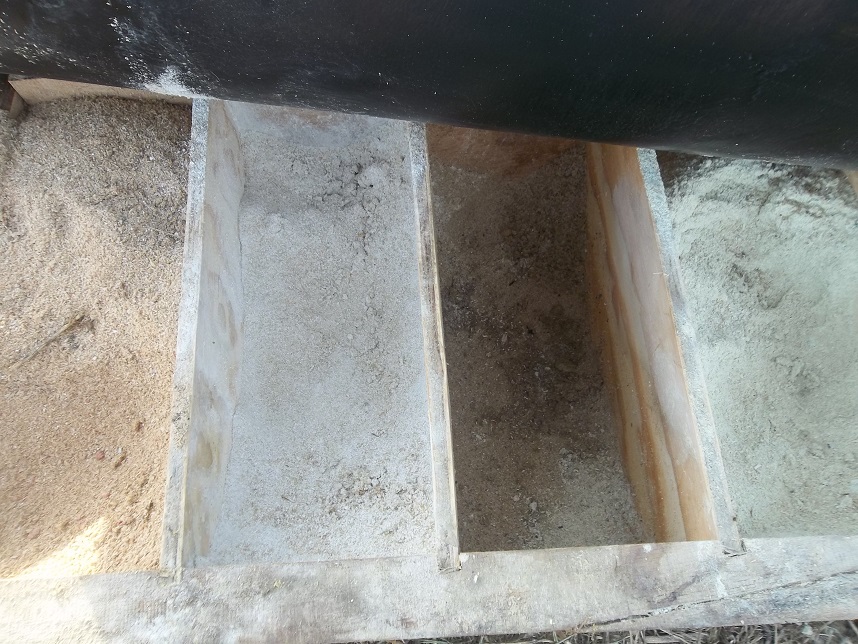
We put out the Free Choice Enterprises mineral feeder in mid-December. I’m amazed how much phosphorus the cows are eating. I filled three holes with phosphorus and they have eaten 2/3 of it. These pictures were taken on January 1.

The cows have nearly finished the phosphorus in this slot:
Phosphorus1Below you can see (from left) kelp, redmond salt and phosphorus. I would have to find my way across Hoth to see what is in the last slot on the right. Sorry. The cows don’t seem to want the kelp. The salt has seen very little action and wasn’t full to begin with. The phosphorus on this end is about 50%.

Phosphorus2

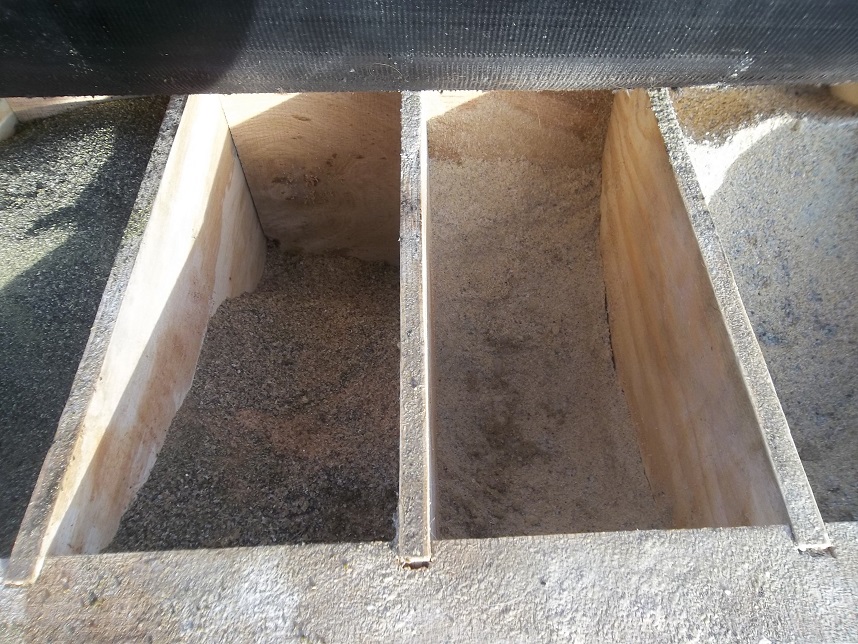
On the other side I have another slot dedicated to phosphorus. On the left is unknown. Again, I’ll have to wander into the frozen tundra to see it now. Next is iodine then phosphorus. To the right is sulphur.

Phosphorus3Keep in mind that every slot was full to the top when we started out. A fair amount of iodine, a little trace mineral, a little sulphur. But the cows have basically emptied two phosphorus slots. My understanding is that this is because phosphorus is hard to come by in stored forages. Once we green up again in the spring we should see much less of a need for phosphorus. But I didn’t anticipate this level of need. Basically, 10 cows are going through a bag of phosphorus ($28) every week. Wow! So…back to the budget we go.

The other surprise for me here was that the cows turned their back on kelp. They have absolutely consumed kelp all year up till now. My Fertrell dealer suggested they were using the kelp heavily in the spring to meet their magnesium needs and he suggested I put out some epsom salts. Next year I don’t think I’ll have to guess what they need. I’ll just watch the mineral box and see what goes down.