Sleeping Pastures

Wake Up!

There is a goofy Disney movie called Rocketman. In one scene, because of an accident, the main character doesn’t go into “hyper-sleep” with his crew mates and is isolated and alone on the ship for eight months. He does everything he can think of to pass the time. He makes a chain of paper dolls, paints the ceiling and goes bananas screaming comically for his fellow crew members to wake up. Wake up! Wake Up! WAKE UP WAKE UP WAKE UP WAKE UP!

I was thinking about this recently as I stood in my pasture.

SnowGrazing

I’m killing time.

Waiting.

I look out over my fields, feeling helpless against the endless snow pack. I live in a desert of ice. The cows are grazing through the snow pack but we still supplement with hay …and the hay pile is running low. The wood pile is running low. Propane is crazy-expensive. I’m ready for winter to end.

IceWater

How many more months to go? How long before the world comes back to life?

Wake up! Come on! I’m ready already! Let’s butcher some chickens! Let’s build some fence while fighting mosquitoes and dodging poison ivy! Bring on the milk cows slapping us in the face with a manure-covered tail. ..and the flies, oh! the endless, beautiful clouds of flies! At least let it warm up enough to tap the trees!

It can’t happen fast enough.

And when it does I’ll be ready for winter again.

Parts and Patterns

Julie bought me the book Holostic Management 5 or more years ago. We took a stab at reading it at the time but really couldn’t get through the meat. We had a conceptual understanding of grazing but no real hands-on experience…and experience was needed. So we put the book aside.

I am overdue for another stab at the book and as I read it again I am fascinated. This time I seem to be getting it…or, at least, getting more of it. And that’s good since I sent a copy of it to dad’s friend Marty…and I know he’ll breeze through the book.

Chapter 3 kicks off a discussion of Jans Christian Smuts’ book Holism and Evolution, presenting the concept that, though we tend to break things down into individual parts, we need to look at wholes. In a recent post I discussed the loss of native diversity because in our local oak/hickory forests, Yellow Lady’s Slipper orchids are a part of the whole. Remove that part and the whole is diminished by the loss…the remainder becomes increasingly fragile.

The book gives several examples of ecological degradation caused by predator removal. If I trap out the minks I will open a void in predation. Minks eat mice. Extra mice may be a benefit to other predators but the loss of the mink makes our farm slightly more fragile. What happens when I kill the mink and disease removes the coyotes and foxes? Can the owls pick up that much slack?

But who cares about mice and minks and owls? We are farmers. We grow cows and pigs and chickens. And minks eat chickens. And owls eat chickens. So why not just kill the minks and scare off the owls and raise chickens in greater security?

Because of the whole interconnected web occurring on the farm. Owls also eat skunks. If there are no owls what will eat skunks? Maybe I could get a big dog? But that won’t eat large numbers of mice. So…barn cats? But those will eat song birds too. I could keep searching for substitutions to force my will on the land but it is not hard to imagine that I would be better off nestling, rather than imposing, my farm into the countryside. To make my farm an enhancement of the natural order rather than a replacement of the natural order. I need to find a pattern of farming that compliments the patterns of the landscape.

So I have to manage for diversity. And that includes making room for my enemy, the mink.

But I also need to recognize and enhance patterns. Hackberry trees grow alongside walnut trees. Gooseberry grows in their shade. Opossums eat gooseberries. Squirrels eat and plant walnuts, acorns and hickory nuts. Hawks eat Squirrels. All of them add manure.

The wildlife can’t begin to eat the gooseberry, nut and squirrel crop. I happen to like gooseberries, hickory nuts and squirrel. I have to find ways to fit myself into the landscape without diminishing the whole. Further, I have to fit cows, pigs and chickens into the landscape while retaining and respecting coyotes, foxes, mink, mice, squirrels, owls, hawks, deer, raccoons, groundhogs, skunks, opossums, rabbits, gooseberries, walnuts, hickory nuts, acorns and Yellow Lady’s Slipper orchids.

There are patterns holding this abundance of life together and my job, as a farmer, is to weave myself into the pattern, not to unravel it.

That only scratches the surface of the chapter but it is enough for today’s posting.

How are you weaving yourself into the patterns you observe?

Isolated and Fragile

I had a chance to visit with an old friend of my father’s I haven’t really seen in 20 years. He was a biologist for the state and is a large part of the reason I have a degree in biology. The last time I saw him was nearly 17 years ago (at my wedding rehearsal dinner (not so much a dinner as a 4th of July party with a bluegrass band at my parent’s house)) and I talked his ears off about the amphibians I had collected the previous week in the Columbia River Gorge (Ask me about dicamptodon or ascaphus!). This time I tried to avoid talking his ears off about grazing cattle.

I did it anyway. He is a polite listener and I really had to pry to get him to talk about his own interests. Marty is now retired and spends his days volunteering to help retain native diversity in Southern Illinois forests. He also is a decade into a prairie restoration program on some land his family owns.

I should have taken notes.

Obviously it is important that we manage for pasture diversity. Marty further suggested that I should be looking for local sources of native grasses to help re-establish those in my pastures. There is a clump of big bluestem that grows in the cemetery. I don’t have the foggiest notion where I could come up with Eastern Gamagrass though. Hopefully, by proper management and resting a portion of my pastures each year, I’ll see some of those natives come back out of the seed bank in the soil. By “proper management” I mean managing my pastures for what I want, not managing to limit what I don’t want. If I want additional native forages and pasture diversity I have to let the natives achieve maturity. Gamagrass may take 3-4 months to go to seed so I can’t just let the cows lop it off every few weeks. So if I want that, I have to plan for it.

Speaking of things I don’t want, I live in the part of Illinois that was recently on the news because of the massive dust clouds coming off of the farm fields in the wind, causing road closures. Some of this is due to drought. Some due to fall plowing. But mostly, it’s because there is nothing protecting the dirt, binding and holding it in place…and few windbreaks. The trees have all been cut out of the fence rows because they shade out the corn. So I invited Marty to dad’s back deck to look into the woods with me. Dad’s house is built in a 15 acres stand of trees near another 20 acre stand of trees. There are clumps of trees all around and a solid, unbroken canopy following a big creek from North to South for miles and miles. Talking to dad, he keeps the woods because he likes the woods. He thinks (and I agree) we need to have areas set aside for wildlife and recreation. But it is difficult to realize the economic advantages of turkey, deer, squirrels, raccoons and coyotes and keeping these areas forces us to operate at some economic loss…loss that is multiplied if we work to manage the forest by cutting out invasive species and removing sick or dead trees. So I asked Marty:

  • What is the economic advantage of retaining these trees?
  • Where is the incentive to cut out invasive species?

Marty survived a career of working for the government. One might think he would be looking for a government solution but he’s not (well, not overtly). Marty volunteers, apparently, massive quantities of time to cutting Japanese bush honeysuckle out of our forests. Marty says if it isn’t done – if we allow Japanese bush honeysuckle and autumn olive and other exotic invasives to persist – we are allowing our forests to decline and die. At this point, we can’t afford to lose our native forests (dominated by oak and hickory trees) so we have to actively destroy the invasives (by using glyphosate) allowing the sub-canopy to regenerate native species. He further said that our part in this process is particularly important because our tree stands tend to be isolated and fragile. (I believe Marty said “fractionated”, not “isolated”…)

600 words into the post and I finally get to the title. There is so much I want to do with those three words. “Isolated and Fragile”. In my head I’m swearing in disbelief like Lee Ermey in Full Metal Jacket. In one little phrase everything falls into place.

I don’t want to be isolated and fragile. That’s why I read blogs. That’s why I blog. That’s why you are reading my blog. That’s why I’m married. That’s why I bought the farm next to my folks. That’s why we are encouraging our kids to work with us. Heck, that’s why we had kids. I don’t want to be isolated when I’m elderly. Beyond social issues, that’s why our farm isn’t our only investment. That’s why my job isn’t our only income.  Isolation leads to fragility.

And that’s the problem with those fields. The dirt is blowing away because there is nothing to hold it down. The soil is fragile. The dirt exists in isolation. There is no polyculture. No grass. No chickory. No dandelions. No clover. No dung beetles. No worms. The crop residue is minimal, most of it has already been digested by the soil. There is no structure to the soil, it was plowed in the fall to help it dry out more quickly in the spring. Just grains of dirt, sitting all alone.

Getting back to Marty, he believes that if the native plants are shaded out by the invasives, we’ll lose that native diversity. Once it’s gone, it’s gone. The stands of trees are too isolated and if the seed is not present there is no way a Yellow Lady’s Slipper Orchid can grow. The isolated stand of trees becomes diminished by the loss of a single species. This can also happen with acorns. If saplings are shaded out or smothered by Japanese bush honeysuckle and the mature trees climax and decline, what will replace them? Pioneer trees may be carried in by birds but how far do acorns get carried? And how many decades will pass before the native oak/hickory stand is again dominant even by way of intervention by man? And how many decades or centuries will be required to return the forest to a condition that will support orchids?

Now, I realize my fellow permaculturists may have a bone or two to pick with the notion that “invasive” species need to be managed…especially the native species that have been labeled “invasive” by the man because they are too good at their job. The argument could be made that they are only growing to fill a void and that cutting them out doesn’t fix anything. I don’t think that’s incorrect thinking…and I shared those thoughts with Marty. I’m not sure Marty was entirely sold on the idea but he repeated that these stands of trees are only a few acres in size. They are isolated. They are broken apart, mismanaged and lacking health. His efforts aren’t to fix a problem so much as retain local diversity. The problem is bigger than Japanese bush honeysuckle and Yellow Lady’s Slipper Orchid. But that’s where he can help.

So Marty is actively participating in making the world a better place. He’s not roping off a section of forest and letting nature take its course. He’s not lobbying for the government to do something (well, maybe he is…but he’s not stopping there). Obviously I took a lot home from that conversation.

I could go on and on about these ideas but I think you can see what I’m saying here. Isolation and Fragility are things I am working to avoid with my land, with my family, with my finances…but it took a conversation about forestry for me to really acknowledge it.

Motivating my Volunteer Corps

Bad weather is on its way. They are calling for a mix of sleet and snow Friday, Saturday and again Tuesday. Temps should fall back into single digits again, wind chills deeply negative. There is quite a bit of work to do beforehand so I asked the kids to get the laundry done, firewood brought in, pine cones collected, the pigs and chickens bedded, and the house picked up. There is much more to do but the kids can handle those few chores. I left a list on the fridge this morning including a suggested timeline. Before 8, do this. Before noon, have these done. Before 5, be sure to have everything behind you.

I got some negative feedback from my oldest. Actually, my wife called me at work and asked me to talk to my son about his attitude.

So I talked to my son. I didn’t talk down to my son. I didn’t yell at my son. I didn’t even lecture my son. I said, “A storm is coming. If you guys can do those chores, I’ll have that much less to do when I get home after dark.” He felt foolish and agreed that the work just needed to be done and really wouldn’t take all that long.

But I am not finished. With him or with me. I’ll start with me.

I am significantly larger and stronger than my children. In fact, there have been several recreational wrestling matches pitting my four children and my wife against me (they try to get a toy out of my hands). I always win. I could easily force my children to submit to my will. But even if I couldn’t physically overpower them, I have absolute power over them. I could restrict their freedoms, remove favorite toys and prove to them in many ways, beyond a shadow of a doubt, that I am not only someone to be respected and feared, I am an enemy to be escaped from. That is not what I want to teach my children.

Let’s talk about my relationship with my wife for a moment. My wife is a sovereign partner in our marriage. She is a willing participant. She is not my slave. I have no ownership claim on her as she is not my property. Her body is her own, not mine. The success of our marriage is not the result of my command but the result of conscious, daily choices each of us make to respect the other. Julie has full authority to act without my permission but chooses to limit her actions in favor of partnership with me. For example, she could easily drive to the airport, hop on a plane for Jamaica and spend a week on the beach without us but she doesn’t. She could spend what little money we have but she doesn’t. She could, behind my back, sell all of our livestock or attract the attention of any man. But she doesn’t. And it’s not because she is afraid of me. We live on the farm, not because I said, “You are my wife!” and she said, “Goodbye city life!” but, instead, because we agreed to live here.

I have to teach this to my children. My children are not yet sovereign individuals but as they approach sovereignty I have to turn loose a little more. At age 3 it is enough to command. After around age 5 it becomes appropriate to reason…but not negotiate. To say, “We’re doing this because…” but not ask your children for permission to act. But then there will come a time when my children have full authority to act without my permission. I have to handle that transition correctly. They have to know they have the power and ability to either hurt or honor others as well as the freedom to make their own choices…and earn their own consequences. I want them to learn to express their freedom, not simply to exert power over others. So I work to avoid expressions of power. I try not to dominate. I try only to set the example and to show them love and respect.

I should have made a better presentation for my children this morning. I should not have simply written a list of things to do. I should have spelled out why each is important. I like wearing clean socks so we need all of the laundry clean in case the power goes off for the next two weeks (as has happened in the recent past). We need firewood stacked indoors in case the storm really packs a wallop and pine cones to help light fires (since we are out of stick bundles). The chickens and pigs need fresh bedding for their health and it is easier to add today than it will be when the sawdust is covered by snow and ice. If the laundry is all put away and the tables are cleaned off we’ll be more comfortable when we are all stuck indoors. I know these extra chores add a lot of time to your day but all of us will be better off for the next few days if we just pitch in and do it now.

So tonight when I get home I’ll sit with the family at the dinner table and review the day’s activities. I’ll pull up the weather forecast on the laptop and show them what is predicted to come our way. I’ll lay out the whole list of chores that have to be completed before bad weather hits tomorrow night (lay out cow pasture, haul, stack and cover hay, make sure coolers are clean in case power goes out, verify our pantry is sufficiently stocked, etc.). Then, after dinner, I’ll lay out the work I hope to accomplish tonight and in the morning and what they can do to help out. Maybe it won’t work. I don’t know. As a friend recently said to me, there are no “do-overs” in parenting. I think it is better to make a mistake while being respectful toward my children than to make a mistake being abusive.

My Mountain of Gold

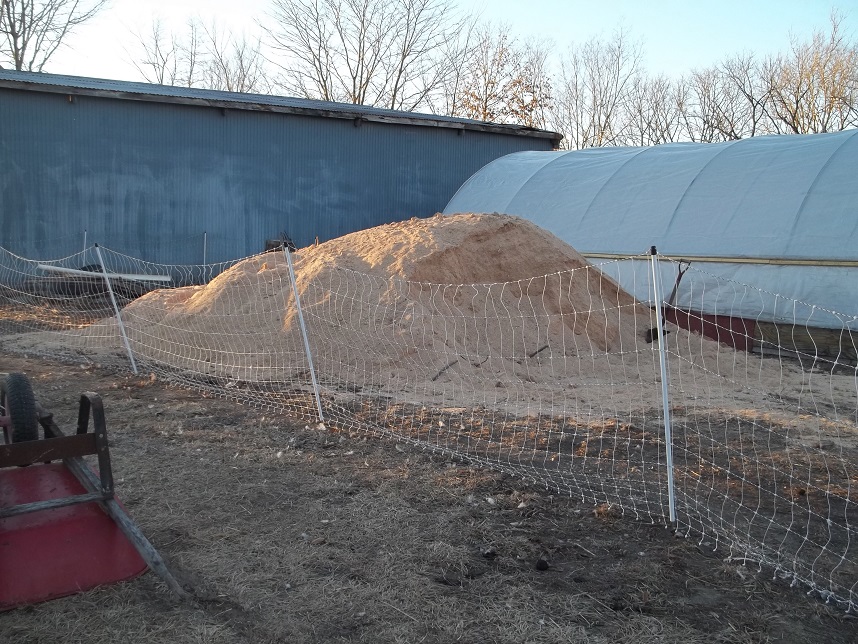
OK. Not so much a mountain. And certainly not gold. I hope the scale works in this picture. The pile is as tall as me.

Sawdust

We order a load for our place and a load for the horses every year. This entire load will be spread this winter in the greenhouse under the pigs, rabbits and chickens. We also take any wood chips we can get from the power company and local tree services. And I am overdue to rent a chipper for some brush I have piled up. It all comes in handy, soaking up odors, making animals comfortable and increasing pasture fertility. That represents the entirety of our annual fertilizer bill.

Three cheers for Sawdust!

Grazing the Not-Stockpile

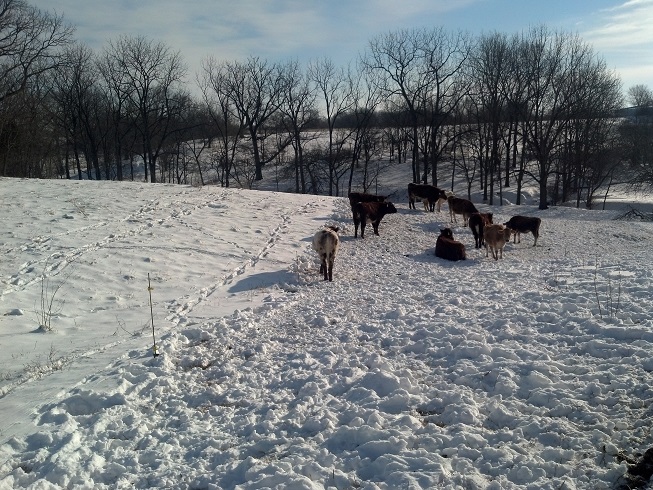
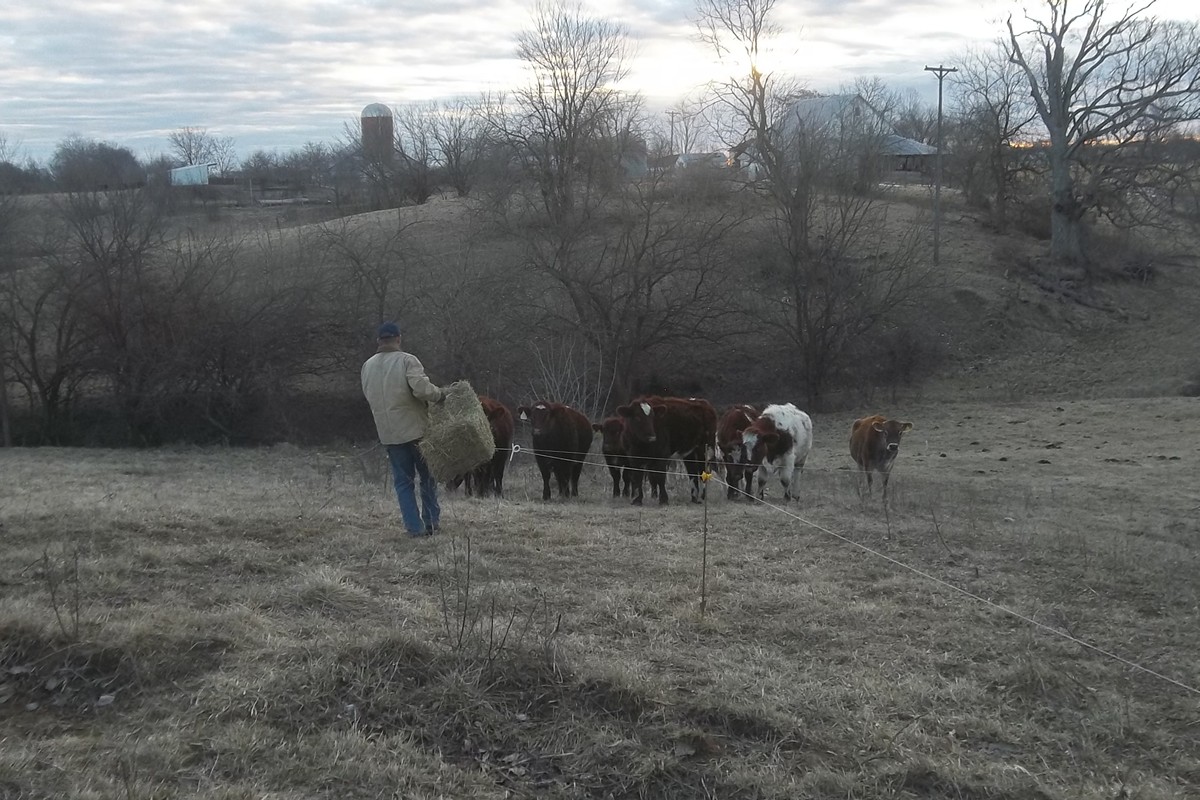
The cows are just East of the house right now. They finished up grazing the primary stockpiled ground further East and I needed somewhere to go with them. Really, they should be North of the house in the bottom where the grass is 10-12 inches tall and still green (somehow). But that’s a long way to drag a hose.

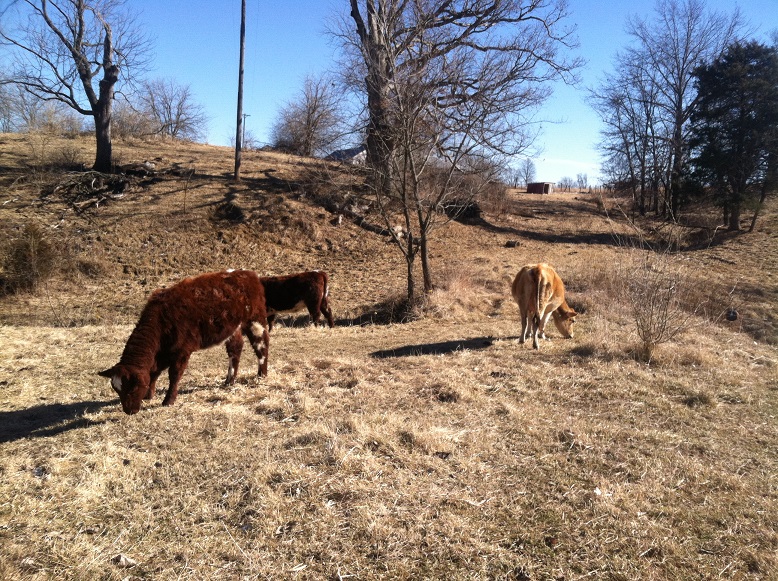
East and South of the house lies the remains of pasture that the cows passed over in October. Forages they just elected to skip. Lots of fescue. There is a fair amount of grass there but it is only marginal in quality…at best. I am offering large grazing areas and two whole bales of hay each day.

GrazingJanuaryThis is mostly a South-facing slope that will start recovering mid-February and will really be ready to graze again in March. Certainly by St. Patrick’s day. But right now it has bunches of fescue and tall stalks from chickory and other forages. Mixed in are a few thorny saplings that I need to manage. If I do this right, the cows will crop it all close, add nearly a ton of manure and expose the thorny trees so I can deal with them. 

GrazingJanuary2

Speaking of fertility, I have to keep an eye on their manure. Yes, every day I look at cow manure. This is looking too dry and stiff. I need to up the protein in their diet. For now I’m calibrating it with alfalfa hay but as we graze our way North I may need to do a little more for them. The pasture to the North is tall, dry, brown bermudagrass. I’m sure it’s about as delicious as straw and will require protein supplementation for digestion.

GrazingJanuary3

The slope they are on sheltered them from NW winds above 45 mph Sunday night and a wind chill toward -20. That’s quite a change from Sunday’s high temperature of 50 degrees that left several of the cows panting in the heat.

I still have a few acres of stockpiled fescue but, for now, we’re going to ask the cows to do their best with this stuff. I’ll have to keep an eye on things.

As a note to myself in this public diary, Flora came up with a limp in her rear left on Saturday morning. Picture #2 above shows her standing with weight off of that hoof. The cows had been in the hickory grove. I suspect she either slipped on ice or she has a thorn in her hoof. Sunday it was less pronounced. Monday it was still there but less so. I’ll try to catch her Tuesday morning and check out that hoof.

Just a Couple of Pigs

We shipped out last pig out on Tuesday of last week. We were scheduled to pick up a new batch of piglets on or after Feb. 1 but I couldn’t stand it any longer. 5 days without pigs was 5 days of misery. Julie saw it coming and laughed at me. She knows I love having pigs around.

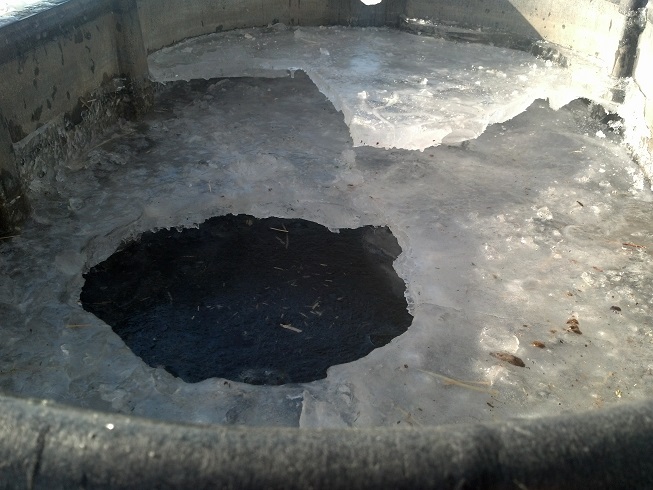
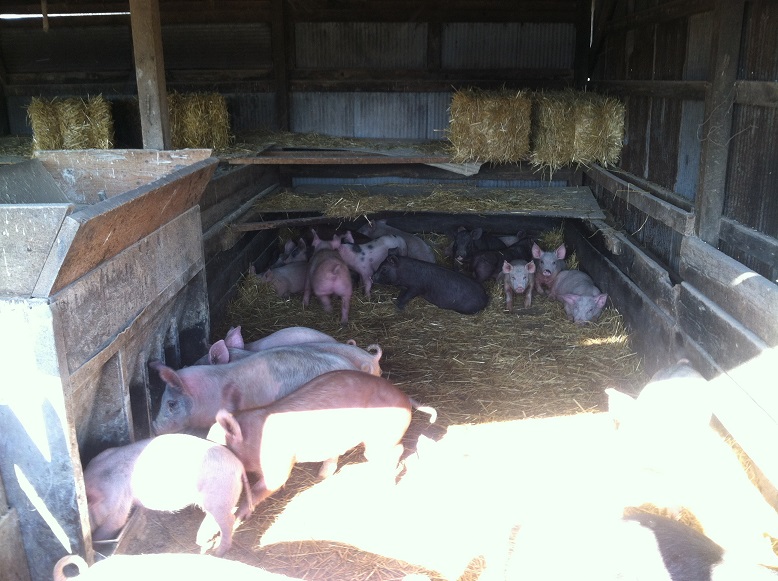
Sunday morning we made room for and assembled a pig pen in the greenhouse. We use a big water tank for a drinker and it would freeze solid if we tried to keep the pigs outdoors. Since ice is a problem and frozen piglets are unhappy piglets I chose instead to ask the chickens to share space.

I made plans to meet Mike Butcher at noon for a couple of 60 pound pigs. Mike raises hogs for a couple of well-known major organizations, each with their own audits and specifications. His sows farrow outdoors and never see a gestation crate. His pigs are raised on deep bedding and he uses no antibiotics. Mike has a clean, neat hog business. He gives me a discount on pigs since they are, in his own words, going to a good home that appreciates their health. Not only do I appreciate their health, I appreciate their breeding. These are the best eating hogs we have raised and fatten quickly. Mike does it right.

Pigs1

Plus he generates mountains of compost.

pigs2Mike is justifiably proud of his business. He is also proud of his herd of large black hogs that he has kept for decades. He is always anxious to show us all around the place, look in any and every building, play with newborn piglets…whatever. I have never seen a sick animal on his place. Dad was with me yesterday and commented on how clean all of the pig pens were. Mike works hard and it shows.

We loaded up four piglets in a homemade crate (more on that another time), wrote Mike a check and headed off down the road. That sounds too easy. I caught 3 piglets, dad caught a fourth and we carried them to the truck. That still sounds too easy. I walked through groups of pigs, called out the one I wanted and we (my son and I) sifted through the group until I could get my hand on the specific one I wanted to take home while Mike’s Jack Russel Terrier worked to add to the confusion. But it’s not enough to get your hand on a 60 pound ball of muscle. You have to hang on to it. Ugh. Then, wriggling pig in hands, I climbed out of the pen and wheelbarrowed each pig over to the truck. Then I lifted each one, stepped up on the tailgate and gently lowered each into the crate. I still didn’t describe it well enough because I left out the amount of manure that gets all over me during the operation. But you could probably figure that out on your own.

The pigs are comfy in their own portion of the greenhouse where they will remain until April. They went to work digging in the bedding right away.

I have a lot more to say about pigs and why I found it so hard to go without a pig on the farm for even a full week but I’ll save that for another time. I do have to say, catching and wrestling pigs was just exactly the kind of workout I was discussing in yesterday’s post. I’m sore today.

CrossFarm 2014

In a prior life I did the main page Crossfit Workout of the Day (WOD) every day. I write about this from time to time. Speaking from experience, the main page Crossfit WOD is not for normal humans. All these years later the main page WOD has been accelerated to the point that it’s not even for exceptional humans. It is made for super-humans. Truly elite fitness. But 10 years ago I couldn’t wait to knock out the main page WOD and post my results. I should also add that Crossfit came along at just the right time in my life. If you think I write about Crossfit too much…well, please understand there is more going on here than just push-ups.

Let me summarize what I believe Crossfit is. Crossfit is for everyone. It calls itself the sport of fitness. In short, they put up a workout 3 days out of 4 to measure your own ability to perform work in time. (The fourth day was a rest day and there was usually some suggested discussion topic ranging from history to liberty to economics.) In a normal workout you might deadlift 300 pounds 21, 15 and 9 times. In between deadlifts you might have to do 9, 15 and 21 handstand push ups. Yeah. Handstand pushups. But it’s not enough to just pick up the weight and stand on your hands. The workouts are designed to be completed quickly. You wouldn’t think of lifting 300 pounds as a cardio workout…until you try to lift 300 pounds 21 times in 30 seconds. Total intensity followed by rest. You learn very quickly where your body is weak, where you want to quit and when you really need to quit. Crossfit is for everyone…but you probably need to scale it back for your fitness level, age and ability. Don’t believe me? Pick up a grandchild. That’s a deadlift. If you don’t do it correctly you will probably injure your back.

There was a time when my hands were covered in callouses from deadlifting, the pull-up bar and from gymnastics rings. I became monstrously strong in a short period of time. But as much as I admire the program and its benfits, I don’t crossfit anymore. I have a farm.

I reached a point in my Crossfit career where I wanted to do more than just the main page WOD. I would practice skills like juggling or tumbling. I cut a big oak log out of dad’s woods to carry on my shoulder as I walked through my neighborhood (true story…total dork!). I would use a rotary mower to mow the grass while wearing a weight vest…for time. Yeah.

But things are different with a farm. Now I walk/jog to the barn, grab a 60 pound bale of alfalfa, deadlift, power clean and rest the bale on my shoulder then walk a half mile over an obstacle course, up and down hills to feed the cows. And because I’m almost late for work I have to do this work for time. I have to make decisions about firewood. Should I make one trip up the hill with one big log or should I make 10 trips up the hill with firewood-sized chunks? And because I have 10 other things to do today this too is for time. I pull up fence posts, drive in new fence posts, string electric fence all for time. Then it’s back up the hill to the house in time to fill a wheelbarrow or two with wood to stack next to the wood stove before it starts sleeting (for time). I have to process 100 birds for time. Water the chickens for time.

carrying hay

Everything is for time. Crossfit measured my ability to perform a given amount of work in time. Farming is only a little different. Not only do I have to work hard, I have to get my work done or something might die! But Crossfit also emphasized the importance of rest and proper nutrition. (Clearly this had an effect on me. It’s why we started growing our own food!)

In one of my very first posts on this blog I referred to the action of the livestock working our soil as Crossfit for the farm. The cows, pigs and chickens create a varying and seasonal but intense pattern of disturbance and massively increased microbial action after which the land recovers, heals and becomes stronger than it was before. The varying workload involved in caring for the animals seasonally keeps me both fit and entertained. The hardest part is limiting sugar intake so I can recover more fully between workouts…I mean…chores.

Let me state clearly, I’m not for or against Crossfit. I promise you, the main page WOD is not for everyone. It is probably not for you. It’s for the athletic elite. But if you are planning to move to a farm to begin your adventures in agriculture, I strongly encourage you to consider your physical condition. Maybe find a program that not only builds strength but also builds endurance. ’cause you’re gonna need it. Also pay attention to your diet, rest and sleep cycles. The whole farming adventure can be stressful. Lack of sleep or proper nutrition only compounds the issue.

How to Win Every Game Ever and Even Life Itself!

How’s that for a flash title?

My kids ask me how I seemingly always win. Let’s be clear. I don’t always win. Munchkin is anybody’s game. But if you involve a sheep or a Mario or a Settler of Catan, I do pretty well. Or at least my kids think I do. Some of this is due to luck. Some of it is due to experience (30 years with Mario), but most of it is a recognition of strategy. I know where I’m trying to go before I begin. I figure out what I need to do. I’m prepared for bad dice rolls. The kids don’t stand a chance…yet.

Also included in the title is the notion that I feel that I’m ahead on points in life itself. That is not a joke. I have already won. I married Julie. Nanny-nanny boo-boo. Besides, I’m always harping about vision. Knowing where I am going…figuring out I need to do to get there. I am prepared in case of curve balls. You can see why these kinds of games appeal to me.

We are enjoying playing Agricola. When you first set up the game you will likely be intimidated by the apparent complexity of the board but it’s really not so bad. Here is a finished game played in family version. It takes up a lot of room.Agricola

Each round you send your people to work for you. They can gather clay, rock, lumber or reed. They can bake bread, fetch livestock, expand your family, sow crops…you get the idea. Any action you take this round prevents someone else from taking that same action this round. Additional resources pile up weather you take them or not so you might try to hold off taking that big pile of wood this turn because it will be even bigger next turn…if nobody else takes it. Whatever else happens, you have to have enough food available to feed your people at harvest time.

Then there are key strategies to employ to help you maximize your points. Keep in mind there are only 14 rounds and 6 harvests…and harvests come faster and faster as the game goes on. Stone houses are worth more than clay huts or wood houses. Grain is easy to sow and harvest but grain is only useful up to a certain point. There is zero return in points on your investment in plowing more than 5 fields. Fencing is cheap and will wait till later. More people helps you get more resources and more points…as long as you can feed them.

So…what comes first? Well. If you don’t plow fields, build stone houses or fence barns in you won’t get many points. But if you don’t eat, you’ll have to beg for food. And nobody wants that. It takes away 3 points at the end of the game.

I feel the early part of the game comes down to one key strategy: Create a flexible food generation machine. A fireplace allows you to make food from anything. If that is not available, build an oven and bake bread. Once you can feed your family, everything else falls into place.

OK, Chris. You like Agricola. That’s nice. How about we bring this back to the real world?

Agricola does not allow me to assign a specific one of my meeples to a specialized task but real life allows that additional complexity. Julie, the kids and I are not interchangeable. Any of us could get stone, clay or reed. No doubt. But we can do so much more! And each of us are different…different motivations…different desires…different strengths. How can I leverage these differences to give our family an advantage in the game for generations of players still to come?

The current strategy (still early in the game) is to build a revenue-generating engine. If we miss payments at the bank we lose points. We can’t afford to lose points. We don’t particularly want to make payments. So we have to work hard, right now to secure our financial future. All of us chip away at the same set of chores day after day…feed, water, gather eggs, haul firewood, cook, clean, fold. There is no assigned cook. There is no assigned dishwasher. There is no assigned egg gatherer.

gathering eggs

But the time will come when our farm grows to the point where Julie and I will have to step back a bit. We will have to specialize. We may move from field work to administration, accounting or sales. The current strategy is focused on accumulation (knowledge, skill, resources). The later strategy will be utilization. Efficiency. The kids may take over portions of the farm to run as their own business units. One may keep pigs, one may be an auto mechanic, one may raise cut flowers.  The current unification and generalization makes sense. The later diversification and specialization may make sense. But the strategy will evolve as the game continues.

The difference is that the kids, Julie and I play Agricola against each other. In real life, we are a team. A winning team.

Lowest Cost Production III: Efficient Until it Hurts

In a recent posting I was suggesting we, as cattle producers, need to lower costs. I also wrote this ridiculous run-on sentence:

Is it more efficient to plant, fertilize and spray herbicide on corn and beans, harvest those crops, screen them, haul them to town, dry them in a bin, grind them into feed, haul that feed back to the farm where you feed chickens in long houses with high rates of death so we can manually pack the birds into crates, haul them to a processing plant, hang them on a shackle, dress the bird out on a conveyor, part the bird up and sell the tenders at the deli than it is to do basically the same process with cattle?

So why on Earth is chicken cheaper than beef? I have already demonstrated that I can raise slightly more meat per acre with chicken than with beef. Just imagine if I could raise 6 batches of 20,000 birds working year round? Then we can focus on mechanization of the process. I could just build a house, have my wife and kids clean out the dead birds a couple of times/day and every 2 months we could cash a check. In return, we could cover our pastures in 6″ of broiler litter each year! Beyond the increase efficiency, I would be handling feed in larger quantities, receiving chicks in larger numbers…economies of scale apply all around. But the birds would never see the sun. And they would probably stink. But a little efficiency here and there add up and pretty soon it is more efficient to plant, fertilize, spray, harvest, screen, haul, dry, grind, haul, feed, catch, haul, hang, dress, part and cook chicken than it is to do basically the same process with cattle. Largely, though, this is because cows aren’t built to digest grain and are therefore harder to mechanize.

In yesterday’s article I worked out that I need 2 acres of crop ground to support 500 broilers plus a third acre to raise those birds on sustainable pasture. If I built a 20,000 bird broiler house my ratio would be much closer to 2 acres per 500 birds, maybe less if I grow them to a mere 3 pounds. In fact, we may need less than two acres per 500 birds because I’m guessing that the feed ration is made from processed grains and by-products, not whole grains (which may even make the feed free!). I would also have to deal with the significant debt and maintenance of a long broiler house. It is difficult to determine what the true profit margins are for broiler farmers. This article indicates it’s pretty low but no financials are revealed. This article, though, paints a bleak picture and says the farmer keeps 3-5 cents for each pound of chicken produced out of which he has to pay a $550,000 mortgage…and buy groceries, make a car payment and plan for the future. I mean, it stinks for the poor schmuck but it’s great for consumers because we can buy a fully-cooked 2.5 pound rotisserie chicken at the grocery store for $6! And we only have to pay the rube $0.15 for the bird! (And here I have the audacity to raise my birds to 5 pounds and charge $15 for each one and not even give them a single dose of antibiotic!) Please don’t misunderstand me. I’m not suggesting we should pity the chicken farmer. He may be doing quite well at $0.05 per pound. He may be living out his dreams. And maybe $6 chickens are just what the world needs.

But from where I’m sitting (and based on the high rate of turnover in the industry), it looks financially bleak for our chicken farmer friend. If he decides working 12 hour days to make $5,000 every two months  isn’t what he wants to do (BTW, the payment on a $550,000 mortgage is more than the chickens earn him each month)…well, what else is he going to do with those chicken buildings? The banker may have something to say about his desire for a career change. In fact, they may suggest he just borrow more to build another chicken house. Take care of twice as many birds. Then he can make some real money! Remember this conversation in Food, Inc.? He may find himself married to chickens…at least until the “mort” in mortgage happens.

So let’s review the comparison I made in the previous article. You could borrow a bunch of money, erect a 40×200 structure of concrete and steel, put in power and water lines, heat and cooling and never take a day off again in your entire life while depending on cheap fuel prices to continue ripping, planting, harvesting, drying, grinding and delivering grain to your chicken masters…OR you could buy or rent a little land, build a little fence and run some solar-powered cows you may or may not own. If you need a day off, build your daily pasture allotment larger than normal. If you need to make a little more money, build some chicken tractors and raise chickens SEASONALLY. Or quail. Or pheasant. Or layers. Or not. Let’s just stick with the cows. Are you going to get rich? Nope. But the chicken house doesn’t look like the road to riches either. In fact, the moving target that is “rich” may be a mirage. Another day. Besides, your neighbors may not want to live downwind of a chicken house. Who wants to be rich while polluting the commons and being hated by neighbors?

Now for some news: You can manage your cattle differently than your grandpa did. You can bunch them up into a tight herd, fitting more cows on fewer acres while building and improving soil and forages. You can have your grass and eat it too. It’s true! Use dense hooves to trample uneaten grass in to feed the soil. Just allow the ground to rest between grazings and make a few (just a few) dollars on little more than harvested sunlight and rain. And you can do it with just a couple of hours each day. And the more cows you have doing this work the more impressive the results are…within certain constraints.

I started this series by weighing MY chicken operation against MY cattle operation. And the figures I reveal show that I should be growing chickens across all 60 acres, not across a mere two acres. But that is a lot of work. I fit birds in where it is appropriate and when I want to. Pigs too. Both of these act as additional profit centers and diversify my risk and income potential. None of these activities are my master.

Compare that to a commercial chicken house.

So, back to my original posting. If we are going to take on a low-margin, land extensive enterprise like raising cattle, we better find ways to keep our costs low. The good news is that cows were originally designed with grass in mind. And a blade of grass is a solar collector. Just add water. No tractors are needed. No feed grinders. I don’t even need to own a truck. I suppose, if it came to it, I could walk my cows to the local slaughterhouse. Heck with the concrete, rebar and unpayable, intergenerational debt. I do not desire to be a slave to chickens, to mechanization or to bankers…any more than I am.