Rolling the Grazing Forward

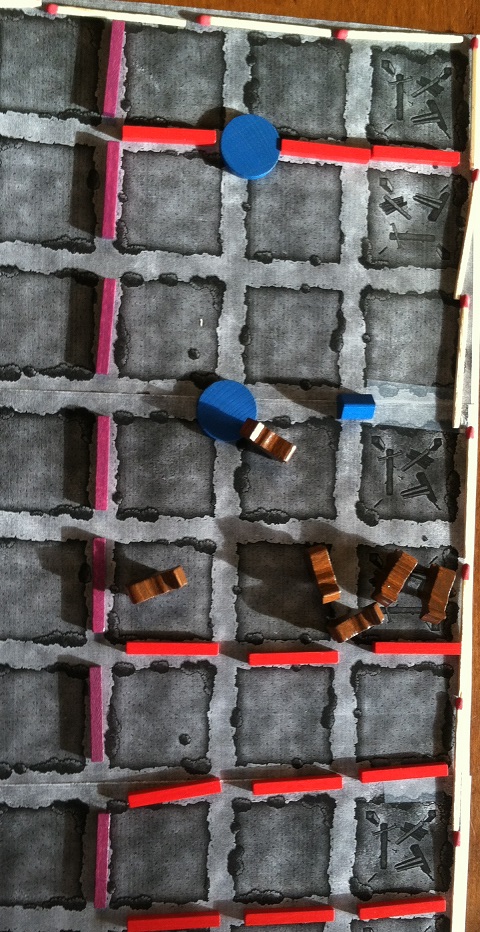
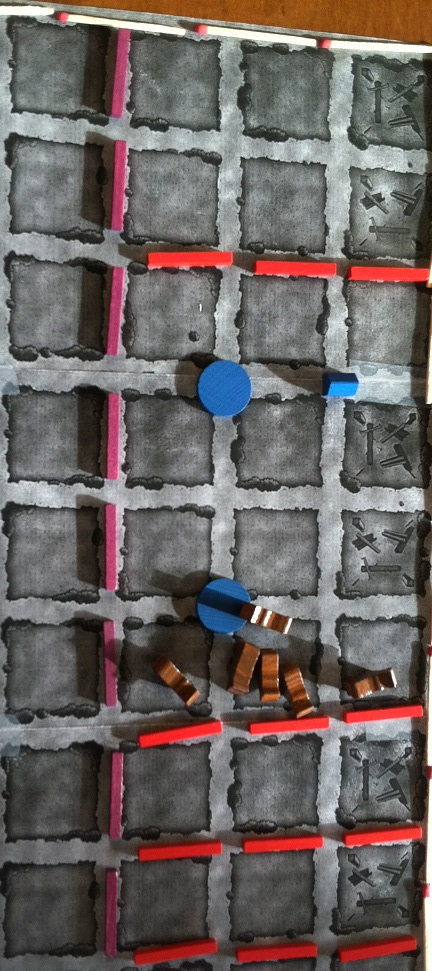
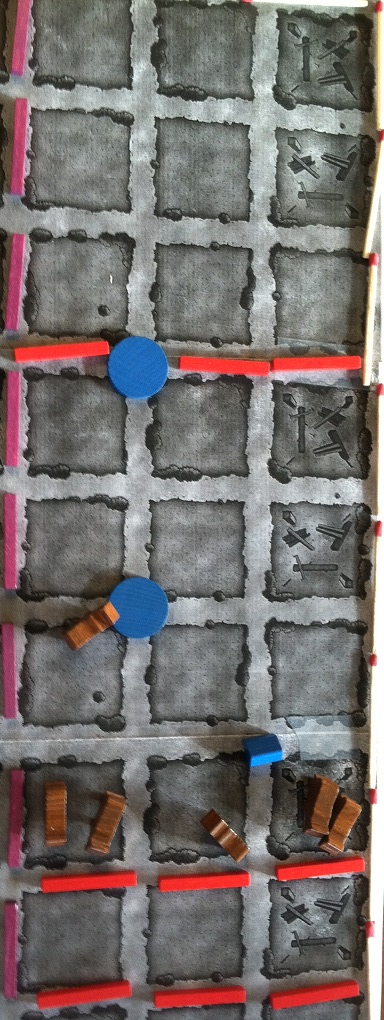
A reader asked what I meant yesterday when I said, “We are currently moving the cows daily and rolling about four days worth of grazing with them.” Those words were, apparently, not as clear as they should have been. With the help of our trusty Agricola game pieces (and a few matches) I will demonstrate what I meant. We’ll start on day 4 and roll through day 7 with the help of some toy cows. First, a quick look at what the blocks mean.

MapLegendAnd we’re ready to begin. The cows are in the corner of the perimeter fence in this illustration. They have been here for four days. For illustration purposes, each day they get a new row of three blocks. There are two watering troughs that move with the cows and a free choice mineral feeder. The lagging watering trough is allowed to go empty so we can simply carry it forward. The mineral feeder has to be dragged so we move it less frequently.

Day4

I want to point out that the cows spend most of their time on the freshest strip of ground. They get up to eat then lay down to chew their cud. What happens when a cow stands up? It manures. Cows like to lay down on fresh ground. They don’t like to lay in manure. So the cows are always moving to the fresh ground, leaving a path of muddy, manure-covered, hoof-printed destruction in their wake. The fresh ground is like couch, cupboard and toilet all in one. So they always need more.

Day5

So we move the cows. By day 5 we are beginning to fence out the first waterer. We want to let that go empty. There are times when it is entirely appropriate to dump 100 gallons of water on the pasture but not at the height of mud season.

Day6

The next day we move the cows again. They are always where the action is. The action is right up by the new fence. The back fence creeps forward one day at a time…rolling four days worth of ground forward. By day 4 new blades of grass are starting to peek their heads up. It would be detrimental to this year’s grass crop to allow the cattle to take a bite now. So we move them on.

Day7

It’s day 7 and you’re getting the idea. We have had to move the mineral feeder forward. Sometimes we fence them out of the mineral feeder for a day just to make it easier for us. The cows are always eating, stomping, lounging and manuring on fresh ground. They really only go back to get to the water. But right now I think it is important to give them the extra room, even if they don’t use it. They may face a choice. They could stand in the wet mud on a rainy day or they could stand under a tree on a bit of high ground. I would like to give them the option.

It is important for me to add that this is not our year-round strategy. It would work…ish. But it’s not what we do. This is this month’s grazing strategy. All winter there has been no back fence. We just allow the cows to move forward. Now that grass is growing again we are bringing the back fence along to protect tender young plants. When the grass starts to grow really fast we’ll start to move the cows really fast. Right now they may gain 1/16th of an acre/day. In April I anticipate giving our 11 cows 1/2 acre/day. The cows will just nibble the tips and select the choice morsels as they gear up for calving in May. When the grass growth slows the cows slow too. But that’s a subject for another blog post…or book.

Just a couple of other notes on the ground we are currently grazing. This ground was planned to be this year’s sacrifice area. The whole farm is a muddy mess, except the few South-facing slopes. To protect the rest of the farm we stockpiled fescue everywhere we could and planned to be on the flat bottom during the thaw. Next year we’ll find a different flat spot to graze in March. If it’s too wet we’ll just take the cows to the barn and feed them there but that creates an awful lot of work for us feeding, bedding and later composting and hauling the manure.

Finally, because of the amount of disturbance the cows are creating right now (which really isn’t too bad) we will allow this ground to have an extended recovery period. We will finish grazing this by April 1 and we may not return until June. Maybe even July. 60 days is a long time in the spring, keeping in mind what I said about offering the cattle 1/2 acre grazing areas while the grass is growing quickly.

Strolling Through the Pasture March 2014

The pastures are finally greening up and we still have a little stockpiled grass for the cows. Whew! Let’s follow the cows through the pasture over the winter and see what they did.

The cows started on the stockpiled pasture in January. This had been grazed in July and rested since August. The fescue was thick and tall and there was a good amount of sorgum, sudan grass, turnips and radishes in the stand. I was disappointed at how little clover came out but maybe next year. For reference, this is what it looked like when the cows grazed it in July

EarlyMorningMove

We bunched the cows up densely all winter and supplemented them with 6-12 pounds of hay each day from November first. Basically, we offered a single square bale of alfalfa in the morning and a single bale of grass hay in the evening most days, but just the grass hay when the weather was nicer. Otherwise, the cows were expected to push the snow aside and eat what they could find. It worked out great. The cows came through winter in great condition. This was suggested to me by David Hall who said he tries to feed 30 days worth of hay to his cattle, spread over 6 months. I didn’t do quite as well as that but my pastures are getting better and it won’t be long.

But this isn’t a post about cows. This is a post about pasture. You have to know the story so you will understand what we did. We put down a lot of manure. Like a lot.

March2014_1

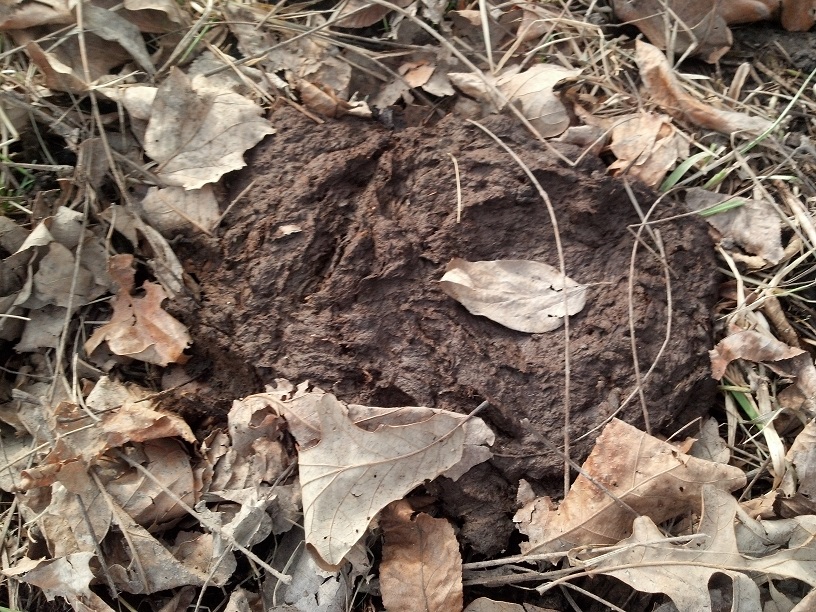
Those manure pats have been frozen for 3 months but you can see the density. By taking the hay to the cows and offering the cows fresh ground at regular intervals we have an even manure distribution. I moved the hay so I don’t have to move the manure. You down?

Turn to the right and go up the hill and we get to the remains of a big patch of turnips.

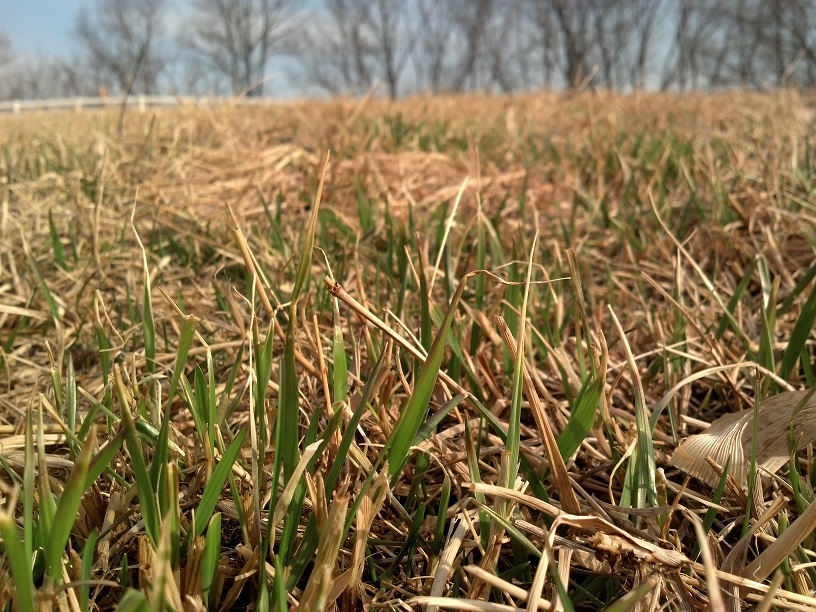
March2014_2The manure coverage is not as dense here. We had a spot of wet, cold, windy weather so the cows tended to shelter and concentrate their manure under the trees. But still, it isn’t bad. Notice the little bits of green grass coming up here and there. More on that as we go.

March2014_3Further up the hill and a bit to the west the manure coverage is better. Here the forage was stronger. Still a few turnips (which make the cows loose) but plenty to eat and a good great amount of litter covering the soil. In fact, that’s kind of a uniform thing across all of our pastures. We have a thick layer of litter over all of our pastures. Here it is particularly thick. Much of it is stems from the goldenrod stand that dominated the landscape until July but the thick grass that grew here is still protecting our soil. A few pictures from now the real value of the litter shows itself.

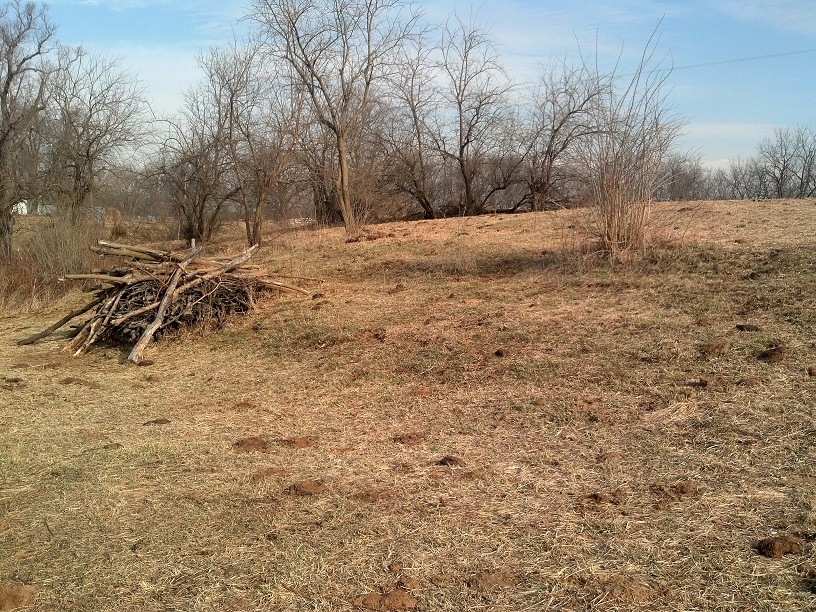
March2014_4In the picture above, I have crossed the creek and I’m looking back toward where I stood in the previous picture. I was standing up to the left of that power pole on top of the hill. Notice how green the South-facing slope is already. Also notice the manure density and the soil litter. Pay no attention to the scrubby trees, the brush pile or the small pile of metal I haven’t finished hauling out.

March2014_5This is the cemetery hill and this is what I’m talking about when I say “litter”. The cows weren’t allowed to (or interested in) eating down to the dirt. We just kept them moving along as they dug through the snow for food. As a result…

March2014_6

the cemetery hill is several weeks ahead of the surrounding farms in terms of grass growth. That’s all well and good but what are the cows actually eating? I mean grass hasn’t grown here for nearly 6 months.

March2014_7They are eating whatever grew 6 months ago. They trample dried stalks of tall weeds, crop close to thorny trees and even nibble at tree limbs. Fescue is the main portion of their diet but they eat leaves and whatever else they can find.

March2014_8

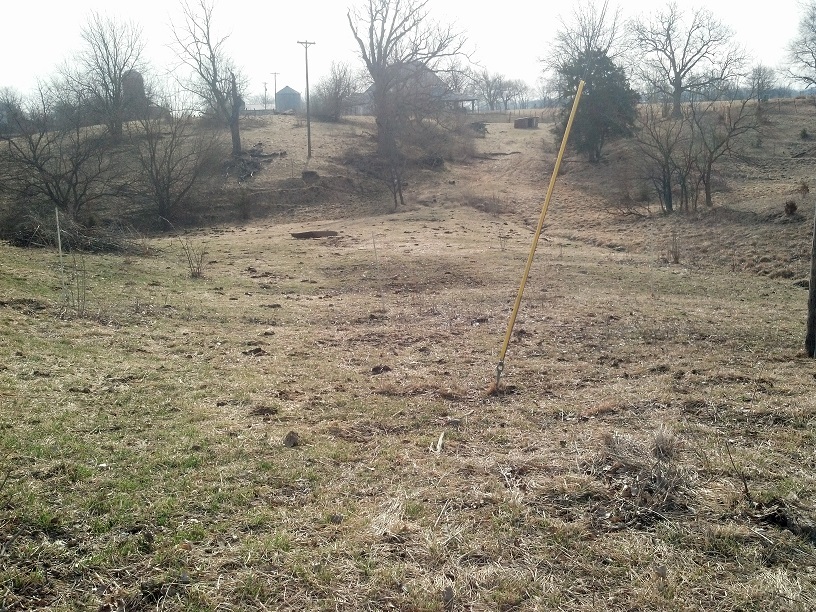
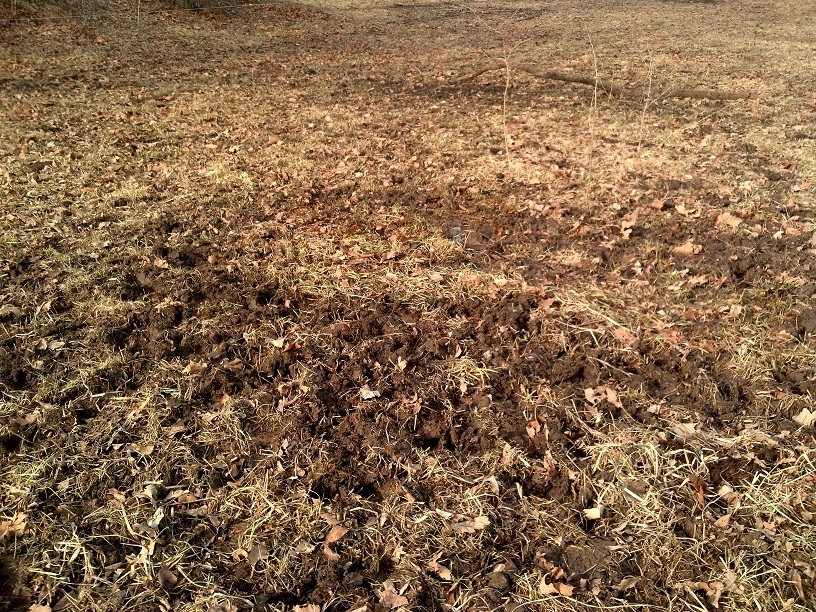
With the recent freeze/thaw cycles we have about 2″ of mud on top of several inches of frozen ground so the cows are making a bit of a mess of things. The picture above is what things look like around the watering troughs. That’s some pretty serious cow impact and will require an extended recovery time. But that’s part of the plan. I have saved this bottom ground as a sacrifice area to preserve the rest of the pasture for later grazing. This will recover and, I believe, be better than ever. We just have to give it time.

March2014_9

If you are concerned that I’m pushing the cows too hard I want to say that my cows are clean, in excellent condition and their manure is perfect. My concern is with the land. Maybe I’m pushing that too hard. I don’t think I am but I don’t want to find out I’m wrong. We are currently moving the cows daily and rolling about four days worth of grazing with them. These are currently larger grazing areas than they would have in the late summer or even than they got in December and January but the forage quality is decreased and it’s pretty muddy out there. We also try to give them room to stretch their legs. Rolling four days worth of grazing forward seems to work well for us.

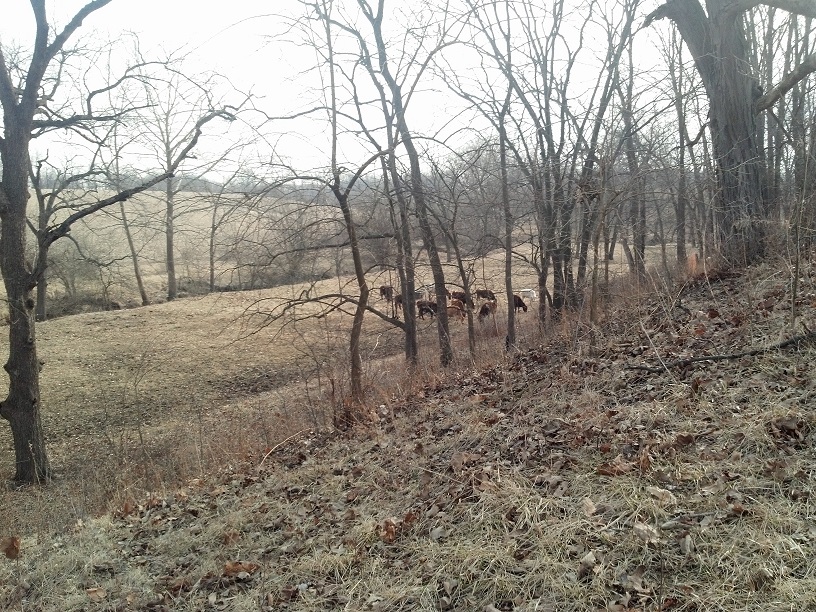
March2014_10This picture should give the reader an idea of how much space we give 11 cows. There is a line below the cows showing yesterday’s grazing line…that’s where the fence was. The white cow at the top right is almost up against today’s fence. I haven’t moved the water troughs in the picture above but generally, one 100 gallon watering trough stays at the new front fence line, a second trough lags behind. As the second is emptied I move it ahead of the first. We put a cup of apple cider vinegar in each as we fill them and the cows seem to appreciate it. We also drag their mineral box along every few days.

We have enough standing grass in the bottom to get us to April 1. At that point we plan to graze along the Eastern edge of the South pond. Then we’ll move to the draw East of the big alfalfa field. Dad doesn’t think that has been grazed in years. Decades possibly. That gives us time to establish our grasses before starting to graze in earnest. I suspect we’ll spend most of April grazing 1/2 acre per day with our 11 cows. A portion of our farm will remain ungrazed all year. A portion will be set aside for late summer and a portion will be used in the spring then rested later in the year. More detail to come. For now it is enough to celebrate that it is March and we have more grass than we can eat and hay left in the barn. It worked!

Farming Through the Low Points (Boom and Bust Part 2)

This is a continuation of a look into our farm’s history and my reflections after reading the K.C. Fed’s paper on cyclical agricultural prosperity. I admit. It’s a little nerdy. I’m trying to keep it fun though.

Look back at part 1 to see at some of the cool stories of our family history. I know just as many stories of hard times. In the ’80’s the debt on the hog floor (built in the ’70’s boom) dragged the farm down. The story is more complicated than that, as locals know, but let’s just say Grandpa made the best of a bad situation. I know it caused a pinch in the farm’s finances but money was always tight…because grandpa would always and immediately reinvest earnings back into the farm. He would improve his herd genetics, upgrade equipment, build fencing, build ponds…you with me here? He reinvested earnings…sometimes to the frustration of my grandmother. They were mostly on the same page…except a few times when she wanted a new oven, a couch or some carpeting. She built her own kitchen cabinets. I assume that was more budget than hobby but we still use them.

Sidebar – I have to pause here to explain the relationship between my grandparents as an uncle once explained it to me. My grandma was, in my grandfather’s mind, his trophy wife. The arrangement, made by her, was simple. She would keep the house, he would be a farmer. She was not a farmer. She certainly did not milk cows. She was beautiful. That was that. Apparently grandpa found that to be a favorable arrangement though he did have a sense of humor. Grandma never knew how many people to cook lunch for. Grandpa would feed the men working on the farm, certainly, but who knows who else would be dragged to the table with him. Also, grandpa considered gardening to be a part of the household. Every year he plowed up a big patch of garden for her. Or he would bring home a truckload of peaches to be canned. Grandma had a sense of humor too, though hers was more subtle.

Things are different in our house as I wash dishes and Julie milks the cow. However, as I learn more about my grandfather I marvel at his strength. He bought a tractor before anybody else had one and borrowed money to do it. Grandpa ran a number of businesses, all to support a central theme. He did row cropping, kept pigs and cattle (and brought in Limousin genetics early on), ran a feed and fertilizer business on the farm, sold Badger equipment and always worked to improve his own land, herd genetics and equipment. Along the way he positively impacted an awful lot of people (and ticked off a few). I feel like I’m weird because I ask cattle to eat grass. I can’t imagine how he felt…his entire life. Just know that grandpa feared the debt he held…and for good reason. He had seen downturns in agriculture and was always planting his earnings back into the farm. I think he would be astounded at current land valuations and heading for cover. He probably wouldn’t be selling land but he would be taking full advantage of the cattle price.

To continue, exports are necessary to pay for imports. You can only pay for products with production. If exports dry up, we are in trouble. More so if debt is involved as in the hog floor above. Grandpa stayed out of trouble by selling feed, fertilizer, equipment and livestock and working to minimize debt. But the ’80’s were hard all the way around. Again from the Fed paper:

During the 1970s, surging exports underpinned a new plateau in agricultural commodity prices, and farm revenues reached a record high. From 1971 to 1973, agricultural commodity prices jumped 75 percent and remained elevated throughout the decade.

But then…

A weak global economy, world debt problems, a strong exchange value of the dollar and trade barriers—including a Russian grain embargo—cut U.S. agricultural exports (Drabenstott). In 1986, agricultural exports bottomed at $47 billion, half the levels posted five years earlier.

Our farm bears few scars of the bad times as evidenced by the fact that there is an unbroken chain of family ownership going back to the 1840’s but neighboring farms didn’t fare as well. The father of one neighbor saved during the prosperity of the 1910’s and bought land heavily during the Great Depression. His risk and prudence set his family up for lasting, generational wealth that benefits them to this day. But there were necessarily folks who either didn’t save in the good times, had it worse than others (losses to illness or war, bad business bets, etc.), sought other opportunities with their capital or otherwise gave up on farming. But, apparently, the largest problem was debt. Once again referencing the K.C. Fed:

During the 1920s and 1930s, the collapse in farm incomes and land prices led to a wave of farm bankruptcies. Facing higher interest rates and lower incomes, many farmers struggled to service the debt they accumulated during the 1910s farm boom. The result was a surge in farm foreclosures during the 1920s and 1930s (Stam and Dixon). According to the U.S. Census Bureau, at its worst, almost 6 percent of U.S. farms were sold in 1933, with 70 percent of the sales due to foreclosure.

The ’80’s saw another wave of farm transfer. If you look at the local plat book there are fields that are owned by the local banks and have been since the ’80’s. What happened? More of the same.

The debt accumulation of the 1970s contributed to the economic calamity of the 1980s. By 1982, when interest rates spiked as the Federal Reserve tightened monetary policy, farmers had more debt than they had capacity to service with their existing cash flows. The result was a farm financial crisis, a rise in farm bankruptcies, and the 1980s farm bust.

With shrinking profits and higher real interest rates, farm asset values and capital expenditures plummeted. After peaking in 1981, the average price of farmland dropped more than 40 percent by 1987, returning to 1960s levels. The farm bankruptcy rate spiked, topping levels experienced during the Great Depression. Capital expenditures on machinery, equipment and land improvements dropped 70 percent below the 1970s highs.

This was exasperated by increased productivity on farms.

Agricultural production expanded as farmers planted “fence row to fence row” and productivity gains emerging from the 1970s “Green Revolution” boosted yields. Weak demand and bin-busting supplies placed downward pressure on agricultural commodity prices, and gross farm revenues fell to 1960 levels. With elevated production costs, farm profits declined. By 1983, returns to operators were roughly 10 percent of the 1970s high.

I would like to point out that this is nothing new. It also happened before the turn of the 20th century (emphasis mine):

The most serious problem by far was low prices.  One can approach this problem in a number of ways, but, simply put, low prices resulted from the fact that the supply of farm goods was growing much more rapidly than the demand for farm goods, which meant that farmers had to accept lower prices for their products over time.  Now it is true that the general price level in the United States was falling through much of the late nineteenth century, but, even in this period of general deflation, farm prices fell more than prices in other sectors of the economy, which hurt farmers in a relative sense.

Low prices hurt farmers particularly hard because many were debtors.  In a deflationary economy, it is especially difficult to repay debts because the real cost of a debt rises as money becomes harder to come by.  During the late nineteenth century, as more and more farmers commercialized their operations, specialized and mechanized, they often took on significant levels of debt, which became harder and harder to repay.  As a result, many lost part or all of their farms, leading to a great rise in the number of tenants and sharecroppers, on the one hand, and the movement of many farmers out of agriculture altogether, on the other.

Back to the story. Things got pretty tight on the farm several times but I never heard Grandpa Tom complain. I mean that. I never heard my grandpa complain. Plastic knees, prostate cancer or blown engine in a tractor…he just took it all in stride. Grandpa said they weren’t aware of the Great Depression, they had plenty to eat. Because of his father’s illness and a mentally handicapped older brother, grandpa was head of household and couldn’t go to war for WW2. The only problem I ever heard of was in the ’80’s but grandpa was able to cover the loan for the hog equipment – though I don’t know how – and I never heard him talk about it. At the same time I watched an uncle refinance his land repeatedly until finally selling his best ground to get out from under it. Farmers were so discouraged through the ’80’s they stopped buying. Either they were convinced that the downward trend would never end or they were buried under a mountain of debt. That’s how my coal miner father became a land owner. Farmers weren’t showing up to buy so, on grandpa’s suggestion, after a whole lot of prayer, thought and worry, mom and dad did.

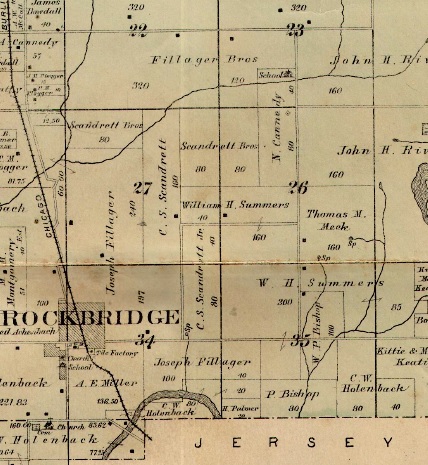
Obviously my grandpa is a hero to me but he wasn’t the only area farmer to survive the ’80’s. In fact, a number of farmers were able to expand. Just like in other downturns. To contrast that, Julie’s great-grandma Alice married a Fillager late in life. The Fillager family owned 1,000 or so acres 1893. Much more land later.
Fillager

The Fillager siblings didn’t have children of their own so the estate was auctioned off little by little following funerals. Some of that wealth was donated (war bonds), hence the Fillager clinic in Greenfield. I have friends who own Fillager ground (and everyone was convinced there was gold buried on the property so they kept after him for years, “Did you find the gold yet?” He denies finding any. Of course.) Some of that Joseph Fillager land was owned by Julie’s grandparents until the ’80’s. Julie’s parents had several acres until around 2002 but they sold and moved to town. Julie has a great-aunt who still owns a large portion of the farm. Otherwise, it’s all gone. Over 100 years of unbroken family legacy…no family to give it to.

There were financial mistakes made along the way. There was also a genetic dead-end as no Fillagers had kids! Same thing happened on the other side of Julie’s family. Julie’s grandpa grew up poor. His stepmother did not. My understanding is she was part of a prosperous farming family. Her brothers stayed home and farmed and expected her to do the same. Nobody had time for family. Later in life Ruth found a family in need of a mother. Julie’s great-grandma Ruth left the prosperous farm behind and, in the process, lost her claim on the estate (please correct me in comments if I am mistaken here). I guess her siblings held the farm together while they lived but the family legacy ended. There was no next generation to own and work the ground. I’m not even sure where their farm was now. Or Julie’s grandpa’s farm. I don’t think there are even houses at those locations now.

Clarence and Ruth (Mitchell) Ashby

All good things come to an end. It happens. I have the next generation thing covered but how can I keep our heritage in place through the downturn that is eventually coming? And what can I do to positively impact my neighbors so the whole community can weather the storm? Nobody wins if the banks own all the land, not even the banks. They are in the business of loan origination (money creation) not land management. And short-term tenants are hard on the land. In the book Family Wealth the author is discussing drawbacks of perpetual trusts (and I don’t think it’s a stretch to suggest that this thinking holds true to land owned by banks).

…[lands held in perpetual trust] were often poorly administered, because they had no owner who cared about their improvement, since he or she would never own them outright. Many life tenants sought to receive the maximum annual return possible without regard to such a policy’s long-term effect on land’s productivity.

Low prices could crush us…could crush me indirectly. Our friends at the Fed are freightened of deflation. They are working to do everything they can to keep the money flowing through the economy, not just in terms of currency supply but also in terms of velocity. But if it’s not enough…well…then what? What if the dollar strengthens and American agricultural products are more expensive (because of currency valuations) than those of other countries? I’m no mercantilist but I can see the effects on our current way of life. Even the supposedly favorable ratio of debt to equity carried by current farmers could turn sour in a hurry. I have to work to minimize my exposure to those risks by focusing on providing value to customers, lowering my production costs, minimizing my exposure to debt and putting away some cash for a rainy day.

But I’m getting ahead of myself. Farming has seen some rough times. Debt has drowned many farming families. I’ll do what I can to lay out our plan in my next post.

When to Harvest Money (Historical Highs and Lows of Farming Part 1)

I found a 2011 paper by the Kansas City Federal Reserve titled, Agriculture’s Boom-Bust Cycles: Is This Time Different? What a thought-provoking read. Let’s skip to the end. No. This time is not different unless you mean worse. Now, let’s look through their paper together and talk about a few interesting things. (So interesting I had to break this up into several parts.)

The Fed’s paper looks at agricultural boom and bust cycles over the last 100+ years. Not only can I see evidence of those cycles on my own farm, I can see evidence of them in my plat book. In fact, if we leave the paper behind for a moment you can see a timeline that illustrates the changes over time here (link). Notice the entry from 1889-1919 is called simply “Farm Prosperity”. Some of this was, apparently, the result of increased farm productivity. Farmers were able to grow and sell surpluses rather than just work for subsistance as noted in the transcript of a speech by Peter A. Coclanis:

During the period between the Civil War and World War I, we find other changes in the agricultural sector as well. American farmers became much more commercialized in this period, offering more and more of their annual output for sale on local, regional, national, and international markets. Put another way, there were fewer and fewer subsistence farmers and fewer and fewer farmers striving for, let alone achieving self- sufficiency.

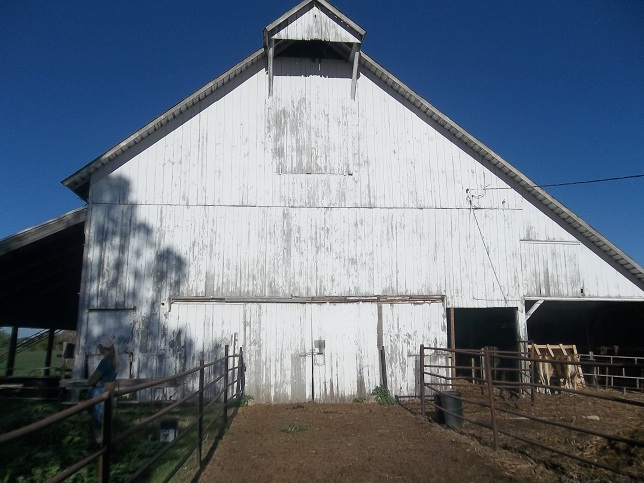
This period of prosperity is obvious on our farm. The main part of our house was built in 1911 by Dick Chism (my great, great uncle). Our big barn was built in 1914 by men hired by uncle French and my great-grandfather Charlie (all brothers).

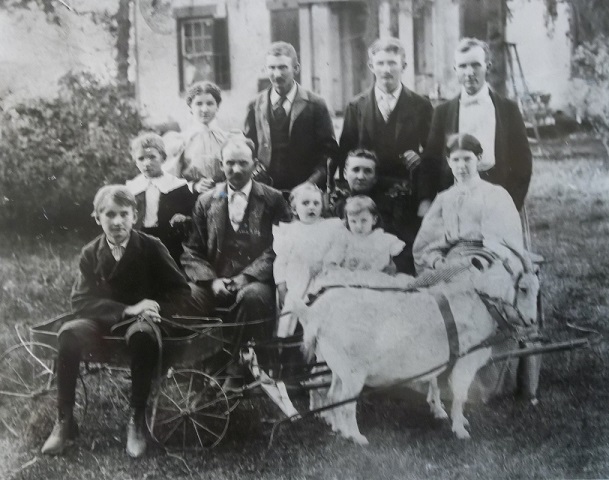
FamilyAmerican farmers were productive at that time and the world (which was at war) needed our agricultural products…anything from wheat to mules.

The British Army also purchased a large number of mules from the USA. The mule has amazing stamina and endured the terrible conditions in the front-line better than the horse. At the end of the war the army owned 213,300 mules.

But the Great War ended. Cars became cool. Europe could focus on feeding themselves again. Not only did a large portion of our agricultural exports cease, our need for livestock feed fell off because we had fewer animals in harness (and thank God). So more of the ground used to grow livestock feed could be used to grow grains for human consumption. This led to huge surpluses in crops and a crash in agriculture. From the K.C. Fed Report:

Farm prosperity, however, was short-lived as global food production rebounded, export demand collapsed, and farm incomes fell. With the conclusion of the war, export demand faded. By 1922, U.S. agricultural exports returned to pre-war levels, slashing agricultural commodity prices by 40 percent from 1919 to 1921. Returns to operators plummeted.

Moreover, the industrialization of U.S. agriculture through the adoption of the tractor and other mechanized equipment reduced the need for feed grains for draft animals. The combination of weak exports and increased food grain production led to another collapse in agricultural commodity prices and profits during the early years of the Great Depression.

But nothing brings high prices like low prices (the inverse is true too) and nothing generates demand for food like hungry people. And when the world went to war again we were busy feeding the world. Farming became valuable again. Again from the Fed notes:

Similar to the 1910s, World War II sparked another farm export and income boom. A surge in wartime food demand boosted U.S. exports through the 1940s. After bottoming at $4.3 billion in 1941, real agricultural exports quickly rose to $25 billion by 1944. Similar to World War I, a wave of livestock exports fueled U.S. export growth during the war, while crop exports increased moderately.

The paper goes on to note that exports remained high following the war and into the ’60’s. In what must have been around 1937 (at age 16) my grandpa borrowed money directly from Oliver to buy a new Oliver 70…the first tractor in the neighborhood.

Sidebar – This story is a part of my own life because around 1984 my grandma wanted to buy a dress. Grandpa said they didn’t have the money for a new dress (we’ll discuss the ’80’s next time). In spite of the cash flow issue grandpa went to a farm auction and came home with a rusty old Oliver 66. Grandma, at least slightly angry, said, “Tom, what is that?” Grandpa, knowing he was caught, said, “um…that’s for Christopher. It’s…ummm…like the tractor I started with.” Some time later we went to the farm for a visit. Before I got out of the car grandma was on the porch yelling for me. “Christopher, go to the machine shop and see the tractor your grandfather bought for you!” You can imagine my shock! Apparently grandpa was shocked too. He stood, defeated and staring at his feet as I ran off to the shed. I have had that tractor for nearly 30 years now. Dad restored it when I was a kid. Truth be told, it’s more of dad’s tractor than mine…or it’s a memory we share. He has something apart on it even now.

Shortly after grandpa bought that first tractor, my great-grandfather and all of his sons sold their horses. The story goes that my great-grandpa got sick (had a stroke?) and grandpa Tom had to take over the farm. He got the tractor and earned $1/acre plowing the neighbor’s fields. Everybody saw the productivity gains available with the tractor and grandpa’s business only lasted one season. My great-grandfather wasn’t having any of it. By reputation, he was a little hard-headed and demanded that men work hard because men should work hard. (That notion may be countered by the story that my great grandpa bought a car but couldn’t drive it. So he told my pre-teen grandfather learn to drive.) I guess my great-grandpa Charlie recovered enough that the two of them decided to go out and plow in the spring, grandpa Tom with the tractor, his father with the horses. By the time lunch came around my great-grandpa decided it was time to unhitch the horses forever. Grandpa Tom claimed to have little use for horses, just as his sister is shocked that we milk cows (lol). Guess they were done doing things the hard way.

pond

Grandpa went bananas building ponds and bulldozing the world around 1955. At one point he even moved a creek bed! I have heard that neighbor teens (who are all grandparents now) would gather and swim at the beach on the pond. Water lines were trenched all over the farm (and are now overdue for replacement). In the ’60’s my grandpa’s cousin built an addition on to the house. We have some nice pictures of my parents wedding reception in that room as well as family reunions and Christmas dinners every year. That’s the room our wood stove is in now. All that stuff and all of those memories were built by a time of agricultural prosperity.

Reception

When dad first came to the farm grandpa was still farrowing pigs on pasture. There is a story of a big rain flooding the pastures surrounding my house and washing away pigs. So in the late 70’s grandpa and his hired man built a concrete hog floor and a pig nursery at the home place. This was top of the line stuff at the time. The floor and slurry pond are still there, though overgrown, and we use the pig nursery as a chick brooder (and it’s awesome!).

Look at all the wealth that has been accumulated on our farm over the last 100 years. The infrastructure changes line up perfectly with the boom periods outlined by the K.C. Fed. But I have left out the busts.

Every boom is followed by a bust. The views are great on top of the mountain but the fruit is grown in the valley. At least if you are optimistic about low points. At certain points, my ancestors took money off of the table. Rather than spend that money they made infrastructure improvements and parked that wealth in the farm itself. This is like planting a tree knowing you will never rest in its shade. This is planning for abundance in future generations.

Barn

Come back next time and I’ll tell you about the low points in our own farm’s history, how grandpa held things together and I’ll share some of the neighborhood history. I can point out 20 barns nearby that are roughly the same age as ours. Not very many are still owned by the builder’s family. The Fed paper says there is a reason for that. Debt.

The Purpose Trumps the Plan

Years ago we established a family mission statement. A number of books we have read emphasized the need for this but The Thomas Jefferson Education got us to actually do it.

The Jordan Family Mission:

We work together as a team to steward God’s resources, create a welcoming home, share with others, encourage one another, learn and explore new ideas and pursue our God given purpose.

That should be seen as a work in progress. In fact, it is still in draft form and is revisited regularly. But what is included? Cows? Pigs? Money? Only as “God’s resources”. Money, that great bug-a-boo, is a means not an end. The end is learning and personal development. Enlightenment. We use money to buy books and to heat our home so we can read in comfort. It’s just a tool. The cows are a way of caring for the land and generating a little money (so we can be warm and can buy books). Cows are just a tool. A means not an end.

feb cows

We don’t bother to name tools in the mission statement. We don’t specify plans either. The mission statement is the what, not the how.

I have this vision of what could be. A preferred future. I have written about it before so I’ll just go on. I have a plan to get there. 11 cows today. 5,000 cows tomorrow. Simple as that. Oh, along the way I’ll have to learn about sales, I’ll have to accumulate more land, time will pass, money will be lost, money will be made. Then I get old, they bury me in the family cemetery and succeeding generations continue to succeed. The Jordan family grows to eclipse the Rockefellers.

No plan of battle ever survives contact with the enemy
-Helmuth von Moltke

The cold, hard reality of the world can’t be planned for. My detailed, step-by-step agenda could include my great-grandchildren building long-range ships to ranch all of Mars. Will it happen? Is that important to the objective? Cows on Mars is not the objective. Honoring God, welcoming people and seeking personal growth is the objective. 

So if the plan goes awry…well, we’ll survive. If we fail as farmers we are still a family. If we fail as a family the farm won’t be needed. What is important here?

What is important is that each of us see the big picture.

Plans are useless but planning is indispensable
-Dwight D. Eisenhower

Since we have a farm we should try to do something with it. So we make plans. These plans don’t make or break our family. Julie plans to get rid of clutter on a weekly basis. Is that time wasted if the house burns to the ground or is carried away by a tornado? I don’t think so. The weekly exercise has forced her to change her thinking about our possessions. It has helped her to focus on the objective and certainly helps make a welcoming home. But the weekly exercise is not the goal. The welcoming home is the goal. By planning to clean a little more each week we inch closer toward our objective.

The focus is not on the plan. The focus is on the purpose.

The cows are part of the plan. The cows are not the purpose.

Cleaning the house is part of the plan. A clean house is not a purpose.

Money is part of the plan. Money is not the purpose.

Johnny Cash’s music is part of our family cultural heritage. Johnny Cash’s music is not our family purpose. (lol)

It is not always so easy to distinguish plans from objectives…especially when emotions come into play. But I think we are off to a flying start.

Now what?

Now we pray/hope/teach our kids to recognize the objective. We make a few plans. We turn the next generation loose and get out of the way. The most important thing I can do is to give control to the next generation as soon as possible. I am beginning to notice that I am not as fearless as I have been in the past. Maybe it’s time to move myself to an administrative position in our organization. I am reaching the point where I am no longer fit to lead the troops on the front lines. I have raised a generation of creative, intelligent, hard working children. Their intelligence and creativity exceeds my own (thank God). Our objective is personal development. The farm is the incubator for that development. It’s almost time for them to fly.

If I retain control the farm will stagnate. We’ll have cows. We’ll have chickens. We’ll have pigs. I’ll blog. I’ll write books. But what won’t I do? We will continue moving toward our purpose but the toolset will be limited. The kids may continue the livestock but add in Android applications, cookbooks, automated cattle fencing and a series of rental cabins on the farm. I can’t even imagine what they will come up with…and I’m excited to see it.

feb dot

So rather than close them out, rather than force them to move on and seek funding for their own ideas, I would rather move into an advisory role. To offer them counsel and financial enhancement (but not dependence!). College? Sure, if you want. Seminary? Sure, if you want. Recording studio for a podcast? Sure, if you want. Come up with a plan. Show me how it fits into the overall purpose. Even if the plan fails, the purpose remains.

And my children know our purpose. We defined it together.

We work together as a team to steward God’s resources, create a welcoming home, share with others, encourage one another, learn and explore new ideas and pursue our God given purpose.

Kids, I’m here for you. I love the work we do together. I hope we can always work together. And I’m excited to see where you take it next. Whenever you are ready. We’ll fulfill our purpose together. And as soon as possible, pass it on to your children.

Beyond The Thomas Jefferson Education, the following books have been valuable in directing our family purpose:

You might think it’s funny for po’ folk like us to read books with lofty titles like those. It’s not funny. It’s inspiring.

Also, portions of this post were influenced by this series. Hats off to Project Managers everywhere.

Should I Sell All of My Cattle?

It is interesting how people find my blog. Various search engines bring in a lot of traffic. Someone was searching the internets for an answer to the title question. That has inspired me to write a little bit.

Should I sell all of my cattle in 2014?

There are a lot of variables in that. It’s like asking if you should go ahead and buy that Plymouth DeSoto.

I’m not interested in owning a Plymouth DeSoto at any price. But they do have value…which means they are valued. Should you buy one? I dunno. Do you want one? Do you have the money? Where are you going to park it? What will your spouse say? What is the plan?

But there is so much more to it than that. In essence the reader is asking, “Is it better to have cash or cows right now?”

I’m going to switch gears and talk about eggs and dollars briefly. Dollars are a product. Eggs are a product. But dollars are infinitely liquid, eggs are less so. For example, anybody can give me $4 and I’ll give them a dozen eggs. But not everybody will accept a dozen eggs in exchange for $4.

Dollars are infinitely liquid, cows are less so. It is unlikely that I could trade my cows for a Plymouth DeSoto. But you can’t eat dollars. So the question becomes, after you sell your cows, what will you do with the dollars? Do you just want to stack them up in your house? Maybe build a couch out of $100 bills? That wouldn’t be very comfy. And I doubt there are any real women in red dresses that would lounge seductively on a stack of paper.

100Couch

Click image for source. No, really. It’s worth your time.

So what do you do with the money? I mean, before you do something you should decide what it is you are actually going to do. You probably don’t want the dollars. You want the convenience of the dollars…their near-universal acceptance. You might hold dollars for a period of time but you aren’t going to make a couch with dollar bills. You are eventually going to buy something with them…and probably not a brunette in a red dress. Cows? Grass? Pasture? Dollars? Plymouth DeSoto? The idea is to put your resources to their best and highest use. If not cows, then what? Could make for a fun night at the casino but is that what you want? Because if you swap out the cows for cash and don’t have a plan…well, you may as well have a good time. What is the marginal utility of a hangover?

Rather than focus on getting out of the cattle business you need a plan for getting into the next thing. Trading cows for cash may accelerate your efforts…if you are going somewhere. If he/she has some culls to spare, this is a chance to get a great price on sub-par genetics! Maybe A. Person meant to type, “Should I sell all of my cattle and buy cattle of a higher quality.” OK. I have heard of a number of ranchers who have sold out of the cow/calf business because they believed calf prices were abnormally low (so calves produced were not covering costs). They sold family herds that had taken generations to build to buy heavily into cheap stockers. Then when the market skewed the other direction they quit raising stockers and bought a nicer herd of cows than they had owned previously…making money on every trade…always looking for the class of cattle that were relatively undervalued. Not just selling the cattle, trading one appreciating asset for another with dollars in the middle.

But let’s assume A. Person doesn’t want to sell out completely. As I mentioned earlier, high cattle prices are the time to cull out the worst of your herd. When prices go down again (and they will…and maybe by a lot…and maybe for a long time since this cycle has been up for a long time), buy in quality again. If that’s the plan, sell some cows now.

Or maybe none of his cows bred this year. Sell them.

Or maybe he has noticed his cows can’t perform in the absence of corn, Ivermectin and alfalfa cubes. Sell them.

Or maybe he is just looking for a new opportunity. Sell them.

In fact, if you are asking the question at all…the answer is yes. Do it. You obviously want to sell them. Go. Carpe some diem. Don’t look back. Embrace a brighter tomorrow for you. Just get the cows out of your way. There is no obligation with cows. It’s not a marriage. They aren’t children. There is no business contract. Do what you need to do to move onward and upward. Devise your plan, make it happen and cherish the consequences!

Maybe that’s just me though. That’s kinda how I tend to run. Always looking for deep water to jump into and dealing with the results.

Should I sell my own cattle? Nope. They are part of the plan. Should I train up my son to take over control of the cow herd when he turns 15? Sounds great to me. I’ll move onward and upward to the next thing. He will be the “Head Farm Steward” and I will move into an advisory role. Awesome. I have a plan for that…should it come to fruition.

Should you sell your cattle? The better question to ask is, “What am I going to do next?” because my response is, “What’s the plan?”

Going Easy on The Cows, Hard on the Future

Are my cows bred? I dunno. Some of them are really starting to show. Others? Well, I dunno. 19 bellows and stands at regular intervals. She’s not going to make the team. 27 and 70? Dunno. I have never seen any sign of heat from 70. Ever. At all. But she’s not showing. At all. I don’t think she’s a freemartin so I don’t know what’s up. I guess I should just invite the vet to preg check them for us.

So what if some aren’t pregnant? Well, then they don’t get to stay on the team. I bought these cows off of hot feed, not from a grazing herd. The odds are against them genetically. That’s why every grazing expert you talk to says to buy cows from an established grazing herd. It is expensive to return cows to eating grass. Isn’t that an odd thing to say?

I am not in the business of providing cow retirement. I don’t need cows to eat grass. I need cows that can reproduce while eating grass. I need to increase beef production per acre while reducing the amount of fuel that goes into each pound of beef. That’s what I need. Rather than spending money on tractors, balers, rakes, conditioners, barns, hay elevators, wagons, (this list could go on for a while so let’s just sum up and say “iron”) I am investing in cows. Some investments turn out great. Some investments don’t. But over time I can breed toward a greater tendency for success.

“But”, asks my father, “what do the cows need? Surely a little oats to warm them on cold nights wouldn’t be a bad thing.”

It wouldn’t. Not if these were pet cattle. But I’m not raising pets.

What does a cow need? Boil it down to the absolute essentials. Forage, water and a little salt. Barns are not for cows. Barns are for storing feed and for feelings…as in “I feel better that my cows don’t have to stand in the rain.” Or barns are for status…as in, “Look at those nice buildings. That’s a successful farmer!” That’s what you see from the road. What you don’t see from the road is the amount of time and resources used to build and maintain the buildings, the debt gained to have the buildings and the vacation days burned to repair the buildings after a wind storm.

BarnDamage

I’m not interested in status. My kids think I’m cool. Good enough. The more stuff I own the more stuff I have to fix. I don’t want to fix stuff. I want to play with my kids, read books and sell cows. But I do store a little feed. To some degree, I regret having hay in the barn. Who works for who in this deal? Do I work for the cows or do the cows work for me? I sweat, sneeze and cough in May, July, August and sometimes September to put hay up there. Then meter it out as winter passes, a little at a time, to …well, to do what exactly? My cows are still grazing grass we grew last summer. I guess I give them a small portion of their daily feed in hay as a treat. Same as my dad suggesting that they would like a little oats.

Shoot.

Let’s be completely fair about hay though. I don’t think anyone would argue that I should own zero hay. I would like to go years without feeding any hay though. We are expecting a serious ice storm this weekend. With events like that coming it makes sense to have a little hay on hand (and the barn roof repaired). But feeding hay every day when I have acres of fescue out there doesn’t make sense, except that my pastures currently need a little help. They were overgrazed and under-rested for decades. But they’ll come around. Will I come around? Or will I continue feeding a little hay in the winter out of habit?

Fencing is another example of my needs vs. cow needs. I have several neighbors with 7-wire high-tensile fences. Those are dang-near deer proof! Oh, how I would love to rip out my fencing and start fresh…properly follow keylines, get rid of the barbed wire and make the farm look nicer! But do I need that? My cows are rarely against the perimeter fence anyway. The perimeter fence is really just insurance. I bought several rolls of high-tensile fence a few years back but haven’t built the fence. I would rather have the cash…so I could have more cows. Cause this is a cow business. Not a fence business.

Will all of my cows respect a lesser fence? Will all of my cows thrive on pasture stockpile? Will all of my cows reproduce without supplemental grain? Nope. They won’t. But the ones that don’t are not a good fit for our program…obviously.

What kind of cows do I want? Do I want infertile cows? Nope. Do I want to haul in grain? Nope. Do I want to put up (or even buy in) hay? No more than I have to. Not every cow can make it without grain. Not every heifer will breed early and often. Those who don’t make the cut won’t stick around to drag down the herd of the future.

From today’s Pharo Cattle Company update (I realize it’s an ad. But it’s also right on.):

When you need a bull, who are you gonna call? There are hundreds of seedstock producers who would love to sell you a bull, so how do you decide where to go? Do you look for a place with pretty white fences, big buildings and busy feed trucks? Do you look for someone who places expensive four-color ads in all the beef magazines? Do you look for a producer who displays over-fat cattle at the stock show? Or… do you simply look for the cheapest bull that meets your basic color requirements?

If you’re in this business for the long haul… you need to purchase your bulls from a seedstock producer who demands more from his cattle than you demand from yours. If they don’t demand more from their cattle, they will NEVER be able to improve the genetics of your cattle. Unfortunately, nearly all seedstock producers have a pampered herd of high-maintenance cows.

The goal is to capture solar energy and convert it into beef and increased soil fertility. The goal is not to own big barns and big tractors. Will a little grain and hay hurt? Well…yes. It will cost me money (that I could use to buy better cows) and it will cost me time and storage resources and, worst of all, it will cost me the chance to find cows that will thrive without. We are seeking solar power. That means some cows won’t make the cut. And good riddance.

Now, how can I figure out which cows are pregnant without getting elbow-deep in the question?

Internal Predation

We brought our pigs home late in January. They were 60 pound pigs at the time.

Because winter has been so harsh we thought the best place for them was in the greenhouse with the chickens. Salatin gave a presentation (The one I’m thinking of was at UC Berkley in 2005 but the link appears to be broken) where he says at 75 pounds the pigs get a hankering for chicken legs.

Pigs

Well, that only took two weeks. We now have one less New Hampshire pullet.

I can’t afford to feed my layers to my pigs. The pigs just aren’t worth it.

So off they go. We wheelbarrowed the pigs out to the shed with just two days of negative temperatures remaining in the forecast. We bedded them on the remaining bedding from the previous batch of pigs we shipped out about a month ago. There is a good pile of straw they use for a nest on cold nights.

They are dry. They have a warm place to lie down. They have food. They have water. They don’t have chicken dinners. I wish they were still in the greenhouse though. Maybe I’ll figure something out for next year. More that that, I’m counting down the days until the pasture thaws and firms up.

Satisfying My Inner Weird

I took a vacation day yesterday to finish getting our chick brooder ready and cut some firewood for next year. I also took care of a few odds and ends around the farm. Finally, the thaw and rain have caused a little flooding so the cows had to be moved to higher ground. Thank God I still have stockpiled forages up high! I haven’t been writing much lately because that’s just how the days have been. I get up, I work. I finish working, I go to bed. I try to make time in there to just hang out with the kids which means I am not writing. 

A friend at work asked me if I had fun on my vacation day. “Yup. I did. I cut a bunch of firewood! I’m really sore today too!”

She replied, “That doesn’t sound like fun.”

My inner weird showed up again in an email to a friend. I have convinced him that he needs a couple of pigs to boost fertility in his yard and garden and help cycle resources that otherwise go underutilized. I said, “If you haven’t met me, I’m all in favor of boiling something down to its essence. You might call it “oversimplificaiton”. Further, I don’t scare easily. And I’m willing to endure significant pain to get the desired result. Let me give you an example. I could save 70% of each paycheck if I just had a modest home in the suburbs. That money could be invested in any of several index funds. With all my free time, I could write books about homeschooling or family government. But instead I’m pouring all of my money and time into a farm, driving 3 hours/day and fighting to keep animals alive so I can kill them in the dream that farming will at least prove to be a wash financially.”

That’s a frightfully honest assessment of my situation. Maybe cynical…but still…not dishonest.

I wish I could write more. Lots of neat things are happening around the farm and I would love to show them to you. This morning there were small, green blades of grass behind where the cows have grazed! You should see the manure the cows put down in the pasture as we strip grazed through the snow! But then, there’s that inner weird again.

StripGrazing

We have lived in the suburbs…within distance of pizza delivery. I have cut the grass and washed the car. That’s a sweet gig. I have chatted with neighbors over the fence and discussed our favorite sports teams and ribbed each other’s joking inadequacies. It was fun but I was bored. Unfulfilled. It was like I was waiting for something to happen. Try as I might, I couldn’t make it work. My inner weird was always lurking…ready to shock the world. “I was thinking of pulling out the burning bush and replacing them with blueberries. They would still be pretty but would also give us fruit.” Somehow (and I really don’t understand why) that was just the wrong thing to say. For reasons I still can’t fathom, food can’t come from people’s yards.

So here we are. Too busy to tell you about it. Still as weird as ever but with a 60 acre yard and lots of food.

The Way I See You. The Way I Love You.

When I was 16 I saw you for the first time. You were beautiful. But I didn’t see you on that first Valentines day. You weren’t my girlfriend. You were just some girl at church and school. Pretty, yes. But just another girl.

On Valentines day of 1995 you were much more to me. You were acceptance. Appreciation. Affirmation. My 18 year old eyes didn’t see you that way but that’s what you were. And I thought I loved you. I had no idea.

In 1997 we were married. I’m embarrassed to say I saw you as an object when we were first married. Certainly we were still friends and were supportive of each other but I didn’t see that. I just saw, and appreciated, your beauty. On Valentines day of 1998 I thought I loved you. I had no idea.

Wedding1

When I was 30 we renewed our vows. Events in our lives had drawn us very close together. I thought I loved you then. I had no idea.

Wedding2

Now it is 2014. I have seen you nearly every day for 20 years. (Kissed you nearly every day for 18 years.) What I see has changed over time. Not changed. Evolved. As has my understanding of the word “love”.

We have changed. Our relationship. We grew up together and have grown together. Our paths have merged more fully. When we were first married we were two people sharing some stuff and time. My concept of “closeness” had more to do with proximity than with emotions. I thought we had arrived! Woo Hoo!

I had no idea.

Valentines day is not just some made-up holiday to sell cards and chocolate. Valentines day gives me an official excuse to stand on a mountain and proclaim to the world that I love you. But I don’t have a mountain. I have a blog. (Thanks Ron Burgundy). I love you so much more than I did when I was 18. I have outgrown that love. I have outgrown the love I had for you when I was 30. I had no idea what love was. And now, as I stand at the edge of 38, I see more clearly what we are becoming.

Christmas

Becoming.

I thought I had arrived when we swapped rings 16+ years ago. I thought we had arrived when we bought a house. I thought we arrived when we had kids 1, 2, 3 and 4. I thought we had arrived when we moved to the next house. Or the next house. Or the farm itself. We have not arrived.

We are still traveling. Together.

I wouldn’t trade you now for the “you” of 10 years ago. I need you as you are now. In another 10 years I’ll know you so much better. You will teach me more about what “love” means. I’m excited about how I’ll see you in 10 years. But I’ll wait.

I have no idea what is next. I know where we are aiming. We have written down our shared goals. I know what we are trying to do. But today we are here.

And I’m so happy to be here – right here – with you now.

I love you Julie Boo.