Literally a Broken Record

Remember records? Not like a record for underwater pogo jumps but records…music…needles. Skip, repeat, skip, repeat. I have a nice copy of Led Zeppelin 4 in my attic on LP. Somewhere a twenty-something is looking this up on Wikipedia. Next they will look up Led Zeppelin.

The repeating theme I know you have read before is: This farming stuff is hard.

It’s hard.

No, like, really hard.

No. I still don’t think you get it. I’ll say it in teenspeak. It is like literally hard to even. Literally.

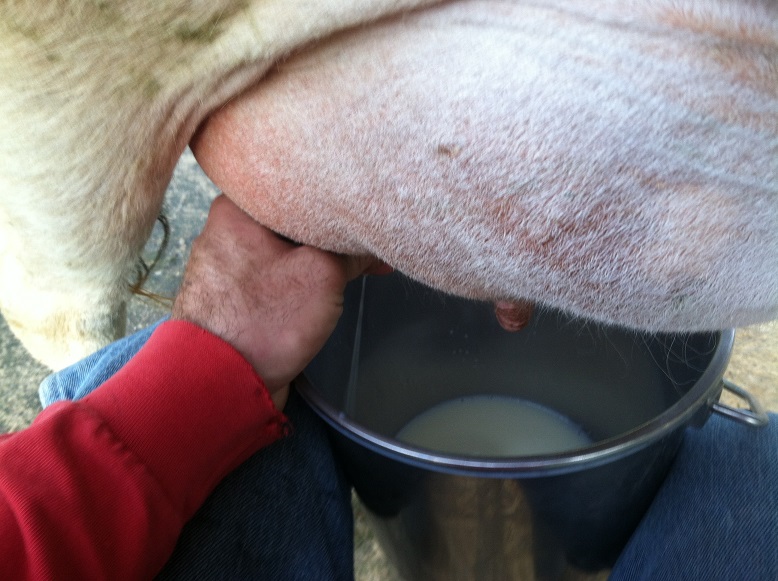
Near as I can tell, May (dairy cow #2) is cycling right now so her udder may be a little…sensitive (all the lady readers say “Hey!”). I attached a cup, she kicked it off. I attached it again, she kicked it off again. I attached to the rear first, she kicked me (not intentionally but literally. Like even). Sigh.

And so it goes.

Dream that dream. Go ahead. It’s awesome when that calf is born or that chicken you didn’t know was missing returns with a hatch of chicks trailing behind her.

ChicksBut there are not awesome days too. Days when you forget to put the milk away and there is no chicken feed in your warehouse and that project you’ve been working on gets delayed and your spouse gets sick and the house is a mess and the cow like literally kicks your butt. Try not to smile as the cow’s tail hits your face (happened). Don’t inhale a bug when you laugh your way through the pasture (happened). Be polite to the internet company when they say it will take 4 days to fix their service (but you’ll be billed for the whole month). Even if you didn’t have the cows things would go wrong. That’s life.

Fairy tales end with “…and they lived happily ever after.” I call BS. They moved into a cold, drafty old house, the roof leaked and they literally had some bad days and some good days ever after. But it required a lot of sacrifice and it turns out Prince Charming snores. OMG!

So. Pick your poison. Do you want the bad things in life to happen in suburbia or do you want to take them out in the stix? I think we are literally better off out here in the stix. But it’s literally hard to even. You know?

Walking the Farm in a Spring Rainstorm

According to the very expensive, precise and scientific bucket that was left sitting out, we got a total of 5 inches of rain yesterday, 3 inches in the first hour. When that kind of rain hits the farm I like to put on my raincoat and spend time looking around. I want to know where the rain is soaking in and where it is running off. Is there any soil washing out? Did any lids blow off of chicken tractors? Are the ducks teaching the chickens how to swim? We’ll start at our broken old bridge to nowhere.

Bridge

There is normally a trickle of water flowing through here. The kids crawl through the tunnel and hunt up crawdads or pretend it is a fort. Today it is roaring as water flows through. I’m glad to see that there is not more water flowing through. This tunnel is fed by the overflow from the pond (not much is overflowing yet thankfully), the runoff from the alfalfa field (again, just a trickle) and the runoff from the corn field and feedlot and the ditch across the road (the majority of the water you see). It looks like most of my water is either soaking in or being delayed in reaching the branch. I love it when a plan comes together. But the pond is receiving quite a bit of water and topsoil from the neighbor’s field and then there is that feedlot. Well, not much I can do about that. Following the water downstream I’m concerned the branch will flood the bottom…where the chickens are currently.

Branch

The water was about a foot from coming out of the banks. Too much water for me to cross so I can’t go any further to the North. Within an hour the creek was already receding so I slept soundly believing the chickens to be high and dry…until I heard it raining again about 2:00 in the morning. (Skip to the end: chickens are fine). No choice but to go east. Cows are out in the open east of the yellow house. I’m taking advantage of the cool weather to graze open areas right now. The cooler weather will end this weekend so we’re watching the clock. The cows are so full they are a little hard to move. I’m giving them larger areas right now to get back to the trees in time. We will have a big, square cutout in the pasture that will remain ungrazed until fall. That’s how it goes I guess.

RainCows

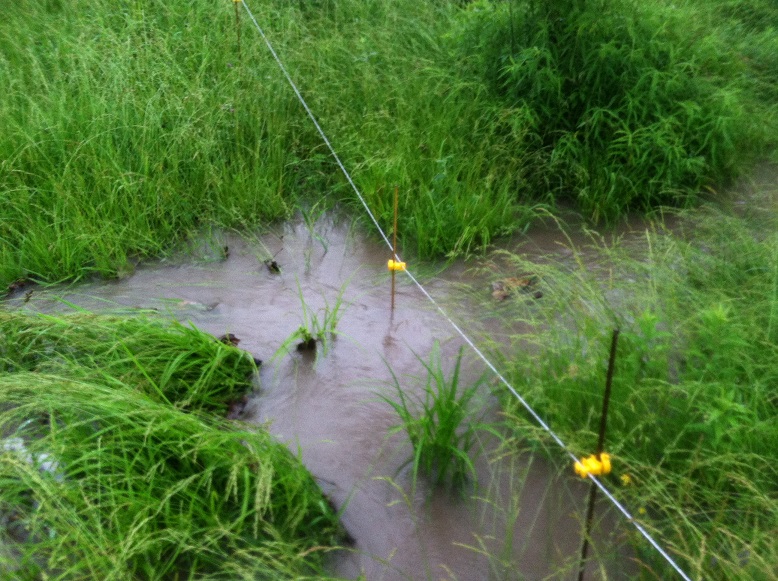
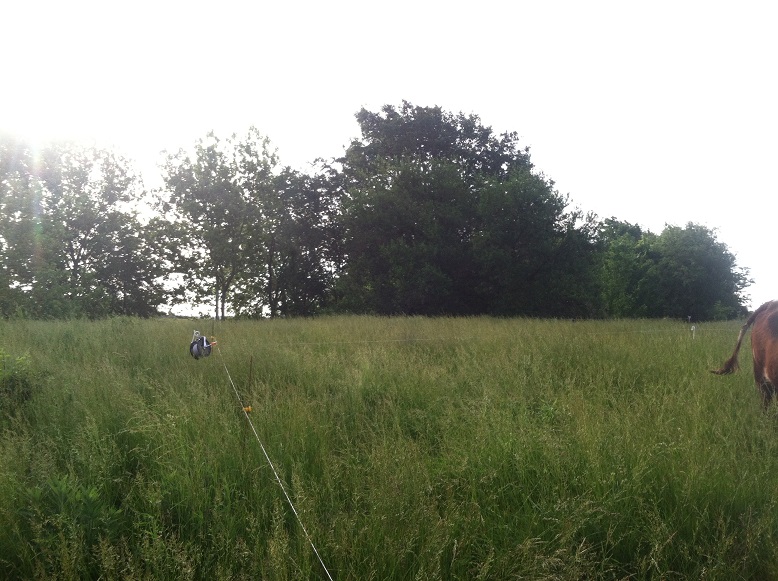
Further east the little wash is flooded and we are just about to lose our fence. I stop to adjust the insulator a little bit.

Flooding

This water is either overflow from the neighbor’s new pond or runoff from the eastern half of the alfalfa field. There is a dry dam on the alfalfa field that is making a huge sucking noise as the water rushes through the pipe. It was too dark in the woods to get a good picture but a dead tree was against the drainpipe and it was spraying water in two directions. There was a huge pool of water there. I’ll need to take some corrective measures to heal that forest floor. When I say “corrective measures” think cow hooves. Most of the green you see is poison ivy so it won’t be milk cow hooves.

DamDrainFinally I stopped by a mulberry tree for a snack, something I try to do a couple of times each day. Mmmmm, freshly washed fruit. I’ll get tired of eating mulberries in a few weeks…about the time I run out of berries I can reach. Mulberry trees will grow anywhere a bird can poop. They are tough plants, will take serious pruning, will grow from cuttings and make good firewood. They are all over the farm and I try to visit each one regularly. There are some deep in the woods that aren’t ripening yet extending the harvest season.

MulberriesLet me know if you got any of this rain too or if you have any ideas for preserving mulberries. I don’t care for them frozen and we don’t tend to make jelly. Wine maybe?

One additional note:

The chickens are a long way from the cows and have been for about 2 weeks. The chickens are currently housed in our portable layer houses. That design has worked well for the last year but has its limitations. We will be re-purposing those structures or the components. One severe limitation is the lack of portability over distance. We are moving to a new design on a wagon running gear so we can close it up and head down the road (cause we can’t cross the broken bridge). I have been delayed getting that project finished. Look for pictures soon.

Reap Your Wild Oats

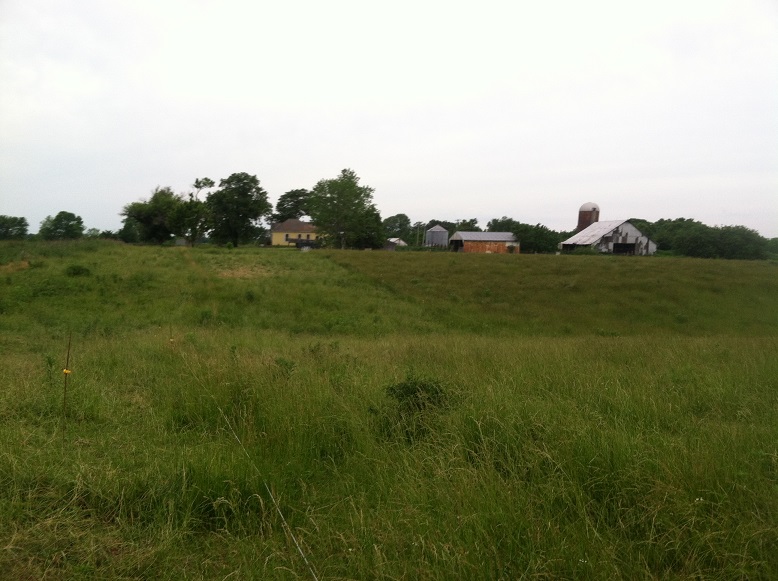
I have had quite a bit of offline discussion about dealing with fescue in our pastures. I don’t claim to know everything there is to know about fescue – in fact, I only know a little about my own pastures – but I do have some observations. I can’t bend the landscape to my will for any length of time. The best I can do is to observe, learn and play along as well as I can. I measure my success by increased drought resistance, healthier cattle and increased plant species diversity over time. But it takes time.

WideView

Let’s start with a paraphrase of what I have read concerning fescue.

If your cows graze fescue the tips of their tails will fall off and their hooves will rot off…it’s basically a starvation diet. Spray all of your fescue and replant to more desirable species immediately.

Yup. So. That’s what I’ve read. Other advice seems a little more reasonable.

Broadcast 5 pounds of red clover and one pound of white clover per acre in February to dilute the effects of fescue on your livestock.

That second paraphrase is much less alarming than the first but we don’t really do that either. There is clover out there already. There are other grasses too. The thing is, the only grass that has been allowed to grow to maturity inside the fence in the last X years has been fescue…because the cows eat everything else down to the dirt. Our strategy has been this: we don’t let the cows eat everything all at once. It’s amazing the grasses that are coming out of nowhere because of this crazy idea.

Salatin jokes that “cows always eat their ice cream first” meaning they walk the whole farm eating favorite plants first. If you just open the gates to the pasture and allow the cows to graze continuously they will deposit their manure mainly in favorite loafing areas. You’ll have cow paths everywhere on your property. Cows will walk acres and acres to find just that one delicious, favorite plant and will nip it off as fast as it will regrow. You can see it in my east 40. For years the cows would travel single file between the feed bunk, the pond (where they eroded the dam) and the stands of trees beyond. They would graze only favorite plants, leaving the others to dominate the pasture. There is a fair amount of white clover in our pastures. We took pictures of it last summer hugging the ground for protection from grazing animals. Red clover, as you can see in the picture above, is almost nonexistent. The only saplings that survive are the ones that are too thorny to eat.

By switching from continuous grazing to planned rotational grazing we are allowing plant species to recover. In fact, that’s the point of the planning…to plan for recovery of desirable species. Better than that, we are allowing a wide variety of species to go to seed…seeds the cows will spread as they move on to the next grazing area. It won’t take long and we’ll see red clover coming up in more of the pasture as the cows move the seeds around. The long recovery windows are allowing species we have never seen to emerge, survive and spread. I had never seen wild oat go to seed in the east pastures (not that wild oat is all that great but it’s better than fescue!)

Oats

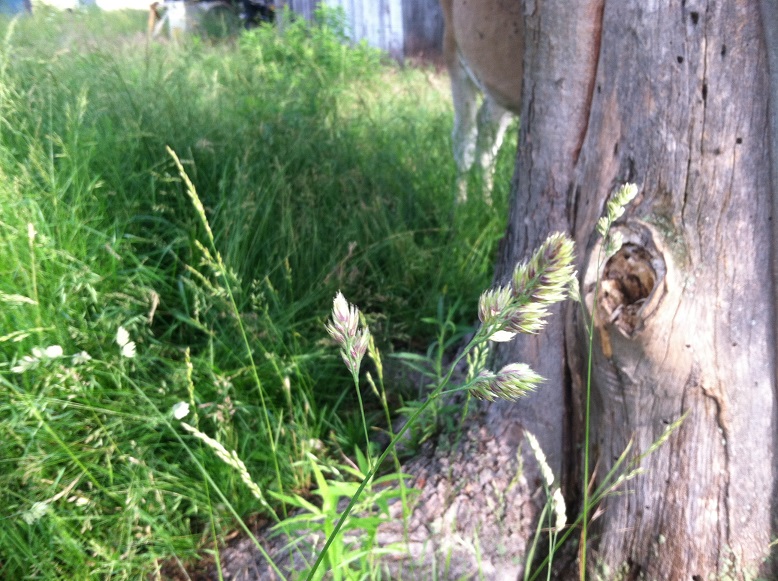
I had never noticed orchard grass either but it’s showing up in big clumps.

OrchardGrass

And that’s not the end of it. In fact, the end isn’t the end of it either. It’s the beginning. That perfect cow pat shows that the cows are getting a balanced diet and are in good health. The cows don’t get a balanced diet from fescue alone. There has to be enough energy and protein. Looks like we’re doing good (maybe a little extra protein but…)

TheResult

The fescue is the dominant plant in our pastures. No doubt. But as we decrease the amount of time animals spend grazing each bit of ground and increase the recovery between grazings we see an explosion of legumes…not to mention weeds. It happens over time. Gradually. Slowly. No diesel fuel required. I don’t need to buy seed. I don’t need to spray chemical death. I just need to manage for the resources I want.

And I think that last sentence is important. I’m managing FOR not managing AGAINST. Feel free to apply that to any part of life. Maybe there are better ways to get the kids to wash the dishes than to make yourself an adversary. Sorry to say, it’s the same with training animals. Manage for the positive. I want more than fescue? I don’t go killing fescue. I start allowing other species to compete…to go to seed. I allow the cattle to graze somewhat selectively, trampling what they don’t want.

FescueThe progression would happen faster if I had more hooves and mouths and higher density. We’ll get there. The cows are knocking down most of what they don’t eat currently. We will do better in time but this is a start.

RemainingGrass


This Week in Grazing

Maybe I should start a podcast with that title. (in my ample free time…lol)

It’s tough grazing out there to the east. The soil is dry and hard…not signs of health…not conducive to plant health or cow health. So the fescue grows a few inches tall and throws up a tall seed head and white clover grows where it can. There is a little red clover too but there is a lot of exposed dirt and moss. I need the hooves and claws (do chickens have large talons?) to break up the moss and manure and plant material to cover the soil with a protective blanket. Future grass will grow better and be sweeter.

GrazedAndUngrazed

You can see how much pasture the cows are just walking past in the picture above. The cows have grazed out the yummy bits in the left center of the picture, trampled quite a bit more and left the rest. I’m not running them at a high enough density to really impact the pasture at this time, I’m focusing on speeding them along about half as fast as when we were last here in April..55 days ago. I want the cows to get all the energy they can, leaving manure behind. At the current pace it will take me 120 days to cover the entire farm. That will be October 1. I can live with that.

EastPastureFescue

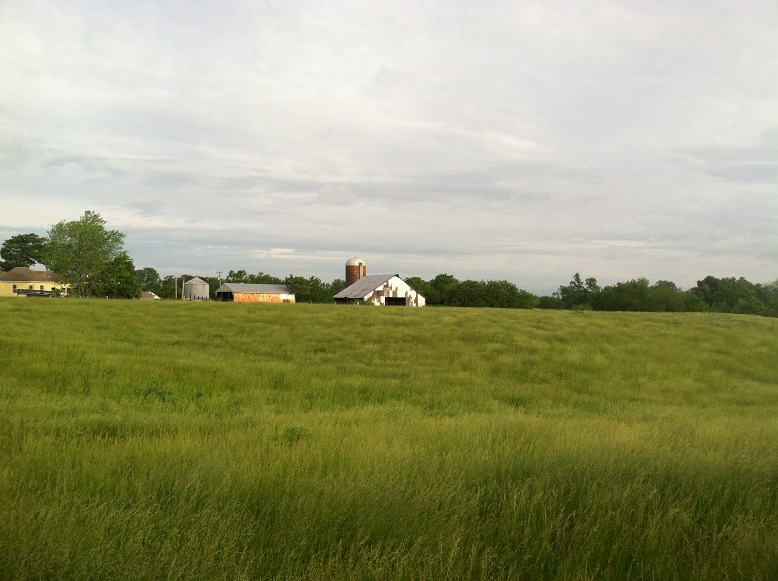
But there are large sections of my pasture where there is no shade. I’ll just skip those until fall, waiting for cooler weather. What I really need to do is add to my tree inventory. And paint that old barn. More on trees in a minute.

Alfalfa

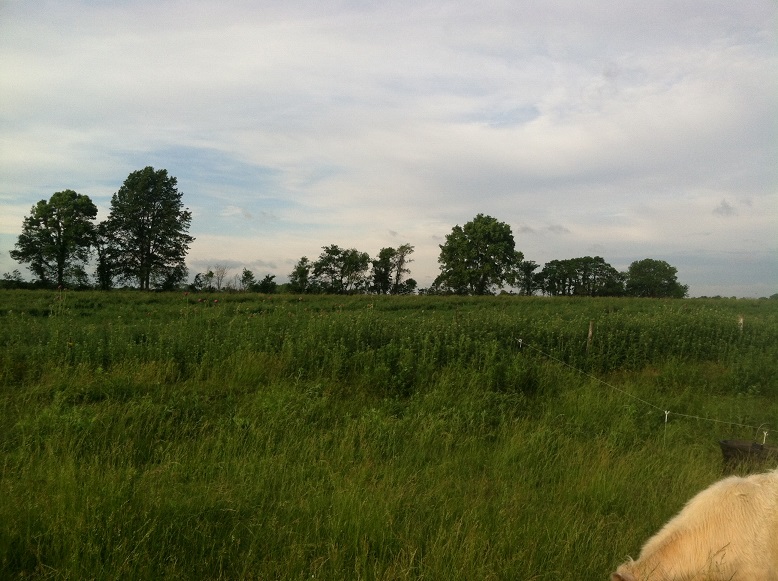
There is a fence of questionable quality keeping the cows separate from the alfalfa field. I don’t particularly want an alfalfa field but you play the cards you were dealt. Complaining about the alfalfa field is a little like complaining about eating ice cream. Where the fence lies the cows can’t trample and manure so we have a nice forest of thistle. I could spray the thistle out. I could chop. I could do any of several things but I would prefer to move the fence north or south by about 10 feet and let animals do the work. There are only so many hours in a day and only so much I can do. If it would stop raining for a couple of days we could cut hay…but there I go complaining about ice cream again. Soon I’ll be wishing for rain…

Tomorrow

It has been hot out this week [Note: this post was written a week before it was published]. Not August hot but regularly above 90 with humidity above 70%. Some of our cows do ok with that, some pant and drool because they still have a winter coat. Those cows need to leave the farm. We have enough trees that I can section off a portion of a tree lot to give the cows a one-day loafing area in the heat. Then we open up new pasture for the cows morning and evening. The cows reminded me how important this is yesterday when it was 85 out and they were standing in full sun panting. I have to do better. On weekends I subdivide further but it’s not fair for me to ask Julie to roll up fence wire with all the other stuff she has to do during the week so we try to keep things simple.

Anywhere I stand on my farm I am surrounded by trees. Honey locust, black locust, a variety of oaks (shingle, white, burr, red, pin), shagbark and pignut hickory, hackberry, wild cherry, osage orange, redbud, walnut, cottonwood, black willow, sassafras, elm, mulberry, sycamore, sugar and silver maple, sumac, even a few pines and junipers, maybe a persimmon or pawpaw…all of these are valuable both for shade and as forage and many make great firewood and posts. The leaves are high in protein and tannin and the cows eat every leaf they can reach. The trees mine nutrients and water (I repeat myself) and contribute greatly to the available organic material in the soil. You would think I live on the prairie but there is a lot of forest in the river hills. Our goal is to maintain open savanna under a healthy canopy, not allow an overgrown tangle of fallen limbs, multi-flora rose and poison ivy to rule the forest. This requires managed disturbance (including chainsaw disturbance). The cows get in there, eat the good stuff, trample the rest and add a dose of bacteria to an otherwise fungal environment. Adding more trees to the open spaces and in greater variety will only make our farm more productive and help keep our cows happy.

This week in grazing I’m dealing with heat, rain, pasture health and tree planning. I know the time is coming when the heat will worsen and the rain will cease. I need to plant about 10,000 trees. That’s going to take a while…even if I could plant 1,600 trees in a day. But I have to be serious about increasing my tree numbers as my herd numbers grow.

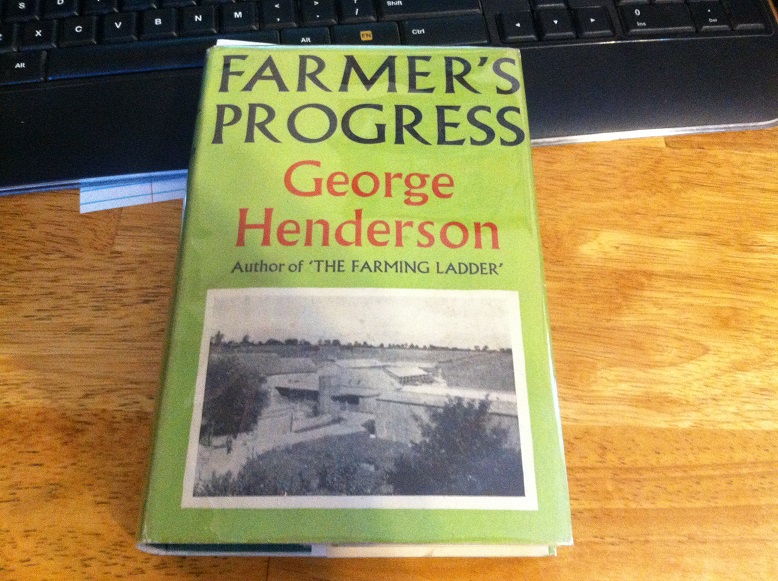
Farmer’s Progress Chapter 7: The Management of a Farm

The first rule is that you must have sufficient capital, land and stock to ensure you will be profitably and fully occupied. If you have not, then you must arrange to work for others part-time, as a contractor or otherwise. Do not be tempted to think you can supplement your earnings by literary efforts, at least not in the agricultural sphere, for, by the queer contrariness of this world, that is reserved for those who have already earned their money in farming…

Well, so much for that plan. OK. I don’t have any real money to speak of, I don’t have much in the way of cattle or chickens and I’m currently out of pigs but I have a good amount of land. It gets worse.

…do not waste what should be productive farming hours on telling other people how to do it! Plenty of time for that when you retire.

Well. I…um. I really only do this when it’s dark out. Most often in the early morning…if the dishes are done. So. (This is embarrassing…) I try not to tell you, dear reader, how to farm. I just read, research, discuss, try things and write about the good and the bad. Not how-to, just the how-we.

FarmersProgress

That’s how it’s been reading Mr. Henderson’s books. I read. I learn. I accept correction. Some years ago dad and I read Marcus Aurelius. On the very first page he dives into his appreciation for things he has learned from others. (I’m quoting from my Loeb, not the link.)

From my Grandfather’s Father, to dispense with attendance at public schools, and to enjoy good teachers at home, and to recognize that on such things money should be eagerly spent.

I finished public school 20 years ago and have been practicing at learning ever since. Julie thinks I’m a little too eager to spend money on yet another book, electronic or paper. The closest thing I can do to inviting Mr. Henderson into my home to teach me is to buy his books and pay close attention to his writing. I’m not writing this series to rob you of the need to read Henderson’s works for yourself. I’m writing to record my notes and thoughts as I explore these books for the first time. And if I am choosing to invite Mr. Henderson to instruct me, I have to accept correction from him.

There is a difference, Mortimer Adler taught me, between reading for entertainment, reading for information and reading for enlightenment. I may be trying to get too much from my initial reading of Henderson’s works but I doubt I’m reaching the enlightenment stage. To get there I need to fully grok Henderson’s reasoning, be able to present his arguments and to respond to them. I can’t do that…yet but you know I’m going to try anyway.

If you are here seeking enlightenment I’ll let you down. I may have a little information but, really, the best you should hope for is to be entertaining as we talk about farm management. You know, ’cause farm management is such an exciting topic.

I have already noted Mr. Henderson expressed concern that I am wasting my time writing this post so let’s begin, instead, with the lack of capital. He suggests

where capital is limited, …keep as many poultry as the reserves of feeding-stuffs will maintain

Well. OK. But. You know. Then what? I mean, George, we have chickens. Lots of chickens. Feeding them isn’t our problem. Marketing them is. It’s not like I can take all the eggs to Mr. Olson’s store and trade for a plow, a few yards of gingham and a poke of salt. What do I do with all the eggs? Right now we are have long days, and lots of interesting things in the pastures for the chickens to eat and good weather so the girls are laying like gangbusters. Way, WAY more eggs than our regular customers need. But soon the summer heat will set in and laying will back off. Then we’ll transition to the new flock and be covered up in pullet eggs until we butcher the older birds. Hopefully, the new flock will lay enough eggs to get our regular customers through the winter…until we are flooded with eggs again next spring. We are selling our eggs right now but we also get a percentage of eggs that are stained, cracked or checked and can’t be sold. We can’t eat them all. What do we do with the extra?

Feed them to pigs…the next operation he suggests when you are starting out and money is tight. And I find that I agree with him. If I could have only one type of animal I would have a pig. Pigs cover all the bases. Meat and manure, they cycle nutrients like nothing else, if you need to dig a hole, get a pig. There’s bacon at the end of that rainbow! Henderson spends a fair amount of time in both books discussing the utility and value of pig manure over cow manure. But beyond any of that, I just like pigs. They are inquisitive and intelligent animals. When they are small, they are quite pleasant. There has to be some allotment for enhanced quality of life when evaluating choice of livestock. It’s not all marketability and utility.

Skipping ahead a bit, he suggests that we, as small farmers, consider pedigree livestock. Just a small herd of cows, for example, all related and purchased all at once can, over time, build to a consistent and improved herd. He emphasizes the need for patience, for culling and for more patience and more culling. Don’t go out and buy more cows. Just get that initial group of moderate animals, breed two generations to the same bull then change bulls (there is a whole chapter dedicated to this later). He was, apparently, very concerned about disease but the general outline I shared is basically the model he used to build his Jersey herd in his previous work, The Farming Ladder.

The first essential is not money but a love and understanding of good stock; and once you have set your heart on it, you will find the ways and means to buy that old cow, who can be the mother, suitably mated, of a great herd. A pedigree gilt, or a few registered ewes, may cost you little more than the commercial price, but you have the raw material. After all, it is not the buying of the paint and canvas that makes an artist, it is what he does with it.

There are only three cows in our beef herd that matter. Three didn’t breed and will be sold for beef. One heifer is a cull, the other is marginal. (I didn’t use any sense when I bought those two) and that’s where Mr. Henderson spends a lot of time. Be picky about your initial stock. Buy related animals that can be improved…quality animals but not show stock. Be picky.

To have to feed and water for two or three years an animal which is developing some fault is to learn a lesson which may never be acquired in a hundred visits to the show ring.

…management is all-important, for nine-tenths of the improvement in livestock comes from this source, since nearly all reasonably well-bred stock has the inherent capacity to produce, and it is management which brings it out.

It’s not all about livestock. You have to feed your animals too. He lays out directions and warnings for feeding your animals properly without overfeeding them as overfeeding both harms the development of the animal and the pocketbook. He gives directions for how many acres of root and grain crops are needed per head as well as suggestions on how to make the best use of waste potatoes. We don’t grow many potatoes. Not many at all. Maybe that’s something we should revisit on our farm. We do grow a lot of grass.

But of all the crops the stockbreeder grows, grass is the most important and the one which is most neglected and abused. …Any one pasture plant can be encouraged or reduced by over- or understocking at certain seasons of the year. …Poultry are the greatest improvers of a permanent pasture that I know. Stock it evenly at the rate of a hundred birds to the acre, and if it is also regularly grazed by sheep and cattle it will improve out of all recognition.

I have to say I agree. I can’t seem to get Julie excited at the prospect of keeping sheep but where we ran goats, cattle and chickens in rotation our pastures are dense, thick and healthy and the soil is soft. To the east where cattle were allowed year-round non-stop access to the pastures the grass is sparse, the soil is hard and the ground is covered in moss. Once we get the layer flock out there we’ll start adding in serious amounts of manure as well as scratching out the moss and making a nice seed bed. 100 per acre? 6,000 birds!?!? Geez.

He goes into several pages of detail about crops and crop rotations but the most important part (as of this reading) was this:

Chemical analysis gives no indication of the capacity of the land to produce. Samples taken from this farm, which has been worked on the market-garden level of 10 tons of muck to the acre per annum for a long time, show no significant difference from adjoining fields which have not seen a muck cart for a hundred years, but we will grow a better crop, with no additional manuring, than the other will with the recommended dressing. Chemical analysis shows the chemicals lying in that soil, but the humus content is so deficient that it does not hold sufficient moisture to enable the plants to take it up.

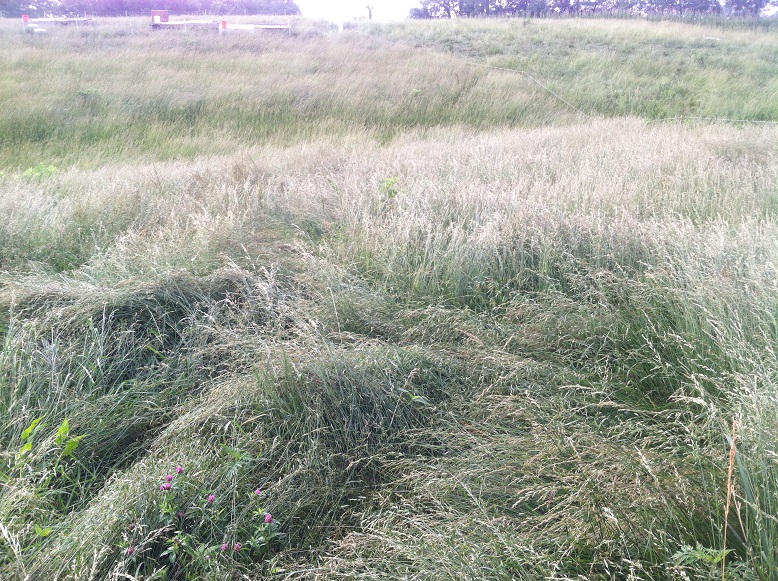
And that’s just what we need. I have slopes that have lost all topsoil, just brick-hard clay on top. I need to add organic material to that in the form of plant roots and with thin, regular layers of compost. I can tell from the grazing habits of the cattle that the grass there is poor. I would guess the base minerals exist in the soil but there is insufficient support for the transport mechanisms. I would bet the brix is lower in those grasses. The cows are very, very picky in the east pasture. It looks like a wavy sea of fescue. The grass itself is only 4-6″ tall, it’s just the seed head that stands up high. It may not look like it, but there are lots of places out there you could set a softball down without touching a plant.
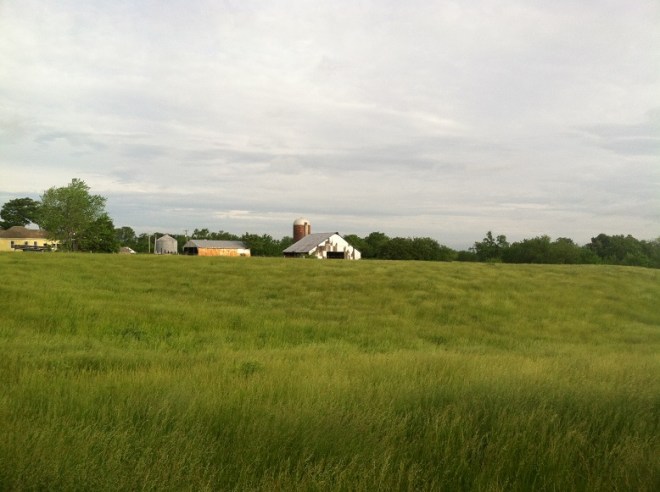
EastPastureFescue

But it’s not what they want to eat. Mostly they eat the white clover and plantain, leaving the fescue to do its thing. The cows grazed between the wavy fescue and the thistle forest, mostly knocking things over as they passed.

GrazedAndUngrazed

Henderson would set to work immediately improving these soils to improve the forage. He would probably also remove the fence that encourages and allows the thistle stand between the pasture and the alfalfa field…but only so he could till the flat areas of the pasture in rotation. Whatever he would do with my farm, he would have a plan.

The balance of stock and crop not only enables the farmer to make the best use of his land but to organize his labour to the best advantage. …The farm that can keep everyone usefully and profitably employed day in and day out is the farm that is going ahead.

The planning of the work is very important, and the getting in hand of supplies necessary for the work in slack seasons: gravel for concreting, wood and nails, paint and spare machine parts. The most tiring job I know on a farm is trying to fill in time.

I would quote the rest of the chapter if I could. You get to know the rhythm of your farm over time so you know how much light is left, what seasons are appropriate for what work and when you can count on rain and dry. The last two paragraphs are especially valuable as he deals with how the farmer himself should plan his time, not doing regular chores but filling in and helping out where needed. I think Julie and I succeed at this in the home but not as well in the field. The kids rotate chores on a weekly basis. Everybody knows their set of jobs. For example, when it is your week to wash dishes it is also your week to help make meals. We rotate through the entire house and the kids learn to manage the whole home without the burden of managing the whole thing alone. Julie and I don’t have regular house chores. And our focus is not on correction when the kids are slacking. We just roll up our sleeves and get the dishes caught up or help fold towels. Everybody lives here. Everybody works. Mom and dad keep it running. Henderson says the farm should be the same way. Our farmhands should be cross-trained and have regular work while we pitch in where needed. I’m afraid I keep an awful lot of the farm work to myself…some of that because the kids are still young, some because I’m something a perfectionist…and can be very critical. Very. I need to chillax and encourage the kids to step it up in age-appropriate areas so Julie and I can spend more time measuring and monitoring, less time on routine chores.

Henderson closes the chapter with this summary:

There are farms where all seems to go well, keeping time with the inevitable passage of the seasons, steadily going on, undisturbed by the distant mutterings of an unhappy world. Such farms are something to pray for, but are brought about chiefly by good organization, and are the product of the farmer’s own initiative, good example, enterprise, grasp of essentials, and long-term policy.

Long-term policy. Long-term. If things go according to plan, I will drop my silly title and hand it to a son, daughter, niece or nephew. Then…maybe then I can focus on cutting firewood and not worry if the chickens have food and water and if the eggs need to be collected or if the cows have fresh pasture, water and shade or if we have enough hog feed on hand to last the week or if the forecast will allow us to cut hay or…

You know what I really want to do? What I really, really, really want to do more than anything else in the world? I want to sit. I want to sit and listen actively and attentively to my wife. Offer her affirmation but not advice. Just the two of us. Then lean back in the recliner together and close our eyes and take a nap. Doesn’t that sound nice? It doesn’t happen. There isn’t time. There isn’t time because I need to improve my management ability. Mr. Henderson gave me a number of suggestions for just how to get it done.

Calving When it’s Time to Calve

From Wednesday’s Pharo Cattle Company PCC update:

Just one week after the official beginning of our calving season, we are almost two-thirds done calving.   That is impossible for those who do not calve in sync with nature.  Since all calves are born with a summer hair coat, doesn’t it make sense to calve in warm weather?

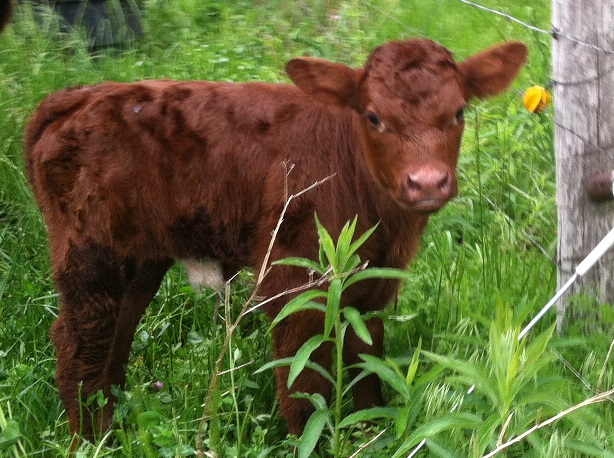
That’s pretty much the boat we are in. Our animals were all naturally serviced in a short window and it has taken 17 days for four out of five calves to hit the ground. The cows were on pasture all year but we turned them on new grass 2 months ago. They are fat, healthy and clean. The grass is tall. The air is warm. Calves are all coming unassisted. We just look away for a second and look back and there’s a calf up nursing.

Curly

Certainly some of the vigor we are seeing in our calves is due to the bull we used but there is more than just that. Certainly some portion of calving ease is due to herd genetics but that doesn’t account for the whole picture either. The calves are warm. Their bellies and moms’ udders are kept clean by tall, fresh grass. They are standing, running and romping on firm ground. Mom is making milk just at the time when the pasture is at its peak of production.

Edith

So now the question…should I breed at the same time this year? Last year the bull arrived on July 27th. Three heifers did not breed. Did they miss because they were inferior animals? Too tall? Infertile/unhealthy? Were they just too hot when the bull was here? So far, all heifers bred on their first cycle but the bull was here until the end of September. Do those other three really have an excuse? Really?

I don’t know. I mean, I guess I can stick with the same window and continue selecting for cattle that will breed in the heat. It’s hard to know what is best.

Clover

Our pastures are dominated by infected fescue. Infected fescue does all sorts of bad things to cattle including increasing their body temperature. Lots of ranchers just to the west of us breed in December to calve in the fall flush of growth and take advantage of stockpiled fescue when it is of the highest quality…when it is frozen. Then they wean in the spring when calf prices are high but to this point we have allowed the cow to wean the calf herself…at about 9 months. That’s no big whoop either.

Henry_Edith

I don’t know if I am doing the right thing. We aren’t worried that the calf will be cold. The cows are fat, clean and in good health. We are doing what other, apparently knowledgeable, apparently successful farmers and ranchers do. We are doing what the deer do. It seems to be working out well.

Farmer’s Progress Chapter 6: Farming as a Business

I don’t know how many of you are reading through Farmer’s Progress with me. The book is out of print and a little hard to find but I think it’s worth the effort. Today Mr. Henderson reminds us that a farm is not just a dream or a tax shelter, it is a business. I am not trying to distill each chapter down to a few bullet points. I am also not trying to republish his work. I am giving you a glimpse into Mr. Henderson’s wonderful book, encouraging you to find a copy and sharing a few anecdotes and thoughts of my own along the way.

FarmersProgress

On this topic, Ethan Book released a podcast last week about financing a farm. Each episode of the podcast features a hard lesson learned (or not yet learned) segment. This week’s Ethan suggested that he bought his farm to satisfy a dream rather than to fulfill a business goal. At one point he asks how ridiculous would it be for him to buy a restaurant with zero experience in the restaurant business. That’s exactly the point Mr. Henderson is making as he corrects me once again. We arrived with business in mind but zero experience. We quickly overcame the early (and low) hurdles of efficient livestock production but, as Bruce King pointed out, how do you sell that 300 pigs once you raise them? We were ready to raise chickens. We were somewhat ready to kill chickens. But we were not ready for a freezer full of chickens. I guess we thought it would be Field of Dreams…if we grow it, they will come. They didn’t come. They won’t come. Our farm “business” has to be about 10% production time and 90% marketing time. I don’t know if Mr. Henderson would approve but that’s what it takes to move a chicken.

In earlier chapters he wants the reader to define a clear vision, gain experience, work and save your nickels, understand the world around you and your place in it, and make a study of the efficient application of labor. In chapter 6 we are faced with the grim reality of the market. Scarcity will place farms in the hands of those who can produce most efficiently and strip it from those who just tread water.

To farm a farm as it has been farmed before is to obtain nothing more than a bare living from it, for the great weakness in British agriculture lies in seeking a  stable rather than a progressive industry, and a farm should always be planned on the assumption of steadily rising costs which will have to be met by greater efficiency and a higher output.

The early part of the chapter is given to a reminder that farming is a business. A business! Henderson says we are going to stack multiple enterprises on the same bit of land. He talks about having a poultry farm, a cattle farm and a pig farm all on the same land, each enhancing the other, each carrying the other through price downturns and building the farm up over time. But it isn’t as simple as buying a variety of livestock (and planting a variety of grain). He wants you to turn your money frequently. You down? Economists talk about the “Velocity” of money. There could be $1,000,000 of currency in the economy doing $1,000,000,000 worth of work. It just has to move quickly. Think of it this way, if you can make 10% on every transaction you won’t earn a 10% annual return. You’ll compound your return every time. So Mr. Henderson wants us to buy some ram lambs, some pigs and some pullets. By the time the pullets are ready to lay the ram lambs will be ready for market. We can take the proceeds from the ram lamb sale and put it toward the next set of lambs AND some chicken feed. When the pigs ship we buy replacement stock, spread the manure on the fields (to increase the carrying capacity of our pastures or grow more grain for chicken feed) and buy the feed required for the next batch of pigs. You get the idea. Our money is always invested where it is growing and in a variety of places. The faster we can release that capital, reinvest and realize profits, the faster we can move the farm forward.

That’s why Julie and I never have two nickels to rub together. It all goes back into the farm (and then some!). Well, that and we aren’t very good at turning our inventory. Look at the annual statement of any publicly traded company. Any of them. Compare the two major retailers if you want. You need to see two figures. You just need to divide the cost of goods sold by the average inventory for the period. No big whoop. That will indicate to you which competitors are using resources more efficiently. If Business A turns inventory every 3 days and Business B turns inventory every 5 days and Business C is turning inventory every 20 days…well, you can probably make a few assumptions about the management of Business C.

Let’s do it this way. How many people in your community buy milk? Does the grocer keep that much milk in stock at all times? You’ll find out next time there’s an ice storm. The grocer needs to maximize the utility of his refrigerator case, maximize the return on his inventory purchases and still meet your needs. If he is efficient about it, he is buying and selling milk frequently.

All of that to say, how efficient are you about turning your farm inventory? I bring a calf into the world, put labor, grass, nutrients, and improvements into the calf and, over the span of 6-8 months create a finished product…a weaned calf. I get one crop of calves each year. It takes me a long time to turn my money over with cattle. But I could manage my operation differently. I could lamb 3 times in two years. I could pig (verb) two or three times each year. I could do a Bud Williams Sell/Buy operation where I’m always looking out for the relatively undervalued class of stock immediately after selling the relatively overvalued class of stock. I could turn my money over monthly. Calves this month, open cull cows next month, sheep the month after that…always looking to keep my money in motion…to increase the velocity. To make my percentage over and over and over quickly. Eggs bring in cash every day but after 5-6 months of raising the birds to point of lay you have to pay off their housing, fencing and feed with egg sales. Broilers give a return in about 2 months(if you have done your marketing). Feeder pigs give a return in 4-5 months (again, marketing). Corn needs a summer season before you see your investment again (and corn in the bin is money in the bank). You need 4 calves to break even on the development of a heifer. It’s only the cows that wean a calf every year for 5 or more years that make you any money. That’s slow turning, though fairly reliable.

We’re talking about rapid ROI here and it’s a difficult and sobering conversation. Land costs money…a frightening amount of money. You can lower the land resource cost of each operation by adding additional profitable enterprises. Remember, Mr. Henderson wants a balanced mix of arable land and livestock. The livestock pay the fertilizer bill, the arable land pays the feed bill and everything grown is of the highest quality from the registered stock to the seed corn he harvests. To balance production requires investment in buildings. Where most farmers of the time valued a farm primarily on the amount of arable land, Henderson considered the improvements.

…the value of a farm is not the market price or the rent you are asked for it, but what you intend to do with it. … After all, piped water, a good cowshed, dairy, piggery, and Dutch barn make all the difference between being compelled to depend on arable farming and having a fully balanced system building up stock and fertility.

Mine was a mixed farm from its inception. The yellow house, at the center of a 60, has two barns, a hog floor, a grain bin, a machine shed, a pond, a pig nursery and a corral. There is a road that makes it easy to move equipment to each of the buildings. Water lines are buried everywhere (and are in need of replacement), power runs overhead and underground, the head stalls for the milk cows are still functional. The farm is set up for livestock. Even with termite damage in the barn and roofing blowing off and trees growing up besides buildings and walls pushed out by livestock and leaky water lines that we have shut off until we can replace them…even with all the repairs we need to do the farm layout makes working here more pleasant and saves me from having to figure out how to lay out a farm on my own. This must have made a real difference to my ancestors when they farmed with horses…moving wagons by team. That planning continues to make a positive impact today but I have to amplify it. Remember the first quote I used about always assuming we have to meet steadily rising costs with increased productivity?

…it is no use producing more unless you produce it cheaper; it is of no value to produce cheaper unless the labour you save is devoted to further production. The people of this world have either to reduce population, to increase production, or starve. Let us take the middle course – it is by far the most comfortable and interesting!

He goes further than that. It is not only important that we lay out the farm in an efficient manner and work in an efficient way, not so we can goof off more, but so we can produce more, it is important that we design to be inclusive.

The saving of human effort is also important, for we are not all built for heavy work, and nowadays, when some of the best and most conscientious workers are women, it is a pity to have to retain anyone whose only qualification is brute strength.

I need to design with Julie in mind. Why is she carrying that bucket? Can I put a spigot there? What will cost more: the spigot or back surgery? This also counts for the kids. What can I do to make things easier on the kiddos so they can handle a greater portion of the now easier workload?

From here Mr. Henderson goes into the need for proper bookkeeping. Peppered into each chapter are lengthy sections describing methods of making work more efficient and he does not disappoint here. While describing his bookkeeping method he also teaches about pulping roots for fodder then he transitions to the need for business-mindedness and delivers this gem:

Many farmers, still dreaming of the golden age of the 1870’s when their grandfathers lived like gentlemen, and hoping those days will come again, despise the tradesman; but there is a great deal they could learn from him. The ex-shopkeeper often does well in farming simply because he is used to thinking in terms of pennies as the profit on an article, and he will be quite happy to sell even a bale of straw retail if the opportunity occurs.

He then goes into the reluctance many farmers feel not just about selling retail but about selling at all. If you need a bale of straw he’ll extract a favor rather than money. If you need to borrow some of his workers, just pay their wages…never demanding a little bit for organizing and training the crew or to compensate you for the work they won’t get done while they are on his place.

This, I suppose, originated in the hoary old tradition that farmers never make a profit anyway!

I was thinking about my great-grandpa Charlie yesterday. He was born 101 years before me. He built the big white barn 100 years ago this year – when he was just about my age – at a time of great agricultural prosperity. I don’t know how he lived. I don’t know if he ever laughed. I see the old family picture of stern looking people and know the stories of how they suffered and worked and look at the house I live in, the barn we use, the ruined old yellow house…My goodness! I really do appreciate what they did for my generation. I believe they lived well for their time. But I wouldn’t trade places with any of them for a second. It would be cool to see 14 Jersey and Guernsey cows lined up in the head stalls and to hear the pail sing with each squirt of milk from my great-grandpa’s, my grandpa’s and my great-aunt’s effort. What did they do with the milk? How did they account for the costs? Was it a business? Was it a lifestyle? I know they were a prosperous people…but did they know it?

As grandpa lay in his hospital bed in the room where I am typing, he expressed concern for grandma’s future without him. He owed a little money on 80 acres down the road. He feared debt. I have no idea what my great-grandpa Charlie was like but I remember my grandpa Tom well and my great-aunt is very similar. Grandpa was always on the lookout for a deal. Not so he could profit from another’s error but so he could facilitate one guy in moving something and another in buying it. He would always take odd routes, often stopping to chat about a baler or a bull or …who knows what else. Dad says grandpa would bring a baler home and just when they got it timed and working well grandpa would sell it. Make a little profit. Turn that money. A bull, a cow, a pig. Improve the breeding stock. Improve the land and water systems. Make the workload more efficient. Profit by making other farmers more efficient. Profit by making sure everybody came out a winner.

I would like to say that’s where Henderson ends the chapter, teaching us to go ahead and reap where we have sown, to take a little reward for risks taken. But he closes out the chapter railing against the injustices of the British tax officials of the time. Not that it appears Henderson is against paying taxes but, instead, he is against the injustice of the system that makes no concession for error and the extreme difficulty of obtaining a refund for overpayment.

It is even said that as much revenue is obtained from payments in error as is lost by evasion of payment. What a comment on the ethics of the Civil Service! In the great majority of cases a farmer must employ someone whose business it is to see that he does not pay too much.

I made the mistake of moving here thinking I could raise a few birds, milk a few cows and fatten a few pigs and everything would just turn out peachy keen. Fattening stock is easy. Ridiculously easy. The hard part is marketing our goods, calculating profit percentages, growing our money and reinvesting in infrastructure. We came here to raise animals and succeeded. I was utterly unprepared to be in business. Mr. Henderson drove that home in this chapter.

Tell Me You Were Kidding about the Poop!

“What do you mean, ‘Tail covered in manure‘?!?!?!?” asked an alarmed friend.

Well…um…not exactly covered. I meant that to be a humorous post about the down and dirty of the daily chores, not a confession that I’m milking a sick cow in unsanitary conditions. I’m not milking a sick cow and we keep things clean. Very clean. I am milking a cow that is on some pretty lush spring forage, is refusing to eat any hay and has loose manure…some of which splattered on the hair at the tip of her tail…the part that beat me on the head as I milked so we dang-near give her a sponge bath before milking.

I might say “I’m covered in ticks” when I have two ticks on my person. Any manure on the cow’s tail is too much manure on the cow’s tail when that tail hits the back of your head. She wasn’t coated in manure. She wasn’t really covered in manure. The tip of her tail was splattered lightly. That’s part of spring but it’s not part of milking.

I keep an eye on the cow manure every morning and evening. It’s just part of the routine. What did they eat in this paddock? Are their ears up? Anybody lagging behind? Eyes clear? Are they full? What does the manure look like? All of those questions can be answered in less than a minute.

We have gone through some dense bromegrass, orchardgrass, fescue and red clover pasture and we have been getting at least an inch of rain every week for about the last month. Things are growing like gangbusters out there so the forage is pretty rich and immature (high in protein). This site talks about manure consistency and what it means. Ours looks a lot like the last picture. Very thin. Very green. Very splatterish.

Julie (who is listed in my phone as Beautiful Wife) texted me yesterday (I had to dress this up a bit as it arrived out of sequence):

CowManure

So that’s that. Too much protein and it comes out wet. I need more energy in my forages…which should start to happen any day now as the grass is 3′ tall and going to seed. But let’s just plow through that mess and move on.

Cows poop. Poop happens. But you don’t want poop in your dairy. We could go ahead and let poop happen in the dairy then hide the evidence with pasteurization or we could work our butts off to keep the cow clean, keep the dairy clean, keep our bucket clean and keep the milk clean.

Remember that picture earlier this week?

MilkingFlora

Where is the bucket? We are milking on a clean concrete pad but the bucket isn’t on the concrete. The cow just stepped there! I hold the bucket up between my knees, really close to the clean udder. What you don’t see is me milking out about a quart then pouring it into another pail…a pail with a lid. Then I go back for more. If something should happen to the bucket (like a splattering of cow manure) I continue milking but stop collecting the milk for household consumption. We let the waste milk clabber up and we give it to the piggies. You also don’t see the filter we use in the kitchen to help us prove the milk is clean (not to clean the milk…though we do allow it to filter a stray hair or two.) Switching to the milking machine has given us even more bio-security both from a cleanliness standpoint and in terms of speed to chill. Here’s a cool video showing what is involved (not us). You can learn more about the video below at this link.

As my father reminded me, “Cleanliness is next to godliness”. But we don’t wash our bodies with antibacterial soap every day to kill even the beneficial bacteria covering us do we? Oh. Some of you do? Huh. OK. Well. We don’t cook ourselves through at 138 degrees for 2 seconds each day to purify our bodies. We wash our hands, eat well, get regular sleep, get a little sunlight and rely on our healthy, functioning immune systems to keep the baddies at bay. When drinking raw milk you also have to keep the pasture healthy, the cow healthy (let it graze fresh, tall grass in the sunlight, let it get a little exercise), wash your hands and keep the cow poop out of the bucket. If Flora comes to the barn with a truly messy tail we take a moment outside to clean things off. Then we brush her to remove loose hair. By this time she’s usually a little antsy so we put her in the head stall and get to work.

Let’s go back and revisit that previous paragraph. I have read a number of arguments that suggest there is no difference in the health of a cow on pasture and a cow in a confinement dairy. Further, there are not enough acres of grassland to support nation-wide grass-based dairy. Confinement dairy works because we have access to cheap energy and because we have bred cows that make large volumes of fluid milk on high-powered feed. Confinement cows, however, rarely last past three lactations (remember the argument that there is no difference in health!). Grazing dairies usually have surplus heifers they sell to the confinement dairies. The acres involved are much less of a problem but I’ll outline it briefly then suggest a solution. A cow has to spend X hours each day eating and digesting (varies based on body weight, temperature and stage of life). Any time spent walking to and from the dairy is time that is not spent grazing or, more importantly, ruminating. Even after overcoming the near total lack of grazing-adapted dairy genetics in North America, we have to reduce the number of cows per dairy and increase the number of dairies. I don’t see the downside here…moving away from EPA hazard 4,000 cow confinement dairies that turn 5-year old cows into hamburger and consume massive quantities of oil, however efficiently, to many, many 200 head grazing-only operations. Not to mention decentralization. I have heard so many arguments against Wal-Mart that can basically be summed up in one point: Wal-Mart is too big. Well. If we hate big corporations, don’t we also hate the big organic milk producer that is organic in name only? Isn’t more selection more better? Isn’t this what the Net Neutrality fuss is all about? Desiring competition in the marketplace so we don’t all have to bow at the alter of the big cable provider? Don’t we want competition in milk production? Don’t we want cows to eat grass? (I’m about to go full-on rant here so I should just stop now.)

I’m really not interested in arguing for or against raw milk. This product is not for sale and the bulk of our milk goes to the pigs (’cause we can’t drink it all). I think there are all sorts of problems in American dairies from the mineral-deficient land to cattle stuck indoors to dishonest or misleading dairy protections to the overweight, immuno-compromised consumers. For my fully-vaccinated, athletic and generally healthy family, raw dairy from our own clean, healthy cattle grazing on clean, healthy, well-mineralized pastures, milked in a clean environment with clean, sterile equipment and milk that goes from teat to fridge in under 15 minutes is no problem. But I’m not interested in making that decision for you. I generally shy away from telling people what to do, I focus on telling people what NOT to do as in “Don’t screw up like I did”. Nor will I recommend that you go buy raw milk because it is “better”. If raw milk is your bag, get to know your dairyman. If you dig pasteurized milk, well, you can pasteurize the raw milk you buy from your dairyman. I know several families that re-pasteurize store-bought milk. If you want to buy pasteurized milk at the store go to town but pasteurized milk is not sterile. Similar thinking applies to ham and spinach…and sprouts are deadly.

If you are milking the cow, keep things clean. Don’t give infection an opportunity. If you are buying the milk, educate yourself then go see what goes on at the dairy.

How’s this for Glamour?

“Oh! To live as you do….on the farm, chickens, cows, a few apple trees! How wonderful for your children to eat all that fresh food!”

Awesome? Yes. Easy? No. Glamorous? LOL!

Remember, behind every beautiful cow is a tail covered in manure…smacking you on the back of the head as you milk.

MilkingFlora

There is a lot going on in that picture, many small tweaks that come from experience and even a few from a recent read of Farmer’s Progress. I’m holding the bucket between my knees to keep it up and clean and not stepped in. My left knee keeps the cow from kicking. My head presses into her side, looking toward the cow’s head. The only problem here (aside from the manure on the tail hitting the back of my head) is the small handles. She has thimbles!  I have to milk her with my thumb and two fingers. Ugh…takes For. Ever. This kind of milking will teach patience. Fortunately Julie does most of the milking! I think it’s time to break out the milker. …and to tie up the tail during milking.

So, yeah man. Move on out to the farm. Spend the day with the fragrance of eau de Bos. Vous serez tres chic! (You may even remember your high school French!)

Totally Faking It Every Day.

I seem to have them all fooled…at least for now. All of them. My employer, my wife, my children, my dog. Maybe even you, the reader.

We have a bumper sticker that came with our van that says, “Lord, let me be the person my dog thinks I am.” Wow does that apply to my life.

My livestock expect me to be the kind of man who gets up in the morning and meets all of their needs. Not just safety, respect and high-quality feed and forage but opportunity to express natural inclinations. But I don’t know what I’m doing. I just look at the animals and their poop and make adjustments until things look like I think they are supposed to. Then I write a few notes about my cow’s poop, include a few pictures and publish it for all of the internet to enjoy…because apparently there are a few people out there who enjoy gritty stories of farm life from the trenches.

Lord, let me be the person my cows think I am.

I wouldn’t have a farm if I didn’t have a job with a fairly significant income. We just wouldn’t be here. So I have to keep that job. I have done my job for 10 years but with side jobs and extra hours I have at least 15 years of experience. Most of my work time is spent being proactive about problems. Being intentionally vague (cause my job is nerdy and boring) I work to find issues before they impact customers. I also dedicate a portion of each day to learning about new technologies and new trends in my field. I do a bit of firefighting but if I’m really on top of my game I look like the Maytag repair man…but I have to look busy or I’ll lose my job and, potentially, my farm. Management doesn’t seem to appreciate me when everything just “works” regardless of how much work it takes to look effortless.

Lord, let me be the employee my employer thinks I am.

Being completely honest, I couldn’t do my job as well without the internet. I don’t have to discover every solution. Somebody else has already done it, blogged it and moved on. Same with cattle. Where would I be without Joel Salatin’s books and the generations of farmers he has inspired (at least 2 generations now, maybe 3). I wonder if Salatin every prays, “Lord, let me be the farmer they think I am.”

That takes me to my family. I don’t know who they think I am. I have no idea why Julie married me. I wouldn’t marry me. Not only that, but she married me and stuck with it. Weird. And she intentionally and voluntarily created children with me. Is she on drugs? Is this all a dream? What if she finds out? After everything that Julie and I have been through I’m really not as insecure about our relationship as I’m pretending to be but still…I have no idea why she is still there every night when I get home. It must be the exciting and frequent conversations we have about cow poop.

Lord, let me be the husband my wife needs me to be.

Kids, though…kids. In some ways you could liken them to inmates. They have an 18-year sentence before we’ll let them loose. By that point they may be so completely institutionalized that the freedom will drive them crazy or they will break down the locked door to get back home. Hopefully, though, they will grow to be self-assured young men and women who live each day with purpose and vision. But who is going to teach them that? Me? LOL! I don’t know what I’m doing. I have never raised children before! They are more complicated than dogs. Messier too. Fortunately the conversation is so much more meaningful. But what do I talk to them about? I can’t talk about my job. They don’t care about cow poop. I think the older boy is catching on to me. Maybe I should wrestle him in the grass, throw a ball and end the day with a meaningful life lesson, “Son, life is like cow poop. Sometimes it’s runny and messy and sticks to your tail. Other times it’s firm and hard. Either extreme is too much. You want it right in the middle. That’s all of life right there, son. If cow poop comes out soft but doesn’t mess up the tail and has a depression on top, you’ve done everything right by your cows. You think about that, son.”

Lord, let me be the father my children think I am.

I have no idea what I’m doing but I have an idea of what I need to do each day. I wake up, make a plan and execute that plan…or at least chip away at it. The phrase “Fake it ’till you make it” indicates that someday I’ll finally know something about what I’m doing and can stop faking my way through. But someday isn’t here. I have heard grazers say it takes 20 years to learn anything about grazing livestock so I’ll be faking for at least another 15 years.

To be more serious for a moment, I really don’t know where I’m going…where my wife and I are going. We have direction. We are obedient. We work hard. I have a vague idea of the next destination but I can’t for the life of me comprehend how to get there. So we focus on our relationships, we do our work, we study, we take one step at a time and we pray a lot. I don’t know what else to do.

I don’t know how you do what you do or if you share any of my insecurities but I do thank you for reading this and hope you will come back again.

Lord, let me be the person my blog reader thinks I am.