Above Average on Purpose

I originally wrote this post in September of 2012 but it got lost in the shuffle and I never published it. I also wrote another, similar post (short attention span) but I feel this one covers it from a different angle. As I re-read now I am concerned that I come across as arrogant. That is not my intention. Julie and I have a wonderful thing going on here. We had a wonderful thing going in town too. Just lucky? I don’t think so. I think we have made a series of choices that benefit our family and our goal in this post is to encourage you to evaluate your own choices. Oh, and I may just be fooling myself. If so, let me be.

SO, Mr. Steward. You say it’s all work. Work, work, work. You wrote a whole post last year complaining about the workload from a “glass is half empty” perspective…as if to warn others to avoid farming at all costs. So, why do you do it? Why bother?

Good question! We live in a world of scarcity.  At some point I’ll run out of pizza and coke within arms reach of the couch.  Then I’ll have to do work.  I’ll have to get off of the couch and either call someone to bring more pizza to me (work) or open the freezer, pre-heat the oven, unwrap the pizza (ugh!  More work!).

Click image for source

Either way, I have to wait 20 minutes and it costs me money. And that money has to come from somewhere. I had a “managing director” tell me once, “Just because you’ve still got checks in the checkbook doesn’t mean there’s any money in there.” (That was his way of saying I should be happy I wasn’t getting a raise. (I was not.(He may have been implying that the company was broke and I should start looking…(I did)))). So now, unless I have a generous benefactor, I have to go get a job to make money to buy pizza so I can sit on the couch and enjoy life. All this because pizza and coke are scarce. Well, everything is scarce. How do you choose to solve the problem of scarcity while maintaining a high quality of life? I do it by working my tail off…you know, cause it works.

I’m going to share some measurable things about myself and some that would be difficult to measure. Then bring it around to the point. You’ll understand more as you read.

My life is above average. I’m really rather ordinary but my life is above the norm. I’m above-average height, average intelligence, average-looks (maybe even below average) but I married well and am truly blessed and can grow a fantastic beard.

Christmas

Beyond the blessings I have made lifestyle decisions that have pushed me into the above-average category in a number of places.  This could still be true if I lived in the suburbs but somehow I wouldn’t be “me” – the way I am “me” here – if that makes any sense at all. The farm makes me “me”.

Among any group of 37 year old American men my health is above average.  I work harder than the average person and expect, in time, to be wealthier than the average person. My waistline is below average…which is good. I am stronger than average. I read far more than average across a broader than average range of subjects. I believe, based on experience, I can run 1/4 of a mile up a hill faster than average while carrying a dead 150 pound hog on my shoulder on a hot day in July or while carrying a live, struggling calf in October. These are objectively measurable things. But there are subjective things too. My happiness appears to be above average…at least above the average I have experienced and seen in others in my first 37 years (this may be measurable by the distinct lack of anti-depressants). I have more direction and purpose in life than average as a survey of my generation – many of whom seem to be sailing without a rudder. I think I’m more “me” than the average 37 year old guy is “he”.

This isn’t all a result of me living on the farm, though the farm functions as an outlet for me. It’s a result of living with purpose for most of my adult life. I haven’t begun to describe myself, just specific attributes that will help make my point. But what is the point? How is this applicable to you?

I’m not going to suggest that you sell your beautiful suburban home, move to the stix, home school your kids and start farming. Well, OK, I do suggest that but I admit it won’t work for a everybody. Well, it should be for everybody but it takes some convincing. Well, it takes a lot of convincing. So I’m not going to try to convince you in this post but I am going to get to a point in the next paragraph or two.

Behind your eyes is a person. The person back there lives inside a strange shell. The shell is not you. The “you” is inside…not outside. This becomes more noticeable as you age. “You” don’t age. The shell does. You may feel trapped in that aging shell. You may not know what you are doing in there…wondering why you can’t do cartwheels anymore. You may just be walking around daily following a set pattern for reasons that are not fully understood. Break that pattern. Begin by understanding your pattern.

Why did you get out of bed this morning? No really. Why? What was the point? What did it accomplish? Were you just going through the motions necessary to acquire more pizza and coke? I hope you are happy with your answer. If you are not, work to improve your answer. Find your purpose. Purpose! Do you watch TV when you get home at night? Is that what you want to do? What else could you have done with that time? What have you put off for years because you just can’t find the time? Is “Watching more TV” on your bucket list? What did you eat today? Why did you eat it? What happens if you ditch work today? Can you make plans to take some time off? Are you so enslaved by debt and lifestyle choices that you can’t? Is college so important that you should borrow $100k to attend? What does it cost you to work? Can you really afford for both spouses to work full-time? Will you ever be able to retire? What will you do with your time when you retire? Will your marriage survive retirement? There is a question living in the shell with you…nagging at you daily. What happens when you uncork your ears, listen the question and answer it honestly? Are you strong enough to do that?

Jeremiah 29:11 says I know the plans I have for you. Plans to prosper you and not to harm you.

What’s the plan?

I had a plan when I got out of bed this morning (I promise this will still be true even as you read this years later!). Did you have a plan? Find your plan. You could begin with a book like Sink Reflections. Fly Lady outlines a positive routine that may just get you in a pattern of accomplishment no matter where you are. That initial accomplishment (a shiny sink) may build the foundation for real purpose instead of just coasting. There is more to life than pizza and coke…more than Candy Crush and the latest episode of that popular reality show you talk about with the other people who are chasing pizza and coke. Go find it!

If we all do this we’ll raise the average. Then I could be more normal…ish. Maybe.

The Alarm Clock

Once upon a recent Saturday…

bing-BiNg-BING! bing-BiNg-BING!

“Ugh. It can’t be 5 already.”

It isn’t. Julie’s phone decided to announce a 30 minute alert for her 5:00 appointment to get up, study her Bible and make breakfast. Good job Julie’s phone. Good job me for putting Julie’s phone next to the bed last night.

Please, God, let me fall asleep again.

I can’t.

My eyes are too bleary to focus on the tablet we use for an alarm clock. After several attempts I log into my account to disable the alarm for the day then I lay back on the bed.

I don’t feel like I used to feel after a day of work. It was just 150 bales yesterday and they are still on the wagons. Is this “old” or just “tired”?

The weather says it’s going to rain today. Hot too. OK. I need to come up with a plan. A list. Things to get done. Then I’ll get up.

I need to spread compost where we cut hay. Hay. I need to stack the hay in the barn before it gets hot. Ugh. It’s already hot. Maybe it’s still hot. Either way, it’s hot. I wonder how much hay I can stack before Julie goes to milk the cows at 6. We are behind on dishes and laundry. I wonder if I have any clean clothes to wear today. We have an outdoor wedding reception tonight too.

Julie is still asleep. I don’t know how she does it. Maybe she’s just pretending.

I turn on the bathroom light so I can see, manage to find something to wear and start my morning routine. Then I slip on my boots and head out the door a few minutes after 5.

By 6:00 I have seen the livestock, stacked first wagon load of bales that were in the barn from last night and loaded another 30 from the back of the pickup. Just another two wagons between me and the finish line. Before stacking the bales I just put in the barn I return home to get Julie, the milker and the cooler. I can’t help but smell myself as I drive the truck. What a way to greet my wife in the morning.

alarm clock chickens 2

“You ready to go Boo?”

The oldest boy is coming too. Thank God.

I’m down to two wagons of hay to unload. Dad showed up early and the three of us got everything loaded and stacked by 8.

I need a glass of water.

The oldest daughter is making quiche for breakfast. It won’t be ready for a little while. Well, I better get at that horse manure.

After a little work I get the spreader out of the barn and parked next to the manure pile. No sooner than I get started shoveling dad calls to say a man is coming in 20 minutes to bid on building a pond. I just keep shoveling compost until they roll up.

I need a glass of water.

We drive out to the pasture and I point to the old pond with a failing dam. I also point to a new location where I would like to build a dam. They spend about an hour talking while standing in the full morning sun. They take some measurements, ask about a few options and he references a table to determine the cost.

Ho. Ly. Cow.

pasture

Back to shoveling manure. The oldest boy is helping me now. He needed a little breakfast before he could do much of anything. He’s growing like a weed. At 13 he’s as tall as I am. Kid’s going to be a monster.

Dad has a lot to say about some folks from his church who were recently in Africa. “Should we be shipping rice from Arkansas to Africa or should we be teaching them to grow their own?” Along those lines, our conversation frequently drifts to wealth. Are the wealthy obliged to the poor? What can we do to help the poor? How can we build and preserve wealth while respecting others? That’s a funny conversation to have while shoveling rotted horse crap into a rusty, broken down manure spreader on a 100 degree Saturday morning.

Am I wealthy? Is this wealth? Will this activity help make me wealthy someday or am I wasting valuable time working too hard for too little return? I guess it’s a matter of perspective. Am I doing this because I’m rich or am I doing this because I’m poor.

I don’t know. Depends on who you ask I guess.

alarm clock cows

I need a glass of water.

It’s not that I don’t drink water. It’s that my cup keeps getting empty. I bet I’ve had at least a gallon of water today and it’s only 10:30.

We top off the manure spreader with a layer of crushed limestone and head off to spread in the pasture. The plan is to work from the outside in, moving slowly for good coverage. I don’t even get 10 feet before the manure spreader breaks. The shaft that drives the beater has worn through under a wooden bushing.

We’ll have to drive back to the house to weld it up again.

Good. I need a glass of water.

Dad is a better welder than I am. That’s saying it too gently. Dad can weld. I can watch the welding rod spark and spit and make little piles of goose poop. I fill up on water and turn the shaft as he welds around it. We are using a stick welder on rusty metal so he has it turned up pretty hot. Dad burns through the shaft once…then again. Toward the end we’re really just crossing our fingers as he sews up the holes he made. Really, we should remove the shaft and replace a section but…well…let’s try it.

By 11:30 we have successfully unloaded the manure spreader and have positioned it where I can shovel a load of pig bedding for the same field. The pig bedding is in a shaded building. I snag a little lunch (the quiche) and a lot of water then dad and I chat while loading the wagon again…one forkful at a time.

I’m starting to feel tired.

By 2 we have that load on the field.

I need a glass of water.

Dad goes to his house, I go to mine. Remember that conversation about wealth? Running water is wealth. Cold water, running out of the shower is a blessing beyond description. The water feels cold as it hits my head but warm as it runs down my back.

Water is wealth. I need to save my water. I guess I’ll build the pond dam.

Dad calls and asks if our house is on fire.

“No, dad, it’s not.”

“Well, where is the smoke coming from?”

“What smoke?”

“Look south.”

The neighbor’s machine shed was on fire. The fire department kept things lively for a couple of hours as trucks with water tanks zip back and forth from town. Nobody was hurt. The neighbor lost a couple of tractors, some equipment and a lot of hay. We stop by to express our concern as do most of the neighbors. Nice living in a small community.

I’m not entirely sure what to do with myself now. Some new books came in the morning mail but I can’t seem to get myself excited about them. Looking back, I really don’t remember what I did between my shower and the reception. There are two hours that are just missing. Somebody got the eggs and checked that the stock all had water and then it was time to go.

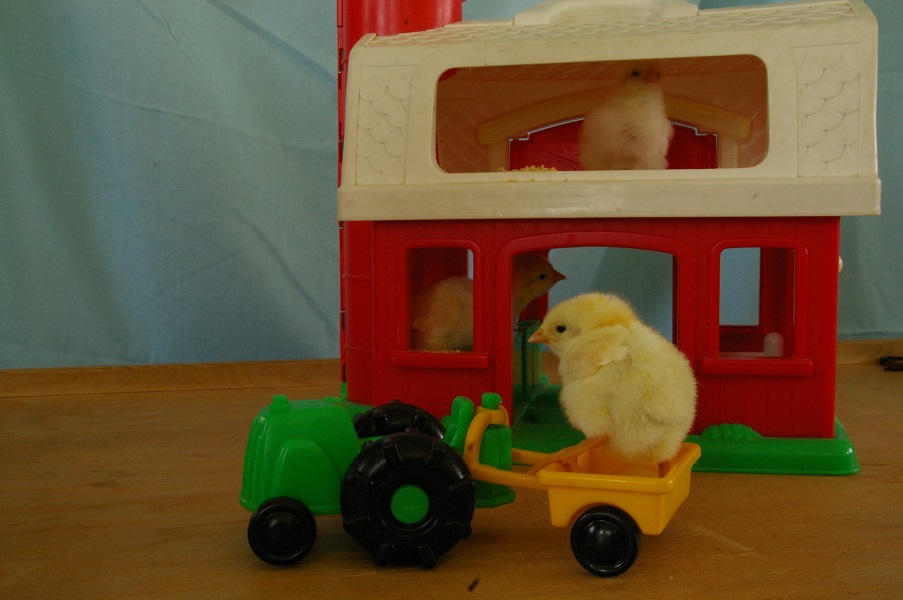
alarm clock chickens

The reception was nice. Way out in the woods, a little music, a little BBQ, a little to drink. We saw an old classmate, some old friends and made arrangements to buy a few pigs the next day from Mike. It was really nice out there. Giant trees, a slight breeze, More food than we could eat. Kiddie pools full of water, soda and other drinks. Cake, pies, homemade ice cream. Thinking back to my conversation with dad, I don’t know what “wealth” looks like but what more could you want?

Then the storm arrived. We watched it roll in on radar and hopped in the car just as it arrived. It looked like it was going to be a pretty quick storm. I chose not to total tee at the reception so Julie drove us home. In the rain. Fortunately the storm was moving from north to south and we were able to get ahead of it most of the way home. We left the party in the rain then as soon as we walked in the door the rain hit our house.

It was not a quick storm but the lightning abated.

The chickens are in a new house and haven’t learned to roost inside of it yet. I need to go tuck in the birdies so I can move them to fresh pasture tomorrow morning but the storm won’t let up. I just have to do it. I just have to do it. Julie goes with me. I love her.

The birds are all roosted by 9:30. Not an easy chore to wrestle each bird in the mud and carrying it to the door of the coop. The rain still hasn’t let up. I hadn’t realized my rain coat had so many leaks. I’m soaked to the bone. I just spent two hours in the mud and chicken manure to convince a flock of chickens that it was bedtime. I must be wealthy. Maybe just stupid. Maybe wealthy enough to afford to be stupid?

Another shower and it’s time for my own bedtime.

I just closed my eyes and I hear it.

bing-BiNg-BING! bing-BiNg-BING!

“Ugh. It can’t be 5 already.”

Adventures in the Jungle

I had a number of things to do Thursday night after dinner and with Julie away for the evening I thought the kids and I could go on a little adventure. I needed a couple of poles for chicken roosts, we were hoping to transplant a pawpaw tree, the last few eggs needed to be collected and the cows needed fresh pasture. It so happens the pawpaw thicket is right next to a stand of tall, thin maples on dad’s farm but we have to walk 1/4 of a mile through the brush and weeds to get there…the jungle!

We better have a little snack before we go. Along the road by my parent’s house we spy some ripe candy. We shoved a lot of berries in our faces before I even thought to get the camera out.

Raspberry

Then it was on down the road. 8′ tall corn to the right, 6′ tall ragweed to the left.

Ragweed

On and on we travel. Deeper and deeper into the thick. Not much poison ivy but here and there it grows against the corn forcing us to blaze a new trail, often pinched between the corn and the steep stream banks. You can see mud on leaves showing how high the water was for a recent flood.

Stream

But we must go on. Just a brush axe, chainsaw, helmet and four children. Four children? “Everybody here? Count off.” No count.I arrive at the edge of the stand of maples. This is the place. The kids are somewhere behind me. They’ll catch up when they hear my saw.

MapleStand

Just inside of the edge everything opens up. It is amazingly open in here with a canopy like a hard ceiling…like we are inside a building. Surprisingly cool too. But the mosquitoes are thick. Dad would prefer to remove the maples entirely and reclaim the field. I would like to coppice the stand. These soft maples will coppice well enough but really don’t offer much utility. The wood does not last and has a low BTU value. Maybe I can find a use for it. Maybe I can shift away from the maple and toward the other types of tree growing here; walnut and hackberry. Maybe I could make rustic furniture…lol.

MapleStand2

With my poles cut it’s time to walk on to the pawpaw thicket. I don’t think the kids have ever been here. I have come here a couple of times each year since 1993 but I have never picked a pawpaw. I think the raccoons get them all. There must be a hundred pawpaw trees growing here.

pawpaw

After a bit of searching we find a small shoot coming up from a root. We cut about a foot of root on either side of the cutting and begin the trek back to the road. Everyone was bug-eaten, tired and dirty but we had a good time. With the kids, tools and poles loaded we head down the road to finish up our chores…after a brief stop at a mulberry tree for some more candy. Maybe when I have grandchildren we can pick pawpaws in the yard but it probably won’t happen before 2020. Worse, I really should go back with a shovel and get a couple more trees. Another adventure awaits us!

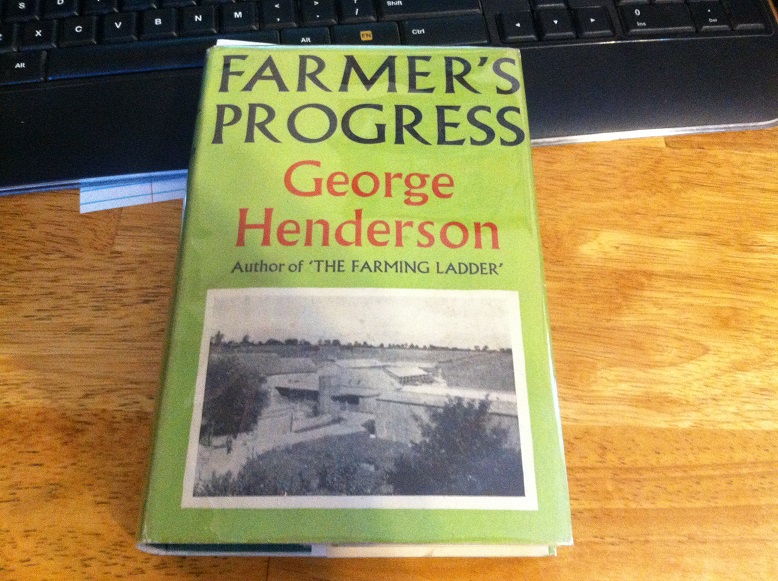
Farmers Progress Chapter 8: The Management of Livestock

This is the continuation of a series as I read through Farmers Progress. The goal here is to jot down my initial reflections of Mr. Henderson’s works, not to republish his work. I do include a few quotes but I try to keep them short. I highly encourage the reader to find a copy of this book. It has changed the way we are approaching things…and how we filter incoming data. Just keep in mind, the focus of these books is entirely on efficient production of the highest quality products, not on marketing. I fear what I could produce if I followed Mr. Henderson’s advice to the letter. Not only would I have to quit my job, I would have to hire a marketing team.

FarmersProgress

Mr. Henderson begins this chapter telling us that, of all the things he does, looking at livestock is his chief interest and pleasure. Then he starts in about his own animals.

Poultry is the most important stock on our farm, from the point of view both of finance and the maintenance of fertility, though it makes possible heavy stock with pigs, cattle and sheep, to such an extent that most farms carrying as many animals in one or other class might regard themselves as a pig, cattle, or sheep-breeding farm.

It is important to note these aren’t simply egg flocks. These are parent flocks for hatching eggs and for raising cockerels for meat and pullets for replacements and for other producers. He next reflects that he can pick birds from their own lines out of other farmer’s flocks because of the familiarity they have with their own chickens. Not only has he bred a closed flock successfully for decades, he has reared them successfully as well. Then he offers a few tips for raising birds:

…we never saw any virtue in running chickens out in a biting wind and a few inches of mud early in the year. They will survive but it confers no lasting benefit when compared with the conditions of those reared in the more genial climate of a large brooder house, with plenty of fresh air and controlled humidity, and of course in equally small units.

and later

With laying stock, large, well-littered houses seem to provide the best conditions for winter production, especially if the eggs are required for incubation. The so-called deep-litter system works well in a dry winter, but when the weather is mild and damp there seems little virtue in leaving the litter in…

I enjoy our chickens. I really do. Most of the time. But I can’t begin to imagine the kind of work Mr. Henderson describes…a 1,700 bird breeding flock, raising pullets, raising cockerels for meat, culling breeding stock and maintaining separate breeding lines, collecting eggs, feeding, watering, moving portable houses and hatching 1,000 chicks each week on top of everything else. I just can’t imagine it. How did he market all of that? How did he sell cull hens, day-old chicks and 650 dozen eggs each week?!?!? But I agree that poultry are a solid foundation on which to build fertility.

IMG_20140626_104045

Stop watching! I can’t do this when you’re watching me!

I totally agree with him that the birds are more healthy when sheltered from the wind, rain and cold and Oxfordshire doesn’t get nearly as windy and cold as it gets here. We move our birds to a deep-littered greenhouse for the winter, collecting the litter for later fertility. This year the birds were indoors from January through March. Next year we will probably move them in a little sooner. I have a lot to learn about providing for the needs of our birds. We went through a short spell where our whites were very runny. Apparently this is caused by a build-up of ammonia. Maybe, as Henderson suggests, I would be better off removing and replacing bedding instead of just adding more and more. We used sawdust this year because that’s what we had. Next year I would like something a little more course…something that will not clump and mat easily.

Beyond fertility and bedding, Henderson gives insight into how to feed the flocks and lists how to modify the ration to use substitutions. The man fed a lot of potatoes during war rationing.

Up to 50 per cent can be fed in the rations, although it will take 4 oz. of potatoes, 1 of meal and 2 of grain as a minimum to keep a bird in full production and the meal will need to be up to 20 per cent protein, unless the birds have access to short grass and insect life on free range.

See? I told you. Buy the book.

From here Henderson offers a few notable quotes on British dairy practices of the time. We have two Jerseys of our own, Flora and May. Flora is beautiful, light colored and fattens easily. She gives a lesser quantity of creamy milk than does May and she can be a real pain in the rear. But she’ll mostly tolerate handling well. May, on the other hand, is dark, tends to be thin and gives a large quantity of thin milk. She has stated clearly that she is not a pet and she only comes in to milk because we offer her a snack. And she can be a pain in the rear. But they are our cows and they calve every year. The calves are much more important to us than is the milk…the milk is close to worthless actually when you account for labor and facility usage.

You can force a cow to give a high yield for a few lactations, or you can be content with a moderate yield over a period of years and of course many more calves.

And that’s the goal. We share milk with the calves, feed some to the pigs and cats and bring home around 2 gallons each day. They bred easily as heifers and calf without difficulty each time. Hopefully we’ll get 8 or 10 more years with them.

jerseys

That’s really all there is to say. But then Henderson calls the whole thing into question with this beauty:

The greater part of British dairy farming requires 5 acres to a cow, and even [then] a lot of concentrates, to produce an average of something under 500 gallons. If half that land were devoted to growing corn for pigs and poultry we should be self-supporting not only in potatoes and milk, as at present, but in bacon and eggs.

IMG_20140625_214440

And so the chapter goes. Pigs and sheep are next on his list. Pigs are a source of valuable manure, sheep are essentially without monetary value but do a good job adding manure and cleaning up behind other stock. Both sections offer the reader numerous tips and feed suggestions and are worth reading…if for no other reason to encourage the reader to grow fodder beets. He closes the chapter with this:

…it does sadden me a lot to see all the wonderful opportunities which are being lost to make our country once more the stockyard of the world. It could be done by each individual farmer making just one little effort to do a little better…

And there it is. We, in the US, could easily be the stockyard of the world. Also the forest of the world. Also the fishery of the world. This is the day I will make an effort to do better…even if just a little. I hope you will pledge to do the same and will encourage me with your success stories.

Updated: Changed my phrasing about sheep near the end. In the original post I reported Henderson saying “sheep are essentially without value”. That’s not what I meant to say. Mr. Henderson clearly cherished being a shepherd, treasured the contribution the stock made to the farm but acknowledged that the whole crop of lambs brought less money than one heifer.

The $10,000 Question

What can you buy for $10,000?

Julie and I drive a 10 year old Chrysler Town & Country. It is big enough that I can fit 4×8 sheets of plywood in it or a couple of 300 gallon tanks or, more simply, our 4 children with comfort. We paid $10,000 for our minivan a couple of years ago when we bought it used. Our previous van had been stolen (along with 5 dozen eggs, my favorite hat and my favorite knife)! $10,000 is about a third of the price of a similar 2014 van.

Our first house cost $30,000 and we had to put in $10,000 worth of improvements before we could move in including hooking on to city sewer and water, repairing the foundation, updating the wiring and replacing the furnace. $10,000 bought all of that…furnace, concrete, wiring and plumbing.

Now, I don’t know who you think I am. I don’t know what you really know about me. I’m not the kind of guy who keeps $10,000 just laying around. My pockets are only so deep. We had a couple of guys out to estimate a pond dam for us and they said $10,000…with more of a firm quote coming.

Sigh.

Can I afford that? I also need a loader tractor. The clutch needs to be replaced on our tractor. Julie wants to build a house…or at least put a roof on this house. I need to plant about a bazillion trees. I need to buy about a bazillion cows…well, maybe 5 or 10 more (easily $10k). There is no end of things I could spend money on…including replacing our minivan. I would love to buy Julie a new ring (lol). Can I really justify buying a 1-acre pond?

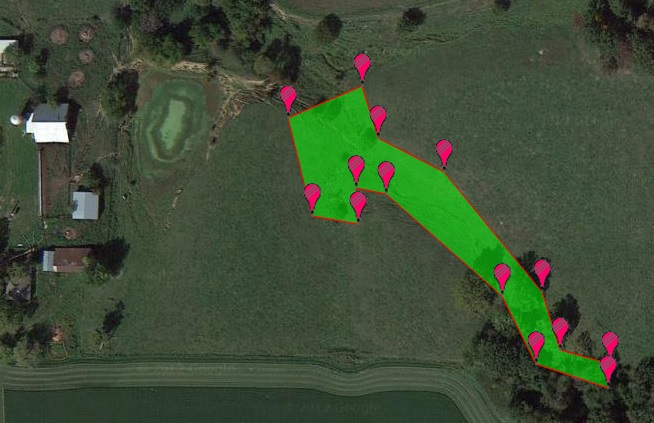
You know, I have found that I can justify just about anything. It’s just a matter of approaching the matter from the right angle. SO. Today I’m going to justify building a pond. I don’t know how I’m going to pay for it but at least I’m going to lay out why I think it’s a good idea for us. First, here’s a rough-out of the pond from the top down thanks to Draft Logic.

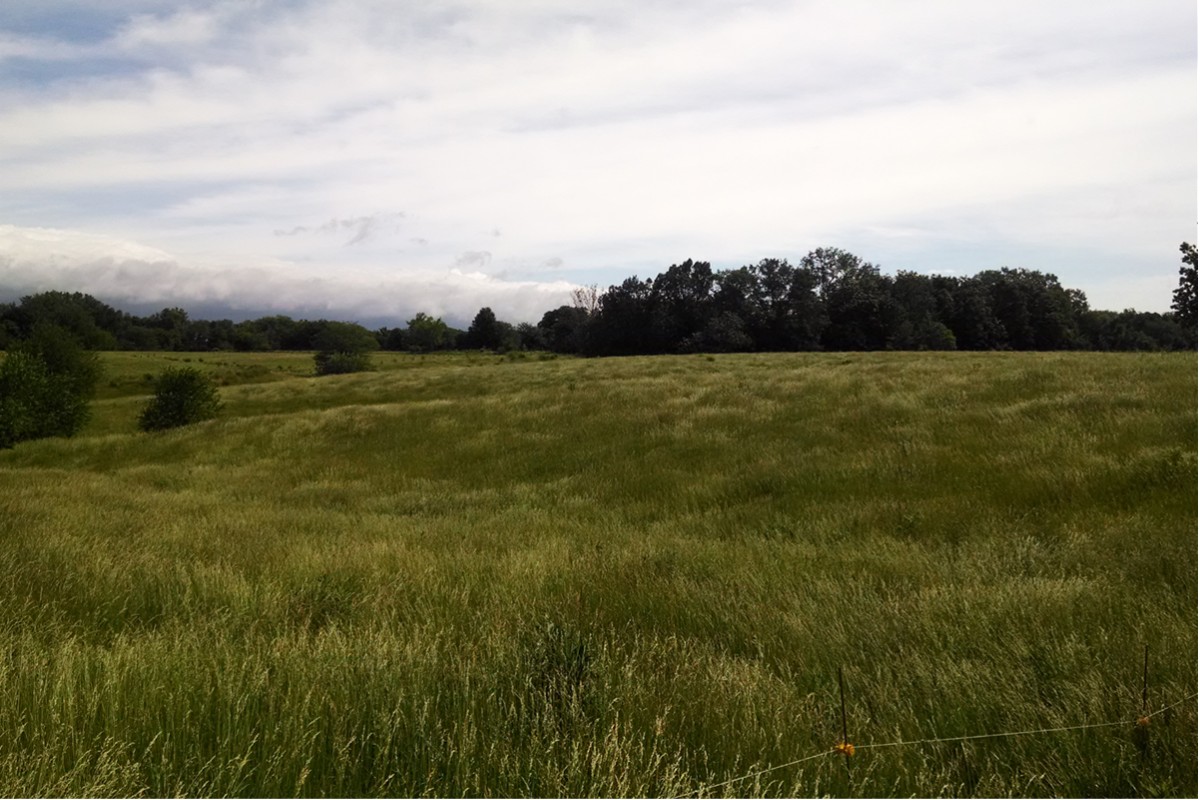
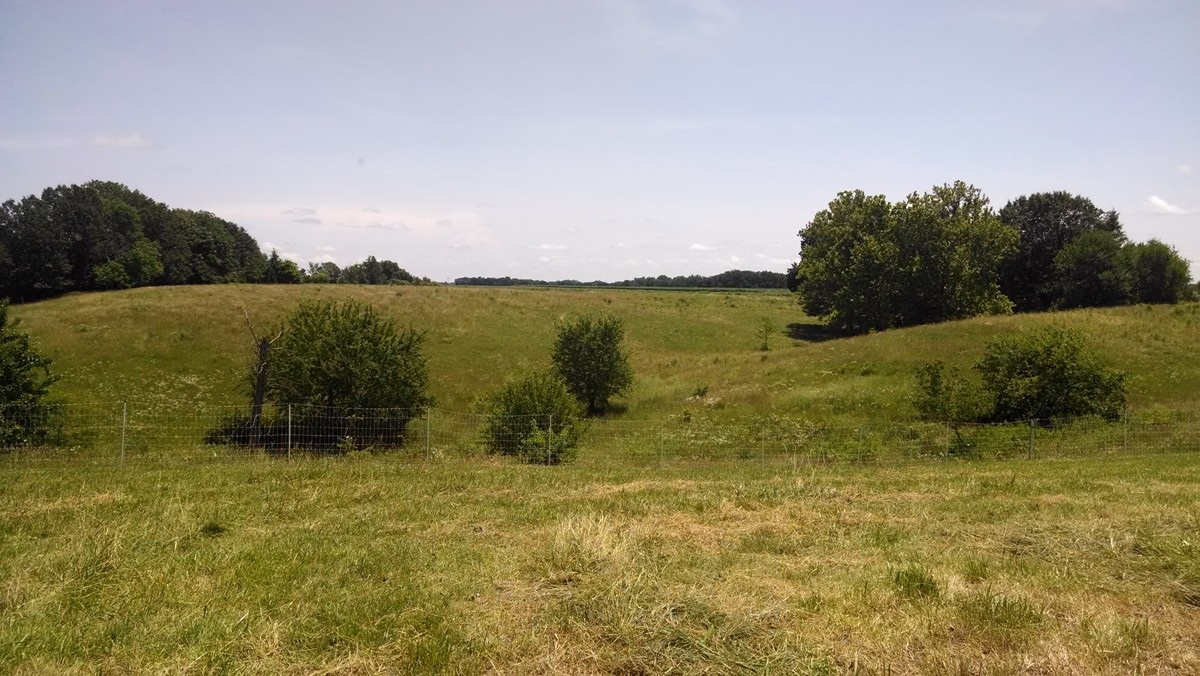
NewPondMy friend Steve says I will never regret having additional water on the farm. I suspect he’s right but this isn’t the pond he was rootin’ for. He wants me to make a single, larger pond instead of a series of small ponds over time (this is just the first). I would like to have it higher on the landscape than this but still, it’s pretty high. There is a lot of bottom ground I could irrigate from this pond if needed. Beyond the extra water, we will gain a dam we can drive across to get to the pasture beyond. The hills here are pretty steep…steep beyond what I would be comfortable mowing. The creek beds are washed out to the point that it’s hard to get a tractor across them too. The grazing on the steep south-facing slopes is sparse and the steep north-facing slopes are covered in moss. Not much grows here. A couple of thorny trees, a little scrap iron and some sparse grass that went to seed early. There are dry dams on two of the three valleys that feed into the pond area and a pond dam uphill from the other so the pond shouldn’t silt in any time soon. Here is the proposed pond area as it sits today. The dead tree to the left is around 18′ tall.

Pond1

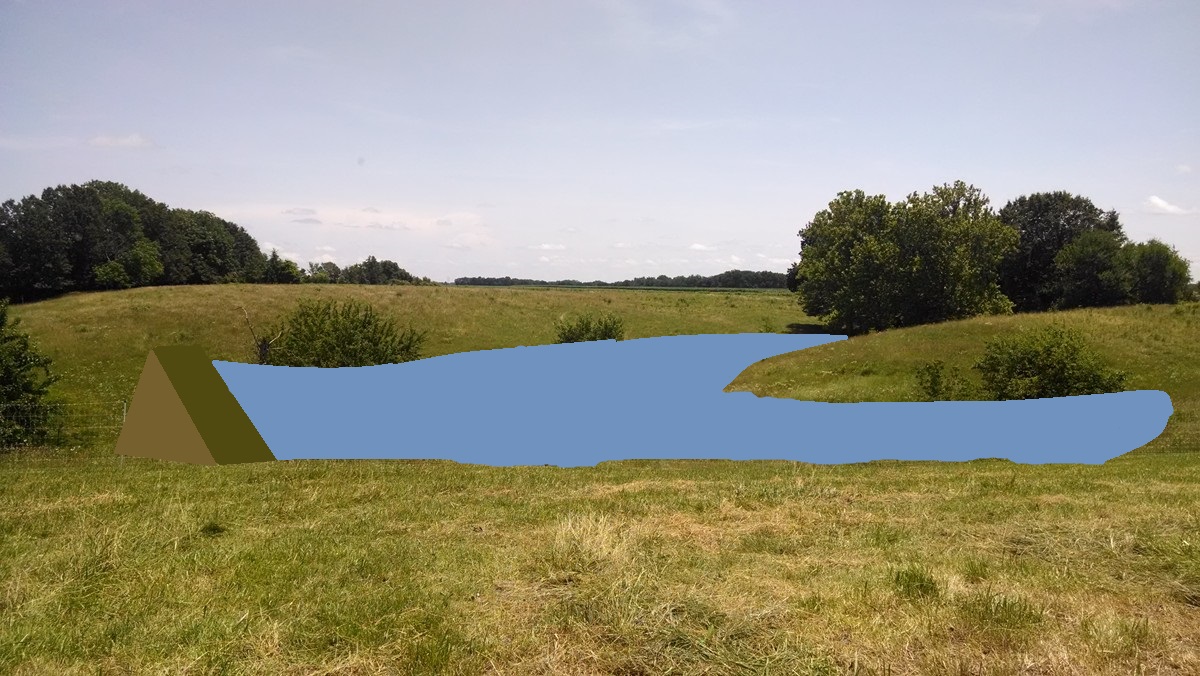
And here is my concept of what the pond will look like. I spent a whole 5 minutes with mspaint making this picture.

pond vision

What we are talking about is a serious benefit to the water cycle, a benefit to the wildlife, a benefit to the livestock, a beautiful feature that will improve my farm’s value and something of lasting value for generations to come. I joked in a post called The Return of Surplus that we needed to bring resources back to the farm and this is a perfect example. Further, by making this investment now we will be able to increase biodiversity and, thus, compound our return over time. Just think of the fish, frogs and turtles. Think of the bald cypress I could plant. Think of the way it will moderate temperature. Think of fried catfish! But the water is illiquid. I will never get my money back without selling the land it is sitting on. Once that money is spent it is gone. That’s it. It’s either pond or loader tractor. Pond or cows.

But once the pond is built and stocked it’s here to stay. There will be nothing more to do for generations to come. Similar to the ponds grandpa built maybe 60 years ago, I’ll be leaving the farm better than I found it.

Can I justify it? Yes. Can I afford it? Ugh.

Today’s Breakfast

For breakfast this morning I had a quart of Saturday’s milk and a couple of handfuls of black raspberries I picked while moving the cows. The milk was hard work. Hard. Work. Milk doesn’t just magically appear in the fridge. Milking machines don’t clean themselves. Hand or machine milking only happens after your cow has calved. Cows only calve after they spend 9 months pregnant…and they eat the whole time. Cows only get pregnant because they have met a bull or have met your whole arm. You with me on the hard work thing here?

The black raspberries just grow in the field edges. The only “work” involved is picking a path through the poison ivy (which the cows are trying to eat) to get to the berries. Dew berries should start coming on in a couple of weeks.

dew berries

Not yet…

What would someone have to pay for a quart of freshly squeezed milk and a pound of fresh berries? Could you even deliver these berries in any condition? Am I living the dream or what? All I have to do is make my farm payment each month, wake up insanely early every morning, follow the cows around, step in cow pies and give them fresh pasture. We also close them off from their calves for large portions of the day which requires …oh, a little more management. Oh and we have to keep the milking area in the barn clean and fight off the barn cats so we get the milk for ourselves. Then it’s an easy quarter-mile walk to pick berries among the poison ivy and spider webs and horseflies and breakfast is served! See how easy?!?!

Sometimes I’ll have another quart of milk to cool down after morning chores. No time for that today though. Just a quick shower to rinse off the layer of sweat and grime before heading in to the office to work with the cereal eaters.

Start Small. Go Slowly.

I was listening to a Permaculture Voices podcast with Darren Doherty. Darren said he was speaking with Teresa Salatin (with me so far?) about her advice for folks just getting started. In short, start small. Go slowly.

Once upon a time an ambitious, hard working young man moved with his lovely bride and children to his family farm (which he bought with real money the bank created from thin air and loaned to him (and he is repaying this real loan of fictional money even to this day)). When the family arrived they already had a small flock of pullets…cause that’s what you do. You get some birdies and then you are a real farmer. Well, some birdies and a gun to protect them with.

FirstPullets

Pullets are fine. Pullets are fun. We had a few roosters too. The flock was small so we knew the birds’ names. Red roosters are always named Roger. Barred Rock roosters are always named Rocky. There was a small pullet who ran to me each day and liked to ride on my shoulder. We called her Polly. Polly was killed one night along with around 30 other birds by a mink.

And that’s how it goes. Everything likes chicken. We had everything to learn. We still have everything to learn. Everything still likes chicken.

But we started. And we started small. We should have started smaller and that’s why I’m writing this.

FirstCornish

Then we got 100 CX chicks so we could call ourselves real farmers (we had, after all, read Pastured Poultry Profits). CX are merely an 8-week prison sentence. No big whoop. But we hadn’t pre-sold any of the birds and really didn’t have any extra freezer space. No plan. Just birds. “We’re really doing it!”

Well, yes. We really were raising animals. We were producing and…well…I guess that’s good. Except…um…you know…where are the customers? Aren’t they supposed to show up? We’re producing what the world wants…shouldn’t the world be here by now?

When the bird thing was under control (barely) we got a milk goat complete with kids. That was a mistake. It was too soon. Too early. Too much we didn’t know. Too much going on at once. (For those of you playing along at home, please consider Dairy to be an advanced topic and not to be entered into lightly.)

FirstGoat

We sold chicken. We sold eggs. We froze whatever goat milk we couldn’t immediately drink. Things were going so well we thought we should add pigs the following year.

Pigs. Again, we’re just in the yard. My (distant) cousin was renting the pasture. He said he wouldn’t mind if I ran my chickens through his pastures near the house. Thank God. But I had to find a place for three ruptured pigs. I made a little shelter with T-posts and pallets (and ripped my hand open driving the t-post…cool zig-zag scar!) and put the pigs back under some trees contained by electric fence. That went really well. I mean…really, really well. The pigs rooted up the yard and later the pasture. Again, few animals tend to have names. We let names happen spontaneously. We sold Susan to a couple of co-workers through the local packer. Buddy and Girly went to our own freezer along with Popeye the goat. (We ground a portion of the goat and pig together and made Popeye/Buddy burgers…totally awesome.)

FirstPigs

These were all ruptures (pigs with hernias) from a production hog floor. Each had a big balloon of skin hanging down from their bellies or scrotum. Because of the flaw we bought them cheap and it all worked out well. In fact, the ruptures closed up. The vet says they didn’t heal, they just were not currently expressed. I suspect it was because we fed our pigs at the ends of the day and let them go hungry for a little while day and night in addition to the clean air, fresh pasture and lack of stress from animal density. Anyway, we learned how to care for pigs on the cheap and how to kill and butcher pigs and goats. I don’t know how many batches of pigs we have raised to date. Several times along the way we have had a nice gilt in the group and we have considered keeping her or just raising a couple to farrow our own pigs. But I think there is a lot to be said for running a complete batch through and being able to take a breather for a little while. We just have pigs when we want them.

FirstCows

For some reason we chose a different strategy with cattle. We bought cows. Cows eat. Cows eat every day. Every. Day. There are no days off. It would be so much nicer to buy stockers in September and sell them in June. Then I could take the summer off. Sweet! But, no. I bought cows. Worse, I bought a couple of milk cows. Remember me saying that dairy is an advanced topic, not for the beginner. I meant it. I really, really meant it. You are better off buying your milk…at least when you first move to the farm of your dreams. Every morning I wake up early (earlier than ever before) to wash milk jars, sterilize equipment and get things started. Every morning. Every morning. Today? 3 gallons. Yesterday? 3 gallons. Day before that? Yup. What do you do with all that milk? I try to drink a gallon each day (helps me keep my girlish figure). Right now there are 7 gallons in the fridge. What do we do with it all? Skim the cream and give the rest to pigs, chickens or cats or dilute the milk and put it in a compost tea.

Read that last sentence again. We need our entire farm working to utilize the surplus milk we receive from two cows…cows with calves we are sharing the milk with. True dat. You need to start small. Dairy isn’t starting small. Dairy is something you add when you’re up and running already.

“But”, you say, “I wasn’t wanting to start with livestock. I just wanted to put in a garden. Only an acre or two.”

Well.

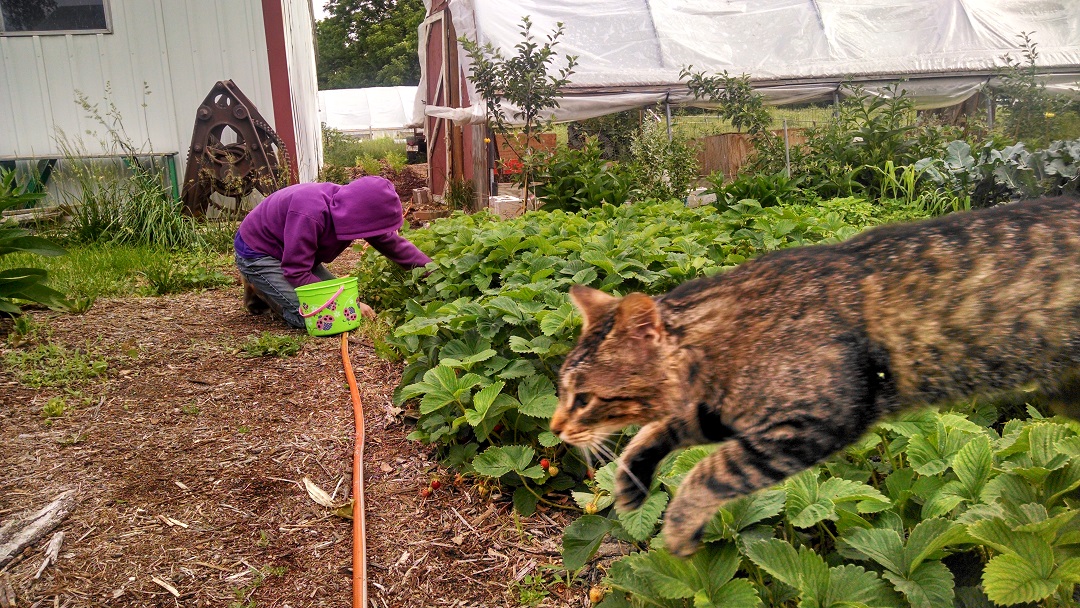
Two years ago I planted a matted row 15′ long of strawberry plants. Last year I thinned that down to a double row and extended it another 15′. So far we have picked 30 gallons of strawberries that I know of, not counting the bug eaten berries we just toss and the handfuls of berries we have eaten right out of the garden.

StrawberryPatch

Cat photobomb

The little girl in the picture above is tired of picking strawberries. Any idea what you are going to do with that bumper crop of tomatoes? We once filled a freezer with jalapenos. What is the plan when you pick 3 bushels of cucumbers every day for two weeks? (hint: it helps to have a pig!)

No matter what you are producing you can easily out-produce your ability to handle the bounty. You may even begin to curse your blessings. It’s pretty cool to collect 10 dozen eggs/day but can you really sell 70 dozen eggs every week? 280 dozen every month? Maybe you shouldn’t raise 150 layers then.

But if you start small you’ll give yourself a chance to work out the marketing kinks. Really, for every hour that goes into production and harvest, you need to dedicate 7 hours to marketing…to expanding your market…to finding new customers. The goal is to start small but to increase your production each year until you just can’t handle all the money coming in. Your family of four could easily utilize 4 bushels of apples each year but you planted 10 apple trees. Each tree will produce that many. What are you going to do with all the apples? Heck, what are you going to do with all the wild abundance that magically grows on your land? All the raspberries? All the mulberries? All the bluegill?

FirstFish

So. Start small. No, smaller than that. If I was advising someone who was starting out fresh I would suggest 4 pullets and a pig. That’s it. Maybe a worm box if you’re adventurous. With those animals around you can up-cycle all the garden and yard waste you can find into bacon, eggs and manure and still have enough eggs to pass some to a neighbor over a fence from time to time. Later, raise 10 broilers for yourself in the fall. Start out with a 10’x10′ garden following recommendations in Jeavons’ book, planting things you know you will eat and working to keep every square foot working year-round. I would plant fruit trees…not a lot of trees but some. Maybe on the north edge of your garden space. Throw in some bushes too..both for fruit and to attract beneficial insects. I would include comfrey and a few other perennial herbs. But keep it all small. Small. Think small.

Let your customers force you to expand. If you start small and work hard, customers will appreciate your quality. Word of mouth is the best marketing tool available. Never let your customers down. You can’t produce quality until you have learned to crawl. Learn to crawl. Start small. Believe me. My knees have been skinned more than once.

Our Chicken Wagon

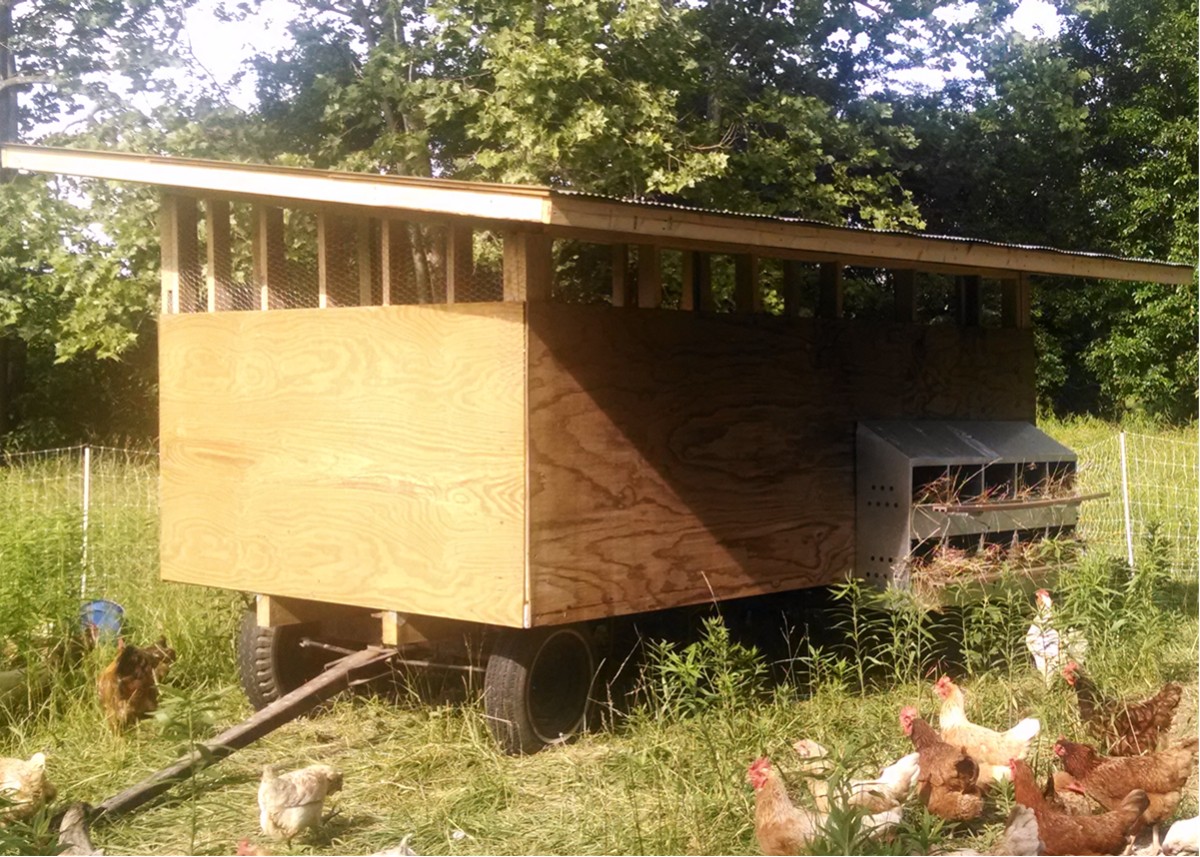
Julie and I needed to find a way to make the chickens more portable. We were already moving toward building an eggmobile on a wagon running gear when we heard Ethan Book discuss the same idea on his podcast. We just needed to simplify moving the chickens so Julie or the kids could handle it alone. Too much of our farm depends on my back.

chicken wagon

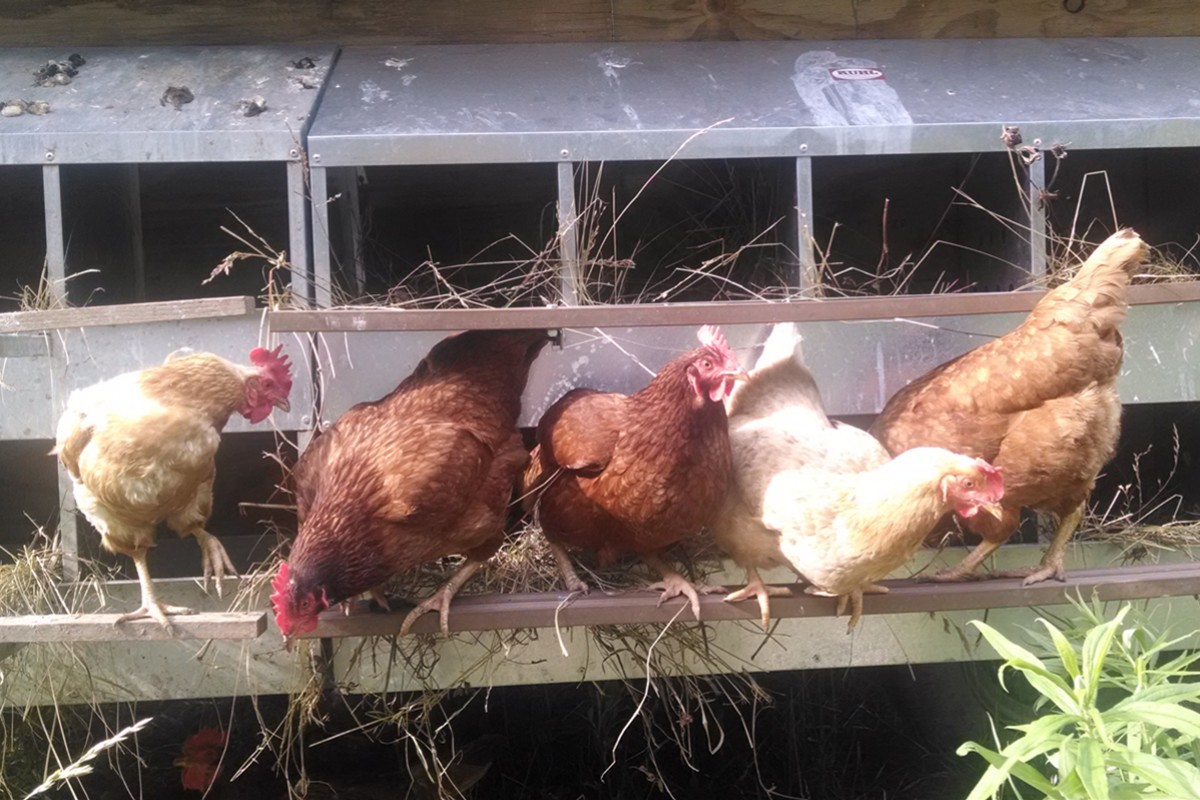
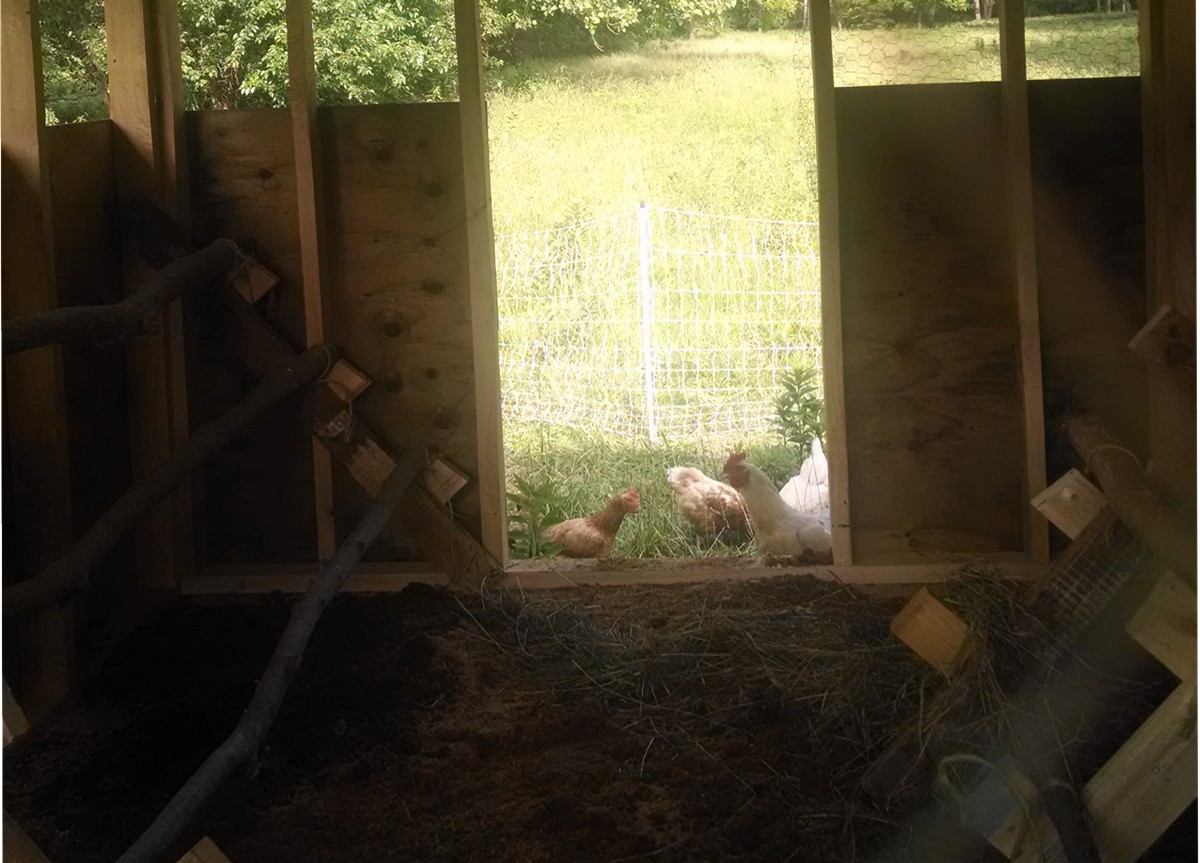
Ours is an 8×12 box. It is 6′ tall on one side, 5′ tall on the other. The roof overhangs by 2′ in all directions (12×16). The interior is all bedding and roost bars with a little room for supplies. The nest boxes are all outside of the enclosure. I think we can tweak our design efficiency but overall it’s a pretty efficient little unit because of dad’s input. It also stayed cool in full sun on a 90 degree day with a breeze largely because we put a layer of insulation board in the roof. Plus it casts a big shadow in the pasture. Chickens are cool in and under the box in the heat of the day.

inside the coop


I plan to hang a barrel on the front to feed watering nipples that will hang down under the edges. There is a second array of nest boxes next to the first you see pictured. We had to cannibalize it from the prior chicken tractor-type layer solution. Other changes will come along but I desperately needed to just get the birds moved so here we are.

So. Thanks to dad and thanks to Ethan. We already had the idea and the momentum, Ethan just applied the spurs and dad made it happen. It turned out well. There will be more and those will be even better. If you are reading George Henderson with me you know that he used something similar…but bigger.

Calving Season is Over

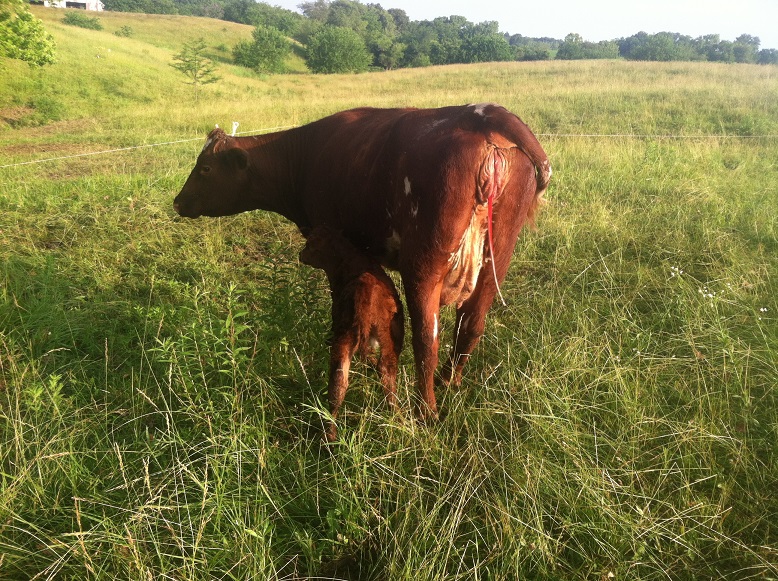
We are finished calving in 35 days. That’s a tight window for some, a long window for others. I’m just glad it worked out so well. 5 healthy calves born without assistance.

Heifer

111 calved early this morning. She’s the last one. In some ways, 111 is the best of the herd. She is short, fat, slicks out easily and has a good disposition. However, she has at least six teats and she calved about 3 weeks after the main part of the herd. Hopefully this little girl will strengthen the group.

We plan to use the same bull again this fall. He was sized correctly and has thrown small, vigorous calves. If I have my druthers I’ll use that same bull again next year too.

I have more grass than cattle and with corn futures low and drought in the west feeder cattle are going high. It’s a good time to be selling cattle. Not a good time to be buying. Sigh. Oh well. At least I have the calves I have and I can get a good price for the heifers that didn’t breed last year.


Simplifying the Cow…Mr. Miyagi Style

Daniel LaRusso was an idiot. He was an immature, hot-headed show off and he should have known better than to repeatedly pick fights with the Cobra Kai. But as the movie progressed Daniel grew up a little because of Mr. Miyagi. What did Mr. Miyagi do? Well, most importantly, he filled an emotional and developmental need in Daniel’s life. But in terms of karate training, he focused on what was important…simple things: belts hold pants up, hard work pays off, stick with it to the end (or <squish> just like grape). Daniel [Spoiler Alert!] was “the best around (Nothing’s ever gonna keep you down!)” because Miyagi required and enabled mastery of a few simple things: block punches, block kicks, punch with balance and a use a special, secret move that “if do right, no can defense”.

So, for the sake of my growing children, let’s break this farm thing down to simple things without secrets so if do right, no can go broke. It’s going to take me more than 90 minutes to teach my children these lessons – lessons I am still learning – but we will begin at the beginning. What is the essence of cow? More simply: What is cow? More simply: Cow?

It’s not about breed. It’s not about color. We are looking to add value to captured sunshine and enable future sunshine to be captured even more efficiently. We use cows. We can make fat cows. We can multiply our cows. We can multiply our cows and make the multiples fat. The cow is a leather-bound sunshine assimilation unit that tastes great with onions and mushrooms. That is cow.

I have seen unhappy cows. Hunched up, head down, shaggy, covered in mud and manure, ears drooping. Sometimes because of mismanagement, sometimes because they got a bad start in life, sometimes…who knows. I have one of those and she’s heading to the meat cutter. This is not cow. It just looks like cow.

WhiteCalfA happy cow is clean, her coat is laying neatly (though may be a little fuzzy in winter), her eyes are clear, she is not hunched up and ears are not drooping (unless she’s a brahman). If she is not grazing she is laying down in a dry, clean place chewing her cud. This is cow.

ZenCows

It takes grass to make cow and we want to make cow with grass…not with diesel fuel.  Grass makes cow. [I could be saying “beef” but saying “cow” seems more Myiagi and keeps the lame analogy going.] If you don’t have grass you can’t make cow. You only need sunlight and rain to make grass but having cow helps you make more grass and do it more quickly. And more grass means more cow…and more grass, if do right, means no can go broke. Quality forage is a science of its own but let’s keep things simple. How much grass does it take to make cow? It takes enough grass to fill this hole behind the rib and in front of the pelvis on the cow’s left…and keep it filled every day. How do you measure each day’s pasture? You offer enough pasture to fill that hole, little enough that the majority of what is left gets trampled and manure is scattered about. We line up a couple of parallel fence lines and move the cows throughout the day until they are full (there are more advanced and seasonal fencing techniques but let’s keep it simple today). If we are on the ball they will have enough fresh pasture overnight that they still look full in the morning when we come to move them. It’s no big deal. Fill that rumen. If it’s not full, give more pasture. If you miss today, do better tomorrow. Easy peasy.

Rumen

Let’s add a little complexity. Cows need more than full bellies. They need a balance of protein, energy and fiber. It is good to look at the side of the cow. It is better to look behind the cow. Look at the cow pat. Does it look like a stack of cookies? The cows need more protein. Does it spray out from the cow when she coughs? She needs more fiber…or she needs wormed (sell her). If it’s nicely piled up with a dip in the center the cow is getting what she needs. There are times when the grass is too lush and you will need to fill the cows up with dry matter (hay). There are times when the pasture just doesn’t have the protein the cows need and you will have to provide some level of supplementation but we’re getting away from simplicity. Graze tall, diverse swards a little at a time and things should be fine here in Illinois…especially if they can reach the lower limbs of trees.

CowPat

There are a few other things cows need like shade (hugely important when it is above 80 degrees!) and salt but that’s a good start. We will spend the rest of our lives learning about cattle and grass but if you only learn a few things, know how to keep them full and how to read manure. Understand what we have them for. They are pretty, yes, but that’s not why. They are fun too but that’s still not why. We have cows because we have grass…and because we want more grass. We are grass farmers. Cows fertilize, cultivate and harvest our fields.

Look at the rumen, look at the manure, buy a belt to hold your pants up and face down adversity. You’re the best around. Nothing’s gonna ever keep you down.

For another look at cow simplification, Hubert Karreman listed 5 (6) preventative measures for animal health in a recent Agricultural Insights Podcast:

  1. Don’t exceed the land’s biological carrying capacity
  2. Offer high-forage diets (75-80%)
  3. Offer good Grazing
  4. Ensure fresh Air
  5. Provide dry Bedding
  6. Give access to sunshine

At this point you’ll have to subscribe to hear that podcast but I think it’s worth it. I haven’t read Mr. Karreman’s books. If you have, let me know what you thought.