Reading Journal 2015 Week 9

Well, this didn’t work out as planned. I thought I would read Gaining Ground this week but only succeeded in carrying it around with me for a week.
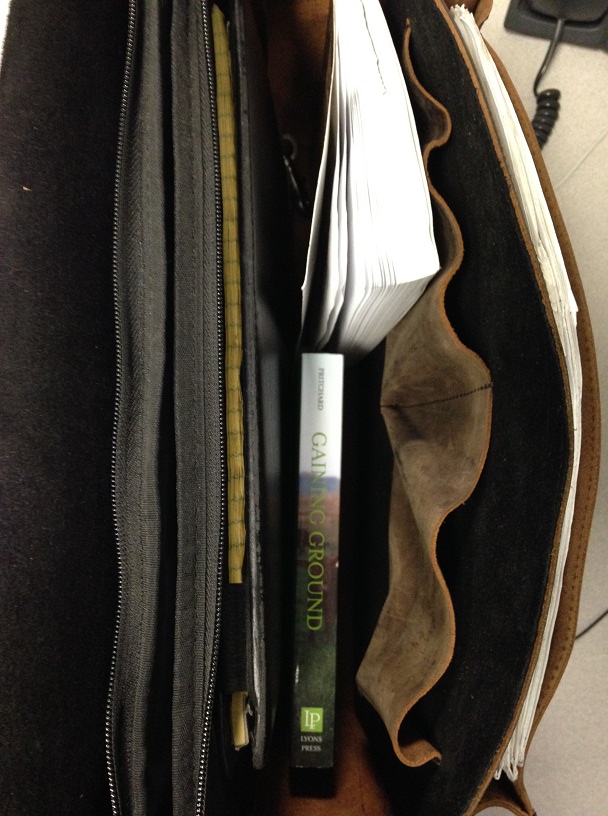
Satchel

I did start and finish Robinson Crusoe and sped my way through something unexpected, The Dilemmas of Family Wealth. On that last one, I feel I should clarify that family money is no problem I suffer from. Rather, I hope to equip my children with a soil-building, cash generating machine that will enable them to live life to the fullest, pursuing their own interests, finding enlightenment and fulfillment on their own terms…not just tagging cows for the old man.

So let’s talk for a minute about reading whatever I wanna and about my kids. My kids read whatever they wanna. Here is a post that talks about why.

Another four inches of snow fell last night. You know what sounds nice? Nicaragua. 93 degrees in Managua today. Sigh.

Let’s get started. We’ll start on a tropical island.


Robinson Crusoe by Daniel Defoe

Guy ignores his father’s advice and ends up shipwrecked on an island. He deals with scarcity and economy as he scratches out an existence on the little island. Seriously? You haven’t read this?

This is a classic among classics. Classics are classics because people still read them. Some are more classic than others though. For example, I have never survived the meat grinder that is Don Quixote…short of watching Peter O’Toole and Sophia Loren.

I focused on economy as I read. What is most important to Rob? The ship wrecks. His companions are all washed away. He is alone and has an unknown but limited amount of time to retrieve goods from the ship before it washes out to sea. What is first? That choice is faced over and over. How to make the most of his time and resources. So let’s bring this on home. Rob had to farm. He kept goats, grew barley, etc. Barley. Barley from seeds he found in a coat pocket. Starting small, with very little, showing a small profit, saving that profit instead of consuming it and re-investing it in the future, Rob ultimately had more barley than he needed. It took time.

It takes time. we bought 6 cows. How long will it take us to increase that to 30 cows? A long time…even in a perfect world where all cows breed each year. Half of the cows born each year are male. Math that out for yourself. But you save heifers and reinvest them. You save and hatch a few chicken eggs and duck eggs. You build your customer base slowly as your production increases. Little by little, over time, focusing on keeping the most important things at the top of your list.

Economy aside, you know what Rob wanted more than anything? Companionship. The Bible says that’s what God wanted too. That’s why He made us.

I spend a lot of blog time praising my wife. I do that in real life too. I need my wife. I need her support. She is my companion. Isolation in our marriage is just a few criticisms away. If I want her to leave me alone I just have to say a few magic words and she’ll disappear. Vanish. In fact, I can make her disappear with a lack of words as well. I can just neglect her out of my life. I also have to be careful with my expectations. I expect to be married the rest of my life and I don’t want to be a broken down old man married to a broken down old woman when we’re 50. We have to make careful choices right now to care for our bodies. She should not be carrying 50 pound feed sacks across ice. I shouldn’t carry two hay bales at once. Those kinds of actions limit our potential over the long haul.

And Robinson Crusoe was in it for the long haul. He played the long game and <SPOILER!> he won.

You may be asking, reader, if everything I read has to involve my farm and my marriage.

Yes. Yes it does.

Do you think eggs matter to anybody? Eggs don’t last. My marriage matters to me…even if you don’t care. My marriage has to last. I was made to worship God. I have vowed before that God that my marriage would work. I have a limited amount of time and resources to invest in my relationship. What do I do first?


The Delimmas of Family Wealth by Judy Martel

Hoo boy. I SPRINTED through this book. Sprinted. This book requires serious, personal reflection time but it is hard for me to apply because I’m not the target audience. I’m ready to step aside and let the next generation run but they aren’t ready yet and we are certainly don’t have money to burn. Is it a classic? I don’t know. I won’t know for some time. I gathered some ideas that will help me guide my family for a few decades but you’ll have to check in 50 years from now to see if I garnered anything of value.

Let’s begin at the beginning. What do I want for my children?

I don’t want my children to take the farm. I hope one or more of them will but I can’t look at my oldest son and say, “Son, this will all be yours someday.” He wants to be an engineer. Oldest girl? Baker. Next child? Pastor/carpenter/taco stand owner. Last child? She just wants to live with us. And she can. So maybe she’ll take the farm. But maybe she’ll grow out of being 8. I don’t know.

But here’s what I do know. I can’t make my kids do this. Nor do I want to. I need to build a base of resources upon which I launch subsequent generations into successes of their own. The farm is our foundation of wealth. We are not slaves, the farm is not our master. The farm is our launch pad.

Martel includes this quote from James Hughes, author of Family Wealth: Keeping It in the Family, a book Julie and dad and I read within the last year.

…most succession plans fail because the first generation tries to impose its dreams on the second, setting up a cycle for dysfunction and eventual collapse. “The families that fail fast are the ones where the first generation says to the second ‘you’ll do this for us, and then we’ll do something for you,’ he says. “It’s better to ask, ‘what is your dream, and how can the family enhance it?”

What are my kids’ dreams? Who are they? Who could they become? What’s the point of having any resources at all if we don’t use them to answer these questions?

So what is the farm then? This is home. This is the place we return to when we are hurt, when we need to heal up, when we need to rest. We are safe here. If there is nowhere else to go, if all the world is against us we can return here.

House

That’s what this house means to me. This was grandma’s house. There were always bags of cookies in the freezer and probably some ham in the fridge. I was loved and wanted here…welcome. If I needed anything at all (need, not want) I could count on grandma and grandpa to help me. When we came to visit I was warm and safe and slept soundly on the couch to the sound of the clock ticking on the mantle. My sister slept on the other couch. Mom and dad slept upstairs. Grandpa slept in his recliner until he went to bed. Even as a teen, I brought a date here to watch Aladdin. We sat on the couch laughing, grandma slept in her recliner.

You know who loved us? Who hated beards but never judged us? Who was more supportive and understanding and loving about the mistakes my cousins and I made in life than anybody else? My grandma. My Bible-reading, popcorn-eating, cookie-baking grandma who had made serious mistakes of her own in life. This was NOT the place to turn when you were short on money but it was the place to turn when your heart was broken. Grandma loved us.

Grandma was perceptive and intuitive. In a certain mood I might say she was manipulative…lol. But she was also creative. She made bookshelves. She made cabinets. She painted pictures and saw blades that are probably in every family’s house. She and her sister wrote a cookbook that mom and her sister just republished so we can still cook up our favorite grandma dishes. Those are, to me, happy smells. They are more than just oatmeal chocolate chip cookies and frozen fruit salad. They are emotion.

Grandma represented love and Grandpa, to my mind, exuded strength. Grandpa was a big, big dude. Remember, his job as a child was to restrain his older brother when Billy had seizures. And he had to carry the milk cans from the white barn down the lane, across the bridge and up the hill because the milk truck couldn’t drive back there…after he milked the cows by hand. That’s a path we still travel.

BarnPath

Through tornadoes, wild animals, recession and ’80’s farm debt, there was comfort in my grandfather’s strength. Maybe I’m showing that the boy in me worshiped the man. Maybe. But maybe it wasn’t just me. Maybe that’s why grandpa positively impacted so many people. Uncle Jack’s eulogy is included in the family cookbook. I’ll quote a little. I’ll start after the story of lifting a little boy up onto the back of his horse to spare him from school bullies…an act that got him out of a traffic ticket years later when said little boy became a police officer.

He himself was a faithful hero. He was the kind of hero who takes on impossible burdens, and never gives up. At the age of 16, he had to drop out of school and become sole support of a family of five, in the midst of the Great Depression. He bought a tractor, one of the first in the community, and began a career of innovation and hard work that lasted 60 years. When his doctor told him he had only two or three years to live, he continued to farm for four years before he retired and had a final sale of his machinery – a month before he died.

About his cancer, he told me, “I’m not afraid of dying, but I hate the idea of becoming helpless and worthless.” The tedium of his illness drove him crazy. He knew farmers who, discovering they had terminal cancer, put their affairs in order and killed themselves. But I knew he’d never do that, because he saw it as his duty to set a good example to the end. He’d spent his life demonstrating, for us, how a man should live. Now he spent these final years showing us how a man dies.

I don’t really want to write a post where I cry and tell you how much I loved my grandparents. I want you to know that this place where I am now…the room where my grandparents watched Johnny Carson and snored in their recliners…this is home. I feel safe here. I want to give that to my children. Grandpa didn’t give me cattle or chickens or stock dogs. He built a pond. That’s true. But I am buying it from the bank at a price I myself find shocking. My grandparents gave me love and a legacy of creativity and integrity and hard work. My grandparents set the stage for me to live my life and helped teach me to be happy and hard-working no matter what. And to worship the Lord. They taught their children who taught their children. Now I teach my children.

That’s wealth. Real wealth. Do you know who I am not? I am not my grandfather. I miss by a few inches and about 60 pounds. I lack the personal discipline and character he developed. But I can love my children. I can love them for being who they are and I can apply my own resources to helping them fulfill their individual purposes, not to bend them to my will. Reading these books is not an expression of my love of money. It is an expression of love for my family following the path grandma and grandpa walked before us.

So with tears wiped and nose blown maybe I should talk about the book a little bit…in my book post. We have clearly established what we’re trying to do. Now how do we do it?

One thing Martel points out is the need for the next generation to share our common vision. There is a worksheet included that boils down to two questions for family members:

  • Who actually understands what we are trying to do here?
  • Are we succeeding?

It may turn out that nobody knows what is going on. Maybe we need to state it more clearly. Maybe I should state it more clearly.

Kids, I want you to learn everything you can about everything you can. I enjoy working with animals and tromping around outdoors. I think owning a farm is a hoot and I see business potential here…though we have yet to fully realize it. I hope the farm will teach you the rewards of hard work, help you appreciate and understand the world around you and will give us a source of income from which we can launch other businesses. Whatever you want to do, I’m with you. The land is just the place. You are the purpose. Or as your mother wrote it:

We work together as a team to steward God’s resources, create a welcoming home, share with others, encourage one another, learn and explore new ideas and pursue our God given purpose.

My grandparents didn’t make anybody stay home on the farm. They also didn’t make anybody leave. But had grandma and grandpa been intentional about building a family business here, things might be different. Aunts and uncles may still have moved away but there would have been something more than the cemetery to link their children to this land.

The cemetery is a good example of another quote I liked from this book. The cemetery committee is voluntary. You want to participate? Great. The committee’s goal appears to be to see to it that our family memorials are cared for and our own place is prepared. I want the cemetery to be the kind of place I would like to be buried. To make that happen, there is a committee to oversee the cemetery and it’s made of adults who contribute willingly. Here the author is quoting David Gage.

The potential roles for siblings working together are extremely diverse – from running the business to being a “silent” investor with a seat on the board of directors. If they, as adults, are given the opportunity to work out their roles and their partnership themselves, they will be more invested in the outcome, and will have a better chance of feeling good about their arrangement – much better, Gage maintains, than if a parent selected those roles for them.

There is no reason my aunt and uncle and parents can’t work together outside of the boundaries of a formal family business. In fact, they do. But the family business structure could be a way Julie and I can facilitate that cooperation. We just have to structure it correctly. There is a TJED home school quote we repeat to ourselves constantly. We seek to inspire, not require. Did you read the link at the top about helping your kids to develop a passion for reading? Let me sum up. If you want your kids to read, you should read. Early and often. That inspire quote is in this book too. Quoting Robert Mondavi’s book Harvests of Joy the author includes:

The greatest leaders don’t rule. They inspire.

This is important, as the author points out, because at some point a family business is likely to be sold. And that may be the best thing. Culture, economy, legislation and talent in the family change. What then? I can’t anticipate what will happen in the future. The best thing I can do is to help my children become thoughtful, mature adults who can branch out, do their own thing and feel that they, themselves are the founding generation so the wealth will grow rather than evaporate.

…what some founders fail to take into account is that future business entrepreneurs are vital for wealthy families because it is through the sale of a successful company that much of the great wealth in this country is earned. These supplemental fortunes help to offset the original asset base that is being depleted as the family grows, simply through the care and feeding of too many mouths. While the family begins to write a multigenerational narrative that will be funded through the wealth created by the founder, the money is being stretched to pay for more members who come into the fold. New family entrepreneurs are needed to replenish the financial capital.

So, by golly, we will have engineers and bakers and taco makers…or the book talks about soldiers, farmers and poets. So I’ll invest in their success. And their children? Who knows. But that’s a more interesting investment than anything listed on an exchange. And it sounds like more fun than buying yacht.

I really can’t cover this book. I found it to be a valuable read but there is just too much here…and as I hope you can tell it is all very personal and important to me. The introduction strongly suggests that the book be read with a group. I agree. And I know just the group to read it with.

I do want to say, though, that the book points out the necessity of connecting future generations with the family’s past. Who are we? Can we still be “us” without the farm? My kids barely remember my grandmother. They never met my grandpa. It is important that we record and tell the stories of our family past to lend context to the process of discovering who we are now. This is important because cows and money do not encompass our family. Those are a means, not an end. I know I used a lot of words to illustrate it but that’s what this book reinforced for me.


Article of the Week

On the topic of family wealth, I make it a point to read Bill Bonner (author of the excellent book Family Fortunes, BTW) at least a couple of times each week. This is not a farming topic. This is entertainment. Just for laughs. The last thing I am looking for is investment advice. Just humor. Keep that in mind as you click. Also, sometimes Bill’s posts are all about misdirection. This week he threatened to post a two-part meditation on the burden of wealth but part 2 was…well, part 2 didn’t go anywhere so he promised to write more later. So go into this forewarned.

Bill kicked this off on Wednesday by writing If You Value Your Freedom, Don’t Get Rich. Basically, being poor…genuinely poor – without clothing or food, not the moving target that is the poverty line – is obviously bad. But being rich isn’t all it’s cracked up to be either. Wealth may lead to isolation. It might be better to be somewhere in the middle. Read the post and you’ll see what he’s getting at.

Part two is inappropriately titled The ONLY Stocks You Should Be Holding Right Now. That’s the right way to title part two of a series about the slings and arrows of outrageous fortune (Look, it’s a play on words, Shakespeare. Let it go.) If you click on the link focus your time on the lower third of the post as he describes a gentleman named Emile. I’ll quote a little.

He was probably the least vulnerable person we have ever met. If the stock market got cut in half, he wouldn’t have noticed. If the country fell into a recession or depression, it wouldn’t have changed a thing about his life or his living standard.

Emile needed no job. He paid no mortgage. He awaited the arrival of no check, neither from the government nor from anywhere else.

It’s not lack of income that makes you vulnerable. Nor is it lack of income equality that makes you a schmuck.

This builds on to the notion Bill frequently presents that you should be ready to ride out any storm with a garden, a wine cellar, a stack of firewood…what more do you need?

And I have no response to that question. What more do I need? I recently asked Julie why we have so much stuff. Really! Why? Our bedroom requires a bed, a dresser and about a foot of clothes hanging in my closet, another foot or more of clothes hanging in her closet. Maybe a bedside table. So why is there so much other stuff? Keep going around the house. Living room. Couch, chair, bookshelf, lamp. Everything else needs to go. Why do I have all of that other stuff? Probably because I have more money than sense. Which is why I don’t have more money. Which is why I don’t have more cows. Which is why I spend several hours each day driving to work instead of sitting with my wife by the fire or tending my garden.


I don’t know who you are or what your are reading. I don’t know if you are even reading this. Pop something in the comment box to let me know you are alive, will you?

Click here to see all entries in my reading journal.
Reading Journal 2015 Week 8

This week I continued with Malabar Farm by Louis Bromfield. I also read World War I: The Rest of the Story and How It Affects You Today by Richard Maybury and started The Man With Two Left Feet by P. G. Wodehouse. The last is a collection of unrelated short stories. I have not finished it but I will. My week ended almost as fast as it began so it was a bit of a scramble to do any reading at all.


Malabar Farm by Louis Bromfield

I’m going to skip what I covered last week and just dive into new quotes. Here’s one…speaking about not using chemicals and working to balance the soil health and mineral content:

Insofar as the garden is concerned, I am convinced that preventative medicine is more effective than patent medicine and for three years no one at Malabar has eaten sulfur or arsenic or rotenone or D.D.T., or any other poison contained in the dusts and sprays which are the patent medicines of the plant world. I also believe that the people and the animals on the farm are getting their minerals and vitamins through the food they eat rather than in pills and capsules taken to cure poor eyesight, tendencies to colds or “that tired feeling.” I know that the animals at least have shown a remarkable response in health and vigor and breedability.

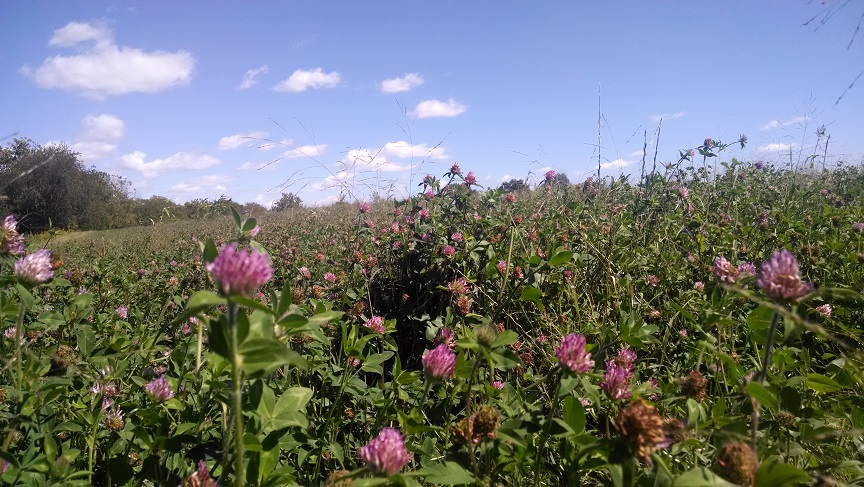
Hmmmm. Health. Vigor. Breedability. Hmmm. Seems like I know more than a few couples who are having fertility issues and football game commercials seem more concerned about the bedroom than my wife is. Better not go there. I’ll stick with my cows. Our soils are thin. Our fertility has been hauled off of the farm in beef and bones for…well…centuries. Hay? Gone. Grain? Gone. Calcium in milk? Well, I guess there has been some lime added to the farm. But looking at our cows, looking at our forages…not enough. My goodness! Fescue didn’t stand a chance where fertility was high. Clovers come in hard where we spread a little lime. It’s amazing. But we’re talking ongoing recovery. Ongoing. Still happening. It’s visible but soil health is not what it could be. So my cattle conception rates are not what they could be. My milk production is not what it could be. My animal health is not what it could be.

CloverField

Mable got sick this fall. In part because she is not well adapted to standing in freezing rain for three days straight. But in large part because I was not addressing her needs at a nutrition level. She is a HEAVY milk producer. Did you see I used all caps? HEAVY! She gives more so she needs more. And I failed her. In some way. But part of my failure was a failure to provide healthy soils. Things are getting better. There’s a great coating of manure on the pasture where the cattle have strip grazed. I have a plan to apply lime. We have a feedlot full of manure, at least a foot deep, from years of prior cattle. These are the blocks that will build future health.

Bromfield talks about how important barnyard manure is to boosting organic matter and soil fertility. In fact, you need the organic matter to make nutrients bioavailable…to harbor life forms that will concentrate and accumulate what you need for later. And it’s happening. But too slowly.

I need to feed health. To my family. To my cattle. To my soil. If I get the soil right, the rest is covered.

Take Home Messages:

I don’t know what else I need to say. I think that’s the take home message for the entire book. Make the soil healthy. Feed health. Done.


World War I: The Rest of the Story and How It Affects You Today by Richard Maybury

This is one of the Uncle Eric books. Never heard of them? Well, let me change your life. You can start reading these anywhere but do yourself a favor and read Whatever Happened to Penny Candy?. Our kids are reading through these books as part of our home school and I am reading with them. I strongly encourage you to read these books. Books should challenge and change the reader. These are no exception. Let me give you an example from chapter 17. These books are written with the voice of an uncle writing letters to his nephew.

Chris, sometimes Americans are told they must send their sons and daughters to war to protect our access to oil sold by other nations. This oil is regarded as a “vital interest” and is, therefore, thought to be worth American lives.

Rarely does anyone ask the question, how much blood are you willing to pay for a barrel of oil, and are you willing to pay with your own blood or only with the blood of others?

Besides, if a regime that hates the West captures an oil field, what are they going to do with the oil, drink it?

They can get little benefit from it unless they sell it.

They might somehow charge a higher price, but the question then becomes, are you willing to die to keep the price of gasoline down?

Did you get upset and stop reading that? Why are you upset? Isn’t that what books are supposed to do?

Maybe you’ll like this one better:

When historians examine wars, they rarely look at the people who found ways to stay out of them. To me this is strange. I think one of the most important lessons that history should teach is how to stay out of wars. What skill could be more valuable?

I know conflict resolution is high on our list of things to teach our children. They already know how to fight each other. They have to learn to live and work together. And that’s hard. Why is it any different at a national level?

Keeping this review short, this is a book you can read in an afternoon but you will revisit later. The information presented will need to percolate over time. And it comes with a sprinkling of H. L. Mencken quotes. I love H. L. Mencken quotes. For example:

Democracy is the theory that common people know what they want, and deserve to get it good and hard.

Or this one:

All government, in its essence, is a conspiracy against the superior man: its one permanent object is to oppress him and cripple him. If it be aristocratic in organization, then it seeks to protect the man who is superior only in law against the man who is superior in fact; if it be democratic, then it seeks to protect the man who is inferior in every way against both. One of its primary functions is to regiment men by force, to make them as much alike as possible and as dependent upon one another as possible, to search out and combat originality among them. All it can see in an original idea is potential change, and hence an invasion of its prerogatives. The most dangerous man to any government is the man who is able to think things out for himself, without regard to the prevailing superstitions and taboos. Almost inevitably he comes to the conclusion that the government he lives under is dishonest, insane and intolerable, and so, if he is romantic, he tries to change it. And even if he is not romantic personally he is very apt to spread discontent among those who are.

I encourage you to read Maybury. I also encourage you to read Mencken. Let me know how that turns out for you.


This Week in Media

This week’s The Beginning Farmer Show is pure gold. He presents an article that basically says there is no money in farming and you shouldn’t buy the lie. Ethan doesn’t respond to the article so much as just discuss it with the audience. Let me repeat the quotes he offers about how to make farming pay. First from You Can Farm by Joel Salatin:

Farming is not a “thing.” It is a life, and a business. Plenty of farmers are awaiting the magical “thing” to become profitable. We make all sorts of excuses to explain why the farm isn’t doing very well and why we need to drive in to town every day for that steady paycheck.

Well, that cuts to the bone. I find that I agree. Entirely. And I want to explain, I, Chris Jordan, in no way feel entitled to own a farm. I don’t deserve to be a farmer just because I want to be a farmer. I work my tookus off…seriously, there’s not much back there. I owe a quarter of a million dollars to a bank. My list of excuses for leaving the farm is one item long. The bank and the tax man need dollars…and lots of them.

But hang on a minute. I don’t feel entitled! Family farm or no, I’m here because Julie and I made some very serious sacrifices to make this happen…and continue to. And it may not work. You know that dream of living in the country and having a horse and a couple of chickens? A place of your own where you can get away from it all? Look more closely. Yours is the last house to have power restored when there is a power outage. The last road to get plowed during a snowstorm. Yours has the slowest internet imaginable and no cell coverage. You have to drive 30 minutes to buy toilet paper. It seems that there are a lot of new farmers who are quickly discouraged and cry out in a loud voice on the internet, “It’s not fair! I deserve to farm!”

No. It’s not fair. Businesses fail every day. Talented bakers flop because the whole town goes paleo. That’s life. At some point SQL Server database administrators will no longer be needed. I may script myself out of a job. Yup. Why would anyone think farming would be as easy as dreaming?

So the other quote Ethan shared was from The Contrary Farmer by Gene Logsdon.

…do not try to make your entire livelihood from the farm, at least not at first. Do like almost all our ancestors did, even in pioneer times: Pay for the land with a job not directly dependent on the farm’s income. Even a casual reading of rural history in the nineteenth and early twentieth century shows that almost every farmer financed his initial land purchases by earning money in a hundred different ways – from teaching to blacksmithing to carpentry to working as a hired hand.

A decade or more ago I read Fields Without Dreams by Victor Davis Hanson. He talked about the necessity of at least one family member working in town to keep the farm alive. Got that?

Salatin is an exceptional marketer. Exceptional. He gets out there and moves product. And he is also an exceptional worker. His hands are big and meaty and calloused.

Salatin

He gets it done and he gets it sold and keeps his nose to the grindstone. There are no vacations, no fancy cars and no off-farm work. BUT he didn’t have to acquire the initial land. His father acquired the land while working off-farm. That is no secret. But it is a key point that I think Logsdon makes clear. I have heard numerous ranchers say that cattle can either pay for the farm or cattle can pay you but cattle can’t do both. That may be a little different when cattle are $2.45 but what happens when cattle are $0.60?

So I continue to work in town.


Ethan also quoted from Gaining Ground by Forrest Pritchard, a book that has lingered on my bookshelf unread for at least 6 months. Maybe a year. That may be next week’s book.

I may also read Robinson Crusoe with the kids. I discuss marginal utility frequently and Crusoe economics is a great way to illustrate it…along with the notion that profit is measurable and savings are desirable even if you are alone in the world. If you haven’t heard of Crusoe economics previously, you’re welcome. Then again, it’s a little like taking the red pill…you can’t un-take it.


Well, you made it to the end. I appreciate that. I really do. Maybe I should break this into several Sunday posts rather than one lengthy marathon of a blog post. Let me know what you think.

Click here to see all entries in my reading journal.

Reading Journal 2015 Week 7

Malabar Farm by Louis Bromfield

What a great book. Special thanks to SailorsSmallFarm for sending it to me. I would not have gotten to it so quickly otherwise. In fact, SSF has suggested a number of books I have enjoyed and may be my favorite librarian.

I’m going to have some fun with this book because I really am enjoying it. But I also think the author was a bit windy here and there. Please don’t mistake my humor for a lack of respect. I will revisit this book soon and encourage you to do the same.

I am currently at the halfway point of this book. My goal is to read a book each week but I just couldn’t muscle through this book in a week. There is too much to think about.

What is the book about?

That should give you the basic idea. There was a certain tone expressed in the book…that of a wealthy intellectual out to set some things straight, addressing his adoring public. Maybe that was just a style of the time. Let me give you an example. As you read this, contrast it to Oliver from Green Acres puffing out his chest and pontificating on the virtues and values of the brotherhood of American farmers.

…our own philosophy that the good farmer is a man who knows as much as possible, never stops learning, and has the intelligence to apply his knowledge and information to the conditions and the program of his own piece of land. It is the kind of farmer we must have in the nation and in this world; it is the kind of farmer we will have inevitably because the other kind is certain to be liquidated economically, despite bribes, subsidies and price floors and their land will be taken over eventually by those who cherish it and can make it productive and maintain that productivity. In the world and even in this country, where there was once so much good land that we believed it inexhaustible both in fertility and in area, mankind, if he is to survive, cannot permit agricultural land to be owned and managed by the lazy, the indifferent and the ignorant.

I don’t know that I disagree. It’s a fair summary of capitalism too. But there’s something in the tone. Oliver sounds naive but entirely lovable. At times, Bromfield is just preachy.

I would also like to add that this book is a follow-up to another of his titles, Pleasant Valley. I haven’t read Pleasant Valley but I think I would like to.

Is it a classic?
Yes. Published in 1947 and affecting my farm today. For large portions of the book I felt he was dragging it out but every so often, in unexpected ways, he would cut to the quick. I would stop and read aloud to Julie.

Will you read it again?
I almost can’t wait. Reading this in a week is like trying to go to seven family Thanksgiving dinners in a single weekend. Too much. Even spread over two weeks it’s a lot to digest.

Does it belong on your bookshelf?
I think I always say “Yes” to this question. Yes.

Can you relate a favorite passage?
Brace yourself.

Mrs. Johnson appeared and turned out to be very intelligent having had many years of experience working along dietary and nutrition lines. She was very interesting about her experiences with the dreary Okie camps in California during the bad years. She agreed that after the post-war boom dies down, we shall have the armies of migratory workers, dispossessed from poor, worn-out land, back on our hands, a liability, not only in relief and taxes but a moral, physical, and spiritual liability to the nation. The economic-human problem of the “poor whites” and “Okies” is an extremely complex one which in the end can be solved only be dealing with fundamentals – soil, diet and education in that order. Poor, worn-out soil produces specimens handicapped physically, mentally and morally from the very beginning. Food grown on such soil from which calcium, phosphorus, and other vital minerals and elements are exhausted can only produce sickly specimens, both humans and livestock. Wretched diet aggravates sickliness, and poor, under-nourished, stupid people make bad farmers who only destroy the soil still further. Education comes third because it is useless to attempt education with people sick physically and mentally from deficiencies of vital minerals. It is no good trying to solve the problem by taxes, WPA, charity and relief, although these may be necessary in time of acute crisis.

From Chapter 4, he is often lamenting large cities and industry…though he is also pushing for more efficient, industrial farm production…away from generalist farming. (Cue the fife!)

It is remarkable how people are becoming interested in these things – a very hopeful sign. If we can overcome the evils, economic and social, which industry and great cities have brought us, we shall be making progress. That is the frightening element in the recent elections. A growing urban proletariat without economic security can wreck everything that America has been in the past and darken the whole of her future.

Going back in time to chapter 2 we can see what he wants for the regular family (as inspired by The Have-More Plan). Farmers should specialize. But everybody else?

The general, widely diversified, and self-sufficient program is, however, admirably suited to the small-scale enterprise of industrial, white-collar and middle-bracket-income citizens with a few acres in the suburbs or in the country itself. This category of small, largely self-sufficient holdings is increasing constantly in numbers and it provides not only a bulwark of security for the individual but a source of strength for the nation as well. A well-managed small place with vegetables, fruit trees, chickens, perhaps a pig or two and a cow provides not only a source of large saving in the family food budget, but it also is a source of health, recreation, outdoor life, and general contentment for the whole family.

At this point, I have to hand the reins to Oliver again.

On the topic of The Have-More Plan, I just want to point out that farms don’t solve problems. Relationships are hard. Business is hard. Work is hard. Life is hard. But harvest comes in due season…if you can survive that long.

When Ed asked for a divorce, Carolyn told Judge House, “I felt like a work horse being turned out to pasture.”

There is a chapter titled, “Malthus was Right”. I think Malthus was right. At some point, it is theoretically possible that we could breed beyond the population we can feed. But I think he is also wrong. The chapter is in support of the notion that we should scream in terror as we approach the Earth’s human carrying capacity. He points to inefficient agricultural methods as some of the reason but, really, proposes no solution. In earlier chapters he bragged that he could keep a cow on every acre of his land. There are 2 billion acres of agricultural land in the US. But there is no proposal to raise cattle and sheep instead of corn, corn, corn…though he does complain about the practice of raising corn, corn, corn and hogs, hogs, hogs and, worst of all sins, of feeding corn to cattle…though he feeds corn silage to cattle. All of Africa. Australia. Russia covers 12 time zones. What do you mean we can’t feed ourselves? We have not yet begun to graze! There were two chapters about what a great healer of the Earth grass is…and anecdote after anecdote supporting the idea that the Earth is better for our management than it would be without it…and yet, he suffers from hysteria and despair that there are too many people. Let’s not be hysterical. Let’s start doing. And while you take a break from all the doing, do a little writing, make a video…find some way to share what you are doing with others to help them get started. Then they can do the same. And on it goes. Like network marketing of global agriculture.

Who should read this book?
There are portions of this book that I thought were fluff. Whole chapters of journal entries that I thought I should skim. A chapter about dealing with bluegill populations (by catching them and dumping them in a stream or neighbor’s pond) and another on his love of his pack of boxers. But overall I think this is a great book…a book you should read to further your understanding of “modern” agriculture.

But there is a lot of fluff…or what struck me as fluff. Let’s talk about growing grass for two chapters, shall we? OK. Here’s the low down. Lime your soils with two tons to the acre then rip the hardpan. If you have weeds and poverty grasses, rip those out and cover the soil with them. Now, add in chemical fertilizer, barn compost, 9 pounds of alfalfa, 5 pounds of brome grass and one pound of ladino clover. Focus, over time, on increasing your soil organic matter so the land can sponge up more moisture. That’s it. Sure, it won’t work just anywhere but it worked great here.

I summarized two chapters in that paragraph above. Two whole chapters. However, Bromfield was writing to help change the future. I live in the future.

Take home messages:
I’ll wrap this up next week when I finish the book.


Can you believe that’s the only book I worked on this week? No links to articles about space. No lecture on the positive virtues of Minecraft. Just keeping busy and staying warm.

Hope you are doing the same.

Cold weather this week. I plan to spend a fair amount of time by the fire reading a book. I need to do some recreational reading this week too. Maybe another book by Wodehouse or a book in the Dune series.

Please discuss this book with me. I hope you are reading it too. Share your favorite quotes or let me know if I have missed the point. Please don’t let me remain ignorant. Help me explore these ideas.

Click here to see all entries in my reading journal.

Reading Journal 2015 Week 6

So what’s the deal? What’s with all the books?

Some years ago (maybe 2006?) Pastor Mark used a Charlie “Tremendous” Jones quote in a sermon. I’ll just let Mr. Jones tell you in a couple of clips.

Here is the quote pastor Mark shared:

That’s what it’s all about. I would encourage you to find more of his materials and give them a look. Apparently he had a spare house to hold his library. Julie just rolled her eyes.

I’m making a few formatting changes each week trying to make this more of what I want it to be. I don’t think I need to publish an in-depth review of everything. Sometimes I just want a record of what I have read.

This coming week I plan to read Malabar Farm. A friend sent me a spare copy she had. I’ll be pressed to get through that book as it looks meaty and Spring is upon us. Chicks will arrive on the 17th. I still don’t have pigs. We are putting garden in a greenhouse but otherwise we are a little behind on our work list. My reading time is suffering.


Farming Manual by George Henderson

What is the book about?
How to get it done by the man who got it done. The Farming Ladder is Henderson’s overall farming philosophy wrapped up in a neat little package. The Farmer’s Progress is more detail focusing on getting young farmers started. This book is more about Henderson as an older farmer passing on hard-won experience. He is detailing everything from training youth to work efficiently to training us in hedge laying. There are things that just don’t transfer well via text but I’ll save my criticism for later in the post.

Is it a classic?
Yes. All three of his books. I don’t care how many aluminum cans you have to pick up to pay for these books. Buy them. Read them. Treasure them. Not kidding.

Will you read it again?
Oh, yes. Several times.

Does it belong on your bookshelf?
Get the other two books first. A reader linked me to a .pdf of this book but the file was structured so facing pages were presented both at once. There may be a way to present single pages but it was beyond me…and beyond frustrating. I couldn’t read the .pdf on the screen of my phone. So I bought the book. And it wasn’t cheap. So my long-winded answer is that I didn’t find the .pdf readable so I had to get a physical copy to read. And it will now live on my bookshelf forever. Your shelf? How much of a completionist are you?

Can you relate a favorite passage?
Well, let’s start at the beginning.

Start at five o’clock and do an hour’s work until breakfast time. An hour for breakfast and start again at seven o’clock. A twenty minute break mid-morning with a  glass of milk, fruit or a scone. A good meal at midday and a rest until one o’clock. Half an hour for tea at four-thirty. Another two hours’ work, followed by a light meal will complete the day without any sense of exhaustion at any time. If one rests on Sundays between the mid-morning break and tea time, it gives you a seventy-two-hour week, and if every hour is properly planned and organized the output of work will justify the effort involved and will leave a sense of quiet satisfaction and achievement. The work must also be planned to give variety and interest, one would not want to hoe sugar beet for seventy-two hours. From labour health, from health contentment springs.

Well, that certainly fits with last week’s ideas from Elon Musk but I like his notion that you need a variety of work throughout the day. There are certainly seasons when it is appropriate to work 10 hours on a single task but every day for a few months? No thanks.

The habit of reading, and deriving knowledge from books, is essential for any young man who wishes to go far in farming. It is worth studying how to read quickly. A practiced reader will read the introduction carefully, which should describe the purpose of the book, and then flip quickly through and make brief notes on the sections which will merit closer study. In some books there are whole chapters which may be skipped altogether. The skill in quick reading lies in directing the eyes between the lines, and it will be found that whole phrases instead of individual words are being taken in at a glance.

But all you read are mere theories until we have tried them out in practice. Whatever comes to us, good or bad, is usually the result of our own action or lack of action.

So work hard and read a lot.

At a later point in the book he is talking about seeking maximum efficiency as we move toward mechanization on the farm. He points out that it costs

£4 to the acre for custom combining, often leaving a lot of grain behind on the ground (one grain to the square foot is 4 lb. to the acre), and then a further charge for baling the straw – if weather permits.

And later,

Nine-tenths of the crops we grow are cashed in through animals.

You know what I want? I want an hour to drink coffee with George Henderson. I know he is frugal but he’s suggesting we build a rick with our grains. Why? Because that’s a cheap way to store it. Sure, why not. But then what? Well, you have to thresh it. OK. So what if you have to combine 3,000 acres of wheat? Well then, we’ll use a machine and leave some on the ground.

Have you ever seen a corn field in the fall? Around here they get the corn (maize) out in September most years. We get a warming spell in October and the fields that haven’t been plowed will look like they have been replanted with corn. Not just the end rows where the corn head knocked the stalks down leaving whole ears in place, the whole field. Terribly wasteful. But it makes more economic sense than putting an army of people to work gathering $3 corn out of the stubble.

And if 90% of the grain goes to livestock anyway, why not let the livestock glean the fields? They’ll add fertilizer while they are there.

So, Mr. Henderson, I await your answer. In the meantime I’ll try a few things out on my own. I understand it is easier to transport one pound of pork than to transport three pounds of corn. That’s why so many farmers around here have confinement hogs. I get it.

After a lengthy chapter on human anatomy to help us understand and observe why we need to work certain ways he closes by saying,

A person who would take exercise in preparing for farm work will find there is nothing to equal walking with a good posture.

I think that’s pretty good advice. Go take a walk. It’s February 8th today and the weather is particularly spring-like. In fact, I may have entirely missed the maple sap. We spent the entire day outside yesterday and it was great. We walked to the woods in the corner of our property, cutting thorny sprouts along the way, hoping to find deer sheds (too early). But all six of us, my brother in law and my two nephews were out in the mud, climbing on hay bales, crushing ice under boots and having a good time. Go for a walk. Even if you’re not a farmer.

Who should read this book?
Read through the table of contents in the .pdf. The book is honest about the subjects it covers. If you want to read Henderson’s detail on hedging, feel free to read what he has to say. If you want to learn about hedging though, this book won’t get it done. Watching YouTube might get you a little closer. But you’ll probably have to find somebody to work with for some time to really get it down. Reading this book was, for me, less about the content and more about gaining a better understanding of George Henderson.

Take home messages:
Mr. Henderson read everything he could and, as this book shows, worked to bring it all together. It’s not enough to read for entertainment. It’s not enough to read for information. You have to, as Mortimer Adler points out, read for understanding. Henderson understood.

I think that’s the message to get here. Read beyond the borders of your specific interest. See what else is out there, see how it relates to what you already know and get a better picture of the whole. I think Henderson could see a bigger world than I can at the present time. But I’m working on it.


Article of the Week

I don’t like the “X of the Week” subtitle. I’ll work on that.

Julie and I have subscribed to Graze for several years now. Our friend with the dairy, Steve, recommended it and said he easily recovers the cost of the publication each year. So we did. And I agree.

This month’s issue (Volume 22, No. 2) has an article by Gabe Brown detailing his transition away from a high-maintenance, high-cost of maintenance herd to a low-maintenance, grass-based herd. Basically, Gabe pulled the plug on the herd and kept the survivors. I highly encourage you to read it. In fact, I make it a point to read anything of Gabe’s, though I don’t hold his word up as gospel. He just seems to say interesting and thought-provoking things.

Anyway, he pulled the plug. I’ll quote a little bit here but I want you to make it a point to read the article…somehow. OK? Promise? Pinky-swear? OK.

You have to decide what’s not necessary to your operation. In ours it was all vaccines, de-wormers, pour-ons, grain supplementation and as much hay as we could eliminate in our environment. We got rid of all of them cold turkey, all at the same time.

OK. Great. Now, skip forward.

I’m not going to kid you: That first year, the conception rate averaged less than 50%, which tells you just how wrong our cattle were for what we wanted to do.

HOLY TOLEDO!

But here’s what the article doesn’t tell me…and it’s important. He lost 50%…of how many? A few weeks ago I read the King Ranch book. He talked about keeping 6 heifers out of 1000, culling the rest. Similarly, Phil Rutter talks about hoping to keep 8 of the first 5,000 hazels he plants. So I might suggest that Brown wasn’t aggressive enough. But I might also suggest HOLY TOLEDO! Half of his herd!?!?!?!?

Let’s play with that for a minute. Just a minute, I know you have other things to do with your day. I have 13 cows. Next year, following this plan, I would have 6…plus 3 heifers. What’s the cull rate on the second generation? Was I lucky enough to stop at 50% the first year? Maybe if I had cattle numbered in the hundreds or thousands…I don’t know.

It does seem that this is the time to take my medicine. But I have heard Ian Mitchel-Innes say that you need 300 cows before you close your herd. So what do I do between now and then?

The best I can.

I have to raise my cattle to the best of my ability, selecting bulls with a background on grass. I may even need to cross-breed my herd to increase the value of my calf crop, bring up fertility and take my herd closer to grass. Whatever I do, I think it’s a hoot. And I’m glad you are here with me. Let me know if you are taking the same medicine.

BTW, I recently (within the last 4 months) read Man, Cattle and Veld. Zietsman had very similar feelings but would keep non-performing heifers in his herd to keep mob numbers up. He just wouldn’t keep their offspring for breeding. That’s the approach I’m taking. I don’t like Snowball. Mrs. White and 27 didn’t breed until they were 3. I’m happy to have their calves but I won’t be selecting future bull calves from them because they were late to mature…mostly because they are so danged tall. But this year 70 is going to have to go. She appears to be a non-breeder.

Let’s talk a little more about my cow herd in my post about reading books. I want small cows. I want small cows. I want small cows. Small cows. Not short cows. Not tiny cows. Small. At least in the eyes of my neighbors. Small. There is some concern that if you breed heifers too early you’ll stunt their growth. So what? Why do we care if my cow weighs 1,000 pounds and is frame 4 instead of 1300 pounds and frame 5? We haven’t changed the genetic potential of her offspring, just the expression of her own genetics. So I raise my replacement heifers on grass and they do appear to be a little smaller than other heifers I bought last summer with similar birth dates…but those similar heifers were given corn.

Why does this matter at all? Because every day a cow eats a percentage of her body weight. The more they weigh the more they have to eat. Mrs. White eats a lot. By shrinking my cows I will need less grass to maintain my herd lowering my production costs and, potentially, increasing my output…I just have to make sure my calves have the potential to be everything the market demands in terms of size and weight.

And I think that’s just the kind of change Mr. Brown was talking about.


Please give me some feedback on this post. I read a lot. Like, a lot, lot. I like to share with my readers when I find a book that helps a farmer out. But I also like to be entertained so I include links to movies and music. Fun books too. Please let me know if there are questions I can answer for you or if you have any suggestions to help make this format more meaningful.

Also, let me know if you are doing any of the reading with me…even if you are running behind. Share your favorite quotes. Tell me if I missed the point.

Click here to see all entries in my reading journal.

Reading Journal 2015 Week 5

This is turning into an endurance race and I’m stretched a little thin. To help with the time crunch I have started getting up at 4:30 but making myself go to bed at 10. I may have to start staying up 30 minutes late though. Another thing I am doing is allocating blocks of time for specific activities. Not really my bag but it seems to work.

This week was particularly tough because of the programming book I included. The book is great and easy to understand. Knocking out 4 chapters/day while writing out all the code? Not easy…even though I came into this experienced. Next week I plan to back off a bit. A reader recently sent me a link to Henderson’s Farming Manual and that should do for the week. Want to read it with me?

Skip around if you want but please take a moment to read the “Article You Hafta Read” section below.


Born Again Dirt by Noah Sanders

What is the book about?
It’s kind of a Bible study, kind of a lecture on proper Christian attitudes on the farm. Kind of a book about Christian life and attitudes. Kind of a book about permaculture that doesn’t say the word “Permaculture”.

Is it a classic?
No. Yes. Maybe. Honestly, I would have a better idea on this one if Julie had read it with me. This is a discussion book, not one to read in isolation. I had a hard time narrowing down the favorite passage section because I kept finding ideas I wanted to run with. Not that these ideas are necessarily new or profound but the book lays the ideas out neatly and in a way that begs for discussion. So fun to read? Yes. Good for discussion? Yes. Food for thought? Yes. Classic? …maybe.

Will you read it again?
No. Yes. Maybe. I think I will refer to it from time to time. More later.

Does it belong on your bookshelf?
Um…I would have been happy to borrow it. I’ll probably loan it out. Maybe it won’t come back. Maybe it will. Not too worried.

Can you relate a favorite passage?
I list this passage in direct contrast…or maybe in support of…hmmmm. I’ll try again. I list this passage to accompany the ending quote I used last week when discussing Gladwell book (Outliers). Sanders says the following:

If you are a farmer, then you realize that you aren’t in control of everything that affects your farm. Rain, hail, drought, disease, and pests can impact the production and fruitfulness of our farms, and we can’t do anything about it most of the time. Even if nothing ever went wrong, we still can’t take credit for things going right. We can’t make things grow. We can plant seeds and care for animals and water the ground, but unless God causes increase we won’t accomplish anything.

As Christian farmers we must recognize that we are completely dependent on the Lord to make us succeed. A successful farm comes not from our own strength or skill, but from God blessing our faithfulness.

Arkush said that’s fatalistic and pessimistic, belonging to a feudal system. I mean, “The Earth is the Lord’s and the fullness thereof.” My farm is not mine. I just get to use it for a while. “Everything in the Heavens and the Earth is yours, O Lord. We adore you as being in control of everything. Riches and honor come from you alone and you are the ruler of all mankind; your hand controls power and might and it is at your discretion that men are made great and given strength.” It’s all his, man. The cattle on a thousand hills. The gold. All of it. And anything I do I do in his power.

So do I agree with both thoughts? Um… Well, you know, either you believe in God or you don’t. If you do believe in God, what kind of a god is God? Is God the kind of deity standing idly by as we spin out of control, are we pets to be looked after or are we companions to be blessed? I choose the latter. Any post-creation example in the Bible of a miracle requires action by man. The widow had to get jars and pour oil. Noah had to build the ark. Seriously? Did God need some dude to build a boat to save animals? Moses had to keep his hands up. Hands. Someone had to get jars of water for Jesus. Why didn’t Jesus just miracle up some bottles from a future French vineyard? Because we have to do our part. There isn’t much I can do to make a seed sprout…short of making the conditions right. And I’m not sure the Chinese proverb listed by Gladwell contradicts the book of Proverbs…”All hard work leads to profit, but mere talk leads only to poverty.

Back to the book.

This sounds familiar:

the income for the average farming family is now the same as for other farming occupations. However, the study admitted that eighty-seven percent of their income came from off-farm jobs!

The author is referencing a publication from 1997 called Rural Conditions and Trends but I can’t seem to dig it up. But I don’t doubt the trend but I’m not sure it’s honest. There are all kinds of distortions in these figures. Let’s go a little different direction. Where I live the average age of farmers is above 65. Why is that? Is it because nobody younger wants the farm? That doesn’t appear to be the case here. Plenty of kids Julie and I went to school with are still working on their family farms…but they have businesses of their own. Often they haul grain or rock so their occupation is “Truck Driver”. The oldest in the family typically owns all of the land and has a big life insurance policy to help manage the transfer.

Many of the farm wives around are school teachers or nurses. They are the primary source of off-farm income. What happens to the on-farm income? It gets plowed back into the farm to lower the taxable income. New trucks, new tractors, new buildings…it seems the worst thing a farmer can do is show a profit. Of course 87% of income comes from off-farm! Just like the average age of farmers, we haven’t identified a problem…we have identified a strategy. I’ll hit this topic more personally in a bit.

Here’s a gem:

I believe our farms should be homes that are beautiful and fruitful, not just workplaces where we also live. Many times our farms can take over our lives because we never leave our work and go home. We tend to work all the time because we live where we work. However, as good as work is, our lives are to be primarily relationship-oriented (God and people), not work-oriented. Therefore we should view our farms as, first and foremost, our homes, and not a production factory where we live.

Who should read this book?
There is a lot here and this isn’t one to skim lightly through. This would be a great thing for a farming couple to work through or maybe even share with a Bible study group. Especially a group with little or no experience with sustainable farming practices.

Take home messages:
The chapter on marketing and pricing is very good noting that

A good steward doesn’t waste or just retain his master’s property – he adds to it.

If we aren’t seeing increase …well? We might as well put our money in a hole in the ground. And Jesus said that behavior isn’t rewarded.

If we were doing our job of honoring the Lord the Earth would be beautiful, fruitful and habitable. My farm is a reflection of my efforts toward God’s design. Yipe! He quotes a lot of scripture in this book…all of it pointed at me.

One who is slack in his work is brother to one who destroys.
Proverbs 18:9

And just go ahead and read Proverbs 24:30-34. Go ahead. Then come tour my farm. See my thorns, weeds and weak fences. My failing buildings. My junk piles.

I have some work to do.


Hello World!: Computer Programming for Kids and Other Beginners (Second Edition) by Warren Sande

Let’s go to Christmas of 1994 together, shall we? Julie’s parents bought a 486 computer with 4 MB of memory and a dot matrix printer! It even had a “Turbo” button! At the time memory was something like $100/MB but we needed more…somehow. We had trouble getting Warcraft: Orcs and Humans to load if we exited Windows to go back to DOS. The solution was to put a menu in the Autoexec.bat. We gave it 20 seconds to choose to boot to DOS with anything unnecessary stripped out of the boot cycle or just to boot to Windows. Our problems were solved. And it was all magic in the land before the Google.

This book took me back to that time. That level of excitement. Even one of the games I played at that time. I can’t tell you how much fun I had playing this book…I mean…reading this book this week. I want to be clear here, I started off working through 4 chapters each day in this book but that pace could not be maintained. There is just too much work required of the reader. I did not finish this book but I will. One week just isn’t enough time.

What is the book about?
Breaking python programming down into bite-sized portions while making it interesting and available to the uninitiated.

Is it a classic?
No. Things change too quickly in tech. This book is pretty awesome though.

Will you read it again?
Only as my kids go through it.

Does it belong on your bookshelf?
Yes.

Can you relate a favorite passage?
Chapter 10 makes a clone of Ski Free! I spent hours playing Ski Free more than two decades ago and had totally forgotten it.

Who should read this book?
Anyone who wants to dip their toes into a deep body of water. Might be dangerous out there. Might be fun too. Adventure awaits! Make it up as you go along. I recommend it for 14+ and work through a chapter/day, repeating most chapters and giving a little cushion of time. Give yourself 2 months to really get it done. This is not a novel. You have to re-train your brain.

Whatever you think of Heinlein, programming a computer is on his list of things everybody should be able to do. This book is a great place to start.

Take home messages:
Programming doesn’t have to be boring.


Article You Hafta Read

I imagine you, reader, want to ask me a question. Maybe something like this, “Chris, this is a farm blog. You use your farm blog to discuss your efforts to inspire your children to advance your ambitions and make them their own. Why do you talk so much about computers?”

I’m glad you asked. Are you ready for my answer?

I know which side my bread is buttered on.

With that introduction, I think you should go read this article then come back for some more thoughts. If you don’t want to click I’ll summarize. The author is, appropriately enough, a writer. She is discussing how writers afford to write and the dishonesty with which they address that very subject. Let’s apply that to farming.

I am the seventh generation on this farm. You know how much money and land I have inherited to get here? ZERO. I took over a crappy, smelly, leaky, drafty farmhouse on a farm with porous fences, failing pond dams and pastures filled with cowpaths and thorny trees. This wasn’t a working farm when I took over. This was a big hole that eats money.

My farm is sponsored by my incredible job in town. A job that requires me to continually update my skill set or they will pull their sponsorship. My farm is also sponsored by my job in Florida…a job I do on my vacation time…another job that will pull my sponsorship if I don’t stay certified in my tech field. Yeah. My farm is also sponsored by some other work I do on the side here and there.

The author above says she is largely sponsored by her spouse. I feel the same way. In addition to everything else she does, Julie runs the farm when I’m at work. But it doesn’t stop there. Mom and dad are always around. Dad checks chicken water, waters rabbits, owns tractors I don’t and lets me use them. And it doesn’t stop there. I have somehow managed to surround myself with supportive, caring people. Did you read above where I said, “Julie’s parents bought a 486 computer…”? That computer is a big part of the reason I have the job I have (and a big part of the reason their youngest son has the job he has). And they buy chicken from me!

But having people rooting for me isn’t enough. I still have to do the work. I still have to code. I still have to build fence. I still have to be loving toward my wife and repay the investment others have made in me.

Someday someone might ask, “Chris, how did you build the farm into a dominant, interplanetary enterprise?”

I will answer “I surrounded myself with loving, encouraging people, worked hard at my town job and read like it was going out of style. We also lived on less than I earned and reinvested all farm income.”


This Week in Media

On the topic of 100 hour weeks I found the following video.

…figure out if something really makes sense or if it’s just what everybody else is doing.

If you have read my blog for any length of time at all you know I am constantly wrestling with my own motivations. I thought this was a powerful video.

You should take the approach that you are wrong. Your goal is to be less wrong.

Just watch the video. I can’t transcribe it all.


Please give me some feedback on this post. I read a lot. Like, a lot, lot. I like to share with my readers when I find a book that helps a farmer out. But I also like to be entertained so I include links to movies and music. Fun books too. Please let me know if there are questions I can answer for you or if you have any suggestions to help make this format more meaningful.

Also, let me know if you are doing any of the reading with me…even if you are running behind. Share your favorite quotes. Tell me if I missed the point.

Click here to see all entries in my reading journal.

Reading Journal 2015 Week 4

As usual, my eyes were bigger than my stomach this week. William Corbett got pushed off and I’ll add some details below. I am only 25 pages into Born-Again Dirt so that will happen next week. I’m afraid that means I didn’t complete any farm reading this week…you know…for my farm reading journal. This is due, primarily, to a lack of discipline on my part. I read Outliers Wednesday on a whim. I may have played a little Minecraft when I should have done a little reading. So next week…

Anyway.

Outliers: The Story of Success

What is this book about?
I’ll let the author tell you. Here he his at his most succinct on page 267. I’ll edit it a bit to make it even shorter.

…success follows a predictable course. It is not the brightest who succeed. […] Nor is success simply the sum of the decisions and efforts we make on our own behalf. It is, rather, a gift. Outliers are those who have been given opportunities – and who have had the strength and presence of mind to seize them.

How does one seize the opportunity? Get up early, dedicate yourself to your purpose and just get it done. The issue he raises is that not enough people are given that opportunity and we, as a society, need to focus on providing opportunity and recognizing the value of work.

Is it a classic?
This book has been covered everywhere and by everyone for the last 5 years. That indicates it may be a classic but it may prove to be a fad. I’m leaning toward classic.

Will you read it again?
Not right away. It’s a fast read though.

Does it belong on your bookshelf?
I don’t think so. You can find it online for free, you can listen to the audiobook on YouTube or you can get it from the library. I see no need to own it. However, the audiobook could not keep my attention. I had to read the real book.

Can you relate a favorite passage?
Quite a few, actually. But we’ll stick with my favorite theme.

Lareau calls the middle-class parenting style “concerted cultivation.” It’s an attempt to actively “foster and assess a child’s talents, opinions and skills.” Poor parents tend to follow, by contrast, a strategy of “accomplishment of natural growth.” They see as their responsibility to care for their own children but to let them grow and develop on their own.

and later…

“[Middle-class kids] acted as though they had a right to pursue their own individual preferences and to actively manage interactions in institutional settings. They appeared comfortable in those settings; they were open to sharing information and asking for attention…”

…skip ahead a bit…

By contrast, the working-class and poor children were characterized by “an emerging sense of distance, distrust and constraint.” They didn’t know how to get their way, or how to “customize” – using Lareau’s wonderful term – whatever environment they were in, for their best purposes.

Skipping to the end and pulling out a few snippits…

When it comes to reading skills, poor kids learn nothing when school is not in session. … Virtually all of the advantage that wealthy students have over poor students is the result of differences in the way privileged kids learn while they are not in school.

Think back to Alex Williams, the nine-year-old whom Annette Lareau studied. His parents believe in concerted cultivation. He gets taken to museums and gets enrolled in special programs and goes to summer camp, where he takes classes. When he’s bored at home, there are plenty of books to read, and his parents see it as their responsibility to keep him actively engaged in the world around him. It’s not hard to see how Alex would get better at reading and math over the summer.

OK. That’s bananas. Julie and I exercise a decided lack of discipline when it comes to books. Books we buy, books we borrow from the library, books we borrow from friends. Come by our house unexpectedly and you’ll find piles of books on end tables, stacked on the floor or covering tables. We don’t send our kids to summer camp, we don’t drive to the museum regularly but we do work to engage our children…either in things we are interested in or we work to ferret out what they are interested in. We discuss topics at the dinner table together and talk about our plans, dreams and our limited budget. At the same time, though, they are expected to entertain themselves…find their own books or build something or go outside and try not to kill each other with swords. I guess that’s what you get when you bridge between the worlds described above. I suppose we are middle class…but we really don’t live like it. More like poor farmers with too many bookshelves, a leaky roof and one, old minivan.

Another part stuck out to me on a similar theme. A man named Terman found, followed and studied children with exceptionally high IQs throughout their lives. Ultimately, he divided them into three groups based on success. The most successful were group A.

In the end, only one thing mattered: family background.

The As overwhelmingly came from the middle and the upper class. Their homes were filled with books. Half the fathers of the A group had a college degree or beyond, and this at a time when a university education was a rarity. The Cs, on the other hand, were from the other side of the tracks. Almost a third of them had a parent who had dropped out of school before the eighth grade.

I’m going out on a limb here to suggest the books on the shelves weren’t a collection of trinkets. They were carefully chosen part of the family. The books were assimilated into and allowed to change and help define the family culture. But I’m way outside of the text here.

He had a lot to say about KIPP schools. I hadn’t heard of that before. The kids arrive at school around 7:15 and return home around 5. Homework keeps them busy until 10 or so. On Saturdays school is only until 9:30. The school is designed to immerse the kids in learning…to keep them busy, working, and moving forward. It has a high level of success in the worst neighborhoods…neighborhoods where the kids don’t receive educational support from home. They made it a point to say that test scores appear to diverge the most over summer vacations as children wealthier families tend to continue learning over the summer, children from poor families lose a little ground. The KIPP school seems to replace the family at some level…for 10 hours each day. Like Psi corps.

Who should read this book?
You should. You and anyone who has ever told me that “I’m only successful because I’m tall, blonde and male.”

Take home messages:

I have an October birthday and grew up believing I was exceptionally stupid, exceptionally clumsy, unattractive and short…but I was at least a year younger than anyone else in my class! What if I had started school later? Who would I be? Even Bastiat couldn’t say. But I don’t have any regrets and my parents shouldn’t either. I turned out OK.

Allow me to summarize the book. Opportunities abound. Work sucks. But those precious few who embrace opportunities and work hard can achieve extraordinary success. He puts a number to “work hard” saying it’s 10,000 hours of dedicated, correct practice (correct practice because if you practice incorrectly you can get really good at doing whatever badly.) But opportunities for hard work spring from family support, family culture and all kinds of things out of your control. And this is where I felt the book let me down. He seems to attempt to walk some line between simple hard work and dumb luck. Jewish immigrants became clothing manufacturers…not because there was an opening in that market and they were lucky to be prepared. They found that opening in the market because they were desperate. They could only do what they knew so that’s what they did. They identified a market opening and exploited it. It wasn’t timing, it wasn’t luck. They just did the best they could with what they had. Maybe they got a leg up by some incredible timing but…

…that’s kind of the point. His examples are extreme. The book focuses on 0.001% of people. The Outliers. Nevermind that there are lots of Millionaires Next Door who did nothing special, just worked hard, built a solid business and lived frugally after embracing whatever opportunity they happened to come across. That includes every owner of every business I have ever worked for. Well, Bill Canfield may be a truly extraordinary person.

I’m going to throw in one more quote from Outliers will reference it next week when we read Born Again Dirt.

The historian David Arkush once compared Russian and Chinese peasant proverbs, and the differences are striking. “If God does not bring it, the earth will not give it” is a typical Russian proverb. That’s the kind of fatalism and pessimism typical of a repressive feudal system, where peasants have no reason to believe in the efficacy of their own work. On the other hand, Arkush writes, Chinese proverbs are striking in their belief that “hard work, shrewd planning and self-reliance or cooperation with a small group will in time bring recompense.”


Java Programming for Kids

This is not Java for kids, it’s just intro to Java. I applaud the effort but I’m afraid there is nothing here to grab their attention and keep their attention as they work. Nothing at all. If you want to learn Java you are better off to begin at YouTube. There you can find someone who speaks your language…says things in an understandable manner. The book was OK. Not great in any way. It doesn’t belong on my shelf. It doesn’t belong on your shelf. It’s not a classic.

Let me be clear. My criticism is not with Java itself. Clearly Java is a useful solution for a variety of problems. It’s the examples in the book that I take issue with. Let’s write a little code in Java, shall we? I’m going to add 5 and 7. Ready? First we have to write our code. You can use notepad but I like Notepad++.

public class AdditionExample
{
public static void main(String[] args)
{
int firstNum = 5;
int secondNum = 7;
int sum = firstNum + secondNum;
System.out.println(sum);
}
}

Now that code has to be compiled. (If you are going to play the exciting copy of our home game you’ll need to install the JDK. Just Google it. Be sure to update your PATH environment variable too.) Save your script as AdditionExample.java and remember where you saved it. Open command prompt, navigate to that location and type “javac AdditionExample.java”. That compiles your code. Now, to execute it you simply type “java AdditionExample” as below:

D:\JavaForKids>javac AdditionExample.java

D:\JavaForKids>java AdditionExample
12

Isn’t that great kids? Look. All that to make the computer say 12!

That gibberish code above is not unique to Java but it’s completely unreadable. Public class? Public static void? String[] args? What is that stuff? He briefly covers that later in the book but it is still gibberish…not meaningful. But that’s kind of the way it is. Let’s write the same thing in VBScript as an example.

Dim firstNum
Dim secondNum
Dim sum

firstNum = 5
secondNum = 7
sum = firstNum + secondNum

wscript.echo sum

Now save that to AdditionExample.vbs and double-click on the file to execute it. What happens? We get a pop-up window telling us “12”. Isn’t that neat kids?

So maybe it’s not the book’s fault. Maybe programming is just boring. Maybe I am boring. Maybe so. But even still, this book is kind of lame. The premise is you can learn to program while making your own calculator. Calculator. A text-based calculator. If you plan to teach basic programming concepts to your children I don’t think this is the place to start. If you or your children already have a handle on the jargon and concepts and are ready to move into Java this book might be OK but, again, YouTube is probably better. Heck, most of what this book covers is covered in the Java howto on the Oracle website.

But I could be totally wrong. I have a real handicap in this topic. I have no memory of learning computerish stuff. I’m sure it didn’t come naturally but I don’t remember doing it other than “Load BC.exe,8,1“. So I don’t know how to teach it. For this reason I tend to leave my work at work and my kids have no idea what I do for a living…just that I work on a computer. I don’t know how to bridge the gap.

And that’s how I excuse including this book in my farm reading journal. I’m trying to bridge the gap. My kids can manage the farm today. If I break my leg some things will need to be cut back and they may need a little instruction but I’m sure the four of them can figure out what little I know. But there is no way my kids could take over my day job…the work that currently pays for the farm. There is a portion of my life that is partitioned away from my family and I think that is a mistake. My blog is a farm blog but it focuses on involving the kids. I want my kids involved in every aspect of my life. You’ll see more programming books in the near future. I hope you understand. In fact, next week I plan to begin working through JavaScript for Kids. The first code we write puts cats on the screen. Cool. That said, Julie showed an interest in learning and teaching Python as she was reading a Minecraft book Thursday morning so we may start with Python for Kids instead.

Should you read this? Is it a classic? Will I read it again? Does it belong on your bookshelf?
No.


Cottage Economy not revisited

I had planned to read the second half of Cottage Economy this week but I just didn’t want to. There is only so much preaching on bread and beer I can take in one dose. Julie and I were laughing at the extreme level of sexism displayed in the book. A man simply can’t love a woman who can’t bake bread. I want to believe he was considered a pig in his time. Further, it is more important to God’s kingdom that a father ensure his daughter can bake bread than that she can recite scripture.

I put it down. I’ll pick it up again if I feel the need to laugh. The opening statements concerning personal responsibility are gold. The rest of the first half? Not so much.


 Article of the Week

Should we go to Mars? How can we pay for it? I know, let’s set up an interplanetary internet using satellites in space…faster than anything we have now. From arstechnica.com:

Musk’s venture will be considerably more expensive, possibly costing as much at $10 billion. It could take more than five years to get operational. “But we see it as a long-term revenue source for SpaceX to be able to fund a city on Mars,” Musk said on Friday night. “It will be important for Mars to have a global communications network as well. I think this needs to be done, and I don’t see anyone else doing it.”

What does space have to do with farming? Variety is the spice of life. I wish you could alter time, speed up the harvest or teleport me off of this rock.

And I say we farm another rock. Diversify our risks as a species. But it’s hard. Mars is a long way away. Let’s look at the solar system if the moon is just one pixel. That means the nearest star is an almost incomprehensible distance away. Just something to think about while you scoop manure as scooping manure doesn’t require much brain power.

Also consider that low Earth orbit is out of any government’s jurisdiction…for now. There is no preventing the dissemination of information. And the promise is faster internet…anywhere on Earth…for everybody. And the proceeds go to Mars. Sign me up!


This Week in Spending Money

I maintain a big line in my budget for books and education. A big line. In years past I have forked over as much as $8,000 of my own money for two weeks of tech training…not counting the loss of vacation time. That’s just what you have to do to stay current in my line of business. Sometimes I get asked, “Chris, how did you learn all this computer stuff? Why can’t I do it?” You can. Just spend 10 or 20 years learning all about it. In 20 years you will be amazed how much you don’t know. I don’t know anything so I still spend money and time learning more. This week, in an effort to increase my own understanding and spark a fire in my children, we bought 5 more books.

Now you, dear reader, may say, “Gosh Chris, you sure spent a lot of money on books this week!” Yes I did. And if just one of those books sparks something in just one of my children (or even my wife! (or even myself)) then the return on investment will far outstrip anything else I could have put that money into. And why all this computer stuff? First, because it’s what I know and do. Second because it’s something that can be done anywhere. I can sit here at my desk and code for a customer in Alaska. No big. I read the book Ranching Full-time on Three Hours a Day some years ago and shortly after spoke to David Hall (who lives near Cody). David expressed a similar amount of time was needed by his cattle operation so he also had rental property, an insurance office and, until recently, an implement dealership. Put your time to work. There are other things we can do on the farm, even if it’s not farming.

But there is something more I want to share. Something that makes me a little bit sad. My wife and children have no idea what I do when I leave here. I come home at night and I’m greeted with a kiss from Julie and hugs from the younger children. Julie asks, “What did you do today?” I realize she’s not really asking but I need you to understand I can’t really tell her. My job is something I do by myself. In absolute isolation…even from my family. I drive there alone. I work alone. I drive home alone. I can’t find an intelligible way to communicate what I do. So I don’t talk about it.

And that hurts a little bit.

There is a part of me I can’t seem to share with my family. Half of my day. Every week day. So I just say, “Oh, the usual.” and we go on about our day.

What if I told them? What if I really said it? “Well, this morning my inbox was flooded with errors. Apparently the SharePoint database backup routine failed last night and the transaction logs grew too large. We didn’t run completely out of disk space but it was a near miss. Then Mike stopped by with a query that suddenly needed a little over a minute to run. I guess the database outgrew its design so we had to tweak it a little. I added an index and got it to a little over a second. Then we had a rush job to write an XML query for a load process. That got pretty rough, let me tell you. After that it was just helpdesk tickets all day long. Nothing too exciting.”

I lost Julie at SharePoint.

But today, as I was installing the newest version of Python 3 for a book I was planning to work through, Julie asked why I wasn’t installing Python 2. The Minecraft Mod book says we need Python 2. Julie has never been more attractive.


Please give me some feedback on this post. I read a lot. Like, a lot, lot. I like to share with my readers when I find a book that helps a farmer out. But I also like to be entertained so I include links to movies and music. Fun books too. Please let me know if there are questions I can answer for you or if you have any suggestions to help make this format more meaningful.

Also, let me know if you are doing any of the reading with me…even if you are running behind. Share your favorite quotes. Tell me if I missed the point.

Click here to see all entries in my reading journal.

Reading Journal 2015 Week 3

This was an odd week. I have included a book by Wodehouse I have been reading here and there in my free time for the last three weeks. I know that doesn’t meet the book-in-a-week theme but I include it for sake of completion.

Once again, I did some reading about gaming. Why would I include this on a family farm blog? I’m glad you asked.

I wrote about this recently but in short, I have these kid…things. Children. Small adults…just add water. They share my house. They eat my food. They help kill chickens. They beg Julie to play Minecraft on a daily basis. Now, it’s a fun game. Let’s not misunderstand. But why do I make it a point to play WITH my kids? Because I want to meet my children where they are. That’s why we play board games. That’s why we watch Star Wars and Shaun the Sheep together. Some of this is building common culture in our family but mostly it’s making an effort to be with my kids with the hope that my investment in them will be repaid. If I play Minecraft this week, maybe I can make a connection that will make a difference in morale on a long, hard day. I hope that makes sense.

One final note before I begin, I’m not having a hard time reading a single book in a week. That’s no big deal…as long as I’m somewhat selective about the book (nothing by Dumas!). The trouble I’m having is that I tend to do all of my reading on Friday and Saturday. I tend to procrastinate…then I have to force-feed myself some of these books in short order. It’s like being in college again. I didn’t like college. In fact, I didn’t learn to enjoy reading until after college. I’m worried I’m returning to some bad habits here. If you choose to do this, try to spread your reading out over several days. Doing it this way makes my head hurt on Sundays.


Cottage Economy

Cottage Economy has proven to be more than a match for me. I am shocked. Mr. Cobbett enumerates his paragraphs and thank God. I read paragraph 5 and stopped to read it aloud to Julie. Then we discussed. Then I read paragraph 6 and stopped again. Rinse and repeat. I could be justified in writing whole blog posts on just paragraphs in this book…though maybe not on this blog…

Anyway, I’ll review what I have muddled through and pick up the rest next week.

What is the book about?
Let’s let him say it. This is most of paragraph 16.

I propose to treat of brewing Beer, making Bread, keeping Cows and Pigs, rearing Poultry, and of other matters; and to show, that, while, from a very small piece of ground a large part of the food of a considerable family may be raised, the very act of raising it will be the best possible foundation of education of the children of the labourer; that it will teach them a great number of useful things, add greatly to their value when they go forth from their father’s home, make them start in life with all possible advantages, and give them the best chance of leading happy lives. And is it not much more rational for parents to […to do this stufff…] than to leave them to prowl about the lanes and commons, or to mope at the heels of some crafty, sleekheaded pretend saint, who while he extracts the last penny from their pockets, bids them be contented with their misery, and promises them, in exchange for their pence, everlasting glory in the world to come? It is upon the hungry and the wretched that the fanatic works. The dejected and forlorn are his pray. As an ailing carcass engenders vermin, a pauperized community engenders teachers of fanaticism, the very foundation of whose doctrines is, that we are to care nothing about this world, and all our labours and exertions are in vain.

Is it a classic?
Yes. No doubt.

Will you read it again?
Yes. Portions of it anyway. 10% of the book is given to the detail on brewing beer. I tend to think more modern writers have done a better job of presenting this information with current materials, weights and measures.

Does it belong on your bookshelf?
Yeah, I think so.

Can you relate a favorite passage?
In the introduction there was a paragraph I found myself returning to again and again. This is, I think, in line with the quote I read in the Bob Kleberg book about the definition of social justice: “the process of giving everyone an equal opportunity to become unequal.” There is inequality. That’s how it is. I can’t go surfing this morning. Not fair. But feeling sorry for yourself because the other person has more is bad for all of society.

Let it be understood, however, that by poverty, I mean real want, a real insufficiency of food and raiment and lodging necessary to health and decency; and not that imaginary poverty, of which some persons complain. The man who, by his own and his family’s labour, can provide a sufficiency of food and raiment, and a comfortable dwelling place, is not a poor man. There must be different ranks and degrees in every civil society, and, indeed, so it is even amongst the savage tribes. There must be different degrees of wealth; some must have more than others; and the richest must be a great deal richer than the least rich. But it is necessary to the very existence of a people, that nine out of ten should live wholly by the sweat of their brow; and, is it not degrading to human nature, that all the nine-tenths should be called poor; and, what is still worse, call themselves poor and be contented in that degraded state?

But why stop there? Later he is talking about education. He has already established that 9 out of 10 have to live by the sweat of their brow so children should be given a thorough education in how to work. Education should not stop there but it also shouldn’t start with books. I’ll let him tell you from paragraph 12. I’ll just write the whole thing out. I am tempted to add emphasis but I think you’ll get it.

Understand me clearly here, however, for it is the duty of parents to give, if they are able, book-learning to their children, having first taken care to make them capable of earning their living by bodily labour. When that object has been secured, the other may, if the ability remain, be attended to. But I am wholly against children wasting their time in the idleness of what is called education; and particularly in schools over which the parents have no control, and where nothing is taught but the rudiments of servility, pauperism and slavery.

Ho. Ly. Cow. From 1821 no less!

Who should read this book?
The first part of the book should be required reading.

The last 10 or 15 years have been a good time to pick up home brewing as a hobby. If that’s your bag, the second chapter of this book is for you. I skimmed. We have made our own hard cider but I don’t see brewing beer on my horizon any time soon.

Take home messages:
How about this? Tea has no useful strength. Men who want to be strong, vigorous and vibrant – the sort of men needed by Britain to maintain the empire – should drink beer. Tea will only keep you awake at night. It is of no use, being corrosive, gnawing and poisonous. Working folk should breakfast upon Bread, Bacon and Beer! Besides, who can afford for their wife to spend two hours each day making tea when you could just drink a beer?

Little children, that do not work, should not have beer.

I should say not. I encourage the reader to read Ben Franklin’s autobiography to see what he had to say about the drinking of beer some decades earlier in Britain. (Just search the link for the first instance of “beer” and read on.) Cobbett is encouraging economy but Franklin shows how it’s done, saying the beer brewers provide beer to workers on credit, workers buy beer desiring strength but really it’s just a drain on their finances. Franklin is (by his own account) stronger and wealthier than all because he eats bread and drinks water. That’s right. And, though Cobbett condemns Americans for drinking liver-burning and palsy-producing spirits…well, who wears the empire pants now?

Maybe that’s not a take-home message. Let’s do this one next week when I finish the book. Just wait till you read what he thinks about the evil potato!


Blandings Castle

What is the book about?
Mayhem. The aristocracy. Show pumpkins. Show pigs. Love interests.

Is it a classic?
Heck yeah! Everything Wodehouse. Even the books about cricket (And I can’t begin to understand cricket).

Will you read it again?
Yes but not right away. Too much other Wodehouse to read.

Does it belong on your bookshelf?
Wodehouse gets his own bookshelf.

Can you relate a favorite passage?
This is tricky. Wodehouse weaves jokes through his writing. Since this book is all short stories I am really having a hard time pulling one specific passage out. It just loses too much context. My favorite story is Pig-Hoo-o-o-o-ey. Let me summarize the beginning. Lord Emsworth’s pig keeper goes to jail just prior to the pig show. Empress (the sow) stops eating and Emsworth is very concerned. At the same time his niece (Angela) breaks her engagement with one man and picks up with another. Multiple characters come to Emsworth to discuss the problems with the female pronoun (her, the girl, etc.) Emsworth always assumes the conversation concerns the pig rather than his niece. The jilted fiancee appeals to Lord Emsworth.

‘I say, I’ve just ridden over to see if there was anything I could do about this fearful business.’

‘Uncommonly kind and thoughtful of you, my dear fellow,’ said Lord Emsworth, touched. ‘I fear things look very black.’

It’s an absolute mystery to me.’

‘To me, too.’

‘I mean to say, she was all right last week.’

‘She was all right as late as the day before yesterday.’

‘Seemed quite cheery and chirpy and all that.’

‘Entirely so.’

‘And then this happens – out of a blue sky, as you might say.’

‘Exactly. It is insoluble. We have done everything possible to tempt her appetite.’

‘Her appetite? Is Angela ill?’

You see where this is going. Emsworth’s character fits this role perfectly…being consistently absent-minded in each book. His first concern is his garden but after that he worries about the pig. Interpersonal problems seem to resolve themselves so…

Who should read this book?
Anybody with a little free time, a sense of humor and a desire for an increased vocabulary.

Take home messages:
I don’t know. Wodehouse’s characters are often not the most intelligent but they are generally caring and honest. Maybe that’s the most important thing. Harvest comes in due season…you reap what you sow.


Minecraft: The Unlikely Tale of Markus “Notch” Persson and the Game that Changed Everything

What is the book about?
The birth and rise of Minecraft…written as a biography of Marcus Perrson.

Is it a classic?
No. I don’t think so. Portions were very interesting though. I spent a surprising amount of time discussing it with Julie on our way to a family outing this weekend.

Will you read it again?
Probably not. The kids won’t read it either. Too many things I don’t want to explain.

Does it belong on your bookshelf?
No.

Can you relate a favorite passage?
This is from Chapter 8. It’s not breaking new ground here but this triggered some thought:

The conclusion was obvious: game players have different brains than others. The question then becomes: What causes what? No one knows if gaming makes the striatum grow or if a congenitally larger striatum makes one more inclined to play. It’s clear that certain personality traits seem to be more common among those who play a lot. They seek immediate rewards for their efforts and make decisions more quickly than others. If it could be proved that games make the brain’s enjoyment center grow then it’s logical that these characteristics are strengthened by a lot of gaming. If that’s the case, then gaming may make us more active and give us quicker reactions, but it might also lead us to tend to choose short-term rewards rather than working long-term toward something greater.

Well, maybe. I have been playing video games my whole life. My kids want to know why I am so good at Super Mario games. Well, I’ve been playing Super Mario for 30 years in one form or another. Am I a gamer? Yes. But I can still work toward long-term goals. As can the gamer who created Minecraft…the subject of the book. I mean, I don’t think the author has thought about what he is saying. But it still gave me something to chew on.

In chapter 9:

Jakob and Markus found themselves at the same crossroads that most people with entrepreneurial dreams encounter at some point in their lives. On the one hand: a secure work life, with a permanent job and a monthly salary. On the other hand: a rare opportunity to realize a dream.

There was also detail about Jeb’s initial inclusion in Minecraft development. The product belonged to Markus. Nobody worked on it but Markus. Not that it was protected, that’s just how it was. Jeb took a look at some code and spent a Christmas vacation adding a feature so players could dye sheep’s wool…even while still on the sheep. It was a little risky but Markus embraced it and promoted the programmer. I think it is cool that Markus poured his life into a project but still was free and open enough to embrace a contribution honored the spirit of the game.

Who should read this book?

Last week I read another book about Minecraft. This one got a little further into the details Markus Perrson’s personal life, his family and his motivations. Each book has its strong points. Though this book was written prior to the other one I feel this is the book that should be read…if one were inclined to read a book about Minecraft.

Take home messages:
You know that thing you think you should do? That book you should write? That blog you should start? That spreadsheet you have been meaning to design? That car you need to fix? That thing you haven’t done because everybody says it’s stupid? That thing you haven’t done because you don’t think it really matters? 

It matters.

Don’t quit your job though. Make time in your day to do whatever your thing is. I know you don’t have time. That’s why I said “MAKE” time.  There will come a time when you succeed out of your job. You won’t have an alternative. That’s your goal. Today is the day. Get started.


Favorite Blog Post of the Week

This week Matron wrote part two of a series about capturing and utilizing winter livestock bedding. I think both parts of this series are great. Just great. I look forward to a third.

In short, how much time does she spend on bedding? How much bedding does she use? What does she do with it all? Find the answers in the cleverly-named Peeing Forward Part II.


Favorite Podcast of the Week

I don’t know if podcasts will be a regular feature of my weekly (ahem…) reading journal or not but to round off my media consumption for the week, The Survival Podcast had a great episode on Thursday. Let me caution you that this is not an episode I will listen to with my children. He drops every word but F.

So let me give you the gist. The American dream is not a house. The American dream is a productive home. An asset, not a liability. A place that increases our wealth and well-being, not just a place to store our stuff. He also hits on an important idea, that we can strengthen our relationships by enduring hardship together…a concept we believe in strongly.


Just to open the window into our library, the following books arrived Friday:

Why these books? My kids are into Minecraft so I’m into Minecraft. As far as they want to go. They picked up the ball…now we run together. At some point they will move on. So will I. Believe me when I say we are doing more than playing a game here. Much more. I’ll give you an example. To build a dome with blocks you have to have a base diameter that is an odd number. What is a diameter? Why does it have to be odd?

I plan to read and work through the Java programming book this week. If you want to make it in tech you have to constantly learn new stuff. That’s just how it is. Otherwise the industry will leave you behind. There is nothing new about Java but it is new to me. I’m adding to my skill set…in large part to help my kids as they work through the same book on their way to making Minecraft mods.

I’m sure I’ll flip through the other books as well.

I am also working through so TSQL puzzles from this site as I work to train a co-worker. The most interesting part is the HUGE number of valid ways you can solve any problem. What do I do for a living? How do I pay for the farm? I tell my children I solve Sudoku puzzles all day…not far from the truth as I have no idea what kinds of issues I’ll have to solve each day…many of which are quite puzzling. But anybody else who asks gets told, “I work on a computer like a UPS guy works on a truck. I can’t fix your home PC.” I hate fixing people’s home computers. Hate. Like lasers-Shooting-Out-Of-My-Eyes-just-before-my-head-explodes hatred. “No, I don’t want to update your anti-virus. Oh, you have both Norton AND McAfee. Wow. It appears an unknown gremlin has used your browser to visit a number of sites which indicate said gremlin has certain tastes…that I’m not judging and really don’t want to know about…but I suspect those sites have a lot to do with the problems we are seeing. The gremlin also managed to install seven different toolbars in Internet Explorer. Couldn’t you just save your budget spreadsheet to Google Docs or OneDrive or Dropbox and sync your cat pictures to one of any of the online photo whatsits? Then we could just wipe and start fresh every third week.”

Anyway, this week I plan to read something related to farming besides finishing Cottage Economy. I haven’t decided what yet but I’ll keep you up to date. I’m leaning toward Native and Adapted Cattle by Kelley, though I appear to have the only copy.


Please give me some feedback on this post. I read a lot. Like, a lot, lot. I like to share with my readers when I find a book that helps a farmer out. But I also like to be entertained so I include links to movies and music. Fun books too. Please let me know if there are questions I can answer for you or if you have any suggestions to help make this format more meaningful.

Also, let me know if you are doing any of the reading with me. Would it be better if I published some sort of schedule or is it OK that I shoot from the hip?

Click here to see all entries in my reading journal.

Reading Journal 2015 Week 2

This was a busy week. Hopefully we saw our low temperatures for the year. It’s hard to keep bedding under the cows, feed in the cows and water available to the cows. Much easier when they are on pasture. To make things harder I was introduced to Minecraft this week. That is, quite possibly, the greatest PG-rated time waster ever! I had to scramble to get any reading done. More in a minute.

I wanted to make a quick note about ebooks. I tend to read on my phone about half the time. When I have a paper book in my hand I also keep a pencil in hand (or mouth) to underline passages that impact me. I also scribble notes in the margins. I can highlight in an ebook and it’s easy to look through sections of a book I have highlighted but somehow…I…don’t. When I review an ebook I have read I tend to have many fewer notes than when I read a physical book. Sometimes, though, I think that is appropriate. Sometimes a book is a meal. Sometimes it’s just a cup of coffee.

Ten Acres Enough

What is the book about?
A change from city businessman to man in the business of farming. He wrote about stacking products and staggering harvest windows 100 years before permaculture was a word…cause he read about it from even older books. He even calls himself a book farmer.

TenAcresEnough

Is it a classic?
Anything people still read and discuss 150 years later is, necessarily, a classic. However, this could have been written last week. You can’t swing a dead cat without hitting somebody who yearns for life in the country…making an honest living growing and selling small fruits and this book bore fruit all those years ago.

Will you read it again?
Quite probably. And soon. In fact, I think it’s worthy of a chapter-by-chapter reflection. Or maybe a topic by topic reflection.

Does it belong on your bookshelf?
This was one of those books that I knew about, had heard a thing or two about but never made the slightest attempt to read. One of Julie’s uncles gave it to me for Christmas…a very thoughtful gift. It will remain on my shelf both because I enjoyed it and plan to study it further and because I wish to honor Julie’s uncle Tim.

Can you relate a favorite passage?
Just one?

In chapter 2 he makes a long series of arguments to persuade the reader that land ownership is desirable. As you read here, remember he is violently opposed to debt. His argument includes this quotable quote:

Wheat grows and corn ripens though all the banks in the world may break, for seed-time and harvest is one of the divine promises to man, never to be broken, because of its divine origin. They grew and ripened before banks were invented, and will continue to do so when banks and railroad bonds shall have become obsolete.

He finishes his argument with this: It’s hard for the kids to sell it.

When all other guards give way, early memories of parental attachment to these ancestral acres, or tender reminiscences of childhood, will come in to stay the spoliation of the homestead, and make even the prodigal pause before giving up this portion of his inheritance.

Chapter 3 has one worthy of mention also. The world is full of prognostications even today. In the Old Testament, prophets who got it wrong got killed. Today the world is flooded with news of impending doom from all directions and there are no consequences for the Chicken Little prophets. I assume there were no consequences for fear-driven business advisers in the 1840’s either.

Twenty years ago nurserymen were advised to close up their sales and abandon their businesses, as they could soon have no customers for trees – everybody was supplied. But trees have continued to be planted from that day to this, and where hundreds were sold twenty years ago, thousands are disposed of now. Old-established nurseries have been planted. The nursery business has grown to a magnitude truly gigantic, because the market for fruit has been annually growing larger, and no business enlarges itself unless it is proved to be profitable.

Well, I might argue that last point. In an era of free money there is a lot of capital misallocation. But that’s a different book for a different day. Some of that free money gets thrown at projects that would, otherwise, not be funded then the money evaporates. Pets.com comes to mind.

At any rate, the future is unknown, business is risky and that’s why owners typically take home a higher percentage than employees. It’s their neck on the line. Everybody says there is no need for more trees but you, the risk taker, go ahead and pot up another batch. Will they sell? Will you sleep until they do?

Chapter 21 has a great quote about a man who started small, the need to start small and the strength that gives for growth. Of course, the gentleman in question, as many of the author’s mentors did, used manures to the greatest advantage. Put that poop to work!

His great success removed all doubt and disarmed all opposition. But even his was not achieved without unremitting industry and intelligent application of the mind. Neither his hands nor the manure did every thing. But manure lay at the foundation of the edifice: without it he would have toiled in vain to build up an ample fortune from the humblest of beginnings.

The final chapter is concerned with where to buy land; East vs. West. He is, obviously, in favor of buying in the east where the major population centers were. Land is more expensive but you can sell product for a higher price. Let’s just let him say it.

If my example be worth imitating, land should be obtained within cheap and daily access to any one of the great cities. If within reach of two, as mine is, all the better, as the location thus secures the choice of two markets.

…and later…

But choose as he may, locate as he will, he must not, as he hopes to succeed in growing the smaller fruits to profit, locate himself out of reach of a daily cash market. New York and Philadelphia may be likened to two huge bags of gold, always filled…

Who should read this book?
I think you should. You. Yes, you. If nothing else, this book will expand your vocabulary.

Take home messages:
Several themes stand out to me:

  • Avoid debt…banks are evil. Old Testament stuff. Forty years of darkness. Earthquakes, volcanoes…dogs and cats living together. Mass hysteria!
  • Rely on your spouse as your teammate
  • Stagger production windows into high income produce
  • Plant the whole farm off the bat
  • Stack multiple crops in the same area (like Stefan Sobkowiak(you should buy that!))
  • Make an investment in fertility. He bought the farm for $1,000. Over the next two years he spent $200 each year to buy manure…40% of the farm value in manure. And you wonder why I spend so much time writing about manure…

And now for something completely different.

Minecraft

What is this book game about?
It’s an open world sandbox. Completely open. You can build, destroy, hunt, explore…just a sandbox. No missions. No quests. Just go. Do. If you want you can just build huge glass castles and breed rabbits. Whatever. I’m a 38 year old child. This game is a dream. It requires a certain level of genius to make a calculator out of Minecraft blocks though.

Is it a classic?
At 60 million copies sold? Yes. And for good reason. This game will inspire and direct gaming for years to come. It comes in at third place for game sales across all platforms following Tetris and Wii Sports. (Wii Sports? Seriously? I, like, literally can’t even.)

Will you read play it again?
Again and again. For a while anyway. I’m sure it will get old but it’s right up there with my favorite game of all time, X-Com UFO Defense. Oh, gosh! Imagine an alien invasion Minecraft world! Instead of zombies you could fight aliens! Instead of abandoned mines you could discover alien bases! If only I was a better programmer.

Does it belong on your bookshelf computer?
Obviously I think so. It’s PG. It’s appropriate for all ages. It’s a hoot. Why did I wait so long? Why was I born in 1976 instead of 2010? Why don’t I go out and buy 4 more computers so the kids and I can all play together? I mean, seriously! I could hook that up for about the price of a cow!

Can you relate a favorite passage or experience?
Favorite passage?

/kill @e[type=Creeper]

The best experience is easily repeatable. I mined out a bunch of materials, suited up in armor, grabbed a couple of swords and a few stacks of torches and ladders and explored the abandoned mine I found. I should clarify, if your character dies in game it’s not a huge deal. Your stuff stays where you died until you either return to pick it up or the garbage collector routine sweeps it up for you. But you don’t want to die. So my kids are gathered around as we light up the darkness. We hear zombies moaning somewhere around us. A giant spider hisses. Then…suddenly from deep in the darkness a skeleton starts firing arrows at me. I don’t know where I can step because the ground is uneven. I don’t know where the enemies are. My kids are screaming, the younger two run out of the room acting scared and being goofy, I fall in a hole, zombies fall on me while I hack and slash and….we all have a blast. Seriously. Most fun I have had gaming in years.

Who should read this book play this game?
Anybody who wants to have fun. I think this game opens a world of possibilities for my kids. Really. If there is one skill I would have my kids learn right now it would be OO programming. I don’t know what is coming next but I do know that right now, if they want a job that is in demand, something they can do that pays well with pleasant working conditions, something they could do right here at home to supplement farm income, I would encourage them to become software developers. That requires a solid foundation in math. I can say that over and over. I can tell my kids they need to know math. But if I show them something like this…if I show them the formulas involved in creating a landscape out of blocks and persisting that data…maybe then they will begin to pay attention. Or at least start asking me questions. There is a pretty high-energy video that asks “Is Minecraft is the ultimate educational tool?

Take home messages:
This really might be a paradigm shift in gaming. The Legend of Zelda was absolutely revolutionary in 1986. This is SO MUCH COOLER. I’m not supposed to be doing anything and I want to do everything. But I can’t. There isn’t time. But we (kids and I) can have a lot of fun, can learn about PC specs, networking, programming and how to kill creepers before they explode. When the kids who are playing this now learn to create their own games, look out!

A Year With Minecraft: Behind the Scenes at Mojang

What is this book about?
It’s history and biography of the staff at a small indie game studio.

Is it a classic?
I really don’t think so.

Will you read it again?
I really don’t think so. My kids might though there was one bad word in a narration about trying to meet public expectations.

Does it belong on your bookshelf?
No.

Can you relate a favorite passage?
Long story. I have known about Minecraft for a few years now and it is something I have avoided because I though it was just some kid thing. But it’s not. It’s built for the community. The developers are very responsive to the demands of the player community. The game was originally released in a very, very pre-release form. This allowed the developer (mainly Markus) to focus on features the community wanted the most. There are several passages that discuss this, comparing Minecraft to another game, Scrolls, that the company was developing at the time the book was being written. In fact, the book may be not-so-subtle advertising for that other game. Anyway…

Rather than bludgeon you with direct quotes spanning the entire book and repeating what I said above I want to talk about how it relates to me. I am really tuba-playing band nerd turned computer guy and father who pretends to be a farmer pretending to write about farming. I have pretended so well that I’m 40-50% of the way finished with a book on raising and selling a few pigs. Just a few pigs…done the way(s) we do it. But I seem to be stuck. Not exactly writer’s block but something like that. I don’t know what level of detail to include at certain points. I suppose I could follow the model used for Minecraft and release a discounted pre-release version of the book and rely on reader feedback to form the final version complete with free updates.

So I guess that makes my book review a not-so-subtle advertisement for a book I’m pretending to write.

Also, the book follows the company. The team. The people. That’s the focus. Markus Persson created an incredible game and did so at just the right time. But behind the scenes, Markus Persson also found an incredible group of people and was incredibly generous with them, building employee loyalty, making work fun and making it financially rewarding. That’s not luck…but it’s not to say that luck didn’t come into play.

One other thing struck me. I have had to sign contracts that say the company owns my creative works for the duration of my employment. I have also benefited greatly from my network of colleagues and my professional reputation. The following quotes tie those two ideas together.

We [Online photo service company] had a problem that needed solving and someone who knew Markus from a forum was aware that he had worked with that type of programming before.

…but actually hiring him was not easy…

It took almost a year to lure Markus from King.com to Jalbum, and the main reason he eventually accepted was that he wanted to work more on Minecraft. That’s was why a programming job was preferable to game developing at King, who also had rules against employees making games outside of work – especially if you charged for the game.

King lost a talented employee because they believe a lie. They believe ideas are scarce and valuable. Ideas are not scarce. Ideas are worthless. Everybody has ideas. But very few lock themselves in their home every evening for years to create something of their own. Ideas for projects are common. Finished projects are rare. Talented employees who can finish projects are gold. King screwed up. It looks like Mojang handles this differently but I only have one quote to back it up.

In the new premises, Mojang would come to have more workstations than employees, the thought being that other indie developers could use those empty seats.

I can’t even imagine. Data security? Code security? Network security? But they seem to believe making resources available to talented people is beneficial to all…so…they do it. Maybe they cultivate talent that way. What does it cost them? What does it benefit them?

How can I implement a similar sense of openness and support in our home? On our farm?

Finally, each person at Mojang carries a lot of responsibility. There aren’t big teams of people working together toward a common goal, there are individuals with individual assignments. I’m sure they bounce ideas off of each other and support each other but…

This way of working not only means that each person at Mojang have a lot of work on his or her hands; it’s also up to them to get it done. There is no one to hide behind. …People are working quietly and are persistently studying their computer screens. Diligence was the word coming to mind.

I can certainly rely on my kids to complete specific tasks. But this is, I think, more. These people are all passionate about their job. If Markus wrote Minecraft in the right place at the right time, these people are also in the right place at the right time…at the right company. I need to ensure that my kids feel similarly. I need my kids to feel rewarded and inspired. I need my kids to feel the impact of their work financially, ecologically and in our community. How do I do that? Mojang uses twitter to get feedback from millions of gamers. I don’t have that marketing reach…but still I have to make them believe. Why else would they pour their heart and soul into the work?

…creates positive peer pressure. If you stand up in front of a group and tell them what you are going to do, then you also have an obligation to the group to deliver. I think that’s the best form of organization you can create as a manager, to get the team to organize themselves and set their own goals.

That’s why I announce publicly that I’m going to finish a book each week and report on it here. So how can I cast vision into my children? How can I help them see the tremendous amount of work there is to do here, prevent them from feeling overwhelmed by breaking it down into smaller parts and encourage them to stand in front of the family and take ownership of it?

Ask me again in a few years.

Who should read this book?
I guess people like me. I have always played video games and it’s pretty cool to see through a foggy window into that world. It’s so different than the simple financial or health utility programs I have been involved with. Gamers are harder to please than the SEC and are extremely fickle. These people handle it well.

Take home messages:
I enjoyed reading this book though I really only gave it about 4 hours. It’s light reading…details on the people behind a game I am having fun playing. I found the most value in their unwavering openness, honesty and hard work. They appear to have a lot of fun working together but they do work together. They are inspired. They share a common vision. They reap the rewards. As I mentioned, I seek application of that here at home.

Favorite Blog Post of the Week

You have to know I read a TON of blog posts throughout the week. I’ll leave out the blogs about the SQL Server OPENROWSET() function to retrieve data from XML files. That’s pretty cool but doesn’t compare to cow manure.

The most personally challenging post I read this week was by my friend at SailorsSmallFarm. I didn’t comment on her blog post which is somewhat unusual, especially since she was kind enough to mention me in her post (What does “skookum” mean? Apparently it’s Chinook for “neato”). I wanted to reply to her closing question but I couldn’t find the right words.

So now, I just need to make it happen, and then…how am I going to get the pig’s paddock to be multi-functional?

I tend to be a problem solver but I think sometimes I just need to be supportive. That’s what Julie says anyway. Maybe what she needs is what she has…plus a few nut and berry plants…plus some reassurance from a friend 2200 miles away. Cause that would be cool. So…”Right on SSF. Things are looking great! You have been working hard and it shows. I can’t wait to see what you do next!”

I have started reading Cottage Economy and a couple of others I’ll report on next week. Until then, please give me some feedback on this post. I read a lot. Like, a lot, lot. Especially in the winter. I like to share with my readers when I find a book that helps a farmer out. But I also like to be entertained so I include links to movies and music and, apparently, video games. Fun books too. Please let me know if there are questions I can answer for you or if you have any suggestions to help make this format more meaningful. Would pictures of the books help?

Reading Journal 2015 Week 1

This week started early. Not much early but last year early.

Anyway, the big goal is to log what I read, not just read. I tend to read and read and read but I don’t know how much of what I ingest I actually assimilate. This is both to help me assimilate more and to keep a record of when I read what. Books will be assimilated.

Click image for source. Come on. You know I like Star Trek.

But here’s the thing. I find it is difficult to cut through meaty books at this pace. I prefer to read things slowly…er…procrastinate. Maybe I read 6 or 7 books at once, finishing them all over the course of 4-6 weeks. Isolating one book each week doesn’t seem like it’s going to allow things to percolate through. But maybe that’s not all bad. I’m changing some reading habits here too, not just focusing on a single book and speed. I’m making notes in my books so I can re-focus on certain passages when I read the book again.

But this week was awful. I got distracted reading two other books just trying to run away from reading about the King Ranch. Not that I didn’t want to read about the King Ranch, I wanted to do other stuff too.

So that takes me to my review system. I just don’t have the time to share my chapter by chapter notes of each book in a series of blog posts. I have a job, man. So I’m going to attempt to answer a few simple questions about each book to help you determine if it’s the book for you. Let’s just dive in.

Bob Kleberg and the King Ranch

What’s it about?
This book seems to be two things at once. It’s kind of a biography of Bob Kleberg as well as a history of the King ranch. But it is also kind of an autobiography of Bob’s right hand man, John Cypher. Kind of. It details their decades of working together to grow the ranch into a global enterprise. Really, pretty fascinating stuff if you can wrap your head around the numbers involved. For example, they projected a property in Venezuela would finish 4,000 steers each year but they actually finished 19,000. Wow. There are numerous anecdotes that are instructional to the aspiring rancher as well as crazy stories of life with Bob.

Is it a classic?
On the initial reading I would say no. Good but not great.

Will you read it again?
Yes. I plan to read it again, skimming through and seeking out the portions of the book I highlighted.

Does it belong on your bookshelf?
Maybe for a little while. I do plan to flip through it once or twice more.

Can you relate a favorite passage or two?
Here the author is relating the experiences of establishing business in Cuba right up through when Castro seized power and stole the ranch. It’s hard to risk an investment if you don’t have secure property rights. Ultimately the ranch and investors lost $6 million. That’s a lot of money in 1959. Plus the cattle…many of which ended up in Russia. How about that? Anyway, I feel that this is personally applicable right now…and for the next 6 or 7 years.

Unlike most manufacturing, the ranching business is a slow start-up. It takes years to bring raw land to a good grass yield and to breed up a herd to the point of turning off quality and quantity beef. Though the company operated seven years, it was only in the last six months that it generated its first net profit, $600.

Next they were working in Brazil with one of the most successful businessman in the country at the time, Dr. Augusto T. A. Antunes. The following was asked of Dr. Antunes:

Doctor, how do you define social justice?

Without hesitation, Antunes replied, “Social justice is the process of giving everyone an equal opportunity to become unequal.”

Who should read this book?
This is a historical, biographical collection of tales mixed with details of efficient cattle operations, hunting and drinking. I don’t think they are tall tales and the author doesn’t seem to shy away from pointing out Bob’s weaknesses. There are also interesting global political notes as the world stood 50 or 60 years ago. So if you’re into that…

The Martian: A Novel

What’s the book about?
Group of astronauts go to Mars. Emergency situation comes up. One gets left behind. He wants to go home.

Is it a classic?
No. Well, maybe. There may be more here than I picked up on the initial reading. I don’t think so though.

Will you read it again?
Oh, maybe. It’s a fast read on a rainy day and it made me laugh.

Does it belong on your bookshelf?
Nope. It’s an ebook and should stay there. See if you can catch it on sale.

Can you relate a favorite passage or two?
Several. At one point the main character, who has been alone for more than a year, is focused on driving a vehicle to a rescue location. He can’t keep his mind on his work though. He interrupts himself in the middle of a narration and it made me giggle.

[Driving and going through a list of wants…]

It has been a long time since I’ve seen a woman. Just sayin’

Anyway, to ensure I don’t crash again I’ll – Seriously…no women in like, years. I don’t ask for much. Believe me, even back on earth a botanist/mechanical engineer doesn’t exactly have ladies lined up at the door. But still, c’mon.

Who should read this book?
First let me say to my Sunday School teachers out there: Skip this book. Potty. Mouth. Lots of worty dirds. Guy gets wounded and left for dead on Mars…of course he has some choice words. But he tends to have a sense of humor about things. Here’s a mild quote. Our hero is trying to build a vehicle to travel from A to B on Mars. He needs a place to sleep so he puts a tent on through an airlock on the vehicle to act as a bedroom.

The rover and trailer regulate their own temperatures just fine, but things weren’t hot enough in the bedroom.

Story of my life.

If you found any humor at all in those quotes, get the book. If you read that and thought, “I can’t believe Christopher would quote such a thing”, this isn’t the book for you. I laughed all the way through…though I did skim here and there. Narrations of driving across the surface of a frozen desert planet were…well…skimable.

Next week I plan to read Ten Acres Enough. I received that as a Christmas gift. It looks like a fast read so I may also tack on Cottage Economy.

Please give me some feedback on this post. I haven’t written a book report for 25 years and I find the results to be less than satisfactory. I read a lot. Like, a lot, lot. I like to share with my readers when I find a book that helps a farmer out. But I also like to be entertained so I include links to movies and music. Fun books too. Please let me know if there are questions I can answer for you. The current post format is just the Beta version. I’m not even sure this kind of thing belongs on this blog. Especially books about lovesick astronauts stranded on Mars.