Generalizing about Specialization

Specialization has made us all wealthy.  Cell phones, packaged meat, refrigeration…the dreams of kings!  All because of specialization.  Focusing on doing one thing very well and doing it repeatedly means I don’t have to do 50 things poorly.  I focus on doing what I do best and hire other specialists to manage the other things.  For example, I no longer turn wrenches on my own cars.  I hire a specialist.  Also, I am not my children’s dentist but I am my son’s barber.  By separating the duties of a roofer from those of a machinist from those of a cardiologist we end up with better roofing, more precise machining and a better chance of surviving when our lifelong assault on our heart becomes more than it can handle.  We are all better off because of specialists.

Generalization lends security.  What if I can’t get to a dentist?  What if I have to perform CPR on that stranger who wrecked his motorcycle on the road?  What if all the roofing companies are overbooked and nobody is available to put a roof on my house?  That’s when we rely broad knowledge and experience.

Everyone bridges the gap.  No person is 100% dedicated to their field.  The best cardiologist in the world is still a human the rest of the day.  She may also be a mother, a child, a volunteer or a welder by day and a dancer by night (she’s a maniac!)

I have to balance this out as well.  If I did nothing but my primary vocation from sunup to sundown I would make more money but I would be bored…and boring.  Well, more boring.  I really like what I do for a living.  It’s exciting, challenging and stimulating.  It is also air-conditioned and comes with a nice, cushy chair and a desk.  Though I don’t even get a cubicle to protect me from communicable diseases, I do have a desk of my very own. I am not the only specialist in my office.  The office is filled with specialists.  Each of us can create, fix, plan or manage our way to corporate profitability (though some get cubes!).

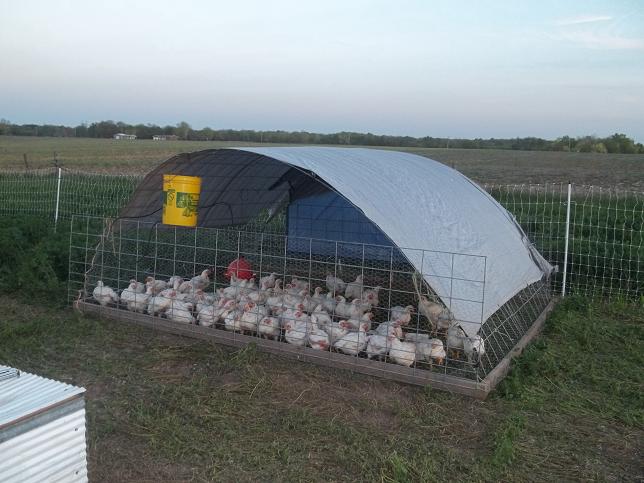
So far this hasn’t been a current events post about the farm but I’ll swing this back to the farm for you now.  I am a specialist in my career but my career does not define me.  I have traded away decades (yup, plural) of my life and a small fortune in training and books to gain the technical knowledge I possess.  Please understand, I take my job seriously.  I work hard to stay current on changes in technology.  That said, I am not my job.  The job is too small to describe me.  It’s just one thing I do.  I am not a specialist on the farm either.  Our speciality is pastured chicken but we also raise pigs, cows, turkeys, ready-to-lay pullets, mushrooms, garden vegetables, children, make tons and tons of compost, cut and manage our woodlot, and grow acres and acres of grass some of which we store in the barn for future use.  Each of these endeavors requires knowledge, practice, education and experience.  Because we do so many things I can only go so deeply into each one.  Why do I stop at 1200 broilers each year?  Because I am a generalist.  That’s all I can handle given our time constraints…for now anyway.  But the same equipment we use to raise broilers allows us to raise pullets for ourselves and for sale.  In fact, our fencing and chicken tractors can be used for pigs as well.  Not only am I a generalist, I try to utilize multi-purpose, non-specialized equipment.
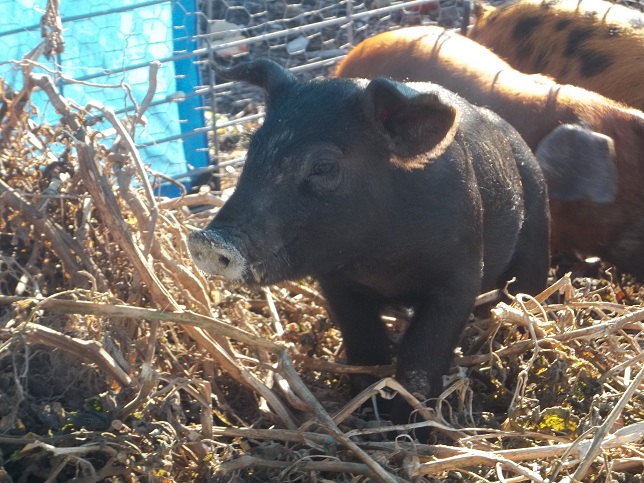
I can set up, design and maintain your SQL Server database.  I can raise, kill and process chickens, turkeys, rabbits, ducks and pigs.  I am, over time, becoming a gardening and canning fool.  I can shingle a roof with the best of them.  I have flipped burgers, watered plants, mowed grass, designed landscaping, framed houses and traveled the length and breadth of North America (and Puerto Rico) training truck mechanics how to use software.  I have changed tires on everything from cars to semi-trailers to tractors.  I have changed diapers.  But I am not rich.  Were I to give up all this generalist nonsense and focus on my career I might be closer to “rich” but I do feel secure knowing we’ll eat well.

Forgive me if the world is less wealthy because I refuse to specialize.  I’m just having too much fun.  Besides, Heinlien said:

A human being should be able to change a diaper, plan an invasion, butcher a hog, conn a ship, design a building, write a sonnet, balance accounts, build a wall, set a bone, comfort the dying, take orders, give orders, cooperate, act alone, solve equations, analyze a new problem, pitch manure, program a computer, cook a tasty meal, fight efficiently, die gallantly. Specialization is for insects.

-Robert A. Heinlein

Why Does the Salatin Model take 20 Acres?

Why Does the Salatin Model take 20 Acres?  That’s an excellent question someone asked the blog.  Though I have only met Salatin once and can’t begin to read his mind, I’m willing to take a stab at it.  This is my opinion, not his.  It doesn’t take 20 acres.  He suggests what is possible with a mere 20 acres.  But since I have 20 acres I’ll explain why I think it’s a good number when you are starting out.

First, 20 acres isn’t a lot of ground.  It’s an amount of ground that could be purchased for a reasonable price when the book “Pastured Poultry Profits” was published in the 90’s.  If the idea is to get in cheap and get rolling quickly, buying 20 acres generally fits the bill.  If you get started and decide raising chickens isn’t for you then you could still keep the land as recreational ground or take a stab at growing something else.

An acre will raise 300-500 broilers depending on how fast they grow out, how good your feed ration is, temperature, rainfall, bug population and numerous other factors.  Let’s just say 400 birds per acre per year.  As pointed out in the book, once your broilers spend a day on an area of ground you’ll need to wait until next year to bring them back.  Otherwise you’ll saturate the soil with nitrogen and (probably) kill or at least damage your grass.  If you are buying in all of your feed (as Salatin indicates in the book) and using all of your land for poultry production (assumption in the book) and the land is relatively flat, level and well drained you can raise 8,000 Cornish Cross birds in a year.  But wait, there’s more.  His goal is to net you $25,000.  That means each acre of birds has to put $1250 in your pocket over expenses.  So you have to buy the chicks ($1 each), feed each bird 15 pounds (or $4.50) worth of of feed.  300 birds at a time are brooded together then split up into groups of 60 in chicken tractors.  Along the way you’re paying for the brooders, lamps, water, electricity and time handling.  Then, once in chicken tractors, you take time each day to feed, water and move them.  At my efficiency level, by the time the birds are grown I have spent about 2 minutes with each bird.  It takes me a further 2.5-3 minutes per bird to kill, dress and pack them.  That time is worth something.  You aren’t going to process many birds alone so you’ll have to pay some help.  Finally, the purchase price of chicken tractors, processing equipment, fence and freezers have to be spread across multiple batches of birds across a number of years…adding to your costs.  If you don’t buy processing equipment, add in the cost of transportation and processing off-site.

SO, to net $25,000 on your 20 acres you have to make $3.13 above costs for all 8,000 birds.  OK.  That’s not too bad.  Let’s say the birds average 4 pounds and you are charging $4/pound for the whole bird.  You have just made your margin.  But you still have to sell 8,000 birds.  That takes time.  Our first three years were 500, 900 then 1200 birds and I suspect we’ll stay at or below 1200 next year.  Salatin outlines a similar schedule.  It takes time for you to learn marketing.  It takes time for word of mouth to spread.  It takes time to build skill with the livestock, learn about seasonality, learn how to process and package.  It takes time to train customers to buy in bulk rather than just a chicken or two every other week.  But you only have to manage 20 acres while you’re learning and growing your small business.

If you are looking to get started, have room to grow and ultimately earn a fair portion of your annual farm income from seasonal broiler production, read the book and get to work.  If $25k doesn’t quite go far enough you could augment your income with any number of additional enterprises on the same land.  Anything from large market gardens, pecan trees, cows, sheep, apples, nursery stock…who knows.  Let your imagination run wild or check out Salatin’s other books  (especially You Can Farm and Family Friendly Farming) and works by other authors like Making your Small Farm Profitable for lists of suggestions.  The chickens are just one option to boost your small farm income.   But that, I think, is why Salatin suggests a small parcel: manageable costs, manageable workload, steep but manageable learning curve.  Again, the book lays out what is possible with 20 acres but in no way requires 20 acres.  One acre will keep you busy with chickens the first year.

Now, if you really want your noodle baked, he suggests elsewhere that you should rent until you build wealth then buy to preserve your wealth.  Stay light, portable, flexible and out of debt.  Pastured chicken is the new black.  Who knows what tomorrow will bring.

Processing Day 10/20/12

We will begin processing chickens as soon as we’re finished milking in the morning on 10/20.  If you are interested in seeing how we do this, show up any time after 9.  If you are coming to pick up fresh chicken, whole or cut up, show up any time after 11.  If you don’t come on butcher day the birds will be frozen.

The weather promises to be cold and breezy so we’ll work pretty fast to get done quickly.

Wish us luck.  These are the last birds of the season.  If you miss out, we have a few in inventory.  Otherwise we’ll see you in April or May.

Finally, if you want to come out but don’t know where the farm is, shoot an email to chismheritagefarm@gmx.com and I’ll help you find your way.

Did You Ever Give a Chicken a Bath?

No.  Heck no.  They run around in the rain.  Good enough.  I also don’t snuggle with my birds.  Maybe I’m the weird one.

Click on image for source

However, I don’t show my birds.  Mine are economy birds, not luxury birds and certainly not show birds.  They eat bugs, dethatch the pasture, spread manure piles and lay eggs, all on a relatively small amount of feed.  Economy.  They are not pets.  When they get old they get retired to freezer camp.  If they get sick they get culled.  If they develop a limp they get culled.  If they don’t lay eggs they get culled.  I think they are happy taking dust baths so I don’t waste time fighting it.

I now present two links.  The first is a how-to on bathing your chicken sent by my sister.  I read that and shake my head.  Others may read it and take notes.  Good for you.

Click on image for source

The second is a portion of a documentary called The Natural History of the Chicken.  I would swear it was made as an homage to Christopher Guest.  Just watch the bit about the lady with the chicken.  Start at the beginning of the series to learn about giving mouth to beak to a chicken…lol.

Click on image for source

Good luck and let me know if you have ever bathed with, gone swimming with or kissed a bird.  I haven’t.

Talking Turkey

To be honest, I don’t think about the turkeys very often.  Once they are out of the brooder they are darned near indestructable.  I keep water in front of them, give them feed and a source of grit, move them daily and they’re good.

Oh, they’ll do everything in their power to kill themselves in the brooder but after that they don’t really need me.

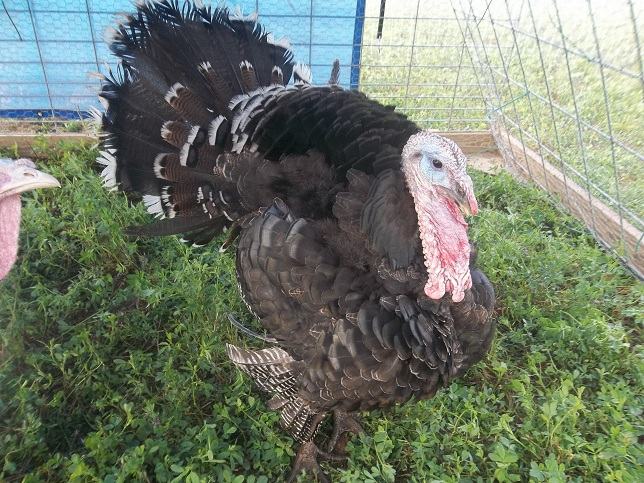
Broad Breasted Bronze

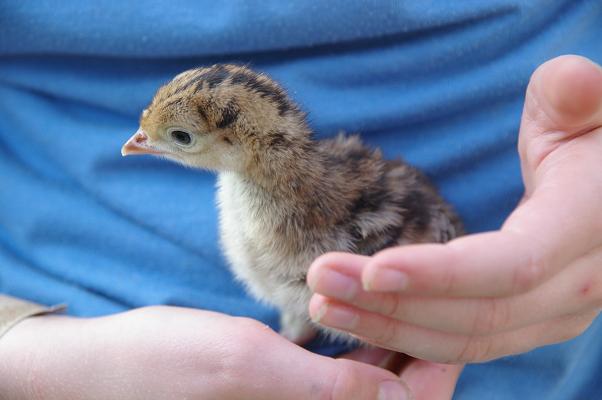
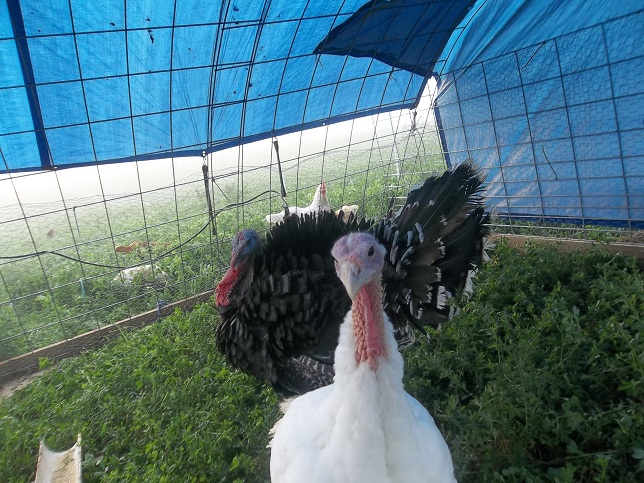
I don’t have any experience with heritage breeds.  We have raised Broad Breasted White and Broad Breasted Bronze turkeys the last two years.  The first year I slaughtered all 20 chicks.  This year 7/10 died in the brooder.  But 3 came through with flying colors.

This year’s turkeys arrived on May 4th.  At 4 weeks the turkeys left the brooder and went to the chicken tractor.  This is a bit early but since the weather was unseasonably warm and dry we took our chances.  They dressed out early in September as HUGE birds.  Huge.  Dinosaurs.  Once again we waited too long to process them.  Also, the white (no surprise) are easier to dress out.

I can tell you how many pounds of feed my broilers eat.  I have no idea how much my turkeys ate.  I believe they are pretty efficient because they forage so well but, honestly, I have no idea.  We just feed them and they grow.

Two years in and we still have much to learn about turkeys!  Let me know if you have any advice on keeping poults alive.

The Last Broilers of 2012

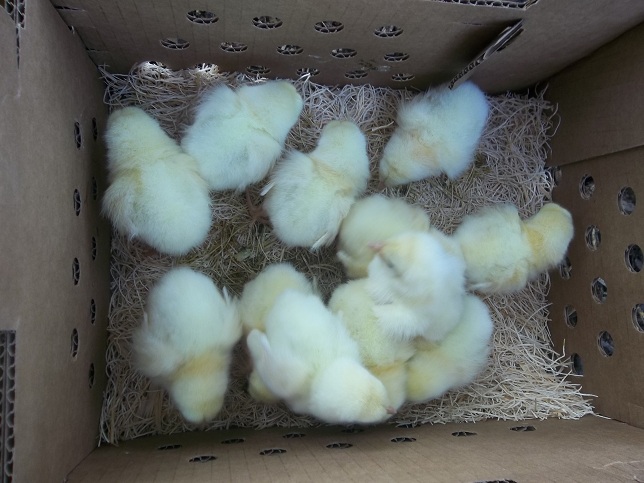
Well, it’s time.  We recieved our last batch of broilers for the year.  We were on the fence about ordering more birds but the weather cooled off a bit, it finally rained and we are nearly sold out of boneless breast meat.  At the last minute we decided to order 125 chicks.

I called our normal hatchery, Schlecht Hatchery, to see if she could fit me in the 8/15 shipment.  Etta said she had gone to hatching every other week and wouldn’t be able to fill my order until September 5th.  Well, a Sep. 5th ship date means a Nov. 1. butcher date.  I don’t want to butcher chickens in November again…too cold.  I called another supplier, Sun Ray Hatchery (also in Iowa).  They acted like they were waiting for me to call.  No problem at all with my order.

I had very good luck with turkeys from Sun Ray last summer and I have high hopes for their chicks.  At any rate, these are all destined to be cut-up birds, available either Oct. 13th or 20th depending on weather.  Between now and then we have a good supply of whole frozen birds and backs but very few boneless breasts, leg quarters or wings available.  If you are in the market for a whole bird or one hundred whole birds, give us a call.  That means it’s a good time to learn how to cook and use the whole bird.  Look for a new series on cooking the whole bird soon and check back for updates as these little birdies grow.  They will be on pasture in early September.

Before the chicks arrived we went through the normal routine.  We put a layer of well-composted (and quite warm) wood chips down in an even layer.  Then we turned on the heat lamps.  We thought we only needed two lamps but it turned out later we needed three.  No big deal.  We filled the water bucket with 5 gallons of water and 1/4th cup of sugar.  The sugar tip came from Andy Lee in Chicken Tractor.  He actually says 3 Tlbs sugar or honey per quart of water for the first 2 days.  I also filled two feed trays and two bucket lids with feed and nestled them into the bedding so they were level with the ground.  That gives the chicks a place to eat at ground level.  It’s important that they don’t have to reach up to eat and, I think, important they don’t have to jump hurdles as they run around and play.  Tomorrow they will get creek sand on top of their feed but today I just want them to drink, warm up and rest.

The post office called early in the morning but we finished our chores before driving to town.  Everybody looked great.  Julie counted 80 chicks from her crate, I lost count of mine.  There were supposed to be 125.  We’ll count them again as we unload the brooder.

Two by two we loaded them into the brooder.  I don’t know how they know but chicks know how to be chicks.  They went right to work.  Scratching, pecking, running, chasing, even drinking from the watering nipples.  Amazing.

Even more amazing was the packaging label.  Caution!  Step Back!  Dangerous Chickens!  OMG!!!  BIRD FLU!!!!!

New Nest boxes

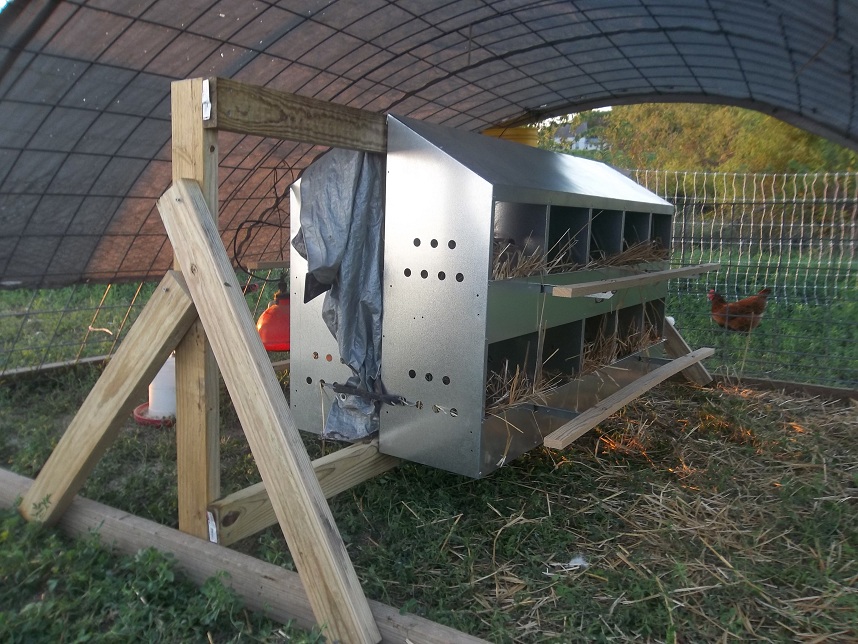
Now, forgive me if this looks crude.  The picture you are about to see represents 15 minutes worth of thought and actual work.  I needed a quick solution to hanging the nest boxes so I could continue moving the chicken tractor.  Three and a half 2x4s later…

The boxes are hanging from screws in the upper 2×4.  There are tarp straps holding the bases together so they don’t swing in the wind.  Everything seems to work fine but it’s suddenly quite a heavy chicken tractor.

I put part of an old tarp between the two nest boxes hoping to offer the hens a little privacy without adding much weight.

So, there you go.  There’s still room for feed and water in the shelter and there’s plenty of airflow.  I just need to make it a bit lighter.  Let me know if you have any ideas.

One Misty Moisty Morning

One Misty Moisty Morning
When cloudy was the weather
The pullets got nestboxes
We all rejoiced together!

I ordered new nest boxes…real nest boxes.  Not the wooden jalopy I normally make but galvanized metal.

I’ll build some sort of framework to hold it after work today but for now I’m just glad I don’t have to hunt for eggs every day.

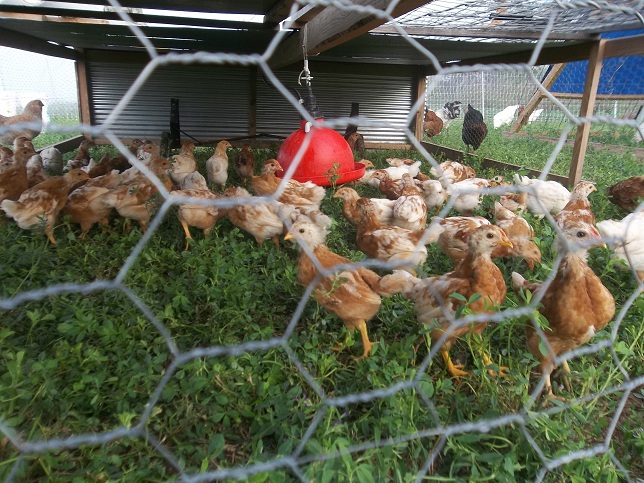
While we’re taking pictures of the chickens, the younger pullets are coming along nicely.

…and we’re just about ready to harvest our Thanksgiving dinner.  I need to order a couple of turkey-sized bags for the freezer.

Poultry Processing Reader Questions

Our friend Jesse is just starting his farming adventures and regularly shares his experiences with me in email.  He makes some valuable observations and asks good questions.  Here’s our recent coorespondence concerning poultry processing:

Jesse:

We just finished up our first day of processing.  21 birds, ha.  We are  slow, BUT we didn’t have any problems.  It was actually really smooth.  Took us about 9am to 12 for the evisceration, then a break, then we shrink wrapped.  A lot of learning took place, but the equipment all worked well, and we didn’t hurt each other.  We are tired though.   Well I had to share that with you.  I do need to ask you, do you remove  the kidneys?  We did, but every evisceration video I watch says nothing  about it.  Also do you leave the necks on?  We did, but it looks a bit  unorthodox in the shrink bags.  Thanks again!

I replied:
We leave on the neck.  We leave in the kidneys.  Just make sure to scrape out the lungs.  We used a bent butter knife when we started but found that to be unnecessary.  Now we just run our fingers along the keel till we start feeling ribs.  Then we run one fingernail between each rib down to the spine.  The lung just pops right out.

Glad you started small.  Salatin makes it look so easy.  You’ll find your groove.

Jesse wrote later:

Our days 2 and 3 of processing went really well, so we finished our first batch of 100 and they are beautiful.  We sold some fresh and some frozen, and we hope the quality of those first sold set off a wildfire of new customer referrals.  We’re still trying to find our rhythm working with the featherman equipment.  We did about 40 in 3 hours on Sunday morning.  I killed, scalded and plucked all the birds, then put them in cold water.  Lesley [His lovely bride] started the evisceration, table top, and when I finished all the plucking I joined her.  We feel we’re getting a little faster each time.  Any tips on improving processing speed?  One thing that slows us down is picking the few pin feathers before we start eviscerating, especially on the tail and at the base of the legs.  Also I had the pilot go out twice on the scalder, not sure why, the weather was good.  How long does a normal propane tank last you?  We did have about 3 broken or dislocated wings.
Our birds were on Sunday were nearly all at 4lb or over, with one or two even at 5lb.

I replied:
A 20# propane tank lasts several processing days if I don’t light my fire too early.  I don’t know why the pilot light won’t stay on sometimes.  You can tell by my blog posts I find it frustrating.  I suspect I’ll be indoors next year.

I know you have read this before but I’m going to write it out so I can think it through.  If it’s just Julie and me I pull four birds out of the plucker and put them in a dry stainless steel sink (2 more should be in the scalder with more bleeding out).  These birds are already headless.  One at a time I cut the feet off and cut out the scent gland.  While the bird is in my hand I reach for my plyers and pull out any remaining tail feathers.  Then I check the armpits of the birds and pass the bird to Julie.  I have to finish two birds before the scalder finishes its work.  Then I unload the scalder into the plucker, load the scalder with two birds again, finish the other two in the sink, unload the scalder, turn on the plucker, load the scalder, kill two birds, turn off the plucker, kill two birds, put 2 in the scalder, grab the birds out of the plucker and start again.  WHEW!  It helps if you can make a little triangle of equipment around you but lay it out so dying birds don’t flip their crap on the evisceration table.  Julie cuts the skin at the neck to pull the crop and windpipe then eviscerates the bird, removes the lungs, rinses it out and drops it in the chill tank.  She also maintains the ice in the chill tank.  She can do all that faster than I can type it so she sometimes waits on me after cleaning her work area.  It really helps if you have children who will grab the birds out of the plucker, remove the feet, pluck the feathers and hand the bird to mommy…lol.  I know we can do 80 in an hour but 60 is a lot easier on all of us.  Just the two of us are probably limited to 40-50/hour.  When we have even unskilled adult help we can quickly push to 100 birds.  I just need somebody to keep the kill cones filled so I can focus on keeping the water hot, the scalder full and the plucker cleaned out.

—-

Re-reading that response I realized I missed his comment about broken wings.  Lots of things can go wrong in the plucker.  We see broken wings, broken legs, broken ribs and torn skin but all of these are fairly rare.  Out of 100 birds Jesse saw three bad wings.  When we have a broken wing we usually salvage the leg quarters, breast meat and tenders for customers then keep the broken wing for ourselves.  There’s nothing wrong with the bird, it’s just not up to the standards we want to present to our customers.  Just know that it does happen.

I want to emphasize several things Jesse said.  His first time out of the gate he needed 3 hours to do 21 birds and was tired when he finished.  He needed 10 minutes per bird his first time out.  That’s why I recommend you start small.  This stuff is hard.  His second and third times he needed 3 hours to do 40 birds.  That’s a lot better but still a hard way to make a dollar.  Play with your equipment setup, kill more birds and you’ll figure out a process flow.  Just keep doing it and finding ways to get better.  I still watch Salatin eviscerate.  I have never figured out how he grabs the crop as quickly as he does.  I have shaken his hand.  I don’t think he’s that much stronger than I am.

I would like to know how long it took Jesse to package the birds in the shrink bags each time.  Hopefully Jesse will let us know in comments.  In fact, maybe he’ll do some guest blogging for me now that he’s an old hand at processing.

Good luck with your bird processing.  I hope you, like Jesse, won’t hesitate to ask if you need help either in comments or through email.

The Curse of the 3,001st Layer

3,000 Layers.  That’s the limit for my Illinois limited producer license.  3,000.  I’m in no danger of reaching that limit but I think it’s worth discussing.

Why 3,000?  When you get above 3,000 the magical bureaucratic fairy covers your farm with pixie dust and suddenly you have to treat your eggs for salmonella.  I’m sure this legislation is well-intentioned but 3,000 birds?  The number of birds isn’t the issue where chicken and egg health are concerned, population density is.  A farmer can have all 3,000 birds in batteries in a 2-car garage and, from the state’s perspective, that’s no different than 3,000 birds pastured over 10,000 acres.

3,000 birds make around 800 pounds of manure each day.  The unlimited egg producer license is supposed to protect the customer from salmonella but it makes no provision for poisoning the soil under an 1/8th acre 3,001 chicken operation.  “What about the EPA” you ask?  Isn’t that their job?

Nope.  And honestly, thank God.  Remember, the real bad guy in Ghostbusters was from the EPA.

The Illinois EPA doesn’t get involved until you have 82,000 laying hens.  Seriously?  82,000?  Why not an even 100k?  Doing the math, it’s not their concern until your chickens produce 22,000 pounds of manure each day.  Don’t misunderstand.  I’m not asking for EPA involvement.  I’m saying the pure number of birds is useless outside of a spacial context.  I could easily metabolize the manure from 3,000 chickens on 100 acres.  But a backyard producer on 1/8th of an acre could be well within their legal bounds while standing knee-deep in smelly muck poisoned by nitrogen and phosphorus.

This is where you come in.  Your job, as a consumer, is to be the final inspector.  Drive to your farmer’s farm and ask yourself a couple of questions.

  1. Does the place stink?  If so, why?  Does it stink because you are downwind of the neighbor’s CAFO or does it stink because your farmer is trying to raise too many animals in too little space himself?  Are the animals poisoning the soil?
  2. What do you see?  Do the livestock look slick, healthy and bright-eyed but the farm buildings a shambles?  Overlook the buildings.  The farmer is putting his money into animal well-being and future production rather than pretty places to put stuff he probably doesn’t need.  Pretty buildings aren’t a sign of a problem but if he has pretty buildings and sad-looking livestock you might reconsider your purchase.
  3. Walk around a bit.  How do you feel?  Is this a refreshing experience?  Do you feel energized and inspired or do you feel tired, guilty or stressed?

I think these three questions can go a long way toward vetting out the best farmers.  Healthy tomato plants make nutritious tomatoes.  Healthy chickens make nutritious eggs.

I don’t want to raise 3,000 birds.  I don’t want to retail 1,100 dozen eggs each week.  I don’t want to feed 700 pounds of feed every day.  I don’t want to think about the amount of water I would need or the manure I would have to wheelbarrow around (though the compost would be nice).  Under my current model I would need 40 of my simple hoop layer houses to house 3,000 birds.  I would spend a lot of time moving those across acre-sized pastures.  No thanks.

What I want are healthy birds and a healthy relationship with my customers.  I want an opportunity to make a positive contribution to my community, to my local ecology and to my bank account.  I believe these to be compatable ideas.  But this can’t happen without verification by consumers.  I really hate to channel Regan here.  Trust but verify your farmer.

Think back to your most recent trip to a farm.  How did it smell?  What did you see?  How did you feel?