Jailbreak

[Cue Bon Scott] – I ain’t spending my life here.  Gonna make a jailbreak.  Oh, how I wish that I could fly.  All in the name of liberty!

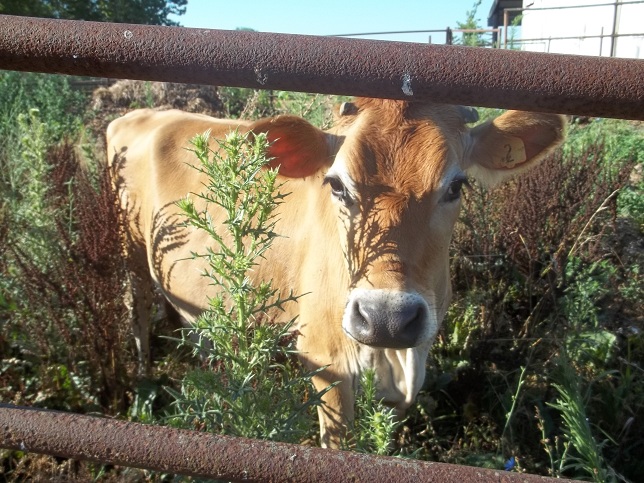
So there I was…fast asleep (had been for at least two solid hours) when the phone rings.  Dad says, “Your cows are out.  Come help me put them in.”

It’s 1:00 in the morning.  I’m asleep and my parents have been out partying with friends.  What kind of geek am I to be in bed when my parents are out?  And why are my parents driving home from a social event at 1:00 in the morning?  I don’t know but thank God my parents are driving home from a social event at 1:00 in the morning.

I step outside and see dad walking behind the girls around the curve in front of my house.  Of course the cows don’t want to be caught.  They are fat as ticks with all the stuff they have eaten along the road but still ornery.  They know they have pulled something off and are not anxious to be caught.  Such children!

Dad walks to their right as we go down the road, I follow behind.  Mom follows with the car in case another car comes around the curve.  They have already opted not to go to my house so now we’re headed to the yellow house where the high-security corral will contain them.

We almost get to the driveway and they decide they’re going to run.  I don’t care if we run, walk or jog.  Just don’t miss the driveway for the yellow house!  Dad races alongside of them to turn them in.  In the dim light the cows see the chance to take a left and, miracle of miracles, they do.  Now they’re in the alfalfa field.

I would like to pause for a moment to say that my father isn’t new anymore.  Along with knee surgery and various other problems he lost a toenail recently and it’s causing him to favor his leg.

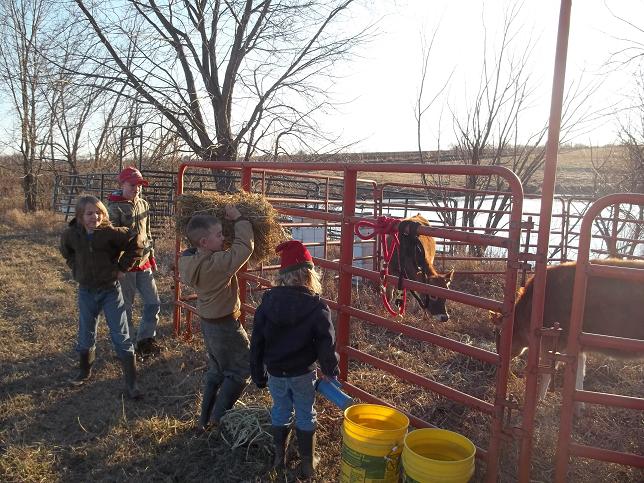
OK.  Now the cows are in the alfalfa field.  The good news is they are already fat as ticks and they’re only stopping for a quick bite here and there but they are no less spirited.  Mom and dad go ahead in the car to the barn lot to open up the corral.  The wife (who just caught up to us) and I are following the cows on foot to the barn.  This can’t be more than 1/4 of a mile.  The girls know what’s going to happen.  They lived at the barn all winter.  Every day we would walk to and from the pond in the center of the alfalfa field.  At this point it’s routine.

Then the routine breaks.  They don’t want to go to jail.  We get as far as the barn lot and both dash to hide in the giant hackberry that recently fell.

Great.

That led to a couple of rounds at the circus maximus around the barn lot before finally getting them corralled in their jail cell.

Now, I have to admit, I’m not at my best when woken from a sound sleep.  I’m not at my best when woken from a sound sleep and asked to run a marathon in the dark.  I’m not my best when woken from a sound sleep and asked to run a marathon in the dark chasing my cows and all their various liabilities.  I was ready to sell.  2 springing jersey heifers, best first offer.  By morning I was feeling more reasonable.  Because of the drought we’re out of feed.  We have been moving the cows around the yard and into shade every day trying to keep them away from flies and manure but moving them around doesn’t magically make more feed appear.  We’re down to a little bit of dried johnsongrass and baked red clover along with some dormant fescue and maybe a bit of lambsquarter here and there.  Not much to write home about.  I can’t blame the cows for being tired of eating grass hay we baled out of the ditch with a flake or two of alfalfa.  But if they want to protest their treatment they should do it when it’s daylight.  Is that too much to ask?

Nope.  No cows for sale.  I do need summer to cool off so I can build some fence.  Then I can at least contain those girls in a hot perimeter fence and keep them off of the road.

Had another rodeo on Sunday when we tried to move the pigs to a new pasture but that’s another story.

Preparing for Chicken Processing

There is a rhythm to work.  Every job has its own groove.  You just have to find it.  Processing chickens is no different.  You have to find your groove.

We moved from square dancing to bebop this year when I upgraded my equipment.  At first we tripped all over ourselves trying to make sense of our Featherman equipment.  It was pretty bad.  Now, it’s no big deal.  As a team, we have divided the workload so each of us is working at a good pace.  With that in mind, I want to address a portion of an email I got from a friend/reader.  I pared down his original question a bit.

…as my first processing day is approaching fast in two weeks, I am assembling some equipment.  I got some knives, heat-seal bags, table-top, scale, etc.  one thing I am still pondering is the chill tank situation.  I am leaning on going with two 110 gallon black stocktank tubs from tractor supply.  They are fairly cheap per gallon compared to some options, $64 for 110 gallons.  I can’t seem to find another freezer or 55 gallon food grade barrels locally.  I was also comparing rope tubs as you mentioned or large rubbermaid trash cans, but I would think the larger 110 gallon tanks would stay cooler longer?  Just looking for your advice.  Also, how long do you chill the birds?  How much ice should I have on hand?  somewhat scared,

If I’m not mistaken, the author has about 100 birds to process and has not processed birds before.  Rather than go with 220 gallons of chill tank in any format to chill all 100 birds at once, I would like to see him spread his processing out over several relaxing days.  I suspect it would take us the better part of 4 hours to sterilize equipment, kill, eviscerate, chill and pack 100 birds then clean up again.  At the end of it we would be tired.  When we first started we got tired after 20 birds.  Our friends at Porter Pond Farm needed 7 hours just to kill and process 130 birds their first try.  Keep in mind, they had help and that 7 hours did not include bagging the birds.

So the best thing you can do is just process a few birds at a time.  Maybe 2 days of 20 birds and one day of 60 birds or 4 days of 10 and one of 50.  Give yourself some time to find the groove.  Just how does Salatin get the crop out so quickly?  It takes time to learn how to do it.  Watch this video over and over.  And over.

We figure you need 10 pounds of ice per 6-10 birds.  We chill the birds until they are cold.  You’ll know when the ice stops melting.  We normally let them rest in the ice water while we compost and clean up.  Then we change clothes and start bagging.  Maybe 90 minutes.  You can save a few bucks by using frozen bottles of water and blocks of ice have more thermal mass but less surface area.

I suspect there are better places to deploy cash than to buy stock tanks to chill birds.  They aren’t a bad idea as they can always be deployed for livestock use but I really doubt you’ll do 100 birds your first day.  If you do, I doubt you’ll be anxious to go back for seconds.  There is a lot of skill involved.  Until you can work efficiently and as a team you’re probably better off doing 20 birds at a time.  20 birds can be chilled in coolers you probably already own.

Here are some other things you need but didn’t list in your email:

  1. You need a Compost Pile.
    With 100 birds to process you need to get four pallets.  Wire them together top and bottom with baling wire so they stand in a square.  Scoop out a bowl in the bottom center of the compost pile then throw in a bale of straw or old hay as a base layer.  Also, see if you can get a couple of trash cans full of sawdust from a sawmill…the finer the better.  Really, a pickup load of sawdust would be better.  Well, a dump truck would be better still but get what you can.  As you process birds, pull a layer of the straw to the sides, dump in your chicken offal, add a layer of sawdust above and cover with fresh straw.  See the link above for more specific detail.
  2. Sharpen your knives.
    Even if your knives are new, sharpen them.  Really sharp.  Crazy sharp.
  3. Gather buckets.
    You will need a bucket for every 20 or so birds you process but we keep one at each station.  One bucket for heads and feet, one for evisceration, one for lungs and some others for feathers and blood later.  You probably already have buckets, just make sure they are empty and ready on butcher day.
  4. Do a dry run.  Heat the water.  Dress one bird out.  Chill it.  Bag it.  Go through the motions all along the way.  Learn what you need to learn.  Find out what you didn’t plan for.

I am sure this list could be larger.  What did I miss?  What are your thoughts?  I may be too far from my first chicken processing experience.  I remember it being very difficult.  I wouldn’t want to do 100 birds out of the gate.


Featherman Product Review Update

This post serves as an update to my original review in April 2012.  Though I think that post is still worth reviewing, the scalder and I have gotten to know each other better and I have more to say about it.

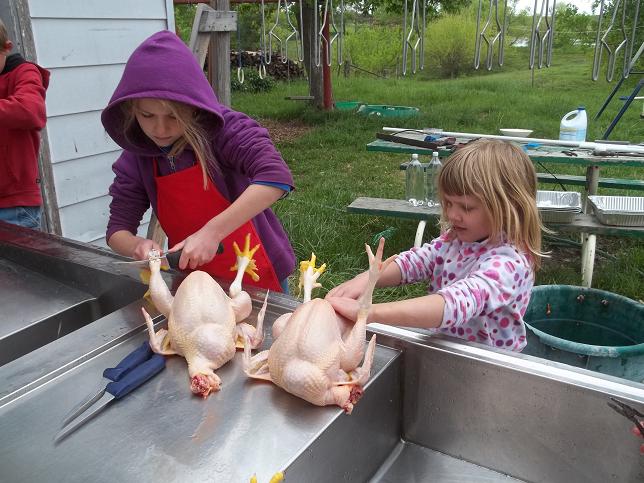
I’m nearly 900 birds into my new Featherman equipment.  Today we processed 75 birds in just under an hour working at an easy pace.  As usual, I was kill, head removal, scald, pluck, foot removal and tail gland removal.  I also plucked whatever the plucker missed.  Three of my children stood at the table to hang up to 8 birds for mommy and to help me pluck feathers.  The oldest daughter also cut feet and glands.  My wife eviscerates 4 birds at a time cutting all crops, setting down the knife, pulling the crop and trachea from each, picking up the knife, cutting all the vents, setting down the knife and gutting each bird.  Finally, the oldest son collects the finished birds from the shackles, removes the lungs, inspects and rinses the birds and places them in chill water.  We started at 8:45 and by 10:30 we were scrubbed, had the offal in the compost and relaxing for a few minutes to write a blog post (this one).  Again, 75 birds took an hour to dress out for 2 adults and 4 children (aged 11, 9, 7 and 6) working at an easy pace.  This was not possible before we had our Featherman setup.

Even with our Featherman setup, I have a few issues.  Every part of the process hinges on the scalder.  If the water is too cold you don’t get a good pluck.  That translates into extra time spent picking feathers out later.  If the water is too hot, the skin tears and you end up with a mess you have to salvage by cutting up the bird.  When we processed on Wednesday we spent 3 frustrating hours trying to keep the scalder lit and warm.  When we finally finished I was sufficiently frustrated that I emailed Featherman to ask what could be done.  Was I using it wrong?  Am I trying to force the equipment beyond its design?  Should I sacrifice a chicken before firing up the scalder each time to appease the scalder gods?

David replied just over 2 hours later.  I’ll say that differently.  The owner of the company replied to my email almost immediately.  That’s cool.  Anyway, here’s his full reply.

Hi Chris,

I very much appreciate the time you’ve taken to outline the problems. I regret you are having them, but this is how we learn, grow, and improve. I am confident we can rectify every problem area you have identified.

I’m just back from Falling Sky Farm In Arkansas and got a big education there. Cody does 8000-9000 birds per year. At this level they are more intimate with the equipment than I can ever be. Although he doesn’t use our scalder (but one with the same burner) he says he had to move indoors. The slightest bit of wind kept it from warming up.

If you are committed to an outdoor space-the way my wife and I always did it-do your best to shield the scalder from the wind while still giving it plenty of combust/exhaust air.

Steel baskets with sharp edges remaining are a huge mistake. I will let our machining and our shipping people know. A potential injury like that should never have gone out. I got cut at the beginning too. They were all supposed to be well sanded down. Due to the extra weight and chore of sanding, we have redesigned with a heavy wire mesh (1″ opening) rather than the flat and sharp expanded metal. We are adding fingers at the ends to help deter heads and feet from dragging on the outside. If you want to swap yours we will be accommodating. They are not out of production yet, however.

I have seen the Ashley and Poultryman scalders – with identical burners as ours – produce at 200 birds per hour. There is no reason ours cannot. You do have the new model scalder, correct? Our first scalder is limited by the burner to 70 bph. Either there is a perennial problem with wind or there is some obstruction in the gas or the air is choked. Look at the flame. It should be a bright blue with only a bit of yellow at the tip and about 1 1/2″ long. If not, check for dirt in the orifice (clean with air, not an object), adjust the air intake cover to see if that helps. If the flame looks good then it is environmental cooling.

Poor location of the scalder, too much or too little air flow, jostling causing movement of wires or thermocouples or pilot light or air intake cover, dirty burner orifices – all of this I have seen or personally experienced as I used the equipment. On one video shoot we waited four hours for water to heat outside, finally broke down and set up inside a green house and zipped along fine (rooster video with roto-dunker). Stainless takes up and gives off heat incredibly rapidly and I’m guessing and hoping that is the culprit here but it is always a challenge to sleuth from far away.

I’m very keen for your demo to go well and for the quirks to disappear. Please keep me informed and let us know what we can do.

One last suggestion. Get a digital thermometer and put the probe safely in the scald water so that you know immediately if the temperature is falling off.

Thanks again,

David Schafer
Featherman Equipment
www.featherman.net
660.684.6464 farm

I was and am pretty satisfied with his response.  The fire under my scalder looks good so I need to find a way to shield my scalder from wind if we continue to do my part of the job outside.  It was pretty breezy toward the end of our processing on Wednesday.  Also, primarily because of sharp edges, we’re working on replacing my roto-dunker with the one he mentioned above.  David writes later to say that, like the newly redesigned scalder, the roto dunker will evolve in time.

I’m watching the roto-dunker closely. I don’t think we are done with it yet. Nobody knows better than I the frustration of equipment mishaps at processing time. This business from Heaven was born of blood, sweat and tears. We are a long way from being finished with a line of equipment.

I am at the summer break in my schedule.  900 birds down, 300 to go in the fall.  Here are my thoughts regarding my Featherman purchase:
-The cones and stand are great.  If you want to process 200 BPH, you’re going to need more than 8 kill cones…lol.  Look for a post coming up on how we clean up the stand.
-The scalder heats up quickly and it does work well but wind and cold weather both tax its abilities.  In May I heated water three times from one 20# propane tank.  That shows it can be efficient at heating water when conditions are right.  Conditions were wrong, wrong, wrong Wednesday.
-The roto-dunker can be your friend.  If your birds dress out below 4 pounds it will turn two in each side.  If above 4 pounds, one in each side.  As I say above, using the roto-dunker under those parameters frees me to go do other things for a few minutes.  That time counts when I’m working to keep my cones full.
-The plucker is absolutely trouble-free.  I do wish I had gotten the turkey plucker though.  I had gotten the milage out of my poor Whizbang plucker.  I remember the frustration of using it on large batches of birds last year.  The Featherman plucker has asked nothing of me.  Not so much as a hiccup.
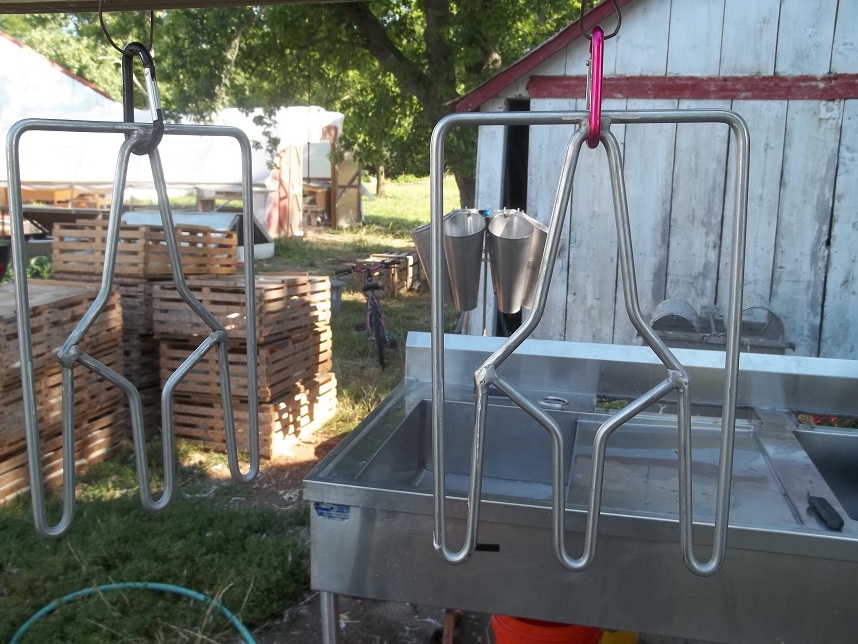
-Evisceration shackles of any make will speed up your process and help your back but the Featherman shackles are, not surprisingly, the best value we have found.  I hung ours with some inexpensive carabiner clips.
-The chill tank is durable, easy to clean and holds a lot of birds.

I wrote to David because I was frustrated with his scalder.  Looking back, I was really frustrated with the wind.  Any scalder would have given me the same trouble and any other scalder would have cost me more money.

Thanks David for all you do to help small farmers like me and for taking the time to respond to my questions.

Too Big to Succeed

This is in response to comments I got on my recent post titled “How Much Could you Make?”  Based on comments, my readers saw me as moping because my marketing skills aren’t where I would like them to be.  I suspect they are right, though I hope I wasn’t moping.  I was trying to say it’s tempting to expand and dive into any number of activities before I’m skillful at any of them.  Marketing is pretty far up on the list of things I need to improve but it’s more than just that.

My dad recently asked, “Why don’t you get some more layers?  That’s money you make every day.”  First, I appreciate my dad asking me questions. He’s not questioning my judgement, he sees an opportunity and wants to help me succeed.  He’s encouraging me to grow.

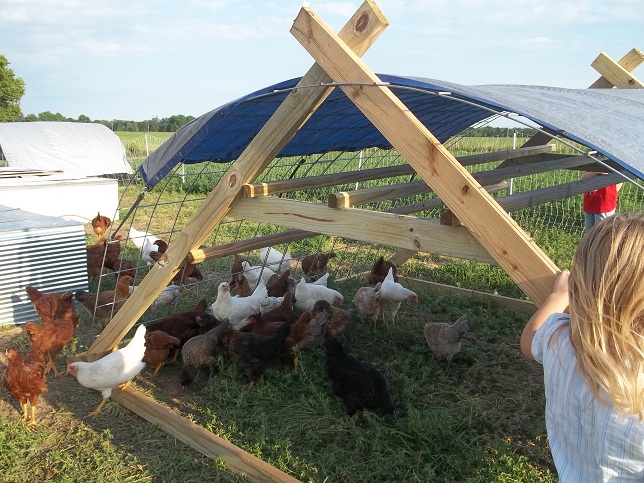
I think the layers are a good example of why I’m reluctant to grow.  A few layers are easy to keep.  A small home flock eats your kitchen scraps, weeds, bugs, etc. and gives you enough eggs to keep your kitchen hopping.  They are entertaining in the extreme.  Your only role is to ensure they have water, shelter and protection from everything that walks.  With a small flock the needs of the chickens are few.  Now.  Let’s shift gears.  Let’s go from three birds up to 300 birds.   Now you need in the neighborhood of 10 pounds of feed every day.  Now you need a much larger shelter.  Now you could lose a bird a night for a week and not notice it…that’s bad.

Each night we gather or 30 or so eggs in a basket.

We bring that basket in the house and set it on the buffet.  When two baskets are full we set out 5 or 6 egg cartons, sort and clean each egg by hand and label them for sale.  We get somewhere in the neighborhood of 14 dozen eggs each week in the summer, 8-10 in the winter.  We try to put an americauna egg in the front right of every box.  Blue eggs really freak people out sometimes.

While I agree we don’t get enough eggs, that’s where we are now.  My house holds 50 birds.  That’s it.  It’s a portable house.  I can’t build an addition onto it.  In the winter we house our flock in the greenhouse.  I can only fit so many birds in that greenhouse.  My infrastructure (or lack thereof) dictates my scale.

But my scale is also dictated by other factors.  There are only so many eggs I can lug up the hill in baskets.  Only so many eggs I can handle, clean and pack.  There are only so many hours in a day.  I’m nearing the ceiling for my skill level, my children’s ability to help at their age and my availability outside of employment.

It’s that last one that hurts the most.  I’m not even making enough money to pay the very modest farm payment, let alone live on.  I have to find a way to bridge the gap somehow.  At this time, we’re adding to our list of products using seasonality on our side.  But, as several commenters pointed out, I need to gain more exposure through everything from farmers markets to Facebook.  I just have to get out there.  But to get out there I have to have something to sell.  Now we’re back to the beginning.

It is a lot to think about.  It’s a lot of work.  It’s a lot of time invested in a helpless, tasty little bird with a narrow profit margin when my time is factored in (and I’d rather do nothing for nothing).  But it’s exposure.  Customers want eggs.

You see where I’m at here?  I need to grow knowing that not all growth is good.  I don’t want to overextend myself but have to do something to move forward.  I could quickly become too big to succeed complete with sick animals, neglected children and a failing marriage.  I’m using my time, putting my assets at risk and trying to anticipate customer needs.  I have to tread carefully.

How Much Could You Make?

“How much money could you make doing this? ”

Oh, golly.  The sky is the limit on could.  Ask a more direct question.

“How much money do you make doing this?”

Well.  Yeah.  You see…we…um…not much.  I see the potential.  I know the market is there.  I just have a hard time introducing myself to that market.   We’re learning every day but we’re still in school.

You can do the math.  We raised 900 birds on a little over an acre to an average of 5 pounds dressed.  4500 pounds of chicken sold at a minimum of $3/pound.  Chicken feed isn’t free.  Chicks aren’t free.  Electric netting isn’t free.  Land isn’t free.  My time is worth something.  So, we come out a little ahead on our season but we’re not getting rich.

We do better with pigs.  Pigs need our attention for about 2 minutes/day, every day for 4 or 5 months.  Then we load them into a trailer (which can be hilarious frustrating interesting) and send them to town.  We have annual pig revenues in the hundreds of dollars.  Yup.

We’re small.  Many of the things we do are just first efforts.  We are still learning what works here.  Yes, I have read Salatin’s Pastured Poultry Profit$: Net $25,000 in 6 months on 20 acres.  My copy is pretty worn.  Yes I have 20 acres.  Yes I raise poultry.  Yes, I have studied the 40 pages in that book on marketing.  I agree with Salatin that sales are driven less by advertising and more by word of mouth.  We have a superior product.  Our customer feedback is positive.  It just takes time to build sales…to get your name out there.  This is our third year raising chicken and we are taking it slowly.  We have to.  It would be very easy to outstrip our sales with production.  While we have always sold out on chicken and pork there is more than just numbers involved.  We have to find ways to get the work done.  Just doing the work is tiring.  We could raise more chicken but when?  I have no doubt we could raise more pigs but I don’t know how many more.  We need time to figure it out.

Could I make my farm payment from the farm?  No doubt.  Could I make a living by farming alone?  I don’t know.  I suspect I could but I need more time.  Time to learn.  Time to market.  Time to figure out what works.  Time to try new things.  Time to grow.

I have to learn about pasture management.  I have to learn about seasonal changes, annual changes, multi-year drought management, low-stress livestock handling, water management, nutrient cycling, winter stockpile management, managing differences between North-facing slopes and South-facing slopes….you see where this is going?  Orcharding, aquaculture, growing and marketing vegetables…on and on.  It takes time to learn/try/recover from each.  Time is not on my side but I have to resist the temptation to force something to happen.  It has to grow.  We have to move slowly.

Farming is a biological process.  Biological processes take time.  I could present you a business model that shows $X over X years but it would not be honest.  There is a lot of work to do.  There is a lot to learn.  Things take time.  You better get started now.

Raising Helpful Children

We aren’t parenting experts.  We’re just parents.  We have four helpful children and we don’t believe that helpfulness is an accident.  Mileage may vary but here’s what we find works.

The workload on the farm is staggering.  Not only do we face the normal household routines of dishes, laundry and food followed by dishes laundry and more food, we have to deliver meals on wheels to a few hundred animals.  Messes seem to happen in certain locations day after day in the house.  We have to clean those up.  Then we have to clean up after a few hundred animals by constantly moving them to fresh ground, composting bedding and moving fencing.  In the yard we pick up fallen tree limbs, weed and mulch the flower beds, mow, keep the garden moving in the right direction and then carry that work out to the rest of the 20 acres.  Thistle threatens to take over the pasture, limbs fall on fences, fences short out and chickens lose the fight to raccoons.  We have to be diligent about testing our fences for shorts on a daily basis.  I’m just scratching the surface here.  There is a lot of work to do both in and out of the house.  We could not function at our current skill level if our children were not helping us.  We don’t see much of a future on the farm if our children run screaming away from us when they get old enough to be on their own.

Our children have to know that we love them.  They aren’t accidents.  We don’t regret our decision.  We thought, saved, considered and prayed before each was born.  Well, maybe we would have liked to spread them out a bit more but…  Our children aren’t a burden to us, they are our treasures.  I could give up the farm tomorrow but I will never give up my children.  I need them.

They have to know that this is home.  It’s not my home.  It’s our home.  They belong here, this is theirs too.  That sense of ownership is important in helping them understand they aren’t imposing on us or living in a hotel and I’m not providing a storage locker for their things.  This is their home.  I’m not passing my time hoping they’ll move out someday.  I am not burdened by their presence.  I don’t calculate the “cost” of raising a child (nor should you).  I hope they stick around as adults.  They make everything I do easier and more fulfilling.  As a part of a home they have to share the workload.  Being a part of any community requires one to contribute.  Sometimes being part of a home goes beyond contribution into sacrifice.

Our children have to know that their work is necessary and important.  We aren’t just keeping them busy.  We aren’t sending them because we are too lazy to go ourselves.  They know that we can’t do everything and they find ways to help us.  Together we keep things running around the farm.  Our kids understand this so well we have to hold them back at times.  With time and training the kids will finally be able to help me buck bales.  Right now they sit frustrated on the sidelines knowing I’m tired and wishing they could help.

We have to model an appropriate attitude toward work for our children.  We don’t complain about the work.  We don’t drag our feet.  We just get it done.  In fact, we work to be joyful about our purpose.  They know it’s hard.  I’m sure they realize we don’t always want to do the work but we do it anyway.  It has to be done.  No matter how late we were up the night before, no matter how hot/tired/sick/hungry/busy we are, the chickens have to be watered.  Sometimes the routine gets old.  There’s a lot of just going there when you’re going somewhere.  But when we arrive!  The destination is worth the journey.

Our children have to know that hard work is rewarding.  There is no allowance.  Our children aren’t paid to live.  Our children earn money.  They either earn play money for doing regular household chores or they earn real cash for doing farm work.  Either way, we have an opportunity to teach them about savings and delayed gratification.  Sometimes we just stop for ice cream and tell them they are great.  Sometimes we go swimming.  Whatever we do, we make it a point to tell the kids how much we appreciate their help.

Our children need to be trained to accomplish each task.  Just like I won’t hand the car keys to my untrained 16 year old and say, “Well, you’ve seen me do this so just go do it.” we train our children to do the housework.  Cleaning a bedroom is not obvious to a 6-year old.  She might get started looking for socks under her bed but would quickly be distracted.  The whole project is too big if she hasn’t been trained to break it up into multiple tasks…bite sizes.  Stay with her, encouraging her, working with her for the first few room cleanings.  Help her at the end of each day to tidy things up so next time it’s not such a big deal.  Every morning ask if she made her bed.  This is training.  In time, it will become routine so when she’s 12 you won’t be talking (let alone screaming) about cleaning rooms.  Our oldest two can run the house now.  The meals may be a little bland but they can cook, clean, fold and put away laundry, vacuum and clean the bathroom.  It took years of training to get them to this point but now they are wrapping up the training required to function daily as a human so they can spend their adolescent years in a focused pursuit of their passion…be it art, astronomy or bio-intensive carbon sequestration.

Finally, we have to praise our children for their contribution.  We tell friends and neighbors how proud we are of our children…in front of our children.  My oldest taught a group of men from India how to eviscerate a chicken when he was 9.  It was a hands-on class and he was the teacher.  We have told that story to everyone who would listen and now I have shared it with the internet.  It was a big deal.  Not only could he do the work, he could teach it to adults…at age 9!  Now, at age 11, he can replace me at any point in the chicken process, though he has been doing final inspection lately.

I hope that helps you understand why our kids jump to meet our requests and how we got there.  Please comment if you have any additional suggestions.

Excellence, Diversity, and Creativity in Agriculture

What are you farming for?  Why bother?  Isn’t there something easier you can do?  (Oh, gosh.  There are a lot of easier ways to make a dime.)

I want to offer my customers the best products on the market.  I want my customers to be confident that I am giving them everything I can, doing everything I can, being as frugal as I can, stewarding the ecology as well as I can and serving them as well as I can.  I am not a carbon copy of another farmer.  To do this successfully I seek inspiration from a broad range of sources from personal interaction to podcasts to huge numbers of books.  I try to do a number of complimentary things as well as I can, always seeking new and better ways to accomplish my goals.  That’s fine for me but I am not enough.  I hope to help inspire a new generation of stewards working toward similar goals.  Why?

I can raise chicken for about 25 families currently.  I may be able to grow that in time but that’s where I’m at.  According to the Census bureau there are 114 million households.  Servicing those households with chicken at my scale would require nearly 5 million farmers and I would estimate 15-20 million farmers are required to meet the broad dietary needs of those households.  There are only about 2 million “farmers” in the US currently.  There are only 300 million people in the US.  Now apply that math on a global scale.  Where are those farmers going to come from?  How can we inspire families to dream of the day their children grow up to become entrepaneurial farmers?  How can we bless children with a vision of success that doesn’t include forcing their bodies to fit the shape of a chair?  How can we raise a healthy, strong, vibrant, non-allergic generation ready to propel us forward into a drought-resistant world brimming with a diversity of life and health?  It has to come from the bottom up.

“Their dreams have been about building unity when they should have been about creating excellence – even if that means diversity” – The Telegraph

I’m not interested in discussing the content of the article as this is the wrong format for that.  I’m interested in that quote.  How can I focus on inspiring/creating excellence even if it means doing things differently?  How can I write in a way that inspires readers to adopt and change our ideas to fit their situation?  How can I help others find new solutions to old problems…enabling diversity?  How can I further broaden my perspective to allow for new ideas and methods…even those that may show me to be in error?  How can I be better, beyond simply increasing my skill as a farmer, at building and participating in a diverse community?  Let me answer in as few words as I can.

We need more farmers.

Guess I’ll have to expand on that.

More farmers means greater intensity.  Modern rowcrop farming is about cashflow, not food production and it’s certainly not about “feeding the world”.  I can have a more intensive focus and a higher level of productivity per square foot on one acre than I can with 1000 acres.  There is only so much one person can do.  I can utilize a broad area but the more area I manage, the less the intensity of management.  Further, if I was grazing 10,000 cows on 6,000 acres I may not have time to stack in other profitable enterprises.  More farmers mean greater intensity and productivity.  More farmers also means more innovators, discovering new and better ways to solve old problems.  How can we stack more growth on fewer acres?  How can we sequester more carbon?  How can we find more ethical and efficient ways to produce eggs for our neighbor’s kitchens?  I suggest it can only happen if we have more people working to solve that problem…people who are willing to pursue ideas others think are silly.

Who is best qualified to generate silly ideas?  The youth.
As we age we become increasingly risk averse.  We become set in our ways, believing in the paradigm that has gotten us where we are, even if it has exceeded it’s point of maximum efficiency.  Youth aren’t stuck in a rut and aren’t afraid to look silly…unless they are confined in a daytime prison camp, subjugated by peers and are actively punished for non-conformity by their guards teachers.  I am the seventh generation on this land and from what I can tell, each of us has done it differently.  At least, I do it differently than grandpa did and he farmed differently than his father.  How can I perpetuate that legacy?  I try to read everything I can, spend a lot of time thinking before committing to an action and try, really try to allow my kids ages 6-11 to feel like their input is part of the decision making process here and to feel that their contributions are valued.  Many of our successful ideas come from our children.
But how can more young people (not children) begin farming when they typically have negative equity and no business experience?  I don’t have an easy answer.  I could go into a long post on economics and monetary policy but, again, this isn’t the right forum for that (maybe I need another blog…).  It is important to start small and use what you have but there has to be more we, as a community, can do to encourage agriculture as a way of life.  Land owners need to find ways to encourage young entrepaneurs to become tenants, managers, partners or interns.  Give them some way to learn before they leap, some way to earn and some measure of guidance as they build equity and, ultimately, independence.  One successful example is the New Zealand model of sharemilking.  There’s a nice article on the concept here.  We are working to find ways to involve our children in our businesses and to start complimentary enterprises of their own while we are still here to help them back up when they fall down.  We make a major financial investment in our children, model frugality so they can buy land of their own someday and teach them what little we know about marketing.  Most of all, we teach them to pursue excellence and independence.

Each of our children want to do different things; rabbits, pigs, laying hens, and a taco stand.  Yes.  A taco stand.  We’re not laughing.  It’s nice that our kids can do different things but it’s important that they do complimentary things.  Bill Mollison said, “Diversity isn’t involved so much with the number of elements in a system as it is with the number of functional connections between these elements. Diversity is not the number of things, but the number of ways in which things work.”  However, he later cautions, “Just by putting a lot of things together, we might reach the stage where we pollute the system simply with diversity.”  On our own farm we have to be careful to measure our success and admit our shortcomings as we attempt to stack elements.  This yearning for diversity, though pointed in the same general direction, also applies to my neighbors…even the GMO-happy glyphosate crowd.  My favorite dairy farmer in the world who builds ponds, grazes his cattle, maintains his timber and generally moves in the right direction does any number of things differently than I would.  He is weighing his options and making the best choices he can.  We have to allow for differences as we work to influence the world around us.  As more of us turn to agriculture, more differences will appear.  The same problems exist in both Maine and Texas but the solutions may be entirely different.  The same is true of farms across the road from each other.  We need to encourage these farmers to both pursue the best solution they can find locally and to build relationships with each other to continue sharing ideas.

Mollison continues: “We have got to let experts loose on the ground. We need hundreds and hundreds of them. We don’t want at any time to patent anything or to keep any information to ourselves”.  That’s it.  I need to be free to improve on your ideas.  You need to be free to improve on mine.  As we push forward we may eventually make something useful…who knows!  I spend a lot of time reading and discussing Salatin’s works, in part, because he hasn’t patented his ideas.  He and Andy Lee showed me how to use a chicken tractor.  I modified Salatin’s plan and built one that works well where I live.

I’ll say again that I’m going against the grain here.  I do things that nobody does…a few things nobody has ever done.  I’m an odd duck.  When I screw up (frequently) I have a number of people ready to pounce and say, “See?  What were you thinking?  I told you it wouldn’t work.”  Gene Logsdon points out that, because I’m different, it’s as if I’m telling my farming neighbors that they have been doing the wrong things for the last 60 years.  We, as practitioners of alternative agriculture, need to find common ground with our conventional neighbors.  Yes, we all do it our own way.  Some of us are even successful at it.  But we need to stand together even with our conventional neighbors.  There is nobody else who can/will support us.  If we are a community, our success will influence them to adopt our ideas in time.  If we push them away it will only make things worse.

We can’t all do the same things the same way.  Building a community is a better aim…a diverse, understanding, creative community pursuing excellence.  My farm is not your farm.  My schedule is not your schedule.  My budget is not your budget (be thankful).  My interests are not your interests.  My priorities are not your priorities.  In spite of this we can find common ground and we can achieve similar goals together.

So now the big question.  How can we get more youth excited about sustainable agriculture/permaculture?  Go out and meet your farmer.  Find a farmer who is excited and be inspired to see his work continue, expand and improve.  Find a farmer who will take time to break things down for children, inspiring them to see farming, not as drudgery, mud, blood and sweat, but as passion, meaningful work and a valuable contribution to the health of our world.

Overcoming Inertia

Someday.  Someday.  We hear it all the time.  “We’re not ready yet.”  “I’ll have chickens someday.”  “I would like to have a goat someday.”

Guests come to our farm, admire our children, the work we do, the love we share and the sense of accomplishment, fulfillment and purpose that fills our lives.  They begin telling us things about someday.  This is a big chunk of our ministry at Chism Heritage Farms.  It’s not all about healing land and feeding our community.  We also want to heal and feed people on an emotional level.  We begin asking questions.  “Why did you get out of bed this morning?  What are you hoping to accomplish today.  I’m not talking about SOMEDAY, I’m talking about TODAY!”

“Someday” is a lie you tell yourself.  Someday will slip past before you realize it.  What is it that’s really holding you back?  Why not begin to embrace your dream now?  Are you afraid?  Think it won’t work?  Have you ever failed at anything?  I have, early and often.  Failure is easy.  Anybody can fail but few have the courage to really do it well.  Have you ever really succeeded at anything though?  I have done that too…but not without spectacular failures along the way.  How much don’t I know about raising pigs, chickens or children?  Or being married?  A lot.  But it hasn’t stopped me yet.

Go for it.

You don’t know what your dream is?  You’re not alone.  I see an entire generation waiting to be told what to do.  Let me tell you what to do.  Something.  Several somethings.  Just go do stuff.  You’ll find something you do well.  Work to do better.  You won’t find purpose in front of the TV.  If you are absolutely unable to find something worth doing, do nothing.  Absolutely nothing.  Sit down somewhere bright and convert Vitamin D in the sunlight.  Look at the world around you.  What contribution can you make?  What problem can you solve.  What are you here for?  What can you do today?  Pray about this.  You are a part of creation.  You were created.  Why were you created?  Did you ever think to ask your creator?

Maybe you already know what it is…that thing that screams at you each day.  Maybe you have starved it down to a whisper but you still hear it.  What can you do today to make that dream a reality?  What’s the first step?  Write it down.  Just write it down.  Fill a page with as many details as you can come up with.  Better yet, write it in a small notebook you can carry around with you daily.

Second step?  Look at what you’ve written.  Post it somewhere you can’t avoid (bathroom mirror).  Make that vision a part of your life.  Be purposeful about your purpose.

Third, start reading.  Turn off the TV.  Turn it off.  My wife says in the video we are sedating our lives with entertainment a la Aldous Huxley.  (Ironic that she said that in video.)  Start with a few simple things.  You’ll need to be inspired to pay down debt.  I suggest the following as a starting point:

Rich Dad, Poor Dad…for all its flaws we recognize the positive impact it made in our lives.
The Dream Giver…another imperfect book but the message it contains is outstanding.
If you’re going to pursue farming, read You Can Farm and The Contrary Farmer.  These are truly classics of agricultural writing and will give you the confidence to go against the current.  If you’re not into farming, find the classics of your passion.

Find a writer you like and read everything they have written.  It really won’t take long in your new post-TV life.  Then, begin reading what your favorite author reads.  We read everything Gene Logsdon wrote, including correspondence we had with him through the mail.  Gene Logsdon pointed me to Andy Lee.  Andy Lee pointed me to Joel Salatin.  We read (and continue to read) Joel Salatin and moved to the farm.  That’s how it works.  Start reading.

Fourth, as you read, find ways to attack your debt.  All of your debt.  Since you’re not watching TV anymore you don’t have a cable bill.  You might even free up some cash by selling the TV, though that may be a wash as you replace the entertainment center with a bookshelf.  Pick one debt and put everything into it.  Once gone roll that payment into a second debt.  We paid off 2 cars, 2 college loans and saved a downpayment for a farm on one modest income in just a couple of years…with four children.  We didn’t subscribe to any magazines, we didn’t eat out, we didn’t go on vacation.  We pursued our purpose.  Now it’s your turn.

Finally, avoid negativity.  Well-intentioned loved ones will think you are crazy.  They’ll tell you it won’t work.  They may even say something helpful like, “I tried that once” or “You’re young, you’ll learn”.  You need to learn.  You need to learn to avoid these people’s opinions.  They may honestly think they are being helpful.  They may not realize they want you to fail because they feel like failures and misery loves company.  You also have to learn to shut out that internal voice that says you will fail.  Fight discouragement.  You aren’t destined to be discouraged.  You’re destined to make a positive contribution to the world around you.

Go write something down.  James Altucher says the same thing every day on his blog.

Oh, and if you’re considering farming I highly recommend you read this first.

Dear Diary…

Dear Diary…er…blog…thingy,

What a weekend.  I’m not even sure what happened on Saturday.  I took some allergy medicine on Friday that knocked me out.  Somehow in my antihistamine-induced stupor I hatched a plan for a new chicken house design.  Besides running over a garden hose with the mower (I blame the medicine), nothing else stands out until we went to a graduation party for Jane and David’s son on Saturday.


Our friend Jane makes the best BBQ pulled pork and didn’t disappoint.  We need to get that recipe.  Once again I showed the kids what cupcake eating contests are all about then we had to skip out early to get to church.

After church we made a few stops looking for a matress pad.  I prefer a firm matress but the wife needs a little more give.  We came home empty-handed after seeing the prices.  We made the regular Saturday stops to Farm and Home for a new chicken drinker, the library (permaculture book came in!), the gas station, pizza place (I know) and WalMart to get a new tarp for the new layer house.  I’m pretty jazzed to try the new chicken house design.  Stay tuned for updates.

Once home we tucked in the pigs, layers, goats, chicks, pullets, rabbits and children then stayed up late watching Downton Abbey.

The show is gripping but I’m amazed how many problems the writers could resolve if the characters had any firm basis for their morality.  Churches are just buildings in the show.  The only moral compass the characters seem to possess is a concern of what others might think…if they found out.  At the same time, nobody is really ashamed.  There’s no forgiveness.  There’s little in the way of love expressed between the main characters.  So many problems could be solved if one sister would just tell the other she’s sorry and they had a good cry together.  We stayed up even later to open up about where we, as a couple, are.  It seems that we had a few issues to resolve that I, unsurprisingly, was completely unaware of.  Mostly that we spend so much time working that she feels disconnected.  We are behind on dishes and laundry but, worse than that, we’re behind on emotional intimacy.  I can’t tell you the last time I’ve seen the clock after midnight but we stayed up, said we were sorry and had a good cry together.

The alarm goes off at 5:00 every morning…even if we stayed up late the night before.  We had planned to butcher 60 chickens (one whole tractor) on Sunday.  We’re trying to break up the processing to avoid the marathon weekend we tried last time.  We loaded up the trailer with 7 transport boxes, looked at the birds in the 5 chicken tractors and picked the one that looked like it had the largest birds.  Since we had a spare box we went ahead and loaded up another 10 birds, selecting the largest from the remaining four tractors.  It is important to load the chickens early so their digestive tract is empty…the birds are cleaner during processing.  Then we moved the chicken tractors and fed and watered the chickens.

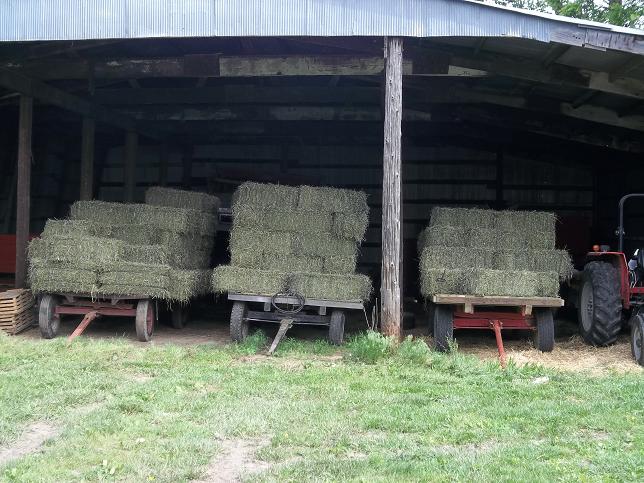
We got the transport boxes in position at home and continued with our morning chores: take hay to the goats, feed the pigs, take oyster shell and feed to the layers and let them out of their houses, make sure everybody has water.  Dad stopped by planning to unload one wagon of hay.  I took 3 of the kids with me to help.  The youngest two took a handkerchief and some apples for a picnic in the barn.  They sat on the straw bales with their hankee spread out eating their formal meal.  It was really cute.  My oldest could just (I mean JUST) throw an alfalfa bale.  Dad’s bales are mostly grass and are considerably lighter than my alfalfa bales so he could help much more.  Dad unloaded onto the hay elevator, my son and I carried and stacked the bales.  When the first wagon was finished (50 bales) we were just warmed up so we went ahead and unloaded all three wagons (150 bales).  My son was flagging near the end and, I have to admit, I was wearing down too.

It was now 9:30 and we hadn’t begun to process our birds.  We got things organized and began scrubbing and sanitizing all surfaces.  The wife went to town for ice while we finished up the cleaning.  While we were discussing who was going to do what job dad showed up to help.  Dad makes a huge positive impact on our day not only by working but by making little jokes to keep the kids involved.  We did the first 40 birds in about an hour, took a break for lunch then wrapped up the rest in about 45 minutes.  I timed my kill/scald/pluck process and found that it takes 1 minute of my time per bird doing two birds at a time in the roto-dunker.  I think I’ll kick the scalder temperature up a bit to speed that up by a few seconds.  Then there’s another long cleanup and composting process while we wait for the birds to chill out.  Then we worked about another hour bagging and labeling the birds before popping them in the freezer.

This is a volunteer army...

To round out my to-do list I needed to restock the empty chicken tractor in the pasture.  We have 300+ 17 day old chicks in the brooders.  Though no chicks have died, I need to make a blog post about the problems we have had with the outdoor brooders this spring.  My dad, my oldest son and I packed 120 chicks in four boxes on to the truck.  Then everybody went inside to put on swimwear and we headed off to the pond.  Dad and I delivered the broilers to the chicken tractor.  120 in an 8×10 is fine when they are small and is far better for them than being in the brooder if the weather cooperates.  There was a 40% chance of rain, not a cloud in the sky so we thought we were good to go.  Dad headed off in the truck while I walked over to the pond.  Clear, sunny, hot afternoon.  Not a cloud in the sky.  No sooner than I arrived at the pond (150 yards from the chickens) the skies opened up.  A storm suddenly appeared out of the SW.  I may have been knee-deep in the pond when it was time to go home.  Kids rode their bikes quickly, wife and I walked.

We got soaked.  Soaked.  The kids were huddled inside fearing the wind and storm when we got home.  The oldest son was working to close up the greenhouse, close the sandbox and otherwise batton down the hatches…then the hail hit.  Then the hail got larger.  I would guess we got 2″ of rain in 20 minutes…then it kept raining.  Sometimes from the East, sometimes from the west.  The roof blew off of a hare pen, the clothes on the clothesline pulled in the wind taking the swing set the line was tied to for a tumble.

Ma popped a chicken in the oven for dinner and we headed to town to talk with a young farmer on Skype.  We kept him on the phone far too long discussing what we had tried, what we enjoyed and what was most profitable.  It was nice to just sit for an hour and talk.

Mom and Dad came by for supper and we surprised the kids with ice cream with chocolate and carmel topping.  The kids helped so much throughout the day we thought they deserved a treat.  Our 11 year old son had done a man’s work that day.  He really stepped it up and was tired.  Everybody was tired.

Bedtime came just in the nick of time but I fell asleep thinking of how much we had accomplished…dreading how much still needs to be done.  Garden to put in, cows to fence out, need to find someone to sharpen my bandsaw blades, need to order a load of sawdust, need to fix the bobcat….I could fill the page.  I can only do what I can do.

Hopefully our customers appreciate the work we do.  I know they like our chicken but I wonder if they really understand what it takes to bring that chicken to market.

Cross…Farm? Diet and Exercise for Alternative Agriculture.

People always ask me, “Chris, how do you get it all done?” then say, “It must be nice to be so young!”

First, I don’t get it all done.  Though it used to sound old, it is nice to be 35.    There are things we can do to make the work more manageable at any age though.  First I have to be strong enough and take care of my health.  Second I have to eat right to have enough energy and take care of my health.  Finally, I have to take care of my health.  You with me so far?

Exercise

We’ve been tightening our belts this spring.  Our winter insulation has been obliterated by our work routines.  If I don’t tighten my belt my pants fall off.  Nobody makes shirts that fit me well.  My large shoulder/small belly ratio is far outside of the sizes offered by mainstream manufacturers.  The result is my shirts fit my shoulders and arms well but at the waist it looks like I’m wearing my dad’s shirt.

Though this isn’t saying much, I may be the strongest I have ever been.  But I’m not as healthy as I have ever been.

Years ago, when we lived in town, we were avid CrossFit athletes.  A typical workout is something like run set distance, lift heavy objects, climb a rope, rinse and repeat, completing the work in a minimum of time.  The workouts vary greatly so your body never quite adjusts to the workload.  It’s always hard.  The time factor is genius as it forces you to crank up the intensity as you compete with yourself in an effort to get better.

CrossFarm (lol) requires we walk, run or bike 1/4 mile to the broilers on pasture carrying a feed bag or pulling a wagon loaded with feed bags, lifting and pulling chicken tractors, carrying buckets of water and returning to the house…often for time as we try to beat a coming rainstorm, sunset or other deadline.  Like the Clean and Jerk, I have to lift a heavy bale from the floor, lift it onto my forearms and launch it into the air accurately placing it high on the pile fast enough to stay ahead of the my father and son who unload the wagons.  We have to run through the brambles, up and over the hills, over and over again trying to find that silly pig that escaped when we were trying to load the trailer for market.  We squeeze, grip, jump and roll when the horse we are riding bare back decides it’s time for him to kill us…lol.  There are shooting events, late night electric fence troubleshooting and all-night hide-and-go-seek games with the cows.  There are ample opportunities for strength on the farm.  Intensity is added by the fact that there is so much to do and so little time to get it all done…or when we suddenly find ourselves being outrun by a 400 pound bulldozer/pig…that decides to turn and run after us!  But…

Exercise is not enough!

The work accomplishes only a portion of the change.  We are busy.  We do work hard.  But we also try to eat well.  In fact, that’s why we started farming.  We were looking for sources of clean food and found the best solution was to raise it ourselves.  We recently fell into the busy trap and found ourselves selling the best chicken in the world to our customers and stopping for a pizza between church and chores.  Late nights lead to sleepy mornings and there’s nothing quite like a sugary, caffiene-laden soft drink to get you started in the morning.  It’s a real problem for me.  Add to it the cookies and desserts that accompany social gatherings and suddenly I’m not feeling 100%.  My allergies are acting up.  I just feel run-down.  I’m strong, yes.  I’m burning calories, yes.  But, I’m not healthy and my runny nose is the proof.

CrossFit forced us to eat well.  If we didn’t eat well we wouldn’t be able to recover between workouts.  When we were in the Zone my allergies disappeared, my blood pressure dropped, my waking heart rate was low, my cholesterol was awesome.  Recently I got busy and allergies have returned.  I’m realizing the shortcuts I have been taking in recent months come with a cost.  It’s time to clean up my diet.  Not just to skip the sugar but to add in lacto-fermented foods like sauerkraut.

I know better than to treat my body this way.  I’m not living up to my own expectations.  This post is part confession, part line in the sand and, I hope, part encouragement.  Want to feel better?  Modify your diet and add in a dose of intensity to your activity.

Changing your diet

We found Nourishing Traditions to be the best challenge to our notions of a healthy diet.  Their recipes are historically normal but are nothing you’ll read in current magazines.  Also, spend some time researching the Paleo diet.  Both of these will rock your diet and may help you tighten your belt as well.  Most of it comes down to avoiding processed grains.  It turns out Cheerios aren’t part of a nutritious breakfast at all.  Breads, grains and pastas may not be the best things for your health…though the government recommended them as the base of our diet for years.  Pasteurized milk may not be such a good idea.  Everything is upside down.

Energy Levels and Rest

I need to maintain a high level of energy.  I have a full-time job and a full-time farm.  That means I have to make time to rest.  Yesterday (Sunday), I got up early and did my normal chores then I took a nap.  After my nap I went to lunch at my in-laws…and took another nap.  I was feeling so good after that I picked up our milk at the dairy then drove home to watch a little Star Trek with the kids…and took a nap.  Then it was dinner, a few more chores and an early bed time.  If I don’t make it a point to rest on the weekend I risk shorting my employer, my chickens or my children.  Any of those would be a disaster.  Many of us fall into the trap of maintaining social relationships and work by sacrificing sleep.  That’s not sustainable.  Weather managing pastures, work schedules or intense workouts we have to allow for recovery and rest.

Work with intensity, eat right and rest.  If any of these are lacking you will suffer.  Your farm will suffer.  Your customers will notice.  Finally, if you want to try CrossFit scaled for mere mortals, scaled versions of the workouts can be found here.  Thank God because I’m not as young as I used to be.