What If They Move Away? Is It Worth It?

What if?

Do you consider the possibilities? Like, all of the possibilities? The unlikely ones like coronal mass ejection or alien abduction and the likely ones like ice storms and layoffs. How do you handle it all? What if the sky really is falling? What if my kids run screaming from the farm seeking freedom in the city?

I don’t know.

Let me summarize this post for you. I have no idea which, if any, of my children will want the farm in 20 years. I can’t even guarantee that I will want the farm in 20 years. But I promise you I love my children. I love my wife. I don’t want to be alone. So we adapt. We respond. We change. We seek unity.

We make the best choices we can given the information we have at the time. But we have to be careful about what choices we bother to wrestle. When I find myself dwelling on an issue there is one question that brings everything into focus for me.

What problem am I trying to solve?
FamilyVision2

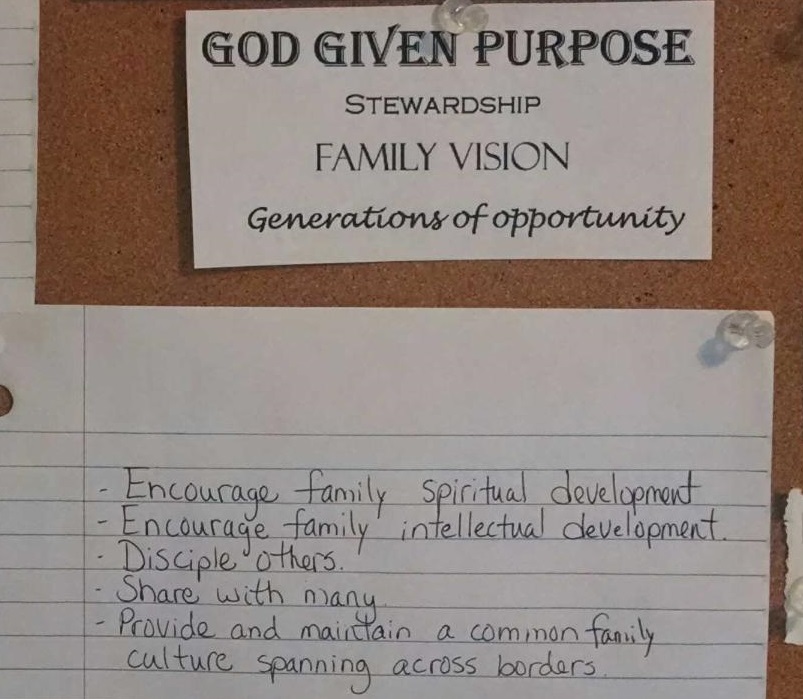
The picture above is from the center of Julie’s vision board. What do you see in there that has anything to do with farming? (BTW, there is a lot of cool stuff on her vision board. Feel free to ask her to share the whole thing with you. I don’t feel like I should share the whole thing today.)

The question from our friend SailorsSmallFarm came in like this:

Will one or more of your kids take on the farm when it’s their turn? It’s the big question isn’t it…because if they don’t, who will? And is all this worth it if they don’t? Quite a gamble, but worthwhile, I believe.

So, OK. My bad. I really, REALLY dig the farming thing. Like, really really. Like if I had my druthers I would spend my days moving cows and checking brooder temps and hauling feed sacks and scratching pig ears. Even in cold weather. That is so in my wheelhouse. But it’s not everybody’s bag. I get that.

It may not be the ideal any of my children prescribe for their own lives. And that’s OK.

I have this job thing. It’s in town. It pays money. It takes me away from the farm but it enables me to farm. Fortunately, my town job does even better than that. It makes the farm payment with a little left over. What do we do with that remainder? We encourage family spiritual and intellectual development. How do we do that? We read books together and talk about them. We read the Bible and talk about it. We seek out opportunities to be giving in our community and invest in others. We go to the zoo and the art museum together and otherwise devote our surplus time to  #5 on the list, Providing and Maintaining a common family culture.

Culture

Common family culture

What is a “Jordan”? What does it take to make the team? Are we farmers? No. Roofers maybe. Mom’s people are farmers…or were. But what happens when the farmers leave the farm? Is something lost? The wealth was retained and spread among the heirs to fritter away or save but was some part of common family culture lost when mom’s generation left the farm?

I dunno. Maybe. There was something common binding mom’s side of the family together. Maybe it was grandma Chism more than the farm. The Matriarch. The farm is a place we all have sentimental attachment to. Grandma Chism was more. But was grandma the common tie or just the focal point? Grandma’s sister (Aunt Melba) was certainly part of the culture when she was alive. Did we lose something when she died? Her kids stopped coming so often. Everybody goes to grandma’s house. Grandmas stay home. My mom is a grandma. Most of her siblings are grandparents. Christmas parties got smaller when my grandma died. Did our family get smaller?

What gave us our identity? What gives us our identity now? Do you have to live on the farm to be a Jordan? No. Does your last name have to end in Jordan to be a Jordan? No. Do you have to live in Illinois to be a Jordan? No. Is it necessary to be an American to qualify as a Jordan? No. But experiences and foundational beliefs seem to be part of it.

Our family culture does not seem to be defined by the land we live on. Not defined. Our family culture is certainly shaped by the farm as we are always shaped, in part, by our interactions with the world around us. But farm or no, we are still a family. We still have purpose.

So, SailorsSmallFarm, I guess I disagree with your question. The big question is not “Will the kids take the farm?” The big question is can Julie and I help our children to find their purpose and can we align our family goals with each specific calling? Can we maintain a common culture over generations? Can we create a structure that, like a grandmother, brings everyone back together…uniting us in some intangible way?

I don’t have an answer to that question. I think we can but I don’t really know what it looks like. But I think the farm gives us an anchor. It’s home. It’s the place we go to for safety. We have a sentimental attachment here…if not the memories of the land then to the memories of family we buried here. But the house? The farm? The cows? Those things are not “Jordan”. They are not particularly “Chism” either. They are just things. And they only exist to help us fulfill our family mission:

We work together as a team to steward God’s resources, create a welcoming home, share with others, encourage one another, learn and explore new ideas and pursue our God given purpose.

So let’s move on to the next part of your question. If they move away will it all be worth it?

I am certain we are not wasting our time. There is no gamble here.

It felt like a gamble when we first arrived on the farm. Oh, the house we sold in the suburbs! It was perfect. Really. Two story, brick. New furnace and A/C. New roof. Dry basement. Fireplace. Two car attached garage. I installed hardwood floors throughout, built floor to ceiling bookshelves in three rooms. Two and a half bath. Four bedrooms. Excellent, quiet neighborhood, nice neighbors of a wide range of ages. Three doors down from a community pool in a nice little town just 25 minutes from St. Louis. The back yard was fenced waist-high allowing neighbors to chat and offer a drink while cutting the grass, raking the leaves or just watching the kids play. The kids had a swing in the big tree in the back yard. It couldn’t have been better. Further, we bought well and had our expenses so tightly controlled we were saving a huge percentage of our income.

Dad was shocked when we sold. Shocked! Surprised! Flabbergasted! Why would we leave paradise to go kill chickens. “Have you even killed a chicken? Do you think you can do it? They stink. The work is not fun. This is the nicest house any of us have ever lived in!”

The house sold very quickly and we moved into grandma’s house.

Talk about a contrast.

We made a mistake. A big mistake. Not the farm. The house. Wow. Wow! What a hole.

The kids cried. The older daughter missed her best friend from next door. The younger daughter missed our elderly neighbors. There were spiders and wasps and swarms of flies at the farm house. It was pretty icky. Grandma had rented the house to a work crew for a while and they, apparently, liked to drink beer, play poker and go fishing. Housework was not a priority. Julie cried.

There was a problem with the sewer system. The house smelled. Stink. Stank. Stunk.

Then we got the heating bill for the first winter. Oh! My! GOSH!

Ahem! Mr. Jordan, I believe you were attempting to persuade the reader that your farming endeavors were not in vain.

I just don’t want to sugarcoat it. It got pretty gritty. Raccoons had attempted to dig into the kitchen through the roof. Rain water flooded the kitchen. Chimney swifts flew into the chimney and out through the basement. I caught one during a birthday party once. Aunt Marian was impressed.

I would like to say “But, it all worked out. The house is now our home.” but that really doesn’t do it justice. The house still has problems. We are tackling them one by one.

However, in spite of the initial discomfort I feel certain that we made the right choice.

We live next to my parents. How cool is that? I want a close, ongoing relationship with my children. They aren’t a 20 year sentence. They are a lifelong blessing! Or I want them to be… And what better way than for me to model it with my own parents? My parents live next door…if next door is half a mile down the road. I talk to my dad daily. Do we always agree? LOL! No. No! But we don’t have to agree. I don’t expect my kids to always agree with me. I expect them to honor me as I honor my parents. I believe that our children will arise and call Julie blessed (her husband also and he praises her!). Could that happen in town? Yup. Do I want to move back? Nope. But someday I might.

Right now my kids can range through 60 acres, picking nuts and berries, going fishing, building forts, sledding, climbing trees…you name it. There is a barn full of life. Horses to ride, kittens to tame, barn swallows to marvel over. We are raising free-range children. 99% of children are locked down in confinement houses, packed tightly into small areas and given antibiotics. Ours are given a varied ration and a clean environment with fresh air and sunshine with every opportunity to express their distinctive human-ness. We even tailor each child’s education to match their interests. Compare that to the poor, suffering children you see raised in medicated confinement. Sigh.

But that stuff is right now. I have no idea what happens next. Will my children marry? Who will they marry? Will I be a grandfather in 10 years? Don’t know. Can’t know. But I can work to meet my children where they are. I can work to understand my children for who they are. I can help my children to understand who we are. We are our parent’s children. We look to them for wisdom. We continue to honor them. We work to continue learning, continue developing, continue growing. We care for the resources we have been trusted with…be that money, cattle, land, lives or just time.
Time

Will my children want to continue on the farm in 20 years? Will I want to continue on the farm in 20 years? Dunno. I’ll tell you when we get there. Maybe I’ll look back on this experiment as a failure, like the collarless button up shirts of the ’90’s. But I suspect this will be different. My children are being formed right here right now. The work we are doing right now could impact generations to come no matter where they live.

Farm? No Farm? Dunno.

Family? Worth it.

The Farm That Was..That May Be Again

I have often wondered what was really happening economically on our farm before 1950. Oh, I know they had beef and sheep and dairy and chickens and bees and an array of field crops. But how many? And in what numbers? This is important to me because it at that time my son is almost the same age my grandfather was when grandpa took over management of the farm. What would that look like today?

I don’t have those answers but I have a better idea of sales figures since dad found a Report of the account of C. Thomas Chism & Marian H. Chism, Executors of the estate of Charles A. Chism. I’m afraid I know very little of the people involved here but it appears the trust was set up to care for Granna Tim (my great grandma) and her handicapped son Billy. I have only seen a picture or two of my great uncle Billy.

Click image for source

He looked a lot like grandpa Tom but my uncle Jack sent me this picture of Uncle Billy in words:

He was a big man, about the size of my dad, but had dark hair and less pattern baldness. He liked walking around outdoors, and they always assigned him chores. (Gathering eggs; chopping wood.) He sang most of the time when he was outdoors–various songs he remembered from the radio; but his favorite seemed to be “Happy Birthday.”

He was the firstborn to a couple who had to wait until ages 42 and 35 to get married. After he came, they went ahead and had two more kids.  It was the job of the whole family to care for [Billy]. He occasionally had epileptic seizures, and it was younger brother Tom’s job to restrain him to keep him from hurting himself.

At 16 grandpa took over the farm when his father had a stroke. In 1948 grandpa would have been 27. Here he is at 29 or 30 just to lend a little context.

Click image for source

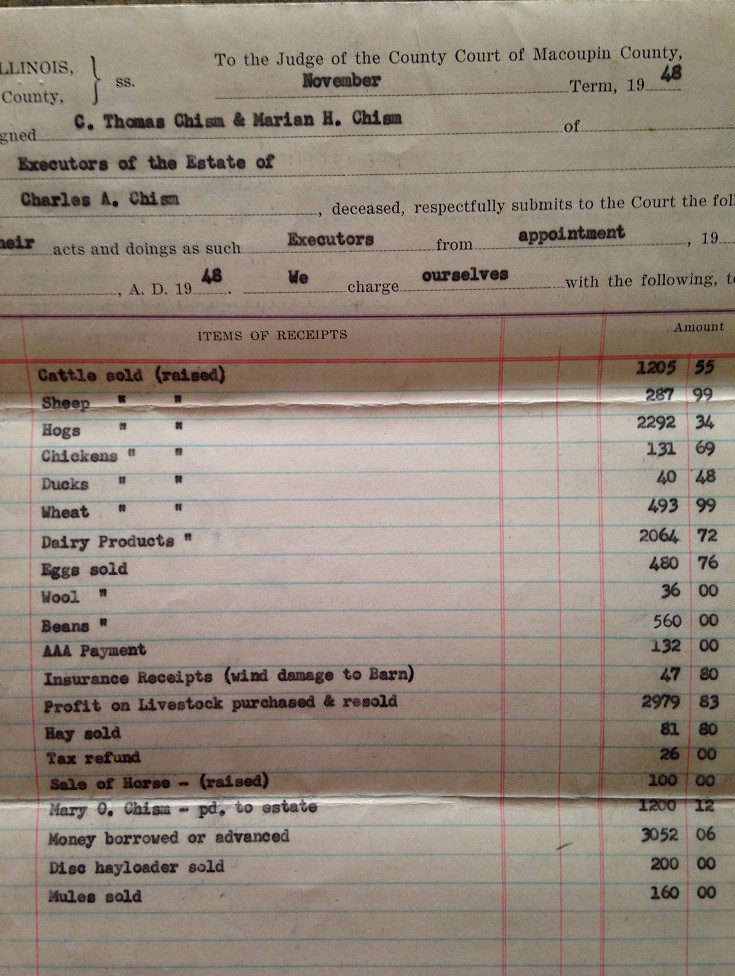
What you are about to see is an accounting of stewardship. Let’s skip to the end, looks like everything earned is being reinvested into the farm leaving $12.14 “held in trust by said Executors as Trustees under descendant’s Will for the benefit of the beneficiaries and purposes therein set forth.” But what they are earning is almost 5 times the average annual income…and they still had other work they did for themselves. Aunt Marian kept a job in town!

Pretty cool. SO what did they sell off of the old farm in 1948? Let me show you.

Trust

I found a few resources online to try to give this listing some meaning but, really, I was only able to guess what the numbers meant. Profit on Livestock Purchased & Resold could be anything. I see expenses on the other side of the page detailing how many dollars they spent in several categories of livestock but nothing to indicate what earned this specific sum. I just have to imagine it follows the formula that less than 1% of overall farm income came from sheep and 27% of farm income came from pigs as suggested by the brochure  Twenty Years of Prices and Incomes Received by Illinois Farmers. From what I understand they sold fluid milk and milked 14 cows by hand. If my guess at their milk check is correct they were selling around 12 gallons each day, leaving some milk on the farm for the household and for pigs. Based on a guess of wholesale egg prices and my understanding of layer reliability of the era they kept a flock of 60-80 chickens. But those are just guesses and, as such, are mostly useless.

So how can I make that spreadsheet useful? What can we really see in it? That my grandpa, who passed away 16 years ago, and his sister just took me to school. Look at that list! And that list doesn’t include other things grandpa did on his own including custom plowing. They even had to fix the barn (the barn their father built). I had to fix the barn too!

BarnDamage

But it’s what I don’t see that interests me most. Why is there so little income from grain? Probably for the same reason they spent $7,000 on livestock feed. Grain was grown to fatten livestock (not people). But the items listed above aren’t the things it takes to run a household and they aren’t the only things the farm produced, just what got sold. There was an orchard east of the yellow house. Somehow they had time to maintain that orchard and can up the produce. And keep a garden. And butcher for their own table. And care for an older brother.

Grandpa Charlie was at least four years older than I am now when he started having children. He was at least 20 years older than me when he had a stroke. Looking at this document I can only reflect on the success he had training his children to take over. They brought in a farm income of $15,000 at a time when the average household income was $3,600. I have a son who is 14. Could I step out of his way in two years, allowing him to run the farm? Should I? He is already larger than me…like grandpa was. I have a 12 year old daughter who is in many ways similar to my Aunt Marian. She works hard, volunteers frequently, gives selflessly, seems to enjoy working with her hands and she has a sharp wit. What will she do with the farm? Could the two of them generate $250,000 in farm sales each year (5x 2014 median income)? What about the other two children? One wants to be a preacher and open a taco restaurant, one wants to stay here and help us.

What will they do with the farm? Will they raise sheep and horses and mules and cattle and chickens and ducks? Will they maintain an orchard? Will they build fences and put up hay? Will they be able to tell me what a disc hayloader is? Will they convert it into a park they visit on weekends while busying themselves with work in town? Maybe the answer depends on me. I’ll come back to that.

I am also struck by what is listed and what I have never seen here.Why weren’t there sheep and ducks and chickens when I was a kid? Where were the dairy cows? I asked uncle Jack what he thought:

Sheep: My dad despised them for some reason. Goats: He got three nannies and kept them for awhile; then came out one morning and he had twelve: three sets of triplets. For some reason he decided he was tired of goats.

Can’t tell you anything about the cattle, except that when I was small around 1950, I do remember we still had a milk truck stopping each morning to pick up big milk cans in front of the house. The milking barn was over at the other place; but the current road south of the pond didn’t exist then—not until they built the pond. So the road by our house which went over past the windmill was the private lane of the home place. So my dad brought the milk cans out to the mouth of the road, next to your house. And this means that 2-3 years after the document you’re looking at, we still had a number of dairy cows. And I always assumed in those early years that there were beef cattle around—usually black ones at that time. Around 58-60 we got Herefords from Montana and raised those for awhile.

“The home place” is the yellow house…the barn Julie and I milk in. Grandpa and Aunt Marian were born at the yellow house. My folks lived there when I was born. But for most of my life it was the place grandpa housed his hired help. It is just storage now. Things change.

But some things don’t change. Just like my elders, I need to make the most of what I’ve got. To do that I need more livestock. I need more cows. I need to add sheep. I need more chickens. But I also need to prepare the next generation to take over. Great grandpa Charlie was, apparently, better at this than grandpa Tom but maybe only out of necessity. Great grandpa Charlie had a stroke but was still around to advise grandpa Tom. But grandpa Tom farmed into his 70’s. One son bought a farm of his own, the other children moved away. Mom and dad moved to another farm nearby when I was 16 but by that time most of my generation of cousins had grown up away from farming. Only one cousin was (is) still here. Maybe that’s why the sheep, chickens, ducks and dairy departed. It is a lot of work without youth to help. Involving the kids now is a big part of making the most of what I’ve got. I don’t need more land. I need additional responsible decision makers.

Henderson includes this quote near the end of The Farming Ladder:

…the pupils are the farmers of the future, and therefore the most valuable and important stock on the farm; for it is their youth and energy which have contributed so largely to [the success of the farm].

Every morning my body reminds me that I am no spring chicken. I need the youth and energy of my own children. We will need the youth and energy of their children. And their children. None of this can continue without a regular infusion of youth and energy. Fences have to be maintained. Barns have to be repaired. Livestock have to be managed. Trees have to be planted, pruned and picked. Firewood has to be cut. New ideas have to be tried out. Failures have to be recovered from. Grandpa and Aunt Marian brought youth and energy and innovation (tractors) to the farm. My parents and aunts and uncles brought covered dishes to the farm at Christmas. My grandma cried when I said I would like to buy the farm. She thought nobody wanted it. Will my children bring life and energy to the farm or will they bring covered dishes? Will an elderly, widowed Grandma Julie cry wondering if any of her children will want to continue here?

How can I encourage my children to take ownership…to protect it, to multiply it, to give it their very best? I have to make it theirs. I have to stop being so critical and step back into a supportive role. Mom and dad and Julie and I have to show them what is possible.

Bringing the Awesome to our Children

Sailor’s Small Farm left a quick comment on a recent post.

Very good plan, teaching your kids to find the awesome. I’ve had mixed success with it, and looking back can see where I’d change quite a few things I did or didn’t do. They are helpful and proficient around here – I mean, I left 250 chickens in three stages of development and 2 pigs in their capable hands for two days and left the country. They were happy to be entrusted with the whole shebang. But neither of them wants that kind of work for the long term. They want the awesome without the grunt. Eat ethically raised meat? Absolutely. Move broiler shelters every day for 4 weeks? Not so much. Home grown veg? Love it! Dig six rows of potatoes? Later.

Let’s look at things from a child’s perspective. After all, it was a mere (hmmmfannmum) years ago that I myself was a child. I have some memory of it. At 10 I wanted to build airplanes and spaceships with Lego. I was also exercising and training daily to help Mario save the Princess and to lead Link to his destiny with Ganon. I was paid to cut the grass for dad, I shoveled snow from as many driveways as I could to make extra cash and spent whole summers at the city pool. My dad did a little carpentry work here and there around the house and I would help…ish. He would mechanic on our vehicles and I would be underfoot.

Let’s overlay that onto my 10 year old son. He wants to build Lego airplanes and spaceships. Link and Mario have been replaced with other characters but if he could, he would train daily. He cuts a little grass and looks for odd jobs. Given his choice he would go fishing at the pond every minute of every day. I do a little work around the farm and he…well…helps. Sometimes he’s underfoot but I’m always glad to have him around.

But when it’s time to kill chickens he’s on the swing set. I think killing chickens is at least as cool as racing Bowser. Maybe even cooler. Doesn’t he know that?

Kids

It appears that I’m operating from the wrong perspective again. Let’s change my child’s point of view. Dad has a lot of jobs. What does dad do and why?

  • Dad works on the farm. Works. Lift heavy bags, shovel smelly things, drive dangerous tractors, felling big, thorny trees and cows kick when you milk and dad is rewarded by maybe making the farm payment and delicious cream for his morning coffee.
  • Dad works in the city. Sits at a desk and gets paid enough money to buy our family the things we need plus Legos…plus pays for the farm.
  • Dad works in Florida. Stands in front of a classroom and makes enough money to pay for a modest family vacation.
  • Dad does extra work on the side at his computer…whatever it is that he does he can, apparently, do it on the internet.

Any reasonable person would look at their needs and decide how best to meet their needs. My kids need legos, books and a warm house.

Q: What is the best way for me to provide these things?
A: Go to the city and sit at a desk.

That’s why the farm isn’t awesome.

It won’t be long and the farm will be free of thorny things. The perimeter fence will be in good repair. Our marketing reach will be well established. Our cattle herd will thrive on grass alone. The farm will generate sufficient revenue to support our modest needs. It won’t be long.

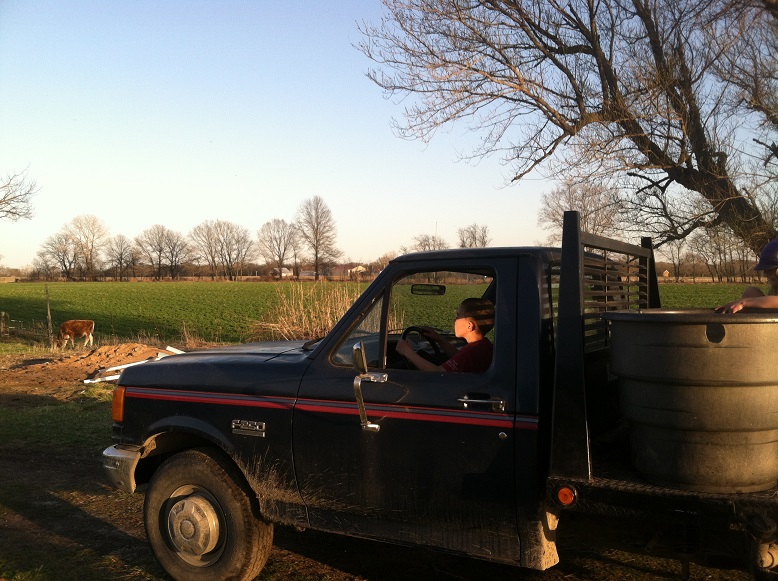
But while our children are young and impressionable it’s all work all the time…plus driving lessons.

Driving

But while they are young the only thing they think they need me to do is to pay for a house and buy legos.

So what, exactly is the problem I’m trying to solve?

One goal here is to establish in my children’s minds that riches have a high utility but wealth is the real goal…if we continue with our definition of riches as money and wealth as time. We certainly want to be wealthy enough to pursue our own productive interests. We certainly want to reinforce that money can be useful but more money is not, in itself, a worthy goal. But at the same time we acknowledge that a little more money would sure be handy.

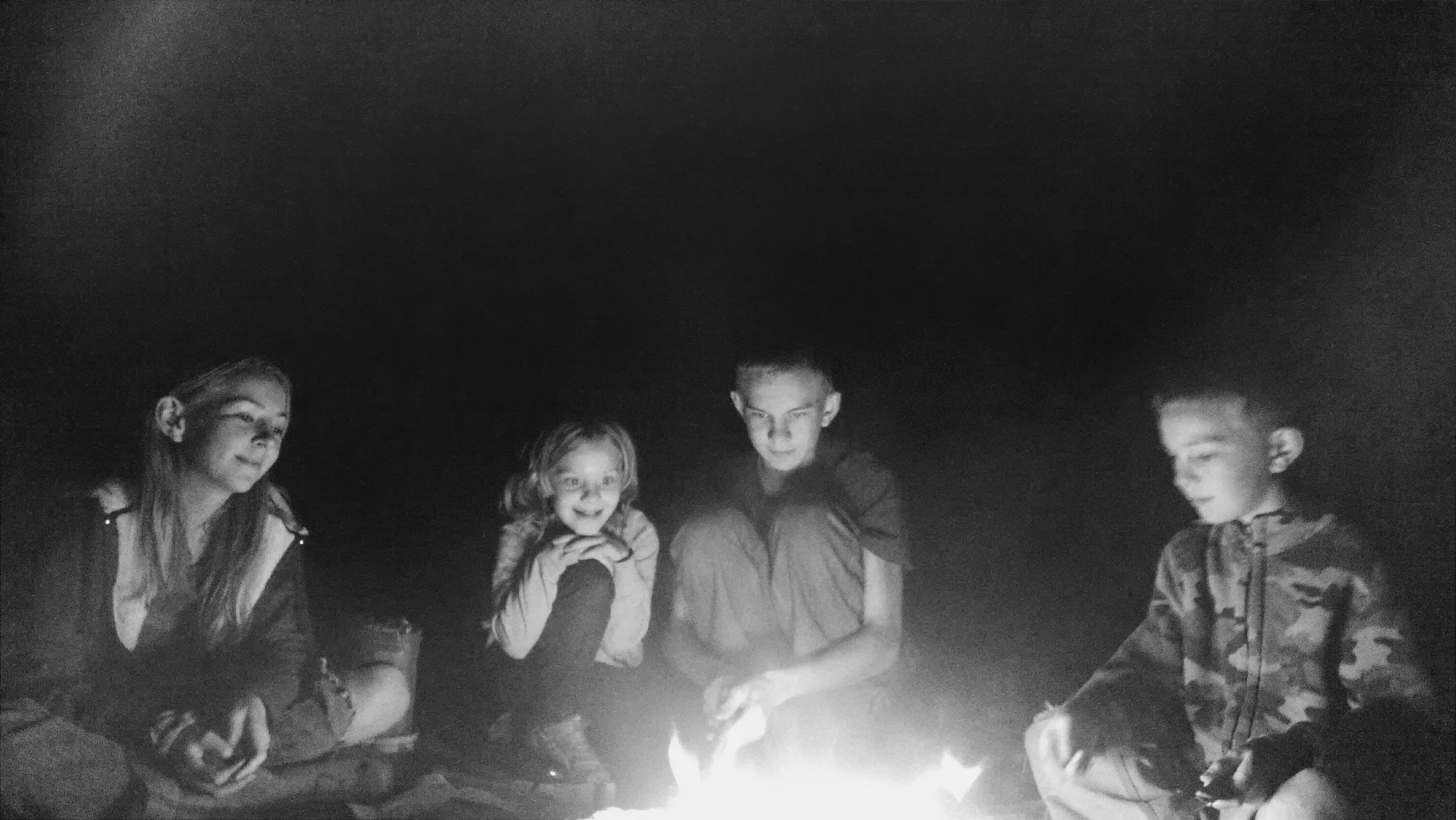
I’m still not getting there. Why the farm? We see the farm as the future source of our family wealth. My job is our present income, the farm is the future security. The future home. The place we recline in the grass reading a book with the cows cropping nearby. We explore. We climb. We run. We build fires and roast hot dogs. The place we hide when the world has turned against us. The place we return to celebrate, to recover, to rest. Working with percentages, nobody else has this anything like this. That’s the problem we’re trying to solve. We hope to help our kids to recognize the problem and encourage them to support our proposed solution. Or, heck, maybe they will show us the error in our thinking.

My jobs in town generate the cash required to just keep our heads above water. But only just. We don’t want our heads just above water. We want a cushion of security. We want to produce…to create…provide…we have this crazy idea that we can make the world a little better and eat well at the same time. By choosing not to spray our apples we don’t have to eat apple sprays. We also preserve the vast majority of insects that are not interested in apples but are affected by insect sprays. Those insects prey on our garden pests and help to feed our bird population. The more bugs we have the more manure we put down. The more health we build into our landscape. The less topsoil I send down the river. The more resilience and productive capacity we retain here on the farm and all because we didn’t spray an apple tree.

picking apples

A series of small choices, made over a number of years, cascade into big results. That morning doughnut multiplied by 10 years adds up on your belly. I could buy that Lego set, that video game or that soda but what else could we do with that money? What if we saved up and bought a heifer instead?

We have to walk out to our imaginary heifer’s pasture twice daily to make sure she has everything she needs and is where we expect her to be. Our investment in cattle is also an investment in our health. If things go as planned, that heifer will give us a calf next spring. We could either sell the bull calf and recoup a portion of our original investment or retain a heifer calf and continue our compounding efforts. Let’s pretend it’s a heifer. Now we are managing two animals for every walk out to the pasture. More bang for the walk. The next spring there will be three animals. The year after that, 5. Then, possibly, 8.

Assuming we have thrown heifers all along or that we have sold our steers to buy additional heifers, our original investment has grown from one heifer to eight animals in five years or a 160% annual return on our investment. Beyond the increase, we have been outside building fence, walking, enjoying the fresh air. We have probably handled hay in some way or otherwise lifted heavy things. And at the end of it all there is a large cut of beef, entirely grass raised with a delicious rind of fat on one edge. Food that nourishes us as we entertain guests with tales of investments and adventures in the pasture, celebrating the animal we knew well.

Certainly I have to expense the land we used to graze the animals but at this point, here in Illinois, I could get by with the above 8 cows on 10 acres. I may have to buy a little hay but we’re talking a ridiculous maximum of $100,000 for land when the median home value in the US is $175k. Heck, you could buy 10 acres in Shropshire for £55k. You may have to live in a tent or remodel a drafty old farm house but, you know, it might be fun.

Compare that to a video game.

No really. Let’s compare it. I’m something of an authority on this topic. The video game won’t reproduce. The video game won’t get sick or get into the road and cause a car accident. A video game won’t poop in your neighbor’s front yard. It also goes down in value almost exponentially after purchase. We could play the video game with our guests and regale them with wild tales of high scores as we sit on our ample seats, draped in pale, plump, soft skin untouched by the sun or wind but we would have to order in pizza.

So without making my children into boring workaholics (like me) I need to show them the awesome of the farm. I need to show them that we can heal the landscape, eat well, produce a surplus for the benefit of our community and stay trim and healthy by making boring choices early on. We could buy fun things now. Or we could look forward to the day when, suddenly and without warning, we wake up to realize we no longer have to work our city jobs. Our farm production more than meets our obligations. We now have more time to manage things here. We now have more time to read and play tag. We now have true wealth.

Time is the key ingredient. Keeping cattle is anything but boring but building a herd, as with any investment, takes time, especially if you don’t have any money to begin with. That’s where we are. That’s why I work in town. We know where we are going. We know how to get there. We want you in the picture.

Will the kids go there with us or will they just run from the work when the opportunity arises? In large part, that depends on me.

Fridiary Randomness

Just a few disconnected thoughts on a Friday morning. I thought “Disconnected from each other, Connected to the farm” was too long of a title and may be more useful in discussing family relationships.

Yesterday Julie was away at a class learning about AromaTouch, a massage technique involving the oils she sells. Apparently it is quite relaxing. Julie fell asleep when they demonstrated it on her.

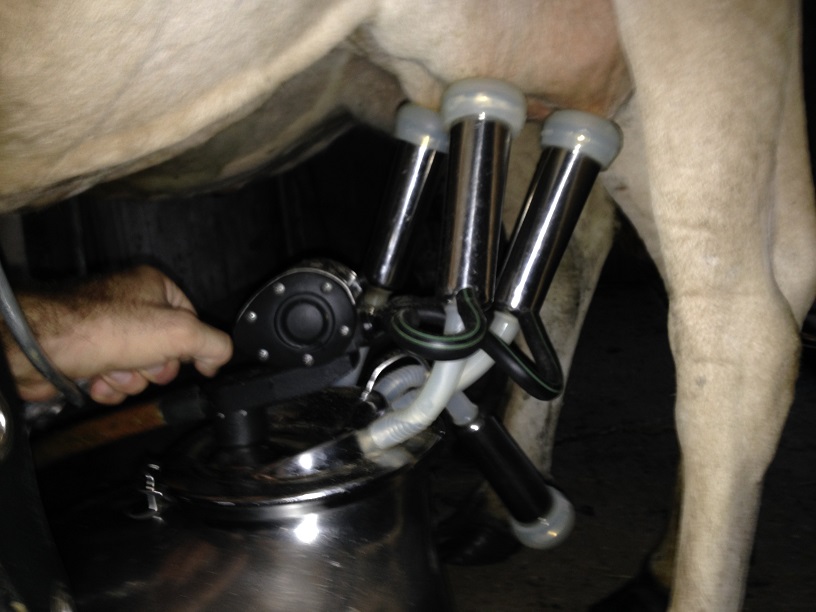
While she was out I had a long list of farm chores to do. Along the way I discovered one milker inflation has a tear in it. The inflations are made to be used for one lactation only but we have used ours longer. We rotate which three teats we milk on the cows so we will simply stop using that inflation for the remainder of our milking season (10 more days). The tear does not impact the function of the milker as it is held closed when the milker is in place but I am concerned about what could live in that seam. Better just to skip it.

Our first frost was two days ago (two weeks late). The air temp didn’t get below 38 but there was ice on the windshield. Those are the mornings I need to be out walking the farm. I found this in a well known frost pocket. The clover won’t last much longer. Sigh.

FrostedClover

It is important to know where frost pockets are as they impact where you would plant certain things and where you will graze your cattle. There are a few plants (like clover) that are best left ungrazed when frosted.

My day yesterday was primarily spent rediscovering why you should never, never, NEVER use powdered laundry detergent in a HE washing machine. I was up to my elbows in our sewer line, complete with a big hole in our yard.

Dad found a livestock drinker on CL yesterday for $150 just like our other hog waterer. The lady had been using it to keep her dogs watered. It’s not new but it is in good shape. The float is out of place and it is missing a stopper. No big whoop. We picked that up and got home in time for dinner.

While dad and I were out we stopped to look at tractors. Boy, a cab tractor with a loader would be a wonderful thing for cleaning up manure, hauling away scrap iron and digging holes for fence posts. I could own one in a mere 84 months of payments too. That’s the same as renting a Bobcat for a weekend every month for the next 7 years except I would get to pay the repair bills on the tractor. Well, and a Bobcat is really no help in baling hay. I am really wrestling with this. I see the value in owning a tractor with a loader but I also like not going into a debt agreement for 84 FREAKIN’ MONTHS!

Sigh.

What’s the big deal? It’s only 40 calves worth of tractor.

Well, it is a big deal. Instead of driving to rent a loader every month and only having access to it for a weekend, I could have one here I can use any time at all for the same money. Ugh. How does one illustrate frustration in text? Picture, in your mind, me pulling my hair out while making gurgling noises, sighs and the occational scream. Ugh. Weather ’tis nobler in the mind to suffer the slings and arrows of 7 years of indentured servitude or to take rentals against a sea of cow manure, and by opposing, gain fertility and clean the barn all at once?

And let’s talk about the cattle barn briefly. What a dump. Should I repair it? Seems like tin comes loose every month. The north wall is leaning out at about a 30 degree angle because cattle have pushed on it for decades. There is metal siding over old wood siding and it’s only partially on, partially laying in the pasture waiting for me to clean it up. It needs a loft put back in it. Should I do that first or should I fix the white barn first? Don’t get me started on the white barn.

What do I need a loft in the cattle barn for? I’m reading The Farming Ladder again. Henderson says he gives each of his five fresh milk cows two hundredweight of straw each day. EACH DAY! I’m not British. I don’t speak in terms of “stone” and “hundredweight”. Am I right in understanding that to be the rough equivalent of 4-5 square bales of straw? Each day? I can’t imagine it. Can’t. Imagine. It. I mean, I can but…no way. Let’s try it with a pig. A bale of straw costs $2. I suspect you could put down a bale of straw each day for a pig and keep the pig clean while capturing the liquids in suspension. After 120 days the pig leaves the farm and you have 120 bales worth of straw holding manure for you. Per pig. $240 worth of bedding. Per pig. Can’t imagine. There are certainly cheaper sources of carbon but Henderson is pointing out that I’m not doing enough. That I’m not making fertility a high enough priority. He transported 600 loads of manure to his fields each year. Can’t. Imagine. But maybe that’s why I need a loader tractor. Back to that again.

I have a mountain of unpublished blog posts I need to get out. I’m just having a hard time finding the time to get it all done. Similarly I’m behind on work and I can’t seem to find time to read either. I’m not sure what is happening. Am I being affected by the short days? Dunno.

Anyway, Diary. Thanks for listening.

Could I Farm the Whole Farm?

I recently wondered what it would be like to fully stock and graze the entire state of Illinois. In short, I would have 55 million hooved animals covering 400 square miles each day, followed by 110 million laying hens. We also included plans to plant millions of fruit and nut trees and leave room for people to live their lives and pursue their own interests. Surely some of them would be beekeepers.

But let’s scale it back. Let’s put my money where my mouth is. I have cows and chickens. I have walnut trees, oak trees, hickory trees, black locust trees. We are planting apples and cherries and plums and hazels and chestnuts. But we aren’t covering the entire 60 acre farm.

To cover the farm I would need 27 cows. Remember, I have to leave an acre per person out of production for roads, buildings, gardens and recreational area so I only have 54 acres available for agricultural activities. I suggested each cow/calf pair needs two acres in Illinois so I need 27 cows. Also 108 ewes and 270 laying hens. Those animals are not here yet. I’m not ready for the marketing, I haven’t built the equity and I don’t have the education required to manage them. I mean, on that scale I would be producing something on the order of 24 calves, 200 lambs and 5000 dozen eggs. Maybe throw in a couple hundred pigs on deep bedding too. That’s just the picture Henderson painted in The Farming Ladder…though he had 100 birds per acre.

I’m casting vision I really can’t see. It’s too far out.

Clover

I mean, it was fun to imagine the numbers involved in managing 37 million acres but I have my hands full managing 60 acres. It’s worse than just peddling all that production. I have to pull white snakeroot where it grows. I have to cut firewood, build fence, keep the tin nailed to the barn roof and participate in family stuff.

And we aren’t even dealing with the 70 or so walnut trees that have dropped their walnuts this fall. How many have I picked up? Zero. Aunt Marian’s three apple trees proved more than my match. What would I do if I planted 8 apple trees on every acre? How about 20 on every acre?

If I can’t handle the abundance of a mere 60 acres what chance do we stand trying to scale that up to the whole state?

What I need is some division of labor. I need somebody who cares about apples to pick and deal with the apples. I need somebody who cares about walnuts and somebody who cares about sawing lumber and somebody who wants to sell product and just leave me alone to watch my livestock graze in the afternoon sun.

That would have to happen on a grand scale. That would have to happen on the farm scale. That will have to happen on the family scale.

FarmGirls

Family scale is where things usually break down on the farm. Kids get tired. Are they valued members of the team or are they slave labor? Are we living out their vision or mine? Whose dreams are coming true here? Who is taking risks and being rewarded? Where is the awesome?

It can’t all be about cows and sheep and electric fence and work, work, work. Work stinks. Nobody wants to work. But you know what is fun? Making the cows happy. Harvesting fruit from trees you planted with your own hands. Opening the chicken coups in the morning under a blood moon lunar eclipse.

BloodMoon

That’s not work. That’s awesome…to me anyway. What do each of my kids think is awesome? If my kids can learn to experience the awesome on the farm, maybe I can help them buy another 60 acres of their own…set them up with a whole generation of stock from our own farm too. Send them with 13 heifers, 100 ewe lambs, a dozen or so gilts and as many hatching eggs and walnuts and chestnuts and hazels as they want. Same with my grandchildren…and thus, through the course of time, we will stock and graze the entire State of Illinois!

I don’t have 27 cows, 108 ewes and 270 chickens on 54 acres. I don’t have 200 trees per acre either. It will happen and it will happen soon but it can’t happen yet. I have to bring the awesome to a new generation first. I still have my town job so we can afford not to maximize our production…so we can afford to learn…so we can afford to teach our children to find the awesome. We can farm the whole farm after I teach my children to love it here.

I don’t want to farm alone.

How Are We Going to Pay For This?

Oh, the joy! The fulfillment of a lifelong dream!

how are we going to pay for this 3

I liked my grandma’s house so much I bought it.

But now that I have it, how do I pay for it? Land isn’t exactly cheap right now…nor was it when I bought the farm a few years ago.

Let’s leave the dollars out of this. Let’s talk in terms of production. What do I have to produce each year just to service the debt I hold on my 60 acres? Ready? I have to produce all of the following:

  • 2,000 dozen eggs
  • 5-7 calves
  • 20 pigs
  • 1,200 broilers

All that just to make the farm payment. Now, maybe that’s not such a high hurdle…especially since the math involved has already accounted for income tax. But it is a hurdle. 1,200 broilers at our scale chews up the whole spring and fall. 3 batches of 6-8 pigs are no big deal but forces us to keep pigs all year. Eggs are a year-round deal too but 100 layers really aren’t hard to manage. That said, the income from that small flock only accounts for about 12% of the farm revenue as presented above. Layers are more about fertility and bug control than revenue but maybe we should increase the flock to account for a full 25% of revenue. Yikes! Mr. Henderson would say yes but…Yikes!

How are we going to pay for this?

So that’s what it takes. Sure I could pay the payment with 20 calves but I don’t have 20 calves. And I’m not sure I want to ONLY have cattle anyway. I have exposure to a number of markets this way. Many customers buy eggs. Fewer buy chicken. Fewer still buy pork. The marketing pyramid works very well. So we produce a variety of classes of livestock. The good news is we already have everything we need to produce these numbers. The bad news is all of that production ONLY SERVICES THE DEBT.

What about the fencing we need to build? What about the trees we want to plant? What about the buildings that need to be repaired? How can I afford to buy a tractor?

I don’t know. I guess I need a couple more pigs. And another 300 broilers. And another calf or three. And another 100 layers.

But Julie is already tired (as I frequently write). How can I double my livestock numbers without negatively impacting my job or our family life? I don’t know. Maybe I should quit my job.

But if I quit my job we’ll still need some form of income. Remember, to date we are only servicing the debt and producing enough to make small infrastructure investments. Now we’re talking income. You know, money. The kind you need to slap braces on the kids and pay for books and plan for college and…you know…what happens when I’m 70? Will I be able to relax on the farm I have served my entire life, harvesting the abundance of my decades of labor or will I have to sell my beloved land and move to town?

how are we going to pay for this edited 2

Happens all the time.

Well, that’s no hill for a climber. Maybe if we got to 300 layers. That would give us 15 dozen eggs/day to sell. And maybe we could raise 15 pigs at a time. And sell 25 calves every fall. And heck, the kids are growing. Maybe we can handle 2,400 broilers. Maybe even 3,000! Would that be enough?

Enough?

What does enough mean? How much is enough?

How much is too much?

I don’t know. Dirty Harry warned that “A man’s got to know his limitations.”

Do I know my limitations?

Do I believe I am immortal?

Did I pay too much for my farm?

What is this dream costing me?

Don’t read regret into this post. Please don’t think I’m being pessimistic. Quite the opposite. After spending a few years learning how I’m finally making this thing pay.

how are we going to pay for this edited 1

So. Be sure to sit yourself down with a couple of sharp pencils and do the math before you buy land. Try to sell something. Just try. Your boss may enjoy eating pork chops but does he have freezer space for half of a hog? Will your co-workers continue buying from you if you change jobs? Can you sell a dozen eggs at a profit? Start small. Learn as you go. Grow when you have to. Move slowly. Always do the math.

Always do the math.

Leavin’ It To The Kids

We were gone. Both of us. Gone. Away from the farm. Kids were with grandparents.

Weird. 3 weird days. Lonely. I strangely missed doing chores as I studied in my hotel room.

It took a bit of planning, a bit of negotiation, a little fiddling with things to make it a success but it was a success. A complete success. Our older kids, aged 14 (almost) and 12, with help from grandpa (age withheld), ran the farm for three days while I was working and Julie was goofing off in Florida.

leaving 6

So what has to happen when we are gone?

leaving 5

Well? Everything.

Chickens need to be opened in the morning and closed in the evening. Ideally, eggs are gathered at 11 and again at 3 and the drinker is filled at those times too.

Pigs don’t need much, just top off the feeder and make sure the water is available. Bedding is always in style but they will be fine for 3 days.

Cows need to be moved. Every. Day. The forecast was calling for cooler days so I set up a long strip on the clover field, segmented it with cross fences like a long ladder and left instructions to move the cows in the afternoon when the clover was warm and dry. Unfortunately it got hot so we had to open up some back fence to allow the cows access to shade. Water is automatic, just have to check it. The water trough is much more likely to overflow than to go dry so it is important to check to see if the cows have churned the area around the water into a muddy mess. If so, move the water. That proved to be more work than can be handled at age 13. Otherwise, no big deal.

leaving it 3

Dairy is a different thing altogether. We were only gone for three days. Three days. You with me? Three days. Tuesday Julie left the calves with the cows. All you can eat. Wednesday the kids didn’t milk. This has its drawbacks and limitations, not the least of which is the concern that the calves will overeat. But one day shouldn’t be cause for concern…especially since the calves are big enough to wean. Wednesday afternoon it was back to normal schedule. At 3, when you get the eggs and water the chickens and move the shorthorns, find the dairy calves (they ignore the fence) and lock them up at the barn. Good luck. Thursday morning they had a bit of a rodeo milking the cows but they got the job done. First they forgot the water to wash the udder. Then they forgot the rubber ring for the milker. But all went well and they got the normal amount of milk. They didn’t milk again on Friday but separated the calves so we could milk Saturday morning. No ill-effects. No big whoop.

leaving it 4

But what if the pigs get out? Or a cow? Or the bull?!?!? What then?

I don’t know. Call the pigs and put new temporary lanes up to return the cows to their pastures. But it didn’t happen.

Not only are we proud of our kids for doing such a great job, we got some feedback from dad on how to make things better. Everything from managing the water for the birds to concentrate ration changes for the milk cows. We are pretty intentional about not feeding for increased milk production as we value the longevity of the cows and calves over the volume of (otherwise worthless) milk produced but dad wants to see a little more fat on the cows. I do too. Dad also pointed out that my new layer flock is a little heavy on roosters. Strange because I bought all pullets.

With a little planning, a little training and a couple of crossed fingers, everything worked well. The kids were tired but it was nice that Julie and I got away for a little bit together.

I should also add that it was Julie who lined most of this up. I left directly after the funeral to begin school on Sunday morning. Julie was home washing eggs and preparing the kids and grandpa for the chores until she flew out Wednesday morning. This was a total team effort. I am both proud and thankful.

Aunt Marian

Oh, the things I don’t know about my great aunt. I was looking at magazines on her table recently and asked her how her parents spelled her name…her mail was addressed to Marian and to Marion and I have written both on the blog. I don’t think she gave me an answer, just a laugh. It must not have mattered to her.

We asked her about her uncle French…was “French” a common name 100 years ago? “No” she said, “I only knew one other person named French. That was French Fry.” We all started laughing. It took her a minute then she realized why we were laughing and we realized she wasn’t making a joke. She said, “I never thought about that before” and laughed with us. I still think that’s funny.

AuntMarianGoat

Aunt Marian recently celebrated her 95th birthday.

Party

She passed away on Wednesday.

When I was a kid Aunt Marian was just some lady who lived near Grandma and Grandpa’s and made me itchy clothes. I love pumpkin pie but she didn’t make pumpkin pie. She made squash pie. Squash pie? SQUASH PIE? Mom makes pumpkin pie from real pumpkins out of a can. Now that’s pumpkin pie!

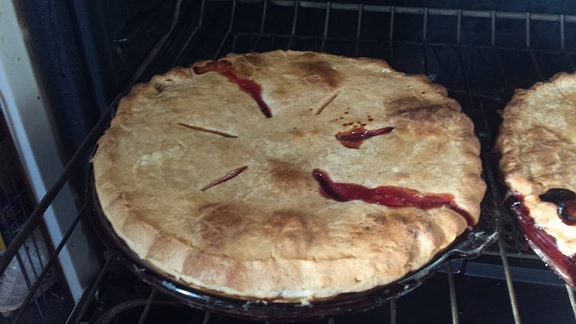
But as I grew I learned more about her and gained a tremendous amount of respect for her. In the last few years I noticed she only slept when she was driving. Otherwise she was working. She made dresses for all of the girls at Christmas and Easter. I think I broke her of making boy clothes. She always gave me blue dress socks at Christmas. I don’t wear blue dress socks. I think she had a sense of humor. She somehow managed to keep her flowers growing, her garden in, her lawn mowed and her apples canned. I can’t do even one of those things. She volunteered at the local food pantry. She made grape pies for the fish fry. She helped at church functions. She kept her thistles chopped. She loved us.

Grandpa and Aunt Marian had an older brother named Billy. Billy was mentally handicapped (hydrocephalus). From what I have put together, Aunt Marian kept Billy with her when she was out picking berries and she had to pick 100 quarts of raspberries every summer. Imagine that. Beating through the brush to pick 25 gallons of raspberries, stabbed by the vines, tromping through the poison ivy, brother in tow and probably horses cropping grass nearby. And not only that she had to milk the cows.

She was in our kitchen about a year ago and saw our milking machine. She said, “What do you need that for? You only have two cows.” What response can you give to such a question? She continued, “I milked 14 by hand.” But it’s worst than that. She milked 14 twice each day by hand. We only milk in the morning. Same barn. Same stanchions. Jersey cows grazing the same places where her Jersey and Guernsey cows grazed. We don’t even churn the butter. We just skim off the cream for our coffee. How lazy are we?

She made time in her schedule to tell us a little about milking. She said her father offered to pay her a nickel if she could milk out one cow before he finished the rest. It took her 5 years to earn that nickel. She also told me that she would milk while grandpa was still in bed. That sounds like something you would hear a sibling say.

But I I have no doubt that she milked 14 cows and tromped through the brush picking berries with her older brother in tow. And maintained the orchard. And made clothes. And rode her horse to school. And worked in a doctors’ office for years. And what else? What else don’t we know about her?

Did you know she made my sister’s wedding dress? She made Julie’s wedding dress too. And several others. Not just the dresses for all of her great-great nieces each year, she made stuff out of the blue. I hate to think of the time she spent asleep at the wheel on her way to Springfield to buy fabric but dresses were made somehow. Maybe elves helped her at night.

This year somebody else will have to make the corned beef and cabbage. Somebody else will have to bake the pumpkin roll for the church potluck. I doubt if anybody will pick up the baton and make 30+ dresses for Christmas. Apparently I’m not up to the task of making applesauce out of 40 bushels of apples. Who will work at the food pantry? Who will make grape pies? Who will buy me blue dress socks?

I miss her already. She was a fine example of love and sacrifice and she was never intimidated by hard work. We are less one hero. If you would like to share a story about Aunt Marian please post it in comments below. I would love to hear it.

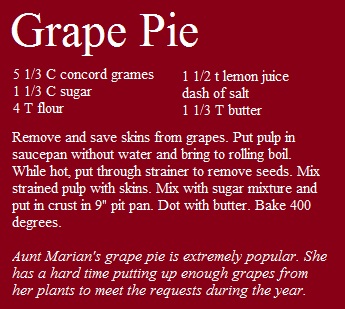
Aunt Marian’s Grape Pie (From the Chism Family Heirloom Cookbook (comment if you are interested in a copy.)

GrapePieRecipe

GrapePie

15 Favorite Things

Yesterday I shared that I love owning and toiling over the farm. Though sometimes frustrating, I derive a measurable satisfaction from the work.

But have you met my wife?

Julie is loving. Supportive. Encouraging. But not physically strong.

Much of the work in the early stages of our farm requires strength and plenty of it. Lift this, load that, lug it over there. Stack wood, carry feed sacks, load up scrap metal, stack hay, wrestle this piglet. It feels great to be so physically exhausted. I can fall asleep almost instantly…anywhere (sorry pastor Mark!).

She doesn’t love that. She loves me but she doesn’t love all of the work.

BackToPasture

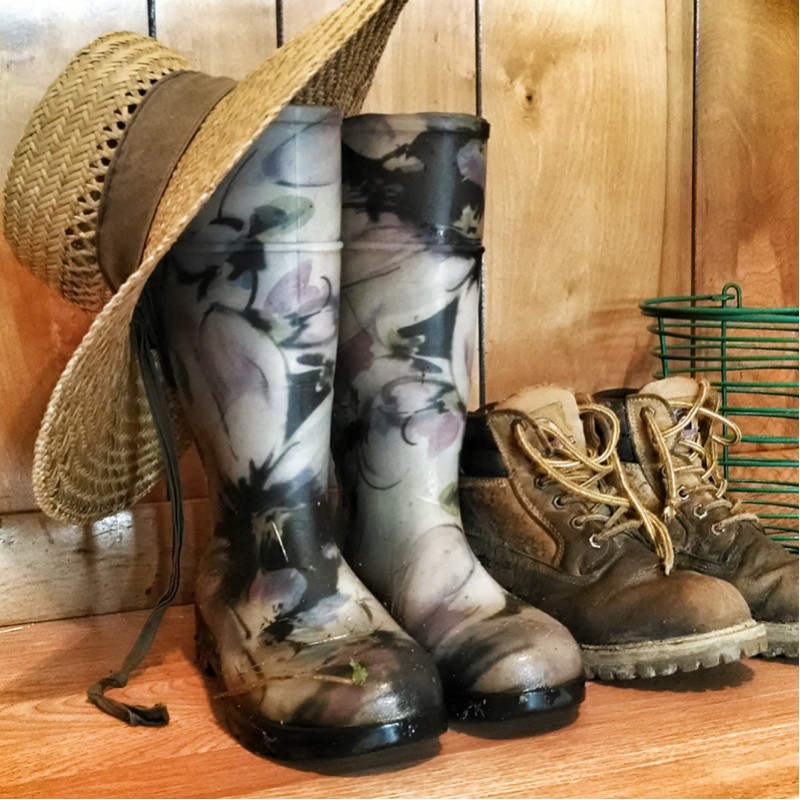
So I try to accommodate her needs. Some of today’s post is exaggerated to make the point but some of it is very real. Please don’t comment that I’m a jerk. I can be a jerk at times. But most of the time I’m a pretty normal guy. You know…a jerk.

Julie recently made a list of her top 15 things that are free and her top 15 things that cost money. Stop reading now and go make that list. Really. Stop. Write down 15 things that you treasure that are free. Now write down 15 that cost money.

Done? Good. Post some of your 15’s in comments. Come on. Hundreds of people will read this. SOMEBODY can share a few things they enjoy. May as well be you.

My top 15 include piglets. Her top 15 (of both categories somehow) include chocolate. I love cutting firewood and watching the forest transition from thorny weed trees to dominant, climax hardwoods. She likes the warm fireplace in the winter. I enjoy watching the cows graze and stomp the pasture as we manage toward fertility and diversity. She likes to hold hands as we walk through the pasture. I want to make the chickens happy. She wants to talk to the egg customers.

Our goals are not mutually exclusive but they are not entirely aligned either. They are complimentary. Well, some of the time. Other times?

I want a clean house, well-behaved children, a weed-free garden and no toys on the floor. She does too. It’s unanimous so why doesn’t it get done? What does she do all day? I get up early, care for the critters, solve computer puzzles all day and come home to play farmer some more. What does she do all day? Why aren’t the dishes done? She has four helpers! It only takes a few minutes to wash the dishes! I know, I DO A LOT OF DISHES!

These aren’t productive thoughts to verbalize in argument conversation with your wife.

Julie shared her top 15(s) with me this past weekend after yet another …um…discussion(?) about the milk cows that resulted in me selling the cows. (Fast forward a few days, we haven’t sold the cows. I found a willing buyer within 3 minutes but cooler heads prevailed. For now.) You know what is NOT in Julie’s top 15? Milking the cows.

How can she feel that way? I mean, what is her problem!?!? Milking the cows is totally in my top 15.

FloraAndHenry

No. She wants to hold hands as we walk in the pasture and eat chocolate and buy art supplies and journal her thoughts and …I don’t know…do some other girl stuff. I want to hold a rusty bit of baling wire in my teeth as I save the world once again with a miraculous repair like my super-hero dad. Hold hands? I guess but, “Hold hands? In the pasture?! Baby, we don’t have to go to the pasture to hold hands. Anyway, I gotta collect the eggs. Maybe you can hold my hand while I walk down to the birdies. But can you wear your purple rubber boots? I need to cross the creek and count the cows. I should probably build a little fence while I am down there. And I need to move the water trough too.” And just like that we are no longer holding hands as we stroll through the pasture to collect a basket full of eggs. We are working. Like workey-work. Baling wire in your teeth, cow manure on your jeans, broken fingernail, grunt and smell and save the world kind of work. The kind of work that adds to the already massive pile dirty laundry when you come in from doing chores and have to take a shower because the dog is the only one who likes your smell. And, by the way, the dirty laundry has to be put away when it is cleaned. You know, that chore that isn’t getting done as is evidenced by the baskets full of clean laundry sitting on the bed so we have to deal with them before going to sleep but we actually just carry the baskets to the living room every night because we are so tired from gathering eggs, building fence, moving water troughs and holding hands.

farm fashion

Well, something like that anyway.

So she doesn’t want to milk the cows. It’s not on her list.

So I am milking the cows. It is on my list. And it frees up time in her day to accomplish more of the stuff she wants to do.

Milking

And it is important that she have time in her day to explore things she is passionate about…and that I support her in those things. So the dishes don’t get washed after every meal. So there is clean laundry on the bed. So sometimes I stop working and just hold her hand in the pasture. Sometimes we all pile in the car and go to the library. Or to visit family. I separate the jobs that I want to do from the jobs I need to do, we do what we have to and leave the rest for later so we can all play a board game together. Same reason the house isn’t completely spotless sometimes. She had more important stuff to do. Same reason there isn’t a new blog post every day.

Sometimes it is important to her that she help me stack firewood. Sometimes it is important to me that we hold hands in the pasture while eating a chocolate bar and doing nothing else. I have to meet her where she is…to invest in her. To put a deposit in her love account.

All of this seems like common sense…and it is. But you forget that when it’s hot and the garden is submerged under a sea of weeds and the cows are out and the kids are grouchy and you can’t see the kitchen counter and things, generally, could be going better. But that’s life…the life we share. She loves me and likes the farm. I should probably adopt her style of thinking.

And I don’t know what else you could want in a free blog post. This is real life. I’m not here to pick at scabs for an audience. I’m also not here to tell you that farming is easy and the best way to make the world a better place is to buy a $250 American Guinea Hog that you butcher at 60 pounds after 6 months and harvest 30 pounds of meat for $10/pound. I keep it real. This is where I am today. Julie and I are fine. Farming is hard. Marriage is hard. Getting older is hard. But I rather enjoy farming and getting older with my best friend. It isn’t always easy but we’ll tough it out. And I hope you will too.

I Just Love it

There are days of stress. Days when things don’t go well. For example, cows only get out during a thunderstorm.

But I love it. Every minute of it. It’s just great.

I often write about how greatly we underestimated the challenge of living here because I want to caution readers who haven’t made the leap yet. It’s a lot of work. A lot of hard work. A lot of hard, dirty, sweaty, hot, broken fingernail, stained hands, peeling callous, rip in your jeans, leaky rubber boot, blood mixing with manure and dirt kind of work.

But I love it.

The real challenge for me, as we often relate to our readers, is that I forget that Julie doesn’t always love it as much as I do. And that I love Julie more than I love the farm. (And not just because she is hot.)

Julie liked milking the cows for about two months. Then Julie just milked the cows for another two months, sometimes dragging her feet. Tears were shed. Words were said. So now I’m milking the cows. She has had enough.

And who can blame her? It’s not a lot of fun being hit in the face with a cow tail for a few minutes each morning or smashed between them when they lean against each other in the stanchions.

But I love it.

20 minutes before sunrise...

20 minutes before sunrise…

This morning I let the chickens out into a new area then went to count the cows. The chickens ran and hunted and scratched in the early morning light. I would almost say they played but they were too serious about their work to “play”. They were working. But I think they were enjoying their work.

I enjoy my work.

Even when I’m walking the cows out of the neighbor’s bean field as a thunderstorm begins late at night.

Some of this thinking dovetails with a comment dad left on the blog a few years ago:

Just gotta say, I love putting up hay! I love cutting it, raking it, baling it, riding the wagon or driving the tractor, seeing a wagon full of well cured hay, putting it in the barn, going in the hay mow and smelling summer all winter, remembering which cutting and which field a bale came off of, and planning how I can put up quality hay in the future. I even love trying to outthink nature to get it put up.

Each morning I have to be finished milking by 7 so I can get to my desk on time. Also, pigs have to be fed, both flocks of chickens cared for, cows counted, self showered, eggs packed and children hugged. It’s hard to get it all done but I love it. Thank God for coffee. Gotta go.