Hill Potato Blues

What seems like a lifetime ago, but was just this past St. Patrick’s Day, we planted potatoes.  We have hilled them.  And hilled them.

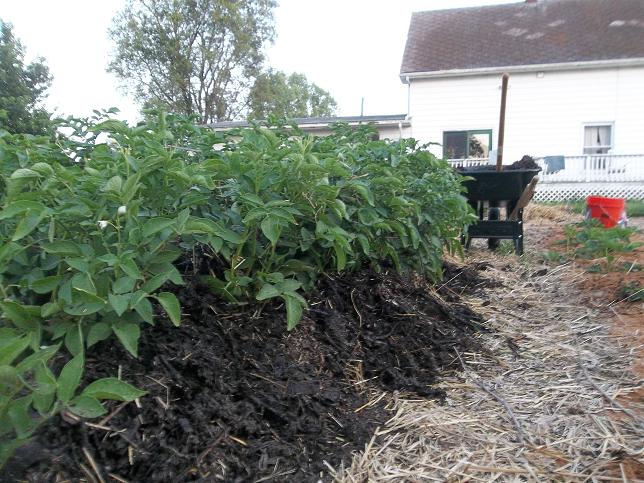
Today, with the greenhouse nearly empty of livestock (just the rabbits and ducks left), I started hauling out bedding.  Well, more than started, I worked on it for a couple of hours and went a foot deep in a 10×15 area but didn’t really make much of a dent.  While the wife and kids weeded the garden I hauled wheelbarrow after wheelbarrow out to the garden beds to surround the peppers.  Finally, I just had to do it.  I had to hill the potatoes again.

The bedding I am hauling out is mostly from under the rabbit cages.  It’s months worth of wood chips mixed with rabbit manure, chicken manure, old hay and who knows what else.  It’s moist, warm and full of worms.  It’s also heavy.

This really isn’t a huge deal but by planting the way Jeavons says to, and since potatoes don’t always come straight up where they should, there’s a dense pack of plant matter and it’s kind of hard to deliver the compost where it is needed.  But I did it.  And kept going back for more.  And I’ll do some more tomorrow.  Why, oh why did I plant 100 pounds of potatoes?

Yes, the plants really do tower over my wheelbarrow.  It’s not just a perspective thing.  I can’t seem to get enough material in there to hill them the way I would like.

My Own Pig Farmer

My friend Steve pointed us to the most interesting hog farmer I have ever met.  He farrows on pasture, raises pigs in deep bedding and uses, of all things, large black hogs in his hybridization program.  In a world of specialists and sub-specialists, I found a guy who is not only farrow to finish, he does it in a way that honors the pig-ness of the pig.  There are things I would do differently (multispeciation) but he’s going against the grain and keeping his head above water.

I met Mike Butcher some months ago.  The first thing noticed was that he was pigging on pasture…in February.  I saw a number of huts spread across the field, each hut with a sow, each sow with a litter of little pigs.  Out in the real world, sows are kept in confinement in crates to minimize the number of little pigs that get squished when the sow lays down or eaten when she expresses her stress level.  Mike has selected for good mothering instinct and farrows in an environment that give the sow room to relax.

Yes, it’s a muddy mess, but we’re in monsoon season here.  I really want to drive home the point that he’s pigging on pasture.  His sows do such a good job of mothering the pigs he had one who kept 15 piglets this week!

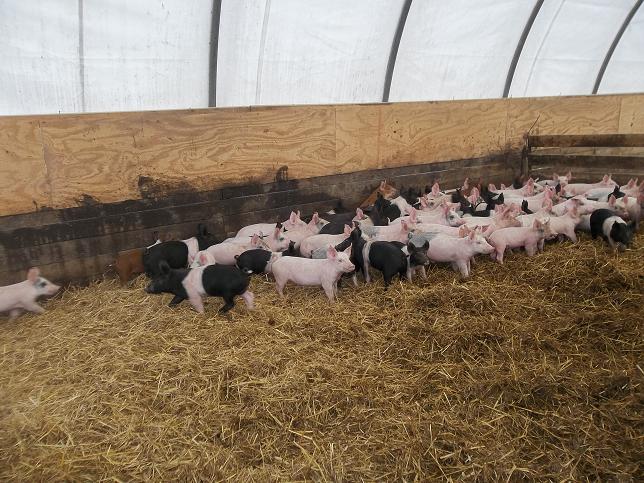
Once the pigs are weaned they move to a series of hoop houses.  Unlike other confinement buildings I’ve been in, Mike’s hoop houses don’t have slatted floors with a manure pit beneath.  Instead, the shoats  were bedded in a deep layer of straw and the larger pigs were bedded with round bales of corn stalks.  As a consequence, there was little smell and enormous compost piles.  Enormous.

Look at the space available to these little guys.  And they have a foot of straw to root, play and sleep in.  From a confinement perspective, this is hog heaven.

Again, Mike pigs on pasture, uses heritage sows with excellent mothering characteristics, raises pigs in deep bedding and composts everything.  I don’t know what else I could expect from him.  I was so pleased I bought 8 pigs.  I was so pleased with his price I gave him a free chicken along with the check.  If you’re in the Palmyra area and want to see hog confinement done artfully, find Mike Butcher.

At one time this was normal.  I’m happy to support Mike in his business.

We had a few problems keeping these little guys fenced when we got home.  Look for an article on that in the near future.

Glossary:
Farrow (verb) – To give birth to a litter of pigs
Pig (verb) – See Farrow.   Also written as “pigging”
Shoat (noun) – Weaned pig male or female

Creek Sand?

My friend Darby and I were discussing things we do to ensure chick vitality.

Me: “Kelp, creek sand and restricted feed go a long way toward happy birds.”

Darby: “Kelp and creek sand?  Can you elaborate?”

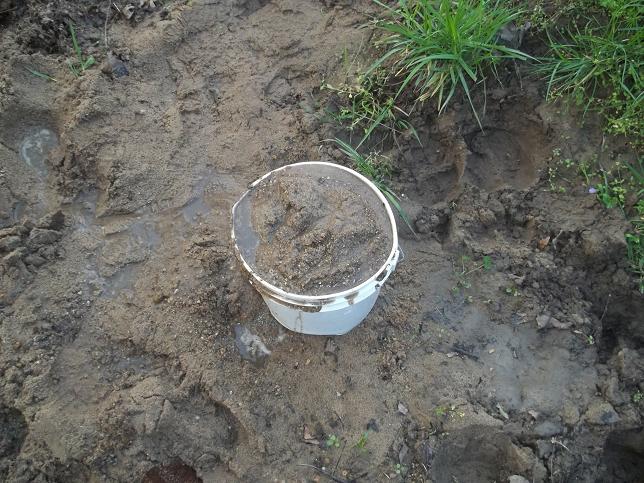
Well, here is the skinny on creek sand.  I go down to the creek (well, the branch) with a bucket and a shovel.

I’m not concerned about getting pure sand, a specific size of the sand or even looking for dry sand.  I just fill the bucket.  The chicks will pick out their favorite bits and everything will be just dandy.  Further, there are small organic bits mixed with the mud and sand as well as small organisms the chicks seem to really enjoy.

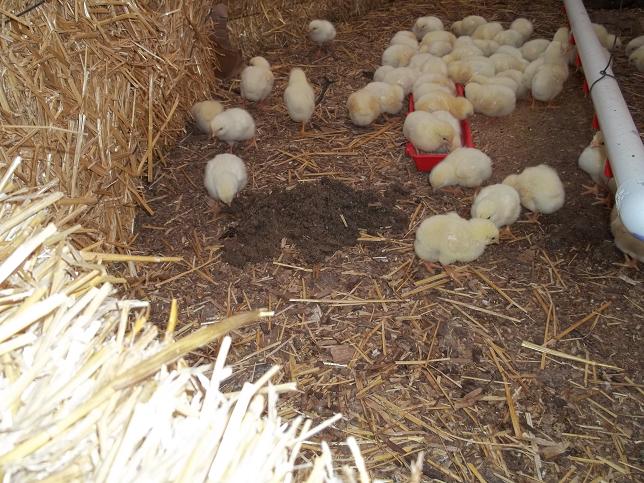
It is important that my day-old chicks have access to sand as soon as possible.  They may totally ignore it.  That’s fine.  It will mix into the bedding or will be there when they dig around later.  But they will eat some, days later they will eat more.  The sand cost me only a stroll down the hill so I don’t mind if they seem to ignore it.  Further, this costs $0 in fuel and there’s no sales tax.  (insert evil laugh)

I also put small shovels of sand out for the young pullets and ducks.  Again, they pick out what they want and incorporate the rest into the bedding.  A little sand is a good thing in compost.

Because chickens don’t have teeth they use their gizzard to grind up the food.  The gizzard is just a muscle so rocks stored in the gizzard enable the chicken to utilize feed more efficiently.  By providing creek sand I’m giving the chickens a variety of rocks to pick from and additional nutrition at essentially no cost.  I don’t have to be stingy about creek sand as noted by my friend Darby after he tried it.

D: “Those chicks tore that creek sand up!  Thanks for the suggestion.  I’m also finding that I’m not stingy with it, since I didn’t have to pay for it.  I’m sure it will [make] a nice difference.”

All of this was detailed in Salatin’s “Pastured Poultry Profits” on page 45.  If you are considering raising poultry on pasture, be sure to read this book.

I Need More Carbon

A friend recently commented, “You talk about fecal material a lot.”  I do.  I appreciate manure and what it can do for my soil, the soil life and the world around me.  While most people just use it to pollute drinking water, I make it work.  In order to make it work I need carbon.  Lots of carbon.

The primary use is just to keep the animals warm and dry.  Carbon also helps to sponge up nutrients, preventing odors from escaping and holding nutrients in suspension for later use.  It soaks up liquids, helping to protect the underground water supply.  It adds structure to the soil.  It acts as a weed barrier.  I could go on.

We buy carbon in several forms.

Straw bales are the first thing people think of when they think of barns.  Why straw?  It’s a local resource and is available in quantity.  It’s a by-product of raising small grains.  It is a useful tool for bedding but has its limitations.  It mats quickly, it is not very absorbant and it takes up a lot of space.  On the plus side, it adds air space to compost and rots quickly.

What is better than straw?  Wood chips.

I cut a lot of brush and run most of it through my chipper…the smaller stuff anyway.  That, and chips dropped off by the power company, help me to accumulate large windrows of wood chips.

Wood chips are large and bulky.  They do a good job stabilizing a muddy area but are unpleasant to walk on or scratch in…if you are a chicken.  They are also of limited use absorbing nutrients as there is so little surface area per unit of volume.  But they do make nice paths through the garden.

But what’s better is hardwood sawdust.  Sawdust offers greater surface area per unit of volume and is comfortable to walk on.  Cows prefer to lay on sawdust over straw.  We use it to mulch our garden beds, to bed our chickens, cows in the winter and to catch rabbit manure.

Sawdust quickly soaks up water, urine and manure, it’s easy for the chicks to scratch into, it is easy to move around with a shovel and a wheelbarrow, it is cheap and can be found locally.  We use sawdust straight from the sawmill rather than from a wood shop.  The kiln dried stuff acts and feels different.  Also, we let a pile sit out in the weather for at least a few months before we really tie into it.

Where I am, these are the three easiest forms of carbon to get my hands on.  Each are useful as bedding, build great compost and help maintain soil health.  If given the choice, I would choose a truckload of wood chips over a truckload of fresh horse manure.  It has so many more uses.

Georgia’s Wall Part 3

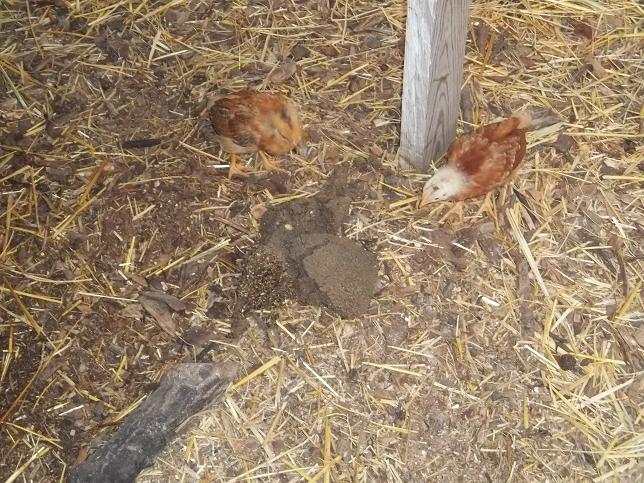
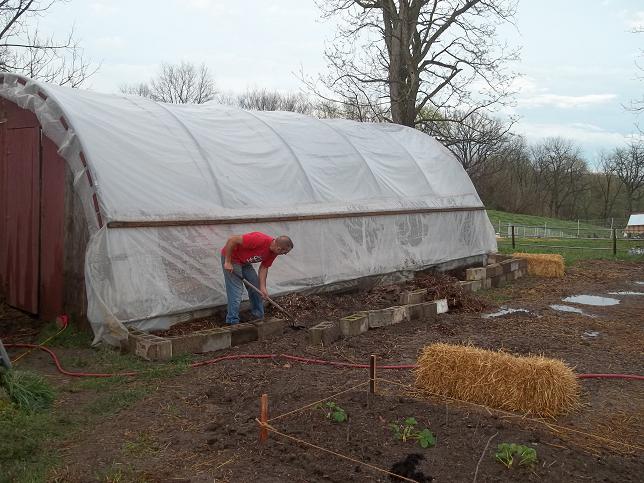
Sunday morning we finished our regular chores and had a few minutes to spare before going to see John Carter with the kids at 9:00.  Four of us shoveled rabbit manure and bedding out of the greenhouse to finish up the raised bed.  The chicks found this activity particularly interesting.

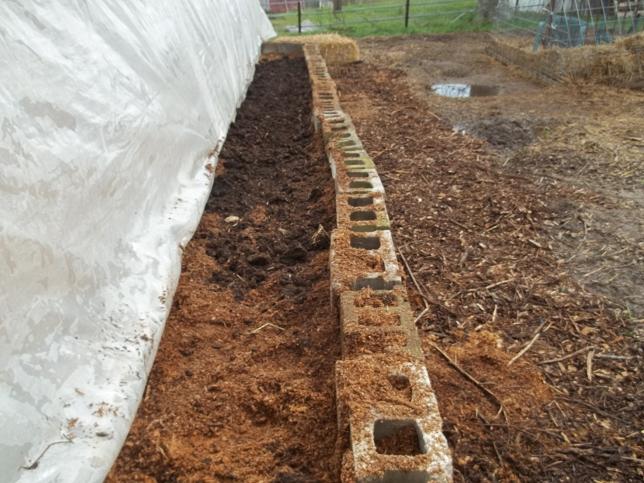
8 Loads later we had 3-4″ of rabbit manure mixed with course sawdust across the entire bed and it was time to wash up and head out.

So, in review, we built a block wall, added in large bark chips and bits of odd firewood, layered course wood chips on top of that, course sawdust on top of that, a layer of composted horse manure, and a thick layer of rabbit manure and bedding.  I gave it a good soaking with the hose and it got surprisingly warm.

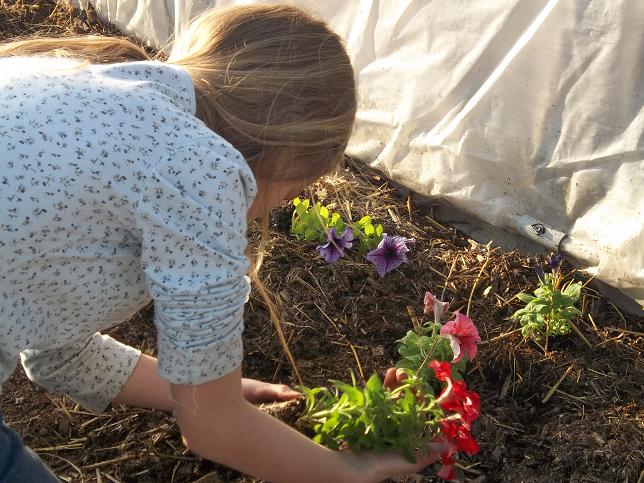
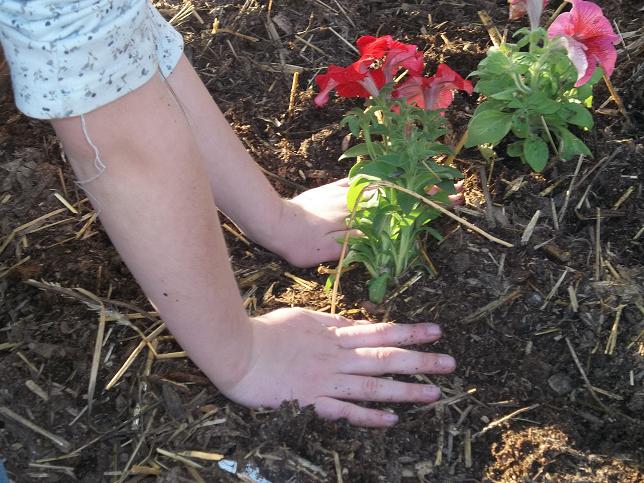
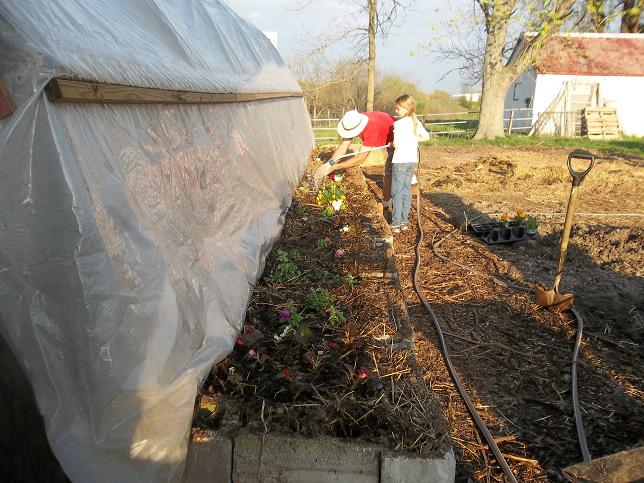
With the movie behind us, friends visited, chicken feed freshly ground and our Sunday afternoon swimming (cold!) out of the way we came back to work in the garden.  We were planting begonias and petunias along with herbs.  We spaced the herbs evenly across the bed and fit the flowers in between.  I layed out the bed and my daughter knew just what to do.

With that finished we gave everything a good drink, washed our hands and began the next project.

Now, you may think it’s silly to plant flowers so early, especially when my main vegetable garden isn’t in.  You may be right, but it was an excuse to work alongside my daughter doing something that helps her feel involved, helps her to make a positive contribution to our family and allows her to express herself.  We weren’t just doing chores that dad says need to be done.  She wanted to do this.  That’s more important than broccoli.

Georgia’s Wall Part 2

I hauled 500 pounds of manure in eight feed sacks to put in the raised bed.  Initially, and before work, I just got four bags.  That didn’t go far enough but I was dodging raindrops and short on time.

Again, this is well-rotted horse manure.  Since the wife and oldest son are at the homeschooling expo in St. Louis, I took the three remaining kids with me over lunch to grab the rest of the manure.  Here they are on the trailer.

I dumped each bag then the oldest daughter spread them out in the bed while telling me how excited she is to get her flowers planted.  Yup.  It’s worth it.

After work we added a layer of composted leaves, chicken bedding and chicken offal.

Tomorrow we choreograph the pasture ballet and have a few appointments to keep so we won’t make much traction on this project.  Sunday when I clean out bedding under the rabbits I’ll add that to the top of the bed.  The plan is to have some full-sun annuals planted on Sunday.  Hopefully we’ll get a heavy rain in the next 24 hours to wash the nutrients all through the chips below and take some of the nitrogen out of the composted horse manure.  If not, I think we’ll be fine.  There should be a fair amount of residual warmth coming from the greenhouse and the composting action in the bed so we shouldn’t have problems if we get a light frost.  If winter comes for one last hurrah I’ll have to cover the plants.

Georgia’s Wall Part 1

Georgia was a friend of mine before I married her granddaughter.  I helped her build a water garden just outside her door and she kept the door open so she could hear the frogs.  Georgia passed recently.  She spent years collecting things…lots of things.  She had a nice pile of used cinder blocks she had collected from somewhere so I built a retaining wall out of them.

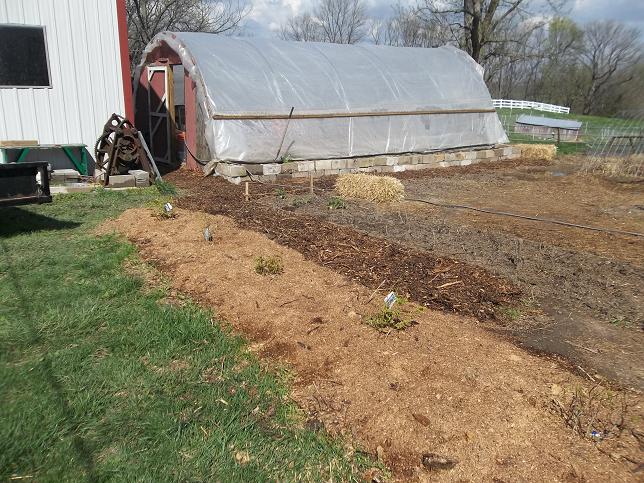
The South face of the greenhouse seems like a nice place for some added beauty and my oldest daughter wants a flower bed.  I started by trying to level out some of the ruts and wallows the pigs left behind.  Then I put down a row of blocks.

If I was making a taller wall I would need to do some foundation work but with just two blocks I’m not too worried.  If it falls over we’ll just stand it back up.  I’m not concerned about level since I’m using broken, partial, used blocks from all over the place.

I put in a layer of course wood chips and sticks equal to the height of the first row of bricks.  There is also a layer of large chunks of bark and odd firewood scraps in the bottom of the pile.  Then I finished stacking the second course of blocks.  To be completely honest, my lovely bride of 15 years stacked many of the blocks.

With the wood chips nicely leveled out we added in 3 or so inches of sawdust.  This brought our level to the mid-point of the second block.  Both boys were busy keeping the wheelbarrow employed while the rest of us leveled, raked, shoveled and lifted.  This job took all 12 hands.

We were an hour into the project and it was time for dinner.  The wall is not straight, the blocks are not perfectly level, the raised bed barely qualifies as a hugelkultur bed but the flowers should be happy.  Tomorrow we’ll add a layer of compost, composted horse manure and who knows what else topped off with a layer of straw.  I also have to find a use for a number of half blocks that are still on the trailer.

Planting Blueberries

For years we have purchased blueberries from some friends, Mark and Kelly Smith.  This year we thought we should put in a row of our own and see how it goes.  With luck and in time we may be blueberry independent.  We had 2 inches of rain the night before so working on mulch was going to be the only work I could accomplish in the morning.

Now, I know blueberries in central Illinois may not qualify as sustainable as our soil is anything but acidic.  They are something of a guilty pleasure.  I’ll have to work to keep the acidity up.  But we like them, they will provide a little color in the fall, and a windbreak for our garden.  Also, the line we are planting is at the very edge of the parking lot/driveway and will give us a clear border.

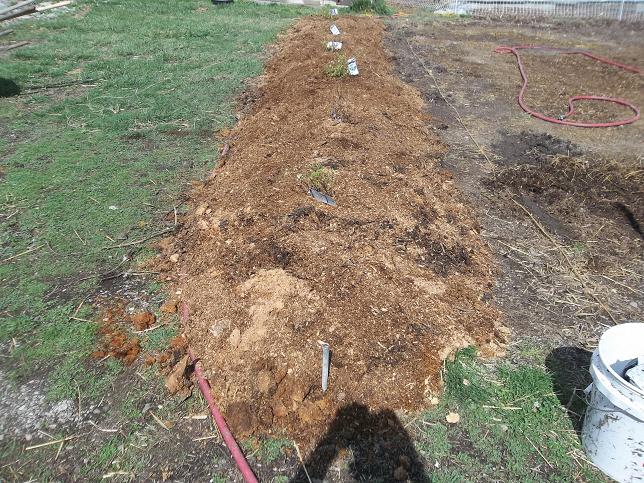
I began by laying out some lines that were square with the buildings.  Please note the recycled bailer twine.  I also had a 6″ deep line of aged wood chips and sawdust in place for the last week or so in preparation for planting.

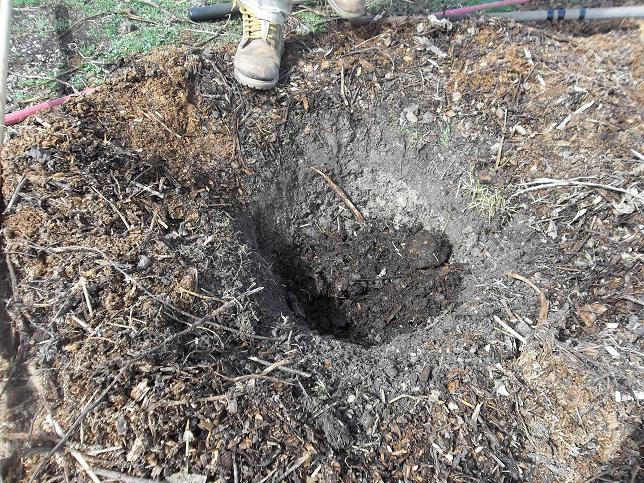
Then I began digging.  I knew my grandpa collected rocks but I had no idea.  I plan to put up a post in the near future about making sure your short-term goals (preventing your tractor from getting stuck) won’t be in the way of future generations…considering the consequences of your vision.
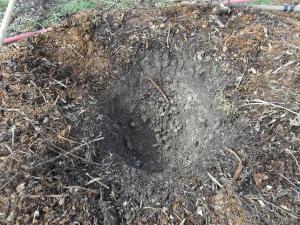

The goal is to dig a hole 1 foot deep and 2.5 feet in diameter.  I stopped mining rock before I got to my goal on the last hole..

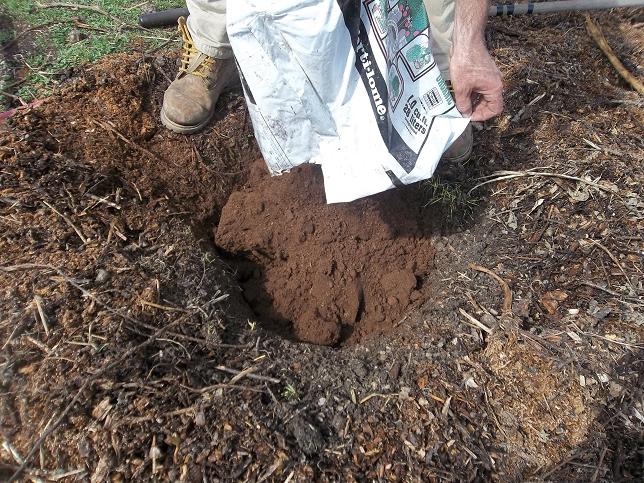
Because I took so much rock out I had very little soil to put back into the hole.  I put in a mix of several things to give my plants a good start.  First I put in a few shovels full of unsifted compost.

Then I added in about half a bag of peat to bring up the acidity.  Now, if given the choice between peat and coco coir I would choose the coco coir but this is a special situation.  I bought a greenhouse from a nursery that was going out of business.  He also had a pallet of peat.  Rather than send the peat to the landfill I brought it home.  This isn’t a choice I make every day but I think, in this scenario, you understand.

Next I add a few shovels of rabbit manure mixed with sawdust.  I realize not everybody has rabbit manure but you have to understand, I don’t have soil in this hole.  I’m using the rabbit manure to replace the missing soil mass.  Bear with me here.  I’m not presenting an ultimate solution, I’m just trying to make lemonade.
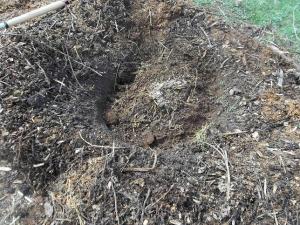
Then I mix the components and add some water.

Now I replace my string, measure my space between plants (with a 4′ tool handle) and place my plant in the hole.
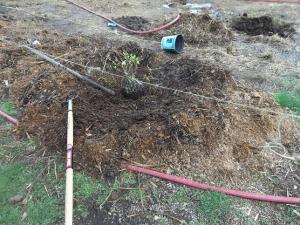
I’m still short on soil so I continue surrounding the plant with rabbit manure and top it all off with a bit of horse manure.  Yeah, I know…not everybody has horse manure laying around either.  I’m trying to bring up the acidity after mining out a bushel basket of limestone.
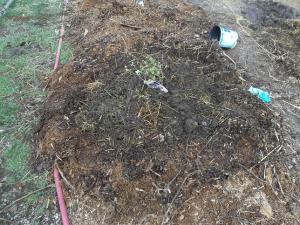
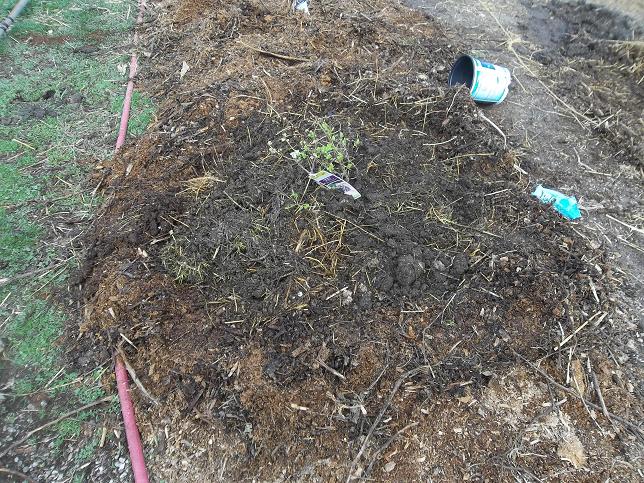
Finally, I cover the row with a fresh 4″ of composted sawdust.  As that sawdust breaks down it will provide a weed barrier and raise the acidity of my soil.  Also it will sponge up moisture and provide soil structure as blueberries want to be moist, not wet.

I have done a lot of work over a couple of hours to plant a measly six plants.  As they grow they’ll tell me what they need.  I may have to make some changes or at least a few tweaks before they really take off.  I don’t know.  It is the unknown unknowns (Thanks Talib) that make gardening exciting.

Special thanks to our friends Nathan and Aimee for lending a hand with the mulch.   They thought they were just coming for lunch

Composting Winter Bedding

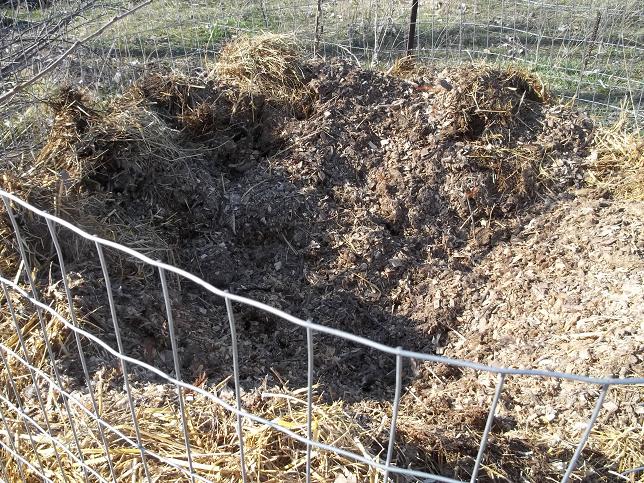
Our primary compost pile is a little long in the tooth and totally stuffed.  I had to build a new pile to handle the winter bedding for goats and chickens.  I began with a 5 foot ring of fencing, 4 feet tall.  I piled used bedding into it but any carbon will do: straw, leaves, etc.

I left the center open to give me a pocket for smelly organic wastes.  In this case, four 5-gallon buckets of kitchen scrap.  This can be anything that will rot from watermelon rinds to coffee grounds and filters to paper plates.

Finally, I added a good layer of carbon to the top to keep the odors in and the flies down.  Remember, if you can smell it you need to add carbon!  People often add a layer of wire mesh to the top to keep animals from digging into it.  I’m not too concerned with this pile but when I add chicken offal I will protect it from our wildlife.

So there you have my 5′ diameter, 4′ tall overflow compost pile.  I should note that while it is dry I leave the top dished out to capture as much rainfall as possible into the dry pile.  Once it gets nicely soaked I’ll probably change that.  If this pile still exists in July I expect it will steam even on the hottest days but it should be fertilizer by then.