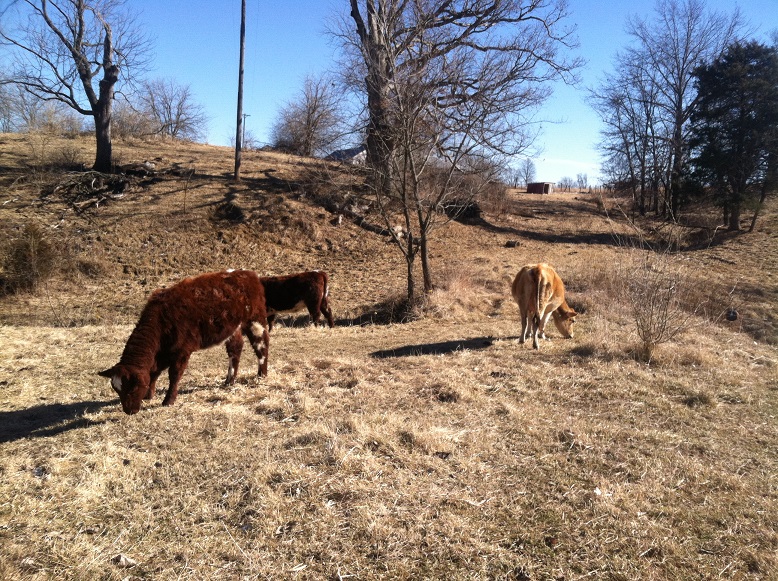
The Awesome and the Not Awesome

We’re up! We’re down! This is great! I can’t go on.

Ready for the awesome?

Sunday morning I was washing dishes at the sink. I could see the cows out the kitchen window including Flora, our expecting-any-day-now milk cow. Every day the kids ask me, “How’s Flora?” and I reply, “Still pregnant.” Sunday morning I could see her clearly from the window. “How’s Flora?”

“Still pregnant.”

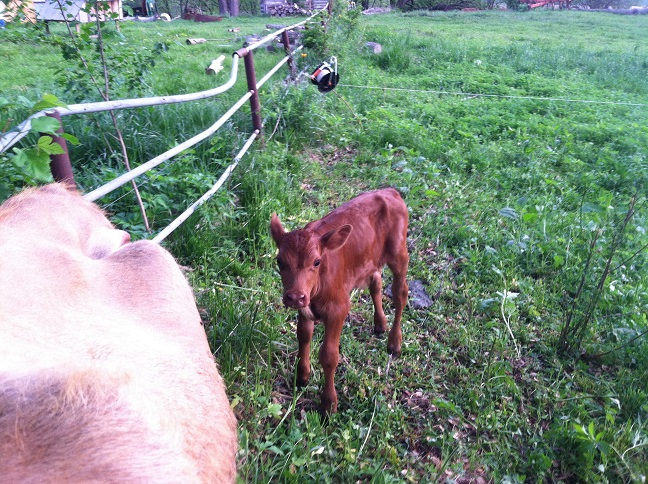
I finish up the dishes, dry my hands and head outside to open the nest boxes and check the animals. Within 10 minutes of washing the dishes I am walking through the cows and almost fall down in surprise. A fresh, wet brown bull calf is already standing next to flora and trying to nurse. Within 10 minutes!

Here he is at 24 hours old.

DryCalf

Good little guy. The kids are calling him “Steak” but I think we’ll choose something less…pointed. He is nursing well on all four quarters and running with the herd. Vigorous calf on an early May morning. What more could I want?

Had he been born 12 hours earlier the story would have been different. Saturday night we got an inch and a half of rain and quite a bit of wind with cooler temperatures. All that rain…all that wind would have been hard weather for this little guy. Thank God he was born in the morning after the storm.

But that brings us to the not awesome. We have month old pullets in our chicken tractors currently. 3 tractors, 50 pullets each. They are growing well and feathering out…doing everything a pullet is supposed to do on pasture. 46 of them piled and died in the rain Saturday night. There is no sense in it at all. Just a bucket full of dead birds…birds that didn’t have sense enough to get out of the rain.

I don’t have words for the level of frustration we are feeling. Cackle Hatchery sent us 156 pullets, 155 made it out of the brooder and lasted until last night. Weather is always a factor and there is only so much I can do to plan for it. But I would never have imagined I could lose a full third of my birds to rain.

We are up one calf. We are milking Flora again. But our future flock was just cut back dramatically. That’s the news…good and bad. This farming stuff is hard.

30 Days Into the Grazing Season

We are a month into our grazing plan. In some places I am disappointed by the pasture. In other places I’m amazed. I still haven’t covered the farm but that’s good news because the starting point still hasn’t recovered. I need to encourage and allow those grasses to tiller and develop root systems to grow taller, capture more nutrients and cover bare places. I talked about this in a recent post because of the difference in forage where my chicken tractors covered the ground.

SparseForage

I can’t return to this pasture yet. But the good news I don’t have to because I still have a large portion of the farm that I have not grazed, not to mention field edges that I prefer to graze before we cut hay. Remember the plan for the month of April? It worked out pretty much as planned but we haven’t grazed the pasture south or east of the house. We also grazed a little here and there in unmarked areas. Things work out differently in real life. Plans becomes guidelines.

SpringGrazingPlan

So now what? Well, now it’s time to plan for winter again. It is also calving time. I have to increase by grazing density and slow down the herd. So in the image, our house is on the left of the map next to Rockbridge Rd., not in the center of the map. There is a block by the cemetery marked with a 1 that needs to become a larger number. In fact, every marked number should be multiplied by at least 3…maybe as much as 5. We have covered the farm in 30 days. Now I need to cover the farm in 120 or more days. The cows should not return to the pasture around the cemetery until September.

Most important to me is to cover those four formerly 3-day fields far to the east before July 1. There is very little shade out there and about half of that area is south-facing. I like to have my cows near shade when summer turns hot and dry and I want to graze and stomp and manure all over that area before the rains stop. And if we multiply the grazing areas by 4 we have 48 days of grazing out there. That’s a tough row to hoe for a couple of reasons. There are places that remain ungrazed that I want to graze before I return to the start…in part because the ground needs to be managed, in part because my starting point hasn’t recovered yet. But 48 days before July 1 is May 15th.

BTW, In SQL Server that is SELECT DATEADD(d,-48,‘2014-JUL-01’). Isn’t it nice that SQL server streamlines code inside of built-in functions? You don’t want to know what it takes to calculate date in DOS.

OK. May 15th. 10 days from today.

Well, it sounds like a nice plan. I’m sure I have enough remaining pasture to delay for 10 days but will I get enough growth on my pasture in the next 10 days to allow the required density? I dunno. Maybe I can kill some time on field edges then go a little faster on that pasture. I was hoping to have the cows trample in a little warm season annual seed just to fix more biomass out there but I may not get the density to allow that. So. I don’t know.

But we have a plan. And we can afford to be flexible. I have 10 cows and 30 acres. It almost doesn’t matter what condition my pastures are in. What matters is that I work to increase stocking density now so I can increase stocking rate later.

Stay tuned. It ought to work.

Reading Condition in the Herd

Hoo boy. Matron, who knows her beans, put up a picture of Jane in a blog post Monday. Jane is a good-looking cow. She is, apparently, not an easy keeper but she looks great. That is a testament to Matron’s abilities and to the condition of her soils…after years decades of management. I highly encourage you to take a look.

My pastures haven’t been well managed. I still have a lot to learn about grazing. My herd genetics are not what we hope they someday will be. And it is still early in the season so the cows haven’t slicked out the way I hope they will. But some cows just don’t shed their coat well. And those are the ones that didn’t breed last year. But 111 is a fertile, short, fat tank and she is losing her winter coat. But beyond that, Matron always points out that if the cows are properly mineralized they won’t look shaggy…scruffy. I have a couple of cows that are nothing short of scruffy. I think I’m on the right track with our mineral program but I have a lot to learn and a lot of work to do.

111

She really is the future of the herd. I try to look at every cow every day at least once. That’s easy since there are so few. But it’s not just a glance. I look for gut fill by standing at the cow’s left and looking at the gap between the last rib and the pelvis. If there’s a triangular depression there, the cow hasn’t had enough to eat. If it’s full (even slightly bulging) I have done my job. If it has expanded and looks inflated, we need to stop what we are doing and deal with bloat immediately. Short of suggesting you make sure the cows have access to something brown and dry when the pastures are growing fast I’m not going to spend any time on bloat today.

111_Rear

I also walk around behind every cow. Every cow. Every day. How do things look back here? Round? Plump? Are the cows gaining weight from day to day? Are their rumps and tails covered in loose, wet manure? Some of them are. That early spring grass is pretty rich so I’m making it a real point to have a little dry grass hay available to them…even if they ignore it.

Grazing

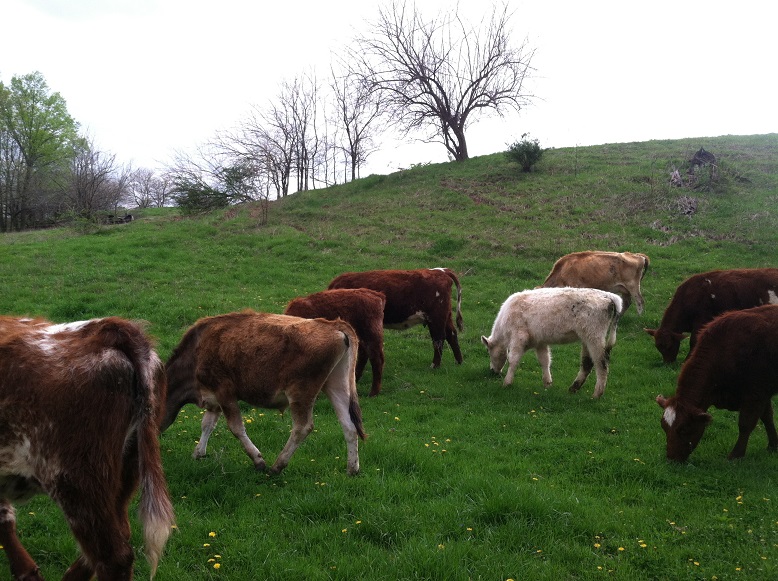
The dairy cows are a little thin for my liking. The beef cows are a little hairy. Some are a little loose. They all get looked over every 12 hours as we move them. That really is the best part of my day. Just listening to the frogs, looking for snakes. Listening to the quiet rhythm of the cows grazing; tongue, rip, breathe…tongue, rip, breathe.

In the video above 41 came into fresh pasture with a full rumen but she went right to work. Cows will always eat a little more…cause if they don’t, another cow will. The grass is fairly dense here, mixed with young plantain and lots of dandelion but not much clover. It wasn’t long before they were all laying comfortably on the fresh ground taking naps and chewing cud. You can see a clear line between the morning’s grazing area and this new, fresh ground. That’s why we keep moving…and keep moving fast. An acre a day…so fast I have a hard time keeping the mineral feeder fenced in with them. That rate would translate to 500 acres/day if I had 5,000 cows. I’ll have to figure something out before we get there…lol.

GrazingLine

I hope your grazing adventures are as fun as ours. Or if our grazing adventures are your grazing adventures, I hope I’m capturing it in a way that is helpful to your vicarious farming dream. It’s not all grass and manure. There is a lot of rolling up fence, pulling fence posts, pounding them back in and carrying heavy things around too. So if you are farming vicariously, go out in the rain and pick up something heavy. Be sure to splash a mud puddle in your boot so every other step sloshes.


Racing the Forage

It’s really happening. Finally. The cows are on the move. We are covering ground at an almost unheard of pace…11 animals covering an acre each day divided into two sections. At first they grazed everything away from the repugnancy zones. Soon the grass got ahead of us and the cows could begin to graze very selectively. They go into each paddock fat and come out even more fat. And fat is what we are after.

This is the time we have all been waiting for. The world is green again. The grass is growing fast. As much as I want to put some pressure on certain portions of the pasture this is not the time. It’s just time to run. Right now we are concerned about cow condition. I want the cows to have a big area, a big variety and a big volume of feed. But we are also concerned about future pasture. We don’t want the cows to eat the grass down to the dirt. There is not enough grass out there to knock it over and leave a covering on the soil so we just try to graze the tops off of the plants and move on immediately. The pasture in the picture below was grazed over the course of a week about a week ago.

Grazing1

The idea here is that we sprint across as much of the farm as we can. Realistically, I’ll only cover 2/3 of the farm before it begins to go to seed…at which point we’ll return to the first pasture. The ungrazed area will be left in reserve either for drought or for winter stockpile…or both. The starting point changes each year, the drought reserve changes each year, the pasture changes each year. It’s fun to plan and manage and as the forage quantity and quality increases I’ll have to increase the size of my herd. For instance, on the half of the farm we have managed for several years we have grazed once with cattle and once with chickens and the forage is at least 2 weeks ahead of the new 40. The goal is that the soil health will continue to improve and we’ll gain a month of grazing at each end of the season…then 6 weeks…then…well, then we will solve other problems.

Keep in mind we just took possession of the 40 east of our house. We are building fence on pasture we have never walked before. Certainly we have seen the ground but fencing and grazing gives us more intimacy with the land than does a casual stroll. We have lots of places on the farm that are remote and rough…beyond zone 5. There is no reason to go there so we don’t. But with the cattle on rotation we are covering the whole farm. It’s amazing what we are finding. Everything from evil, thorny trees to the neighbor’s trash from decades ago.

We do better some days than others. It’s hard to read the forage through the remaining weed stalks from last year. Sometimes the cows seem to fatten on nothing. Sometimes they look empty but there is standing forage all over behind them. I can only assume they are ignoring forage for a reason and it’s better to try to learn from their selectivity rather than to force the issue. Maybe I need to amend the soil there. Maybe the chickens need to sanitize the area. Maybe it just needs to rest.

Grazing2

Sometimes we just open a fence and let the cows through. Sometimes we take the cows on a bit of a walk. Sunday morning we took a rather long walk. When the cows got there they went bananas running, rubbing on trees and playing around. We didn’t realize until afternoon that they were probably looking for the missing steer…that we didn’t realize was missing. We walked them through a draw and he stayed behind to get a drink and a bite to eat. He was looking pretty lonely (but fat) when we found him later in the day. He flat refused to go over or under that horrible electric fence so we had to walk him all the way to the end of the line to rejoin the herd. I’m feeling pretty good about the new fence charger.

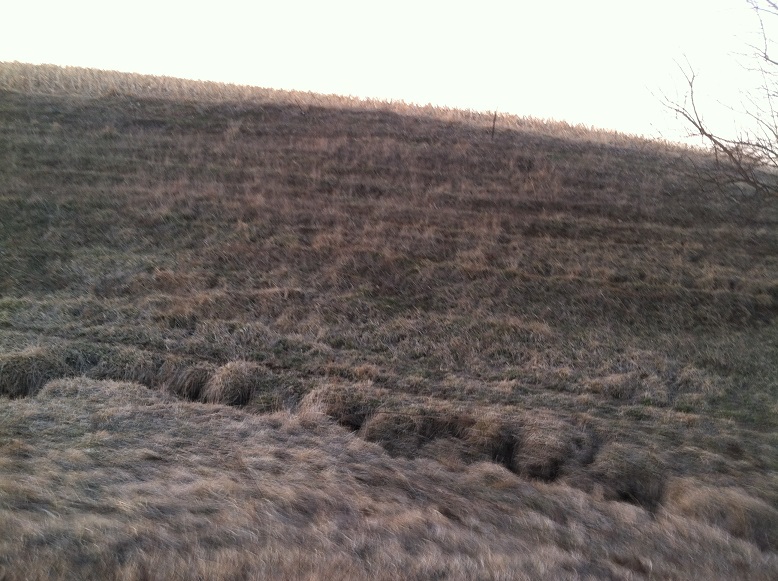
One thing I am constantly aware of is the poor condition of my south-facing slopes. Our pastures have been set-stocked for decades. By grazing the hot south-facingn slopes in the middle of summer the grasses have been set back. The soil organic matter is low. I’ll have to hustle to correct this…and it will probably take several years. Matron talked about the same problem in a recent post. The main corrective action will be to use care when grazing the farm over the summer, preserving tall forage on these slopes to heal the grass. Tall grass catches more dew and puts down deep roots.

CowPaths

The other problem we face over here are the cow paths. There are deep ruts cut into the hillsides by the cows over time. I need these to heal over. In short, we are seeking to prevent travel along these paths and increase the rest periods so forages can begin to establish here. Also, we are trying to slow the flow of water along these ditches. One thing at a time. The cows are looking pretty good. The pastures are thickening up and we are allowing rest. That’s what we need. Our half of the farm has no visible cow paths remaining outside of the creek crossings. A couple more years for those…

Spring Grazing…Ugh.

…not yet. …not yet.  Just a little longer…..

Ugh. I can’t wait a little longer. I’m out of stockpile! There is still hay in the barn but we don’t want to feed it all. And the cows clearly prefer grazing over waiting for me to bring them feed. So here we are. Grazing field edges that haven’t been grazed in …possibly decades. The cows eat grass, alfalfa and thistle. Why is there thistle? Because they sprayed the groudn with roundup for years to keep the fence clear. The earth doesn’t want to be naked…something has to grow. So thistle grows. The cows stomp and manure ground that hasn’t been directly manured and they only get a couple of hours to do it. We bunch them tightly and move them quickly. This kind of treatment will knock back the thistle better than anything else I can do. (BTW, see Mrs. White with her head up looking at the camera? Her head is not in the game.)

AlfalfaEdge1The field edge lasted two days. The first day we fed hay in the morning, gave them a grassy area to graze then sped them along the field edge. Toward the end of the day we asked them to camp out at the other end of the field where mature, stale grass rules.

AlfalfaEdge2

They munch through the brown grass to find green grass beneath. They trample it all in, knock down brambles and manure everywhere. They even found a really nice antler in the tall grass I would never have found. Then, the next day, we let them have the other half of the field edge they missed the day before. Again, they went onto it full, we kept them bunched tightly and we moved quickly. Alfalfa in the spring can be risky…actually, the transition to green forage is a little tricky but bloat is the biggest concern.

But now what? I have enough of this wooded patch to last until Wednesday evening. Then I have to do something else with my moos. The pasture isn’t ready to be grazed. Well, some portions are but in general, not so much.

EastPastureMost of the grass is just inches tall. We are in a warm rainy cycle. It shouldn’t take long for the grass to really come on and right now a week really makes a big difference. I just need to delay grazing for a little while and when we go to pasture we will be offering big grazing areas and moving the cows quickly. I mean, we’ll offer the 10 cows an acre/day (and probably break that into 4 sections) so they can pick and choose the best grazing and I’ll probably continue to offer them a little hay while we continue the transition and wait for the grass to catch up. We are planning to race across the farm in about a month as shown below (numbers of days per segment, segments will be subdivided), after that we’ll slow down and use smaller and smaller grazing areas, dropping some out for stockpiling. Matron talks about this in a post on her blog.

SpringGrazingPlan

There are, apparently, several important things for me to do right now. First, I don’t want to eat tomorrow’s grass today. If I remove too much of the leafy area I weaken the emerging grass right now when it is fragile. That can potentially set the plant back, limiting its growth for the entire season.

Second, I need to get my cows fat. They are coming out of winter a little on the thin side. They aren’t skinny but they aren’t in the condition I want for calving. I have 30 days before calving starts. Again, I really don’t know anything about cows (sorry if that’s a shock) but as I read in any number of grazing books (Walt Davis comes to mind first), the most important thing I can do to help my cows breed back is to make sure they have a good layer of fat (stored energy) on them at calving time. The good news is their metabolism is set for winter maintenance, not spring gain…so we’ll get compensatory gain from them if we give them access to enough forage and variety until their bodies adjust. Same thing happens when you diet, btw. You go “off feed” for a while, your body adjusts, then you “reward” yourself at a family gathering and suddenly your skinny jeans just don’t fit anymore. You taught your body to become more efficient at storing energy. Well, that’s what we’re doing with the cows. They have been on a diet all winter and they have worked hard and behaved themselves. Soon they get a treat. All the grass they can eat!

I just need to delay a little while longer. There are areas on the map above that are not accounted for. I need to take advantage of those areas. I can get a day in the yard at the yellow house with the help of a little hay. I can get a day in the barnlot. That gets me to Friday night…two extra days of 60 degree plus weather. Will it work? I dunno. I do my best. I read everything I can. I make a plan. I go out and try. I tell you all about it…good or bad. Wish me luck!

(In this post I linked heavily to Matron of Husbandry’s blog. Whatever books and blogs I have read or seminars I have attended, Matron has done the most to remove the fog (for instance, this post). A few postings, a few illustrations and everything became clear. She’s a great teacher…and I bet she’s rolling her eyes right now.)

The Pastures to the East

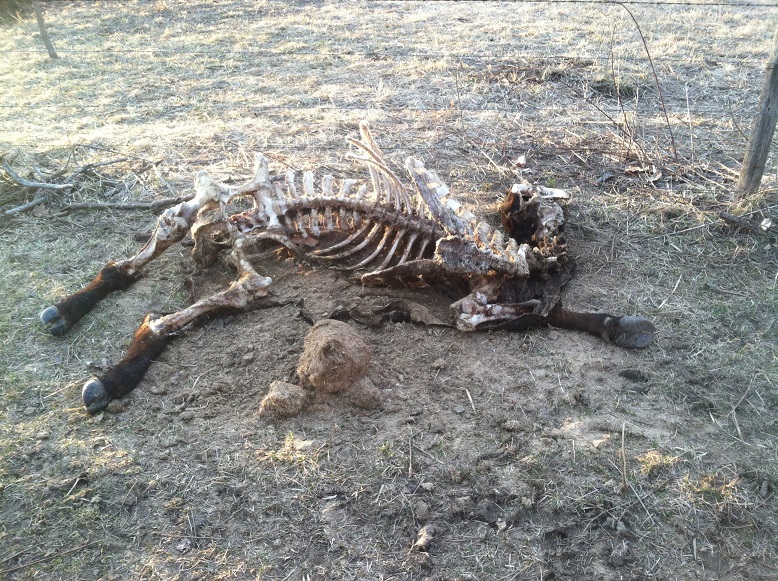
Until recently I haven’t spent much time on the Eastern portion of my property. A distant cousin rented it and that was that. Well, in 5 days his cows will exit the property so my son and I took a walk, mainly to inventory the mature honey locust trees and check the condition of the fences. Some portions of the farm are pretty remote. Steep creek banks prevent access with a tractor. If something dies out there, there really is no way to retrieve it. Obviously this is unfortunate but it’s reality. The coyotes ate well for a few days. Apart from the smell, the kids were fascinated.

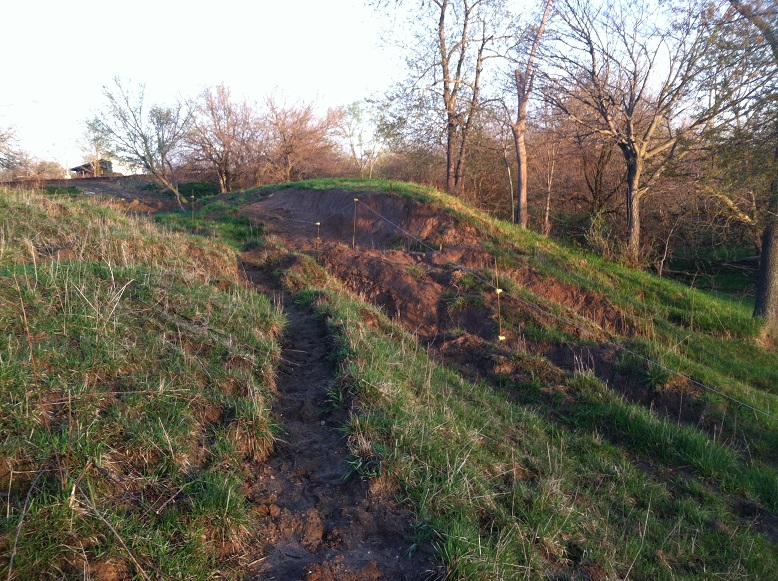
CalfThe lack of intensity on our farm over a number of decades has caused those steep creek banks as well as encouraging the thorny pioneer tree species. Further up hill we are seeing damage in the pastures. I can repair this quickly with hooves and rest. Hopefully fixing this will help heal the land further down hill…closing up the wound like closing a zipper.

StreamWashI would have to cross two washes like this to get back to a 9 acre corn field…which means we can’t get there. But we would like to get there to at least shred the corn stubble but it would be nice if we could run a drill across that field to plant it to pasture. I may just have to do it with cows, broadcast seed and hay. That’s probably the right way to go but the mechanical solution sounds cooler.

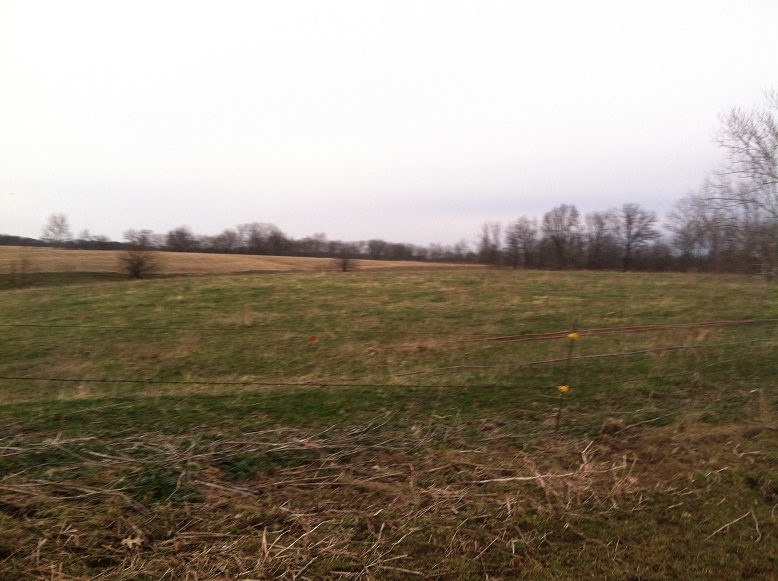
CornField

That corn field is surrounded by electric fence, mostly on contour. That fence is on my list of fences that will be removed. More on infrastructure another time.

All in all the pastures and field to the east don’t look too bad. The North-facing slopes are a patchwork of weeds, sparse grass and moss. The moss has to go but hooves, chicken claws and manure will take care of that. The chicken tractors are out there now. The creek is pretty badly eroded further down. I don’t have a picture to share as it was getting too dark but it isn’t pretty. Just know I can’t climb down, I have to fall and I can stand in the bottom and can’t see out. And I’m not short. I have a lot of work to do with my chainsaw but the cows should do the majority of the real work. I just need more cows. And more time. A bulldozer would be nice too. Sigh.


Three out of Six

Last spring we bought 6 heifers off of a feedlot. When they arrived they had been on hot feed…a high protein, high energy ration plus a little hay. This was evidenced by the whole kernel corn that passed straight through them and stuck to their manure-covered tails.

Shorthorns2

But they were short, their mothers grazed-ish on fescue-ish (with a little corn) and I gave them a shot. I mean, heck. Nobody around me does grass-only beef so what difference does it make? I bought local. I rolled the dice. They were good heifers in every respect, just not raised on grass.

Fast forward 10 months. Turns out half of my heifers didn’t breed. Half.

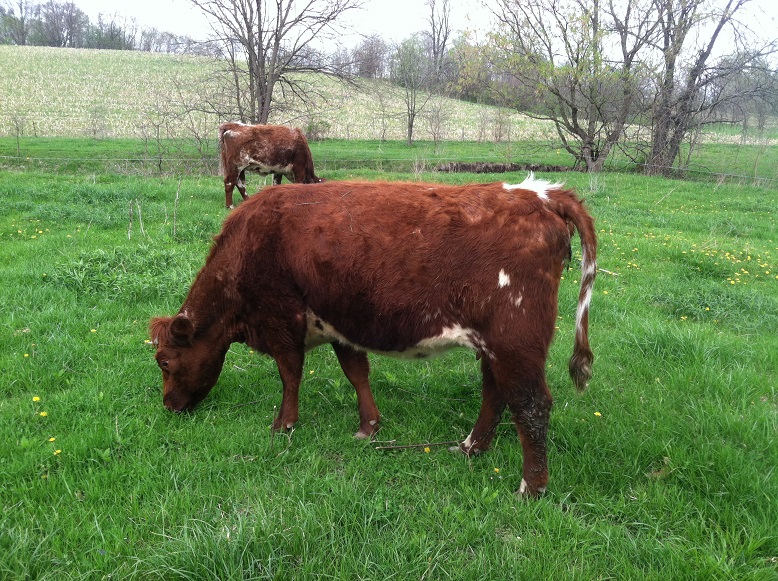
There’s the tall, thin, tall and (did I mention) really tall Miss White (19). She is always on high alert with her head in the air. She is also the boss. Here she was the day I looked at the heifers. See that head up high? Should have walked away from that:

MissWhite

Here she is again. Always on high alert. She needs to go. Beyond that, she has a hollow leg. When everybody else is laying down with eyes closed chewing cud she’s still up eating. Always eating. She’s just too big for grazing.

MorningCows

There is the tall, tall, tall 27. Her attitude is good and you could park a truck on her wide back but she just kept growing after she came home. Up, up and away. Cows need fat to cycle. She and 19 were too busy growing up and couldn’t grow out so they didn’t cycle. Further, neither of them shed completely out last summer…and they were hot. They may simply have been off duty when the bull was on duty. Or, if they did cycle, maybe they didn’t stand. Whatever. Both are just over 2 years old now. I could understanding giving 27 another chance with the scarcity of heifers right now. We’ll see.

Then there is 70. I don’t know what 70’s deal is. She is short and looks thin but not bad…but no dice. Maybe she didn’t like the heat of August. But there really are no second chances. I don’t need lawn mowers. I need reproductive lawn mowers. And I’m not sure I have ever noticed her calling or riding or anything. Maybe she is sterile. Dunno. Will she get a second chance? Heifers are in short supply now. I’m dithering.

Mantis

These really should all be fattened on spring grasses and shipped before the bull arrives again in July. I am sure we can find customers for these cows (could be you!) and turn a modest profit for our effort but that wasn’t the goal. We need calves! Fertility is the real key. I want cows that fatten quickly, sure. I want cows with a positive attitude. Sure. I want cows that bring a live calf to weaning. Sure. But before we can concern ourselves with any of that, they have to at least breed successfully! So we select for cattle that achieve fertility at an early age and breed back every year. These three cows don’t fit the bill.

But I can’t neglect that I need cows that can succeed with our native forages. Cows that succeed without supplementation…beef without the petroleum. 111 and 41 are enormous tanks and 76 isn’t bad at all. I need an army of their offspring. If they don’t get fat they won’t breed. They need to fatten quickly after calving or they won’t breed back again. Some of that is on me. Some of that is the genetic potential of the animal. There is nothing I can do about genetic potential except to select for it over time.

It stinks that I have to cull half of my herd this year but by biting the bullet now I avoid this pain in the future.

This is precisely why all of the advice from veteran grazers is to buy genetics with a proven track record on grass. It’s going to be expensive to breed away from teacup cattle. These girls have history going against them. I’m facing an uphill battle making these work on grass alone. I think the next generation should be good as the bull was developed on grass alone. Also, the next generation will be pre-disposed to my home pastures due to phenotypic plasticity. (Bring that up at your next dinner party. “Oh, yes. Suzy is doing very well in school. Probably a result of phenotypic plasticity.”)

Maybe the cows aren’t to blame. Maybe it’s me. I’ll get better cows and I’ll get better at managing cows. It will just take time. I bought two more newly weaned heifers at the end of summer last year. We’ll see what happens with them but I suspect it will be the same percentage. I’m going to have to get better…but selecting foundational stock now ensures that my cows are all easy keepers.

Should I Sell All of My Cattle?

It is interesting how people find my blog. Various search engines bring in a lot of traffic. Someone was searching the internets for an answer to the title question. That has inspired me to write a little bit.

Should I sell all of my cattle in 2014?

There are a lot of variables in that. It’s like asking if you should go ahead and buy that Plymouth DeSoto.

I’m not interested in owning a Plymouth DeSoto at any price. But they do have value…which means they are valued. Should you buy one? I dunno. Do you want one? Do you have the money? Where are you going to park it? What will your spouse say? What is the plan?

But there is so much more to it than that. In essence the reader is asking, “Is it better to have cash or cows right now?”

I’m going to switch gears and talk about eggs and dollars briefly. Dollars are a product. Eggs are a product. But dollars are infinitely liquid, eggs are less so. For example, anybody can give me $4 and I’ll give them a dozen eggs. But not everybody will accept a dozen eggs in exchange for $4.

Dollars are infinitely liquid, cows are less so. It is unlikely that I could trade my cows for a Plymouth DeSoto. But you can’t eat dollars. So the question becomes, after you sell your cows, what will you do with the dollars? Do you just want to stack them up in your house? Maybe build a couch out of $100 bills? That wouldn’t be very comfy. And I doubt there are any real women in red dresses that would lounge seductively on a stack of paper.

100Couch

Click image for source. No, really. It’s worth your time.

So what do you do with the money? I mean, before you do something you should decide what it is you are actually going to do. You probably don’t want the dollars. You want the convenience of the dollars…their near-universal acceptance. You might hold dollars for a period of time but you aren’t going to make a couch with dollar bills. You are eventually going to buy something with them…and probably not a brunette in a red dress. Cows? Grass? Pasture? Dollars? Plymouth DeSoto? The idea is to put your resources to their best and highest use. If not cows, then what? Could make for a fun night at the casino but is that what you want? Because if you swap out the cows for cash and don’t have a plan…well, you may as well have a good time. What is the marginal utility of a hangover?

Rather than focus on getting out of the cattle business you need a plan for getting into the next thing. Trading cows for cash may accelerate your efforts…if you are going somewhere. If he/she has some culls to spare, this is a chance to get a great price on sub-par genetics! Maybe A. Person meant to type, “Should I sell all of my cattle and buy cattle of a higher quality.” OK. I have heard of a number of ranchers who have sold out of the cow/calf business because they believed calf prices were abnormally low (so calves produced were not covering costs). They sold family herds that had taken generations to build to buy heavily into cheap stockers. Then when the market skewed the other direction they quit raising stockers and bought a nicer herd of cows than they had owned previously…making money on every trade…always looking for the class of cattle that were relatively undervalued. Not just selling the cattle, trading one appreciating asset for another with dollars in the middle.

But let’s assume A. Person doesn’t want to sell out completely. As I mentioned earlier, high cattle prices are the time to cull out the worst of your herd. When prices go down again (and they will…and maybe by a lot…and maybe for a long time since this cycle has been up for a long time), buy in quality again. If that’s the plan, sell some cows now.

Or maybe none of his cows bred this year. Sell them.

Or maybe he has noticed his cows can’t perform in the absence of corn, Ivermectin and alfalfa cubes. Sell them.

Or maybe he is just looking for a new opportunity. Sell them.

In fact, if you are asking the question at all…the answer is yes. Do it. You obviously want to sell them. Go. Carpe some diem. Don’t look back. Embrace a brighter tomorrow for you. Just get the cows out of your way. There is no obligation with cows. It’s not a marriage. They aren’t children. There is no business contract. Do what you need to do to move onward and upward. Devise your plan, make it happen and cherish the consequences!

Maybe that’s just me though. That’s kinda how I tend to run. Always looking for deep water to jump into and dealing with the results.

Should I sell my own cattle? Nope. They are part of the plan. Should I train up my son to take over control of the cow herd when he turns 15? Sounds great to me. I’ll move onward and upward to the next thing. He will be the “Head Farm Steward” and I will move into an advisory role. Awesome. I have a plan for that…should it come to fruition.

Should you sell your cattle? The better question to ask is, “What am I going to do next?” because my response is, “What’s the plan?”

Going Easy on The Cows, Hard on the Future

Are my cows bred? I dunno. Some of them are really starting to show. Others? Well, I dunno. 19 bellows and stands at regular intervals. She’s not going to make the team. 27 and 70? Dunno. I have never seen any sign of heat from 70. Ever. At all. But she’s not showing. At all. I don’t think she’s a freemartin so I don’t know what’s up. I guess I should just invite the vet to preg check them for us.

So what if some aren’t pregnant? Well, then they don’t get to stay on the team. I bought these cows off of hot feed, not from a grazing herd. The odds are against them genetically. That’s why every grazing expert you talk to says to buy cows from an established grazing herd. It is expensive to return cows to eating grass. Isn’t that an odd thing to say?

I am not in the business of providing cow retirement. I don’t need cows to eat grass. I need cows that can reproduce while eating grass. I need to increase beef production per acre while reducing the amount of fuel that goes into each pound of beef. That’s what I need. Rather than spending money on tractors, balers, rakes, conditioners, barns, hay elevators, wagons, (this list could go on for a while so let’s just sum up and say “iron”) I am investing in cows. Some investments turn out great. Some investments don’t. But over time I can breed toward a greater tendency for success.

“But”, asks my father, “what do the cows need? Surely a little oats to warm them on cold nights wouldn’t be a bad thing.”

It wouldn’t. Not if these were pet cattle. But I’m not raising pets.

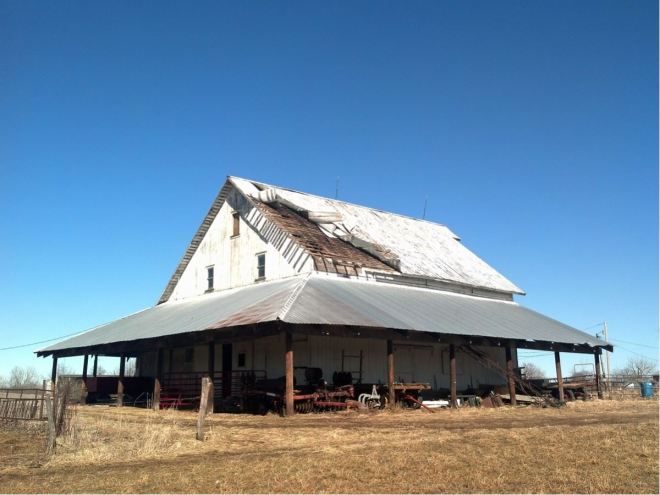
What does a cow need? Boil it down to the absolute essentials. Forage, water and a little salt. Barns are not for cows. Barns are for storing feed and for feelings…as in “I feel better that my cows don’t have to stand in the rain.” Or barns are for status…as in, “Look at those nice buildings. That’s a successful farmer!” That’s what you see from the road. What you don’t see from the road is the amount of time and resources used to build and maintain the buildings, the debt gained to have the buildings and the vacation days burned to repair the buildings after a wind storm.
BarnDamage

I’m not interested in status. My kids think I’m cool. Good enough. The more stuff I own the more stuff I have to fix. I don’t want to fix stuff. I want to play with my kids, read books and sell cows. But I do store a little feed. To some degree, I regret having hay in the barn. Who works for who in this deal? Do I work for the cows or do the cows work for me? I sweat, sneeze and cough in May, July, August and sometimes September to put hay up there. Then meter it out as winter passes, a little at a time, to …well, to do what exactly? My cows are still grazing grass we grew last summer. I guess I give them a small portion of their daily feed in hay as a treat. Same as my dad suggesting that they would like a little oats.

Shoot.

Let’s be completely fair about hay though. I don’t think anyone would argue that I should own zero hay. I would like to go years without feeding any hay though. We are expecting a serious ice storm this weekend. With events like that coming it makes sense to have a little hay on hand (and the barn roof repaired). But feeding hay every day when I have acres of fescue out there doesn’t make sense, except that my pastures currently need a little help. They were overgrazed and under-rested for decades. But they’ll come around. Will I come around? Or will I continue feeding a little hay in the winter out of habit?

Fencing is another example of my needs vs. cow needs. I have several neighbors with 7-wire high-tensile fences. Those are dang-near deer proof! Oh, how I would love to rip out my fencing and start fresh…properly follow keylines, get rid of the barbed wire and make the farm look nicer! But do I need that? My cows are rarely against the perimeter fence anyway. The perimeter fence is really just insurance. I bought several rolls of high-tensile fence a few years back but haven’t built the fence. I would rather have the cash…so I could have more cows. Cause this is a cow business. Not a fence business.

Will all of my cows respect a lesser fence? Will all of my cows thrive on pasture stockpile? Will all of my cows reproduce without supplemental grain? Nope. They won’t. But the ones that don’t are not a good fit for our program…obviously.

What kind of cows do I want? Do I want infertile cows? Nope. Do I want to haul in grain? Nope. Do I want to put up (or even buy in) hay? No more than I have to. Not every cow can make it without grain. Not every heifer will breed early and often. Those who don’t make the cut won’t stick around to drag down the herd of the future.

From today’s Pharo Cattle Company update (I realize it’s an ad. But it’s also right on.):

When you need a bull, who are you gonna call? There are hundreds of seedstock producers who would love to sell you a bull, so how do you decide where to go? Do you look for a place with pretty white fences, big buildings and busy feed trucks? Do you look for someone who places expensive four-color ads in all the beef magazines? Do you look for a producer who displays over-fat cattle at the stock show? Or… do you simply look for the cheapest bull that meets your basic color requirements?

If you’re in this business for the long haul… you need to purchase your bulls from a seedstock producer who demands more from his cattle than you demand from yours. If they don’t demand more from their cattle, they will NEVER be able to improve the genetics of your cattle. Unfortunately, nearly all seedstock producers have a pampered herd of high-maintenance cows.

The goal is to capture solar energy and convert it into beef and increased soil fertility. The goal is not to own big barns and big tractors. Will a little grain and hay hurt? Well…yes. It will cost me money (that I could use to buy better cows) and it will cost me time and storage resources and, worst of all, it will cost me the chance to find cows that will thrive without. We are seeking solar power. That means some cows won’t make the cut. And good riddance.

Now, how can I figure out which cows are pregnant without getting elbow-deep in the question?

Grazing the Not-Stockpile

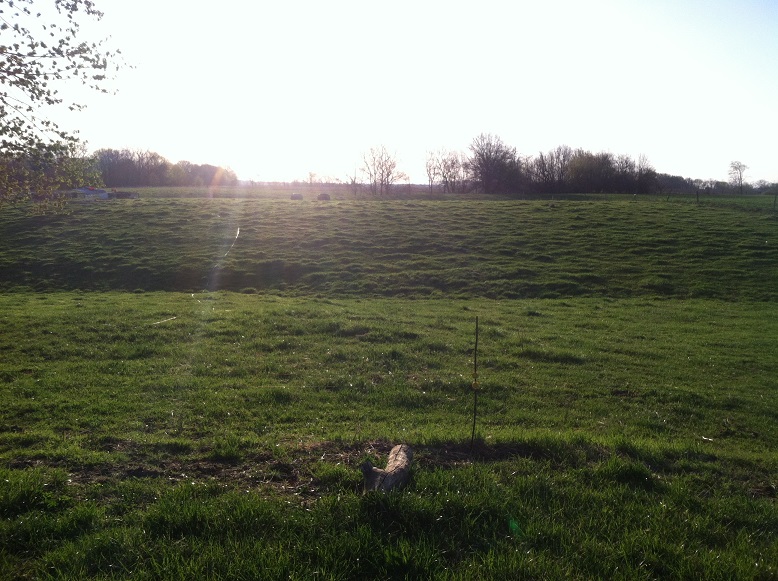
The cows are just East of the house right now. They finished up grazing the primary stockpiled ground further East and I needed somewhere to go with them. Really, they should be North of the house in the bottom where the grass is 10-12 inches tall and still green (somehow). But that’s a long way to drag a hose.

East and South of the house lies the remains of pasture that the cows passed over in October. Forages they just elected to skip. Lots of fescue. There is a fair amount of grass there but it is only marginal in quality…at best. I am offering large grazing areas and two whole bales of hay each day.

GrazingJanuaryThis is mostly a South-facing slope that will start recovering mid-February and will really be ready to graze again in March. Certainly by St. Patrick’s day. But right now it has bunches of fescue and tall stalks from chickory and other forages. Mixed in are a few thorny saplings that I need to manage. If I do this right, the cows will crop it all close, add nearly a ton of manure and expose the thorny trees so I can deal with them. 

GrazingJanuary2

Speaking of fertility, I have to keep an eye on their manure. Yes, every day I look at cow manure. This is looking too dry and stiff. I need to up the protein in their diet. For now I’m calibrating it with alfalfa hay but as we graze our way North I may need to do a little more for them. The pasture to the North is tall, dry, brown bermudagrass. I’m sure it’s about as delicious as straw and will require protein supplementation for digestion.

GrazingJanuary3

The slope they are on sheltered them from NW winds above 45 mph Sunday night and a wind chill toward -20. That’s quite a change from Sunday’s high temperature of 50 degrees that left several of the cows panting in the heat.

I still have a few acres of stockpiled fescue but, for now, we’re going to ask the cows to do their best with this stuff. I’ll have to keep an eye on things.

As a note to myself in this public diary, Flora came up with a limp in her rear left on Saturday morning. Picture #2 above shows her standing with weight off of that hoof. The cows had been in the hickory grove. I suspect she either slipped on ice or she has a thorn in her hoof. Sunday it was less pronounced. Monday it was still there but less so. I’ll try to catch her Tuesday morning and check out that hoof.