What should this cost?

What should a chicken cost?  Mr. Steward, you sell a chicken for about $15.  I can buy one at the supermarket for $7.  Why should I pay more?

Thank you for asking.

Mine is better.  Need more detail than that?

Efficiency.  Everyone who has seen Fight Club knows that waste is a thief.  Efficiency is key.  Profit is the reward for efficiency.  If I, as a chicken producer, can make my chicken more efficiently I can either lower my price or keep it high so I can  make more money.  My profit margins are ultimately driven by either my direct competitors or by consumer substitutions (beef vs. chicken).   I am driven to increase efficiency to punish my competitors…rewarding consumers who buy my product.  You with me so far?

But what happens when we allow our motivation for efficiency (profit) to override morality?

This is called Free Range/Cage Free...

Highly Efficient...

Not only are the chickens packed in, they are typically fed the remains of other manufacturing processes, not whole grains, and subtheraputic levels of antibiotics.  They get the remains of the corn that has already been made into ethanol, corn oil, corn syrup or ???  They are not in the sunlight.  They don’t have their large talons in the grass.

Because I am a moral man I cannot go beyond a certain level of efficiency.  These are biological, not mechanical structures.  My chickens are healthy, given enough room to grow and play, and are given a healthy diet consisting primarily of locally grown whole grains sans antibiotics.  As they eat grass, alfalfa and bugs they make a mess.  I move them away from that mess daily onto fresh grass, alfalfa and new bugs.  This is good for the chicken and great for the soil and local ecology but fairly inefficient.  I am not trying to feed the world…maybe 25 families.  My lack of scale and efficiency raises my sale price.  You can either be efficient or moral.  I chose not to compromise my morality.

If you, as a moral consumer, think it is important to buy a healthy chicken that was raised in a way that is beneficial to the environment you will not only be willing to pay more for this bird, you will refuse to buy from efficient, but immoral producers.  An unmedicated chicken raised on pasture in small numbers, fed whole grains and treated respectfully costs more money.  It also tastes better and is healthier to eat.  That’s a lot easier to swallow.

This thinking may also apply to t-shirts but that’s another conversation for another day.

Doing it All Wrong!

I’m doing it wrong.  All of it.  It’s wrong, wrong, wrong.  Grandpa didn’t do it this way.  Dad doesn’t do it this way.  None of the neighbors do it this way.  It’s wrong.  Wrong, wrong, wrong.  I’m going to either go broke or wear myself out doing this.  Oh, the things people say to me…

“You’re going to kill that beautiful alfalfa stand running chickens over it like that.”

“You can’t sell enough chickens to make a living.  Even if you could, the workload would kill you.”

“Nobody is going to pay $X for eggs.”

“You’re a smart guy with a good job.  Why do you want to be a farmer?”

“You’re not a farmer.  You don’t till soil.”

“We can’t feed the world farming the way you do it.”

“Who has the time to move the cows several times each day?  That’s a lot of work.”

“What do you mean you’re only feeding your cows grass?”

“Who in their right mind would want to milk a goat?”

“Raw milk will kill you.  Look at our ancestors…they’re all dead!”  (OK, that was a joke.)

“Did you see [Popular Reality Show] last night?  No?  What do you do out there?  I would DIE without my TV!”

“How can you just kill a chicken?  I mean, it’s alive.  I couldn’t eat anything that used to be alive.”

“Oh.  You home school your kids.  You’re one of those people.”

“Even if it pollutes drinking water and helps to destroy the Earth, a flushing toilet is a basic human right!”

“I just can’t imagine why you would want to live out here.”  (Nevermind that they live here voluntarily…)

“Well, you’ll learn.  No, just go on ahead and do that.  I tried it once.  You’ll learn.”

“Your kids will hate you for this.”

“I used to think like that.”

Yup.  Again, feel free to move out to the stix, buy a little scrap of land and try to make it productive.  Be sure to have thick skin, write down your vision and be in total unity with your spouse/business partner/whatever.  Well-intentioned friends, family and neighbors will fearlessly tell you how wrong you are, how quickly you will go broke and what a mess you will make of things if you do it your way.  Find a way to filter their input while maintaining relationships.  You need those people, even if they tend to be negative.

Not everything you do will work.  Not every idea is great.  Once in a while your detractors will be right.  Don’t be defeated.  There will be awful days when you feel like a total failure, when you have wasted significant sums of money, when your dreams become nightmares or when that little goat you spent a week feeding, loving and worrying over dies in your arms…poor Shivers.  A friend recently filled a 5-gallon bucket with dead baby chicks.  He analyzed the problem, made some adjustments and worked to do better.  Don’t be defeated.

Finally, never tell the next generation, “I used to think like that” or “I tried that once”.  Tell them to keep improving.  Expect them to keep looking for new ways to solve old problems.  Button your lip as you help them back to their feet.

Where are the goats?

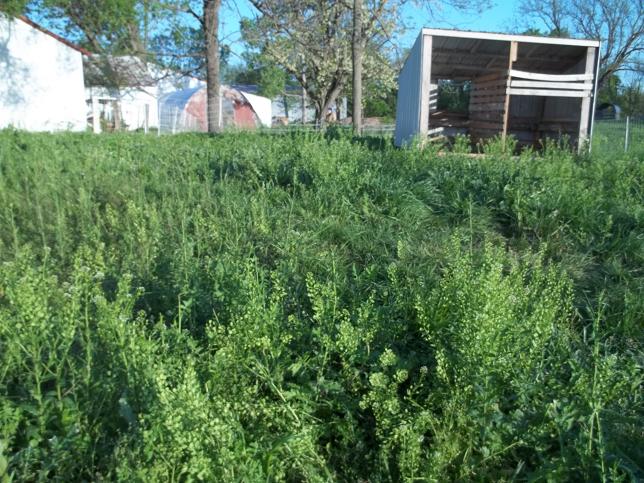
The goats finished cleaning up their pasture and since I have a vacation day today I thought we should go ahead and move them a day early.  They moved to an extra-large area loaded with field pennycress, thistle and Osage orange and honey locust saplings.

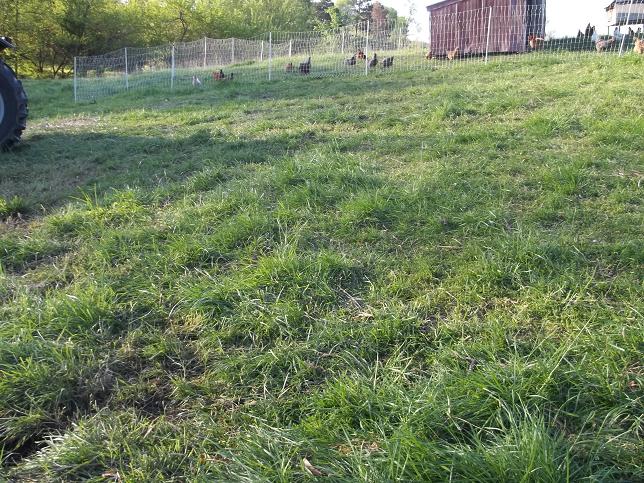
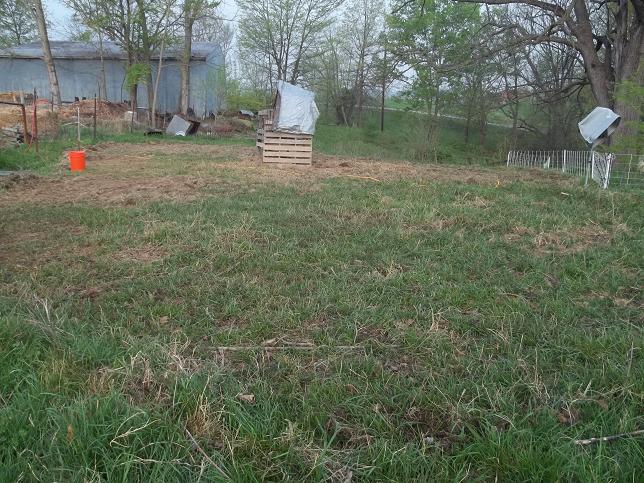
This opened a new place for the layers to run and play.  The pasture below looked like the picture above three days ago.

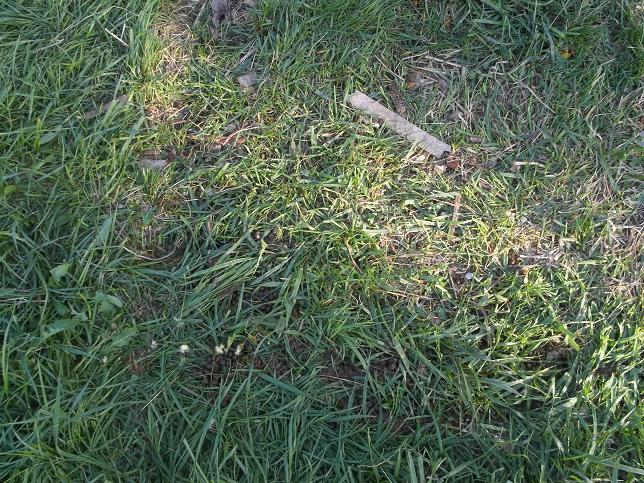
Finally, here’s a shot of the pasture the chickens left behind.  Fewer bugs, even fewer weeds, lots of additional nitrogen and plenty of disturbance.  Now it’s time for rest.

Disturbance and rest.  Disturbance and rest.  The greater the intensity, the longer the recovery period.  Disturbance and rest.  This applies to your own body, not just to grass and dirt.  Did you experience intense physical disturbance today or just rest?

The Hare Pen Part 2

Why a part 2?  Because I am very happy with what I see out there.  

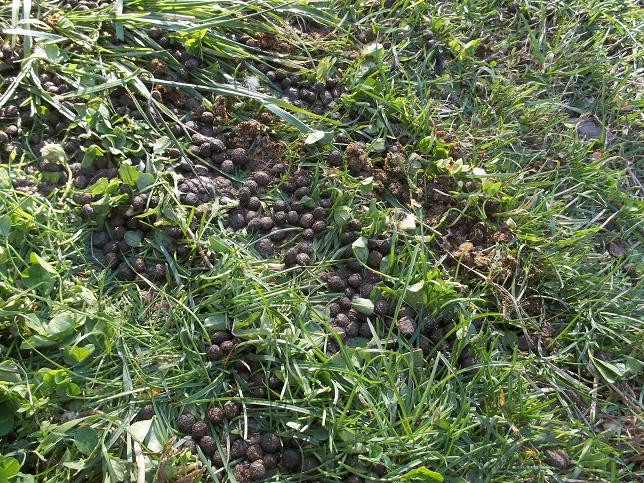
Black Gold.  Deposited in neat little rows on my grass.  I don’t even have to haul it.

This is where the hare pen sat all night, surrounded by polywire.  The manure isn’t very evenly distributed but that really doesn’t matter.  The earthworms say thanks.

The longer you leave them in one place the more manure they put down but the more pellets they will eat.  If you’re looking to lower your feed bill, move them more frequently.  If you are trying to increase fertility quickly, you could carry in pellets, hay, fresh clippings.  We are just using them to trim up small patches of grass around the garden.  It’s nice not to run the lawn mower.

The Hare Pen

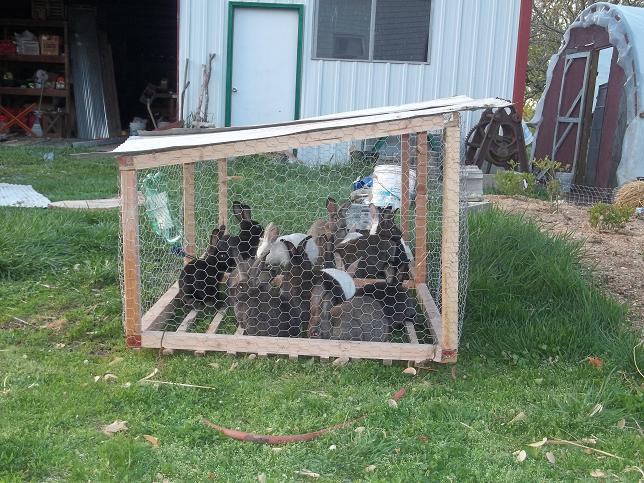
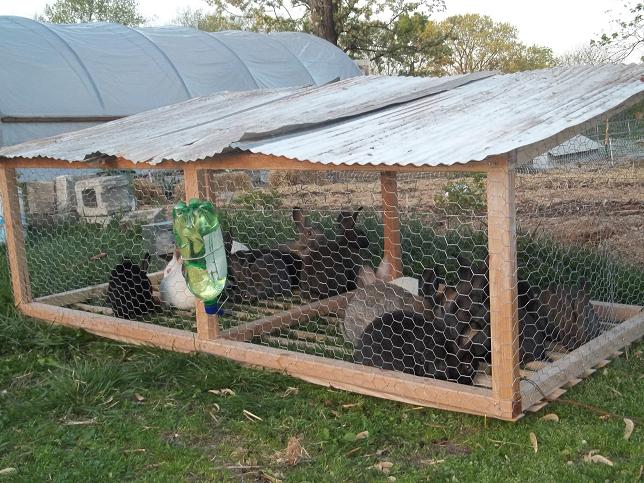
My oldest son has been wanting to build one of these for a while.  I took a little vacation time to wrap up some things around the farm and this project was on the list.  It’s a hare pen.  It measures 6’x3′ and is 24″ tall on one side, 18″ tall on the other.   3/4″x1″ slats are screwed to the bottom on 3″ centers.  That’s as much of a plan as you’re going to get anywhere.  This is enough room for 8-12 rabbits.

The roof is covered with three scraps of metal we found out back.  The two on the ends are nailed on, the middle one is nailed to a couple of boards to give it weight but floats freely and is easily removable so we can load and unload it easily.

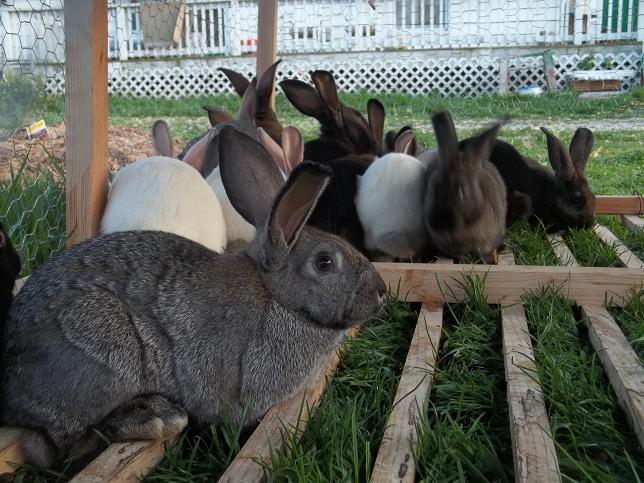
At least 70% of the floor space is open to the ground.  The rabbits are free to graze to their heart’s content, though they also have access to pellets.  We move them a couple of times each day, leaving their manure behind to add to our fertility.

Here are a few links I used to put together my own hare pen.  I have fewer ribs than the original Salatin pen but it seems to work fine.  My kids can manage it on their own.

Grady’s post on Hare Pens.

Video of the Hare Pen in action (from 1:08 till about 3:00)

Survival Podcast Start at around 31 minutes for this detail.

What’s the Buzz?


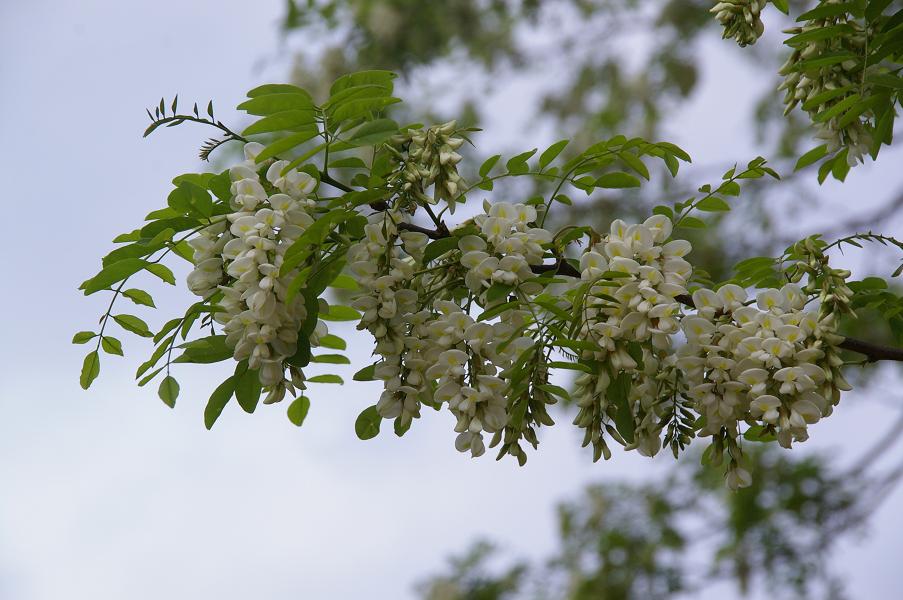
I saw more bumblebees last night than I have ever seen in one place.  It appears that bumblebees like black locust trees when they are in bloom.

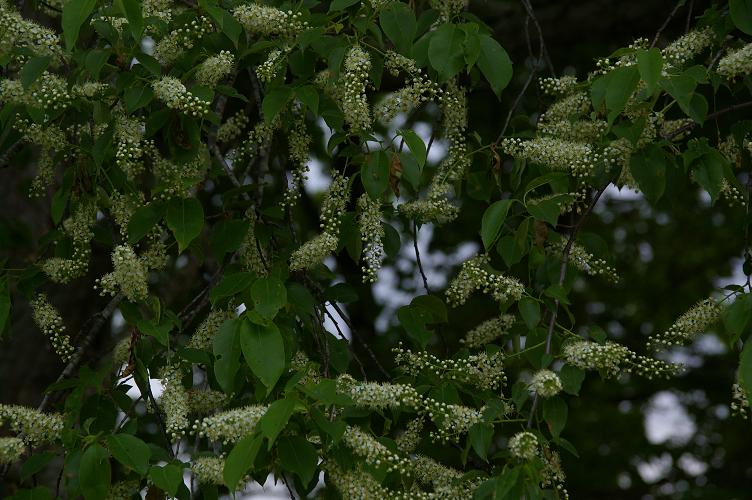
I thought it was appropriate to take stock of what is blooming currently.  Wild black cherry trees are in full bloom.

And the dogwood is looking great.

Elms are finished…

…as are silver and sugar maples.

Peonies are on deck.

A United Front or How We Got From There to Here.

This post is much more autobiographical than I like to write.  Please accept my apologies.  I think this is an important subject.

My wife and I are in this together.  The things we do are things WE decided to do, not things one of us forces on the other.  We live to fulfill our purpose.  We aren’t simply busy, our work is intentional.  This wasn’t always so.

I met my wife when we were 16 and 15.  I, like most public school children, suffered a total lack of vision.

Anonymous – “What are you going to do after high school?”

Me – “I don’t know.  Join the Marines or go to college or something.”

Even when we went to college I didn’t know what I was there for.  I enjoyed playing tuba so I was a music major for a while.  I enjoyed studying frogs so I became a biology major.  I even did a research project on tadpole development and published a poster at a meeting of the American Society of Ichthyologists and Herpetologists in Seattle, WA in 1997.  After college I needed a job.  Any job would do.  My wife was a year behind me in school so I needed something local.  I went to work for a software company in town.  It was Y2K and software companies were hiring.

You with me there?  Music -> Biology -> Y2K Software.  Movement for the sake of movement.  By all appearances I was succeeding.  I don’t know what I was succeeding at but I was “educated”, employed, married to an intelligent, beautiful woman and owned a home.  It all just sort of happened.

“Would you tell me, please, which way I ought to go from here?”
“That depends a good deal on where you want to get to,” said the Cat.
“I don’t much care where–” said Alice.
“Then it doesn’t matter which way you go,” said the Cat.
“–so long as I get SOMEWHERE,” Alice added as an explanation.
“Oh, you’re sure to do that,” said the Cat, “if you only walk long enough.”
(Alice’s Adventures in Wonderland, Chapter 6)

Though I put too much emphasis on pretty and not enough emphasis on strong, I married remarkably well.  Everything else in life up to that point just sort of happened, but our marriage was intentional.
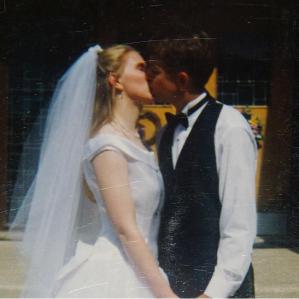
We realized we were just letting life happen to us not long after we had our first child.

We read a few books including Rich Dad/Poor Dad which, for all its flaws, gave me a push in the right direction.

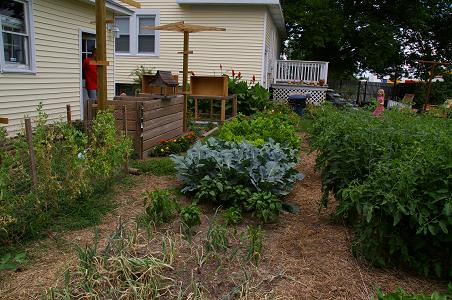
Much later I found Crossfit and started making different dietary choices.  You have to make better dietary choices so you can recover between Crossfit workouts.  Shopping the perimeter of the grocery store shows you how limited your options are.  It’s easy to exceed your grocery budget eating only fresh foods.  We decided the quick solution was to be more serious about gardening and keep a few hens for eggs.

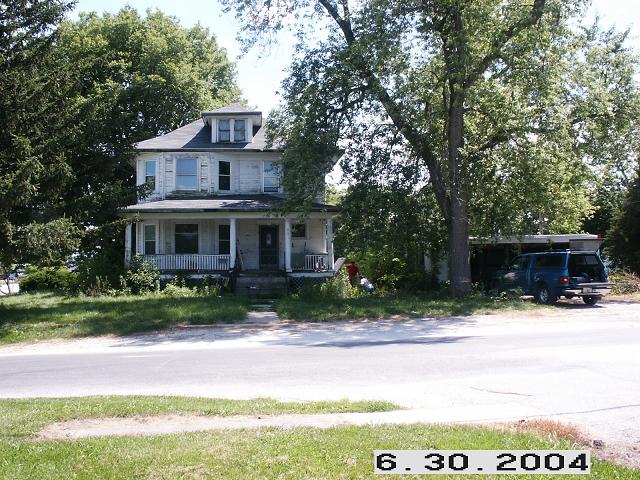
But this is real life.  Real life is hard.  We hit a rough spot in our marriage.  We bought an old fixer-upper house and spent several years making it livable.  As you can imagine, a house without a kitchen adds stress to a marriage.
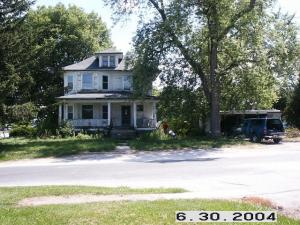
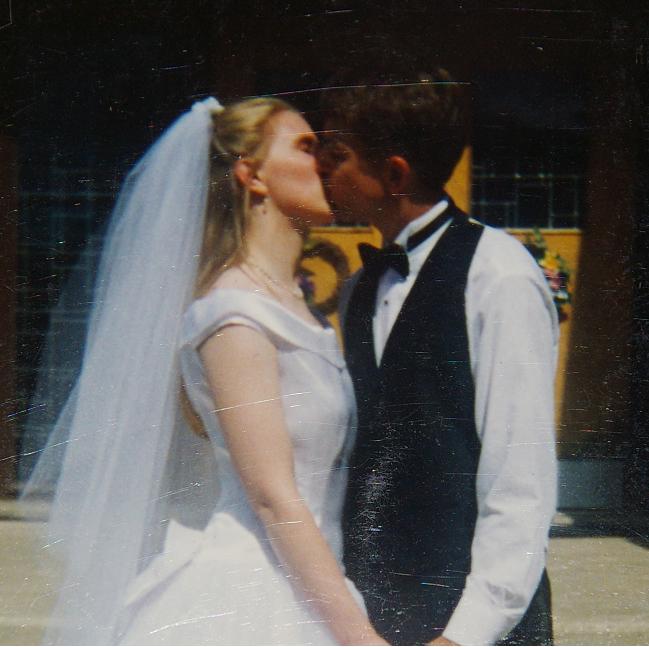
It got pretty gritty and reached a point where we had to make a decision about continuing our partnership.  This was a hard time in our lives.  We were working so hard with small children, work, a major remodel, and home schooling we forgot to make time for emotional intimacy.  It was difficult for us to learn to open up to each other again.  Though I wouldn’t wish it on anyone, I feel this time prepared us for later struggles.  We renewed our vows on our 10th wedding anniversary.  This time we were less formal.
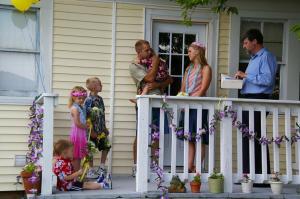
While we rebuilt our relationship we read.  Over time we started shifting our reading away from gardening and more toward agriculture; The Contrary FarmerMaking Your Small Farm More ProfitableBackyard Market GardeningYou Can Farm and Self-Sufficient Life and How to Live it.  I started beekeeping.  We read books about homeschooling.  We studied Shakespeare, history, math, economics and chess.  We switched off our television and studied as broadly as we could, often reading aloud as a family for hours on end.  We adopted the philosophy that we can’t teach our kids but we can model education by teaching ourselves (See Thomas Jefferson Education).  It works.

As time passed we realized it was time to move.  We needed more than just a yard.  We prayed, we continued studying, we continued working, and we prayed some more.  Though the market had just crashed and we knew it would be tough we listed our house.  We had a vision of a preferred future, we were working to gain both experience and knowledge but there were no serious buyers.  Our bags were packed.  We were ready to go.  We couldn’t leave.

It took two years to sell our house.  Then suddenly it was gone.  Where were we going to go?  We looked and looked for small acreage farms but found nothing.  Oh, we found some but we were  not willing to gut and rehab another home and we weren’t looking for a mansion.  It seemed there was nothing in between.  We did, however, find a very nice home on a large lot in a quiet suburb.  The location was excellent, the price was right, the yard was huge and we thought it might be just the place to ride out the storm.  Maybe even build some equity…even if we couldn’t have chickens.

The suburbs proved to be too much for us.  We took on some major remodeling projects in the house, continued to read, continued to work, to garden, to keep bees and to fit in.  It didn’t work.  We just didn’t fit in.  Follow the link for the gory details.

So here we are, several years later, living on the family farm.  The road here was full of twists but there were a few things that were constant throughout.  My wife and I remained faithful; first to the Lord, also to our marriage.  We were diligent about seeking out experience and education.  Though we were stuck in town we were constantly working toward our goals, learning to compost, learning to dress chickens and rabbits, squeezing more food into our garden space.  All of this was accomplished together.  Years of working side by side, supporting each other, questioning our decisions together, moving forward hand in hand…often with great uncertainty.  Even today she weeds the peas….
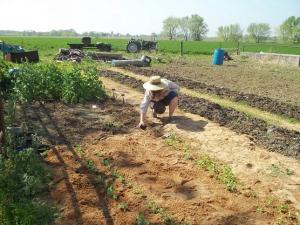
…and I weed the peas.

I get into the near-freezing pond on New Year’s Eve

…and she gets into the near-freezing pond on New Year’s Eve.

I can’t be home working with her every day but all of our planning, all of our decisions, all of our dreaming is done together.  I don’t simply tell her we’re raising X chickens each year and go off to my job leaving her to care for it all.  We develop a plan together that we believe we can manage.  Yes, she works hard.  Yes, I work hard.  But the biggest job is staying close and open to each other…to continue dreaming together.

If you are going to sell your beautiful suburban home, move out to the lonely middle of nowhere, survive the scoffing and questioning of friends and family, milk goats and/or cows, raise chickens, kill/scald/pluck chickens, practice rotational grazing when all your neighbors think you’re nuts and devote yourself to gardening and canning instead of driving to a grocery store you’ll need your spouse on your side.  This is a wonderful place to raise kids, we eat the best food in the world and we have a lot of fun but homesteading stresses marriages.  The work is hard.  It’s easy to take on too much and start blaming each other when the money comes up short.  As a man it is easy to dig in my heels and try to force something to happen.  Because she is with me, I’m forced to stop and consider the consequences.  At times her hesitation is difficult to appreciate as I’m sure she finds it difficult to appreciate my lack of hesitation.

If I have to choose between the family farm and my marriage I choose marriage.  Stewarding my relationship with her is far above my obligation to steward the land.  My dream of remaining married to her for the rest of our lives supersedes my dream of home-cured bacon.  It is easy to lose sight of your goals when searching out a new dream.  Sometimes you find you traded in your Mercedes for a Yugo.  Emotions are poor counselors.  Don’t be afraid to embrace your dreams slowly.  Put your toes in the cold water together.

Leftover Potatoes

We planted potatoes on St. Patrick’s Day.  They are just beginning to emerge above the manure we covered them with.

Last year’s potatoes were planted in the next row over.  We planted turnips there after the potatoes came out.  Some turnips are still there.  As I pull turnips to feed Wilbur (horse) I have found a few potato plants coming up from potatoes we missed last summer.
Aren’t they beautiful?  How about the one on the left?  Finding these encourages me to plant my potatoes on Labor Day instead of St. Patrick’s Day then mulch the dickens out of them.  This article indicates the fall potatoes spend the winter building a root system then shoot for the sky when it’s warm enough for growth above ground.  Be sure to read that article closely because he details how to plant and mulch them to give them the best chance in the winter.

We live near the Northern edge of zone 6 so fall potatoes are a bit of a gamble.  I’m sure my sister, living further South with a sheltered garden location, would be successful at it.  I’m going to try it in the fall.  Our spring is so busy it would be a relief to have something crossed off our list before spring arrives.  If it fails we won’t be out much.  If it succeeds we may be able to harvest the potatoes in time to plant a late crop of beans.

Let me know if you have any tips for fall potato planting.  These volunteer potatoes say it’s worth looking at.

The Whole Fleet

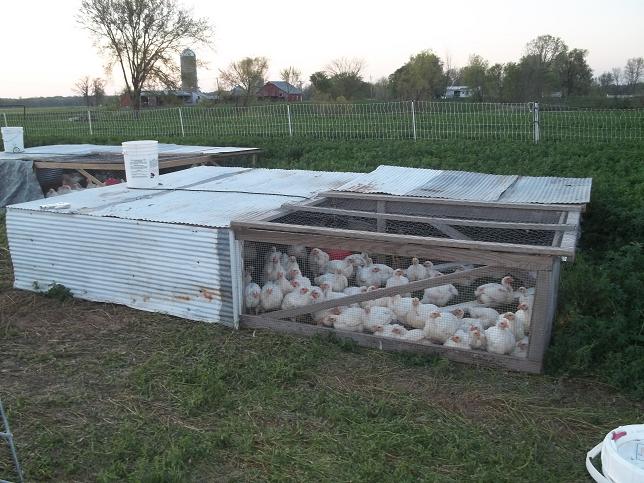
We built our recent chicken tractors after those of Joel Salatin.  The term Chicken Tractor, as near as I can tell, is something Andy Lee gave us.  In Pastured Poultry Profits Mr. Salatin describes a 10x12x2 structure that is lightweight and fairly easy to move.  We built ours as 12x8x2 but otherwise the original tractor is quite similar.  We built it out of scrap material we had laying around.  What could be better?  …or heavier?

That thing is a tank.  It has all kinds of bracing and is made with heavy steel siding rather than the prescribed aluminum.  But, it works.  When we were designing the second tractor we went with fewer braces and lighter steel.  The result was better but not great.

It may not look a lot different but it is a lot lighter.  I was bitten by the bug.  I built a third chicken tractor to see how light I could make it.  Further, I built the third to address a serious issue, heat.  I left the sides off entirely so the wind could blow through and keep things cool inside.

It worked remarkably well.  It is light but won’t blow away in 50 mph March winds.  It stays much cooler than the other two tractors.  But there is a problem.   This spring I have lost zero chickens in the other tractors but I have lost four in this one.  Four.  For those of you playing the home game, that’s a big number.  There appears to be something about that open side that stresses the birds.  I now have a tarp covering the South side of the tractor as it is light, portable, inexpensive and temporary.

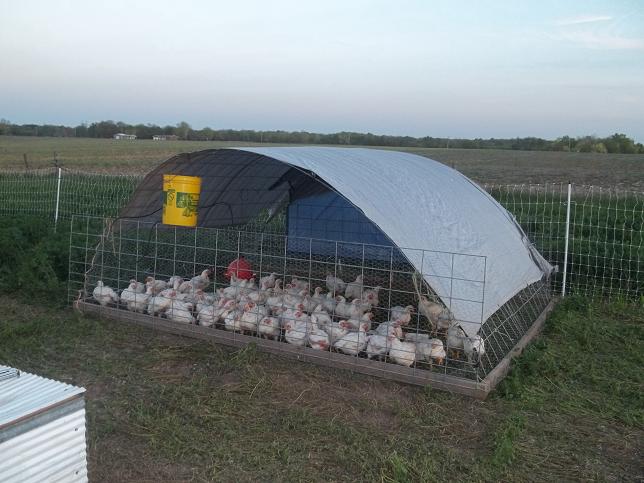
That takes us to the fourth tractor design, a radical departure from what we have seen so far.

This tractor is the cheapest to build, the fastest to build and the most versatile.  I took one side off for the winter and raised 6 hogs in it.  I could imagine putting weaner pigs in one and moving it daily like they were chickens until they were big enough to escape, though I suppose one could wrap the interior with electric fencing to keep the pigs from rooting out.  I could also imagine using it for a calf shed or a hoop house.  The point is, it’s multi-purpose infrastructure.  We see these as the future of our fleet.

All four tractors use Plasson bell drinkers that are gravity-fed from a bucket.  We use 4″ PVC pipe cut in half lengthwise as a feeder.

Take a moment to imagine your perfect chicken tractor before you build it.  After you build it, take notes on what you would like to do differently.  Don’t be afraid to break from the norm.  By your third or fourth tractor you may have something that fits your organization’s goals.  Mac Stone of Elmwood Stock Farm says before long you’ll end up with a whole fence row of what you thought was the perfect chicken tractor design.

What do pigs do?

Well, pigs eat.  Pigs manure.  Pigs sleep a lot.  Pigs drink and wallow.  The best thing pigs do is dig.

This is a post about digging.  Pigs dig for fun and to find food.  This week we put them in the pasture near the iron pile where they discovered a small pile of odd parts that had been buried in the pasture over time.  These are probably things my grandpa dropped out there 20 or more years ago.

Here’s a view of the whole pasture they left.  They did more digging further away, less closer and almost none up close.

Looking the other direction I have drawn some lines.  The further line is where the fence was.  The near line is where they stopped digging.  Why did they stop digging?

They did not dig where they manured because pigs are clean animals.  They manured near the fence and did not dig in their manure.  There is almost no manure anywhere else in the pasture.  Just there by the fence.

The pasture will recover quickly where the manure is.  The pasture will recover slowly where they dug but, in the long term, the massive disturbance will allow opportunity for plant succession that would not have happened otherwise.  There is a seed bank in the soil that will now have a chance to come to life.  There will be grass.  There will be weeds.  It will be great.

When keeping pigs on pasture it is important to leave them enough room to play, to dig, and to take care of business.  If you place too many pigs in too small of a space or leave them in one place for too long, the whole area will be defoliated.  We try to manage things so when the pigs run out of fresh grass to eat they are moved to a new location.  By that measure the pasture has a reasonable chance to recover quickly.

Good luck with your own experiments with pigs, grass and portable fence.  Things may work out differently for you.