The $10,000 Question

What can you buy for $10,000?

Julie and I drive a 10 year old Chrysler Town & Country. It is big enough that I can fit 4×8 sheets of plywood in it or a couple of 300 gallon tanks or, more simply, our 4 children with comfort. We paid $10,000 for our minivan a couple of years ago when we bought it used. Our previous van had been stolen (along with 5 dozen eggs, my favorite hat and my favorite knife)! $10,000 is about a third of the price of a similar 2014 van.

Our first house cost $30,000 and we had to put in $10,000 worth of improvements before we could move in including hooking on to city sewer and water, repairing the foundation, updating the wiring and replacing the furnace. $10,000 bought all of that…furnace, concrete, wiring and plumbing.

Now, I don’t know who you think I am. I don’t know what you really know about me. I’m not the kind of guy who keeps $10,000 just laying around. My pockets are only so deep. We had a couple of guys out to estimate a pond dam for us and they said $10,000…with more of a firm quote coming.

Sigh.

Can I afford that? I also need a loader tractor. The clutch needs to be replaced on our tractor. Julie wants to build a house…or at least put a roof on this house. I need to plant about a bazillion trees. I need to buy about a bazillion cows…well, maybe 5 or 10 more (easily $10k). There is no end of things I could spend money on…including replacing our minivan. I would love to buy Julie a new ring (lol). Can I really justify buying a 1-acre pond?

You know, I have found that I can justify just about anything. It’s just a matter of approaching the matter from the right angle. SO. Today I’m going to justify building a pond. I don’t know how I’m going to pay for it but at least I’m going to lay out why I think it’s a good idea for us. First, here’s a rough-out of the pond from the top down thanks to Draft Logic.
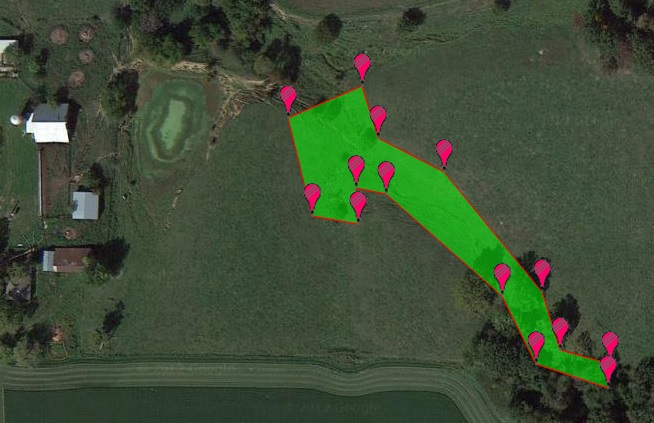
NewPondMy friend Steve says I will never regret having additional water on the farm. I suspect he’s right but this isn’t the pond he was rootin’ for. He wants me to make a single, larger pond instead of a series of small ponds over time (this is just the first). I would like to have it higher on the landscape than this but still, it’s pretty high. There is a lot of bottom ground I could irrigate from this pond if needed. Beyond the extra water, we will gain a dam we can drive across to get to the pasture beyond. The hills here are pretty steep…steep beyond what I would be comfortable mowing. The creek beds are washed out to the point that it’s hard to get a tractor across them too. The grazing on the steep south-facing slopes is sparse and the steep north-facing slopes are covered in moss. Not much grows here. A couple of thorny trees, a little scrap iron and some sparse grass that went to seed early. There are dry dams on two of the three valleys that feed into the pond area and a pond dam uphill from the other so the pond shouldn’t silt in any time soon. Here is the proposed pond area as it sits today. The dead tree to the left is around 18′ tall.
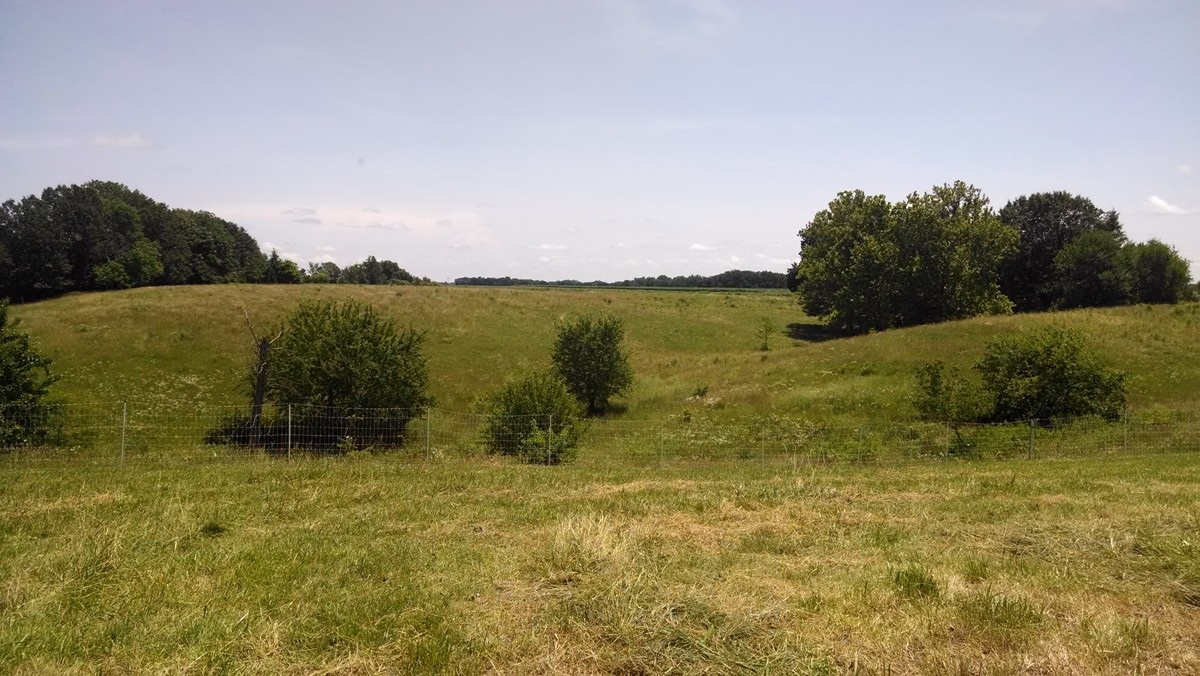
Pond1

And here is my concept of what the pond will look like. I spent a whole 5 minutes with mspaint making this picture.
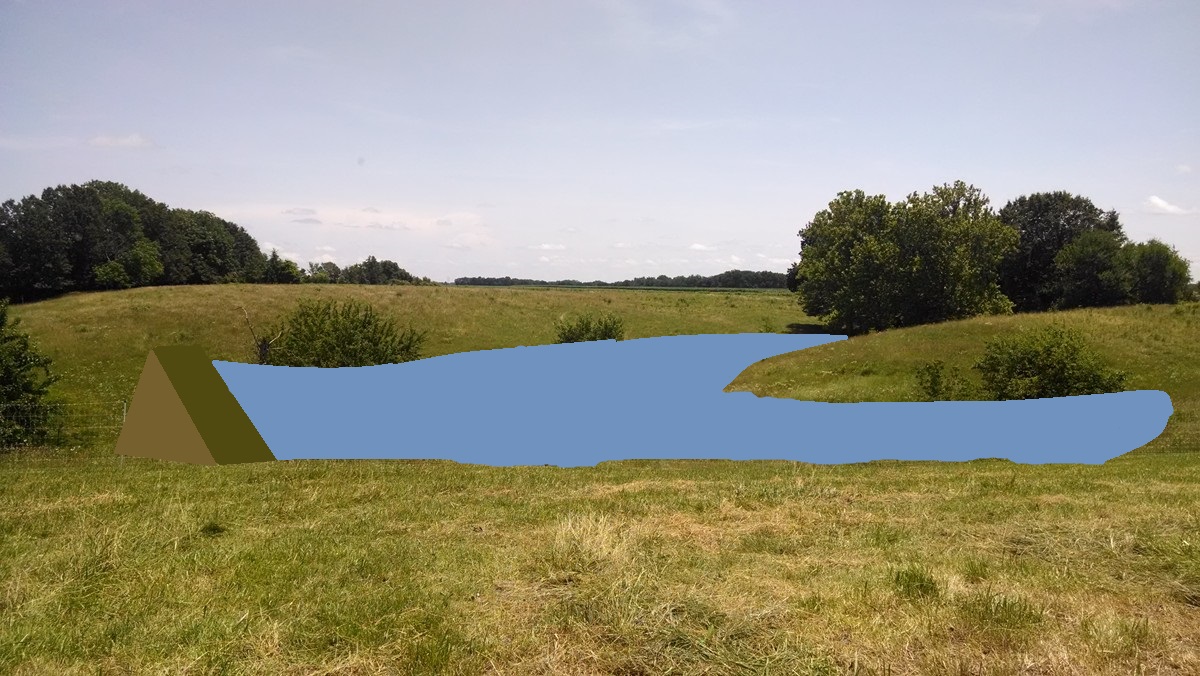
pond vision

What we are talking about is a serious benefit to the water cycle, a benefit to the wildlife, a benefit to the livestock, a beautiful feature that will improve my farm’s value and something of lasting value for generations to come. I joked in a post called The Return of Surplus that we needed to bring resources back to the farm and this is a perfect example. Further, by making this investment now we will be able to increase biodiversity and, thus, compound our return over time. Just think of the fish, frogs and turtles. Think of the bald cypress I could plant. Think of the way it will moderate temperature. Think of fried catfish! But the water is illiquid. I will never get my money back without selling the land it is sitting on. Once that money is spent it is gone. That’s it. It’s either pond or loader tractor. Pond or cows.

But once the pond is built and stocked it’s here to stay. There will be nothing more to do for generations to come. Similar to the ponds grandpa built maybe 60 years ago, I’ll be leaving the farm better than I found it.

Can I justify it? Yes. Can I afford it? Ugh.

Today’s Breakfast

For breakfast this morning I had a quart of Saturday’s milk and a couple of handfuls of black raspberries I picked while moving the cows. The milk was hard work. Hard. Work. Milk doesn’t just magically appear in the fridge. Milking machines don’t clean themselves. Hand or machine milking only happens after your cow has calved. Cows only calve after they spend 9 months pregnant…and they eat the whole time. Cows only get pregnant because they have met a bull or have met your whole arm. You with me on the hard work thing here?

The black raspberries just grow in the field edges. The only “work” involved is picking a path through the poison ivy (which the cows are trying to eat) to get to the berries. Dew berries should start coming on in a couple of weeks.

dew berries

Not yet…

What would someone have to pay for a quart of freshly squeezed milk and a pound of fresh berries? Could you even deliver these berries in any condition? Am I living the dream or what? All I have to do is make my farm payment each month, wake up insanely early every morning, follow the cows around, step in cow pies and give them fresh pasture. We also close them off from their calves for large portions of the day which requires …oh, a little more management. Oh and we have to keep the milking area in the barn clean and fight off the barn cats so we get the milk for ourselves. Then it’s an easy quarter-mile walk to pick berries among the poison ivy and spider webs and horseflies and breakfast is served! See how easy?!?!

Sometimes I’ll have another quart of milk to cool down after morning chores. No time for that today though. Just a quick shower to rinse off the layer of sweat and grime before heading in to the office to work with the cereal eaters.

Start Small. Go Slowly.

I was listening to a Permaculture Voices podcast with Darren Doherty. Darren said he was speaking with Teresa Salatin (with me so far?) about her advice for folks just getting started. In short, start small. Go slowly.

Once upon a time an ambitious, hard working young man moved with his lovely bride and children to his family farm (which he bought with real money the bank created from thin air and loaned to him (and he is repaying this real loan of fictional money even to this day)). When the family arrived they already had a small flock of pullets…cause that’s what you do. You get some birdies and then you are a real farmer. Well, some birdies and a gun to protect them with.

FirstPullets

Pullets are fine. Pullets are fun. We had a few roosters too. The flock was small so we knew the birds’ names. Red roosters are always named Roger. Barred Rock roosters are always named Rocky. There was a small pullet who ran to me each day and liked to ride on my shoulder. We called her Polly. Polly was killed one night along with around 30 other birds by a mink.

And that’s how it goes. Everything likes chicken. We had everything to learn. We still have everything to learn. Everything still likes chicken.

But we started. And we started small. We should have started smaller and that’s why I’m writing this.

FirstCornish

Then we got 100 CX chicks so we could call ourselves real farmers (we had, after all, read Pastured Poultry Profits). CX are merely an 8-week prison sentence. No big whoop. But we hadn’t pre-sold any of the birds and really didn’t have any extra freezer space. No plan. Just birds. “We’re really doing it!”

Well, yes. We really were raising animals. We were producing and…well…I guess that’s good. Except…um…you know…where are the customers? Aren’t they supposed to show up? We’re producing what the world wants…shouldn’t the world be here by now?

When the bird thing was under control (barely) we got a milk goat complete with kids. That was a mistake. It was too soon. Too early. Too much we didn’t know. Too much going on at once. (For those of you playing along at home, please consider Dairy to be an advanced topic and not to be entered into lightly.)

FirstGoat

We sold chicken. We sold eggs. We froze whatever goat milk we couldn’t immediately drink. Things were going so well we thought we should add pigs the following year.

Pigs. Again, we’re just in the yard. My (distant) cousin was renting the pasture. He said he wouldn’t mind if I ran my chickens through his pastures near the house. Thank God. But I had to find a place for three ruptured pigs. I made a little shelter with T-posts and pallets (and ripped my hand open driving the t-post…cool zig-zag scar!) and put the pigs back under some trees contained by electric fence. That went really well. I mean…really, really well. The pigs rooted up the yard and later the pasture. Again, few animals tend to have names. We let names happen spontaneously. We sold Susan to a couple of co-workers through the local packer. Buddy and Girly went to our own freezer along with Popeye the goat. (We ground a portion of the goat and pig together and made Popeye/Buddy burgers…totally awesome.)

FirstPigs

These were all ruptures (pigs with hernias) from a production hog floor. Each had a big balloon of skin hanging down from their bellies or scrotum. Because of the flaw we bought them cheap and it all worked out well. In fact, the ruptures closed up. The vet says they didn’t heal, they just were not currently expressed. I suspect it was because we fed our pigs at the ends of the day and let them go hungry for a little while day and night in addition to the clean air, fresh pasture and lack of stress from animal density. Anyway, we learned how to care for pigs on the cheap and how to kill and butcher pigs and goats. I don’t know how many batches of pigs we have raised to date. Several times along the way we have had a nice gilt in the group and we have considered keeping her or just raising a couple to farrow our own pigs. But I think there is a lot to be said for running a complete batch through and being able to take a breather for a little while. We just have pigs when we want them.

FirstCows

For some reason we chose a different strategy with cattle. We bought cows. Cows eat. Cows eat every day. Every. Day. There are no days off. It would be so much nicer to buy stockers in September and sell them in June. Then I could take the summer off. Sweet! But, no. I bought cows. Worse, I bought a couple of milk cows. Remember me saying that dairy is an advanced topic, not for the beginner. I meant it. I really, really meant it. You are better off buying your milk…at least when you first move to the farm of your dreams. Every morning I wake up early (earlier than ever before) to wash milk jars, sterilize equipment and get things started. Every morning. Every morning. Today? 3 gallons. Yesterday? 3 gallons. Day before that? Yup. What do you do with all that milk? I try to drink a gallon each day (helps me keep my girlish figure). Right now there are 7 gallons in the fridge. What do we do with it all? Skim the cream and give the rest to pigs, chickens or cats or dilute the milk and put it in a compost tea.

Read that last sentence again. We need our entire farm working to utilize the surplus milk we receive from two cows…cows with calves we are sharing the milk with. True dat. You need to start small. Dairy isn’t starting small. Dairy is something you add when you’re up and running already.

“But”, you say, “I wasn’t wanting to start with livestock. I just wanted to put in a garden. Only an acre or two.”

Well.

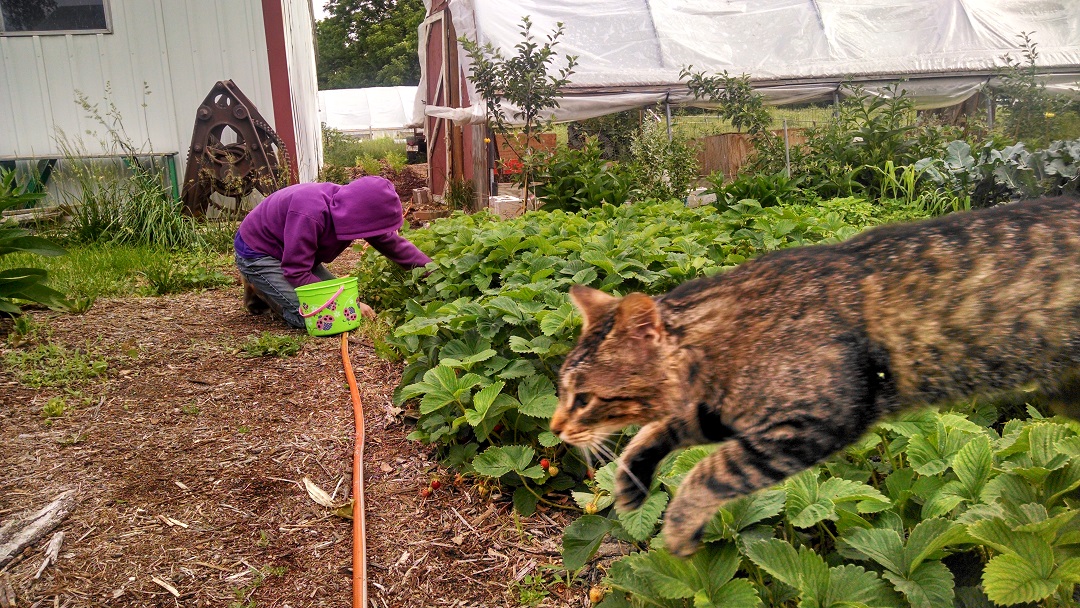
Two years ago I planted a matted row 15′ long of strawberry plants. Last year I thinned that down to a double row and extended it another 15′. So far we have picked 30 gallons of strawberries that I know of, not counting the bug eaten berries we just toss and the handfuls of berries we have eaten right out of the garden.

StrawberryPatch

Cat photobomb

The little girl in the picture above is tired of picking strawberries. Any idea what you are going to do with that bumper crop of tomatoes? We once filled a freezer with jalapenos. What is the plan when you pick 3 bushels of cucumbers every day for two weeks? (hint: it helps to have a pig!)

No matter what you are producing you can easily out-produce your ability to handle the bounty. You may even begin to curse your blessings. It’s pretty cool to collect 10 dozen eggs/day but can you really sell 70 dozen eggs every week? 280 dozen every month? Maybe you shouldn’t raise 150 layers then.

But if you start small you’ll give yourself a chance to work out the marketing kinks. Really, for every hour that goes into production and harvest, you need to dedicate 7 hours to marketing…to expanding your market…to finding new customers. The goal is to start small but to increase your production each year until you just can’t handle all the money coming in. Your family of four could easily utilize 4 bushels of apples each year but you planted 10 apple trees. Each tree will produce that many. What are you going to do with all the apples? Heck, what are you going to do with all the wild abundance that magically grows on your land? All the raspberries? All the mulberries? All the bluegill?

FirstFish

So. Start small. No, smaller than that. If I was advising someone who was starting out fresh I would suggest 4 pullets and a pig. That’s it. Maybe a worm box if you’re adventurous. With those animals around you can up-cycle all the garden and yard waste you can find into bacon, eggs and manure and still have enough eggs to pass some to a neighbor over a fence from time to time. Later, raise 10 broilers for yourself in the fall. Start out with a 10’x10′ garden following recommendations in Jeavons’ book, planting things you know you will eat and working to keep every square foot working year-round. I would plant fruit trees…not a lot of trees but some. Maybe on the north edge of your garden space. Throw in some bushes too..both for fruit and to attract beneficial insects. I would include comfrey and a few other perennial herbs. But keep it all small. Small. Think small.

Let your customers force you to expand. If you start small and work hard, customers will appreciate your quality. Word of mouth is the best marketing tool available. Never let your customers down. You can’t produce quality until you have learned to crawl. Learn to crawl. Start small. Believe me. My knees have been skinned more than once.

Our Chicken Wagon

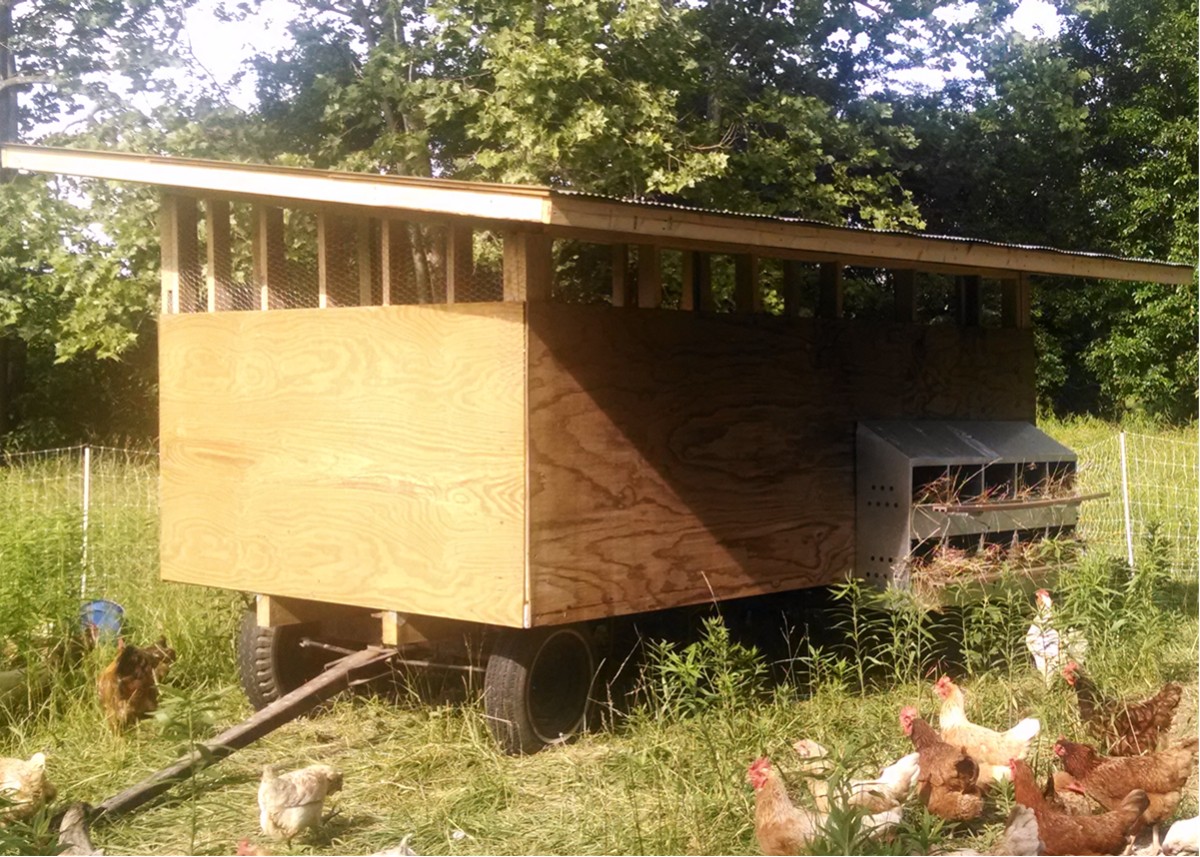
Julie and I needed to find a way to make the chickens more portable. We were already moving toward building an eggmobile on a wagon running gear when we heard Ethan Book discuss the same idea on his podcast. We just needed to simplify moving the chickens so Julie or the kids could handle it alone. Too much of our farm depends on my back.

chicken wagon

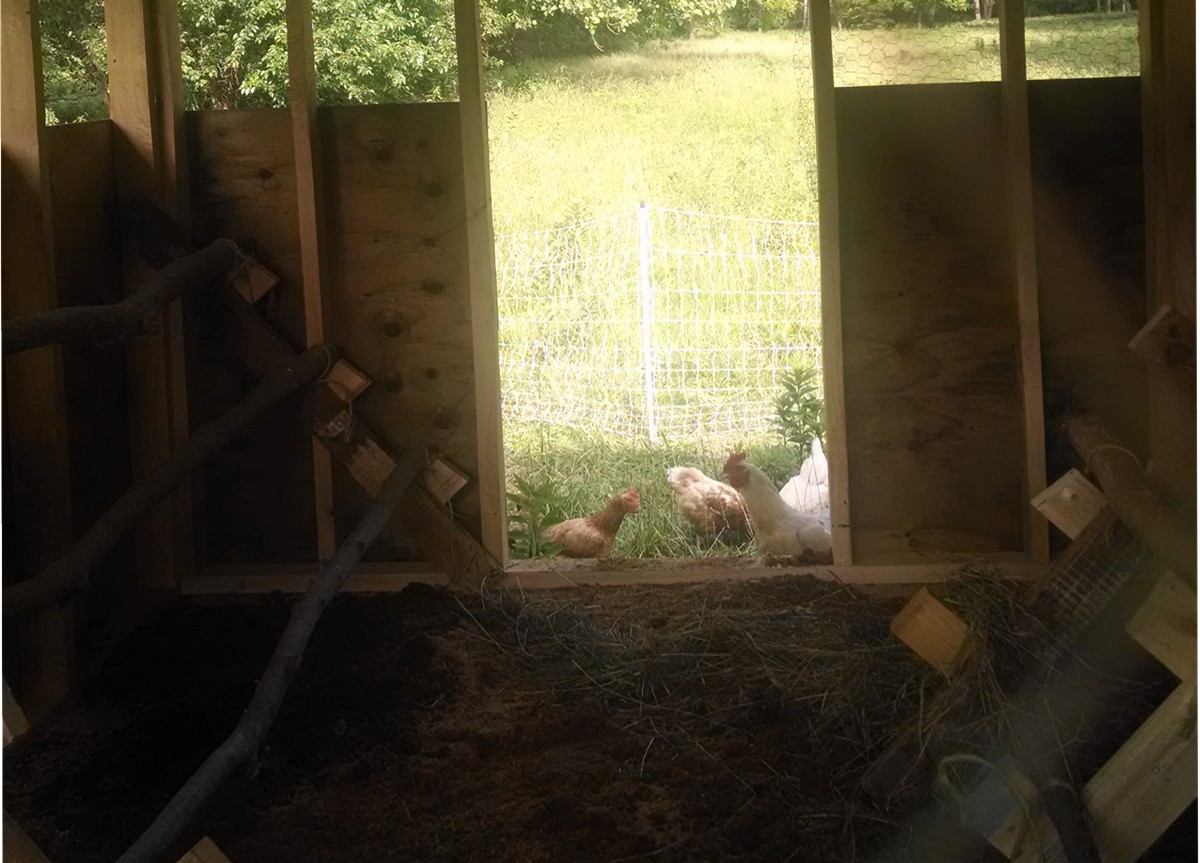
Ours is an 8×12 box. It is 6′ tall on one side, 5′ tall on the other. The roof overhangs by 2′ in all directions (12×16). The interior is all bedding and roost bars with a little room for supplies. The nest boxes are all outside of the enclosure. I think we can tweak our design efficiency but overall it’s a pretty efficient little unit because of dad’s input. It also stayed cool in full sun on a 90 degree day with a breeze largely because we put a layer of insulation board in the roof. Plus it casts a big shadow in the pasture. Chickens are cool in and under the box in the heat of the day.

inside the coop


I plan to hang a barrel on the front to feed watering nipples that will hang down under the edges. There is a second array of nest boxes next to the first you see pictured. We had to cannibalize it from the prior chicken tractor-type layer solution. Other changes will come along but I desperately needed to just get the birds moved so here we are.

So. Thanks to dad and thanks to Ethan. We already had the idea and the momentum, Ethan just applied the spurs and dad made it happen. It turned out well. There will be more and those will be even better. If you are reading George Henderson with me you know that he used something similar…but bigger.

Calving Season is Over

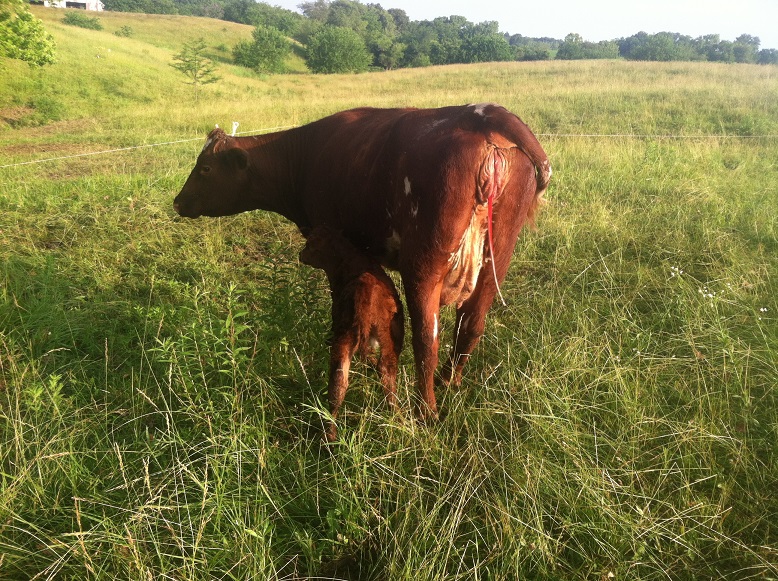
We are finished calving in 35 days. That’s a tight window for some, a long window for others. I’m just glad it worked out so well. 5 healthy calves born without assistance.

Heifer

111 calved early this morning. She’s the last one. In some ways, 111 is the best of the herd. She is short, fat, slicks out easily and has a good disposition. However, she has at least six teats and she calved about 3 weeks after the main part of the herd. Hopefully this little girl will strengthen the group.

We plan to use the same bull again this fall. He was sized correctly and has thrown small, vigorous calves. If I have my druthers I’ll use that same bull again next year too.

I have more grass than cattle and with corn futures low and drought in the west feeder cattle are going high. It’s a good time to be selling cattle. Not a good time to be buying. Sigh. Oh well. At least I have the calves I have and I can get a good price for the heifers that didn’t breed last year.


Simplifying the Cow…Mr. Miyagi Style

Daniel LaRusso was an idiot. He was an immature, hot-headed show off and he should have known better than to repeatedly pick fights with the Cobra Kai. But as the movie progressed Daniel grew up a little because of Mr. Miyagi. What did Mr. Miyagi do? Well, most importantly, he filled an emotional and developmental need in Daniel’s life. But in terms of karate training, he focused on what was important…simple things: belts hold pants up, hard work pays off, stick with it to the end (or <squish> just like grape). Daniel [Spoiler Alert!] was “the best around (Nothing’s ever gonna keep you down!)” because Miyagi required and enabled mastery of a few simple things: block punches, block kicks, punch with balance and a use a special, secret move that “if do right, no can defense”.

So, for the sake of my growing children, let’s break this farm thing down to simple things without secrets so if do right, no can go broke. It’s going to take me more than 90 minutes to teach my children these lessons – lessons I am still learning – but we will begin at the beginning. What is the essence of cow? More simply: What is cow? More simply: Cow?

It’s not about breed. It’s not about color. We are looking to add value to captured sunshine and enable future sunshine to be captured even more efficiently. We use cows. We can make fat cows. We can multiply our cows. We can multiply our cows and make the multiples fat. The cow is a leather-bound sunshine assimilation unit that tastes great with onions and mushrooms. That is cow.

I have seen unhappy cows. Hunched up, head down, shaggy, covered in mud and manure, ears drooping. Sometimes because of mismanagement, sometimes because they got a bad start in life, sometimes…who knows. I have one of those and she’s heading to the meat cutter. This is not cow. It just looks like cow.

WhiteCalfA happy cow is clean, her coat is laying neatly (though may be a little fuzzy in winter), her eyes are clear, she is not hunched up and ears are not drooping (unless she’s a brahman). If she is not grazing she is laying down in a dry, clean place chewing her cud. This is cow.

ZenCows

It takes grass to make cow and we want to make cow with grass…not with diesel fuel.  Grass makes cow. [I could be saying “beef” but saying “cow” seems more Myiagi and keeps the lame analogy going.] If you don’t have grass you can’t make cow. You only need sunlight and rain to make grass but having cow helps you make more grass and do it more quickly. And more grass means more cow…and more grass, if do right, means no can go broke. Quality forage is a science of its own but let’s keep things simple. How much grass does it take to make cow? It takes enough grass to fill this hole behind the rib and in front of the pelvis on the cow’s left…and keep it filled every day. How do you measure each day’s pasture? You offer enough pasture to fill that hole, little enough that the majority of what is left gets trampled and manure is scattered about. We line up a couple of parallel fence lines and move the cows throughout the day until they are full (there are more advanced and seasonal fencing techniques but let’s keep it simple today). If we are on the ball they will have enough fresh pasture overnight that they still look full in the morning when we come to move them. It’s no big deal. Fill that rumen. If it’s not full, give more pasture. If you miss today, do better tomorrow. Easy peasy.

Rumen

Let’s add a little complexity. Cows need more than full bellies. They need a balance of protein, energy and fiber. It is good to look at the side of the cow. It is better to look behind the cow. Look at the cow pat. Does it look like a stack of cookies? The cows need more protein. Does it spray out from the cow when she coughs? She needs more fiber…or she needs wormed (sell her). If it’s nicely piled up with a dip in the center the cow is getting what she needs. There are times when the grass is too lush and you will need to fill the cows up with dry matter (hay). There are times when the pasture just doesn’t have the protein the cows need and you will have to provide some level of supplementation but we’re getting away from simplicity. Graze tall, diverse swards a little at a time and things should be fine here in Illinois…especially if they can reach the lower limbs of trees.

CowPat

There are a few other things cows need like shade (hugely important when it is above 80 degrees!) and salt but that’s a good start. We will spend the rest of our lives learning about cattle and grass but if you only learn a few things, know how to keep them full and how to read manure. Understand what we have them for. They are pretty, yes, but that’s not why. They are fun too but that’s still not why. We have cows because we have grass…and because we want more grass. We are grass farmers. Cows fertilize, cultivate and harvest our fields.

Look at the rumen, look at the manure, buy a belt to hold your pants up and face down adversity. You’re the best around. Nothing’s gonna ever keep you down.

For another look at cow simplification, Hubert Karreman listed 5 (6) preventative measures for animal health in a recent Agricultural Insights Podcast:

  1. Don’t exceed the land’s biological carrying capacity
  2. Offer high-forage diets (75-80%)
  3. Offer good Grazing
  4. Ensure fresh Air
  5. Provide dry Bedding
  6. Give access to sunshine

At this point you’ll have to subscribe to hear that podcast but I think it’s worth it. I haven’t read Mr. Karreman’s books. If you have, let me know what you thought.

Literally a Broken Record

Remember records? Not like a record for underwater pogo jumps but records…music…needles. Skip, repeat, skip, repeat. I have a nice copy of Led Zeppelin 4 in my attic on LP. Somewhere a twenty-something is looking this up on Wikipedia. Next they will look up Led Zeppelin.

The repeating theme I know you have read before is: This farming stuff is hard.

It’s hard.

No, like, really hard.

No. I still don’t think you get it. I’ll say it in teenspeak. It is like literally hard to even. Literally.

Near as I can tell, May (dairy cow #2) is cycling right now so her udder may be a little…sensitive (all the lady readers say “Hey!”). I attached a cup, she kicked it off. I attached it again, she kicked it off again. I attached to the rear first, she kicked me (not intentionally but literally. Like even). Sigh.

And so it goes.

Dream that dream. Go ahead. It’s awesome when that calf is born or that chicken you didn’t know was missing returns with a hatch of chicks trailing behind her.

ChicksBut there are not awesome days too. Days when you forget to put the milk away and there is no chicken feed in your warehouse and that project you’ve been working on gets delayed and your spouse gets sick and the house is a mess and the cow like literally kicks your butt. Try not to smile as the cow’s tail hits your face (happened). Don’t inhale a bug when you laugh your way through the pasture (happened). Be polite to the internet company when they say it will take 4 days to fix their service (but you’ll be billed for the whole month). Even if you didn’t have the cows things would go wrong. That’s life.

Fairy tales end with “…and they lived happily ever after.” I call BS. They moved into a cold, drafty old house, the roof leaked and they literally had some bad days and some good days ever after. But it required a lot of sacrifice and it turns out Prince Charming snores. OMG!

So. Pick your poison. Do you want the bad things in life to happen in suburbia or do you want to take them out in the stix? I think we are literally better off out here in the stix. But it’s literally hard to even. You know?

Walking the Farm in a Spring Rainstorm

According to the very expensive, precise and scientific bucket that was left sitting out, we got a total of 5 inches of rain yesterday, 3 inches in the first hour. When that kind of rain hits the farm I like to put on my raincoat and spend time looking around. I want to know where the rain is soaking in and where it is running off. Is there any soil washing out? Did any lids blow off of chicken tractors? Are the ducks teaching the chickens how to swim? We’ll start at our broken old bridge to nowhere.

Bridge

There is normally a trickle of water flowing through here. The kids crawl through the tunnel and hunt up crawdads or pretend it is a fort. Today it is roaring as water flows through. I’m glad to see that there is not more water flowing through. This tunnel is fed by the overflow from the pond (not much is overflowing yet thankfully), the runoff from the alfalfa field (again, just a trickle) and the runoff from the corn field and feedlot and the ditch across the road (the majority of the water you see). It looks like most of my water is either soaking in or being delayed in reaching the branch. I love it when a plan comes together. But the pond is receiving quite a bit of water and topsoil from the neighbor’s field and then there is that feedlot. Well, not much I can do about that. Following the water downstream I’m concerned the branch will flood the bottom…where the chickens are currently.

Branch

The water was about a foot from coming out of the banks. Too much water for me to cross so I can’t go any further to the North. Within an hour the creek was already receding so I slept soundly believing the chickens to be high and dry…until I heard it raining again about 2:00 in the morning. (Skip to the end: chickens are fine). No choice but to go east. Cows are out in the open east of the yellow house. I’m taking advantage of the cool weather to graze open areas right now. The cooler weather will end this weekend so we’re watching the clock. The cows are so full they are a little hard to move. I’m giving them larger areas right now to get back to the trees in time. We will have a big, square cutout in the pasture that will remain ungrazed until fall. That’s how it goes I guess.

RainCows

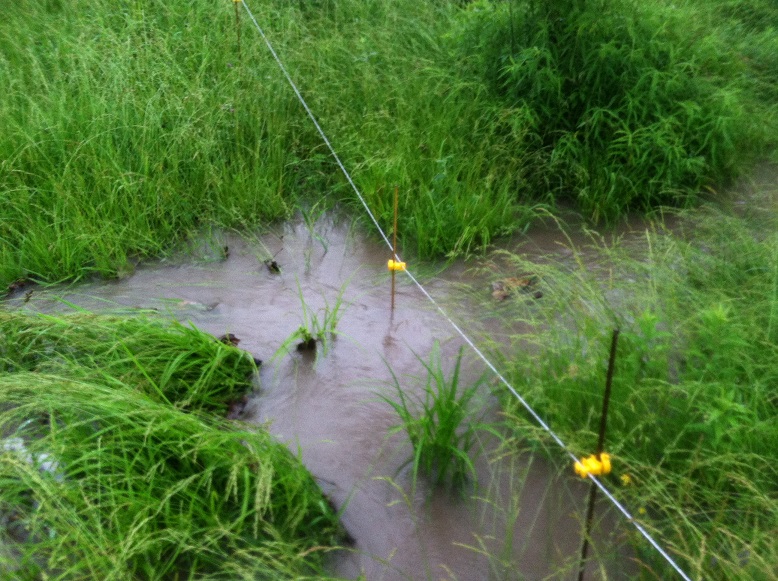
Further east the little wash is flooded and we are just about to lose our fence. I stop to adjust the insulator a little bit.

Flooding

This water is either overflow from the neighbor’s new pond or runoff from the eastern half of the alfalfa field. There is a dry dam on the alfalfa field that is making a huge sucking noise as the water rushes through the pipe. It was too dark in the woods to get a good picture but a dead tree was against the drainpipe and it was spraying water in two directions. There was a huge pool of water there. I’ll need to take some corrective measures to heal that forest floor. When I say “corrective measures” think cow hooves. Most of the green you see is poison ivy so it won’t be milk cow hooves.

DamDrainFinally I stopped by a mulberry tree for a snack, something I try to do a couple of times each day. Mmmmm, freshly washed fruit. I’ll get tired of eating mulberries in a few weeks…about the time I run out of berries I can reach. Mulberry trees will grow anywhere a bird can poop. They are tough plants, will take serious pruning, will grow from cuttings and make good firewood. They are all over the farm and I try to visit each one regularly. There are some deep in the woods that aren’t ripening yet extending the harvest season.

MulberriesLet me know if you got any of this rain too or if you have any ideas for preserving mulberries. I don’t care for them frozen and we don’t tend to make jelly. Wine maybe?

One additional note:

The chickens are a long way from the cows and have been for about 2 weeks. The chickens are currently housed in our portable layer houses. That design has worked well for the last year but has its limitations. We will be re-purposing those structures or the components. One severe limitation is the lack of portability over distance. We are moving to a new design on a wagon running gear so we can close it up and head down the road (cause we can’t cross the broken bridge). I have been delayed getting that project finished. Look for pictures soon.

Reap Your Wild Oats

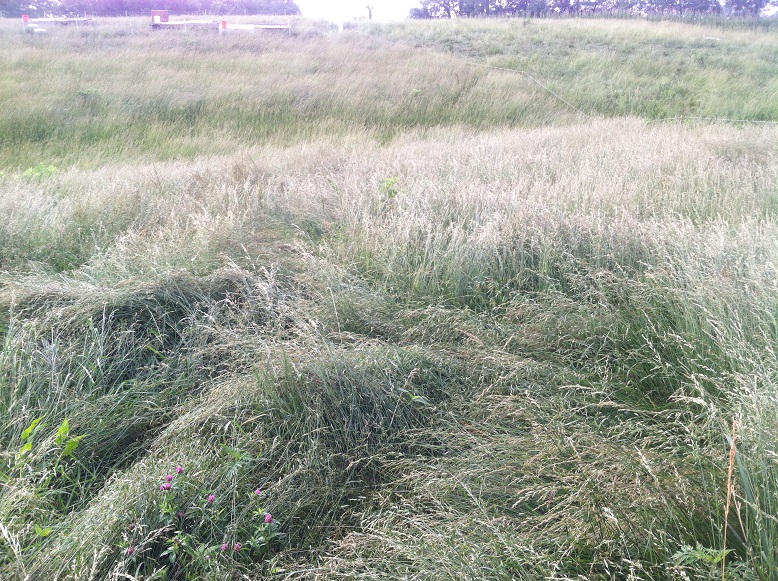
I have had quite a bit of offline discussion about dealing with fescue in our pastures. I don’t claim to know everything there is to know about fescue – in fact, I only know a little about my own pastures – but I do have some observations. I can’t bend the landscape to my will for any length of time. The best I can do is to observe, learn and play along as well as I can. I measure my success by increased drought resistance, healthier cattle and increased plant species diversity over time. But it takes time.

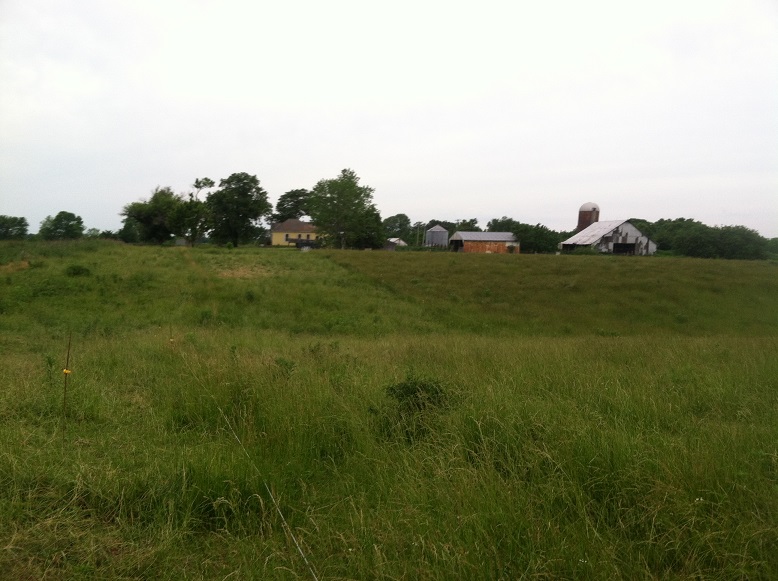
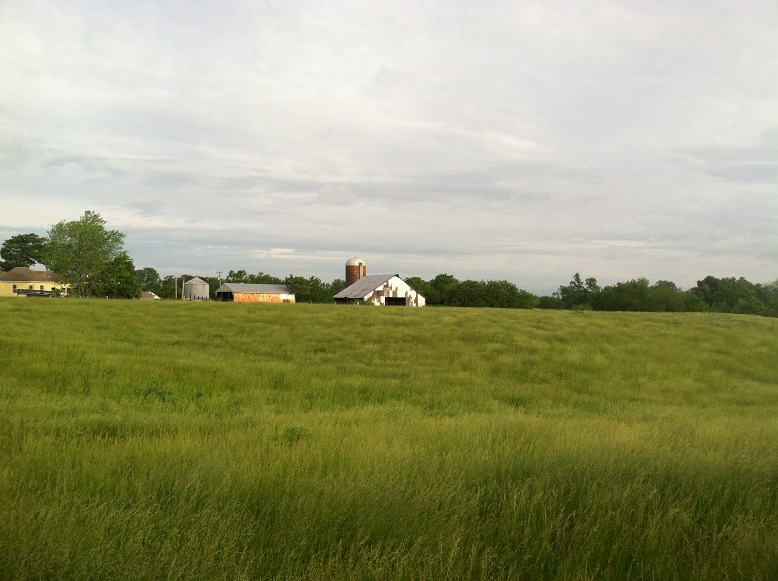
WideView

Let’s start with a paraphrase of what I have read concerning fescue.

If your cows graze fescue the tips of their tails will fall off and their hooves will rot off…it’s basically a starvation diet. Spray all of your fescue and replant to more desirable species immediately.

Yup. So. That’s what I’ve read. Other advice seems a little more reasonable.

Broadcast 5 pounds of red clover and one pound of white clover per acre in February to dilute the effects of fescue on your livestock.

That second paraphrase is much less alarming than the first but we don’t really do that either. There is clover out there already. There are other grasses too. The thing is, the only grass that has been allowed to grow to maturity inside the fence in the last X years has been fescue…because the cows eat everything else down to the dirt. Our strategy has been this: we don’t let the cows eat everything all at once. It’s amazing the grasses that are coming out of nowhere because of this crazy idea.

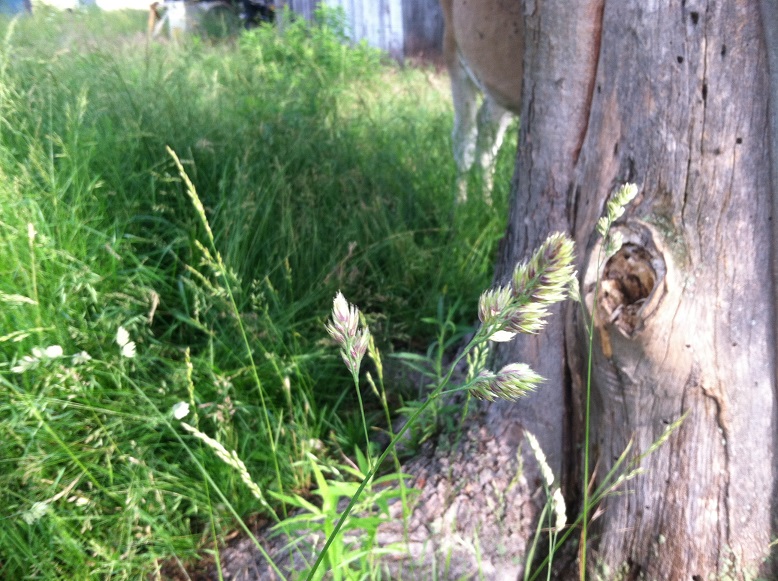
Salatin jokes that “cows always eat their ice cream first” meaning they walk the whole farm eating favorite plants first. If you just open the gates to the pasture and allow the cows to graze continuously they will deposit their manure mainly in favorite loafing areas. You’ll have cow paths everywhere on your property. Cows will walk acres and acres to find just that one delicious, favorite plant and will nip it off as fast as it will regrow. You can see it in my east 40. For years the cows would travel single file between the feed bunk, the pond (where they eroded the dam) and the stands of trees beyond. They would graze only favorite plants, leaving the others to dominate the pasture. There is a fair amount of white clover in our pastures. We took pictures of it last summer hugging the ground for protection from grazing animals. Red clover, as you can see in the picture above, is almost nonexistent. The only saplings that survive are the ones that are too thorny to eat.

By switching from continuous grazing to planned rotational grazing we are allowing plant species to recover. In fact, that’s the point of the planning…to plan for recovery of desirable species. Better than that, we are allowing a wide variety of species to go to seed…seeds the cows will spread as they move on to the next grazing area. It won’t take long and we’ll see red clover coming up in more of the pasture as the cows move the seeds around. The long recovery windows are allowing species we have never seen to emerge, survive and spread. I had never seen wild oat go to seed in the east pastures (not that wild oat is all that great but it’s better than fescue!)

Oats

I had never noticed orchard grass either but it’s showing up in big clumps.

OrchardGrass

And that’s not the end of it. In fact, the end isn’t the end of it either. It’s the beginning. That perfect cow pat shows that the cows are getting a balanced diet and are in good health. The cows don’t get a balanced diet from fescue alone. There has to be enough energy and protein. Looks like we’re doing good (maybe a little extra protein but…)

TheResult

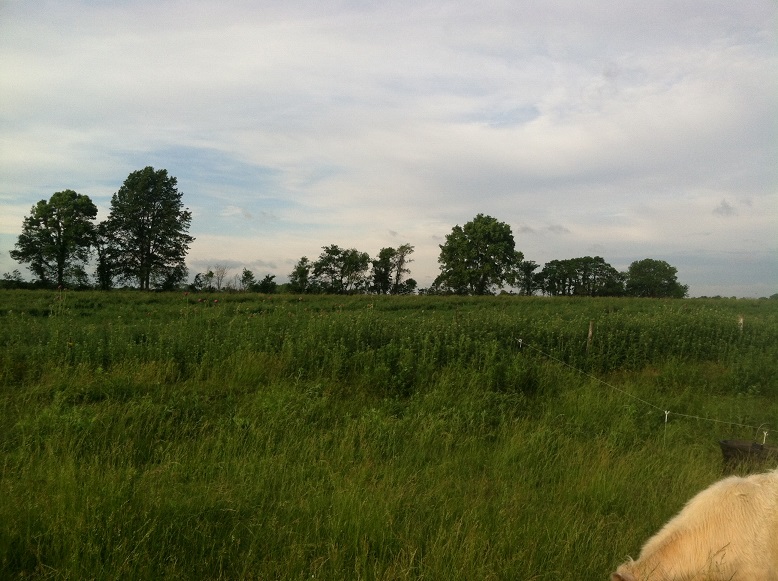
The fescue is the dominant plant in our pastures. No doubt. But as we decrease the amount of time animals spend grazing each bit of ground and increase the recovery between grazings we see an explosion of legumes…not to mention weeds. It happens over time. Gradually. Slowly. No diesel fuel required. I don’t need to buy seed. I don’t need to spray chemical death. I just need to manage for the resources I want.

And I think that last sentence is important. I’m managing FOR not managing AGAINST. Feel free to apply that to any part of life. Maybe there are better ways to get the kids to wash the dishes than to make yourself an adversary. Sorry to say, it’s the same with training animals. Manage for the positive. I want more than fescue? I don’t go killing fescue. I start allowing other species to compete…to go to seed. I allow the cattle to graze somewhat selectively, trampling what they don’t want.

FescueThe progression would happen faster if I had more hooves and mouths and higher density. We’ll get there. The cows are knocking down most of what they don’t eat currently. We will do better in time but this is a start.

RemainingGrass


This Week in Grazing

Maybe I should start a podcast with that title. (in my ample free time…lol)

It’s tough grazing out there to the east. The soil is dry and hard…not signs of health…not conducive to plant health or cow health. So the fescue grows a few inches tall and throws up a tall seed head and white clover grows where it can. There is a little red clover too but there is a lot of exposed dirt and moss. I need the hooves and claws (do chickens have large talons?) to break up the moss and manure and plant material to cover the soil with a protective blanket. Future grass will grow better and be sweeter.

GrazedAndUngrazed

You can see how much pasture the cows are just walking past in the picture above. The cows have grazed out the yummy bits in the left center of the picture, trampled quite a bit more and left the rest. I’m not running them at a high enough density to really impact the pasture at this time, I’m focusing on speeding them along about half as fast as when we were last here in April..55 days ago. I want the cows to get all the energy they can, leaving manure behind. At the current pace it will take me 120 days to cover the entire farm. That will be October 1. I can live with that.

EastPastureFescue

But there are large sections of my pasture where there is no shade. I’ll just skip those until fall, waiting for cooler weather. What I really need to do is add to my tree inventory. And paint that old barn. More on trees in a minute.

Alfalfa

There is a fence of questionable quality keeping the cows separate from the alfalfa field. I don’t particularly want an alfalfa field but you play the cards you were dealt. Complaining about the alfalfa field is a little like complaining about eating ice cream. Where the fence lies the cows can’t trample and manure so we have a nice forest of thistle. I could spray the thistle out. I could chop. I could do any of several things but I would prefer to move the fence north or south by about 10 feet and let animals do the work. There are only so many hours in a day and only so much I can do. If it would stop raining for a couple of days we could cut hay…but there I go complaining about ice cream again. Soon I’ll be wishing for rain…

Tomorrow

It has been hot out this week [Note: this post was written a week before it was published]. Not August hot but regularly above 90 with humidity above 70%. Some of our cows do ok with that, some pant and drool because they still have a winter coat. Those cows need to leave the farm. We have enough trees that I can section off a portion of a tree lot to give the cows a one-day loafing area in the heat. Then we open up new pasture for the cows morning and evening. The cows reminded me how important this is yesterday when it was 85 out and they were standing in full sun panting. I have to do better. On weekends I subdivide further but it’s not fair for me to ask Julie to roll up fence wire with all the other stuff she has to do during the week so we try to keep things simple.

Anywhere I stand on my farm I am surrounded by trees. Honey locust, black locust, a variety of oaks (shingle, white, burr, red, pin), shagbark and pignut hickory, hackberry, wild cherry, osage orange, redbud, walnut, cottonwood, black willow, sassafras, elm, mulberry, sycamore, sugar and silver maple, sumac, even a few pines and junipers, maybe a persimmon or pawpaw…all of these are valuable both for shade and as forage and many make great firewood and posts. The leaves are high in protein and tannin and the cows eat every leaf they can reach. The trees mine nutrients and water (I repeat myself) and contribute greatly to the available organic material in the soil. You would think I live on the prairie but there is a lot of forest in the river hills. Our goal is to maintain open savanna under a healthy canopy, not allow an overgrown tangle of fallen limbs, multi-flora rose and poison ivy to rule the forest. This requires managed disturbance (including chainsaw disturbance). The cows get in there, eat the good stuff, trample the rest and add a dose of bacteria to an otherwise fungal environment. Adding more trees to the open spaces and in greater variety will only make our farm more productive and help keep our cows happy.

This week in grazing I’m dealing with heat, rain, pasture health and tree planning. I know the time is coming when the heat will worsen and the rain will cease. I need to plant about 10,000 trees. That’s going to take a while…even if I could plant 1,600 trees in a day. But I have to be serious about increasing my tree numbers as my herd numbers grow.