Going on the Attack

I use these couple-times-a-week missives to tell you what’s happening on the farm, how we do something specific or just how much I love my wife. I really love that woman. I can’t think of a post where I’ve simply gone off about something someone else has done. It may exist. I hope it doesn’t. We depend on our customers and consider most if not all of them to be friends. I don’t complain about my customers nor do I expect them to worship and adore me for doing what I do. I depend on our suppliers and most if not all of them bend over backwards to help us even when we forget to plan ahead. I am related to all of my neighbors. If I have a problem with them, this sure isn’t the place for me to say it.

I see a lot of folks using Facebook or other social media as a place to complain loudly. I hear co-workers constantly complaining about X, Y or Z. The radio constantly harps about those derned Demopublicans. Enough!

Instead, let’s look at the pretty cows. Let’s make some hay. Let’s discuss books to help us grow as people. Let’s treasure those we love!

Kids

So that’s what I try to do…all while keeping it real…but from a “glass is half full” perspective. I am not a victim. I am responsible for my own mistakes. And I make plenty of mistakes. When I go on the attack, I go on the attack to correct problems here at home. Problems I have created or enabled.

The original incarnation of this post was, according to Julie, “…very real. Very raw.” I want to tread carefully here. I am only so willing to expose my own failures publicly…but that’s kind of the point of the post. Some of our failures just hurt too badly to discuss. I am not interested in bleeding in front of you but I think I can help you by telling you about a few old wounds. There is no teacher like failure and there is plenty of failure to go around on this side of the fence. There is no need to be critical of others. I don’t even have time to time to be critical of others.

I make it a real point not to attack other farmers on my blog. I may use other farms to illustrate points but I work hard not to do so in a negative way. Confinement and monocrop agriculture are the current reality. That’s how it’s done right now. That’s how we attempt to “feed the world”. I could use this platform to preach against acres and acres of apple trees but…well, who does that help? In general, the kind of people who bother to read this are already in the choir and the people who put in 3,000 acres of corn don’t read this blog. And all of us like to eat rice and beans…which are grown in big, monoculture fields…the very kind I would be complaining about. Besides, nobody wants to grow commodities anymore, there’s too much competition (sorry Yogi).

I don’t worry about other people. Instead I tend to be introspective. What am I doing? Why am I doing it? Why did I bother to get out of bed this morning? How well am I really accomplishing my goals? What did I screw up today?

I need to ship several cows that didn’t breed last year and a heifer that’s just a poor do-er. I torture myself will all kinds of questions about those girls night and day. Are they too thin? Do I move them enough? Give them enough pasture? Will the meat be tough? Will those customers return or will they hate me? (Please don’t hate me Chera!) Am I contributing to the bad name grass-fed meat has gotten? Did they fail to breed because of my management? Is the white heifer a poor do-er because of something I did? Would she be healthy if Steve had raised her? Yes. Then again, Steve loses calves sometimes.

WhiteHeifer

Hot weather is more of a problem for us than cold weather. We had some real problems on triple-digit days with layers and heat stroke a few years ago. We have had trouble keeping cool water available to pigs on pasture. We have cattle like the white calf above that did not shed out and would die if left in the full sun of a summer day. These were hard lessons we had to learn…and the education, at times, came at a high cost. There has never been a how-to book written about my farm.

Pigs

We have had freezers fail. We have also failed our freezers. We lost I don’t know how many pounds of meat when we didn’t completely close an upright freezer last summer. Not only did the meat thaw, it defrosted and drained onto the floor. Yuk.

This past spring we moved 150 Silver Laced Wyandotte pullets to chicken tractors. Good looking birds. They were in tractors for two weeks before it cooled off considerably and rained 4 inches. I didn’t even check the birds in the morning. They were on top of a hill, hadn’t been eating all the food we had been setting out, the birds were big and healthy and I couldn’t imagine them having a problem with the rain. I was busy that whole day and didn’t get there till the afternoon when I found 50 dead birds just laying there, drowned by a rainstorm or smothered by their peers and unloved by their farmer.

What about the three SLW pullets that were given to me by a little girl? She found out she couldn’t keep them in town and asked us to take care of them. A raccoon got under our fence and ate two of them one night. Dad and I took turns camping out in the field to catch the masked bandit but we never even saw him.

I have mountains of junk I need to get rid of. Old, broken barbed wire wrapped around posts, weeds out of control and trees I would rather you not see. I cut more firewood last winter than I could stack and some of it is still laying out where I cut it. There are tree tops around and in the way waiting to be burned or chipped. A tree at the yellow house fell down several years ago and guess what? Big chunks of it are still in the yard. We just work around it.

I don’t have to look across the fence to see failure. It’s right here at home. I don’t have to alienate my neighbors or prove my superiority to my readership. I would be a fraud and a liar. I am the worst farmer I know. So that’s what I work to correct. Every day. I hope I can spare the reader from making some of my mistakes. How silly would it be for me to point my camera across the fence or down the road at that other guy?

I don’t have time to hunt down the injustices of the world. I have to do better here at home.

I can’t waste time preaching about my dream of utopia. I just have to create it…even though I will make mistakes along the way.

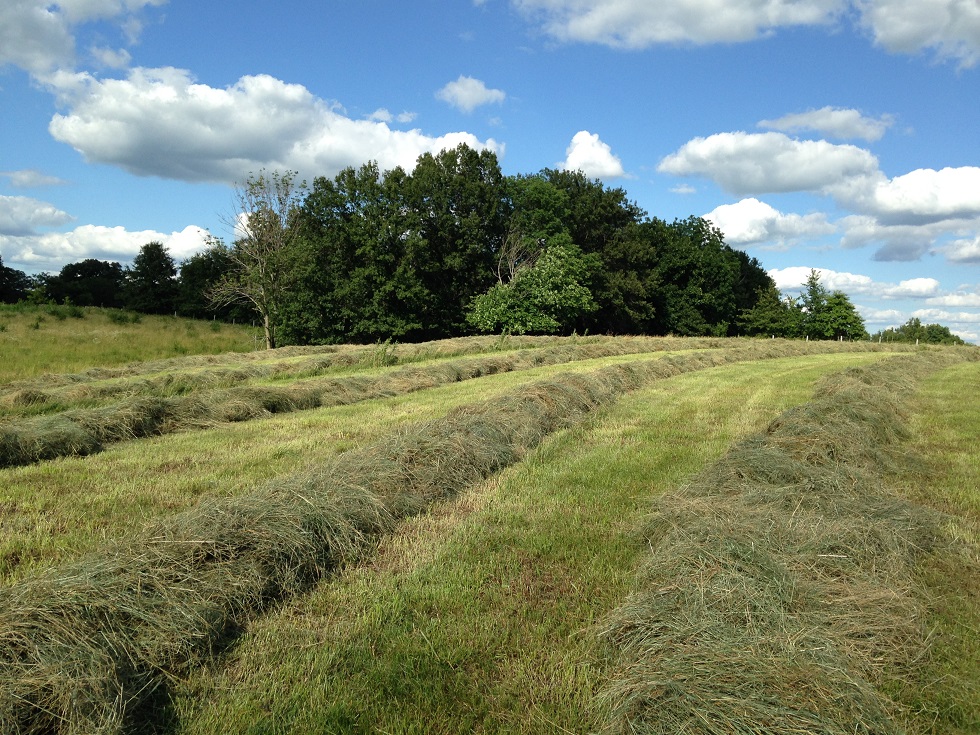
First You Cut the Hay

Well, first you check the forecast to see if it’s going to rain. Then you pray the forecast is right. Then you cut the hay. Then you wait (and pray some more). Then you rake the hay, twiddle your thumbs while it dries and you bale it all up and haul it to the barn. And it better not rain or else. If you have done everything right your livestock will eat well and the barn won’t burn down.

So let’s go through that more slowly. In four-part harmony. With feeling. This may not apply where you live. Find a local mentor.

We cut hay to the east of the farm over my lunch hour one Tuesday (as we usually do). It’s better to wait till later in the day so the brix in the forage is high. Dad had me take my chainsaw to cut tree sprouts so they wouldn’t damage the hay conditioner so I was too busy to take any pictures. Imagine a machine with an array of cutter teeth cutting through the grass about 2″ high and feeding it through a crimper. The crimped grass dries out more quickly then is left laying in a wide row behind the cutter. Swallows usually follow the tractor to grab the bugs as they fly out of the grass around the mower. You down? We leave that laying for a day or three until it is dry enough to turn.

RakingHay

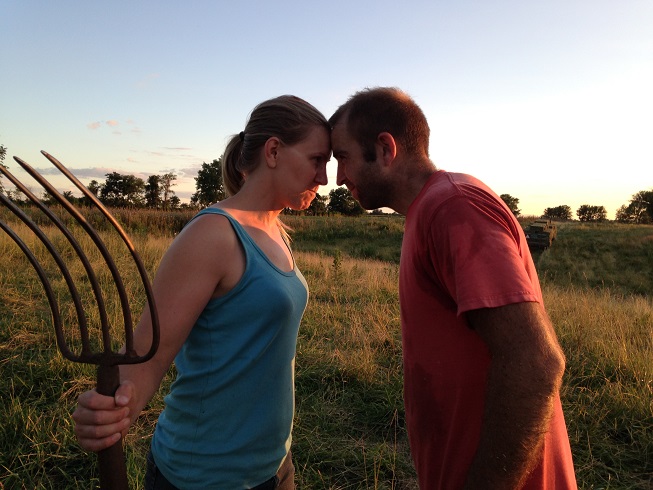
Dad likes to rake the grass hay into full-on double windrows (Whoa! Double Windrows! What does it mean?). By turning it we expose the grass that was on the ground that may not be quite dry yet. Dad makes double windrows so he can bale more slowly and have more room in the field. Maybe there are other reasons. We really don’t talk about it. In some cases the windrow is too wide for the baler so I usually keep a pitchfork with me as he bales to scoop up hay that was missed.

DoubleWindrows

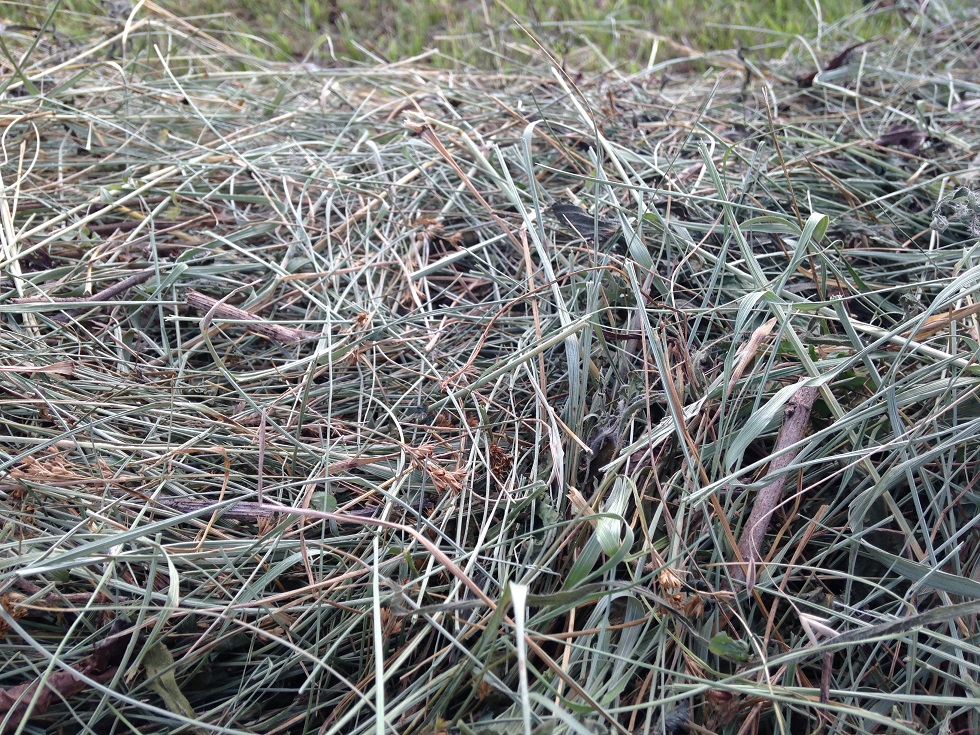
We are always in a bit of a pinch on baling day (in this case, after work on Thursday). We have to wait for the dew to dry off of the hay before we can rake. I spend a little time digging through the windrows looking for wet spots as dad rakes. I also think it is interesting to look at the variety of forages. We raked up some thick stems, some thorny things, you can see brown, leafy clovers, grasses, some goldenrod, once in a while a little plantain…it’s all here. That variety will be a good thing in the winter but it’s hard to dry out the thick stems without damaging the finer hay.

WindrowCloseUp

Then we have to wait for that (now) top layer to be completely dried out before we can bale it. But we have to bale it before the evening dew comes on. We have to get the bales up before they soak up moisture in the evening. There isn’t much standing around once we start and we have to be careful not to cut too much at once. This time we cut about an acre and a half. That’s enough for us. We have a 9-acre field to cut later in the summer. We’ll spread that out over several sessions when the weather looks right.

BalingHay

Dad ties in with the baler around 4:00. He made heavy bales the first pass as the hay was thicker than we had expected. After a bale broke he backed off the bale tension and cruised through the rest of the field. Sometimes bales just break (as did two others) but that can just be because of a weakness in the twine. The first bale that broke was a monster. Just a monster! We either feed the broken bales back through the baler or I just scoop them up later with a pitchfork and a trailer.

BaledHay

As dad bales I follow him around the field scraping up hay that the baler missed and adding it to the next windrow. My oldest son and I also try to double up the bales so we don’t have to travel so far when we come back later to pick them up. We could stack the bales right off of the baler but that makes me sneeze…lots of dust. Instead, we pulled two wagons behind the tractor. I alternated putting the bales on each wagon and the boy and the wife stacked. I suspect Julie will drive next time and dad will stack. Some of the bales were pretty heavy. It was pretty good hay.

Stacking

I was expecting to get 80 bales from this field. We ended up with 166. I didn’t have enough wagons for that much hay and we had to drive up and down a steep valley that prevented us from stacking high. We had to take two wagon loads to the barn so we could continue. Again, we had to get the hay off of the ground or the bales would absorb moisture. We are almost finished in the picture above and I’m breathing hard between bales. You can see how much time has passed by looking at the sun in the last two pictures. It is always a long, hard, hot day but it is so nice to smell that little dose of summer when you go to the barn in February.

Just a couple of additional thoughts:

  • We normally plan to put up grass hay on Memorial Day, July 4 and Labor day but this year has been late because of all the rain. Alfalfa is on a slightly more frequent schedule.
  • I am cutting hay in my pastures because I don’t have enough cattle to eat it all. I also don’t have enough cattle to eat all of the hay we are putting up. I hate to sell hay but…
  • I like to spread at least one load of composted manure on the field for each wagon load of hay we remove. Usually it is a mix of brooder litter, pig bedding, horse manure, cow manure and whatever else I can scrape up topped off with a layer of crushed limestone…all loaded by hand with help from that strong young lad in the picture above.
  • A neighbor was killed this weekend putting up hay. Be safe. I try not to cut hay on the slopes but there are any number of dangerous things I do in the field that I shouldn’t (walking between moving wagons or dismounting a moving tractor on a flat field). Dad and I have agreed to focus on safety moving forward.

Moving the Cows to Fresh Pasture

A reader recently asked if it’s a big deal to move the cows. Not really.

The cows were grazing along a fence line I have been working to clear on the southern edge of the property. From there I needed to move them back to the center of the property. We set up a temporary lane and walked them to the next spot. Julie led the herd and I followed to encourage the stragglers. Nobody yelled. Nobody got their blood pressure up. No big deal. It doesn’t matter that the calves squirt under the wire. They won’t leave mama. Everybody knows the routine. We are all well trained.

In this video they walk up the lane to the barnyard. We held them in the barnyard for a short time while we tore down and rebuilt fence. I had almost a mile of fence to tear down so it took a little while.

I had a similar situation Saturday morning when a calf knocked down a fence that wasn’t powered. The herd was scattered across a couple of acres. Once again, I just walked behind them zigging and zagging like a border collie, maybe a pat or two on the rump, and they went where they were supposed to. (then I powered the fence.) The dairy cows got out later on the same day. Different fence, not powered. So we really fixed the fence…all of the fence. At least moving them from A to B went well.

I enjoy working with my cattle…less so with other people’s cattle. I really should break down and buy a Bud Williams DVD. I know I need to get better.

Happily Ever After? After What?

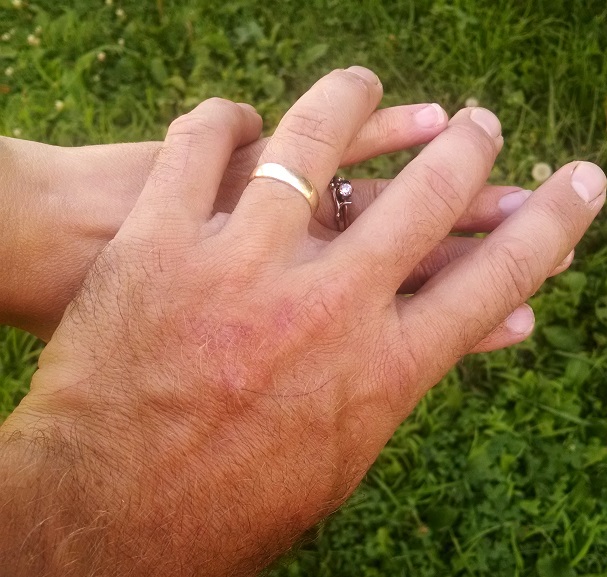
Oh Julie! It’s just like we imagined! Today marks 17 years of joy! I am married to a beautiful woman with superior genetic potential who passed her best traits to our offspring! You are married to a man who is smart enough to get a decent job and dumb enough to go to it every day. It’s perfect!

Hands

Remember when we were first discussing marriage? I must have been 18 at the time…so wise! So ready for life! And you, just a year younger and going to college with me. We wore matching Carhartt jackets. How sweet! We looked at rings and we set a date and we bought some major appliances and then before you knew it we were all married and stuff. And that’s when the magic is supposed to happen. The magic. The wedded bliss. Happiness forever! Remember that honeymoon we didn’t go on because we were flat broke? Remember stretching a $5 bucket of fried chicken for a whole week with a little help from Ramen? Remember when we couldn’t even afford the Ramen and that homeless guy heard us arguing in Aldi and bought us a package of sausages with his food stamps? Remember telling that story to Joe and Peggy who then showed up at our house with a box of groceries so we could eat? (That was the last time we had cream of wheat in our house.) Remember the fights? Remember the time you were so angry you punched the refrigerator? Remember when I worked as a janitor at night while still a full-time student and I didn’t sleep for days at a time (and I had to re-take Microbiology with Dr. Singh)? Remember when we were both so sick we couldn’t get out of bed for about a week in that house we rented with the rotten kitchen floor and the broken sewer pipe in the basement? That was exactly the picture I had in mind when you said, “I do”…and that was just the first year! Happily ever after!

You are still the girl of my dreams but it’s not always dreamy is it? You know, that odd day when the sink is full of dishes and there is nothing to eat and I notice only too late that we have run out of toilet paper. Those days I might wish the ever after was a little different. But that’s part of the deal. Part of living with another human.

And here we are. We still don’t have enough money. We still get sick every year. We still fight. We still go short on sleep. There seems to be enough food though (especially eggs). I’m ready for some richer…some better…some health. But I remain by your side. I love you. I love only you. This is so much harder than we thought it would be when we were kids but I’m glad I’m facing it with you. We don’t always agree but I know we are on the same team. Side by side. Equal partners. Friends.

I know 17 is not a big number but it is a big deal to me. I love you Julie boo.

Day 6,208 (Not that I’m Counting)

A couple of years ago I included a Heinlein quote in a post and a reader joked that she would like to see me write a sonnet. OK. I’ll give it a whack. But first let me tell you why I would write a lame sonnet and actually publish it on my farm blog. Because farming is hard. And I would rather have Julie than land. Better or worse, till death…my real mortgage is to Julie. I can easily get out from under my farm debt without dying. I probably wouldn’t even have to put up a sign. The reader should know that this post was originally written some months ago. Julie asked me not to publish it at that time as the wounds were still fresh. Our Seventeenth anniversary is tomorrow so I thought I would sneak this in today.

Angry

Maybe this has taken me more than 6,200 days to learn. Maybe I am just relearning this lesson over and over. I don’t know. But I’m writing it down today. Julie is my team mate. There are times she will take me for granted or forget to be courteous to me. There may be days she just doesn’t have time for me. But we are a team. We are united by a common goal…a vision. Not division. One, not two.

We have had some long days. Long. Days. Early starts, bit of housework till the sun rises, pack eggs if time allows, get bug bites while opening nest boxes and doing morning chores, then run in for a quick shower and change and it’s off to the office. Sometimes the office really takes it out of me. But it doesn’t matter to the animals. There is work to do when I get home. So I change into farm clothes and go out to build fence or cut wood or whatever chore is seasonally appropriate, coming in only when the sunlight fails. Sometimes there is no supper left for me. Sometimes there is a stack of dishes in the sink and a stack of books on the couch and Legos on the floor. I don’t know why but sometimes…on certain days…in certain moods I take the mess in the house personally. As if Julie is saying, “I know you don’t like this. I don’t want you here” when she’s really saying, “Holy Crap! I’m busy too!”

But the enemy comes to steal, kill and destroy. He wants us to feel isolated and alone. To be separated from our emotional support. Away from the immediacy of emotion I realize it would be so easy to just change my perspective slightly…to realize that I do half of the housework and I’ve been too busy to do it…so my half hasn’t gotten done. She has been too busy to pick up my slack. It’s not’s that she has been goofing off on Facebook and eating M&Ms. She has been working on the computer, occasionally checking Facebook and eating M&Ms. That’s totally different. (lol)

But let’s say she takes a week off, refuses to water the cows and demands to sell the farm. Then what? Do I buy her a little place in town and split the sheets? Do I keep her in her little house in town and visit her on Sundays? Nope. If she says “sell” we sell. If she says “move” we move. I love her. I choose her. For better or for worse. In sickness and in health. In farm or in town. Till death do we part.

She married a boy hoping I would someday become a man. I married a girl seeing the woman she would become. For 6,208 days we have changed each other and changed together. Sometimes I resist resent the change…and she does too. Marriage in real life looks nothing like I remember reading in the brochure. (Our old pastor was pretty honest with us about marriage emphasizing our need for continuing and balanced spiritual, emotional and physical development. Physical ran way out in front for a long time. 4 kids…)

I have painted a pretty bleak picture here…but there are bleak seasons. Julie and I are emerging from one right now and that’s just part of the deal. Our pastor says we are always in one of three states: Entering a storm, enduring a storm or emerging from a storm. I think that lines up with the idea of a refiner’s fire or a pottery wheel. I am still being made. Still being refined. Still becoming. And sometimes it really hurts.

But look at what we have become. Just stop for a second and look Julie! Holy cow. We still have the whole rest of the mountain to climb but let’s just pause for a second. Wow. Look how far we have gone. There were ups and downs. The views are great from the high points but the fruit is grown in the valleys. I know we have a long way to go but in just 6,208 days we have gotten here! I love you! Thank you for growing with me. I would not be here without you and I can’t go on alone. I need you and I mean specifically YOU. I meant it when I said “Better or worse”. The worse has been pretty bad but the better is pretty awesome. The season is changing. Due season is arriving! I love you. All that other stuff…it is behind us. We are here now. No baggage. This is us. We are here. We choose to go there. Together.

So I wrote 12 lines outlining the problem and two lines of resolution in iambic pentameter choosing the Shakespearean style. I mean, that’s obviously what people do, right? This both summarizes the issue and knocks something off of my to-do list. When it doubt, speak like Yoda you must.

I stood before the Lord and said my vow.
Since childhood through ups and downs we share.
But Heaven open up and hear me now,
For worse has got the better of my care.

Where is the joy, the love or passion’s cure?
Naive was I to think we could succeed?
My younger self believed to be so sure.
Today I stand perplexed on what you need.

Misunderstanding. Time alone. Regret.
Days spent nursing a hurt or simple slight.
Neglected. Love from times we soon forget.
Why won’t the other person make it right?

Today I choose to love my wife once more
As also she my failures must ignore.

OK. Let’s see how we measure up to ol’ Heinlein’s list today.

  • change a diaper – No problem.
  • plan an invasion – an invasion? Of what? Of local markets with fresh farm products? Check.
  • butcher a hog – Give me a break.
  • conn a ship – Do what?
  • design a building – Let’s design and build a house.
  • write a sonnet – Maybe not a good one but…Check.
  • balance accounts – Check.
  • build a wall – Check.
  • set a bone – Check. (Did it. My own broken arm.)
  • comfort the dying – Check.
  • take orders – Check.
  • give orders – Check.
  • cooperate – Check.
  • act alone – Check.
  • solve equations – Check.
  • analyze a new problem – Check.
  • pitch manure – Check.
  • program a computer – Check.
  • cook a tasty meal – Check.
  • fight efficiently – I guess so. Not much of a fighter but I understand the mechanics and am in reasonable condition.
  • die gallantly – Not really interested in dying. Hope it goes well.

Pasture Acne…er…Transition, Healing and the Return to Health

Have you ever tried a new shampoo and had your face break out? I have. For Pete’s sake I’m 37 years old. Can I stop having pimples now? Please?

Actually it’s worse than that. Have you ever switched from using shampoo to…to not using shampoo? Have you ever gone pooless? Some people have to go through a period of…adjustment. Your hair may be greasy for a little while. I used to use shampoo almost every day and my body compensated by producing an excess of oil to replace what I was stripping out. It took a while for that to level out. I also had to learn how to use the baking soda and vinegar, in what proportions and how often (not very often). It was both an adjustment of the environment/terrain and an adjustment in management. If I didn’t get all of the baking soda out I had this crazy Zach Morris ’90’s hair almost parted, almost spiked. (If you don’t know who Zach Morris is…go to the Google. The show was cool in its time but is totally unwatchable now.)

Same with food. It is not uncommon for people to try real food for the first time and have …well…a biological response. It’s amazing how well sauerkraut can clean out some people’s pipes…let alone dairy. If your internal biological terrain is engineered exclusively for Twinkies, double cheeseburgers and Coke, it may not know what to do with yogurt. Cut the caffeine and sugar out of your diet and see how your body reacts. If you are normal, your body will DEMAND caffeine and sugar by making your head hurt. The more disciplined of you may find yourselves divorced. Good luck.

If I leave an open area of my farm unmanaged for a length of time what happens? The grasses begin to surrender ground to pioneer species. Raspberry seeds will be carried in by birds and thorny canes will rise up as tall, stale, oxidized grass shades out new grass beneath. Same with honey locust pods. Squirrels will bury acorns and hickory nuts and trees will begin fighting each other for dominance. In a few short decades we’ll see a transition from grassland to forest.

IMG_20140618_132357

It really is the same thing in the hay fields. A monoculture won’t last. We have an alfalfa field that is speckled with weeds and grasses. Most folks spray their fields to stop the advance of “evil” but I tend to be pretty chill about it. The first step in recovering health (diversity) in my alfalfa field is the emergence of grasses. Why do I want an alfalfa field anyway? What do those new plants mean? Do they mean my hay will have less value on the market? Why am I selling hay? Do the grasses mean alfalfa weevil will have a hard time? Good. Does the grass mean my cows are less likely to bloat while grazing? Good. Does it mean we are putting roots in a variety of zones in the soil, building organic material and fertility over time? Good.

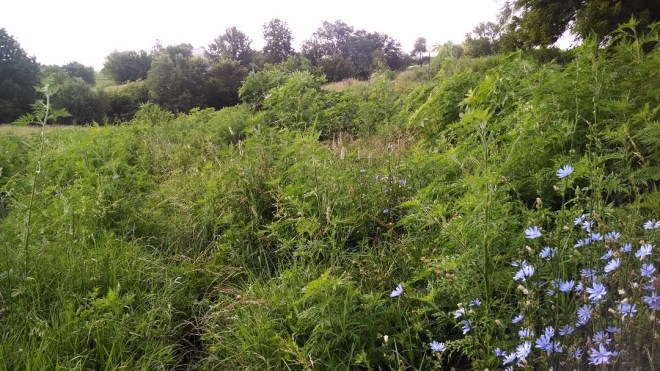
Our pastures are changing quickly. Plants are emerging that have not had the opportunity in …well, maybe in decades. It’s a mess out there; cow poop, matted, brown grass, muddy areas where the waterer sat for a day, flies. And that’s the good stuff. I have so many acres and so few cattle I’m having trouble grazing everything. Steve says I just need to speed up grazing and clip behind them. Ugh. The open, sunny areas where the cows can’t get shade are on hold until fall. Most of those areas have gotten little manure over the years. One in particular is a compacted mess as it was the travel path to and from the barn for years after it was the breeding pasture for the swine herd. You would not believe the weeds in there. While I see the weeds as a reparative mechanism (not the problem itself) I’m going to mow before those weeds set seed, allowing the biomass to accumulate as mulch for the layers to scratch through. Maybe I shouldn’t (Grandpa Tom said it costs $100 every time you mow) but I just can’t bear to see the mess…even if the mess exists to heal the landscape. I can manage for grass and eliminate thistles. I can manage for legumes and win the battle against ragweed (which makes the milk taste a little sweet, a little…I don’t know…like I remember of the milk that remains at the bottom of your Rice Krispies. Genus Ambrosia…which, as we remember from Greek mythology, makes one immortal).  After cutting the trees I’m going to mow to hit the reset button and allow other forage species an opportunity to grow free from the shade of 7′ tall ragweed plants. I could certainly let it run its course then allow the cows to trample it in the fall but…well…it ain’t pretty. Any way you slice it. So I’ll try to use the brush hog without spending $100 (Update: Fail!).

WeedyMess1

In the shady places the cows are eating poison ivy, ragweed and plantain. They are trampling the goldenrod. Those places have looked ugly for decades but things are looking up. The cows are making improvements. They even found a hawthorn grove I didn’t know I had. I had never been able to penetrate the poison ivy to see in there…even in winter.

WeedyMess2

The cows are doing great but I don’t have enough of them. Even if I did we would have to go through a transition period. There are huge portions of the farm that may not look that great for a while. I once knew a woman whose 3rd molar roots had grown into her sinuses. She had the wisdom teeth removed and her sinuses drained for the better part of a week. She just sat with her face hanging over a trash can. Sounds gross but she is undoubtedly better off. It just required a few days of ugly adjustment as she returned to health. Do I want pretty pastures or do I want healthy pastures? Healthy microbes lead to healthy worms. Healthy worms, healthy pastures. Healthy pastures, healthy cows. Healthy cows, healthy people.

Pasture acne is part of the return to health. Things are changing for the better…even if it looks worse for a little bit. I could sustain and mask the lack of health with a bottle of chemical but…let’s not. Let’s move forward, away from monoculture. Away from “hay” fields and toward health.

Above Average on Purpose

I originally wrote this post in September of 2012 but it got lost in the shuffle and I never published it. I also wrote another, similar post (short attention span) but I feel this one covers it from a different angle. As I re-read now I am concerned that I come across as arrogant. That is not my intention. Julie and I have a wonderful thing going on here. We had a wonderful thing going in town too. Just lucky? I don’t think so. I think we have made a series of choices that benefit our family and our goal in this post is to encourage you to evaluate your own choices. Oh, and I may just be fooling myself. If so, let me be.

SO, Mr. Steward. You say it’s all work. Work, work, work. You wrote a whole post last year complaining about the workload from a “glass is half empty” perspective…as if to warn others to avoid farming at all costs. So, why do you do it? Why bother?

Good question! We live in a world of scarcity.  At some point I’ll run out of pizza and coke within arms reach of the couch.  Then I’ll have to do work.  I’ll have to get off of the couch and either call someone to bring more pizza to me (work) or open the freezer, pre-heat the oven, unwrap the pizza (ugh!  More work!).

Click image for source

Either way, I have to wait 20 minutes and it costs me money. And that money has to come from somewhere. I had a “managing director” tell me once, “Just because you’ve still got checks in the checkbook doesn’t mean there’s any money in there.” (That was his way of saying I should be happy I wasn’t getting a raise. (I was not.(He may have been implying that the company was broke and I should start looking…(I did)))). So now, unless I have a generous benefactor, I have to go get a job to make money to buy pizza so I can sit on the couch and enjoy life. All this because pizza and coke are scarce. Well, everything is scarce. How do you choose to solve the problem of scarcity while maintaining a high quality of life? I do it by working my tail off…you know, cause it works.

I’m going to share some measurable things about myself and some that would be difficult to measure. Then bring it around to the point. You’ll understand more as you read.

My life is above average. I’m really rather ordinary but my life is above the norm. I’m above-average height, average intelligence, average-looks (maybe even below average) but I married well and am truly blessed and can grow a fantastic beard.

Christmas

Beyond the blessings I have made lifestyle decisions that have pushed me into the above-average category in a number of places.  This could still be true if I lived in the suburbs but somehow I wouldn’t be “me” – the way I am “me” here – if that makes any sense at all. The farm makes me “me”.

Among any group of 37 year old American men my health is above average.  I work harder than the average person and expect, in time, to be wealthier than the average person. My waistline is below average…which is good. I am stronger than average. I read far more than average across a broader than average range of subjects. I believe, based on experience, I can run 1/4 of a mile up a hill faster than average while carrying a dead 150 pound hog on my shoulder on a hot day in July or while carrying a live, struggling calf in October. These are objectively measurable things. But there are subjective things too. My happiness appears to be above average…at least above the average I have experienced and seen in others in my first 37 years (this may be measurable by the distinct lack of anti-depressants). I have more direction and purpose in life than average as a survey of my generation – many of whom seem to be sailing without a rudder. I think I’m more “me” than the average 37 year old guy is “he”.

This isn’t all a result of me living on the farm, though the farm functions as an outlet for me. It’s a result of living with purpose for most of my adult life. I haven’t begun to describe myself, just specific attributes that will help make my point. But what is the point? How is this applicable to you?

I’m not going to suggest that you sell your beautiful suburban home, move to the stix, home school your kids and start farming. Well, OK, I do suggest that but I admit it won’t work for a everybody. Well, it should be for everybody but it takes some convincing. Well, it takes a lot of convincing. So I’m not going to try to convince you in this post but I am going to get to a point in the next paragraph or two.

Behind your eyes is a person. The person back there lives inside a strange shell. The shell is not you. The “you” is inside…not outside. This becomes more noticeable as you age. “You” don’t age. The shell does. You may feel trapped in that aging shell. You may not know what you are doing in there…wondering why you can’t do cartwheels anymore. You may just be walking around daily following a set pattern for reasons that are not fully understood. Break that pattern. Begin by understanding your pattern.

Why did you get out of bed this morning? No really. Why? What was the point? What did it accomplish? Were you just going through the motions necessary to acquire more pizza and coke? I hope you are happy with your answer. If you are not, work to improve your answer. Find your purpose. Purpose! Do you watch TV when you get home at night? Is that what you want to do? What else could you have done with that time? What have you put off for years because you just can’t find the time? Is “Watching more TV” on your bucket list? What did you eat today? Why did you eat it? What happens if you ditch work today? Can you make plans to take some time off? Are you so enslaved by debt and lifestyle choices that you can’t? Is college so important that you should borrow $100k to attend? What does it cost you to work? Can you really afford for both spouses to work full-time? Will you ever be able to retire? What will you do with your time when you retire? Will your marriage survive retirement? There is a question living in the shell with you…nagging at you daily. What happens when you uncork your ears, listen the question and answer it honestly? Are you strong enough to do that?

Jeremiah 29:11 says I know the plans I have for you. Plans to prosper you and not to harm you.

What’s the plan?

I had a plan when I got out of bed this morning (I promise this will still be true even as you read this years later!). Did you have a plan? Find your plan. You could begin with a book like Sink Reflections. Fly Lady outlines a positive routine that may just get you in a pattern of accomplishment no matter where you are. That initial accomplishment (a shiny sink) may build the foundation for real purpose instead of just coasting. There is more to life than pizza and coke…more than Candy Crush and the latest episode of that popular reality show you talk about with the other people who are chasing pizza and coke. Go find it!

If we all do this we’ll raise the average. Then I could be more normal…ish. Maybe.

The Alarm Clock

Once upon a recent Saturday…

bing-BiNg-BING! bing-BiNg-BING!

“Ugh. It can’t be 5 already.”

It isn’t. Julie’s phone decided to announce a 30 minute alert for her 5:00 appointment to get up, study her Bible and make breakfast. Good job Julie’s phone. Good job me for putting Julie’s phone next to the bed last night.

Please, God, let me fall asleep again.

I can’t.

My eyes are too bleary to focus on the tablet we use for an alarm clock. After several attempts I log into my account to disable the alarm for the day then I lay back on the bed.

I don’t feel like I used to feel after a day of work. It was just 150 bales yesterday and they are still on the wagons. Is this “old” or just “tired”?

The weather says it’s going to rain today. Hot too. OK. I need to come up with a plan. A list. Things to get done. Then I’ll get up.

I need to spread compost where we cut hay. Hay. I need to stack the hay in the barn before it gets hot. Ugh. It’s already hot. Maybe it’s still hot. Either way, it’s hot. I wonder how much hay I can stack before Julie goes to milk the cows at 6. We are behind on dishes and laundry. I wonder if I have any clean clothes to wear today. We have an outdoor wedding reception tonight too.

Julie is still asleep. I don’t know how she does it. Maybe she’s just pretending.

I turn on the bathroom light so I can see, manage to find something to wear and start my morning routine. Then I slip on my boots and head out the door a few minutes after 5.

By 6:00 I have seen the livestock, stacked first wagon load of bales that were in the barn from last night and loaded another 30 from the back of the pickup. Just another two wagons between me and the finish line. Before stacking the bales I just put in the barn I return home to get Julie, the milker and the cooler. I can’t help but smell myself as I drive the truck. What a way to greet my wife in the morning.

alarm clock chickens 2

“You ready to go Boo?”

The oldest boy is coming too. Thank God.

I’m down to two wagons of hay to unload. Dad showed up early and the three of us got everything loaded and stacked by 8.

I need a glass of water.

The oldest daughter is making quiche for breakfast. It won’t be ready for a little while. Well, I better get at that horse manure.

After a little work I get the spreader out of the barn and parked next to the manure pile. No sooner than I get started shoveling dad calls to say a man is coming in 20 minutes to bid on building a pond. I just keep shoveling compost until they roll up.

I need a glass of water.

We drive out to the pasture and I point to the old pond with a failing dam. I also point to a new location where I would like to build a dam. They spend about an hour talking while standing in the full morning sun. They take some measurements, ask about a few options and he references a table to determine the cost.

Ho. Ly. Cow.

pasture

Back to shoveling manure. The oldest boy is helping me now. He needed a little breakfast before he could do much of anything. He’s growing like a weed. At 13 he’s as tall as I am. Kid’s going to be a monster.

Dad has a lot to say about some folks from his church who were recently in Africa. “Should we be shipping rice from Arkansas to Africa or should we be teaching them to grow their own?” Along those lines, our conversation frequently drifts to wealth. Are the wealthy obliged to the poor? What can we do to help the poor? How can we build and preserve wealth while respecting others? That’s a funny conversation to have while shoveling rotted horse crap into a rusty, broken down manure spreader on a 100 degree Saturday morning.

Am I wealthy? Is this wealth? Will this activity help make me wealthy someday or am I wasting valuable time working too hard for too little return? I guess it’s a matter of perspective. Am I doing this because I’m rich or am I doing this because I’m poor.

I don’t know. Depends on who you ask I guess.

alarm clock cows

I need a glass of water.

It’s not that I don’t drink water. It’s that my cup keeps getting empty. I bet I’ve had at least a gallon of water today and it’s only 10:30.

We top off the manure spreader with a layer of crushed limestone and head off to spread in the pasture. The plan is to work from the outside in, moving slowly for good coverage. I don’t even get 10 feet before the manure spreader breaks. The shaft that drives the beater has worn through under a wooden bushing.

We’ll have to drive back to the house to weld it up again.

Good. I need a glass of water.

Dad is a better welder than I am. That’s saying it too gently. Dad can weld. I can watch the welding rod spark and spit and make little piles of goose poop. I fill up on water and turn the shaft as he welds around it. We are using a stick welder on rusty metal so he has it turned up pretty hot. Dad burns through the shaft once…then again. Toward the end we’re really just crossing our fingers as he sews up the holes he made. Really, we should remove the shaft and replace a section but…well…let’s try it.

By 11:30 we have successfully unloaded the manure spreader and have positioned it where I can shovel a load of pig bedding for the same field. The pig bedding is in a shaded building. I snag a little lunch (the quiche) and a lot of water then dad and I chat while loading the wagon again…one forkful at a time.

I’m starting to feel tired.

By 2 we have that load on the field.

I need a glass of water.

Dad goes to his house, I go to mine. Remember that conversation about wealth? Running water is wealth. Cold water, running out of the shower is a blessing beyond description. The water feels cold as it hits my head but warm as it runs down my back.

Water is wealth. I need to save my water. I guess I’ll build the pond dam.

Dad calls and asks if our house is on fire.

“No, dad, it’s not.”

“Well, where is the smoke coming from?”

“What smoke?”

“Look south.”

The neighbor’s machine shed was on fire. The fire department kept things lively for a couple of hours as trucks with water tanks zip back and forth from town. Nobody was hurt. The neighbor lost a couple of tractors, some equipment and a lot of hay. We stop by to express our concern as do most of the neighbors. Nice living in a small community.

I’m not entirely sure what to do with myself now. Some new books came in the morning mail but I can’t seem to get myself excited about them. Looking back, I really don’t remember what I did between my shower and the reception. There are two hours that are just missing. Somebody got the eggs and checked that the stock all had water and then it was time to go.

alarm clock chickens

The reception was nice. Way out in the woods, a little music, a little BBQ, a little to drink. We saw an old classmate, some old friends and made arrangements to buy a few pigs the next day from Mike. It was really nice out there. Giant trees, a slight breeze, More food than we could eat. Kiddie pools full of water, soda and other drinks. Cake, pies, homemade ice cream. Thinking back to my conversation with dad, I don’t know what “wealth” looks like but what more could you want?

Then the storm arrived. We watched it roll in on radar and hopped in the car just as it arrived. It looked like it was going to be a pretty quick storm. I chose not to total tee at the reception so Julie drove us home. In the rain. Fortunately the storm was moving from north to south and we were able to get ahead of it most of the way home. We left the party in the rain then as soon as we walked in the door the rain hit our house.

It was not a quick storm but the lightning abated.

The chickens are in a new house and haven’t learned to roost inside of it yet. I need to go tuck in the birdies so I can move them to fresh pasture tomorrow morning but the storm won’t let up. I just have to do it. I just have to do it. Julie goes with me. I love her.

The birds are all roosted by 9:30. Not an easy chore to wrestle each bird in the mud and carrying it to the door of the coop. The rain still hasn’t let up. I hadn’t realized my rain coat had so many leaks. I’m soaked to the bone. I just spent two hours in the mud and chicken manure to convince a flock of chickens that it was bedtime. I must be wealthy. Maybe just stupid. Maybe wealthy enough to afford to be stupid?

Another shower and it’s time for my own bedtime.

I just closed my eyes and I hear it.

bing-BiNg-BING! bing-BiNg-BING!

“Ugh. It can’t be 5 already.”

Adventures in the Jungle

I had a number of things to do Thursday night after dinner and with Julie away for the evening I thought the kids and I could go on a little adventure. I needed a couple of poles for chicken roosts, we were hoping to transplant a pawpaw tree, the last few eggs needed to be collected and the cows needed fresh pasture. It so happens the pawpaw thicket is right next to a stand of tall, thin maples on dad’s farm but we have to walk 1/4 of a mile through the brush and weeds to get there…the jungle!

We better have a little snack before we go. Along the road by my parent’s house we spy some ripe candy. We shoved a lot of berries in our faces before I even thought to get the camera out.

Raspberry

Then it was on down the road. 8′ tall corn to the right, 6′ tall ragweed to the left.

Ragweed

On and on we travel. Deeper and deeper into the thick. Not much poison ivy but here and there it grows against the corn forcing us to blaze a new trail, often pinched between the corn and the steep stream banks. You can see mud on leaves showing how high the water was for a recent flood.

Stream

But we must go on. Just a brush axe, chainsaw, helmet and four children. Four children? “Everybody here? Count off.” No count.I arrive at the edge of the stand of maples. This is the place. The kids are somewhere behind me. They’ll catch up when they hear my saw.

MapleStand

Just inside of the edge everything opens up. It is amazingly open in here with a canopy like a hard ceiling…like we are inside a building. Surprisingly cool too. But the mosquitoes are thick. Dad would prefer to remove the maples entirely and reclaim the field. I would like to coppice the stand. These soft maples will coppice well enough but really don’t offer much utility. The wood does not last and has a low BTU value. Maybe I can find a use for it. Maybe I can shift away from the maple and toward the other types of tree growing here; walnut and hackberry. Maybe I could make rustic furniture…lol.

MapleStand2

With my poles cut it’s time to walk on to the pawpaw thicket. I don’t think the kids have ever been here. I have come here a couple of times each year since 1993 but I have never picked a pawpaw. I think the raccoons get them all. There must be a hundred pawpaw trees growing here.

pawpaw

After a bit of searching we find a small shoot coming up from a root. We cut about a foot of root on either side of the cutting and begin the trek back to the road. Everyone was bug-eaten, tired and dirty but we had a good time. With the kids, tools and poles loaded we head down the road to finish up our chores…after a brief stop at a mulberry tree for some more candy. Maybe when I have grandchildren we can pick pawpaws in the yard but it probably won’t happen before 2020. Worse, I really should go back with a shovel and get a couple more trees. Another adventure awaits us!

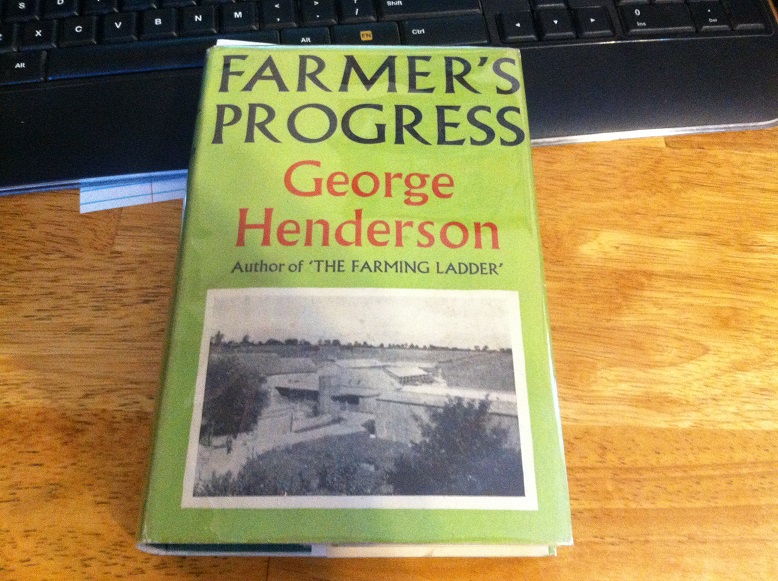
Farmers Progress Chapter 8: The Management of Livestock

This is the continuation of a series as I read through Farmers Progress. The goal here is to jot down my initial reflections of Mr. Henderson’s works, not to republish his work. I do include a few quotes but I try to keep them short. I highly encourage the reader to find a copy of this book. It has changed the way we are approaching things…and how we filter incoming data. Just keep in mind, the focus of these books is entirely on efficient production of the highest quality products, not on marketing. I fear what I could produce if I followed Mr. Henderson’s advice to the letter. Not only would I have to quit my job, I would have to hire a marketing team.

FarmersProgress

Mr. Henderson begins this chapter telling us that, of all the things he does, looking at livestock is his chief interest and pleasure. Then he starts in about his own animals.

Poultry is the most important stock on our farm, from the point of view both of finance and the maintenance of fertility, though it makes possible heavy stock with pigs, cattle and sheep, to such an extent that most farms carrying as many animals in one or other class might regard themselves as a pig, cattle, or sheep-breeding farm.

It is important to note these aren’t simply egg flocks. These are parent flocks for hatching eggs and for raising cockerels for meat and pullets for replacements and for other producers. He next reflects that he can pick birds from their own lines out of other farmer’s flocks because of the familiarity they have with their own chickens. Not only has he bred a closed flock successfully for decades, he has reared them successfully as well. Then he offers a few tips for raising birds:

…we never saw any virtue in running chickens out in a biting wind and a few inches of mud early in the year. They will survive but it confers no lasting benefit when compared with the conditions of those reared in the more genial climate of a large brooder house, with plenty of fresh air and controlled humidity, and of course in equally small units.

and later

With laying stock, large, well-littered houses seem to provide the best conditions for winter production, especially if the eggs are required for incubation. The so-called deep-litter system works well in a dry winter, but when the weather is mild and damp there seems little virtue in leaving the litter in…

I enjoy our chickens. I really do. Most of the time. But I can’t begin to imagine the kind of work Mr. Henderson describes…a 1,700 bird breeding flock, raising pullets, raising cockerels for meat, culling breeding stock and maintaining separate breeding lines, collecting eggs, feeding, watering, moving portable houses and hatching 1,000 chicks each week on top of everything else. I just can’t imagine it. How did he market all of that? How did he sell cull hens, day-old chicks and 650 dozen eggs each week?!?!? But I agree that poultry are a solid foundation on which to build fertility.

IMG_20140626_104045

Stop watching! I can’t do this when you’re watching me!

I totally agree with him that the birds are more healthy when sheltered from the wind, rain and cold and Oxfordshire doesn’t get nearly as windy and cold as it gets here. We move our birds to a deep-littered greenhouse for the winter, collecting the litter for later fertility. This year the birds were indoors from January through March. Next year we will probably move them in a little sooner. I have a lot to learn about providing for the needs of our birds. We went through a short spell where our whites were very runny. Apparently this is caused by a build-up of ammonia. Maybe, as Henderson suggests, I would be better off removing and replacing bedding instead of just adding more and more. We used sawdust this year because that’s what we had. Next year I would like something a little more course…something that will not clump and mat easily.

Beyond fertility and bedding, Henderson gives insight into how to feed the flocks and lists how to modify the ration to use substitutions. The man fed a lot of potatoes during war rationing.

Up to 50 per cent can be fed in the rations, although it will take 4 oz. of potatoes, 1 of meal and 2 of grain as a minimum to keep a bird in full production and the meal will need to be up to 20 per cent protein, unless the birds have access to short grass and insect life on free range.

See? I told you. Buy the book.

From here Henderson offers a few notable quotes on British dairy practices of the time. We have two Jerseys of our own, Flora and May. Flora is beautiful, light colored and fattens easily. She gives a lesser quantity of creamy milk than does May and she can be a real pain in the rear. But she’ll mostly tolerate handling well. May, on the other hand, is dark, tends to be thin and gives a large quantity of thin milk. She has stated clearly that she is not a pet and she only comes in to milk because we offer her a snack. And she can be a pain in the rear. But they are our cows and they calve every year. The calves are much more important to us than is the milk…the milk is close to worthless actually when you account for labor and facility usage.

You can force a cow to give a high yield for a few lactations, or you can be content with a moderate yield over a period of years and of course many more calves.

And that’s the goal. We share milk with the calves, feed some to the pigs and cats and bring home around 2 gallons each day. They bred easily as heifers and calf without difficulty each time. Hopefully we’ll get 8 or 10 more years with them.

jerseys

That’s really all there is to say. But then Henderson calls the whole thing into question with this beauty:

The greater part of British dairy farming requires 5 acres to a cow, and even [then] a lot of concentrates, to produce an average of something under 500 gallons. If half that land were devoted to growing corn for pigs and poultry we should be self-supporting not only in potatoes and milk, as at present, but in bacon and eggs.

IMG_20140625_214440

And so the chapter goes. Pigs and sheep are next on his list. Pigs are a source of valuable manure, sheep are essentially without monetary value but do a good job adding manure and cleaning up behind other stock. Both sections offer the reader numerous tips and feed suggestions and are worth reading…if for no other reason to encourage the reader to grow fodder beets. He closes the chapter with this:

…it does sadden me a lot to see all the wonderful opportunities which are being lost to make our country once more the stockyard of the world. It could be done by each individual farmer making just one little effort to do a little better…

And there it is. We, in the US, could easily be the stockyard of the world. Also the forest of the world. Also the fishery of the world. This is the day I will make an effort to do better…even if just a little. I hope you will pledge to do the same and will encourage me with your success stories.

Updated: Changed my phrasing about sheep near the end. In the original post I reported Henderson saying “sheep are essentially without value”. That’s not what I meant to say. Mr. Henderson clearly cherished being a shepherd, treasured the contribution the stock made to the farm but acknowledged that the whole crop of lambs brought less money than one heifer.