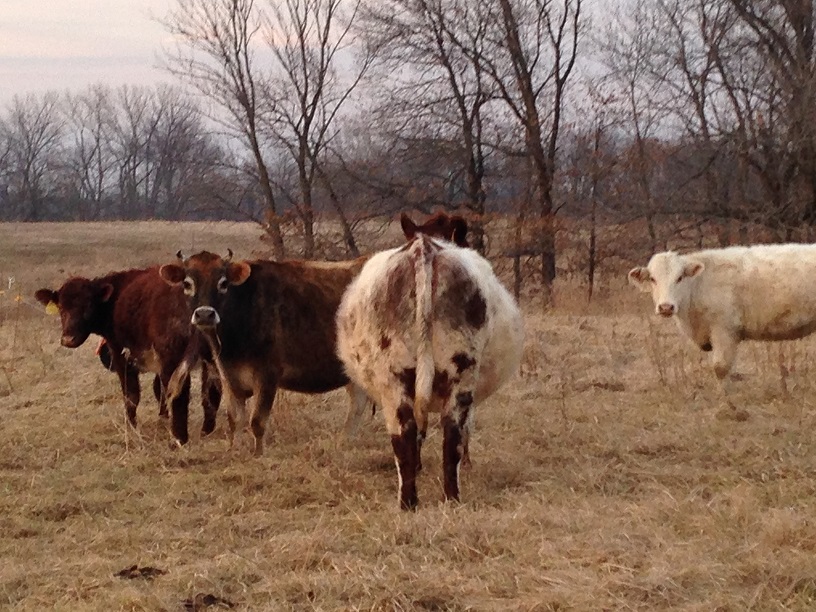
Reading Journal 2015 Week 15

Res Rusticae.

I read the first book in this series this week. What a treasure. Before I dive in and begin quoting, I want to pause. I wish I could read Latin and Greek. This translation was enjoyable but I have to wonder what I’m missing. Let me give you an example. “Why didn’t the skeleton cross the road? He didn’t have the guts.” Now let’s imagine the punchline in translation. “Because he lacked the intestinal fortitude.” The joke falls flat.

I can’t imagine hearing Shakespeare in its original Klingon. Much ado about Nothing….or Noting. Play on words. Does that work in translation? Dunno. Am I missing anything by reading ancient books in translation? Dunno.

Drives me bananas.

With that out of the way, let’s start in the middle.

In the first place, agriculture is not only an art but an art which is as useful as it is important. It is furthermore a science, which teaches how every kind of land should be planted and cultivated, and how to know what kind of land will produce the largest crops for the longest time.

It’s fun to read the agricultural works of empires past. The Romans, just as the British, recognized the need for order but also made allowances for variation based on climate and conditions. Fences vary between regions in Italy. Look at the regional differences between hedge laying across England. Heck, Henderson drew a line from Somerset to York saying if you lived north and west of that line, raise livestock. If you live South and East, raise crops. Henderson’s words were probably not so cut and dry but that’s basically what he said. Even within that oversimplification of Henderson’s words there was some gray area but it’s a guideline for assistance in determining where you should buy land for the type of crops you want to grow.

Books bring the past to the present. Books are created by people with wealth and resources and sometimes even by people with knowledge. A key to enlightenment, I think, is being able to say, “I don’t know.” It appears that the current culture is afraid of variation. Afraid of regional differences and leaving out artistry and judgement. “Just put your cows out on grass and move them around each day” is terrible advice. “Add chickens to boost fertility. Dig swales, plant trees on contour.” But that’s how we do everything. Democrats and Republicans. Cardinals and Cubs. No middle ground. Nobody saying, “You know, tetanus vaccines make a lot of sense but maybe there’s room to question the efficacy of flu vaccines.” Nope. Now I’m anti-vax. Similarly, “Never, never, never use chemical herbicides. Those are 100% pure evil.”

Maybe they are evil. Maybe you could change the world putting pigs on pasture in November. You might change the world. You might. Maybe for the worse. Res Rusticae is written as a transcription of a group discussion of agriculture and a survey of prior literature on the topic. There are allowances made for regional differences. The writers are willing to say, “This may not work here.” And that’s OK. The writers were willing to discuss and think. I also think they were willing to be wrong and to cut their losses when they made a mistake.

The farm which is healthiest is the most valuable, for there the profit is certain. On the other hand, on an unhealthy farm, however fertile it may be, misfortune dogs the steps of the farmer. For where the struggle is against Death, there not only is the profit uncertain, but one’s very existence is constantly at risk: and so agriculture becomes a gamble in which the farmer hazards both his life and his fortune.

They go on later to write that if your land is unhealthy you should sell it and get out. If you can’t sell it, give it away.

I made an emotional decision when I bought my land. I was not rational. I made a mistake. That’s hard for me to admit. I’m too far from my customer base. My land is marginal at best. My slopes primarily face north and are far too steep to be useful. The second story windows on our house leak when it rains, the septic tank smells and it’s impossible to heat the house. I have too many buildings, all in disrepair and, as the book points out, those repairs come out of the profits. But it’s my family land. I just wanted it. That’s bad business. And, let me tell you, it affects morale.

A better business decision may have been to just stay in town and replace my burning bush with blueberries. Plant productive plants in place of ornamentals. Sell surplus produce from my yard. That would have been so much easier! And with faster internet!

“Is not Italy so covered with fruit trees that it seems one vast orchard?”

If only Illinois were so planted! But I wasn’t happy with a quarter of an acre. I wanted 60 acres. I can’t plant 60 acres. I spend my days working to pay for 60 acres. There just isn’t time to manage it too. Let’s listen to our author on this topic:

The Italian farmer looks chiefly for two things in consideration of a farm, whether it will yield a harvest proportioned to the capital and labour he must invest, and whether the location is healthy. Whoever neglects either of these considerations and despite them proposes to carry on a farm, is a fool and should be taken in charge by a committee of his relatives. For no sane man is willing to spend on an agricultural operation time and money which he knows he cannot recoup, nor even if he sees a likely profit, if it must be at the risk of losing all by an evil climate.

How’s that sitting? Illinois climate is good. But the business climate is questionable. I have a variable interest rate. Things could go south quickly. Is my family more healthy running over the hills, swimming in the ponds, working side by side? Absolutely. But are we stressed by the pressures and the distance from work and church and customers? Absolutely.

I should be taken in charge by a committee of my relatives.

They tried.

Again, I made an emotional decision. We ***WANTED*** a farm. Wanted. Didn’t need. When we lived in town I was able to save nearly half of every paycheck. I had free time galore. We could read, walk, visit, participate in activities around town. Now? Not at all. The money is all gone. The time is all gone. We are skinny and strong and tired…and maybe that’s good but, well, we’re tired.

The purposes of agriculture are profit and pleasure.

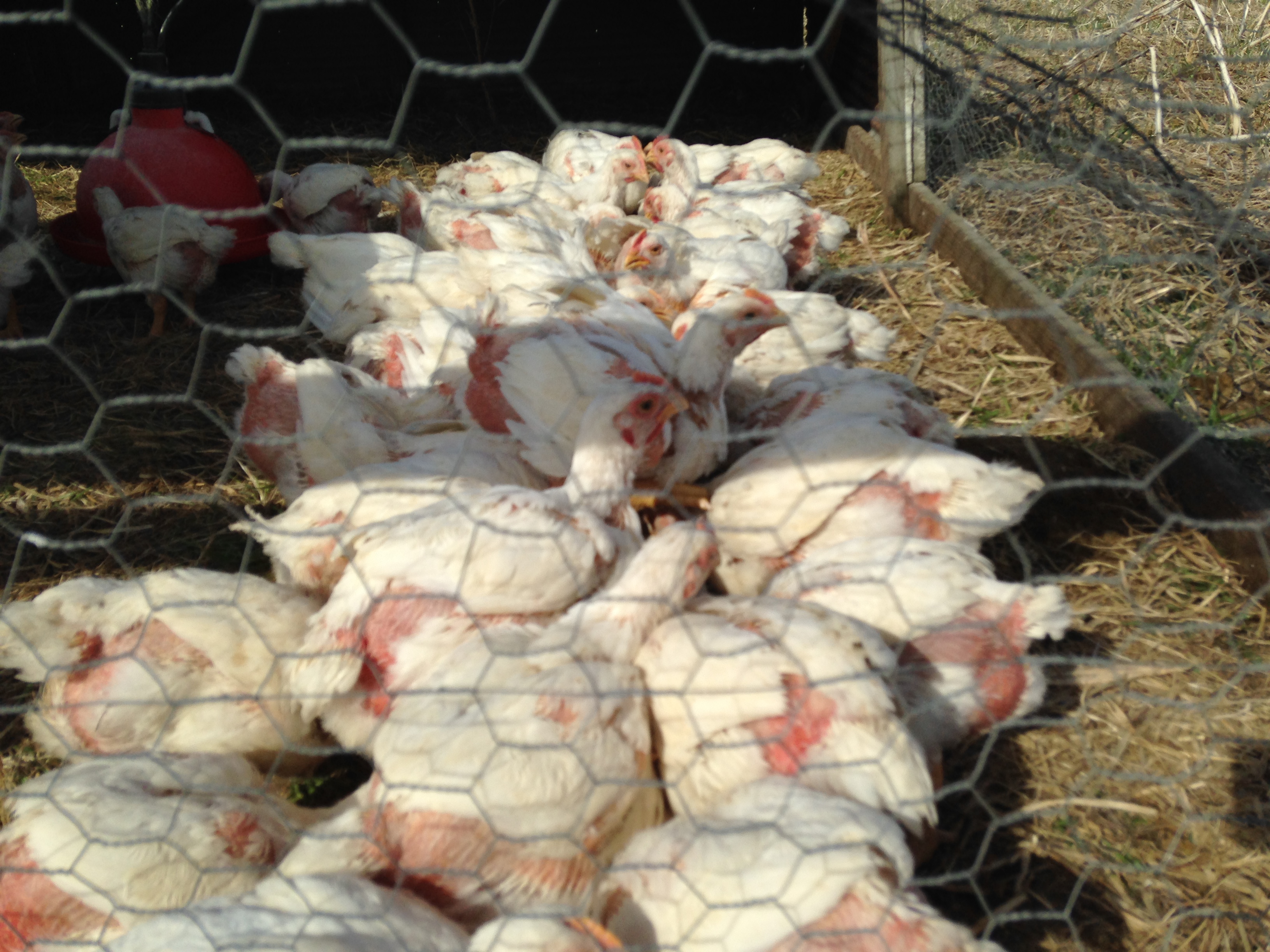
I think it’s safe to say we are having fun out here. I sound a little down in the paragraphs above. But doing my taxes this spring was a slap in the face…as it is every year. Some friends from church came over yesterday to help us butcher 100 broilers. That was a fun day. Really. I’m tired and sore but everybody had a chance to do every step along the way. We had some laughs. We had time to chat and visit. We got the work done and sent our friends home with a load of chickens for themselves. We profited by our association with them. I hope they profited by their association with us. I hope everybody came out ahead. But financially? If I had to butcher and market chickens every day? I don’t think so. Not at $3/pound.

And maybe that’s a good summary of my frustrations. Low interest rates have driven up asset values. Market intervention has driven down food prices. I have to pay too much for land and charge too little for produce. I’m goosed at both ends by a system I can’t control. And I live an hour from my primary customer base.

The current financial market has to be weighed along with other factors when choosing the right land for your profit and pleasure and health. Emotions are poor counselors.

Do you really want a farm? Or do you want productive land where you can be happy? Maybe the latter option is in your own back yard. Maybe you need to move to a healthier environment. But don’t let your emotions carry you away. Farmers in the ’80’s were driven by fear to buy more and more land at seemingly any price because, “They aren’t making any more of it”. What is driving you?

Update:

Julie and I were discussing and I’m worried that I sound regretful in this post. I am not regretful. I’m happy to have the farm. Given the choice, I would almost certainly do it again. Our farm income situation is largely a result of our laziness and lack of experience and marketing reach. My goal in this post was to reflect on my motivations and to measure to what extent I have achieved success toward our goals. It’s fun to read Romans talking about what defines a Roman…and to strive to adhere to Roman ideals. What defines a Jordan? Are we emotional or reasoning or prayerful? Are we regretful? Filled with self-doubt? Or are we confident and able to continue striving forward whatever the obstacle? Well, maybe I’m not the man I would like to be. Maybe I have doubts. Maybe that’s OK.
Reading Journal 2015 Week Whatever

OK. I finished Adventure Capitalist. In fact, I finished it this morning. I was laying awake in bed, thinking about all of my many failures and decided to read the book instead of continuing to wallow in self-pity.

Really, I am a very blessed person. But MAN! do I screw some stuff up! There are things I forget, things I neglect, things I just don’t get around to. Things I put off. Things I try to pretend don’t exist so they will someday just go away.

I write this blog thing sometimes. I post pictures of cows and green grass and chickens…but is any of it real? You want to know what’s going on behind the scenes? I look at my cows multiple times each day wondering if I’m not making a serious mistake. Am I grazing too early? Are they getting what they need? Then there are other things. How are we going to butcher all of those chickens next weekend? And what on Earth are we going to do with all of the eggs we are getting right now?

This book was particularly difficult because the author continually forces you to consider the efficiency with which you are utilizing your resources. Am I investing in productive assets here on the farm or am I pouring money in a bottomless pit?

And that’s where I transition away from my therapy session to talking about the book. As Jim Rogers travels from country to country he takes time to discuss where each government or dictator is misallocating capital. As he goes through Africa he comments multiple times about the strongly negative effects of foreign aid on countries and cultures. Deliveries of rice and wheat arrive in a small town in Africa. People pour in from the countryside…program looks like a success. Then everybody takes their allotment of food and sells it at the market for cash…at any price. Apparently the food didn’t meet the needs. But it’s easy for us to grow and ship food and to feel good about ourselves for doing so.

What Ethiopia lacks is the incentives to get food to the people who need it. Seeing leaking water towers all over the country, I was reminded that Indian economist Amartya Sen had won a Nobel Prize for demonstrating that most famines are caused not by a lack of food but by government bungling.

What kind of bungling? Geez. How silly is our own agricultural world? The government has its hand in every step of the process from the interest rate when you borrow to the kinds of crops you are allowed to grow to the price you receive at market. But it could be worse. Another country could be dropping off free food here putting me entirely out of business.

Massive amounts of aid in the form of free food have been going to Ethiopia since famine was first reported in the Western press, and we were in Lalibela the day one of the monthly shipments arrived. People from all over the countryside came into town on their donkeys – well, not into town, but near it. The poorer you are, the more food you get, and no one wanted to show off his possessions, so everyone parked his donkeys about three kilometers from town and walked the rest of the way. There were hundreds of donkeys around, waiting on the edge of town, and hundreds of people in the center of town waiting for the food trucks to arrive.

While this was going on, glorious, lush fields all around Lalibela lay fallow because nobody farmed them anymore. An entire generation of Ethiopians has grown up without learning how to farm. Instead, to put food on the table, they go to town every month, park the donkey, and collect grain. Some recipients, the day we were in Lalibela, carried their ration of wheat directly over to the town market and started selling it. And so, in addition to that generation that has never learned how to farm, there is a generation of farmers who have simply stopped farming because they can no longer sell the fruits of their labor – there is no way to compete with free grain.

Africa could feed itself and export food again, but not when its farmers are up against subsidized Western agriculture and free lunches.

He then illustrates the same point with clothing drives. Feels great to give old shirts to charity. But then what happens? Charity ends right there. Then lots of clothing are auctioned and distributed to other markets in Africa. It’s hard for tailors to compete with clothing coming in at no cost. So there are few tailors anymore. Little textile activity at all. Maybe that’s good. Maybe we need less global competition. It appears that our churches and charities believe it is better to keep Africa poor and under our thumb than to allow them to develop.

So what do I do with this line of thought? I can list a hundred ways I’m strongly and negatively effected by varying policies and beliefs. But then what? I could light up my blog with fussing about our silly government. But then what? I still have to pay my taxes. The rain still falls. The sun still shines. As long as I understand the rules as they stand today I can continue to adapt to them.

And that’s what Rogers sees as he travels. He sees people adapting. Living. Not just surviving, but making the most with what they’ve got. The example above, of leaking Ethiopian water towers, applies to me too. Boy does it! I have a leaking water system right now. I’ve got to plug the leaks in all of my finances. But I also need to plug the leaks in our emotions. It’s emotionally draining to look at certain portions of the farm. The junk piles, the brush piles, the thorny saplings, the damaged fences. Brings me down and keeps me awake in the morning. That’s not a good use of my emotional capital. But it hasn’t been a big enough deal that I’ve bothered to do anything about it…just as Ethiopia hasn’t had to bother about their leaky water towers.

As the book came to a close I got the feeling that Jim was getting tired. His father had passed away while he traveled. Australia, NZ, South America and the US are really just blips on the radar as he passes through. I think the best part of the book was his trip through Africa, though traveling west through Russia was eye-opening in its own way.

I spent a month reading and digesting this book. Dad got through it in two sittings. I really enjoyed it. Dad did too. If you want my opinion, though, take the time to mull things over and argue with the author. His responses might offer an opportunity for real growth and self-discovery. And that’s why we read any book.

Next week I’m reading through Columella’s Res Rustica on dad’s suggestion. In this case, I’m not pausing for argument with the author, simply attempting to cover the material. I also have a hankering to read some more Wodehouse.

Spring Greening

We are still sick. All of us. My 14-year old 6’2″ eating machine seems to be faring the best of all of us…but I think he’s just late to the party. Whatever this cough thing is, it got the better of me. I rarely get sick. I don’t remember ever taking two sick days in a row before. Yesterday I went with Julie and the boy to help move the cows. I couldn’t keep up with them. They were walking too fast. Ultimately, I just lay down in the warm sunshine on a south-facing slope, feeling the tender, fresh, green grass around me. Still too cool for bugs but the sunshine was warm on my face. It was pretty comfy.

GoingToWork

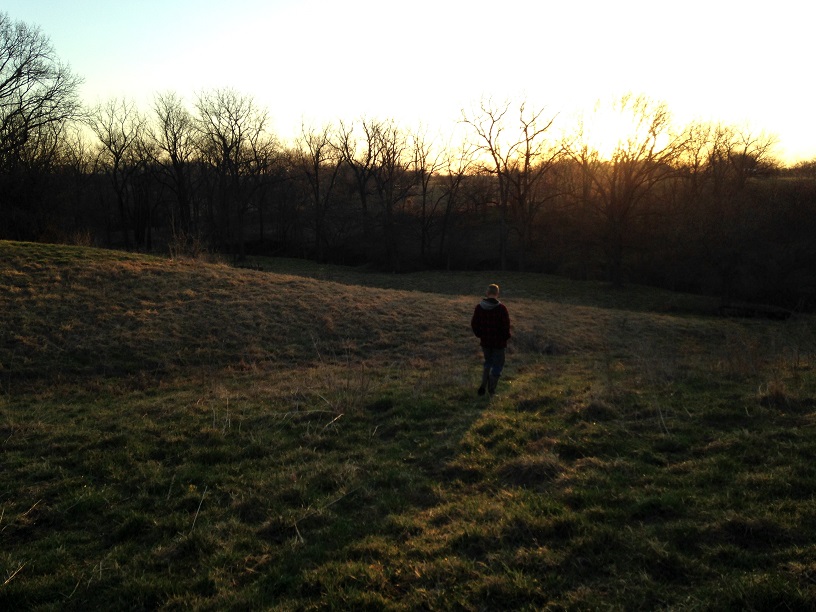
Unrelated to the topic, there is about a ten degree difference year-round between the top of the hill and the little valley the boy is about to walk through. It’s pretty amazing. We try to walk up the valley on warm summer evenings because the rush of cool air flowing past us is great.

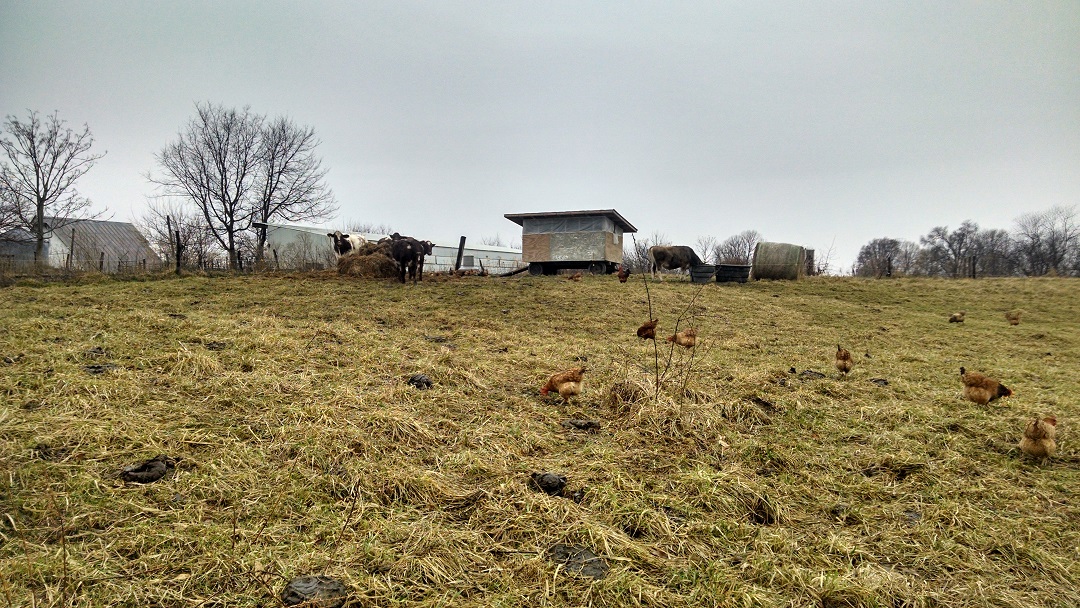
The chickens and cows are North of the hog building. We have the old flock of layers out there and running unfenced. I have mixed feelings about this but, really, I think the hens are doing very well and seem to be laying their eggs in the nest boxes.

FreeChickens

The cows grazed the area pictured above a little more than a week ago. We are just about ready to mash the accelerator pedal on our pasture. I had trouble getting my cattle to shed out their winter coats last spring. Mark Bader responded to an email and suggested the cows were low on energy and that I should speed up the rotation in the early spring. OK. We’ll give it a try. In a few days I’ll split the farm up into a 10-day rotation giving the cows 3-4 acres each day. They can be as selective as they want. But for now we are still bunching them up into half-acre daily moves so they knock down weed skeletons and remove surplus grass. We are moving slowly trying to allow the grass to grow three or four leaves. Most of the farm has three leaves right now. The moisture in the soil and highs near 80 degrees are rapidly accelerating growth.

OldHickory

The picture above shows today’s grazing area. The shagbark hickory tree decided to give up the ghost last night. Fortunately it didn’t land on a cow. You can also see the saplings that have come up recently in that pasture. I need to get busy.

As warm as it has been, we are not out of the woods yet. We can still get a snow or two. Or a heavy frost. In 2001 or 2002 (I’ll have to check my bee diary) we had a 4″ snow on April 20. In 2011 or 12 we had a hard frost on May 10…and the alfalfa took a lot of damage. So did our tomato plants.

Sick Day

Friday

Co-worker: “Yeah, she’s out today. Looks like she got that cough that has been going around the office.”

Me: “Cough? But I had a meeting with her yesterday.”

Fast forward to Saturday night.

Guess I got it too.

I’ll publish my reading journal tomorrow. I’m going back to bed.

I don’t take many sick days. Don’t count it against me.

Songs Stuck Since Childhood

Our Cow fence is built twelve steps at a time. Twelve. I count each step. Yes, I measure distance in terms of steps.

FencePosts

One…Two…Three…

And about here I get one of two songs stuck in my head. Thanks Sesame Street.

First the Pointer Sisters.

Showing my age here, eh?

How about ladybugs?

There is no escaping my childhood.

Strolling Through the Pasture March 2015

Remember strolling through the pasture? I used to do this quite a bit. What has happened to my life? Sigh.

I still walk the pastures. I always have my phone with me. I just don’t seem to stop and look around anymore. Julie took most of today’s pictures. This isn’t a farm walk. It’s just a snapshot of the farm (pun!) in a few places. The cows are way up north of the barn and hog building. Nothing has grazed there since September and that was brief as we were trying to get to the clover field asap.

Let’s start in the trees.

Pasture6

Not much going on here in terms of forage. Maybe this is a good time to talk about goals, intentions, reality and consequences.

The goal is to allow the cows to quickly skim across the landscape, allowing them to eat a little of the new, a lot of the old and to make the most of the remaining hay by converting it into magical brown messy stuff. That’s the goal.

Pasture2

Our intention is to minimize the amount of damage cow hooves make to the muddy landscape while grazing…most of the time. Sometimes a little creative destruction is appropriate. But it has to be intentional. Hooves can cut the soil and allow tiny pools of water to form and increase opportunity for seed germination. But they can also cause soil compaction.

Pasture8

The reality is we aren’t very good at this stuff. We still have the cows bunched up tightly because the grass is not growing fast and we don’t want to decapitate baby grass. So we are spreading out the magical brown messy stuff, allowing the cows access to fresh green, old green and hay but sometimes they make a mess. And that’s my fault. Normally it’s just around the water supply but sometimes it’s in places that just don’t drain well.

Pasture1

I guess it doesn’t look too bad. The soil is covered. The cows have been asked to move. But they will return in a few weeks. In fact, I may try to rotate across the entire farm every 10 days this spring. Yeah. I want to put a lot of energy into the cattle so they shed out quickly. We’ll see how it goes. I have 16 animals grazing nearly 45 acres so they should get the cream of the cream. That’s part of why the hay is out there…to help balance out their digestion. But I want to talk about what cream is and what cream isn’t.

Pasture5

This is not cream. This is grass in its infancy. I have to protect this grass right now. Maybe for another two weeks. So the cows are still bunched up and moving slowly over tall fescue stockpile. Acres and acres of it. With access to hay.

Pasture3

While the rest of the farm just gets to sit and rest. I want to point out the brush in the picture below. All those thorny stems are hedge trees. Hundreds of them. Every one 1″ in diameter and loaded with sharp thorns. That’s what happens when you cut hedge trees without killing the stump. Ugh. Pick your poison. You can either apply a bit of brush killer with a paintbrush or you can apply the loppers every few months for the next few years.

Pasture7

The pastures to the east are recovering after heavy grazing most of the winter…

IMG_2310

..with the exception of the broilers. They move daily, dropping a tremendous amount of manure along the way. Otherwise, we are resting this area. Need to put some clover seed out too.

IMG_2315

So now we are at the part about consequences. What are the consequences of messing up today?

The consequences are pretty serious. If I graze the young grass too soon I’ll lose production all summer. If I compact the soil the pasture will suffer for years. If…if…if…

But if I don’t graze off and smash down some of that dead, oxidizing grass I’ll hurt grass production for the year. And I’ll have to feed more hay. And put down more bedding. And haul bedding later.

So the cows are on pasture. Again. Thank God. And the chickens are following close behind. The old chickens. The ones I should have slaughtered last fall but didn’t. After taking their third winter off they are laying heavily again.

Mess up or not, April will be here soon. Let’s take a look at April 30 of 2014.

CemeteryHill

Look at all that fescue! It won’t be long.

Spring Bee Situation

OK. Well. I have learned my lesson. Again.

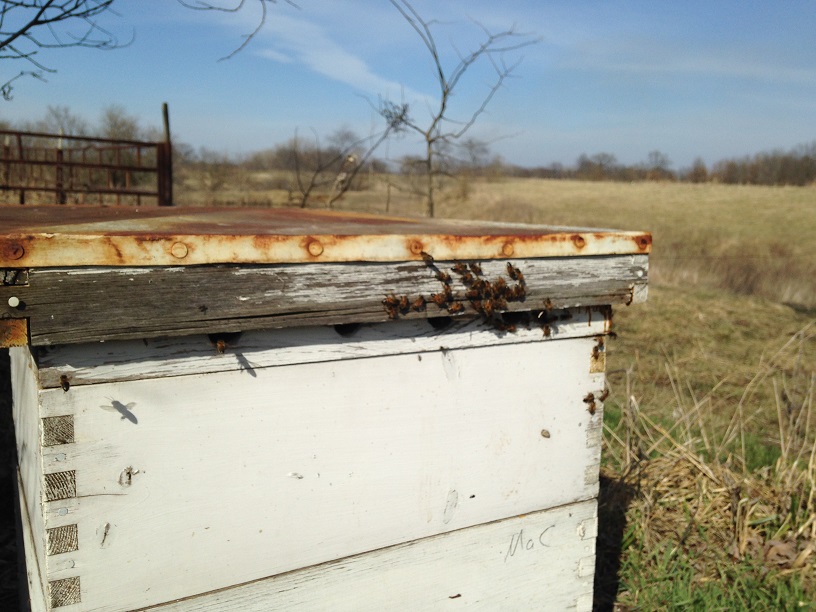
I like to keep my bees by the pond. In my mind that’s a convenient location and is near water. After several years of beekeeping in drought I thought the pond was the solution to all of my hive cooling problems. Well, after several winters of frozen hives I have decided I need to place my apiary near water but near shelter and away from the freezing cold air that blows out of the west and across the frozen pond for four months every winter.

BeeHive

So we are back to one hive. Again. But it looks strong.

I haven’t blogged about beekeeping previously for two main reasons. First, I am more of a bee owner than a bee keeper and I’m not very good…even after 10 years. Second, it seems…and I hope you understand this…intensely personal. Beekeeping is very…zen. I have to be totally chill when I have a frame of brood in my hand and about a thousand stinging beasts ready to launch at any moment.

I have a beekeeping mentor (get yourself a mentor) who took me out on January 1 my first year of beekeeping to check 50 or so hives. I don’t remember what the arrangement was. Either he pulled the lid and I poured sugar on the frame tops or the other way around. Whatever the deal was, he didn’t let me wear gloves. Hood? Fine. No gloves. Fewer smashed bees that way. Did you know that I type for a living? It’s hard to type when your fingers are swollen like bratwursts. I got so stung up…you wouldn’t believe it. I hardly have any reaction to bee stings these days. Thanks Arvin.

BeeFeeder

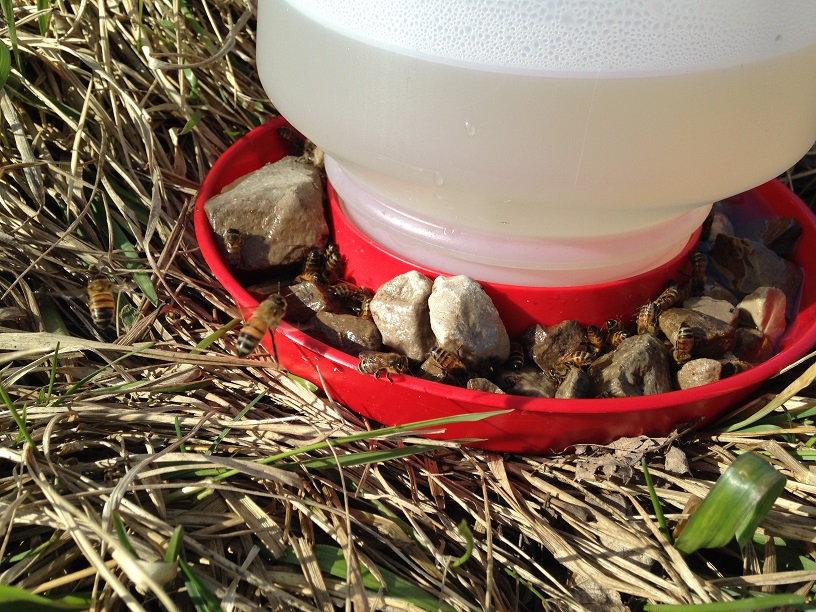
I am down to one hive right now. I have high hopes of splitting that survivor hive. But I need that hive to continue to survive. They are pretty low on food and are flying hard. The trees haven’t bloomed yet so we set out a feeder with a 1:1 syrup. Should see big bees in three weeks. Should be good times.

We use spare chick drinkers. Multi-purpose infrastructure, right? We place rocks in the bowl because bees are not good at swimming.

Do you keep bees? Do you understand what I mean about it being personal? It’s my alone time. It requires my complete attention. And it’s a lot of fun. Sorry I don’t write about it more.

Reading Journal 2015 Week 12

The last two weeks have been…well…work has taken more time than usual recently. And I guess that’s going to be the new usual. Plus, traffic has been awful. Awful. I don’t know if I’m making a note to myself here or if I’m speaking to you, reader. But stuff is gettin’ real.

I have been fascinated reading and savoring Adventure Capitalist by Jim Rogers. What is this book about? Really. Is this a book about investing around the world? Is this a book about the state of morality around the world? Is he taking a vacation or making a case against global intervention?

Yes. Especially the morality part. Because why would you invest with immoral people?

I mean moral here, not religious. Moral. There are few investment opportunities when you are marketing time with impoverished women but he comments on market availability and price wherever he goes. I’m not kidding, man. Every chapter there is something about prostitution. Why? Because in some places there are no jobs. There is no opportunity. There is only one thing to sell. Women in eastern Siberia could sell it to tourists from the far east for a higher price than the ladies a little to the west who lacked access to tourists. But before you get your hackles up about male Japanese tourists taking advantage of underprivileged women in Siberia, flip ahead to the trip to Africa and the detail of single, young women from Europe traveling to Gambia for the same purpose. This is not an issue of race nor of sex.

Sigh.

Market demand.

But why is there no opportunity when there are so many Mercedes driving around? Because they are stolen in Brazil and shipped to Siberia. And because of aid programs that are only aiding those strong enough to muscle to the front of the line.

“I have called ahead,” he said. “You won’t have any problems.”

He had called his people two or three cities down the line to smooth our passage.

“If you do have problems, let me know,” he said, “and whoever it is, we will have them killed.”

He was serious. This was not bravado. (For the price of a decent night out in the United States, you can have somebody killed in Siberia, and in Siberia these days, the latter seems to be the more common practice.) So we had the mafia’s protection…

So this is a book about morality.

Capital has its own laws as inexorable as those of gravity. Until Russia comes to respect capital, to provide for its safety and nourishment, capital will not come to its aid. Intelligent capital does not aid thieves.

But it is also a book about investing. Last week a reader was hoping for some insight into how the author’s predictions have turned out all these years later. While in Japan in 1999 Jim wrote this:

I am convinced that the Japanese economy has hit a temporary bottom and that a prosperous time – call it a rebound – is coming. I am looking for stocks to buy for the medium term. Furthermore, the Bank of Japan – in time-honored, economically blundering fashion – has made it pretty clear that it is going to start printing money. And when governments print money, one of the first places the money winds up is the stock market. I believe that in the short term the yen will rise against the even more fundamentally weak dollar, so not only will certain stocks do well, but the currency will also advance along with stocks, doubling the impact of my purchases. Again, I am speaking of the short or medium term. The Nikkei is not a place I expect to have money for the next ten or twenty years. Japan is sailing into the wind…

Welcome to my blog about our family farm. Let’s talk about investing in the Yen 15 years ago, shall we? It may seem like a stretch but this fits the blog very well. We have to make the most of our available resources so the next generation will have the chance to do the same. I could screw this all up. I could be the generation that breaks the family legacy. I have to make the most of my opportunity to position the land, people and resources to have a positive impact on our community and our ecology far into the future. Or we should just pack it up and move back to town. SO I, Chris Jordan, in real life, away from the blog, hidden from view, read at least as many financial publications as I do farming publications. Probably more. And you know what I have learned over the years?

Popular financial “experts” are clowns and are unworthy of my trust.

But let’s look into what may have been for the claims Jim made above. Let’s go back to 1999. I don’t know when he arrived in Japan. It might be in the book but if so I missed it. Let’s say he drove across Europe and Asia in four months…as he was in Russia during the summer. OK. That puts us in April of 1999. On April 1 the Yen was, apparently worth $0.0083. By 2007 it had not changed much…$0.0085. Maybe that’s a bigger change than it appears. Maybe I missed some major fluctuations in there along the way. But that’s the window of time I’m going to stick with. Less than 10 years, right?

So what about Japanese stocks? He makes no individual recommendations. I’m sure we could cherry pick the stars out of any bunch if we wanted but let’s just stick with the index. If he had bought the Nikkei 225 on April 1, 1999 it would have been 16,701. On April 1, 2007 it would have been 17,400. Not much happenin’ there. I guess he could have operated on a shorter window of time and done better. Of course, the book wasn’t written in 1999. He was driving then. So maybe he looked back at his notes from Japan in 2002 or 2003 and decided to buy at that time. In April of 2003 the Nekkei was at 7,831. He could have sold it at any time after that and come out ahead.

It’s not clear. It’s not our business either. But what is our business is understanding that there is no clear, straight line to riches especially when following advice written by some stranger 15 years ago.

But I do agree with his statement that equities tend to rise when money gets cheap. Apple doesn’t know what to do with their $300 billion in cash so they are buying back their own stock. They have enough cash laying around to build two copies of the international space station and they are buying apple stock as if that’s the best option.

I don’t understand. It probably is the best option. It puts money in the pockets of the executives. But it weakens the company’s financial position. If you are interested in this topic you might read this essay.

I’m not a financial adviser. I’m not an investor. I don’t own apple stock. I don’t own any part of the Nikkei. I don’t own Jim Rogers. I own cows. When I have more cash available I put it into more cows. The plan is simple. Over time, by reinvesting a portion of my profits (keeping heifers) my investment grows. That makes sense to my limited intellect. The stock market makes no sense to me whatsoever. I guess if I had no other option and had no idea what to do with a mountain of surplus cash I might consider handing it over to someone else to help build their business. But right now I have my own business to build. Mind your own business.

But I digress.

I wouldn’t look at this book for investment insight. The little it offers is neither specific enough nor timely enough to act on. But the discussions surrounding each mention are worthy of your time. We live in a complex world. Humans tend to exaggerate that complexity. It’s a level of complexity that confounds the efforts of world-improvers everywhere.

I was told that there were more top-of-the-line Mercedes in Moscow than in any city in the world…Where does this money come from? It pours in from the IMF and the World Bank, which are funded by the world’s taxpayers. In 1998 I testified before Congress, which, following the collapse of the ruble, was planning yet another Russian bailout. I said then that both the IMF and the World Bank should be abolished.

Self-perpetuation and ever-growing bureaucracies founded after the Second World War, these institutions have long since diverged from their original mandates. Their analyses are hopeless, and their prescriptions are worse. There are no external, independent audits to determine the long-term efficacy of their projects. The greatest beneficiaries of their programs are the twelve thousand bureaucrats who work for them and their well-funded and well-protected pensions. I have made a career of analyzing financial statements, and I have yet to see a financial statement of either the World Bank or the IMF that I can understand, nor have I ever met anyone who could explain them. Whenever I have found this to be true of corporations, it has always been a sign of serious problems.

At this point I’m only sharing quotes from the first third of the book. Wait till you read about his trip through Africa. And I think you should. I really enjoyed this book. I’m not reading it for ideas on where to park or invest surplus cash. There is no surplus cash and no shortage of ideas on how to “invest” any that comes my way. But the book is fascinating in other ways. The crossroads of desperation and morality. When you have nothing left to sell, apparently you sell time with your daughter.

Maybe I have been too sheltered. Maybe my upbringing was too perfect. Too protected by my parents who did too good of a job making sure we learned the value of work, brushed our teeth, ate our dinner, did our homework, stayed active in sports and went to bed on time.

Thank God.


This Week in Other Printed Media

Our insurance company markets to specifically to farmers. We pay for membership to their little organization, they pay lobbyists to influence legislation and that’s how it goes. They write a weekly propaganda letter to send out to subscribers. There is no intention of impartiality nor of journalism. It’s all propaganda. And it’s truly amazing. Truly.

I rarely read it. When I do it’s because something caught my eye as I am crumpling the newspaper up to help start a fire. And I want to point out, whatever paper they print this on doesn’t burn well.

This week, as I was starting the fire with an empty paper feed sack and a little of the propaganda paper in question I noticed an article, “Chipotle CFO claims no fear intended.”

In short, Chipotle made some advertisements that implied that current conventional agriculture was..well, maybe not what we want to do with our resources. And Chipotle proposed itself to be the solution.

Whatever.

The Illinois Farm Bureau hopes to talk to Chipotle about the sustainable practices of Illinois farmers. Chipotle doesn’t want to talk to them. So IFB says they are doody-heads. And, just taking a stab in the dark here, Chipotle says the IFB are doody-heads because they are an extension of Monsanto…more doody-heads. And that summarizes the article neatly.

I’m not taking sides here. But the discussion can’t focus on bureaucrats vs. mega-corporations. If you want to help farming families grow and prosper, why not help them identify niches they can fill to achieve a higher profit margin? You can still grow corn if you want. You just have to do things a little differently to make a little more money. But I don’t think our policy-makers are truly concerned about helping farming families grow and prosper.

I’m also not entirely sure that Chipotle is interested in helping farming families grow and prosper. But at least we didn’t elect Chipotle to help farming families. The good news about businesses is that they can go out of business. Bureaucracies are harder to get rid of.

So it went into the wood stove.


So this silly goal of mine to start and finish a book a week in 2015…it hasn’t held up. And I’m not sure it should. The pattern is fairly simple, I get busy throughout the week. Work, farm, family, Minecraft. Then the weekend arrives. Friday night I cram in a couple of chapters. Saturday I try to read a little bit throughout the day. Saturday night I stay up late turning pages. Sunday morning I get up about 4:00 and read and write and flip back through looking for memorable quotes to share. That’s tough.

I’m not saying it’s impossible. I’m not saying it’s going to stop. I’m just saying it’s wearing on me. I enjoy reading. But I’m not sure I enjoy this pace. It is nice to be finishing so many books though.

Livin’ Large

Mrs. White was a big heifer. Now she’s a big cow.

MrsWhite

Cow size, like everything else, is subject to marginal utility. Big is good but too bug is too big. Like steak? Eat the 96er. Mrs. White is too big. She was late to mature and didn’t breed until she was 3. But I won’t say no to a calf. We’ll just keep track of the late breeding thing so we don’t accidentally select for it. She was bred late in the evening three days after the bull arrived…I caught them smoking cigarettes. So she should calve in April.

Grass is greening up quickly. Cows are still on stockpiled forage but I still put hay out just to make sure they get all they can and to put the hay out where I need it to decompose.

Decompose you ask? Yes. Last summer was wet. Our hay was not what I might have wanted.

Not much of a post today. Used a picture that is at least a week old. Lots of green out there. We went from 0 to 70 in about 2 days then hovered above 50 for a week or so. I think it hit 81 yesterday. Stuff should really start to happen now.

Reading Journal 2015 Week 11

Let’s go back to January 1, 2015 together, shall we?

Julie and I are big on goals. But for some reason, when it came time to write down our goals on paper so that those who read it can run I was caught short. Normally I just write a list of things I think we should budget for and get done in the calendar year. But this year I decided I didn’t want to make a shopping list. I wanted to do stuff. On that list was one very challenging item.

Read a book each week.

Look. That doesn’t sound like a big deal. My two oldest children read a book a day or more. But they don’t have jobs.

Start and finish a book within a week…and do that every week.

Some books…well, with some books that’s just fine. There is nothing to chew on, you just gulp and swallow. Some books though, some books give you too much to think about. I recently read Malabar Farm in a week…and that was a disservice to Louis Bromfield. His book isn’t meant to be read quickly. His book is meant to be savored. I think Mr. Bromfield wanted his readers to read a few pages each morning with coffee, then lay the book aside and think about how to apply what you read. And I don’t think that’s an extension of his ego, I think the book is worthy of that level of reflection.

I made that same mistake again this week.

I was chatting with my father a few weeks ago about a book I had heard about but hadn’t read by Jim Rogers titled Adventure Capitalist. In short, a billionaire investor drove a car around the world and kept a journal of his observations. Sounded cool enough. Dad bought a used copy and got through it in a week, strongly suggesting that I read it as well.

Have you met my father? Dad worked at a mine my entire childhood. In 16 years he took, I believe, one sick day. Somehow he also found time for college classes on philosophy and community theater and home remodeling projects and playing catch and going fishing with me…in spite of the fact that he worked swing shift…his sleep pattern changed every two weeks. Ugh. SO dad, apparently, is the kind of person who can just get things done.

I am not.

I sat down with Jim Rogers several times throughout the week to discuss his world travels but I couldn’t finish the conversation. He kept saying things that I couldn’t digest. Things I needed to think about. The writing style is approachable. I didn’t need to deconstruct his sentences to find meaning. But I could only read so much in one sitting. Let me give you an example from page 8. He has decided to have a custom-built Mercedes to drive around the world by merging two different models, a 4WD chassis mounted to a convertable top.

Even in the absence of a warranty, I knew, I would find Mercedes service everywhere in the world. Even in the developing world one is never far from a dealership; every dictator and mafioso in the world drives a Mercedes. Even in countries with no roads to speak of, Mercedes service is available…

OK. I’m going to stop mid-sentence here. The author has identified a pattern and is seeking to leverage it to his advantage. He could go around the world in a Toyota. Sure. But he has decided to go with a Mercedes. Why? I dunno. Cause he’s a billionaire and he wants to have the top down while driving in comfort and style. But he is, at least, practical. If he needs a mechanic, he believes he can find one anywhere in the world if he drives a Mercedes.

Then he goes into why he thinks that is. You should be sitting down.

…Mercedes service is available – often to the exclusion of things like food – thanks to all the US foreign aid, the International Monetary Fund and the World Bank money being shipped in. It is no secret that this money is aimed at nourishing only those corrupt enough to get their hands on it, while at the same time fattening bureaucrats on both sides of the transaction who diligently work the trough. And none of them is driving a Chevy.

I knew much of this from my last trip. The upcoming trip, especially as it took us through Africa, would be an eye-opening education in to the workings of the latest foreign aid scam: the nongovernmental organization, or NGO. As an American taxpayer I would be amazed to discover that a lot of the money we send to these countries goes to support Mercedes and BMW dealers and various Swiss bankers.

So. Yup. That just happened.

I don’t feel that the paragraphs above are the kind of material you just read and move on. You have to stop. I stopped. I read it to Julie. I read it to Mike, my boss. I read it to John at work. I spent a lot of time thinking about it. First, make sure you can get your things repaired. Good lesson. Second, actions – even well-intentioned ones – may have unexpected consequences. Is he right? Is there too much obfuscation? I’m happy to share with those in need…but am I actually meeting needs? That money they take out of my paycheck before I even have a chance to say, “no, thanks – not that I have the option of saying “no, thanks” – ends up going through a number of hands, each taking their cut before heading off to its final destination. What percentage of dollars involved actually accomplish their mission? Our author suggests a great number of them successfully filter their way to German car manufacturers. I guess that’s mission accomplished.

That’s just on page 8. Later he gets through China and into Korea and, later, Japan. He talks at length about protectionism and how damaging it is to the economy. As an example, he discusses the lack of real free trade between the US and Canada at the time…in spite of Free Trade agreements…by pointing out the absurdity of tariffs on tomatoes imported from Canada. If a farmer anywhere in Canada can produce a tomato cheaper than a farmer in America…well, maybe they should. Henry Hazlitt talks about this quite a bit in Economics in One Lesson. (If you haven’t read that book…well, you should.) Keeping tomato prices artificially high benefits American producers but hurts EVERYBODY WHO WANTS TO EAT A TOMATO!

Same thing happening at the time in Korea and Japan. Let’s say you are a Korean Billionaire and want to drive a Toyota. Can’t. Let’s say you want a Sony phone. Can’t. Hafta buy a Samsung. Why? Cause it’s good for our domestic producers. Sure, it’s bad for everybody else in the whole world but we have to protect our own manufacturing. And we are so bad at producing stuff nobody would buy it if the government didn’t force people to.

Sigh.

Have you ever driven through Indiana, Illinois and Iowa in the summer? Have you ever wondered how much of that corn would be there if your tax dollars weren’t being used to grow it? How many John Deere dealerships exist as a result of government action? What is that costing the world? What would be growing there if we were free to pursue our own interests and weren’t growing corn? Would there be endless fields of hemp? But it goes beyond that. We have policies in place to keep interests rates low so prices will be higher. Yeah. So buying a farm is almost impossible. And that’s good for the economy somehow. Who needs new farmers anyway? They’ll probably want to do something crazy and not plant endless seas of corn. What would we do then? How would we pay for a Mercedes without our government contract to ship corn to Africa?

So you see, this was a difficult book for me to finish. I tried. I really tried.

But beyond the time spent reflecting on his words I had a difficult week. I am staring at some major changes at work and I’m afraid it wore on me all week long.

So this week I didn’t meet my goal of reading a book in its entirety. I am still averaging more than a book a week on the year but the average wasn’t the goal. I wanted to finish a book each week.

I’ll continue chipping away at the book over the next week or so. I hope it shows that I’m having a lot of fun reading it and hope that counts as a recommendation.

Please comment below to let me know what you are reading and feel free to offer additional recommendations.

Click here to see all entries in my reading journal.