My Friend Olive…the goat

In a few short days we’ll be enjoying fresh goat milk again.  I love goat milk.  It makes the best ice cream, the cream doesn’t separate and it is easily digestible.  I have heard a lot of people tell me that they think goat milk tastes bad but I think it depends mainly on the goat’s diet.  Our goat milk tastes great but our goats are offered a wide variety of forages.

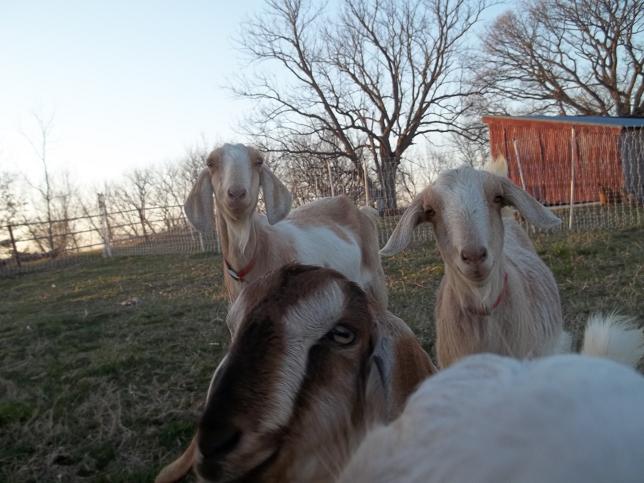
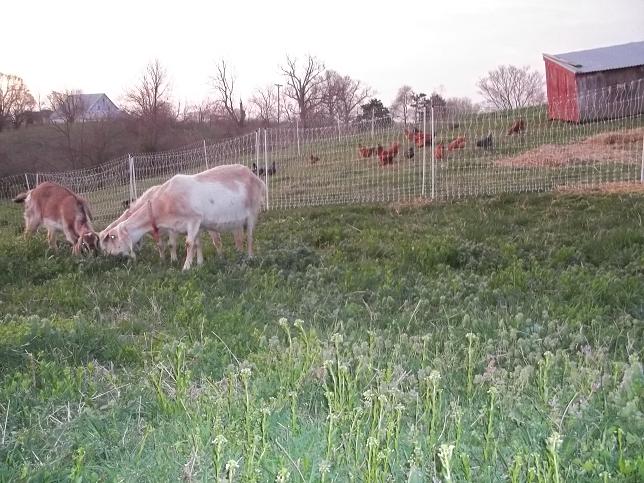
Let me introduce you to our goat herd, headed up by Olive.  We bought Olive on Craig’s List some years back.  She came from a farm about an hour to the North.  I believe she is rounding out her sixth year.  She’s a gallon milker and is at least mostly nubian.  Isn’t she pretty?

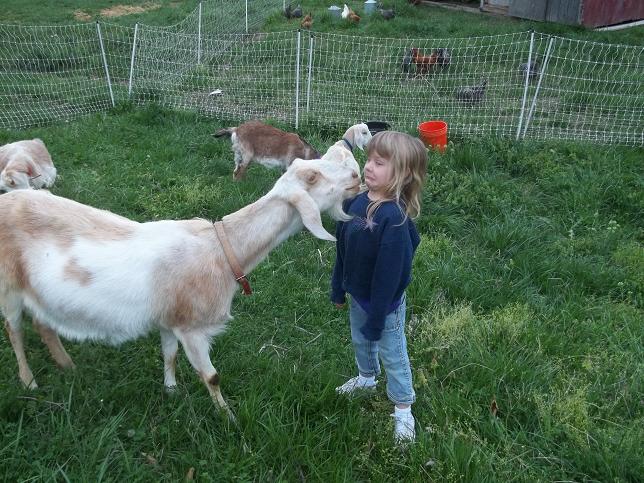
Olive arrived with her twins (Sweet Pea and Popeye (Supper)) two summers ago then gave us quadruplets last year.  That’s a pretty strong mark against her as it is a trait we want to select against.  We were able to keep two of the four.  I made an attempt at a family photo but..well, goats are goats.  From the back left Olive, Sweet Pea, Pixie and Honey.  Honey wanted to eat my pant leg and refused to pose.

What we like best about the goats is they aren’t much of a threat to our children’s safety.  They may love you to death but that’s the worst they’ll do. Billy goats are a little different story…

Olive and Sweet Pea are days away from freshening…from kidding…from having babies.  We’ll keep a close eye on them as we believe Olive was bred on Dec. 10th and Sweet Pea was bred a few days later.  When Olive was carrying quads last year she developed a limp…you would too.  So far she’s getting around normally but you can tell she isn’t comfortable laying down.

This will be Sweet Pea’s first freshening.  She’s developing an udder and you can tell she’s not comfortable with any part of this arrangement.  She’ll be a handful on the milking stand.  Should make for good times though.

Anyone have any tips on breaking a goat to milk?

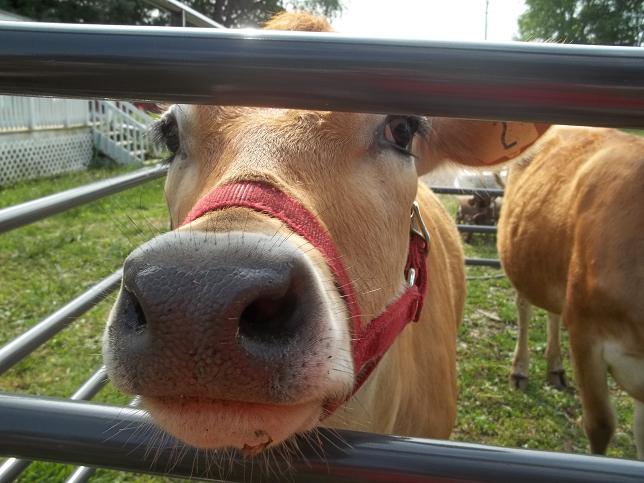
Talking to Your Cows

How do cows talk?  With their mouths….and with their manure.  Their manure says it has been raining a lot recently so let’s stick to the front end for today.

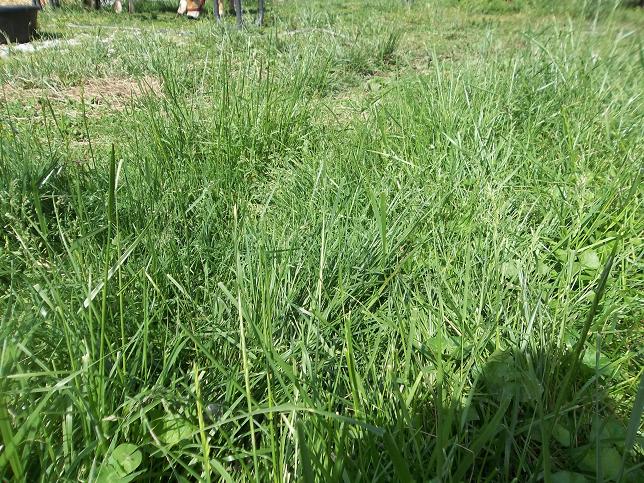
Talk to your cows.  They don’t mind.  But to hear them you have to listen with your eyes.  For example, here the cows told me they don’t care for fescue:

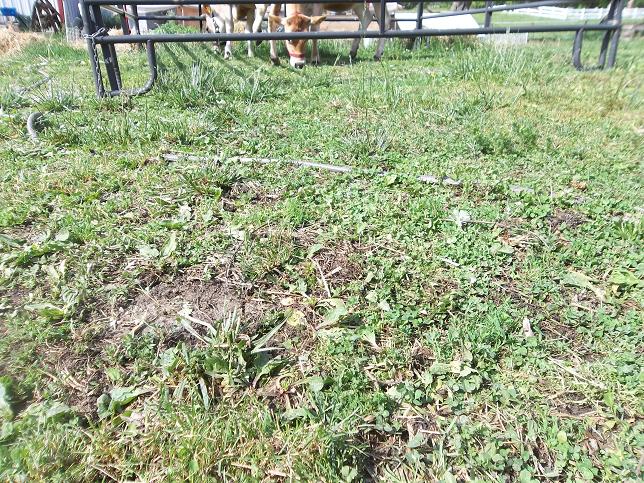
They couldn’t wait to leave the fescue behind.  They were placed on this patch at around 9:30 this morning while the day was still cool and the sun was hidden.  Just before the monsoon du jour hit we put them back in the barn and moved them to the next spot in the early afternoon:

This spot is right next to the spot they ignored, it’s just colonized by different plants, it’s a different time of day and the monsoon passed…for now.  If you look closely you’ll see white clover, dandelion, plantain, chickweed, pineapple weed, violets and a variety of grasses I’m not so good with…but little fescue.  They ate it right down to the ground.

Now, I’m not as good at speaking cow as I am with chicken or pig but I think this means they liked this spot better.  Or it may mean that early morning, pre-rainstorm fescue isn’t very tasty.  Or that they were really hungry when I let them out of the barn.  I don’t know.

Pssssst!

If any of you speak cow…specifically the Jersey dialect, please comment and let me know.

Full disclosure: I broke down and mowed behind the cows the other day.  There were tall clumps of fescue that I just couldn’t ignore.  I can only tolerate so much as I look out my window.  Bear with me.  I’m not there yet.

A Pleasant Surprise

I can’t tell you where this came from.  Well, I could but you would get bored.  A co-worker of a friend who goes to my church and works with my sister-in-law….see what I mean?

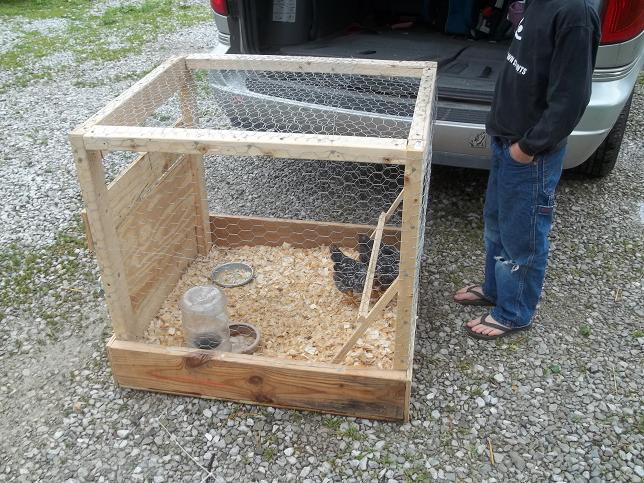
So a guy got some pullets and found it wasn’t his cup of tea.  He gave them to us along with a nifty little cage he built.  It even has a roost bar built in.

These poor birdies are wondering what happened to their little girl and the life they left behind.  But they’ll be loved and well cared for…and it just happens I have two little girls of my own.

The owner delivered them with the remains of a 40# bag of Nutrena medicated crumbles.  I’m not sure what to do with it.  I don’t even know what Amprolium is…other than a coccidiostat.  These birds are faced with an immediate switch to freshly-ground, whole grain feed with a big dose of Fertrell Nutri-Balancer containing a probiotic and lots of fresh, clean water.  Coccidiostat indeed!  My birds have immune systems and we assault their immune systems regularly…as we do our own.  We don’t put healthy birds on crutches just in case!  For Heaven’s sake, we pasture our birds.  They are exposed to all manner of things the robins bring back from Florida.

Well, with that behind me, these are Silver Laced Wyandotte pullets and appear to be a little over a month old.  Most of the farm supply stores around us buy from Cackle hatchery so it’s a good bet they came from there.  The birds appear healthy, their cage is perfect for three little birds so we did little more than park them in the greenhouse with the other pullets (who welcomed them with open arms) and the ducks (who are very judgemental) and the rabbits (who pretended not to notice).

Thank you for being so generous Jim.  I hope you’ll bring the kids up to see their birds as they grow.  We’ll be sure to let them gather eggs, help us milk or just watch them run and play.  Nothing quite like free-range children.

If it will ever stop raining I’ll get a shovel full of dirt and grass for the birds to pick at.  That ought to give their digestive and immune systems something to do.

The Turkeys Have Arrived

Last year we ran only Broad-breasted white turkeys.  They were very entertaining, easy to sell but hard for us to manage.  This year we are only raising a few…so if you want one you should speak up soon.

Turkeys are very fragile animals.  Give them any excuse…any excuse at all and they’ll die.  In spite of this we harvested 19 of the 20 birds Sunray hatchery shipped us (#20 broke a leg at about 3 weeks and I put him down).  This year we ordered 5 white and 5 bronze turkeys from our friends at Schlecht.  These ten arrived with our latest batch of 300 broilers.  Unfortunately, one chick and one bronze turkey didn’t survive the post office…further reinforcing our decision to drive to Iowa to pick up or next order in August.

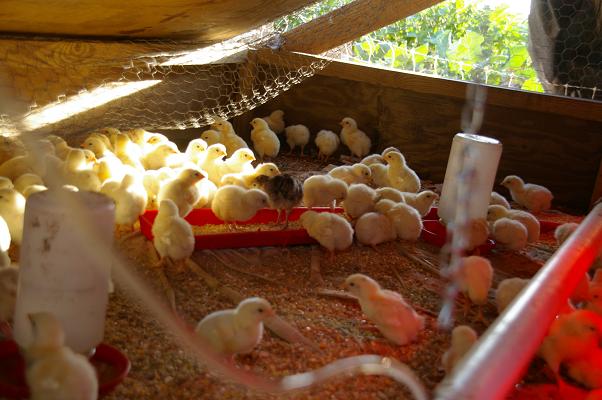
We have moved out of the greenhouse into the outdoor brooders.  It can still be a bit chilly in the evenings so for the first few days we cover the ends with plastic (plastic we found out in the pasture that was used for round bales years ago).  All 300 are in one 8×8 for now.  Soon we’ll split them between the two brooders but early on they like to be close.

Can you spot the turkey?  Look for the one that has the start of a snood.

This one is easier:

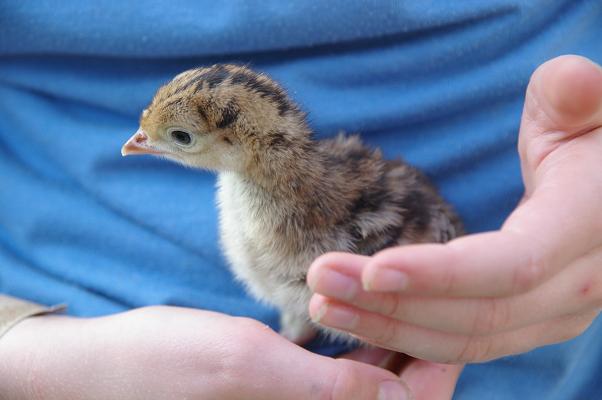
Here are a few close-ups.

Broad Breasted Bronze

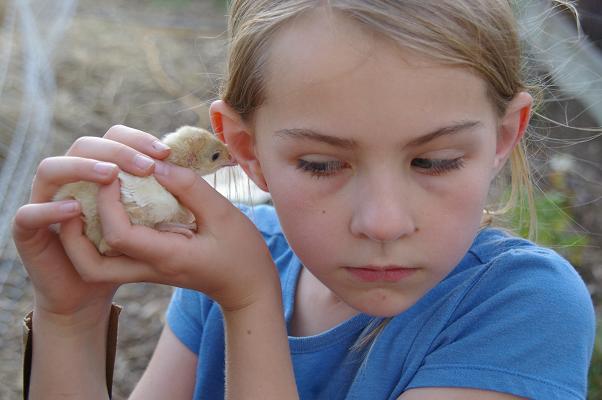
Broad Breasted White.  What is it saying?

Keep your fingers crossed.  We are still pretty nervous about raising turkeys.  They are so fragile.

If you have heard or read that turkeys should not be raised with chickens…well, we heard that too.  But it works and works well.  The chickens seem to show the turkeys what to do.  Joel Salatin talks about it at 5:00 in this video:

Don’t be afraid to get yourself a few turkeys to raise with your broilers.  Once they are out of the brooder they are pretty durable.  One turkey faught off a raccoon last year, removing the raccoon’s eye.  Be careful because they seem to go from 15 pounds to 25 pounds overnight.  We found it’s a little harder to market a 25 pound bird than it is a 18 pound bird.

What Pigeonhole do you fit in?

Is your farm organic?  Is your farm free-range?  Are you just conventional farmers?

We hear these questions frequently from prospective customers.  Let me answer the question.  No.

I don’t look down on my friends who produce organic products.  I also don’t look down my nose at my conventional farming neighbors, though I do hope they don’t go broke.  I really try not to look down at anyone.  I just do my very best to bring a quality product to market that will enhance the health of my land and the local ecosystem and nourish your family.

Our animals are healthy, happy and normal.  Our pigs and chickens are allowed to be omnivores and given regular doses of fresh grass and forbs.  They are expected to contribute positively to our pasture management to earn their keep.  We don’t have chickens for the sake of having chickens, they are a tool that we use carefully.  Similarly, our goats and cows are expected to be herbivores.  They have to eat a wide variety of plants.  Each of our herbivores perform a different function, either mowing and crushing or trimming.  Both add manure.  The milk we receive is a wonderful but secondary goal.  The primary goal is enhanced microbial activity in our soil leading to increase fertility, dense swards, healthy trees and non-eroding waterways.  Again, we accomplish this by keeping the right animals in the right places for just the right amounts of time and allowing them the opportunity to fully express their unique talents.

So, what do you call that?  How about orchestrated, choreographed, local, respectful, ethical agriculture?

How do you, the customer, verify that we actually do what we say we do?  You come see for yourself.

There is no man behind the curtain.  There is no curtain.

We don’t desire third-party verification at this time mainly because we want relationships with our customers.  We want customers who will come and see how things work here, customers who will ask questions and make suggestions and challenge us to continue improving.  We want customers who will partner with us.

What about GMO-free or organic grains?

We’re just not there yet.  I have been in contact with a vendor who can provide me a complete non-GMO feed solution for my stock.  He’s in Ohio.  At this point, we think it’s better for us to buy corn straight from the field that may be GMO and certainly is not organic but is grown within 100 yards away from our house than to buy grain from hundreds of miles away and uses unknown quantities of petroleum to get here.  We buy local.  I am working to influence the local farmers I buy from to take the next step in environmental and ecological stewardship.  They aren’t there yet.  But, together we’ll get there.

I’m buying local, working with what is available here, now.  I’m doing the very best I can to bring a locally produced, quality product to market that was not only humanely raised but humanely processed.  Not only humanely processed but locally processed.  I don’t ship my birds 200 miles for processing just to bring them back again.  We do the work here.  We use local sawdust, local straw, buy local corn, and buy locally produced animals whenever possible.  Sure, there are things I buy that are not local but I try to buy them from local vendors.  For example, I buy coco coir from a vendor close to where I work, though it probably comes from Sri Lanka.

I’m working to be as local as I can.  I’m also working to make it better.

To be honest we aren’t where we want to be on many of these issues.  Please partner with us, join us on our farm, encourage us to continue working and participate in the local economy.

What about antibiotics?

When a cow or horse gets sick we’ll take steps to heal it using whatever technology is appropriate.  We don’t use subtheraputic levels of antibiotics or medicated feed to help the chickens survive until slaughter date.  Our management style makes that unnecessary and we feel that is an inappropriate use of medication.  Though we have never used antibiotics on our animals, even our willingness to use an antibiotic to heal a sick animal would prevent us from achieving organic certification.  I want to care for my stock.  I’m willing to use whatever means are appropriate.  While I’m unwilling to allow my animals to suffer to strive for an ideal, I take precautions to maximize our animal’s immune system function by providing a varied diet, allowing the animals to select the most palatable and nourishing food and providing minerals free-choice.  We minimize their need for immune response with multi-species grazing and long periods of pasture rest and recovery.

Again the best thing you, the consumer, can do is to come see what’s going on here.  I hesitate to quote Regan but I’m asking you to trust, but verify your farmer.

Always? Usually? Sometimes? Never?

My wife asked a friend (who has 7 children of her own) how she gets it all done.  The friend replied, “I don’t”.  How great is that?

People ask me all the time how I get it all done around the farm.  I don’t.

As I write, it is 10 at night.  I stopped in Jerseyville on my way home from work to pick up a few hundred pounds of ingredients we use to grind chicken feed.  As soon as I got home I unloaded the van and we all piled in to head to church.  Once home, I closed up the layers, checked on the chicks and poults in the brooder, moved a fence to surround the outdoor brooder (first use this season) and ground 500 pounds of feed.  I’m eating supper as I write this.  There are dishes to wash, laundry to put away, books I have put off and a blog I have neglected.

“Gosh, it must be nice to be so young and energetic.  BTW, how old are you?”  35…a bicentennial baby.  Not as young as I used to be but stronger than I have ever been.  It’s just that everything hurts now…where nothing hurt before.  Not always…just sometimes.

And if you think I work hard, you should see my wife!  I sit for 12 hours every day either driving or chained to my keyboard.  She makes more than 1000 animals happy every morning before breakfast, babysits the cows all day, home schools the kids, cooks excellent meals, gathers the eggs and makes this all possible.

So is the work around here usually, sometimes or never finished?  It’s never finished.  Our top priority is keeping our family functional.  Next, we have a lot of animals to entertain.  Somewhere after that come dishes, laundry and hot spots (flat surfaces that seem to attract clutter).

I need to make sure I never walk in the door after my long day of pushing buttons and show my disappointment that the dishes aren’t washed.  I need to love, encourage and even sacrifice myself for her.  Usually I do a fair job of it.  Sometimes I screw up.

It isn’t always like this.  It’s not even usually like this.  It’s just sometimes like this.  We run a seasonal farm.  Right now everything has to be done at once.  Soon the chickens will be gone and we will begin canning our garden produce.  We’ll put up hay through the summer.  In the fall we’ll pick some apples, can pie filling, press cider and can applesauce…maybe can some pears too.  In the winter we catch up on our reading and cut wood.  But throughout the year we make time to swim…like today.  We make time to play catch.  We make time to go see the Avengers (can’t wait!)  We make time to watch Dr. Who.  We remember to enjoy our lives, not just our work.

We always have plenty to do.  The work is usually there waiting for us.  We sometimes get to do nothing.  A double-negative is never not funny.

The Day After

I must process chickens.
Chicken processing is the mind killer.
Chicken processing is the little chore that lasts all day.
I will face chicken processing.
I will stand here and do this all night if I have to.
And when it is gone I will close my eyes and go to sleep.
When the chicken is gone there will be nothing.
Only I will remain.  (Sorry Mr. Herbert)

The chickens will be gone and I will remain.  My faith will remain.  My marriage will remain.  My children will remain.  The dirty dishes in the sink will remain.  I have to do something about the dishes.

We spent Saturday morning processing chickens.  We spent Saturday afternoon processing chickens.  We spent Saturday evening processing chickens.  We spent Sunday afternoon processing chickens.  We spent Sunday evening/night packaging up chickens.  That took entirely too long.  Along the way the goats got out of their fence and the cows escaped and ran up and down the road in spite of our pleadings…you know…the normal things that happen when you’re too busy to watch your livestock closely.  Cows and goats have needs.  They don’t have words.  You have to watch them…especially when your heifer is in season.  We were so busy working we forgot to watch.

So.

That takes us to Monday.  Monday.  Glorious Monday.  The laundry room is filled to the gills with some pretty gross laundry.  No dishes were washed over the entire weekend.  In fact, the whole house looks like we have four children under 12 running amok.  Well, we do have four children under 12…and they did run amok.  At least a little.

We do everything we can with our kids.  I want my kids with me.  They are an asset, not a liability.  We don’t force them to do much (even to learn) but we encourage them to at least be outside while we are working.  When I put up hay, they pick raspberries and mulberries nearby.  When we walk 1/4 mile out to the chickens to feed, they walk 1/4 of a mile to feed (or they bicycle).  When we process chicken, they are right there with us…even if around the corner in the sand box.  If nothing else my kids know more about vertebrate anatomy than you do.

We were tired Monday.  The kids were tired Monday.  The house was a mess.  Every muscle in my body was (still is) sore but the work has to be done anyway.  “Honey, wake up.  It’s time to make the chickens happy.”

It takes just minutes to make the laying hens happy.  Dump some corn and oats out in trays, refill their feeder, check the water and open the door.  Then we make the goats happy with a few flakes of hay and a bit of water.  When the cows got out we corraled them in pens next to the horses at the other place (my grandpa called it the home place because he was born there.  I was born there.  Why don’t I call it the home place?  (How many parenthetical phrases can you put in a paragraph?  (You don’t have to answer that.))).  Anyway, the cows had to come home.  It took 45 minutes to walk the cows home along the road.  It makes the cows happy if you let them grab a few bites to eat along the way.  Then we made the compost pile happy by tossing in a few hundred pounds of chicken offal and loads and loads of sawdust, wood chips, mulch and straw.

In total, it normally takes about an hour to make the animals happy.  How do I make my wife happy?  How long does that take?  15 years and still working on that.  It takes hours to hand wash seemingly every stinking dish in the house.  I have to be at work at 8.  Nothing to do but roll up the sleeves.  Oh, and I better get some laundry started while the wife works on breakfast.

How do I make the children happy?  At breakfast, while the kids are dirtying some more dishes, I pay the kids for the help they gave over the weekend.  I pay them generously.  I want them to know there is reward for hard work…and they all worked hard.  Again, I didn’t force them to do it.  They didn’t do it for the money.  They don’t even know we live in a world of scarcity and working is the means to fight scarcity.  They did it because they wanted to.  Sound strange?  Why do you think I do it?  (Hint: I’m a grown-up.  I don’t do many things I don’t want to do.)

Also at breakfast I gave them their choice of one item out of the prize box.  The kids earn points (monopoly money) throughout the week for doing their assigned tasks.  Tasks rotate.  Training them to function as a part a working household is a big part of home-schooling…and is a skill public schools seem to overlook.  It takes time to teach a 6-year old to fold towels.  Many towels have to be secretly folded again but it lays a foundation of necessary life skill early on so we can do more focused learning later.

Everybody was tired.  There was still work to do.  Throughout the day we tried to encourage the kids to sit and read, to play, to nap or just to relax.  Though we can’t be lazy this time of year we have to have downtime.

After work Monday we tried to relax with the kids some more.  We played some video games and let the kids pick a movie.  They wanted a Star Wars marathon.  Sounds good to me.  We grilled chicken leg quarters and wings, baked potatoes, made some green beans and added hot sauce…all washed down with lemonaide.  The only complaint came from the youngest who didn’t want to eat her potatoes.  I was so tired I fell asleep watching the imperial troops enter the base on Hoth.  But I was sleeping while snuggling my little girl…and our dog.  Important stuff.

After the kids went to bed we closed up the chicken coop, fed the goats again, gathered eggs, moved the cows one last time, closed up the greenhouse, fed the rabbits…another 30 minutes worth of work.

We were tired.  We are tired.  There is work that just has to be done.  Dishes have to be washed.  The fridge has to be cleaned out.  Laundry has to be washed, hung on the line, folded and put away.  Pets and livestock have to be cared for.  We just have to do that stuff.  But the work is not the goal.  The work is not an end.  I need to make time to be real with God.  I need to invest in friendship with my wife.  I have to make time to relax and play with the kids.  Our work is not burdensome, it’s part of life.  Our kids are not a problem they are a solution.  They are not the target, they are the arrow.  We have to teach them to enjoy work, but not to be workaholics.  To respect and revere creation but not worship creation.  To honor God, to make family come first and to make the chickens happy.  That is the stewardship that counts.  This requires balance.  Yes, work has to be done but life has to be lived.

If my children run away from the land when they are grown, my operation is not sustainable.  We seek to inspire, not require, them to continue our work.  We have to demonstrate to them the value of work, the necessity of work and the importance of just relaxing with the family.  I have to show them that I still love mommy even when we are tired and make mistakes.  I have to show them that people have value outside of their capacity for work…that we value live and individuality in addition to honesty and liberty.  I am working to develop my children’t core values.  I am working to build a foundation of business that my children can expand.  I have to make sure they have a clear understanding of what is most important before I hand them the reins.  Their mommy is the most important person in my life.  Everything else can go, but mommy and I are a team.  The chicken processing is gone and our marriage remains.

That was hard.  It will get better.

By the way, my dad is awesome.  He wasn’t there the whole time but he was there when I needed him.  He’s always there when I need him.  Dad has a way of stopping by at just the right time, seeing what needs to be done and bringing new life to the work and entertaining the kids along the way or just to help catch the cows.  Thanks dad.

Featherman Product Review

I initially published this review in April of 2012.  By the end of June 2012 I had a more informed opinion of my gear.  Much of what I said below is still helpful but the updated review should be considered.

My thoughts on my Featherman equipment shifted several times today.  We were so successful working slowly on Thursday night I really wanted to turn up the juice.  I was anxious to test David’s claim that this could handle 200 birds/hour.

It can’t.  I did get to 80 birds and I believe that’s pretty sustainable.  The scalder is the limiting factor.

Here are some notes on each item then I’ll go into the process that I found works best.

Kill cones:
Kill 4 at a time.  This equipment is best-suited for batches of four 4-pound birds.  My only real complaint about the kill cones is the difficulty cleaning the base when finished.  We scooped out 10 gallons of congealed blood with a cottage-cheese container before washing it.  The base is heavy and difficult to pour into another container.  This is a small complaint.

Scalder:
The  scalder nearly convinced me to write a strongly-worded letter to Featherman.  I do not believe it is capable of more than 60 birds/hour on a 45 degree day (this morning), though 80 birds is manageable if the weather cooperates.  It just doesn’t generate enough heat.  60 birds/hour sounds like a lot unless you’re processing 300 at a time and have other things to do with 5 hours of your day.  I bought this equipment under the impression that it could manage 200 birds/hour, 150 anyway.  I do not believe the scalder can go beyond 80/hour.  Be sure to keep it filled with water.

Roto-Dunker:
Another strongly-worded letter opportunity.  Thursday we were plucking four birds at a time each dressing out at 5 or 6 pounds.  That’s more weight than this little rotisserie motor can swing.  Birds that will dress out at around 4 pounds are perfect.  You have to keep the load balanced and the scalder full (more on that later) for this to work but it can work for you.  Also, we found the birds inch along head-first as they turn in the dunker and their heads will stop the rotation.  We also found that putting the heads toward the center wasn’t a solution because the feet would drag the rotation down.  The solution appears to be pulling the heads off of the birds before you put them in the dunker.  This way they will work across the cylinder and drag their necks against the sidewall without their big head being in the way of the rotation.  2 headless birds, facing the same direction, appears to be the way to go.  I also found it was best to flip the birds over halfway through their scald.  The roto-dunker doesn’t totally submerge all birds so you can end up with a feathery patch that will need to be hand-plucked.  Finally, there are a number of sharp edges on the roto-dunker and my fingers are pretty shredded. Gloves maybe?

Gamebird Plucker:
The plucker is terrible at plucking a single bird.  My whizbang did a far better job.  However, if you put in three or four birds at a time it does a great job.

Shackles:
My wife gives these 5 stars.  She says, “You just line them up and cut, cut, cut then gut, gut, gut.  It’s much faster than laying them on the table and better on my back.”  I agree.  They are easy to load and handy to use.  Highly recommended.

Chill Tank:
This little beauty doesn’t hold 200 5# birds.  It just doesn’t.  It is nice though.  Very nice.

There is a pattern I found in the afternoon that kept the scald water hot, kept my wife busy eviscerating and cut through the birds at a reasonable pace.  First, the scalder has to be full.  Full.  The roto-dunker doesn’t work if the bird isn’t totally wet.

I’ll start at the end.  Take the birds, one at a time, out of the roto-dunker and place them in the plucker.  Turn the water on, start the plucker and step away.  Grab the hose and refill the scalder to about half an inch from the overflow.  This little bit of water makes a big, big difference.  Keeping the scalder full makes or breaks the plucker.

I’m assuming you have a helper monitoring the plucker.  If not, put the hose down and go empty the plucker.  This gives time for the scald water to warm up again.  Now, go kill 4 birds.  While they finish up, grab the 4 birds that were already dead in the cones one at a time.  As you grab them, remove their heads.  You’ll need two full rotations to load four birds in the roto-dunker.  Both birds go in facing the same direction.

Once the scald is complete (8 rotations or so), unload them one at a time into the plucker.  Just like loading, you’ll need two full rotations to unload the roto-dunker.

You may feel like you’re standing around quite a bit in this process but believe me, it’s the right pace for this equipment.  I may find ways to go faster.  I may develop more comfort with the gear but at this speed the burner never shuts off.

David won’t be getting a strongly-worded letter from me.  I had to adjust my expectations.  Initially I was disappointed.  My scald was pretty awful.  But once I settled into the pattern above I found we could manage quite well.  I don’t think 60-80 birds/hour is a bad pace for 3 people.  And, for the price I could run two roto-dunkers and still save money over the Ashley or Poultryman scalder.  If one broke I would still be in business.

We have 50 birds left to process.  I have little doubt that we can finish them up in an hour plus cleanup time.

Also, everything fits in the scalder when cleaning.  That’s pretty handy.

These are my thoughts after one solid day with my new equipment.  My thoughts may change as I settle in more with the gear.  I’ll keep this post up to date.

Getting Started with Broilers

If I were just starting, if I knew absolutely nothing, and if I lived in town and wanted to raise broilers, how would I get started?

Let’s make sure you know what you’re getting into.  You’re going to raise a broiler.  These are typically a hybrid chicken selected and bred to gain muscle mass in the minimum amount of time.  The cornish cross hybrid will eat nearly 18 pounds of feed over the course of it’s life.  That’s nearly $6 worth of feed per bird if you buy at the major farm supply stores.  Each chick will cost you at least a dollar, purchased mail-order from a reputable hatchery.  Because these are high-octane birds and you are inexperienced, there’s a fair chance several chicks will die.  In spite of my experience, there’s still a chance my chicks will die.  The animal and the feed will cost you more than a similar-looking finished product costs in the store.  No, your chicken will not compare to that $7 factory bird but there really is no comparison on quality.  With me so far?

Good.  Let’s start at the end.  These are birds for eating…as in they will die..and you will eat them.  These aren’t pets, they are radishes.  You harvest and eat them.  Don’t think you can do the work personally?  No problem.  You can drive (possibly for hours) to a processing plant.  Go into this with the right attitude.  These are food.  You are growing them for food.  If you’re still with me you need to see the work being done right so you can make sure you handle your birds in a humane and safe manner or you can make sure your processor does the same.  Several of these videos that were filmed by David Schafer of Featherman Equipment feature Joel Salatin.  Those two men have done more than anyone else to pioneer efficient, humane small-scale poultry production.  I’ll post links because they aren’t for the squeamish.  We got the most out of the Polyface Processing Overview video.  The Other Featherman Videos are the very best we have found online for every stage of poultry processing at various levels of scale.  If you want to see true, large-scale processing there are videos you can watch but I don’t have any I can recommend.  I can’t imagine standing in one place all day making the same cut over and over and over.  I can’t imagine wanting to watch a video of a worker standing in one place all day making the same cut over and over.  That’s tipping toward a rant so I’ll just stop there.

You also might try to find a local pastured poultry producer who processes his own birds for a more personal demonstration.  You’re welcome to stop by our farm anytime.

Now, assuming you’re still in for the long haul, how many are you going to raise?  Let’s say you’re just going to put your toe in the water and raise 25 birds in your suburban backyard for your own consumption.  Yes, it’s probably illegal but that’s the hypothetical situation.  You can deal with issues of morality vs. legality vs. nobody will care, they are only on pasture for 5 weeks and the healthy meat is worth the fine besides your lawn will look great.  Begin by reading this book.  You can read while you are waiting for the post office to deliver your chicks.

Image from Polyface Farm website. Click image for detail.

So, 25 birds.  Those 25 baby chicks will need a brooder.  Almost any brooder will do.  Use plenty of wood chips or course sawdust from a sawmill to build up deep bedding underneath.  Make sure there are no right angle corners where the birds could pile up and crush each other.  Watch the birds under the lamp to see if they are huddling, panting or whatever.  There are a million resources online for brooding chicks so I’m wasting your time here.  Don’t forget to add creek sand.

While your brooder is keeping the birds warm you need to build a chicken tractor.  I’m going to suggest you build an inexpensive hoop structure as in this link.  It’s going to cost you $200 and a couple of hours to put together but you can cover it with plastic and use it as a greenhouse to extend your garden season spring and fall.  That will help you recoup some portion of your infrastructure costs.

At 3 weeks (at the latest) you’ll move the birds to their new home on pasture.  Get ready for growth.  The chickens will flourish on grass and clover.  Every day that structure needs to move to fresh grass.  If the structure is 8×12 (as mine are) and you have it stocked with a mere 25 birds you can get away with moving it every other day, though every day is better for the birds.  That means you need at most 35 8×12 spaces for that tractor…about 1/8th of an acre…half of a suburban yard.

Still on board?  Good.

99% of Christopher Columbus’ trip was just going there. Once the chickens are in the tractor it’s just a daily grind of move, feed, water, feed, water, feed, water and move again.  They don’t need much from you, just fresh pasture, feed, clean water and security.  Security.  Everything likes to eat chicken.  There are a lot of raccoons in suburban areas.  Good luck.

Early one morning in the 8th week after the chickens hatched you’re either going to sharpen your knives and get to work in some way displayed in the videos above or a variation thereof or you’re going to truck the birds off to slaughter elsewhere.  The end result is the same: nearly $350 worth of meat.

Let’s review.  You paid $25 for chicks.  You paid $150 for chicken feed.  You may have paid $2 per bird to have them processed or you bought some good knives, heated water on your stove, hand plucked, eviscerated, chilled and bagged the chickens yourself…maybe totalling $50 anyway.    That money is spent and gone.  You paid $200 to build a chicken tractor and another $20 for the brooder and supplies for it.  Thest two could be sold to recoup costs.  At this scale, you’re paying an absolute premium for your chicken.

Obviously, I think it’s worth it.  Beyond the meat you have also gotten a broad education that covers how to raise poultry from start to finish, ecological and environmental stewardship and a new depth of understanding of what real food costs.  You also either learned that this is something you could do or you learned that it’s better for you, personally, to outsource your chicken raising to a gifted farmer nearby (like me).

I hope you find out it’s for you.  I can’t raise anywhere near enough chicken to meet customer demand.  Not only do I need help and assistance with bulk purchasing, I need competitors.  I need someone to push my efforts toward ethical efficiency.  You, as a consumer, need pastured producers with open door policies to become more numerous and more efficient so prices can fall.  We can only achieve this goal with more consumers.  I can’t handle more consumers alone.  I need additional growers…who will become competitors.  With luck I’ll be pushed out of the poultry business and can focus more on dairy, hogs, forestry, gardening or whatever is next.  I’m ready.  I need you to get started.  Now.

Featherman Initial Thoughts

I’m not ready to give a final review of my new Featherman equipment so I’ll try to make this fast.  We ran 35 birds through tonight in about 45 minutes because we didn’t want our big processing day on Saturday to have any surprises.  We weren’t running at full speed because we had so many changes to adjust to.  I think we’ll be significantly faster as we make some adjustments.

Here are my initial thoughts:
-The kill cones and stand are awesome.  The best thing ever.  Ever.  It could be improved if the sides of the base were higher to catch more of the blood but that’s not a deal breaker.  Next time I’ll put a layer of sawdust around the base and cleanup will be a snap.
-The scalder is pretty darned good.  I’m not sure it generates enough heat to process 200 birds/hour as David claimed but I’m going to try to find out.  After about 15 birds the burner kicked on and stayed on for the duration.  For the most part, the birds came out clean…then I remembered to add soap to the water (blushing).   As I understand it, the scalder was recently redesigned and I have the new model.  I think she lit the burner around 4:30 and it was hot at 6:00.  No complaints.
-The roto-dunker is going to need some getting used to.   There is a youtube video where a user has problems with it.  I can see what his problems were.  I think I have it figured out but we’ll see.  The motor may just not be powerful enough for four giant, wet birds.  It ran flawlessly with only two birds.  I think it is fine though, I just need to load the birds right…and maybe park a 6-year old next to it in case it stops.
-The plucker did a great job.  I bought the gamebird plucker with extra fingers.  By “extra fingers” I mean “extra hard to clean”.  Otherwise it did a great job.

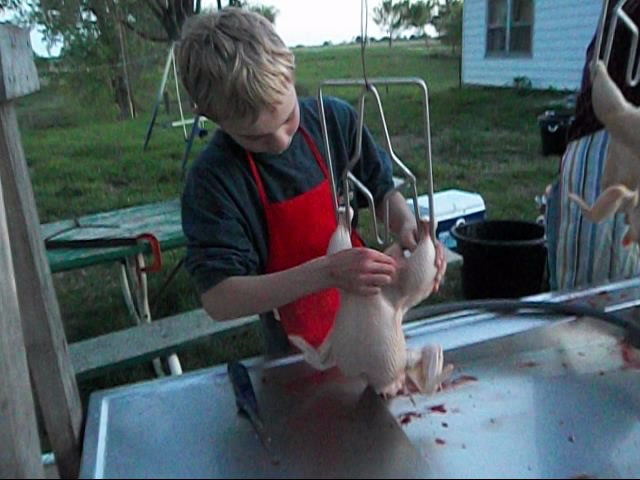
At this point I hand the birds off to my wife and son for evisceration.  The wife gave positive feedback on the shackles saying they will need some getting used to but they are good.  She was working on four birds at a time, making the same cut to each one before returning to the beginning.  Then the birds were handed off to our oldest son for lung and scent gland removal and final inspection.  Ultimately the shackles will hang from chain on a pipe.  For now, we just wanted to verify the hype so I whipped up something quick.

That’s really all I have time to write because I still need to cut and package the birds…after I eat dinner…after I tuck the kids in.  I also have to make plans for a more permanent pipe to hang the shackles from.  And close up the chickens.  And move the cows.  And…

Ah, the joys of being a sundown farmer.