The First Fire

This is two years in a row we have lit our first fire before Sep. 15th. If you would have asked last year I would have said it was unusually cold but now? Turns out I would have been mistaken.

FirstFire

I tend to think of September as a hot month. A week ago it was. On the 9th I came in from morning chores soaked with sweat and still sweating after I got out of the shower and dressed for work. This morning I wore a hoodie to do chores and it was only just warm enough. But September will warm up again. No doubt.

We had planned to light our first fire a week ago when the forecast called for this:

Forecast

But when that weather arrived the house still had so much residual warmth we just couldn’t excuse it. Now, however, the A/C units are out of the windows and the house is a little chilly. And for those of you keeping score, when the 13th arrived 8 days later (today) we hit 41, not 46.

We all slept with a few extra blankets on our beds last night. My oldest daughter stood behind the stove to warm up when she woke up this morning. (The other kids will too but she is the only one up this early.) I think this transition into fall is the best time of the year.

It didn’t take much wood to warm up the back room. It wasn’t much of a fire. Just something to warm the kettle. But it was nice.

Excessive Heat?

LOL. Excessive. Yeah. Like the weather people are scolding August.

“Darn you August! This is well beyond tolerance! How dare you?!”

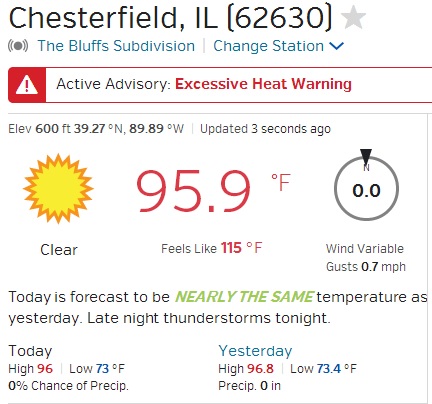
Captured from WeatherUnderground.com

Captured from WeatherUnderground.com

Anything above 80 is excessive if you ask me. Not only is it hot, it is humid. The high temp is only 96 today but apparently it feels like 115 as you swim through the air. It’s hard on the farm animals. And that heat index only goes up as the day goes on. It’s hard on the farm children. It’s hard on the farmers.

SO. Moving quickly here, the cows are down in the bottom under a tall canopy. It really isn’t too bad down there. We keep a close eye on them and haven’t seen them panting. Mostly they lounge under the trees then go for a swim in the creek as needed. We keep them on fresh ground and it’s amazing the number of toads, frogs, spiders, dung beetles and horse flies out there. Biodiversity in action.

BananaSpider

The main layer flock is not too far behind the cows but aren’t as shaded. The chicken house stays remarkably cool so there are usually hens in and under the house for shade. We keep the drinker filled with cool water and in the shade at all times and offer the chickens as many apple drops as they will eat. Seems to be going well.

The pigs are having a hard time with the heat in spite of being in the shade of the barn. We hose them down a couple of times each day to cool them off and allow them to wallow.

Dad’s horses just stay in the shade of the barn.

Julie and the kids stay in as much as possible. We have so much work to do right now that we really can’t escape the heat. She keeps a fan going in the kitchen as she and the kids put up applesauce. They need to do something with grapes too. And she keeps the dehydrator going non-stop with herbs from the garden. But the garden is a weedy mess and nobody wants to volunteer to fix that problem. It’s even hot at night right now.

picking apples

So we stay in. We read. We play video games. We read some more. We try to do all of our chores before 7 in the morning and after 7 in the evening, only going out to collect eggs and check water during the day, drinking plenty of water before and after each trip out and wash a ton of laundry.

We are so glad we don’t have chicks in chicken tractors right now. Just over a month until we get our first frost. We lit our wood stove for the first time on Sep. 15th last year. We really just have to get through this week but this has been a hard week. I really prefer winter. Ask me again in January and I will probably have an opinion on the excessive cold.

As the Sun Sets on the Farm

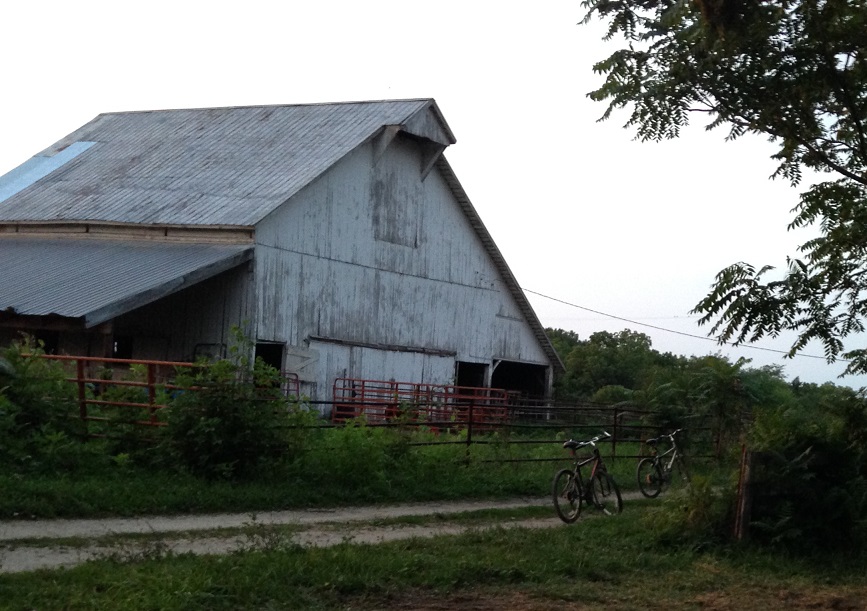
We rode our bikes to the barn to finish up chores just as the sun was setting. It was a small list of things to do, all light work. The dairy cows need a little more pasture to get them through the night, we need to check on the calves, make sure the pigs have water and tuck in the chickens. We have already given the beef cows fresh pasture as we do every 12 hours or so. They mowed, trampled and manured through a tall jungle of giant ragweed today. They also pruned a black locust sapling for me. Looks great.

Shorthorns

The evening air is filled with the noises of cicadas, crickets and the call of a Bobwhite quail along with the soft hum of the bicycle tires on the road. The few remaining barn swallows finish hunting for the day. The breeze is blowing from the southwest and carries the sweet smell of the neighbor’s cornfield. You can still smell a bit of summer in the hay loft in February but that corn smell is fleeting. The neighbors feed corn silage in the winter but that has an entirely different, but pleasant, smell. They will start cutting silage soon and then the corn harvest will begin in earnest. Those tall walls of corn will be gone and we will be able to see our neighbor’s houses again. Fall is coming…and fast.

Sunset2

But tonight we just have a few chores to do. The kids are gone for the evening and Julie and I wanted to be outside together. We park our bikes by the barn and open up a little more grazing for the dairy cows then check on the calves. Not much to worry about with those two, just make sure they have water, a little hay and a clean, dry bed.

BarnBikes2

The SLW pullets are not quite ready for bed yet, though a few are starting to roost. We are still working to train them to roost indoors. They are still working to train us to leave them alone. Who will win?

SLWPullets2

Julie leads the way to the main layer flock. We need to move the birds to fresh pasture tomorrow morning so I take a roll of fence with me. The birds are still busy hunting for bugs and getting a last drink of water before going to bed.

Layers

They need a little more time. I busy myself building fence for tomorrow’s chicken pasture. It should be enough room to last them until Sunday, complete with fresh cow pies to scratch through. In no time at all I have two of the three fence panels in place and decide to call it a day. I am surprised at how many saplings have come up in the pasture this year. A stray bird or two just refuse to roost in the chicken house each night. I find and catch those birds (one in a nest box, one under house, roosted on the running gear) and close up the house for the night. It won’t be long and the birds will be in the greenhouse.

Julie left before I started on the fence as we were expecting the children to come home any minute. She also wanted to get the dishes done so we could just relax together after we put the kids to bed. She and I both have a number of books going at once and are anxious to make some headway. I have to keep my mouth shut and my eyes scrunched to keep the bugs out on the bicycle ride home in near-total darkness.

It was a beautiful summer evening. Cool weather, light work to do. Really, just a chance to stand in awe of the world around us. I get to live here. For a short while this farm is mine. There are times when it seems like too much work, too much stress, too much all happening at once but today I am thankful.

This is pretty cool.

Only the Best For You

It may not be apparent on the blog. It may not really be obvious on the farm. Julie and I have scaled things back a bit this year. In the short term it hurts our bottom line (but not by much) but in the long-run I think it will pay dividends. It doesn’t matter if I butcher 500 broilers or 5,000 (the state-imposed limit). It matters that the food you buy from me is the best you have ever eaten. So good, in fact, that you take pictures of it cooking, post a picture of it on your plate on Instagram and, most importantly, tell all of your friends about the delicious chicken you bought from me. Then you will come back for more and word of mouth will grow our business. You are our marketing plan.

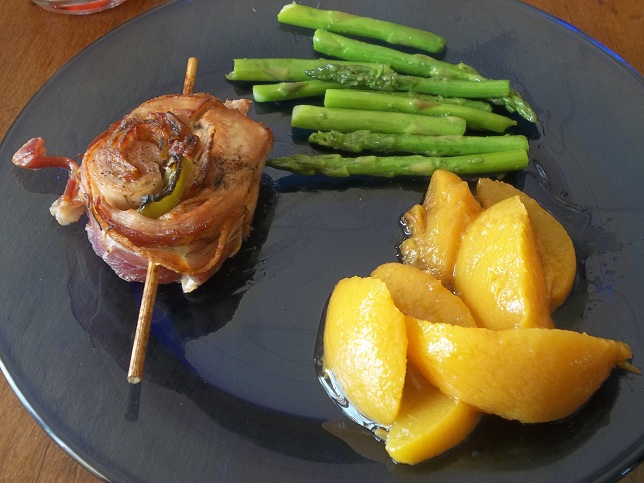
DinnerIsServed

…or in this case rabbit.

However, because we scaled back your friends may just have to wait until next year to buy a delicious bird from us. I have to make sure it is worth waiting for. If I just cranked out large numbers of mediocre birds…well…mediocre birds don’t start conversations. They are just something to eat. Average birds cost less than a dollar a pound so I can’t compete with that market. And I can’t market to the average consumer. I have to raise the very best and cater to those who appreciate it.

After a number of years of raising broilers we have tried it all. One year we butchered 75-150 birds every other Saturday. Think about that. All summer long. And we sold them all! But Julie was tired. She started losing her fingernails from scraping lungs out and her back hurt from standing at an odd position to do the work. Don’t forget that I have a job in town. Julie had to go to the chicken tractors at least twice daily to fill water and feeders but Julie just isn’t strong enough to move the chicken tractors. And we found that the CX birds have a hard time with our summer heat. When it’s triple-digits in the shade they just didn’t do well in our Salatin-style chicken tractors. Switching to hoop-style tractors helped bird health but we also have to be concerned with farmer health. We just didn’t want to go water chickens when the heat index was 112. Just as important we found that customers stopped cooking dinner in the hot weather. Our sales pattern (and this may only apply to us) was to sell birds between Memorial Day and July 4, then again from October 1 until we ran out around Christmas or New Years. Our current schedule produces birds only for those windows. Now our freezers are not filled (or failing) when the weather is hot and customers don’t want to cook anyway.

Broilers

But it doesn’t stop there. If customers don’t want chicken in August, they certainly don’t want pork. Now we try to time our batches of pigs to be out the door by July 1 and little pigs arrive shortly after. Little pigs can manage in the heat well and will be ready to roast and serve with fresh apple cider in October or early November. And you should know that we don’t do large batches of pork. First, I don’t think I could market a dozen hogs all at once but second, and most important, I don’t think I could produce a quality product at my current ability level. So we usually run a batch of four pigs, three times/year. Does that seem like too few? It’s just the right number for our interest, ability, equipment and market. And, fortunately, that’s a lesson we didn’t have to learn the hard way, short of a half of a hog my folks bought for the processing cost after the customer evaporated.

But it’s not just a matter of working to meet customer time preference, it’s also about minimizing our distractions so we can serve you better. Let’s face the facts. If I didn’t have a job, we wouldn’t have a farm. That’s the awful truth. So we have to build the farm around Julie and the kids. What can they manage well? Right now we are focusing on dairy, eggs and pork, keeping each operation small. There are beef cattle on pasture but I manage them almost entirely. The rabbits are gone. The goats are gone. I miss the turkeys. We are focusing on just those three things: the best possible milk for our own table AND fat, healthy calves. The very best egg in the world from fat, healthy birds. Pork the likes of which you have never tasted from animals that are respected and live with purpose. Outside of those three we are educating our children, reclaiming our farm from overgrowth, heating our home with wood, putting up winter stores of food and hay, gardening and playing tag. And we can’t overlook the need for Julie and I to maintain our marriage. That’s more than just saying, “Hi” and kissing goodnight. There has to be time for us to rediscover each other as people. My marriage may seem unrelated to my chicken eggs but you have to know that there wouldn’t be any eggs to sell if my marriage failed.

Olive3

I miss having them but there are no turkeys or goats or rabbits this year. We just don’t have the time. As we learn to do a few things well we will become more efficient…streamlined and that will open up additional opportunities on our farm. How many pigs did Salatin raise last year? A lot. How many pigs did Salatin raise in 1995? Eight. (Read under the heading “Hogs for Free”). You want to grow up to be just like Joel Salatin? Start small. And he didn’t just have pigs for the sake of having pigs. He had a job for them to do then he built a market for his products over time. We are taking our time. Our skill is growing. Our market is growing. We are careful not to allow ambition to overrun marketing and husbandry. We want to provide the best for you, ensure the best for our family and do so by limiting growth while we continue to learn.

Does this apply even if you live in town? I hope it does. What are you doing with your time? Are you really working toward your goals or are you just trying to keep up? Or, worse, are you just keeping busy? We have scaled back to move forward. Together.

First You Cut the Hay

Well, first you check the forecast to see if it’s going to rain. Then you pray the forecast is right. Then you cut the hay. Then you wait (and pray some more). Then you rake the hay, twiddle your thumbs while it dries and you bale it all up and haul it to the barn. And it better not rain or else. If you have done everything right your livestock will eat well and the barn won’t burn down.

So let’s go through that more slowly. In four-part harmony. With feeling. This may not apply where you live. Find a local mentor.

We cut hay to the east of the farm over my lunch hour one Tuesday (as we usually do). It’s better to wait till later in the day so the brix in the forage is high. Dad had me take my chainsaw to cut tree sprouts so they wouldn’t damage the hay conditioner so I was too busy to take any pictures. Imagine a machine with an array of cutter teeth cutting through the grass about 2″ high and feeding it through a crimper. The crimped grass dries out more quickly then is left laying in a wide row behind the cutter. Swallows usually follow the tractor to grab the bugs as they fly out of the grass around the mower. You down? We leave that laying for a day or three until it is dry enough to turn.

RakingHay

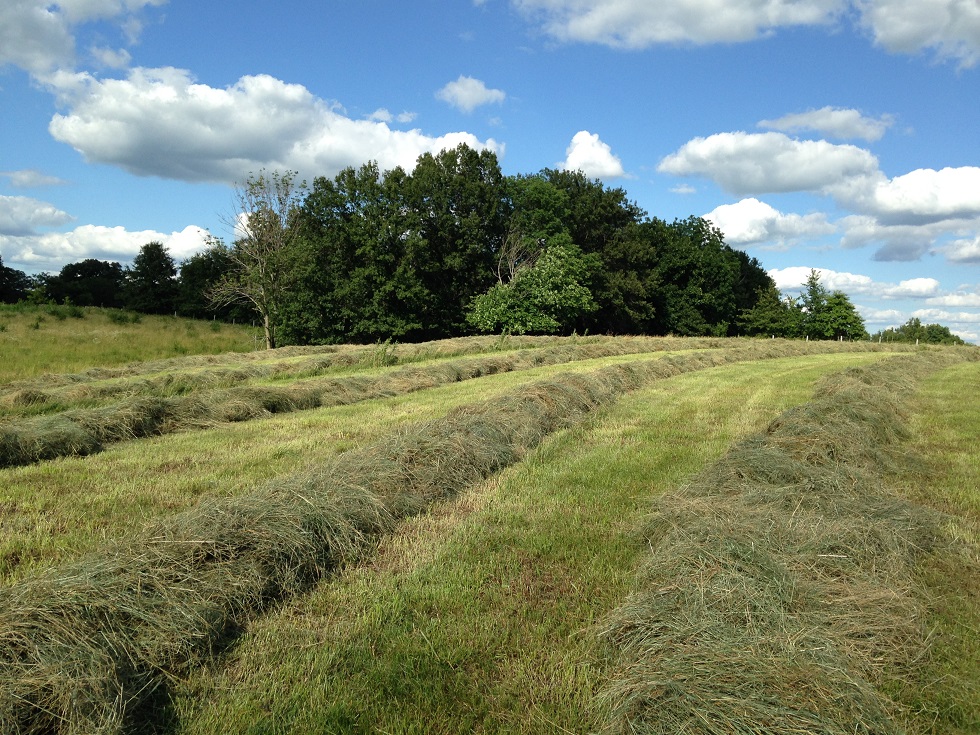
Dad likes to rake the grass hay into full-on double windrows (Whoa! Double Windrows! What does it mean?). By turning it we expose the grass that was on the ground that may not be quite dry yet. Dad makes double windrows so he can bale more slowly and have more room in the field. Maybe there are other reasons. We really don’t talk about it. In some cases the windrow is too wide for the baler so I usually keep a pitchfork with me as he bales to scoop up hay that was missed.

DoubleWindrows

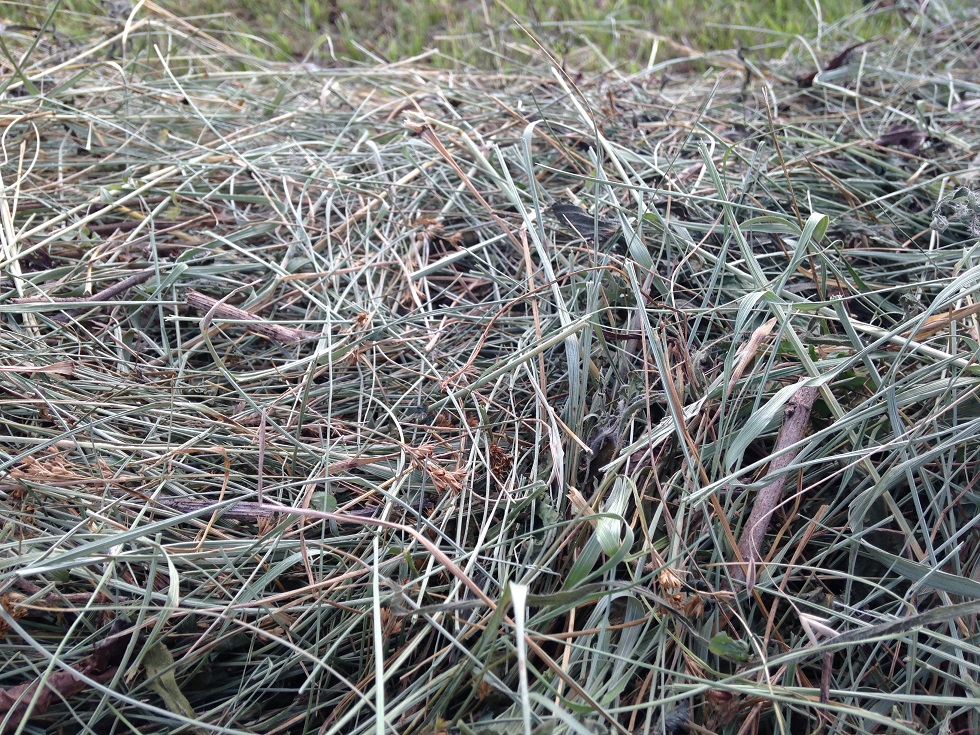
We are always in a bit of a pinch on baling day (in this case, after work on Thursday). We have to wait for the dew to dry off of the hay before we can rake. I spend a little time digging through the windrows looking for wet spots as dad rakes. I also think it is interesting to look at the variety of forages. We raked up some thick stems, some thorny things, you can see brown, leafy clovers, grasses, some goldenrod, once in a while a little plantain…it’s all here. That variety will be a good thing in the winter but it’s hard to dry out the thick stems without damaging the finer hay.

WindrowCloseUp

Then we have to wait for that (now) top layer to be completely dried out before we can bale it. But we have to bale it before the evening dew comes on. We have to get the bales up before they soak up moisture in the evening. There isn’t much standing around once we start and we have to be careful not to cut too much at once. This time we cut about an acre and a half. That’s enough for us. We have a 9-acre field to cut later in the summer. We’ll spread that out over several sessions when the weather looks right.

BalingHay

Dad ties in with the baler around 4:00. He made heavy bales the first pass as the hay was thicker than we had expected. After a bale broke he backed off the bale tension and cruised through the rest of the field. Sometimes bales just break (as did two others) but that can just be because of a weakness in the twine. The first bale that broke was a monster. Just a monster! We either feed the broken bales back through the baler or I just scoop them up later with a pitchfork and a trailer.

BaledHay

As dad bales I follow him around the field scraping up hay that the baler missed and adding it to the next windrow. My oldest son and I also try to double up the bales so we don’t have to travel so far when we come back later to pick them up. We could stack the bales right off of the baler but that makes me sneeze…lots of dust. Instead, we pulled two wagons behind the tractor. I alternated putting the bales on each wagon and the boy and the wife stacked. I suspect Julie will drive next time and dad will stack. Some of the bales were pretty heavy. It was pretty good hay.

Stacking

I was expecting to get 80 bales from this field. We ended up with 166. I didn’t have enough wagons for that much hay and we had to drive up and down a steep valley that prevented us from stacking high. We had to take two wagon loads to the barn so we could continue. Again, we had to get the hay off of the ground or the bales would absorb moisture. We are almost finished in the picture above and I’m breathing hard between bales. You can see how much time has passed by looking at the sun in the last two pictures. It is always a long, hard, hot day but it is so nice to smell that little dose of summer when you go to the barn in February.

Just a couple of additional thoughts:

  • We normally plan to put up grass hay on Memorial Day, July 4 and Labor day but this year has been late because of all the rain. Alfalfa is on a slightly more frequent schedule.
  • I am cutting hay in my pastures because I don’t have enough cattle to eat it all. I also don’t have enough cattle to eat all of the hay we are putting up. I hate to sell hay but…
  • I like to spread at least one load of composted manure on the field for each wagon load of hay we remove. Usually it is a mix of brooder litter, pig bedding, horse manure, cow manure and whatever else I can scrape up topped off with a layer of crushed limestone…all loaded by hand with help from that strong young lad in the picture above.
  • A neighbor was killed this weekend putting up hay. Be safe. I try not to cut hay on the slopes but there are any number of dangerous things I do in the field that I shouldn’t (walking between moving wagons or dismounting a moving tractor on a flat field). Dad and I have agreed to focus on safety moving forward.

Walking the Farm in a Spring Rainstorm

According to the very expensive, precise and scientific bucket that was left sitting out, we got a total of 5 inches of rain yesterday, 3 inches in the first hour. When that kind of rain hits the farm I like to put on my raincoat and spend time looking around. I want to know where the rain is soaking in and where it is running off. Is there any soil washing out? Did any lids blow off of chicken tractors? Are the ducks teaching the chickens how to swim? We’ll start at our broken old bridge to nowhere.

Bridge

There is normally a trickle of water flowing through here. The kids crawl through the tunnel and hunt up crawdads or pretend it is a fort. Today it is roaring as water flows through. I’m glad to see that there is not more water flowing through. This tunnel is fed by the overflow from the pond (not much is overflowing yet thankfully), the runoff from the alfalfa field (again, just a trickle) and the runoff from the corn field and feedlot and the ditch across the road (the majority of the water you see). It looks like most of my water is either soaking in or being delayed in reaching the branch. I love it when a plan comes together. But the pond is receiving quite a bit of water and topsoil from the neighbor’s field and then there is that feedlot. Well, not much I can do about that. Following the water downstream I’m concerned the branch will flood the bottom…where the chickens are currently.

Branch

The water was about a foot from coming out of the banks. Too much water for me to cross so I can’t go any further to the North. Within an hour the creek was already receding so I slept soundly believing the chickens to be high and dry…until I heard it raining again about 2:00 in the morning. (Skip to the end: chickens are fine). No choice but to go east. Cows are out in the open east of the yellow house. I’m taking advantage of the cool weather to graze open areas right now. The cooler weather will end this weekend so we’re watching the clock. The cows are so full they are a little hard to move. I’m giving them larger areas right now to get back to the trees in time. We will have a big, square cutout in the pasture that will remain ungrazed until fall. That’s how it goes I guess.

RainCows

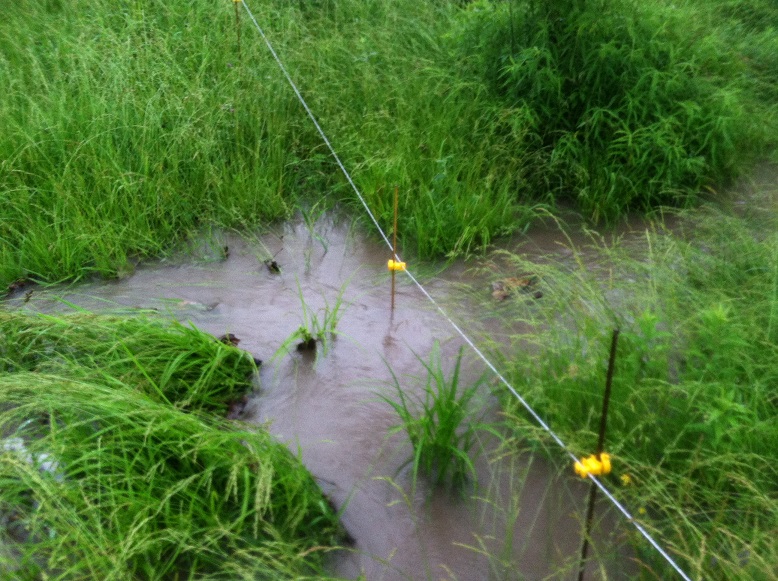
Further east the little wash is flooded and we are just about to lose our fence. I stop to adjust the insulator a little bit.

Flooding

This water is either overflow from the neighbor’s new pond or runoff from the eastern half of the alfalfa field. There is a dry dam on the alfalfa field that is making a huge sucking noise as the water rushes through the pipe. It was too dark in the woods to get a good picture but a dead tree was against the drainpipe and it was spraying water in two directions. There was a huge pool of water there. I’ll need to take some corrective measures to heal that forest floor. When I say “corrective measures” think cow hooves. Most of the green you see is poison ivy so it won’t be milk cow hooves.

DamDrainFinally I stopped by a mulberry tree for a snack, something I try to do a couple of times each day. Mmmmm, freshly washed fruit. I’ll get tired of eating mulberries in a few weeks…about the time I run out of berries I can reach. Mulberry trees will grow anywhere a bird can poop. They are tough plants, will take serious pruning, will grow from cuttings and make good firewood. They are all over the farm and I try to visit each one regularly. There are some deep in the woods that aren’t ripening yet extending the harvest season.

MulberriesLet me know if you got any of this rain too or if you have any ideas for preserving mulberries. I don’t care for them frozen and we don’t tend to make jelly. Wine maybe?

One additional note:

The chickens are a long way from the cows and have been for about 2 weeks. The chickens are currently housed in our portable layer houses. That design has worked well for the last year but has its limitations. We will be re-purposing those structures or the components. One severe limitation is the lack of portability over distance. We are moving to a new design on a wagon running gear so we can close it up and head down the road (cause we can’t cross the broken bridge). I have been delayed getting that project finished. Look for pictures soon.

Calving When it’s Time to Calve

From Wednesday’s Pharo Cattle Company PCC update:

Just one week after the official beginning of our calving season, we are almost two-thirds done calving.   That is impossible for those who do not calve in sync with nature.  Since all calves are born with a summer hair coat, doesn’t it make sense to calve in warm weather?

That’s pretty much the boat we are in. Our animals were all naturally serviced in a short window and it has taken 17 days for four out of five calves to hit the ground. The cows were on pasture all year but we turned them on new grass 2 months ago. They are fat, healthy and clean. The grass is tall. The air is warm. Calves are all coming unassisted. We just look away for a second and look back and there’s a calf up nursing.

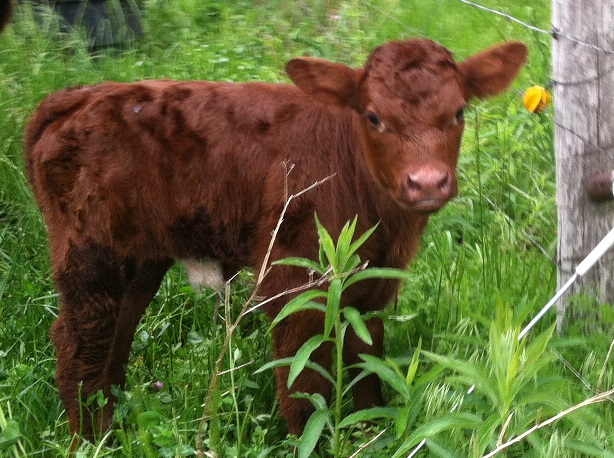
Curly

Certainly some of the vigor we are seeing in our calves is due to the bull we used but there is more than just that. Certainly some portion of calving ease is due to herd genetics but that doesn’t account for the whole picture either. The calves are warm. Their bellies and moms’ udders are kept clean by tall, fresh grass. They are standing, running and romping on firm ground. Mom is making milk just at the time when the pasture is at its peak of production.

Edith

So now the question…should I breed at the same time this year? Last year the bull arrived on July 27th. Three heifers did not breed. Did they miss because they were inferior animals? Too tall? Infertile/unhealthy? Were they just too hot when the bull was here? So far, all heifers bred on their first cycle but the bull was here until the end of September. Do those other three really have an excuse? Really?

I don’t know. I mean, I guess I can stick with the same window and continue selecting for cattle that will breed in the heat. It’s hard to know what is best.

Clover

Our pastures are dominated by infected fescue. Infected fescue does all sorts of bad things to cattle including increasing their body temperature. Lots of ranchers just to the west of us breed in December to calve in the fall flush of growth and take advantage of stockpiled fescue when it is of the highest quality…when it is frozen. Then they wean in the spring when calf prices are high but to this point we have allowed the cow to wean the calf herself…at about 9 months. That’s no big whoop either.

Henry_Edith

I don’t know if I am doing the right thing. We aren’t worried that the calf will be cold. The cows are fat, clean and in good health. We are doing what other, apparently knowledgeable, apparently successful farmers and ranchers do. We are doing what the deer do. It seems to be working out well.

Racing the Forage

It’s really happening. Finally. The cows are on the move. We are covering ground at an almost unheard of pace…11 animals covering an acre each day divided into two sections. At first they grazed everything away from the repugnancy zones. Soon the grass got ahead of us and the cows could begin to graze very selectively. They go into each paddock fat and come out even more fat. And fat is what we are after.

This is the time we have all been waiting for. The world is green again. The grass is growing fast. As much as I want to put some pressure on certain portions of the pasture this is not the time. It’s just time to run. Right now we are concerned about cow condition. I want the cows to have a big area, a big variety and a big volume of feed. But we are also concerned about future pasture. We don’t want the cows to eat the grass down to the dirt. There is not enough grass out there to knock it over and leave a covering on the soil so we just try to graze the tops off of the plants and move on immediately. The pasture in the picture below was grazed over the course of a week about a week ago.

Grazing1

The idea here is that we sprint across as much of the farm as we can. Realistically, I’ll only cover 2/3 of the farm before it begins to go to seed…at which point we’ll return to the first pasture. The ungrazed area will be left in reserve either for drought or for winter stockpile…or both. The starting point changes each year, the drought reserve changes each year, the pasture changes each year. It’s fun to plan and manage and as the forage quantity and quality increases I’ll have to increase the size of my herd. For instance, on the half of the farm we have managed for several years we have grazed once with cattle and once with chickens and the forage is at least 2 weeks ahead of the new 40. The goal is that the soil health will continue to improve and we’ll gain a month of grazing at each end of the season…then 6 weeks…then…well, then we will solve other problems.

Keep in mind we just took possession of the 40 east of our house. We are building fence on pasture we have never walked before. Certainly we have seen the ground but fencing and grazing gives us more intimacy with the land than does a casual stroll. We have lots of places on the farm that are remote and rough…beyond zone 5. There is no reason to go there so we don’t. But with the cattle on rotation we are covering the whole farm. It’s amazing what we are finding. Everything from evil, thorny trees to the neighbor’s trash from decades ago.

We do better some days than others. It’s hard to read the forage through the remaining weed stalks from last year. Sometimes the cows seem to fatten on nothing. Sometimes they look empty but there is standing forage all over behind them. I can only assume they are ignoring forage for a reason and it’s better to try to learn from their selectivity rather than to force the issue. Maybe I need to amend the soil there. Maybe the chickens need to sanitize the area. Maybe it just needs to rest.

Grazing2

Sometimes we just open a fence and let the cows through. Sometimes we take the cows on a bit of a walk. Sunday morning we took a rather long walk. When the cows got there they went bananas running, rubbing on trees and playing around. We didn’t realize until afternoon that they were probably looking for the missing steer…that we didn’t realize was missing. We walked them through a draw and he stayed behind to get a drink and a bite to eat. He was looking pretty lonely (but fat) when we found him later in the day. He flat refused to go over or under that horrible electric fence so we had to walk him all the way to the end of the line to rejoin the herd. I’m feeling pretty good about the new fence charger.

One thing I am constantly aware of is the poor condition of my south-facing slopes. Our pastures have been set-stocked for decades. By grazing the hot south-facingn slopes in the middle of summer the grasses have been set back. The soil organic matter is low. I’ll have to hustle to correct this…and it will probably take several years. Matron talked about the same problem in a recent post. The main corrective action will be to use care when grazing the farm over the summer, preserving tall forage on these slopes to heal the grass. Tall grass catches more dew and puts down deep roots.

CowPaths

The other problem we face over here are the cow paths. There are deep ruts cut into the hillsides by the cows over time. I need these to heal over. In short, we are seeking to prevent travel along these paths and increase the rest periods so forages can begin to establish here. Also, we are trying to slow the flow of water along these ditches. One thing at a time. The cows are looking pretty good. The pastures are thickening up and we are allowing rest. That’s what we need. Our half of the farm has no visible cow paths remaining outside of the creek crossings. A couple more years for those…

Spring Grazing…Ugh.

…not yet. …not yet.  Just a little longer…..

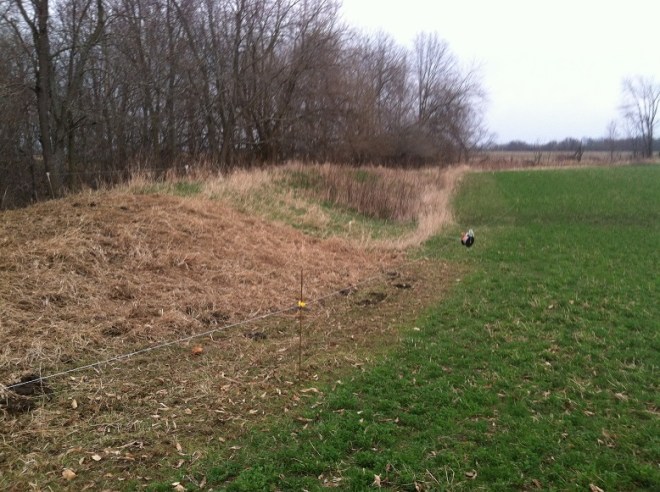
Ugh. I can’t wait a little longer. I’m out of stockpile! There is still hay in the barn but we don’t want to feed it all. And the cows clearly prefer grazing over waiting for me to bring them feed. So here we are. Grazing field edges that haven’t been grazed in …possibly decades. The cows eat grass, alfalfa and thistle. Why is there thistle? Because they sprayed the groudn with roundup for years to keep the fence clear. The earth doesn’t want to be naked…something has to grow. So thistle grows. The cows stomp and manure ground that hasn’t been directly manured and they only get a couple of hours to do it. We bunch them tightly and move them quickly. This kind of treatment will knock back the thistle better than anything else I can do. (BTW, see Mrs. White with her head up looking at the camera? Her head is not in the game.)

AlfalfaEdge1The field edge lasted two days. The first day we fed hay in the morning, gave them a grassy area to graze then sped them along the field edge. Toward the end of the day we asked them to camp out at the other end of the field where mature, stale grass rules.
AlfalfaEdge2

They munch through the brown grass to find green grass beneath. They trample it all in, knock down brambles and manure everywhere. They even found a really nice antler in the tall grass I would never have found. Then, the next day, we let them have the other half of the field edge they missed the day before. Again, they went onto it full, we kept them bunched tightly and we moved quickly. Alfalfa in the spring can be risky…actually, the transition to green forage is a little tricky but bloat is the biggest concern.

But now what? I have enough of this wooded patch to last until Wednesday evening. Then I have to do something else with my moos. The pasture isn’t ready to be grazed. Well, some portions are but in general, not so much.

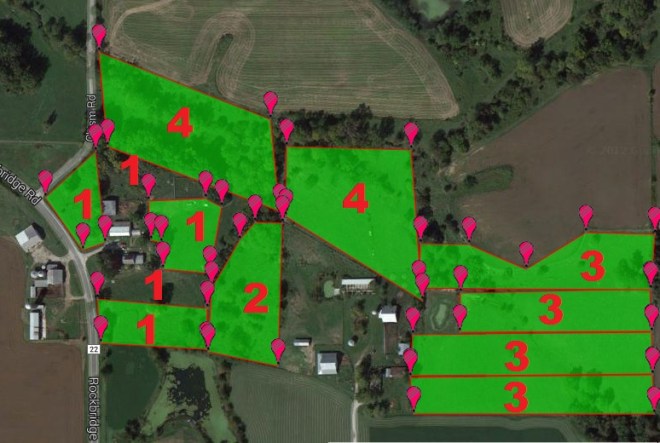
EastPastureMost of the grass is just inches tall. We are in a warm rainy cycle. It shouldn’t take long for the grass to really come on and right now a week really makes a big difference. I just need to delay grazing for a little while and when we go to pasture we will be offering big grazing areas and moving the cows quickly. I mean, we’ll offer the 10 cows an acre/day (and probably break that into 4 sections) so they can pick and choose the best grazing and I’ll probably continue to offer them a little hay while we continue the transition and wait for the grass to catch up. We are planning to race across the farm in about a month as shown below (numbers of days per segment, segments will be subdivided), after that we’ll slow down and use smaller and smaller grazing areas, dropping some out for stockpiling. Matron talks about this in a post on her blog.
SpringGrazingPlan

There are, apparently, several important things for me to do right now. First, I don’t want to eat tomorrow’s grass today. If I remove too much of the leafy area I weaken the emerging grass right now when it is fragile. That can potentially set the plant back, limiting its growth for the entire season.

Second, I need to get my cows fat. They are coming out of winter a little on the thin side. They aren’t skinny but they aren’t in the condition I want for calving. I have 30 days before calving starts. Again, I really don’t know anything about cows (sorry if that’s a shock) but as I read in any number of grazing books (Walt Davis comes to mind first), the most important thing I can do to help my cows breed back is to make sure they have a good layer of fat (stored energy) on them at calving time. The good news is their metabolism is set for winter maintenance, not spring gain…so we’ll get compensatory gain from them if we give them access to enough forage and variety until their bodies adjust. Same thing happens when you diet, btw. You go “off feed” for a while, your body adjusts, then you “reward” yourself at a family gathering and suddenly your skinny jeans just don’t fit anymore. You taught your body to become more efficient at storing energy. Well, that’s what we’re doing with the cows. They have been on a diet all winter and they have worked hard and behaved themselves. Soon they get a treat. All the grass they can eat!

I just need to delay a little while longer. There are areas on the map above that are not accounted for. I need to take advantage of those areas. I can get a day in the yard at the yellow house with the help of a little hay. I can get a day in the barnlot. That gets me to Friday night…two extra days of 60 degree plus weather. Will it work? I dunno. I do my best. I read everything I can. I make a plan. I go out and try. I tell you all about it…good or bad. Wish me luck!

(In this post I linked heavily to Matron of Husbandry’s blog. Whatever books and blogs I have read or seminars I have attended, Matron has done the most to remove the fog (for instance, this post). A few postings, a few illustrations and everything became clear. She’s a great teacher…and I bet she’s rolling her eyes right now.)

Rolling the Grazing Forward

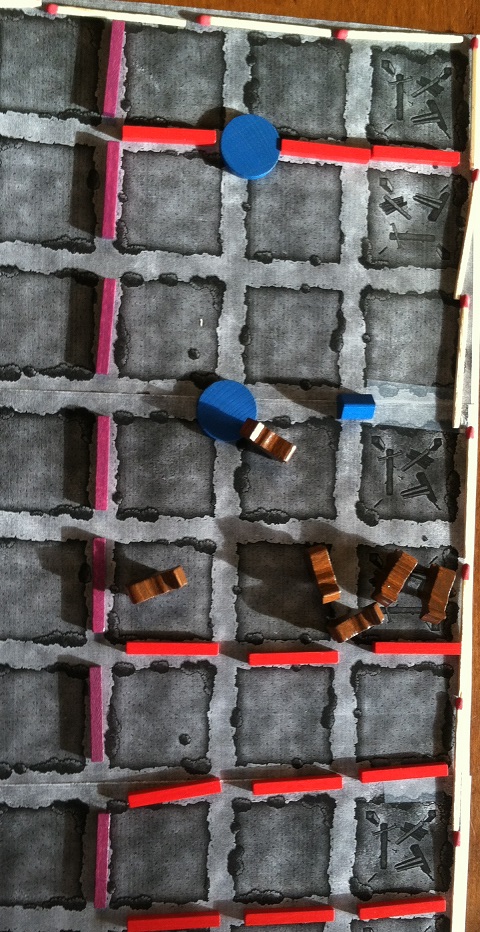
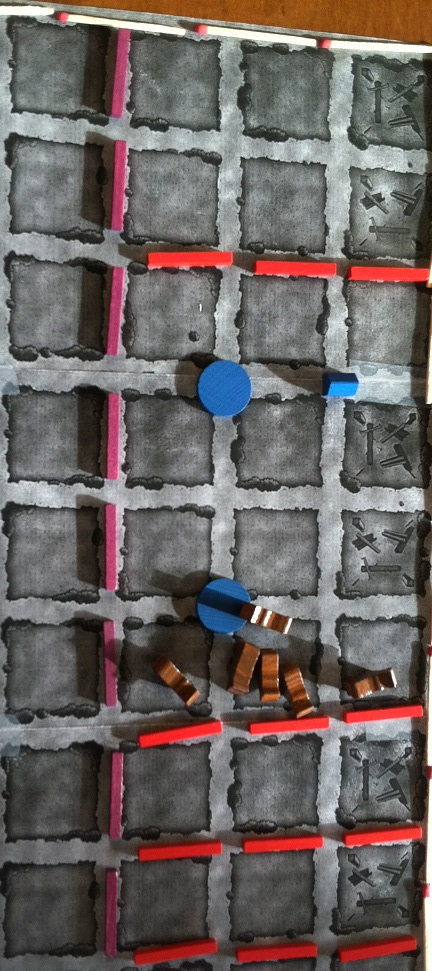
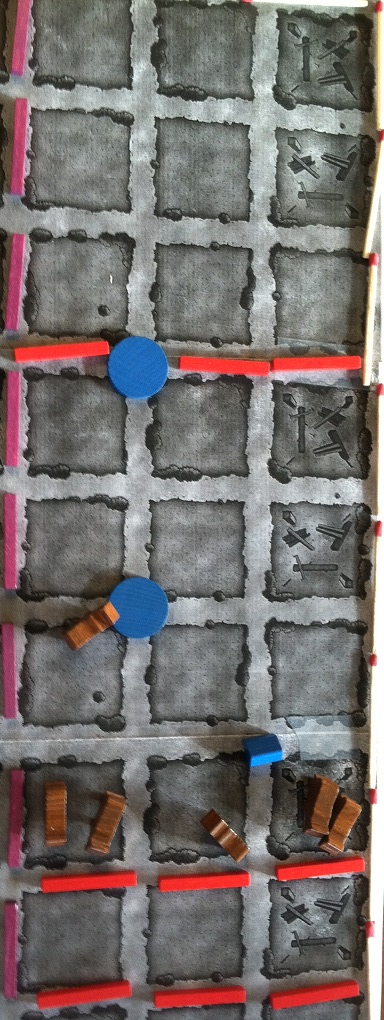
A reader asked what I meant yesterday when I said, “We are currently moving the cows daily and rolling about four days worth of grazing with them.” Those words were, apparently, not as clear as they should have been. With the help of our trusty Agricola game pieces (and a few matches) I will demonstrate what I meant. We’ll start on day 4 and roll through day 7 with the help of some toy cows. First, a quick look at what the blocks mean.

MapLegendAnd we’re ready to begin. The cows are in the corner of the perimeter fence in this illustration. They have been here for four days. For illustration purposes, each day they get a new row of three blocks. There are two watering troughs that move with the cows and a free choice mineral feeder. The lagging watering trough is allowed to go empty so we can simply carry it forward. The mineral feeder has to be dragged so we move it less frequently.

Day4

I want to point out that the cows spend most of their time on the freshest strip of ground. They get up to eat then lay down to chew their cud. What happens when a cow stands up? It manures. Cows like to lay down on fresh ground. They don’t like to lay in manure. So the cows are always moving to the fresh ground, leaving a path of muddy, manure-covered, hoof-printed destruction in their wake. The fresh ground is like couch, cupboard and toilet all in one. So they always need more.

Day5

So we move the cows. By day 5 we are beginning to fence out the first waterer. We want to let that go empty. There are times when it is entirely appropriate to dump 100 gallons of water on the pasture but not at the height of mud season.

Day6

The next day we move the cows again. They are always where the action is. The action is right up by the new fence. The back fence creeps forward one day at a time…rolling four days worth of ground forward. By day 4 new blades of grass are starting to peek their heads up. It would be detrimental to this year’s grass crop to allow the cattle to take a bite now. So we move them on.

Day7

It’s day 7 and you’re getting the idea. We have had to move the mineral feeder forward. Sometimes we fence them out of the mineral feeder for a day just to make it easier for us. The cows are always eating, stomping, lounging and manuring on fresh ground. They really only go back to get to the water. But right now I think it is important to give them the extra room, even if they don’t use it. They may face a choice. They could stand in the wet mud on a rainy day or they could stand under a tree on a bit of high ground. I would like to give them the option.

It is important for me to add that this is not our year-round strategy. It would work…ish. But it’s not what we do. This is this month’s grazing strategy. All winter there has been no back fence. We just allow the cows to move forward. Now that grass is growing again we are bringing the back fence along to protect tender young plants. When the grass starts to grow really fast we’ll start to move the cows really fast. Right now they may gain 1/16th of an acre/day. In April I anticipate giving our 11 cows 1/2 acre/day. The cows will just nibble the tips and select the choice morsels as they gear up for calving in May. When the grass growth slows the cows slow too. But that’s a subject for another blog post…or book.

Just a couple of other notes on the ground we are currently grazing. This ground was planned to be this year’s sacrifice area. The whole farm is a muddy mess, except the few South-facing slopes. To protect the rest of the farm we stockpiled fescue everywhere we could and planned to be on the flat bottom during the thaw. Next year we’ll find a different flat spot to graze in March. If it’s too wet we’ll just take the cows to the barn and feed them there but that creates an awful lot of work for us feeding, bedding and later composting and hauling the manure.

Finally, because of the amount of disturbance the cows are creating right now (which really isn’t too bad) we will allow this ground to have an extended recovery period. We will finish grazing this by April 1 and we may not return until June. Maybe even July. 60 days is a long time in the spring, keeping in mind what I said about offering the cattle 1/2 acre grazing areas while the grass is growing quickly.