Second Butchering Day Aftermath

We’re tired.  Like tired tired.  Wiped out.  Used.  Sapped.  Tapped out.  Done.  Spent.  200 birds.  2 days.  2 adults, 4 children and a little help from my mother-in-law.  The dog may have eaten a few livers too.  We also went swimming, watched a little Star Trek, read, played legos and took care of the rest of the farm but the poultry processing was the absolute focus.  It’s not like we’re new to this…it’s just hard work.

Here’s a shot of the new freezer:

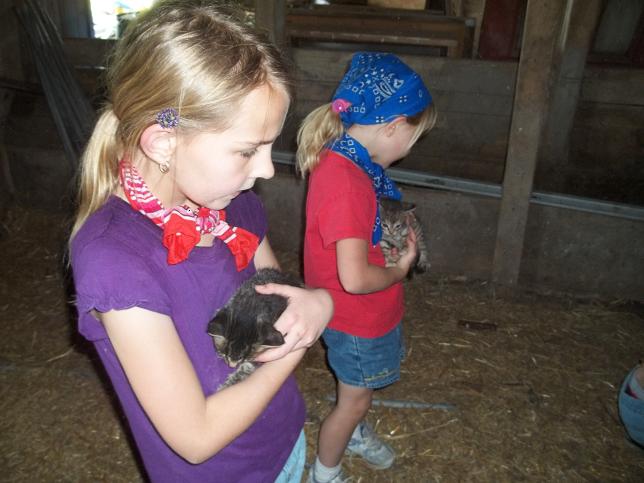
Here’s a shot of the CL freezer we got from a nice couple in a beautiful home complete with chickens and kittens way, way out past the greater MO trailer park-o-rama off of 70 somewhere.  I mean way out there.  Well, not as far off the beaten path as we are…but still.  Way out there.
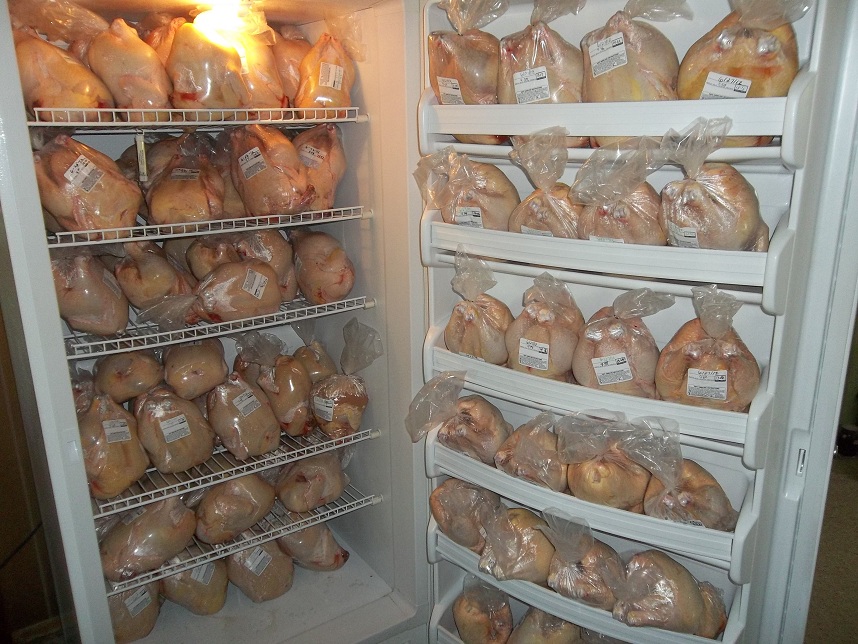
So.  That ought to keep ’em for a while cause that’s it.  Well, I have another hundred on pasture to butcher in the next three days or so but then I mean it.  That’s it.  Well, that’s kind of it.  That’s it till we butcher again in October.  Maybe.  Raymond Mears (ex-gf’s grandfather (I have some of his ties)) said, “Corn in the bin is money in the bank”.  I suppose I could look at this chicken that way.  As long as the power doesn’t go out, it’s money in the bank and it’s safe from the 4-legged masked bandits that have apparently taken over the farm.  I saw 3 in my yard early this morning!  Sheesh!

I read about guys who process 300-500 birds/day or process 10,000 birds/year.  Salatin says he processes 30,000.  I can’t imagine how they chill all those birds.  Those two freezers are putting out a lot of heat right now.  Maybe walk-in coolers can handle it better.

We work to be very efficient from kill to chill and from chill to freezer but I’m surprised to take note of how long we spend packing the birds into transport crates.  I don’t think there is much of a solution to that but I haven’t been estimating that time correctly.  Just an observation.

Well, chicken for dinner tonight.
Butchering Days

We are butchering this week.  We have 3-digit high temps coming this week so we’re trying to butcher our broilers before that happens…you know, since I’m on vacation.

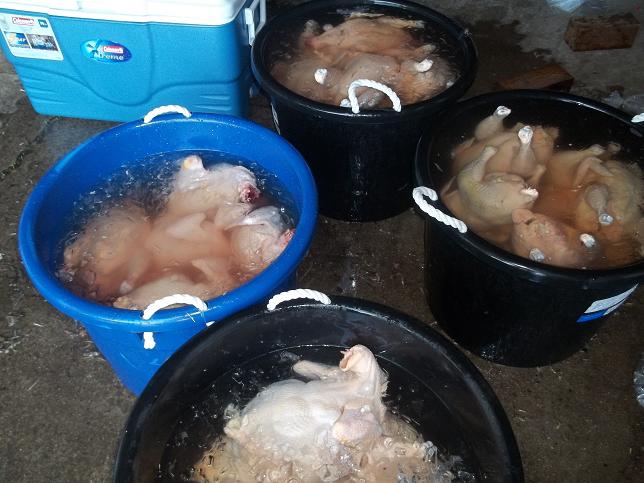
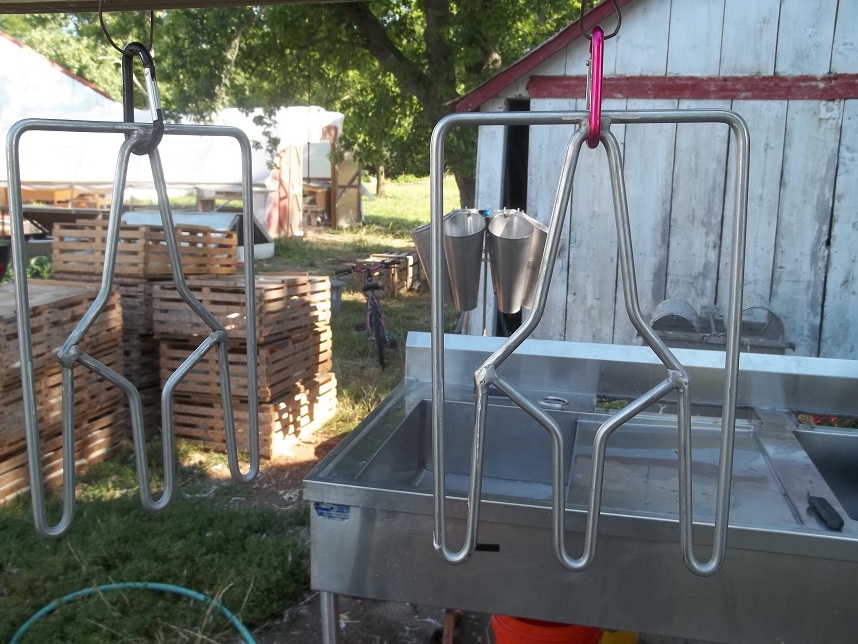
Yesterday morning there were 300 broilers on pasture.  We butchered 100 yesterday.  It took us 2 hours to get them in the chill tanks, another hour to bag.  But we were late getting started so we barely finished before lunch, took a break and bagged them from 3-4.  Today we intend to start earlier.  I really mean it this time.

My flat Salatin-style chicken tractors get the hottest so they got emptied first.  Today I’ll take 20 birds from each of the hoop tractors to make more room, take 40 of the turkey’s roommates and finish up the remaining Salatin-style box.

Yesterday’s birds weighed an average of 4 pounds.  That’s just what we were shooting for.  Customer feedback on 5 and 6 pound birds varied.  It’s nice to have normal-sized birds available again.

The freezers are nearly full!  This is it for the summer.  There are no chicks on the farm right now.  Soon we’ll be focused on swimming instead of feeding and watering!

OK.  Really gotta get going.  Have to start butchering at 7 and I have to catch the birds, sterilize the work surfaces and sharpen the knives.

Nothing is Perfect

I like our Premier One Permanet.  I really, really like it.  But, since I have lost 4 pullets in 5 days to one dirty, stinking, filthy so-and-so skunk who is either bulletproof or can dodge bullets like Neo from Matrix and who can get through/under the fence in spite of a consistent 8,000 volts running through the permanet, it’s obviously not perfect.

I watched legions of raccoons splash at the pond night before last.  Raccoons aren’t getting through my fence and killing my chickens.  It’s a skunk.  One single bird each night.  Raccoons would kill several each.  The fence does a good job of keeping the raccoons out but can’t keep a determined skunk out.  It also failed to protect us from a mink once.  Neighbors are nice but they need to respect my property.  This kind of wanton property destruction and outright theft can not be tolerated.  Murdering a chicken is a capital crime if you are a skunk or a mink.  Skunks who murder and eat four chickens in five nights bring out the worst in me.

So I camped out at the pond, flashlight and gun in hand.  Just a tarp, an old blanket and the lumpy ground.  400 chickens make a lot of noise.  No skunk showed up to party.  I had to move the East side of the fence yesterday to continue moving the chicken tractors so maybe I filled in the unknown gap the skunk was using.  Maybe he smelled me.  Maybe he died a horrible death from a great horned owl.  I don’t know.  I won’t sleep well until I know.

The fence is not a perfect solution but it mostly gets the job done.  When it doesn’t, it makes for a long couple of nights and days of guilt, discouragement and stress.  At least it’s not cold out.  Or raining.  Yet.  Fortunately, the fence is 99% reliable.

Oh.  It’s raining now.  Well, that’s good.  It hasn’t rained in about a month.  Maybe the skunk will catch pneumonia.

New Layer House Prototype

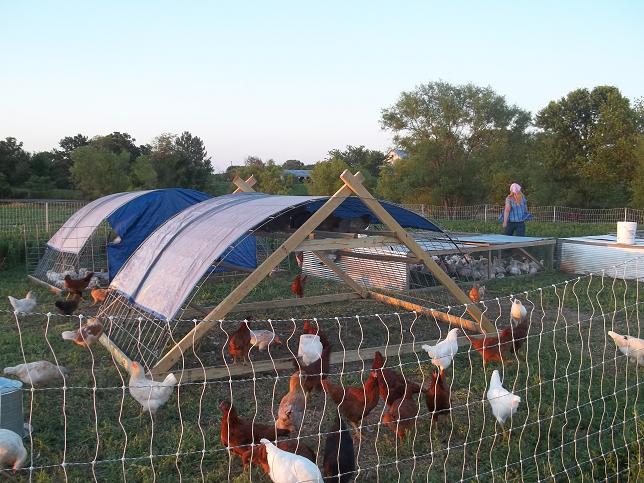
I like the cow panel hoop chicken tractors so much I thought I would try my hand at making a layer house out of them.  This will solve several problems for me.  Primarily, I don’t want to clean out bedding in a layer house on pasture.  Also, I don’t want to use a tractor to move my layers.  This design has several drawbacks though.  First, it’s open on both sides.  An owl could fly right in and ruin my day.  Second, I have some concerns about the weather.  We’ll certainly keep them in a greenhouse over the winter.  Anyway, here it is.

The crossed 2x4s support the hoop and prevent it from swaying.  Then there are roost bars across the span.  I may need to put in two more 2x4s to prevent the roost bars from drooping.  I also may need to lower the roost bars a bit as the pullets grow.

Overall though, I really like it.  I plan to hang nest boxes off of one side or both.  For now these birds follow immediately after the chicken tractors and I move their house daily.

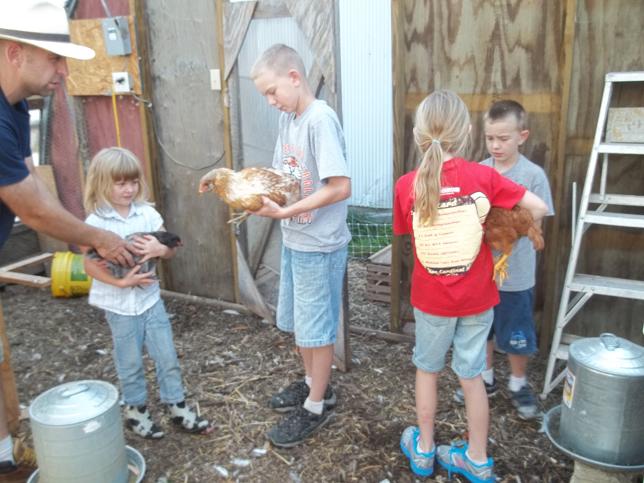
We had a bit of a circus rounding up the pullets in the greenhouse to move them out to pasture.  Everybody helped and after a little while, all birds were caught, their wing feathers were clipped and they were packed into crates for the big move to the alfalfa field.  Once there, we had a good time convincing these birds they needed to roost in the structure.  Oh well.  Keeps things interesting.

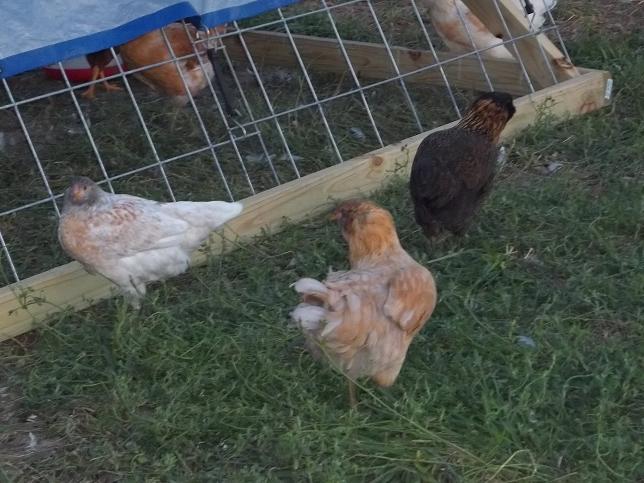
Now, it just so happens that I have a few Americauna pullets to spare.  If you know anyone interested in them, please let us know.

I’ll keep you posted on how the house works out.  We’re two days in.  So far…so good.

600 Birds Later…

We processed our 600th bird with our Featherman equipment.  We did 56 birds in a little under an hour with just two adults early Sunday morning.  I was kill/scald/pluck/head and feet removal…as usual.  My wife hung them on the shackles and eviscerated, inspected and placed in the pink chill water.  Our kids woke up and joined us when there were a few birds left.  I was happy to see this pace though we haven’t broken any records.  In Pastured Poultry Profits, Salatin says he did 150 birds in 2.5 hours with his wife and young son helping.  I think that’s doable, we just aren’t quite there yet.

We need about an hour to scrub and sterilize the work area.  We need an hour to process 60 birds.  We need an hour to clean up and compost.  Then we need about 2.5 hours per 60 birds to package them because I had so many cut-ups.  Yikes!

The packaging process is the worst.  It’s a big chunk of the reason I need $3 per pound tending toward raising the price.  Darby reminded me, “You may as well do nothing for nothing as something for nothing”.  Something has to change on the packaging front.  Something has to change.  A label printer would save a few seconds and a bit of frustration.  Working to get a good scald would save a bit of time cleaning up birds before packaging.  Otherwise, it just takes time to cut and bag them.

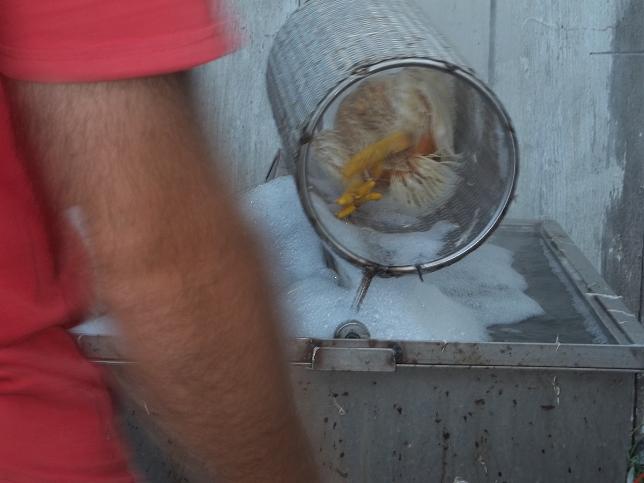
I stand by the Featherman review I published earlier.  The kill cones are great.  The scalder does a good job but I have found the burner to be a bit fiddly.  The roto-dunker needs work as my fingers are cut from sharp edges on the dunker and the motor isn’t powerful enough.  The plucker does a fine job on the birds and the shackles are awesome.  Porter Pond Farm offers independent verification of the issues I am having with our processing equipment.

Raising chickens is easy…even with Cornish Cross.  We lose less than 2% of the birds to natural death.  The percentage goes up just a little bit when you include accidental death from pre-teen feet and very rare accidents when moving the chicken tractors.  Killing and eviscerating isn’t too bad.  It’s manageable work.  Packaging the birds in shrink bags is rough as cutting up and packaging parts eats away at the day.

I’m happy to report three 90 degree days later the compost pile is mostly containing the odor.  I put in equal parts sawdust and chicken offal along with a bale of straw on top of it all.  You can smell bad management.  My management must not be too bad…but that means it can be better.

Another 100 Down

Today is chicken butchering day.  If you’re our customer you already know that…lol.

We had some operator issues with our Featherman scalder today.  I started with a propane tank I knew was not full, expecting it to run out.  It ran out…but I forgot to expect it.  Consequently, we were late getting started and slow going.  After the first 30 birds we thought we should go ahead and feed the kids breakfast.  We started again hoping to push through in record time and as always happens…we failed.  My pilot light went out in the scalder and I was paying no attention.  It took forever to get that water up to temp again.  Along the way we hand-plucked a ton of birds.  No fun.

So we did 100 birds in 3 hours including clean-up.  They aren’t packaged yet so I’m off to do that.  I also have to expand my compost pile.

I also want to note that this is the third time my hands have been shredded by the Featherman roto-dunker.  The baskets have sharp edges and twice today I cut my fingers as I was loading birds.  Every time I have to stop, clean the wound and put on a band-aid.  It’s another mark against the roto-dunker.  Be careful, kids.

OK.  Gotta go.  Can’t be lazy today!

What do you Feed your Layers?


A friend said, “Chris, my wife wants to know what you feed those birds.  She doesn’t want to eat any eggs other than yours.”

That’s always nice to hear.

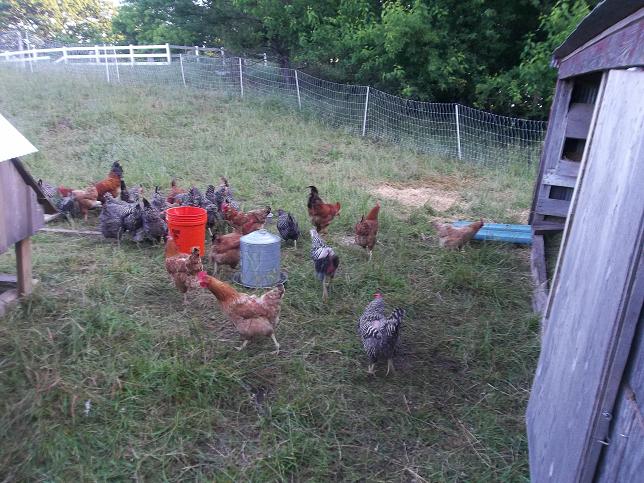
We grind the Fertrell rations on the farm.  In short it’s corn, oats and roasted soybean mixed with aragonite and Fertrell Poultry Nutri-Balancer.   Fertrell Poultry Nutri-balancer is mostly soft-rock phosphate and includes kelp, vitamins and probiotics.  Our layers get the layer ration free-choice along with whole kernel corn and oats.  They also get oyster shell free choice (makes the egg shell harder).  Finally, they get a new patch of pasture every third day so there are always fresh greens and bugs available to them.


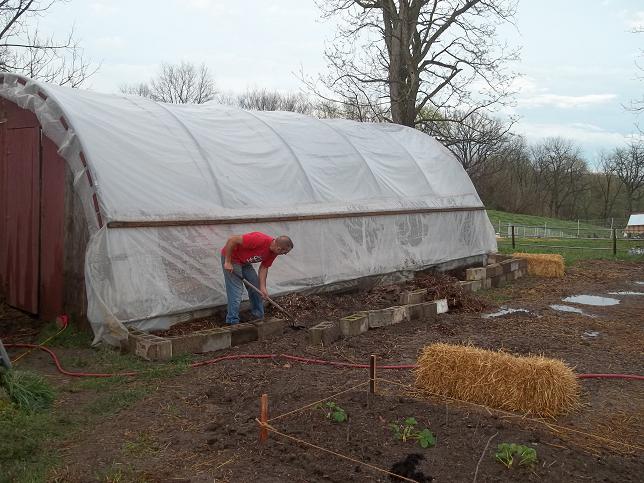
This all changes in the winter.  We winter the birds (and rabbits) in our greenhouse on deep bedding offering them the same feed along with several flakes up to a bale of hay daily.  The deep bedding provides most of their protein requirements, prevents odors, generates warmth and makes great fertilizer for our gardens.  The hay gives them a source of greens and seeds in winter and helps build up the bedding further.

That’s the plan anyway.  Who knows what will really happen.  Might be even better once I get the other greenhouse built.

Vegetarian…Chicken…Soup?

Humanely-raised, vegetarian fed.  That’s what the label said.

My wife’s aunt called asking how she makes such delicious chicken soup.  My wife replied, “I don’t know how you can do it without one of our chickens.”  Nearly all of her siblings have our chicken in their freezers.  She should too…lol.

Well, that doesn’t help.  She needs chicken soup now and lives four hours away.  What to do?  What to do?  She went to the local supermarket looking for the next-best thing.  She found a humanely-raised, vegetarian chicken.

Now, I’m going to offer my wife’s chicken soup recipe in a minute but bear with me here.  How can a chicken be both humanely-raised and vegetarian?  Chickens are omnivores.  You give the chicken a choice between wheat and worms and the chicken will choose both.  They also seem to really enjoy flies and larvae.  I understand what they are really trying to say…the chicken wasn’t fed beef tallow.  But a lack of beef tallow does not a humanely-raised chicken make.

If you deny an omnivore the chance to eat meat you are denying it an expression of self.  That’s pretty inhumane.  Though humans are omnivores in their natural state, some people choose not to eat meat.  That’s fine.  They make a choice.  I promise you, no chicken on earth would make such a choice.  Further, I almost guarantee these chickens are raised in a building, with fans blowing to keep the ammonia smell down.  They can’t see the sun, they don’t get fresh grass under their feet daily, and they never escape their manure.

Our chickens thrive on a diet of mixed corn, oats, roasted soybeans and fish meal.  They also get fresh alfalfa daily and all the worms they can eat when it rains hard and the worms surface.  That is, I think, more humane.  The chickens are on pasture, in the sun, eating a variety of feed they enjoy.

Now on to chicken soup.  Buy a bag of Chism Heritage Farm backs and necks.  Place 3 backs and necks in a stock pot and cover with water.  Add a quartered onion, 6 sliced carrots, 6 sliced celery stalks and a little salt.  Bring that to a simmer for at least 24 hours, adding water as needed.  Stewing them for 3 days would be better, resulting in a dark, rich, fatty broth and soft chicken bones.

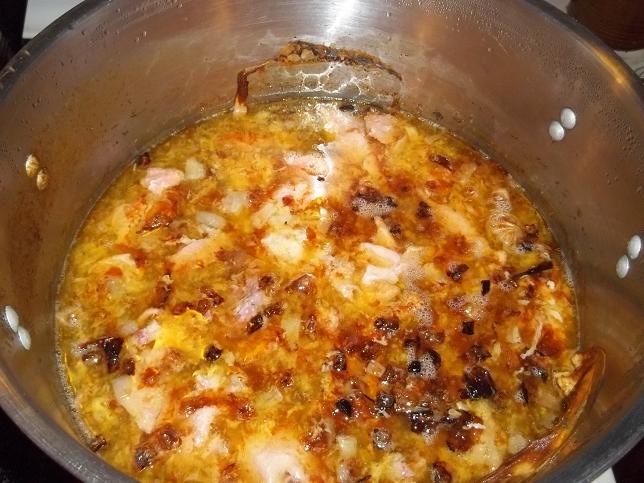
Strain the broth into a fresh stock pot.  Here’s a picture of broth we intend to can.  We’ll strain it and place it in a smaller stock pot which we will refrigerate overnight.  Then we’ll skim the fat off of the broth and can it.  We like to use chicken broth when we make mashed potatoes among other things.

Pick the meat off of the bones and add back into the broth.  Chop an onion, slice 6 more carrots and 6 more celery stalks and add in garlic, oregano, pepper, salt and maybe a little basil.  Maybe a bay leaf toward the end.

Set this to boil while you make the noodles.  You need:
1 cup flour
1 egg (Chism Heritage Farm happy chicken eggs!)
1/2 egg shell full of milk

Mix these together in a mixing bowl.  Flour the countertop, roll out the dough to 1/8″ thick then slice into 1/4″ wide, 4″ long noodles with a pizza cutter.  Add the noodles to the soup stock and boil for 30 minutes.  Remove the bay leaf and serve.

Now you have a humanely-raised, omnivore-fed chicken in your soup.  If you want to do even better, buy a Chism Heritage Farm stewing hen in the fall…if you can.

What’s going on?

One of our rabbits kindled yesterday.  We finally found the kittens in the barn…and my oldest son found out how protective mama cats can be.

The goats still haven’t kidded.  You have to be kidding!  We thought Sweet Pea was in labor on the 6th.  Nothing.  Nothing.  Just uncomfortable girls chewing cud.

Broilers are coming along nicely.  They are scheduled for freezer camp on the 26th but we plan to send some early.  Early birds shouldn’t be above 5 pounds and that would be good.  They’re pretty hard on the alfalfa that we just cut for hay.  If we could just get some rain…

The pigs are settling in well.  They still don’t like us but they know we bring food.  It’s a step.

That’s about it.  What’s going on at your place?

What Makes Your Eggs So Special

I have read a couple of articles recently on the differences between pasture-raised eggs and confinement eggs.  Both point out the advantages of eggs from pasture, one somewhat subjectively, one scientifically.  The Mother Earth News article goes pretty far in depth. The Pantry Paratus article is lighter and has a nice video of a small egg handling machine.

I have an egg handling machine.  Two of them, in fact.   Both are 1976 models.  They work to collect, carry, wash, weigh, candle and pack the eggs.  Every day.  They are a little older.  They show signs of wear, they are a bit scratched up, scarred and thickened…but they are clean.

Actually, they don’t look too bad in that picture.  They will by the end of the week when we finish putting up hay.  Oh, well.  They are multi-purpose machines.  In fact, the greater the variety of work I put them to, the longer they last.  I don’t spend 8 hours every day packing eggs with them.  I don’t spend 8 hours/day every day processing chicken either.  We keep our enterprises small enough that each of them is just a portion of our day, minimizing repetitive stress, minimizing drudgery.  It’s work but it’s pleasant work.

I’m a small, diversified farmer.  I can do that.

Back to eggs.  My chickens get enough pasture to last them 3 days.  They sanitize the pasture and eat any weeds the goats leave behind and devour bugs.  They scratch, dig and poop.  They eat worms and leave behind things for worms to eat.  Then we move everybody again.  The pasture is better where the chickens have been.  The eggs are better because of fresh pasture.  The periodic, intense disturbance cycle makes everything better.

Best of all, it makes an egg that is out of this world and, according to the research in the Mother Earth article, is healthier than most.  Does your farmer move his chickens to fresh pasture regularly?