Broilers in the Late Fall?

I got an email from a friend asking about getting started with broilers. In summary, the local pastured chicken producers are planning to retire leaving a hole in the market and she is anxious to begin. I edited the email below slightly.

The “chicken people” at the local farmer’s market are throwing in the towel. They’re in their 70’s and are ready for retirement. As a result, there is no one selling chicken or eggs. When we asked them if they had eggs last weekend, they wanted to know if we were on the waiting list. And at the closest FM, the vendor sells out in 3 days after processing.

[My farmer] reminds me that there is a huge hole in the FM since there’s no one selling chicken. I remind him that we’re six months or so from being able to get some land. He goes on to say that we could do it at his farm. I come back with “but it’s 7 days/week and we work” and he responds with “if you buy the feed I’d be happy to move them and feed them when you can’t get out here”. The lady in front of me responds with “I’d be your first customer and if you raised turkeys I’d LOVE you”.

[Husband reminds her that they] don’t have a lot of time as it is and we would have to drive about 25 minutes each way to tend to the birds. We both work…

My thoughts are that we could raise the broilers here for 3 weeks and then move them out to the farm for the next 5 until they’re ready for processing. They could follow his cows on pasture. A win-win for them and us.

Potential problems:

1. We live in suburbia with crazy predator pressure…the raccoons visit the trash can every night and are not afraid of us. Perhaps electronet would be enough?

2. He does not have a LGD so again, there’s the predator issue. Electronet again?

3. The drive. That’s 2 gallons of gas every time we go out to move/feed the birds. About $7/visit

4. Profit. Based on your numbers and Joel’s book, it looks like we could make about $5/bird.

5. Processing equipment. I’ve checked Craigslist and other local sites to see if anyone is renting out their equipment and no luck so far. I wouldn’t consider purchasing it for this potential venture.

6. The split. I have no idea what [the farmer] would want out of this. Who knows…he may not want anything at all but even if he didn’t, that just doesn’t seem fair. What would be a fair compensation? Part of his real estate taxes? “Free” chicken? A monthly rent?

I can’t wait to hear your thoughts!

Well, my first thought is that you sent this on October 5th. That means IF you can get chickens today you’re looking at a slaughter date on or after December 1st. Because day length gets so short and chickens go to bed early, your slaughter date will necessarily be after…like December 15th. I don’t know where you are but I don’t like butchering chickens in the cold. Where we are November and December can be cold, dark and rainy months…not the weather we want to tend to chickens in. Plus, you will be depositing a large quantity of manure on pasture that is going dormant in the cold…potentially leaving the ground without a blanket over the winter.

From there, let’s go through your questions one at a time.

1. Predator pressure in town.
You are right to be concerned. I’m always amazed at how many raccoons I see when I visit Sarasota, FL. Based on what I have seen, most major cities have similar problems. Add in little yippie neighbor dogs and stray cats and your little chicks are in for a rough time. That doesn’t make it impossible though. Electronet will add significant peace of mind if you keep it working daily but they don’t exactly give the stuff away. I have seen cats learn to jump right through the netting which leads me to believe skunks can do the same. You will have to be creative about dealing with predators as you are unlikely to impact the population level by trapping a few animals…just open up some territory.

2. Livestock Guard Dog
Yup…Electronet. To be specific I would go with single-spike PermaNet and plan to support the corners in wet weather. Again, this only goes so far. If your farmer will be moving the chicken tractor you’ll need to buy enough fence that he won’t have to move it too. Otherwise, your labor costs will eat you alive.

3. The Drive
Oh, golly! 25 minutes? No way. Deal breaker. Ain’t happenin’. If for no other reason just because of short days. You want to go visit your birdies after work? It will be dark.

4. Profit
Well, I don’t know what you are selling the birds for but if you spend $7 to drive out there a couple of times each week and pay a worker to move, feed and water the birds…not sure there is anything left over. Charge what you have to.

5. Processing Equipment
Really, this depends on how many birds you’re talking about. For 25 birds you just need a stock pot and a couple of sharp knifes. You could manage 250 birds with the same equipment but a Whizbang plucker starts looking pretty good as you move up from there.

6. The Split
This one is tough. I always calculate 3 minutes per chicken tractor per day not counting time spent walking to the field. That’s just filling water, feed and moving the birds. 3 minutes per day for 35 days spread across 60 birds in each tractor. You can calculate what you are willing to pay him based on the difference between your feed, chick, housing and fencing costs and your sale price. It might be better to contract with him…offer him $X for delivering Y birds at Z average slaughter weight on December 7th with a bonus for numbers or weights above those margins. Then you are hands-free, essentially buying a live bird, butchering it and doing the marketing. No 25 minute drive.

What I would strongly consider:
I wouldn’t want to put broilers out in the field this late in the year. It’s just too hard on the turf. If I were you I would consider raising 25 birds in a chicken tractor over a garden bed this year. Just leave the chicken tractor in one spot and add straw or wood chips regularly to “uppen the soil” as Andy Lee detailed in the book Chicken Tractor. You will want to protect the birds in your yard from predation but this would allow you to manage your birds on a daily basis, gaining your degree in Advanced Broiler Management along the way. You’ll have a freezer full of meat for your family, a few to sell or give to loved-ones and the foundation you need to start strong when you really launch your business in the spring.

Those are my thoughts. Hopefully other readers will chime in. Again, since you haven’t raised broilers previously, I would rather see you invest in portable infrastructure and keep a few birds at home then really launch when you move in the spring. Since it’s already fall you really shouldn’t be out on pasture.

More Egg Math

Someone brought this to my attention. It’s from a Facebook posting for a farm in Oregon. No names are required. I’m not “telling them off”, just utilizing their example.

Every two months we order a one ton tote of verified GMO free, organic and locally produced chicken feed. It is the most expensive and high quality feed in our area. We believe this feed as a supplement to fresh pasture and organic veggies produces the best eggs possible for our members. Every year we spend about $6,000 on chicken feed. We sell all of our eggs which totals to 850 dozens and we sell them for $6.50 per dozen. That means this year we will lose about $800 on our eggs. So the question becomes, do we raise our prices? or do we buy poorer quality feed resulting in poorer quality eggs? This is a question that the farmer faces everyday but the consumer is the one to answers it.

The detail that they buy “the most expensive and high quality feed in our area” amuses me. You have to pay the most to get the best? Really? Are you sure you are getting the best or are you just paying the most and making an assumption? And I really have a lot to say about “verified” GMO-free feed and the quality of protein available in substitutes. Anyway.

Let’s start with his egg production numbers. He says he gets 850 dozen eggs/year and loses about $800 on eggs (If you do the math he loses $475 on feed but let’s just run with his numbers).  That’s 2.3 dozen/day. Let’s say they raise their prices to $12/dozen ($1 per egg!). That brings egg revenue up from $5,525 to $10,200…which is a good thing because his calculation above doesn’t count land usage, fencing, housing, labor, etc.

But let’s look at his numbers again.

He’s buying in bulk, getting a one ton tote – 2000 pounds, same as 40 bags – for, apparently $1,000. That’s $25 per bag of feed. High but not entirely out of the question. We pay significantly less but we live where the corn and beans are grown and our customers aren’t demanding non-GMO organic. They’re delighted with fresh, orange-yolked eggs that taste good and come from healthy birds out on healthy pasture. But I digress.

The farmer in question gets 10,200 (850 * 12) eggs each year…or around 27 eggs/day. Let’s say they get 30 eggs and throw away 3 that are checked, cracked, stained or misshapen. A chicken lays 2 eggs every three days. Really good ones lay an egg every 28 hours. Let’s pretend there is no winter. To get 30 eggs you would need (30/.66) 45 birds…as two thirds of the birds are laying each day…right? He’s feeding 2,000 pounds of feed every two months, or 33 pounds of feed every day or 22 pounds of food per chicken per month. My birds don’t eat that much but maybe my chickens are freaks so I did a quick search of the internets and I found that a laying hen (probably in confinement) should eat 10 pounds of feed every month and they tend not to overeat. He’s going through more than twice that amount of feed. So I guess they have at least twice that number of birds and they aren’t laying well…which could either be an indication of bad genetics, age or maybe his high-quality feed isn’t high-quality enough.

Now, I’m skeptical of the 10 pound figure. First because it comes from Nutrena. They don’t use whole grains…it’s like giving your chickens snickers bars. But the article suggests correctly that free-range birds can harvest some portion of feed for themselves…at least, for a portion of the year. We feel that we need to feed our chickens whole grains (even if shattered) rather than processed remainders. We also take our mineralization and pro-biotics seriously. If the chicken itself has unhealthy gut flora she can’t digest and absorb her food efficiently (and we feel this applies to ourselves as well). I don’t want those minerals to just slip right through the bird. With that in mind, with very little searching, I found this quote from a Backyard Chickens member:

I have 61 in my free ranging flock and I go through 200 lbs of feed a month.

UPDATE:
As Craig pointed out in the comments below, that figure is pretty extreme. In fact, it is almost as extreme as 20 pounds of feed per chicken. I apologize. Craig’s numbers, my numbers and several others I have spoken to are more in the 7 pounds/bird range when on pasture. If you are unhappy with my calculations for the number of chickens involved, calculate the pounds of feed per egg. I think that may better illustrate the lack of efficiency the farmer in this example is ignoring.

I don’t know what the revenue picture is for the farm (though Facebook indicates they are building a big new barn) but it looks to me like they could save a little money and, probably, a lot of time if they would stop raising chickens for eggs…or, at least, abandon the chickens they are currently raising. Rather than transport 3 pounds of feed to Oregon maybe he should transport 1 pound of eggs and spend additional time planting, weeding and marketing produce. Do 2 dozen eggs/day really bring in enough customers to justify paying them to take the eggs? As you know, I’m dealing with similar issues here.

Eggs: Cheaper By the Dozen (Updated)

So, how do we make money on the farm? Well, we really don’t make much but opportunities abound. Today I’m going to talk about eggs and my answer is decidedly nonlinear. Further, the numbers I use may not apply to you at all but the process involved will at least provide you with the base questions to ask to determine profitability. Remember, price is determined by customers. It’s harder to find customers for $10 eggs than for $1 eggs. It’s hard to find chickens that lay eggs you can sell for $1/dozen. We currently sell $4 eggs. The money we make helps us move the farm forward, even if slowly. I’m happy to offer this transparency to our customers and readers. You should know what you are buying…what you are supporting…and what you are getting into. I have to make money to continue farming. If you think I’m making too much money (lol!) you can pursue other options.

I always enjoy talking to new customers after they have tried their first dozen eggs. Quite often they go on and on about taste, texture and color. Based on customer feedback and my own experience, we make the best egg in the world. However, no matter how good our eggs are, I won’t stay in business if I don’t count the cost. We have to figure out what it costs to sell eggs. Again, I won’t work for free. I need to make good use of my time. If eggs aren’t worth doing, we’ll make soup. This was originally posted on The Survival Podcast Forum but I have revised the numbers slightly.

Here’s what my numbers look like with additional detail below. Keep in mind we’re small potatoes so economy of scale works against us. Also realize I have been known to make errors in my math.
Costs (per day):
Chicks – $0.005
Feed – $6.72
Fencing: $0.27
Housing – $0.34
Egg handling – $1.89
Those costs total $9.265/day or $0.154/sellable egg (60 eggs/day annual average)…$1.85 per dozen before labor. I usually just say $2.

We retail eggs for $4/dozen and seasonally wholesale a portion of our eggs so we’re really looking at a gross of $19.50 and a net of $10.25/day, again, before labor. Labor includes moving chicken houses, feeding, watering, collecting the eggs then cleaning and sorting the eggs. This is unskilled labor and is valued on the market at less than $8/hour. (Probably much less than $8/hour.) That means I have to make darned I wrap up my work quickly or the farm is losing money.
__________

Now the boring details. My feed is not organic. It is not non-GMO (Sorry for the double negative). I use the Fertrell poultry rations and grind my own.

Last year’s pullets cost me an average of $1.80 each. I bought 350 then sold 225 of them for $5 each at 8 weeks…basically covering the costs of all birds up to 8 weeks. This covers electricity, water, brooders, shipping and feed. So I’m starting at 2 months from zero. 3 months to go before the first egg.

I raised my pullets on the alfalfa field. The cost per day of using the alfalfa field is a wash against the benefit of the manure they put down and the minerals from their feed. I feed them broiler mash until 2 weeks before onset of lay. Last year broiler mash cost me $26.92/hundred to grind myself. 125 birds ate an average of 15# of feed per day for that period of time so we’re looking at $4/day to feed 125 birds until their first egg. Again, the bird was free for the first two months. I have 75 days of feeding at $4/day spread across 125 birds in the flock. Let’s say 120 birds in the flock because at some point last spring a raccoon ate 5 of them. (Dad and I took turns sitting out all night every night for a week and never saw him.) So, at point of lay, each bird cost me $2.46. That has to be recuperated over the remaining 18 months of productive chicken life…or an additional half cent per day.

As adults, the birds get a slightly different ration that costs $27.14/hundred for me to grind. During the winter they tend to eat more than summer but the flock averages 20 pounds of mash and 5-7 pounds of oats each day. Oats cost me $20/hundred so let’s say $1.20 worth of oats each day and $5.42 of layer mash totaling $6.62/day for chicken feed plus $0.10 per day for the range feeder (assuming it lasts 10 years). We get 80-90 eggs/day from those same now 110 birds (predation is an issue) and to make the math easier, I’ll suggest to you we get a yearly average 60 eggs/day that are grade AA Large. The balance are cracked, stained, misshapen or small. 5 dozen eggs are salable. With me so far?

The birds spend their lives (2 years) surrounded by four lengths of PermaNet. That’s a $660 investment plus a solar energizer that cost $350. The fencing and charger, spread over 10 years, divided out to a per-day cost takes us to $0.27 cents/day.

The birds live in two simple hoop structures that also should last 10 years. Each hoop costs $200 to build plus two nest boxes for $180 each, again spread over 10 years adds another $0.21 per day. If we winter in a high tunnel the cost of the tunnel is spread between the livestock we keep there and the produce we grow the rest of the year. Since we bought the tunnel used the cost per day is pretty low. If we apply the entire cost directly to the chickens we need to add $0.13 to the cost every day.

I pay $0.31 for unprinted paper egg cartons. I sell 5 dozen eggs/day so that’s $1.86/day. We collect our eggs in baskets or plastic egg trays daily. For sake of completion I’ll add those in at $0.03 per day.

Now, labor. For months we moved our pullets every day, never getting a dime (beyond manure value which we washed against alfalfa field usage). Now, every day we move the layer houses (1 minute each), feed, water and gather eggs (15 minute round trip from the house). Then we wash, grade, sort and pack eggs (1 minute/dozen). 23 minutes of time against $10.25. Really the margin isn’t very good but that’s why it is not a primary enterprise. Salatin says a layer should make you $12 over the course of her life. I’d say that’s about right. But having eggs to sell puts our label in a family’s kitchen every day of the week. Once we get our eggs in the kitchen we go ahead and sell a chicken. Then half a hog. Each of these operations is increasingly profitable.

You can see from that, once you calculate the value of your time, eggs are a hard way to make a living. Without paying a dime for labor we are in the neighborhood of $3,000 from egg sales this year and we only worked for 23 minutes each day…not counting time spent sourcing and grinding feed, checking water extra times on hot days, sleeping in the pasture to deal with whatever has been hunting my birds or just marketing product. My true labor average may be more like an hour per day. Also, the layers don’t lay steadily year round. At some point production will drop below 3 doz/day but costs will remain relatively the same. Finally, as my friend Matron of Husbandry would point out, those chickens are eating bugs and dropping manure…that’s worth something. I also left off a charge for land use which varies between $50 and $200 per acre (though that is likely an expense shared by additional enterprises). All of that is the nonlinear part of this equation. Too many things vary. I didn’t even account for the possibility of a tornado blowing the birds away or a mink killing them all in one night. Adjusting vaguely for those missed values, we can begin to see Salatin’s argument more clearly. Once we pay our labor, each layer may only be making us $12 over the course of her life (and I suspect that includes selling her as a stewing hen).

Obviously economies of scale apply but I really don’t believe moving to 3,000 hens would boost annual farm income (before labor costs) to $72,000. I would have a heck of a time retailing 144 dozen eggs each day. Wholesale numbers would have to go up so margins would drop but, sticking with the $12/bird notion, spread over two years, after labor your 3,000 laying hen operation could bring in $14,000-$18,000 each year to the farm keeping someone very, very busy for 4-6 hours each day.

We prefer to keep the laying flock between 100 and 150 birds as a sideline business. Though marginally profitable, we don’t see it as a mainline enterprise. Just a part of the whole.  Remember what a cow costs? Individually, these enterprises won’t sustain us. Taken together, we have a chance.

UPDATE:
I had some offline correspondence with Matron of Husbandry who sent me a couple of links. I particularly appreciated the breakdown listed in this post. I came to $1.85 before labor because I didn’t count brooder costs, having supported that phase by selling pullets. That author comes to something on the order of $2.61 before labor, though the post lists something on the order of $5/dozen including labor and includes chick and brooder costs each year of production. Do the math any way you like as my math may be wrong and your numbers will be different. Selling eggs is a hard way to make a living.

Should I raise my prices? Probably. Should I just stop keeping layers? Maybe. But how boring would that be?

Broilers and Layers

In recent years I have been running my layer flock in the same fencing with our broiler chicken tractors.  This presents certain problems but solves some others.  In short, the layers always seem to find a way to get where they don’t belong but the layers clean up the feed the broilers leave behind. They also knock down the forage ahead of the tractors as they hunt for insects.  That kind of helps when moving the tractors but it slightly soils the clean sheets we give the broilers each day.

Layers

Anyway, we have run this way for several years and I always swear I won’t do it anymore.  But it’s kind of nice to only have one set of fence to move.

Failing to Plan for Fall Egg Demand

I get this all the time.

“So, Chris, my 14 year-old daughter just watched Food Inc.  Now she’s not eating.  How much are your eggs?”

“Chris, we just started this new diet (Paleo, Zone, Sally Fallon…you name it) and need a source of clean food.  Do you sell eggs?”

“Chris, my sisters are coming in town this weekend and we are hoping to do a bunch of baking.  Can you get me 3 dozen extra?”

Well, shoot.  Our eggs are $4 (that’s $0.50 less than an inferior egg costs at Walmart!) but I’m afraid I can’t take new customers until Spring.  I would love to publish more on the topic of working to lower food costs and prices but for now, see what Salatin had to say about it in his speech about going full-time.

I sell a better egg than you can buy anywhere at a better price than you can find in a store. Consequently I don’t have enough eggs. Any chicken owner will tell you that egg availability changes through the year.  In the spring we are swimming in eggs.  In the heat of the summer the girls slow down (understandably) and heading into fall they molt. We’re in the lean times and it will get worse before it gets better. To account for this, most chicken owners start pullets in the spring so they begin laying in the fall. That way when the older hens molt they can be retired (either to the freezer or to Craig’s List) and the new hens will pick up the slack through the winter. I realize I’m not using specifics here but I’m just relating a general trend.

I failed. Our spring was so busy I just couldn’t raise pullets.  My travel schedule, my work schedule, the endless amount of work the farm requires of us…I couldn’t get it all done in the spring. Something had to give.  Since I didn’t sow, I don’t get to reap.  No pullets? No eggs. Not only can’t I accept new customers, I’m struggling to satisfy the demands of my existing customers.  I should have ordered pullets in the spring…like we always have.

Pullets On Pasture

Chalk this one up as a mistake we will work to avoid going forward.  If you focus on making a quality product, customers will find you.  You need to anticipate and accommodate that demand. I could have put down a book one evening late last winter and gotten everything ready for a few hundred chicks.  I just didn’t. As a consequence, I’m missing an opportunity to feed more people. Lesson learned.

Chickens for Hipsters?

Am I a hipster?  OH golly!  I might be…especially since I’m currently growing a beard…and generally go against the grain…and don’t care…and I have a liberal arts degree!…and read constantly…and work in tech…and raise chickens. Oh shoot!  But I don’t wear tight-fitting clothes, don’t wear pretend glasses and I keep my hair short.  Oh, and I don’t drink coffee for a meal.  Whew!

Before I get going, please understand this is a post about eating animals and recognizing the usefulness of livestock in reshaping and healing our environment.  With me?  OK.  Let’s go.

A friend forwarded me a link to an article about the tragedy of backyard chickens ending up in animal shelters, blaming hipsters for this trend and somehow claiming that there just isn’t enough land in the world for us all to eat meat.  I have so much to say about this article I’m not even sure where to begin.

I want animal shelters to remain empty and unused.  Unfortunately, biology crossed with irresponsibility (or accidents) means a lot of cats and dogs are born unwanted or have with quirks or defects that make them hard to keep.  I truly and deeply sympathize with this issue and am currently working on a deal with a vet to have all of the barn cats fixed (all 18 of them) knowing it will probably cost me a small fortune, knowing those cats will never find homes, and knowing they will each, in turn, become a tasty snack for a passing owl or coyote or the victim of a brutal territorial fight with a feral tomcat (it’s a rough life on the farm).  But, never fear, more unwanted kittens will be dumped on the road past my house and will find their way here.  I’ll have them spayed or neutered too.

With that out of the way, I’ll start with economics (look for another post with more detail on chickenomics).  A pullet costs around $2 as a chick and 5 months of feed before laying the first egg or it costs $10 as a ready to lay pullet.  For simplicity, let’s avoid the brooder phase and just buy the ready to lay pullet.  At this point she owes you $10.  Now, she can pay that back as many as 5 different ways:

  1. Scratch soil and eat bugs.  This is a big deal.  Fewer bugs, better incorporation of nutrients, good times.
  2. Convert feed into manure
  3. Lay eggs
  4. Ultimately make soup and compost
  5. Provide companionship (optional and totally subjective.  Maybe even crazy.)

Now, any old bird can scratch, snuggle, poop and be killed for soup.  Snuggling (and swimming(I really hope that lady is an actress)) may be unique to an individual’s perception of a relationship toward a specific bird but egg laying requires something else.  You have to have a hen, not a rooster.  You have to have a young hen.  As they get older hens lay fewer, but larger, eggs.  Just as there are few pre-menopausal 90 year women, there are few 9 year old hens laying eggs.

LayerHen

That’s a very important detail.  Again, any old bird will poop.  But birds that lay an egg every day bring home the bacon.  Pets are nice but if I’m going to stay up all night trying to catch a raccoon to protect a bird, I expect breakfast in return.  Further, she eats every day and chicken feed at the local farm store was priced at $16 for 40 pounds this past weekend.  Little Henny started out $10 in the hole.  If she’s not laying eggs you really have to value her manure to keep her alive.  The additional profit center offered by egg production makes a huge difference when that bird is trying to repay you.  Now, some people keep parrots because they like having a bird around.  That’s nice but what do you do with a parrot that doesn’t parrot?  I don’t know but I know what you do with an egg laying bird that doesn’t lay eggs.  (Hint: it has to do with carrots and noodles.)

So that takes us to the next step.  Either cut her throat, pluck her feathers (harder than you would believe), and dress her out (looks nothing like a store-bought bird!) for soup (cause she’s too tough to roast) or you sell her to someone else willing to do that work.  As a third option, as presented by the article linked above, you send the chicken to a chicken retirement shelter.  Sigh.

Now, look.  We tend to anthropomorphize our dogs and cats.  I get it.  I even do it myself.  Reggie, our dog, is part of our family…even if he sometimes pees on the couch.  I will never eat Reggie.  Reggie’s entire purpose in life is to provide companionship.  When we hired him, that was the job: love my kids.  He does a good job of it.  When he dies we’ll bury him out in the pasture with the other dogs and remember him fondly.  To get love from Reggie I have to treat him well, feed him and protect him.  He may provide protection himself but …well, probably not.  If, in return for the care we give him, Reggie decided to attack my children the arrangement would change.  We would probably change dogs.

Reggie

Now, compare that to a chicken.  I (and I suggest most suburban chicken owners) want eggs.  To get eggs I have to provide feed, water and protection.  To give eggs the bird has to be young.  I may feel some level of attachment to a hen and that may make me willing to continue caring for her as she becomes older.  I may feel she has a “right” to live out her life after faithfully giving me 400 eggs in 600 days.  That’s fine…except I probably originally got chickens because I wanted eggs, not to gather more pets.  In most towns you are limited on how many birds you can keep.  And you want eggs.  Besides, she has value after she finishes laying eggs.  We should always put our resources to their best and highest purpose…she tastes good.  So I, as a suburban chicken owner, would raise her replacement and make soup or sell her to someone else who wants soup.

That’s the deal.

As a closing remark, the article states, “there just isn’t enough land for all the meat, dairy and eggs we want to eat”.  Sigh.  This ties into my next point. Livestock (and pets) can, and should, be used to enhance the environment they are kept in.  A chicken can quickly enhance soil fertility and plant diversity but it can also quickly overload the soil with nutrients, cause runoff and stink up the neighborhood.  Same with a dog.  Same with a cow.  Same with a pig (and I think suburban folks would be much better off raising a pig than a chicken but that’s a conversation for another day).  It’s all in how they are used.  But God help the vegetarian who wants to cycle nutrients in the absence of consumable livestock.  I can raise a cow per acre on sunlight and rain.  I don’t need to use petroleum to rip soil, plant seeds, cultivate, spray (even organic sprays) then harvest, dry and transport.  Nope.  I just graze the cow until it weighs enough…or I milk it each day and sell, raise or eat its offspring.  Beef raised on harvested sunlight without fossil fuel should be cheaper than chicken.  It’s the kind of thing we should raise in zones 3 and 4 if you can think of the city as permaculture zone 1.  Produce should be grown in the city so you can have a nice salad with your beef after we walk the cows to town for slaughter.  How much land do we need to cultivate for annual crops?  Once you cut out 70% of the corn crop that is grown for livestock feed and whatever is wasted on ethanol production how much land do we really need?  Not a whole lot…less than 3% of the available land (the current residential lawn space).  All we have to do is convert a portion of our lawn space into productive garden space, put up some high tunnels, let cows eat grass and walk the cows to town for slaughter.  Then you can graze co-owned dairy cows on what remains of your urban lawn space and raise your own chickens on your kitchen scraps.  Now, that’s a pretty extreme simplification but I think it’s more realistic than assuming it’s simply not possible.  It’s not sustainable under the current agricultural paradigm but it’s entirely possible (and ecologically beneficial) for the world to eat meat.  You might even take a page out of Will Allen‘s book and eat fish with your salad.

So, go get yourself a chicken or two and help save the world…even if you’re not a hipster.

Hatching a Few Eggs

The duck hatch was so successful we set some eggs from our mostly New Hampshire flock.  Somebody gave us a gold laced Wyandotte and a Buff Orpington so those eggs were mixed in as well.  We can sift those chicks out as they hatch striped, not a big deal.  They started hatching Thursday night and will have to be finished Sunday morning so I can set more eggs.

IncubatorWe are attempting to hatch our own replacement layers this year.  Approximately 20% of the eggs we get are not New Hampshire eggs.  50% of those remaining will be males.  And we shouldn’t expect to hatch more than about 75% of the eggs we set.  That means I probably only get 12 pullets every hatch.  I’ll be hatching for a while.  It would be better if I would just go separate those two hens from the flock but the kids like the striped chicks.

Brooder

For now we are brooding in a 300 gallon Rubbermaid trough in the back room.  Really, this is just a place to keep the chicks warm until we free up brooder space in the greenhouse.  (AKA we kick the ducks out).  We’ll need nicer weather before we do that.

NHRThis is an awful lot of fun and could be the beginning of generations of NHR chickens on our farm.  Their mothers and fathers (plural) have survived 2-3 years of heat, cold, wet and dry.  Some of their peers didn’t make it.  Hopefully, in a few generations, we’ll have birds that are genetically predisposed to success on our farm.

Red birds?  Red cows?  I sense a trend.

Chicken in the Mornin’

So.  How does this work in the morning?  What do you do with your chickens each day?

I’m glad you asked.  Have you seen the Walmart cheer?  We don’t do that.  We walk or bike down to the alfalfa field (half mile?) and are greeted by the entire flock.  Then there are a couple of checks we do every time.

1. Are any layers dead?  It happens.  Something penetrates our fence, enduring the pain of electrocution in desperation for a free chicken dinner.  Or it flies in.  Whichever.  But it happens rarely but sometimes birds die.

2. Do they have water?

3. Do they have feed?  We now keep a 300# pasture feeder in the field.  We only feed the birds once each week.  It’s great.

4. Do they have shell?  No shell means broken eggs.

LayerMorning

Then we check the chicken tractors.

2. Do they have water?  Do the birds have access to that water?

BroilerWater

3. Are any broilers dead?  It’s rare but it does happen.  Most commonly happens when they are very young and pile on top of each other.  It can happen when they get just about butcher weight.  But it can also happen after a heavy rainstorm.  You will know because the birds will probably be laying on their face.  We have only had two deaths in a chicken tractor related to predation.  One morning we found two dead chickens in the same tractor.  They were young birds.  One was killed by talons of a predator through the chicken wire side.  The other was crushed under a pile of chickens trying to get away from the owl.  However, the owl never returned.  He banged into the side of the tractor and left a pile of his own feathers on the ground.  You may also find a bird laying on its back and looking purple.  Heart attack.  We had an americauna rooster die of a heart attack so it’s not just a CX thing.

Broilers

4. Do they have feed?  We always feed the broilers.  I want to know if I fed them too much or not enough last time.  I want to offer them too much feed…but only a little too much.

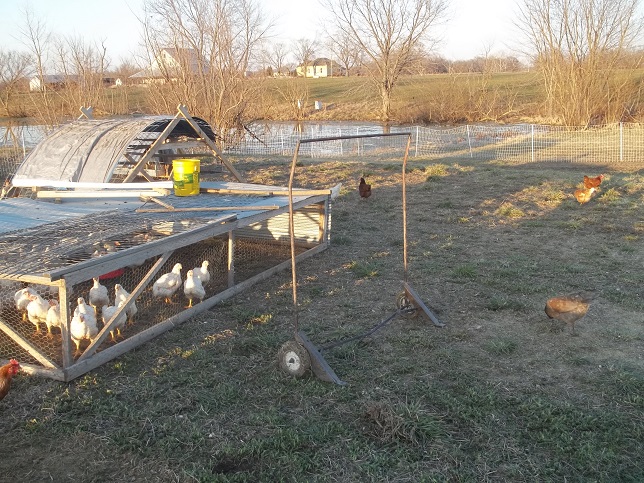
Feed or not, I pull the feeders from the chicken tractors one at a time.  Then I use the dolly to move each tractor forward, waiting on the chickens to move, being careful not to run over any birds.  We find this goes better in the cool of the morning when the birds are hungry than in the evening when they are fat and the temperature is higher.  The dolly was a trade for 8 chickens.  He made it from sucker rod, angle iron and lawn mower wheels.

Dolly

The layer houses also need moved because they too make serious deposits on the ground.

LayerMorning2

Feeders are filled and replaced, the water is filled again and we’re done for a couple of hours when we come back to feed and water again.  The broilers need our attention about every four hours or so.  If they go short on water they die.  If they go short on feed they don’t grow the way we need them to.

We can easily get away with checking the layers once/day when we gather the eggs.  All it takes is excess feed and water capacity.  But the broilers need our attention regularly.  Consequently we’re shortening our broiler production windows.  Keeping the two groups of birds together saves on time, reduces our fencing needs and limits waste from the broiler feeders.  Any food that hits the ground gets picked up by the layers eventually.

Delayed Chicken Processing

The chickens just aren’t paying attention to our butchering schedule.  If you want a fresh, never frozen, hormone- and antibiotic-free, humanely-raised, pastured chicken you’re going to have to wait another week.  If you want a frozen, hormone- and antibiotic-free, humanely-raised, pastured chicken you’re going to have to wait another week…cause we’re all out.  Either way…we’re moving our processing date to the 20th.

Broilers

You Will Know Them by Their Hen Fruit

Over the weekend I noticed our egg yolks are looking a little pale.  A customer also mentioned it to me.  That’s not much of a shock given the time of year but it’s something I need to manage.  The picture also indicates that my whites are a little loose, though those particular eggs came from geriatric hens so it may be a hen issue.

EggYolks

The yolks should be orange.  The kind of orange that screams at you like like William Wallace calling for his favorite crayon…”ORANGE!!!”  My chickens are not getting enough greens in their diet.  Later in the spring when the dandelions are growing well, the color will return on its own.  Right now the chickens need some supplemental greens.  I’ll start tossing in a bucket or two of alfalfa chaff and some winter annuals that are growing among the carrots in the garden (chickweed and henbit) and we’ll see how things go.  Things are starting to green up already but I’m not moving the birds fast enough to keep them in the green.  Work, work, work.

If you want a little bit of homework you can read about what makes a good pastured egg and how they compare to factory eggs on a nutritional level at Mother Earth News.

PS
My lovely bride (who is looking particularly beautiful today) says my joke title is a bit of a reach.  Chime in on comments if you get it at all.