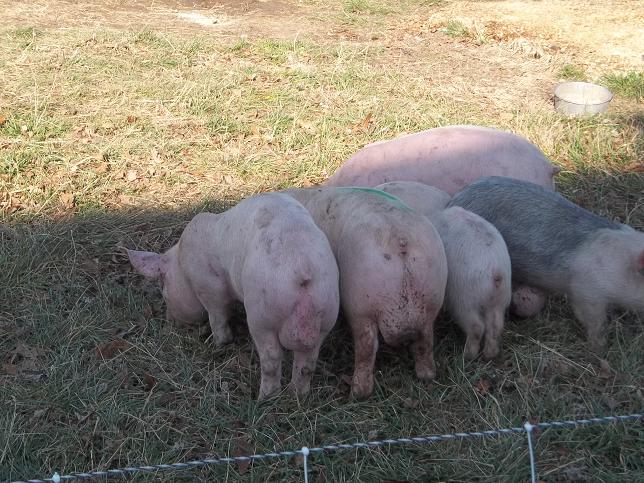
Market Day or The Great Pig Rodeo

So there I was.  Backed up to the chute at the locker.  There was a gap between the chute and the trailer but not so much that I was worried.  Then Eyeliner broke through.  He didn’t walk down the hallway, he made a break for it.  7 adults with a rope and a few muttered curses corralled, chased and herded the pig.  Nobody lost their temper but nobody was amused.

…20 minutes later we unloaded Blue.  More carefully this time.

Ah, the joys of keeping a 300 pound intelligent animal that doesn’t have a handle.

It didn’t start this way.  It started pretty well in fact.  I made a long, thin corral of pig quick fence leading from their pasture to the trailer.

You can see in the second picture I have narrowed the corral so the pigs can’t wander away to explore.  Any exploring they do will be around the trailer.  We put a straw bale at the rear of the trailer so the pigs could step up easier and put a little food inside to coax them in.  It didn’t take long and Eyeliner’s curiosity got the best of him.  Once Eyeliner was in, Blue decided breakfast sounded pretty good but he wasn’t willing to put his back legs in the trailer.  I jumped the gun, grabbed him by the back legs and tried to wheelbarrow him in.  Well…it was a good plan.

Eyeliner stayed put.  In fact, I closed Eyeliner in the front half of the trailer.  Blue wasn’t having any more.  Ultimately, we used sorting boards and pizza to get him back to the trailer.  Then I just picked him up and helped him in.  Lifting 220 pounds of weight is well within my range.  Lifting 220 pounds of wriggling mass when there is nothing to hang on to is something else.

I love keeping pigs.  I just like having them around.  I like the noises they make.  I like the disturbance they bring to the pasture.  I like that they are always so happy to see me…I mean, I bring them food and scratch their ears for 5 months.  They think I’m the greatest person in the world.  I make them lie down in green pastures, they tear it up and I give them another green pasture.  Don’t worry, the clods will be rolled flat with cow hooves, the grass will grow back stronger than ever before and the thorny trees will die.  Die!  DIE!!!!!  Sorry…

Anyway, are you with me here?  I like these animals.  Today could have gone much worse but it could have gone better.  Again, nobody lost their temper, no animals were abused and the bacon will be great but I know I can make this better for my pigs.  To this point, our pig operation has been an experiment.  I have been reluctant to make any investments in permanent handling equipment.  I even house the pigs under pallets and tarp for crying out loud.  I think it is time to reopen our copy of Humane Livestock Handling and get cracking on a real loading chute.  As convenient as the pig quick fence is, a real loading chute would be better for all parties involved.

Joel Salatin says his animals have a “wonderful life and one bad day.”  I want to cut that down to a few bad seconds.  My loading and unloading has to get better.

One more thing, this is Blue.
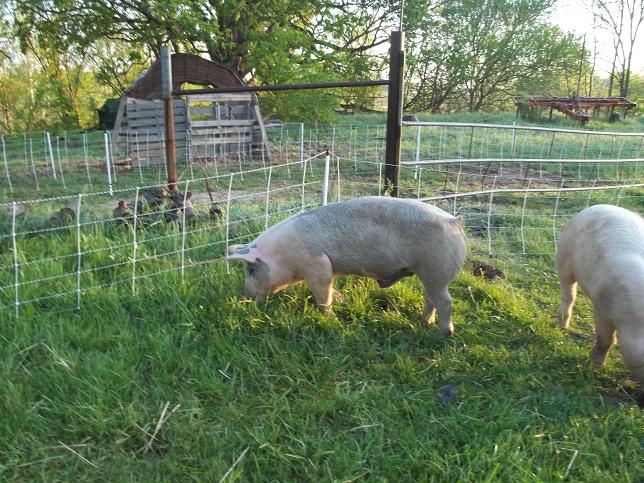
When we first got Blue he had a rupture (hernia) in his penis.  It was swollen, had three distinct bulges, was dragging the ground and had a red, raw, bloody patch where it hit the ground.  This weakness would have killed him in confinement.  We gave him no antibiotics and no medications.  We did rub a Neosporin-like salve on the wound the first day but beyond that he has been on his own.  We were afraid we would have to butcher him at about 60 pounds but he came out of it.  It was just a matter of changing his conditions, his feed and his feeding schedule.

Good old Blue.

It has been 2 hours.  I already miss the pigs.  I need to make a phone call to make arrangements for the next group.

What do pigs do?

Well, pigs eat.  Pigs manure.  Pigs sleep a lot.  Pigs drink and wallow.  The best thing pigs do is dig.

This is a post about digging.  Pigs dig for fun and to find food.  This week we put them in the pasture near the iron pile where they discovered a small pile of odd parts that had been buried in the pasture over time.  These are probably things my grandpa dropped out there 20 or more years ago.

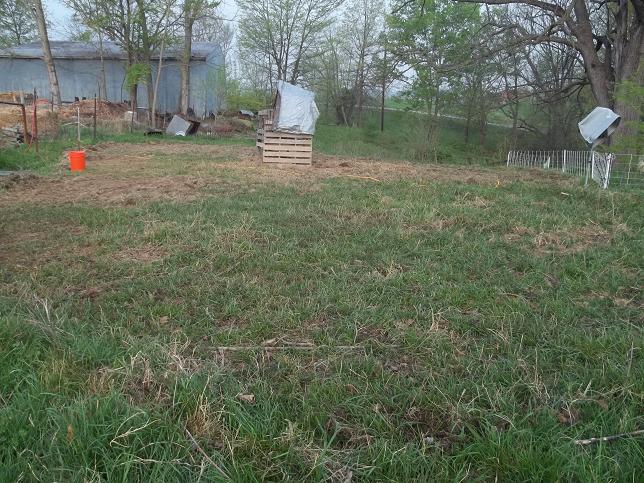
Here’s a view of the whole pasture they left.  They did more digging further away, less closer and almost none up close.

Looking the other direction I have drawn some lines.  The further line is where the fence was.  The near line is where they stopped digging.  Why did they stop digging?

They did not dig where they manured because pigs are clean animals.  They manured near the fence and did not dig in their manure.  There is almost no manure anywhere else in the pasture.  Just there by the fence.

The pasture will recover quickly where the manure is.  The pasture will recover slowly where they dug but, in the long term, the massive disturbance will allow opportunity for plant succession that would not have happened otherwise.  There is a seed bank in the soil that will now have a chance to come to life.  There will be grass.  There will be weeds.  It will be great.

When keeping pigs on pasture it is important to leave them enough room to play, to dig, and to take care of business.  If you place too many pigs in too small of a space or leave them in one place for too long, the whole area will be defoliated.  We try to manage things so when the pigs run out of fresh grass to eat they are moved to a new location.  By that measure the pasture has a reasonable chance to recover quickly.

Good luck with your own experiments with pigs, grass and portable fence.  Things may work out differently for you.

One Day of Pigs on Pasture

Yesterday this was carpeted in grass and splattered here and there with cow manure.  Today it’s another story.

The pictures don’t show it but it’s surprising how much grass the pigs eat when they first move.

They dug out a little nesting site and moved most of the straw to the side.  I added more straw.  Even if they don’t want it the pasture will benefit from it.

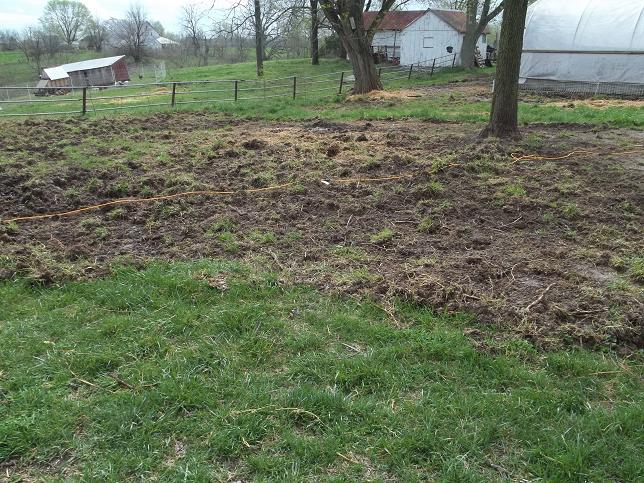
Here’s the pasture they came from.  They were here for three days.  It’s a wreck.  Looks like a war zone.  Don’t they do a good job?

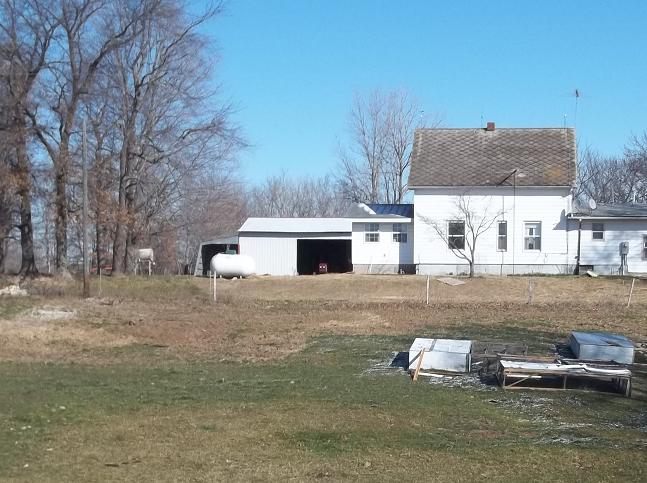
Like CrossFit, this is all about intensity and rest.  I may do a little raking and shoveling out there since it’s my yard but in a very short time the grass will come back thicker and healthier than ever before.  Here’s the pig pasture as of March 3rd.  It sat empty and bare all winter as the pigs were slaughtered in December and by December the hogs were creating some massive soil disturbance.  Obviously nothing would grow in the winter but things were in place for spring.

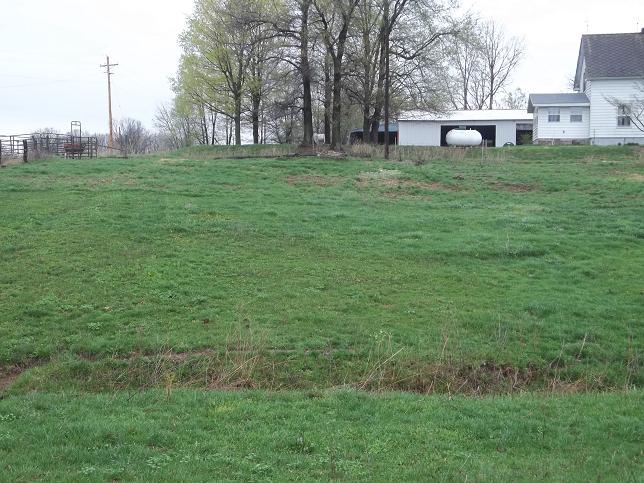
Here it is two weeks later.

It changed from barren to lush in short order.  Yes, there were things I could have done to cover the ground.  Maybe I should have put some straw out there.  But I didn’t.  I didn’t spread any seed.  I didn’t go over it with a harrow.  It just is what it is.  Recovery is rapid.  Nature hates a vacuum.  Things grow.  My only role is to coordinate the rest and disturbance cycles.  This area needs more rest.   Pigs aren’t allowed to return to the same square foot for at least a year.  But what a time they have while they are there!

Bringing Home the Bacon

I can’t imagine how we lived before pigs.  My sister, living in town, joked that she thinks she can get away with owning a pot-bellied pig.  I think it’s an excellent idea.  They root, they eat, they manure and they don’t ask much of their keeper.  They do ask for proper management; keep them safe, well-fed, move them away from their manure regularly and treat them well.  Let the pig do what pigs are built to do.

I have yet to see any living thing that will cause soil disturbance like a grown pig.  They will dig up moles, rhizomes, worms, grubs and who knows what else.  They dig just for the pleasure of digging.  That digging, left unchecked, can create an area that looks like the surface of the moon.  However, judicious use of pig noses can renovate pastures and make a positive ecological change to the landscape.

Everything we waste can be pre-composted through our pigs.  Garden wastes can go to pigs, feed spoiled in the chick brooder, cow manure, mice from our traps…they will eat it all.  In the winter that pre-composted material goes right to the compost pile where it helps maintain a high temperature for our thermophilic composting process.  Whatever we miss is churned with the soil and bedding into the garden.

Our most recent batch are ruptures from a production floor.   Just a quick note, a “rupture” is a pig with a hernia.  Often the hernia is expressed in the belly of a female or the scrotum of a male.  In both men and in hogs, the tendency toward a hernia is genetic.  It is generally believed there isn’t a way to manage the hernia short of surgery.  I don’t in any way wish to demean the farmers I bought the pigs from.  They are close friends who run a highly-efficient formula of inputs and outputs on a schedule.  Not all animals qualify for their program.  I picked up those that were genetically disqualified.

These pigs arrived in mid-December.  Please notice the three ruptured males.  Also notice they are packed in tightly together though they have room to run.  This shot was taken within 15 minutes of the first time their feet ever hit dirt.  Chew on that for a moment.  40-60# hogs that have never touched dirt and have never been more than a few inches apart.  Finally, there are two runts in there.  They never did grow for us but tasted great.

In the back is a ruptured female with a massive belly rupture.  We call her Thing1.  Here’s a better (but not great) shot of her:

Here’s another picture of the blue pig above.  I want you to be sure I’m showing you the same batch of pigs across this post.

Click on the image to see his large rupture.  I wish I had a better shot but I don’t. The rupture is within his …male anatomy.  It bulged in three distinct lobes and a portion was raw from where it rubbed the ground.  We thought we were going to have to put him down right away.  Here is the same pig at the end of February.

Where did it go?  In fact, where did any of the ruptures go?

These pigs were scheduled to be executed because of their ruptures.  They would not have survived on the floor in their condition.  I brought them home, switched them to Fertrell feed (high in pro-biotics) fed them twice daily plus a few scraps and gave them room to run in the sunshine and fresh air.  Their gut emptied between feedings.  They burned energy running, rooting, fighting and playing.  No antibiotics, medications or belt straps involved.  Just a change in management.

This winter we just parked them on the new garden and hauled manure away daily, using them to till the soil and work in organic material.  In the spring, summer, and fall we move 3-4 pigs to a fresh 25×25 area every third or fourth day using pig quick fence from Premiere 1 Supplies.  The fencing hugs the contours well, is visible to the livestock and everybody has a healthy respect for it.

Keeping a hog around the farm or house is a great way to boost fertility, create disturbance, pre-compost wastes and feed the family but proper management is the key to health.

One final note, if you smell the pigs you need to add carbon.  Pigs don’t smell, bad managers do.