Putting Compost to Work

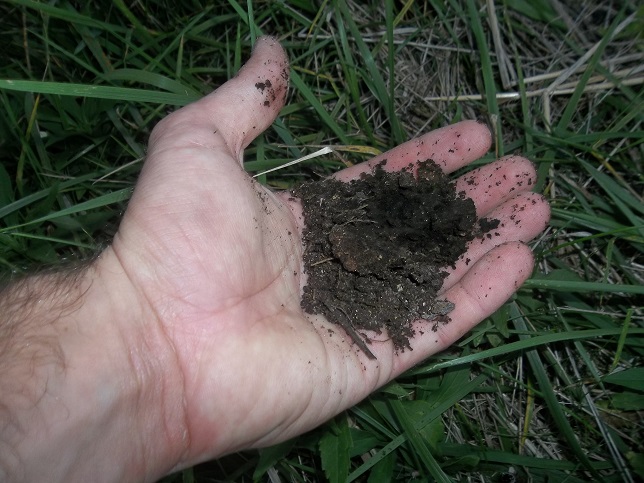
We spread our compost on the winter stockpiled pasture a few weeks ago (Sep. 9th). The compost pile was the end result of offal from 1,200 chickens, 3 pigs and a goat along with a year’s worth of humanure and kitchen and garden waste. That pile was built over the course of a year then aged for another year. At the end of that time my eldest son and I shoveled it into the manure spreader sifting out bits of trash (string, bag tops, wire and one pig skull) then I spread it on the fall stockpiled pasture. We spread the compost to help boost fall fescue growth as well as to help innoculate the soil.

Isn’t it interesting that the first step toward building healthy soil is to increase the soil bacteria? Kinda makes one rethink using anti-bacterial soap. Compost The compost spread in a thin layer across a couple of acres. If things go as planned, I’ll get the pigs moved and I’ll spread another layer from that cow/pig bedding on the field as well. Not only will it give the stockpile an extra kick of growth, it will help the stockpile tolerate the cold weather. This practice was emphasized in several books including Salatin’s $alad Bar Beef but also by Stacey last year on her blog. Thanks for the reminder Stacey!

Planting Seeds in Children’s Minds

This is the third in a series about how we are home schooling and preparing our children for their futures…the future of the farm. Sustainability is the real issue. If you are just joining us, go back and read parts one and two. I have worked to condense this post down to bare bones but I could go on and on. Forgive me if some of my transitions are …less than smooth.

We, as parents, plant seeds on a daily basis. Some of it is intentional, some of it just scatters about. Genuine comments like “Wow! that’s a great drawing!” or “I really appreciate your help” mean a lot to us as humans and, if you were uncertain, children are humans. Those comments are nurturing but they aren’t seeds. The gift of paper and pencil are the seeds. The opportunity to pitch in where needed is a seed. Comments help that seed to grow or cause it to wither.

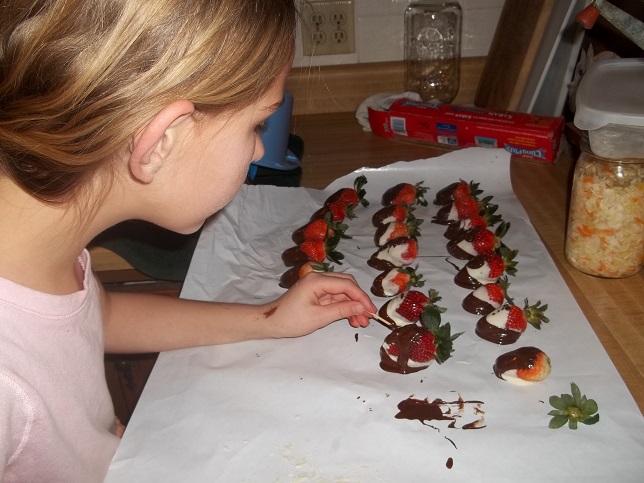
Strawberries

Have you ever heard that little voice in your head attempting to defeat you? Let me open up briefly and tell you what I hear on my worst days. I am a worthless, ignorant, arrogant, selfish and generally bad man…hardly a man at all. I talk too much. People don’t really like me, they tolerate me. I just get in the way. All of my ideas are ridiculous. I’m too skinny, too weak, too tall, too short, too ugly, too hairy. Julie made a mistake marrying me. I’m a lousy father. I’m terrible at my job and I’m just faking my way through my career. Somebody is going to find out…and soon. This (whatever crazy idea) will never work. My cows are not getting what they need because I lack the skill to manage grazing correctly. The list goes on but that’s enough.

Is any of that true? I don’t know…probably some of it to some degree. But those thoughts and others like them are on a near-constant loop in my head on rainy days. I’m not seeking a therapy session. I’m seeking real-life examples. Those are weed seeds. And I am not alone in having a mind littered with weed seeds trying to take root. You hear the voices too. My children hear the voices too.

I have to fight that. I can’t let the weed seeds take root in my children’s minds. I have to reinforce to my children that they are good enough. …that they are not an accident. …that their mother and I love them, cherish them and do not regret having them. …that they can make a difference. My children have purpose. They can work to fulfill that purpose and positively impact the world around them…and for generations to come.

To have this opportunity we, as parents, have to work to build personal, intimate, ongoing relationships with our children. With that foundation in place, we can begin to scatter seeds of our own…nurturing those seeds and working to out-compete the weeds.

HayWagon

But there is a tendency to plant weeds of our own. To scatter seeds that work against our children. Have you ever heard or said any of these gems?

“You should go to college because you are too smart to be a farmer.”

“There’s no future here. You’ll never make any money.”

“If you don’t go to college you will never succeed in life.”

“You can’t do that because it would take a lot of money (and you’ll never have any money (cause we don’t have any money (and my ego can’t stand the thought of you succeeding where I have failed))).”

“This country is going to Hell and there’s nothing we can do about it! It’s all the blue team’s fault (or the red team…both the same really). THOSE people have taken away your whole future! We are helpless.”

Don’t send your kids away. Don’t tell them there is no hope. Don’t teach them to be victims. Don’t seed discouragement.

This isn’t a post telling you to boost your child’s self-esteem. That’s a false god. A whole generation of kids who have accomplished nothing believing they can do anything! That lasts until reality strikes. Then they turn to Pfizer for help.

There is a school of thought that we should fill our homes with tools, not toys. Give our children opportunities not entertainment. Those opportunities are the seeds we are looking for. It’s not enough to believe you can. You have to do it. Book learnin’ and believin’ won’t cut it. You have to do it. Kids have to do it. What are your kids interested in? What do they want to do? What chances have they had to really try something? …to really fail at something? …to learn that failure is a beginning? We have tools, stacks of lumber, musical instruments, paper, pencils, crayons, markers, scissors, glue, computers, books on beginning programming, books, books and more books! Pallets for club houses, old tarps for roof tops, messes everywhere! Adventure everywhere! There are rabbits to raise, chicks to play with, chickens to dress, fencing to build, hay to stack, hay to play on, veggies to plant, weed and pick, cows to move and water…all of these are jobs the kids can help with. Look at the opportunities!

We scatter these opportunities in front of our kids hoping they will pick something up. When something sparks their interest we, the parents, have to be attentive and ready to run. An interested learner will consume massive amounts of information in a short period of time. As a mentor you’ll have your hands full trying to keep up…stay ahead…anticipate which direction the learner will go next. That anticipation requires an intimate understanding between learner and mentor.

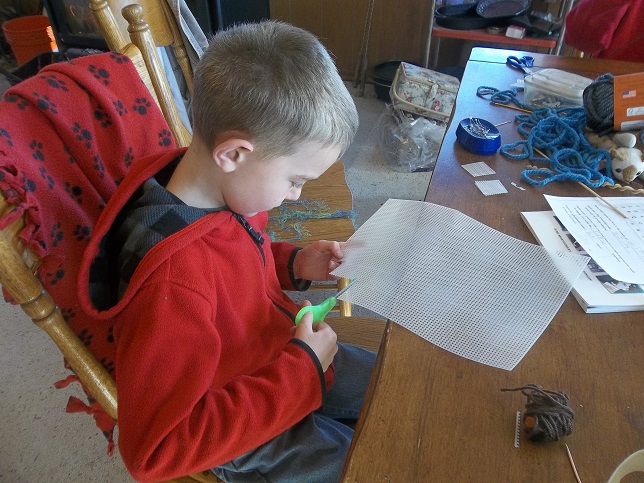
Crafts

There are certainly phases of learning where we are just dumping information in front of the children. Phases where nobody is particularly motivated to chase down a specific curiosity. At those times we read aloud, play together or just hang out. I am always surprised how things work out. In a recent rut I borrowed a video game from a friend. That led to pages and pages of artwork and stories about favorite characters by our youngest two. You never know what will allow the opportunity for encouragement and growth.

And those opportunities can grow. Each of the kids has a preferred set of chores. Daughter #1 has her own chickens. She just muscled in and pushed me out of the way. Now she takes care of them. That’s GREAT! That’s what we are after! And each of the kids know that there is a place for them here. That they can succeed here. That I’m laying a simple foundation for all of us to build on. “You can expand the pig operation, you can expand the cattle. You can grow and sell cut flowers. You can supply nurseries with stock. I’ll clean the toilets!” All of these businesses help each other, build on each other and share and expand the customer base. We are planting those seeds now! There is no reason to wait until the kids are 18 to say, “you know…you and your husband could just live right here with us.” By that time our kids will have defined themselves. It may never have occurred to them that we want them here. We say it now. Maybe my oldest will grow up to be an astronaut…or the manager at a Starbucks…or, worse, the president. He may not want to live here. We all have to make our own choices in life. But I’m giving him the opportunity…and I’m giving it now. We will nurture that seed as it grows…even if it doesn’t sprout for 50 years.

That’s how we believe we can achieve sustainability. To get there we have to separate cheap comments like “Good job, Billy” from nurturing comments like “Billy, you did your very best and I’m impressed. I think you have a real talent for …” Nurturing comments are like a ray of sunshine or a cool drink of water. But you can only nurture seeds…seeds you have to plant. We also have to be careful and purposeful about what seeds we plant. What seeds are you planting in your children’s minds?

Next time I’ll share how we attempt to get out of the way of our children’s successes.

Preparing Fertile Ground

This is the second in a quick series about farm sustainability…sustainability gained by preparing the next generation.

I can’t do this forever. I could work for decades but not forever. Also, I can’t do this alone. I could try but without some level of redundancy something is going to fail eventually. So the first step (following the example of all previous generations who made me) was to find a suitable companion and carry on the family tradition. Not only can my wife fill in when I am unavailable but we have kidlets that are coming along as well. Those kidlets are the future of the farm. They are the key to our farm’s sustainability plan. I won’t last forever and I can’t do this alone so we are manufacturing our replacements. And they have to be willing participants in the manufacturing process. If they don’t want the job we have to find someone who does or the farm goes away.

With that in mind I want to talk briefly about what we feel is the first step in training our children: Preparing fertile ground.

This is easy in the garden. Build up soil humus and add nutrients…same as saying to invest time bringing your soil to life. How is this different from the human mind? We have to bring our minds to life. Maybe this doesn’t seem as straightforward as a wheelbarrow of composted horse manure. Maybe that’s because we haven’t bothered to learn what children need. Wow. That’s a disturbing thought…that we have more innate, cultural knowledge of soil health than we have of mental health. [Shiver] Have to think on that a bit.

Kids

Our four children may look the same but that’s where the similarities end. Each have their own interests, abilities, dreams and desires. Pushing each child to follow a set pattern of educational development in a one-size-fits-all approach would probably lead to universal failure. I suppose we could medicate and attempt to retrain where the kids don’t fit but that seems inappropriate and cruel. What seems better, at least for us, is to allow the children to direct the learning process. To discover where each child is in the lifelong process of learning and to encourage them to continue. This discovery process requires more of us as parents but…I mean…we didn’t have kids thinking it would be a vacation. Our children are an investment.

I have to make a conscious effort to engage my children in conversation and to pay attention to them as we interact on a daily basis. What does my oldest daughter enjoy? What motivates her? What is her love language? How can I meet her needs personally and, later, in terms of education? Before I can help my daughter to learn she has to trust and respect me and I have to learn who she is. She really doesn’t want to learn the ins and outs of my profession. That’s not her bag. Before she will trust and respect me I have to make an interpersonal connection with her. It’s not enough that I simply claim her as my daughter. It is not enough that I feed and clothe her. I have to be someone she trusts. Someone she loves. Someone she respects.

If I can earn her love, trust and respect I can begin finding out who is really in there. Once I know who she is we can begin to guide her development. If I don’t know her, I can only force her onto a path of my own design…one she may not be excited to follow.

I am quite vocal about my generation’s tendency to take our children to karate, soccer, swimming, scouts, awana, dance, baseball and gymnastics. Nobody has time to even cook, let alone interact, with a schedule like that. Your children will interact with others while you watch…but that’s not what we’re after! Add in homework and football games and PTO and Bible studies…any of these things, taken individually, could help you build intimacy with one or more of your children. But these activities are more commonly used as a daily distraction to “keep the kids busy and out of trouble”. You know, because having kids is such a burden. Isn’t that what you are telling them? “Oh, what a long day at work. Now get your cleats we have to get to the field! I guess we’ll just have to stop for pizza again. I don’t know how we can afford to continue doing this but we’re doing it for you. Get out on that field with your little friends and I’ll go talk to the parents over here. Maybe you and I can talk on Sunday…after church…after the football game…after evening services…before bedtime.” That schedule does not lead to intimacy…it does not build fertile ground. It probably boosts sales of anti-depressants though.

Finding the fertile ground in our children is a matter of taking the time to learn who they are. Investing that time now gives us the chance to plant seeds of opportunity later. This has nothing to do with deciding what cool new curriculum we are using this year. Fertile ground is about relationships. Why would you want to live with someone who doesn’t want to know you? Maybe that’s why kids grow up and leave home.

To be sustainable I need my kids to grow up and stick around. I need fertile ground to plant seeds into. I have to make an emotional investment in my children. Some of that has to do with sticking around on the farm but mostly, it’s about making deliberate choices to be engaged in my children’s lives. I could probably succeed at engaging my children at a soccer game but I fear soccer is mostly a distraction separating us from them. Be engaged.

Next time we’ll talk about planting seeds…you know, discovering interests, passion and purpose in the lives of our children…and in ourselves.

Farming, Home School…What’s the Difference?

We scatter seeds. It is all about planting now and reaping later in our pastures and in our personal lives.

TractorDriver

Here’s the main idea of our home schooling: We get the kids interested in something. When they show interest we run together. Curriculum doesn’t matter. Nobody gets up in the morning and throws a fit about doing a math lesson. We do what we are excited about…and usually math comes along for the ride. I mean, you can’t price the chickens without doing a little math…so it just happens. We certainly have a nice collection of math curricula (like Life of Fred) but the curriculum isn’t as important as the appreciation. You with me?

You may not care about our home schooling philosophy but, believe it or not, this is a post about farm sustainability.

I can’t force my kids to learn to do math. We learned that the hard way. We just work it in to our daily interactions. We count the dots on legos (Hand me a 10×2 flat blue) or estimate the acorns on a branch, estimate the branches on a tree and multiply it out. If I print out a math page and park them at the table inside on a sunny day we’ll have a problem. Similarly, we also can’t force a pig to load up in a trailer when it is out in a pasture. If I try to force the pig to do something…anything…the pig will put its head down and dig in its heels. Pigs are always asking, “What’s in it for me?”

My kids ask the same question. We all do. “What’s in it for me?”

I have to make sure everybody wins. If everybody wins, everybody has fun. If everybody has fun, life is easy. Salatin doesn’t force pigs to aerate his compost. He incentivises them to aerate his compost by burying corn ahead of time.  Pigs get fat, bedding gets composted, everybody wins. This is certainly applicable in farming but only to a point. Let’s stop talking about pigs and focus on the kids. Farming is more sustainable because of pigs. Farming is ONLY sustainable because of future generations. But I can’t force them to farm. I can only scatter seeds hoping they fall on fertile ground. Further, I have to let the seeds grow. I am 24 years older than my oldest child. If I wait until I’m 84 to give him control of the farm he’ll be 60. Will he want to control the farm then or just retire? His oldest could be 36 (YIKES!). Will they want the farm? Their oldest kid could be 12 (DOUBLE YIKES!). I have to make room for the seed to grow. Who are we planting seeds in…and for what purpose? And I can’t just plant the seed, I have to nurture it and reap the harvest. I am sowing seeds of success…purpose…vision into my children. I don’t anticipate being in charge of anything around here in 10-15 years. My goal is to become superfluous. I’ll be the janitor. It will be awesome! But for that to happen I have to plant the seeds now. As our children grow they will begin to search for purpose. Our children’s purposes can all be here. All I have to do is prepare, plant, nurture and get out of the way.

I plan to expand on this thinking a little bit in future posts. I hope you’ll stick around and share any thoughts you have with us.

Rome Wasn’t Built in a Day

I used to carry my production schedule everywhere I went. It contained customer contact information, order dates, frost dates, birthdays, notes about President Cleveland…everything. Inside the front cover is a note to myself saying “There is no get rich quick in farming!”

RichFarming

I needed that reminder. Everything moves slowly. Things take time.

Our pastures are lacking in plant diversity, minerals, humus and just biological life. We have cow paths across all pastures with compacted soils beneath, from years of open pastures. The cow paths only turn where a thorny tree blocks their progress. Given the option, the cow will walk a half mile for a bite of sweet grass…always taking the same path. That sweet grass is slowly selected against because the root system never grows out, the grass is not allowed to go to seed, the plant fails to tiller properly…the cows just love it to death over time. Then the cows lounge under the same grove of trees each day compacting the soil under the tree (killing hardwoods) and concentrating nutrients gathered from the entire pasture in one spot. This happened over time. You can’t fix it immediately. It is a slow process.

Our cows are no longer genetically adapted for grazing only. They are built to eat grain so they can wean heavy calves…no matter the cost. This didn’t happen overnight. For years we (cattlemen) kept back the biggest heifers. Then we kept their biggest heifers. Then we fed a little grain to get those heifers fat enough to breed. Then a little more grain. The genetic makeup of the herd doesn’t make an immediate return to grass possible. It has to happen over time.

I dare you to go out and pay cash for a half-million dollar farm. You can do it…eventually. But if you are like me, it will require a lifetime of production and savings and frugality to pile up the cash a little at a time. Just like building fertility in my soil. Just like returning my herd to grass. Just like everything else. There are no real shortcuts. It takes time to heal…to grow.

I was thinking of this today when I decided to write my wife a letter. Like everything else, my relationship with my wife requires consistent investment spread over years. She doesn’t need a daily list of chores from me (well, she does) she needs reminders that we are partners in this, that the dream we are living is ours (not mine)…that I believe in her and that I will always love her. There is no get rich quick in farming. You can’t make up for years of neglect with one afternoon’s worth of work. This is even more true with loved-ones.

Julie,

I am very proud of you. It seems like I never find the time to say it though. You are a great friend to me, a wonderful mother and a fine cook. You are beautiful, strong, healthy and intelligent. None of these attributes came after a reading a how-to book or by changing your habits for a week. You have made small changes over time and have stuck with it making a big difference in many areas of our life. Let’s look at a few examples.

You have never had a problem with your weight but last year you started making a few changes…changes I resisted. You stopped baking bread and started drinking lemon water. Lemon water! You made many small adjustments to our diet…so many and so small I don’t even remember what they were. Over time I couldn’t help but notice that your shape changed…in a way that I liked. This isn’t because you started some fad diet or some intense workout regiment…except for the 21-day sugar detox. It is the result of small choices over time.

We home school our children. This started out simply, teach them to read and cipher and the rest will take care of itself. Over time that has changed. We have added complexity and, later, simplified again…over and over. But always with small changes. Nothing drastic. We just stick to it, working through the problems that come up, taking them on one at a time.

On the farm it is much the same. We started raising a few birds for ourselves and a few extra to sell. We initially bought 24 layers not knowing what we were doing but thinking that was starting small. Then we got Olive for milk. Later, we got 3 pigs…then 8 pigs. Then cows. Then the farm. Then more farm. Always moving toward a specific goal, always moving slowly, growing organically. No huge leaps, no big changes…just small tweaks. We try something, evaluate the results and make additional small changes. Together.

Now you are starting a new business selling (FDA says I can’t say the vendor’s name) oils. Again, this is a methodical process. Learn the products, attend classes, teach classes, attract interest…rinse and repeat. Over time your knowledge of product, of business, of clients increases. Over time your revenue builds until, at some point in the future, your income will replace mine.

None of these are 30-day cures. These are major shifts brought about by a series of small decisions over time. We both know I am resistant to change and, at times, have been less than supportive but I see where things are going and I believe in you. I know you will succeed. I am with you.

So tomorrow morning when you continue your newest practices (listing the 6 most important tasks for the day and yoga) know that I am proud that you are my wife. No matter how I react to the small change du jour, I am behind you 100%. I am with you and I am supporting you. I love you.

Broilers in the Late Fall?

I got an email from a friend asking about getting started with broilers. In summary, the local pastured chicken producers are planning to retire leaving a hole in the market and she is anxious to begin. I edited the email below slightly.

The “chicken people” at the local farmer’s market are throwing in the towel. They’re in their 70’s and are ready for retirement. As a result, there is no one selling chicken or eggs. When we asked them if they had eggs last weekend, they wanted to know if we were on the waiting list. And at the closest FM, the vendor sells out in 3 days after processing.

[My farmer] reminds me that there is a huge hole in the FM since there’s no one selling chicken. I remind him that we’re six months or so from being able to get some land. He goes on to say that we could do it at his farm. I come back with “but it’s 7 days/week and we work” and he responds with “if you buy the feed I’d be happy to move them and feed them when you can’t get out here”. The lady in front of me responds with “I’d be your first customer and if you raised turkeys I’d LOVE you”.

[Husband reminds her that they] don’t have a lot of time as it is and we would have to drive about 25 minutes each way to tend to the birds. We both work…

My thoughts are that we could raise the broilers here for 3 weeks and then move them out to the farm for the next 5 until they’re ready for processing. They could follow his cows on pasture. A win-win for them and us.

Potential problems:

1. We live in suburbia with crazy predator pressure…the raccoons visit the trash can every night and are not afraid of us. Perhaps electronet would be enough?

2. He does not have a LGD so again, there’s the predator issue. Electronet again?

3. The drive. That’s 2 gallons of gas every time we go out to move/feed the birds. About $7/visit

4. Profit. Based on your numbers and Joel’s book, it looks like we could make about $5/bird.

5. Processing equipment. I’ve checked Craigslist and other local sites to see if anyone is renting out their equipment and no luck so far. I wouldn’t consider purchasing it for this potential venture.

6. The split. I have no idea what [the farmer] would want out of this. Who knows…he may not want anything at all but even if he didn’t, that just doesn’t seem fair. What would be a fair compensation? Part of his real estate taxes? “Free” chicken? A monthly rent?

I can’t wait to hear your thoughts!

Well, my first thought is that you sent this on October 5th. That means IF you can get chickens today you’re looking at a slaughter date on or after December 1st. Because day length gets so short and chickens go to bed early, your slaughter date will necessarily be after…like December 15th. I don’t know where you are but I don’t like butchering chickens in the cold. Where we are November and December can be cold, dark and rainy months…not the weather we want to tend to chickens in. Plus, you will be depositing a large quantity of manure on pasture that is going dormant in the cold…potentially leaving the ground without a blanket over the winter.

From there, let’s go through your questions one at a time.

1. Predator pressure in town.
You are right to be concerned. I’m always amazed at how many raccoons I see when I visit Sarasota, FL. Based on what I have seen, most major cities have similar problems. Add in little yippie neighbor dogs and stray cats and your little chicks are in for a rough time. That doesn’t make it impossible though. Electronet will add significant peace of mind if you keep it working daily but they don’t exactly give the stuff away. I have seen cats learn to jump right through the netting which leads me to believe skunks can do the same. You will have to be creative about dealing with predators as you are unlikely to impact the population level by trapping a few animals…just open up some territory.

2. Livestock Guard Dog
Yup…Electronet. To be specific I would go with single-spike PermaNet and plan to support the corners in wet weather. Again, this only goes so far. If your farmer will be moving the chicken tractor you’ll need to buy enough fence that he won’t have to move it too. Otherwise, your labor costs will eat you alive.

3. The Drive
Oh, golly! 25 minutes? No way. Deal breaker. Ain’t happenin’. If for no other reason just because of short days. You want to go visit your birdies after work? It will be dark.

4. Profit
Well, I don’t know what you are selling the birds for but if you spend $7 to drive out there a couple of times each week and pay a worker to move, feed and water the birds…not sure there is anything left over. Charge what you have to.

5. Processing Equipment
Really, this depends on how many birds you’re talking about. For 25 birds you just need a stock pot and a couple of sharp knifes. You could manage 250 birds with the same equipment but a Whizbang plucker starts looking pretty good as you move up from there.

6. The Split
This one is tough. I always calculate 3 minutes per chicken tractor per day not counting time spent walking to the field. That’s just filling water, feed and moving the birds. 3 minutes per day for 35 days spread across 60 birds in each tractor. You can calculate what you are willing to pay him based on the difference between your feed, chick, housing and fencing costs and your sale price. It might be better to contract with him…offer him $X for delivering Y birds at Z average slaughter weight on December 7th with a bonus for numbers or weights above those margins. Then you are hands-free, essentially buying a live bird, butchering it and doing the marketing. No 25 minute drive.

What I would strongly consider:
I wouldn’t want to put broilers out in the field this late in the year. It’s just too hard on the turf. If I were you I would consider raising 25 birds in a chicken tractor over a garden bed this year. Just leave the chicken tractor in one spot and add straw or wood chips regularly to “uppen the soil” as Andy Lee detailed in the book Chicken Tractor. You will want to protect the birds in your yard from predation but this would allow you to manage your birds on a daily basis, gaining your degree in Advanced Broiler Management along the way. You’ll have a freezer full of meat for your family, a few to sell or give to loved-ones and the foundation you need to start strong when you really launch your business in the spring.

Those are my thoughts. Hopefully other readers will chime in. Again, since you haven’t raised broilers previously, I would rather see you invest in portable infrastructure and keep a few birds at home then really launch when you move in the spring. Since it’s already fall you really shouldn’t be out on pasture.

Why All that Stuff is in the Shop

I have this job thing that’s pretty cool and keeps me on my toes…oh, and it pays the bills for our farming habit. I went to work Friday morning and returned home Saturday morning after completing a large, multi-month project. There was no chance to catch up on sleep on Saturday so when Sunday rolled around I was a little cranky.

Sunday was scheduled processing day for 100 broilers. No big deal, just a couple of hours worth of work. We slept in then worked around the farm and house Sunday morning at a leisurely pace then started on the chickens at 1:00. I had big plans to process a couple of roosters and a dozen or so ducks while we were at it.

Well, it shouldn’t have been a big deal. Our scalder broke. More specifically, the solenoid on the gas valve burned out. I could light the pilot light but the burner wouldn’t fire.  I noticed this about the time the 10th bird was in the scalder. Things just weren’t going right. At 20 birds we called an all stop.

So there I was, covered in chicken blood. My kids were waiting anxiously to complete our work so we could go inside, clean up and watch Star Trek. (We always watch Star Trek on Sundays.) My wife was miserable from a head cold but was sticking with it, ready to go inside and call it a day. And the scalder wouldn’t scald.

Fast forward a little bit. Not knowing what the problem was, I decided to try calling Featherman. To my complete astonishment they answered the phone on a Sunday afternoon. They were running a booth at a conference in Kansas. They helped me work the problem to the point that we identified the gas valve as being faulty in some way. Then my father in law stopped by to give me a hand. We found a matching gas valve on an old furnace (amazing what you can find laying around an old farm). With a little scrounging for parts here and there we installed the new valve and fired it up. Sighs of relief all around.

Until it broke. You see, in our elation over finding the part we neglected to account for a change in voltage. The previous valve was 120v. This one (out of a furnace) was 24v. Yeah. We burned up the replacement.

OK. Still tired, still running late, still not daunted. I know there are some brass fittings around here somewhere. Heck with the gas valve. I’ll control the fire manually!

After a total of 3 hours testing, brainstorming and scrounging parts around the farm we were back in business. Too late to do all 100 birds but we got 70 before it got dark. No temperature regulation with this design but it’s working until I get my replacement.

GasValveSo the moral of the story is that some day when you are short on sleep and everyone you care about is waiting on you to conjure up a miracle in time for dinner and Star Trek and customers are on their way to pick up birds you haven’t even killed yet you’ll be glad you haven’t thrown away all that junk that is cluttering the machine shed. I promise. Maybe.


Improving the Grass Cow Herd

A while back I wrote about seeking appropriate selection criteria when looking to build a herd from scratch.  I referenced 5 favorite books to come up with my criteria:
Comeback Farms by Greg Judy
Ranching Full-Time on Three Hours a Day by Cody Holmes
How to Not Go Broke Ranching by Walt Davis
Salad Bar Beef by Joel Salatin
Grass-Fed Cattle by Julius Ruechel

I included a bit of Success on the Small Farm by Haydn Pearson and today I’ll quote him further.  Also, I share a bit of advice I haven’t seen anywhere but on Throwback at Trapper Creek but have heard in conversation with old-timers.

For the most part these books assume you already have a herd and are looking to improve it.  Even if you don’t, play along by pretending you have a few and are looking at them with fresh eyes. Some animals are genetically predisposed to your climate, parasites, forages and management style.  You can’t always tell by looking which they are so fertility becomes a primary selection criteria.  If a cow doesn’t wean a calf she ate a year’s worth of food without paying for it.  The kinds of cows that need a year off between calves are not the kinds of cows we need to own. There are additional criteria involved here but this whole post really comes down to one action: Cull.

I’ll let Walt Davis start us off.

Fertility is a measure of the total well-being of an animal; it is not a single trait but rather the result of the many effects of many traits.

He goes on to say:

The simple way to select for fertility is to remove any animal with an obvious fault (prolapsed, bad udder, highly parasitized, crippled, or just hard doing), and then cull any animal that does not bring a live offspring to the weaning.  The heritability of fertility may be low, but if you sell all subfertile animals, you soon have a fertile herd.

Davis closes the chapter by discussing the culling method of a central Texas sheep farmer, Clifton Marek.

…after he has shipped lambs, he will call the sheep out of their paddock and take them for a walk down the road.  Whoever is leading the sheep sets a pretty quick pace, and Clifton watches as the flock stretches out; when he sees a distinct group of stragglers fall behind, he steps in and separates these sheep to be sold.  He will catch the animals that are heavily parasitized or have low-grade respiratory problems, bad feet, infections of any kind, foot rot, and just about any other condition that reduces the animal’s vitality; in a couple of hours, he has removed the vast majority of animals that either have problems or will have problems in the near future.

Here’s Greg Judy once again, this time on p. 247 of Comeback Farms:

If a cow misses calving, cull her.

If a cow gives you a runt calf, cull her.

Bad attitude or skittish cows should not be tolerated.  They will pass this same trait on to their offspring.

Cows that develop foot problems should be culled from the herd.

Cows that come through the winter with low body condition scores should be culled.

Cows that do not shed off early in the spring should be targedted for culling.

If a cow needs assistance calving, cull her from your herd.

He goes on to say that if you do not want to sell all of those cows immediately, simply mark down that you don’t want to keep any of their calves until your top producers provide your replacements.

Holmes describes the keeper cow this way on p. 11:

The best cow in the herd will raise exactly one calf every year and never miss.  She also will never eat a bite of grain, supplement, or require the use of machinery.  She will never require assistance at calving and will protect her calf from predators, but will not eat you for lunch when you bring her to the corrals.

All of this – and it will never be important that she wean off the biggest calf in the herd.  This will be the most profitable cow you could ever own.  Notice that I never mentioned hair color, genetics or EPDs.  That’s because if your cows meet the description I listed in the paragraph above, the rest doesn’t matter.

That sounds a lot like Judy’s list.  Holmes says it again on p. 13 ending with:

If you are culling consistently from within your herd, the oldest cows in your herd should have done all these good things and done them longer than any of the other cows.  This describes the cow that produces the heifers and bulls you will keep.

Salatin begins chapter 13: Choosing a Breed by saying breed doesn’t matter.  Each breed has good and bad points.

I think the ultimate goal is to find an animal “that works for me.”…obviously this can’t be done overnight, but by watching our animals we can gradually cull to the type that work under our program.

What criteria does Salatin use to cull?  For the rest of the chapter Salatin emphasizes the same list of cull criteria at some length.  I’ll summarize.  First he culls for fertility (calf every year).  Second, mothering instincts.  Third, parasite resistance.  Fourth, beauty (works hard, stays clean and shiny, doesn’t get fat).  Fifth, he culls for calf size (big enough to market, small enough to avoid health problems).  He ends the chapter with:

Let’s be committed to finding what “works for us,” and let that be the underpinnings of our “cow type.”

These people are serious about culling.

Matron (who knows all about culling cows) at Throwback at Trapper Creek wrote recently

I let the beef cows wean their calves, with the belief that if I keep heifers that weren’t weaned by their mothers, that I am moving my cow herd towards cows that need to have their calves weaned.

And much earlier:

Our cows wean the calves at about 8 months of age.

Matron has selected for cows wean their own calves.  Salatin talks about culling cows that allow last year’s calf to nurse.  There is always more you can do to improve a herd.  You work your whole life to get a group of efficient, fertile, healthy girls and realize it can be better still.

Haydn shared an anecdote about reaching the pinnacle of herd improvement that is worth bearing in mind.

At the beginning, the man had a herd of outstanding cows, a string of 15 or so that were a joy to behold – big, straight-backed cows with lots of capacity and large, well-swung udders.  But in any herd of good ones there are, of course, some that are better than others.  For years Bill R. had been building up his herd.  He liked cows and was a natural-born farmer.  He had made a point of always keeping his best cows and the best heifer calves from these topnotch producers.

One day an out-of-state buyer came along.  He offered Bill a big price for his half-dozen best cows.  He made an above-value offer for several two-year-olds and for the best calves.  It represented a lot of money.  Bill thought: “Suppose Buttercup fell and broke her leg.  Right now I can get $300 for her.  I guess I’d better take it.”

To condense a long and painful story, Bill sold off his best stock – after working many years to build himself a reputation as a breeder.  He had reached the point where farmers were coming from miles around to buy his calves and older cows.  That sale was 10 years ago.  Bill is on the way up again, but he isn’t at the top yet.  “The worst and most senseless thing I’ve done in 30 years of farming,” he said to me in commenting on the incident.

Keep the best.  Always keep the best.

Now, picture in your mind a whole herd of mixed cows. Some are fuzzy in July, some are slick. Some stand with their heads down and their eyes closed, some look at you alarmed, some continue to graze calmly. Some stand taller than you at the hip and spend all day eating grass, some are much smaller and are usually laying down chewing their cud. Some have a calf by their side, others don’t and don’t look pregnant. Do you see them? There is that one cow…she’s at least 14, you’ll have to check your notebook…she has always weaned a calf every year since she was 2. She is always in good condition and loses her winter coat by the end of April. You see that cow? The comparatively small one laying down over there? She is the future of your entire herd. Save her daughters and one of her sons. In a few years you will have a nice group of similar cows but there will still be some that stand out. Keep picking the very best.

As I said a months ago, I think you could do worse than to have all five of these books on your shelf. And Matron is pretty entertaining as well.

So, I Read a Book…and Now I Know Everything

I have a friend named David. Dave has a great sense of humor. When we first met Dave my wife and I were still living in town 10 years ago. My wife and David’s wife, Jane, took our children to the same home school group. Jane and David are real farmers. At the time David worked for a large farmer and they kept rabbits, chickens and turkeys at their home. I didn’t really know any of this when Julie invited them over for dinner.

Picture in your mind a young, 28 year-old me with a bookshelf full of dog-eared, bookmarked, annotated farming books and zero experience. No chickens of my own. No pigs of my own. No experience butchering. Just a city kid with a dream.

I also need you to understand that the things Julie and I do are very unconventional…backwards even. David and Jane are conventional, modern farmers and are very good at it, not to mention frugal and otherwise like-minded.

Through the evening I keep asking David about this or that referencing a book I had read. COULD you do this with pigs? WOULD this work with goats? How about chickens with this or that? I read about this in a book.

David, who I hadn’t met previously, starts teasing me about all my book learnin’. “So-I-read-a-book…” became referenced constantly. “Wow. Did you learn that from a book?” “What did your book say about that?” “You don’t have a book about this?”

Point taken.

/*****************************

If you are squeamish and just read my blog casually this is the place to stop. Really. There is a big dose of cold reality just ahead. Meat comes wrapped in leather before it is wrapped in plastic. So if you are finishing now, Dave and I are good friends and we all lived happily ever after. The end.

Stop now.

Last warning.

*****************************/

Still with me? Hang on. I have some great pictures to accompany this post but my wife suggested I painted a sufficient picture with words.

Fast forward a few months. We were invited to Jane and David’s to learn to butcher rabbits. Oh! My! Gosh! The book didn’t say anything about screaming rabbits! David is an enormous bear of a strong man. He grabbed the rabbit by the hind legs and it starts screaming and struggling to escape. Then he grabs the head with the other hand and breaks the rabbit’s neck. Let me tell you, that takes some muscle and it’s not something I can do even now. I don’t know what I was expecting. You know…you raise rabbits to a certain size then you kill, dress and eat them. You know…like in the book. It’s easy. Clean. Quiet. The book says so!

So then he hangs the bunny up by its back legs using some baling twine in the shed and pulls out his pocket knife to start skinning it by tracing a line around each ankle then cutting toward the pelvis. Then, after finishing the entire process, he turns to my lovely bride and says, “Your turn”.

The worst part of the day was cooking the rabbit. Look, it’s not a chicken. It’s lean meat and it can turn out tough and dry if you don’t know what you are doing (we didn’t). So we had all of this trauma of killing a rabbit we had never met, complete with details that weren’t in the book, and this …eeew…blood clot on the neck… ending in a bad meal nobody wanted to eat.

And that’s how you transition from books to reality.

Several years later David and Jane have moved closer to her parents to work on the family hog confinement floor. We got our first few batches of hogs from them as floor rejects as each were ruptures (they had a hernia that caused a balloon somewhere along their bellies) consequently making them very cheap. Really, it’s a loop of intestine that pushes out of the wall of the stomach. This rupture can be torn open by hogs or by wear on the production floor which doesn’t end well for the pig. Hogs with ruptures sometimes survive to slaughter weight but the processing plants seriously dock the purchase price of a rupture because of the additional care needed to slaughter one. Sometimes the bag on the belly is filled with infection or just dark fluids that taint the meat. Most commonly ruptures are executed and sent to the rendering plant, reporting the data for the benefit of the vertical integration manager as ruptures are largely a genetic thing.

/*****************************

Remember when I said to stop reading a minute ago? That might apply more here. The piggies and bunnies were magic friends forever. The end.

*****************************/

I decided it was time to process a hog of my own. David had gotten busy and a few ruptures made it above 250 pounds and invited us to buy one of the ruptures from the hog owner and help with butchering day. Hoo boy! Remember above about the screaming rabbits? Yeah. Times 10. I don’t recommend this for the uninitiated…no matter how much you like bacon.

On a cold morning, David calmly walks one pig down the lane in the confinement house to the exit door where he has set up a temporary pen. Then he grabs a youth-model single-action .22 and puts the pig down, immediately cutting the carotid as the pig begins having a seizure.  The pig bleeds out quickly and we hang it from a singletree, spray away the blood and, in turn, walk out two more pigs for the same procedure. It is important to clean up the blood as it will make the next pig anxious.

David did a final scrub of the pigs then we drove the tractor to the shop where we skinned (easier than scraping) and gutted the pigs. I’m not going to go step by step into the butcher process but I’ll share a few observations. Remember the line in Empire Strikes Back where Han says, “I thought they smelled bad on the outside!”

Yeah. Smell.

The confinement floor the pigs were raised on was having a ventilation fan issue. All three pigs had black spots on their lungs…I assume from the dust and ammonia in the building but it could have been a secondary infection brought on by their ruptures and the accompanying weakened immune system. Who knows. Cutting around the ruptures proved interesting…challenging…frustrating. We had to cut around the ruptures to gut the animals. We couldn’t cut into the rupture without fear of tainting the bacon (mmmm…bacon!) It was a lengthy process of making little cuts and exploring the rupture to find where the problem was so we could cut around it. Geez.

Once the head, skin and innards were separated from the meat and bone we left everything hanging in a cold shed. By this time it was late morning and everybody had work to attend to. We made plans to cut and package the meat the next day.

The next day was a lesson in both anatomy, frugality and hard work. We cut, trimmed and ground our way through three hogs: pork chops, roasts, ham steaks, pork steaks, sausage and they kept most of the leg bones for stewing. It is amazing how lean pork sausage really is. I wonder what they do at the store to make it so fatty. Anyway, some of this I knew from reading…but that’s not the same as doing. In fact, I didn’t know anything. I couldn’t have shot the pig…if I had, it wouldn’t have been a clean kill. It wouldn’t have been a kill at all. The shot doesn’t kill the pig, cutting the carotid does…and fast! It’s all well and good to read the books but if I hadn’t found a mentor I would have been up against a steep learning curve. We continued to work with our friends as time allowed. They even brought their equipment to our house to help us butcher a couple of pigs and a goat for our own freezer. Let me tell you, there is nothing like sausage that’s 50/50 goat and pork.

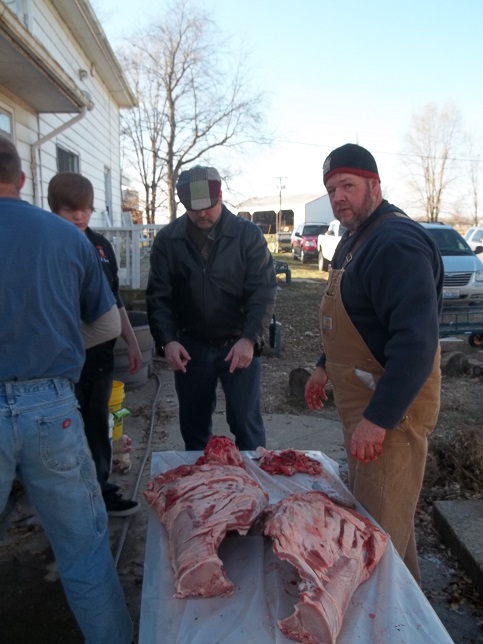
Pork

Each time got better. Each time we knew and handled more of it on our own. If it hadn’t been for the experience our friends shared we would have had a hard time getting started…either with rabbits or with hogs. Or with a greenhouse. Or with any of a dozen other things they taught or gave us. Find yourself a mentor…even a conventional farmer has a lot to offer you. There is more overlap than we recognize sometimes. The books and blogs don’t have all the answers.

If I Were Homesteading Over Again…

I appreciate and welcome email correspondence with readers. In fact, probably the coolest part of the blog is the people I have met through it. There are a couple of themes that most emails follow and I would like to address one of those today: What to start with.

The typical letter I get goes something like this (please understand I’m having fun with this):

Chris,
My wife and I really enjoy reading your blog (though we never leave a comment) and have been making plans to move to a few acres of our own. We would like to keep goats and a few chickens. Do you have any tips that would help us get rich from goat milk and chicken eggs on our two acre lot?

Thanks,

A. Reader

Mr. Reader,

We have been all the way down Goat Road. I don’t find that goats are the easiest animals to keep and I’m not alone in that thinking. They are sweet. They won’t break your foot if they step on you. But they have specific nutrition requirements, need the best hay you can buy in the winter and they tend to turn half or more of their hay into manure-covered bedding. They are hard to keep fenced…and it is especially difficult to keep them fenced out of your orchard. They can jump over fence, crawl under fence and they have a built-in, natural resistance to electric shock. Really. Salatin jokes that he won’t keep them because he can’t keep an animal that is smarter than he is. Julie and I found the goats would stay put with a hot fence and plenty of brush to eat but when they run out of food the fence may as well not be there. Maybe it’s not that bad but they can be rough. And what do you get out of the deal? A quart of milk? Talk about a recipe for a fast homestead burnout!

Olive4

Instead of focusing on what I wouldn’t do (herd of elephants) I would rather break down what I would do if I were homesteading all over again. Sound cool? I have to admit, I surprised myself with my choices as I wrote the posting. Stick with me here. This may not apply to you. It may not be what you expect. But it is where I am today.

I can’t imagine a homestead without three types of animals. Maybe four as time goes on…five if conditions are right. Feel free to disagree but if I was me (and I am me) and I was moving to a couple of acres to start fresh, goats just wouldn’t make the cut. Again, you are probably thinking of the ideal farmstead with cow, pig and chicken. Maybe include a duck or a goose or a cat like in the Little Red Hen. But this isn’t the Little Red Hen. This is a homestead.

This is not a zoo. Too many animals will damage your soil. Too many can put too much pressure on the land not allowing adequate recovery and requiring you to buy feed, draining your budget. Miss Coulton was talking of supplying additional feed to livestock saying,

…but these things are only required when you keep more stock than your land can support,—a fault very common to inexperienced farmers on a small scale.

So let’s keep it simple and pare it down to bare bones. Knowing what I know now, what would I do if I was homesteading on an acre or three? I want to keep my workload to a minimum, keep the infrastructure costs to a minimum and allow a maximum amount of time to be a Human Being not a “Human Doing”. You with me here? I want to improve my soils and enjoy my livestock but not wake up every morning dreading the day’s chores.

Since we are homesteading, I would want to put in a big garden and plant a few fruit trees appropriate for my climate but, though my diet will be positively impacted by growing my own broccoli, my budget really won’t be. In fact, growing my own veggies could add significantly to my total food costs. And I would need a source of fertilizer and something to do with all of my weeds and garden wastes. I need to partner with livestock to significantly impact my budget…raising and butchering my own meat and sourcing my own natural fertilizers. But I need animals that will work for me efficiently and that will require a minimum amount of my resources in terms of daily chores and protection from predation. Ready? Let’s go.

Pigs

No surprise to long-time readers, pigs are on the top of my list. I hate it when we sell out of pigs. Usually I only make it a few days before I go buy more. I enjoy their intelligence, their curiosity and their ability to break down and convert waste products into bacon…and what’s better than bacon? The book Harris on the Pig breaks down what makes a pig worth keeping in the opening pages of the book.

The hog is a great eater. He can eat and digest and assimilate more nutriment in a time in proportion to his size than any other of our animals.

But more to the point, the pig assimilates what would otherwise go to waste.

…roots nuts and worms and other animal matter the natural food the hog.

and later…

We can in no other way utilize the refuse from the house and the dairy so advantageously as by feeding it to swine. On grain farms pigs will obtain a good living for several weeks after harvest on the stubbles and in some sections they find a considerable amount of food in the woods.

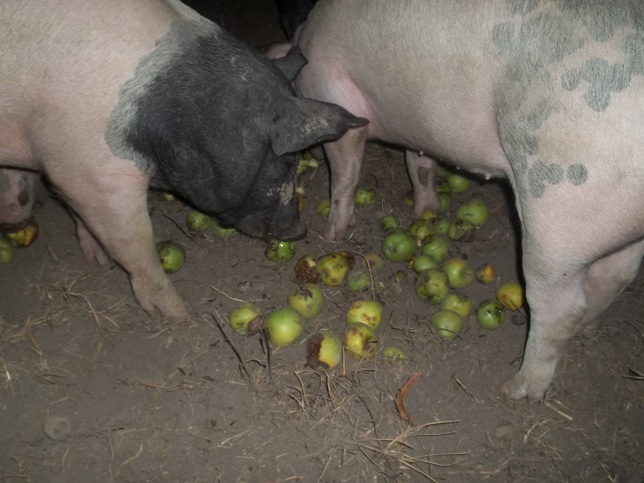
Our pigs get spoiled milk, apple drops, all the acorns, hickory nuts and walnuts they want. It’s fun to watch a pig try to eat a walnut…sounds like they are trying to eat marbles and keeps them entertained for hours. They get tomato vines and bad tomatoes, split watermelons, etc. from the garden and relish any weeds we can throw their way, especially lambsquarters. And as much as they will eat, they really don’t ask for much from us. They need shade, shelter, food and water and a place to dig. No problem. We need to go away overnight to attend a wedding? Put down some fresh bedding, fill the feeder, check the water and we’re good.

HamAndApples

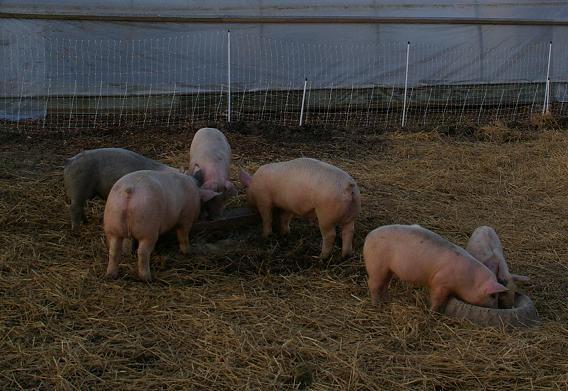
If I had limited space available I would confine the pig or pigs on deep bedding. I know, confinement. But this is exactly what Salatin does when he puts his pigs in the cow shed. Feed, water, shelter and a place to dig. That’s it. The pigs will decide to manure in one specific place and that’s the place to pile on extra bedding. When the pig ships, heap up all the bedding, let it cook through and age then add it to your potato bed. I might even suggest you overwinter a small group of pigs in an area you want to break sod and turn into a garden. To keep it simple you might pick up four 16′ combination panels then put a cover over one corner and hold everything in place with T-posts. That’s your $50 hog confinement facility. Add in a watering nipple for $2 and a feeder pan and I think you can see where I’m going with this.
Group2

Finally, I have to add that pigs can be an excellent centerpiece to your farm even beyond providing your own meat and scrap conversion. This is a business line you could grow into over time, building on skills as you go and can fully utilize your acreage, rotating through over time while keeping infrastructure costs low.

Rabbits

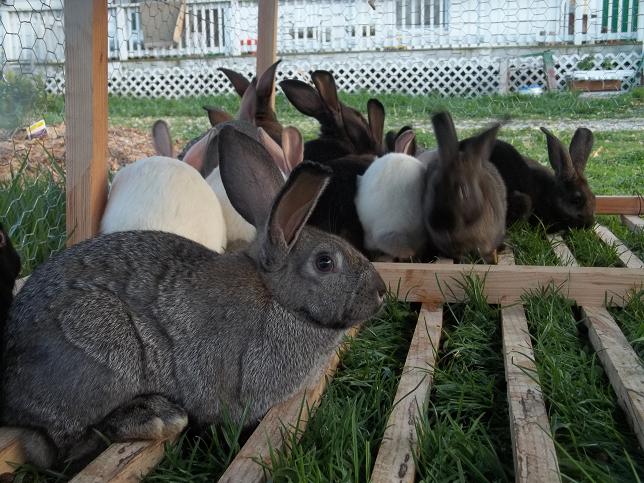
This may be something of a surprise but after getting a pig on my farm I would set up 4 cages, get 2 males and 2 females and start building a rabbit tractor or two to grow out the bunnies. Not unlike pigs, bunnies relish weeds and require little of the owner, though, as with pigs, we haven’t gotten around using a bagged feed. You have to work to keep them cool in the summer but they can produce a terrific amount of meat in short order and are easy to dress out. My great-grandpa Brown kept meat rabbits in his garage in Indianapolis and, apparently, my great-grandma Brown made rabbit-skin coats. I realize fur isn’t fashionable right now because we would rather save the world with polyester but some day we’ll return to utilizing natural resources…or at least I can hope.
HarePen3

Rabbits also produce copious amounts of manure…the kind you can put directly on your garden without composting and it acts like a time-release fertilizer capsule. But if you choose to compost it you’ll only make things better. Maybe make a compost pile with alternating layers of leaves and rabbit manure in the fall. But to keep odors down you’ll need to either clean and haul the rabbit manure regularly or cover the pile with sawdust regularly. Your nose will tell you…but if you wait to hear from your nose the rabbits will suffer. Be proactive about manure management.

After meat, fur and manure we are left with the offal. If you aren’t into eating rabbit livers (pretty good, really) you can save them for dog food. Same with kidneys and hearts. In fact, the head isn’t a bad thing for a little pooch or for your pig. Yup. The pig will eat every part of the rabbit you don’t…they are omnivores. We typically compost the heads, feet and intestines.

Worms

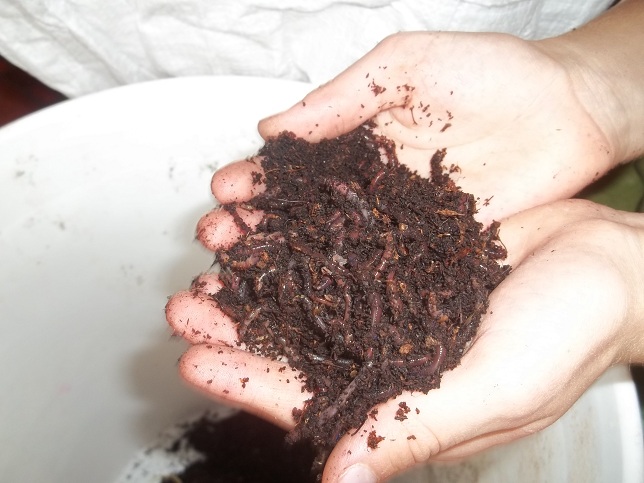
I know what you are thinking…Chickens didn’t make the top 3? Nope. Worms did. I was surprised myself. There are some things you just can’t convince a pig to eat. There are some things that you are better off not taking to the pigs. Our kitchen generates coffee grounds, banana peels and citrus waste in small portions. Pigs really aren’t interested in those but worms LOVE them. And worms do a thorough job of composting everything at a low temperature for use in our garden. After an initial thermophilic composting of pig bedding and manure we can give it to the worms for finishing, ending up with the best stuff in the world. Not to mention, worms we can sell or feed to other animals…fish, chickens…whatever.

Like the others, the worms don’t need much from us. Make sure they are damp, not wet. Make sure they have something to eat. Make sure they are not too hot or too cold. That’s about it. I highly recommend the book Worms Eat My Garbage for additional reading on the topic.
Worms

Let me pause here to say that you SHOULD be able to raise all three of my top 3 while still living in suburbia with less than $100 invested in infrastructure. Many places allow “pet” rabbits and pot-bellied pigs (often available for free) and there is no law against worms. You don’t need acres and acres of ground. You don’t need a huge amount of debt. What you do need is a plan to contain odors. You need a source of carbon. Do you live near a cabinetry shop? How about a sawmill? Do you have deciduous trees that you can gather leaves from? Can you collect newspapers from neighbors or buy some from the local recycler? If so, run composted animal wastes through your worms and sell the worm castings. Homestead at home. You’ll be amazed what you can do.

About a decade ago all the hog farmers around me who had sold out of hogs in the late ’90’s crash got caught up in a worm farming pyramid scheme. Don’t get caught up in a worm farming pyramid scheme. It strikes me that with a minimal investment in infrastructure, you can make superior compost for your garden using worms. This could be a serious money-maker but I’m really talking about a nutrient cycling resource.

So that’s my top 3. I’m as surprised as you are. But since we’re here, let’s talk about the rest as you may have your own ideas.

Need help mowing? Try Cows or Sheep

Cows are great at solving problems with surplus forage. You are probably going to have a hard time making a single cow happy as they are herd animals and you would probably have a hard time feeding a cow from a suburban yard (several yards maybe but watch for land mines). But on larger acreages…I mean, what else are you going to do with all that grass? You won’t save the Earth with a mower. Sheep may fit into suburbia but, again, you are better off in the stix to help you rotate away from parasites and avoid odor issues. In fact, I think you could make a case that a cow and 4 sheep count as one complimentary unit, utilizing pastures and breaking pathogen cycles, not to mention the cows keeping sheep predators at bay.

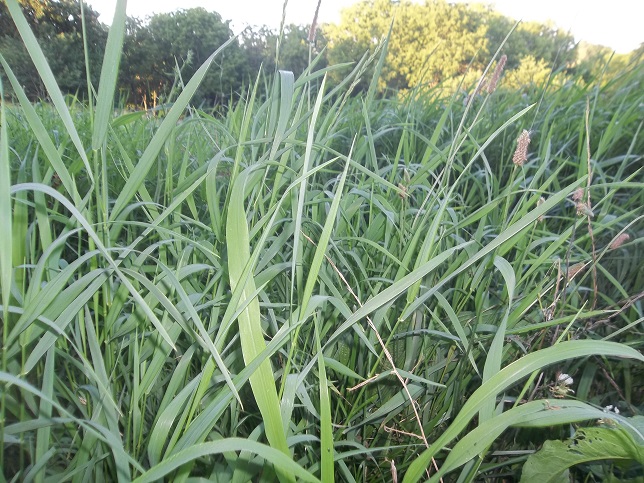
Not only do they take a low-value product (grass) and turn it into something better (steak or milk) but the grass sward improves because the cow tugged at the grass, salivated on it, urinated on it, stepped on it and manured all over it. If you want to build fertility in a hurry, if you are anxious to fix carbon and quickly save the world, hire a cow. The grass gets mowed and fertilized in one pass, nutrients are pushed into the soil and the mowers can reproduce themselves. Just add salt and water.
CompleteRecovery1

All that said, they are herd animals. What is a herd? Julius Ruechel says cows don’t really act like a mob until you have at least 500 in one group. I have also read numerous places (this is the most convenient) that you need one hired hand per 1,000 cows (commodity cows anyway)…which is the same as saying that you need 1,000 cows to pay the salary of one man…or one you. That’s a long way of saying, this is a low-margin, land-extensive enterprise. But it sure beats mowing.

HappyCows

I’ll forgive you if you include a dairy cow on your 1-5 acre farm. John Seymour includes a dairy cow in his homestead plans. Just know that milking isn’t for everybody. It just might be easier to drive 20 minutes to buy milk 6 gallons at a time once/week than to deal with 6 gallons/day from old Bessie. But, that’s why you have the pigs. Though it is only mentioned briefly, Eric Bende learned about this and shares his milking experiences in the book Better Off: Flipping the Switch on Technology. Also keep in mind, milk cows don’t take any days off. I hope Paul Atreides will forgive this joke but the milk must flow. Every day you bring Bessie to the barn in the morning, brush her off, wipe her off, check each teat, milk her out then clean up the barn after filtering and chilling the milk, sterilizing the milking pail…the list goes on. Matron says it takes her 15 minutes to go from her door to the cow and back again…twice each day. So, again, I might suggest you should make that 20 minute drive once/week instead. Cow or no cow is a quality of life decision and I can see both sides.

Milking

Let’s round out the top 5 with Fish.

I know, right? Look. We have a couple of ponds. They came stocked with bluegill, crappie and bass and we threw a couple hundred catfish in for kicks. Those fish don’t need anything from me. But if I chose to feed them the feed conversion rate for fish is the best it can be. For every pound of feed eaten they gain a pound. Every year I threaten to put Japanese Beetle traps over the pond to feed the bluegill (who love Japanese beetles, btw). How many meals could I pull from an acre pond in a year? How many hours do I have to spend maintaining fence to keep the fish in? None. How many hours fighting raccoons to protect my fish population? None. That said, maybe fish have just displaced pigs on my list. Nah.

Pond

You can look into aquaponics, and I encourage you to do so, but I’m attempting to list things that can take care of themselves. Our first attempt at aquaponics was a dismal failure. Since I have a pond…well, that’s easier.

So, What about…

Laying Hens

OK. Well. Not really a high-margin enterprise here. And everything likes to eat chicken. Everything. So, if you can keep them alive, you’ll get an excellent source of protein on a near-daily basis. Since the margins tend to be so tight (or negative) and we’re talking just a couple of acres here, it might be better to trade for eggs with your neighbor so they can go to war while you stay home. But if you want your own birds for household use you should plan one bird for each member of the household plus two birds…with a minimum of six birds. You could pickle surplus eggs or send cracked, checked or otherwise unwanted eggs to the pigs (you have to have pigs!). And I would buy the birds as ready-to-lay pullets so you don’t have to invest in brooding equipment, though chicks are cute and fun. Just understand, when you are coming home from Bob’s house after sundown on a Saturday evening and nobody was home to close up the chickens…well, you may have one less chicken and a fat skunk stuck in the fence. Good luck with that.

Chickens were the first livestock we bought and every step of the way has been more difficult than advertised. Numerous people have told me tales of the chicken wars recently. Here’s a real example.

Friend: “Well, we started with 15, got down to 1, bought 10 more and now we have 5.”

Me: “How many eggs have you gotten from those 25 birds?”

Friend: “None.”

Me: “Maybe you would be better off with pigs, rabbits or worms.”

Broilers

This is also a low-margin enterprise. If starting over, I would be tempted to find a farmer who raises broilers and work out a deal for the 50/year I need for my own household. 50 whole birds weighing 4 pounds at $3/pound is $600. Maybe you could trade him a fat hog or a litter of shoats for 50 frozen birds. Maybe you could just pay him the $600. There are big advantages to running broilers on your farm seasonally but there are also big expenses.

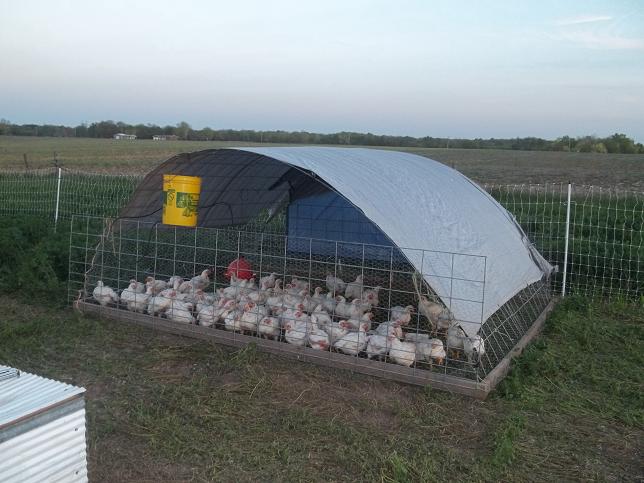
Hoop

Sigh. I guess I would go ahead and raise my own birds. I enjoy the work and with 3 weeks in the brooder and 5 weeks in the field it is not exactly a life-sentence…the way milking a cow is. I would probably fit broilers in either spring or fall on my homestead…but I say that grudgingly. I’ll hold further comment on broilers for another blog post.

So that’s about it. There are any number of animals I have intentionally overlooked on my list. Please don’t be offended if you are a fan of geese. I think geese could be a good source of grass-fed meat on a farm but I don’t have any experience with them. Ducks are comical but I don’t really like them. You may have your own ideas for an ideal homestead starting lineup but that’s mine. Pigs, rabbits and worms…animals you could start with while you are still in town. Feel free to disagree…but if you are disagreeing before you have dipped your toes in the water, let me know when you dream up your revised list. You will ultimately have to follow your heart’s leading but whatever you do, start small. Start where you are. Minimize your expenses. Start slowly. Step into each enterprise carefully…but for Pete’s sake…take a step!