Thoughts on Writing

I have tried – really tried – to publish every day. I just have too much going on (poor me). I often have nothing to write about but it just seems like I should. I do write almost every day but publishing is another thing entirely. You should see the backlog of unpublished drafts. Sometimes I don’t publish because forced writing comes across as bitter or venomous and I just keep those to myself.

Today I want to write about writing. I was speaking with someone recently and I said, “You know how you sit and write about 5,000 words then look back over it a couple of times and still miss mistakes? Drives me bananas.”

She looked at me like I was bananas. I guess writing 5,000 words is a big deal from her perspective. I try to break up lengthy essays into multiple posts on my blog because I think it’s impolite to ask you to spend all day reading my nonsense as you flip through the pretty pictures.

I have a couple of thoughts on this and since it’s my blog I’m going to write them down…even if you don’t read this. Our pastor often uses points that start with the same letter to make it seem catchy. I failed miserably at this but tried anyway. Especially since my points are Pot, Passion, Pants, Paint and Publish. Yikes. I don’t think I’ll be preaching any time soon.

A Watched Pot Never Boils
5,000 words is not a goal. It is not a destination. It’s just a part of the going there. No big whoop. I don’t know why professors and teachers in my past demanded X pages or X,000 word essays. I always found myself looking at the word count to see when I could finish typing.

You know that thing you can talk about for hours but you don’t because it’s rude? You know that thing you read every chance you get? That thing you love so much you feel like you’ll bust if you don’t let a little of it out from time to time? That thing you absolutely geek out about? If you were writing about that thing…well 5,000 would just get you started. Don’t look at the total number of words. That’s nothing. Get the ideas out of your head.

DoorGuard

Passion is Required
You ask me a simple question about any of several topics and I’ll give you both barrels. Don’t get me started. I could corner you for hours to talk about cow poop or any of a number of topics. BTW, I expect you to be just as passionate as I am if we disagree because if I’m wrong I don’t want to remain wrong. Don’t give up on me. Convince me. Sway me with your words. You can’t succeed if you don’t care. It’s just not worth it.

But if you do care…if you love what you are writing about…there is no limit. There is no end. You’ll be upset that you have to cut out whole paragraphs to get you back to that ridiculous and arbitrary 5,000 word limit.

Put on your grown-up Pants
You know you want to do it. But something is stopping you. Why are you making excuses? You want to write? Write. Get yourself a blog and throw it out there for the world to see. Will you be rejected by some? Yes. Will some people say you’re an idiot? Yup. Will your opinions be challenged and will your best arguments be exposed as somewhat shakey? Yes. And that’s good. You will also help some of your readers to evolve their own opinions. I don’t want to continue living in ignorance. Please, enlighten and persuade me. Almost every blog post results in a conversation with dad. Sometimes it’s clarification, sometimes it’s correction, sometimes it’s just an exploration. How cool is that?

Paint (maybe Picture)
Show me the world. Use words. Use pictures if you want. Publishing costs are effectively zero so…go to town. I keep my phone with me at all times. If I see something interesting that creates a spark I snap a picture of it. Julie does the same. In fact, lots of times the pictures are the story. I just put words between pictures to chain them along. But you don’t need a phone. You have words. Write it up. Call me Ishmael. Make it happen on the page. Show me the world you see…or the world you want to see. I can’t see it if you don’t show it to me. And if a picture is worth 1,000 words…well, it’s easy.

BarnKitty

Publish It
What aren’t you writing about? I know there is a lot of garbage out there that’s not worth reading. That should be encouragement enough to convince you that you need to start. The worst you can do is add to the pile like I do. But there is a chance, however small, that you will say something that will impact the world or even just one reader in a positive way…that you will infect someone with your passion. But if you sit and wring your hands and live in constant fear of rejection, refusing to publish what few scribbles you have made we will never hear your voice. And we may all continue to live on in ignorance because you are afraid…afraid of rejection. Afraid of the work. Afraid of 5,000 words.

My goodness! it has never been easier to get your words out there. Just start up a free blog (like this one), take some cat pictures (to build traffic from Facebook), write a few words and hit publish. That’s it. No big whoop. Just hit publish. Just do it. If it stinks (and I think most of my stuff does) try to do better tomorrow. And the next day. If you manage to publish every day or even every other day, before long you’ll have enough practice that you can sit down with a simple idea and build 5,000 words of passion and persuasion before you finish that first cup of coffee (or in this case, about 1000 words). It’s no big deal. You are writing about your favorite topic…even if it’s not cow poop.

What are you passionate about? I’ll never know if you don’t tell me.

Julie wrote a response already.

Straight Poop about Winter Grazing

I am using a highly sophisticated, scientific method for grazing our cattle this winter. This process will be hard for the average farmer to duplicate so I release this information with a measure of reluctance. I’m not sure how useful it really is. This post relies heavily on two expensive and precise scientific tools to measure feed quality and quantity…a pitchfork and size 11.5 feet. I should also alert the reader, based on recent conversations, that this post will show pictures of cow manure. Lots of cow manure. Further, it will have explicit descriptions of cow manure. In fact, I may even discuss the philosophy of cow manure. The Zen of cow manure. Don’t misunderstand, this is a post about what my cows eat…but you have to pay close attention to the other end of the cow too. Let’s look at a sample. Here we have a rare sight indeed! Cow manure covered in coyote poop. You have to walk through a lot of pasture before you see one like this…complete with persimmon seeds in the coyote poop.

Click for source

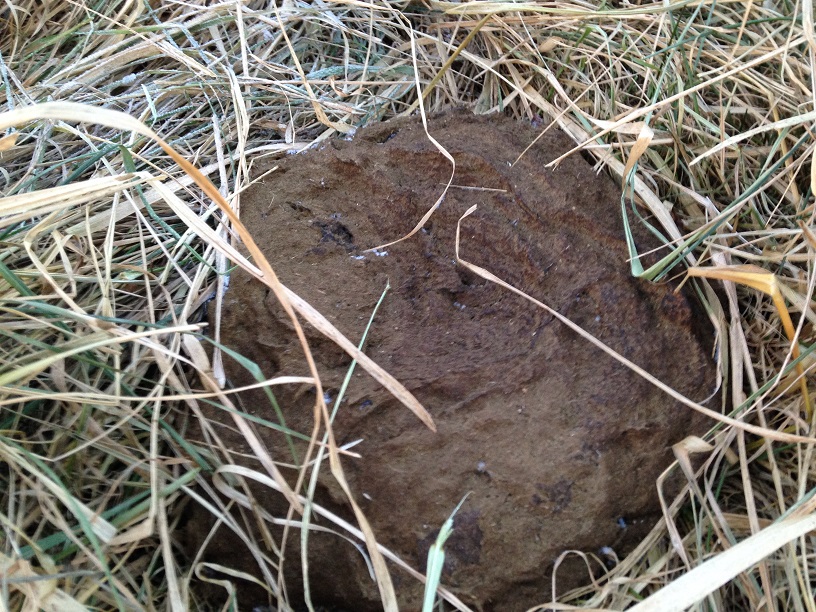
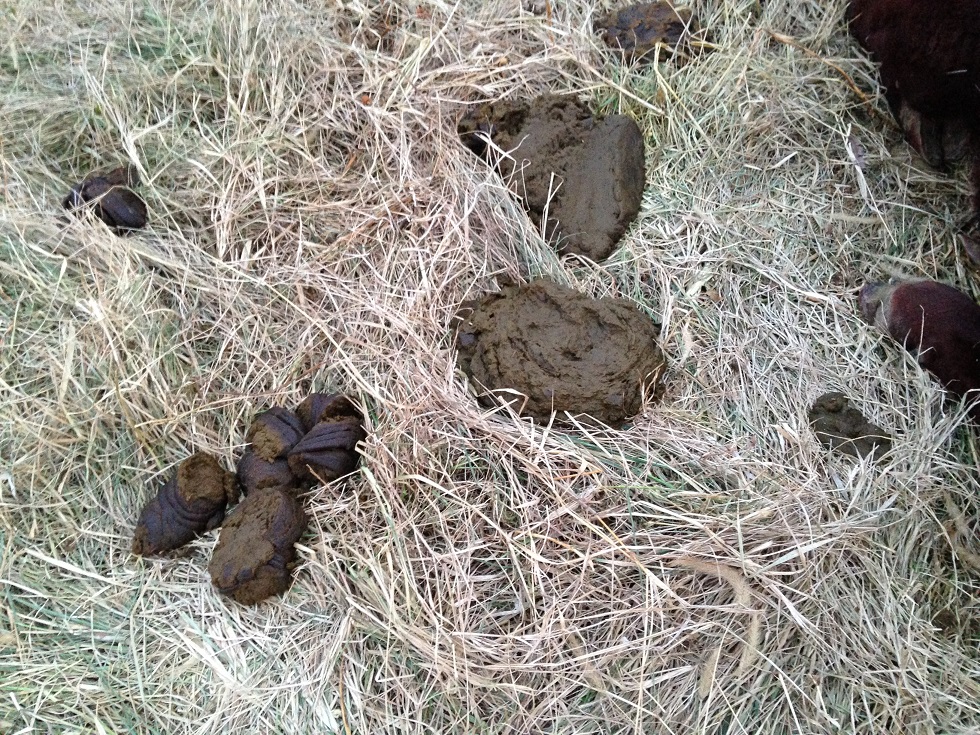
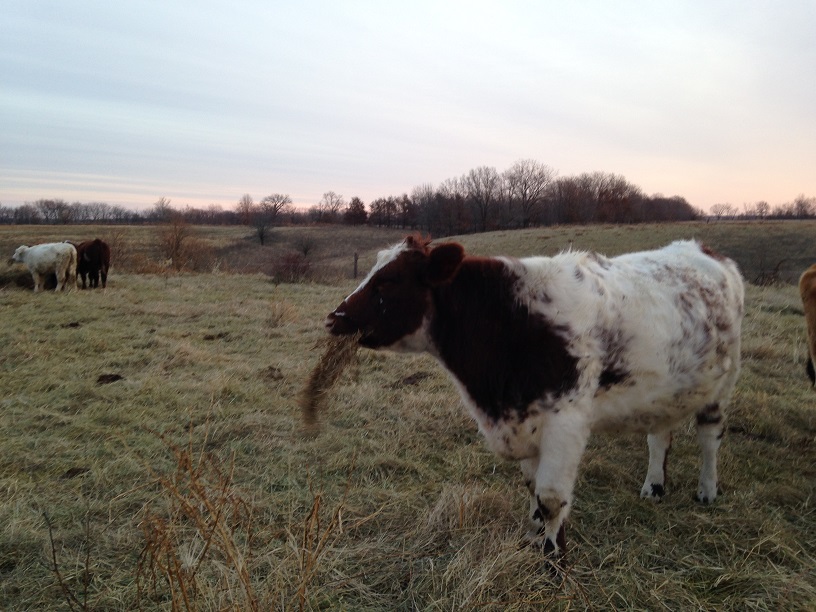
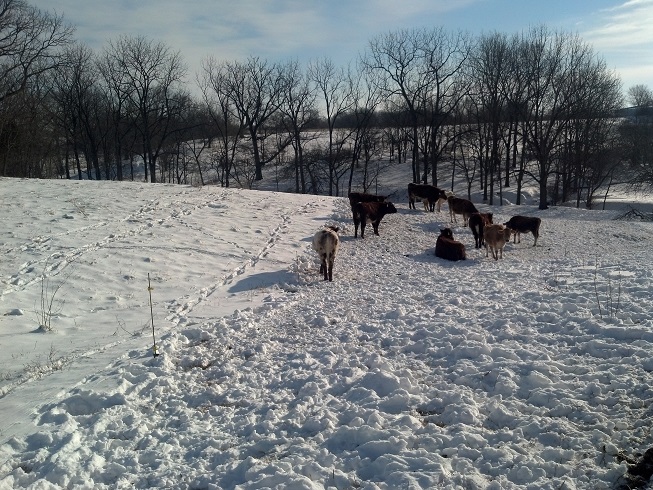
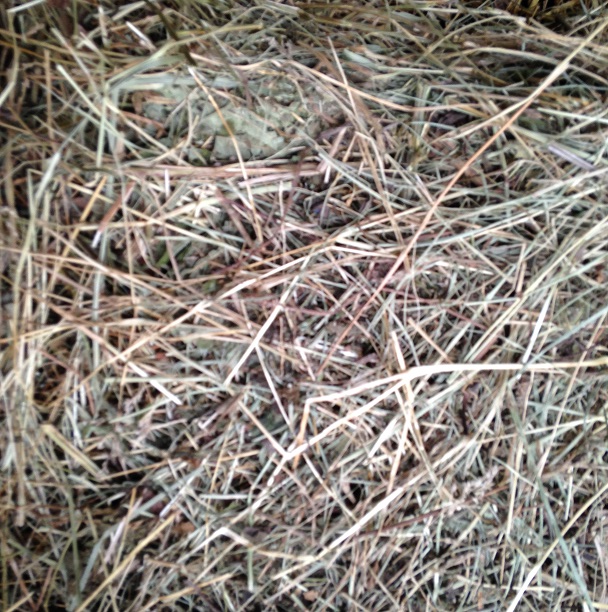
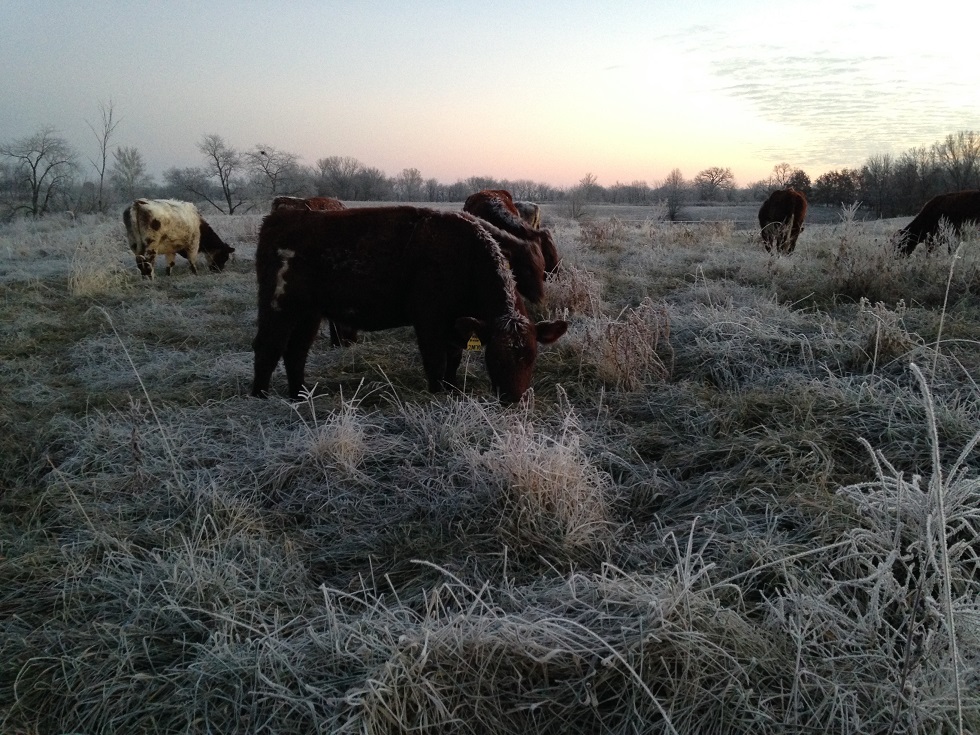
If you are really interested in seeing coyote poop on cow poop, complete with persimmon seeds you can click here. If you clicked on that you’re weird. I know because I’m an authority on weird. I took the picture. Here’s a bonus. Coyote tracks in cow manure. Believe me, you have to look at a lot of cow pies to find one of those. So…I look at a lot of cow manure. I take pictures of cow manure. I think cow manure is important. You down? Anyway, I have cows. Hooray for cows! I have cows because I need something to eat my grass. Hooray for grass! RemainingGrass So I ask my cows to eat my grass. Have you read Coleman’s Winter Harvest Handbook? That’s what we are talking about here…except on acres and acres of farmland. The cows aren’t eating fresh forage that is actively growing…cause nothing is growing. They are eating forage we grew in August, September and October and stored in the field for later consumption. Winter harvest. And it’s mostly grass because the poor legumes just can’t take the cold…and other reasons I’ll get into in a minute. However, if my cows only eat grass this time of year they will get a bit constipated. There just isn’t a lot of protein in the grass that is out there. Fescue, apparently, does well in the cold but I have not done a formal forage analysis. I just turn the cows into a new area, make sure they are full, in condition and I look at their poop. Science! (Cue Thomas Dolby.) As I said above, if I expect the cows to ONLY eat the standing forage their stool tends to get a little dry. Their manure looks like a stack of cookies that fell over. There is some good forage out there that they seem to like but it’s not, I think, everything they need. Here’s some dry manure from last winter as an example. GrazingJanuary3 What we really want is pictured below. A nice, clean pile with a depression in the middle. A cow pie that looks like a pie. Perfect poop. I get this by supplementing the protein in their diet with high-protein hay. Others use a protein lick. Still others use grains. But the idea is the same. By offering a little supplementation you can not only fit more animals in the same area, you can utilize resources that would otherwise go wasted and you can concentrate fertility where it is needed most. PerfectPie So. Quiz time. What’s what here? GoodBadUgly OK, so that’s why I give them a little alfalfa hay. How much alfalfa? Oh, I don’t know. Some. (Science again.) I put out maybe 50 pounds of hay in the morning and another 50 pounds in the evening giving each cow around 7 pounds of alfalfa. I don’t carry a scale, man. Assuming the cows average about 1,000 pounds they are probably consuming another 13-15 pounds of dry matter by grazing. That’s about where we want it. I don’t want to provide more than about 30% of their dry matter from alfalfa…both because I have a limited supply and because it’s not good for them. We will measure “not good” in a minute. Before I go on I need to point out something. My pastures are brand new. Not new like freshly seeded to yummy things to eat. New like we aren’t even on a full year of managed grazing yet. The forages are just whatever came up. Whatever was left over after the tenant’s cows ate it down to the nubbins. So what is there is what is there. And what is there isn’t quite the balanced meal a cow needs. It just isn’t out there…not yet anyway. Not in terms of varieties, not in terms of soil health, not in terms of plant health, not in terms of cow health. So at this point I HAVE TO provide a little extra. We graze a strip that is measured in similarly scientific manner. Here’s the plan, I need to cover enough ground each day to keep my cows in top condition but only as much ground as I absolutely have to so my forage lasts until April or May. This recipe will change as my herd grows and as forage density varies but, for now, where we are grazing, I begin by laying out two parallel fences roughly 40 steps apart by aiming for points in the distance that I think are roughly 40 steps apart. So we’re 40-ish paces wide, right? Now I step off 20-ish paces for each day’s allotment and call it good. That packs the cows in tight enough that they are utilizing a high percentage of the available forage, they are full when I come back to see them in the morning and, just as important, their manure is distributed evenly – and heavily – throughout the pasture. Healthy cows like to lay in clean places. By growing into a new 20 steps each day the cows lounge in a new spot each day. What is the first thing a cow does when it stands up? Coverage But wait! There’s more. I need to see if the cows are full or not. Any cow will do but the shorthorns are super-shaggy. The Jerseys are not. I have one Jersey I can rely on as my fuel gauge. I can see when she is full. If she is full, everybody is full. And I want full cows. Full means that triangle on her left side is not sunken in…or not sunken in by much. And it shouldn’t be sunken in when you go to move the herd. Here is a pic of Mrs. White last winter when she ran empty due to poor management (me). EmptyRumen She looks better this year. I feel like I’m doing a better job. MrsWhite2014 As an aside, how do you keep a cow warm on a cold night? You keep her full. Keep that biology burning inside her. How do you keep a cow warm on a cold, wet night? Put her indoors. Saves your pasture too. By metering out my pasture like this I can make it last into spring. Further, I am not only budgeting my land, I’m leaving something in the account at each location. If needed, I could graze here again. I can also benefit from the even covering of manure all over my pasture. It’s like a war zone out there. First, it will boost fertility in the coming growing season, second I don’t have to haul it. Less work is more better. But the best thing of all is this: The cows eat everything. A little of this, a little of that, trample and manure on what’s left. They eat everything green. (Cows have not grazed on the right.) BeforeAfter Now, our friend Kari asked if the cows would return to eating grass once they were given hay. I really don’t know how to answer that question…other than, “Yes?” But really I’m thinking, “What? Of course? I’m Ron Burgundy?” I don’t even know what that means. Our cows don’t go back and forth, they get both…unless I have to take them to the barn during a weather event. Then they seem to look forward to eating fresh greens again. So my answer is, “Yes?” Maybe I have magic pasture. Maybe I have magic cows. Maybe both? I’m telling you, Fescue is an unfair advantage in the winter. They dig through the snow to get to it. This helps offset the MAJOR disadvantages of fescue in the summer. But I think this is the real answer. Consistency. Cows like routines. My neighbor’s cows know silage is coming in the morning. They hear the tractor and they start to drool. My cows know I’m coming to open a fence in the morning. If you keep switching things up in their diet not only does their rumen have to adjust, the animal has to feel stressed to some degree. Like I do when Julie moves the furniture around…I’m a creature of habit. SnowGrazing Forage slowly degrades over the season. By last March they were eating anything and everything. Brown grass? Brown leaves? Green tips of trees? You name it. We increased the amount of hay we offered each day as we got closer to grass growing again…as we got closer to running out of pasture…as we increased our confidence that our hay supply would last. As we continue grazing, as we continue building soil, as we continue building health and life we should see our supply of green stuff stretch. We may even reach a point where we don’t need hay anymore. But I’m not holding my breath. March2014_7 And even if the cows ignore the majority of the organic material out there (and they don’t), they still benefit from the little bit of fresh green and deliver the manure for me. So what if I take them a little hay? You know what the difference is between taking hay to a feed bunk and taking hay to the field is? Mud. And the good news is we have some excellent quality grass hay. Grass stems are thinner and easier to put up than alfalfa. The weaned calves seem to want a percentage of this in their diet…even though their stool is a little dry. GrassHay I don’t keep my cows outside all the time. I could. Some do. But I don’t. When it’s raining and turning colder I think the cows are better off covered and warm. When it’s cold and muddy my pasture is better off without cattle. Sometimes it’s just easier to be a farmer if the cows are in the feedlot eating hay. My friend Matron prefers to keep them up close for all reasons above. But the same rules apply there. Keep the cows full. Look at the poop. If they sneeze and squirt their neighbor you might back off on the protein. You might also be concerned for their well-being. How do you feel when you get loose? Provided they aren’t sick (always give clean water), give just enough protein supplement to help them digest the rest of their feed. I use alfalfa hay to supplement protein. Jim Elizondo offers flaxseed meal. Guess what he says?

Then watch manure, gut fill and body condition to determine if they need protein…

Ta da! Then, check this out Kari:

I haven’t had success with moving cows to a high protein forage and then back to low-protein old forage on a daily basis, so I prefer to finish the higher quality forage first as it will lose quality the fastest.

In that quote Jim is explaining why we hit the alfalfa field early on. We got the high-quality forage out of the way because it would be the first and the fastest to lose quality. Now we work through the rest of the pasture. The remaining pasture needs a little help so we get proper rumen function. He supplements with flaxseed meal, I give high-legume hay grown right here in River City. And maybe that’s why your neighbors aren’t seeing success. Maybe they are trying to go back and forth on forage quality. I’m not going back and forth. I’m supplementing consistently. Heads are down in the pasture. FrostyCowsI don’t know if this will work at your farm, with your forages, with your cattle, in your climate. I don’t know. Apparently the PNW isn’t the best place to try…which makes me want to try. It seems to work here but I have had neighbors tell me I’m wrong…that my cows may as well be eating straw. “If you think it will work or it won’t you’re probably right.” AMIRIGHT? If you want to know more, feel free to ask questions. I don’t know either but it’s fun to learn together. I think it’s also worth your time to check out Jim Elizondo’s DVD and Jim Gerrish’s books. Even if you can’t directly apply their work you can probably find inspiration and direction.

I want to add one more thing to this post. The cows have a wide variety of minerals available to them right now. They are hitting the phosphorus particularly hard right now. Because they have the minerals they need, they tend to utilize their forage better and they tend to eat less. But if you read the Jim Elizondo link above you know that already.